Skip to Content
CompoundsCompounds
  • Communication
  • Open Access

23 January 2026

Screening for Antivirally Active Flavonoids Against Herpes Simplex Virus Type 2 and Influenza A Virus


and
1
Graduate School of Medicine and Pharmaceutical Sciences, University of Toyama, Toyama 930-0194, Toyama, Japan
2
College of Life and Health Sciences, Chubu University, Kasugai 487-8501, Aichi, Japan
*
Author to whom correspondence should be addressed.

Abstract

The discovery of antiviral agents is an important research area because the world is increasingly exposed to the risk of viral infectious diseases. Herpes simplex virus type 2 (HSV-2) causes globally prevalent sexually transmitted diseases, and numerous individuals are living with HSV-2. Influenza A virus (IAV) causes annual epidemics and occasional pandemics, attracting great concern in public health. In this study, antiviral activities against HSV-2 and IAV of 103 flavonoids were screened. The screening identified cirsilineol and apigenin as active against HSV-2, while cirsimaritin and hymenoxin displayed anti-IAV activity. These flavonoids have the potential to serve as therapeutic candidates for viral infectious diseases.

1. Introduction

There is no doubt that natural products are a rich source of drugs, and lead compounds of many drugs are obtained from nature. One major advantage of natural product-derived drug discovery is the vast structural diversity and complexity that remain unmatched by synthetic libraries [1]. Indeed, many of the drugs introduced to the market are derived directly or indirectly from small biogenic molecules. Thus, the value of natural products never fades in modern drug discovery.
Among the natural products, flavonoids are an important class of plant secondary metabolites, having a benzo-γ-pyrone structure. So far, more than 4000 varieties of flavonoids have been identified, and they are involved in floral pigmentation, UV filtration, and symbiotic nitrogen fixation in higher plants. Conversely, flavonoids exhibit a broad spectrum of health-promoting activities, such as anti-inflammatory and antitumor. They are scavengers of free radicals and are indispensable components in a variety of nutraceutical, pharmaceutical, medicinal, and cosmetic applications [2,3]. Flavonoids are ubiquitous natural compounds; more than 10,000 distinct structures have been reported. Typically, flavonoids are divided into flavones, flavonols, flavanones, flavanes, flavanols, chalcones, anthocyanidins, biflavones, and so on. These compounds are well-known for possessing various biological effects [4]. Therefore, flavonoids are important sources for drug discovery.
Recently, viral infectious diseases have become serious global concerns, with increasing risks of the emergence and re-emergence of pathogenic viruses. Herpes simplex virus type 2 (HSV-2) is a globally prevalent sexually transmitted infection and the most common cause of genital ulcer disease [5]. It is estimated that 491.5 million people are living with HSV-2 infection [6]. HSV-2 infection can cause recurrent and painful genital lesions. Moreover, infection with HSV-2 was observed to be a high-risk factor for potential HIV infection, as well as invasive cervical carcinoma [7]. Influenza A virus (IAV) causes an acute viral respiratory infection, annual epidemics, and occasional pandemics. Its infection produces a broad spectrum of clinical disease severity ranging from asymptomatic infection to death. The WHO showed seasonal influenza caused 3–5 million cases of severe illness and estimated respiratory deaths range from 290,000 to 650,000 annually [8]. Vaccines and antivirals remain the primary tools for controlling viral infections. However, certain viruses cannot be effectively prevented by vaccination due to intrinsic or perinatal host factors, nutrition, environmental influences, etc. [9]. Conversely, antiviral therapy is often compromised by the rapid emergence of drug-resistant viral strains. Hence, novel antivirals with mechanisms distinct from those of current drugs are urgently needed. Drug discovery from natural origin is a great task to open new gates for developing new therapeutic agents with different modes of action from existing drugs.
In this study, we present the screening results of antiviral effects against HSV-2 and IAV of flavonoids.

2. Materials and Methods

2.1. Chemical Compounds

The flavonoids listed in Table S1 were isolated from various plants, except for a few compounds which were chemically synthesized. Those flavonoids have been identified and corrected in the Laboratory of Pharmacognosy in Toyama Medical and Pharmaceutical University and University of Toyama. Acyclovir (ACV) and oseltamivir phosphate were purchased from Sigma-Aldrich Co., LLC. (St. Louis, MO, USA) and F. Hoffman-LA Roche Ltd. (Basel, Switzerland), respectively. All compounds were dissolved in dimethyl sulfoxide and diluted with phosphate-buffered saline (PBS) as necessary before use. Eagle’s minimal essential medium (MEM) was obtained from Nissui Pharmaceuticals (Tokyo, Japan). All other chemicals were purchased from Wako Pure Chemicals (Osaka, Japan).

2.2. Cells and Viruses

Vero and MDCK cells obtained from Denka Seiken Co., Ltd. (Tokyo, Japan) were grown in MEM supplemented with 5% fetal bovine serum (FBS; Sigma-Aldrich, St. Louis, MO, USA) and antibiotics (100 units/mL penicillin and 100 μg/mL streptomycin; Nacalai Tesque, Kyoto, Japan). HSV-2 (UW268 strain) and IAV (A/NWS/33 strain, H1N1 subtype) were kindly donated by the Toyama Institute of Health (Toyama, Japan). HSV-2 and IAV were propagated on Vero and MDCK cells, respectively. Those viruses were stored at −80 °C until use. An aliquot of the virus stock was titrated by plaque assay. Briefly, a plaque assay was performed using overlay medium containing 0.8% methylcellulose or 0.5% agarose, for HSV-2 and IAV, respectively, and stained with 0.06% crystal violet solution (20% ethanol in distilled water) [10].

2.3. Antiviral Assays

Vero and MDCK cell monolayers cultured in 48-well plates (2 × 10⁵ cells/well) were infected with HSV-2 or IAV at 0.1 plaque-forming unit (PFU) per cell at room temperature. After 1 h of viral infection, the monolayers were washed three times with PBS and incubated in a maintenance medium (MEM plus 2% FBS) at 37 °C. The sample was added immediately after the viral infection. Virus yields were determined by a plaque assay at the 1-day incubation point. Briefly, the 50% effective concentration (EC50) was calculated from concentration–response curves. For the cell growth inhibition study, Vero or MDCK cells were incubated at an initial density of 1.2 × 10⁴ cells/well in 96-well plates. After the cells had been incubated for 1 day at 37 °C, the sample was added, and the incubation was continued for 3 days. Viable cell yield was determined by the trypan blue exclusion test. The 50% cytotoxic concentration (CC50) was obtained from concentration–response curves. All data are presented as the mean ± SD from duplicate assays.

3. Results

3.1. Flavonoids Used in This Study

A total of 103 flavonoids stocked in our laboratory were examined. They are included in two biflavones, two chalcones, nine flavanones, eight flavanonols, 36 flavones, 35 flavonols, and 11 isoflavones, as shown in Table S1.

3.2. Antiviral Effects of Flavonoids Assesed by Cytopathic Effect

For screening of the flavonoids against HSV-2 replication, we determined the antiviral activities based on the presence or absence of cytopathic effects caused by viral growth. Screening based on the cytopathic effect identified six flavonoids—cirsilineol (40), cirsimarin (44), cosmosiin (46), chrysoeriol (39), apigenin (35), and hymenoxin (31)—that inhibited HSV-2 replication. On the other hand, three flavonoids, such as cirsilineol (40), cirsimaritin (45), and diosmetin (47), showed the inhibition of IAV replication. The other 95 flavonoids showed no potent cytopathic effects against tested viruses. In the next step, these eight flavonoids were subsequently evaluated for anti-HSV-2 and anti-IAV activities by plaque-reduction assays.

3.3. Antiviral Effects of Flavonoids Assessed by Plaque Assay

To evaluate the antiviral activity based on the plaque assay, CC50 and EC50 values were determined for each compound. Selectivity indexes (SIs) were calculated as the ratio of CC50 for cell growth to EC50 for viral replication [11]. As shown in Table 1, the samples showed cytotoxic effects against Vero cells in the range below 10 µM, except for cosmosiin (17 µM). The EC50 values of these compounds against HSV-2 ranged from 0.36 to 4.1 µM. Thus, the selectivity index (CC50/EC50; SI) values ranged from 0.66 to 13. In general, SI values more than 10 could be regarded as possessing antiviral effects. Therefore, cirsilineol and apigenin might have anti-HSV-2 effects.
Table 1. Anti-HSV-2 effects of flavonoids.
When those flavonoids were applied to the anti-IAV assay, they showed the cytotoxicities ranging from 1.9 to 110 µM against MDCK cells, and those values were lower than those against Vero cells (Table 2). The EC50 values against IAV were in the range from 0.66 to 200 µM. Judging from the selectivity indices, two compounds, cirsimaritin and hymenoxin, showed potent anti-IAV activities. Because these two flavonoids were dimethoxy and tetramethoxy flavonoids, methylation was supposed to be a key point to show anti-IAV effects. It is noteworthy that cirsimaritin was found to possess the most potent anti-IAV activity because its SI value was 48.
Table 2. Anti-IAV effect of flavonoids.

4. Discussion

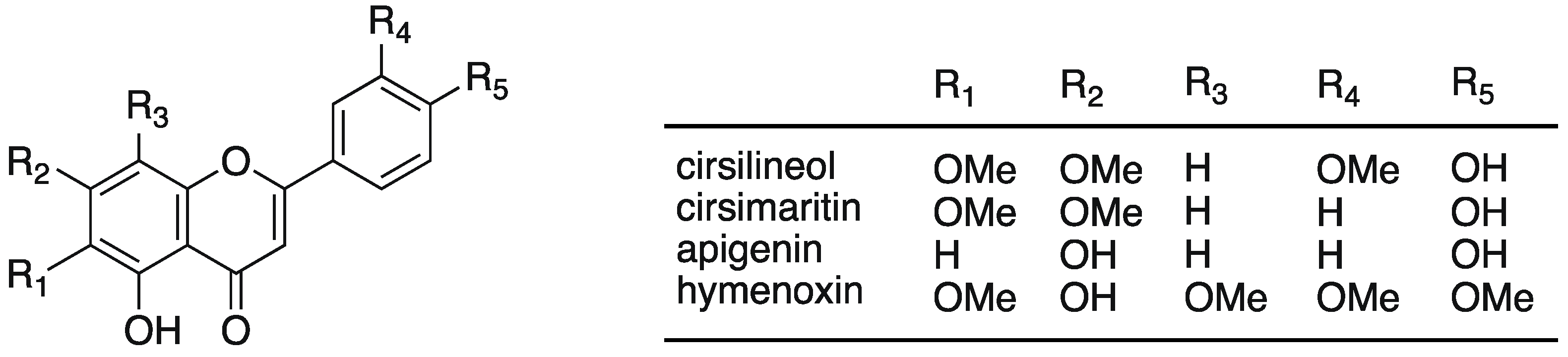
In this study, we identified four flavonoids with antiviral activity (Figure 1). All active flavonoids belong to the flavone subclass. Other subclasses, such as flavanes and isoflavones, possessed no activities against tested viruses. In addition, no compounds carrying glycosyl residues showed antiviral effects against HSV-2 and IAV.
Figure 1. Chemical structure of antiviral flavonoids.
Cirsilineol, a trimethoxyflavone, has been isolated from various plant resources, such as Combretum fragrans, Artemisia vestia, and related species [12,13]. It has been reported that cirsilineol showed various biological activities such as anticancer and anti-inflammatory effects [12,13,14,15]. Apigenin is the most widely distributed flavonoid in the plant kingdom and has numerous biological activities, including anti-hyperglycemic and anti-inflammatory effects [16,17]. Recently, apigenin has been paid attention to as a candidate of antiviral drugs because it has inhibitory mechanisms by modulating multiple targets [18].
Cirsimaritin is a dimethoxyflavone found in many plants and is well-studied for its biological activities such as its antidiabetic, antibacterial, and antioxidant effects [19]. Yan et al. reported that cirsimaritin inhibited IAV replication [20], with the selectivity indices being almost in agreement with our data. Its antiviral mechanism was reported to be linked with the inactivation of the NF-kB/p65 signal pathway. Therefore, this dimethoyflavone might be a candidate for compounds against anti-IAV drugs. Hymenoxin is a tetramethoxyflavone isolated from Hymenoxys scapos [21]. In addition, it was also isolated as a cytotoxic flavone from Scoparia dulcis [22]. However, there is no report about the antiviral effects of hymenoxin. Thus, this is the first report of its anti-IAV effects of hymenoxin.

5. Conclusions

In conclusion, four flavonoids, such as cirsilineol, cirsimaritin, apigenin, and hymenoxin, were found to possess antiviral activities against HSV-2 and/or IAV. Among them, this is the first time that the antiviral activity against IAV of hymenoxin has been discovered. It can be assumed that these flavonoids are therapeutic candidates for virus infectious diseases with great potential. For future application of them, it is necessary to elucidate their antiviral mechanisms.

Supplementary Materials

The following supporting information can be downloaded at https://www.mdpi.com/article/10.3390/compounds6010009/s1, Table S1: List of flavonoids used in this study.

Author Contributions

Conceptualization, J.-B.L. and K.H.; methodology, K.H.; validation, J.-B.L. and K.H.; investigation, J.-B.L. and K.H.; writing—original draft preparation, J.-B.L.; writing—review and editing, J.-B.L. and K.H. All authors have read and agreed to the published version of the manuscript.

Funding

This research received no external funding.

Data Availability Statement

The raw data supporting the conclusions of this article will be made available by the authors on request.

Acknowledgments

We thank Toshimitsu Hayashi for the conceptualization of the present research. We also thank Satomi Kimura for technical assistance.

Conflicts of Interest

The authors declare no conflicts of interest.

Abbreviations

The following abbreviations are used in this manuscript:
HSV-2Herpes simplex virus type 2
IAVInfluenza A virus
ACVAcyclovir
PBSphosphate-buffered saline
PFUplaque-forming unit
CC50half-maximal cytotoxicity concentration
EC50half-maximal effective concentration
SISelectivity index

References

  1. Roseén, J.; Gottfries, J.; Muresan, S.; Backlund, A.; Oprea, T.I. Novel chemical space exploration via natural products. J. Med. Chem. 2009, 52, 1953–1962. [Google Scholar] [CrossRef]
  2. Havsteen, B.H. The biochemistry and medical significance of the flavonoids. Pharmacol. Ther. 2002, 96, 67–202. [Google Scholar] [CrossRef]
  3. Panche, A.N.; Diwan, A.D.; Chandra, S.R. Flavonoids: An overview. J. Nutr. Sci. 2016, 5, e47. [Google Scholar] [CrossRef] [PubMed]
  4. Chen, S.; Wang, X.; Cheng, Y.; Gao, H.; Chen, X. A review of classification, biosynthesis, biological activities and potential application of flavonoids. Molecules 2023, 28, 4982. [Google Scholar] [CrossRef] [PubMed]
  5. Tronstein, E.; Johnston, C.; Huang, M.-L.; Selke, S.; Magaret, A.; Warren, T.; Corey, L.; Wald, A. Genital shedding of herpes simplex virus type 2 and asymptomatic persons with HSV-2 infection. JAMA 2011, 305, 1441–1449. [Google Scholar] [CrossRef] [PubMed]
  6. Ayoub, H.H.; Amara, I.; Awad, S.F.; Omori, R.; Chemaitelly, H.; Abu-Raddad, L.J. Analytic Characterization of the Herpes Simplex Virus Type 2 Epidemic in the United States, 1950–2050. Open Forum Infect. Dis. 2021, 8, ofab218. [Google Scholar] [CrossRef]
  7. Akinyi, B.; Odhiambo, C.; Otieno, F.; Inzaule, S.; Oswago, S.; Kerubo, E.; Ndivo, R.; Zeh, C. Prevalence, Incidence and Correlates of HSV-2 Infection in an HIV Incidence Adolescent and Adult Cohort Study in Western Kenya. PLoS ONE 2017, 12, e0178907. [Google Scholar] [CrossRef]
  8. WHO. Influenza (Seasonal). 2025. Available online: https://www.who.int/news-room/fact-sheets/detail/influenza-(seasonal) (accessed on 1 December 2025).
  9. Zimmermann, P.; Curtis, N. Factors that influence the immune response to vaccination. Clin. Microbiol. Rev. 2019, 32. [Google Scholar] [CrossRef]
  10. Hayashi, K.; Asai, S.; Umezawa, K.; Kakizoe, H.; Miyachi, H.; Morita, M.; Akaike, T.; Kuno, H.; Komatsu, S.; Watanabe, T.; et al. Virucidal effect of monogalactosyl diacylclyride from a green microalga, Coccomyxa sp. KJ, against clinical isolates of SARS-CoV2 as assessed by a plaque assay. J. Clin. Lab. Anal. 2021, 36, e24146. [Google Scholar] [CrossRef]
  11. Andrei, G.; De Clercq, E. Inhibitory effect of selected antiviral compounds on arenavirus replication in vitro. Antiviral Res. 1990, 14, 287–300. [Google Scholar] [CrossRef]
  12. Dawé, A.; Mbiantcha, M.; Yakai, F.; Jabeen, A.; Ali, M.S.; Lateef, M.; Ngadjul, B.T. Flavonoids and triterpenes from Combretum fragrans with anti-inflammatory, antioxidant and antidiabetic potential. Z. Naturforsch C J. Biosci. 2018, 73, 211–219. [Google Scholar] [CrossRef]
  13. Yin, Y.; Gong, F.; Wu, X.; Sun, Y.; Li, Y.; Chen, T.; Xu, Q. Anti-inflammatory and immunosuppressive effect of flavones isolated from Artemisia vestinta. J. Ethnopharmacol. 2008, 120, 1–6. [Google Scholar] [CrossRef]
  14. Sheng, X.; Sun, Y.; Yin, Y.; Chen, T.; Xu, Q. Cirsilineol inhibits proliferation of cancer cells by inducing apoptosis via mitochondrial pathway. J. Pharm. Pharmacol. 2008, 60, 1523–1529. [Google Scholar] [CrossRef] [PubMed]
  15. Pathak, G.; Singh, S.; Kumari, P.; Hussain, Y.; Raza, W.; Luqman, S.; Meena, A. Cirsilineol inhibits proliferation of lung squamous cell carcinoma by inducing ROS mediated apoptosis. Food Chem. Toxicol. 2020, 143, 111550. [Google Scholar] [CrossRef] [PubMed]
  16. Salehi, B.; Venditti, A.; Sharifi-Rad, M.; Kregiel, D.; Sharifi-Rad, J.; Durazzo, A.; Lucarini, M.; Santini, A.; Souto, E.B.; Novellino, E.; et al. The therapeutic potential of apigenin. Int. J. Mol. Sci. 2019, 20, 1305. [Google Scholar] [CrossRef] [PubMed]
  17. Ali, F.; Naz, R.F.; Jyoti, S.; Siddique, Y.H. Health functionality of apigenin: A review. Int. J. Food Prop. 2017, 20, 1197–1238. [Google Scholar] [CrossRef]
  18. Lee, I.; Lee, J.; Hong, S.-H.; Seo, Y.-J. Apigenin’s therapeutic potential against viral infection. Front. Biosci. (Landmark Ed.) 2023, 28, 237. [Google Scholar] [CrossRef]
  19. Benali, T.; Jaouadi, I.; Ghchime, R.; El Omari, N.; Harboul, K.; Hammani, K.; Rebezov, M.; Ali Shariati, M.; Mubarak, M.S.; Simal-Gandara, J.; et al. The current state of knowledge in biological properties of cirsimaritin. Antioxidant 2022, 11, 1842. [Google Scholar] [CrossRef]
  20. Yan, H.; Wang, H.; Ma, L.; Ma, X.; Yin, J.; Wu, S.; Huang, H.; Li, Y. Cirsimaritin inhibits influenza A virus replication by downregulating the NF-kB signal transduction pathway. Virol. J. 2018, 15, 88. [Google Scholar] [CrossRef]
  21. Thomas, M.B.; Mabry, T.J. Isolation, structure, and synthesis of hymenoxin, a new flavone from Hymenoxys scaposa (Compositae). J. Org. Chem. 1967, 32, 3254–3256. [Google Scholar] [CrossRef]
  22. Hayashi, T.; Uchida, K.; Hayashi, K.; Niwayama, S.; Morita, N. A cytotoxic flavone from Scoparia dulcis. Chem. Pharm. Bull. 1988, 36, 4849–4851. [Google Scholar] [CrossRef]
Disclaimer/Publisher’s Note: The statements, opinions and data contained in all publications are solely those of the individual author(s) and contributor(s) and not of MDPI and/or the editor(s). MDPI and/or the editor(s) disclaim responsibility for any injury to people or property resulting from any ideas, methods, instructions or products referred to in the content.

Article Metrics

Citations

Article Access Statistics

Multiple requests from the same IP address are counted as one view.