Blend Extracts of German Chamomile (Matricaria chamomilla L.) and Feverfew (Tanacetum parthenium L. Sch. Bip.) Against Oxidative Stress and Multidrug-Resistant Bacteria: Role of Extraction Temperature

 ,
,  , , ,
, , ,  , and
, and 
Abstract
1. Introduction
2. Materials and Methods
2.1. Reagents and Standards
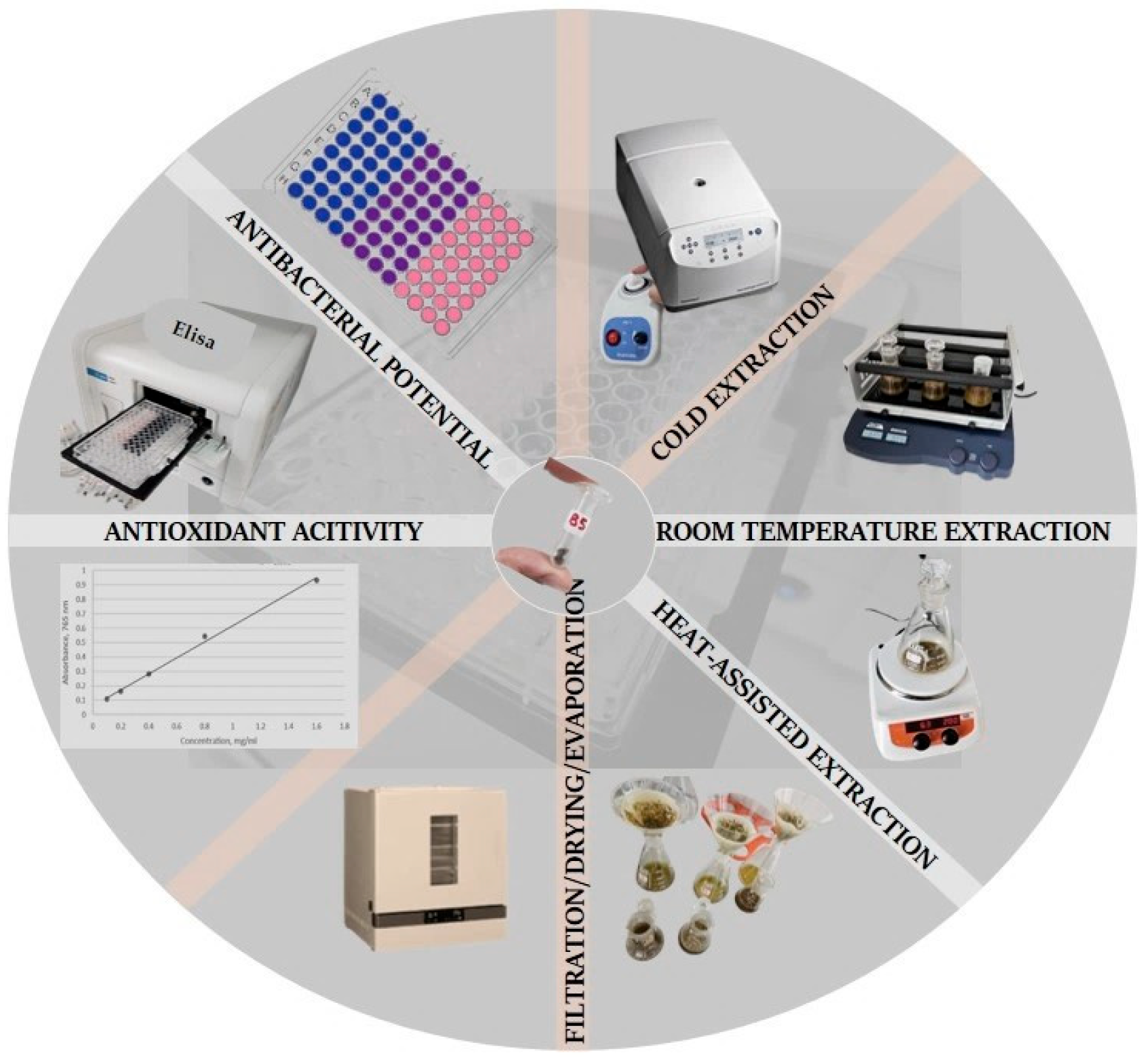
2.2. Preparation of Chamomile and Feverfew Extracts
2.2.1. Cold Extraction Under Refrigerated Centrifugal Agitation
2.2.2. Extraction at Room Temperature
2.2.3. Heat-Assisted Extraction
2.3. Total Phenolic (TPC) and Flavonoid (TFC) Content
2.4. UHPLC Q-ToF MS Analysis
2.5. Antioxidant Activity
2.5.1. ABTS Radical Scavenging Assay
2.5.2. DPPH Radical Scavenging Activity
2.5.3. FRAP (Ferric Reducing Antioxidant Power) Assay
2.5.4. Cupric Ion Reducing Antioxidant Capacity (CUPRAC) Assay
2.6. Antibacterial Activity
2.6.1. Bacterial Strains
2.6.2. Bacterial Cultivation
2.6.3. Estimation of Antibacterial Potential
2.7. Statistical Analysis
3. Results and Discussion
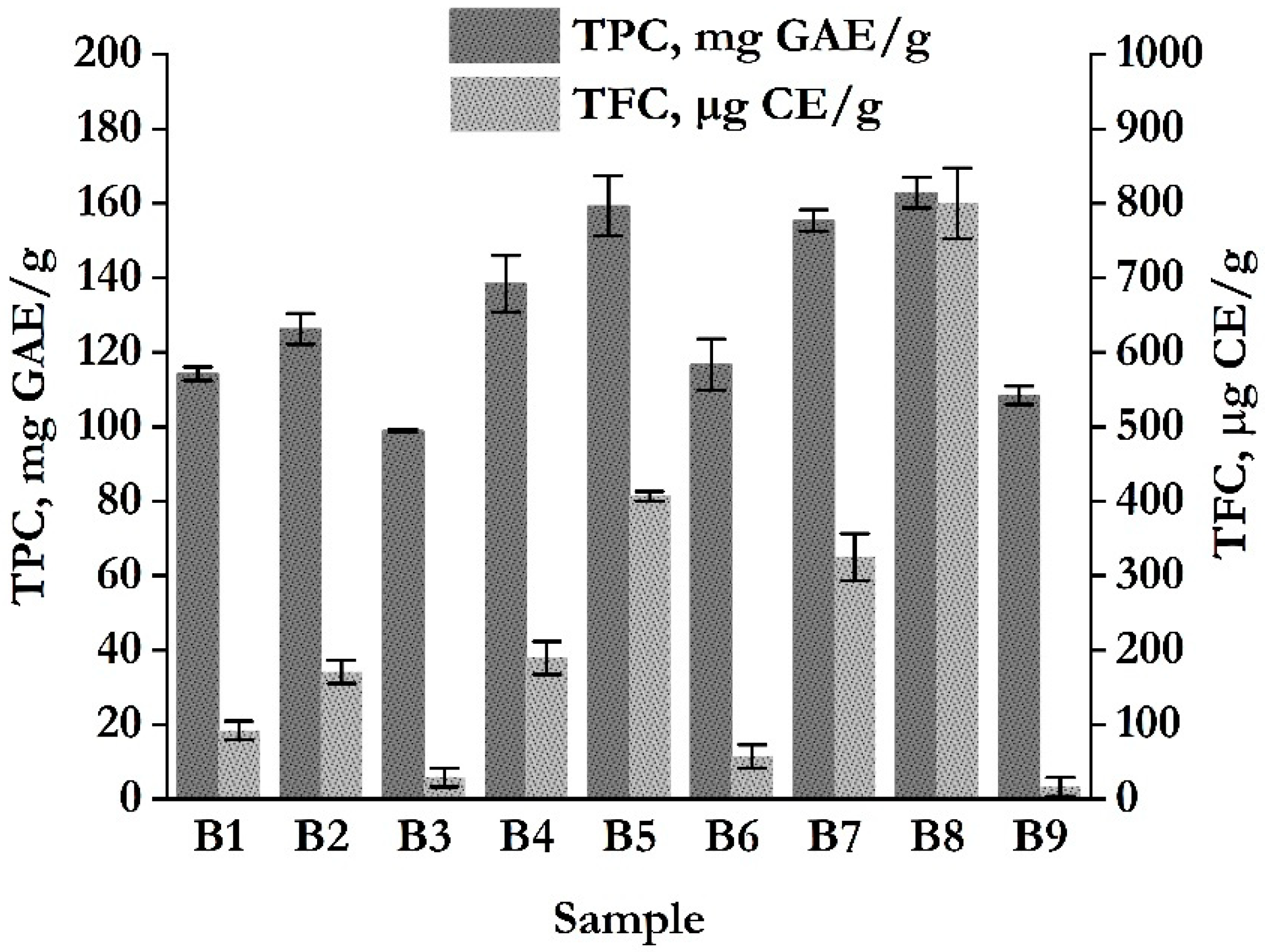
3.1. Total Phenolic and Flavonoid Content
3.2. UHPLC Q-ToF MS Profile of Selected Blend Extracts
3.2.1. Phenolic Compounds
3.2.2. Phenylamides
3.2.3. Sesquiterpene Lactones
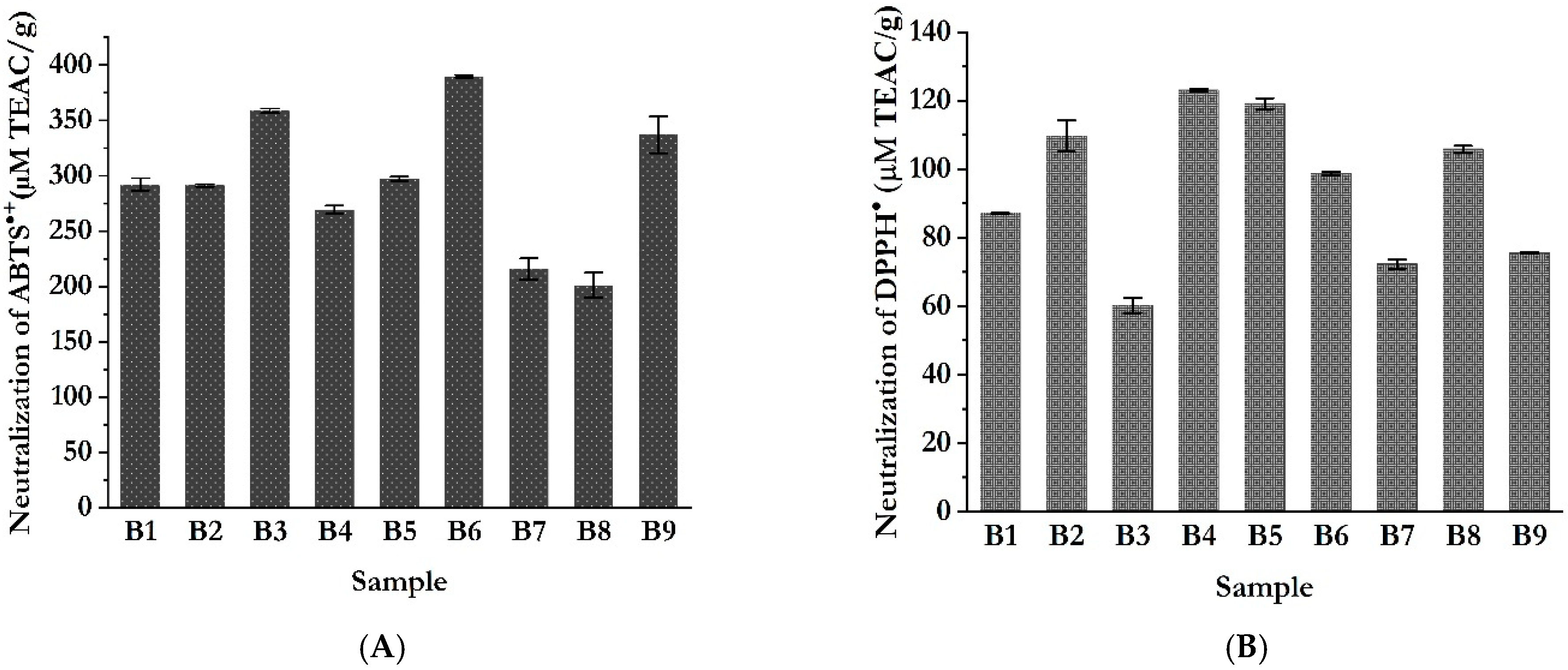
3.3. Antioxidant Activity of Prepared Blend Extracts
3.4. Antibacterial Potential of Prepared Blend Extracts
4. Conclusions
Supplementary Materials
Author Contributions
Funding
Institutional Review Board Statement
Informed Consent Statement
Data Availability Statement
Conflicts of Interest
Abbreviations
| MDR | Multidrug resistant |
| ABTS | 2,2′-azino-bis(3-ethylbenzothiazoline-6-sulfonic acid) assay |
| DPPH | 2,2-diphenylpicrylhydrazyl reagent |
| FRAP | Ferric reducing antioxidant power assay |
| CUPRAC | Cupric ion reducing antioxidant capacity assay |
| MRSA | Methicillin-resistant Staphylococcus aureus |
| MIC | Minimum inhibitory concentration |
| MBC | Minimum bactericidal concentration |
References
- Pareek, A.; Suthar, M.; Rathore, G.S.; Bansal, V. Feverfew (Tanacetum parthenium L.): A Systematic Review. Pharmacogn. Rev. 2011, 5, 103. [Google Scholar] [CrossRef]
- Kolanos, R.; Stice, S.A. German Chamomile. In Nutraceuticals; Elsevier: Amsterdam, The Netherlands, 2021; pp. 757–772. [Google Scholar] [CrossRef]
- Murphy, J.J.; Heptinstall, S.; Mitchell, J.R.A. Randomised Double-Blind Placebo-Controlled Trial of Feverfew in Migraine Prevention. Lancet 1988, 332, 189–192. [Google Scholar] [CrossRef]
- Heptinstall, S.; Williamson, L.; White, A.; Mitchell, J.R.A. Extracts of Feverfew Inhibit Granule Secretion in Blood Platelets and Polymorphonuclear Leucocytes. Lancet 1985, 325, 1071–1074. [Google Scholar] [CrossRef]
- Sotiropoulou, N.S.; Megremi, S.F.; Tarantilis, P. Evaluation of Antioxidant Activity, Toxicity, and Phenolic Profile of Aqueous Extracts of Chamomile (Matricaria chamomilla L.) and Sage (Salvia officinalis L.) Prepared at Different Temperatures. Appl. Sci. 2020, 10, 2270. [Google Scholar] [CrossRef]
- Mohsenzadeh, F.; Chehregani, A.; Amiri, H. Chemical Composition, Antibacterial Activity and Cytotoxicity of Essential Oils of Tanacetum Parthenium in Different Developmental Stages. Pharm. Biol. 2011, 49, 920–926. [Google Scholar] [CrossRef]
- Bernabé-Antonio, A.; Martínez-Ceja, A.; Romero-Estrada, A.; Sánchez-Carranza, J.N.; Columba-Palomares, M.C.; Rodríguez-López, V.; Meza-Contreras, J.C.; Silva-Guzmán, J.A.; Gutiérrez-Hernández, J.M. Green Synthesis of Silver Nanoparticles Using Randia aculeata L. Cell Culture Extracts, Characterization, and Evaluation of Antibacterial and Antiproliferative Activity. Nanomaterials 2022, 12, 4184. [Google Scholar] [CrossRef]
- Liu, Y.C.; Kim, S.L.; Park, Y.R.; Lee, S.-T.; Kim, S.W. Parthenolide Promotes Apoptotic Cell Death and Inhibits the Migration and Invasion of SW620 Cells. Intest. Res. 2017, 15, 174. [Google Scholar] [CrossRef]
- Studzińska-Sroka, E.; Znajdek-Awizeń, P.; Gawron-Gzella, A. Studies on the Antimigraine Action of Feverfew (Tanacetum parthenium (L.) Sch. Bip.). Wiad. Lek. 2013, 66, 195–199. [Google Scholar]
- Sztiller-Sikorska, M.; Czyz, M. Parthenolide as Cooperating Agent for Anti-Cancer Treatment of Various Malignancies. Pharmaceuticals 2020, 13, 194. [Google Scholar] [CrossRef]
- Sah, A.; Naseef, P.P.; Kuruniyan, M.S.; Jain, G.K.; Zakir, F.; Aggarwal, G. A Comprehensive Study of Therapeutic Applications of Chamomile. Pharmaceuticals 2022, 15, 1284. [Google Scholar] [CrossRef]
- Dai, Y.-L.; Li, Y.; Wang, Q.; Niu, F.-J.; Li, K.-W.; Wang, Y.-Y.; Wang, J.; Zhou, C.-Z.; Gao, L.-N. Chamomile: A Review of Its Traditional Uses, Chemical Constituents, Pharmacological Activities and Quality Control Studies. Molecules 2023, 28, 133. [Google Scholar] [CrossRef]
- Tadic, V.; Zivkovic, J.; Bigovic, D.; Zugic, A. Variation of Parthenolide and Phenolic Compounds Content in Different Parts of Tanacetum parthenium (L.) Schulz Bip., Asteraceae during 18 Months Storage. Lek. Sirovine 2019, 39, 35–39. [Google Scholar] [CrossRef]
- Heptinstall, S.; Awang, D.V.C.; Dawson, B.A.; Kindack, D.; Knight, D.W.; May, J. Parthenolide Content and Bioactivity of Feverfew (Tanacetum parthenium (L.) Schultz-Bip.). Estimation of Commercial and Authenticated Feverfew Products. J. Pharm. Pharmacol. 1992, 44, 391–395. [Google Scholar] [CrossRef]
- Scalbert, A.; Johnson, I.T.; Saltmarsh, M. Polyphenols: Antioxidants and Beyond. Am. J. Clin. Nutr. 2005, 81, 215S–217S. [Google Scholar] [CrossRef]
- Nguyen, M.M.; Karboune, S. Combinatorial Interactions of Essential Oils Enriched with Individual Polyphenols, Polyphenol Mixes, and Plant Extracts: Multi-Antioxidant Systems. Antioxidants 2023, 12, 486. [Google Scholar] [CrossRef]
- Daglia, M. Polyphenols as Antimicrobial Agents. Curr. Opin. Biotechnol. 2012, 23, 174–181. [Google Scholar] [CrossRef]
- Che Sulaiman, I.S.; Basri, M.; Fard Masoumi, H.R.; Chee, W.J.; Ashari, S.E.; Ismail, M. Effects of Temperature, Time, and Solvent Ratio on the Extraction of Phenolic Compounds and the Anti-Radical Activity of Clinacanthus nutans Lindau Leaves by Response Surface Methodology. Chem. Cent. J. 2017, 11, 54. [Google Scholar] [CrossRef]
- Olszowy-Tomczyk, M. Synergistic, Antagonistic and Additive Antioxidant Effects in the Binary Mixtures. Phytochem. Rev. 2020, 19, 63–103. [Google Scholar] [CrossRef]
- Michalak, M.; Stryjecka, M.; Żarnowiec, P.; Zagórska-Dziok, M.; Kiełtyka-Dadasiewicz, A. Chemical Composition of Extracts from Various Parts of Feverfew (Tanacetum parthenium L.) and Their Antioxidant, Protective, and Antimicrobial Activities. Int. J. Mol. Sci. 2024, 25, 12179. [Google Scholar] [CrossRef]
- Cvetanović, A.; Švarc-Gajić, J.; Zeković, Z.; Savić, S.; Vulić, J.; Mašković, P.; Ćetković, G. Comparative Analysis of Antioxidant, Antimicrobiological and Cytotoxic Activities of Native and Fermented Chamomile Ligulate Flower Extracts. Planta 2015, 242, 721–732. [Google Scholar] [CrossRef]
- Wider, B.; Pittler, M.H.; Ernst, E. Feverfew for Preventing Migraine. Cochrane Database Syst. Rev. 2015, 2020, CD002286. [Google Scholar] [CrossRef]
- Sarkar, M.; Chawla, P. Curative Properties of Chamomile in Gastrointestinal Disorders. In Herbs, Spices, and Medicinal Plants for Human Gastrointestinal Disorders; Apple Academic Press: Burlington, ON, Canada, 2022; pp. 125–140. [Google Scholar] [CrossRef]
- Chebrolu, K.K.; Jayaprakasha, G.K.; Jifon, J.; Patil, B.S. Optimization of Flavanones Extraction by Modulating Differential Solvent Densities and Centrifuge Temperatures. Talanta 2011, 85, 353–362. [Google Scholar] [CrossRef]
- Singleton, V.L.; Orthofer, R.; Lamuela-Raventós, R.M. [14] Analysis of Total Phenols and Other Oxidation Substrates and Antioxidants by Means of Folin-Ciocalteu Reagent. In Methods in Enzymology; Elsevier: Amsterdam, The Netherlands, 1999; Volume 299, pp. 152–178. ISBN 0076-6879. [Google Scholar] [CrossRef]
- Shraim, A.M.; Ahmed, T.A.; Rahman, M.M.; Hijji, Y.M. Determination of Total Flavonoid Content by Aluminum Chloride Assay: A Critical Evaluation. LWT 2021, 150, 111932. [Google Scholar] [CrossRef]
- Milinčić, D.D.; Vidović, B.B.; Gašić, U.M.; Milenković, M.; Kostić, A.Ž.; Stanojević, S.P.; Ilić, T.; Pešić, M.B. A Systematic UHPLC Q-ToF MS Approach for the Characterization of Bioactive Compounds from Freeze-Dried Red Goji Berries (L. barbarum L.) Grown in Serbia: Phenolic Compounds and Phenylamides. Food Chem. 2024, 456, 140044. [Google Scholar] [CrossRef] [PubMed]
- Čutović, N.; Marković, T.; Kostić, M.; Gašić, U.; Prijić, Ž.; Ren, X.; Lukić, M.; Bugarski, B. Chemical Profile and Skin-Beneficial Activities of the Petal Extracts of Paeonia tenuifolia L. from Serbia. Pharmaceuticals 2022, 15, 1537. [Google Scholar] [CrossRef] [PubMed]
- Batinić, P.; Jovanović, A.; Stojković, D.; Čutović, N.; Cvijetić, I.; Gašić, U.; Carević, T.; Zengin, G.; Marinković, A.; Marković, T. A Novel Source of Biologically Active Compounds–The Leaves of Serbian Herbaceous Peonies. Saudi Pharm. J. 2024, 32, 102090. [Google Scholar] [CrossRef]
- Sultana, B.; Anwar, F.; Ashraf, M. Effect of Extraction Solvent/Technique on the Antioxidant Activity of Selected Medicinal Plant Extracts. Molecules 2009, 14, 2167–2180. [Google Scholar] [CrossRef]
- Milošević, M.D.; Marinković, A.D.; Petrović, P.; Klaus, A.; Nikolić, M.G.; Prlainović, N.Ž.; Cvijetić, I.N. Synthesis, Characterization and SAR Studies of Bis (Imino) Pyridines as Antioxidants, Acetylcholinesterase Inhibitors and Antimicrobial Agents. Bioorg. Chem. 2020, 102, 104073. [Google Scholar] [CrossRef]
- Vasilijević, B.; Mitić-Ćulafić, D.; Djekic, I.; Marković, T.; Knežević-Vukčević, J.; Tomasevic, I.; Velebit, B.; Nikolić, B. Antibacterial Effect of Juniperus communis and Satureja montana Essential Oils against Listeria monocytogenes in Vitro and in Wine Marinated Beef. Food Control 2019, 100, 247–256. [Google Scholar] [CrossRef]
- Foschi, M.; Marsili, L.; Luciani, I.; Gornati, G.; Scappaticci, C.; Ruggieri, F.; D’Archivio, A.A.; Biancolillo, A. Optimization of the Cold Water Extraction Method for High-Value Bioactive Compounds from Chamomile (Matricaria chamomilla L.) Flower Heads Through Chemometrics. Molecules 2024, 29, 4925. [Google Scholar] [CrossRef]
- Bitwell, C.; Sen Singh, I.; Luke, C.; Kakoma, M.K. A Review of Modern and Conventional Extraction Techniques and Their Applications for Extracting Phytochemicals from Plants. Sci. Afr. 2023, 19, E01585. [Google Scholar] [CrossRef]
- Zengin, G.; Cvetanović, A.; Gašić, U.; Stupar, A.; Bulut, G.; Şenkardes, I.; Dogan, A.; Sinan, K.I.; Uysal, S.; Aumeeruddy-Elalfi, Z. Modern and Traditional Extraction Techniques Affect Chemical Composition and Bioactivity of Tanacetum parthenium (L.) Sch. Bip. Ind. Crops Prod. 2020, 146, 112202. [Google Scholar] [CrossRef]
- de Angelis, M.; Amicucci, C.; Banchelli, M.; D’Andrea, C.; Gori, A.; Agati, G.; Brunetti, C.; Matteini, P. Rapid Determination of Phenolic Composition in Chamomile (Matricaria recutita L.) Using Surface-Enhanced Raman Spectroscopy. Food Chem. 2025, 463, 141084. [Google Scholar] [CrossRef]
- Tsivelika, N.; Irakli, M.; Mavromatis, A.; Chatzopoulou, P.; Karioti, A. Phenolic Profile by HPLC-PDA-MS of Greek Chamomile Populations and Commercial Varieties and Their Antioxidant Activity. Foods 2021, 10, 2345. [Google Scholar] [CrossRef]
- Long, C.; Sauleau, P.; David, B.; Lavaud, C.; Cassabois, V.; Ausseil, F.; Massiot, G. Bioactive Flavonoids of Tanacetum parthenium Revisited. Phytochemistry 2003, 64, 567–569. [Google Scholar] [CrossRef]
- Mulinacci, N.; Romani, A.; Pinelli, P.; Vincieri, F.F.; Prucher, D. Characterization of Matricaria recutita L. Flower Extracts by HPLC-MS and HPLC-DAD Analysis. Chromatographia 2000, 51, 301–307. [Google Scholar] [CrossRef]
- Masterova, I.; Grancai, D.; Grancaiova, Z.; Pour, M.; Ubik, K. A New Flavonoid: Tinctosid from Anthemis tinctoria L. Pharmazie 2005, 60, 956–957. [Google Scholar] [CrossRef] [PubMed]
- Petrič, D.; Mravčáková, D.; Kucková, K.; Čobanová, K.; Kišidayová, S.; Cieslak, A.; Ślusarczyk, S.; Váradyová, Z. Effect of Dry Medicinal Plants (Wormwood, Chamomile, Fumitory and Mallow) on in Vitro Ruminal Antioxidant Capacity and Fermentation Patterns of Sheep. J. Anim. Physiol. Anim. Nutr. 2020, 104, 1219–1232. [Google Scholar] [CrossRef]
- Švehlíková, V.; Repčák, M. Apigenin Chemotypes of Matricaria chamomilla L. Biochem. Syst. Ecol. 2006, 34, 654–657. [Google Scholar] [CrossRef]
- Švehlíková, V.; Bennett, R.N.; Mellon, F.A.; Needs, P.W.; Piacente, S.; Kroon, P.A.; Bao, Y. Isolation, Identification and Stability of Acylated Derivatives of Apigenin 7-O-Glucoside from Chamomile (Chamomilla recutita [L.] Rauschert). Phytochemistry 2004, 65, 2323–2332. [Google Scholar] [CrossRef] [PubMed]
- Petruľová-Poracká, V.; Repčák, M.; Vilková, M.; Imrich, J. Coumarins of Matricaria chamomilla L.: Aglycones and Glycosides. Food Chem. 2013, 141, 54–59. [Google Scholar] [CrossRef]
- Zhang, J.; Hu, X.; Gao, W.; Qu, Z.; Guo, H.; Liu, Z.; Liu, C. Pharmacokinetic Study on Costunolide and Dehydrocostuslactone after Oral Administration of Traditional Medicine Aucklandia lappa Decne. by LC/MS/MS. J. Ethnopharmacol. 2014, 151, 191–197. [Google Scholar] [CrossRef]
- Peng, Z.; Wang, Y.; Gu, X.; Guo, X.; Yan, C. Study on the Pharmacokinetics and Metabolism of Costunolide and Dehydrocostus Lactone in Rats by HPLC-UV and UPLC-Q-TOF/MS. Biomed. Chromatogr. 2014, 28, 1325–1334. [Google Scholar] [CrossRef]
- Liu, Q.; Manzano, D.; Tanić, N.; Pesic, M.; Bankovic, J.; Pateraki, I.; Ricard, L.; Ferrer, A.; de Vos, R.; van de Krol, S. Elucidation and in Planta Reconstitution of the Parthenolide Biosynthetic Pathway. Metab. Eng. 2014, 23, 145–153. [Google Scholar] [CrossRef]
- Orhan, I.E.; Tosun, F.; Gülpınar, A.R.; Kartal, M.; Duran, A.; Mihoglugil, F.; Akalgan, D. LC–MS Quantification of Parthenolide and Cholinesterase Inhibitory Potential of Selected Tanacetum L. (Emend. Briq.) Taxa. Phytochem Lett 2015, 11, 347–352. [Google Scholar] [CrossRef]
- de Rijke, E.; Out, P.; Niessen, W.M.A.; Ariese, F.; Gooijer, C.; Brinkman, U.A.T. Analytical Separation and Detection Methods for Flavonoids. J. Chromatogr. A 2006, 1112, 31–63. [Google Scholar] [CrossRef] [PubMed]
- Salehi, B.; Venditti, A.; Sharifi-Rad, M.; Kręgiel, D.; Sharifi-Rad, J.; Durazzo, A.; Lucarini, M.; Santini, A.; Souto, E.B.; Novellino, E. The Therapeutic Potential of Apigenin. Int. J. Mol. Sci. 2019, 20, 1305. [Google Scholar] [CrossRef] [PubMed]
- Bangar, S.P.; Kajla, P.; Chaudhary, V.; Sharma, N.; Ozogul, F. Luteolin: A Flavone with Myriads of Bioactivities and Food Applications. Food Biosci. 2023, 52, 102366. [Google Scholar] [CrossRef]
- Mailänder, L.K.; Lorenz, P.; Bitterling, H.; Stintzing, F.C.; Daniels, R.; Kammerer, D.R. Phytochemical Characterization of Chamomile (Matricaria recutita L.) Roots and Evaluation of Their Antioxidant and Antibacterial Potential. Molecules 2022, 27, 8508. [Google Scholar] [CrossRef] [PubMed]
- Kostić, A.Ž.; Çobanoğlu, D.N.; Milinčić, D.D.; Felek, I.; Düzdaban, P.; Pešić, M.B. Could Phenylamides Emerge as a Powerful Chemotaxonomic Tool? A Case Study of Rapeseed Bee-Collected Pollen Originating from Serbia and Türkiye. Chem. Biodivers. 2025, 22, e202500339. [Google Scholar] [CrossRef]
- Fotirić Akšić, M.M.; Pešić, M.B.; Pećinar, I.; Dramićanin, A.; Milinčić, D.D.; Kostić, A.Ž.; Gašić, U.; Jakanovski, M.; Kitanović, M.; Meland, M. Diversity and Chemical Characterization of Apple (Malus sp.) Pollen: High Antioxidant and Nutritional Values for Both Humans and Insects. Antioxidants 2024, 13, 1374. [Google Scholar] [CrossRef] [PubMed]
- Qiao, J.; Feng, Z.; Zhang, Y.; Xiao, X.; Dong, J.; Haubruge, E.; Zhang, H. Phenolamide and Flavonoid Glycoside Profiles of 20 Types of Monofloral Bee Pollen. Food Chem. 2023, 405, 134800. [Google Scholar] [CrossRef] [PubMed]
- Zhao, G.; Gai, Y.; Chu, W.-J.; Qin, G.-W.; Guo, L.-H. A Novel Compound N1, N5-(Z)-N10-(E)-Tri-p-Coumaroylspermidine Isolated from Carthamus tinctorius L. and Acting by Serotonin Transporter Inhibition. Eur. Neuropsychopharmacol. 2009, 19, 749–758. [Google Scholar] [CrossRef]
- Park, S.B.; Song, K.; Kim, Y.S. Tetra-Cis/Trans-Coumaroyl Polyamines as NK1 Receptor Antagonists from Matricaria chamomilla. Planta Medica Int. Open 2017, 4, e43–e51. [Google Scholar] [CrossRef]
- Li, Q.; Wang, Z.; Xie, Y.; Hu, H. Antitumor Activity and Mechanism of Costunolide and Dehydrocostus Lactone: Two Natural Sesquiterpene Lactones from the Asteraceae Family. Biomed. Pharmacother. 2020, 125, 109955. [Google Scholar] [CrossRef]
- Tassorelli, C.; Greco, R.; Morazzoni, P.; Riva, A.; Sandrini, G.; Nappi, G. Parthenolide Is the Component of Tanacetum parthenium That Inhibits Nitroglycerin-Induced Fos Activation: Studies in an Animal Model of Migraine. Cephalalgia 2005, 25, 612–621. [Google Scholar] [CrossRef]
- Majdi, M.; Liu, Q.; Karimzadeh, G.; Malboobi, M.A.; Beekwilder, J.; Cankar, K.; de Vos, R.; Todorović, S.; Simonović, A.; Bouwmeester, H. Biosynthesis and Localization of Parthenolide in Glandular Trichomes of Feverfew (Tanacetum parthenium L. Schulz Bip.). Phytochemistry 2011, 72, 1739–1750. [Google Scholar] [CrossRef]
- Catani, M.V.; Rinaldi, F.; Tullio, V.; Gasperi, V.; Savini, I. Comparative Analysis of Phenolic Composition of Six Commercially Available Chamomile (Matricaria chamomilla L.) Extracts: Potential Biological Implications. Int. J. Mol. Sci. 2021, 22, 10601. [Google Scholar] [CrossRef]
- Chen, J.; Yang, J.; Ma, L.; Li, J.; Shahzad, N.; Kim, C.K. Structure-Antioxidant Activity Relationship of Methoxy, Phenolic Hydroxyl, and Carboxylic Acid Groups of Phenolic Acids. Sci. Rep. 2020, 10, 2611. [Google Scholar] [CrossRef]
- Silva, F.A.M.; Borges, F.; Guimarães, C.; Lima, J.L.F.C.; Matos, C.; Reis, S. Phenolic Acids and Derivatives: Studies on the Relationship among Structure, Radical Scavenging Activity, and Physicochemical Parameters. J. Agric. Food Chem. 2000, 48, 2122–2126. [Google Scholar] [CrossRef] [PubMed]
- Marete, E.N.; Jacquier, J.-C.; O’Riordan, D. Effect of Processing Temperature on the Stability of Parthenolide in Acidified Feverfew Infusions. Food Res. Int. 2013, 50, 593–596. [Google Scholar] [CrossRef]
- Eruygur, N.; Akça, K.T.; Üstün, O.; Tekin, M. In Vitro Antioxidant and Enzyme Inhibition Activity of Tanacetum argyrophyllum (K. Koch) Tzvelev Var. Argyrophyllum Extract. Turk. J. Pharm. Sci. 2022, 19, 377. [Google Scholar] [CrossRef]
- Apak, R.; Güçlü, K.; Özyürek, M.; Çelik, S.E. Mechanism of Antioxidant Capacity Assays and the CUPRAC (Cupric Ion Reducing Antioxidant Capacity) Assay. Microchim. Acta 2008, 160, 413–419. [Google Scholar] [CrossRef]
- Afshin, M.; Sharifi-Rad, M.; Saeidi, S. Phytochemical Investigation, Antioxidant and Antibacterial Activities of Tanacetum parthenium L. Aerial Parts and Root Ethanolic Extracts at Different Phenological Stages. Iran. J. Med. Aromat. Plants Res. 2023, 39, 445–464. [Google Scholar] [CrossRef]
- Poudineh, F.; Azari, A.A.; Fozouni, L. Antibacterial Activity of Ethanolic Extract of Matricaria chamomilla, Malva cylvestris, and Capsella bursa-Pastoris against Multidrug-Resistant Pseudomonas aeruginosa Strains. Avicenna J. Clin. Microbiol. Infect. 2021, 8, 23–26. [Google Scholar] [CrossRef]
- Ahani Azari, A.; Danesh, A. Antibacterial Effect of Matricaria chamomilla Alcoholic Extract against Drug-Resistant Isolates of Staphylococcus aureus and Pseudomonas aeruginosa. Infect. Epidemiol. Microbiol. 2021, 7, 29–35. [Google Scholar] [CrossRef]
- Mekky, A.E. Study of Phytochemical Analysis and Antimicrobial Activity of Ethanolic Extract of Nigella sativa L. and Matricaria chamomilla L. Al-Azhar J. Agric. Res. 2022, 47, 38–51. [Google Scholar] [CrossRef]
- Alkuraishy, H.M.; Al-Gareeb, A.I.; Albuhadilly, A.K.; Alwindy, S. In Vitro Assessment of the Antibacterial Activity of Matricaria Chamomile Alcoholic Extract against Pathogenic Bacterial Strains. Br. Microbiol. Res. J. 2015, 7, 55–61. [Google Scholar] [CrossRef]





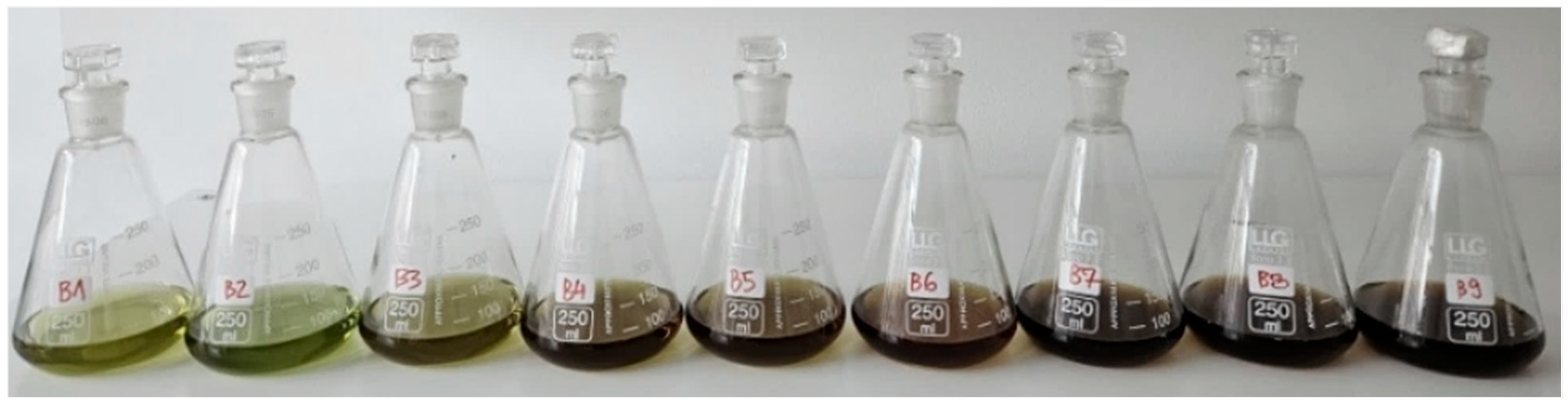
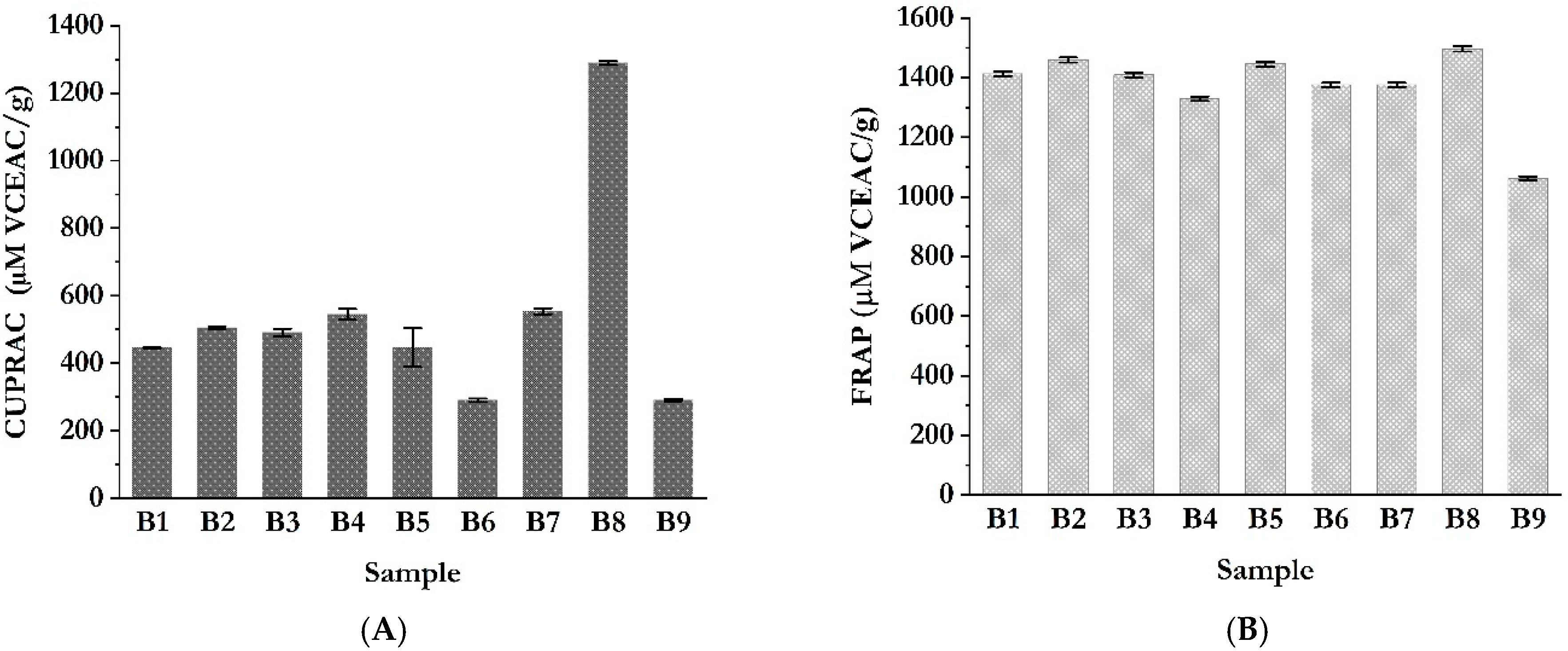
| Label | Formulation of a Blend | Extraction Method and Equipment |
|---|---|---|
| B1 | 5 g chamomile + 5 g feverfew | old extraction [mixing on the 4 ± 1 °C, 10 min, 1500 rpm; vortex mixer (GrantBio PV-1 Vortex mixer, Cambridgeshire, UK); slow agitation at 4 ± 0 °C, 20 min, 200 rpm; Centrifuge 5430R, Eppendorf®, Hamburg, Germany]. |
| B2 | 7.5 g chamomile + 2.5 g feverfew | |
| B3 | 7.5 g feverfew + 2.5 g chamomile | |
| B4 | 5 g chamomile + 5 g feverfew | Extraction at room temperature (21 ± 1 °C, 30 min, 200 rpm; Digital linear shaker SK-L330-Pro, SCILOGEX, LLC, Rocky Hill, CT, USA). |
| B5 | 7.5 g chamomile + 2.5 g feverfew | |
| B6 | 7.5 g feverfew + 2.5 g chamomile | |
| B7 | 5 g chamomile + 5 g feverfew | Heat-assisted extraction (63 ± 1 °C, 30 min, 200 rpm; magnetic stirrer (LLG LABWARE uniSTIRRER 3 PRO, Meckenheim, Germany). |
| B8 | 7.5 g chamomile + 2.5 g feverfew | |
| B9 | 7.5 g feverfew + 2.5 g chamomile |
| Enterococcus faecalis VRE * | |||
| Antibiotics | MIC | Interpretation | Group of Antibiotics |
| Ampicillin | >16 | R | Penicillins |
| Imipenem | >8 | R | Carbapenems |
| Gentamicin SYN | >500 | R | Aminoglycosides |
| Ciprofloxacin | >4 | R | Fluoroquinolones |
| Levofloxacin | >4 | R | Fluoroquinolones |
| Vancomycin | >8 | R | Glycopeptides |
| Linezolid | 1 | S | Oxazolidinones |
| Tigecycline | ≤0.12 | S | |
| Staphylococcus aureus MRSA | |||
| Benzylpenicillin | >0.25 | R | Penicillins |
| Ampicillin | R | Penicillins | |
| Oxacillin | >2 | R | Penicillins |
| Amikacin | >32 | R | Aminoglycosides |
| Gentamicin | >8 | R | Aminoglycosides |
| Ciprofloxacin | >4 | R | Fluoroquinolones |
| Levofloxacin | >2 | R | Fluoroquinolones |
| Moxifloxacin | >2 | R | Fluoroquinolones |
| Erythromycin | >2 | R | Macrolides |
| Clindamycin | >1 | R | Lincosamides |
| Tetracycline | >4 | R | Tetracyclines |
| Vancomycin | ≤0.5 | S | Glycopeptides |
| Linezolid | 1 | S | Oxazolidinones |
| Trimethoprim-sulfamethoxazole | 20.0 | S | Sulfonamides |
| Klebsiella pneumoniae | |||
| Antibiotics | MIC | Interpretation | Group of antibiotics |
| Ampicillin | >32 | R | Penicillins |
| Amoxicillin-clavulanic acid | >32 | R | Penicillins |
| Piperacillin-tazobactam | >64 | R | Penicillins |
| Cefotaxime | >32 | R | Cephalosporins |
| Ceftriaxone | >32 | R | Cephalosporins |
| Ceftazidime | >32 | R | Cephalosporins |
| Cefepime | >32 | R | Cephalosporins |
| Imipenem | >8 | R | Carbapenems |
| Meropenem | >8 | R | Carbapenems |
| Ertapenem | >8 | R | Carbapenems |
| Amikacin | >16 | R | Aminoglycosides |
| Gentamicin | >8 | R | Aminoglycosides |
| Tobramycin | >8 | R | Aminoglycosides |
| Ciprofloxacin | >2 | R | Fluoroquinolones |
| Levofloxacin | >4 | R | Fluoroquinolones |
| Colistin | ≤1 | S | Polymyxin B |
| Acinetobacter baumannii | |||
| Imipenem | >8 | R | Carbapenems |
| Meropenem | >8 | R | Carbapenems |
| Amikacin | >32 | R | Aminoglycosides |
| Gentamicin | >8 | R | Aminoglycosides |
| Tobramycin | >8 | R | Aminoglycosides |
| Ciprofloxacin | >1 | R | Fluoroquinolones |
| Levofloxacin | >2 | R | Fluoroquinolones |
| Colistin | ≤0.5 | S | Polymyxin B |
| Pseudomonas aeruginosa | |||
| Piperacillin-tazobactam | >64 | R | Penicillins |
| Ceftazidime | >32 | R | Cephalosporins |
| Cefepime | >32 | R | Cephalosporins |
| Imipenem | >8 | R | Carbapenems |
| Meropenem | >8 | R | Carbapenems |
| Amikacin | >32 | R | Aminoglycosides |
| Tobramycin | >16 | R | Aminoglycosides |
| Ciprofloxacin | >2 | R | Fluoroquinolones |
| Levofloxacin | >4 | R | Fluoroquinolones |
| Colistin | ≤1 | S | Polymyxin B |
| Enterobacter sp. | |||
| Ampicillin | >32 | R | Penicillins |
| Amoxicillin-clavulanic acid | >32 | R | Penicillins |
| Piperacillin-tazobactam | >64 | R | Penicillins |
| Cefalexin | >32 | R | Cephalosporins |
| Ceftriaxone | >32 | R | Cephalosporins |
| Ceftazidime | >32 | R | Cephalosporins |
| Cefepime | >16 | R | Cephalosporins |
| Imipenem | >8 | R | Carbapenems |
| Meropenem | >8 | R | Carbapenems |
| Ertapenem | >8 | R | Carbapenems |
| Amikacin | 4 | S | Aminoglycosides |
| Gentamicin | >16 | R | Aminoglycosides |
| Tobramycin | >16 | R | Aminoglycosides |
| Ciprofloxacin | >2 | R | Fluoroquinolones |
| Levofloxacin | >4 | R | Fluoroquinolones |
| Trimethoprim-sulfamethoxazole | >160 | R | Sulfonamide |
| Colistin | ≤0.5 | S | Polymyxin B |
| No. | RT | Compounds | Formulas | Calculated Mass | m/z Exact Mass | mDa | MS Fragments (Main Fragment, %) | Ref. *** |
|---|---|---|---|---|---|---|---|---|
| Phenolic acids | ||||||||
| Hydroxybenzoic acid and glycoside | ||||||||
| 1 | 4.13 | Hydroxybenzoic acid | C7H5O3− | 137.0239 | 137.0234 | −0.47 | 108.0209(100), 109.0268, 118.9381 | [35] |
| 2 | 2.45 | Dihydroxybenzoic acid is. I (Protocatehuic acid) * | C7H5O4− | 153.0188 | 153.0182 | −0.58 | 108.0203(100), 109.0287 | Std. |
| 3 | 4.44 | Dihydroxybenzoic acid is. II (Gentisic acid) * | C7H5O4− | 153.0188 | 153.0180 | −0.78 | 108.0208(100), 109.0259 | Std. |
| 4 | 5.72 | Dihydroxybenzoic acid is. III | C7H5O4− | 153.0188 | 153.0180 | −0.78 | 108.0200(100), 109.0277 | [35] |
| 5 | 2.45 | Dihydroxybenzoic acid hexoside | C13H15O9− | 315.0716 | 315.0702 | −1.41 | 108.0207(100), 152.0097, 109.0278, 153.0164 | [35] |
| Hydroxycinnamic acid and derivatives | ||||||||
| 6 | 6.32 | Caffeic acid * | C9H7O4− | 179.0344 | 179.0333 | −1.13 | 135.0437(100), 134.0359, 161.0193 | Std.; [36] |
| 7 | 6.09 | Caffeic acid hexoside | C15H17O9− | 341.0873 | 341.0875 | 0.24 | 135.0435(100), 161.0225, 179.0331 | [36] |
| 8 | 5.92 | Caffeic acid glucuronide-methyl ester | C16H17O10− | 369.0822 | 369.0802 | −1.97 | 161.0224(100), 133.0268, 175.0352 | - |
| 9 | 6.29 | Caffeoylquinic acid (Chlorogenic acid) * | C16H17O9− | 353.0873 | 353.0851 | −2.16 | 191.0541(100), 161.0229, 173.0433, 149.0594, 111.0447, 127.0387, 179.0330 | Std.; [35,37] |
| 10 | 8.25 | Dicaffeoylquinic acid | C25H23O12− | 515.1190 | 515.1172 | −1.75 | 191.0546(100), 179.0332, 173.0440, 161.0233, 135.0442, 335.0737, 353.0850 | [5,35] |
| 11 | 6.80 | Ferulic acid hexoside | C16H19O9− | 355.1029 | 355.1008 | −2.11 | 149.0592(100), 134.0363, 193.049 | [36] |
| 12 | 8.79 | Caffeoyl-ferulic acid hexoside | C25H25O12− | 517.1346 | 517.1306 | −4.00 | 161.0233(100), 149.0597, 179.0337, 193.049, 134.0364, 135.044, 323.0749, 355.0993 | - |
| Flavonoids | ||||||||
| Flavonol aglycones (O-methylated flavonols) and derivatives | ||||||||
| 13 | 9.43 | Quercetin * | C15H9O7− | 301.0348 | 301.0333 | −1.53 | 151.0025(100), 121.0285, 178.9970, 107.0130, 227.0333, 245.0435, 273.039 | Std. |
| 14 | 12.33 | Ermanin | C17H13O6− | 313.0712 | 313.0702 | −1.01 | 283.0226(100), 255.0277, 298.0457, 269.0435, 241.0485, 227.0331, 211.0384, 151.0023, 183.0434, 211.0384 | [35] |
| 15 | 10.64 | Quercetin-dimethyl ether | C17H13O7− | 329.0661 | 329.0648 | −1.33 | 211.1324(100), 183.1378, 229.1431, 171.1014, 229.1431, 243.028, 257.0435, 271.023, 299.0178, 314.0406 | - |
| 16 | 12.60 | Santin | C18H15O7− | 343.0818 | 343.0807 | −1.08 | 270.0151(100), 285.0388, 313.033, 328.0568, 298.0102, 242.0206, 186.0307, 178.9973 | [35,38] |
| 17 | 9.84 | Axillarin | C17H13O8− | 345.0610 | 345.0606 | −0.44 | 315.0124(100), 287.0177, 330.0362, 271.0228, 259.0229, 243.0282, 231.0282, 175.0027, 149.0234 | [35] |
| 18 | 10.78 | Centaureidin | C18H15O8− | 359.0767 | 359.0760 | −0.69 | 286.0101(100), 329.0283, 314.0048, 344.0517, 301.0332, 270.0148, 258.0157, 230.0206, 178.9972 | [35,38] |
| 19 | 11.85 | Casticin | C19H17O8− | 373.0923 | 373.0909 | −1.44 | 343.0437(100), 300.0256, 328.0202, 315.0487, 358.0669, 285.0024, 272.0303, 257.0077, 241.0127, 229.0131, 213.0171 | [35] |
| 20 | 7.81 | Quercetin 3-O-glucoside * | C21H19O12− | 463.0877 | 463.0857 | −1.95 | 301.0321(100), 300.0248, 151.0021, 271.0220, 178.997, 343.0419 | Std.; [36] |
| 21 | 7.34 | Quercetagetin 7-O-hexoside | C21H19O13− | 479.0826 | 479.0804 | −2.17 | 317.0273(100), 316.0195, 359.0392, 271.0223, 243.0272, 165.9892, 139.0015 | [36] |
| 22 | 7.94 | Patuletin 7-O-hexoside (like as Patulitrin) | C22H21O13− | 493.0982 | 493.0964 | −1.82 | 331.0431(100), 316.0196, 287.0171, 243.0269, 227.0321, 165.9893, 181.0122, 373.0526 | [36,39] |
| 23 | 8.68 | Patuletin 7-O-(6″-O-caffeoyl)hexoside | C31H27O16− | 655.1299 | 655.1271 | −2.81 | 331.0434(100), 316.0198, 373.0551, 655.1268, 493.0940, 287.0194, 271.0226, 161.0232, 135.0436, 209.0077, 179.0337 | [40] |
| Flavone aglycones and derivatives (glycosides and acyl derivatives) | ||||||||
| 24 | 10.03 | Apigenin * | C15H9O5− | 269.0450 | 269.0435 | −1.50 | 117.0339(100), 151.0025, 107.0133, 149.0231, 159.0439, 169.0638, 183.0436, 225.0536, 269.0435 | Std. |
| 25 | 8.89 | Trihydroxyflavone (unknown) | C15H9O5− | 269.0450 | 269.0441 | −0.90 | 269.0436(100), 117.0336, 159.0439, 225.0533, 107.0133, 183.0431, 197.0587 | [41] |
| 26 | 9.36 | Luteolin * | C15H9O6− | 285.0399 | 285.0384 | −1.51 | 133.0286(100), 151.0025, 107.0129, 285.0382, 175.0384, 199.0382, 217.0487, 241.0478 | Std. |
| 27 | 8.35 | Apigenin 7-O-glucoside (Apigetrin) * | C21H19O10− | 431.0978 | 431.0955 | −2.32 | 268.0358(100), 431.0952, 269.0421, 117.0335, 151.0016, 311.054 | Std.; [5] |
| 28 | 7.88 | Luteolin 7-O-glucoside * | C21H19O11− | 447.0927 | 447.0909 | −1.84 | 285.0374(100), 284.0299, 447.0898, 151.0026, 327.0482, 133.0276 | Std.; [37] |
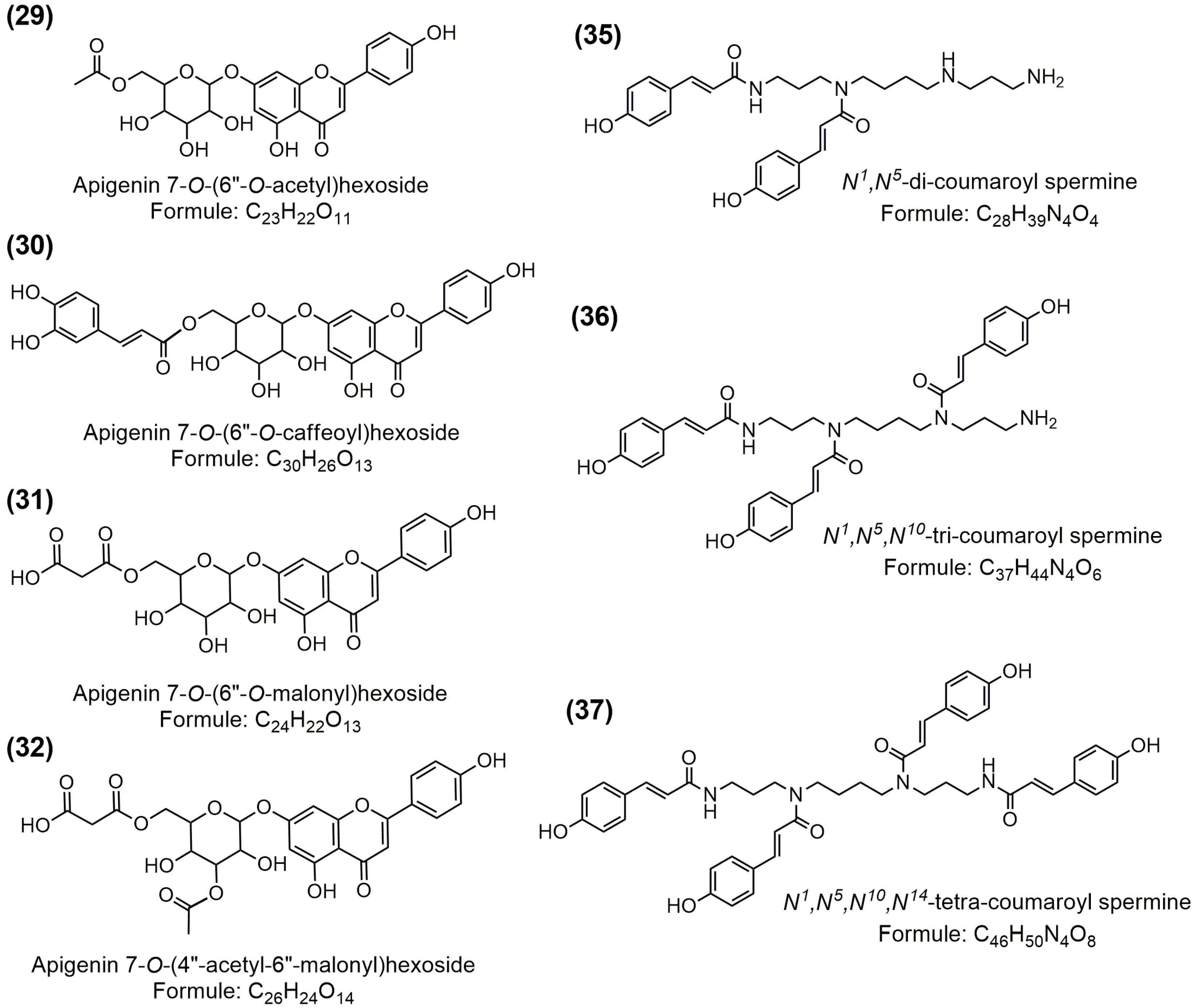
| 29 | 9.02 | Apigenin 7-O-(6″-O-acetyl)hexoside | C23H21O11− | 473.1084 | 473.1062 | −2.19 | 268.0352(100), 269.0412, 473.1052, 413.0845, 311.0553, 151.0020, 117.0321 | [36] |
| 30 | 9.22 | Apigenin 7-O-(6″-O-caffeoyl)hexoside | C30H25O13− | 593.1295 | 593.1274 | −2.12 | 269.0433(100), 323.075, 161.0228, 179.0332, 135.0439, 117.033, 431.0955 | [41,42] |
| 31 | 8.82 | Apigenin 7-O-(6″-O-malonyl)hexoside | C24H23O13+ | 519.1139 | 519.1180 | 4.13 | 271.0610(100), 433.1208 | [37,43] |
| 32 | 9.53 | Apigenin 7-O-(4″-acetyl-6″-malonyl)hexoside | C26H25O14+ | 561.1244 | 561.1285 | 4.07 | 271.0612(100), 475.1243 | [37,42] |
| Flavanone and coumarin | ||||||||
| 33 | 9.22 | Eriodictyol | C15H11O6− | 287.0556 | 287.0543 | −1.26 | 135.044(100), 151.0025, 107.0136, 125.0224, 165.0164, 245.0960 | [35] |
| 34 | 6.12 | Daphnetin 7-O-glucoside (Daphnin) | C15H15O9− | 339.0716 | 339.0708 | −0.81 | 177.0172(100) | [44] |
| Phenylamides | ||||||||
| 35 | 8.75 | Di-coumaroyl spermine (N1,N5-di-coumaroyl spermine) | C28H39N4O4+ | 495.2971 | 495.3007 | 3.57 | 204.1031(100), 275.1772, 147.0449, 119.0505, 129.1396, 218.1172, 349.2619, 421.2165, 478.2752, 495.2986 | - |
| 36 | 8.75 | Tri-coumaroyl spermine (N1,N5,N10-tri-coumaroyl spermine) | C37H45N4O6+ | 641.3339 | 641.3398 | 5.89 | 641.3369(100), 495.2990, 275.1766, 204.1029, 147.0449, 624.3112, 477.2889, 421.2141, 349.2615, 218.1180, 129.1394 | [41] |
| 37 | 10.44 | Tetra-coumaroyl spermine (N1,N5,N10,N14-tetra-coumaroyl spermine) | C46H51N4O8+ | 787.3707 | 787.3766 | 5.91 | 641.3372(100), 495.2993, 275.1768, 147.0448, 787.3736, 623.3262, 584.2805, 521.2782, 478.2767, 421.2169, 438.2412, 275.1768, 204.1033 | [36,37] |
| Sesquiterpene lactones | ||||||||
| 38 | 15.57 | (−)-Dehydrocostus lactone | C15H19O2+ | 231.1385 | 231.1395 | 1.00 | 105.0707(100), 117.0704, 128.0627, 129.0701, 131.0861, 143.0860, 157.1011, 170.1098, 185.1327, 213.1270 | [45,46] |
| 39 | 10.10 | Sesquiterpene lactone I-unknown | C15H19O2+ | 231.1385 | 231.1396 | 1.10 | 105.0706(100), 119.0860, 129.0700, 131.0858, 143.0863, 157.1015, 170.1093, 185.1323, 213.1282 | - |
| 40 | 11.71 | Parthenolide (-H2O) * (Parthenolide) ** | C15H19O2+ (C15H21O3+) | 231.1385 (249.1491) | 231.1414 (249.1509) | 2.90 (1.83) | 105.0710(100), 117.0710, 119.0864, 131.0865, 142.0784, 143.0863, 157.1015, 159.1164, 185.1323, 195.1165, 213.1282 | Std.; [47,48] |
| 41 | 13.54 | Costunolide | C15H21O2+ | 233.1542 | 233.1553 | 1.15 | 105.0708(100), 119.0862, 131.0862, 145.1018, 159.1172, 187.1488, 215.1439 | [46,47,48] |
| 42 | 9.09 | Sescuiterpene lactone II-unknown | C15H19O3+ | 247.1334 | 247.1346 | 1.18 | 105.0705(100), 145.1006, 117.0705, 131.0860, 143.0859, 158.0745, 159.0815, 183.1169 | - |
| Other compounds (plant hormone) | ||||||||
| 43 | 9.16 | Abscisic acid * | C15H19O4− | 263.1283 | 263.1276 | −0.73 | 203.1057(100), 210.1361, 189.0906, 153.0909, 122.0357, 136.0523 | Std. |
| Sample | Extraction Method | Blend Ratio | Staphylococcus aureus MRSA ** | Klebsiella pneumoniae | Enterobacter sp. | Pseudomonas aeruginosa | Enterococcus faecalis | Acinetobacter baumannii | Range | ||||||
|---|---|---|---|---|---|---|---|---|---|---|---|---|---|---|---|
| MIC *** | MBC **** | MIC | MBC | MIC | MBC | MIC | MBC | MIC | MBC | MIC | MBC | MIC | |||
| B1 | Cold extraction (4 ± 0 °C) | 1:1 | 1.25 | 5 | 1.25 | >5 | 1.25 | >5 | 0.625 | 1.25 | 1.25 | 2.5 | 0.625 | 1.25 | 0.625–1.25 |
| B2 | 3:1 | 1.25 | 5 | 1.25 | >5 | 0.625 | >5 | 0.625 | 1.25 | 1.25 | 2.5 | 0.625 | 0.625 | 0.625–1.25 | |
| B3 | 1:3 | 1.25 | 5 | 1.25 | >5 | 0.625 | >5 | 0.625 | 1.25 | 1.25 | 2.5 | 0.625 | 0.625 | 0.625–1.25 | |
| B4 | Room temperature extraction (22 ± 1 °C) | 1:1 | 1.25 | 5 | 1.25 | >5 | 0.625 | >5 | 0.625 | 1.25 | 1.25 | 2.5 | 0.625 | 0.625 | 0.625–1.25 |
| B5 | 3:1 | 1.25 | 5 | 1.25 | >5 | 0.625 | >5 | 1.25 | >5 | 1.25 | >5 | 0.625 | 2.5 | 0.625–1.25 | |
| B6 | 1:3 | 1.25 | 5 | 1.25 | >5 | 0.625 | >5 | 1.25 | >5 | 1.25 | >5 | 0.625 | 0.625 | 0.625–1.25 | |
| B7 | Heat-assisted extraction (63 ± 1 °C) | 1:1 | 1.25 | 5 | 1.25 | >5 | 1.25 | 2.5 | 1.25 | >5 | 1.25 | >5 | 0.625 | 0.625 | 0.625–1.25 |
| B8 | 3:1 | 1.25 | 5 | 1.25 | >5 | 1.25 | 2.5 | 1.25 | >5 | 1.25 | >5 | 1.25 | 1.25 | 1.25–2.5 | |
| B9 | 1:3 | 1.25 | 5 | 1.25 | >5 | 1.25 | 2.5 | 1.25 | >5 | 2.5 | >5 | 1.25 | 1.25 | 1.25–2.5 | |
| Povidone iodine | n.a. * | n.a.* | 31.25 | 31.25 | 62.50 | 62.50 | 62.50 | 62.50 | 62.50 | 62.50 | 31.25 | 31.25 | 31.25 | 31.25 | 31.25–62.50 |
Disclaimer/Publisher’s Note: The statements, opinions and data contained in all publications are solely those of the individual author(s) and contributor(s) and not of MDPI and/or the editor(s). MDPI and/or the editor(s) disclaim responsibility for any injury to people or property resulting from any ideas, methods, instructions or products referred to in the content. |
© 2025 by the authors. Licensee MDPI, Basel, Switzerland. This article is an open access article distributed under the terms and conditions of the Creative Commons Attribution (CC BY) license (https://creativecommons.org/licenses/by/4.0/).
Share and Cite
Batinić, P.; Čutović, N.; Marinković, J.; Krstić, A.; Čukić, S.; Pešić, M.; Milinčić, D.; Marković, T. Blend Extracts of German Chamomile (Matricaria chamomilla L.) and Feverfew (Tanacetum parthenium L. Sch. Bip.) Against Oxidative Stress and Multidrug-Resistant Bacteria: Role of Extraction Temperature. Compounds 2025, 5, 60. https://doi.org/10.3390/compounds5040060
Batinić P, Čutović N, Marinković J, Krstić A, Čukić S, Pešić M, Milinčić D, Marković T. Blend Extracts of German Chamomile (Matricaria chamomilla L.) and Feverfew (Tanacetum parthenium L. Sch. Bip.) Against Oxidative Stress and Multidrug-Resistant Bacteria: Role of Extraction Temperature. Compounds. 2025; 5(4):60. https://doi.org/10.3390/compounds5040060
Chicago/Turabian StyleBatinić, Petar, Natalija Čutović, Jelena Marinković, Aleksandar Krstić, Stanislava Čukić, Mirjana Pešić, Danijel Milinčić, and Tatjana Marković. 2025. "Blend Extracts of German Chamomile (Matricaria chamomilla L.) and Feverfew (Tanacetum parthenium L. Sch. Bip.) Against Oxidative Stress and Multidrug-Resistant Bacteria: Role of Extraction Temperature" Compounds 5, no. 4: 60. https://doi.org/10.3390/compounds5040060
APA StyleBatinić, P., Čutović, N., Marinković, J., Krstić, A., Čukić, S., Pešić, M., Milinčić, D., & Marković, T. (2025). Blend Extracts of German Chamomile (Matricaria chamomilla L.) and Feverfew (Tanacetum parthenium L. Sch. Bip.) Against Oxidative Stress and Multidrug-Resistant Bacteria: Role of Extraction Temperature. Compounds, 5(4), 60. https://doi.org/10.3390/compounds5040060