1. Introduction
A fundamental objective of anthropological sciences is to establish the identity, reconstruct the biological profile, and determine the living conditions of past individuals, while considering the taphonomic processes, trauma, and pathology that influence the preservation of human remains. In recent years, research within both Biological and Forensic Anthropology has increasingly focused on developing new analytical methods for dealing with commingled remains, collections of intermixed skeletal material resulting from mass disasters, warfare, accidents, or archaeological and paleoanthropological contexts [
1,
2,
3,
4]. In these situations, anthropologists are tasked with estimating the minimum number of individuals represented and reassociating skeletal elements to their respective people.
Traditionally, the reassociation and pair-matching of bones relied heavily on visual assessment, grouping elements based on similarities in color, texture, surface morphology, and general size. An approach that depends mainly on the observer’s expertise and could therefore result in human error [
1,
3]. Additionally, the preservation of the skeletal remains is often affected by pathology, trauma, ante-mortem, and post-mortem alterations, which could lead to difficulties in the sorting process [
2].
Although DNA analysis could help resolve sorting issues, various factors such as the high cost, post-mortem degradation, and destructive sampling are often seen as drawbacks of this method. Therefore, most reassociation procedures still rely on traditional anthropological techniques. Despite the widespread application of visual sorting, it is a method often criticized for its subjectivity and limited reproducibility, while it is also time-consuming when the sample size is large [
5]. To address these limitations, new methods have been extensively used based on osteometric and semi-automated metric protocols. These novel methods have shown improved accuracy levels in smaller assemblages, whereas in cases of large-scale commingling, there is still no significant difference [
6,
7].
Recent advances in the field, like the application of 3D geometric morphometrics, have provided promising results in the pair-matching and reassociation of the hip joint [
2]. Building upon these developments, the present study focuses on the reassociation of the thoracic vertebrae, using 3D geometric morphometrics and specifically, focusing on the vertebral bodies and the upper and lower articular facets of T4–T7, which exhibit minimal morphological variation. The study focuses on the vertebral bodies, which are generally well preserved due to their protection from direct ground contact and taphonomic destruction [
7,
8,
9,
10].
This study aims to evaluate the effectiveness of 3D geometric morphometrics in the reassociation of commingled thoracic vertebrae, to enhance the accuracy and objectivity of bone sorting in both forensic and archaeological contexts, while developing a more reliable methodology for the reassociation of skeletal remains from large assemblages.
2. Materials and Methods
The present study focused on two pairs of thoracic vertebrae, T4–T5 and T5–T6. These segments show no differentiating anatomical differences, while they were the most prevalent pairs of the sample. However, not all pairs were preserved in the same individuals, and therefore, the total number of individuals varies between the pairs. All vertebrae were digitized using a handheld structured light scanner with an accuracy level of 0.05 mm (Artec Space Spider™, Artec 3D, Luxembourg). The scanning process enables a detailed capture of the surface morphology of the skeletal remains and could be used to compare the geometry of the vertebrae.
To ensure that the proposed method could be applied in both archaeological and forensic contexts, and to reduce the influence of inter-population variability, the skeletal material used is from multiple assemblages representing different geo-chronological contexts. The complete sample comprised adult individuals from three distinct collections. A total of 19 individuals originated from the Forensic Anthropology Unit of the Department of Forensic Medicine and Toxicology, School of Medicine, National and Kapodistrian University of Athens. A further 40 individuals came from the Forensic Medicine Unit at the University of Crete, representing contemporary Greeks from the southernmost part of the country [
11]. Finally, 6 individuals derived from a Late Roman archaeological assemblage curated by the Department of History and Ethnology at the Democritus University of Thrace in Komotini [
12].
The contemporary skeletal material corresponds to individuals who lived during the second half of the 20th century and are of known age, sex, occupation, and cause of death. The archaeological specimens originate from a Late Roman burial site in northern Greece. Only adult males and females were included in the analysis, while subadults were excluded because their vertebrae are not fully fused. To ensure that the origin of each vertebra was securely known, all skeletal remains derived from individual graves.
In addition to the main vertebral pairs, the T6–T7 pair was analyzed as part of a blind study designed to assess the reliability and reproducibility of the proposed 3D shape-matching methodology.
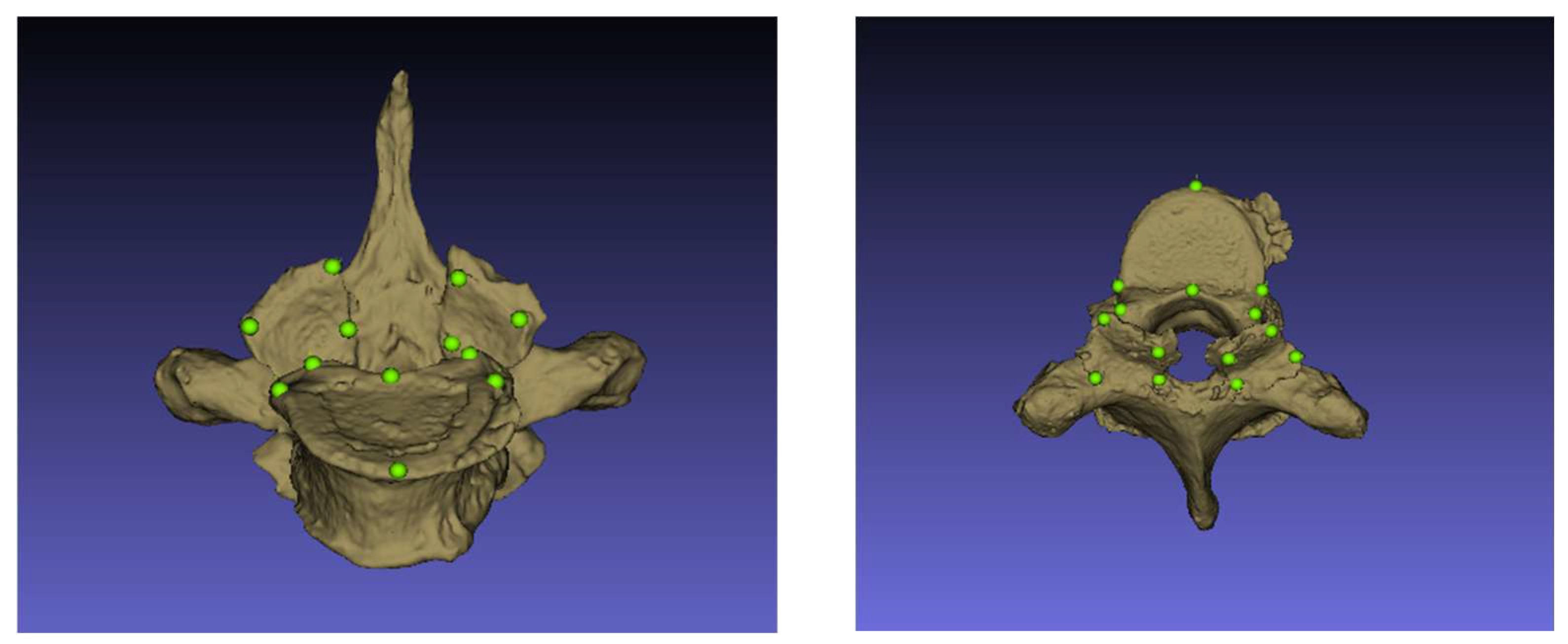
For evaluating the morphological correspondence between adjoining vertebrae, a total of fourteen landmarks were placed on the inferior rim of the body and the articular facets of the T4. Additionally, fourteen more landmarks were placed on the superior rim of the body, and the articular facets of the adjoining T5 (
Figure 1). Each landmark placed on the 3D model of T4 was then mirrored at the corresponding anatomical point on T5. The same procedure was applied to the T5–T6 vertebral pair. The precise location and anatomical description of each landmark can be seen in
Table 1.
All the landmarks were manually digitized on the MorphoDig software package (version 1.2.0, MorphoMuseuM, Université de Montpellier). Following landmark placement, the raw coordinate data were saved in “.pts” format and imported into the PAST software package (version 4.03) for statistical analysis. To remove non-shape variation, Procrustes superimposition of the landmark coordinates was applied [
13]. This allowed the translation, rotation, and scaling of the data to unit size along the central axis, thereby eliminating size differences among specimens. As a result, homologous landmarks were optimally aligned across all vertebrae, following the standard geometric morphometric protocol [
14,
15,
16,
17,
18].
Following Generalized Procrustes Analysis, Euclidean distances were calculated for all specimens to quantify shape dissimilarity. The pair of vertebrae exhibiting the smallest Euclidean distance was interpreted as showing the highest overall shape correspondence and was subsequently examined to determine whether both elements originated from the same individual and represent a true anatomical pair [
2,
19,
20,
21,
22].
In addition, Manhattan distances were calculated as a complementary, algorithmic measure of similarity to allow direct comparison with previous reassociation studies. Although Manhattan distance does not conform to the geometric assumptions of shape space and is therefore not used for biological interpretation of shape variation, it has been applied in morphometric and medical imaging contexts as a robust matching metric. The Euclidean distance squares coordinate differences and therefore exaggerates the influence of extreme values, while the Manhattan distance is used to compute the sum of absolute deviations. Euclidean and Manhattan distances produced comparable reassociation outcomes in the present study, indicating that results are not sensitive to the choice of distance metric [
2,
19,
20,
21,
22].
Aiming to evaluate the reliability and broader applicability of the proposed methodology, another vertebral pair, T6–T7, from 5 randomly selected skeletons, was analyzed. This blind test was designed to assess whether the proposed methodology could be applied across different thoracic vertebral pairs under constrained conditions, rather than to provide statistically generalizable success rates. The outcomes of this validation procedure are presented in
Section 3.
A subsample of 5 individuals was selected to assess the repeatability and reproducibility of landmark placement through intra- and inter-observer error testing. For the intra-observer test, the first author (M.V.) repeated the digitization one month after the original session, giving enough time between trials to keep them independent. For the inter-observer assessment, a second examiner (I.A.) was provided with a table including the landmark numbers and their corresponding anatomical definitions (see
Table 1). In order to quantify the measurement precision and observer consistency, both datasets were examined using the Technical Error of Measurement (TEM) [
23].
3. Results
Following the outlined methodology, a statistical analysis was conducted to evaluate morphological correspondence between adjoining vertebrae. After digitizing and applying fourteen fixed three-dimensional landmarks to homologous articular surfaces in direct contact between adjacent bones, each vertebra under study, always the lower element of the pair, was compared with all corresponding upper vertebrae in the sample. For example, in the T4–T5 pair, the T5 vertebra was compared with all T4 specimens from the dataset. The vertebra that exhibited the smallest Euclidean distance relative to the vertebra in question was considered to be morphologically the most similar in shape and size and, therefore, the most probable true anatomical pair originating from the same individual.
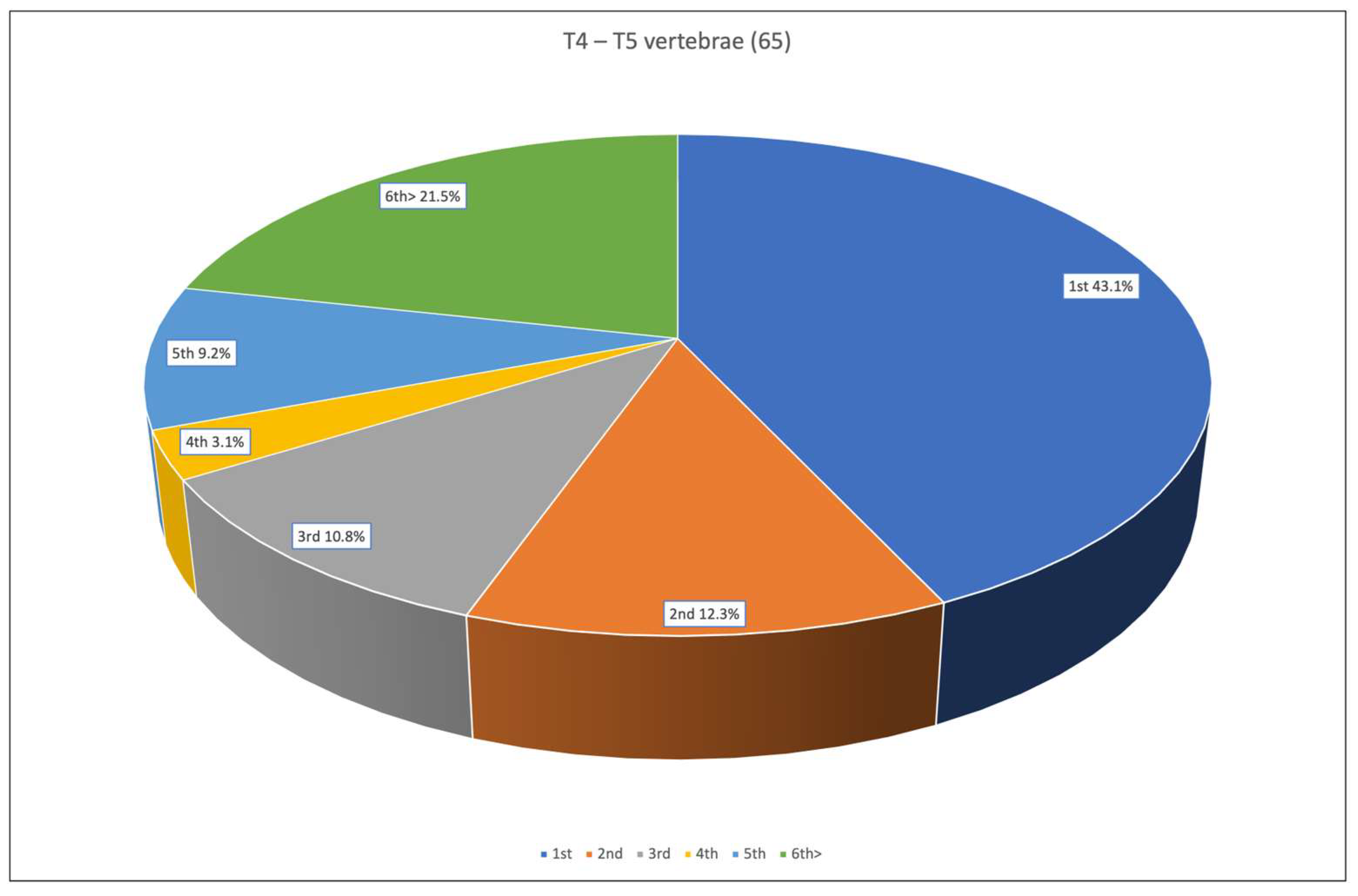
From the total of 65 analyzed T4–T5 pairs, 28 of the T5 vertebrae (43.1%) were correctly matched with the corresponding T4 from the same individual. An additional 5 T5 vertebrae (12.0%) were identified as the second closest match to their correct T4, while 7 T5 vertebrae (10.8%) were correctly matched as the third possible choice. 2 T5 vertebrae (3.1%) were correctly associated with their corresponding T4 at the fourth closest Euclidean distance, and 6 (9.2%) were matched at the fifth possible choice. Finally, 14 T5 vertebrae (21.5%) were correctly assigned only after the sixth possible choice. Overall, 43 out of 65 T5 vertebrae (66.2%) were correctly matched to their true corresponding T4 within the first three possible choices (
Figure 2).
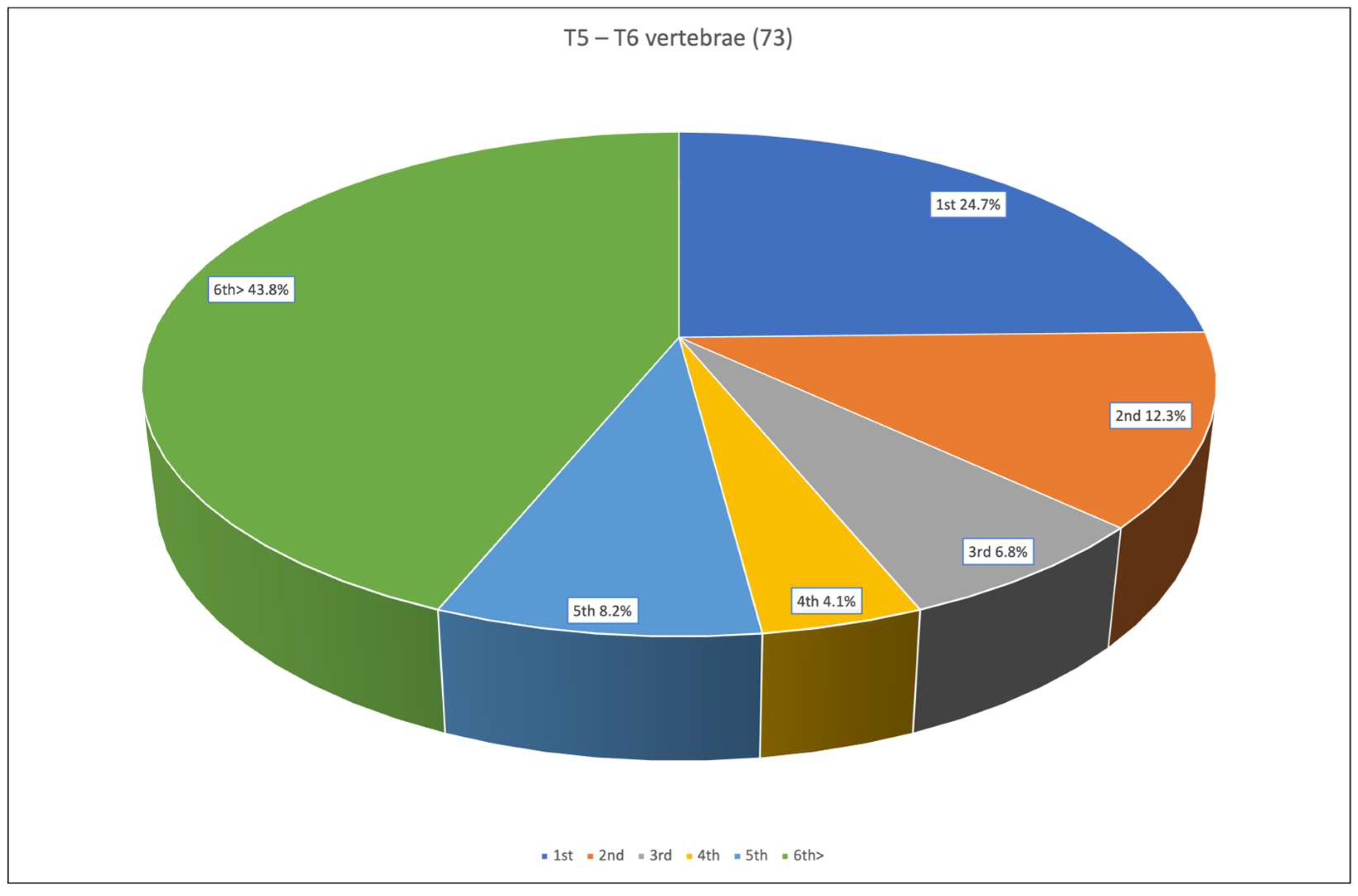
Of the 73 individuals in which the T5–T6 pairs were analyzed, 18 of the T6 vertebrae (24.7%) were correctly matched with the corresponding T5 from the same individual. An additional 9 T6 vertebrae (12.3%) were identified as the second closest match to their correct T5, while 5 T5 vertebrae (6.8%) were correctly matched as the third possible choice. 3 T6 vertebrae (4.1%) were correctly associated with their corresponding T5 at the fourth closest Euclidean distance, and 6 (8.2%) were matched at the fifth possible choice. Finally, 32 T6 vertebrae (43.8%) were correctly assigned only after the sixth possible choice. Overall, 32 out of 73 T6 vertebrae (43.8%) were correctly matched to their true corresponding T5 within the first three possible choices (
Figure 3).
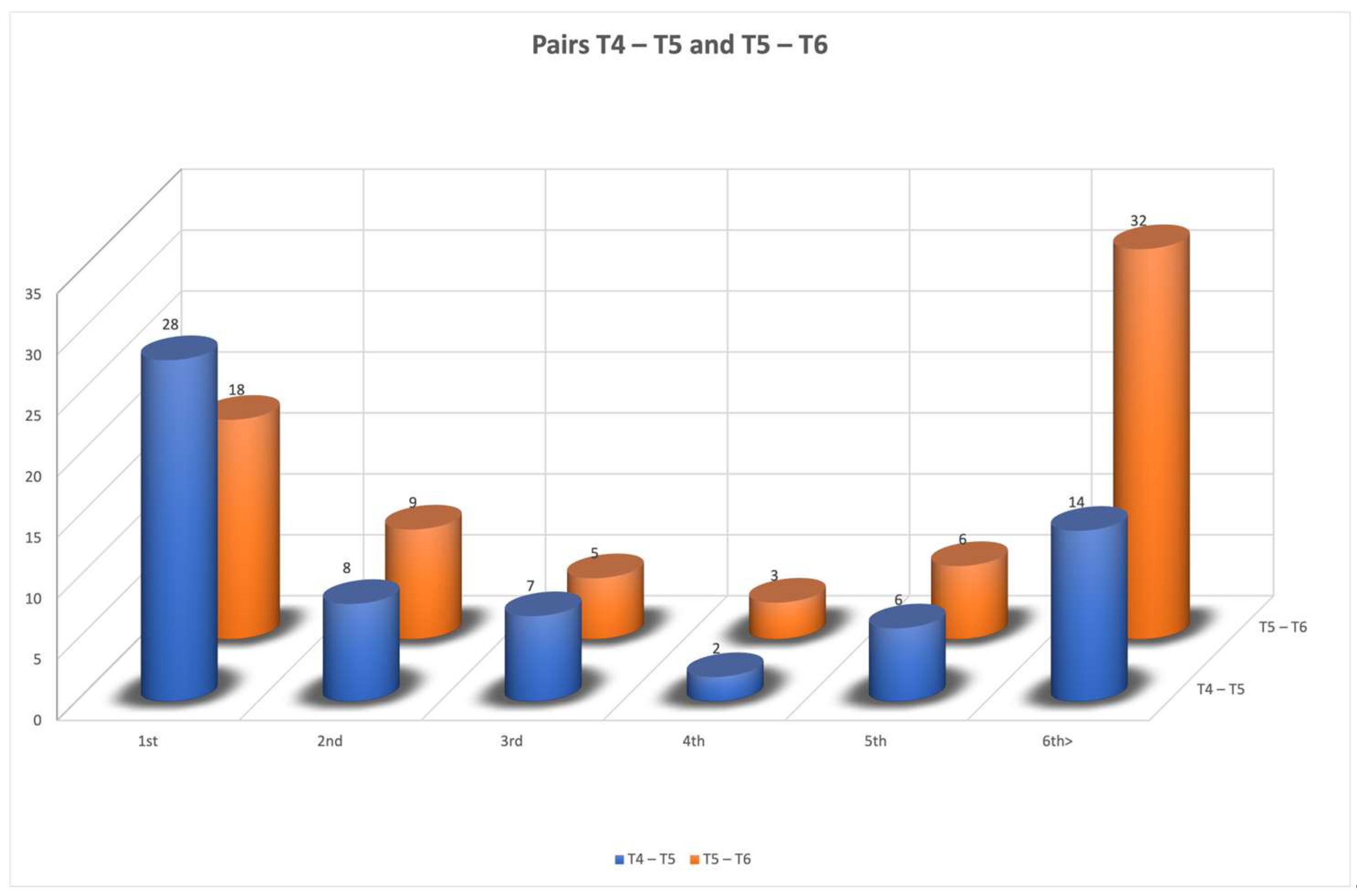
The results of both pairs were plotted on a single diagram, highlighting their similarities and differences. In the diagram, the T4–T5 pair is represented in blue color, while the T5–T6 pair is shown in orange color. The order of correct matches is displayed on the x-axis, with the numerical 1st, 2nd, 3rd, 4th, 5th, and 6th–12th, indicating at which ranking each vertebra was correctly reassociated. In both pairs, the number of correct matches decreases progressively from the first to the fifth choice, followed by an increase in the 6th–12th range. T5–T6 shows greater variability across categories, with both lower counts in early categories and a substantial spike in the final category, while T4–T5 shows a more balanced distribution, with its highest value at the first category but no extreme peaks thereafter (
Figure 4).
3.1. Blind Test
To evaluate the applicability and reproducibility of the proposed methodology, a blind test was conducted. As described in
Section 2, the same set of landmarks was applied to a new pair of vertebrae, T6–T7, from five randomly selected skeletons. The analysis revealed that, in all cases, each T7 vertebra exhibited the smallest Euclidean distance with its adjoining T6 vertebra, resulting in a 100% correct reassociation rate. While this outcome indicates that correct reassociation is achievable under limited candidate conditions, the small sample size precludes broader inference regarding method reliability.
3.2. Error Test
To evaluate how repeatable the landmark placement was for the vertebral reassociation analysis, an examination of both internal reliability and reproducibility was conducted using the TEM method. The error rates were below 1.5% and 2%, respectively. Both values fall well within the acceptable thresholds reported in the literature, confirming that landmark placement in this study was both repeatable and reproducible across different observers.
4. Discussion
The present study focused on the analysis of two pairs of consecutive thoracic vertebrae, T4–T5 and T5–T6. The selection of these vertebrae was based both on their frequency within the sample and their anatomical position. These vertebrae are a challenge for visual assessment and differentiation since they are located in the mid-thoracic region, showing subtle morphological variations. Therefore, these pairs were examined to determine whether each inferior vertebra would display the smallest Euclidean distance with its true superior counterpart and could thus be accurately reassigned to the same individual.
For the first pair (T4–T5), a total of 43.1% of the T5 vertebrae were correctly assigned to the corresponding superior T4 of the same individual. When the correct match was searched within the first three possible options, the accuracy increased to 66.2%. The lowest level of correct assignment was observed in 14 out of 65 individuals, representing the least accurate matches within this pair.
For the second pair (T5–T6), the sample consisted of 73 individuals. The results differed from those of the previous pair, with only 24.7% of the T6 vertebrae correctly assigned to their corresponding adjoining T5. When the first three possible matches were considered, the percentage increased to 43.8%, although this remained below half of the total sample. Interestingly, the vertebrae with the greatest Euclidean distances, between 6th and 8th possible choices, also showed a 43.8% rate. With correct and incorrect assignments almost equal, suggesting the method could not produce reliable results for this vertebral pair yet. In contrast, during the blind test conducted on the T6–T7 pair, all five pairs were correctly assigned, demonstrating a 100% accuracy rate in the reassociation of adjoining vertebrae.
The incorrect assignment of vertebrae may be attributed to several factors. Primarily, this could be attributed to the shape similarity of these skeletal elements across individuals, making the distinction of certain vertebrae harder. Another factor that could have affected the results may be the presence of osteophytes on the vertebrae discussed. Specifically, osteophytes—exostoses forming along the joint margins [
24]—occurred on both the superior and inferior vertebrae, leading to the alteration of the overall shape of the bones. Such formations may also aid in identifying correct pairs, as corresponding osteophytes on adjoining vertebrae can provide additional matching cues. Therefore, the placement of the landmarks was decided to include these degenerative features. The examined assemblages did not show any differences based on their geographical and chronological setting, supporting the applicability of the method across diverse contexts, including cases where vertebrae were incomplete due to taphonomical, pathological, or trauma-related factors. However, since the sample derives exclusively from Greek populations, further analyses of assemblages from additional regions are necessary to validate the broader applicability of the proposed method. Moreover, due to the material’s cemeterial origin, the age-at-death distribution found in our assemblages is skewed toward older individuals. Such a demographic framework should be considered when evaluating the results, as age-related morphological variations may affect the patterns observed. Future research could benefit from concentrating on younger individuals and non-adults, who exhibit fewer age-related alterations. Additionally, lower rates of correct assignment were exhibited on the T5–T6 pair, possibly relating to the pair’s central anatomical position within the spine, where differential biomechanical loading may have influenced morphological vertebral variation. Increased disc degeneration has been associated with shape alterations in adjacent vertebrae, particularly in the mid- and lower thoracic regions [
25]. Finally, although the present study focuses exclusively on shape variation as defined within a geometric morphometrics framework, the integration of size-related metrics may further improve reassociation performance. Such an approach would represent a distinct methodological framework and warrants dedicated investigation in future studies.
Furthermore, the results suggest that sample size influences assignment accuracy. The blind test, which involved the smallest sample (T6–T7), produced the highest correct assignment rate (100%), followed by the T4–T5 pair, and finally the largest sample, T5–T6, which showed the lowest accuracy. The disparity between the blind test and larger-sample results highlights the influence of sample size and candidate pool complexity on reassociation outcomes. The success rates in this study indicate that 3D geometric morphometrics alone do not provide a consistently reliable method for definitive reassociation of thoracic vertebrae in commingled assemblages. Correct matches frequently occurred beyond the true match, limiting the practical utility of the approach as a standalone identification tool. Based on the results of this study, shape information may still contribute value in a probabilistic or exclusionary framework, in cases of commingling, preliminary visual separation on morphological characteristics could improve the percentage of correctly reassociated vertebrae before applying geometric morphometric methods.
Author Contributions
Conceptualization, M.V., I.A. and K.M.; methodology, M.V. and I.A.; software, M.V.; validation, M.V. and I.A.; formal analysis, M.V.; investigation, M.V.; resources, M.V.; data curation, M.V.; writing—original draft preparation, M.V.; writing—review and editing, I.A. and K.M.; visualization, K.M.; supervision, K.M.; project administration, M.V.; funding acquisition, M.V. All authors have read and agreed to the published version of the manuscript.
Funding
This research was funded by In the framework of the Operational Programme “Human Resources Development, Education and Lifelong Learning” (NSRF 2014–2020)—priority axes 6, 8, 9, co-funded by Greece and the European Union (European Social Fund)—the State Scholarships Foundation (IKY): “Supporting human capital in research through doctoral studies” and A.G. Leventis Foundation.
Institutional Review Board Statement
The study was conducted in accordance with the Declaration of Helsinki and approved by the Bioethics and Code of Conduct Committee of the National and Kapodistrian University of Athens, School of Medicine (protocol code 168 and date of approval 18 September 2019).
Informed Consent Statement
The study concerns the scientific analysis of curated human skeletal collections housed in public academic institutions. In Greece, informed consent is not required for this study. The applicable legal framework consists of the following: (i) Law 4521/2018 (Ν. 4521/2018), which regulates the operation, governance, and academic responsibilities of higher education institutions, including medical schools and their collections. (ii) Law 4624/2019 (Ν. 4624/2019), which implements the General Data Protection Regulation (GDPR) in Greece and does not impose informed consent requirements for anonymized human skeletal materials from institutional collections.
Data Availability Statement
The raw data supporting the conclusions of this article will be made available by the authors on request.
Acknowledgments
This paper draws on a study carried out by the first author for her PhD at the Department of Forensic Medicine and Toxicology, National and Kapodistrian University of Athens, Greece. The material used for this study was offered by the Department of Forensic Medicine and Toxicology, National and Kapodistrian University of Athens, Greece; the Forensic Medicine Unit at the University of Crete, Greece with the help of Elena Kranioti; and the Department of History and Ethnology at the Democritus University of Thrace in Komotini, Greece with the help of Christina Papageorgopoulou.
Conflicts of Interest
The authors declare no conflicts of interest. The funders had no role in the design of the study; in the collection, analyses, or interpretation of data; in the writing of the manuscript; or in the decision to publish the results.
References
- Adams, B.J.; Byrd, J.E. (Eds.) Recovery, Analysis, and Identification of Commingled Human Remains; Humana Press: Totowa, NJ, USA, 2008; Available online: http://link.springer.com/10.1007/978-1-59745-316-5 (accessed on 23 March 2023).
- Anastopoulou, I.; Karakostis, F.A.; Harvati, K.; Moraitis, K. Accurate and semi-automated reassociation of intermixed human skeletal remains recovered from bioarchaeological and forensic contexts. Sci. Rep. 2021, 11, 20273. Available online: https://www.nature.com/articles/s41598-021-99962-x (accessed on 7 April 2022).
- LeGarde, C. Preliminary Findings from a Visual Pair-Matching Study in a Large Commingled Assemblage. Forensic Anthropol. 2018, 2, 65–71. Available online: http://journals.upress.ufl.edu/fa/article/view/810 (accessed on 26 March 2024). [CrossRef]
- Garrido Varas, C.; Intriago Leiva, M. Managing commingled remains from mass graves: Considerations, implications and recommendations from a human rights case in Chile. Forensic Sci. Int. 2012, 219, e19–e24. Available online: https://linkinghub.elsevier.com/retrieve/pii/S0379073811005706 (accessed on 23 March 2023).
- Ubelaker, D.H. A history of forensic anthropology. Am. J. Phys. Anthropol. 2018, 165, 915–923. Available online: https://onlinelibrary.wiley.com/doi/10.1002/ajpa.23306 (accessed on 21 March 2023). [PubMed]
- Anastopoulou, I.; Karakostis, F.A.; Borrini, M.; Moraitis, K. A Statistical Method for Reassociating Human Tali and Calcanei from a Commingled Context. J. Forensic Sci. 2018, 63, 381–385. Available online: https://onlinelibrary.wiley.com/doi/10.1111/1556-4029.13571 (accessed on 21 March 2023). [PubMed]
- Byers, S.N. Introduction to Forensic Anthropology; Routledge: Oxfordshire, UK, 2016; Available online: https://www.taylorfrancis.com/books/mono/10.4324/9781315642031/introduction-forensic-anthropology-steven-byers (accessed on 26 March 2024).
- Byrd, J.E.; Adams, B.J. Osteometric Sorting of Commingled Human Remains. J. Forensic Sci. 2003, 48, JFS2002189. Available online: https://www.astm.org/jfs2002189.html (accessed on 26 March 2024).
- Byrd, J.E. Models and Methods for Osteometric Sorting. In Recovery, Analysis, and Identification of Commingled Human Remains; Adams, B.J., Byrd, J.E., Eds.; Humana Press: Totowa, NJ, USA, 2008; pp. 199–220. Available online: https://doi.org/10.1007/978-1-59745-316-5_10 (accessed on 26 March 2024).
- Waldron, T. The Relative Survival of the Human Skeleton: Implications for Palaeopathology; Death, Decay, and Reconstruction: Approaches to Archaeology and Forensic Science; Manchester University Press: Manchester, UK, 1987; pp. 55–64. [Google Scholar]
- Nathena, D.; Gambaro, L.; Tzanakis, N.; Michalodimitrakis, M.; Kranioti, E.F. Sexual dimorphism of the metacarpals in contemporary Cretans: Are there differences with mainland Greeks? Forensic Sci. Int. 2015, 257, 515.e1–515.e8. [Google Scholar] [CrossRef] [PubMed]
- Ziota, C.; Lokana, C.; Moschakis, K. New archaeological evidence from Mavropigi, Eordaia in Kozani municipality. In Archaeological Work in Macedonia and Thrace, 2013, Volume 27; Ministry of Culture and Sports, Aristotle University of Thessaloniki: Thessaloniki, Greece, 2018; pp. 97–108. [Google Scholar]
- Hammer, Ø.; Harper, D.A.T.; Ryan, P.D. Past: Paleontological statistics software package for education and data analysis. Palaeontol. Electron. 2001, 4, 9. Available online: http://palaeo-electronica.org/2001_1/past/issue1_01.htm (accessed on 4 December 2025).
- Adams, D.C.; Rohlf, F.J.; Slice, D.E. A field comes of age: Geometric morphometrics in the 21st century. Hystrix Ital. J. Mammal. 2013, 24, 7–14. [Google Scholar] [CrossRef]
- Bastir, M.; Higuero, A.; Ríos, L.; García Martínez, D. Three-dimensional analysis of sexual dimorphism in human thoracic vertebrae: Implications for the respiratory system and spine morphology. Am. J. Phys. Anthropol. 2014, 155, 513–521. [Google Scholar] [CrossRef] [PubMed]
- Carew, R.M.; Morgan, R.M.; Rando, C. A preliminary investigation into the accuracy of 3D modeling and 3D printing in forensic anthropology evidence reconstruction. J. Forensic Sci. 2019, 64, 342–352. [Google Scholar] [CrossRef] [PubMed]
- Di Angelo, L.; Di Stefano, P. A new method for the automatic identification of the dimensional features of vertebrae. Comput. Methods Programs Biomed. 2015, 121, 36–48. [Google Scholar] [CrossRef] [PubMed]
- Karakostis, F.A.; Hotz, G.; Scherf, H.; Wahl, J.; Harvati, K. Occupational manual activity is reflected on the patterns among hand entheses. Am. J. Phys. Anthropol. 2017, 164, 30–40. [Google Scholar] [CrossRef] [PubMed]
- Kumar, R. Analysis of shape alignment using Euclidean and Manhattan distance metrics. In Proceedings of the 2017 International Conference on Recent Innovations in Signal Processing and Embedded Systems (RISE), Bhopal, India, 27–29 October 2017; pp. 326–331. [Google Scholar] [CrossRef]
- Dokmanic, I.; Parhizkar, R.; Ranieri, J.; Vetterli, M. Euclidean distance matrices: Essential theory, algorithms, and applications. IEEE Signal Process. Mag. 2015, 32, 12–30. [Google Scholar] [CrossRef]
- Krislock, N.; Wolkowicz, H. Euclidean distance matrices and applications. In Handbook on Semidefinite, Conic and Polynomial Optimization; Springer: New York, NY, USA, 2012; pp. 879–914. [Google Scholar]
- Lele, S.; Richtsmeier, J.T. Euclidean distance matrix analysis: Confidence intervals for form and growth differences. Am. J. Phys. Anthropol. 1995, 98, 73–86. [Google Scholar] [CrossRef] [PubMed]
- Perini, T.A.; de Oliveira, G.L.; dos Santos Ornellas, J.; de Oliveira, F.P. Technical error of measurement in anthropometry. Rev. Bras. Med. Esporte 2005, 11, 5. [Google Scholar]
- Waldron, T. Palaeopathology, 2nd ed.; Cambridge University Press: Cambridge, UK, 2020. [Google Scholar]
- Goh, S.; Tan, C.; Price, R.I.; Edmondston, S.J.; Song, S.; Davis, S.; Singer, K.P. Influence of age and gender on thoracic vertebral body shape and disc degeneration: An MR investigation of 169 cases. J. Anat. 2000, 197, 647–657. [Google Scholar] [CrossRef] [PubMed]
| Disclaimer/Publisher’s Note: The statements, opinions and data contained in all publications are solely those of the individual author(s) and contributor(s) and not of MDPI and/or the editor(s). MDPI and/or the editor(s) disclaim responsibility for any injury to people or property resulting from any ideas, methods, instructions or products referred to in the content. |