1. Introduction
Listeria monocytogenes is an opportunistic intracellular pathogen capable of causing invasive diseases, particularly in pregnant women, neonates, elderly individuals, and immunocompromised patients. Invasive listeriosis (sepsis, meningitis or meningoencephalitis) carries a high mortality, often exceeding 30–40% despite appropriate therapy [
1].
A distinctive feature of
L. monocytogenes is its ubiquity: it can be found in soil, surface water, animal reservoirs, food-processing environments, domestic refrigerators, and household water systems. It tolerates refrigeration and high salt concentrations and can form persistent biofilms [
2]. These biological properties mean that
L. monocytogenes can contaminate a wide range of ready-to-eat (RTE) foods, including delicatessen meats and traditional products, and may persist in food-processing and domestic environments.
From a forensic and legal standpoint, this ubiquity has direct consequences. In several jurisdictions, the detection of
L. monocytogenes in a patient and in a food product is sufficient to trigger a criminal investigation against food business operators, even before definitive causation has been established. In European Union countries, due to Regulation (EC) No 178/2002 of the European Parliament, food business operators may be subject to criminal investigation for negligent injury or homicide when a fatal outcome is temporally associated with the consumption of contaminated food, particularly in vulnerable individuals. Similar legal frameworks exist in other jurisdictions, where civil and criminal liability may arise from breaches of food safety obligations and failures to protect consumers from contaminated food [
3]. In the European Union, microbiological criteria for
L. monocytogenes in RTE foods are established by Commission Regulation (EC) No. 2073/2005 and subsequent amendments, which require the absence or limited growth of the pathogen in 25 g of product and specify responsibilities for food business operators and official controls [
4]. However, the evidentiary threshold in criminal proceedings is necessarily higher than that used in public health surveillance to open an epidemiological investigation.
In this context, investigating listeriosis using a generic ‘food poisoning’ paradigm may be insufficient; a pathogen-specific forensic approach is required. For L. monocytogenes, a simple co-detection in patient and food is insufficient. Investigators must build a structured chain of evidence that is tailored to the biology and epidemiology of this pathogen and integrates the following:
A detailed and chronologically coherent exposure history, aligned with the known incubation period of invasive listeriosis (median around 11 days, with 90% of cases occurring within 28 days of exposure) [
5,
6];
Traceable and representative sampling of suspected foods and alternative sources (including water systems and domestic environments), in line with EU and EURL-Lm guidance for RTE foods [
7];
Strict adherence to EU reference methods for
L. monocytogenes detection and enumeration as well as to general microbiological requirements (ISO 7218) [
8,
9,
10];
Cautious interpretation of WGS data, in line with EFSA/ECDC recommendations, especially for clonal complexes that are widely disseminated [
11,
12];
A rigorous clinical and medico-legal assessment of the proximate cause of death, distinguishing underlying conditions, precipitating infection, and immediate lethal mechanism.
If this pathogen-specific chain is not constructed from the outset, subsequent medico-legal opinions—whether for the prosecution or the defence—will rely on incomplete or biased material. This can lead to higher costs for the State (prolonged, inconclusive proceedings, conflicting expert reports) and a substantial risk of injustice for both defendants and victims.
In this article, we present a fatal case of listeriosis in a severely immunocompromised woman, initially attributed to a traditional pork offal product from a small farm. Rather than focusing solely on the outcome of the specific trial, we use the case as a didactic, methodological example. Through a multidisciplinary review involving forensic medicine, infectious diseases and food hygiene, we show how weaknesses in sampling strategy, laboratory procedures, source attribution and clinical assessment can compromise the pathogen-specific evidence chain required in listeriosis.
This study aims are as follows:
- (i)
Reconstruct the clinical and forensic timeline of the case;
- (ii)
Analyse where the pathogen-specific chain of evidence for L. monocytogenes was incomplete or flawed;
- (iii)
Discuss how such weaknesses generate additional costs and uncertainties for the criminal justice system;
- (iv)
Propose practical methodological recommendations for medico-legal experts advising both prosecutors and defence teams in listeriosis cases.
2. Materials and Methods
This is a retrospective medico-legal methodological analysis starting from a existing case. Clinical information was obtained from hospital medical records (emergency department, oncology ward and intensive care unit), nursing notes, and laboratory reports. Forensic and epidemiological data were retrieved from official documents of veterinary and public health authorities, including sampling forms, laboratory results and communications from regional and national reference laboratories for L. monocytogenes.
The analytical framework used to assess the evidence chain was built by integrating the following:
EU food safety regulations concerning L. monocytogenes in RTE foods;
ISO standards for detection, enumeration, and general microbiological procedures;
EFSA/ECDC technical reports on WGS use in foodborne outbreaks;
Published epidemiological data on incubation periods of invasive listeriosis [
12].
Patient identifiers were removed, and the case is presented in an anonymised form. According to local regulations, single anonymised case reports and medico-legal analyses do not require formal ethics committee approval when no identifiable personal data is disclosed.
3. Results
3.1. Patient History
A 60-year-old woman had a history of autoimmune thyroiditis with hypothyroidism, asthma, previous cervical disc surgery, and meningococcal meningitis in 2019 with residual right-leg weakness, bilateral hypoacusis, and left ptosis. Since 2020, she had symptomatic IgG lambda multiple myeloma with multiple osteolytic lesions, was receiving second-line treatment with pomalidomide and weekly dexamethasone, and was considered in complete remission at her last haematologic follow-up.
Chronic medication included L-thyroxine, pregabalin, prolonged-release oxycodone, pomalidomide, dexamethasone, and prophylactic low-molecular-weight heparin. Functionally, she alternated between bed and armchair, reflecting significant frailty.
Onset of Illness and Hospital Admission
According to emergency department (ED) records, the patient had asthenia and vomiting for two days before admission; on 9 February 2024, she presented with high fever (39.4 °C) and confusion. On arrival, she was febrile and confused, with a soft but diffusely tender abdomen and preserved peristalsis. Laboratory tests showed normal haemoglobin, mild thrombocytopenia, leucopenia with neutrophil predominance, elevated C-reactive protein and procalcitonin, and normal renal function. Chest X-ray showed chronic changes only; abdominal X-ray showed marked faecal loading with rectal faecaloma. The ED diagnosed sepsis in an immunocompromised patient and admitted her to the oncology ward, where empiric intravenous piperacillin/tazobactam was started.
3.2. Neurological Deterioration and Diagnosis of Listeria Meningitis
Neurological assessment documented spontaneous eye opening but absent speech, axial hypertonia with neck stiffness, bilateral hyporeactive pupils, and severe diffuse weakness. Brain CT showed extensive osteolytic skull lesions attributable to myeloma, chronic ischaemic changes, and diffuse brain atrophy, without acute haemorrhage or mass effect. Vancomycin was added.
On 12 February, the patient deteriorated with septic shock, oliguria, acute kidney injury, and refractory hyperpyrexia. She was intubated and transferred to the intensive care unit (ICU). Lumbar puncture yielded turbid CSF; analysis showed very high protein, elevated glucose, and mixed polymorphonuclear/mononuclear pleocytosis. Multiplex PCR (“FilmArray”) detected L. monocytogenes, whereas conventional culture remained negative. Ampicillin (12 g/day continuous infusion) and gentamicin, as commonly performed in complicated infections, were initiated and later adjusted for renal impairment; gentamicin was eventually discontinued on infectious disease advice. Blood cultures taken on 13 February and 4 March were negative; no report of the 9 February ED blood culture was present in the hospital files, although this sample was later used by the reference laboratory for sequencing.
3.3. ICU Course and Outcome
The patient remained critically ill, with haemodynamic instability requiring norepinephrine, acute renal failure treated by continuous venovenous haemodiafiltration, and respiratory failure with bilateral basal lung involvement and left lower-lobe atelectasis and effusion. From 15 February onwards, nursing notes repeatedly described melena or “feci picee”, with parallel falls in haemoglobin requiring multiple transfusions. No upper GI endoscopy was performed; treatment consisted of proton pump inhibitors and transfusions.
By 20–21 February, she became apyretic, inflammatory markers (CRP, procalcitonin) decreased steadily, and renal function improved. Neurologically, she evolved to a “coma vigile” state with partial eye opening and minimal motor responses. A percutaneous tracheostomy was performed on 29 February to facilitate weaning. Brain CT on 1 March showed no new lesions compared with 11 February (
Figure 1).
On 2 March, ventilation was partially assisted, renal and coagulation parameters were near normal, and sepsis markers were low. On 3 March, however, fever recurred together with further melena and a marked drop in haemoglobin to 6.3 g/dL, requiring urgent transfusion. On 4 March, amid ongoing GI bleeding, haemodynamic deterioration and renewed fever, the patient suffered cardiocirculatory collapse and died shortly thereafter. No autopsy was performed.
3.4. Forensic and Epidemiological Investigation
Following notification of invasive listeriosis, veterinary services and the public health department initiated a foodborne outbreak investigation. Based on the husband’s initial statements, a home-made pork offal product (“soprassata”) produced by a specific farm was considered the likely vehicle. The family reported purchasing it between late December and early January and consuming it in early January; a bank receipt dated 2 February was later used to identify a supposedly “compatible” lot.
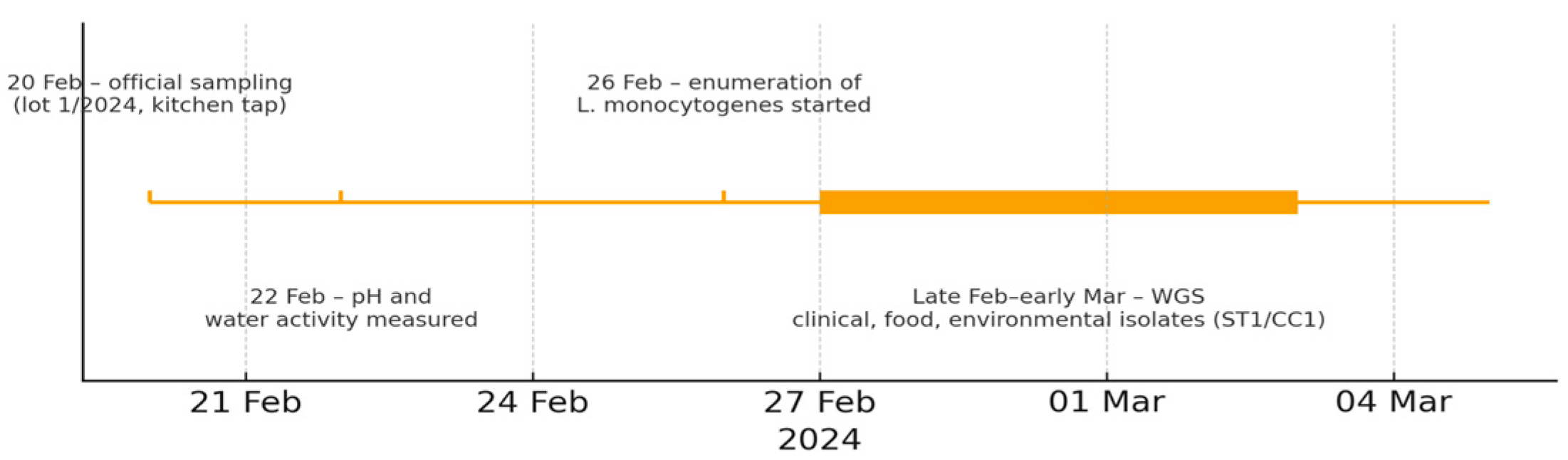
Since no leftover product was available at home, official sampling on 20 February 2024 targeted prepacked units labelled as lot 1/2024 at a retail outlet. Five units were pooled for Listeria testing, and one additional unit was used to determine pH and water activity. L. monocytogenes was detected qualitatively in all five units and enumerated at levels above the regulatory limit.
On the same date, environmental swabs were collected from the domestic refrigerator and kitchen sink;
L. monocytogenes was recovered only from the tap/sink swab. The household relied exclusively on well water for drinking and domestic use. Although an official well water sample was reportedly planned, no traceable documentation or results were found. A privately commissioned rapid water test yielded negative results but lacked formal validation and accreditation [
13].
All isolates (one “clinical”, ten food, one environmental) were subsequently typed and sequenced at regional and national reference laboratories. Multilocus sequence typing (MLST) identified them all as ST1/CC1; core-genome MLST and SNP analysis showed close genomic relatedness. National and European surveillance data indicate that ST1/CC1 is among the most common clinical clonal complexes of
L. monocytogenes, associated with multiple clusters across different regions [
14].
Based on the microbiological and genomic findings, prosecutors hypothesised that the patient had acquired fatal listeriosis by consuming contaminated “soprassata” from the farm, and they opened a criminal case against the producer for foodborne homicide and mismanagement of food safety.
3.5. Methodological Analysis of the Evidence Chain
3.5.1. Temporal Coherence and Incubation Period
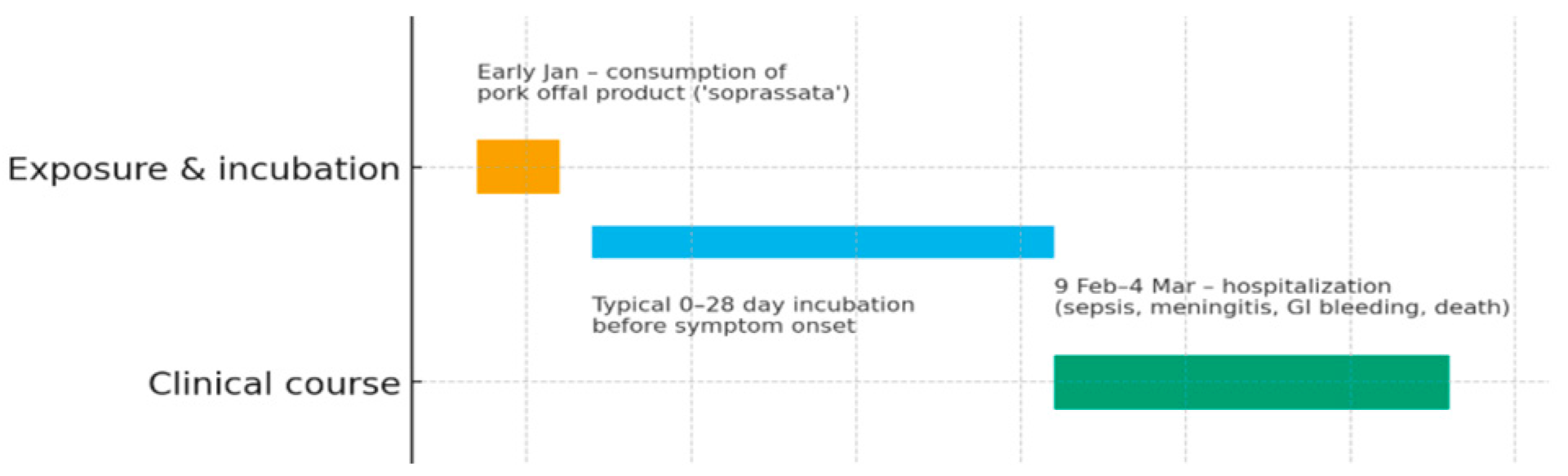
Epidemiological studies of invasive listeriosis report a median incubation period of approximately 11 days, with an estimated 90% of cases occurring within 28 days of exposure. In this case, the husband reported that the pork offal product was consumed in early January, while symptom onset occurred around 7–9 February, more than 30 days later. This interval lies beyond the range in which most invasive cases are expected to occur and should have prompted exploration of more recent exposures and alternative reservoirs before focusing on a single product and producer.
From a pathogen-specific perspective, temporal coherence with the incubation period is a first filter in constructing a plausible evidence chain. When exposure–disease intervals are implausible, subsequent links in the chain (sampling, WGS, clinical causation) become fragile regardless of their apparent strength (
Figure 2) [
5,
6].
3.5.2. Traceability and Sampling Strategy
The “compatibility” between the product consumed and lot 1/2024 was inferred retrospectively from a bank receipt and delivery records, without direct proof that this lot was available at the time of purchase in late December–early January. It is more plausible that the family consumed an earlier production lot, likely from 2023, which was no longer present when official sampling took place.
For a pathogen as ubiquitous as L. monocytogenes, traceability is an integral part of the evidence chain. EU regulation assigns responsibilities both to food business operators and to official controls for the verification of microbiological criteria in RTE foods.
However, if the sampled lot cannot be reasonably equated with the product actually ingested, microbiological findings cannot be treated as direct evidence about the patient’s exposure [
15].
A pathogen-specific investigative approach would favour the following:
Prioritising leftover portions and kitchen samples whenever available;
Systematic sampling of all relevant RTE foods, domestic environments and, in this case, well water;
Detailed documentation of the sampling context and lot history.
3.5.3. Laboratory Methods and Adherence to Standards
The laboratory procedures in this case raised several methodological issues:
Detection and enumeration of
L. monocytogenes in food and environmental samples should follow EN ISO 11290-1 and 11290-2, which define horizontal methods for detection and enumeration of
L. monocytogenes in food, feed, and environmental samples [
8,
9].
General handling of microbiological samples, including transport and storage, should comply with ISO 7218, which emphasises that samples must be transported under appropriate temperature control and examined as soon as possible, preferably within 24 h, to avoid artificial changes in bacterial load [
10].
In the present case, while pH and water activity were measured on 22 February, enumeration of L. monocytogenes began on 26 February—four days after opening the vacuum-packed sample. Storage conditions during this interval and transport temperatures were not documented. Given the ability of L. monocytogenes to grow at refrigeration temperatures, such delays and unknown conditions could significantly increase the measured counts, compromising any quantitative assessment of risk.
In addition, the only documented clinical evidence of L. monocytogenes infection was the positive CSF PCR; CSF culture and subsequent blood cultures were negative. The “clinical” isolate used for WGS was reported as derived from a 9 February blood culture whose positivity does not appear in the clinical records and for which no analytical chain-of-custody was provided.
For medico-legal purposes, these aspects illustrate how deviations from ISO standards and incomplete documentation weaken the pathogen-specific evidence chain, regardless of WGS results.
3.5.4. WGS Interpretation in Context
WGS is now widely recognised as a powerful tool for detecting and delineating foodborne outbreaks, including those involving
L. monocytogenes. However, EFSA and ECDC stress that genomic relatedness must always be interpreted in the context of epidemiological data, sampling strategy, and background prevalence of specific clonal complexes [
11].
In this case, all isolates (clinical, food, environmental) were ST1/CC1 and highly related. Yet, ST1/CC1 is one of the most frequently observed clonal complexes in European listeriosis surveillance and has been implicated in multiple multi-country clusters. In a pathogen that is both ubiquitous and genetically structured into a limited number of common clones, finding the “same” clone in patient and food does not, by itself, prove a direct causal link [
11].
Furthermore, uncertainties about the origin and documentation of the “clinical” isolate reduce the weight that can be attributed to WGS findings. In a pathogen-specific forensic approach, WGS should be used as one link in a chain that is already coherent in terms of exposure, traceability and laboratory methods—not as a stand-alone proof of causation [
16].
3.5.5. Alternative Infection Sources
The official questionnaire listed numerous other foods consumed by the patient (various meats, sausages, cured meats, fish, dairy products, vegetables, and ready-to-eat items), many of which are typical vehicles for L. monocytogenes. None of these items was investigated microbiologically.
More importantly, environmental sampling identified L. monocytogenes on the kitchen tap, in a household supplied exclusively by well water. Scientific reports and technical guidance acknowledge that L. monocytogenes can persist in water systems and biofilms, and that contamination of domestic environments may act as a reservoir. In the absence of a properly documented official investigation of well water, contaminated water remains a plausible alternative reservoir compatible with the environmental findings and the patient’s exposure pattern.
In a pathogen-specific evidence chain, alternative sources of infection should be explicitly considered and investigated, especially when the temporal link to a single food is weak.
From a prosecutorial or public health perspective, an alternative interpretation is that the co-detection of ST1/CC1 in patient, food and kitchen environment reflects a single contamination event linked to the suspected product. However, in a forensic setting the probative weight of this hypothesis depends on time-anchored exposure history, demonstrable lot equivalence, and documented laboratory chain-of-custody; when these elements are incomplete, alternative reservoirs remain methodologically plausible.
3.5.6. Clinical Causation and Proximate Cause of Death
Finally, the medico-legal assessment of proximate cause must distinguish between
L. monocytogenes infection as a precipitating disease and the immediate mechanism of death [
17].
In this case, the patient developed invasive listeriosis with meningitis and septic shock but later showed improvement: she became apyretic, inflammatory markers decreased, and organ function partially recovered. In parallel, from 15 February onwards, she experienced recurrent melena and progressive anaemia, requiring multiple transfusions without endoscopic evaluation or haemostatic intervention. At the time of the fatal deterioration, inflammatory markers and leukocyte counts had largely normalised, and microbiological tests near death were negative, while there was ongoing and clinically significant GI blood loss [
18].
In the absence of autopsy, cause-of-death determination remains open; the most plausible interpretation is that the patient died from hypovolemic shock due to upper GI bleeding, in the context of severe frailty and recent invasive listeriosis. From a medico-legal perspective, invasive listeriosis acted as a serious contributing condition, but the immediate lethal mechanism was more likely massive uncontrolled bleeding than overwhelming sepsis. This distinction is important when evaluating the causal link between food contamination and death [
19,
20,
21].
4. Discussion
Implications for Criminal Attribution and Forensic Methodology
This case illustrates how early, pathogen-specific planning of the investigation could have strengthened or falsified the hypothesis of foodborne homicide, with potential benefits for all parties.
A robust investigation of fatal listeriosis, consistent with EU regulations and technical guidance, would typically include the following:
Activation of national listeriosis surveillance protocols with a complete, time-anchored exposure history and integration of human, veterinary, and environmental data, rather than premature focus on a single food item;
A structured sampling plan, designed jointly by prosecutors, health authorities, and reference laboratories, in line with EFSA/ECDC and EURL-Lm guidance, including systematic sampling of RTE foods, food-processing and domestic environments, and water systems when indicated;
Verification that official laboratories apply the EU reference methods for detection and enumeration of L. monocytogenes and handle samples according to ISO 7218, with documented transport conditions and minimal delay between sampling and analysis;
Interpretation of WGS results within this regulatory and epidemiological framework, acknowledging that genomic relatedness alone cannot demonstrate a direct causal link in the absence of robust traceability and representative sampling;
Once a criminal investigation for foodborne homicide has been opened, performance of a full forensic autopsy with targeted histological and microbiological sampling to clarify the proximate cause of death and the relative contribution of infection, underlying disease and possible iatrogenic factors.
From a forensic standpoint, a medico-legal autopsy in suspected fatal listeriosis should aim to document both the presence and the extent of invasive infection and the immediate mechanism of death. Recommended sampling would include blood, cerebrospinal fluid, and tissue samples from central nervous system, liver, spleen, and gastrointestinal tract for microbiological culture and molecular testing, as well as systematic histopathological examination. Demonstration of invasive disease with tissue involvement, inflammatory response, or organ dysfunction consistent with listeriosis is essential before the infection can be considered the proximate cause of death, particularly in patients with significant comorbidities.
For prosecutors, such a pathogen-specific framework can increase the probative value of microbiological and genomic findings, reduce the risk of initiating lengthy and costly proceedings on weak evidence and focus resources on truly high-risk situations. For the defence, transparent documentation of each step of the evidence chain facilitates critical review and protects the right to adversarial testing of evidence. For the State, investing in high-quality initial investigations yields economic benefits by reducing inconclusive trials and conflicting expert opinions and improving the overall efficiency and fairness of the justice system.
5. Conclusions
In this criminal case, a combination of epidemiological incongruities, traceability gaps, deviations from microbiological standards, non-specific genomic findings, and clinical data inconsistent with death from active listerial sepsis led to substantial doubt about the attribution of both infection and death to a specific pork offal product and alleged food mismanagement by the producer.
Beyond the outcome of the individual trial, the investigation provides a methodological template for forensic practice in listeriosis:
Listeria monocytogenes is an ubiquitous pathogen, and causal attribution in criminal proceedings requires a pathogen-specific chain of evidence, not merely co-detection of the organism in patient and food.
This chain must include coherent timing with the incubation period, documented traceability of food lots and alternative exposures, strict adherence to ISO and EU microbiological standards, context-aware interpretation of WGS data, and rigorous clinical assessment of the proximate cause of death.
When these elements are integrated from the beginning of the investigation, the justice system benefits from more efficient and less costly proceedings, and both defendants and victims benefit from a higher level of substantive fairness.
In this context, the absence of a medico-legal autopsy represents a critical limitation. When criminal attribution is considered in suspected fatal listeriosis, a forensic autopsy is essential to assess the extent and distribution of infection, to document alternative lethal mechanisms, and to obtain appropriate biological samples for microbiological and histopathological analysis. Reliance on clinical records alone is insufficient to support robust causal inference in a criminal setting.
We propose that this case be understood not only as a disputed attribution of responsibility but as an example of pathogen-specific medico-legal methodology in listeriosis. The same approach—early involvement of forensic experts, careful design of sampling and laboratory work, and structured causal reasoning—may be adapted to other ubiquitous pathogens at the interface of epidemiology, microbiology, and criminal law.
Author Contributions
Conceptualization, S.F.; Methodology, R.M.; Validation, S.F. and P.G.M.; Formal analysis, S.F.; Investigation, F.R.; Resources, V.G.; Writing—original draft, S.F. and P.G.M.; Writing—review & editing, S.F., M.F., L.F. and P.G.M.; Supervision, L.F. and P.G.M.; Project administration, P.G.M.; Funding acquisition, S.F. and P.G.M. All authors have read and agreed to the published version of the manuscript.
Funding
This research received no external funding.
Institutional Review Board Statement
Not applicable. This study was conducted in accordance with Italian national regulations. The principles outlined in the Declaration of Helsinki were respected insofar as they are applicable to retrospective studies on deceased individuals. According to the Italian Ministry of Health Decree of 8 February 2013 (Criteri per la composizione e il funzionamento dei comitati etici), ethics committee approval is required only for studies involving living human subjects or clinical trials. This study involved only deceased individuals, and all information was fully anonymised before analysis; therefore, ethics committee approval was not required.
Informed Consent Statement
Not applicable. Informed consent for participation was not required as per Italian legislation (Legislative Decree No. 196/2003, Article 110, as amended) and Regulation (EU) 2016/679, since the study was conducted exclusively on fully anonymised retrospective data.
Data Availability Statement
No new data were created or analysed in this study. Data sharing is not applicable due to privacy and ethical restrictions.
Conflicts of Interest
The authors declare no conflicts of interest.
References
- Vazquez-Boland, J.A.; Kuhn, M.; Berche, P.; Chakraborty, T.; Dominguez-Bernal, G.; Goebel, W.; González-Zorn, B.; Wehland, J.; Kreft, J. Listeria pathogenesis and molecular virulence determinants. Clin. Microbiol. Rev. 2001, 14, 584–640. [Google Scholar] [CrossRef] [PubMed]
- Finn, L.; Gil, M.I.; McClure, P.; Holah, J.; McCabe, E.; Fanning, S. Listeria monocytogenes biofilms in food-associated environments: A persistent enigma. Foods 2023, 12, 3339. [Google Scholar] [CrossRef] [PubMed]
- Cavico, F.J.; Mujtaba, B.G.; Muffler, S.; Samuel, M.; Polito, N.M. Restaurant liability for contaminated food and beverages pursuant to negligence, warranty, and strict liability laws. Glob. J. Soc. Sci. Stud. 2017, 3, 63–100. [Google Scholar] [CrossRef]
- Commission of the European Communities. Commission Regulation (EC) No 2073/2005 of 15 November 2005 on microbiological criteria for foodstuffs. Off. J. Eur. Union 2005, L338, 1–26. [Google Scholar]
- Goulet, V.; King, L.A.; Vaillant, V.; de Valk, H. What is the incubation period for listeriosis? BMC Infect. Dis. 2013, 13, 11. [Google Scholar] [CrossRef] [PubMed]
- Angelo, K.M.; Jackson, K.A.; Wong, K.K.; Hoekstra, R.M.; Jackson, B.R. Assessment of the incubation period for invasive listeriosis. Clin. Infect. Dis. 2016, 63, 1487–1494. [Google Scholar] [CrossRef] [PubMed]
- European Union Reference Laboratory for Listeria monocytogenes (EURL Lm). Technical Guidance Document on Sampling the Food Processing Area and Equipment for the Detection of Listeria monocytogenes. Version 4, 2023. Available online: https://zenodo.org/records/8406616 (accessed on 10 February 2026).
- ISO 11290-1:2017; Microbiology of the Food Chain—Horizontal Method for the Detection of Listeria monocytogenes and of Listeria spp.—Part 1: Detection Method. International Organization for Standardization (ISO): Geneva, Switzerland, 2017.
- ISO 11290-2:2017; Microbiology of the Food Chain—Horizontal Method for the Enumeration of Listeria monocytogenes and of Listeria spp.—Part 2: Enumeration method. International Organization for Standardization (ISO): Geneva, Switzerland, 2017.
- ISO 7218:2007; Microbiology of the Food Chain—General Requirements and Guidance for Microbiological Examinations. International Organization for Standardization (ISO): Geneva, Switzerland, 2007.
- Koutsoumanis, K.; Allende, A.; Alvarez-Ordóñez, A.; Bolton, D.; Bover-Cid, S.; Chemaly, M.; Davies, R.; De Cesare, A.; Hilbert, F.; Lindqvist, R.; et al. Whole genome sequencing and metagenomics for outbreak investigation, source attribution and risk assessment of food-borne microorganisms. EFSA J. 2019, 17, e05898. [Google Scholar] [CrossRef] [PubMed]
- European Food Safety Authority; European Centre for Disease Prevention and Control. The Use of Whole Genome Sequencing in the Surveillance of Food-Borne Pathogens; EFSA Supporting Publications: Parma, Italy, 2021. [Google Scholar] [CrossRef]
- Moura, A.; Lefrancq, N.; Wirth, T.; Leclercq, A.; Borges, V.; Gilpin, B.; Dallman, T.J.; Frey, J.; Franz, E.; Nielsen, E.M.; et al. Listeria CC1 Study Group. Emergence and global spread of Listeria monocytogenes main clinical clonal complex. Sci. Adv. 2021, 7, eabj9805. [Google Scholar] [CrossRef] [PubMed]
- Gattuso, A.; Cella, E.; Fillo, S.; Ortoffi, M.F.; Angeletti, S.; Ciccozzi, M.; De Medici, D.; Lista, F.; Fiore, A. Phylogenetic and evolutionary genomic analysis of Listeria monocytogenes clinical strains in the framework of foodborne listeriosis risk assessment. Front. Microbiol. 2022, 13, 816880. [Google Scholar] [CrossRef]
- Bjergbæk, L.A.; Iversen, M.H.; Albrechtsen, H.J. Survival of animal- and human-associated Listeria monocytogenes in drinking water distribution systems. Water Supply 2021, 21, 3515–3527. [Google Scholar] [CrossRef]
- Prieto, B.D.; Pietzka, A.; Martinovic, A.; Ruppitsch, W.; Bogdanovic, I.Z. Surveillance and genetic characterization of Listeria monocytogenes from food production in Montenegro: A whole genome sequencing approach. Front. Microbiol. 2024, 15, 1418333. [Google Scholar] [CrossRef]
- Koopmans, M.M.; Bijlsma, M.W.; Brouwer, M.C.; van de Beek, D. Human listeriosis. Clin. Microbiol. Rev. 2023, 36, e00060-19. [Google Scholar] [CrossRef] [PubMed]
- EEvans, L.; Rhodes, A.; Alhazzani, W.; Antonelli, M.; Coopersmith, C.M.; French, C.; Machado, F.R.; Mcintyre, L.; Ostermann, M.; Prescott, H.C.; et al. Surviving sepsis campaign: International guidelines for management of sepsis and septic shock 2021. Intensive Care Med. 2021, 47, 1181–1247. [Google Scholar] [CrossRef] [PubMed]
- Gralnek, I.M.; Stanley, A.J.; Morris, A.J.; Camus, M.; Lau, J.; Lanas, A.; Laursen, S.B.; Radaelli, F.; Papanikolaou, I.S.; Gonçalves, T.C.; et al. Endoscopic diagnosis and management of acute non-variceal upper gastrointestinal bleeding: ESGE Guideline. Endoscopy 2021, 53, 300–332. [Google Scholar] [CrossRef] [PubMed]
- Laursen, S.B.; Dalton, H.R.; A Murray, I.; Michell, N.; Johnston, M.R.; Schultz, M.; Hansen, J.M.; De Muckadell, O.B.S.; Blatchford, O.; Stanley, A.J.; et al. Performance of new thresholds of the Glasgow Blatchford score in managing patients with upper gastrointestinal bleeding. Clin. Gastroenterol. Hepatol. 2015, 13, 115–121.e2. [Google Scholar] [CrossRef] [PubMed]
- Manyi-Loh, C.E.; Tufa, T.B.; Mamphogoro, T.P. Listeria monocytogenes and listeriosis: The global enigma. Foods 2025, 14, 1266. [Google Scholar] [CrossRef] [PubMed]
| Disclaimer/Publisher’s Note: The statements, opinions and data contained in all publications are solely those of the individual author(s) and contributor(s) and not of MDPI and/or the editor(s). MDPI and/or the editor(s) disclaim responsibility for any injury to people or property resulting from any ideas, methods, instructions or products referred to in the content. |




 ,
,