


Abstract
Although an isosporan coccidian has been reported from the broad-headed skink, Plestiodon laticeps (Schneider), no acroeimerians are known from this reptile. A single fecal sample was collected by hand in June 2025 from a female P. laticeps from Nevada County, Arkansas, USA. The sample was placed in a vial containing 2.5% potassium dichromate. It was examined for sporulated oocysts after flotation in Sheather’s sugar solution, measured, and photographed. The skink was found to be passing a new species of Acroeimeria Paperna and Landsberg, 1989. Oocysts of Acroeimeria nevadaensis sp. n. were spheroidal with a smooth bi-layered wall, measured (L × W) 15.6 × 13.7 µm, and had a length/width (L/W) (shape index) average ratio of 1.1; micropyle and oocyst residuum were absent but one to two polar granule(s) were present. Sporocysts are ovoidal and measured 7.7 × 5.9 µm, L/W ratio of 1.3; Stieda, sub-Stieda, and para-Stieda bodies were absent. The sporocyst residuum was composed of a loose aggregate of various-sized granules between and across the sporozoites but sometimes a compact, rounded, or irregular mass. In addition, new data on oocysts matching the description of Choleoeimeria fasciatus from the same host are provided. Here, we document a description of a new species of Acroeimeria as well as provide a new host and geographic distribution record, photomicrographs, and mensural and morphological data for a choleoeimerian from this skink. This is the first acroeimerian reported to be from P. laticeps and, more importantly, the second known to be from members of the family Scincidae of the world.
1. Introduction
The broad-headed skink, Plestiodon laticeps (Schneider), is a medium-sized member of the family that has a broad geographic range from southeastern Pennsylvania to central Florida and west to eastern Kansas and Texas, USA [1]. In Arkansas, USA, P. laticeps is found statewide in suitable wooded habitats, including in rotting logs, under flat rocks, around woodpiles, and in trash piles within old sheds and barns [2]. They primarily feed on small insects and other arthropods.
A single coccidian parasite is known to come from P. laticeps: Isospora scinci Upton, McAllister, and Trauth, 1991 from Arkansas, USA [3]. However, to our knowledge, there are no other coccidians known to be from P. laticeps. Here we describe a new species of Acroeimeria Paperna and Landsberg, 1989 from P. laticeps from southwestern Arkansas, as well as present new data on Choleoeimeria fasciatus (Upton, McAllister, and Trauth, 1991) Paperna and Landsberg, 1989.
2. Materials and Methods
2.1. Collection and Necropsy
On 16 June 2025, a single female P. laticeps was collected by hand on private land by a private individual and euthanized with an intraperitoneal injection of concentrated tricaine methanesulfonate. A mid-ventral incision was made from its throat to its anus, and feces from the rectum were collected. Unfortunately, no tissues were saved, and the fecal sample was forwarded to one of us (C.T.M.) for processing.
2.2. Morphological Characterization
The sample was placed in an individual vial containing 2.5% (w/v) aqueous potassium dichromate (K2Cr2O7) and transferred to a Petri dish containing a small layer of K2Cr2O7 at room temperature (23 °C) for 48–72 h to allow for sporulation. After flotation in Sheather’s sugar solution (specific gravity = 1.30), the sample was examined again using an Olympus BX43 light microscope (Olympus Corporation, Center Valley, PA, USA). All morphological measurements are reported in micrometers (µm) with the means followed by the ranges in parentheses. Photographs were taken using Nomarski interference-contrast optics at ×1000 magnification. Oocysts were ca. 20 days old when measured and photographed. Descriptions of oocysts and sporocysts follow the standard guidelines of Wilber et al. [4], including oocyst length (L) and width (W) and their ranges and ratios (L/W), micropyle (M), oocyst residuum (OR), polar granule(s) (PG), sporocyst length (L) and width (W) and their ranges and ratio (L/W), sporocyst (SP), Stieda body (SB), sub-Stieda body (SSB), para-Stieda body (PSB), sporocyst residuum (SR), sporozoites (SZ) anterior (ARB) and posterior (PRB) refractile bodies, and nucleus (N).
2.3. Deposition of Voucher Specimens
Photovouchers of sporulated oocysts were accessioned in the Harold W. Manter Laboratory of Parasitology (HWML), University of Nebraska, Lincoln, NE, USA. The host voucher was accessioned in the Northeast Texas Community College (NTCC) Vertebrate Collection, Mt. Pleasant, TX, USA. Current common and scientific names of skinks follow Nicholson [5].
3. Results
3.1. Description of the New Species
Phylum Apicomplexa Levine, 1970
Class Conoidasida Levine, 1988
Subclass Coccidia Leuckart, 1879
Order Eucoccidiorida Léger & Duboscq, 1911
Suborder Eimeriorina Léger, 1911
Family Eimeriidae Minchin, 1903
Genus Acroeimeria Paperna and Landsberg, 1989
Figure 1.
(A–D). Nomarski interference-contrast photomicrographs of sporulated oocysts of Acroeimeria nevadaense sp. n. from broad-headed skink, Plestiodon laticeps. (A) PG (polar granule); sporocyst residuum (SR). (B) OW (oocyst wall); PG. (C) Lipid droplet (LD); SR. (D) PRB (posterior refractile body). Scale bars: 5 µm.
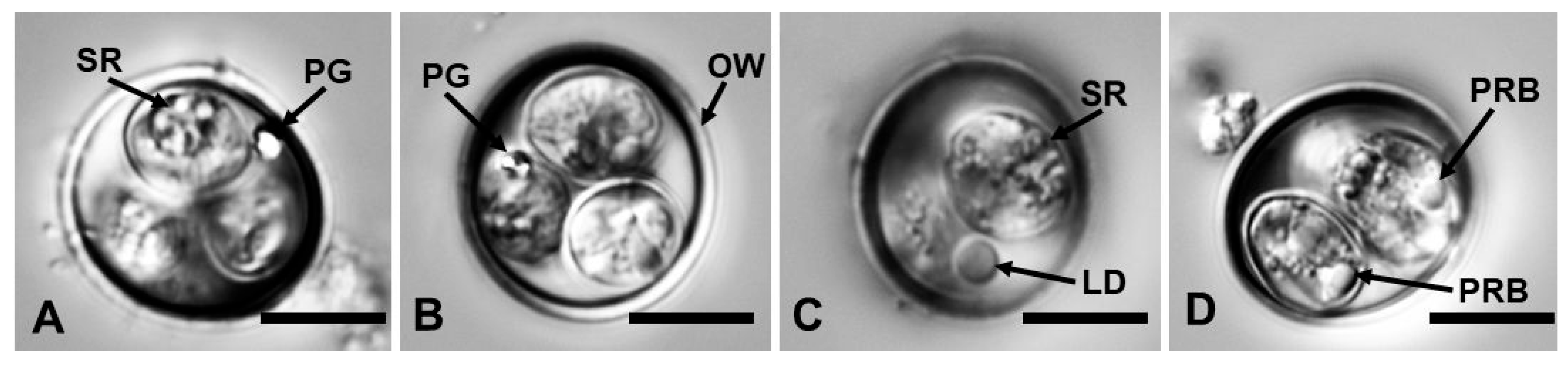
Figure 2.
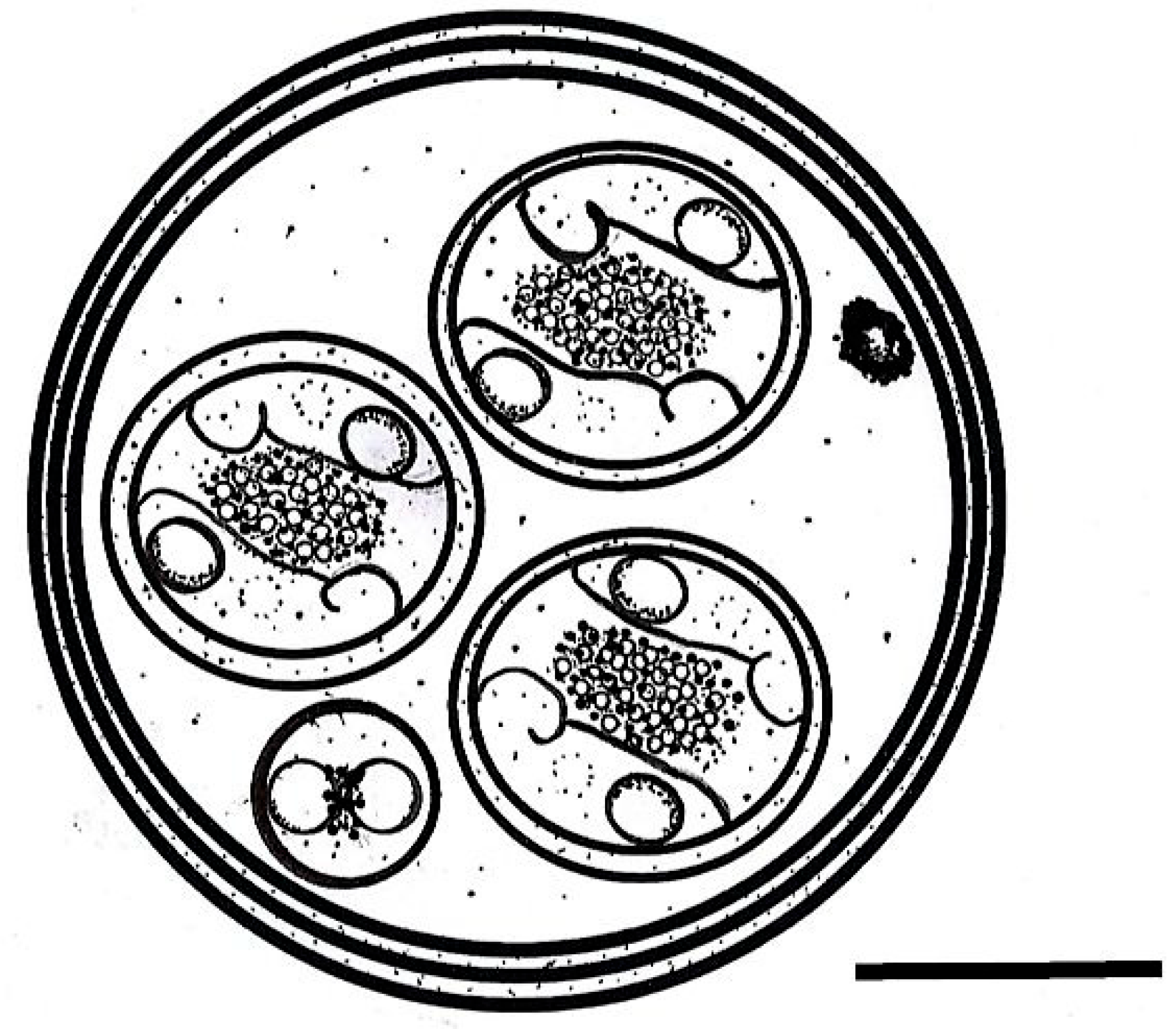
Composite line drawing of Acroeimeria nevadaense sp. n. Scale bar: 5 µm.
ZooBank: To comply with the regulations set out in article 8.5 of the amended 2012 version of the International Code of Zoological Nomenclature [6], details of the new species have been submitted to ZooBank. The Life Science Identifier (LSID) for Acroeimeria nevadaense sp. n. is urn:lsid:zoobank.org:act:55B1147F-1D37-4BAE-A598-1CECCA1A0B11.
Diagnosis: Oocysts morphologically consistent with those of the genus Acroeimeria Paperna and Landsberg, 1989 [7].
Description: Oocysts subspheroidal to ovoidal; walls 2, bilayered; wall characteristics: ~1.1 (0.9–1.3) thick, outer layer smooth and colorless, ~2/3 total thickness, inner layer being darker; L × W (n = 30): 15.6 × 13.7 (14–17 × 12–15); L/W ratio (shape index): 1.1 (1.1–1.2); M, OR: both absent; PG 1 (occasionally 2). Lipid droplets occasionally observed in oocysts (see Figure 1C). Distinctive features of oocyst: small size and spheroidal shape, lack of M, OR, but distinct PG present. Sporocysts ovoidal; L × W (n = 30): 7.7 × 5.9 (7–9 × 5–7); L/W ratio: 1.3 (1.2–1.6); SB, SSB, and PSB absent. SR: present; SR characteristics: typically a loose aggregate of various-sized granules between and across the SZs; sometimes a compact, rounded, or irregular mass. Distinctive features of sporocyst: small size and shape, lack of SB, SSB, and PSB. Sporozoites vermiform (not measured); elongate, spheroidal to subspheroidal PRB, no ARB or N observed.
Type species and type host: Acroeimeria (syn. Eimeria) lineri (McAllister, Upton, and Freed, 1988) Paperna and Landsberg, 1989, Mediterranean gecko, Hemidactylus turcicus (L.), Houston Zoo, Harris County, Texas, USA [7,8].
Type host: Broad-headed skink, Plestiodon laticeps (Schneider, 1801), female, 81 mm snout-vent length, collected 19 June 2025.
Type locality: USA, Arkansas, Nevada County, 20 km N of Prescott at 154 Nevada F-215 (33°53′16″ N, 93°22′10″ W).
Prevalence: 1 of 1.
Sporulation: Exogenous. Partially sporulated oocysts were fully sporulated within 72 h.
Prepatent and patent periods: Unknown.
Site of infection: Unknown; oocysts were recovered from feces.
Endogenous stages: Unknown.
Cross-transmission: Unknown.
Pathology: Unknown.
Material deposited: Photosyntypes of sporulated oocysts are deposited as HWML 218089.
Etymology: The specific epithet is given for the southwestern county in Arkansas in which the type host was collected, Nevada County, formed during the era of Reconstruction on 20 March 1871. It was so named after the state of Nevada, USA, because of the observed similarity between their physical geographic shapes; as viewed inverted, the county loosely shadows the same outline as the US state’s boundary.
3.2. Remarks
To our knowledge, there are no previously described acroeimerians reported from North American skinks. The only other acroeimerian from a skink, Acroeimeria rouxi Modrý and Jirků, 2006 from the marble-throated skink Marmorosphax tricolor Bavay from New Caledonia [9] possesses subspherical oocysts measuring (L × W) 18.4 (16–20) × 16.9 (14–19) µm, with an average shape index of 1.09 (1.00–1.36). Oocysts of the new species are smaller, 15.6 × 13.7 (14–17 × 12–15), with an average shape index of 1.1 (1.1–1.2). The sporocysts of A. rouxi are subspherical to irregularly polyhedral and measure 8.7 (8–9) × 7.8 (7–9), with an average shape index of 1.12 (1.00–1.29). The sporocysts of the new species are smaller, 7.7 × 5.9 (7–9 × 5–7), but with a larger average shape index of 1.3 (1.2–1.6). In addition, based on vast differences in distance in geographic localities of these two acroeimerians (12,087 km or 6527 nautical mi), as well as the differences in subfamily taxonomy/phylogeny (Eugongylinae vs. Scincinae) [10], our data are significant enough, and we feel confident to support a description of a new species of Acroeimeria in the broad-headed skink. The fecal sample is available to potential collaborators for DNA-based analysis of oocysts.
McAllister et al. [11,12] described Eimeria lipinia McAllister, Duszynski, Austin, and Fisher, 2013 from the moth skink Lipinia noctua (Lesson); Eimeria melanesia McAllister, Duszynski, Austin, and Fisher, 2013 from Roux’s lipinia skink Lipinia rouxi Hediger; and Eimeria krausi McAllister, Duszynski, Fisher, and Austin, 2014 from the yellow-footed green-blooded skink, Prasinohaema flavipes (Parker), all from Papua New Guinea. Although each possessed oocyst morphologies with mensural values similar to Acroeimeria spp., with an average L/W ratio of 1.1 (1.0–1.3), they did not place either one in that genus, although it is conceivable they actually represent acroeimerians. Another similar skink coccidian, Eimeria eutropidis Megía-Palma, Martínez, Acevedo, Martín, García-Roa, Ortega, Peso-Fernández, Albaladejo, Cooper, Paranjpe, Sinervo, and Merino, 2015, was described by Megía-Palma et al. [13] from the bronze grass skink, Eutropis macularia (Blyth), from the pet trade (imported from Thailand). Oocysts are spherical or subspherical and measure 14.0 (12.9–15.2) × 13.4 (12.2–14.7) µm, with an average shape index of 0.9 (0.9–1.1). Sporocysts are ellipsoidal and measure 7.0 (5.2–8.4) × 5.1 (4.3–5.9) µm, with an average shape index of 1.3 (1.0-1.6); polar granule(s) and a sporocyst residuum were absent. Although this form was placed in the genus Eimeria and has a very small oocyst shape index fitting sizes typical for acroeimerians, A. nevadaense sp. n. differs considerably in measurements and possession of both polar granule(s) and a distinct sporocyst residuum.
3.3. Additional Description of Previously Described Species
Phylum Apicomplexa Levine, 1970
Class Conoidasida Levine, 1988
Subclass Coccidia Leuckart, 1879
Order Eucoccidiorida Léger & Duboscq, 1911
Suborder Eimeriorina Léger, 1911
Family Eimeriidae Minchin, 1903
Genus Choleoeimeria Paperna and Landsberg, 1989
Choleoeimeria fasciatus (Upton, McAllister, and Trauth, 1991) Paperna and Landsberg, 1989 (Figure 3)
Figure 3.
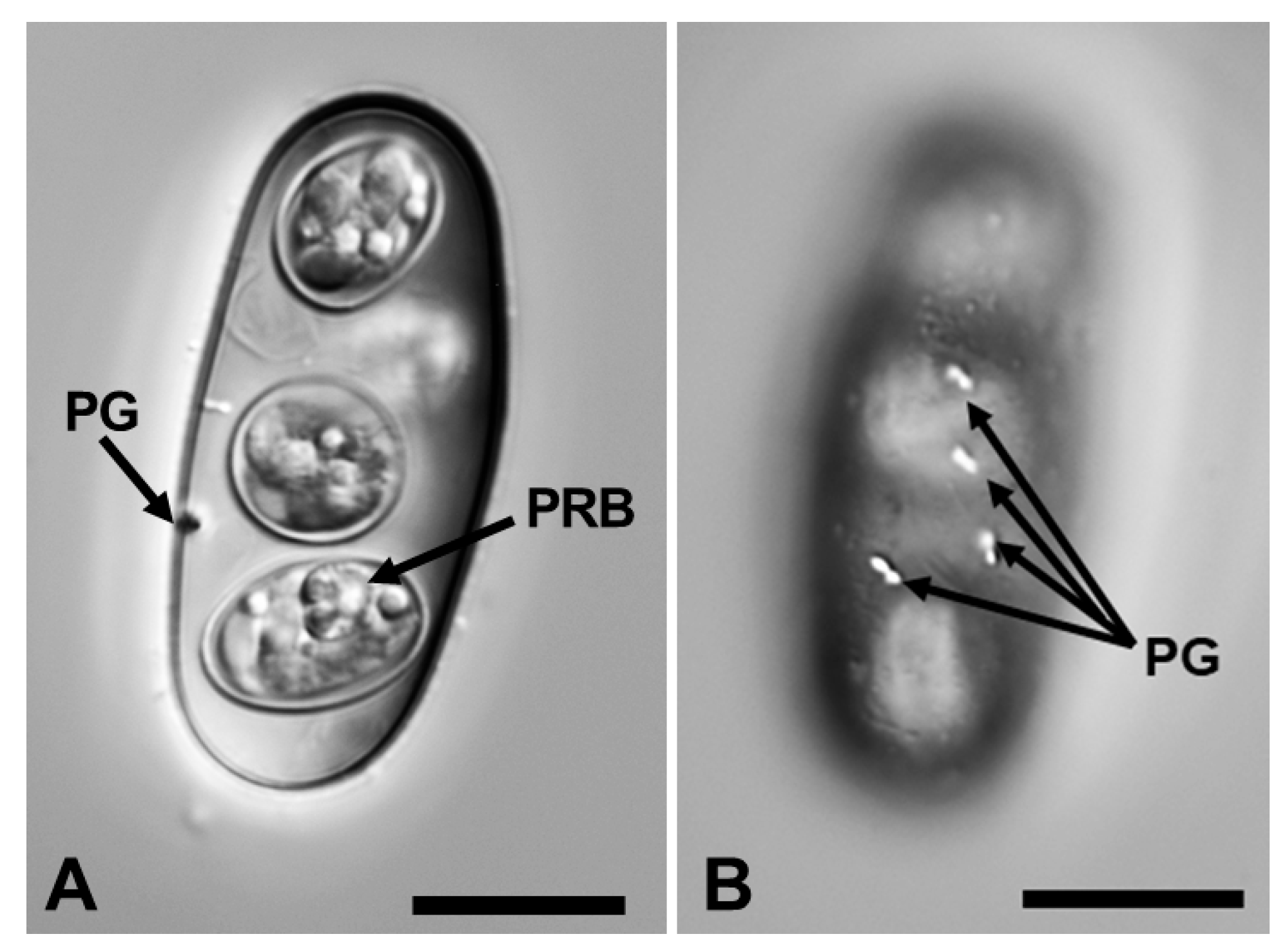
Nomarski interference-contrast photomicrographs of sporulated oocysts of Choleoeimeria fasciatus from broad-headed skink, Plestiodon laticeps. (A) PG (polar granule); PRB (posterior refractile body). (B) PG (polar granule[s]). Scale bars: 10 µm.
Diagnosis: Oocysts morphologically consistent with those of the genus Choleoeimeria Paperna and Landsberg, 1989 [7].
Description: Oocyst ellipsoidal to elongate; number of walls: 2; wall characteristics: ~1.1 (1.0–1.2) thick, outer layer smooth and colorless, ~2/3 total thickness, inner layer being darker; L × W (n = 10): 34.2 × 16.0 (33–38 × 16–18); L/W ratio: 2.0 (1.8–2.1); M, OR: both absent; PG 4 to 6, dumbbell-shaped, often in Brownian movement. Distinctive features of oöcyst: large size and elongate shape, lack of M, OR, but distinct PGs present. Sporocyst ovoidal to ellipsoidal; L × W (n = 10): 11.0 × 8.1 (10–12 × 7–9); L/W ratio: 1.4 (1.2–1.5); SB, SSB, and PSB absent. SR: present; SR characteristics: a loose cluster of large granules typically between and across the SZs. Distinctive features of sporocyst: large size and shape, lack of SB, SSB, and PSB. Sporozoite elongate (not measured); spheroidal to subspheroidal PRB; no ARB or N observed.
Type species, type host, and deposited histosection: Choleoeimeria (syn. Eimeria) turcicus (Upton, McAllister, and Freed, 1988) Paperna and Landsberg, 1998, Mediterranean gecko, Hemidactylus turcicus (L. 1758), Houston, Harris County, Texas, USA [7,8]. Histological slide USNM 81419.
Type host and type locality: Common five-lined skink, Plestiodon fasciatus (L.), Washington County, Arkansas, USA, collected May 1989 [14].
New host and new locality: Plestiodon laticeps, USA, Arkansas, Nevada County, 20 km N of Prescott at 154 Nevada F-215 (33°53′16″ N, 93°22′10″ W). Same host as above for the new species.
Prevalence: 1 of 1.
Sporulation: Exogenous. Unsporulated oocysts were fully sporulated within 72 h.
Site of infection: Gall bladder epithelium (see Upton, McAllister, and Trauth, 1991, their fig. 5 [14]).
Material deposited: Photovouchers of sporulated oocysts are deposited as HWML 218090.
3.4. Remarks
The oocysts and sporocysts we recovered from P. laticeps match the original description of C. fasciatus from P. fasciatus from Arkansas, USA, quite well. Upton et al. [14] provided measurements for oocysts and sporocysts of C. fasciatus as follows: (L × W) 34.9 × 16.2 (32–36 × 15–17) µm, with an average shape index of 2.2 (1.9–2.3); sporocysts were 12.0 × 8.7 (10–13 × 8–9) µm with an average shape index of 1.4 (1.1–1.5), respectively. To date, C. fasciatus has now also been reported from P. laticeps (a new host) and also from P. fasciatus from various physiographic locales in Nevada, Pope, Washington, and Woodruff counties, AR, USA, respectively ([14], this study).
4. Discussion
The genus Acroeimeria was proposed by Paperna and Landsberg [7] for coccidians that possess spheroidal/subspheroidal to ellipsoidal oocysts with a typical L/W ratio (shape index) of 1.0–1.3 that also have epicytoplasmic endogenous development in the upper ileum of columnar epithelium. Endogenous development takes place above the host cell nucleus and below the brush border in enterocytes of the ileum.
The family Scincidae Gray currently contains about 1785 species of skinks within seven recognized subfamilies [10]. Several species of coccidians (Apicomplexa: Eimeriidae) have been described from hosts within this family [9], particularly those from five species of skinks in North America, including four species of Choleoeimeria, an unnamed Eimeria sp., four species of Isospora Schneider, 1881, and now an acroeimerian (see summaries in [15,16]). The additional collection of 12 native scincid species in North America [1,5], particularly those yet to be surveyed, as well as 6 species in Arkansas [2], may reveal new host and distributional records for their coccidians and the possibility of discovering novel species.
5. Conclusions
Here we provide a description of a novel species of Acroeimeria Paperna and Landsberg, 1989 from P. laticeps from southwestern Arkansas, as well as present new mensural and morphological data on C. fasciatus. As such, A. nevadaense sp. n. is only the second known species of Acroeimeria from a member of the skink family Scincidae, as well as the first from a species of skink in North America.
Author Contributions
The authors confirm contribution to the paper as follows: C.T.M. and J.A.H. prepared Figure 1 and Figure 3; C.T.M. prepared Figure 2; C.T.M. and J.A.H. provided study conception, design, and wrote the main manuscript; C.T.M., G.J.G. and S.H. collected data; C.T.M. and J.A.H. provided analysis and interpretation of results; all authors prepared the draft manuscript, reviewed the manuscript, and approved the final version. All authors have read and agreed to the published version of the manuscript.
Funding
This research received no external funding.
Data Availability Statement
The data presented in this study are available within the article. The original contributions presented in this study are included in the article. Further inquiries can be directed to the corresponding author.
Acknowledgments
The Arkansas Game and Fish Commission provided a Scientific Collecting Permit no. 04182051 to CTM. We thank the Stuarts for allowing collection on their properties and for hosting us at their site. We thank Scott L. Gardner and Gábor R. Rácz (HWML), who provided expert curatorial assistance, and the administrative personnel at NTCC for providing assistance with travel. Coauthors G.J.G. and S.H., NTCC students in Biology 2389, helped to fulfill requirements for this course during this study. We also thank James T. McAllister, III (Engineering and Honors College Librarian, University of Arkansas-Fayetteville, Arkansas), for assistance with providing some supportive cited literature.
Conflicts of Interest
The authors declare no conflicts of interest.
References
- Powell, R.; Conant, R.; Collins, J.T. Peterson Field Guide to Reptiles and Amphibians of Eastern and Central North America, 4th ed.; Houghton Mifflin Harcourt: Boston, MA, USA, 2016; 492p. [Google Scholar]
- Trauth, S.E.; Robison, H.W.; Plummer, M.V. The Amphibians and Reptiles of Arkansas; University of Arkansas Press: Fayetteville, AR, USA, 2004; 421p. [Google Scholar]
- McAllister, C.T.; Upton, S.J.; Trauth, S.E. New host and distributional records for coccidia (Apicomplexa: Eimeriidae) from North American lizards (Reptilia: Sauria). J. Helminthol. Soc. Wash. 1994, 61, 221–224. [Google Scholar]
- Wilber, P.G.; Duszynski, D.W.; Upton, S.J.; Seville, R.S.; Corliss, J.O. A revision of the taxonomy and nomenclature of the Eimeria spp. (Apicomplexa: Eimeriidae) from rodents in the Tribe Marmotini (Sciuridae). Syst. Parasitol. 1998, 39, 113–135. [Google Scholar] [CrossRef] [Scilit]
- Nicholson, K.E. (Ed.) Scientific and Standard English Names of Amphibians and Reptiles of North America North of Mexico, with Comments Regarding Confidence in Our Understanding, 9th ed.; Society for the Study of Amphibians and Reptiles: Lawrence, KS, USA, 2025; 87p. [Google Scholar]
- ICZN (International Commission on Zoological Nomenclature). Declaration 45—Addition of recommendations to Article 73 and of the term “specimen, preserved” to the glossary. Bull. Zool. Nomencl. 2017, 73, 96–97. [Google Scholar]
- Paperna, I.; Landsberg, J.H. Description and taxonomic discussion of eimerian coccidia from African and Levantine geckoes. S. Afr. J. Zool. 1989, 24, 345–354. [Google Scholar] [CrossRef] [Scilit]
- Upton, S.J.; McAllister, C.T.; Freed, P.S. Eimeria turcicus n. sp. (Apicomplexa: Eimeriidae) from the Mediterranean gecko, Hemidactylus turcicus (Sauria: Gekkonidae). J. Protozool. 1988, 35, 24–25. [Google Scholar] [CrossRef] [Scilit]
- Modrý, D.; Jirků, M. Three new species of coccidia (Apicomplexa: Eimeriorina) from the marble-throated skink, Marmorosphax tricolor Bavay, 1869 (Reptilia: Scincidae), endemic to New Caledonia with a taxonomic revision of Eimeria spp. from scincid hosts. Parasitol. Res. 2006, 99, 416–428. [Google Scholar] [CrossRef] [Scilit] [PubMed]
- Uetz, P.; Freed, P.; Aguilar, R.; Reyes, F.; Kudera, J.; Hosek, J. The Reptile Database. 2025. Available online: https://www.reptile-database.org (accessed on 10 November 2025).
- McAllister, C.T.; Duszynski, D.W.; Austin, C.C.; Fisher, R.N. Three new species of coccidia (Apicomplexa: Eimeriidae) from skinks, Lipinia spp. (Sauria: Scincidae), from Oceania. J. Parasitol. 2013, 99, 1086–1088. [Google Scholar] [CrossRef] [Scilit] [PubMed]
- McAllister, C.T.; Duszynski, D.W.; Fisher, R.N.; Austin, C.C. Two new species of Eimeria (Apicomplexa, Eimeriidae) from tree skinks, Prasinohaema spp. (Sauria: Scincidae), from Papua New Guinea. Acta Parasitol. 2014, 59, 256–263. [Google Scholar] [CrossRef] [Scilit] [PubMed]
- Megía-Palma, R.; Martínez, J.; Acevedo, I.; Martín, J.; García-Roa, R.; Ortega, J.; Peso-Fernández, M.; Albaladejo, G.; Cooper, R.D.; Paranjpe, D.A.; et al. Phylogeny of the reptilian Eimeria: Are Choleoeimeria and Acroeimeria valid names? Zool. Script. 2015, 44, 684–692. [Google Scholar] [CrossRef] [Scilit]
- Upton, S.J.; McAllister, C.T.; Trauth, S.E. Two new species of coccidia (Apicomplexa: Eimeriidae) from Eumeces fasciatus (Sauria: Scincidae) in Arkansas. Can. J. Zool. 1991, 69, 2028–2030. [Google Scholar] [CrossRef] [Scilit]
- McAllister, C.T.; Seville, R.S.; Connior, M.B. Isospora scinci (Apicomplexa: Eimeriidae) from five-lined skink, Plestiodon fasciatus (Sauria: Scincidae): Additional records from Arkansas and first report from Oklahoma. Proc. Okla. Acad. Sci. 2014, 94, 73–75. [Google Scholar] [PubMed]
- McAllister, C.T.; Seville, R.S.; Connior, M.B.; Trauth, S.E.; Robison, H.W. Two new species of coccidia (Apicomplexa: Eimeriidae) from ground skinks, Scincella lateralis (Sauria: Scincidae), from Arkansas, USA. Syst. Parasitol. 2014, 88, 85–90. [Google Scholar] [CrossRef] [Scilit] [PubMed]
Disclaimer/Publisher’s Note: The statements, opinions and data contained in all publications are solely those of the individual author(s) and contributor(s) and not of MDPI and/or the editor(s). MDPI and/or the editor(s) disclaim responsibility for any injury to people or property resulting from any ideas, methods, instructions or products referred to in the content. |
© 2026 by the authors. Licensee MDPI, Basel, Switzerland. This article is an open access article distributed under the terms and conditions of the Creative Commons Attribution (CC BY) license.