


Abstract
Two new endemic species from the Atlantic Forest, Philodendron baumgratzii and Philodendron waenglerae, are described herein. Both species belong to the subgenus Philodendron, assigned to sections Schizophyllum and Macrobelium, respectively. Detailed taxonomic descriptions, nomenclatural notes, and geographic distribution data are provided.
1. Introduction
Currently comprising 585 species [1], the genus Philodendron Schott is the second largest in the family Araceae. It is also one of the most important due to its ornamental value, given the beauty of its foliage. This genus occurs predominantly in tropical forests, but it can also be found in wetlands, rocky outcrops, and even in semi-arid regions [2]. It occurs in all Brazilian states except in Mato Grosso do Sul [3], with 162 species recorded across the country [3]. In the state of Rio de Janeiro, 26 taxa are reported [4]. The genus is distributed throughout the tropical and subtropical Americas, ranging from Mexico to Uruguay [5].
Most species are classified within the subgenera Philodendron and Pteromischum, with the subgenus Philodendron further divided into nine non-natural sections [6]. The section Macrobelium Sakur. is the most representative in the Atlantic Forest [7] and is mainly characterized by leaves with a cordate base, an ovary with 6–12 locules, 3–4 ovules per locule, and basal placentation [8].
The section Schizophyllum was described by Schott in 1856 [9] as P. grex Schizophyllum. Ovaries 6–9-locular, each locule with 3–4 ovules with sub-basal placentation; stigma discoid-orbicular; stem scandent; petiole smooth; leaf blade very glossy abaxially, turning gray between green veins, hastate, with 3–5 lobes, bipinnatifid, or 3–5-partite, sometimes laciniate, with lateral veins prominent. In 1878, Engler [10] recognized it as a section of Philodendron. Krause (1913) [8] described six species for the section (P. quercifolium Engl., P. bipennifolium Schott, P. pinnatilobum Engl., P. quinquelobum K. Krause, P. laciniatum Engl., and P. squamiferum Poepp.) and circumscribed it as follows: scandent plants with long internodes, hastate, leaf blades with 3–5 lobes or “bipinnatifid” in shape, with conspicuous primary veins; petiole cylindrical; stigmas orbicular; ovaries 6–9-locular, each locule with 3–4 ovules inserted near the base. The main characters used to distinguish the species were the petiole indument and leaf blade shape (number of lobes and shape of the base).
Taxonomic studies on Philodendron within the flora of Rio de Janeiro, both published and ongoing [11,12], have revealed species of the family Araceae still unknown to science.
Compared to other states in the Southeastern Region, Rio de Janeiro has a relatively small territorial area; however, in terms of Atlantic Forest vegetation, it remains the most preserved [13]. The state’s vegetation cover has been reduced since the colonization of Brazil, reaching its lowest levels in the last century [14]. Nevertheless, to prevent further deforestation, it is essential to produce scientific knowledge that supports both the conservation of these remaining fragments and the restoration of degraded areas.
This study contributes to the knowledge of Philodendron subg. Philodendron in the state of Rio de Janeiro.
2. Results
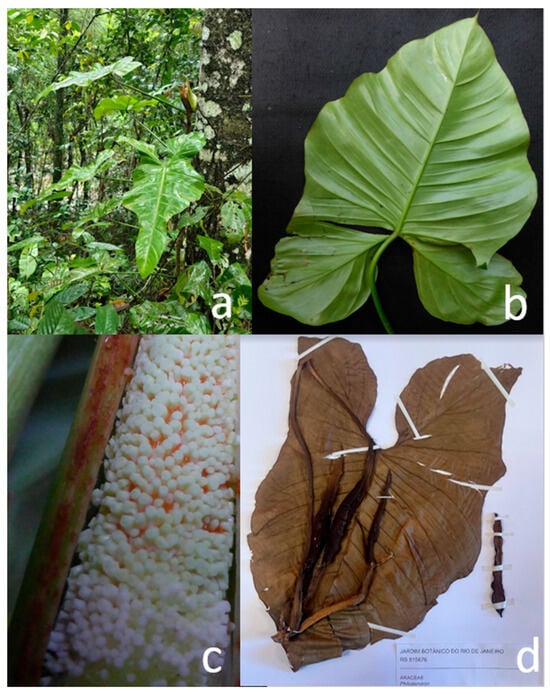
Philodendron baumgratzii Mattos & Nadruz. TYPE: Brazil: Rio de Janeiro, Santa Maria Madalena, Road to Santo Antônio do Imbé, 21°57′31″ S 41°51′15″ W, 144 m.a.sl, 15 November 2021, fl., J.R. Mattos, 990 (RB 821289!) [Figure 1].
Figure 1.
Philodendron baumgratzii: (a)—habit; (b)—leaf blade; (c)—detail of the female zone; and (d)—voucher deposited in the RB Herbarium (photos by the authors).
Diagnosis: Hemiepiphytic; petiole greenish, terete; leaf blade lobed, green, discolorous. Inflorescences 1–2 per sympodium. Spathe externally greenish with reddish spots, internally reddish at the base and greenish toward the apex.
Herb hemiepiphyte, rupicolous; stem with internodes 4.8–8 cm long. Prophyll 27.5–29 cm long, greenish, petiole 26.3–43.7 × 0.4–0.44 cm, greenish, cylindrical to canaliculate with obtuse margins adaxially and obtuse abaxially, absence of protuberances. Leaf blade 32.8–41.9 × 20.2–23.7 cm, pinnatifid, with 1–2 lobes on each side, elliptic to ovate, apex obtuse-acuminate, base sagittate, sinus spathulate with presence of denudation, greenish, discolorous, chartaceous; anterior lobes 22–28.4 cm; posterior lobes 11.8–15 cm; midrib flattened adaxially and obtuse abaxially; primary lateral veins 7–9 on each side, impressed adaxially and prominent abaxially, forming a 100-degree angle with the midrib; secondary veins slightly impressed adaxially and slightly prominent abaxially; posterior division 10.8–13.5 × 19.1–23.2 cm; acroscopic veins 3, and basiscopic 3–4. Inflorescence 1–2 per floral sympodium; peduncle 4.2–5.5 cm long, greenish; spathe 11.5–12.1 cm, non-constricted, greenish, sometimes with reddish spots externally, greenish to whitish on the blade and reddish to pinkish in the tube internally. Spadix without a terminal sterile appendix. Stamens not seen. Ovaries oblong, with 6–8 locules, 6 ovules per locule, basal placentation and hairy funicles. Fruits not seen.
The species is related to Philodendron nadruzianum due to the similarity in the leaf blade and morphology, but it can be easily distinguished by its non-constricted spathe, green outside (sometimes with reddish spots), which is greenish to whitish on the blade internally and reddish to pinkish in the tube (vs. spathe constricted, green outside and cream inside). It is also related to Philodendron ruthianum but differs by the absence of the apical sterile appendix (vs. presence).
Updated key to the species of section Schizophyllum [15]
1. Petiole glabrous........................................................................................................................2
1’. Petiole scaly.....................................................................................................P. squamiferum
2. Leaf pinnatisect, base cuneate, posterior–anterior division not clearly distinct, plants rare......................................................................................................................P.pinnatilobum
2’. Leaf pinnatifid, base hastate or sagittate, posterior lobes clearly separated from anterior division..........................................................................................................3
3. Leaf blade base hastate.............................................................................................................4
3’. Leaf blade base sagittate...........................................................................................................5
4. Leaf blade with 1–2 lobes on each side...................................................................6
4’. Leaf blade with 3 lobes on each side..................................................P. longilobatum
5. Primary lateral veins reddish, apical sterile male zone present.....................P. ruthianum
5’. Primary lateral veins greenish, apical sterile male zone absent..................................8
6. Leaf blade with 1 lateral lobe, posterior lobes entire......................................................7
6’. Leaf blade with 2 lateral lobes, posterior lobes divided.....................................P. pedatum
7. Sterile flowers of spadix without protuberances..................................P. quinquelobum
7’. Sterile flowers of spadix with protuberances........................................P. bipennifolium
8. Primary lateral veins 4–5 on each side; spathe greenish externally and cream-colored internally............................................................................................P. nadruzianum
8’. Primary lateral veins 7–9 on each side; spathe greenish with reddish spots externally, greenish to whitish on the blade and reddish to pinkish in the tube internally.........................................................................................................................P. baumgratzii
Material examined: Brazil. Rio de Janeiro, Santa Maria Madalena. Road to Santo Antônio do Imbé, 21°57′31″ S, 41°51′15″ W, 15 November 2021, fl., J.R. Mattos 990 (RB). Road to Sossego via Cachoeirão, 21°57′51″ S, 41°51′16″ W, October 2020, fl., J.R. Mattos 972 (RB); Road to Sossego via Cachoeirão, 21°57′51″ S, 41°51′16″ W, 21 October 2024, fl., J.R. Mattos 1136 (RB).
Etymology: The specific epithet Philodendron baumgratzii honors the researcher and professor Dr. José Fernando Andrade Baumgratz, a prominent scholar of the flora of Rio de Janeiro State, whose extensive contributions to plant systematics and floristic studies have greatly advanced the botanical knowledge of the region.
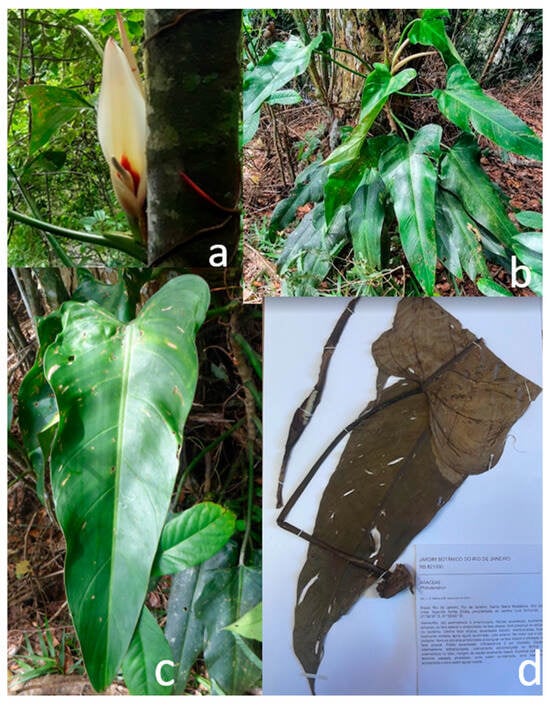
Philodendron waenglerae Mattos & Nadruz. TYPE: Brazil. Rio de Janeiro: Santa Maria Madalena, Alto do Imbé, 21°59′36″ S, 41°58′45″ W, 520 m., 18 October 2021, fl., M.S. Wängler 3131 (holotype RB 821300) [Figure 2].
Figure 2.
Philodendron waenglerae: (a)—inflorescence; (b)—habit; (c)—detail of the leaf blade; and (d)—voucher specimen deposited in RB Herbarium (photos by the authors).
Diagnosis: Hemiepiphytic; roots reddish to brownish. Petiole greenish, slightly flattened on the adaxially and rounded abaxially. Two inflorescences per sympodium. Spathe externally whitish, internally whitish on the blade and reddish in the tube, spathe margin slightly pinkish.
Herb hemiepiphytic. Internodes 2.5–4.5 cm in length. Roots reddish to brownish. Prophyll 12 cm long, greenish. Petiole 8–28.3 × 0.36–0.67 cm, greenish, slightly flattened on the adaxially and rounded abaxially, striations or nectaries absent. Leaf blade 41.4 × 13.5–14 cm, ovate, greenish-discolor, membranaceous; base obtuse in juveniles, cordate in adults; apex acute–acuminate, parabolic sinus. Anterior lobe 36–46 cm long, posterior lobe 1.8–5 cm long. Midrib obtuse to acute on the abaxial surface and flattened on the adaxial surface; secondary veins 6; basal veins 1–2. Inflorescences 2 per floral sympodium, 13.2–17 cm long; peduncle 3–5 cm long; spathe non constricted, externally whitish, internally whitish on the blade and reddish in the tube, margin of the spathe slightly pinkish. Spadix with post-anthesis pistillate zone yellowish, 5 cm long; sterile zone grayish, 0.6 cm long; staminate zone grayish, 3.5 cm long; apical sterile zone pinkish, 4 cm long. Ovary oblong, 8 locules and 5 ovules per locule, placentation basal, with trichomes on funicles. Androecium 3–5 stamens. Infructescence not seen.
Philodendron waenglerae is closely related to Philodendron hatschbachii but can be easily distinguished by its 6 pairs of leaf veins (vs. 4–5 pairs), the presence of a well-defined sinus (vs. sinus absent), 2 inflorescences per floral sympodium (vs. 1), and the presence of the apical sterile zone on the spadix (vs. apical sterile zone absent). It is also morphologically similar to Philodendron fragile but differs in the non-constricted spathe (vs. spathe constricted) and by having 6 pairs of leaf veins (vs. 4–5 pairs). Such characteristics can be observed in Table 1 below.
Table 1.
Differences of closely related species of Philodendron waenglerae.
Examined material (Paratype): Brazil. Rio de Janeiro, Santa Maria Madalena: Alto do Imbé, Santa Elídia farm, property of Mr. Luiz Armando, 21°59′36″ S 41°58′45″ W, 520 m, 18 November 2021, fl., J. R. Mattos 995 (RB). Santa Maria Madalena, Alto do Imbé, 21°59′36″ S, 41°58′45″ W, 520 m., 18 October 2021, fl., M.S. Wängler 3131 (RB)
Etymology: The specific epithet Philodendron waenglerae honors the researcher Dra. Marília Suzy Wängler, who collected the specimen has contributed significantly to botanical research in the municipality of Santa Maria Madalena.
- Description of the Area
The municipality of Santa Maria Madalena is located in the mountainous region of the state of Rio de Janeiro, covering an area of approximately 816.8 km2 at an altitude of about 632 m [16]. The vegetation of the municipality is predominantly a Submontane Dense Ombrophilous Forest [17] and is part of the Atlantic Forest phytogeographical domain.
- Distribution, Habitat, and Conservation
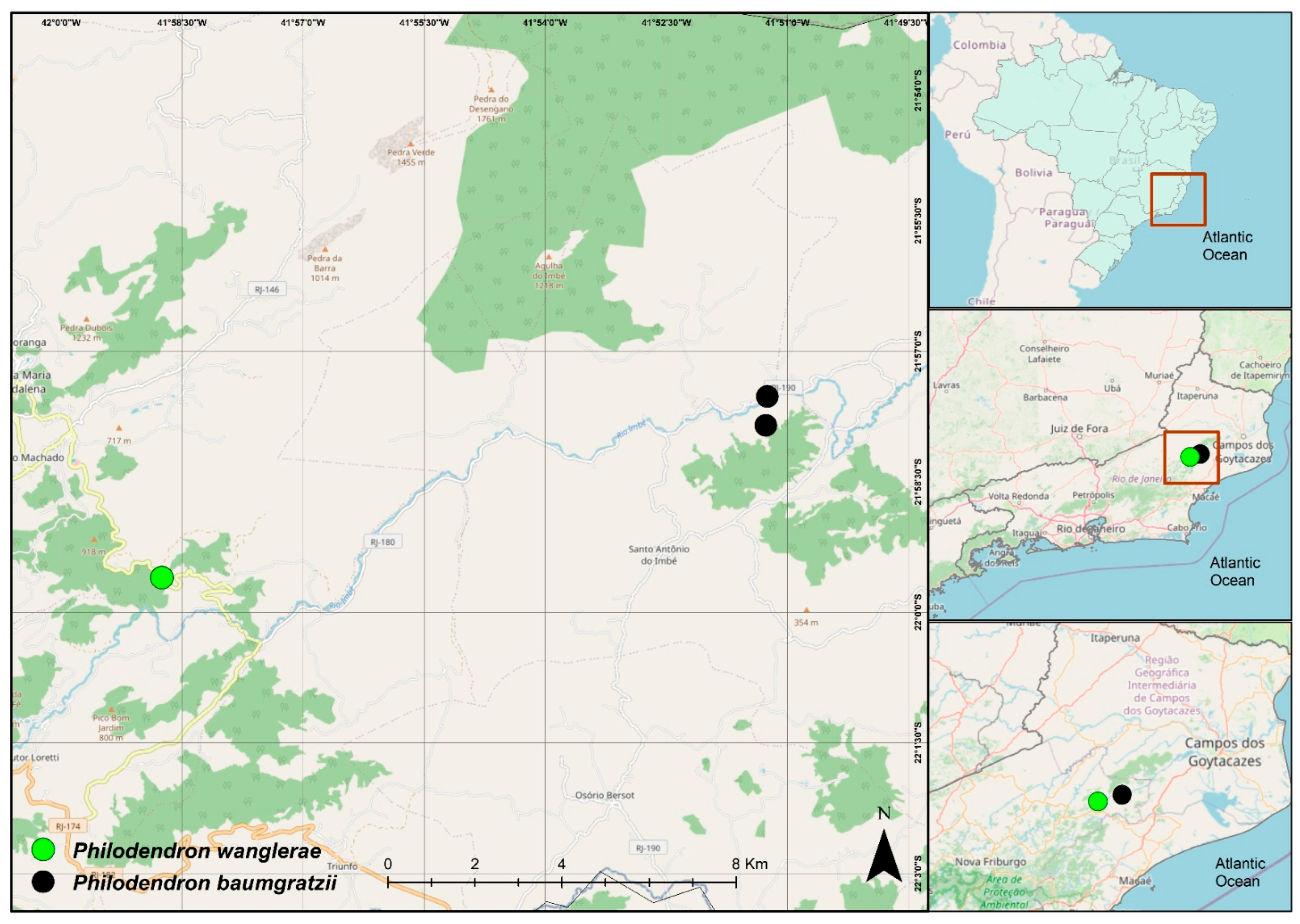
Both species are endemic to the municipality, and since the locations where they were collected are located outside of a protected area, identifying and monitoring degraded forest areas becomes increasingly important for their conservation [Figure 3].
Figure 3.
Occurrence map of Philodendron waenglerae and Philodendron baumgratzii. Source: Ribeiro, R. (2023). Map produced using Esri ArcGIS ArcMap 10.8. Reproduced with permission of the author. Rafael Ribeiro—Instituto de Pesquisas Jardim Botânico do Rio de Janeiro.
Philodendron waenglerae was recorded in a single locality, within a private property, and is therefore considered rare.
Philodendron baumgratzii was recorded in two nearby localities but is still considered rare due to the limited number of collections.
The EOO and AOO were calculated using GeoCAT (version BETA) [18]. The analyses resulted in an EOO of 0 km2 and an AOO of 4 km2, values that place the species within the Critically Endangered (CR) category according to IUCN criteria [19].
3. Materials and Methods
The first expedition took place in October 2020, during which the authors collected Philodendron baumgratzii on a rocky, difficult-to-access cliff along the roadside, outside of any protected area. The second expedition was carried out in November 2021 to collect Philodendron waenglerae, which had been recorded for the first time in the previous month. This species occurs within a private property, outside a conservation unit. In the third expedition, in October 2024, Philodendron baumgratzii was collected again by the authors.
The collection sites were georeferenced using a GPS to ensure a greater accuracy of latitude and longitude values. The samples were herborized following the methods of Croat [20] and deposited in the RB Herbarium of the Rio de Janeiro Botanical Garden, following the appropriate protocols. Leaf tissue samples were also collected and stored in silica gel for future DNA studies, and seedlings of the species were collected and are currently cultivated in the Rio de Janeiro Botanical Garden nursery for ex situ analyses. Comparisons were made with herbarium materials, in person at R and RB herbaria and through virtual tools (SpeciesLink and Reflora).
The taxonomic treatment included the identification, measurement, and descriptions of vegetative and reproductive characters using a stereoscopic microscope; leaf blade width data were obtained by measuring the widest portion of the lamina. Morphological descriptions followed the standard terminology for Araceae by Mayo et al. [5]. For the architecture of the leaf blade, specifically, the manual of Ellis et al. [21] was followed, and for the nomenclature of sinus formation we followed Croat & Bunting [22].
4. Conclusions
The discovery of these new species expands the floristic diversity already known for the municipality of Santa Maria Madalena, highlighting the importance of continuing studies of the local flora. Both species occur outside conservation units, which increases the risk of them falling into one of the threat categories of extinction.
Author Contributions
Conceptualization, J.R.d.M. and M.A.N.C.; methodology, J.R.d.M., M.A.N.C. and T.F.d.S.; validation, J.R.d.M. and M.A.N.C.; formal analysis, J.R.d.M. and M.A.N.C.; investigation J.R.d.M. and M.A.N.C.; data curation, J.R.d.M. and M.A.N.C.; writing—original draft preparation, J.R.d.M.; writing—review and editing, M.A.N.C. and T.F.d.S.; supervision, M.A.N.C.; project administration, M.A.N.C.; resources M.A.N.C. All authors have read and agreed to the published version of the manuscript.
Funding
This research was funded by Fundação de Amparo à Pesquisa do Estado do Rio de Janeiro (FAPERJ) for the master’s scholarship granted to the first author during this study, grant number E-26/201.144/2020 (256745).
Data Availability Statement
All data supporting the findings of this study are available within the article. Occurrence data used for the GeoCAT (version BETA) analyses derive from the voucher specimens, all of which are deposited in the RB Herbarium with their respective collection numbers and can be accessed through the herbarium’s online platform. As only a single individual was collected, duplicates could not be prepared for deposition in other herbaria.
Acknowledgments
We would like to thank the Rafael Ribeiro for preparing the map and Marília Suzy Wängler for the collection and provision of the photographs of Philodendron waenglerae.
Conflicts of Interest
The authors declare no conflicts of interest.
References
- Boyce, P.C.; Croat, T.B. The Überlistof of Araceae: Totals for Published and Estimated Number of Species in Aroid Genera. Florida, Miami, 2011 Onwards. Available online: https://www.researchgate.net/publication/389988567_Uberlist_March_2025 (accessed on 22 May 2025).
- Coelho, M.A.N. Philodendron Schott (Araceae): Morfologia e taxonomia das espécies da Reserva Ecológica de Macaé de Cima-Nova Friburgo, Rio de Janeiro, Brasil. Rodriguésia 2000, 51, 21–68. [Google Scholar] [CrossRef] [Scilit]
- Sakuragui, C.M.; Calazans, L.S.B.; Soares, M.L.; Mayo, S.J.; Ferreira, J.B. Philodendron in Flora e Funga do Brasil. Jardim Botânico do Rio de Janeiro. 2025. Available online: https://floradobrasil.jbrj.gov.br/FB5015 (accessed on 18 March 2025).
- Catálogo das Espécies de Plantas Vasculares e Briófitas do Estado do Rio de Janeiro. Instituto de Pesquisas Jardim Botânico do Rio de Janeiro. Available online: https://florariojaneiro.jbrj.gov.br/ (accessed on 29 April 2025).
- Mayo, S.J.; Bogner, J.; Boyce, P.C. The Genera of Araceae; Royal Botanic Garden, Kew: London, UK, 1997; 370p. [Google Scholar]
- Gauthier, M.L.; Barabe, D.; Bruneau, A. Molecular phylogeny of the genus Philodendron (Araceae): Delimitation and infrageneric classification. Bot. J. Linn. Soc. 2008, 156, 13–27. [Google Scholar] [CrossRef] [Scilit]
- Calazans, L.S.B. A new species of Philodendron (Araceae) from an enclave of Atlantic rainforest in Minas Gerais state, Brazil. Phytotaxa 2020, 452, 217–223. [Google Scholar] [CrossRef] [Scilit]
- Engler, A.; Krause, K. Araceae-Philodendroideae-Philodendreae. In Das Pflanzenreich Regnivegetabilis Conspectus; H. R. Engelmann (J. Cramer): Weinheim, Germany, 1912. [Google Scholar]
- Schott, H.W. Synopsis Aroidearum Complectens Enumerationem Systematicam Generum At Specierum Hujus Ordinis Heinrich Wilhelm Schott; Nabu Press: Charleston, SC, USA, 1856; pp. 1–149. [Google Scholar]
- Engler, A. Araceae. In Flora Brasiliensis; von Martius, C.F.P., Ed.; F. Fleischer: Munich, Germany, 1878; Volume 3, Available online: https://florabrasiliensis.cria.org.br/search?taxon_id=3032 (accessed on 18 May 2025).
- Mattos, J.R.; Coelho, M.A.N.; Baumgratz, J.F.A. New species of Philodendron (Araceae) from the Brazilian Atlantic Forest, Brasil. Rodriguésia 2023, 74, e01652021. [Google Scholar] [CrossRef] [Scilit]
- Mattos, J.R. Sistemática e Estudos Taxonômicos de Philodendron sect. Baursia (Reichb. ex Schott) Engler (Araceae), com Ênfase nas Espécies Ocorrentes no Brasil; Escola Nacional de Botânica Tropical (ENBT), Instituto de Pesquisas Jardim Botânico do Rio de Janeiro: Rio de Janeiro, Brasil, 2026. [Google Scholar]
- SOS Mata Atlântica. Atlas dos Remanescentes Florestais da Mata Atlântica, Período 2015–2016; Relatório técnico; Fundação SOS Mata Atlântica: São Paulo, Brazil, 2017; 69p. [Google Scholar]
- Bergallo, H.G.; Cardoso, E.C.; Rocha, C.F.D.; Uzêda, M.C.; Costa, M.B.; Alves, M.A.S.; Sluys, M.V.; Santos, M.A.; Costa, T.C.C.C.; Cozzolino, A.C.R. Estratégias e Ações Para a Conservação da Biodiversidade no Estado do Rio de Janeiro; Instituto Biomas: Rio de Janeiro, Brazil, 2009; 344p. [Google Scholar]
- Sakuragui, C.M. Two new species and a revised key for Philodendron section Schizophyllum (Araceae). Syst. Bot. 2012, 37, 43–47. [Google Scholar] [CrossRef] [Scilit]
- Prefeitura Municipal de Santa Maria Madalena. 2025. Available online: https://www.pmsmm.rj.gov.br/localizacao (accessed on 20 March 2025).
- IBGE—Instituto Brasileiro de Geografia e Estatística. Mapa de Vegetação do Brasil; Ministério do Planejamento, Orçamento e Gestão: Brasília, Brazil; Instituto Brasileiro de Geografia e Estatística: Rio de Janeiro, Brazil; Diretoria de Geociências: Brasília, Brazil, 2004; 1p.
- Bachman, S.; Moat, J.; Hill, A.W.; de la Torre, J.; Scott, B. Supporting Red List threat assessments with GeoCAT: Geospatial conservation assessment tool. Zookeys 2011, 150, 117–126. [Google Scholar] [CrossRef] [Scilit] [PubMed]
- IUCN. The IUCN Red List of Threatened Species. Version 2021-1. 2021. Available online: https://www.iucnredlist.org/ (accessed on 5 April 2025).
- Croat, T.B. Collecting and preparing specimens of Araceae source. Ann. Mo. Bot. Gard. 1985, 72, 252–258. [Google Scholar] [CrossRef] [Scilit]
- Ellis, B.; Daly, D.C.; Hickey, L.J.; Johnson, K.R.; Mitchell, J.D.; Wilf, P.; Wing, S.L. Manual of Leaf Architecture; Cornell University: Ithaca, NY, USA, 2009; 190p. [Google Scholar]
- Croat, T.B.; Bunting, G.S. Standardization of Anthurium descriptions. Aroideana 1979, 2, 15–25. [Google Scholar]

Disclaimer/Publisher’s Note: The statements, opinions and data contained in all publications are solely those of the individual author(s) and contributor(s) and not of MDPI and/or the editor(s). MDPI and/or the editor(s) disclaim responsibility for any injury to people or property resulting from any ideas, methods, instructions or products referred to in the content. |
© 2026 by the authors. Licensee MDPI, Basel, Switzerland. This article is an open access article distributed under the terms and conditions of the Creative Commons Attribution (CC BY) license.