3.1. New Species
Genus Lonchaea Fallén, 1820.
Description. Holotype male. Head: Eye bare. Frons black, dulled by microsculpture, frontal and interfrontal setulae short approximately 0.1× as long as orbital seta, longer setulae on anterior margin above the lunule. Orbital plate shining black, bare apart from orbital seta. Lunule covered in dense silver pollinosity as is the dorsal half of the parafacial, face light grey-dusted. Antenna, pedicel dull orange, postpedicel black but broadly orange on medial base, this coloration extending ventrally for more than the basal quarter. Length-to-depth ratio 3:1. Arista microscopically pubescent. Anterior genal setae in single row of five along mouth margin.
Thorax: Scutum shining black. Anepisternum with two anterior and two posterior setae. Katepisternum with a single seta near dorsal margin. Proepimeron and proepisternum each with a single seta. Scutellum, dorsum slightly brassy in color, contrasting with the black of the thorax, covered in short setulae, none of the usual stronger setae present on margin. Calypter and fringe pale. Wing length 2.9 mm, wing membrane clear. Legs black, basal tarsomere of all legs clear yellow.
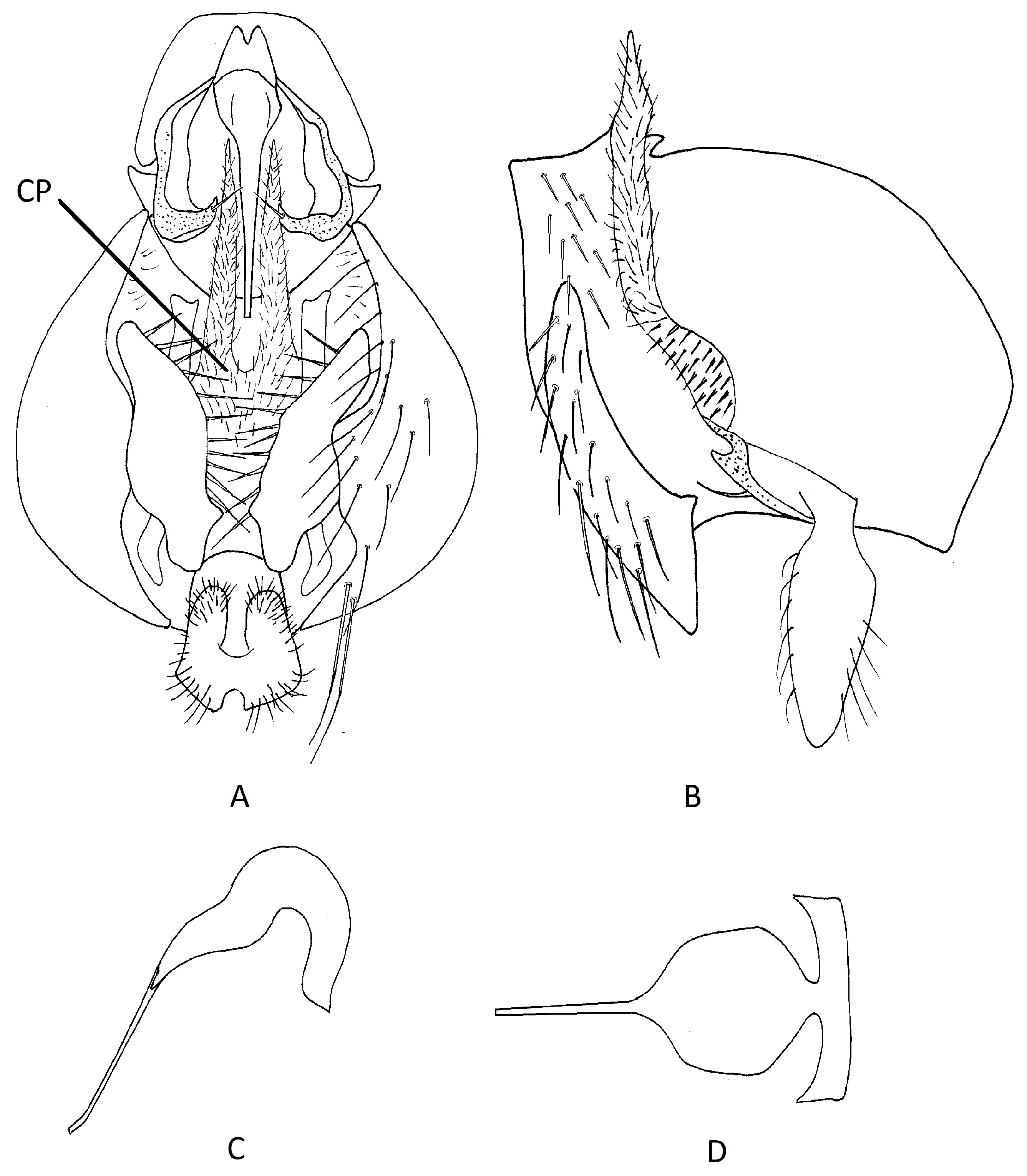
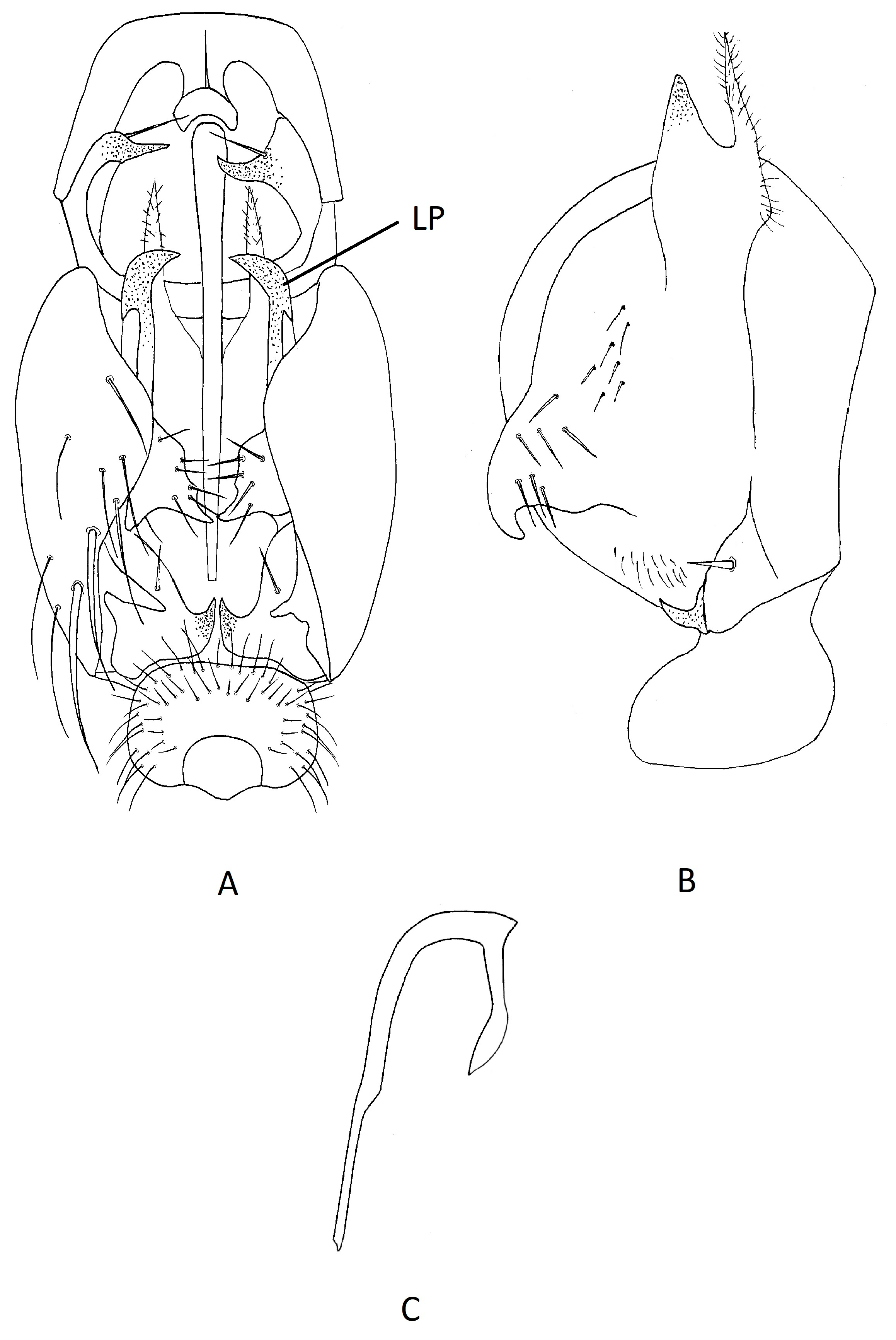
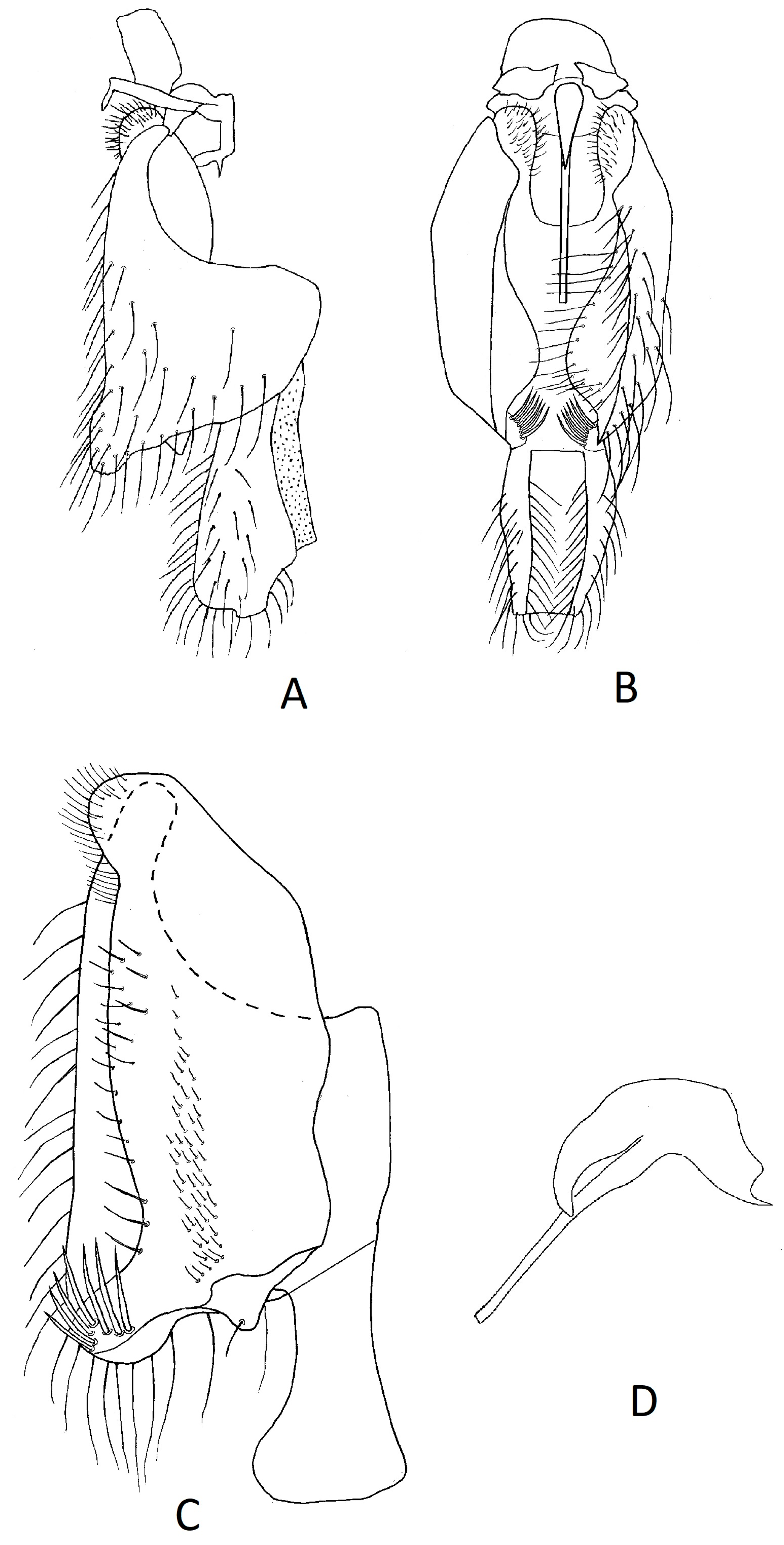
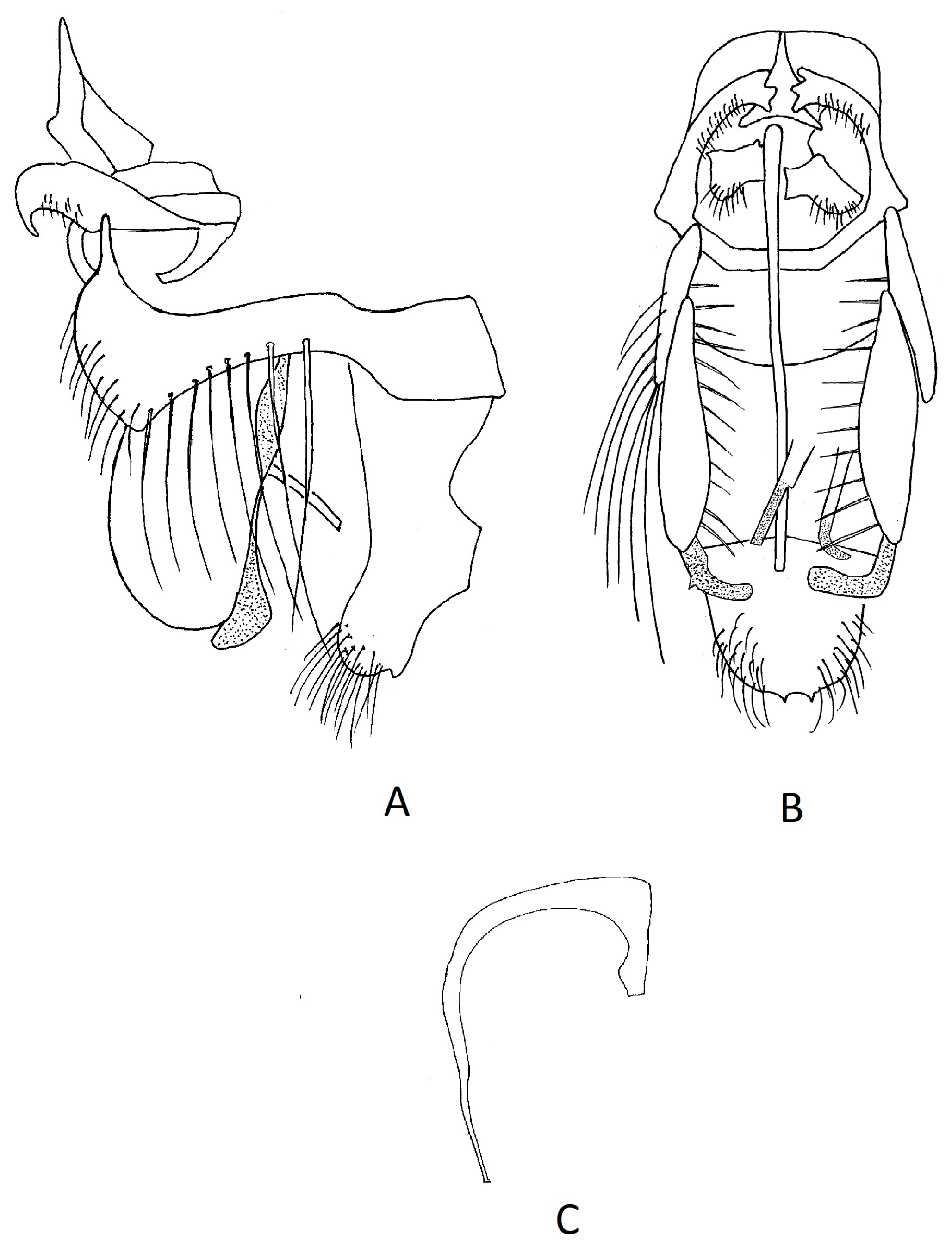
Male terminalia: Epandrium in lateral view slightly wider than high, in ventral view rather globular. Cercus small and membranous, height no more than 0.5× that of epandrium. In lateral view surstylus extending posteriorly beyond the shell of the epandrium as a blunt triangular process, in ventral view surstylus with a rounded irregular shape, posteriorly with a blunt rounded lobe, median surface with only a small blunt projection, medial margin with a fringe of rather strong long setae. Central plate (
Figure 1A—CP) reduced to a membranous structure covered in small, short setulae on posterior portion, anteriorly divided into two long, narrow setulose processes which extend almost to base of phallus. Pregonite extending from base of phallus into shell of epandrium, narrow anteriorly than broadening out, apically forming a large, blunt medially directed tooth, which is slightly sclerotized, a strong apical seta present. Phallus bi-segmented; in lateral view basiphallus broad and sinuous, distiphallus a long, straight narrow tube, slightly bent near apex, in ventral view with a distinct basal plate and swollen basiphallus
Type material. Holotype ♂; Papua New Guinea: Morobe district, Herzog mountains, Vagua, 4000 ft, 4–17. i.1965, leg. M. E. Bacchus. BMNH, specimen number NHMUK 016107486.
Paratype: 1♂ with the same data as the holotype. Specimen number NHMUK 016107487.
Etymology. The specific epithet refers to the collector of the holotype.
Diagnosis. In the key to males of the
Lonchaea impressifrons species-group (McAlpine, 1975: 993) [
11] this species would key out to a small group from the Australasian-Oceanian realm all of which have a setulose scutellar disc. This group includes
L. dasyscutella McAlpine 1964 and
L. cuneifrons McAlpine 1964 both from Queensland, Australia,
L. iridala McAlpine 1964 from the New Hebrides and
L. megacera Kertesz 1901 from Papua New Guinea.
McAlpine (1970: 445) states: “Lonchaea megacera is extremely similar to, and perhaps is identical with, L. dasyscutella. Unfortunately, L. megacera is known from a single female only and L. dasyscutella is known only from males. Until the sexes are properly associated it seems best to treat them as separate entities”. There is a possibility that the species described here, also from Papua New Guinea, is the corresponding male of L. megacera, the descriptions are broadly similar, but following the example of McAlpine I would propose to treat them as separate species until further information is available.
Specimen in poor condition with all legs missing.
Description. Holotype male: Head: Eye bare. Frons sub-shining blue-black, covered with dense microsculpture, at level of antennal bases 0.65× width of an eye. Frontal and interfrontal setulae approximately 0.1× length of orbital setae, longer on anterior margin above lunule. Orbital plate shining black, bare apart from orbital seta. Lunule covered with dense silver pollinosity, parafacials lightly silvered. Face widening ventrally, shining blue-black. Anterior genal setulae in a single row of three to four along mouth margin. Antenna; pedicel orange-brown, postpedicel very long, length-to-depth ratio 4.6:1; extensively orange on medial base, this coloration extending almost halfway along the ventral margin. Arista microscopically pubescent.
Thorax: scutum shining blue-black, lightly dusted near posterior margin, covered with short setulae approximately 0.15× length of orbital seta, anepisternum with a vertical row of four anterior setae and two? Posterior, remainder of sclerite with a scatter of long, thin setulae. Katepisternum with a single seta located near the dorsal margin, a few setulae located anterior to it. A single seta on proepimeron and proepisternum. Scutellum sub-shining black, covered in light dusting, most setae and all setulae missing. Calypter pale with a brown margin and yellowish fringe. Wing light yellowish, wing length 4.0 mm.
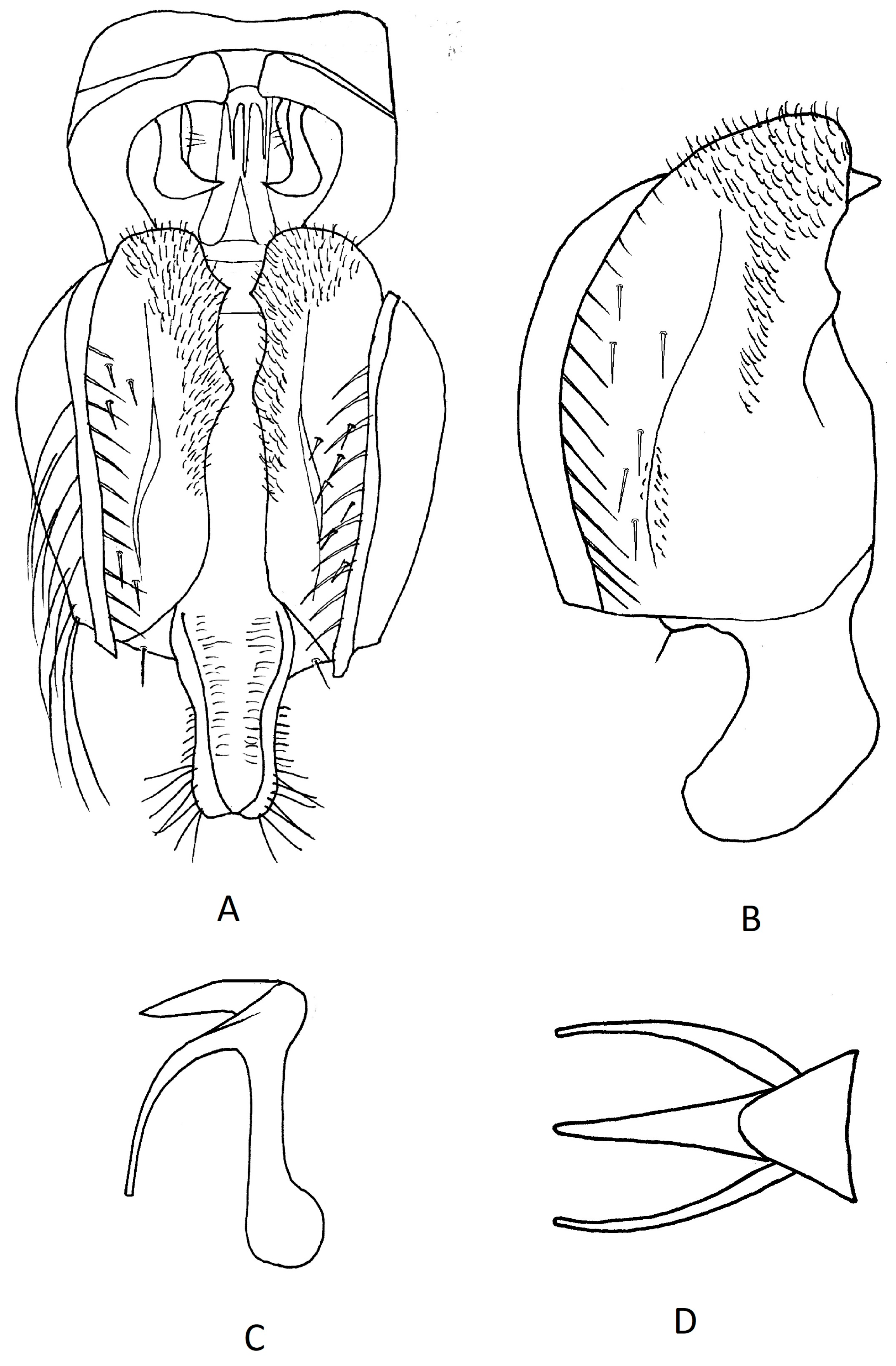
Male terminalia: In lateral view epandrium roughly rectangular, slightly higher than wide, with long setulae along the ventral and posterior margins, the posterior setae being as long as the cercus is high. Cercus, approximately 0.5× the height of epandrium, membranous along dorsal margin, setulose apically. Surstylus evident as a large setulose lobe projecting anteriorly beyond the shell of the epandrium. In ventral view the large, broad surstylus is evident, bearing a dense covering of setulae on the medial margin and apically, where it forms a bluntly rounded process extending beyond the shell of the epandrium. Inner surface of surstylus with five to six setae scattered over the surface between the posterior margin and the bands of setulae. Postgonites membranous apart from a sclerotized medial basal area which bears several setulae. Phallus: not segmented, in lateral view rather U-shaped, basal section relatively broad and as long as the slightly curved apical section, two basal lateral processes. In lateral view these shorter than the phallus, in ventral view the processes curving from their bases to lie parallel to the phallus at their apices.
Type material. Holotype ♂; Papua New Guinea: Morobe District, Herzog Mts. Vagua, 4000 ft, 4–17. i.1965, M. E. Bacchus. BMNH, specimen number NHMUK 016107489
Etymology. The specific epithet refers to the Herzog Mountains on which the holotype was captured.
Diagnosis. This species is perhaps most closely related to Lonchaea malekula MacGowan, 2020 from Vanuatu as both species have a similarly shaped epandrium and cercus with rather setulose anterior apices to the surstyli. The very distinct phallus with its pair of lateral basal processes and the long antennal postpedicel of L. herzogi do however distinguish this species from other described Lonchaea.
Description. Holotype male. Head: Eye bare. Frons black, dulled by fine microsculpture, an obvious rounded depression and a small central raised area situated anterior to ocellar triangle, ratio of frons width at anterior margin to eye width 0.4:1. Frontal and interfrontal setulae very short approximately 0.1× length of orbital seta, becoming longer on anterior margin above lunule. Orbital plate shining black, bare apart from orbital seta. Lunule intensely silver pollinose, parafacials silver pollinose for most of their length, face lightly dusted dorsally and shining black ventrally. Anterior genal setulae in single row of six along mouth margin. Antenna: black, pedicel orange-brown, postpedicel extensively orange on medial inner base, this coloration extending along the ventral margin for basal third, length-to-depth ratio 2.6:1. Arista microscopically pubescent.
Thorax: scutum shining black, covered in short setulae 0.2× length of orbital seta. Anepisternum shining black, a vertical row of three anterior and three posterior setae, otherwise sclerite almost bare. Katepisternum with 1 seta located near the dorsal margin on an otherwise almost bare sclerite. Proepimeron and proepisternum each with a single seta. Scutellum: disc covered in short setulae, lateral margins without any obvious setulae. Calypter white with a white fringe. Wing clear, wing length 2.8 mm. Legs black, basal tarsomere clear yellow, second tarsomere dusky yellow.
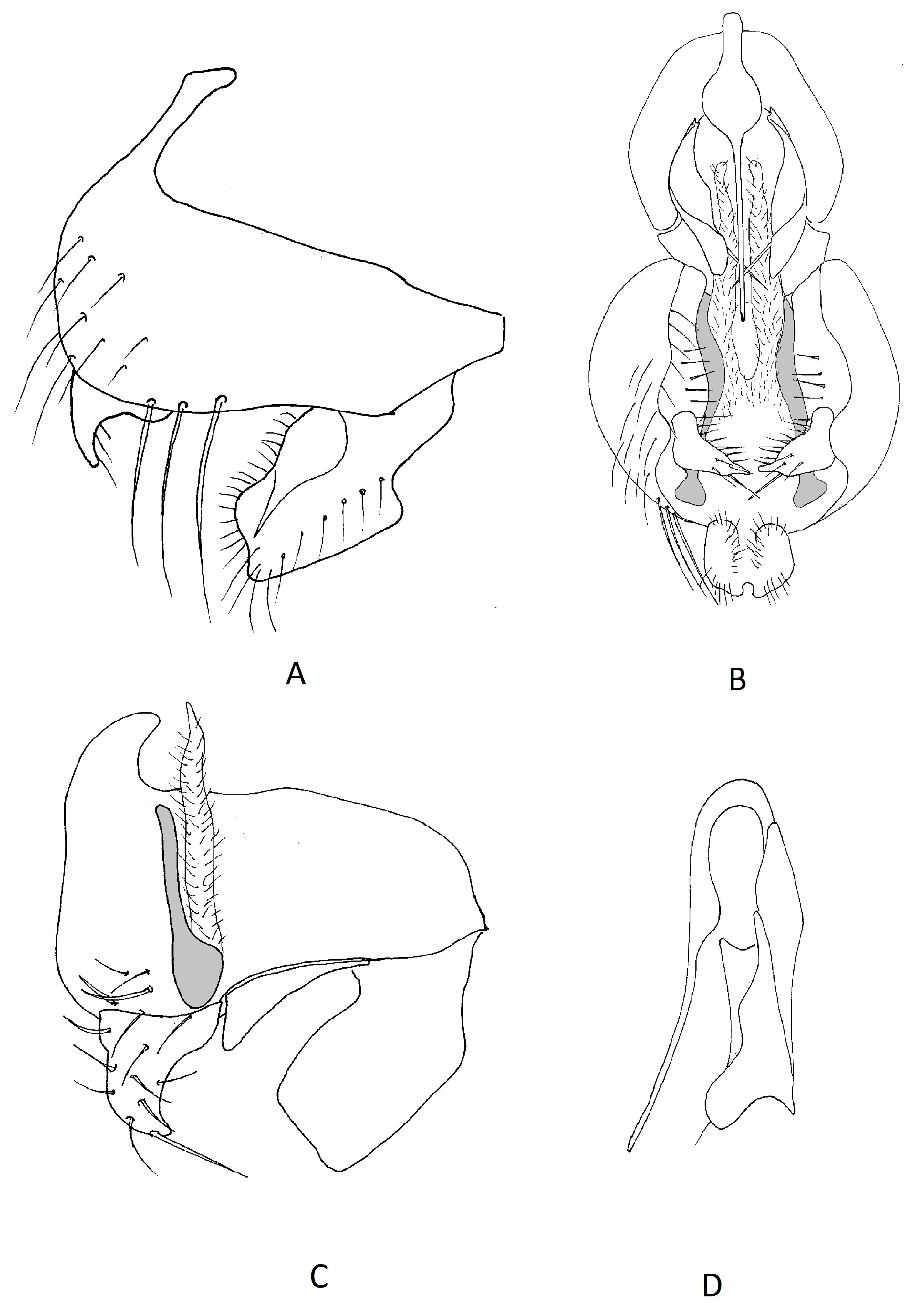
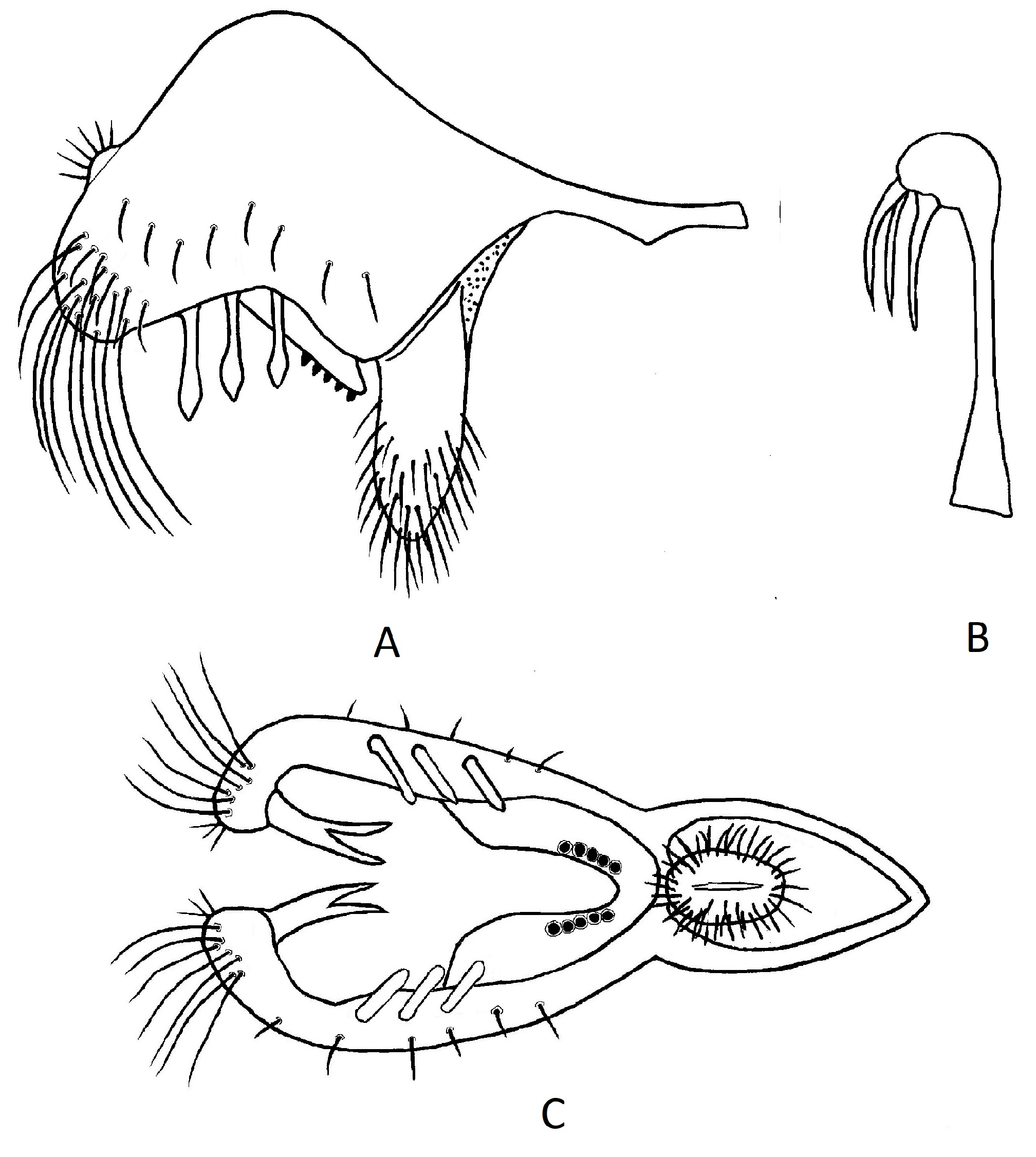
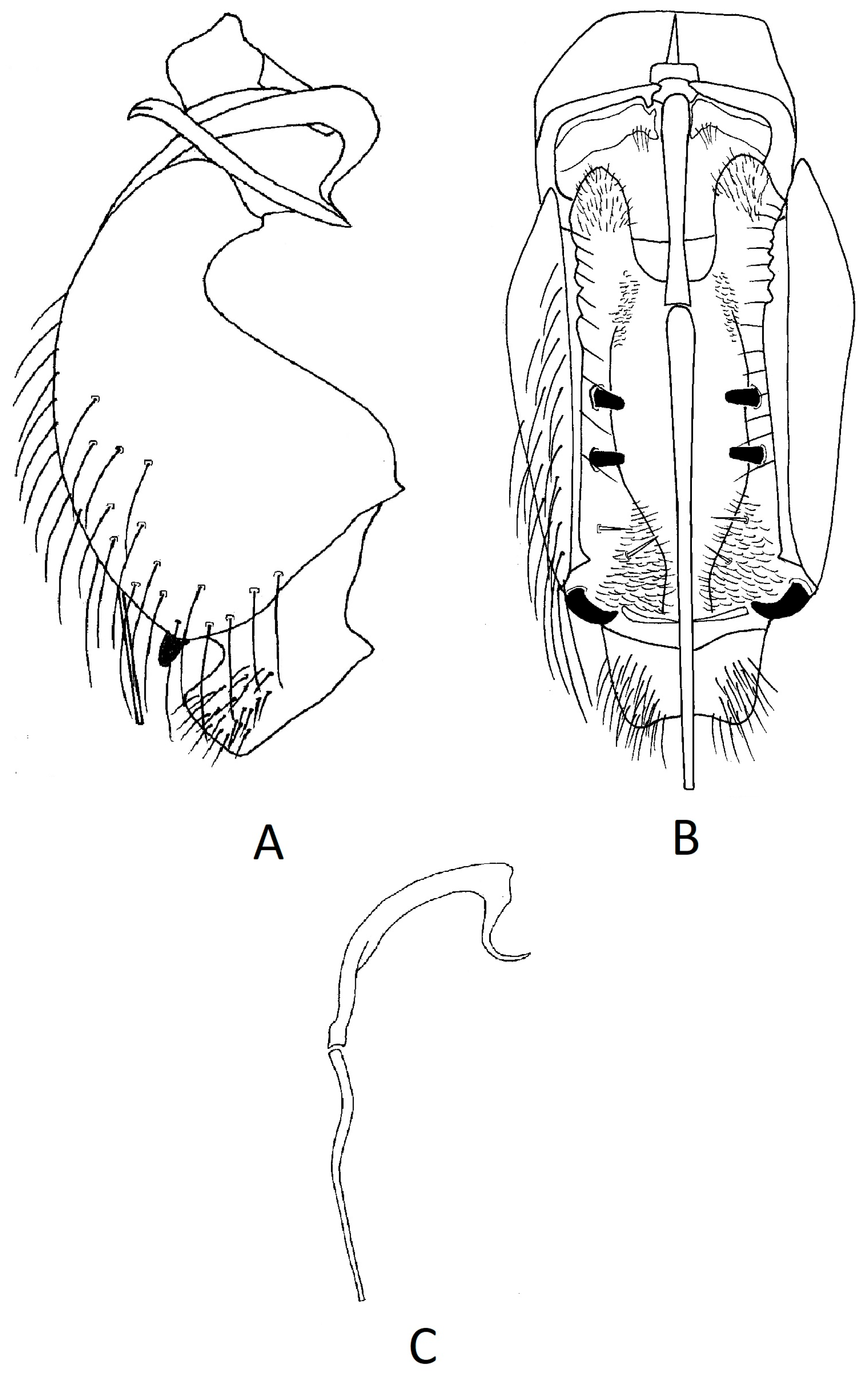
Male terminalia: In lateral view epandrium 1.5× wider than high, with a long antero-ventral projection, three long, strong setae along posterior margin, scattered setulae ventrally. Cercus relatively large, height almost equalling that of epandrium, roughly rectangular in shape, bearing a fringe of setulae on ventral margin and a loose row of setulae posteriorly. Surstylus projecting beyond shell of epandrium posterior-ventrally as a hook-shaped process. In ventral view surstyli small, pistol-shaped, projecting medially to a blunt point, with stiff, strong setulae along medial margin and apices. Central plate membranous, with two apical leg-like setulose projections which almost reach to the base of the phallus. Lying laterally to the central plate a long narrow process, reaching anteriorly almost to the margin of the epandrium, slightly thickened at posterior end. Phallus in lateral view an open J-shape with a conspicuous medial bulge basally, in lateral view this bulge is seen to be a circular expansion of the phallus.
Type material. Holotype ♂. Papua New Guinea: Morobe Province, Bulolo, 27.ix.1980, R. I. Vane-Wright. BMNH, specimen number NHMUK 016107490.
Etymology. The specific epithet refers to Morobe Province, where the holotype was captured.
Diagnosis. This species is similar to other Lonchaea in the Oceania region, excluding those in the L. impressifrons species-group, in that it has a rather flat and wide epandrium. This in combination with the small surstyli and distinctive phallus with its laterally expanded basal area make L. morobe distinct from all other described species.
Description. Holotype male. Head: Eye bare. Frons sub-shining black, covered in dense microsculpture, ratio of width at antennal bases to eye width 0.5:1. Frontal and interfrontal setulae short approximately 0.1× as long as orbital seta, longer setulae on anterior margin above the lunule. Orbital plate bare, shining black. Lunule ground color black, without dusting. Face and parafacial sparsely grey pollinose. Antenna entirely black, postpedicel length-to-depth ratio 2.5:1. Arista plumose, ratio of plumosity at its maximum to depth of postpedicel 0.6:1. Anterior genal setae in a single row of five along mouth margin, these unusually long, as long as depth of postpedicel.
Thorax: scutum sub-shining black, covered with somewhat sparse but long setulae, approximately. 0.6× length of orbital seta. Anepisternum shining brassy, three anterior and three posterior setae, remainder of sclerite with rather sparse, long setulae. Katepisternum with one strong seta, anterior to this a weaker and shorter seta, 0.6× length of posterior seta, otherwise sclerite just with a few scattered setulae. Proepimeron and proepisternum each with a single seta. Scutellum sub-shining black, bare, sparsely covered with grey pollinosity, margin with a single short setula on each side between lateral and apical setae, one between apical setae. Calypter white, fringe dark brown. Wing clear, wing length 4.0 mm. Legs entirely black.
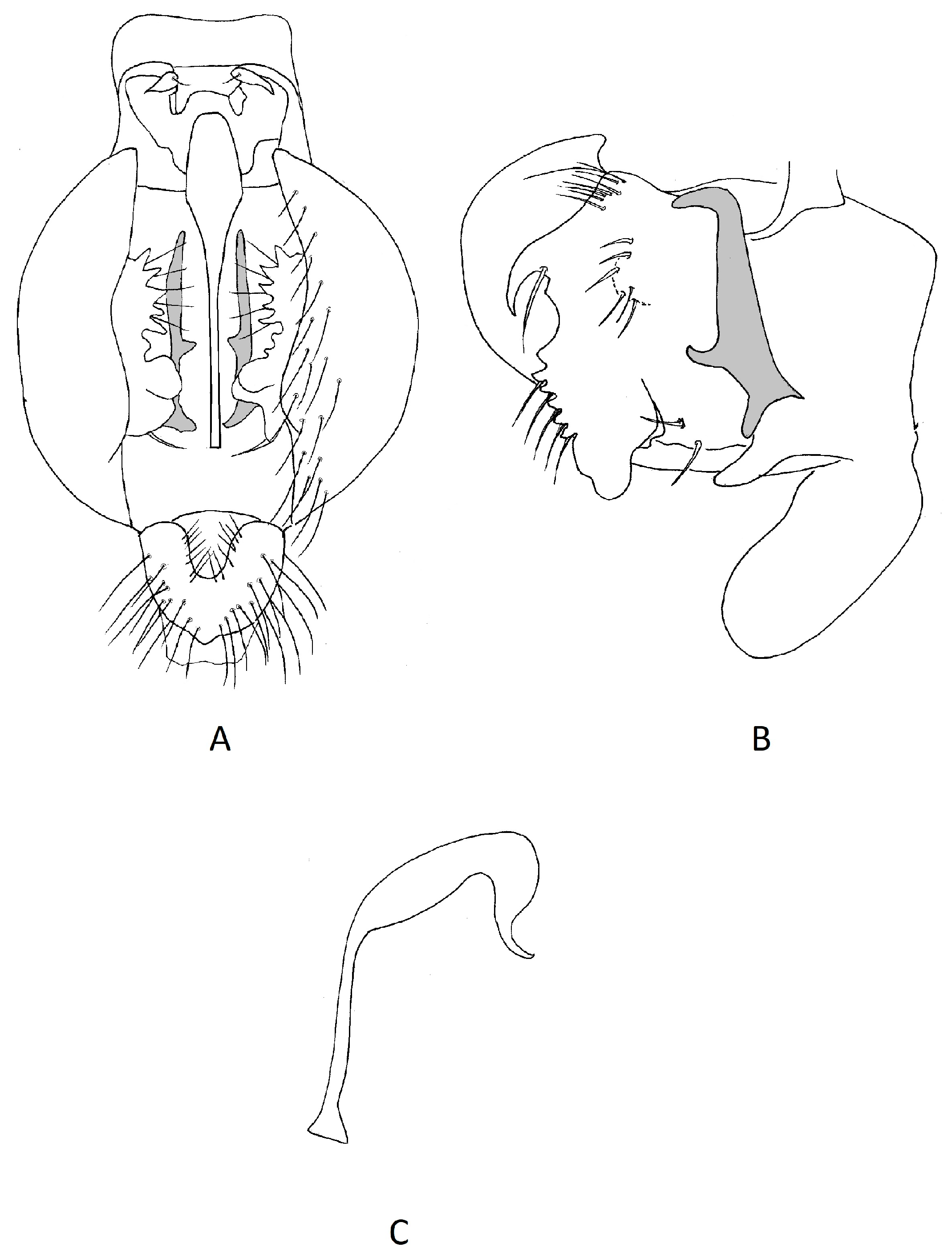
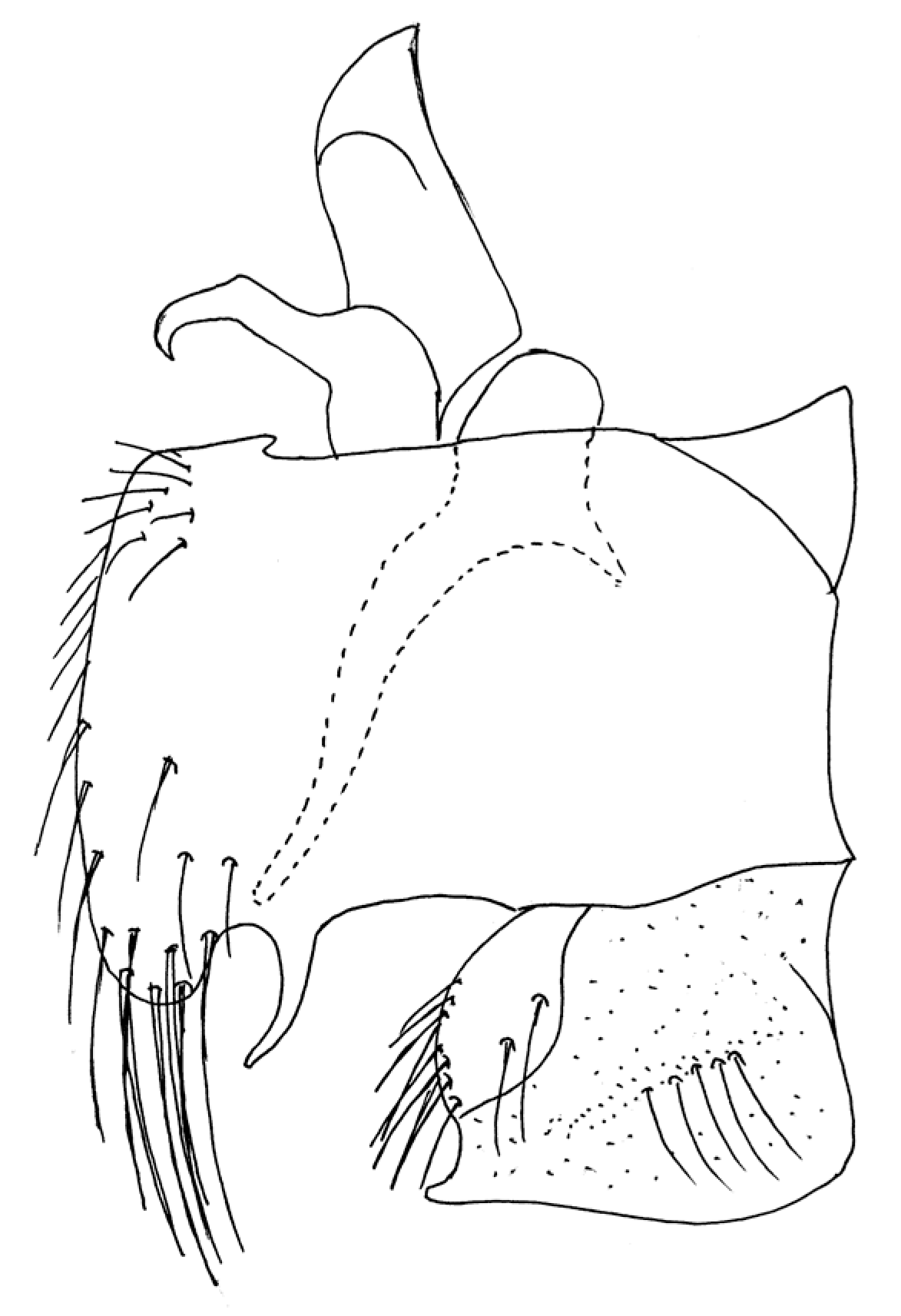
Male terminalia: In lateral view epandrium slightly wider than high. Cercus, height 0.75× depth of epandrium, with numerous setulae at apex. In ventral view surstyli with a very complex medial margin consisting of various lobes and pointed processes. Inner view of epandrium and associated structures again shows the complex margin of the surstyli with a large ventral hook on apical half, setulae present along posterior part of margin, at the base of the hook, a clump on anterior apex and a scattering medially. Central plate divided into two rod-like structures running through the center of the epandrium, on inner view these are seen to have apical, medial and anterior processes. Phallus not segmented and relatively simple, basal section slightly swollen, apical section slightly longer than the basal and almost as wide, with a flared apex
Type material. Holotype ♂; Papua New Guinea: Kundiawa, 30.x.1973, K. A. Spencer. BMNH, specimen number NHMUK 016107488.
Etymology. The specific epithet refers to the captor of the holotype.
Diagnosis. This is another member of the Lonchaea impressifrons species-group as indicated by the complex surstyli and remnants of a central plate. Within the species-group it is apparently unique in having plumose arista. The very characteristic shape of the surstyli and the relatively simple phallus also serve to distinguish it from similar species.
This specimen in poor condition with head, one mid leg, both hind legs and most of the wings missing.
Description. Holotype male. Head: Missing. Thorax: scutum, shining black covered with very short setulae. Anepisternum, shining brightly on disc but pollinose anteriorly and posteriorly, with two rather weak anterior setae and two posterior setae. Katepisternum with one seta located near dorsal margin, otherwise almost bare. Proepimeron and proepisternum each with a single seta. Scutellum: disc covered with very short setulae, margin between lateral and apical setae with four setulae on left and three on right, none between apical setae Calypter white with a white fringe of uniform length. Estimated wing length 2.5 mm. Legs dark apart from basal tarsomeres which are clear yellow, second tarsomere brownish.
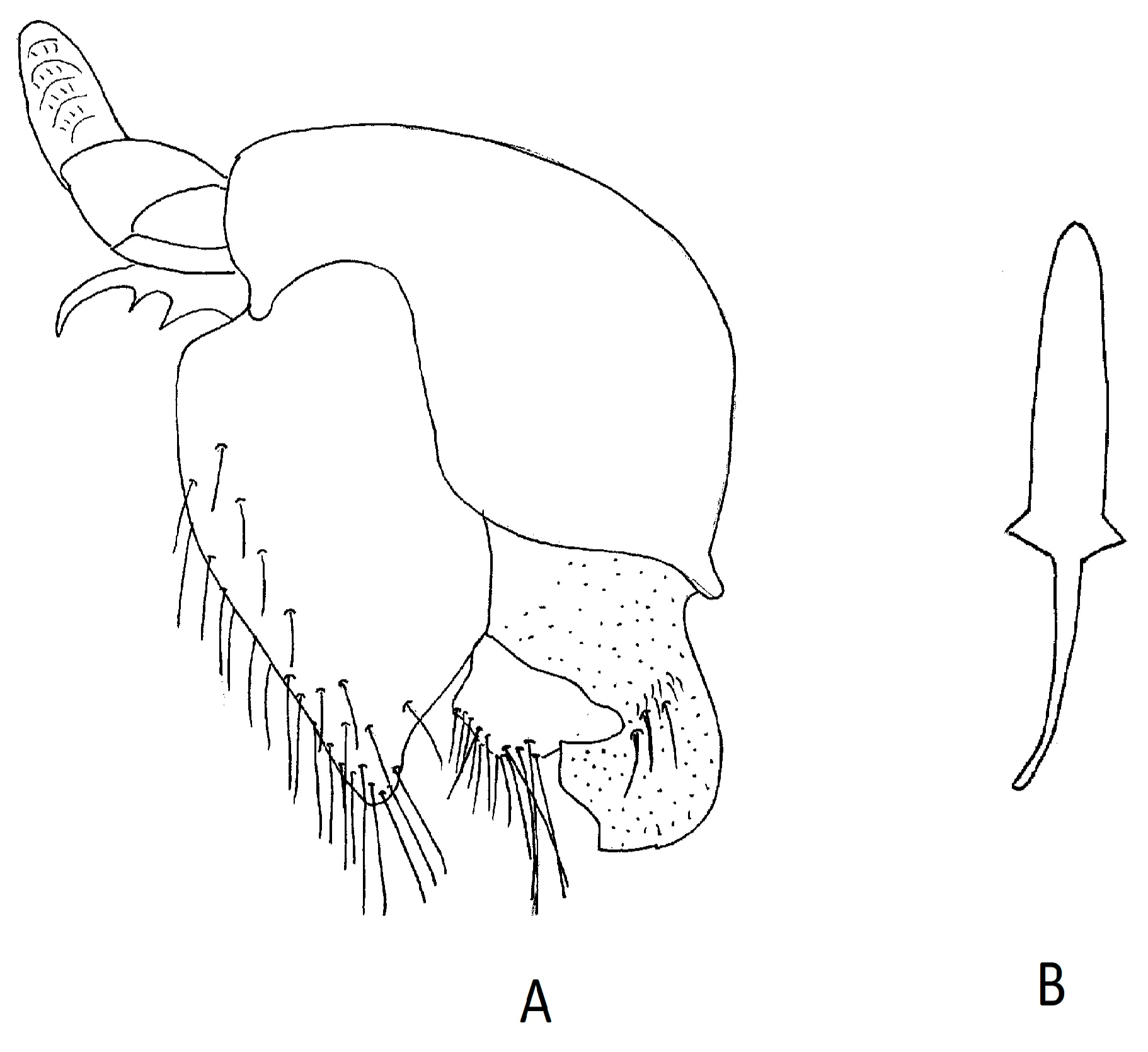
Male terminalia: epandrium in lateral view almost as wide as it is high. Cercus relatively small, approximately 0.5× height of epandrium. In ventral view a broad, hooked process located at the base of the cercus, the apical hooked portion anteriorly directed and partly sclerotized. Surstyli small, at base approximately 0.2× as high as epandrium, medial margin simple apart from a pointed posterior process, with six–eight short, stiff setulae medially. Lateral processes (
Figure 5 LP) well developed, apical portion sclerotized and curved medially. Membranous element produced anteriorly as two thin, pointed setulose processes. Pregonites simple and strap-like, apically with long, pointed, partly sclerotized processes, apical seta long and strong. Phallus; not segmented, a relatively simple J-shape becoming slightly narrower apically.
Type material. Holotype ♂; Indonesia: Sulawesi Utara (North Sulawesi): 25.xi.1983. leg. B. Pitkin. BMNH, specimen number NHMUK 016446517.
Etymology. The specific epithet refers to the island of Sulawesi on which the holotype was captured.
Diagnosis. This a member of the Lonchaea impressifrons species group. Despite being in poor condition, the genitalia are intact and act as the basis for identification. The relatively small surstyli, strap-like pregonites, and hooked process at the base of the cercus serve to distinguish it from its near relatives.
Genus Silba Macquart, 1851.
Description. Holotype male. Head: Eye bare. Frons, matte black, narrowing only slightly from the level of the ocellar triangle to the antennal bases where it is approximately 0.5× width of an eye. Frontal and interfrontal setulae less than 0.25× length of orbital seta, longer setulae present along anterior margin above the lunule. Orbital plate bare apart from the orbital seta. Lunule with a light covering of silver pollinosity, bearing eight setulae. Antenna entirely black apart from a hint of brown at extreme medial base, postpedicel length-to-depth ratio 2.5:1, just reaching down to the mouth edge, arista, plumosity at maximum extent equaling depth of postpedicel. Anterior genal setulae in single row of five along mouth edge, the basal two of these 2× longer and stronger than any other setulae on the gena.
Thorax: scutum shining blue-black apart from light dusting in the pre-scutellar area, covered in setulae which are at most 0.3× length of the orbital seta. Anepisternum with a vertical row of three anterior setae and three posterior setae. Katepisternum with only one seta on right side, two on left, the posterior seta being stronger than the anterior. Prothoracic sternum bearing fine setulae. One seta on proepimeron and one slightly weaker on proepisternum. Scutellum: disc pollinose and bare, on margin between lateral and apical setae with three setulae on left side, two on right, two setulae between apical setae. Calypter: margin and fringe pale yellow, fringe of uniform length. Wing hyaline, wing length 3.5 mm. Legs entirely black.
Male genitalia. Epandrium medially compressed, 0.6× as high as it is wide, extended dorsally into a long thin process, rounded anteriorly and undulating along posterior margin, numerous long curved setae on the posteroventral angle of the epandrium, the longest of these almost as high as a cercus; shorter, scattered setae located near the posterior margin. Three peg-like structures, half the height of the cercus, arising in an equally spaced row midway between the base of the cercus and the posteroventral angle of the epandrium. Cercus finger-like, 0.7× the height of the epandrium at its deepest point, densely covered with short setae apically. Surstylus projecting posteriorly beyond the shell of the epandrium posteriorly as a rather flat rectangular process bearing five small prensisetae, only slightly visible as a rounded setulose process ventrally. In posterior view, a long, medially directed, sharply pointed, bifurcated process arising from the ventral margin of the surstylus. Phallus club-shaped, distiphallus half the height of the basiphallus, with a pair of lateral processes which are as long and strong as the distiphallus.
Type material. Holotype ♂; Papua New Guinea: 15 miles E. of Lac (Lae), Morobe District, 19.xi.1972, leg. G. A. Holloway. AMS collection number K.232391.
Diagnosis. The male genitalia of this species represent yet another example of the derived forms found in Papua New Guinea. In particular the male genitalia with three club-like processes arising from the posterior surface of the epandrium and the club-shaped phallus with a pair of lateral processes equal in size and shape to the distiphallus serve to make the species clearly distinct.
Description. Holotype male. Head: Eye bare. Frons when seen from in front heavily grey-dusted, at narrowest point 0.5× width of an eye. Frontal and interfrontal setulae short approximately 0.2× length of orbital seta, longer anteriorly above the lunule. Anterior genal setulae in a single row of five along mouth margin, the basal two the strongest setae on the gena. Remaining setae on the head mainly missing. Antenna: entirely black, postpedicel length-to-depth ratio 2.75:1. Arista plumose, ratio of plumosity at maximum extent to depth of postpedicel 1.1:1.
Thorax: scutum and thoracic sclerites dulled by dusting, scutum covered by short setulae. Anepisternum with a vertical row of three anterior setae and four posterior setae, remainder of sclerite covered with rather dense long setulae. Katepisternum with two setae located near dorsal margin. Proepimeron and proepisternum each with a single seta. Scutellum: more heavily dusted than thorax, on margin between apical and lateral setae with six setulae in multiple rows on each side, four between apical setae. Calypter dark brown with a dense black fringe of uniform length. Wing densely fumose, wing length 4.0 mm. Legs entirely black.
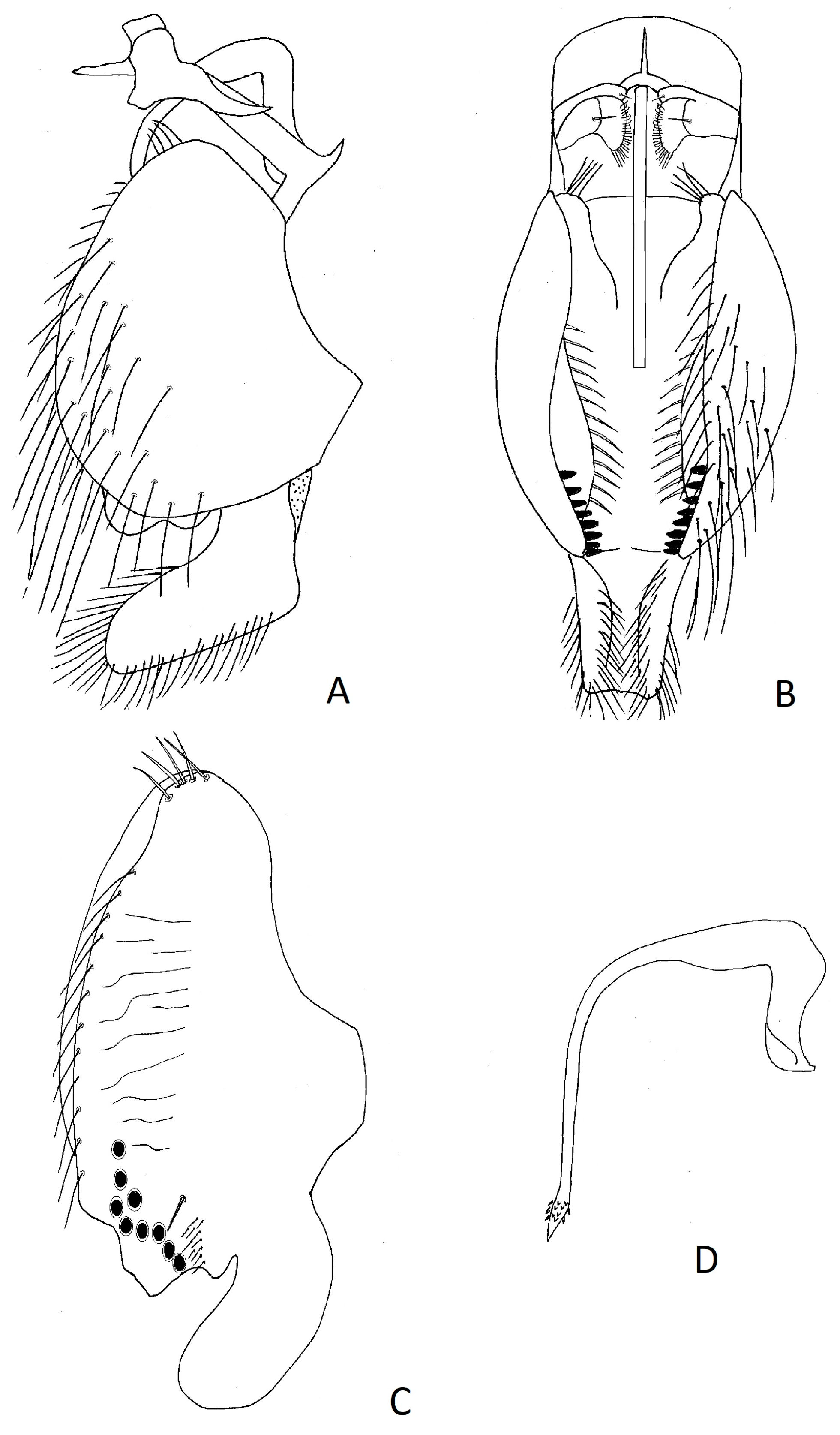
Male terminalia: In lateral view epandrium rounded, 1.3× higher than wide, bearing long setae ventrally and posteriorly, surstylus extending beyond the shell of epandrium posteriorly a small double-humped process. Internal surface of surstylus with nine prensisetae located near posterior margin in a curving partly doubled row, ventral margin with an equally spaced row of short spine-like setae, inner surface with a series of lateral creases, a group of five setae on anterior margin. Postgonites densely setulose on inner margin. Cercus boot-shaped, approximately 0.4× height of epandrium, bearing setulae apically and along posterior margin. Phallus not segmented, L-shaped, the slightly swollen basal section as long as the uniformly wide, posteriorly directed, apical section, apex slightly angled and spiculate.
Type material. Holotype ♂; Solomon Islands: Guadalcanal, Honiara, i.1974, N. L. H. Krauss. BMNH, specimen number NHMUK 016107491
Etymology. The specific epithet refers to the type locality, Honiara, the capital city of Solomon Islands.
Diagnosis. This is a very dull, dusted, dark species with fumose wings and a dark fringe to the calypter, differing from most other Silba species in the Australasian-Oceanian realm which have pale-fringed calypters and clear wings. It is perhaps most similar externally to Silba atratula (Walker, 1860) a widespread species in the Indomalayan and Australasian-Oceanian realm which also has fumose wings and a dark-fringed calypter. However, in S. atratula the phallus is in the form of a long thin curve without apical spicules, the cercus is as high as the epandrium.
Description. Holotype male. Head: Eye bare. Frons black, dulled by rather coarse microsculpture, frontal and interfrontal setulae very short, longer anteriorly above the lunule. Orbital plate shining blue-black in contrast to the roughened frons, orbital setae both missing. Lunule with two to three setulae on each side, covered in intense silver pollinosity, parafacials and face only lightly grey-dusted. Antenna: entirely black, postpedicel length-to-depth ratio 2.3:1. Arista plumose, plumosity at maximum extent approximately 1.2× depth of postpedicel, individual plumes bent forward at apex. Anterior genal setulae in a single row of three to four along mouth margin.
Thorax: scutum shining blue-black, covered with short setulae. Katepisternum and anepisternum slightly dulled by dusting. Anepisternum with a vertical row of three rather short anterior setae, three posterior setae, remainder of sclerite covered with rather coarse, long setulae. Katepisternum with two setae located near dorsal margin, anterior slightly shorter and finer than posterior. Proepimeron and proepisternum each with a single seta. Scutellum: scutum covered in fine grey dusting, some marginal setae and setulae missing but with 2–3 setulae between lateral and apical setae, none between apical setae. Calypter white with a rather dense, short white fringe of uniform length. Wings clear with brownish veins, slightly infuscated at base, wing length 4.0 mm. Legs entirely black.
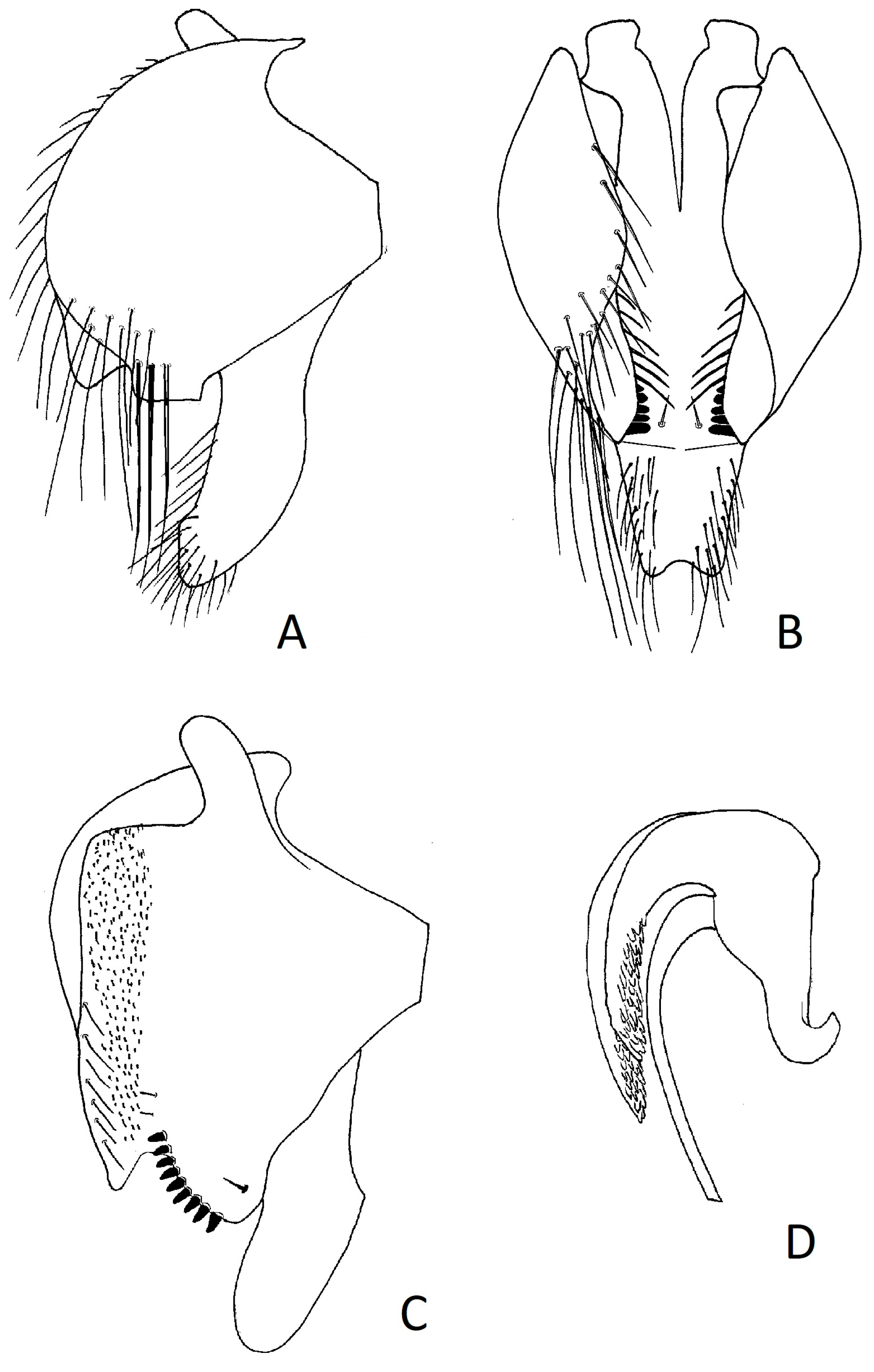
Male terminalia: In lateral view epandrium almost as wide as it is high, with a small truncate process posteriorly and a hooked anterior process, a scattering of long setae posteriorly and along ventral margin, the three nearest the base of the cercus being notably strong. Cercus almost as high as the epandrium, numerous setulae at apex and along ventral margin. Surstylus projecting beyond shell of epandrium as small rounded posterior-ventral and anterior processes. Internal surface of surstylus with nine uniformly sized prensisetae forming a single row along posterior margin, ventrally with a covering of short setulae. Phallus with a pair of lateral curved sub-basal processes, these bearing scale-like setulae on medial surface and at apex, distiphallus a simple J-shaped tube narrowing slightly from the base.
Type material. Holotype ♂; Indonesia: North Sumatra, near Berastagi, secondary forest, 21.v.1985, leg. J. Ismay. CNC, database number CNC1156169.
Etymology. The specific epithet refers to John Ismay the captor of the holotype.
Diagnosis. A relatively standard Oriental Silba species with a pale fringe to the calypter and plumose arista. It is distinguished by the structures of the male terminalia, primarily the shape and structure of the phallus. The genitalia do show some similarities with those of Silba nudoscutella McAlpine, 1964 from Australia which also has a phallus with a pair of sub-basal processes covered in scale-like setulae. However, in S. nudoscutella there are only five large prensisetae set on a distinct posterior basal plate of the surstylus and the distiphallus is a narrow, straight tube with an angled apex. Silba capsicarum McAlpine, 1956 from Indonesia also has a phallus with a pair of sub-basal processes but these are greatly expanded apically forming a truncate apex covered in long spine-like setulae.
Description. Holotype male. Head: Eye bare. Frons relatively wide, 0.75× width of an eye sub-shining black, dulled by microsculpture, with a slight central prominence. Frontal and interfrontal setulae approximately 0.1× length of orbital seta, longer anteriorly above the lunule. Orbital plate shining black, smooth, bare apart from the orbital seta, lunule, when seen from above, covered in silver pollinosity, parafacials and lateral margin of face lightly grey-dusted. Antenna: postpedicel black apart from an obscure orange area at medial base, length-to-depth ratio 2.7:1. Arista plumose, ratio of plumosity at maximum extent to depth of postpedicel 1.0: 1. Anterior genal setulae short and weak, in a single row of five along mouth margin.
Thorax: scutum shining blue-black, covered in setulae approximately 0.5× as long as orbital seta. Anepisternum shining blue-black on disc dusted along ventral margin, with a vertical row of two anterior and four posterior setae, few other setulae on the sclerite. Katepisternum slightly pollinose, with two strong setae located near dorsal margin. Proepimeron and proepisternum each with a single seta. Scutellum: with disc shining blue-black, margin with three to four setulae between apical and lateral setae, these in more than one horizontal row, none between apical setae. Calypter white, fringe dark brown and of uniform length. Wing membrane yellowish brown, wing length 4.5 mm. Legs entirely black.
Male terminalia: In lateral view epandrium approximately 1.4× higher than wide, slightly projecting as a rounded process posteroventrally, anteriorly forming a narrow, slightly curved process, covered in a scattering of long fine setae posteriorly and ventrally. Cercus large and rectangular, 0.7× the height of the epandrium, membranous along dorsal margin, surface covered with long, fine setae. Surstylus extending beyond the shell of epandrium posteriorly as a small triangular process, anteriorly broadly exposed dorsally parallel to the epandrium and anteriorly as a rounded setulose lobe. In internal view surstylus with a large posteroventral lobe on which are located eight to ten very long, slightly curved, pale prensisetae, ventral margin with a row of setae, dorsal to which a slightly separated lie a posterior–anterior row of smaller setulae, posterior process with a single seta, rounded anterior process setulose. Phallus reaching almost to half the height of the epandrium, bi-segmented, in lateral view with a shoe-shapes basiphallus from which the long, straight tube of the distiphallus emerges.
Type material. Holotype ♂; Papua New Guinea: Kokoda, 2000 ft, ix–x 1933, leg. L.E. Cheesman. BMNH, specimen number NHMUK 016107492.
Etymology. The specific epithet refers to the type locality, the town of Kokoda in Oro Province.
Diagnosis. With two setae on the katepisternum and a long antennal postpedicel with plumose arista this species fits comfortably into the genus Silba, the only exception from the norm is that the prensisetae, located in the normal position on the posterior margin of the surstylus, are much longer, and less sclerotized than in other species. This feature, which makes S. kokoda clearly distinct from other Silba species, is another example of the more derived forms within the genus which occur in Papua New Guinea.
Description. Holotype male. Head: Eye bare. Frons sub-shining black, dulled by microsculpture, when viewed from in front slightly grey-dusted, narrowing slightly to antennal bases where the ratio of frons to eye width is 0.45:1. Frontal and interfrontal setulae 0.2× length of orbital seta, longer setulae on anterior margin above lunule. Lunule black, face and parafacials light grey-dusted. Orbital plate slightly dulled by microsculpture, bare apart from orbital seta. Anterior genal setulae in a single, slightly separate row of five along mouth margin, becoming stronger basally. Antenna: entirely black, postpedicel length-to-depth ratio 2.7:1. Arista plumose, ratio of plumosity at maximum extent to depth of postpedicel 0.9:1.
Thorax: scutum sub-shining black, slightly pollinose, covered in long black setulae approximately 0.8× length of orbital seta. Anepisternum with a vertical row of four anterior setae on left, five on right, the dorsal and ventral setae of this row weaker than the central three, three posterior setae, remainder of sclerite covered with numerous long setulae. Katepisternum with two setae located near dorsal margin, anterior rather weak, anterior part of the sclerite with only a few shorter setulae. Proepimeron and proepisternum each with a single seta. Scutellum: on margin, with three setulae between the apical and lateral setae, two between apical setae. Calypter white with a dense, long white fringe of uniform length. Wing fumose but with longitudinal clear streaks in cells. Wing length 5.0 mm. Legs entirely black.
Male terminalia: In lateral view epandrium approximately 2× as high as it is wide, setulose on posterior and ventral margins. Cercus rather rectangular, approximately 0.3× height of epandrium, setulose apically. Surstylus in ventral view with inner surface densely setulose posteriorly and anteriorly, posterior margin with a single large, slightly curved, medially directed prensiseta, two slightly smaller prensisetae situated in a posterior–anterior row approximately midway along the inner surface. Pregonites simple, strap-like. Phallus J-shaped, bi-segmented, very long, extending to the cercus, basiphallus long and thin, slightly shorter than distiphallus, distiphallus a long thin tube, slightly sinuate.
Type material. Holotype ♂; Papua New Guinea: Nauwatabanda, L.A.Bulolo. Morobe Province. 3.vi.1980, leg. H. Ivagai. BMNH specimen number NHMUK 016107493.
Paratypes: 2 ♂ with the same data as the holotype, specimen numbers NHMUK 016107494 & NHMUK 016107495
Etymology. The specific epithet refers to the nation of Papua New Guinea.
Diagnosis. The male genitalia of this species possess a unique pattern of large prensisetae, one on the posterior margin of the surstylus and two located on the inner surface at the midpoint. This feature, combined with the long, bi-segmented phallus and fumose wings with clear streaks serve to distinguish S. papua from all other described Silba species.