Article

Atterberg Limits and Strength Relationships of Oil Sands Tailings

Department of Civil and Environmental Engineering, University of Alberta, Edmonton, AB T6G 2E1, Canada
*
Author to whom correspondence should be addressed.
Mining 2025, 5(4), 86; https://doi.org/10.3390/mining5040086
Submission received: 29 October 2025 / Revised: 1 December 2025 / Accepted: 12 December 2025 / Published: 18 December 2025

Abstract

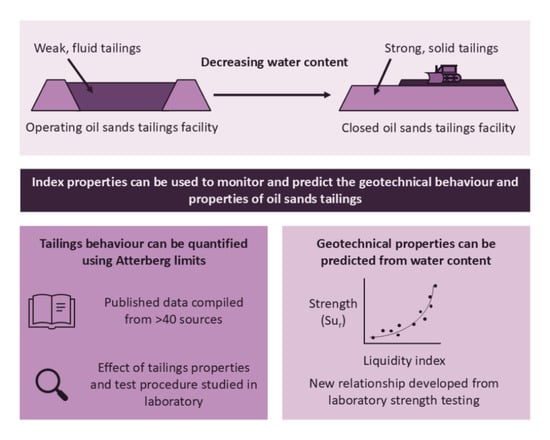
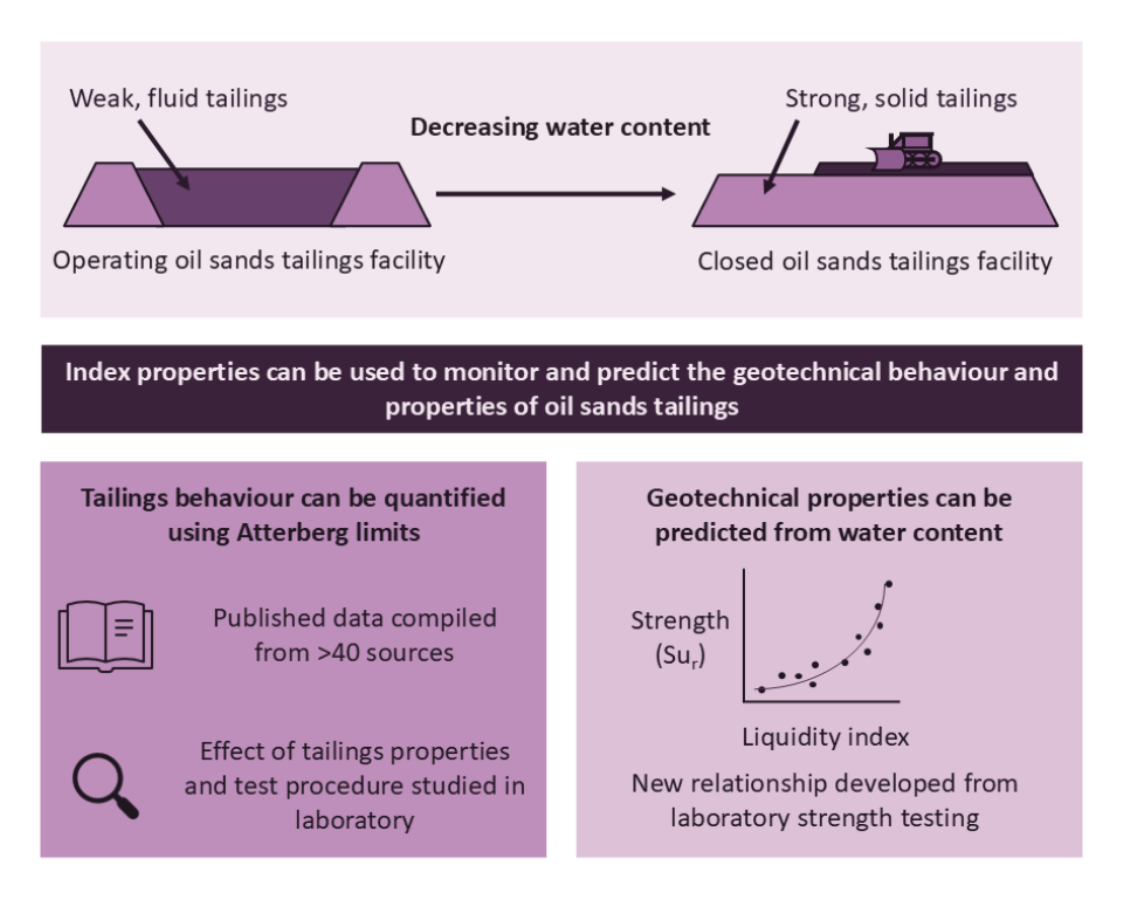
Reclamation of tailings facilities at oil sands mines in northern Alberta presents a significant challenge for industry, regulators, and researchers. Atterberg limits are an established method for quantifying clay behaviour in geotechnical engineering, which has been adopted for oil sands tailings due to their high clay mineral content. Correlations between remoulded undrained shear strength and liquidity index, originally developed for natural clays, have also been applied to oil sands tailings. This paper proposes a new material-specific correlation between remoulded undrained shear strength and liquidity index based on laboratory testing of oil sands tailings. Additionally, the results of Atterberg limits tests on oil sands tailings suggests that the inherent variability of the test itself has a greater effect on the measured value than the preparation method and test procedure. The results of this study support the idea that index properties such as Atterberg limits can provide a cost-effective method for field monitoring and early-stage reclamation design.

Graphical Abstract

1. Introduction

1.1. Background on Oil Sands Mining

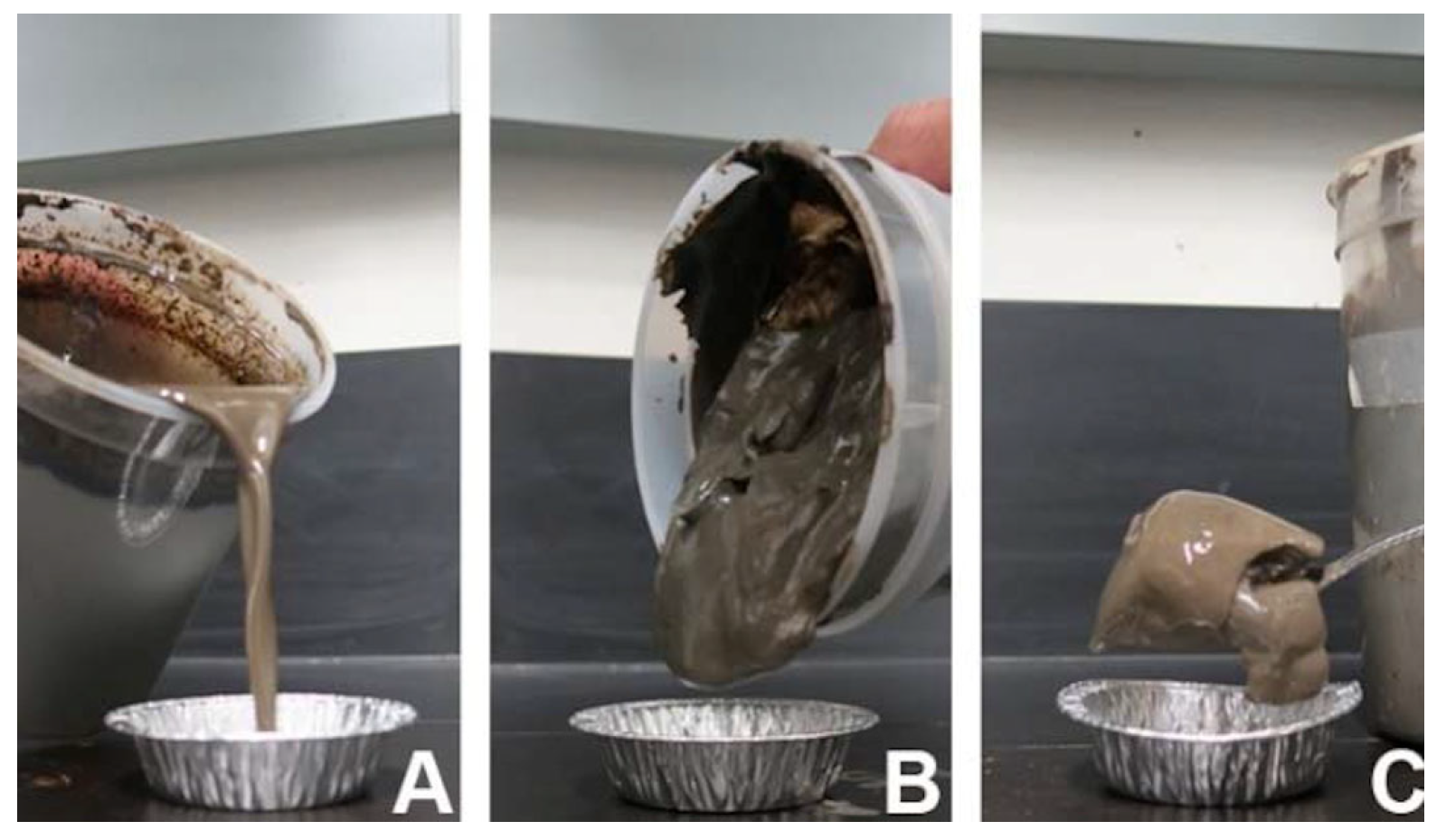
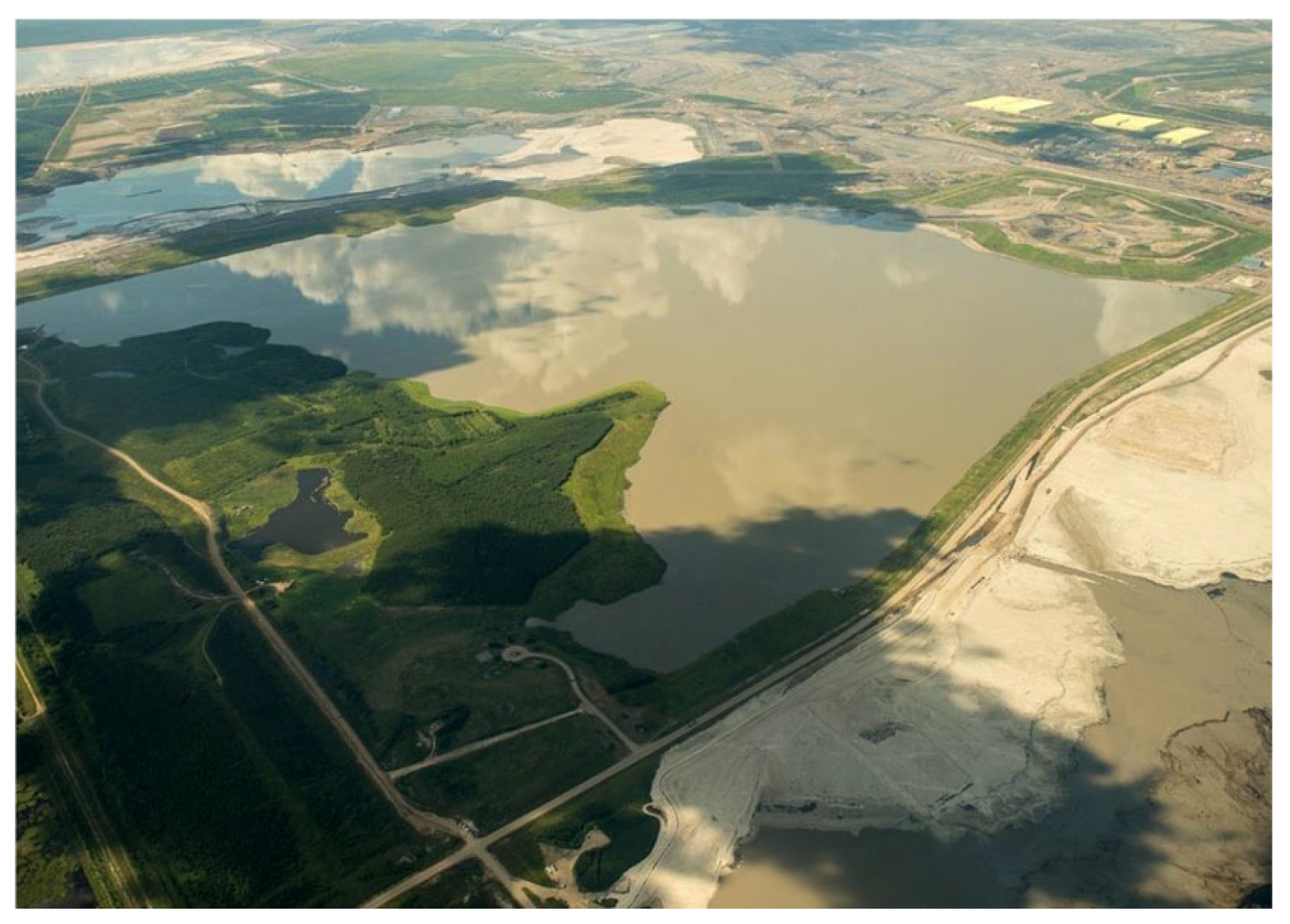
Bitumen mining in the oil sands region of northern Alberta, Canada produces a clay-rich, highly fluid waste stream that presents a significant challenge for mine reclamation. Initially, oil sands tailings have a fluid consistency (6–10% solids by weight) and are deposited in above-ground structures or mined-out pits referred to as tailings facilities (Figure 1) [1,2]. At this initial stage, the waste material is referred to as fluid tailings (FT). Over time, the fine clay and silt particles in FT will settle to the bottom of the pond in the centre of the tailings facility and consolidate to a denser, stronger material referred to as mature fine tailings (MFT) (>30% solids by weight). However, further strength gain through consolidation may take over a century, and a number of techniques are employed in the oil sands region to increase the density and other engineering properties of both existing MFT and newly produced tailings [1,2,3]. These methods are typically some combination of mechanical treatments (e.g., centrifugation, hydrocyclone separation, pressure filtration, thickening) and chemical treatments (e.g., addition of coagulant and/or flocculant) [1]. Oil sands tailings at different solids contents are shown in Figure 2.
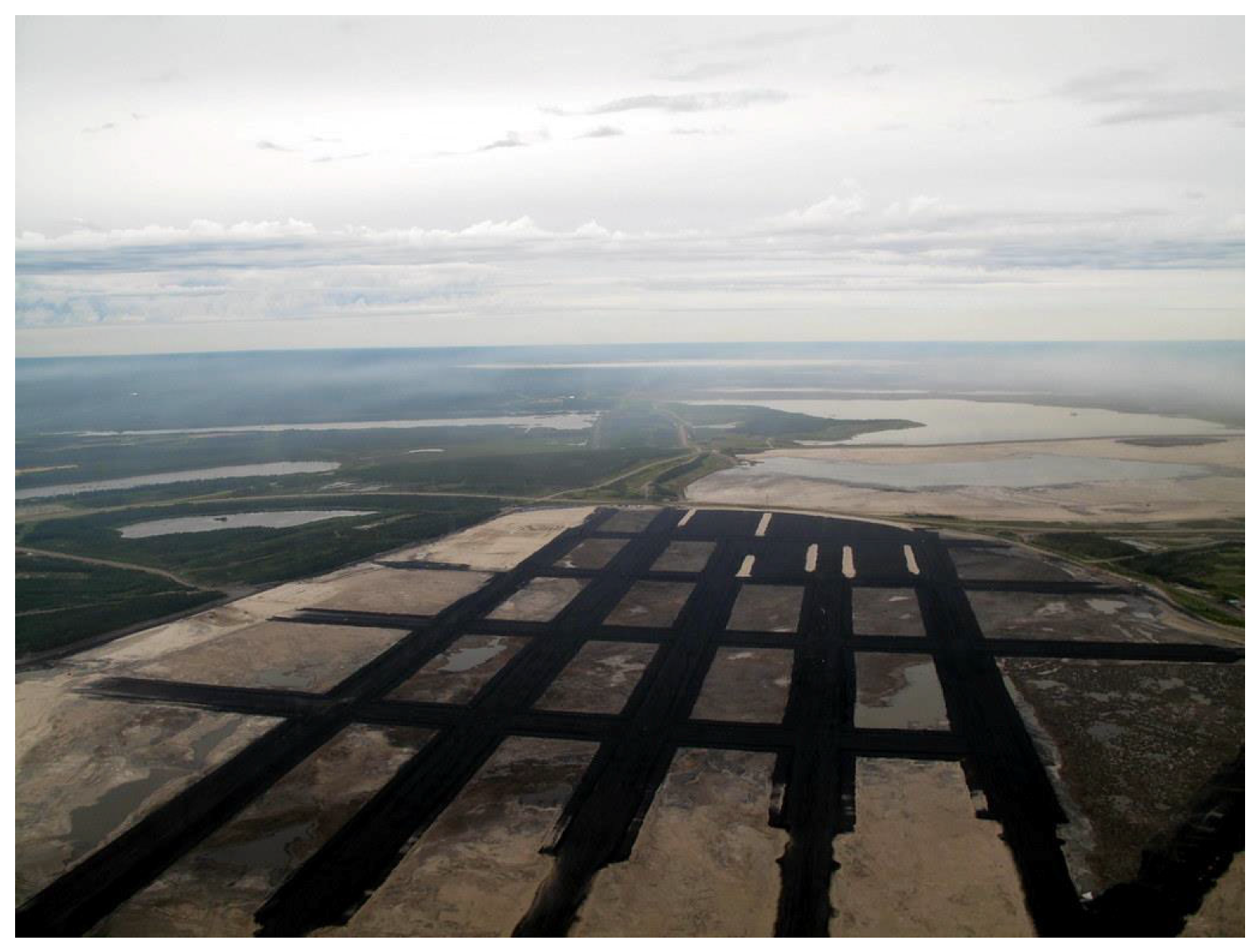
Oil sands mines, including tailings facilities, are required by provincial regulations to be reclaimed to a self-sustaining boreal forest ecosystem [6]. A proposed approach to the reclamation of tailings deposits is capping, in which material such as sand or petroleum coke is placed on the surface to reclaim the deposit as an upland or wetland landform (Figure 3) [4]. The cap serves several functions, including separating the tailings from the ecosystem, improving the engineering properties of the deposit, and providing a stable platform from which further reclamation work can occur. Critically, the underlying tailings in the facility must be able to safely support both the cap as well as the equipment and personnel required to place it without “punching through” the cap. Achieving the necessary strength to cap tailings deposits is an ongoing challenge, in part due to their high clay content [4,7]. The high proportion of clay contributes to challenging geotechnical behaviour, including slow consolidation and low strength [2,8,9,10]. The proportion of solids less than 44 µm in diameter (defined as fines) can exceed 80% in some tailings streams [4].

1.2. Atterberg Limits of Oil Sands Tailings

Owing to the high clay content of oil sands tailings and the associated geotechnical challenges, methods for describing and quantifying clay behaviour have been adopted for tailings characterization. The Atterberg limits are a relatively straightforward and well-established method for quantifying how the behaviour of a clay changes with water content. Because oil sands tailings reclamation is primarily concerned with the dewatering and the associated strength gain of a deposit, the Atterberg limits are a simple and intuitive method to estimate how the behaviour of a deposit is expected to change at different stages of dewatering.
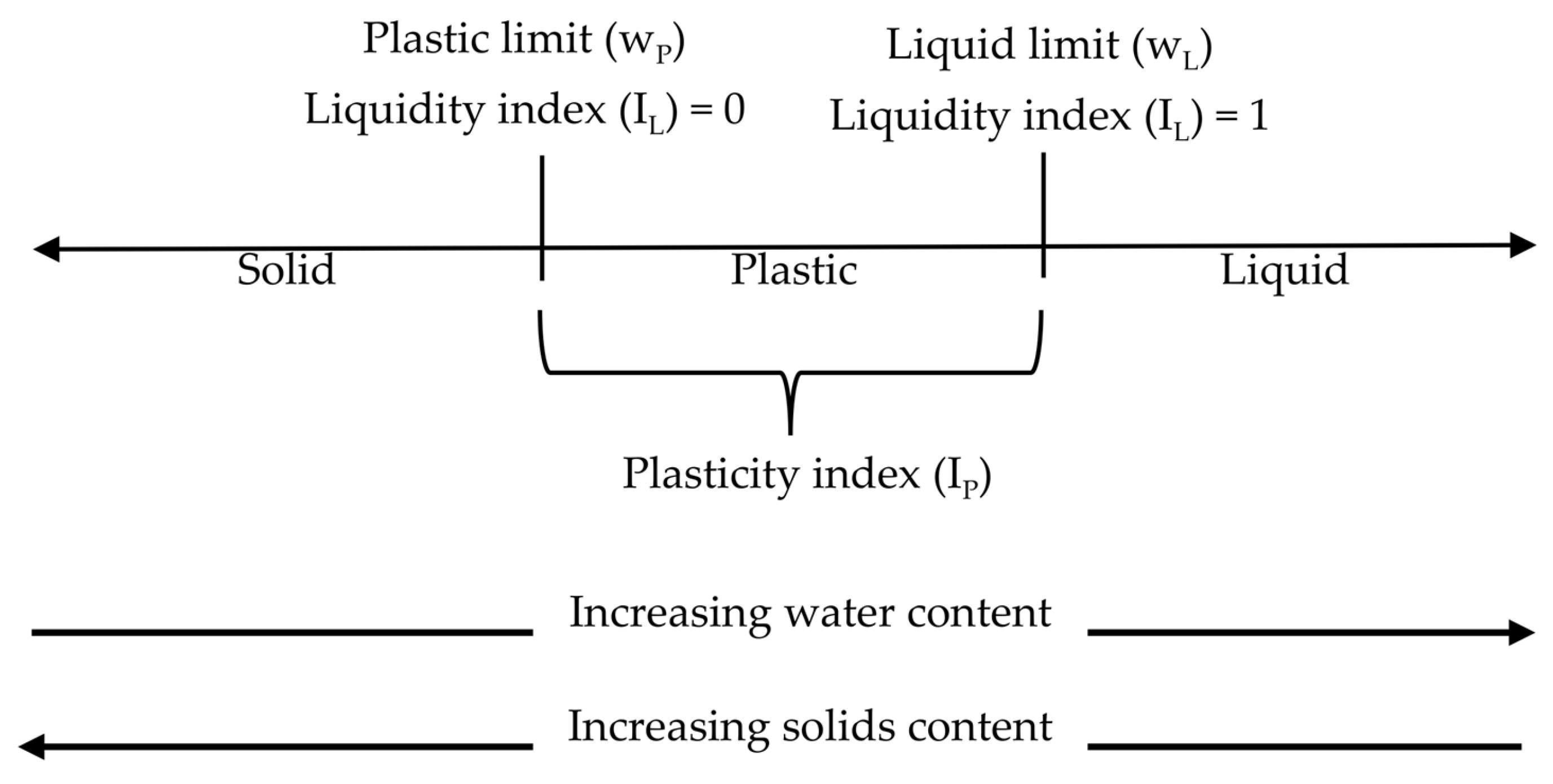
The Atterberg limits of a soil are the geotechnical water contents (defined as the ratio of the mass of water to the mass of solids) that correspond to transitions in behaviour from brittle or solid to plastic, and plastic to liquid (Figure 4). The plastic limit (wP) is the water content at which the behaviour transitions from solid to plastic, and the liquid limit (wL) is the water content at which the behaviour transitions from plastic to liquid. The arithmetic difference between wP and wL is defined as the plasticity index, and the water content can also be normalized against wP and wL as the liquidity index (IL, Equation (1)). At wP, IL is equal to zero, and at wL, IL is equal to one.
I L = w w P w L w P
Atterberg limits can also be linked to other geotechnical properties. Sobkowicz and Morgenstern [12] suggest that index tests such as Atterberg limits and field measurements of solids content could be a cost-effective approach to monitor the long-term performance of tailings deposits. The most useful of these relationships in the context of oil sands tailings reclamation is the relationship between remoulded undrained shear strength (Sur) and IL.
The relationship between Sur and IL has been widely accepted in geotechnical engineering for several decades [13,14,15,16]. This relationship is a useful conceptual framework for oil sands tailings because much of reclamation design is concerned with assessing when the water content of tailings has sufficiently decreased to a strength or consistency that can support foot or vehicle traffic [4]. Additionally, oil sands tailings are a highly thixotropic material and can significantly decrease in strength upon remoulding, meaning that Sur represents the lowest possible strength [17]. The ratio between the peak undrained shear strength (Su) and Sur is referred to as the sensitivity ratio (St) (Equation (2)) and is typically between 2–4 for oil sands tailings [18]. Due to the importance of both water content and strength in oil sands tailings reclamation, a relationship between Sur and IL is a convenient method for estimating a lower bound of strength. In the context of reclamation, this relationship would allow for readily determined index properties to estimate when a deposit has reached a target strength for capping.
S t = S u S u r

1.3. Limitations of Existing Relationships Between Remoulded Undrained Shear Strength and Liquidity Index

It has been previously suggested that the relationship between Sur and IL proposed by Locat and Demers [19] (Equation (3)) for natural sensitive clays captures the behaviour of oil sands tailings [17,18,20]. The Locat and Demers relationship was developed for sensitive clays in Québec, Canada with water contents well above wL (6 > IL > 1.5). However, highly fluid tailings (IL > 1) do not have sufficient strength or density to support a cap, meaning that the Locat and Demers relationship must be extrapolated to provide useful predictions of Sur for reclamation.
S u [ P a ] = ( 19.8 I L ) 2.44
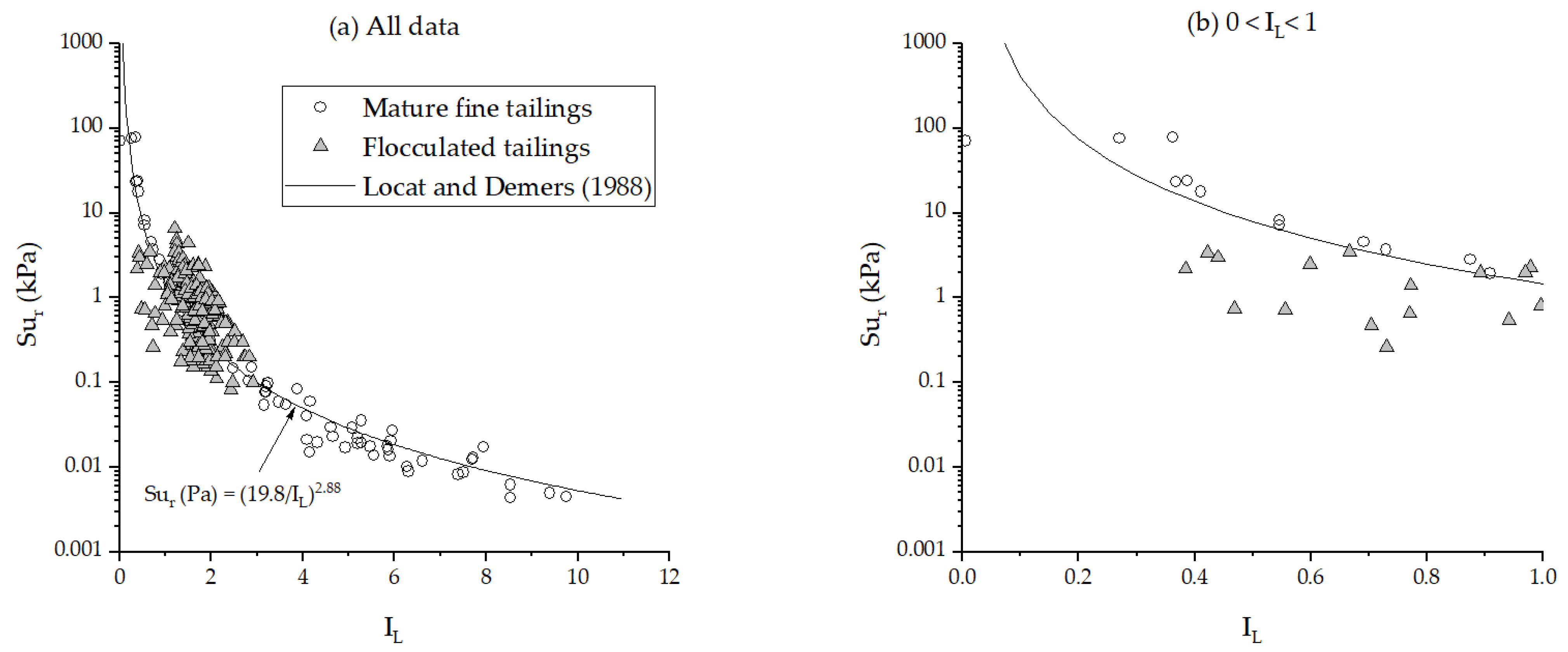
However, assessing whether an extrapolation of the Locat and Demers relationship provides a reasonable prediction of Sur is challenging due to the relatively few published Sur–IL datasets for oil sands tailings. Figure 5 plots published data [17,18,21] with the Locat and Demers relationship. The lack of data between wP and wL (0 < IL < 1) prevents a reliable assessment of performance for reclamation (Figure 5b). There is also a high degree of scatter in the published data, in particular for the flocculated tailings. The objective of this research was therefore to develop a relationship between Sur and IL for oil sands tailings that could be used to predict a lower bound of strength for reclamation applications. This paper presents key findings of this research program with further detail presented in Paul [11]. A summary of the literature review and laboratory test program has also been published in Paul and Beier, [22] and [23], respectively.

1.4. Background on Atterberg Limits

Developing a relationship between Sur and IL requires that the Atterberg limits be known in order to calculate IL according to Equation (1). A secondary goal of this research program was therefore to investigate the effect of material properties, preparation method, and test procedure on the Atterberg limits of oil sands tailings. The following sections provide a background on Atterberg limits including measurement methods, the influence of various factors on the measurement, and a review of published Atterberg limits data for oil sands tailings.

1.4.1. Methods for Measuring Atterberg Limits

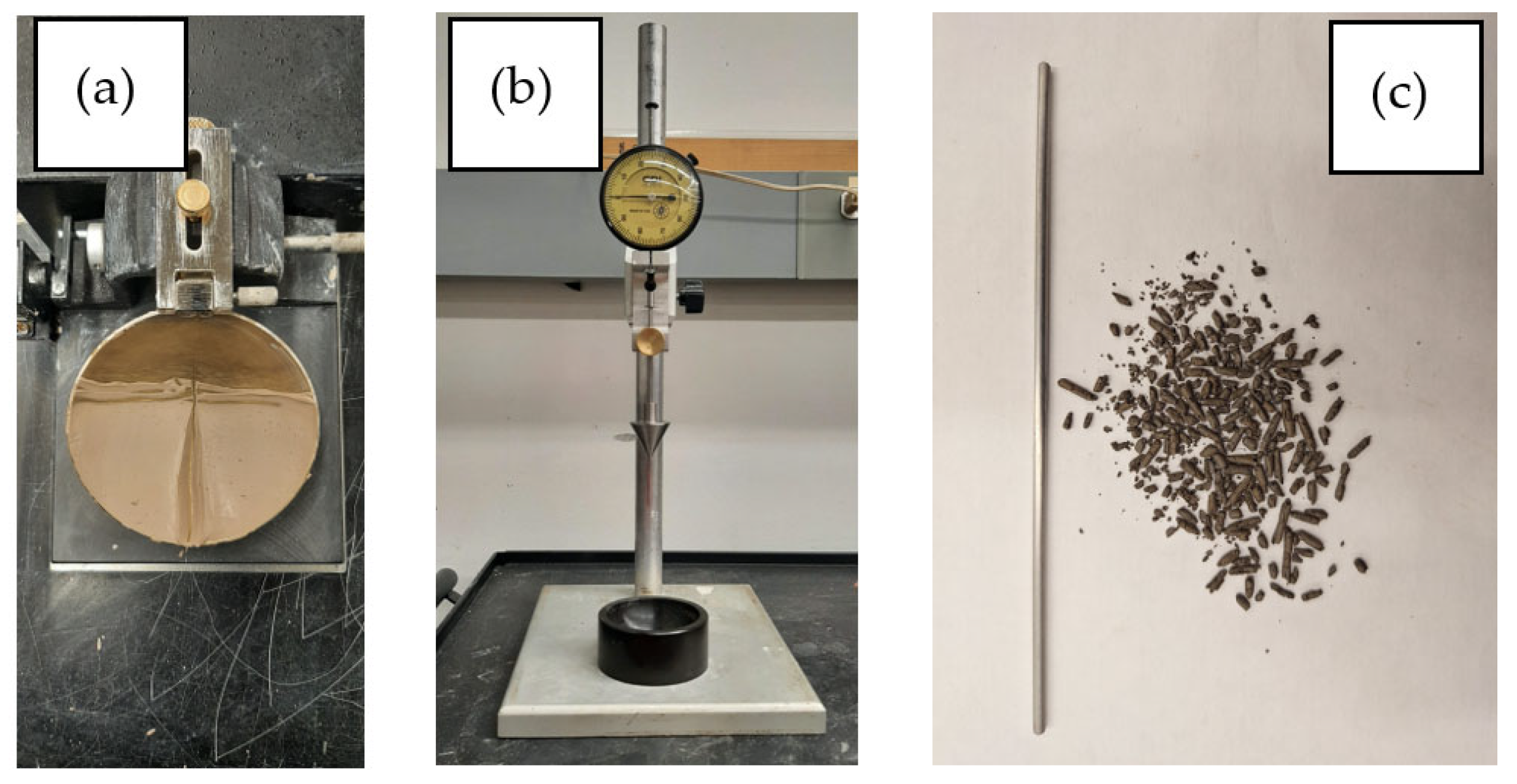
Different standards and specialized pieces of equipment have been developed to measure the Atterberg limits. The Casagrande cup (Figure 6a) [24] or a fall cone penetrometer (Figure 6b) [25] can be used to determine wL. Both methods produce similar results and are generally considered to be interchangeable [26]. wP is determined by rolling and remoulding the sample until it crumbles at a diameter of 3.2 mm. A small metal rod is typically used to compare the sample to the target diameter (Figure 6c). Procedures for determining wP and wL are summarized in Table 1. All tests are performed using only the fine fraction of material passing the No. 40 (425 µm) sieve [24,25].

1.4.2. Influence of Various Factors on the Atterberg Limits of Oil Sands Tailings and Natural Soils

The Atterberg limits of a soil depend on a number of factors, including clay content, clay minerology, and pore fluid chemistry [16,27,28]. Other factors related to the test itself can also have an impact on the measured values. The experience of the operator performing the test has been found to influence results [29]. Further, Basma et al. [30] found that drying the sample at high temperatures (110 °C) resulted in particle aggregation and a decrease in the measured wL. Due to the number of possible factors that can influence the results, there can be significant variability in the measured Atterberg limits for a particular soil. The potential for variability increases for oil sands tailings because the Atterberg limits are also known to be influenced by factors such as the use of tailings amendments (e.g., polymer flocculants), bitumen content, sand content, and process additives from the bitumen extraction process (e.g., NaOH) [21,31,32,33,34,35,36,37,38,39,40]. Similar to natural soils, the clay content of the tailings also influences the Atterberg limits [41]. Oil sands tailings are also highly thixotropic and experience rapid strength loss upon remoulding, followed by a gradual increase in strength [17]. Since Atterberg limits tests are performed on remoulded samples, tests on oil sands tailings must be performed immediately after remoulding, otherwise a larger wL will be measured [40].
In addition to the number of factors that can influence the Atterberg limits of oil sands tailings, a further challenge is that existing measurement standards including ASTM D4318-17 and CAN/BNQ 2501-090 were developed for natural soils [24,25]. As a result, procedures must be modified to perform tests on oil sands tailings. Unlike natural clays, oil sands tailings typically exist in a fluid state above wL and must be dewatered prior to testing. In a review of published results, multiple methods for dewatering tailings were reported including evaporating at room temperature [17,37,40,42,43,44], placing the tailings under a fume hood [17], centrifuging to separate the solid and liquid fractions [17,45], drying in a low-temperature (60 °C) oven [45], and consolidating the tailings under load [41]. If the water content needed to be adjusted during the test, different studies reported using deionized (DI) water, distilled water, or process water removed from the tailings [17,33,43]. Bitumen is also a factor in oil sands tailings behaviour that is typically not present in natural soils. It is generally recommended to perform Atterberg limits tests on tailings, including the bitumen fraction, to best capture in-situ conditions [46]. However, ensuring that the sample includes the complete bitumen fraction is challenging due to the tendency of bitumen to adhere to test equipment such as sieves and container walls [44]. The effect of test methodology on the measured Atterberg limits of oil sands tailings was previously studied by Gidley and Moore [33], who observed a significant difference in the measured Atterberg limits when the dewatering method and water source were varied for the same type of tailings.

1.4.3. Review of Published Atterberg Limits of Oil Sands Tailings

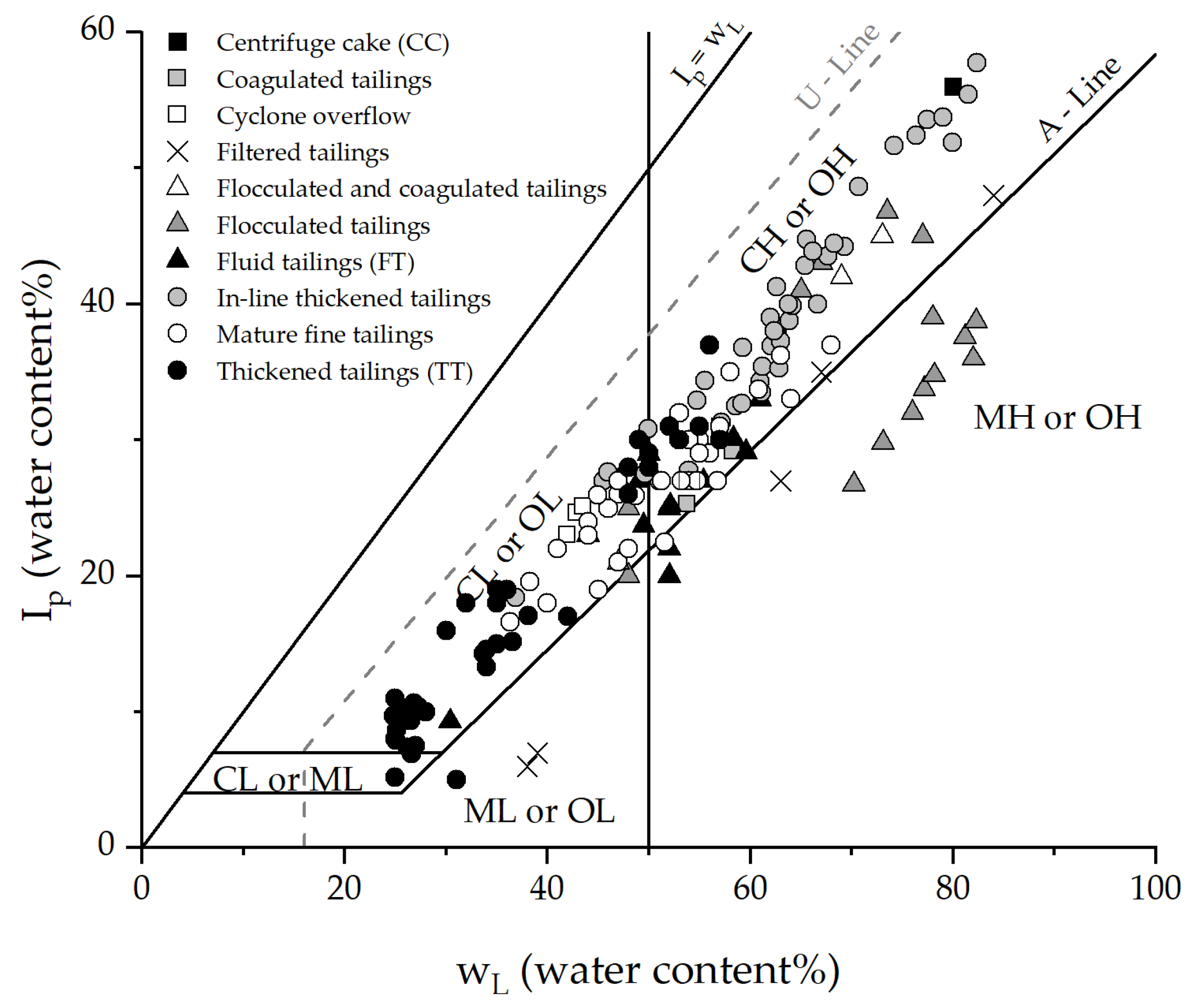
The variation in tailings properties across the oil sands region, coupled with the number of factors that can influence the measurement, results in a wide range of measured values. Published Atterberg limits of oil sands tailings are plotted on a plasticity chart by tailings processing type in Figure 7 with data sources presented in Appendix A. Studies typically do not report the source of their tailings; therefore each tailings processing type could contain data from multiple tailings streams. The majority of tailings can be classified as either low-plasticity clay (CL) or high-plasticity clay (CH); however, the variation in the data further demonstrates that there is no unique value of Atterberg limits for oil sands tailings or indeed for a specific tailings type. While Atterberg limits remain a useful tool for describing dewatering behaviour, they are most useful when comparing results from the same tailings stream and mine site [47].

2. Material Characterization and Methodology

2.1. Test Materials

The test program was performed on three types of oil sands tailings (centrifuge cake, fluid tailings, and thickened tailings) and one commercially available clay (EPK Kaolin), which acted as a standard point of comparison and a physical analogue for oil sands tailings [48]. All tailings samples were collected at different mining operations and shipped to the University of Alberta in sealed pails. The test materials are briefly described in Table 2.
In addition to the as-received tailings, tests were also performed on subsamples of tailings that were amended using either the Dean Stark (DS) or cold extraction (CE) methods (Table 3). The purpose of these amendment methods was to alter the tailings to assess whether the same models of behaviour would apply to materials whose properties had been materially changed. In typical applications, the DS and CE methods use a solvent and physical processing to measure the bitumen content of oil sands tailings. A key distinction between the two methods is that the solids from the Dean Stark method are oven-dried after processing at high temperatures and the solids from the cold extraction method are air-dried at room temperature [50]. Exposing clayey materials such as oil sands tailings to high temperatures is known to decrease wL [30]. Additionally, fine particles may become attached to the thimble used to contain the sample for the Dean Stark method [50].
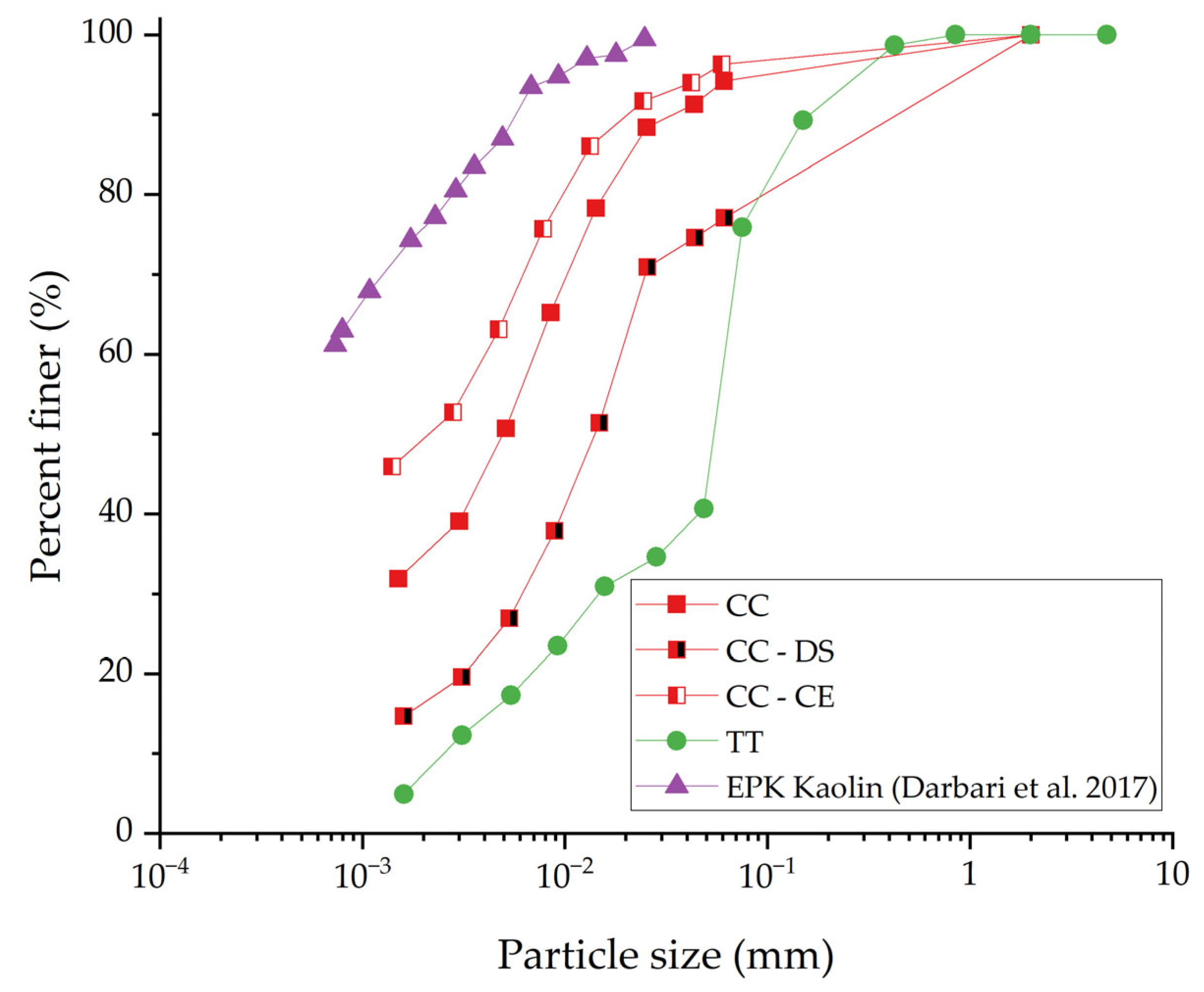
Test materials were characterized using the particle size distribution (Figure 8), bitumen content, clay content by methylene blue index (MBI), water chemistry, and mineralogy. Previously published properties were used to characterize EPK Kaolin. The bitumen content of the amended samples and EPK Kaolin is presumed to be zero. Results of bitumen content, MBI, water chemistry, and mineralogical analysis are presented in Appendix B.
The primary difference between the as-received tailings samples is the variation in the amount of clay and fine particles. In oil sands tailings analysis, the particle size distribution (Figure 8) is used to determine two industry-specific parameters: the fines content (defined as the percentage of particles by weight with a diameter of 44 µm or smaller) and sand to fines ratio (SFR, defined as the ratio of the percentage of solids with a particle size greater than 44 μm to the percentage of solids with a particle size less than 44 μm). The fines content and SFR indicate that the TT has a lower amount of clay and higher amount of sand compared to the other samples.
Due to the small quantity of dry solids produced by the DS and CE methods, the amended CC (CC-DS and CC-CE) were characterized but did not undergo additional laboratory testing, and the amended TT and FT were not characterized but did undergo additional laboratory testing. The characterization results for the CC are considered to provide a reasonable description of the overall changes in the sample properties as a result of the amendment methods. Compared to the as-received sample, the DS method is presumed to decrease the amount of fine particles and the CE method generally increases the amount of fine particles. The change in the DS is likely due to the loss of fine material to the thimble and aggregation of particles through oven drying at high temperatures [30,50]. Centrifugation in the CE procedure tends to aggregate the particles, which then must be broken apart (e.g., by mortar and pestle), and it is proposed that disaggregation may have caused the particle size distribution to become slightly finer by particle crushing [50]. However, the difference is small and could be attributed to sample heterogeneity.

2.2. Atterberg Limits

Developing datasets of Sur and IL for the different materials used in the test program requires that the Atterberg limits be known in order to calculate IL according to Equation (1). However, it has been established that the measured Atterberg limits are influenced by multiple factors. A secondary goal of this research program was therefore to investigate the effect of material properties, preparation method, and test procedure on the Atterberg limits of oil sands tailings.
The Atterberg limits of all samples were determined using multiple test procedures to assess how changes in equipment and sample properties affect the measurement. Both the Casagrande cup (Houghton Manufacturing Company, Vicksburg, MI, USA) and fall cone penetrometer (Geneq Inc., Montreal, QC, Canada) were used to measure wL. Only the thread-rolling method was used to measure wP. In addition to assessing the effect of equipment, the effect of preparation method was also studied. The as-received tailings had an initial water content much greater than wL, which is typical for samples of fluid tailings, and the water content must therefore be adjusted to measure wL and wP. Two methods for adjusting the water content were measured: air-drying to reduce the water content from above wL and rewetting with deionized (DI) water to increase the water content from below wP. The same sample was first air dried and subsequently rewetted to produce two sets of Atterberg limits. Samples of amended tailings and EPK Kaolin were initially a dry powder and were rehydrated to measure the Atterberg limits.

2.3. Developing a Relationship Between Remoulded Undrained Shear Strength and Liquidity Index

The fall cone was used to measure Sur at different water contents to develop a dataset of paired Sur and IL measurements for each sample. To measure Sur, the cone was dropped from the surface of the sample immediately after it had been manually remoulded by vigorous stirring or kneading, depending on the consistency of the sample. Because the measurement is being performed just after remoulding, the fall cone is measuring the remoulded strength. Sur acts as a minimum baseline strength that can be compared between different tailings samples and negates any potential impact of thixotropy on the strength [30,32].
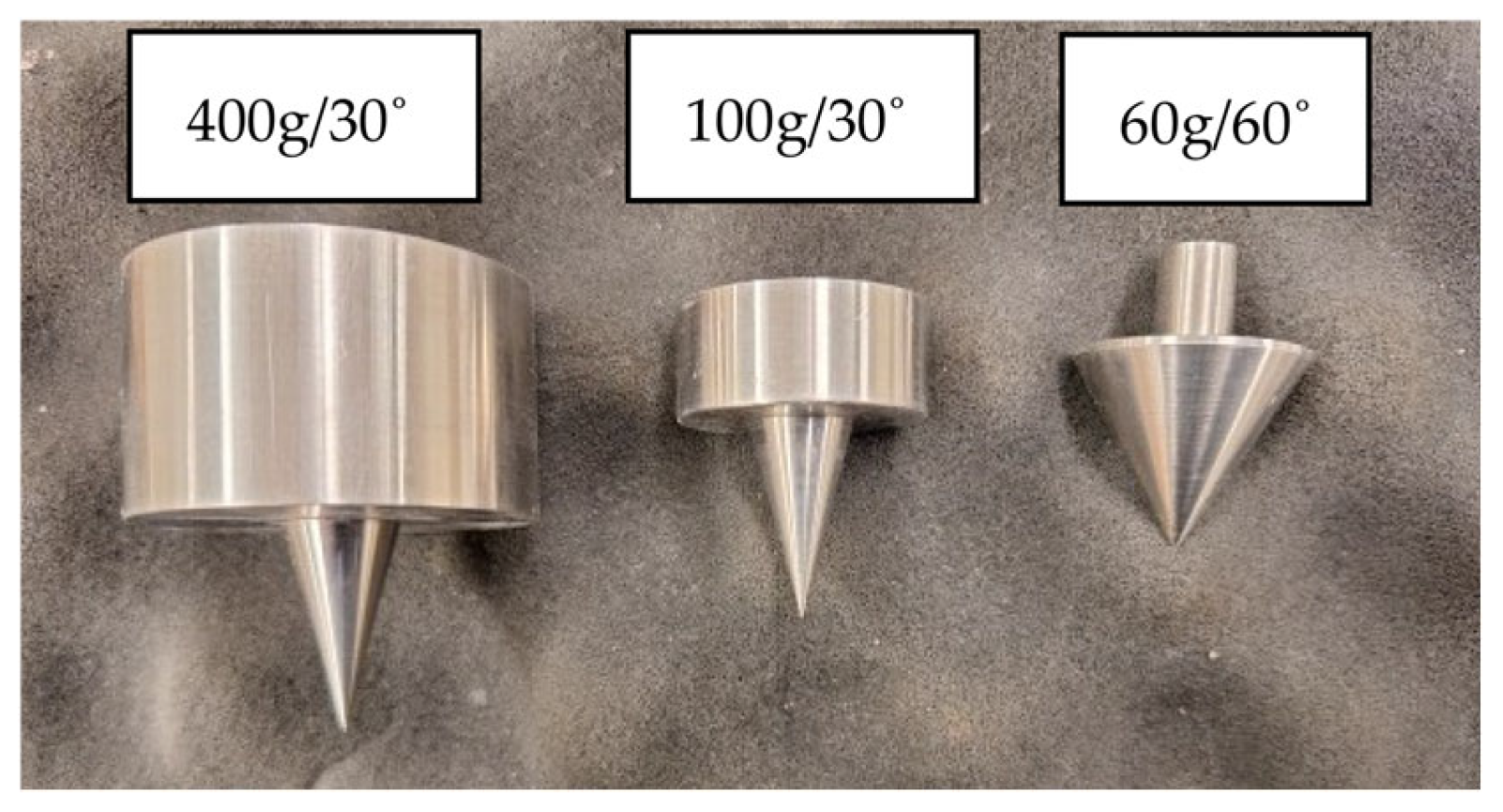
A dataset of paired Sur and IL measurements for each sample was developed by measuring Sur at different water contents. The water content of as-received samples (CC, FT, and TT) was adjusted by first drying and subsequently rewetting with deionized (DI) water (Figure 6) to create both a dried and rewetted Sur–IL dataset. The water content of the amended samples (FT-CE, FT-DS, TT-CE, and TT-DS) and EPK Kaolin, all of which were initially dry powder, were adjusted by rehydrating with DI water. The Atterberg limits matching the sample and preparation method (dried vs. rewetted, as-received vs. amended) were used to calculate IL. The measured penetration values from the fall cone are used to calculate the strength using Equation (4) where K is an empirical constant related to the cone angle (equal to 1.0 for 30° and 0.3 for 60°), m is the cone mass in grams, and P ¯ 2 is the mean square penetration (Equation (5)) [52]. A number of standard cones are available including 10 g/60°, 60 g/60°, 100 g/30°, and 400 g/30° (Figure 9). For samples that were dried from a water content exceeding wL, the lightest cone (10 g/60°) is first used to measure a number of penetrations (N) 1 cm apart on the surface of the same sample. As the sample dried and the consistency changed, the sample becomes stronger and heavier cones are needed to penetrate a minimum distance of 5 mm. The final data point in this series is therefore the highest strength measured and corresponds to a penetration of approximately 5 mm with the 400 g/30° cone. For the rewetted sample, the water content was adjusted as needed with DI water to achieve a data series comparable to the number of measurements from the dried sample.
S u [ k P a ] = 9.8   K m P ¯ 2
P ¯ 2 = P i N

2.4. Summary of Laboratory Test Program

A summary of all test procedures and preparation methods used for each sample is presented in Table 4. For all procedures and preparation methods, a single set of measurements was performed for each sample. The overall rationale for including specific methods and preparation procedures is also summarized as follows:
  • Casagrande cup and fall cone—effect of test method on wL.
  • Drying and rewetting—effect of diluting pore water chemistry on Atterberg limits and strength behaviour.
  • CE- and DS-amendment—effect of major physical and chemical changes of sample properties (e.g., removal of bitumen, removal of pore water, drying at high temperatures) on Atterberg limits and strength behaviour.

Table 4. Summary of laboratory test program.
SampleCCTTFTEPK Kaolin
AR *DSCEARDSCEARDSCE
CharacterizationXXXX X
Atterberg limits
DriedwL—FC X X X
wL—C X X X
wPX X X
RewettedwL—FC X X X
wPX X X
RehydratedwL—FC XX XXX
wL—C X
wP XX XXX
Sur vs. IL
DriedX X X
RewettedX X X
Rehydrated XX XXX
* As-received; Fall cone; Casagrande apparatus.

3. Results

3.1. Measured Atterberg Limits of All Samples

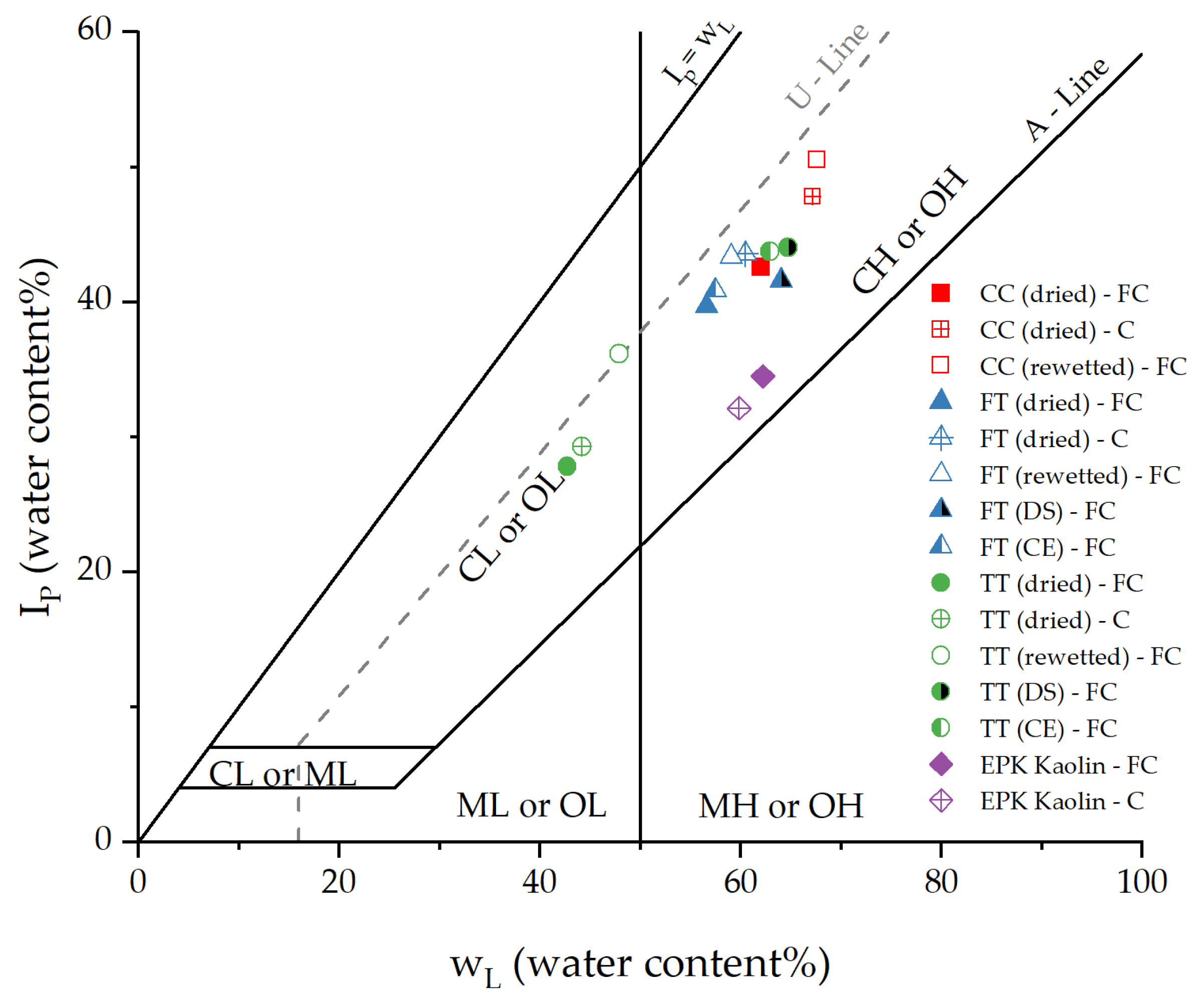
Results of Atterberg limits tests for all samples are presented on a plasticity chart in Figure 10 and Table 5 below. Differences in the measured Atterberg limits are observed when the preparation method is changed for each sample type. Similar to other studies, both methods for determining wL (Casagrande cup or fall cone) give similar measurements [26]. Considering all samples and preparation methods, the overall trend seems to most closely reflect the fines content as measured from the particle size distribution; wL generally increases and wP generally decreases as the fines content of the as-received tailings increases [34,35,36,41,42]. In particular, TT had the lowest fines content of all as-received samples and as a result has the lowest wL and Ip. Taken together, the results suggest that the properties (e.g., fines content) and preparation method (dried vs. rewetted, as-received vs. amended) influence the measured Atterberg limits of oil sands tailings.

3.2. Proposed Relationship Between Remoulded Undrained Shear Strength and Liquidity Index

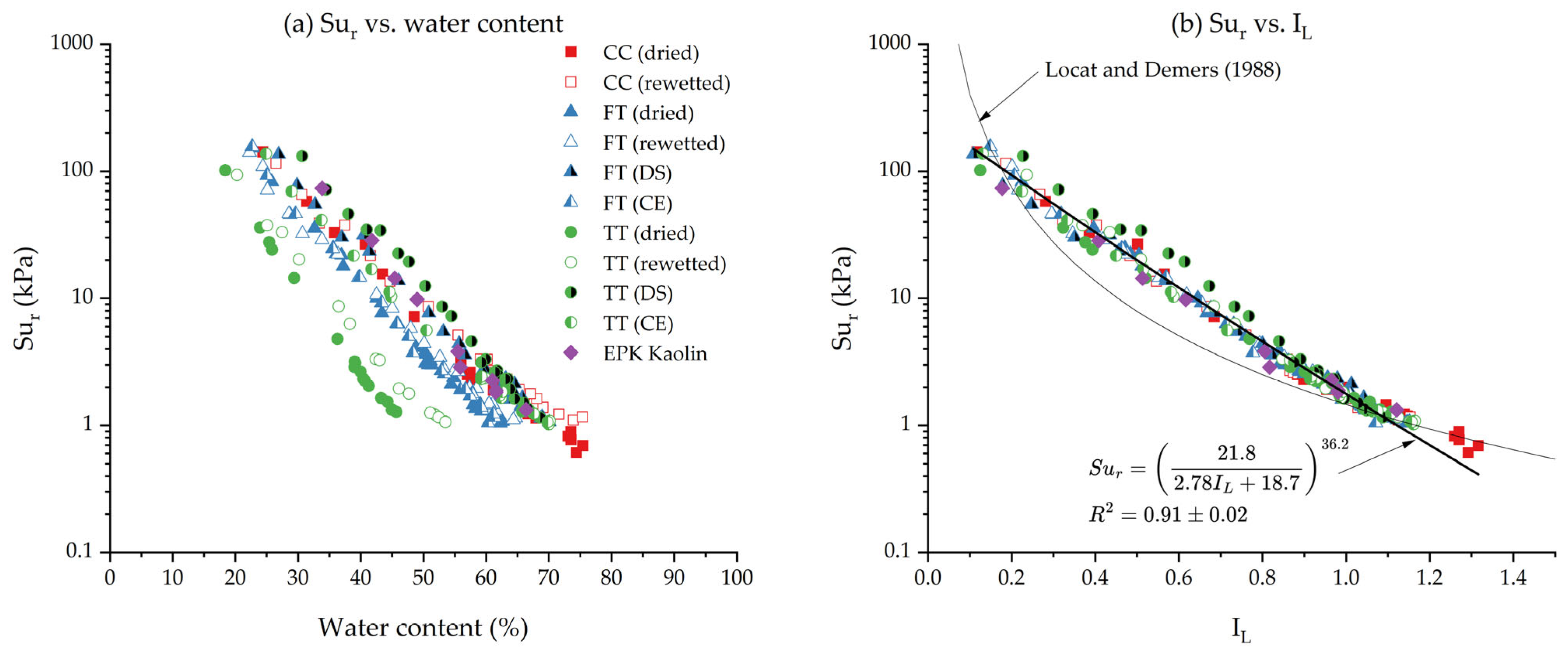
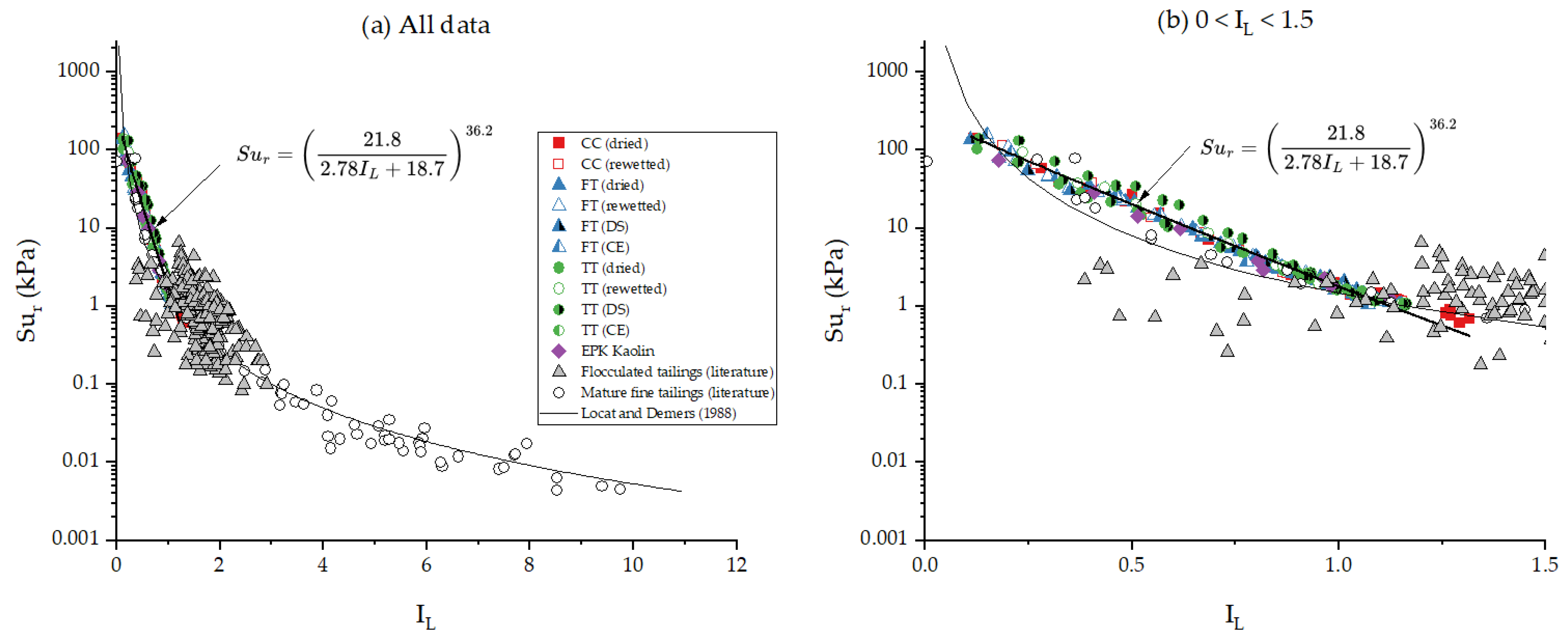
Results of Sur testing at different water contents for all samples is plotted in Figure 11a. The range of measured strengths at a particular water content varies by approximately one order of magnitude. However, when normalized to IL, the measured Sur of all samples shows a consistent trend that is generally underpredicted by the Locat and Demers relationship, which has been extrapolated to the range of the laboratory measurements (Figure 11b). From the measured data for all samples, a new relationship is proposed to predict Sur from IL (Equation (6)). This relationship was determined from all samples in the test program for IL ranging from 0.1 to 1.3. A confidence interval of 95% was calculated for the R2 value of this model (0.91) and all subsequent R2 values in this paper.
S u r = ( 21.8 2.78 I L + 18.7 ) 36.2
Curve fitting was performed using the non-linear curve fit function in Origin data analysis software [53]. Multiple forms of fitting model (polynomial, exponential, and logarithmic) were evaluated. Equation (6) was selected as the most appropriate model based on the R2 value as well as with consideration for ease of application in spreadsheet programs and scientific calculators.

4. Discussion

4.1. Variability of Atterberg Limits

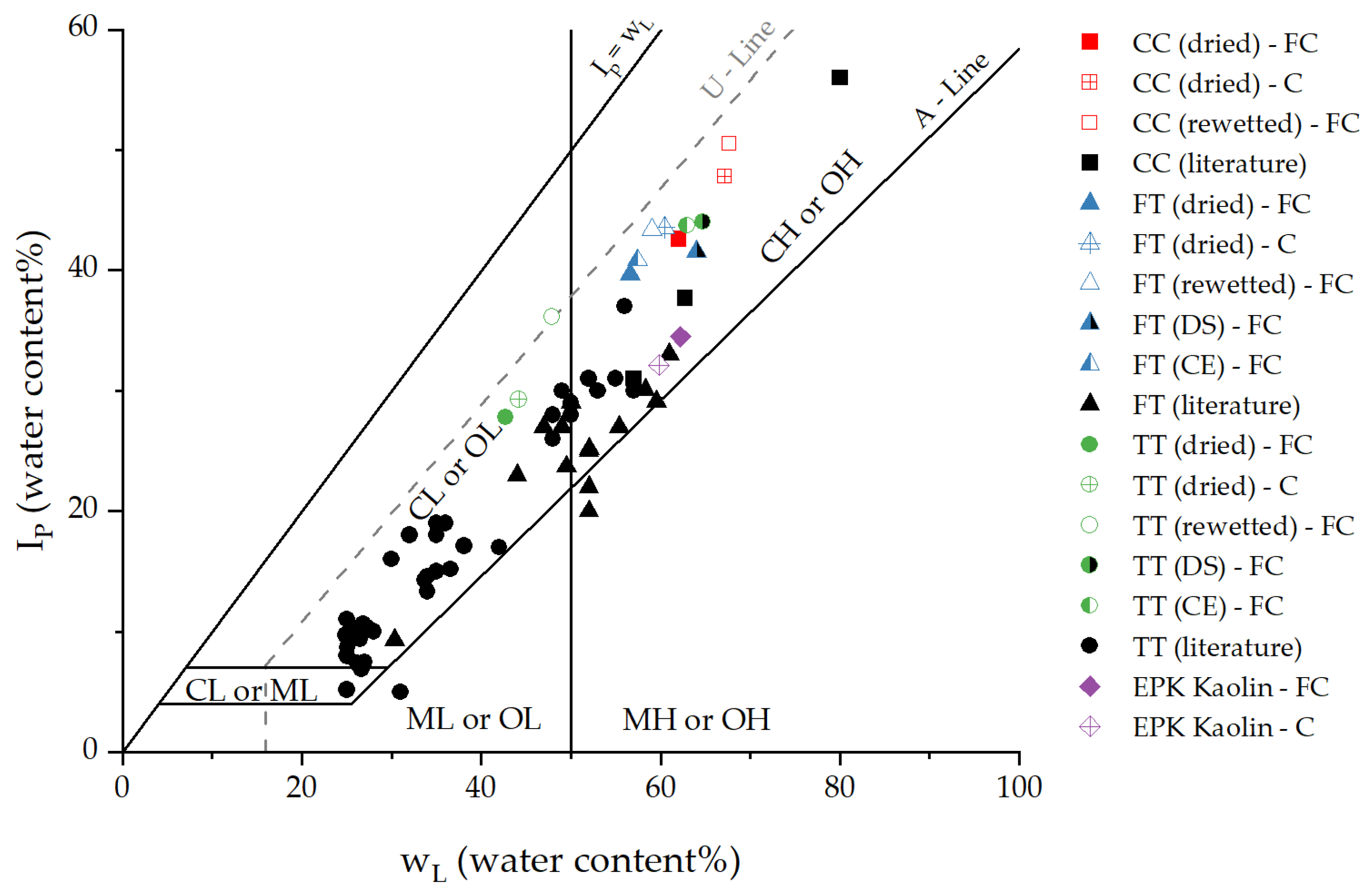
The Atterberg limits measured in the laboratory test program are plotted with published Atterberg limits for the same material type in Figure 12. The measured Atterberg limits appear to fall within the typical range of values for oil sands tailings.
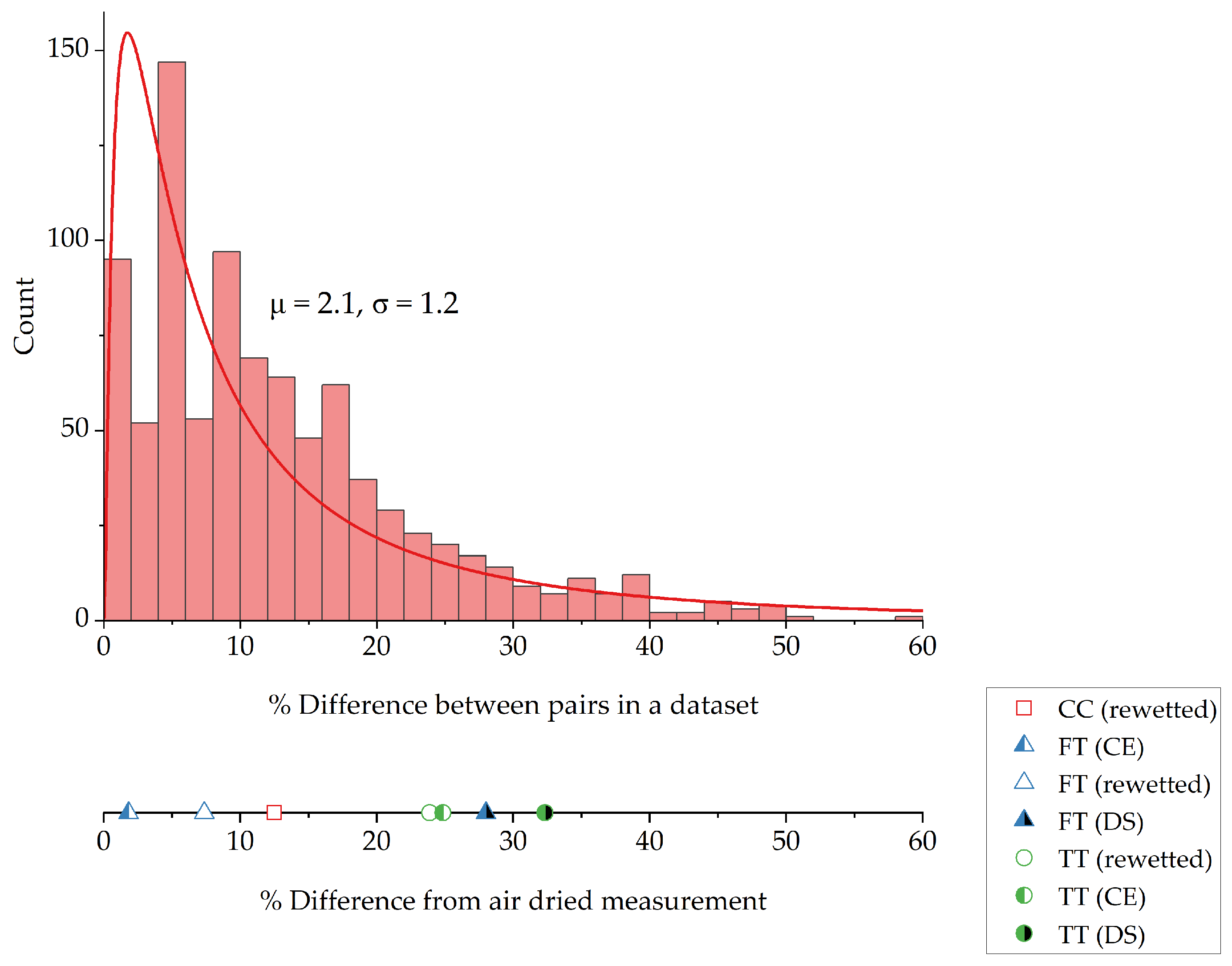
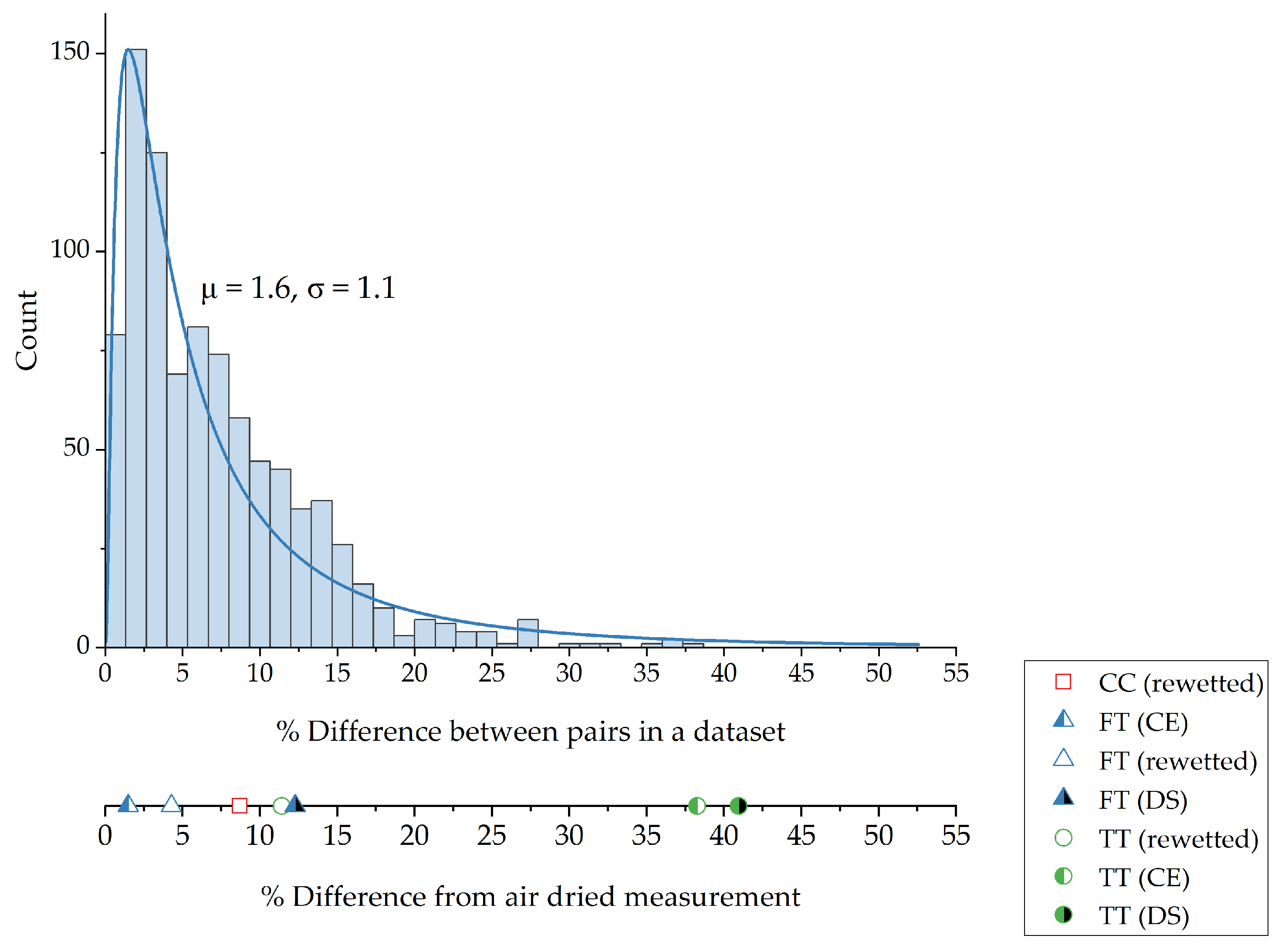
While the overall results suggest that changing the procedure and preparation method impacts the measured value, the effect of specific changes on the measurement cannot be definitively stated. The effect of varying the preparation method was evaluated by comparing pairs of laboratory measurements to pairs of published duplicate measurements [17,33,44,54,55]. The percent difference between duplicate measurements of wP and wL from published studies were plotted on histograms in Figure 13 and Figure 14, respectively. These histograms represent the range of recorded differences between Atterberg limits that have been measured multiple times for the same sample. The percent difference values follow a log-normal distribution with a mean of 1.6% and 2.1%, respectively, for wL and wP. However, there is a wide range of possible values. Theoretically, the percent difference between duplicate measurements should be zero. The non-zero percent difference can therefore be attributed to the inherent variability of the test, capturing factors such as sample heterogeneity and small differences in equipment performance.
The expected difference between duplicate measurements from the literature is compared to the difference between laboratory measurements there was a change in procedure for wL and wP for the same sample type (CC, FT, or TT) where in all cases, the percent difference is calculated by comparing the given measurement to the air-dried measurement (dried vs. rewetted, CE, or DS) as a standard reference point. Considering the results for wL, all results with the exception of TT-DS and TT-CE fall within the range of plausible values for duplicates. The spread of percent difference values is broader for wP but still falls within the range of plausible values. That is, for most of the laboratory results, the difference between two measurements for which the sample preparation method and test procedure has been changed could also plausibly be attributed to the inherent variability of the test. A large-scale test with many duplicate samples would likely be required to distinguish the expected variability from each change in procedure from the inherent variability of the test. However, quantifying the percent difference of published duplicates further demonstrates that measured Atterberg limits values can be affected by multiple factors, not all of which can be controlled or identified. It is therefore suggested that any interpretation of Atterberg limits data incorporates an appreciation of the variability of the test rather than investing unnecessary time, effort, and samples to arrive at a “true” value.
In the broader context of geotechnical engineering and site investigations, variability in properties is to be expected due to the heterogeneity of geotechnical materials. This variability creates uncertainty within a particular design application, and interested readers are directed to the 39th Terzaghi Lecture delivered by J.T. Christian [56] for a discussion of methods of managing uncertainty in geotechnical engineering. Previous studies on variability in geotechnical properties report that the expected coefficient of variation in wL and wP is between 6–30% for a particular soil [57]. However, the physical and chemical processing and subsequent deposition of oil sands tailings is different from that of natural geologic units. As evidenced by the application of the Locat and Demers relationship to oil sands tailings, caution should be exercised when predicting the behaviour of oil sands tailings using methods designed for natural soils.

4.2. Comparison of Proposed Relationship Between Remoulded Undrained Shear Strength and Liquidity Index to Locat and Demers Relationship

The laboratory data and relationship from this study (Equation (6)) are plotted with the literature data and the Locat and Demers relationship in Figure 15 below. For this analysis, the Locat and Demers relationship has been extrapolated below its specified range of 1.5 and 6. Between an IL of 0 and 1.5, Equation (6) (Figure 15a) provides a better fit of the laboratory data than the extrapolated Locat and Demers relationship (Figure 15b), which tends to underpredict Sur. Beyond the range of Equation (6), the Locat and Demers relationship gives a reasonable fit to the MFT data from literature.
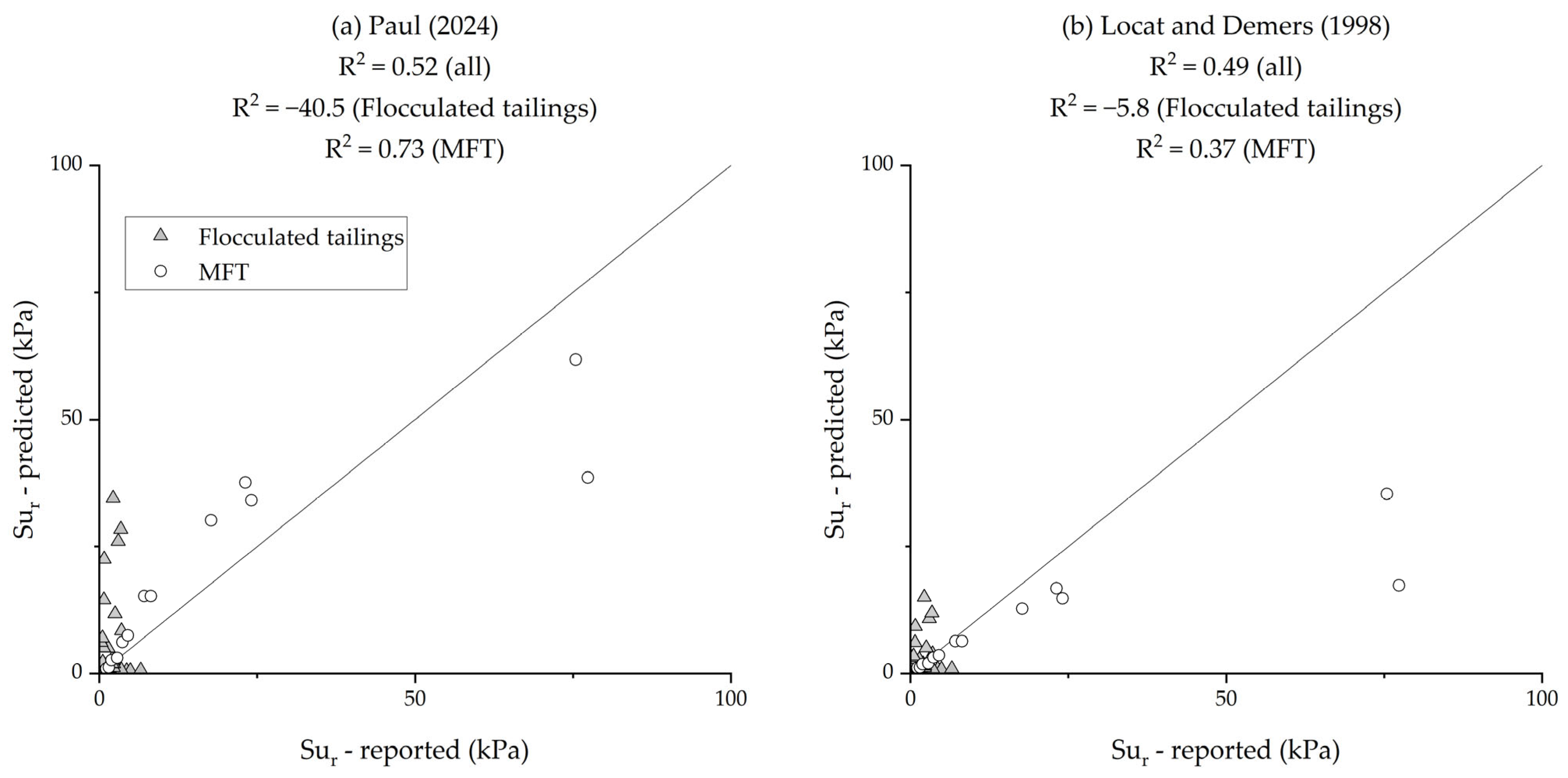
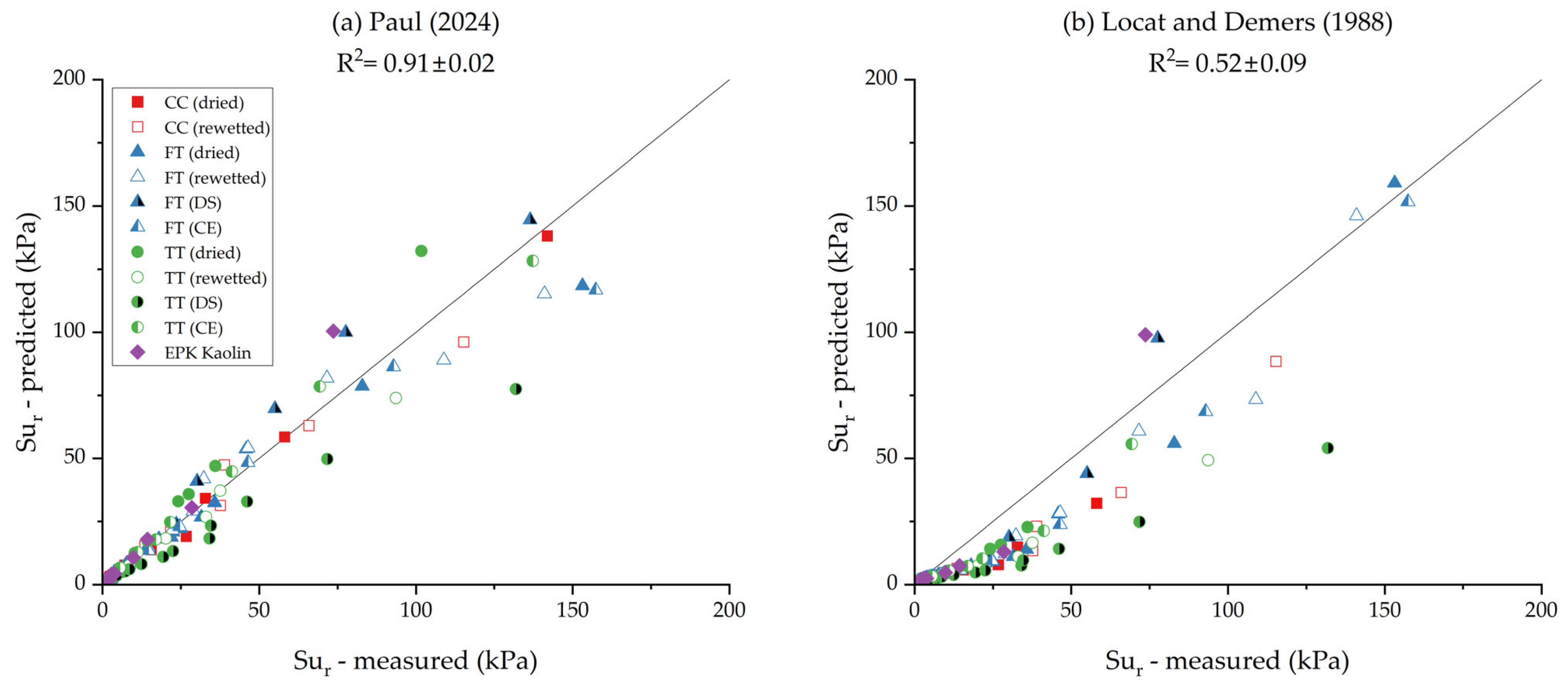
The fit of Equation (6) and the Locat and Demers relationship to the laboratory data is quantified in Figure 16, which plots the predicted and measured Sur with a line of equality. The data generally plots under the line of equality for the extrapolated Locat and Demers relationship (Figure 16b), again representing an underprediction. The R2 value of Equation (6) (0.91) is also higher than the Locat and Demers relationship (0.52) when considering the laboratory data, which further demonstates that Equation (6) is a better fit.
The performance of Equation (6) and the extrapolated Locat and Demers relationship is compared to published data between IL of 0.1 and 1.5 in Figure 17. This data was not used in the development of Equation (6) and it is therefore an independent comparison. While the R2 values are similar for both Equation (6) (0.52) and the extrapolated Locat and Demers relationship, Sur of the flocculated tailings is not predicted from either relationship (R2 < 0). This is likely due to the high degree of scatter in the published data. The MFT data alone is therefore considered to offer a more reliable comparison than the entire published dataset. The R2 value of Equation (6) (0.73) for the MFT is higher than the extrapolated Locat and Demers relationship (0.52), again demonstrating a better fit for tailings data between IL of 0.1 and 1.5.
The evaluation of Equation (6) using laboratory and field data suggests that this relationship can be used to predict Sur of oil sands tailings from IL. This model can be used to support field monitoring and early-stage reclamation design by relating simple index tests (Atterberg limits and water content) to field strengths. Strengths predicted using Equation (6) should be interpreted as lower-bound estimates due the range of tailings properties and influence of factors such as thixotropy. Additionally, as discussed, the measured Atterberg limits are also sensitive to a number of factors including the properties of the sample and the test procedure. Variability in wL and wp therefore carry through to IL and influence the prediction of Sur. As a result, material-specific Atterberg limits should be used to calculate IL, and sensitivity testing may be needed where there is uncertainty about material properties, such as in highly heterogenous deposits. The effect of changing the Atterberg limits on the prediction of Sur using Equation (6) is further discussed in Paul [11].

4.3. Limitations and Suggestions for Ruture Work

The most significant limitation of this research is that there are few published Sur–IL datasets for oil sands tailings available to evaluate the performance of Equation (6). It is suggested that additional studies measuring the Sur, water content, and Atterberg limits of tailings in the laboratory and field should be performed to further assess the fit of Equation (6) to measured data.

5. Conclusions

The correlation between Sur and IL (Equation (6)) can provide a cost-effective method to estimate a lower bound of strength for oil sands tailings. However, the inherent limitations and uncertainties of Atterberg limits are also present in Equation (6). Previous studies and laboratory testing performed in this research program have demonstrated that Atterberg limits are sensitive to factors related to the material properties, preparation method, and test procedure. The influence of specific factors on the measurement could not be quantified, and discerning their effect from the inherent variability of Atterberg limits would likely require an impractical number of tests. Material-specific Atterberg limits shouldtherefore be used to determine IL in Equation (6), and ongoing evaluation is needed to assess the model’s performance in the field and laboratory. Atterberg limits remain a useful tool for describing oil sands tailings behaviour due to their ease of application and relationships with other geotechnical properties. However, the use of index tests in engineering practice must be informed by an appreciation of the variability and uncertainty in geotechnical properties.

Author Contributions

Conceptualization, A.L.P. and N.A.B.; methodology, A.L.P.; formal analysis, A.L.P.; writing—original draft preparation, A.L.P.; visualization, A.L.P.; supervision, N.A.B.; funding acquisition, N.A.B. All authors have read and agreed to the published version of the manuscript.

Funding

This research was funded by the Natural Sciences and Engineering Research Council of Canada and Canada’s Oil Sands Innovation Alliance (NSERC/COSIA) Industrial Research Chair in Oil Sands Tailings Geotechnique (IRCPJ 460863-18).

Data Availability Statement

The original data presented in the study are openly available in Borealis at https://doi.org/10.5683/SP3/BTAGOC (accessed on 11 December 2025).

Acknowledgments

The authors gratefully acknowledge the support of the Natural Sciences and Engineering Research Council of Canada and Canada’s Oil Sands Innovation Alliance (NSERC/COSIA) Industrial Re-search Chair in Oil Sands Tailings Geotechnique.

Conflicts of Interest

The authors declare no conflicts of interest. The funders had no role in the design of the study; in the collection, analyses, or interpretation of data; in the writing of the manuscript; or in the decision to publish the results.

Appendix A

Table A1. Sources of published Atterberg limits data by tailings type.
Tailings TypeData Sources
Centrifuge cakeChigbo et al. (2021) [58], Schafer (2018) [59], Smith et al. (2018) [60],
Stienwand (2021) [61]
MFTBajwa (2015) [21], Banas (1991) [17], Chappel and Blond (2013) [62], Gholami (2014) [63], Guo and Shang (2014) [64], Jeeravipoolvarn (2005) [65], Masala and Matthews (2010) [66], Nik (2013) [67], Pollock (1988) [68], Rima (2022) [69], Rozina (2013) [70], Scott et al. (2013) [32], Shobrook (2014) [71], Sorta (2015) [41], Tang (1997) [45], Torghabeh (2013) [72], Yao (2016) [44], Yao et al. (2016) [73], Zhang (2012) [74]
Flocculated tailingsAmoako (2020) [75], Bajwa (2015) [21], Gholami (2014) [63], Jeeravipoolvarn et al. (2020) [20], Rozina (2013) [70]
Coagulated tailingsMiller et al. (2010) [40]
Flocculated and coagulated tailingsElias (2019) [76]
Thickened tailingsInnocent-Bernard (2013) [43], Jeeravipoolvarn et al. (2008) [42], Kabwe et al. (2019) [35], Kabwe et al. (2021) [36], Masala and Matthews (2010) [66], Masala et al. (2014) [77], Sorta (2015) [41], Wijermars (2011) [78], Wilson et al. (2018) [38], Yao (2016) [73], Yao et al. (2012) [79], Yao et al. (2016) [73], Yuan and Lahaie (2009) [54]
Cyclone overflowJeeravipoolvarn (2010) [34], Sorta (2015) [41]
In-line thickened tailingsJeeravipoolvarn (2010) [34], Kabwe et al. (2013) [37], Rima (2022) [69]
Filtered tailingsAnsah-Sam et al. (2021) [80]
Untreated FTAmoako (2020) [75], Contreras et al. (2015) [81], Elias (2019) [76], Jeeravipoolvarn et al. (2008) [42], Kabwe et al. (2021) [36], Miller et al. (2010) [40], Salam (2020) [82], Stienwand (2021) [61], Suthaker (1995) [83], Wilson et al. (2018) [38]

Appendix B

Table A2. Characterization of test materials [11].
Sample<44 µm (%)SFRBitumen
(wt%)
MBI (meq/100 g)
CC91.40.11.5313.6
CC-DS74.60.3011.5
CC-CE94.20.1011.9
FT82.00.21.208.3
TT39.31.51.298.9
EPK Kaolin85.7 [51]0.203.7 [84]
Table A3. Water chemistry of tailings samples [11].
SampleIon Concentrations (mg/L)SARConductivity
(µS/cm)
pH
Na+K+Ca2+Mg2+ClHCO3SO42−CO32−
CC38830.590.648.4123250705.7128.223908.4
FT32120.031.623.1124390279.12810.615408.6
TT25623.370.535.912.4300403.4336.215208.6
Table A4. Minerology of tailings samples [11].
Oxide (wt%)CCFTTTMineral Phase (wt%)CCFTTT
Na2O0.30.30.3Quartz30.730.737.9
MgO0.90.80.9K-Feldspars6.56.06.1
Al2O324.625.224.2Siderite1.01.61.2
SiO267.467.467.4Anatase0.8-0.8
K2O2.62.42.6Kaolinite46.441.040.7
CaO0.20.20.2Mica/Illite13.620.013.3
TiO20.80.70.8
Fe2O33.23.03.2

References

  1. BGC Engineering Inc. Oil Sands Tailings Technology Review; Oil Sands Research and Information Network, University of Alberta, School of Energy and the Environment: Edmonton, AB, Canada, 2010. [Google Scholar]
  2. Chalaturnyk, R.J.; Scott, J.D.; Özüm, B. MANAGEMENT OF OIL SANDS TAILINGS. Pet. Sci. Technol. 2002, 20, 1025–1046. [Google Scholar] [CrossRef]
  3. Canada’s Oil Sands Innovation Alliance (COSIA). Technical Guide for Fluid Tailings Management; COSIA and Oil Sands Tailings Consortium: Calgary, AB, Canada, 2012. [Google Scholar]
  4. Canada’s Oil Sands Innovation Alliance (COSIA). Deep Deposit Design Guide for Oil Sands Tailings; COSIA: Calgary, AB, Canada, 2022. [Google Scholar]
  5. McKenna, G.; Mooder, B.; Burton, B.; Jamieson, A. Shear Strength and Density of Oil Sands Fine Tailings for Reclamation to a Boreal Forest Landscape. In Proceedings of the 5th International Oil Sands Tailings Conference, Lake Louise, AB, Canada, 4–7 December 2016. [Google Scholar]
  6. Alberta Energy Regulator (AER). Directive 085: Fluid Tailings Management for Oil Sands Mining Projects. 2017. Available online: https://static.aer.ca/prd/documents/directives/Directive085.pdf (accessed on 26 May 2022).
  7. Hyndman, A.; Sobkowicz, J. Oil Sands Tailings: Reclamation Goals & the State of Technology. In Proceedings of the 63rd Canadian Geotechnical Conference, Calgary, AB, Canada, 12–15 September 2010. [Google Scholar]
  8. Ahmed, M.; Beier, N.A.; Kaminsky, H. Evaluating Consolidation Behaviors in High Water Content Oil Sands Tailings Using a Centrifuge. Geotechnics 2025, 5, 3. [Google Scholar] [CrossRef]
  9. Cossey, H.L.; Batycky, A.E.; Kaminsky, H.; Ulrich, A.C. Geochemical Stability of Oil Sands Tailings in Mine Closure Landforms. Minerals 2021, 11, 830. [Google Scholar] [CrossRef]
  10. Kaminsky, H.A.W.; Etsell, T.H.; Ivey, D.G.; Omotoso, O. Distribution of clay minerals in the process streams produced by the extraction of bitumen from Athabasca oil sands. Can. J. Chem. Eng. 2009, 87, 85–93. [Google Scholar] [CrossRef]
  11. Paul, A.L. Assessing the Strength and Bearing Capacity of Tailings for Oil Sands Reclamation. Master’s Thesis, University of Alberta, Edmonton, AB, Canada, 2024. [Google Scholar]
  12. Sobkowicz, J.C.; Morgenstern, N.R. Reclamation and Closure of an Oil Sand Tailings Facility. In Proceedings of the 2nd International Oil Sands Tailings Conference, Edmonton, AB, Canada, 5–8 December 2010. [Google Scholar]
  13. Wroth, C.P.; Wood, D.M. The correlation of index properties with some basic engineering properties of soils. Can. Geotech. J. 1978, 15, 137–145. [Google Scholar] [CrossRef]
  14. Shimobe, S.; Spagnoli, G. Relationships between undrained shear strength, liquidity index, and water content ratio of clays. Bull. Eng. Geol. Environ. 2020, 79, 4817–4828. [Google Scholar] [CrossRef]
  15. Sharma, B.; Bora, P.K. Plastic Limit, Liquid Limit and Undrained Shear Strength of Soil—Reappraisal. J. Geotech. Geoenviron. Eng. 2003, 129, 774–777. [Google Scholar] [CrossRef]
  16. Mitchell, J.K.; Soga, K. Fundamentals of Soil Behavior, 3rd ed.; John Wiley & Sons, Inc.: Hoboken, NJ, USA, 2005. [Google Scholar]
  17. Banas, L.C. Thixotropic Behaviour of Oil Sands Tailings Sludge. Master’s Thesis, University of Alberta, Edmonton, AB, Canada, 1991. [Google Scholar]
  18. Beier, N.; Wilson, W.; Dunmola, A.; Sego, D. Impact of flocculation-based dewatering on the shear strength of oil sands fine tailings. Can. Geotech. J. 2013, 50, 1001–1007. [Google Scholar] [CrossRef]
  19. Locat, J.; Demers, D. Viscosity, yield stress, remolded strength, and liquidity index relationships for sensitive clays. Can. Geotech. J. 1988, 25, 799–806. [Google Scholar] [CrossRef]
  20. Jeeravipoolvarn, S.; Wu, E.J.; Proskin, S.A.; Junaid, A.; Freeman, G. Field Water Release and Consolidation Performance of XUR Treated Fluid Fine Tailings. In Proceedings of the 26th International Conference on Tailings and Mine Waste, Fort Collins, CO, USA, 15–18 November 2020. [Google Scholar]
  21. Bajwa, T.M. Microstructure and Macroscopic Behaviour of Polymer Amended Oil Sands Mature Fine Tailings. PhD Thesis, Carleton University, Ottawa, ON, Canada, 2015. [Google Scholar]
  22. Paul, A.L.; Beier, N.A. A Review of Atterberg Limits and Remoulded Strength Relationships of Oil Sands Tailings. In Proceedings of the 77th International Canadian Geotechnical Conference, Montreal, QC, Canada, 15–18 September 2024. [Google Scholar]
  23. Paul, A.L.; Beier, N.A. Assessing the Strength and Bearing Capacity of Tailings for Oil Sands Reclamation-A Summary. In Proceedings of the 8th International Oil Sands Tailings Conference, Edmonton, AB, Canada, 9–10 December 2024. [Google Scholar]
  24. ASTM D4318-17; Standard Test Methods for Liquid Limit, Plastic Limit, and Plasticity Index of Soils. ASTM International: West Conshohocken, PA, USA, 2017.
  25. CAN/BNQ 2501-090; Determination of Liquid Limit by the Casagrande Apparatus and Determination of Plastic Limit. Bureau de Normalisation Du Québec (BNQ): Québec City, QC, Canada, 2019.
  26. Claveau-Mallet, D.; Duhaime, F.; Chapuis, R.P. Characterisation of Champlain Saline Clay from Lachenaie Using the Swedish Fall Cone. In Proceedings of the 63rd Canadian Geotechnical Conference Calgary, Calgary, AB, Canada, 12–15 September 2010. [Google Scholar]
  27. Seed, H.B.; Woodward, R.J.; Lundgren, R. Fundamental Aspects of the Atterberg Limits. J. Soil Mech. Found. Div. 1964, 90, 75–106. [Google Scholar] [CrossRef]
  28. Skempton, A.W.; Northey, R.D. The Sensitivity of Clays. Géotechnique 1952, 3, 30–53. [Google Scholar] [CrossRef]
  29. Liu, T.K.; Thornburn, T.M. Study of the Reproducibility of Atterberg Limits; Highway Research Board of the Division of Engineering and Industrial Research: Washington, DC, USA, 1964. [Google Scholar]
  30. Basma, A.; Alhomoud, A.; Altabari, E. Effects of methods of drying on the engineering behavior of clays. Appl. Clay Sci. 1994, 9, 151–164. [Google Scholar] [CrossRef]
  31. Scott, J.D.; Dusseault, M.B.; Carrier, W.D. Behaviour of the clay/bitumen/water sludge system from oil sands extraction plants. Appl. Clay Sci. 1985, 1, 207–218. [Google Scholar] [CrossRef]
  32. Scott, J.D.; Kabwe, L.K.; Wilson, G.W.; Sorta, A.; Jeeravipoolvarn, S. Properties Which Affect the Consolidation Behaviour of Mature Fine Tailings. In Proceedings of the 17th International Conference on Tailings and Mine Waste, Banff, AB, Canada, 3–6 November 2013. [Google Scholar]
  33. Gidley, I.; Moore, T. Impact of Test Methodology on the Atterberg Limits of Mature Fine Tailings (slide deck). Presented at the Canadian Oil Sands Network for Research and Development Oil Sands Clay Conference, Edmonton, AB, Canada, 20–21 February 2013. [Google Scholar]
  34. Jeeravipoolvarn, S. Geotechnical Behavior of In-Line Thickened Oil Sands Tailings. Ph.D. Thesis, University of Alberta, Edmonton, AB, Canada, 2010. [Google Scholar]
  35. Kabwe, L.K.; Abdulnabi, A.; Wilson, G.W.; Beier, N.A.; Scott, J.D. Geotechnical and Unsaturated Properties of Metal Mines and Oil Sands Tailings. In Proceedings of the 23rd International Conference on Tailings and Mine Waste, Vancouver, BC, Canada, 17–20 November 2019. [Google Scholar]
  36. Kabwe, L.; Wilson, G.W.; Beier, N.A.; Barsi, D. Effect of Sand and Flyash on Unsaturated Soil Properties and Drying Rate of Oil Sands Tailings. In Proceedings of the 25th International Conference on Tailings and Mine Waste, Edmonton, AB, Canada, 7–10 November 2021. [Google Scholar]
  37. Kabwe, L.; Wilson, G.W.; Donahue, R. Determination of Geotechnical Properties of In-Line Flocculated Fine Fluid Tailings for Oil Sands Reclamation. In Proceedings of the 17th International Conference on Tailings and Mine Waste, Banff, AB, Canada, 3–6 November 2013. [Google Scholar]
  38. Wilson, G.W.; Kabwe, L.K.; Beier, N.A.; Scott, J.D. Effect of various treatments on consolidation of oil sands fluid fine tailings. Can. Geotech. J. 2018, 55, 1059–1066. [Google Scholar] [CrossRef]
  39. Tate, M.; Leikam, J.; Fox, J. Romaniuk Use of Calcium Hydroxide as a Coagulant to Improve Oil Sands Tailings Treatment. In Proceedings of the 21st International Conference on Tailings and Mine Waste, Banff, AB, Canada, 5–8 November 2017. [Google Scholar]
  40. Miller, W.G.; Scott, J.D.; Sego, D.C. Influence of the Extraction Process on the Characteristics of Oil Sands Fine Tailings. CIM J. 2010, 1, 93–112. [Google Scholar]
  41. Sorta, A.R. Centrifugal Modelling of Oil Sands Tailings Consolidation. Ph.D. Thesis, University of Alberta, Edmonton, AB, Canada, 2015. [Google Scholar]
  42. Jeeravipoolvarn, S.; Scott, J.D.; Donahue, R.; Ozum, B. Characterization of Oil Sands Thickened Tailings. In Proceedings of the 1st International Oil Sands Tailings Conference, Edmonton, AB, Canada, 7–10 December 2008. [Google Scholar]
  43. Innocent-Bernard, T. Evaporation, Cracking, and Salinity in a Thickened Oil Sands Tailings. Master’s Thesis, Carleton University, Ottawa, ON, Canada, 2013. [Google Scholar]
  44. Yao, Y. Dewatering Behaviour of Fine Oil Sands Tailings-An Experimental Study. Ph.D. Thesis, Technische Universiteit Delft, Delft, The Netherlands, 2016. [Google Scholar]
  45. Tang, J. Fundamental Behaviour of Composite Tailings. Master’s Thesis, University of Alberta, Edmonton, AB, Canada, 1997. [Google Scholar]
  46. Canada’s Oil Sands Innovation Alliance (COSIA). Guidelines for Performance Management of Oil Sands Fluid Fine Tailings Deposits to Meet Closure Commitments; COSIA: Calgary, AB, Canada, 2014. [Google Scholar]
  47. Wells, P.S.; Kaminsky, H. Slurry to Soil Clay Behaviour Model-Using Methylene Blue to Cross the Process/Geotechnical Engineering Divide. In Proceedings of the 19th International Conference on Tailings and Mine Waste, Vancouver, BC, Canada, 25–28 October 2015. [Google Scholar]
  48. Zheng, T.; Beier, N. Preliminary Evaluation of Speswhite Kaolin as a Physical Analogue Material for Unsaturated Oil Sands Tailings. In Proceedings of the 76th Canadian Geotechnical Conference, Saskatoon, SK, Canada, 1–4 October 2023. [Google Scholar]
  49. Edgar Minerals Inc. Safety Data Sheet-EPK Kaolin; Laguna Clay Company: City of Industry, CA, USA, 2018. [Google Scholar]
  50. Canada’s Oil Sands Innovation Alliance (COSIA). Unified Fines Method for Minus 44 Micron Material and for Particle Size Distribution; COSIA: Calgary, AB, Canada, 2014. [Google Scholar]
  51. Darbari, Z.; Jaradat, K.A.; Abdelaziz, S.L. Heating–freezing effects on the pore size distribution of a kaolinite clay. Environ. Earth Sci. 2017, 76, 713. [Google Scholar] [CrossRef]
  52. Hansbo, S. A New Approach to the Determination of the Shear Strength of Clay by the Fall-Cone Test. Swedish Geotech. Inst. 1957, 14, 5–47. [Google Scholar]
  53. Origin, Version 2023b; OriginLab Corporation: Northamption, MA, USA, 2023.
  54. Yuan, S.; Lahaie, R. Thickened Tailings (Paste) Technology and Its Applicability in Oil Sand Tailings Management. In Proceedings of the 13th International Conference on Tailings and Mine Waste, Banff, AB, Canada, 1–4 November 2009. [Google Scholar]
  55. Stianson, J.; Mahood, R.; Fredlund, D.G.; Sun, J. Large-Strain Consolidation Modeling to Determine Representative Tailings Consolidation Properties from Two Meso-Scale Column Tests. In Proceedings of the 5th International Oil Sands Tailings Conference, Lake Louise, AB, Canada, 4–7 December 2016. [Google Scholar]
  56. Christian, J.T. Geotechnical Engineering Reliability: How Well Do We Know What We Are Doing? J. Geotech. Geoenviron. Eng. 2004, 130, 985–1003. [Google Scholar] [CrossRef]
  57. Phoon, K.-K.; Kulhawy, F.H. Characterization of Geotechnical Variability. Can. Geotech. J. 1999, 36, 612–627. [Google Scholar] [CrossRef]
  58. Chigbo, C.; Schoonmaker, A.; Xu, B.; Walton-Sather, K.; Kaminsky, H.; Collins, V.; Sun, S.; de Lucas Pardo, M.; van Rees, F. Case Study Assessment of Examining Wholistic Effects of Deploying Worms and Plants into Oil Sands Tailings. In Proceedings of the 25th International Conference on Tailings and Mine Waste, Edmonton, AB, Canada, 7–10 November 2021. [Google Scholar]
  59. Schafer, H. Freezing Characteristics of Mine Waste Tailings and Their Relation to Unsaturated Soil Properties. Master’s Thesis, University of Alberta, Edmonton, AB, Canada, 2018. [Google Scholar]
  60. Smith, W.; Olauson, E.; Seto, J.; Schoonmaker, A.; Nik, R.M.; Freeman, G.; McKenna, G. Evaluation of Strength Enhancement and Dewatering Technologies for a Soft Oil Sands Tailings Deposit. In Proceedings of the 6th International Oil Sands Tailings Conference, Edmonton, AB, Canada, 9–12 December 2018. [Google Scholar]
  61. Stienwand, K.A. Accelerating Polymer Degradation to Explore Potential Long Term Geotechnical Behaviour of Oil Sands Fine Tailings. Master’s Thesis, University of Alberta, Edmonton, AB, Canada, 2021. [Google Scholar]
  62. Chappel, M.J.; Blond, E. The Compatibility of Geotextiles with Mature Fine Tailings. In Proceedings of the 17th International Conference on Tailings and Mine Waste, Banff, AB, Canada, 3–6 November 2013. [Google Scholar]
  63. Gholami, M. Shear Behaviour of Oil Sand Fine Tailings in Simple Shear and Triaxial Devices. Master’s Thesis, Carleton University, Ottawa, ON, Canada, 2014. [Google Scholar]
  64. Guo, Y.; Shang, J.Q. A Study on Electrokinetic Dewatering of Oil Sands Tailings. Environ. Geotech. 2014, 1, 121–134. [Google Scholar] [CrossRef]
  65. Jeeravipoolvarn, S. Compression Behaviour of Thixotropic Oil Sands Tailings. Master’s Thesis, University of Alberta, Edmonton, AB, Canada, 2005. [Google Scholar]
  66. Masala, S.; Matthews, J. Predicting Development of Undrained Shear Strength in Soft Oil Sand Tailings. In Proceedings of the 2nd International Oil Sands Tailings Conference, Edmonton, AB, Canada, 5–8 December 2010. [Google Scholar]
  67. Nik, R.M. Application of Dewatering Technologies in Production of Robust Non-Segregating Tailings. Ph.D. Thesis, University of Alberta, Edmonton, AB, Canada, 2013. [Google Scholar]
  68. Pollock, G.W. Large Strain Consolidation of Oil Sand Tailings Sludge. Master’s Thesis, University of Alberta, Edmonton, AB, Canada, 1988. [Google Scholar]
  69. Rima, U.S. Effects of Seasonal Weathering on Dewatering of Polymer Amended Tailings. Ph.D. Thesis, University of Alberta, Edmonton, AB, Canada, 2022. [Google Scholar]
  70. Rozina, E. Bearing Capacity of Multilayer-Deposited In-Line Flocculated Oil Sands Tailings. Master’s Thesis, Carleton University, Ottawa, ON, Canada, 2013. [Google Scholar]
  71. Shobrook, C. High Speed Dewatering of Fluid Fine Tailings. In Proceedings of the 18th International Conference on Tailings and Mine Waste, Keystone, CO, USA, 5–8 October 2014. [Google Scholar]
  72. Torghabeh, E.A. Stabilization of Oil Sands Tailings Using Vacuum Consolidation. Ph.D. Thesis, University of Alberta, Edmonton, AB, Canada, 2013. [Google Scholar]
  73. Yao, Y.; van Tol, A.F.; van Passen, L.; Vardon, P.J. Dewatering Behavior of Fine Oil Sands Tailings: A Summary of Laboratory Results. In Proceedings of the 5th International Oil Sands Tailings Conference, Lake Louise, AB, Canada, 4–7 December 2016. [Google Scholar]
  74. Zhang, Y. Laboratory Study of Freeze-Thaw Dewatering of Albian Mature Fine Tailings (MFT). MSc Thesis, University of Alberta, Edmonton, AB, Canada, 2012. [Google Scholar]
  75. Amoako, K.A. Geotechnical Behaviour of Two Novel Polymer Treatments of Oil Sands Fine Tailings. Master’s Thesis, University of Alberta, Edmonton, AB, Canada, 2020. [Google Scholar]
  76. Elias, J.A. Measurement of Floc Size and the Influence of Size Distribution on Geotechnical Properties of Oil Sands Fluid Fine Tailings. Master’s Thesis, University of Alberta, Edmonton, AB, Canada, 2019. [Google Scholar]
  77. Masala, S.; Nik, R.M.; Freeman, G.; Mahood, R. Geotechnical Insights into Deposition, Dewatering and Strength Performance of Thickened and Paste Tailings Deposits at Shell Canada’s Tailings Test Facility. In Proceedings of the 4th International Oil Sands Tailings Conference, Lake Louise, AB, Canada, 7–10 December 2014. [Google Scholar]
  78. Wijermars, E.A.M. Sedimentation of Oil Sands Tailings. Bachelor’s Thesis, Delft, The Netherlands, 2011. [Google Scholar]
  79. Yao, Y.; van Tol, F.; van Passen, L. Aspects of the Behavior of Fine Oil Sands Tailings during Atmospheric Drying. In Proceedings of the 16th International Conference on Tailings and Mine Waste, Keystone, CO, USA, 5–8 October 2014. [Google Scholar]
  80. Ansah-Sam, M.; Davison, E.; Skinner, B. Filter Press Technology Commercial Scale Pilot-Geotechnical Deposit Performance. In Proceedings of the 25th International Conference on Tailings and Mine Waste, Edmonton, AB, Canada, 7–10 November 2021. [Google Scholar]
  81. Contreras, I.; Schimpke, K.; Ver Strate, R. Strength Fain of Fine Tailings/Slimes Resulting from Secondary Compression. In Proceedings of the 19th International Conference on Tailings and Mine Waste, Vancouver, BC, Canada, 25–28 October 2015. [Google Scholar]
  82. Salam, M.A. Effects of Polymers on Short-and Long-Term Dewatering of Oil Sands Tailings. Ph.D. Thesis, Carleton University, Ottawa, ON, Canada, 2020. [Google Scholar]
  83. Suthaker, N.N. Geotechnics of Oil Sand Fine Tailings. Ph.D. Thesis, University of Alberta, Edmonton, AB, Canada, 1995. [Google Scholar]
  84. MatWeb. Imerys EPK Kaolin. Available online: https://www.matweb.com/search/DataSheet.aspx?MatGUID=ffb851eaeaad4a7dbba94037a46f4ecd (accessed on 25 June 2024).
Figure 1. Aerial view of an oil sands tailings facility [4].
Mining 05 00086 g001
Figure 2. Oil sands tailings at different solids contents: (A) FT; (B) centrifuged tailings; (C) thickened tailings with fly ash added [5].
Mining 05 00086 g002
Figure 3. An aerial view of an oil sands tailings facility being capped with petroleum coke [4].
Mining 05 00086 g003
Figure 4. Atterberg limits definitions [11].
Mining 05 00086 g004
Figure 5. Published Sur and IL data for (a) all IL, and (b) 0 < IL < 1 [19,22].
Mining 05 00086 g005
Figure 6. Laboratory equipment used to measure Atterberg limits: (a) Casagrande cup; (b) fall cone penetrometer; (c) 3.2 mm rod [11].
Mining 05 00086 g006
Figure 7. Published Atterberg limits of oil sands tailings by tailings processing type [11].
Mining 05 00086 g007
Figure 8. Particle size distribution of test materials [11,51].
Mining 05 00086 g008
Figure 9. Standard cones used in test program to measure Sur [11].
Mining 05 00086 g009
Figure 10. Plasticity chart with IP and wL of all samples [11].
Mining 05 00086 g010
Figure 11. Sur of all samples plotted against (a) geotechnical water content; (b) IL [11,19].
Mining 05 00086 g011
Figure 12. Plasticity chart with IP and wL of all samples plotted with published measurements from the same material type [11].
Mining 05 00086 g012
Figure 13. Comparison of percent difference of wP duplicates with pairs of laboratory measurements.
Mining 05 00086 g013
Figure 14. Comparison of percent difference of wL duplicates with pairs of laboratory measurements.
Mining 05 00086 g014
Figure 15. Laboratory and published Sur and IL data plotted with model fit and Locat and Demers relationship for (a) all IL; (b) IL < 1.5 [11,19].
Mining 05 00086 g015
Figure 16. Laboratory data fit with (a) model and (b) extrapolated Locat and Demers relationship [11,19].
Mining 05 00086 g016
Figure 17. Published data fit for 0.1 < IL < 1.5 with (a) model and (b) extrapolated Locat and Demers relationship [11].
Mining 05 00086 g017
Table 1. Summary of test methods for Atterberg limits [11].
MeasurementMethodDescription
wLCasagrande cupwL is the water content at which 25 drops of the Casagrande cup are needed to close a gap in the soil created by a standard grooving tool.
wLFall conewL is the water content at which a 30°cone (80 g) penetrates 20 mm into the soil.
wPThread rollingwP is the water content at which a thread of soil crumbles at a diameter of 3.2 mm.
Table 2. Description of test materials.
MaterialDescription
Centrifuge cake (CC)Tailings that have been densified by spinning in a high-speed centrifuge [1].
Fluid tailings (FT)Tailings that have undergone no additional treatment or modification prior to deposition [1].
Thickened tailings (TT)Tailings that have been treated by the addition of flocculant and subsequent settling of fine particles in a thickener [1].
EPK KaolinA commercially available natural clay used in applications such as ceramics, agriculture, and manufacturing [49].
Table 3. Comparison of Dean Stark and cold extraction methods.
Dean Stark (DS) [50]Cold Extraction (CE) [50]
SolventTolueneToluene (74%)
Isopropyl alcohol (26%)
Method of bitumen removalExtracted from solids by vapourized tolueneMixed with solvent and centrifuged to separate from solids
Solids treatment after testingOven-drying at 105 °CAir-drying at room temperature
Table 5. Measured Atterberg limits of all samples [11].
SampleCCTTFTEPK Kaolin
AR *DSCEARDSCEARDSCE
DriedwL-FC 62.0 42.7 56.6
wL-C 67.2 44.2 60.5
wP19.4 14.9 16.9
RewettedwL-FC 67.6 47.9 59.1
wP17.1 11.9 15.7
RehydratedwL-FC 64.762.9 64.057.462.2
wL-C 59.8
wP 20.719.2 22.416.627.7
* As-received; Fall cone; Casagrande apparatus.
Disclaimer/Publisher’s Note: The statements, opinions and data contained in all publications are solely those of the individual author(s) and contributor(s) and not of MDPI and/or the editor(s). MDPI and/or the editor(s) disclaim responsibility for any injury to people or property resulting from any ideas, methods, instructions or products referred to in the content.