Article

The Effects of Augmented Reality on Very Young Learners’ Motivation and Learning of the Alphabet and Vocabulary

Department of Primary Education, University of Western Macedonia, 53100 Florina, Greece
Digital 2024, 4(1), 195-214; https://doi.org/10.3390/digital4010010

Submission received: 11 January 2024 / Revised: 3 February 2024 / Accepted: 8 February 2024 / Published: 13 February 2024
(This article belongs to the Collection Multimedia-Based Digital Learning)

Abstract

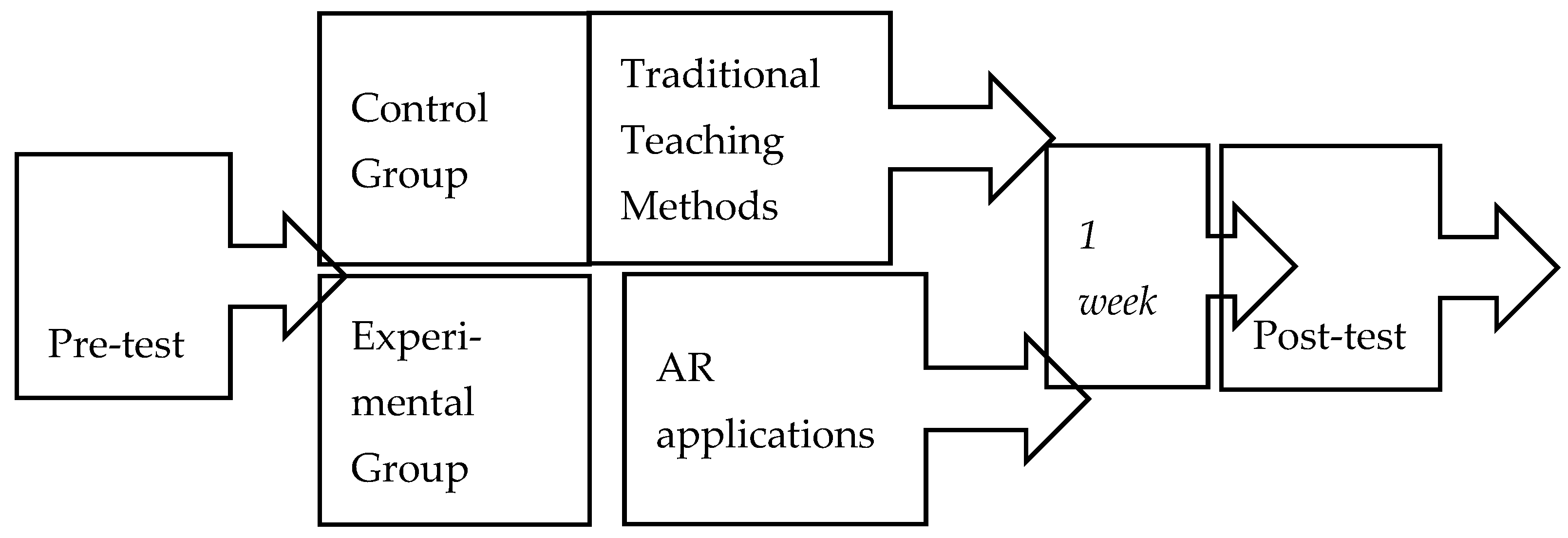
This study aspires to contribute some initial results to the growing area of research regarding technology potential in the field of early foreign language literacy. An experiment was conducted to examine very young learners’ alphabet and vocabulary learning and retention in an early foreign language (FL) learning context when implementing augmented reality (AR) applications, while very young learners’ motivation was also assessed. A pilot intervention was implemented in a state school in northern Greece. The participants (n = 26) were primary school first-graders (5.5–6 years old) and were assigned into two groups, experimental (13) and control (13). To examine the effects of the intervention, this current study employed two instruments: (a) a pre-test–post-test model to assess young learners’ alphabet and vocabulary learning during three phases and (b) a questionnaire to assess their motivation during the learning process. The findings of this study reveal that both groups displayed significant improvements in FL alphabet and vocabulary learning; however, there are statistical differences in favor of the experimental group regarding long-term alphabet and vocabulary learning and retention. Furthermore, qualitative results regarding children’s perceptions of the technology used indicate that AR was highly appealing and motivating to participating students.
Keywords: augmented reality; foreign language; alphabet and vocabulary learning; retention; motivation; early childhood augmented reality; foreign language; alphabet and vocabulary learning; retention; motivation; early childhood