Dental and Periodontal Alterations Associated with the Use of the Interproximal Reduction Technique: A Systematic Review

 ,
,  and
and
Highlights
- The IPR technique does not produce negative effects on the patient when used correctly. Furthermore, it can be effective in counteracting the negative effects of orthodontic treatment and has not been associated with the incidence of caries, alterations in the composition of dental enamel, loss of clinical attachment, or bleeding. Nevertheless, patient selection must be done with great care.
- According to the literature, applying fluoride varnish and coolant spray, along with using ultra-thin finishing and polishing discs, improves the outcomes of the IPR technique. These methods are beneficial for preventing wear of the outer enamel, reducing abrasion, and avoiding an increase in pulp temperature.
- Adults are increasingly opting for orthodontic treatments that are more attractive and less intrusive than traditional braces, like invisible aligners, making the IPR technique highly relevant again. Even with scientific support, its application raises some doubts.
- Updated information is compiled in this study, clarifying doubts about the IPR technique’s application, efficacy, and adverse effects on teeth.
Abstract
1. Introduction
2. Materials and Methods
3. Results
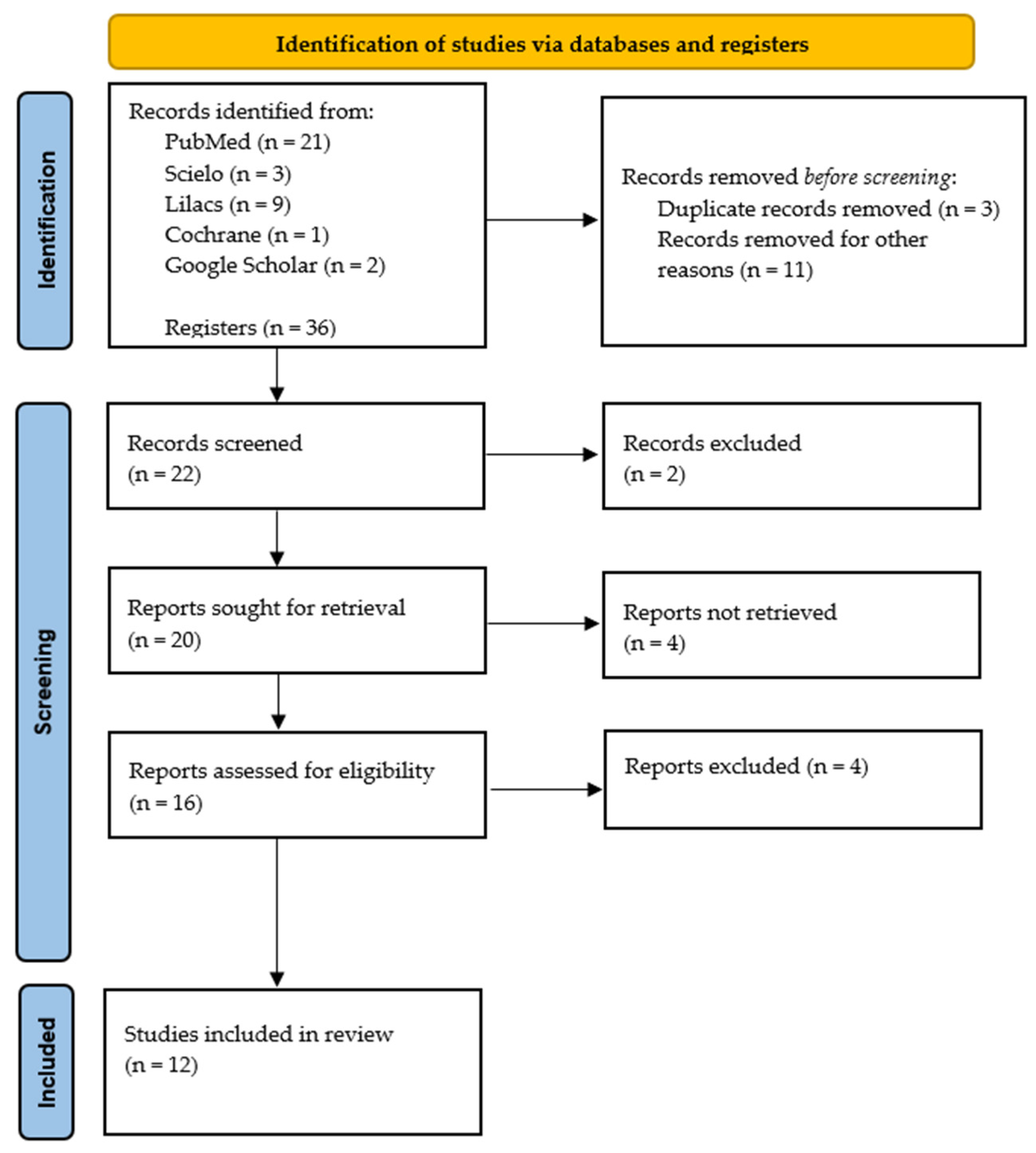
3.1. Study Selection
3.2. Table Summarizing the Selected Studies
4. Discussion
5. Conclusions
Supplementary Materials
Author Contributions
Funding
Institutional Review Board Statement
Informed Consent Statement
Data Availability Statement
Conflicts of Interest
Abbreviations
| IPR | Interproximal reduction |
| ESS | Energy Dispersive Spectrometry |
| EDX | Energy-dispersive X-ray spectroscopy |
| SEM | Scanning electron microscopy |
| AFM | Atomic force microscopy |
References
- Sheridan, J.; Ledoux, P. Air-rotor stripping and proximal sealants. An SEM evaluation. J. Clin. Orthod. 1989, 23, 790–794. [Google Scholar]
- Craig, J.P.; Nichols, K.K.; Akpek, E.K.; Caffery, B.; Dua, H.S.; Joo, C.-K.; Liu, Z.; Nelson, J.D.; Nichols, J.J.; Tsubota, K.; et al. TFOS DEWS II Definition and Classification Report. Ocul. Surf. 2017, 15, 276–283. [Google Scholar] [CrossRef]
- Zachrisson, B.U.; Minster, L.; Øgaard, B.; Birkhed, D. Dental health assessed after interproximal enamel reduction: Caries risk in posterior teeth. Am. J. Orthod. Dentofac. Orthop. 2011, 139, 90–98. [Google Scholar] [CrossRef]
- Sheridan, J.J. John J. Sheridan, DDS, MSD, on air-rotor stripping. J. Clin. Orthod. 2008, 42, 381–388. [Google Scholar] [PubMed]
- Sehgal, M.; Sharma, P.; Juneja, A.; Kumar, P.; Verma, A.; Chauhan, V. Effect of different stripping techniques on pulpal temperature: In vitro study. Dent. Press J. Orthod. 2019, 24, 39–43. [Google Scholar] [CrossRef]
- Ballard, M.L. Asymmetry in tooth size: A factor in the etiology, diagnosis and treatment of malocclusion. Angle Orthod. 1944, 14, 67–70. [Google Scholar]
- Bolton, W.A. Disharmony in tooth size and its relation to the analysis and treatment of malocclusion. Angle Orthod. 1958, 28, 113–130. [Google Scholar]
- Di Fazio, D.; Lombardo, L.; Gracco, A.; D’Amico, P.; Siciliani, G. Lip pressure at rest and during function in 2 groups of patients with different occlusion. Am. J. Orthod. Dentofac. Orthop. 2011, 139, e1–e6. [Google Scholar] [CrossRef] [PubMed]
- Lombardo, L.; Toni, G.; Stefanoni, F.; Mollica, F.; Guarneri, M.P.; Siciliani, G. The effect of temperatura on the mechanical behaivor of nicke-titanium orthodontic initial archwires. Angle Orthod. 2013, 83, 298–305. [Google Scholar] [CrossRef] [PubMed]
- Rossini, G.; Parrini, S.; Castroflorio, T.; Deregibus, A.; Debernardi, C.I. Efficacy of clear aligners in controlling orthodontic tooth movement: A systematic review. Angle Orthod. 2015, 85, 881–889. [Google Scholar] [CrossRef]
- Hellak, A.F.; Riepe, E.M.; Seubert, A.; Korbmacher-Steiner, H.M. Enamel demineralization after different methods of interproximal polishing. Clin. Oral Investig. 2015, 19, 1965–1972. [Google Scholar] [CrossRef]
- Kaaouara, Y.; Mohind, H.B.; Azaroual, M.F.; Zaoui, F.; Bahije, L.; Benyahia, H. In vivo enamel stripping: A macroscopic and microscopic analytical study. Int. Orthod. 2019, 17, 235–242. [Google Scholar] [CrossRef]
- Mohimd, H.B.; Kaaouara, Y.; Azaroual, F.; Zaoui, F.; Bahije, L.; Benyahia, H. Enamel protection after stripping procedures: An in vivo study. Int. Orthod. 2019, 17, 243–248. [Google Scholar] [CrossRef] [PubMed]
- Zach, L.; Cohen, G. Pulp response to externally applied heat. Oral Surg. Oral Med. Oral Pathol. Oral Radiol. Endol. 1965, 19, 515–530. [Google Scholar] [CrossRef]
- Sorel, O.; Aïfa, A. Stripping: Contribution to the control of iatrogenic periodontal effects. Orthod Fr. 2021, 92, 141–157. [Google Scholar] [CrossRef]
- Cremonini, F.; Giannoccaro, V.; Palone, M.; Albertini, P. In vitro study of thoot surfaces after interproximal enamel reduction: Extraoral scanner and SEM analysis. Pesqui. Bras. Odontopediatria Clínica Integr. 2021, 21, e0021. [Google Scholar] [CrossRef]
- Brutus, D.J.; Chawsh, O.F. Evaluation of the enamel nano-topography influenced by different techniques of interproximal reduction: An atomic force microscopic study. J. Orthod. 2023, 50, 196–204. [Google Scholar]
- Shalchi, M.; Abdollahi, N.; Haghshenas, E.S.; Khabbaz, S.; Olyaee, P. Effects of interdental enamel reduction on clinical attachment loss, Bleeding on probing, and incidence of caries in treating class i malocclusion cases: A retrospective cohort study. Cureus 2023, 15, e35018. [Google Scholar] [CrossRef]
- Katsigialou, N.; Sifakakis, I.; Zinelis, S.; Papageorgiou, S.N.; Eliades, T. Manual and mechanical stripping-induced enamel roughness and elemental composition in vivo. Eur. J. Orthod. 2023, 45, 250–257. [Google Scholar] [CrossRef]
- Serbanoiu, D.C.; Vartolomei, A.-C.; Ghiga, D.-V.; Moldovan, M.; Sarosi, C.; Petean, I.; Boileau, M.-J.; Pacurar, M. A comparative analysis of enamel surfaces rougness following various interproximal reduction techniques: An examination using scanning electron microscopy and atomic force microscopy. Biomedicines 2023, 12, 1629. [Google Scholar]
- Nucci, L.; d’Apuzzo, F.; Nastri, L.; Femiano, F.; Perrillo, L.; Grassia, V. Enamel interproximal reduction and periodontal health. Semin. Orthod. 2024, 30, 146–149. [Google Scholar] [CrossRef]
- Dahhas, F.Y.; Almutairi, N.S.; Almutairi, R.S.; Alshamrani, H.A.; Alshyai, H.S.; Almazyad, R.K.; Alsanouni, M.S.; Gadi, S.A. The role of interproximal reduction (IPR) in clear aligner therapy: A critical analysis of indications, techniques, and outcomes. Cureus 2024, 16, e56644. [Google Scholar] [CrossRef] [PubMed]


| Year | Author | Type of Study | Objective or Topic Covered | Materials and Methods | Results and Conclusion |
|---|---|---|---|---|---|
| 2015 | Hellak et al. [11] | In vitro | To investigate the rate of enamel demineralization after IPR. | Using five different systems, the loss of substance was analyzed by optical emission spectrometry. | No potential bacterial colonization was observed within the erosive environment left by the IPR on the tooth. It was concluded that whenever there is wear of the outer enamel layer, there will be an increase in demineralization and that polishing the surface after IPR does not appear to influence a reduction in the degree of demineralization. |
| 2019 | Kaaouara et al. [12] | In vivo | The wear of enamel was studied in vivo at the macroscopic and microscopic levels. | Interdental stripping was performed on patients undergoing orthodontic treatment and analyzed using a scanning electron microscope. | Regardless of the type of material used for grinding, the enamel surface exhibited a degree of roughness with grooves and ridges of varying depths and widths. It was found that using files and oscillating discs produced smoother, less rough surfaces than hand tools (abrasive strips and files), and that using finishing and polishing discs as a final step after grinding reduced the amount of abrasion. |
| 2019 | Mohimd et al. [13] | In vivo | To evaluate the evolution of worn proximal dental surfaces after exposure to the oral environment for 4 months, with and without fluoride protection. | To quantify the percentage of mineral elements, scanning electron microscopy was used for qualitative analysis, and Energy Dispersive Spectrometry (ESS) was used for quantitative analysis. | After 4 months in the oral environment, there was an improvement in the percentage of mineral elements in both groups, but the results were better for those who were treated with fluoride varnish. |
| 2019 | Sehgal et al. [5] | In vitro | Changes in pulp temperature were analyzed during different interproximal grinding procedures. | Interproximal grinding procedures (diamond burs, with and without cooling and diamond abrasive strips). | An increase in temperature was observed with all abrasion methods, but none of the techniques resulted in an increase above the critical level of 5.5 °C suggested by Zach and Cohen [14]. It was concluded that the pulp temperature increase can be limited by using a cooling spray and refreshing water during the procedure. |
| 2021 | Sorel et al. [15] | Analytical, critical and illustrative. | To illustrate an approach based on diagnosis, analysis of dental disharmony, assessment of the magnitude of stripping and its consequences and the prognosis. | A diagnostic approach is used, analyzing the dental disharmony, assessing the extent of the stripping and its consequences, and finally, providing a prognosis. Clinical illustrations of treated cases are provided. | This article emphasizes that the gingiva and gingival festoon are essential elements for good periodontal health and a harmonious smile and that stripping can be a good alternative to counteract the negative indirect effects of orthodontic treatment, which indirectly influence the gingival festoon and particularly the papillae. Clinical cases illustrate the improvement in the appearance of the dental papilla in the presence of black triangles, using the IPR technique. |
| 2021 | Cremonini et al. [16] | In vitro | A qualitative analysis of the enamel surface at the contact point is performed, before and after the IPR. | Comparing two types of abrasive strips, using different techniques, including scanning electron microscopy (SEM), and the use of a scanner and 3-Shape Ortho Analyzer Software (3Shape, Copenhagen, Denmark). | It was concluded that there will always be a change in the shape of the contact point, and that the surface morphology will depend on the extent of wear, and that the type of strip did not have a statistically significant impact on the variation in the morphology. |
| 2022 | Brutus et al. [17] | Microscopic study of atomic force. | The nanotopography of enamel was evaluated after different IPR techniques. | The nanotopography of the enamel is evaluated after different IPR techniques (discs, burs and manual strips). | It was concluded that no IPR method was significant in the nanotopography of tooth enamel, with or without polishing, and that the reduction in roughness with polishing was only significant in disc wear. |
| 2023 | Shalchi et al. [18] | Retrospective cohort study. | Effects of IPR on gingival health (clinical attachment loss and bleeding on probing), as well as the incidence of caries in orthodontic patients without interproximal wear and patients who received IPR, with or without fluoride application. | Effects of IPR on gingival health (clinical attachment loss and bleeding on probing), as well as the incidence of caries in orthodontic patients without interproximal wear and patients who received IPR, with or without fluoride application. | There were no significant differences in the incidence of caries, clinical attachment loss, and bleeding on probing between patients receiving the IPR and those not. The incidence of caries also showed no significant differences between teeth that received fluoride after the IPR and those that did not. |
| 2023 | Katsigialou et al. [19] | In vivo | The enamel roughness and elemental composition were evaluated after mechanical and manual IPR in patients undergoing orthodontic treatment. | Optical profilometry, Raman spectroscopy, scanning electron microscope analysis, and energy-dispersive X-ray spectroscopy (EDX) analysis were used. | Both methods increased enamel roughness with no significant differences between the techniques. IPR did not significantly alter the molecular structure according to Raman and EDX analyses and no alterations in the elemental composition of the enamel were found after at least 6 months of intraoral exposure. |
| 2024 | Serbanoiu et al. [20] | Comparative analysis. | A comparative analysis of enamel roughness was performed after IPR using diamond burs, abrasive strips and discs. | Comparative analysis of enamel roughness after IPR with diamond burs, abrasive strips and discs, using scanning electron microscopy (SEM) and atomic force microscopy (AFM). | The nanotopographic and roughness level result after IPR varies according to the instruments and thicknesses used, with the thinnest strips and discs (15 μm), preserving the quality of the enamel surface and even eliminating natural wear marks. |
| 2024 | Nucci et al. [21] | Critical, informative and up-to-date analysis. | It discusses periodontal health versus interproximal enamel reduction and points out the causes of the negative effects after IPR. | Through citations and literature reviews, the topic of the relationship between the IPR and periodontal health is updated. | The study found that IPR requires a thorough examination and patient selection process and notes that it could cause negative effects if performed in contraindicated cases, such as grooves on the interproximal surface of the tooth, hypersensitivity, damage to the dental pulp, and an increased risk of interproximal caries. It concludes that IPR is useful for reducing or eliminating black triangles. |
| 2024 | Dahhas et al. [22] | Critical, informative and up-to-date analysis. | A critical analysis of the indications, techniques, and results of the IPR is made in the context of aligners, and the research results are clearly and systematically presented. | Through citations and literature reviews, the research results, indications, IPR techniques, as well as their different effects on the tooth and periodontium, are updated and clarified in a clear and orderly manner. | There is an increase in pulp temperature, but it does not exceed the critical threshold of 5.5 °C. The treated surface tends to exhibit greater roughness. There are no significant changes in the enamel nanotopography between polished and unpolished surfaces, but the surface is slightly smoother after polishing, which is why post-polishing is recommended. Susceptibility to caries has been refuted, provided the patient maintains good oral hygiene and the IPR procedure is performed accurately. The absence of periodontal problems is also confirmed. IPR does not increase tooth sensitivity. |
Disclaimer/Publisher’s Note: The statements, opinions and data contained in all publications are solely those of the individual author(s) and contributor(s) and not of MDPI and/or the editor(s). MDPI and/or the editor(s) disclaim responsibility for any injury to people or property resulting from any ideas, methods, instructions or products referred to in the content. |
© 2026 by the authors. Licensee MDPI, Basel, Switzerland. This article is an open access article distributed under the terms and conditions of the Creative Commons Attribution (CC BY) license.
Share and Cite
Lara Espinosa, L.A.; Checa Caratachea, X.A.; González-Aragón Pineda, Á.E.; Castillo Salazar, G. Dental and Periodontal Alterations Associated with the Use of the Interproximal Reduction Technique: A Systematic Review. Oral 2026, 6, 27. https://doi.org/10.3390/oral6020027
Lara Espinosa LA, Checa Caratachea XA, González-Aragón Pineda ÁE, Castillo Salazar G. Dental and Periodontal Alterations Associated with the Use of the Interproximal Reduction Technique: A Systematic Review. Oral. 2026; 6(2):27. https://doi.org/10.3390/oral6020027
Chicago/Turabian StyleLara Espinosa, Luis Alain, Ximena Alejandra Checa Caratachea, Álvaro Edgar González-Aragón Pineda, and Gustavo Castillo Salazar. 2026. "Dental and Periodontal Alterations Associated with the Use of the Interproximal Reduction Technique: A Systematic Review" Oral 6, no. 2: 27. https://doi.org/10.3390/oral6020027
APA StyleLara Espinosa, L. A., Checa Caratachea, X. A., González-Aragón Pineda, Á. E., & Castillo Salazar, G. (2026). Dental and Periodontal Alterations Associated with the Use of the Interproximal Reduction Technique: A Systematic Review. Oral, 6(2), 27. https://doi.org/10.3390/oral6020027