
Engineering Viral Surface Antigens to Improve Display on Virus-like Particle (VLP) Vaccine Prototypes


Abstract
1. Introduction
2. Materials and Methods
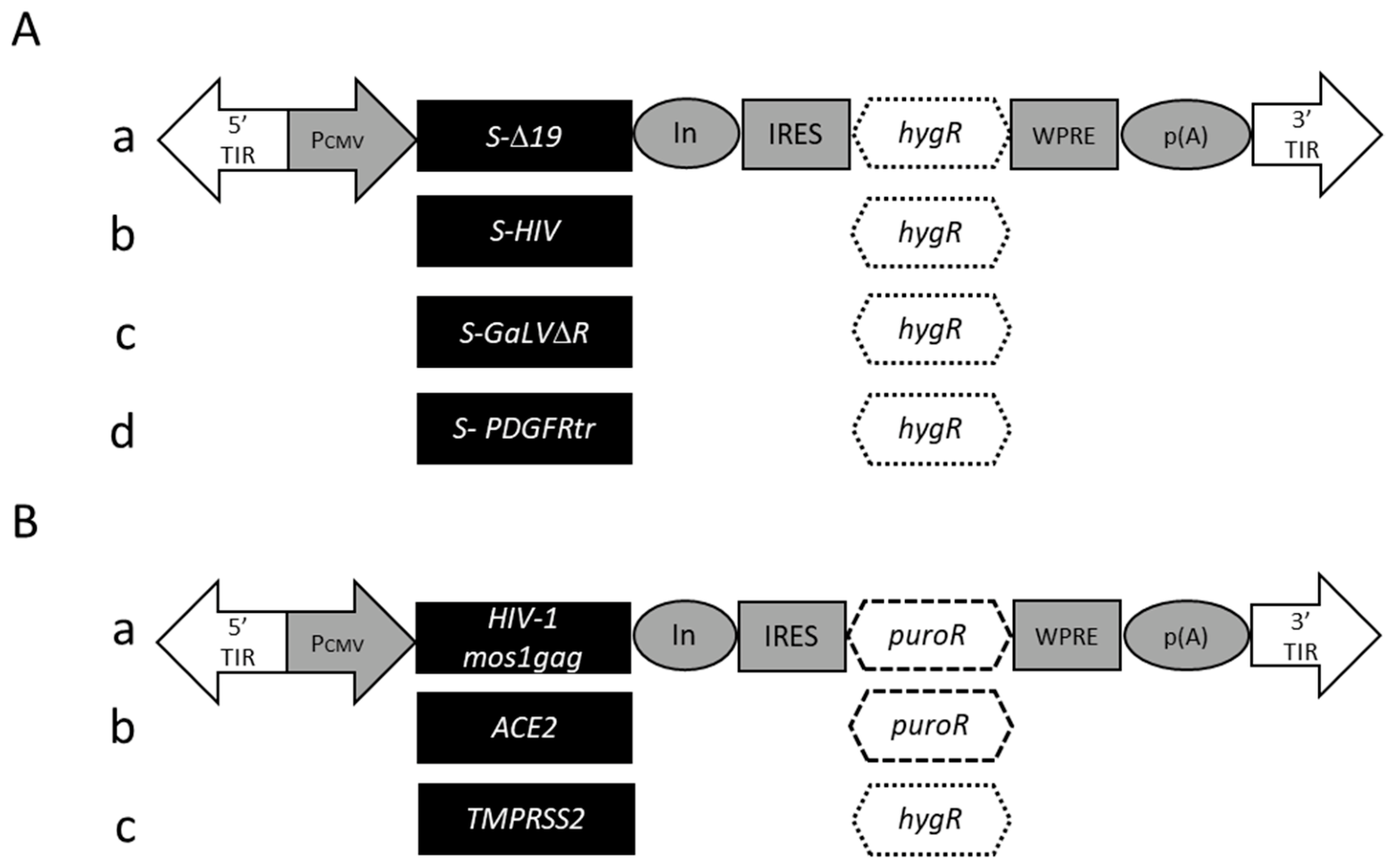
2.1. Plasmids
2.2. Cells
2.3. Western Blotting and Preparation of VLPs and EVs
2.4. Detection of Cell-Surface Spike Protein Expression
2.5. Syncytia-Formation Assay
2.6. Generation of Lentiviral Vectors Pseudotyped with S Variant Proteins and Vector Titration
2.7. Immuno-Precipitation or VLP Capture Assay
3. Results
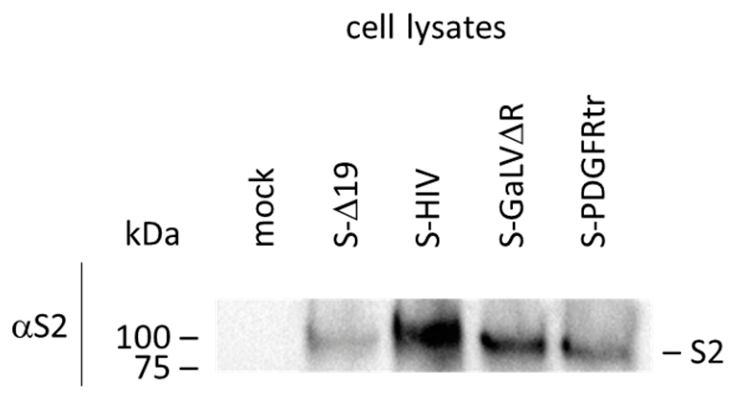
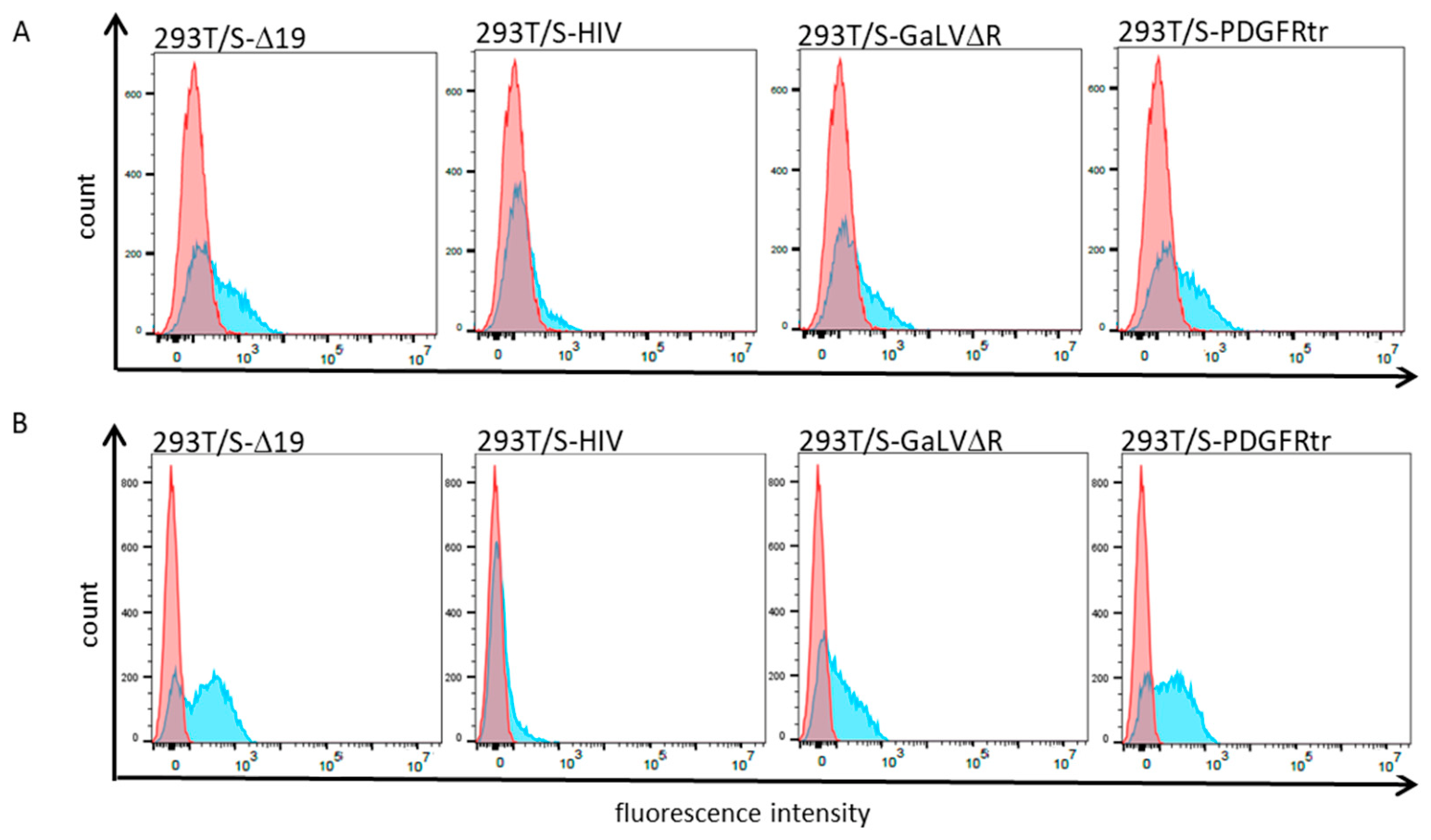
3.1. Cellular Expression and Cell-Surface Display of SARS-CoV-2 Spike Variants
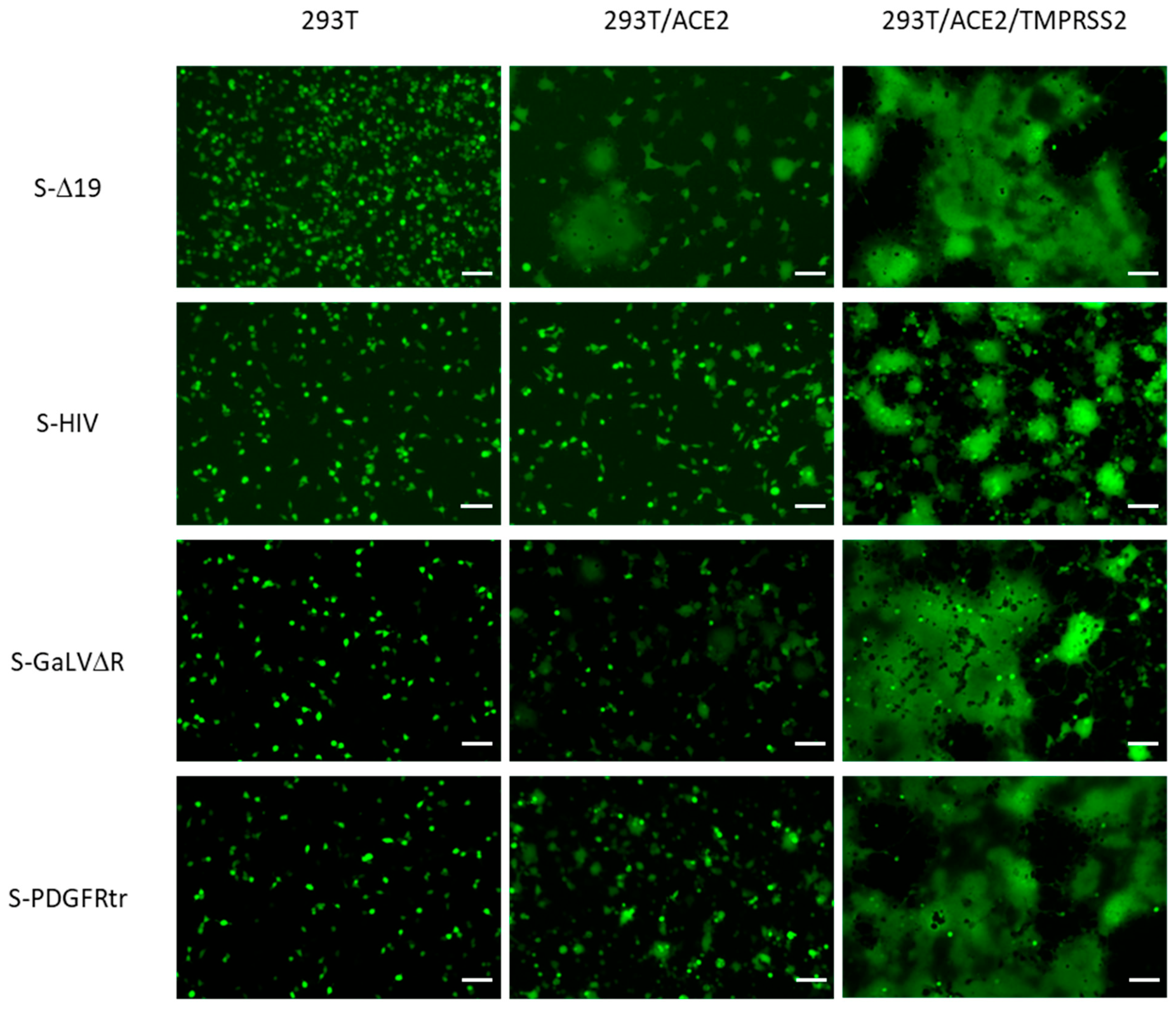
3.2. All Spike Variants Mediate Syncytia Formation
3.3. All Spike Variants Form Transduction-Competent Pseudotype Lentiviral Vector Particles
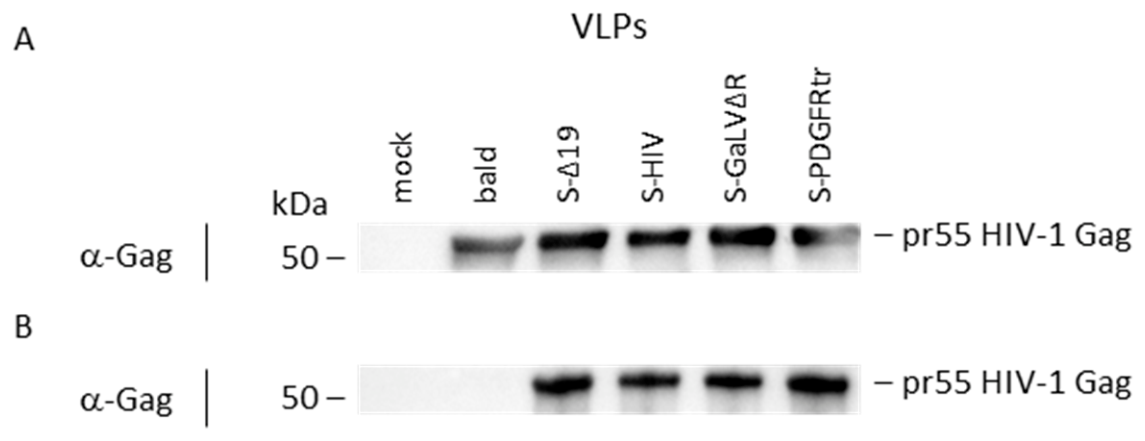
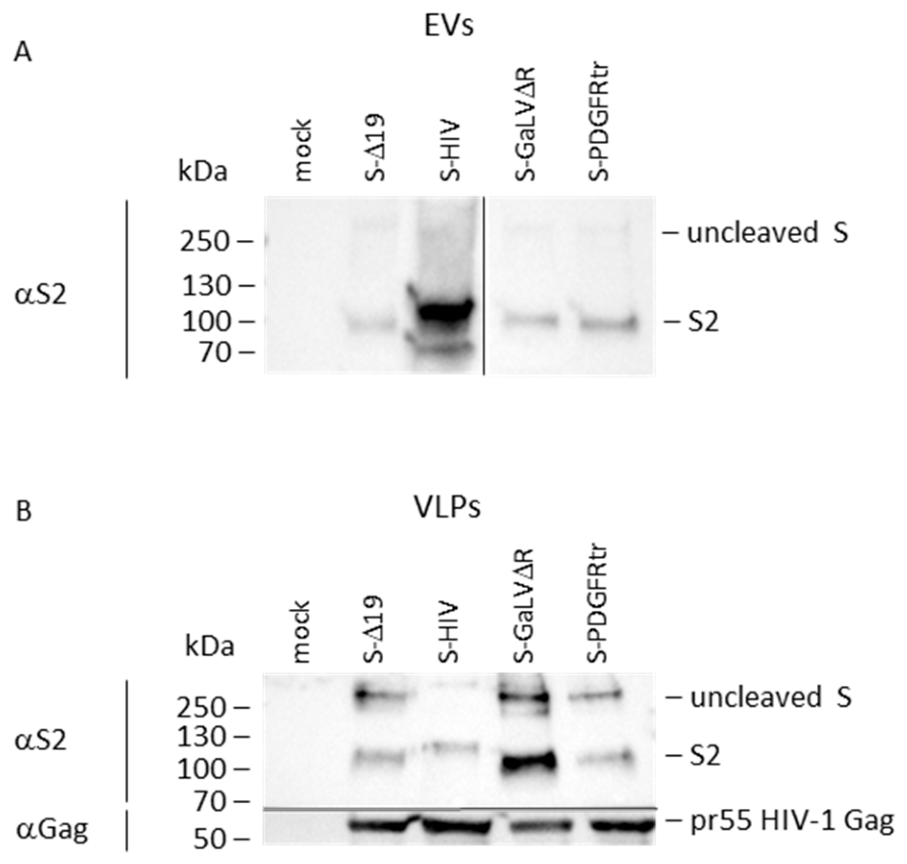
3.4. Incorporation of Spike Protein Variants into VLPs and EVs
3.5. All Spike Variants Expose Neutralization-Sensitive Epitopes on VLPs
4. Discussion
Author Contributions
Funding
Institutional Review Board Statement
Informed Consent Statement
Data Availability Statement
Acknowledgments
Conflicts of Interest
Abbreviations
| aa | amino acids |
| ACE2 | angiotensin-converting enzyme 2 |
| BSA | bovine serum albumin |
| CFSN | cell-free supernatant |
| CT | cytoplasmic tail |
| DMEM | Dulbecco’s Modified Eagle Medium |
| EGFP | enhanced green fluorescent protein |
| EV | extracellular vesicle |
| GaLV | gibbon ape leukemia virus |
| GaLVΔR | truncated GaLV envelope encoding only 16 amino acid residues of the CT |
| hygR | hygromycin B resistance gene |
| In | synthetic intron |
| IRES | internal ribosome entry site |
| kDa | kilodalton |
| MLV | murine leukemia virus |
| nAbs | neutralizing antibodies |
| PCMV | CMV promoter/enhancer element |
| PDGFRtr | truncated human platelet-derived growth factor receptor β |
| PEI | polyethylenimine |
| p(A) | polyadenylation signal |
| puroR | puromycin resistance gene |
| S(2) | (subunit 2 of) SARS-CoV-2 spike protein |
| SNV | spleen necrosis virus |
| TBS-T | Tris-buffered saline with Tween-20 |
| TIRs | terminal inverted repeats |
| TMPRSS2 | transmembrane serine protease 2 |
| TU/mL | transducing units per mL |
| VLP | virus-like particle |
| WPRE | woodchuck hepatitis posttranscriptional regulatory element |
| wt | wildtype |
References
- Sherry, L.; Bahar, M.W.; Porta, C.; Fox, H.; Grehan, K.; Nasta, V.; Duyvesteyn, H.M.E.; de Colibus, L.; Marsian, J.; Murdoch, I.; et al. Recombinant expression systems for production of stabilised virus-like particles as next-generation polio vaccines. Nat. Commun. 2025, 16, 831. [Google Scholar] [CrossRef]
- Han, T.; Xiao, J.; Zhang, S.; Su, T.; Liu, Y.; Zhang, Y. Research Progress Towards Poliovirus Virus-like Particle Vaccines: A Review. Vaccines 2026, 14, 216. [Google Scholar] [CrossRef]
- Tommasino, M. The human papillomavirus family and its role in carcinogenesis. Semin. Cancer Biol. 2014, 26, 13–21. [Google Scholar] [CrossRef] [PubMed]
- Zhang, Y.; Qiu, K.; Ren, J.; Zhao, Y.; Cheng, P. Roles of human papillomavirus in cancers: Oncogenic mechanisms and clinical use. Signal Transduct. Target. Ther. 2025, 10, 44. [Google Scholar] [CrossRef]
- Pathela, P.; Jamison, K.; Papadouka, V.; Kabir, R.; Markowitz, L.E.; Dunne, E.F.; Schillinger, J.A. Measuring Adolescent Human Papillomavirus Vaccine Coverage: A Match of Sexually Transmitted Disease Clinic and Immunization Registry Data. J. Adolesc. Health 2016, 59, 710–715. [Google Scholar] [CrossRef]
- Sankaranarayanan, R.; Joshi, S.; Muwonge, R.; Esmy, P.O.; Basu, P.; Prabhu, P.; Bhatla, N.; Nene, B.M.; Shaw, J.; Poli, U.R.R.; et al. Can a single dose of human papillomavirus (HPV) vaccine prevent cervical cancer? Early findings from an Indian study. Vaccine 2018, 36, 4783–4791. [Google Scholar] [CrossRef] [PubMed]
- Batmunkh, T.; von Mollendorf, C.; Tulgaa, K.; Surenjav, U.; Dalmau, M.T.; Namjil, N.; Tsedevdamba, B.; Tsegmed, S.; Enkhmaa, J.; Garland, S.M.; et al. HPV genoprevalence and HPV knowledge in young women in Mongolia, five years following a pilot 4vHPV vaccination campaign. Papillomavirus Res. 2019, 8, 100175. [Google Scholar] [CrossRef]
- Mohsen, M.O.; Bachmann, M.F. Virus-like particle vaccinology, from bench to bedside. Cell. Mol. Immunol. 2022, 19, 993–1011. [Google Scholar] [CrossRef]
- Rosengarten, J.F.; Schatz, S.; Wolf, T.; Barbe, S.; Stitz, J. Components of a HIV-1 vaccine mediate virus-like particle (VLP)-formation and display of envelope proteins exposing broadly neutralizing epitopes. Virology 2022, 568, 41–48. [Google Scholar] [CrossRef] [PubMed]
- Earnest, L.; Ruiz, D.F.; Edeling, M.A.; Montoya, J.C.; Yap, A.H.Y.; Wong, C.Y.; Holz, L.E.; Gras, S.; Collett, S.; Cooney, J.P.; et al. Preclinical development of a cross-protective β-SARS-CoV-2 virus-like particle vaccine adjuvanted with MF59. npj Vaccines 2026, 11, 34. [Google Scholar] [CrossRef]
- Lee, S.-H.; Chu, K.-B.; Kim, M.-J.; Mao, J.; Eom, G.-D.; Yoon, K.-W.; Ahmed, M.A.; Quan, F.-S. Virus-like Particle Vaccine Expressing the Respiratory Syncytial Virus Pre-Fusion and G Proteins Confers Protection against RSV Challenge Infection. Pharmaceutics 2023, 15, 782. [Google Scholar] [CrossRef]
- Ross, T.M.; Mahmood, K.; Crevar, C.J.; Schneider-Ohrum, K.; Heaton, P.M.; Bright, R.A. A trivalent virus-like particle vaccine elicits protective immune responses against seasonal influenza strains in mice and ferrets. PLoS ONE 2009, 4, e6032. [Google Scholar] [CrossRef] [PubMed]
- Krammer, F.; Schinko, T.; Palmberger, D.; Tauer, C.; Messner, P.; Grabherr, R. Trichoplusia ni cells (High Five) are highly efficient for the production of influenza A virus-like particles: A comparison of two insect cell lines as production platforms for influenza vaccines. Mol. Biotechnol. 2010, 45, 226–234. [Google Scholar] [CrossRef]
- Gheysen, D.; Jacobs, E.; de Foresta, F.; Thiriart, C.; Francotte, M.; Thines, D.; de Wilde, M. Assembly and release of HIV-1 precursor Pr55gag virus-like particles from recombinant baculovirus-infected insect cells. Cell 1989, 59, 103–112. [Google Scholar] [CrossRef]
- Carlson, L.-A.; Briggs, J.A.G.; Glass, B.; Riches, J.D.; Simon, M.N.; Johnson, M.C.; Müller, B.; Grünewald, K.; Kräusslich, H.-G. Three-dimensional analysis of budding sites and released virus suggests a revised model for HIV-1 morphogenesis. Cell Host Microbe 2008, 4, 592–599. [Google Scholar] [CrossRef] [PubMed]
- Lavado-García, J.; Jorge, I.; Boix-Besora, A.; Vázquez, J.; Gòdia, F.; Cervera, L. Characterization of HIV-1 virus-like particles and determination of Gag stoichiometry for different production platforms. Biotechnol. Bioeng. 2021, 118, 2660–2675. [Google Scholar] [CrossRef] [PubMed]
- Ono, A.; Freed, E.O. Plasma membrane rafts play a critical role in HIV-1 assembly and release. Proc. Natl. Acad. Sci. USA 2001, 98, 13925–13930. [Google Scholar] [CrossRef]
- Hogue, I.B.; Grover, J.R.; Soheilian, F.; Nagashima, K.; Ono, A. Gag induces the coalescence of clustered lipid rafts and tetraspanin-enriched microdomains at HIV-1 assembly sites on the plasma membrane. J. Virol. 2011, 85, 9749–9766. [Google Scholar] [CrossRef]
- Hurley, J.H.; Cada, A.K. Inside job: How the ESCRTs release HIV-1 from infected cells. Biochem. Soc. Trans. 2018, 46, 1029–1036. [Google Scholar] [CrossRef]
- Hoffmann, M.; Kleine-Weber, H.; Schroeder, S.; Krüger, N.; Herrler, T.; Erichsen, S.; Schiergens, T.S.; Herrler, G.; Wu, N.-H.; Nitsche, A.; et al. SARS-CoV-2 Cell Entry Depends on ACE2 and TMPRSS2 and Is Blocked by a Clinically Proven Protease Inhibitor. Cell 2020, 181, 271–280.e8. [Google Scholar] [CrossRef]
- Ou, X.; Liu, Y.; Lei, X.; Li, P.; Mi, D.; Ren, L.; Guo, L.; Guo, R.; Chen, T.; Hu, J.; et al. Characterization of spike glycoprotein of SARS-CoV-2 on virus entry and its immune cross-reactivity with SARS-CoV. Nat. Commun. 2020, 11, 1620. [Google Scholar] [CrossRef]
- Nabhan, J.F.; Hu, R.; Oh, R.S.; Cohen, S.N.; Lu, Q. Formation and release of arrestin domain-containing protein 1-mediated microvesicles (ARMMs) at plasma membrane by recruitment of TSG101 protein. Proc. Natl. Acad. Sci. USA 2012, 109, 4146–4151. [Google Scholar] [CrossRef] [PubMed]
- Patel, G.K.; Khan, M.A.; Bhardwaj, A.; Srivastava, S.K.; Zubair, H.; Patton, M.C.; Singh, S.; Khushman, M.; Singh, A.P. Exosomes confer chemoresistance to pancreatic cancer cells by promoting ROS detoxification and miR-155-mediated suppression of key gemcitabine-metabolising enzyme, DCK. Br. J. Cancer 2017, 116, 609–619. [Google Scholar] [CrossRef] [PubMed]
- Raposo, G.; Stoorvogel, W. Extracellular vesicles: Exosomes, microvesicles, and friends. J. Cell Biol. 2013, 200, 373–383. [Google Scholar] [CrossRef]
- Koho, T.; Mäntylä, T.; Laurinmäki, P.; Huhti, L.; Butcher, S.J.; Vesikari, T.; Kulomaa, M.S.; Hytönen, V.P. Purification of norovirus-like particles (VLPs) by ion exchange chromatography. J. Virol. Methods 2012, 181, 6–11. [Google Scholar] [CrossRef]
- Steppert, P.; Burgstaller, D.; Klausberger, M.; Tover, A.; Berger, E.; Jungbauer, A. Quantification and characterization of virus-like particles by size-exclusion chromatography and nanoparticle tracking analysis. J. Chromatogr. A 2017, 1487, 89–99. [Google Scholar] [CrossRef]
- Rathore, A.S.; Peruri, V.; Auclair, J.R. Challenges in the Analytical Characterization of VLPs Through HPLC-Based Methods. LCGC Int. 2024, 1, 14–18. [Google Scholar] [CrossRef]
- von Elling-Tammen, M.S.; Taft, F.; Thom, V.; Stitz, J.; Barbe, S.; Krause, A. Optimizing nuclease treatment to enhance anion exchange chromatography of HIV-derived virus-like particles. J. Chromatogr. B Anal. Technol. Biomed. Life Sci. 2025, 1256, 124539. [Google Scholar] [CrossRef]
- Bachmann, M.F.; Rohrer, U.H.; Kündig, T.M.; Bürki, K.; Hengartner, H.; Zinkernagel, R.M. The influence of antigen organization on B cell responsiveness. Science 1993, 262, 1448–1451. [Google Scholar] [CrossRef]
- Kato, Y.; Abbott, R.K.; Freeman, B.L.; Haupt, S.; Groschel, B.; Silva, M.; Menis, S.; Irvine, D.J.; Schief, W.R.; Crotty, S. Multifaceted Effects of Antigen Valency on B Cell Response Composition and Differentiation In Vivo. Immunity 2020, 53, 548–563.e8. [Google Scholar] [CrossRef]
- Dintzis, H.M.; Dintzis, R.Z.; Vogelstein, B. Molecular determinants of immunogenicity: The immunon model of immune response. Proc. Natl. Acad. Sci. USA 1976, 73, 3671–3675. [Google Scholar] [CrossRef]
- Deml, L.; Kratochwil, G.; Osterrieder, N.; Knüchel, R.; Wolf, H.; Wagner, R. Increased incorporation of chimeric human immunodeficiency virus type 1 gp120 proteins into Pr55gag virus-like particles by an Epstein-Barr virus gp220/350-derived transmembrane domain. Virology 1997, 235, 10–25. [Google Scholar] [CrossRef]
- Wang, B.-Z.; Liu, W.; Kang, S.-M.; Alam, M.; Huang, C.; Ye, L.; Sun, Y.; Li, Y.; Kothe, D.L.; Pushko, P.; et al. Incorporation of high levels of chimeric human immunodeficiency virus envelope glycoproteins into virus-like particles. J. Virol. 2007, 81, 10869–10878. [Google Scholar] [CrossRef]
- Vzorov, A.N.; Wang, L.; Chen, J.; Wang, B.-Z.; Compans, R.W. Effects of modification of the HIV-1 Env cytoplasmic tail on immunogenicity of VLP vaccines. Virology 2016, 489, 141–150. [Google Scholar] [CrossRef]
- Johnson, M.C.; Lyddon, T.D.; Suarez, R.; Salcedo, B.; LePique, M.; Graham, M.; Ricana, C.; Robinson, C.; Ritter, D.G. Optimized Pseudotyping Conditions for the SARS-COV-2 Spike Glycoprotein. J. Virol. 2020, 94, 1110–1128. [Google Scholar] [CrossRef] [PubMed]
- Schmidt, F.; Weisblum, Y.; Muecksch, F.; Hoffmann, H.-H.; Michailidis, E.; Lorenzi, J.C.C.; Mendoza, P.; Rutkowska, M.; Bednarski, E.; Gaebler, C.; et al. Measuring SARS-CoV-2 neutralizing antibody activity using pseudotyped and chimeric viruses. J. Exp. Med. 2020, 217, e20201181. [Google Scholar] [CrossRef]
- Cosson, P. Direct interaction between the envelope and matrix proteins of HIV-1. EMBO J. 1996, 15, 5783–5788. [Google Scholar] [CrossRef]
- Gardiner, J.C.; Mauer, E.J.; Sherer, N.M. HIV-1 Gag, Envelope, and Extracellular Determinants Cooperate to Regulate the Stability and Turnover of Virological Synapses. J. Virol. 2016, 90, 6583–6597. [Google Scholar] [CrossRef] [PubMed]
- Murakami, T.; Freed, E.O. The long cytoplasmic tail of gp41 is required in a cell type-dependent manner for HIV-1 envelope glycoprotein incorporation into virions. Proc. Natl. Acad. Sci. USA 2000, 97, 343–348. [Google Scholar] [CrossRef] [PubMed]
- Goyvaerts, C.; de Groeve, K.; Dingemans, J.; van Lint, S.; Robays, L.; Heirman, C.; Reiser, J.; Zhang, X.-Y.; Thielemans, K.; de Baetselier, P.; et al. Development of the Nanobody display technology to target lentiviral vectors to antigen-presenting cells. Gene Ther. 2012, 19, 1133–1140. [Google Scholar] [CrossRef]
- Bobkova, M.; Stitz, J.; Engelstädter, M.; Cichutek, K.; Buchholz, C.J. Identification of R-peptides in envelope proteins of C-type retroviruses. J. Gen. Virol. 2002, 83, 2241–2246. [Google Scholar] [CrossRef]
- Stitz, J.; Wolfrum, N.; Buchholz, C.J.; Cichutek, K. Envelope proteins of spleen necrosis virus form infectious human immunodeficiency virus type 1 pseudotype vector particles, but fail to incorporate upon substitution of the cytoplasmic domain with that of Gibbon ape leukemia virus. J. Gen. Virol. 2006, 87, 1577–1581. [Google Scholar] [CrossRef]
- Tschorn, N.; Söhngen, C.; Berg, K.; Stitz, J. Ecotropic HIV-1 vectors pseudotyped with R-peptide-deleted envelope protein variants reveal improved gene transfer efficiencies. Virology 2022, 577, 124–130. [Google Scholar] [CrossRef] [PubMed]
- Berg, K.; Schäfer, V.N.; Bartnicki, N.; Eggenschwiler, R.; Cantz, T.; Stitz, J. Rapid establishment of stable retroviral packaging cells and recombinant susceptible target cell lines employing novel transposon vectors derived from Sleeping Beauty. Virology 2019, 531, 40–47. [Google Scholar] [CrossRef]
- Theuerkauf, S.A.; Michels, A.; Riechert, V.; Maier, T.J.; Flory, E.; Cichutek, K.; Buchholz, C.J. Quantitative assays reveal cell fusion at minimal levels of SARS-CoV-2 spike protein and fusion from without. iScience 2021, 24, 102170. [Google Scholar] [CrossRef]
- van Heuvel, Y.; Schatz, S.; Hein, M.; Dogra, T.; Kazenmaier, D.; Tschorn, N.; Genzel, Y.; Stitz, J. Novel suspension retroviral packaging cells generated by transposition using transposase encoding mRNA advance vector yields and enable production in bioreactors. Front. Bioeng. Biotechnol. 2023, 11, 1076524. [Google Scholar] [CrossRef] [PubMed]
- Berg, K.; Schäfer, V.N.; Tschorn, N.; Stitz, J. Advanced Establishment of Stable Recombinant Human Suspension Cell Lines Using Genotype-Phenotype Coupling Transposon Vectors. Methods Mol. Biol. 2020, 2070, 351–361. [Google Scholar] [CrossRef] [PubMed]
- Salmon, P.; Trono, D. Production and titration of lentiviral vectors. Curr. Protoc. Hum. Genet. 2007, 54, 12.10.1–12.10.24. [Google Scholar] [CrossRef]
- Rosengarten, J.F.; Schatz, S.; Stitz, J. Detection of Neutralization-sensitive Epitopes in Antigens Displayed on Virus-Like Particle (VLP)-Based Vaccines Using a Capture Assay. J. Vis. Exp. 2022, e63137. [Google Scholar] [CrossRef]
- Anang, S.; Zhang, S.; Ennis, A.; Ding, H.; Deshpande, A.; Nguyen, H.T.; Kappes, J.C.; Sodroski, J.G. Characterization of full-length and cytoplasmic tail-truncated envelope glycoproteins incorporated into human immunodeficiency virus (HIV-1) virions and virus-like particles. J. Virol. 2025, 99, e0158525. [Google Scholar] [CrossRef]
- Berlioz-Torrent, C.; Shacklett, B.L.; Erdtmann, L.; Delamarre, L.; Bouchaert, I.; Sonigo, P.; Dokhelar, M.C.; Benarous, R. Interactions of the cytoplasmic domains of human and simian retroviral transmembrane proteins with components of the clathrin adaptor complexes modulate intracellular and cell surface expression of envelope glycoproteins. J. Virol. 1999, 73, 1350–1361. [Google Scholar] [CrossRef]
- Boge, M.; Wyss, S.; Bonifacino, J.S.; Thali, M. A membrane-proximal tyrosine-based signal mediates internalization of the HIV-1 envelope glycoprotein via interaction with the AP-2 clathrin adaptor. J. Biol. Chem. 1998, 273, 15773–15778. [Google Scholar] [CrossRef] [PubMed]
- Byland, R.; Vance, P.J.; Hoxie, J.A.; Marsh, M. A conserved dileucine motif mediates clathrin and AP-2-dependent endocytosis of the HIV-1 envelope protein. Mol. Biol. Cell 2007, 18, 414–425. [Google Scholar] [CrossRef] [PubMed]
- Wyss, S.; Berlioz-Torrent, C.; Boge, M.; Blot, G.; Höning, S.; Benarous, R.; Thali, M. The highly conserved C-terminal dileucine motif in the cytosolic domain of the human immunodeficiency virus type 1 envelope glycoprotein is critical for its association with the AP-1 clathrin adaptor correction of adapter. J. Virol. 2001, 75, 2982–2992. [Google Scholar] [CrossRef]
- Ohno, H.; Aguilar, R.C.; Fournier, M.C.; Hennecke, S.; Cosson, P.; Bonifacino, J.S. Interaction of endocytic signals from the HIV-1 envelope glycoprotein complex with members of the adaptor medium chain family. Virology 1997, 238, 305–315. [Google Scholar] [CrossRef]
- Brouwer, P.J.M.; Caniels, T.G.; van der Straten, K.; Snitselaar, J.L.; Aldon, Y.; Bangaru, S.; Torres, J.L.; Okba, N.M.A.; Claireaux, M.; Kerster, G.; et al. Potent neutralizing antibodies from COVID-19 patients define multiple targets of vulnerability. Science 2020, 369, 643–650. [Google Scholar] [CrossRef]
- Zost, S.J.; Gilchuk, P.; Chen, R.E.; Case, J.B.; Reidy, J.X.; Trivette, A.; Nargi, R.S.; Sutton, R.E.; Suryadevara, N.; Chen, E.C.; et al. Rapid isolation and profiling of a diverse panel of human monoclonal antibodies targeting the SARS-CoV-2 spike protein. Nat. Med. 2020, 26, 1422–1427. [Google Scholar] [CrossRef] [PubMed]
- Arakelyan, A.; Fitzgerald, W.; Zicari, S.; Vanpouille, C.; Margolis, L. Extracellular Vesicles Carry HIV Env and Facilitate Hiv Infection of Human Lymphoid Tissue. Sci. Rep. 2017, 7, 1695. [Google Scholar] [CrossRef]





| 1 | FOR_spike ∆19 5′-TCGTACGTTAACATAGATAACTGATCCAGTGTGACCATGTTCGTGTTTCTGGTGCTGCT |
| 2 | REV_spike ∆19 5′-AACAGCTGGCCCTCGCAGACAGCGAATTAATTCCAGCACACTGGCTAGCAGCAGCTG CCACAGCT |
| 3 | REV_spike ∆CT for HIV-1 CT assembly 5′-CCTAACTCTATTCACGCAACACAGCATGATTGTGACC |
| 4 | FOR_HIV CT 5′-ATCATGCTGTGTTGCGTGAATAGAGTTAGGCAGGGATATTCACCA |
| 5 | REV_HIV CT 5′-CCTCGCAGACAGCGAATTAATTCCAGCACACTATTATAGCAAAATCCTTTCCAAGC |
| 6 | REV_spike ∆CT (including GaLV∆R CT in bold letters) 5′-CCTCGCAGACAGCGAATTAATTCCAGCACACTATTACAGAATTTTAACTGCACTTATC CTATCATTGATGAATTGAACTAACTTGCAACACAGCATGATTGTGACCATCA |
| 7 | REV_spike ∆CT (including PDGFRtr CT in bold letters) 5′-CCTCGCAGACAGCGAATTAATTCCAGCACACTATTAACGTGGCTTCTTCTGCCAAAG CATGCAACACAGCATGATTGTGACCATCACGATGGCAATCAGTCCGGCGATAA |
| Target Cell Line | Spike Variant | Titer (TU/mL) | ||||
|---|---|---|---|---|---|---|
| I | II | III | Mean | SD | ||
| 293T/ACE2 | S-Δ19 | 1.64 × 10⁵ | 4.58 × 10⁴ | 1.96 × 10⁴ | 7.65 × 10⁴ | 5.92 × 10⁴ |
| S-HIV | 8.34 × 10³ | n.d. | n.d. | N/A | N/A | |
| S-GaLVΔR | 7.25 × 10³ | 9.05 × 10³ | n.d. | 8.15 × 10³ | N/A | |
| S-PDGFRtr | 2.18 × 10⁴ | 4.03 × 10³ | n.d. | 1.29 × 10⁴ | N/A | |
| 293T/ACE2 /TMPRSS2 | S-Δ19 | 1.23 × 10⁶ | 6.12 × 10⁵ | 3.16 × 10⁵ | 7.21 × 10⁵ | 3.11 × 10⁵ |
| S-HIV | 1.90 × 10⁴ | 5.54 × 10³ | 1.99 × 10³ | 8.84 × 10³ | 6.73 × 10³ | |
| S-GaLVΔR | 2.45 × 10⁴ | 1.04 × 10⁴ | 7.69 × 10³ | 1.42 × 10⁴ | 7.03 × 10³ | |
| S-PDGFRtr | 5.71 × 10⁴ | 3.10 × 10⁴ | 1.23 × 10⁴ | 3.35 × 10⁴ | 1.30 × 10⁴ | |
Disclaimer/Publisher’s Note: The statements, opinions and data contained in all publications are solely those of the individual author(s) and contributor(s) and not of MDPI and/or the editor(s). MDPI and/or the editor(s) disclaim responsibility for any injury to people or property resulting from any ideas, methods, instructions or products referred to in the content. |
© 2026 by the authors. Licensee MDPI, Basel, Switzerland. This article is an open access article distributed under the terms and conditions of the Creative Commons Attribution (CC BY) license.
Share and Cite
Pißarreck, M.; Katsoutas, K.; Stitz, J. Engineering Viral Surface Antigens to Improve Display on Virus-like Particle (VLP) Vaccine Prototypes. BioTech 2026, 15, 38. https://doi.org/10.3390/biotech15020038
Pißarreck M, Katsoutas K, Stitz J. Engineering Viral Surface Antigens to Improve Display on Virus-like Particle (VLP) Vaccine Prototypes. BioTech. 2026; 15(2):38. https://doi.org/10.3390/biotech15020038
Chicago/Turabian StylePißarreck, Mona, Kristina Katsoutas, and Jörn Stitz. 2026. "Engineering Viral Surface Antigens to Improve Display on Virus-like Particle (VLP) Vaccine Prototypes" BioTech 15, no. 2: 38. https://doi.org/10.3390/biotech15020038
APA StylePißarreck, M., Katsoutas, K., & Stitz, J. (2026). Engineering Viral Surface Antigens to Improve Display on Virus-like Particle (VLP) Vaccine Prototypes. BioTech, 15(2), 38. https://doi.org/10.3390/biotech15020038