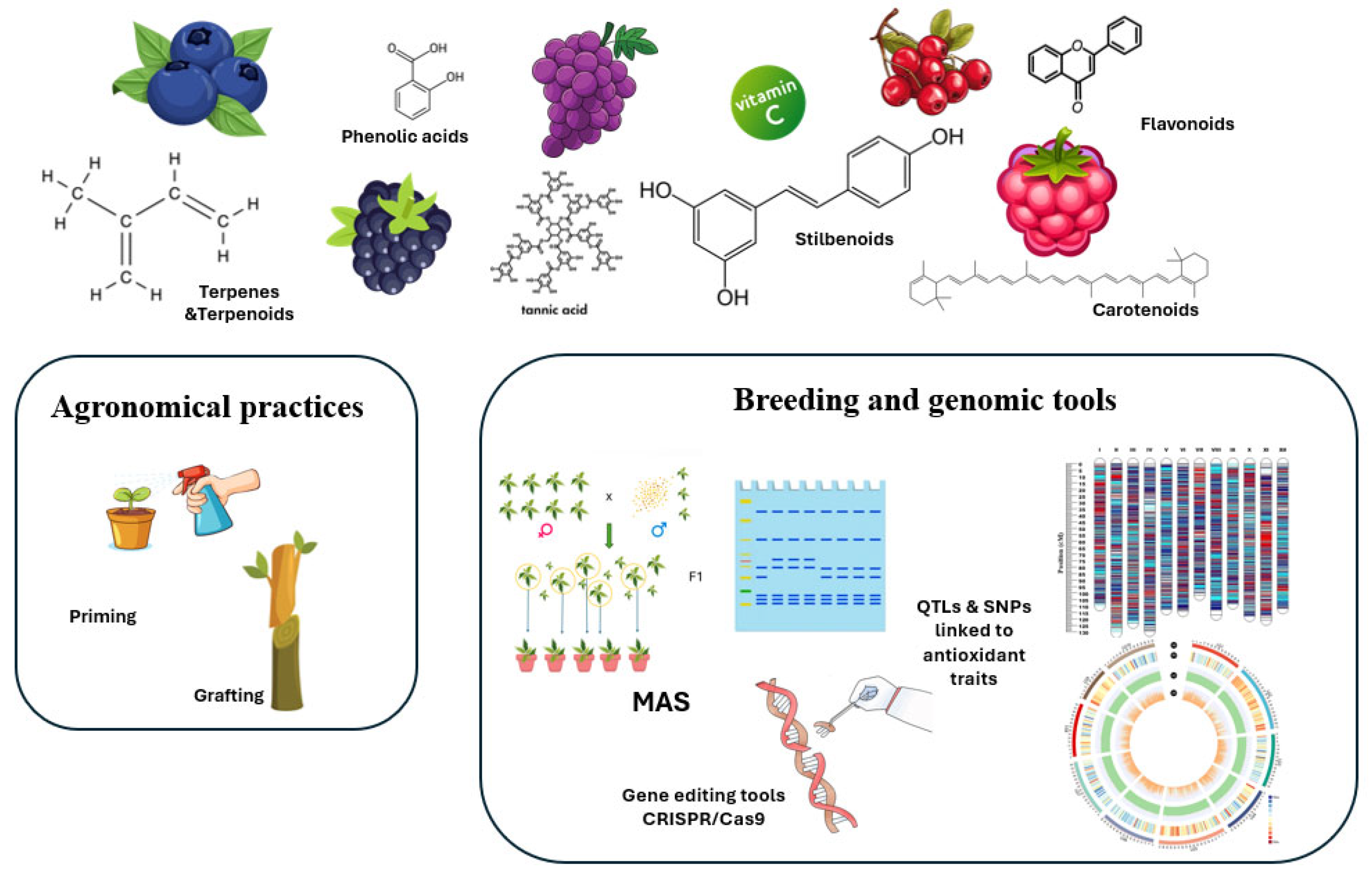

Improving the Antioxidant Potential of Berry Crops Through Genomic Advances and Modern Agronomic and Breeding Tools

 ,
,  , ,
, ,  and
and 
Abstract
1. Introduction
1.1. A Multitude of Berry Crops
1.2. Nutritional and Antioxidant Value of Berries as Pharmaceutical and Nutraceutical Sources
2. Agronomical Practices for Increasing Antioxidant Concentration
2.1. Priming
2.2. Grafting
3. Berry Genomics and Breeding for Enhancing Antioxidant Capacity
3.1. Blueberry (Vaccinium corymbosum L.)
3.1.1. Domestication and Wild Relatives
3.1.2. Modern Genomic and Breeding Tools for Enhancing the Antioxidant Profile of Blueberries
3.2. Red Raspberry (Rubus idaeus L.)
3.2.1. Domestication and Wild Relatives
3.2.2. Modern Genomic and Breeding Tools for Enhancing the Antioxidant Character of the Raspberry
3.3. Blackberry (Rubus occidentalis/Rubus fruticosus agg.)
3.3.1. Domestication and Wild Relatives
3.3.2. Modern Genomic and Breeding Tools for Enhancing the Antioxidant Character of the Blackberry
3.4. Cranberry (Vaccinium macrocarpon Ait.)
3.4.1. Domestication and Wild Relatives
3.4.2. Modern Genomic and Breeding Tools for Enhancing the Antioxidant Character of the Cranberry
3.5. Grapevine (Vitis vinifera L.)
3.5.1. Domestication and Wild Relatives
3.5.2. Modern Genomic and Breeding Tools for Enhancing the Antioxidant Character of Grapevine

| Enzyme Class | Gene Name | Functional Role/Association with Antioxidant Levels | References |
|---|---|---|---|
| Basic-leucine zipper transcription factor | VvbZIP61 | Monoterpene metabolism Associated with increased levels of monoterpenes | Zhang et al., 2023 [172] |
| 1-deoxy-d-xylulose-5-phosphate synthase (DXS) | VvDXS1 | Rate-limiting enzyme of the MEP pathway; Major determinant of monoterpenoid content | Yang et al., 2017 [173] Zhang et al., 2025 [174] |
| Isopentenyl pyrophosphate synthases (IPPS) (geranylgeranyl pyrophosphate synthase) | VvGGPPS-LSU | Enzyme of the MEP terpene biosynthesis pathway; Associated with increased accumulation of monoterpenoid and norisoprenoid levels. | Zhang et al., 2025 [174] |
| WRKY transcription factors | VvWRKY24 | A key regulator of isoprenoid metabolism. Associated with enhanced levels of β-damascenone, an isoprenoid important for berry and wine aroma | Wei et al., 2025 [175] |
| MYB transcription factors | VvMYBA1 | A key positive regulator of anthocyanin biosynthesis | Liu et al., 2023 [65] |
| Chalcone synthase (CHS) | VvCH2 | A key enzyme in the phenylpropanoid metabolism committed to the synthesis of flavonoids | Lai et al., 2025 [176] |
| Stilbene synthases (STS) | VvSTS | A key enzyme of the phenylpropanoid pathway committed to the synthesis of resveratrol | Lai et al., 2025 [176] |
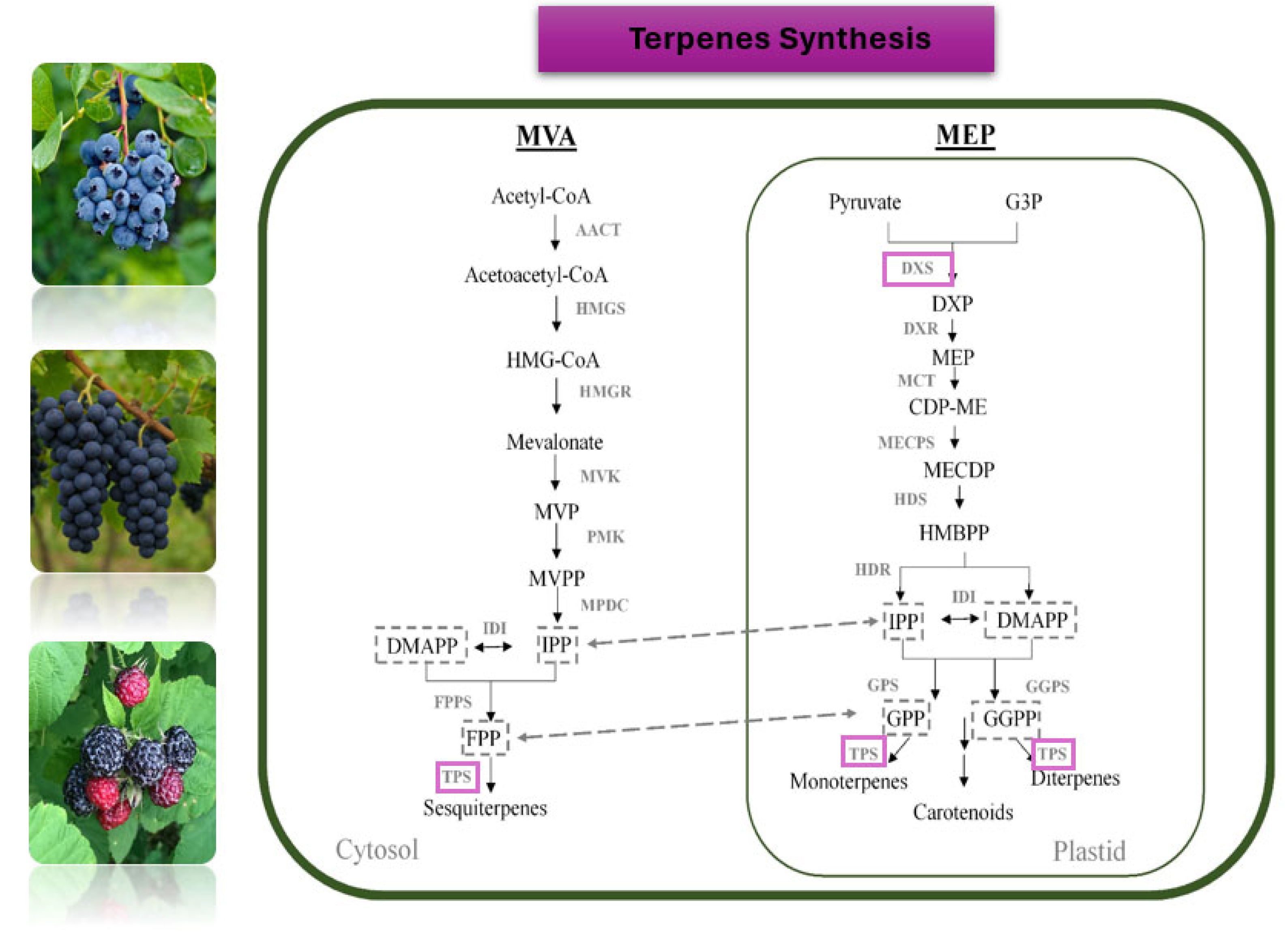
Antioxidants Related to the Aromatic Profile of Grapes and Wine
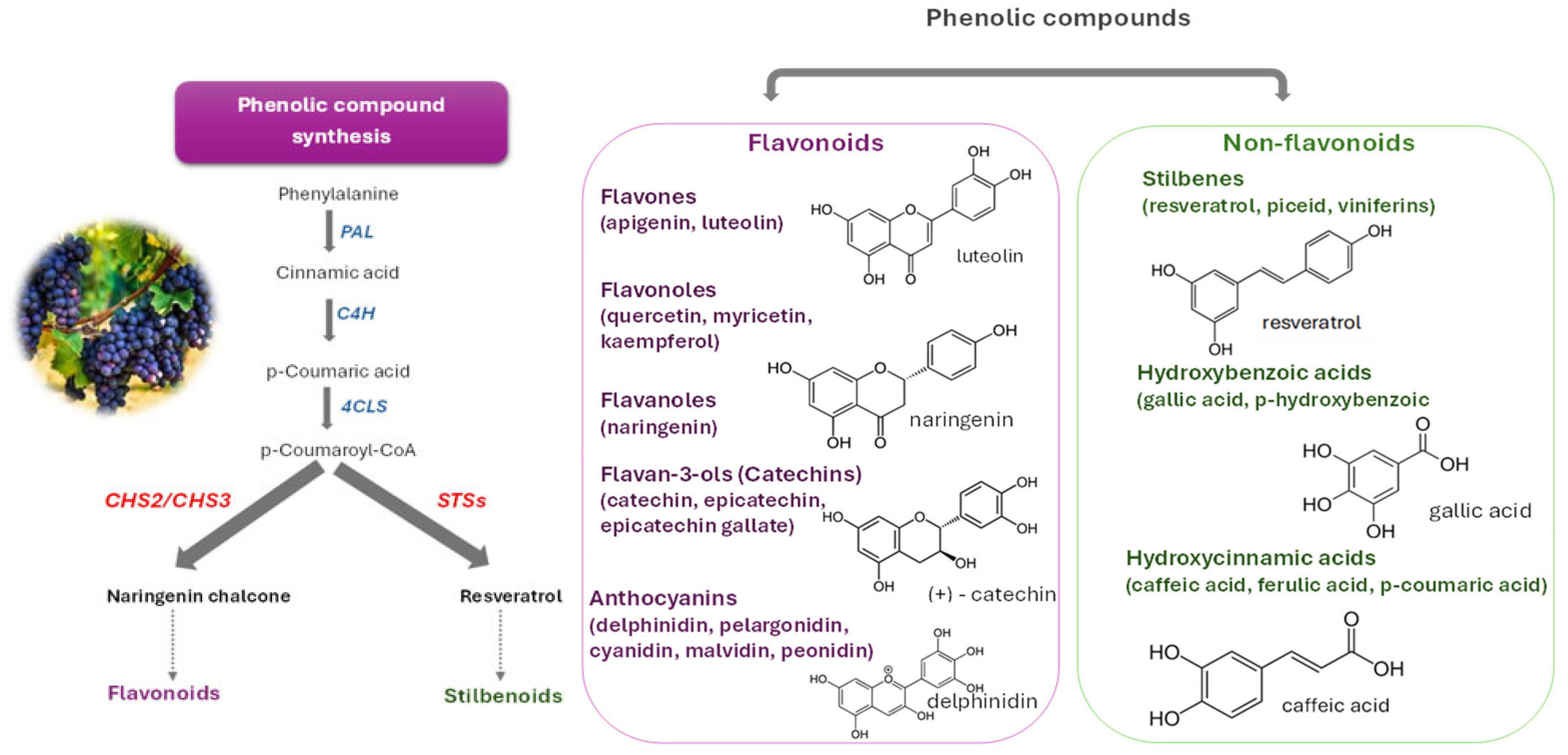
Antioxidants Related to Phenolic Compounds and Health Benefits
4. Challenges and Future Prospects in Berry Breeding for Enhanced Antioxidant Content
5. Conclusions
Author Contributions
Funding
Institutional Review Board Statement
Informed Consent Statement
Data Availability Statement
Acknowledgments
Conflicts of Interest
References
- Kumar, S.; Baghel, M.; Yadav, A.; Dhakar, M.K. Postharvest Biology and Technology of Berries. In Postharvest Biology and Technology of Temperate Fruits; Mir, S.A., Shah, M.A., Mir, M.M., Eds.; Springer International Publishing: Cham, Switzerland, 2018; pp. 349–370. ISBN 978-3-319-76842-7. [Google Scholar]
- Dickenson, V. Berries; Reaktion Books: London, UK, 2020. [Google Scholar]
- Kaume, L.; Howard, L.R.; Devareddy, L. The Blackberry Fruit: A Review on Its Composition and Chemistry, Metabolism and Bioavailability, and Health Benefits. J. Agric. Food Chem. 2012, 60, 5716–5727. [Google Scholar] [CrossRef] [PubMed]
- Skrovankova, S.; Sumczynski, D.; Mlcek, J.; Jurikova, T.; Sochor, J. Bioactive Compounds and Antioxidant Activity in Different Types of Berries. Int. J. Mol. Sci. 2015, 16, 24673–24706. [Google Scholar] [CrossRef] [PubMed]
- FAOSTAT. Available online: https://www.fao.org/faostat/en/#data/QCL (accessed on 24 September 2025).
- Sen, S.; Chakraborty, R. The Role of Antioxidants in Human Health. In ACS Symposium Series; Andreescu, S., Hepel, M., Eds.; American Chemical Society: Washington, DC, USA, 2011; Volume 1083, pp. 1–37. ISBN 978-0-8412-2683-8. [Google Scholar]
- Halliwell, B. Understanding Mechanisms of Antioxidant Action in Health and Disease. Nat. Rev. Mol. Cell Biol. 2024, 25, 13–33. [Google Scholar] [CrossRef] [PubMed]
- Rahaman, M.d.M.; Hossain, R.; Herrera-Bravo, J.; Islam, M.T.; Atolani, O.; Adeyemi, O.S.; Owolodun, O.A.; Kambizi, L.; Daştan, S.D.; Calina, D.; et al. Natural Antioxidants from Some Fruits, Seeds, Foods, Natural Products, and Associated Health Benefits: An Update. Food Sci. Nutr. 2023, 11, 1657–1670. [Google Scholar] [CrossRef]
- Pinilla-González, V.; Rojas-Solé, C.; Gómez-Hevia, F.; González-Fernández, T.; Cereceda-Cornejo, A.; Chichiarelli, S.; Saso, L.; Rodrigo, R. Tapping into Nature’s Arsenal: Harnessing the Potential of Natural Antioxidants for Human Health and Disease Prevention. Foods 2024, 13, 1999. [Google Scholar] [CrossRef]
- Chaudhary, P.; Janmeda, P.; Docea, A.O.; Yeskaliyeva, B.; Abdull Razis, A.F.; Modu, B.; Calina, D.; Sharifi-Rad, J. Oxidative Stress, Free Radicals and Antioxidants: Potential Crosstalk in the Pathophysiology of Human Diseases. Front. Chem. 2023, 11, 1158198. [Google Scholar] [CrossRef]
- Ran, Y.; Li, F.; Xu, Z.; Zeng, K.; Ming, J. Recent Advances in Dietary Polyphenols (DPs): Antioxidant Activities, Nutrient Interactions, Delivery Systems, and Potential Applications. Food Funct. 2024, 15, 10213–10232. [Google Scholar] [CrossRef]
- Pedisić, S.; Zorić, Z.; Repajić, M.; Levaj, B.; Dobrinčić, A.; Balbino, S.; Čošić, Z.; Dragović-Uzelac, V.; Elez Garofulić, I. Valorization of Berry Fruit By-Products: Bioactive Compounds, Extraction, Health Benefits, Encapsulation and Food Applications. Foods 2025, 14, 1354. [Google Scholar] [CrossRef]
- Cosme, F.; Pinto, T.; Aires, A.; Morais, M.C.; Bacelar, E.; Anjos, R.; Ferreira-Cardoso, J.; Oliveira, I.; Vilela, A.; Gonçalves, B. Red Fruits Composition and Their Health Benefits—A Review. Foods 2022, 11, 644. [Google Scholar] [CrossRef]
- Li, X.; Sun, J.; Chen, Z.; Jiang, J.; Jackson, A. Characterization of Carotenoids and Phenolics during Fruit Ripening of Chinese Raspberry (Rubus Chingii Hu). RSC Adv. 2021, 11, 10804–10813. [Google Scholar] [CrossRef]
- La Torre, C.; Loizzo, M.R.; Frattaruolo, L.; Plastina, P.; Grisolia, A.; Armentano, B.; Cappello, M.S.; Cappello, A.R.; Tundis, R. Chemical Profile and Bioactivity of Rubus idaeus L. Fruits Grown in Conventional and Aeroponic Systems. Plants 2024, 13, 1115. [Google Scholar] [CrossRef] [PubMed]
- Bhat, I.U.H.; Bhat, R. Quercetin: A Bioactive Compound Imparting Cardiovascular and Neuroprotective Benefits: Scope for Exploring Fresh Produce, Their Wastes, and by-Products. Biology 2021, 10, 586. [Google Scholar] [CrossRef] [PubMed]
- Zaa, C.A.; Marcelo, Á.J.; An, Z.; Medina-Franco, J.L.; Velasco-Velázquez, M.A. Anthocyanins: Molecular Aspects on Their Neuroprotective Activity. Biomolecules 2023, 13, 1598. [Google Scholar] [CrossRef] [PubMed]
- Norouzkhani, N.; Afshari, S.; Sadatmadani, S.-F.; Mollaqasem, M.M.; Mosadeghi, S.; Ghadri, H.; Fazlizade, S.; Alizadeh, K.; Akbari Javar, P.; Amiri, H. Therapeutic Potential of Berries in Age-Related Neurological Disorders. Front. Pharmacol. 2024, 15, 1348127. [Google Scholar] [CrossRef]
- Padilla-González, G.F.; Grosskopf, E.; Sadgrove, N.J.; Simmonds, M.S. Chemical Diversity of Flavan-3-Ols in Grape Seeds: Modulating Factors and Quality Requirements. Plants 2022, 11, 809. [Google Scholar] [CrossRef]
- Haytowitz, D.B.; Wu, X.; Bhagwat, S. USDA Database for the Flavonoid Content of Selected Foods, Release 3.3; US Department of Agriculture: Beltsville, MD, USA, 2018; 173p.
- Duta-Bratu, C.-G.; Nitulescu, G.M.; Mihai, D.P.; Olaru, O.T. Resveratrol and Other Natural Oligomeric Stilbenoid Compounds and Their Therapeutic Applications. Plants 2023, 12, 2935. [Google Scholar] [CrossRef]
- Smeriglio, A.; Barreca, D.; Bellocco, E.; Trombetta, D. Proanthocyanidins and Hydrolysable Tannins: Occurrence, Dietary Intake and Pharmacological Effects. Br. J. Pharmacol. 2017, 174, 1244–1262. [Google Scholar] [CrossRef]
- Bule, M.; Khan, F.; Nisar, M.F.; Niaz, K.; Nabavi, S.; Saeedi, M.; Sanches Silva, A. Tannins (Hydrolysable Tannins, Condensed Tannins, Phlorotannins, Flavono-Ellagitannins). Recent. Adv. Nat. Prod. Anal. 2020, 132–146. [Google Scholar]
- Bernjak, B.; Kristl, J. A Review of Tannins in Berries. Agric. Sci. 2020, 17, 27–36. [Google Scholar] [CrossRef]
- Olas, B. Berry Phenolic Antioxidants–Implications for Human Health? Front. Pharmacol. 2018, 9, 78. [Google Scholar] [CrossRef] [PubMed]
- Subbiah, V.; Zhong, B.; Nawaz, M.A.; Barrow, C.J.; Dunshea, F.R.; Suleria, H.A. Screening of Phenolic Compounds in Australian Grown Berries by Lc-Esi-Qtof-Ms/Ms and Determination of Their Antioxidant Potential. Antioxidants 2020, 10, 26. [Google Scholar] [CrossRef] [PubMed]
- Bobinaitė, R.; Viškelis, P.; Venskutonis, P.R. Variation of Total Phenolics, Anthocyanins, Ellagic Acid and Radical Scavenging Capacity in Various Raspberry (Rubus Spp.) Cultivars. Food Chem. 2012, 132, 1495–1501. [Google Scholar] [CrossRef] [PubMed]
- Kısaca, G.; Gazioglu Sensoy, R.I. Phenolic Contents, Organicacids and Antioxidant Capacities of Twenty Grape (Vitis vinifera L.) Cultivars Having Different Berry Colors. Food Meas. 2023, 17, 1354–1370. [Google Scholar] [CrossRef]
- Gong, E.S.; Li, B.; Li, B.; Podio, N.S.; Chen, H.; Li, T.; Sun, X.; Gao, N.; Wu, W.; Yang, T.; et al. Identification of Key Phenolic Compounds Responsible for Antioxidant Activities of Free and Bound Fractions of Blackberry Varieties’ Extracts by Boosted Regression Trees. J. Sci. Food Agric. 2022, 102, 984–994. [Google Scholar] [CrossRef]
- Bai, Q.; Shen, Y.; Huang, Y. Advances in Mineral Nutrition Transport and Signal Transduction in Rosaceae Fruit Quality and Postharvest Storage. Front. Plant Sci. 2021, 12, 620018. [Google Scholar] [CrossRef]
- Ahmed, N.; Zhang, B.; Bozdar, B.; Chachar, S.; Rai, M.; Li, J.; Li, Y.; Hayat, F.; Chachar, Z.; Tu, P. The Power of Magnesium: Unlocking the Potential for Increased Yield, Quality, and Stress Tolerance of Horticultural Crops. Front. Plant Sci. 2023, 14, 1285512. [Google Scholar] [CrossRef]
- Yadav, R.B. Potential Benefits of Berries and Their Bioactive Compounds as Functional Food Component and Immune Boosting Food. In Immunity Boosting Functional Foods to Combat COVID-19; CRC Press: Boca Raton, FL, USA, 2021; pp. 75–90. [Google Scholar]
- Martins, V.; Soares, C.; Spormann, S.; Fidalgo, F.; Gerós, H. Vineyard Calcium Sprays Reduce the Damage of Postharvest Grape Berries by Stimulating Enzymatic Antioxidant Activity and Pathogen Defense Genes, despite Inhibiting Phenolic Synthesis. Plant Physiol. Biochem. 2021, 162, 48–55. [Google Scholar] [CrossRef]
- Nile, S.H.; Park, S.W. Edible Berries: Bioactive Components and Their Effect on Human Health. Nutrition 2014, 30, 134–144. [Google Scholar] [CrossRef]
- Oshunsanya, S.O.; Nwosu, N.J.; Li, Y. Abiotic Stress in Agricultural Crops Under Climatic Conditions. In Sustainable Agriculture, Forest and Environmental Management; Jhariya, M.K., Banerjee, A., Meena, R.S., Yadav, D.K., Eds.; Springer: Singapore, 2019; pp. 71–100. ISBN 978-981-13-6829-5. [Google Scholar]
- Liu, H.; Able, A.J.; Able, J.A. Priming Crops for the Future: Rewiring Stress Memory. Trends Plant Sci. 2022, 27, 699–716. [Google Scholar] [CrossRef]
- Pagano, A.; Macovei, A.; Balestrazzi, A. Molecular Dynamics of Seed Priming at the Crossroads between Basic and Applied Research. Plant Cell Rep. 2023, 42, 657–688. [Google Scholar] [CrossRef]
- Turgut-Kara, N.; Arikan, B.; Celik, H. Epigenetic Memory and Priming in Plants. Genetica 2020, 148, 47–54. [Google Scholar] [CrossRef] [PubMed]
- Hönig, M.; Roeber, V.M.; Schmülling, T.; Cortleven, A. Chemical Priming of Plant Defense Responses to Pathogen Attacks. Front. Plant Sci. 2023, 14, 1146577. [Google Scholar] [CrossRef] [PubMed]
- Karami, A.A.; Abdossi, V.; Ghanbari Jahromi, M.; Aboutalebi Jahromi, A. Optimizing Blueberry (Vaccinium corymbosum L.) Yield with Strategic Foliar Application of Putrescin and Spermidine at Key Growth Stages through Biochemical and Anatomical Changes. Front. Plant Sci. 2025, 16, 1564026. [Google Scholar] [CrossRef] [PubMed]
- Gutiérrez-Albanchez, E.; Gradillas, A.; García, A.; García-Villaraco, A.; Gutierrez-Mañero, F.J.; Ramos-Solano, B. Elicitation with Bacillus QV15 Reveals a Pivotal Role of F3H on Flavonoid Metabolism Improving Adaptation to Biotic Stress in Blackberry. PLoS ONE 2020, 15, e0232626. [Google Scholar] [CrossRef]
- Kazakov, P.; Alseekh, S.; Ivanova, V.; Gechev, T. Biostimulant-Based Molecular Priming Improves Crop Quality and Enhances Yield of Raspberry and Strawberry Fruits. Metabolites 2024, 14, 594. [Google Scholar] [CrossRef]
- Salama, A.-M.; Abdelsalam, M.A.; Rehan, M.; Elansary, M.; El-Shereif, A. Anthocyanin Accumulation and Its Corresponding Gene Expression, Total Phenol, Antioxidant Capacity, and Fruit Quality of ‘Crimson Seedless’ Grapevine (Vitis vinifera L.) in Response to Grafting and Pre-Harvest Applications. Horticulturae 2023, 9, 1001. [Google Scholar] [CrossRef]
- Wang, K.; Wu, D.; Bo, Z.; Chen, S.I.; Wang, Z.; Zheng, Y.; Fang, Y. Regulation of Redox Status Contributes to Priming Defense against Botrytis Cinerea in Grape Berries Treated with β-Aminobutyric Acid. Sci. Hortic. 2019, 244, 352–364. [Google Scholar] [CrossRef]
- Zhu, B.; Guo, P.; Wu, S.; Yang, Q.; He, F.; Gao, X.; Zhang, Y.; Xiao, J. A Better Fruit Quality of Grafted Blueberry than Own-Rooted Blueberry Is Linked to Its Anatomy. Plants 2024, 13, 625. [Google Scholar] [CrossRef]
- Habibi, F.; Liu, T.; Folta, K.; Sarkhosh, A. Physiological, Biochemical, and Molecular Aspects of Grafting in Fruit Trees. Hortic. Res. 2022, 9, uhac032. [Google Scholar] [CrossRef]
- Ulas, F.; Kılıç, F.N.; Ulas, A. Alleviate the Influence of Drought Stress by Using Grafting Technology in Vegetable Crops: A Review. J. Crop Health 2025, 77, 51. [Google Scholar] [CrossRef]
- Krishankumar, S.; Hunter, J.J.; Alyafei, M.; Souka, U.; Subramaniam, S.; Ayyagari, R.; Kurup, S.S.; Amiri, K. Influence of Different Scion-Rootstock Combinations on Sugars, Polyamines, Antioxidants and Malondialdehyde in Grafted Grapevines under Arid Conditions. Front. Plant Sci. 2025, 16, 1559095. [Google Scholar] [CrossRef] [PubMed]
- Klimek, K.E.; Kapłan, M.; Maj, G.; Borkowska, A.; Słowik, T. Effect of ‘Regent’Grapevine Rootstock Type on Energy Potential Parameters. J. Water Land Dev. 2024. [Google Scholar] [CrossRef]
- Farneti, B.; Giongo, L.; Emanuelli, F.; Toivonen, P.; Folta, K.; Iorizzo, M. Interdisciplinary Approaches to Improve Quality of Soft Fruit Berries, Volume II. Front. Plant Sci. 2023, 14, 1341519. [Google Scholar] [CrossRef]
- Di Vittori, L.; Mazzoni, L.; Battino, M.; Mezzetti, B. Pre-Harvest Factors Influencing the Quality of Berries. Sci. Hortic. 2018, 233, 310–322. [Google Scholar] [CrossRef]
- Rugienius, R.; Vinskienė, J.; Andriūnaitė, E.; Morkūnaitė-Haimi, Š.; Juhani-Haimi, P.; Graham, J. Genomic Design of Abiotic Stress-Resistant Berries. In Genomic Designing for Abiotic Stress Resistant Fruit Crops; Kole, C., Ed.; Springer International Publishing: Cham, Switzerland, 2022; pp. 197–249. ISBN 978-3-031-09874-1. [Google Scholar]
- Farajpour, M.; Ahmadi, S.R.Z.; Aouei, M.T.; Ramezanpour, M.R.; Sadat-Hosseini, M.; Hajivand, S. Nutritional and Antioxidant Profiles of Blackberry and Raspberry Genotypes. BMC Plant Biol. 2025, 25, 380. [Google Scholar] [CrossRef]
- Lebedev, V.G.; Lebedeva, T.N.; Vidyagina, E.O.; Sorokopudov, V.N.; Popova, A.A.; Shestibratov, K.A. Relationship between Phenolic Compounds and Antioxidant Activity in Berries and Leaves of Raspberry Genotypes and Their Genotyping by SSR Markers. Antioxidants 2022, 11, 1961. [Google Scholar] [CrossRef]
- Krishna, P.; Pandey, G.; Thomas, R.; Parks, S. Improving Blueberry Fruit Nutritional Quality through Physiological and Genetic Interventions: A Review of Current Research and Future Directions. Antioxidants 2023, 12, 810. [Google Scholar] [CrossRef]
- Vorsa, N.; Zalapa, J. Domestication, Genetics, and Genomics of the American Cranberry. In Plant Breeding Reviews; Goldman, I., Ed.; Wiley: Hoboken, NJ, USA, 2019; pp. 279–315. ISBN 978-1-119-61673-3. [Google Scholar]
- Thole, V.; Bassard, J.-E.; Ramírez-González, R.; Trick, M.; Ghasemi Afshar, B.; Breitel, D.; Hill, L.; Foito, A.; Shepherd, L.; Freitag, S.; et al. RNA-Seq, de Novo Transcriptome Assembly and Flavonoid Gene Analysis in 13 Wild and Cultivated Berry Fruit Species with High Content of Phenolics. BMC Genom. 2019, 20, 995. [Google Scholar] [CrossRef]
- Zhu, S.; Zhang, X.; Ren, C.; Xu, X.; Comes, H.P.; Jiang, W.; Fu, C.; Feng, H.; Cai, L.; Hong, D.; et al. Chromosome-level Reference Genome of Tetrastigma hemsleyanum (Vitaceae) Provides Insights into Genomic Evolution and the Biosynthesis of Phenylpropanoids and Flavonoids. Plant J. 2023, 114, 805–823. [Google Scholar] [CrossRef]
- Chen, Z.; Jiang, J.; Shu, L.; Li, X.; Huang, J.; Qian, B.; Wang, X.; Li, X.; Chen, J.; Xu, H. Combined Transcriptomic and Metabolic Analyses Reveal Potential Mechanism for Fruit Development and Quality Control of Chinese Raspberry (Rubus Chingii Hu). Plant Cell Rep. 2021, 40, 1923–1946. [Google Scholar] [CrossRef]
- Chizk, T.M.; Clark, J.R.; Johns, C.; Nelson, L.; Ashrafi, H.; Aryal, R.; Worthington, M.L. Genome-Wide Association Identifies Key Loci Controlling Blackberry Postharvest Quality. Front. Plant Sci. 2023, 14, 1182790. [Google Scholar] [CrossRef] [PubMed]
- Omori, M.; Yamane, H.; Osakabe, K.; Osakabe, Y.; Tao, R. Targeted Mutagenesis of CENTRORADIALIS Using CRISPR/Cas9 System through the Improvement of Genetic Transformation Efficiency of Tetraploid Highbush Blueberry. J. Hortic. Sci. Biotechnol. 2021, 96, 153–161. [Google Scholar] [CrossRef]
- Nguyen, H.M.; Putterill, J.; Dare, A.P.; Plunkett, B.J.; Cooney, J.; Peng, Y.; Souleyre, E.J.; Albert, N.W.; Espley, R.V.; Günther, C.S. Two Genes, ANS and UFGT2, from Vaccinium Spp. Are Key Steps for Modulating Anthocyanin Production. Front. Plant Sci. 2023, 14, 1082246. [Google Scholar] [CrossRef]
- Vaia, G.; Pavese, V.; Moglia, A.; Cristofori, V.; Silvestri, C. Knockout of Phytoene Desaturase Gene Using CRISPR/Cas9 in Highbush Blueberry. Front. Plant Sci. 2022, 13, 1074541. [Google Scholar] [CrossRef]
- Zhang, D.; Xu, F.; Wang, F.; Le, L.; Pu, L. Synthetic Biology and Artificial Intelligence in Crop Improvement. Plant Commun. 2025, 6, 101220. [Google Scholar] [CrossRef]
- Liu, W.; Mu, H.; Yuan, L.; Li, Y.; Li, Y.; Li, S.; Ren, C.; Duan, W.; Fan, P.; Dai, Z. VvBBX44 and VvMYBA1 Form a Regulatory Feedback Loop to Balance Anthocyanin Biosynthesis in Grape. Hortic. Res. 2023, 10, uhad176. [Google Scholar] [CrossRef]
- Polashock, J.; Zelzion, E.; Fajardo, D.; Zalapa, J.; Georgi, L.; Bhattacharya, D.; Vorsa, N. The American Cranberry: First Insights into the Whole Genome of a Species Adapted to Bog Habitat. BMC Plant Biol. 2014, 14, 165. [Google Scholar] [CrossRef]
- Retamales, J.B.; Hancock, J.F. Blueberries; Cabi: Wallingford, UK, 2018; Volume 27. [Google Scholar]
- Lyrene, P.M. Value of Various Taxa in Breeding Tetraploid Blueberries in Florida. Euphytica 1997, 94, 15–22. [Google Scholar] [CrossRef]
- Crowl, A.A.; Fritsch, P.W.; Tiley, G.P.; Lynch, N.P.; Ranney, T.G.; Ashrafi, H.; Manos, P.S. A First Complete Phylogenomic Hypothesis for Diploid Blueberries (Vaccinium Section Cyanococcus). Am. J. Bot. 2022, 109, 1596–1606. [Google Scholar] [CrossRef] [PubMed]
- Rowland, L.J.; Ogden, E.L.; Ballington, J.R. Relationships among Blueberry Species within the Section Cyanococcus of the Vaccinium Genus Based on EST-PCR Markers. Can. J. Plant Sci. 2022, 102, 744–748. [Google Scholar] [CrossRef]
- Colle, M.; Leisner, C.P.; Wai, C.M.; Ou, S.; Bird, K.A.; Wang, J.; Wisecaver, J.H.; Yocca, A.E.; Alger, E.I.; Tang, H. Haplotype-Phased Genome and Evolution of Phytonutrient Pathways of Tetraploid Blueberry. GigaScience 2019, 8, giz012. [Google Scholar] [CrossRef]
- Mohammadpour, S.; Karimzadeh, G.; Ghaffari, S.M. Karyomorphology, Genome Size, and Variation of Antioxidant in Twelve Berry Species from Iran. Caryologia 2022, 75, 133–148. [Google Scholar] [CrossRef]
- Ballington, J.R. The Role of Interspecific Hybridization in Blueberry Improvement. In Proceedings of the IX International Vaccinium Symposium 810, Corvallis, OR, USA, 13–16 July 2008; pp. 49–60. [Google Scholar]
- Araniti, F.; Baron, G.; Ferrario, G.; Pesenti, M.; Della Vedova, L.; Prinsi, B.; Sacchi, G.A.; Aldini, G.; Espen, L. Chemical Profiling and Antioxidant Potential of Berries from Six Blueberry Genotypes Harvested in the Italian Alps in 2020: A Comparative Biochemical Pilot Study. Agronomy 2025, 15, 262. [Google Scholar] [CrossRef]
- Yu, J.; Hulse-Kemp, A.M.; Babiker, E.; Staton, M. High-Quality Reference Genome and Annotation Aids Understanding of Berry Development for Evergreen Blueberry (Vaccinium darrowii). Hortic. Res. 2021, 8, 228. [Google Scholar] [CrossRef] [PubMed]
- Manzanero, B.R.; Kulkarni, K.P.; Vorsa, N.; Reddy, U.K.; Natarajan, P.; Elavarthi, S.; Iorizzo, M.; Melmaiee, K. Genomic and Evolutionary Relationships among Wild and Cultivated Blueberry Species. BMC Plant Biol. 2023, 23, 126. [Google Scholar] [CrossRef] [PubMed]
- Debnath, S.C.; Bhatt, D.; Goyali, J.C. DNA-Based Molecular Markers and Antioxidant Properties to Study Genetic Diversity and Relationship Assessment in Blueberries. Agronomy 2023, 13, 1518. [Google Scholar] [CrossRef]
- Wang, S.Y.; Chen, C.-T.; Sciarappa, W.; Wang, C.Y.; Camp, M.J. Fruit Quality, Antioxidant Capacity, and Flavonoid Content of Organically and Conventionally Grown Blueberries. J. Agric. Food Chem. 2008, 56, 5788–5794. [Google Scholar] [CrossRef]
- Scalzo, J.; Stevenson, D.; Hedderley, D. Blueberry Estimated Harvest from Seven New Cultivars: Fruit and Anthocyanins. Food Chem. 2013, 139, 44–50. [Google Scholar] [CrossRef]
- Connor, A.M.; Luby, J.J.; Tong, C.B.; Finn, C.E.; Hancock, J.F. Genotypic and Environmental Variation in Antioxidant Activity, Total Phenolic Content, and Anthocyanin Content among Blueberry Cultivars. J. Am. Soc. Hortic. Sci. 2002, 127, 89–97. [Google Scholar] [CrossRef]
- Stevenson, D.; Scalzo, J. Anthocyanin Composition and Content of Blueberries from around the World. J. Berry Res. 2012, 2, 179–189. [Google Scholar] [CrossRef]
- Kalt, W.; McDonald, J.E.; Ricker, R.D.; Lu, X. Anthocyanin Content and Profile within and among Blueberry Species. Can. J. Plant Sci. 1999, 79, 617–623. [Google Scholar] [CrossRef]
- Chen, L.; Liu, Y.; Liu, H.; Kang, L.; Geng, J.; Gai, Y.; Ding, Y.; Sun, H.; Li, Y. Identification and Expression Analysis of MATE Genes Involved in Flavonoid Transport in Blueberry Plants. PLoS ONE 2015, 10, e0118578. [Google Scholar] [CrossRef] [PubMed]
- Zhang, Y.; Zhang, Z.; Guo, S.; Qu, P.; Liu, J.; Cheng, C. Characterization of Blueberry Glutathione S-Transferase (GST) Genes and Functional Analysis of VcGSTF8 Reveal the Role of ‘MYB/bHLH-GSTF’Module in Anthocyanin Accumulation. Ind. Crops Prod. 2024, 218, 119006. [Google Scholar] [CrossRef]
- Yang, B.; Song, Y.; Li, Y.; Wang, X.; Guo, Q.; Zhou, L.; Zhang, Y.; Zhang, C. Key Genes for Phenylpropanoid Metabolite Biosynthesis during Half-Highbush Blueberry (Vaccinium angustifolium × Vaccinium corymbosum) Fruit Development. JBR 2022, 12, 297–311. [Google Scholar] [CrossRef]
- Günther, C.S.; Dare, A.P.; McGhie, T.K.; Deng, C.; Lafferty, D.J.; Plunkett, B.J.; Grierson, E.R.; Turner, J.L.; Jaakola, L.; Albert, N.W. Spatiotemporal Modulation of Flavonoid Metabolism in Blueberries. Front. Plant Sci. 2020, 11, 545. [Google Scholar] [CrossRef]
- Ferrão, L.F.V.; Sater, H.; Lyrene, P.; Amadeu, R.R.; Sims, C.A.; Tieman, D.M.; Munoz, P.R. Terpene Volatiles Mediates the Chemical Basis of Blueberry Aroma and Consumer Acceptability. Food Res. Int. 2022, 158, 111468. [Google Scholar] [CrossRef]
- Guo, X.; Hu, J.; Yang, S.; Wang, D.; Wang, J. Genome-Wide Analysis of the F3’5’H Gene Family in Blueberry (Vaccinium corymbosum L.) Provides Insights into the Regulation of Anthocyanin Biosynthesis. Phyton (0031-9457) 2023, 92, 2683. [Google Scholar] [CrossRef]
- Liu, Y.; Wang, Y.; Pei, J.; Li, Y.; Sun, H. Genome-Wide Identification and Characterization of COMT Gene Family during the Development of Blueberry Fruit. BMC Plant Biol. 2021, 21, 5. [Google Scholar] [CrossRef]
- Chu, L.; Du, Q.; Li, A.; Liu, G.; Wang, H.; Cui, Q.; Liu, Z.; Liu, H.; Lu, Y.; Deng, Y. Integrative Transcriptomic and Metabolomic Analyses of the Mechanism of Anthocyanin Accumulation and Fruit Coloring in Three Blueberry Varieties of Different Colors. Horticulturae 2024, 10, 105. [Google Scholar] [CrossRef]
- Zhang, L.; Ma, J. Promoter Cloning of VcCHS Gene from Blueberries and Selection of Its Transcription Factors. Hortic. Environ. Biotechnol. 2025, 66, 983–992. [Google Scholar] [CrossRef]
- Mengist, M.F.; Grace, M.H.; Mackey, T.; Munoz, B.; Pucker, B.; Bassil, N.; Luby, C.; Ferruzzi, M.; Lila, M.A.; Iorizzo, M. Dissecting the Genetic Basis of Bioactive Metabolites and Fruit Quality Traits in Blueberries (Vaccinium corymbosum L.). Front. Plant Sci. 2022, 13, 964656. [Google Scholar] [CrossRef]
- Montanari, S.; Thomson, S.; Cordiner, S.; Günther, C.S.; Miller, P.; Deng, C.H.; McGhie, T.; Knäbel, M.; Foster, T.; Turner, J. High-Density Linkage Map Construction in an Autotetraploid Blueberry Population and Detection of Quantitative Trait Loci for Anthocyanin Content. Front. Plant Sci. 2022, 13, 965397. [Google Scholar] [CrossRef] [PubMed]
- Meng, Q.; Manghwar, H.; Hu, W. Study on Supergenus Rubus L.: Edible, Medicinal, and Phylogenetic Characterization. Plants 2022, 11, 1211. [Google Scholar] [CrossRef] [PubMed]
- Foster, T.M.; Bassil, N.V.; Dossett, M.; Leigh Worthington, M.; Graham, J. Genetic and Genomic Resources for Rubus Breeding: A Roadmap for the Future. Hortic. Res. 2019, 6, 116. [Google Scholar] [CrossRef] [PubMed]
- Graham, J.; Brennan, R. Introduction to the Rubus Genus. In Raspberry; Graham, J., Brennan, R., Eds.; Springer International Publishing: Cham, Switzerland, 2018; pp. 1–16. ISBN 978-3-319-99030-9. [Google Scholar]
- Davik, J.; Røen, D.; Lysøe, E.; Buti, M.; Rossman, S.; Alsheikh, M.; Aiden, E.L.; Dudchenko, O.; Sargent, D.J. A Chromosome-Level Genome Sequence Assembly of the Red Raspberry (Rubus idaeus L.). PLoS ONE 2022, 17, e0265096. [Google Scholar] [CrossRef]
- Kikuchi, S.; Mimura, M.; Naruhashi, N.; Setsuko, S.; Suzuki, W. Phylogenetic Inferences Using Nuclear Ribosomal ITS and Chloroplast Sequences Provide Insights into the Biogeographic Origins, Diversification Timescales and Trait Evolution of Rubus in the Japanese Archipelago. Plant Syst. Evol. 2022, 308, 20. [Google Scholar] [CrossRef]
- Zhang, H.; Yan, M.; Li, L.; Jiang, Z.; Xiong, Y.; Wang, Y.; Akogwu, C.O.; Tolulope, O.M.; Zhou, H.; Sun, Y.; et al. Assembly and Comparative Analysis of the Complete Mitochondrial Genome of Red Raspberry (Rubus idaeus L.) Revealing Repeat-Mediated Recombination and Gene Transfer. BMC Plant Biol. 2025, 25, 85. [Google Scholar] [CrossRef]
- VanBuren, R.; Wai, C.M.; Colle, M.; Wang, J.; Sullivan, S.; Bushakra, J.M.; Liachko, I.; Vining, K.J.; Dossett, M.; Finn, C.E. A near Complete, Chromosome-Scale Assembly of the Black Raspberry (Rubus occidentalis) Genome. Gigascience 2018, 7, giy094. [Google Scholar] [CrossRef]
- Shoukat, S.; Mahmudiono, T.; Al-Shawi, S.G.; Abdelbasset, W.K.; Yasin, G.; Shichiyakh, R.A.; Iswanto, A.H.; Kadhim, A.J.; Kadhim, M.M.; Al–rekaby, H.Q. Determination of the Antioxidant and Mineral Contents of Raspberry Varieties. Food Sci. Technol. 2022, 42, e118521. [Google Scholar] [CrossRef]
- Toshima, S.; Fujii, M.; Hidaka, M.; Nakagawa, S.; Hirano, T.; Kunitak, H. Fruit Qualities of Interspecific Hybrid and First Backcross Generations between Red Raspberry and Rubus Parvifolius. J. Am. Soc. Hortic. Sci. 2021, 146, 445–451. [Google Scholar] [CrossRef]
- Guo, Z.; Fan, Z.; Li, X.; Du, H.; Wu, Z.; Li, T.; Yang, G. Combined Analysis of SRAP and SSR Markers Reveals Genetic Diversity and Phylogenetic Relationships in Raspberry (Rubus idaeus L.). Agronomy 2025, 15, 1492. [Google Scholar] [CrossRef]
- Connor, A.M.; Stephens, M.J.; Hall, H.K.; Alspach, P.A. Variation and Heritabilities of Antioxidant Activity and Total Phenolic Content Estimated from a Red Raspberry Factorial Experiment. J. Am. Soc. Hortic. Sci. 2005, 130, 403–411. [Google Scholar] [CrossRef]
- Kostecka-Gugała, A.; Ledwożyw-Smoleń, I.; Augustynowicz, J.; Wyżgolik, G.; Kruczek, M.; Kaszycki, P. Antioxidant Properties of Fruits of Raspberryand Blackberry Grown in Central Europe. Open Chem. 2015, 13, 1313–1325. [Google Scholar] [CrossRef]
- Graham, J.; Woodhead, M. Raspberries and Blackberries: The Genomics of Rubus. In Genetics and Genomics of Rosaceae; Folta, K.M., Gardiner, S.E., Eds.; Springer New York: New York, NY, USA, 2009; pp. 507–524. ISBN 978-0-387-77490-9. [Google Scholar]
- Ljujić, J.; Sofrenić, I.; \DJor\djević, I.; Macura, P.; Tešević, V.; Vujisić, L.; An\djelković, B. Antioxidant Potential and Polyphenol Content of Five New Cultivars of Raspberries. Maced. Pharm. Bull. 2022, 68, 47–48. [Google Scholar] [CrossRef]
- Frías-Moreno, M.N.; Parra-Quezada, R.Á.; Ruíz-Carrizales, J.; González-Aguilar, G.A.; Sepulveda, D.; Molina-Corral, F.J.; Jacobo-Cuellar, J.L.; Olivas, G.I. Quality, Bioactive Compounds and Antioxidant Capacity of Raspberries Cultivated in Northern Mexico. Int. J. Food Prop. 2021, 24, 603–614. [Google Scholar] [CrossRef]
- Zheng, D.; Schröder, G.; Schröder, J.; Hrazdina, G. Molecular and Biochemical Characterization of Three Aromatic Polyketide Synthase Genes from Rubus idaeus. Plant Mol. Biol. 2001, 46, 1–15. [Google Scholar] [CrossRef]
- Kassim, A.; Poette, J.; Paterson, A.; Zait, D.; McCallum, S.; Woodhead, M.; Smith, K.; Hackett, C.; Graham, J. Environmental and Seasonal Influences on Red Raspberry Anthocyanin Antioxidant Contents and Identification of Quantitative Traits Loci (QTL). Mol. Nutr. Food Res. 2009, 53, 625–634. [Google Scholar] [CrossRef]
- Huang, X.; Wu, Y.; Zhang, S.; Yang, H.; Wu, W.; Lyu, L.; Li, W. Changes in Antioxidant Substances and Antioxidant Enzyme Activities in Raspberry Fruits at Different Developmental Stages. Sci. Hortic. 2023, 321, 112314. [Google Scholar] [CrossRef]
- Woodhead, M.; Weir, A.; Smith, K.; McCallum, S.; MacKenzie, K.; Graham, J. Functional Markers for Red Raspberry. J. Am. Soc. Hortic. Sci. 2010, 135, 418–427. [Google Scholar] [CrossRef]
- Bushakra, J.M.; Krieger, C.; Deng, D.; Stephens, M.J.; Allan, A.C.; Storey, R.; Symonds, V.V.; Stevenson, D.; McGhie, T.; Chagné, D.; et al. QTL Involved in the Modification of Cyanidin Compounds in Black and Red Raspberry Fruit. Theor. Appl. Genet. 2013, 126, 847–865. [Google Scholar] [CrossRef] [PubMed]
- Bushakra, J.M.; Dossett, M.; Carter, K.A.; Vining, K.J.; Lee, J.C.; Bryant, D.W.; VanBuren, R.; Lee, J.; Mockler, T.C.; Finn, C.E.; et al. Characterization of Aphid Resistance Loci in Black Raspberry (Rubus occidentalis L.). Mol. Breed. 2018, 38, 83. [Google Scholar] [CrossRef]
- McCallum, S.; Simpson, C.; Graham, J. QTL Mapping and Marker Assisted Breeding in Rubus Spp. In Raspberry; Graham, J., Brennan, R., Eds.; Springer International Publishing: Cham, Switzerland, 2018; pp. 121–144. ISBN 978-3-319-99030-9. [Google Scholar]
- Salgado, A.; Clark, J.R. Evaluation of a New Type of Firm and Reduced Reversion Blackberry: Crispy Genotypes. In Proceedings of the XI International Rubus and Ribes Symposium 1133, Asheville, NC, USA, 21–24 June 2015; pp. 405–410. [Google Scholar]
- Finn, C.E.; Clark, J.R. Blackberry. In Fruit Breeding; Badenes, M.L., Byrne, D.H., Eds.; Springer: Boston, MA, USA, 2012; pp. 151–190. ISBN 978-1-4419-0762-2. [Google Scholar]
- Van de Beek, A.; Widrlechner, M.P. North American Species of Rubus L.(Rosaceae) Described from European Botanical Gardens (1789–1823). Adansonia 2021, 43, 67–98. [Google Scholar] [CrossRef]
- Moreno-Medina, B.L.; Casierra-Posada, F.; Cutler, J. Phytochemical Composition and Potential Use of Rubus Species. Gesunde Pflanz. 2018, 70, 65–74. [Google Scholar] [CrossRef]
- Agar, G.; Halasz, J.; Ercisli, S. Genetic Relationships among Wild and Cultivated Blackberries (Rubus Caucasicus L.) Based on Amplified Fragment Length Polymorphism Markers. Plant Biosyst. Int. J. Deal. All Asp. Plant Biol. 2011, 145, 347–352. [Google Scholar] [CrossRef]
- Llauradó Maury, G.; Méndez Rodríguez, D.; Hendrix, S.; Escalona Arranz, J.C.; Fung Boix, Y.; Pacheco, A.O.; García Díaz, J.; Morris-Quevedo, H.J.; Ferrer Dubois, A.; Aleman, E.I. Antioxidants in Plants: A Valorization Potential Emphasizing the Need for the Conservation of Plant Biodiversity in Cuba. Antioxidants 2020, 9, 1048. [Google Scholar] [CrossRef]
- Croge, C.P.; Cuquel, F.L.; Pintro, P.T.; Biasi, L.A.; De Bona, C.M. Antioxidant Capacity and Polyphenolic Compounds of Blackberries Produced in Different Climates. HortScience 2019, 54, 2209–2213. [Google Scholar] [CrossRef]
- Memete, A.R.; Sărac, I.; Teusdea, A.C.; Budău, R.; Bei, M.; Vicas, S.I. Bioactive Compounds and Antioxidant Capacity of Several Blackberry (Rubus Spp.) Fruits Cultivars Grown in Romania. Horticulturae 2023, 9, 556. [Google Scholar] [CrossRef]
- Martins, A.; Barros, L.; Carvalho, A.M.; Santos-Buelga, C.; Fernandes, I.P.; Barreiro, F.; Ferreira, I.C. Phenolic Extracts of Rubus Ulmifolius Schott Flowers: Characterization, Microencapsulation and Incorporation into Yogurts as Nutraceutical Sources. Food Funct. 2014, 5, 1091–1100. [Google Scholar] [CrossRef]
- Huang, X.; Wu, Y.; Zhang, S.; Yang, H.; Wu, W.; Lyu, L.; Li, W. Variation in Antioxidant Enzyme Activity and Key Gene Expression during Fruit Development of Blackberry and Blackberry–Raspberry Hybrids. Food Biosci. 2023, 54, 102892. [Google Scholar] [CrossRef]
- Vogt, T. Phenylpropanoid Biosynthesis. Mol. Plant 2010, 3, 2–20. [Google Scholar] [CrossRef] [PubMed]
- Dao, T.T.H.; Linthorst, H.J.M.; Verpoorte, R. Chalcone Synthase and Its Functions in Plant Resistance. Phytochem. Rev. 2011, 10, 397–412. [Google Scholar] [CrossRef] [PubMed]
- Jez, J.M.; Bowman, M.E.; Dixon, R.A.; Noel, J.P. Structure and Mechanism of the Evolutionarily Unique Plant Enzyme Chalcone Isomerase. Nat. Struct. Biol. 2000, 7, 786–791. [Google Scholar] [PubMed]
- Petit, P.; Granier, T.; d’Estaintot, B.L.; Manigand, C.; Bathany, K.; Schmitter, J.-M.; Lauvergeat, V.; Hamdi, S.; Gallois, B. Crystal Structure of Grape Dihydroflavonol 4-Reductase, a Key Enzyme in Flavonoid Biosynthesis. J. Mol. Biol. 2007, 368, 1345–1357. [Google Scholar] [CrossRef]
- Saito, K.; Yonekura-Sakakibara, K.; Nakabayashi, R.; Higashi, Y.; Yamazaki, M.; Tohge, T.; Fernie, A.R. The Flavonoid Biosynthetic Pathway in Arabidopsis: Structural and Genetic Diversity. Plant Physiol. Biochem. 2013, 72, 21–34. [Google Scholar] [CrossRef]
- Kobayashi, S.; Ishimaru, M.; Ding, C.K.; Yakushiji, H.; Goto, N. Comparison of UDP-Glucose: Flavonoid 3-O-Glucosyltransferase (UFGT) Gene Sequences between White Grapes (Vitis vinifera) and Their Sports with Red Skin. Plant Sci. 2001, 160, 543–550. [Google Scholar] [CrossRef]
- Br\uuna, T.; Aryal, R.; Dudchenko, O.; Sargent, D.J.; Mead, D.; Buti, M.; Cavallini, A.; Hytönen, T.; Andres, J.; Pham, M. A Chromosome-Length Genome Assembly and Annotation of Blackberry (Rubus argutus, Cv.”Hillquist”). G3 2023, 13, jkac289. [Google Scholar]
- Paudel, D.; Parrish, S.B.; Peng, Z.; Parajuli, S.; Deng, Z. A Chromosome-Scale and Haplotype-Resolved Genome Assembly of Tetraploid Blackberry (Rubus L. Subgenus Rubus watson). Hortic. Res. 2025, 12, uhaf052. [Google Scholar] [CrossRef]
- Worthington, M.; Chizk, T.M.; Johns, C.A.; Nelson, L.D.; Silva, A.; Godwin, C.; Clark, J.R. Advances in Molecular Breeding of Blackberries in the Arkansas Fruit Breeding Program. In Proceedings of the XIII International Rubus and Ribes Symposium 1388, Portland, OR, USA, 16–21 July 2023; pp. 85–92. [Google Scholar]
- Naithani, S.; Deng, C.H.; Sahu, S.K.; Jaiswal, P. Exploring Pan-Genomes: An Overview of Resources and Tools for Unraveling Structure, Function, and Evolution of Crop Genes and Genomes. Biomolecules 2023, 13, 1403. [Google Scholar] [CrossRef]
- Rodriguez-Bonilla, L.; Williams, K.A.; Rodriguez Bonilla, F.; Matusinec, D.; Maule, A.; Coe, K.; Wiesman, E.; Diaz-Garcia, L.; Zalapa, J. The Genetic Diversity of Cranberry Crop Wild Relatives, Vaccinium macrocarpon Aiton and V. oxycoccos L., in the US, with Special Emphasis on National Forests. Plants 2020, 9, 1446. [Google Scholar] [CrossRef]
- Schlautman, B.; Covarrubias-Pazaran, G.; Fajardo, D.; Steffan, S.; Zalapa, J. Discriminating Power of Microsatellites in Cranberry Organelles for Taxonomic Studies in Vaccinium and Ericaceae. Genet. Resour. Crop Evol. 2017, 64, 451–466. [Google Scholar] [CrossRef]
- Zhidkin, R.R.; Matveeva, T.V. Phylogeny Problems of the Genus Vaccinium L. and Ways to Solve Them. Ecol. Genet. 2022, 20, 151–164. [Google Scholar] [CrossRef]
- Diaz-Garcia, L.; Covarrubias-Pazaran, G.; Johnson-Cicalese, J.; Vorsa, N.; Zalapa, J. Genotyping-by-Sequencing Identifies Historical Breeding Stages of the Recently Domesticated American Cranberry. Front. Plant Sci. 2020, 11, 607770. [Google Scholar] [CrossRef] [PubMed]
- Urbstaite, R.; Raudone, L.; Janulis, V. Phytogenotypic Anthocyanin Profiles and Antioxidant Activity Variation in Fruit Samples of the American Cranberry (Vaccinium macrocarpon Aiton). Antioxidants 2022, 11, 250. [Google Scholar] [CrossRef] [PubMed]
- Diaz-Garcia, L.; Garcia-Ortega, L.F.; González-Rodríguez, M.; Delaye, L.; Iorizzo, M.; Zalapa, J. Chromosome-Level Genome Assembly of the American Cranberry (Vaccinium macrocarpon Ait.) and Its Wild Relative Vaccinium Microcarpum. Front. Plant Sci. 2021, 12, 633310. [Google Scholar] [CrossRef] [PubMed]
- Vorsa, N.; Johnson-Cicalese, J. American Cranberry. In Fruit Breeding; Badenes, M.L., Byrne, D.H., Eds.; Springer: Boston, MA, USA, 2012; pp. 191–223. ISBN 978-1-4419-0762-2. [Google Scholar]
- Debnath, S.C.; An, D. Antioxidant Properties and Structured Biodiversity in a Diverse Set of Wild Cranberry Clones. Heliyon 2019, 5, e01493. [Google Scholar] [CrossRef]
- Schlautman, B.; Covarrubias-Pazaran, G.; Rodriguez-Bonilla, L.; Hummer, K.; Bassil, N.; Smith, T.; Zalapa, J. Genetic Diversity and Cultivar Variants in the NCGR Cranberry (Vaccinium macrocarpon Aiton) Collection. J. Genet. 2018, 97, 1339–1351. [Google Scholar] [CrossRef]
- Šedbarė, R.; Sprainaitytė, S.; Baublys, G.; Viskelis, J.; Janulis, V. Phytochemical Composition of Cranberry (Vaccinium oxycoccos L.) Fruits Growing in Protected Areas of Lithuania. Plants 2023, 12, 1974. [Google Scholar] [CrossRef]
- Vvedenskaya, I.O.; Vorsa, N. Flavonoid Composition over Fruit Development and Maturation in American Cranberry, Vaccinium macrocarpon Ait. Plant Sci. 2004, 167, 1043–1054. [Google Scholar] [CrossRef]
- Šedbarė, R.; Pašakinskienė, I.; Janulis, V. Changes in the Composition of Biologically Active Compounds during the Ripening Period in Fruit of Different Large Cranberry (Vaccinium macrocarpon Aiton) Cultivars Grown in the Lithuanian Collection. Plants 2023, 12, 202. [Google Scholar] [CrossRef]
- Sun, J.; Liu, W.; Ma, H.; Marais, J.P.J.; Khoo, C.; Dain, J.A.; Rowley, D.C.; Seeram, N.P. Effect of Cranberry (Vaccinium macrocarpon) Oligosaccharides on the Formation of Advanced Glycation End-Products. J. Berry Res. 2016, 6, 149–158. [Google Scholar] [CrossRef] [PubMed]
- Gallardo, R.K.; Klingthong, P.; Zhang, Q.; Polashock, J.; Atucha, A.; Zalapa, J.; Rodriguez-Saona, C.; Vorsa, N.; Iorizzo, M. Breeding Trait Priorities of the Cranberry Industry in the United States and Canada. HortScience 2018, 53, 1467–1474. [Google Scholar] [CrossRef]
- Debnath, S.C.; Siow, Y.L.; Petkau, J.; An, D.; Bykova, N.V. Molecular Markers and Antioxidant Activity in Berry Crops: Genetic Diversity Analysis. Can. J. Plant Sci. 2012, 92, 1121–1133. [Google Scholar] [CrossRef]
- Jiménez, N.P.; Fong, S.; Neyhart, J.L.; Johnson-Cicalese, J.; Vorsa, N.; Sideli, G.M. Leveraging Genetic Resources and Genomic Prediction to Enhance Flavonol Content in Cranberry Fruit. Plant Genome 2025, 18, e70074. [Google Scholar] [CrossRef]
- Dong, Y.; Duan, S.; Xia, Q.; Liang, Z.; Dong, X.; Margaryan, K.; Musayev, M.; Goryslavets, S.; Zdunić, G.; Bert, P.-F.; et al. Dual Domestications and Origin of Traits in Grapevine Evolution. Science 2023, 379, 892–901. [Google Scholar] [CrossRef]
- Grassi, F.; De Lorenzis, G. Back to the Origins: Background and Perspectives of Grapevine Domestication. Int. J. Mol. Sci. 2021, 22, 4518. [Google Scholar] [CrossRef]
- Guzmán-Ardiles, R.E.; Pegoraro, C.; Da Maia, L.C.; Costa de Oliveira, A. Genetic Changes in the Genus Vitis and the Domestication of Vine. Front. Plant Sci. 2023, 13, 1019311. [Google Scholar] [CrossRef]
- Wolkovich, E.M.; García de Cortázar-Atauri, I.; Morales-Castilla, I.; Nicholas, K.A.; Lacombe, T. From Pinot to Xinomavro in the World’s Future Wine-Growing Regions. Nat. Clim. Change 2018, 8, 29–37. [Google Scholar] [CrossRef]
- Kapazoglou, A.; Gerakari, M.; Lazaridi, E.; Kleftogianni, K.; Sarri, E.; Tani, E.; Bebeli, P.J. Crop Wild Relatives: A Valuable Source of Tolerance to Various Abiotic Stresses. Plants 2023, 12, 328. [Google Scholar] [CrossRef]
- Mudge, K.; Janick, J.; Scofield, S.; Goldschmidt, E.E. A History of Grafting. Hortic. Rev. 2009, 35, 437–493. [Google Scholar]
- Migicovsky, Z.; Sawler, J.; Money, D.; Eibach, R.; Miller, A.J.; Luby, J.J.; Jamieson, A.R.; Velasco, D.; Von Kintzel, S.; Warner, J.; et al. Genomic Ancestry Estimation Quantifies Use of Wild Species in Grape Breeding. BMC Genom. 2016, 17, 478. [Google Scholar] [CrossRef]
- Darwish, A.G.; Das, P.R.; Ismail, A.; Gajjar, P.; Balasubramani, S.P.; Sheikh, M.B.; Tsolova, V.; Sherif, S.M.; El-Sharkawy, I. Untargeted Metabolomics and Antioxidant Capacities of Muscadine Grape Genotypes during Berry Development. Antioxidants 2021, 10, 914. [Google Scholar] [CrossRef]
- Mendonca, P.; Darwish, A.G.; Tsolova, V.; El-Sharkawy, I.; Soliman, K.F. The Anticancer and Antioxidant Effects of Muscadine Grape Extracts on Racially Different Triple-Negative Breast Cancer Cells. Anticancer. Res. 2019, 39, 4043–4053. [Google Scholar] [CrossRef] [PubMed]
- The French–Italian Public Consortium for Grapevine Genome Characterization. The Grapevine Genome Sequence Suggests Ancestral Hexaploidization in Major Angiosperm Phyla. Nature 2007, 449, 463–467. [Google Scholar] [CrossRef] [PubMed]
- Canaguier, A.; Grimplet, J.; Di Gaspero, G.; Scalabrin, S.; Duchêne, E.; Choisne, N.; Mohellibi, N.; Guichard, C.; Rombauts, S.; Le Clainche, I. A New Version of the Grapevine Reference Genome Assembly (12X. v2) and of Its Annotation (VCost. V3). Genom. Data 2017, 14, 56. [Google Scholar]
- Vitulo, N.; Forcato, C.; Carpinelli, E.C.; Telatin, A.; Campagna, D.; D’Angelo, M.; Zimbello, R.; Corso, M.; Vannozzi, A.; Bonghi, C.; et al. A Deep Survey of Alternative Splicing in Grape Reveals Changes in the Splicing Machinery Related to Tissue, Stress Condition and Genotype. BMC Plant Biol. 2014, 14, 99. [Google Scholar] [CrossRef]
- Shi, X.; Cao, S.; Wang, X.; Huang, S.; Wang, Y.; Liu, Z.; Liu, W.; Leng, X.; Peng, Y.; Wang, N. The Complete Reference Genome for Grapevine (Vitis vinifera L.) Genetics and Breeding. Hortic. Res. 2023, 10, uhad061. [Google Scholar] [CrossRef]
- Chougule, K.; Tello-Ruiz, M.K.; Wei, S.; Olson, A.; Lu, Z.; Kumari, S.; Kumar, V.; Contreras-Moreira, B.; Naamati, G.; Dyer, S. Pan Genome Resources for Grapevine. In Proceedings of the XI International Symposium on Grapevine Physiology and Biotechnology 1390, Stellenbosch, South Africa, 31 October–5 November 2021; pp. 257–266. [Google Scholar]
- Liu, Z.; Wang, N.; Su, Y.; Long, Q.; Peng, Y.; Shangguan, L.; Zhang, F.; Cao, S.; Wang, X.; Ge, M. Grapevine Pangenome Facilitates Trait Genetics and Genomic Breeding. Nat. Genet. 2024, 56, 2804–2814. [Google Scholar] [CrossRef]
- Theine, J.; Holtgräwe, D.; Herzog, K.; Schwander, F.; Kicherer, A.; Hausmann, L.; Viehöver, P.; Töpfer, R.; Weisshaar, B. Transcriptomic Analysis of Temporal Shifts in Berry Development between Two Grapevine Cultivars of the Pinot Family Reveals Potential Genes Controlling Ripening Time. BMC Plant Biol. 2021, 21, 327. [Google Scholar] [CrossRef]
- Zenoni, S.; Dal Santo, S.; Tornielli, G.B.; D’Incà, E.; Filippetti, I.; Pastore, C.; Allegro, G.; Silvestroni, O.; Lanari, V.; Pisciotta, A. Transcriptional Responses to Pre-Flowering Leaf Defoliation in Grapevine Berry from Different Growing Sites, Years, and Genotypes. Front. Plant Sci. 2017, 8, 630. [Google Scholar] [CrossRef]
- Zenoni, S.; Amato, A.; D’Incà, E.; Guzzo, F.; Tornielli, G.B. Rapid Dehydration of Grape Berries Dampens the Post-Ripening Transcriptomic Program and the Metabolite Profile Evolution. Hortic. Res. 2020, 7, 141. [Google Scholar] [CrossRef] [PubMed]
- Savoi, S.; Wong, D.C.J.; Arapitsas, P.; Miculan, M.; Bucchetti, B.; Peterlunger, E.; Fait, A.; Mattivi, F.; Castellarin, S.D. Transcriptome and Metabolite Profiling Reveals That Prolonged Drought Modulates the Phenylpropanoid and Terpenoid Pathway in White Grapes (Vitis vinifera L.). BMC Plant Biol. 2016, 16, 67. [Google Scholar] [CrossRef] [PubMed]
- Savoi, S.; Santiago, A.; Orduña, L.; Matus, J.T. Transcriptomic and Metabolomic Integration as a Resource in Grapevine to Study Fruit Metabolite Quality Traits. Front. Plant Sci. 2022, 13, 937927. [Google Scholar] [CrossRef] [PubMed]
- Zhang, Y.; Liu, C.; Liu, X.; Wang, Z.; Wang, Y.; Zhong, G.; Li, S.; Dai, Z.; Liang, Z.; Fan, P. Basic Leucine Zipper Gene VvbZIP61 Is Expressed at a Quantitative Trait Locus for High Monoterpene Content in Grape Berries. Hortic. Res. 2023, 10, uhad151. [Google Scholar] [CrossRef]
- Yang, X.; Guo, Y.; Zhu, J.; Shi, G.; Niu, Z.; Liu, Z.; Li, K.; Guo, X. Associations between the 1-Deoxy-d-Xylulose-5-Phosphate Synthase Gene and Aroma in Different Grapevine Varieties. Genes. Genom. 2017, 39, 1059–1067. [Google Scholar] [CrossRef]
- Zhang, H.-M.; Lyu, X.-J.; Sun, Z.-Y.; Sun, Q.; Wang, Y.-C.; Sun, L.; Xu, H.-Y.; He, L.; Duan, C.-Q.; Pan, Q.-H. GWAS Identifies a Molecular Marker Cluster Associated with Monoterpenoids in Grapes. Hortic. Res. 2025, 12, uhaf144. [Google Scholar] [CrossRef]
- Wei, Y.; Wang, Y.; Meng, X.; Yao, X.; Xia, N.; Zhang, H.; Meng, N.; Duan, C.; Pan, Q. VviWRKY24 Promotes β-Damascenone Biosynthesis by Targeting VviNCED1 to Increase Abscisic Acid in Grape Berries. Hortic. Res. 2025, 12, uhaf017. [Google Scholar] [CrossRef]
- Lai, G.; Fu, P.; He, L.; Che, J.; Wang, Q.; Lai, P.; Lu, J.; Lai, C. CRISPR/Cas9-Mediated CHS2 Mutation Provides a New Insight into Resveratrol Biosynthesis by Causing a Metabolic Pathway Shift from Flavonoids to Stilbenoids in Vitis Davidii Cells. Hortic. Res. 2025, 12, uhae268. [Google Scholar] [CrossRef]
- Hou, H.; Li, Y.; Zhou, S.; Zhang, R.; Wang, Y.; Lei, L.; Yang, C.; Huang, S.; Xu, H.; Liu, X. Compositional Analysis of Grape Berries: Mapping the Global Metabolism of Grapes. Foods 2024, 13, 3716. [Google Scholar] [CrossRef]
- Tello, J.; Moffa, L.; Ferradás, Y.; Gasparro, M.; Chitarra, W.; Milella, R.A.; Nerva, L.; Savoi, S. Grapes: A Crop with High Nutraceuticals Genetic Diversity. In Compendium of Crop Genome Designing for Nutraceuticals; Springer: Singapore, 2023; pp. 945–984. [Google Scholar]
- Park, M.; Darwish, A.G.; Elhag, R.I.; Tsolova, V.; Soliman, K.F.; El-Sharkawy, I. A Multi-Locus Genome-Wide Association Study Reveals the Genetics Underlying Muscadine Antioxidant in Berry Skin. Front. Plant Sci. 2022, 13, 969301. [Google Scholar] [CrossRef]
- Swallah, M.S.; Sun, H.; Affoh, R.; Fu, H.; Yu, H. Antioxidant Potential Overviews of Secondary Metabolites (Polyphenols) in Fruits. Int. J. Food Sci. 2020, 2020, 1–8. [Google Scholar] [CrossRef]
- Zhan, Z.; Gao, Y.; Chen, Y.; Xu, M.; Wang, H.; Cheng, J.; Zhang, B. Comprehensive Metabolomic Profiling of Aroma-Related Volatiles in Table Grape Cultivars across Developmental Stages. Food Qual. Saf. 2025, 9, fyaf013. [Google Scholar] [CrossRef]
- Šikuten, I.; Štambuk, P.; Marković, Z.; Tomaz, I.; Preiner, D. Grape Volatile Organic Compounds (VOCs)-Analysis, Biosynthesis and Profiling. J. Exp. Bot. 2025, 76, 3016–3037. [Google Scholar] [CrossRef] [PubMed]
- Bosman, R.N.; Lashbrooke, J.G. Grapevine Mono-and Sesquiterpenes: Genetics, Metabolism, and Ecophysiology. Front. Plant Sci. 2023, 14, 1111392. [Google Scholar] [CrossRef] [PubMed]
- Wen, Y.-Q.; Zhong, G.-Y.; Gao, Y.; Lan, Y.-B.; Duan, C.-Q.; Pan, Q.-H. Using the Combined Analysis of Transcripts and Metabolites to Propose Key Genes for Differential Terpene Accumulation across Two Regions. BMC Plant Biol. 2015, 15, 240. [Google Scholar] [CrossRef]
- Emanuelli, F.; Battilana, J.; Costantini, L.; Le Cunff, L.; Boursiquot, J.-M.; This, P.; Grando, M.S. A Candidate Gene Association Study on Muscat Flavor in Grapevine (Vitis vinifera L.). BMC Plant Biol. 2010, 10, 241. [Google Scholar] [CrossRef]
- Duchêne, E.; Butterlin, G.; Claudel, P.; Dumas, V.; Jaegli, N.; Merdinoglu, D. A Grapevine (Vitis vinifera L.) Deoxy-d-Xylulose Synthase Gene Colocates with a Major Quantitative Trait Loci for Terpenol Content. Theor. Appl. Genet. 2009, 118, 541–552. [Google Scholar] [CrossRef]
- Battilana, J.; Costantini, L.; Emanuelli, F.; Sevini, F.; Segala, C.; Moser, S.; Velasco, R.; Versini, G.; Grando, M.S. The 1-Deoxy-d-Xylulose 5-Phosphate Synthase Gene Co-Localizes with a Major QTL Affecting Monoterpene Content in Grapevine. Theor. Appl. Genet. 2009, 118, 653–669. [Google Scholar] [CrossRef]
- Battilana, J.; Emanuelli, F.; Gambino, G.; Gribaudo, I.; Gasperi, F.; Boss, P.K.; Grando, M.S. Functional Effect of Grapevine 1-Deoxy-D-Xylulose 5-Phosphate Synthase Substitution K284N on Muscat Flavour Formation. J. Exp. Bot. 2011, 62, 5497–5508. [Google Scholar] [CrossRef]
- Mendes-Pinto, M.M. Carotenoid Breakdown Products the—Norisoprenoids—In Wine Aroma. Arch. Biochem. Biophys. 2009, 483, 236–245. [Google Scholar] [CrossRef]
- Stringer, S.J.; Marshall, D.A.; Perkins-Veazie, P. Nutraceutical Compound Concentrations of Muscadine (Vitis rotundifolia Michx.) Grape Cultivars and Breeding Lines. In Proceedings of the II International Symposium on Human Health Effects of Fruits and Vegetables: FAVHEALTH 2007 841, Houston, TX, USA, 9–13 October 2007; pp. 553–556. [Google Scholar]
- Sandhu, A.K.; Gu, L. Antioxidant Capacity, Phenolic Content, and Profiling of Phenolic Compounds in the Seeds, Skin, and Pulp of Vitis rotundifolia (Muscadine grapes) As Determined by HPLC-DAD-ESI-MSn. J. Agric. Food Chem. 2010, 58, 4681–4692. [Google Scholar] [CrossRef] [PubMed]
- Ismail, A.; Darwish, A.G.; Park, M.; Gajjar, P.; Tsolova, V.; Soliman, K.F.; El-Sharkawy, I. Transcriptome Profiling during Muscadine Berry Development Reveals the Dynamic of Polyphenols Metabolism. Front. Plant Sci. 2022, 12, 818071. [Google Scholar] [CrossRef] [PubMed]
- Nogales, J.; Canales, Á.; Jiménez-Barbero, J.; Serra, B.; Pingarrón, J.M.; García, J.L.; Díaz, E. Unravelling the Gallic Acid Degradation Pathway in Bacteria: The Gal Cluster from Pseudomonas putida. Mol. Microbiol. 2011, 79, 359–374. [Google Scholar] [CrossRef] [PubMed]
- Căpruciu, R. Resveratrol in Grapevine Components, Products and by-Products—A Review. Horticulturae 2025, 11, 111. [Google Scholar] [CrossRef]
- Diaz-Garcia, L.; Schlautman, B.; Covarrubias-Pazaran, G.; Maule, A.; Johnson-Cicalese, J.; Grygleski, E.; Vorsa, N.; Zalapa, J. Massive Phenotyping of Multiple Cranberry Populations Reveals Novel QTLs for Fruit Anthocyanin Content and Other Important Chemical Traits. Mol. Genet. Genom. 2018, 293, 1379–1392. [Google Scholar] [CrossRef]
- Cataldo, E.; Eichmeier, A.; Mattii, G.B. Effects of Global Warming on Grapevine Berries Phenolic Compounds—A Review. Agronomy 2023, 13, 2192. [Google Scholar] [CrossRef]
- Folta, K.M.; Klee, H.J. Sensory Sacrifices When We Mass-Produce Mass Produce. Hortic. Res. 2016, 3, 16032. [Google Scholar] [CrossRef]
- Williams, D.; Hackett, C.A.; Karley, A.; McCallum, S.; Smith, K.; Britten, A.; Graham, J. Seeing the Wood for the Trees: Hyperspectral Imaging for High Throughput QTL Detection in Raspberry, a Perennial Crop Species. Fruit. Res. 2021, 1, 7. [Google Scholar] [CrossRef]
- Loarca, J.; Wiesner-Hanks, T.; Lopez-Moreno, H.; Maule, A.F.; Liou, M.; Torres-Meraz, M.A.; Diaz-Garcia, L.; Johnson-Cicalese, J.; Neyhart, J.; Polashock, J.; et al. BerryPortraits: Phenotyping Of Ripening Traits in Cranberry (Vaccinium macrocarpon Ait.) with YOLOv8. Plant Methods 2024, 20, 172. [Google Scholar] [CrossRef]
- Nagasaka, K.; Nishiyama, S.; Fujikawa, M.; Yamane, H.; Shirasawa, K.; Babiker, E.; Tao, R. Genome-Wide Identification of Loci Associated with Phenology-Related Traits and Their Adaptive Variations in a Highbush Blueberry Collection. Front. Plant Sci. 2022, 12, 793679. [Google Scholar] [CrossRef]
- Mazzitelli, L.; Hancock, R.D.; Haupt, S.; Walker, P.G.; Pont, S.D.; McNicol, J.; Cardle, L.; Morris, J.; Viola, R.; Brennan, R. Co-Ordinated Gene Expression during Phases of Dormancy Release in Raspberry (Rubus idaeus L.) Buds. J. Exp. Bot. 2007, 58, 1035–1045. [Google Scholar] [CrossRef] [PubMed]
- Mateos, B.; Preedy, K.; Milne, L.; Morris, J.; Hedley, P.E.; Simpson, C.; Hancock, R.D.; Graham, J. Altered Expression of a Raspberry Homologue of VRN1 Is Associated with Disruption of Dormancy Induction and Misregulation of Subsets of Dormancy-Associated Genes. J. Exp. Bot. 2024, 75, 6167–6181. [Google Scholar] [CrossRef] [PubMed]
- Aguilar, F.; Salazar, M.; Fuentes, L.; Calderini, D.; Jerez, A.; Contreras, C. Increased Temperature Effects During Fruit Growth and Maturation on the Fruit Quality, Sensory and Antioxidant Properties of Raspberry (Rubus idaeus L.) Cv. Heritage. Foods 2025, 14, 1201. [Google Scholar] [CrossRef] [PubMed]
- Sønsteby, A.; Heide, O.M. Temperature and Daylength Effects on Growth and Floral Initiation in Biennial-Fruiting Blackberry. Horticulturae 2023, 9, 1285. [Google Scholar] [CrossRef]
- Machesney, L.M.; Dickson, R.W.; McWhirt, A.L.; Worthington, M.L.; Burnett, S.E. Blackberry Long-Cane Cold Storage and Forcing Strategy Effects on Flower and Fruit Development. HortTechnology 2025, 35, 617–626. [Google Scholar] [CrossRef]
- Ellwood, E.R.; Playfair, S.R.; Polgar, C.A.; Primack, R.B. Cranberry Flowering Times and Climate Change in Southern Massachusetts. Int. J. Biometeorol. 2014, 58, 1693–1697. [Google Scholar] [CrossRef]
- Alaba, O.A.; Bechami, S.; Chen, Y.-Y.; Gara, T.W.; Perkins, B.; Zhang, Y.-J. Will Global Warming Reduce the Nutritional Quality of Wild Blueberries? Clim. Change Ecol. 2024, 8, 100088. [Google Scholar] [CrossRef]
- Lobos, G.A.; Hancock, J.F. Breeding Blueberries for a Changing Global Environment: A Review. Front. Plant Sci. 2015, 6, 782. [Google Scholar] [CrossRef]
- Roychowdhury, R.; Das, S.P.; Gupta, A.; Parihar, P.; Chandrasekhar, K.; Sarker, U.; Kumar, A.; Ramrao, D.P.; Sudhakar, C. Multi-Omics Pipeline and Omics-Integration Approach to Decipher Plant’s Abiotic Stress Tolerance Responses. Genes. 2023, 14, 1281. [Google Scholar] [CrossRef]
- Hwarari, D.; Radani, Y.; Ke, Y.; Chen, J.; Yang, L. CRISPR/Cas Genome Editing in Plants: Mechanisms, Applications, and Overcoming Bottlenecks. Funct. Integr. Genom. 2024, 24, 50. [Google Scholar] [CrossRef]
- Mishra, S.; Nayak, S.; Tuteja, N.; Poosapati, S.; Swain, D.M.; Sahoo, R.K. CRISPR/Cas-Mediated Genome Engineering in Plants: Application and Prospectives. Plants 2024, 13, 1884. [Google Scholar] [CrossRef]


| Crop | Scientific Name | Native Origin | Global Production | Main Producers | Soil & Climate Requirements |
|---|---|---|---|---|---|
| Raspberry | Rubus idaeus | Europe, Northern Asia | ~940 kt | Russia (219 kt), Mexico (165 kt), Serbia (122 kt), Poland (118 kt), USA (100 kt) | Fertile, well-drained soils; cool winters for dormancy and flowering |
| Blueberry | Vaccinium spp. | North America | ~1.1 million t (Mt) | USA (300 kt), Peru (230 kt), Canada (165 kt), Chile (125 kt), Spain (70 kt) | Acidic soils; consistent moisture; frost protection |
| Cranberry | Vaccinium macrocarpon | Northeastern North America | ~470 kt | USA (300 kt), Canada (151 kt), Turkey (12 kt) | Acidic, water-saturated soils; benefit from regular field renewal |
| Grape | Vitis vinifera | Near East | >72.5 million t (Mt) | China (12.5 Mt), Italy (8.1 Mt), Spain 5.9 Mt), USA (5.4 Mt), France (6.2 Mt) | Wide soil tolerance; good drainage; warm, dry summers |
| Enzyme Class | Gene | Functional Role | Reference |
|---|---|---|---|
| Multidrug and Toxic Compound Extrusion Transporters (MATE) | VcMATE2 | Facilitate anthocyanin movement across cellular membranes during ripening | Chen et al., 2015 [83] |
| VcMATE3 | |||
| VcMATE5 | |||
| VcMATE7 | |||
| VcMATE8 | |||
| VcMATE9 | |||
| Glutathione S-transferases (GSTs) | VcGSTF8 | Highly expressed during fruit ripening; strong correlation with anthocyanin accumulation | Ζhang et al., 2024 [84] |
| VcGSTF20 | |||
| VcGSTF22 | |||
| O-methyltransferases (COMTs) | VcCOMT40 | Highly expressed during fruit development; involved in lignin biosynthesis and anthocyanin modification | Liu et al., 2021 [89] |
| VcCOMT92 | |||
| Flavonoid Biosynthesis Enzymes | VcCHS | Initiates flavonoid biosynthesis; upregulated during ripening | Chu et al., 2024; Zhang et al., 2025 [90,91] |
| VcCHI | Converts chalcone to naringenin; active in ripening fruit | ||
| VcF3H | Hydroxylates flavonoids contribute to anthocyanin diversity | ||
| VcF3′H | Adds hydroxyl group; modifies anthocyanin structure | ||
| VcF3′5′H | Adds hydroxyl groups for delphinidin-type anthocyanins | ||
| VcDFR | Converts dihydroflavonols to leucoanthocyanidins | ||
| VcANS | Synthesizes anthocyanidins; active during ripening | ||
| VcUFGT | Glycosylates anthocyanins for stability and vacuolar transport | ||
| Flavonol Synthase (FLS) | VcFLS homologs | Produces flavonols like quercetin and kaempferol in fruit skin | Günther et al., 2020 [86] |
| Leucoanthocyanidin Reductase (LAR) | VcLAR | Synthesizes catechin; contributes to proanthocyanidin biosynthesis | |
| Anthocyanidin Reductase (ANR) | VcANR1 | Produces epicatechin; active in fruit tissues |
| Enzyme Class | Gene | Functional Role | Reference |
|---|---|---|---|
| Polyketide synthase (PKS) | RiPKS1 | Encodes a typical chalcone synthase (CHS) active in naringenin production | Zheng et al., 2001 & Kassim et al., 2009 [109,110] |
| RiPKS2 | Characterized from raspberry cell cultures but found inactive due to specific amino acid exchanges | ||
| RiPKS3 | Produced mainly p-coumaroyltriacetic acid lactone (CTAL) | ||
| RiPKS5 | Catalyzes first step in flavonoid biosynthesis | Woodhead et al. (2010) [112] | |
| 4-coumarate:CoA ligase (4CL) | Ri4CL1 | Catalyzes activation of 4-coumarate to CoA esters used in phenylpropanoid pathway | |
| Ri4CL2 | |||
| Ri4CL3 | |||
| Anthocyanidin synthase (ANS) | RiANS | Conversion of leucocyanidins to anthocyanidins | |
| Lipoxygenase (LOX) | RiLOX | Involved in lipoxygenase pathway | |
| Terpene synthase (TPS) | RiTerpSynth | Involved in monoterpene biosynthesis | |
| 3-hydroxy-3-methylglutaryl-coenzyme A (HMG CoA) reductase | ERubLR_SQ8.1_H09 | Involved in mevalonic acid pathway | |
| Isopentenyl-diphosphate delta-isomerase (IDI/IPI) | ERubLR_SQ13.1_F09 | ||
| Aconitase (ACO) | ERubLR_SQ13.2_C12 |
| Enzyme Class | Gene | Functional Role | References |
|---|---|---|---|
| Phenylalanine ammonia-lyase (PAL) | RuPAL | Converting L-phenylalanine to trans-cinnamic acid, providing precursors for flavonoids, lignin, and phenolic acids | Vogt et al., 2010 [126] |
| Chalcone synthase (CHS) | RuCHS | Catalyzes the formation of naringenin chalcone | Dao et al., 2011 [127] |
| Chalcone isomerase (CHI) | RuCHI | Catalyzes the stereospecific isomerization of chalcones into flavanones | Jez et al., 2000 [128] |
| Dihydroflavonol 4-reductase (DFR) | RuDFR | Reduces dihydroflavonols to leucoanthocyanidins | Petit et al., 2007 [129] |
| Anthocyanidin synthase (ANS) | RuANS | Oxidizes leucoanthocyanidins to anthocyanidins | Saito et al., 2013 [130] |
| UDP-glucose:flavonoid 3-O-glucosyltransferase (UFGT) | RuUFGT | Glycosylates unstable anthocyanidins at the 3-hydroxyl position | Kobayashi et al., 2001 [131] |
Disclaimer/Publisher’s Note: The statements, opinions and data contained in all publications are solely those of the individual author(s) and contributor(s) and not of MDPI and/or the editor(s). MDPI and/or the editor(s) disclaim responsibility for any injury to people or property resulting from any ideas, methods, instructions or products referred to in the content. |
© 2025 by the authors. Licensee MDPI, Basel, Switzerland. This article is an open access article distributed under the terms and conditions of the Creative Commons Attribution (CC BY) license (https://creativecommons.org/licenses/by/4.0/).
Share and Cite
Mitronikas, G.; Voudanta, A.; Kapazoglou, A.; Gerakari, M.; Abraham, E.M.; Tani, E.; Papasotiropoulos, V. Improving the Antioxidant Potential of Berry Crops Through Genomic Advances and Modern Agronomic and Breeding Tools. BioTech 2025, 14, 89. https://doi.org/10.3390/biotech14040089
Mitronikas G, Voudanta A, Kapazoglou A, Gerakari M, Abraham EM, Tani E, Papasotiropoulos V. Improving the Antioxidant Potential of Berry Crops Through Genomic Advances and Modern Agronomic and Breeding Tools. BioTech. 2025; 14(4):89. https://doi.org/10.3390/biotech14040089
Chicago/Turabian StyleMitronikas, Georgios, Athina Voudanta, Aliki Kapazoglou, Maria Gerakari, Eleni M. Abraham, Eleni Tani, and Vasileios Papasotiropoulos. 2025. "Improving the Antioxidant Potential of Berry Crops Through Genomic Advances and Modern Agronomic and Breeding Tools" BioTech 14, no. 4: 89. https://doi.org/10.3390/biotech14040089
APA StyleMitronikas, G., Voudanta, A., Kapazoglou, A., Gerakari, M., Abraham, E. M., Tani, E., & Papasotiropoulos, V. (2025). Improving the Antioxidant Potential of Berry Crops Through Genomic Advances and Modern Agronomic and Breeding Tools. BioTech, 14(4), 89. https://doi.org/10.3390/biotech14040089