


Abstract
Alternating glycopolymers bearing periodically arranged pendant carbohydrate residues were synthesized by reversible addition–fragmentation chain transfer (RAFT) copolymerization of maltose-containing vinyl ether (MalVE) and ethyl maleimide (EtMI). The resulting trithiocarbonate-terminated polymers were subsequently converted into thiol-terminated glycopolymers through post-polymerization end-group transformation. These structurally well-defined alternating glycopolymers were immobilized onto gold nanoparticles (AuNPs) via Au–S interactions to construct glycopolymer-functionalized glycointerfaces. Surface functionalization of the AuNPs was confirmed by an increase in hydrodynamic diameter from approximately 42 to 59 nm after polymer immobilization. The resulting glycopolymer-functionalized AuNPs exhibited concentration-dependent lectin-mediated aggregation behavior in the presence of concanavalin A, accompanied by characteristic red shifts and broadening of the localized surface plasmon resonance (LSPR) band arising from multivalent carbohydrate–lectin interactions at the nanoparticle interface. Although the apparent association constants obtained for free alternating glycopolymers using fluorescently labeled lectin cannot be directly compared with those obtained from LSPR-based aggregation assays of AuNP-immobilized glycopolymers, the values increased from the order of 105 L mol−1 in solution to the order of 107 L mol−1 at the nanoparticle interface. This trend suggests that immobilization onto AuNPs enhances multivalent carbohydrate–lectin interactions through multivalent presentation of the glycopolymer chains at the nanoparticle interface. As a control experiment, peanut agglutinin (PNA), which does not recognize maltose residues, was added to the glycopolymer-functionalized AuNPs. No significant LSPR shift or spectral broadening was observed, indicating that nanoparticle aggregation was not induced by nonspecific lectin addition but arose from specific interactions between maltose residues and Con A. Quantitative analysis suggested that polymer chain length may influence the aggregation behavior. These results demonstrate that alternating glycopolymers provide a useful platform for constructing sequence-regulated glycointerfaces and for investigating multivalent biomolecular interactions at nanoparticle surfaces.
1. Introduction
Recent advances in controlled/living polymerization techniques have made it possible to precisely control the primary structure of polymers, including molecular weight, molecular weight distribution, terminal functional groups, and polymer architecture [1,2,3,4,5]. In addition to unique polymer architectures such as brush-like, branched, and cyclic structures, the monomer sequence itself has been recognized as an important factor influencing physicochemical and interfacial properties, leading to increasing interest in sequence-controlled polymers [3,5,6,7,8]. Among sequence-controlled polymers, alternating copolymers, in which two types of monomer units are periodically arranged along the polymer backbone, are of particular interest because they can exhibit physicochemical and interfacial properties distinct from those of conventional random copolymers, including characteristic self-assembly and interfacial behaviors [9,10,11,12,13]. These findings highlight the importance of the monomer sequence as a crucial design parameter in advanced polymer materials.
Interestingly, periodically arranged structures are widely found in biological systems. Glycosaminoglycans (GAGs), for example, are naturally occurring polysaccharides composed of repeating disaccharide units, including heparan sulfate, hyaluronic acid, and chondroitin sulfate. These polysaccharides play essential roles in various biomolecular recognition processes, including cell adhesion, signal transduction, and enzyme regulation [14,15]. The periodic arrangement of sugar residues and functional groups along the polymer backbone is considered important for mediating interactions with biomolecules in extracellular environments. Because of their unique structural periodicity and biological functions, GAG-mimicking glycopolymers have attracted considerable attention as model systems for understanding how polymer sequence and sugar arrangement influence biomolecular recognition processes [16,17,18].
Glycopolymers are widely studied as model platforms for investigating carbohydrate–protein interactions because the cluster glycoside effect enhances binding affinity through multivalent presentation of sugar residues along polymer chains [17,19,20,21,22]. These systems are commonly used to investigate interactions between carbohydrate ligands and carbohydrate-binding proteins, including lectins. However, most conventional glycopolymer systems have focused primarily on the type and density of pendant sugar residues, while little attention has been paid to the effects of monomer sequence and the periodic arrangement of sugar residues. This limitation becomes particularly important when attempting to mimic glycosaminoglycans (GAGs), whose biological functions are closely related to the periodic arrangement of sugar residues and functional groups along the polymer backbone. Although several GAG-mimicking glycopolymers have been reported, most consist of randomly distributed sugar residues or short block sequences rather than well-defined periodically alternating structures [23,24,25,26,27].
To address this challenge, we focused on the alternating copolymerization of electron-rich vinyl ether (VE) monomers with electron-deficient maleimide (MI) monomers, which are known to preferentially form alternating copolymers because of their complementary monomer reactivities [28,29,30]. By incorporating different carbohydrate residues into each monomer and applying RAFT polymerization, we successfully synthesized alternating glycopolymers with periodically arranged pendant sugar residues [18]. Furthermore, RAFT polymerization enables precise control over molecular weight and terminal functional groups, providing structurally well-defined glycopolymer platforms. Because glycan recognition events occur at interfaces in biological systems, nanoparticle surfaces provide a useful platform for evaluating how periodically arranged pendant sugar residues influence multivalent biomolecular interactions under confined interfacial conditions [31,32,33]. Such periodically structured glycopolymers therefore provide a unique platform for studying how periodic sugar arrangements influence multivalent protein recognition and biomolecular interactions at nanoscale interfaces.
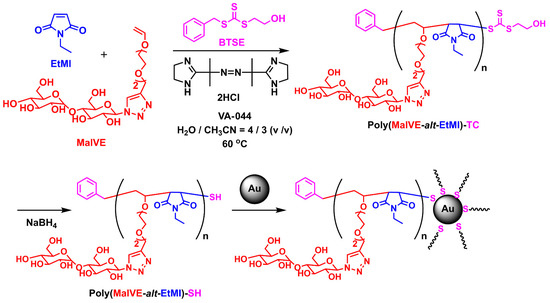
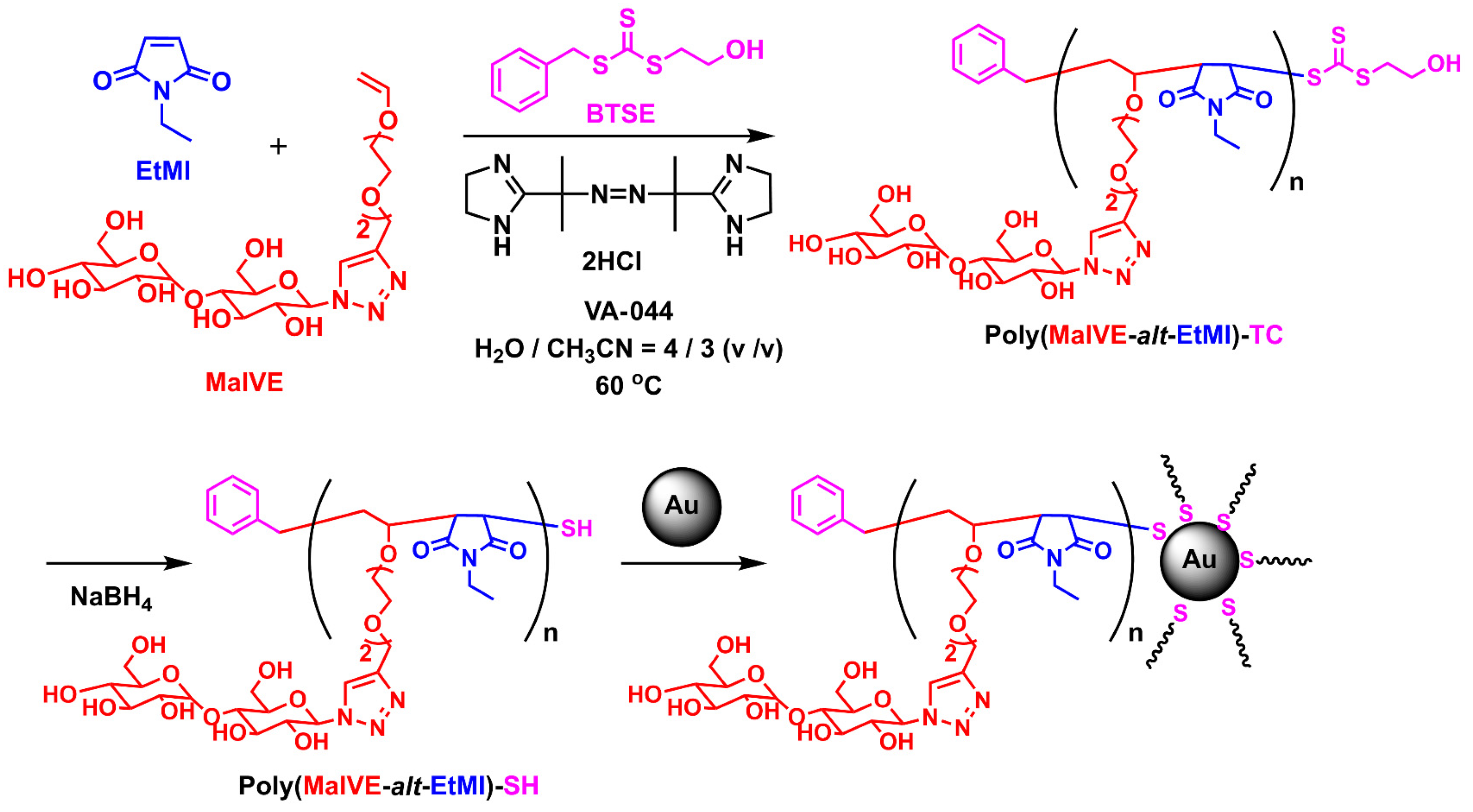
To extend alternating glycopolymers with periodically arranged pendant sugar residues toward the construction of functional glycointerfaces, we investigated the immobilization of thiol-terminated glycopolymers onto gold nanoparticles (AuNPs) through Au–S interactions. The thiol functionalities were introduced by post-polymerization transformation of the trithiocarbonate end groups derived from RAFT polymerization (Scheme 1). Glycan-functionalized AuNPs have been widely studied as model systems for carbohydrate–protein interactions and as functional materials for biosensing applications [31,33] because multivalent glycan presentation at nanoparticle interfaces can induce characteristic optical responses upon interaction with proteins. Immobilization of newly synthesized alternating glycopolymers onto AuNP surfaces enables investigation of how periodically arranged pendant sugar residues influence biomolecular recognition at nanoscale interfaces, thereby providing a model platform inspired by glycosaminoglycan (GAG) architectures. In this study, lectin-mediated nanoparticle aggregation was employed as a model system to evaluate the recognition behavior between proteins and alternating glycopolymer-functionalized AuNPs.
Scheme 1.
Synthesis of the alternating glycopolymer poly(MalVE-alt-EtMI)-TC by RAFT polymerization, post-polymerization end-group conversion to the thiol-terminated polymer poly(MalVE-alt-EtMI)-SH, and subsequent surface functionalization of gold nanoparticles via Au–S interactions.
2. Materials and Methods
2.1. Chemicals and Reagents
D(+)-Maltose monohydrate (FUJIFILM Wako Pure Chemical Corporation, Osaka, Japan, 98.0%), sodium azide (FUJIFILM Wako Pure Chemical Corporation, Osaka, Japan, 98.0%), 2-chloro-1,3-dimethylimidazolinium chloride (FUJIFILM Wako Pure Chemical Corporation, Osaka, Japan, 97.0%), N,N-diisopropyl ethylamine (Tokyo Chemical Industry Co., Ltd., Tokyo, Japan, 98.0%), copper (II) sulfate pentahydrate (FUJIFILM Wako Pure Chemical Corporation, Osaka, Japan, 99.5%), L-ascorbic acid sodium salt (FUJIFILM Wako Pure Chemical Corporation, Osaka, Japan, 98.0%), [(1-benzyl-1H-1,2,3-triazol-4-yl)methyl]amine (Tokyo Chemical Industry Co., Ltd., Tokyo, Japan, 97.0%), N-ethylmaleimide (EtMI; Tokyo Chemical Industry Co., Ltd., Tokyo, Japan, 98%), and 2,2′-azobis-[2-(2-imidazolin-2-yl)-propane] dihydrochloride (VA-044; FUJIFILM Wako Pure Chemical Corporation, Osaka, Japan, 97%) were used as received. Dialysis tubing with a molecular weight cutoff (MWCO) of 1 kDa (Spectra/Por 7; Repligen, Waltham, MA, USA) was used for purification. All other reagents were commercially available and used without further purification. Maltosyl azide (MalN3) [34] and 3-[2-(2-vinyloxyethoxy)-ethoxy]-propyne (VEEP) were prepared according to past studies [35]. The maltose-appended vinyl ether (MalVE) was prepared according to the literature [18]. A chain transfer agent 2-(benzylsulfanylthiocarbonylsulfanyl) ethanol (BTSE) was synthesized using 2-mercaptoethanol, carbon disulfide, and benzyl bromide according to a reported RAFT/MADIX-based procedure [36]. AuNPs (Au colloid solution, diameter; 40 nm, 9.0 × 10¹⁰ particles mL−1) were used as received from BBI Solutions (Cardiff, UK). Concanavalin A (Con A) from Canavalia ensiformis and Peanut agglutinin (PNA) from Arachis hypogaea were purchased from FUJIFILM Wako Pure Chemical Corporation (Osaka, Japan). Fluorescein isothiocyanate-conjugated Con A (FITC-Con A) was purchased from Sigma-Aldrich Co., LLC (St. Louis, MO, USA).
2.2. Methods
1H and 13C NMR spectra were recorded at 25 °C on a Bruker model AC-500 spectrometer (Bruker, Billerica, MA, USA), operating at 500 and 125 MHz, respectively, where chemical shifts (δ in ppm) were determined with respect to non-deuterated solvent residues as internal standards. Analytical size exclusion chromatography (SEC) was performed in 0.2 mol L−1 NaNO3 aqueous solution at 40 °C, using 7.8 mm × 300 mm gel columns (TOSOH TSKgel α–3000, three columns in series) on a JASCO model PU2089 equipped with a UV-2075 variable-wavelength UV-vis detector and an RI-2031 RI detector (JASCO, Hachioji, Japan). The number-average molecular weight (Mn) and dispersity ratio (Mw/Mn) were calculated from the chromatograms with respect to poly(ethylene glycol) standards (Scientific Polymer Products, Inc., Ontario, NY, USA; Mn = 590–11,900 g/mol, Mw/Mn = 1.05–1.11). UV-vis spectra were recorded using a quartz cell of 1 cm path length on a SHIMADZU Type UV-2550 spectrometer (SHIMADZU, Kyoto, Japan). Dynamic light scattering (DLS) measurements were performed on an Otsuka Electronics ELSZ-1000ZS (Otsuka Electronics Co., Ltd., Osaka, Japan). Average hydrodynamic diameters, intensity-based particle size distributions, and number-based particle size distributions were obtained by DLS, while zeta potentials were determined by electrophoretic light scattering in aqueous media.
2.3. Synthesis of Poly(MalVE-alt-EtMI)-TC
RAFT copolymerization of MalVE and EtMI was carried out with BTSE as a chain transfer agent and VA-044 as an initiator. VA-044 (1.2 mg, 4.0 μmol) was added to a solution of MalVE (200 mg, 370 μmol), EtMI (47 mg, 370 μmol) and BTSE (1.8 mg, 7.0 μmol) in H2O (1.27 mL) and acetonitrile (0.95 mL) in a glass tube ([MalVE]0/[EtMI]0/[VA-044]0/[BTSE]0 = 50/50/0.5/1) [18]. The resulting solution was degassed by three freeze–pump–thaw cycles, and then the glass tube was sealed under vacuum and heated at 60 °C for 0.5, 1 and 2 h and quenched by rapid cooling. The reaction mixture was analyzed by SEC and 1H NMR spectroscopy. The products were purified by dialysis with dialysis tubing with MWCO of 1 kDa against distilled water and freeze-dried to give the copolymer. The purified copolymer was obtained as a pale yellow solid after freeze-drying.
2.4. Preparation of Poly(MalVE-alt-EtMI)-Functionalized Gold Nanoparticles
Gold nanoparticles were surface-functionalized with the thiol-terminated alternating glycopolymer poly(MalVE-alt-EtMI)-SH via Au–S bond formation. NaBH4 (1.0 mg, 26 μmol) was added to a solution of poly(MalVE-alt-EtMI)-TC (30 mg) in H2O (2.0 mL), and the mixture was stirred for 2 h at 25 °C. The reduction was carried out under ambient atmosphere. The products were purified by dialysis with dialysis tubing with MWCO of 1 kDa against distilled water and freeze-dried to give copolymer. An aqueous dispersion of AuNPs (1.0 mL) in PBS (–) was added to a solution of the terminally thiolated poly(MalVE-alt-EtMI)-SH (1 mg) in H2O (1.0 mL), and the mixture was stirred for 24 h at 25 °C. The resulting polymer-coated AuNPs were purified three times by centrifugation at 6000 rpm for 30 min at 4 °C followed by redispersion in pure water.
2.5. Lectin-Mediated Aggregation of Poly(MalVE-alt-EtMI)-Functionalized Gold Nanoparticles
The lectin-mediated aggregation behavior of poly(MalVE-alt-EtMI)-functionalized gold nanoparticles was investigated using UV–vis spectroscopy in 20 mM Tris–HCl buffer containing MnCl2 (0.1 mM), CaCl2 (0.2 mM), and NaCl (2 mM). This buffer was used to maintain the activity of Con A while avoiding phosphate-induced precipitation in the presence of divalent cations. Upon addition of concanavalin A (Con A), a mannose/glucose-binding lectin, the glycopolymer-coated AuNPs exhibited concentration-dependent spectral changes associated with nanoparticle aggregation, as evidenced by a red shift in the localized surface plasmon resonance (LSPR) band. These optical responses arise from multivalent carbohydrate–lectin interactions at the nanoparticle interface and provide a convenient means to evaluate lectin recognition behavior. Poly(MalVE-alt-EtMI)-coated AuNPs were prepared in PBS (–), purified by centrifugation, and redispersed in 20 mM Tris–HCl buffer containing MnCl2 (0.1 mM), CaCl2 (0.2 mM), and NaCl (2 mM) for lectin interaction experiments. The initial absorbance of the polymer-immobilized AuNPs was adjusted to a maximum absorbance of 0.15 around 530 nm (the plasmon peak maximum). UV-vis spectra were recorded with varying concentrations of Con A (0–200 nM). To quantitatively analyze the aggregation process, the wavelength shift in the LSPR maximum (Δλ) was plotted as a function of Con A concentration. The resulting aggregation profiles were fitted using a Hill-type equation, which is commonly employed to describe cooperative multivalent interactions in nanoparticle–lectin systems. From this analysis, the apparent dissociation constant for aggregation (KD,ag) and the Hill coefficient (n) were extracted to evaluate the strength and cooperativity of lectin-mediated nanoparticle assembly. The aggregation profiles were analyzed using a Hill-type equation commonly employed for multivalent lectin–nanoparticle interactions [37]:
∆λ/∆λmax = [Con A]n/([KD,ag]n +[Con A]n)
Based on this analytical framework, the lectin-mediated aggregation behavior of the glycopolymer-functionalized AuNPs was systematically evaluated, and the resulting optical responses are discussed in Section 3.3.
2.6. Interaction Analysis of Free Glycopolymers with FITC-Con A
The interaction between free alternating glycopolymers and Con A was evaluated using fluorescein isothiocyanate-conjugated concanavalin A (FITC-Con A). Polymer solutions (2–100 μM, based on maltose concentration) and FITC-Con A solution (2 μM) were prepared in 20 mM Tris–HCl buffer containing MnCl2 (0.1 mM), CaCl2 (0.2 mM), and NaCl (2 mM). Equal volumes (50 μL each) of polymer solution and FITC-Con A solution were mixed in microtubes and incubated at room temperature in the dark for 7 h. The mixtures were then centrifuged at 12,000 rpm for 3 min, and the fluorescence spectra of the supernatants were recorded (excitation wavelength: 495 nm; emission wavelength: 505–700 nm). Specific interactions between maltose residues and Con A induced the formation of polymer–lectin aggregates, resulting in a decrease in fluorescence intensity due to precipitation of FITC-Con A-containing complexes. The apparent association constant (KAssoc) was estimated using the following linear fitting equation [18,38]:
where ΔF represents the change in fluorescence intensity and ΔFmax is the maximum fluorescence change. The apparent association constant was determined from the slope and intercept of the resulting linear plots.
[Sugar]/ΔF = [Sugar]/ΔFmax + 1/(ΔFmaxKAssoc)
3. Results and Discussion
3.1. Synthesis and Characterization of Poly(MalVE-alt-EtMI)-TC and End-Group Transformation
Alternating glycopolymers suitable for subsequent immobilisation onto gold nanoparticles (AuNPs) were synthesised by RAFT copolymerisation with control over molecular weight and terminal structure. We designed an alternating copolymer consisting of maltose-containing vinyl ether (MalVE) and ethyl maleimide (EtMI) (denoted as poly(MalVE-alt-EtMI)-TCx.xk, where x.xk represents the number-average molecular weight (Mn) value determined by 1H NMR analysis) as a precursor polymer with trithiocarbonate (TC) ω-terminal groups that could be converted into terminal thiol functional groups. The polymerisation behaviour and properties of the obtained alternating glycopolymer are summarised in Table 1. MalVE and EtMI were supplied in equimolar ratios and the copolymerisation was carried out in a mixed solvent of H2O and acetonitrile using VA-044 as a radical initiator and a trithiocarbonate-type RAFT agent (BTSE). In the presence of BTSE, the monomer conversion rate increased with reaction time, and SEC analysis confirmed that the copolymer had a relatively narrow molecular weight distribution. EtMI exhibited a consistently higher conversion rate than MalVE, reflecting its relatively high homopropagation tendency, while the copolymer composition remained nearly equimolar throughout the polymerization process, indicating that the two monomer units were primarily incorporated alternately.
Table 1.
Alternating glycopolymer samples employed in this study, including polymerization conditions, monomer conversion, size-exclusion chromatography (SEC) results, dispersities (Mw/Mn), theoretical number-average molecular weights (Mn,theory), number-average molecular weights determined by 1H NMR end-group analysis (Mn,NMR), and composition of copolymers.
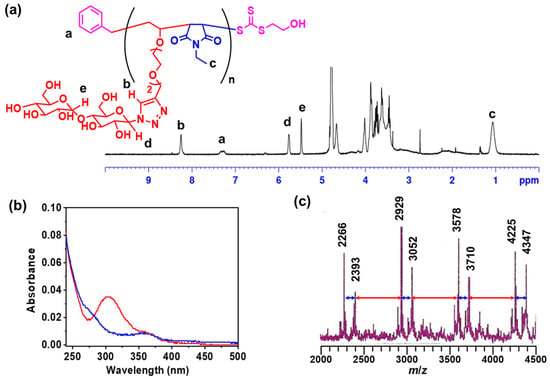
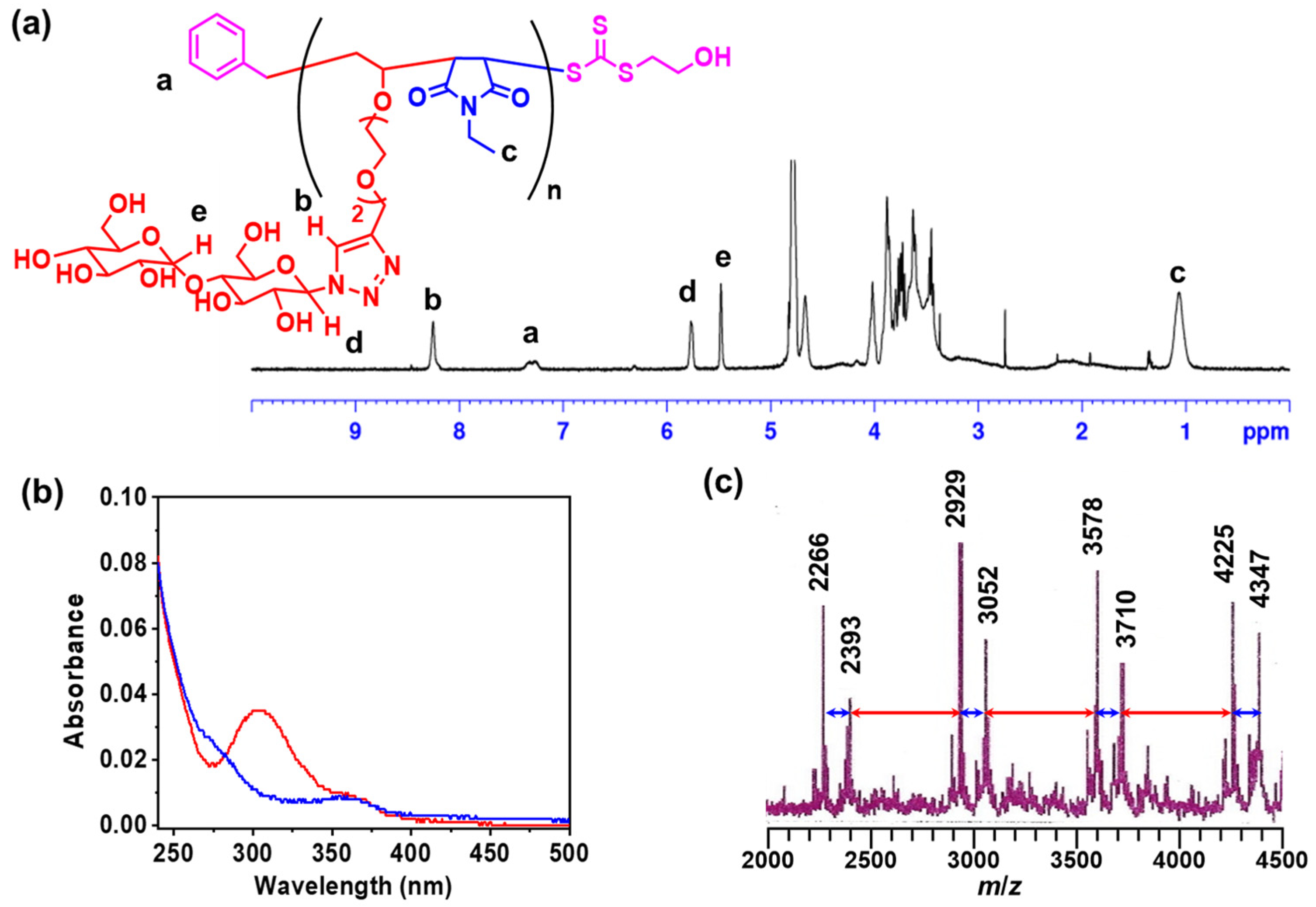
SEC analysis revealed that the Mn increased from 4000 to 6500 as the monomer conversion rate increased. However, the increase in Mn determined by SEC was smaller than expected from the monomer conversion. This discrepancy is attributed to the use of PEG standards for SEC calibration and to the bulky pendant carbohydrate residues, which likely reduced the apparent hydrodynamic volume of the glycopolymers. 1H NMR spectroscopy of the purified copolymer provided further insights into the polymer structure and terminal functional groups (Figure 1a). A clear resonance at approximately 7.2 ppm (peak a) was observed, which was attributed to the aromatic proton at the initiating α-terminus derived from the RAFT agent. This confirmed the incorporation of the initiating fragment into the polymer chain. Conversely, the signal attributed to the trithiocarbonate group at the terminal ω-terminus could not be clearly identified due to overlap with the main-chain resonance. Nevertheless, successful terminal group analysis and controlled molecular weight growth behaviour strongly support the presence of the TC terminal group. The copolymer composition, calculated from the integral ratio of the triazole proton of MalVE (peak b) and the methyl proton of EtMI (peak c), remained almost constant during polymerisation (42:58 to 43:57), indicating that alternating incorporation was maintained even at high monomer conversion rates. Furthermore, the Mn,NMR values calculated from the degrees of polymerization of the MalVE and EtMI units based on 1H NMR analysis showed good agreement with the theoretical molecular weights (Mn,theory) estimated from monomer conversion. These results suggest that copolymerisation of MalVE and EtMI proceeded via RAFT-controlled polymerisation, resulting in trithiocarbonate groups at the terminals. The efficiency of introducing the trithiocarbonate terminal group was evaluated using UV-Vis spectroscopy (Figure 1b; red line). The introduction rate of terminal trithiocarbonate groups was estimated to be 91% based on the molar extinction coefficient at 307 nm, indicating that terminal functional groups derived from RAFT polymerisation were efficiently introduced. MALDI-TOF mass spectrometry (Figure 1c) was employed to analyse the arrangement of the alternating monomers. The results show a clear mass increase corresponding to the MalVE (red arrow) and EtMI (blue arrow) units, which strongly supports formation of a predominantly alternating structure. Furthermore, the reactivity ratio previously reported (r11 = r21 = 0, r12 = 0.9, and r22 = 0.2; M1 = MalVE, M2 = EtMI) and determined using the Kelen–Tüdős method [18] suggests a strong tendency towards cross-propagation, consistent with the observed periodic glycopolymer structure. These results demonstrate that RAFT copolymerisation of MalVE and EtMI successfully affords alternating glycopolymers with controlled molecular weights and efficiently introduced terminal trithiocarbonate groups.
Figure 1.
Characterization of poly(MalVE-alt-EtMI)-TC18.2k synthesized by RAFT copolymerization. (a) 1H NMR spectrum of poly(MalVE-alt-EtMI)-TC18.2k in D2O. (b) UV–vis spectra of poly(MalVE-alt-EtMI)-TC18.2k before (red line) and after (blue line) end-group conversion, demonstrating disappearance of the trithiocarbonate-derived absorption after reduction. (c) MALDI–TOF mass spectrum of the lower-molecular-weight sample poly(MalVE-alt-EtMI)-TC11.6k, showing periodic mass increments corresponding to MalVE and EtMI repeating units. In panel (a), peak a corresponds to the aromatic proton at the RAFT-agent-derived α-terminus, peak b to the triazole proton of MalVE, and peak c to the methyl proton of EtMI.
To introduce terminal thiol groups for AuNP immobilization, the trithiocarbonate end groups of poly(MalVE-alt-EtMI)-TC were reduced using NaBH4. Successful end-group transformation was confirmed by UV–vis spectroscopy (Figure 1b; blue line). The characteristic absorption derived from the trithiocarbonate moiety significantly decreased after reduction, indicating efficient conversion of the terminal TC group into a thiol functionality. Collectively, these results demonstrate that RAFT copolymerization of MalVE and EtMI affords structurally well-characterized alternating glycopolymers bearing trithiocarbonate end groups suitable for subsequent thiol generation and surface immobilization onto AuNPs.
3.2. Surface Functionalization of Gold Nanoparticles with Poly(MalVE-alt-EtMI)
The thiol-terminated alternating glycopolymers obtained by end-group transformation were subsequently used for surface immobilization onto gold nanoparticles (AuNPs) via Au–S interactions [39]. AuNPs with an average particle diameter of 40 nm (9.0 × 10¹⁰ particles mL−1) were used as model nanoparticle substrates to investigate the immobilization behavior of poly(MalVE-alt-EtMI)-SH. Successful surface functionalization was evaluated by dynamic light scattering (DLS) measurements and zeta potential analysis.
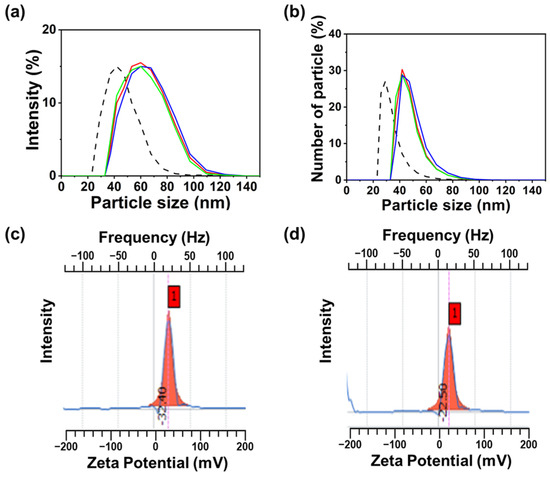
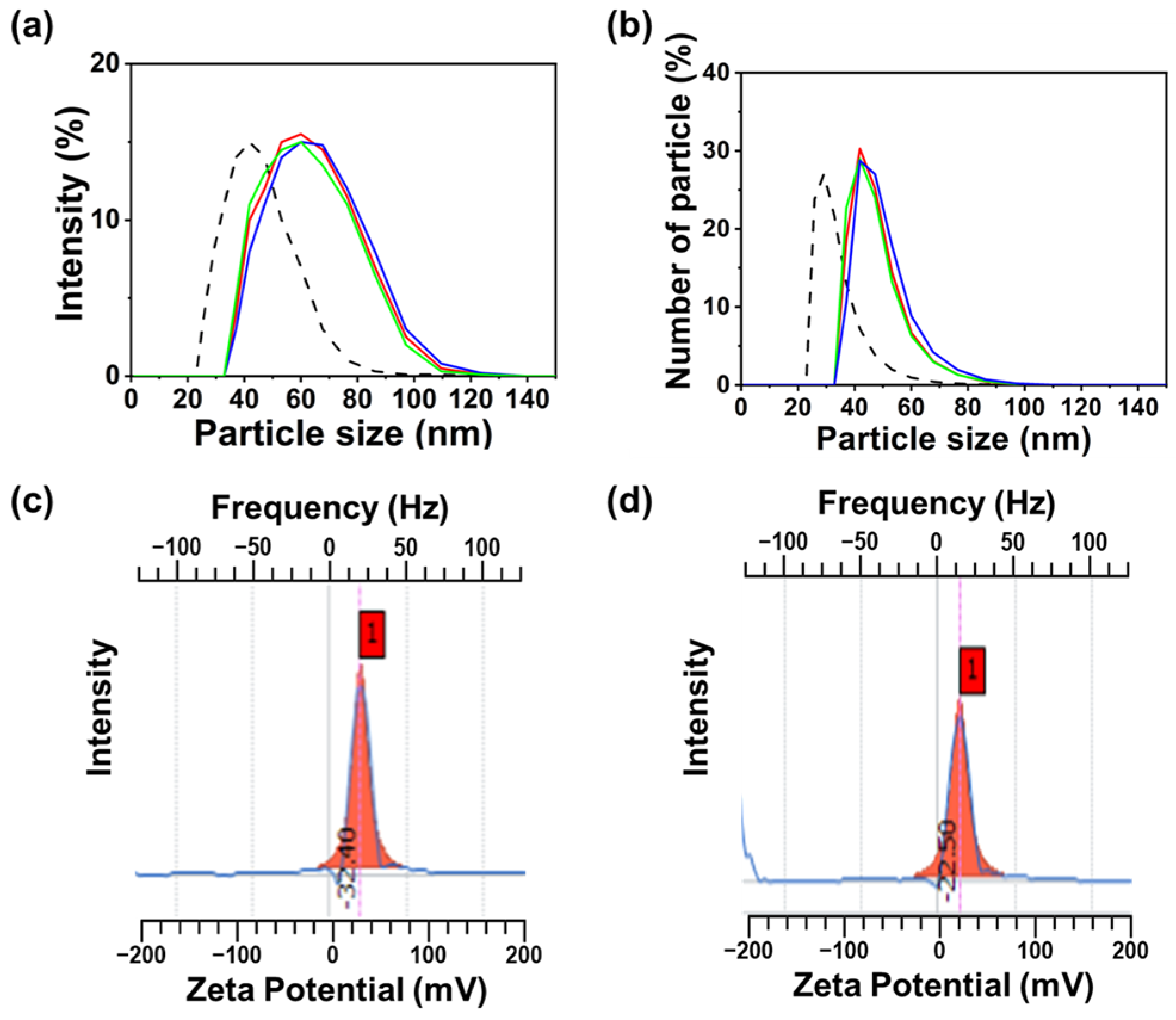
The hydrodynamic diameters of unmodified and glycopolymer-functionalized AuNPs were first analyzed by DLS. As summarized in Table 2, the intensity-based particle size distributions obtained by DLS showed a clear shift toward larger particle diameters after surface functionalization (Figure 2a). Similar tendencies were also observed in the number-based particle size distributions (Figure 2b). Specifically, the average particle diameter increased from 42.3 nm for unmodified AuNPs to approximately 59 nm after treatment with poly(MalVE-alt-EtMI)-SH. Although the immobilized glycopolymers possessed different Mn,NMR values, similar hydrodynamic diameters were observed after surface functionalization. This tendency is consistent with the SEC results described above (Table 1), which showed only moderate differences in the apparent hydrodynamic sizes of the alternating glycopolymers in aqueous solution despite their different molecular weights. The observed changes in particle size distributions provide strong evidence for successful immobilization of the alternating glycopolymers onto the nanoparticle surface. No significant broad peaks attributable to irreversible aggregation were observed after polymer immobilization, indicating that the glycopolymer-functionalized AuNPs retained colloidal stability under the present conditions.
Table 2.
Average hydrodynamic diameters and zeta potentials of AuNPs before and after surface functionalization with poly(MalVE-alt-EtMI)-SH, as determined by dynamic light scattering (DLS).
Figure 2.
Characterization of glycopolymer-functionalized AuNPs. (a) Intensity-based particle size distributions for unmodified AuNPs (black dashed line) and AuNPs functionalized with poly(MalVE-alt-EtMI)-SH11.6k (green), poly(MalVE-alt-EtMI)-SH18.2k (red), and poly(MalVE-alt-EtMI)-SH25.7k (blue). (b) Number-based particle size distributions for unmodified AuNPs (black dashed line) and AuNPs functionalized with poly(MalVE-alt-EtMI)-SH11.6k (green), poly(MalVE-alt-EtMI)-SH18.2k (red), and poly(MalVE-alt-EtMI)-SH25.7k (blue). (c) Zeta potential distribution of unmodified AuNPs. (d) Zeta potential distribution of AuNPs functionalized with poly(MalVE-alt-EtMI)-SH25.7k.
To further evaluate changes in surface properties induced by glycopolymer immobilization, zeta potential measurements were performed. The zeta potential of unmodified AuNPs was approximately −32 mV, whereas the values increased to approximately −20 mV after glycopolymer immobilization (Table 2 and Figure 2c,d). This change in surface charge suggests partial shielding of the negatively charged citrate-stabilized AuNP surface by the immobilized glycopolymer layer.
Collectively, these results demonstrate that thiol-terminated alternating glycopolymers can be efficiently immobilized onto AuNP surfaces to construct structurally defined glycointerfaces. The resulting glycopolymer-functionalized AuNPs provide a suitable platform for investigating multivalent biomolecular interactions at nanoscale interfaces.
3.3. Lectin-Mediated Aggregation of Poly(MalVE-alt-EtMI)-Functionalized AuNPs
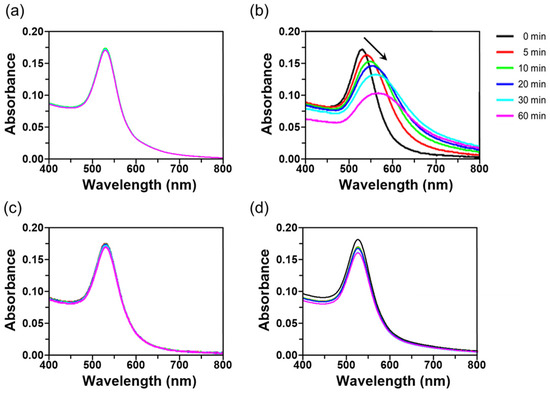
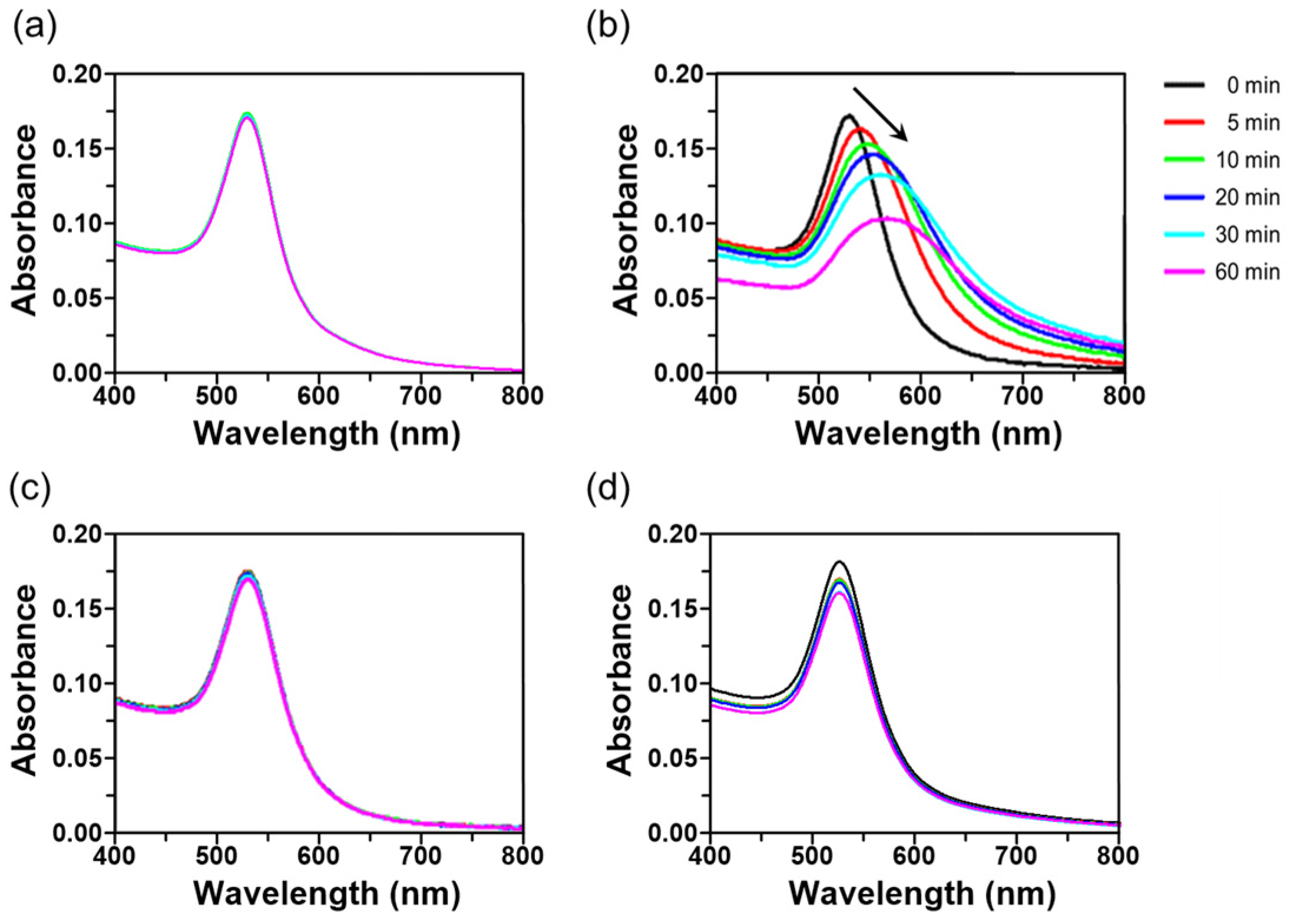
To evaluate the biomolecular recognition behavior of alternating glycopolymer-functionalized AuNPs, lectin-mediated nanoparticle aggregation experiments were carried out using concanavalin A (Con A), a glucose- and mannose-binding lectin [20]. An aqueous dispersion of poly(MalVE-alt-EtMI)-SH25.7k-functionalized AuNPs showed no significant spectral changes in the UV–vis spectrum during incubation for 60 min in Tris–HCl buffer solution in the absence of proteins (Figure 3a), and the glycopolymer-functionalized AuNPs remained colloidally stable for at least 1 day under the present conditions. Upon addition of Con A (100 nM), the UV–vis spectra of the glycopolymer-functionalized AuNPs exhibited time-dependent spectral changes. As shown in Figure 3b, the localized surface plasmon resonance (LSPR) band around 530 nm gradually broadened and shifted toward longer wavelengths with increasing incubation time after Con A addition. These spectral changes are characteristic of interparticle plasmon coupling induced by nanoparticle aggregation and indicate that the glycopolymer-functionalized AuNPs underwent lectin-mediated assembly through multivalent carbohydrate–lectin interactions at the nanoparticle interface [32,37,40]. To examine nonspecific protein adsorption, bovine serum albumin (BSA, 100 nM) was examined under identical conditions. No significant spectral changes were observed after BSA addition (Figure 3c). Furthermore, to examine the specificity of the observed aggregation behavior, peanut agglutinin (PNA), which does not recognize maltose residues, was employed as a control lectin. Upon addition of PNA, slight changes in UV–vis absorption intensity were observed; however, no significant red shift or broadening of the LSPR band was detected (Figure 3d). Taken together, these results indicate that the glycopolymer-functionalized AuNPs underwent lectin-mediated assembly through specific multivalent carbohydrate–lectin interactions at the nanoparticle interface. Therefore, the pronounced spectral changes observed only upon Con A addition predominantly originate from specific interactions between the surface-displayed maltose residues and Con A.
Figure 3.
Time-dependent UV–vis absorption spectra of poly(MalVE-alt-EtMI)-SH-functionalized AuNPs in Tris–HCl buffer. (a) Spectral changes recorded during incubation for 60 min in Tris–HCl buffer in the absence of proteins. Time-dependent spectral changes after addition of (b) concanavalin A (Con A, 100 nM), (c) bovine serum albumin (BSA, 100 nM), and (d) peanut agglutinin (PNA, 100 nM). Spectra were collected at 0, 5, 10, 20, 30, and 60 min, as indicated in the legend. The arrow in panel (b) indicates the direction of spectral changes with increasing incubation time after Con A addition.
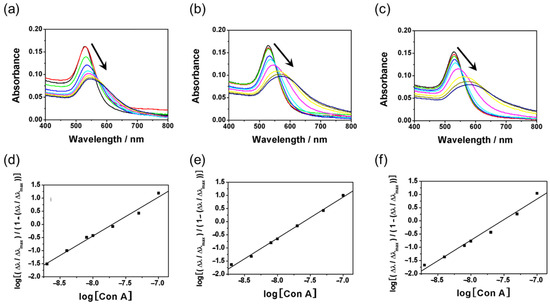
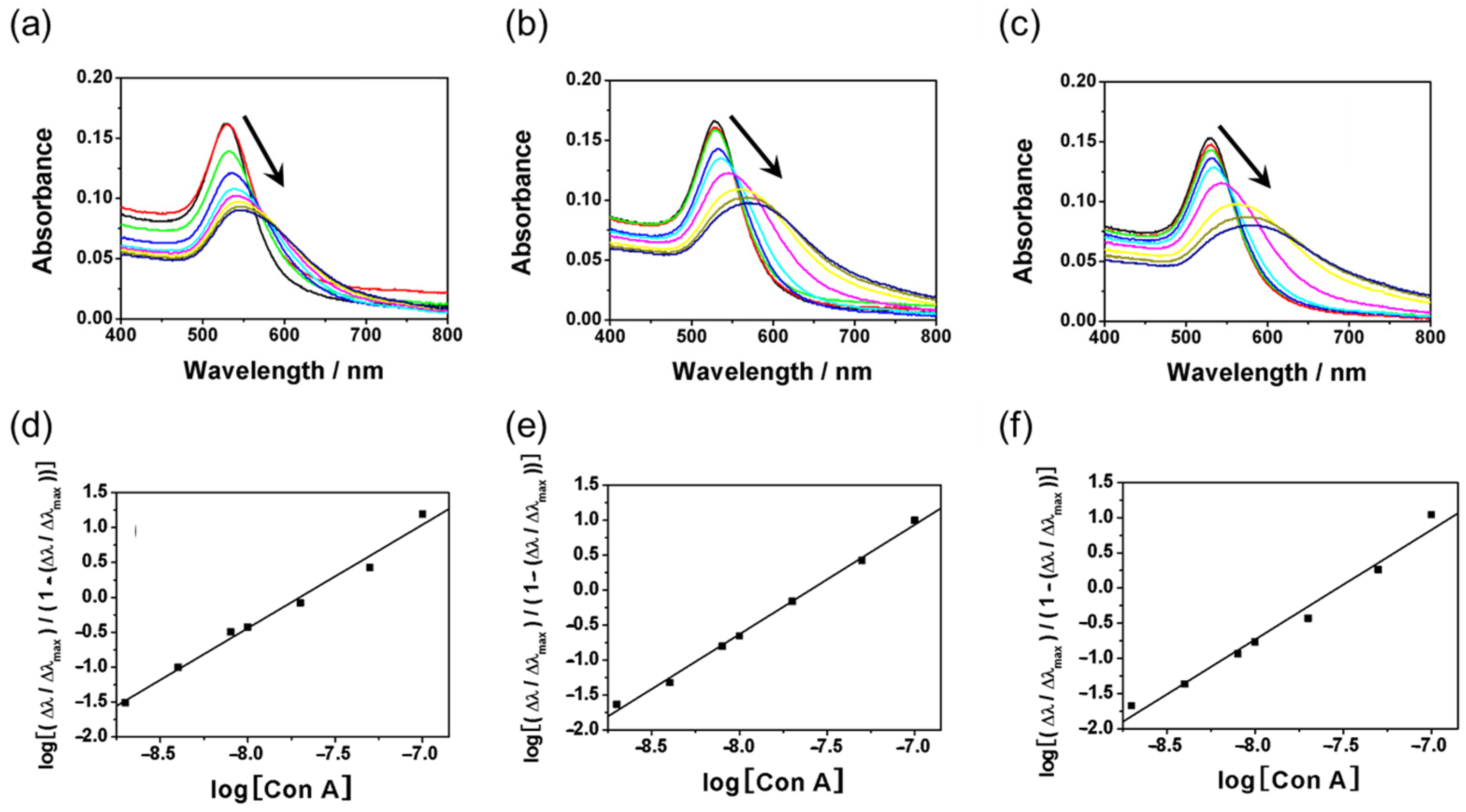
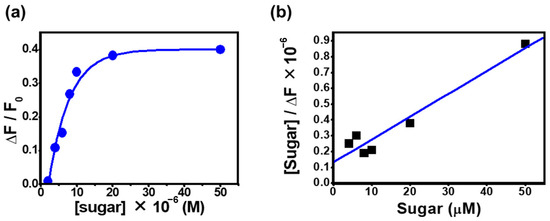
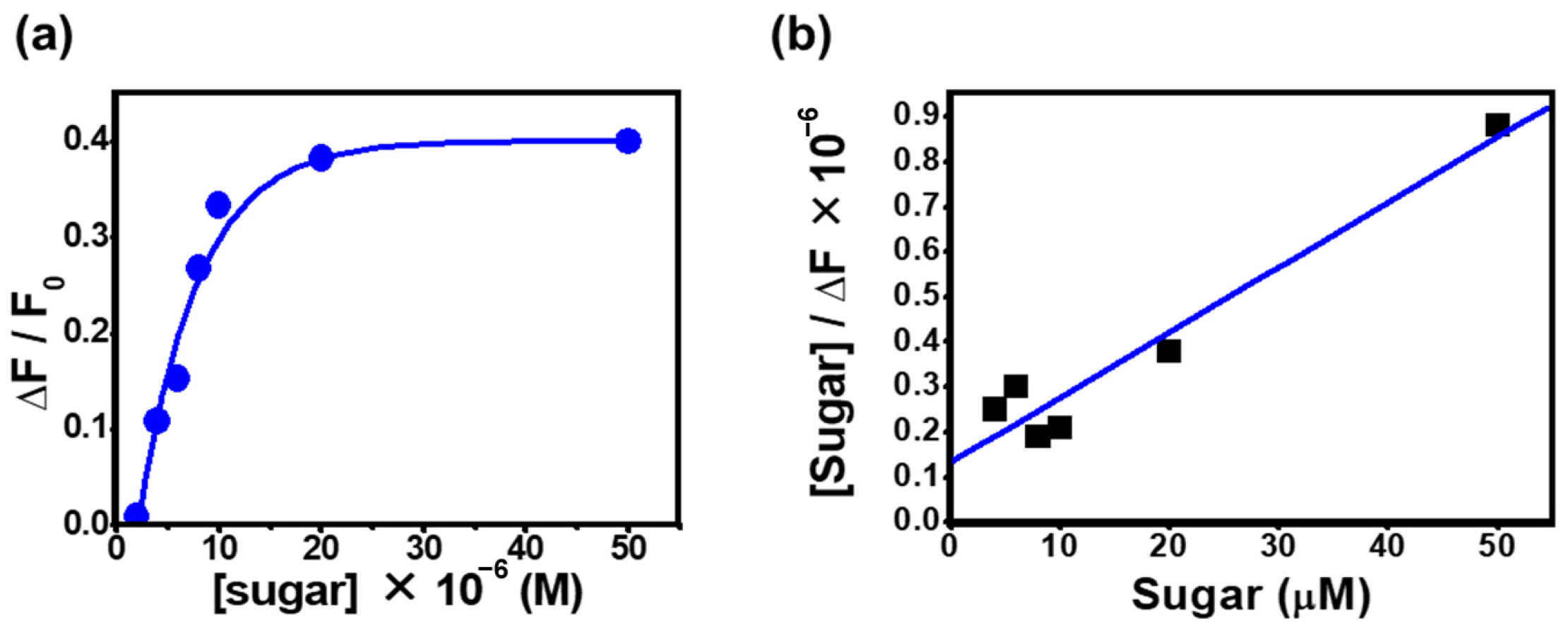
To further investigate the concentration dependence of lectin–glycopolymer interactions, Con A was sequentially added to AuNPs functionalized with three different poly(MalVE-alt-EtMI)-SH samples having different molecular weights, resulting in final Con A concentrations of 2, 4, 8, 10, 20, 50, 100, and 200 nM. UV–vis measurements revealed progressive red shifts and broadening of the LSPR band with increasing Con A concentration (Figure 4a–c), consistent with enhanced nanoparticle aggregation mediated by lectin binding. The interaction strength between Con A and the surface-displayed glycopolymers was quantitatively evaluated by analyzing the wavelength shift (Δλ) of the LSPR maximum. Based on the data shown in Figure 4a–c, the aggregation profiles were fitted using a Hill-type equation [37], and Hill plots of log[(Δλ/Δλmax)/(1 − Δλ/Δλmax)] versus log[Con A] were constructed to evaluate the lectin-mediated aggregation behavior (Figure 4d–f). The resulting Hill plots exhibited good linearity with high R2 values, supporting the applicability of the Hill-type model to the lectin-mediated aggregation process. From these analyses, the apparent dissociation constants for aggregation (KD,ag), Hill coefficients (n), and coefficients of determination (R2) were obtained (Table 3). The apparent association constants (KAssoc), estimated as the inverse of KD,ag, were on the order of 107 L mol−1, which is substantially higher than the values typically reported for monovalent carbohydrate–lectin interactions (~103 L mol−1) [41]. To compare these results with those of free alternating glycopolymers in solution, the interaction between poly(MalVE-alt-EtMI)-TC25.7k and Con A was evaluated by FITC-Con A fluorescence analysis. After addition of poly(MalVE-alt-EtMI)-TC25.7k to an aqueous FITC-Con A solution, the resulting aggregates were separated by centrifugation, and changes in the fluorescence intensity of the supernatant were analyzed. Representative fluorescence titration profiles and the corresponding linear fitting plots are shown in Figure 5. From these measurements, the apparent association constant was estimated to be on the order of 105 L mol−1 (R2 = 0.965). Although the association constants obtained for free glycopolymers and AuNP-immobilized glycopolymers cannot be directly compared because of differences in analytical methodology and lectin format, the observed trend strongly suggests that immobilization of alternating glycopolymers onto nanoparticle surfaces enhances multivalent carbohydrate–lectin interactions through confined interfacial presentation of the glycopolymer chains.
Figure 4.
Concentration-dependent UV–vis absorption spectral changes in AuNPs functionalized with (a) poly(MalVE-alt-EtMI)-SH11.6k, (b) poly(MalVE-alt-EtMI)-SH18.2k, and (c) poly(MalVE-alt-EtMI)-SH25.7k recorded 60 min after Con A addition. Hill plots for AuNPs functionalized with (d) poly(MalVE-alt-EtMI)-SH11.6k, (e) poly(MalVE-alt-EtMI)-SH18.2k, and (f) poly(MalVE-alt-EtMI)-SH25.7k. Con A concentrations were 0, 2, 4, 8, 10, 20, 50, 100, and 200 nM. Colored lines in panels (a–c) represent spectra recorded at different Con A concentrations, and arrows indicate the direction of spectral changes with increasing Con A concentration. In panels (d–f), symbols represent experimental data, and solid lines represent linear fitting results.
Table 3.
Apparent dissociation constants (KD,ag), apparent association constants (KAssoc), Hill coefficients (n), and coefficients of determination (R2) obtained by fitting the lectin-mediated aggregation behavior of glycopolymer-functionalized AuNPs using the Hill-type equation.
Figure 5.
Fluorescence analysis of the interaction between free alternating glycopolymers and FITC-Con A. (a) Changes in fluorescence intensity as a function of sugar concentration. The solid line represents the fitting curve based on Equation (2). (b) Linear plot of [Sugar]/ΔF versus [Sugar] used for estimation of the apparent association constant (KAssoc). In panel (a), circles represent experimental data and the solid line represents the fitting curve based on Equation (2). In panel (b), squares represent experimental data and the solid line represents the linear fitting result.
While slight differences in apparent association constants were observed among the glycopolymer-functionalized AuNPs, these differences should be interpreted carefully because the grafting density and surface coverage of glycopolymers on the AuNP surface were not quantified in the present study. Nevertheless, the present results collectively demonstrate that nanoparticle-confined presentation of alternating glycopolymers provides an effective strategy for enhancing multivalent lectin recognition at nanoscale glycointerfaces. These findings highlight the potential of alternating glycopolymers as structurally defined ligands for the construction of sequence-regulated glycointerfaces and glycopolymer-based biosensing platforms.
4. Conclusions
In this study, an alternating glycopolymer consisting of maltose-containing vinyl ether and ethyl maleimide was synthesized by RAFT copolymerization and subsequently applied to the surface functionalization of gold nanoparticles via post-polymerization end-group transformation. The resulting thiol-terminated alternating glycopolymer enabled stable immobilization onto the surface of AuNPs through Au–S interactions, yielding alternating glycopolymer-functionalized AuNPs. UV–vis spectroscopy, dynamic light scattering, and zeta potential measurements confirmed successful surface functionalization and colloidal stabilization of the AuNPs by the alternating glycopolymer. The glycopolymer-functionalized AuNPs exhibited selective lectin-mediated aggregation behavior in response to concanavalin A through specific multivalent carbohydrate–lectin interactions, whereas only minimal spectral changes were observed in the presence of bovine serum albumin or peanut agglutinin. Quantitative analysis based on Hill-type fitting revealed that the apparent association constants of the glycopolymer-functionalized AuNPs were on the order of 107 L mol−1, which was significantly higher than those estimated for free alternating glycopolymers in aqueous solution (~105 L mol−1) and typical monosaccharide–lectin interactions (~103 L mol−1). These results strongly suggest that immobilization of alternating glycopolymers onto nanoparticle surfaces enhances multivalent lectin recognition through confined interfacial presentation of carbohydrate residues. Collectively, this study demonstrates that alternating glycopolymers bearing periodically arranged pendant carbohydrate residues can serve as structurally defined ligands for constructing sequence-regulated glycointerfaces on nanoparticle surfaces. The present strategy provides a useful platform for investigating multivalent biomolecular recognition at nanoscale interfaces and may contribute to the future development of glycopolymer-based biosensing and diagnostic materials.
Author Contributions
Conceptualization, J.M. and M.M.; methodology, J.M. and M.M.; validation, J.M.; formal analysis, J.K.; investigation, J.M.; resources, J.M. and M.M.; data curation, J.K. and J.M.; writing—original draft preparation, J.M.; visualization, J.M.; supervision, M.M.; project administration, J.M.; funding acquisition, J.M. and M.M. All authors have read and agreed to the published version of the manuscript.
Funding
This research was supported by institutional research funds from Kyoto Institute of Technology. No external funding was received.
Data Availability Statement
The raw data supporting the conclusions of this article will be made available by the authors on request.
Conflicts of Interest
The authors declare no conflicts of interest.
References
- Matyjaszewski, K.; Xia, J. Atom transfer radical polymerization. Chem. Rev. 2001, 101, 2921–2990. [Google Scholar] [CrossRef] [Scilit]
- Moad, G.; Rizzardo, E.; Thang, S.H. Living Radical Polymerization by the RAFT Process. Aust. J. Chem. 2005, 58, 379–410. [Google Scholar] [CrossRef] [Scilit]
- Matyjaszewski, K. Advanced materials by atom transfer radical polymerization. Adv. Mater. 2018, 30, 1706441. [Google Scholar] [CrossRef] [Scilit]
- Anastasaki, A.; Nikolaou, V.; Nurumbetov, G.; Wilson, P.; Kempe, K.; Quinn, J.F.; Davis, T.P.; Whittaker, M.R.; Haddleton, D.M. Cu (0)-Mediated Living Radical Polymerization: A Versatile Tool for Materials Synthesis. Chem. Rev. 2016, 116, 835–877. [Google Scholar] [CrossRef] [Scilit]
- Corrigan, N.; Jung, K.; Moad, G.; Hawker, C.J.; Matyjaszewski, K.; Boyer, C. Reversible-deactivation radical polymerization (Controlled/living radical polymerization): From discovery to materials design and applications. Prog. Polym. Sci. 2020, 111, 101311. [Google Scholar] [CrossRef] [Scilit]
- Hadjichristidis, N.; Pitsikalis, M.; Pispas, S.; Iatrou, H. Polymers with Complex Architecture by Living Anionic Polymerization. Chem. Rev. 2001, 101, 3747–3792. [Google Scholar] [CrossRef] [Scilit]
- Sheiko, S.S.; Sumerlin, B.S.; Matyjaszewski, K. Cylindrical molecular brushes: Synthesis, characterization, and properties. Prog. Polym. Sci. 2008, 33, 759–785. [Google Scholar] [CrossRef] [Scilit]
- Tezuka, Y. Topological polymer chemistry for designing multicyclic macromolecular architectures. Polym. J. 2012, 44, 1159–1169. [Google Scholar] [CrossRef] [Scilit]
- Ouchi, M.; Badi, N.; Lutz, J.-F.; Sawamoto, M. Single-Chain Technology Using Discrete Synthetic Macromolecules. Nat. Chem. 2011, 3, 917–924. [Google Scholar] [CrossRef] [Scilit] [PubMed]
- Lutz, J.-F.; Ouchi, M.; Liu, D.R.; Sawamoto, M. Sequence-Controlled Polymers. Science 2013, 341, 1238149. [Google Scholar] [CrossRef] [Scilit] [PubMed]
- Li, Z.-L.; Zeng, F.-R.; Ma, J.-M.; Sun, L.-H.; Zeng, Z.; Jiang, H. Precision Aliphatic Polyesters with Alternating Microstructures via Cross-Metathesis Polymerization: An Event of Sequence Control. Macromol. Rapid Commun. 2017, 38, 1700050. [Google Scholar] [CrossRef] [Scilit]
- Nishimori, K.; Ouchi, M. AB-alternating copolymers via chain-growth polymerization: Synthesis, characterization, self-assembly, and functions. Chem. Commun. 2020, 56, 3473–3483. [Google Scholar] [CrossRef] [Scilit]
- Kono, H.; Hibino, M.; Ida, D.; Ouchi, M.; Terashima, T. Self-Assembly of Amphiphilic Alternating Copolymers by Chain Folding in Water: From Uniform Composition and Sequence to Monodisperse Micelles. Macromolecules 2023, 56, 6086–6098. [Google Scholar] [CrossRef] [Scilit]
- Lindahl, U.; Couchman, J.R.; Kimata, K.; Esko, J.D. Proteoglycans and Sulfated Glycosaminoglycans. In Essentials of Glycobiology, 3rd ed.; Varki, A., Cummings, R.D., Esko, J.D., Stanley, P., Hart, G.W., Aebi, M., Darvill, A.G., Kinoshita, T., Packer, N.H., Prestegard, J.H., et al., Eds.; Cold Spring Harbor Press: Cold Spring Harbor, NY, USA, 2017. [Google Scholar]
- Xu, D.; Esko, J.D. Demystifying heparan sulfate-protein interactions. Annu. Rev. Biochem. 2014, 83, 129–157. [Google Scholar] [CrossRef] [Scilit]
- Kightlinger, W.; Warfel, K.F.; DeLisa, M.P.; Jewett, M.C. Synthetic glycobiology: Parts, systems, and applications. ACS Synth. Biol. 2020, 9, 1534–1562. [Google Scholar] [CrossRef] [Scilit]
- Miura, Y. Design and synthesis of well-defined glycopolymers for the control of biological functionalities. Polym. J. 2012, 44, 679–689. [Google Scholar] [CrossRef] [Scilit]
- Minoda, M.; Otsubo, T.; Yamamoto, Y.; Zhao, J.; Honda, Y.; Tanaka, T.; Motoyanagi, J. The First Synthesis of Periodic and Alternating Glycopolymers by RAFT Polymerization: A Novel Synthetic Pathway for Glycosaminoglycan Mimics. Polymers 2019, 11, 70. [Google Scholar] [CrossRef] [Scilit]
- Varki, A. Biological roles of glycans. Glycobiology 2017, 27, 3–49. [Google Scholar] [CrossRef] [Scilit]
- Lis, H.; Sharon, N. Lectins: Carbohydrate-Specific Proteins That Mediate Cellular Recognition. Chem. Rev. 1998, 98, 637–647. [Google Scholar] [CrossRef] [Scilit]
- Sharon, N.; Lis, H. History of lectins: From hemagglutinins to biological recognition molecules. Glycobiology 2004, 14, 53–62. [Google Scholar] [CrossRef] [Scilit]
- Gerling-Driessen, U.I.M.; Hoffmann, M.; Schmidt, S.; Snyder, N.L.; Hartmann, L. Glycopolymers against pathogen infection. Chem. Soc. Rev. 2023, 52, 2617–2642. [Google Scholar] [CrossRef] [Scilit]
- Miura, Y.; Mizuno, H. Interaction Analyses of Amyloid β Peptide (1–40) with Glycosaminoglycan Model Polymers. Bull. Chem. Soc. Jpn. 2010, 83, 1004–1009. [Google Scholar] [CrossRef] [Scilit]
- Oh, Y.I.; Sheng, G.J.; Chang, S.-K.; Hsieh-Wilson, L.C. Tailored Glycopolymers as Anticoagulant Heparin Mimetics. Angew. Chem. Int. Ed. 2013, 52, 11796–11799. [Google Scholar] [CrossRef] [Scilit]
- Wang, M.; Lyu, Z.; Chen, G.; Wang, H.; Yuan, Y.; Ding, K.; Yu, Q.; Yuan, L.; Chen, H. A new avenue to the synthesis of GAG-mimicking polymers highly promoting neural differentiation of embryonic stem cells. Chem. Commun. 2015, 51, 15434–15437. [Google Scholar] [CrossRef] [Scilit]
- Nagao, M.; Yoshimatsu, D.; Matsumoto, H.; Miura, Y. Sequence-Dependent Effects of Folded Glycopolymer Structures on Their Biomolecular Recognition. ACS Macro Lett. 2025, 14, 989–995. [Google Scholar] [CrossRef] [Scilit]
- Zhang, Q.; Collins, J.; Anastasaki, A.; Wallis, R.; Mitchell, D.A.; Becer, C.R.; Haddleton, D.M. Sequence-Controlled Multi-Block Glycopolymers to Inhibit DC-SIGN-gp120 Binding. Angew. Chem. Int. Ed. 2013, 52, 4435–4439. [Google Scholar] [CrossRef] [Scilit]
- Hirai, H. Mechanism of alternating copolymerization of acrylic monomers with donor monomers in the presence of lewis acid. J. Polym. Sci. Macromol. Rev. 1976, 11, 47–91. [Google Scholar] [CrossRef] [Scilit]
- Rzaev, Z.M.O. Complex-radical alternating copolymerization. Prog. Polym. Sci. 2000, 25, 163–217. [Google Scholar] [CrossRef] [Scilit]
- Motoyanagi, J.; Oguri, A.; Minoda, M. Synthesis of Well-Defined Alternating Copolymer Composed of Ethylmaleimide and Hydroxy-Functionalized Vinyl Ether by RAFT Polymerization and Their Thermoresponsive Properties. Polymers 2020, 12, 2255. [Google Scholar] [CrossRef] [Scilit]
- de la Fuente, J.M.; Penades, S. Glyconanoparticles: Types, synthesis and applications in glycoscience, biomedicine and material science. Biochim. Biophys. Acta 2006, 1760, 636–651. [Google Scholar] [CrossRef] [Scilit]
- Kiessling, L.L.; Gestwicki, J.E.; Strong, L.E. Synthetic multivalent ligands as probes of signal transduction. Angew. Chem. Int. Ed. 2006, 45, 2348–2368. [Google Scholar] [CrossRef] [Scilit]
- Hezwani, M.; Anokye, D.; Soutar, D.E.; Ligorio, M.; Prabhakar, N.; Oram, J.C.; Cantor, A.J.; Jackson, G.D.; Terracciano, R.; Walker, M.; et al. Glycopolymer-Functionalized Gold Nanoparticles for the Detection of Western Diamondback Rattlesnake (Crotalus atrox) Venom. Biomacromolecules 2025, 26, 3514–3524. [Google Scholar] [CrossRef] [Scilit]
- Tanaka, T.; Nagai, H.; Noguchi, M.; Kobayashi, A.; Shoda, S. One-step conversion of unprotected sugars to β-glycosyl azides using 2-chloroimidazolinium salt in aqueous solution. Chem. Commun. 2009, 3378–3379. [Google Scholar] [CrossRef] [Scilit]
- Tan, N.M.; Mori, R.; Tanaka, T.; Motoyanagi, J.; Minoda, M. Living cationic polymerization of a vinyl ether with an unprotected pendant alkynyl group and their use for the protecting group-free synthesis of macromonomer-type glycopolymers via CuAAC with maltosyl azides. J. Polym. Sci. A Polym. Chem. 2018, 57, 681–688. [Google Scholar] [CrossRef] [Scilit]
- Perrier, S.; Takolpuckdee, P. Macromolecular design via reversible addition-fragmentation chain transfer (RAFT)/xanthates (MADIX) polymerization. J. Polym. Sci. Part A Polym. Chem. 2005, 43, 5347–5393. [Google Scholar] [CrossRef] [Scilit]
- Takara, M.; Toyoshima, M.; Seto, H.; Hoshino, Y.; Miura, Y. Polymer-Modified Gold Nanoparticles via RAFT Polymerization: A Detailed Study for a Biosensing Application. Polym. Chem. 2014, 5, 931–939. [Google Scholar] [CrossRef] [Scilit]
- Furuike, T.; Nishi, N.; Tokura, S.; Nishimura, S.-I. Synthetic Glycoconjugates. 6. Preparation and Biochemical Evaluation of Novel Cluster-Type Glycopolymers Containing Gal β(1→4)GlcNAc (N-Acetyllactosamine) Residue. Macromolecules 1995, 28, 7241–7247. [Google Scholar] [CrossRef] [Scilit]
- Love, J.C.; Estroff, L.A.; Kriebel, J.K.; Nuzzo, R.G.; Whitesides, G.M. Self-Assembled Monolayers of Thiolates on Metals as a Form of Nanotechnology. Chem. Rev. 2005, 105, 1103–1169. [Google Scholar] [CrossRef] [Scilit]
- Mammen, M.; Choi, S.K.; Whitesides, G.M. Polyvalent interactions in biological systems: Implications for design and use of multivalent ligands and inhibitors. Angew. Chem. Int. Ed. 1998, 37, 2754–2794. [Google Scholar] [CrossRef]
- Miura, Y.; Ikeda, T.; Kobayashi, K. Chemoenzymatically Synthesized Glycoconjugate Polymers. Biomacromolecules 2003, 4, 410–415. [Google Scholar] [CrossRef] [Scilit]

Disclaimer/Publisher’s Note: The statements, opinions and data contained in all publications are solely those of the individual author(s) and contributor(s) and not of MDPI and/or the editor(s). MDPI and/or the editor(s) disclaim responsibility for any injury to people or property resulting from any ideas, methods, instructions or products referred to in the content. |
© 2026 by the authors. Licensee MDPI, Basel, Switzerland. This article is an open access article distributed under the terms and conditions of the Creative Commons Attribution (CC BY) license.