Article

Catabolite Repression and Substrate Induction as Strategies for Protease Production in Edible Mushrooms


by
Giovanna Lima-Silva
1,2,*,
Walter J. Martínez-Burgos
1,*,
Daiane B. Pereira
1,2,
Larissa B. N. Soares
1,3,
Aldenora S. Vasconcelos
1,3,4,
Vítor A. Pessoa
1,2,
Ceci Sales-Campos
1,2,3 and
Larissa R. Chevreuil
1
1
Laboratório de Cultivo de Fungos Comestíveis, Coordenação de Tecnologia e Inovação (COTEI), Instituto Nacional de Pesquisas da Amazônia (INPA), Manaus 69067-375, Amazonas, Brazil
2
Programa de Pós-Graduação em Biotecnologia, Universidade Federal do Amazonas, Manaus 69067-005, Amazonas, Brazil
3
Programa de Pós-Graduação em Biodiversidade e Biotecnologia da Rede Bionorte, Universidade do Estado do Amazonas, Manaus 69065-001, Amazonas, Brazil
4
Centro Multiusuário para Análise de Fenômenos Biomédicos, Manaus 69065-001, Amazonas, Brazil
*
Authors to whom correspondence should be addressed.
Macromol 2026, 6(1), 9; https://doi.org/10.3390/macromol6010009

Submission received: 8 November 2025 / Revised: 5 January 2026 / Accepted: 3 February 2026 / Published: 5 February 2026

Abstract

Edible mushrooms are an underexplored source of industrial proteases, whose synthesis is highly dependent on the cultivation substrate. This study investigated the effect of nine culture media on the proteolytic profiles of Auricularia sp., Lentinus sp., Macrocybe sp., and Grifola frondosa. Fungi were cultivated on diverse media (e.g., Czapek, Malt, Soy Flour). We analyzed total protein, specific activities (total, cysteine, serine proteases) using a biochemical assay, and protein secondary structure via FTIR, with metabolic patterns identified by PCA. A dissociation was found between total protein yield (highest in MFI/Casein media) and specific activity (highest in maltose media), suggesting catabolite repression. Distinct metabolic strategies emerged: Grifola frondosa specialized in serine protease production in the minimal Czapek medium (catabolic derepression), while Macrocybe sp. maximized cysteine protease production on soy flour (substrate induction). FTIR confirmed this, revealing a β-sheet-dominant (75.5%) structure for Grifola extract versus a random-coil-dominant (60.8%) structure for Macrocybe. This study provides a framework for mechanism-based bioprocess design, enabling the tailored production of serine proteases from G. frondosa (Czapek medium) or cysteine proteases from Macrocybe sp. (soy medium) for customized biotechnological applications.

1. Introduction

Edible mushrooms, in addition to being a food source rich in minerals and bioactive compounds, also stand out as potential producers of industrially relevant macromolecules. Among these macromolecules, proteolytic enzymes (proteases) are particularly prominent due to their high biocatalytic efficiency and significant advantages over chemical catalysts, such as lower energy demand and high substrate specificity, which make them indispensable in several industrial processes, including baking, meat tenderization, and dairy manufacturing [1,2]. Proteases account for approximately 60% of the global enzyme market, with estimates projecting revenues of USD 11.42 billion by 2030 [3]. The substantial global production of mushrooms, whose market value reached USD 62.2 billion in 2023, highlights the potential of these organisms as sustainable sources for protease production [4,5].
The biosynthesis and secretion of proteases in fungi are highly sensitive to external conditions. Previous research has demonstrated that modifying carbon and nitrogen sources can significantly increase the total protease yield in well-studied species such as Pleurotus sajor-caju [6]. This metabolic regulation can be divided into two distinct mechanisms: catabolic repression, mediated by factors such as CreA/CreB, represses the expression of protease genes in the presence of easily assimilable carbon sources (e.g., glucose), limiting the production of certain enzyme classes, and substrate-mediated induction, which occurs when specific proteins or peptides in the medium activate the expression of protease genes. However, the substrate specificity required to induce distinct enzyme classes (e.g., serine versus cysteine proteases) is not fully elucidated, especially in non-model species [7,8].
In the literature, most research aims to optimize production to obtain maximum yield; few studies seek to manipulate culture media to intentionally target the expression of specific classes of proteases. This targeted production is essential for the development of customized biotechnological ingredients. To address this issue, it is necessary to examine the influence of regulatory mechanisms in underexplored fungal species [9,10].
Despite this potential, the commercial and scientific exploration of mushrooms has been largely restricted to a limited group of species, such as Agaricus bisporus, Lentinula edodes, and Pleurotus spp. Consequently, other edible and medicinal species, including Auricularia sp., Grifola frondosa, Lentinus sp., and Macrocybe sp., remain underexplored regarding their protein composition and enzymatic profile. It is well established that the chemical composition of macrofungi, including enzyme synthesis and activity, is strongly influenced by factors such as the nature and composition of the mushroom cultivation substrate [11,12]. These responses are governed by complex metabolic regulatory mechanisms, such as catabolite repression by simple sugars and substrate induction by proteins. While the definitive analysis of these mechanisms requires molecular tools, they can be inferred through the strategic comparison of specific enzymatic profiles under nutritionally diverse culture conditions. In this context, the present study aimed to investigate the effect of different culture media on the total protein production and proteolytic enzyme activity in underexplored mushroom strains, with the goal of prospecting new food ingredients of biotechnological interest and establishing a mechanism-based bioprocess design framework.

2. Materials and Methods

2.1. Biological Material and Fungal Growth

The Amazonian species Auricularia sp., Lentinus sp. and Macrocybe sp., together with the commercial strain Grifola frondosa, were obtained from the active culture collection maintained at the Laboratory of Edible Fungi Cultivation of the National Institute for Amazonian Research (LCFC-INPA). All strains were maintained on potato dextrose agar (PDA) (Kasvi, Curitiba, PR, Brazil) at 25 °C.
Nine culture media were used to evaluate the fungal protein profile: Casein Agar (CA), Czapek Dox Agar (CDA), Malt Extract Agar (MEA), Malt Yeast Sucrose Agar (MYSA), Oat Flakes Agar (OFA), Potato Dextrose Agar (PDA), Soy Flour Agar (SFA), Specific medium for fibrinolytic proteases (MFI), and specific medium for proteases (MILK) [13]. After autoclaving and solidification in Petri dishes (90 mm × 15 mm), fungal mycelial disks (Ø = 7 mm) were inoculated at the center of each plate and incubated at 25 °C for 7 days, or until the mycelial growth reached the maximum area (8.0 cm2), at which point extraction was performed [14].

2.2. Protein Extraction

Fungi grown in different culture media were frozen at −20 °C for 4 h. Subsequently, the samples were centrifuged (Sorvall Lynx 4000 centrifuge, Thermo Scientific, Waltham, MA, USA) at 15.000× g for 10 min at 10 °C to obtain the supernatants containing the proteins of interest. Protein quantification of the extracts was performed according to the classical methods described by Bradford (Sigma-Aldrich, St. Louis, MO, USA) [15] and Lowry [16].

2.3. Characterization of Protein Extracts

Total proteolytic activity was adapted for a 96-well plate using azocasein as a substrate [17]. Samples were incubated with dithiothreitol (DTT 3 mM) (Sigma-Aldrich, St. Louis, MO, USA), sodium acetate buffer (50 mM, pH 5.0) (Synth, Diadema, SP, Brazil) and EDTA (2 mM) ethylenediaminetetraacetic acid (EDTA 2 mM) (Sigma-Aldrich, St. Louis, MO, USA) for 10 min at 25 °C. Subsequently, azocasein (1%) (Sigma-Aldrich, St. Louis, MO, USA) was added, and incubation proceeded at 37 °C for 1 h. The reaction was stopped by adding TCA (20%) (Synth, Diadema, SP, Brazil), followed by centrifugation at 8680× g for 10 min. The resulting supernatants were neutralized with NaOH (2 M) (Biotec Reagentes, Pinhais, PR, Brazil), and absorbance readings were taken at 420 nm. Enzymatic activity was expressed as units of activity per milligram of protein (UA/mg of protein), where on unit (1 UA) was defined as the amount of enzyme required to produce an increase of 0.01 in absorbance at 420 nm [18].
Cysteine protease activity was determined using the synthetic substrate BANA (N-benzoyl-DL-arginine β-naphthylamide hydrochloride) (Sigma-Aldrich, St. Louis, MO, USA) and the chromogenic reagent DMACA (p-dimethylaminocinnamaldehyde) (Sigma-Aldrich, St. Louis, MO, USA) [19]. The reaction products were quantified spectrophotometrically at 540 nm, and the results were expressed in activity units (UA). One unit of activity (1 UA) was defined as the amount of enzyme required to produce an increase of 0.01 in absorbance at 540 nm under the assay conditions [18].
Serine protease activity was determined using the chromogenic substrates BAPNA (N-benzoyl-DL-arginine-p-nitroanilide hydrochloride) (Sigma-Aldrich, St. Louis, MO, USA) and BTPNA (benzoyl-L-tyrosine-p-nitroanilide) (Sigma-Aldrich, St. Louis, MO, USA), specific for trypsin- and chymotrypsin-like enzymes, respectively [20]. The reaction products were quantified at 405 nm using a microplate reader (Synergy H1, Biotek Instruments, Winooski, VT, USA), and enzymatic activity was expressed in activity units (UA), defined as an increase of 0.01 in absorbance under the assay conditions [18].
Protein extracts were characterized by Fourier Transform Infrared Spectroscopy (FTIR), with spectra recorded in the range of 4000 to 400 cm−1 using an FTIR-ATR spectrometer (Agilent Cary 630,Agilent Technologies, Santa Clara, CA, USA). This analysis aimed to identify the characteristic groups of proteins present in the extracts. It was chosen because it is a fast, non-destructive, and widely accepted method for characterizing the secondary structure of macromolecules in complex and crude biological extracts.

2.4. Statistical Analysis

All biochemical assays were conducted in triplicate, and the results were expressed as mean ± standard deviation (SD). Statistical differences between the group means (culture media and fungal species) were evaluated by Analysis of Variance (ANOVA). The assumptions of normality of residuals and homogeneity of variances were previously verified by the Shapiro–Wilk and Levene’s tests, respectively. When significant differences were detected by ANOVA, the Tukey HSD (Honest Significant Difference) post hoc test was applied to perform multiple pairwise comparisons. A significance level of α = 0.05 was adopted for all tests, and p-values < 0.05 were considered statistically significant.
To explore the multivariate relationships and identify patterns within the dataset, Principal Component Analysis (PCA) and hierarchical clustering analysis with heatmap visualization were employed. For both analyses, the data matrix containing the means values of the variables was autoscaled (standardized to a mean of zero and a standard deviation of one) to ensure equal weighting of all variables in the modeling process. The heatmap was constructed using Euclidean distance as the dissimilarity metric and Ward’s hierarchical clustering method. All statistical analyses and graphical outputs were performed in the R software environment (Version: 2025.05.1+513), with the stats, ggplot2, ggridges, and pheatmap packages.

3. Results

Both the fungal species and the chemical composition of the culture medium significantly influenced the production of extracellular biomolecules (Table 1). Analysis of variance (ANOVA) revealed a strong effect of the medium type on protein production (F(8.96) = 22.98, p < 0.001). The Tukey post hoc test indicated that the MFI (3.92 ± 0.07 mg/mL) and casein (2.23 ± 0.02 mg/mL) media promoted significantly higher protein synthesis compared with the other media evaluated (p < 0.05).
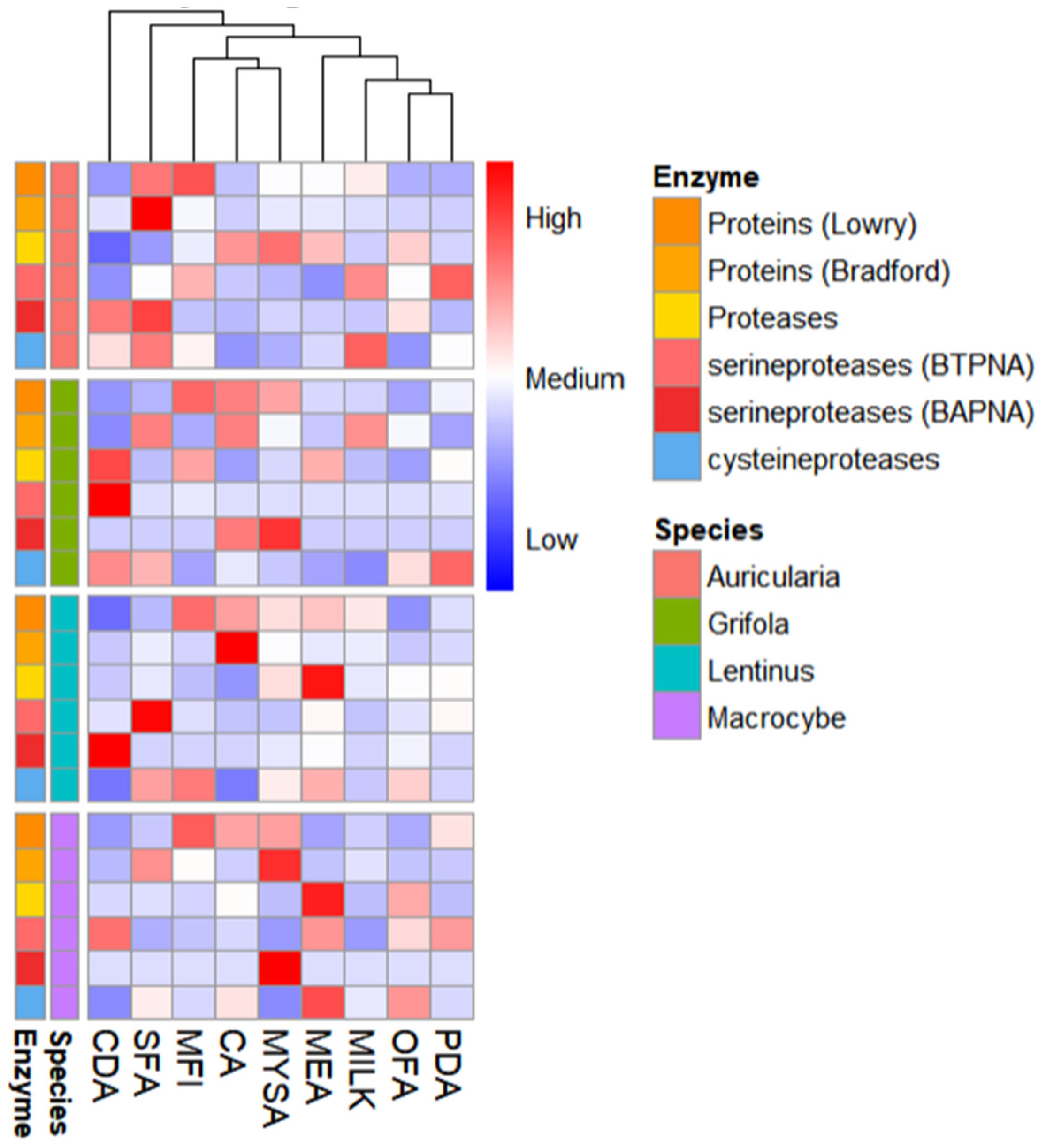
The results of the specific proteolytic activity analysis (U/mg of protein) shown in Table 1 and Figure 1 indicate no correlation. Although the MFI and casein media yielded highest total protein levels, the greatest specific activity was observed in media containing maltose (p < 0.05). Among the species analyzed, Grifola sp. emerged as the most potent producer of highly efficient enzymes (F(3.96) = 8.13, p < 0.001), significantly outperforming the other fungi in this characteristic (Table 1).
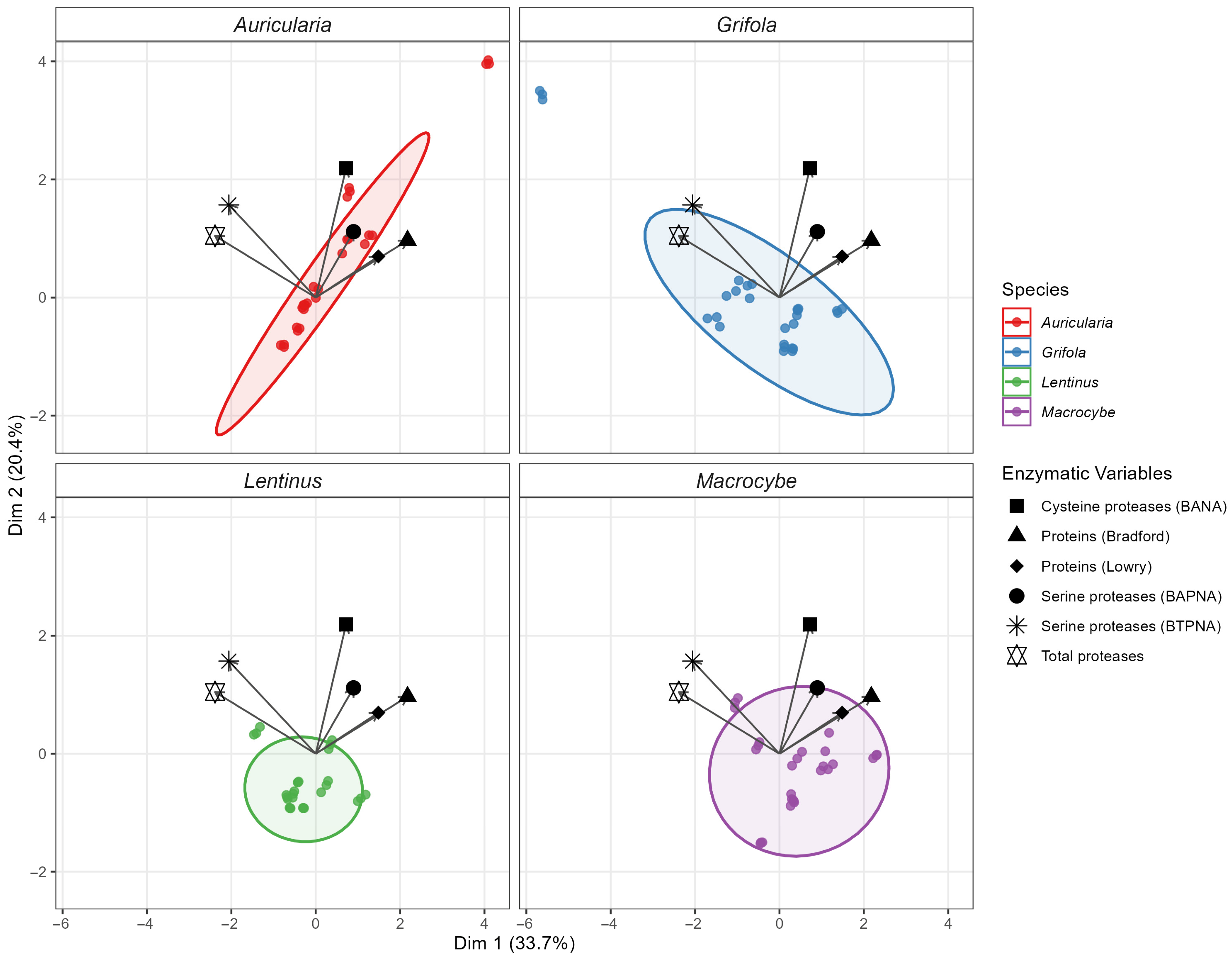
To visualize complex multivariate patterns, a hierarchical clustering heatmap was generated (Figure 1). This analysis revealed distinct visual clusters based on metabolic strategies, such as the pronounced clustering of high serine protease activity (BAPNA, BTPNA) for Grifola in the Czapek medium. To confirm and statistically quantify the metabolic segregation observed in the heatmap, a Principal Component Analysis (PCA) was performed (Figure 2). The first two principal components (PC1 and PC2) accounted for 54.1% of the total data variance, confirming a clear segregation of genera based on their metabolic responses.
The PCA results quantitatively reinforced the visual trends observed in the heatmap. A distinct cluster formed by Grifola showed a strong correlation with serine protease activity (BTPNA and BAPNA), which was positioned on the left side of PC1. This clear separation supports the hypothesis of metabolic derepression under nutritional stress, highlighting it as the predominant metabolic strategy for this genus. In contrast, the positioning of Macrocybe was associated with cysteine protease production, visually confirming the substrate induction hypothesis. The considerable overlap between the Lentinus and Macrocybe clusters further suggests a high degree of similarity in their overall proteolytic profiles compared to the highly specialized Grifola. This multivariate analysis emphasizes that the fungus–substrate interaction influences not only production yield but also defines a distinct enzymatic signature, enabling the targeted production of specific enzyme classes through the strategic selection of fungal species and cultivation substrates.
To assess the potential industrial relevance of the extracts obtained, caseinolytic activity was evaluated on solid media (Table 2). The results confirm the proteolytic capacity of Grifola frondosa, which produced the largest hydrolysis zone (24.50 mm2) in the MILK medium after 24 h, compared to the other extracts. Macrocybe sp. also displayed substantial activity, particularly in the soy flour medium (17.90 mm2), highlighting its efficiency in degrading plant-derived protein substrates. This plate assay provides clear visual evidence of the high enzymatic potency secreted by these selected strains.
To analyze the secondary structure of the secreted proteins, FTIR analysis was performed (Figure 2 and Table 2). The spectra of all fungal extracts showed characteristic protein bands. A broad band was observed in the range 3500–3200 cm−1, attributed to N–H and O–H stretching vibrations. The characteristic Amide I (C=O stretching), Amide II (N–H bending), and Amide III (C–N stretching and N–H bending) bands were identified around 1650–1630 cm−1, 1550–1530 cm−1, and 1242 cm−1, respectively (Table 3).

4. Discussion

The influence of substrate composition and nutrient bioavailability was evidenced by the superior performance of the MFI medium, where the synergistic effect between a readily assimilable carbon source (glucose) and a pre-hydrolyzed nitrogen source (soy peptone) likely promoted enhanced protein biosynthesis and secretion [21,22]. These results align with previous reports for Aspergillus sp., Lentinus villosus, and Pleurotus sajor-caju, in which peptone and glucose were also identified as optimal sources for protein and protease production, respectively [23,24,25]. Similarly, the high protein secretion observed in the medium containing casein reinforces the concept of substrate induction, whereby the presence of the target protein (casein) stimulates the secretion of the enzymatic machinery necessary for its hydrolysis [26].
In addition to the substrate, the fungal species itself was a significant factor influencing proteinogenesis (F(3.96) = 4.50, p = 0.005). Macrocybe sp. presented a higher protein yield (0.16 mg/mL) compared to Lentinus sp. (p = 0.004). However, an important finding of this study was the dissociation between the total amount of secreted protein and the specific enzymatic activity. This indicates that strategies aimed at maximizing total protein synthesis do not necessarily lead to increased production of specific biocatalysts of interest, highlighting that the fungus–substrate interaction determines not only the quantity but also the composition of the secretome [27].
The biomolecule production by Grifola frondosa has been widely reported, with emphasis on polysaccharides and their medicinal properties, whereas few studies have focused on optimizing substrate conditions to maximize enzymatic yield for industrial applications. Therefore, the higher enzymatic activity (U/mg protein) obtained for G. frondosa in this study indicates a more efficient and specific enzymatic extract, which may simplify and reduce the costs of subsequent purification processes [28].
The results also indicate that substrate selection is crucial for maximizing enzyme production. The superiority of maltose over glucose-rich media (such as MFI) in inducing specific activity suggests a catabolite repression mechanism. Glucose, being a readily assimilable monosaccharide, often represses the expression of enzymes required for the utilization of more complex substrates. In contrast, the disaccharide maltose may induce the secretion of a broader and functionally active set of enzymes necessary for its hydrolysis, a phenomenon also observed in other fungal systems [29,30].
Regarding the synthesis of specific enzymes, Grifola sp. exhibited marked specialization in the production of serine proteases, indicating that this is the predominant class in its secretome under the tested conditions. This specialization in Czapek medium, composed solely of inorganic nitrogen and sucrose, is particularly noteworthy, as it suggests a catabolic derepression mechanism in which the fungus, under nutritional stress, activates the expression of highly efficient “scavenging” enzymes (serine proteases) to hydrolyze any available protein residues [31]. This inference of distinct regulatory strategies is structurally supported by the FTIR results (Table 3), which reveal fundamentally different architectures between the secreted proteins. Meanwhile, cysteine protease production was higher in Macrocybe sp., with the greatest activity observed in the soy flour-based medium (SFM).
A substrate-induced regulation mechanism was evident in Macrocybe sp., where the presence of plant-derived proteins in soy flour acted as a biochemical signal promoting the synthesis of specific hydrolytic enzymes, namely cysteine proteases, optimized for the degradation of such substrates. This response aligns with previous reports describing the induction of papain-like cysteine proteases in fungi such as Aspergillus sp. when exposed to plant-based materials [32]. Meanwhile, Auricularia sp. and Lentinus sp. displayed a more heterogeneous enzymatic pattern with lower overall activity, indicating a generalized proteolytic strategy rather than substrate-specific adaptation, as observed in the more specialized Grifola and Macrocybe species.
The presence and definition of these amide bands are characteristic signatures of peptides and proteins, confirming the nature of the analyzed extracts. The Amide I band is particularly important, as it is highly sensitive to the protein secondary structure, such as α-helices and β-sheets [33,34]. Moreover, the FTIR results provided structural validation of the quantitative data. The spectra of Macrocybe extracts showed markedly higher intensities in the Amide I and II bands, particularly in the MFI and Casein media, consistent with the higher total protein concentrations previously determined by the Lowry and Bradford methods (Table 1). In contrast, Lentinus extracts displayed weaker bands, correlating with their lower protein yield. This analysis strongly supports the conclusion that the fungus–substrate interaction not only determines the amount of secreted protein but also influences the conformational characteristics and types of enzymes produced.
In addition to validating protein quantity, the deconvolution of the Amide I band provided structural evidence consistent with the inferred regulatory mechanisms (Table 3). The extracts of Grifola frondosa (Czapek medium), rich in serine proteases (inferred catabolic repression), exhibited a highly ordered structure dominated by β-sheets (75.5%). This high β-sheet content is characteristic of many stable fungal proteases and is often associated with the structural core of trypsin-like enzymes. In contrast, the extract of Macrocybe sp. (soy flour medium), rich in cysteine proteases (inferred substrate induction), was predominantly composed of random coil structures (60.8%). We recognize that the FTIR spectrum reflects the overall secreted protein pool and electrophoresis (SDS-PAGE or Zymography) is necessary for the accurate determination of the molecular mass and number of protease isoforms; however, the observed structural divergence serves as a crucial qualitative validation.
This suggests a less rigid and more flexible protein conformation or potentially the presence of a heterogeneous mixture of smaller peptides and proteins lacking a defined secondary structure. Such structural divergence reinforces the idea that the two fungi produce not only different enzyme classes but also proteins with fundamentally distinct architectures and potential stabilities, corroborating the conclusions obtained from the enzymatic activity assays. Further electrophoretic analyses will be performed to confirm the relative purity and molecular mass of the proteases induced under each condition.
The main biotechnological benefit of this study lies in the ability to customize the protease profile (serine or cysteine) by altering the culture medium. This method represents an industrial competitive advantage, allowing the production of customized enzyme cocktails. Grifola extracts (rich in serine proteases) can be applied in milk coagulation and the production of protein hydrolysates with functional and bioactive properties (such as antihypertensive activity and allergenicity reduction) [35,36,37]. Macrocybe extracts (rich in cysteine proteases) are ideal as alternatives to papain for meat tenderization and beer clarification [38]. Furthermore, the use of underexplored edible fungi confers an advantage in terms of regulatory and market acceptance.

5. Conclusions

This study expands the understanding of fungal biochemistry with direct relevance to food chemistry, providing a framework for the tailored production of enzymatic cocktails. The implications are straightforward: (I) for the production of a robust cocktail of serine proteases (including trypsin-like and chymotrypsin-like activities) with potential for complex hydrolysis or bioactive peptides generation, cultivation of Grifola sp. in minimal Czapek medium represents the most effective strategy; (II) for obtaining cysteine proteases analogous to enzymes such as papain, Macrocybe sp. grown on soy-based substrates is a promising system; (III) for crude extracts exhibiting broad general proteolytic activity aimed at co-product valorization, Grifola sp. cultivated in malt medium is ideal. This work represents a transition from empirical screening to mechanism-based bioprocess design, a critical step toward the development of biotechnological food ingredients with customized functionalities.

Author Contributions

G.L.-S.: conceptualization, investigation, formal analysis, writing—original draft preparation, writing—review and editing; W.J.M.-B.: conceptualization, writing—original draft preparation, writing—review and editing; D.B.P.: conceptualization, investigation, writing—original draft preparation; L.B.N.S.: conceptualization, methodology, writing—original draft preparation; A.S.V.: conceptualization, methodology, investigation, formal analysis, writing; V.A.P.: conceptualization, writing—original draft preparation; C.S.-C.: conceptualization, resources, supervision; L.R.C.: writing—review and editing conceptualization, supervision. All authors have read and agreed to the published version of the manuscript.

Funding

This study was funded by the Fundação de Amparo à Pesquisa do Estado do Amazonas (Public Notice No. 006/2019—Universal Amazonas, Process No. 062.00143/2020) and Resolution No. 002/2023—POSGRAD UEA, Conselho Nacional de Desenvolvimento Científico e Tecnológico (CNPq, Process No. 141036/2022-2), Coordenação de Aperfeiçoamento de Pessoal de Nível Superior—CAPES (Process number 88887.994959/2024-00, 88887.151528/2025-00 and 88887.941186/2024-00) and Iniciativa Amazônia +10, Resolução No. 023/2022, No. 01.02.016301.04655/2022-04, Ministry of Science, Technology and Innovation (MCTI)/Funding Agency for Studies and Projects (FINEP)/National Fund for Scientific and Technological Development (FNDCT)—Research, development and innovation focused on contemporary food systems, new ingredients, alternative proteins and new food technologies, Ref. No. 2881/22.

Data Availability Statement

The raw data supporting the conclusions of this article will be made available by the authors on request.

Acknowledgments

To the Instituto Nacional de Pesquisas da Amazônia (INPA) and the Edible Fungi Cultivation Laboratory (LCFC) for the structure and technical support and to the Fundação de Amparo à Pesquisa do Estado do Amazonas (FAPEAM) for the financial support.

Conflicts of Interest

The authors declare no conflicts of interest.

Abbreviations

The following abbreviations are used in this manuscript:
LCFCLaboratory of Edible Fungi Cultivation
INPANational Institute for Amazonian Research
PDAPotato Dextrose Agar
CACasein Agar
CDACzapek Dox Agar
MEAMalt Extract Agar
MYSAMalt Yeast Sucrose Agar
OFAOat Flakes Agar
SFASoy Flour Agar
MFISpecific medium for fibrinolytic proteases
MILKSpecific medium for proteases
DTTDithiothreitol
EDTAEthylenediaminetetraacetic acid
TCATrichloroacetic acid
NaOHSodium hydroxide
UAActivity unit
BANAN-benzoyl-DL-arginine β-naphthylamide hydrochloride
DMACAp-dimethylaminocinnamaldehyde
BAPNAN-benzoyl-DL-arginine-p-nitroanilide hydrochloride
BTPNAbenzoyl-L-tyrosine-p-nitroanilide
FTIRFourier Transform Infrared Spectroscopy
FTIR-ATRAttenuated Total Reflection Fourier-Transform Infrared
SDStandard deviation
ANOVAAnalysis of Variance
HSDHonest Significant Difference
PCAPrincipal Component Analysis

References

  1. Song, P.; Zhang, X.; Wang, S.; Xu, W.; Wang, F.; Fu, R.; Feng, W. Microbial Proteases and Their Applications. Front. Microbiol. 2023, 14, 1236368. [Google Scholar] [CrossRef] [PubMed]
  2. Yang, W.; Lu, F.; Liu, Y. Recent Advances of Enzymes in the Food Industry. Foods 2023, 12, 4506. [Google Scholar] [CrossRef] [PubMed]
  3. Meena, P.; Singh, V. Impact of Industrial Microbial Alkaline Proteases from Isolated Bacillus Strains. Ecol. Environ. Conserv. 2024, 30, S75–S78. [Google Scholar] [CrossRef]
  4. Niego, A.G.; Rapior, S.; Thongklang, N.; Raspé, O.; Jaidee, W.; Lumyong, S.; Hyde, K.D. Macrofungi as a Nutraceutical Source: Promising Bioactive Compounds and Market Value. J. Fungi 2021, 7, 397. [Google Scholar] [CrossRef]
  5. Sharma, E.; Rakesh, B.; Lal, P.; Sudeepta, P.; Kota, C.; Rajendra, P.; Kumar, A.; Muhammad Ahsan, A.; Rahul Kumar, T.; Milan Kumar, L.; et al. Edible Mushrooms Trending in Food: Nutrigenomics, Bibliometric, from Bench to Valuable Applications. Heliyon 2024, 10, e36963. [Google Scholar] [CrossRef]
  6. Ravikumar, G.; Gomathi, D.; Kalaiselvi, M.; Uma, C. A Protease from the Medicinal Mushroom Pleurotus sajor-caju; Production, Purification and Partial Characterization. Asian Pac. J. Trop. Biomed. 2012, 2, S411–S417. [Google Scholar] [CrossRef]
  7. Tanaka, M.; Gomi, K. Induction and Repression of Hydrolase Genes in Aspergillus oryzae. Front. Microbiol. 2021, 12, 677603. [Google Scholar] [CrossRef]
  8. Leger, R.J.S.; Durrands, P.K.; Cooper, R.M.; Charnley, A.K. Regulation of Production of Proteolytic Enzymes by the Entomopathogenic Fungus Metarhizium anisopliae. Arch. Microbiol. 1988, 150, 413–416. [Google Scholar] [CrossRef]
  9. Snyman, C.; Theron, L.; Divol, B. Understanding the Regulation of Extracellular Protease Gene Expression in Fungi: A Key Step towards Their Biotechnological Applications. Appl. Microbiol. Biotechnol. 2019, 103, 5517–5532. [Google Scholar] [CrossRef]
  10. Bezerra, V.H.S.; Cardoso, S.L.; Fonseca-Bazzo, Y.; Silveira, D.; Magalhães, P.O.; Souza, P.M. Protease Produced by Endophytic Fungi: A Systematic Review. Molecules 2021, 26, 7062. [Google Scholar] [CrossRef]
  11. Sousa, A.S.; Araújo-Rodrigues, H.; Pintado, M.E. The Health-Promoting Potential of Edible Mushroom Proteins. Curr. Pharm. Des. 2023, 29, 804–823. [Google Scholar] [CrossRef] [PubMed]
  12. Liu, P.; Zhang, Z.; Wu, D.; Li, W.; Chen, W.; Yang, Y. The Prospect of Mushroom as an Alterative Protein: From Acquisition Routes to Nutritional Quality, Biological Activity, Application and Beyond. Food Chem. 2024, 469, 142600. [Google Scholar] [CrossRef] [PubMed]
  13. Lima-Silva, G.; Vasconcelos, S.; Vieira, L.; Pessoa, V.A.; Pereira, D.B.; Batista, L.; Romenya, P.; Sales-Campos, C.; Chevreuil, L.R. Highlighting the Potential of an Amazonian Oyster Mushroom (Pleurotus ostreatus) through Comparison with Commercial Strains: Mycelial Growth and Protease Production in Different Culture Media. Appl. Biochem. Biotechnol. 2025, 197, 8302–8318. [Google Scholar] [CrossRef] [PubMed]
  14. Sobal, M.; Carrera, D.M.; Morales, P.; Roussos, S. Classical Characterization of Mushroom genetic Resources from Temperate And tropical Regions of México. Micol. Apl. Int. 2007, 19, 15–23. [Google Scholar]
  15. Bradford, M. A Rapid and Sensitive Method for the Quantitation of Microgram Quantities of Protein Utilizing the Principle of Protein-Dye Binding. Anal. Biochem. 1976, 72, 248–254. [Google Scholar] [CrossRef]
  16. Lowry, O.H.; Rosebrough, N.J.; Farr, A.L.; Randall, R.J. Protein Measurement with the Folin Phenol Reagent. J. Biol. Chem. 1951, 193, 265–275. [Google Scholar] [CrossRef]
  17. Hamada, S.; Kubota, K.; Sagisaka, M. Purification and Characterization of a Novel Extracellular Neutral Metalloprotease from Cerrena albocinnamomea. J. Gen. Appl. Microbiol. 2017, 63, 51–57. [Google Scholar] [CrossRef]
  18. Worthington Biochemical Corporation. Worthington Enzyme Manual; Worthington Biochemical Corporation: Lakewood, NJ, USA, 1972. [Google Scholar]
  19. Cruz, A.C.; Massena, F.S.; Migliolo, L.; Lima, L.; Monteiro, N.K.V.; Oliveira, A.S.; Macedo, F.P.; Uchôa, A.F.; Grossi, F.; Vasconcelos, I.M.; et al. Bioinsecticidal Activity of a Novel Kunitz Trypsin Inhibitor from Catanduva (Piptadenia moniliformis) Seeds. Plant Physiol. Biochem. 2013, 70, 61–68. [Google Scholar] [CrossRef]
  20. Menon, V.; Rao, M. A Low-Molecular-Mass Aspartic Protease Inhibitor from a Novel Penicillium sp.: Implications in Combating Fungal Infections. Microbiology 2012, 158, 1897–1907. [Google Scholar] [CrossRef]
  21. Bhanushali, R.M.; Panchal, H.K. Screening & Optimization Study on Fungal Proteases and Their Applications. Mukt Shabd J. 2020, IX, 7324–7338. [Google Scholar]
  22. Sun, Y.; Qian, Y.; Zhang, J.; Wang, Y.; Li, X.; Zhang, W.; Wang, L.; Liu, H.; Zhong, Y. Extracellular Protease Production Regulated by Nitrogen and Carbon Sources in Trichoderma reesei. J. Basic Microbiol. 2021, 61, 122–132. [Google Scholar] [CrossRef]
  23. Bano, S.; Dahot, M.U.; Naqvi, S.H.A. Optimization of Culture Conditions for the Production of Protease by Pleurotus eryngii. Pak. J. Biotechnol. 2016, 13, 193–198. [Google Scholar] [CrossRef]
  24. da Silva Braga, R.; de Matos Brito, É.C.; Souza, R.Á.T.; Teixeira, M.F.S.; Martim, S.R. Lentinus villosus Klotzsch (1833) AM 169: A Natural and Renewable Source of Alkaline Protease. Braz. J. Dev. 2020, 6, 85867–85883. [Google Scholar] [CrossRef]
  25. Londoño-Hernández, L.; García-Gómez, M.d.J.; Huerta-Ochoa, S.; Polanía-Rivera, A.M.; Aguilar, C.N.; Prado-Barragán, L.A. Effect of Glucose Concentration on the Production of Proteolytic Extract by Different Strains of Aspergillus under Solid-State Fermentation. Fermentation 2024, 10, 97. [Google Scholar] [CrossRef]
  26. Ekedegba, F.E.; Ogbonna, A.I.; Okoye, C.T.; Ogbonna, U.S.A.; Onyimba, I.A.; Madu, J.M. Optimization Studies on Extracellular Protease Production by Aspergillus niger and Aspergillus terreus Using Skim Milk Casein as Substrate. J. Adv. Biol. Biotechnol. 2022, 25, 11–19. [Google Scholar] [CrossRef]
  27. Filiatrault-Chastel, C.; Heiss-Blanquet, S.; Margeot, A.; Berrin, J.-G. From Fungal Secretomes to Enzymes Cocktails: The Path Forward to Bioeconomy. Biotechnol. Adv. 2021, 52, 107833. [Google Scholar] [CrossRef]
  28. Wu, J.-Y.; Siu, K.-C.; Geng, P. Bioactive Ingredients and Medicinal Values of Grifola frondosa (Maitake). Foods 2021, 10, 95. [Google Scholar] [CrossRef]
  29. Mattam, A.J.; Chaudhari, Y.B.; Velankar, H.R. Factors Regulating Cellulolytic Gene Expression in Filamentous Fungi: An Overview. Microb. Cell Factories 2022, 21, 44. [Google Scholar] [CrossRef]
  30. Ren, F.; Wu, F.; Wu, X.; Bao, T.; Jie, Y.; Gao, L. Fungal Systems for Lignocellulose Deconstruction: From Enzymatic Mechanisms to Hydrolysis Optimization. GCB Bioenergy 2024, 16, e13130. [Google Scholar] [CrossRef]
  31. Welter, A.L.; Machida, Y.J. Functions and Evolution of FAM111 Serine Proteases. Front. Mol. Biosci. 2022, 9, 1081166. [Google Scholar] [CrossRef]
  32. Nath, A.; Ahmad, A.S.; Amankwaa, A.; Csehi, B.; Mednyánszky, Z.; Szerdahelyi, E.; Tóth, A.; Tormási, J.; Truong, D.H.; Abrankó, L.; et al. Hydrolysis of Soybean Milk Protein by Papain: Antioxidant, Anti-Angiotensin, Antigenic and Digestibility Perspectives. Bioengineering 2022, 9, 418. [Google Scholar] [CrossRef]
  33. Schwaighofer, A.; Montemurro, M.; Freitag, S.; Kristament, C.; Culzoni, M.J.; Lendl, B. Beyond Fourier Transform Infrared Spectroscopy: External Cavity Quantum Cascade Laser-Based Mid-Infrared Transmission Spectroscopy of Proteins in the Amide I and Amide II Region. Anal. Chem. 2018, 90, 7072–7079. [Google Scholar] [CrossRef]
  34. Talaikis, M.; Strazdaitė, S.; Žiaunys, M.; Niaura, G. Far-Off Resonance: Multiwavelength Raman Spectroscopy Probing Amide Bands of Amyloid-β-(37–42) Peptide. Molecules 2020, 25, 3556. [Google Scholar] [CrossRef]
  35. Halavach, T.M. Efficient Enzymatic Hydrolysis of the Whey Protein Fraction from Bovine Milk. J. Glob. Innov. Agric. Sci. 2024, 12, 743–749. [Google Scholar] [CrossRef]
  36. Morellon-Sterling, R.; El-Siar, H.; Tavano, O.L.; Berenguer-Murcia, Á.; Fernández-Lafuente, R. Ficin: A Protease Extract with Relevance in Biotechnology and Biocatalysis. Int. J. Biol. Macromol. 2020, 162, 394–404. [Google Scholar] [CrossRef]
  37. Chang, C.; Gong, S.; Liu, Z.; Yan, Q.; Jiang, Z. High Level Expression and Biochemical Characterization of an Alkaline Serine Protease from Geobacillus stearothermophilus to Prepare Antihypertensive Whey Protein Hydrolysate. BMC Biotechnol. 2021, 21, 21. [Google Scholar] [CrossRef]
  38. Barido, F.H.; Lee, S.K. Tenderness-Related Index and Proteolytic Enzyme Response to the Marination of Spent Hen Breast by a Protease Extracted from Cordyceps militaris Mushroom. Anim. Biosci. 2021, 34, 1859–1869. [Google Scholar] [CrossRef] [PubMed]
Figure 1. Hierarchical clustering and heatmap of fungal enzymatic activities. The activity values for each assay were normalized using a row-wise Z-score to allow for comparison. Hierarchical clustering was applied to group both the enzymatic assays (rows) and the fungus-medium combinations (columns) based on their activity profiles. The color scale represents the relative activity, from low (blue) to high (red). Row annotations on the left categorize the assays by enzyme class.
Macromol 06 00009 g001
Figure 2. Principal Component Analysis (PCA) of the enzymatic profile of four fungal genera. The score plot illustrates the distribution of the samples, where each data point represents the enzymatic profile of a specific fungal species grown in one culture medium condition, based on the enzymatic variables. The groups are represented by Auricularia (red circles), Grifola (blue circles), Lentinus (green circles), and Macrocybe (purple circles). The axes represent the first two principal components (Dim1 and Dim2), which explain 33.7% and 20.4% of the total data variation, respectively. The vectors (arrows) indicate the contribution and correlation of each original variable (enzymatic activities and protein quantification) with the components. The ellipses represent the 95% confidence interval for each group.
Macromol 06 00009 g002
Table 1. Effects of culture medium and fungal species on total protein production and specific proteolytic activities. Significant differences between groups are denoted by the symbols “>” (greater than) and “<” (less than), indicating relative differences among treatment means.
VariableFactorF Statistic (df)p-ValueSignificant Differences in Culture Media (Tukey)Main Finding
Proteins (Lowry)MediumF(8.96) = 22.98<0.001MFI > CA > SFA > Mysa > OFAMFI promotes greater protein production
Proteins
(Bradford)
MushroomF(3.96) = 4.500.005Macrocybe > LentinusInterspecies differences
Total
Proteases
MushroomF(3.96) = 8.13<0.001Grifola > Auricularia; Macrocybe < GrifolaGrifola is the most productive
MediumF(8.96) = 6.46<0.001Malte > MFI > SFA > OFA; CDA inhibits Malt is the most efficient medium
Serine
proteinases
(BTPNA)
MushroomF(3.96) = 4.600.005Grifola > Auricularia; Grifola > Lentinus Grifola produces more
serine proteases
MediumF(8.96) = 3.98<0.001CDA > SFA ≈ MFI > OFA Czapek stimulates serine
proteinases
Serine
proteinases
(BAPNA)
MushroomF(3.96) = 8.31<0.001Grifola > Auricularia; Grifola > MacrocybeGrifola dominates production
MediumF(8.96) = 6.82<0.001CDA > SFA ≈ MEA Czapek stimulates serine
proteinases
Cysteine
proteinases
(BANA)
MushroomF(3.96) = 18.67<0.001Macrocybe > Auricularia;
Lentinus < Macrocybe
Macrocybe excels in cysteine
proteases
MediumF(8.96) = 2.960.005SFA > Mysa ≈ CA Soybean flour favors cysteine proteases
Note: CA: Casein Agar; CDA: Czapek Dox Agar; MEA: Malt Extract Agar; MFI: Specific medium for fibrinolytic proteases; Mysa: Malt Yeast Sucrose Agar; OFA: Oat Flakes Agar; SFA: Soy Flour Agar; BAPNA: Nα-Benzoyl-DL-arginine 4-nitroanilide hydrochloride; BTPNA: benzoyl-L-tyrosine-p-nitroanilide; BANA: Nα-Benzoyl-DL-arginine β-naphthylamide hydrochloride.
Table 2. Proteolytic (caseinolytic) activity of crude extracts from macrofungi grown in different media, evaluated by the casein agar hydrolysis zone assay. Values represent the hydrolysis zone area (mm2, mean ± standard deviation) after 16 and 24 h of incubation at 37 °C.
SpeciesCulture
Media
Area (mm2)
16 h24 h
LentinusPDA9.30 ± 0.0013.05 ± 3.89
MEA10.70 ± 0.0012.2 ± 0.14
MILK10.45 ± 0.2115.8 ± 0.28
MYSA14.80 ± 0.0014.8 ± 0.00
AuriculariaOFA4.30 ± 0.004.3 ± 0.00
SFA11.95 ± 0.0714.55 ± 0.07
MEA9.20 ± 0.009.55 ± 0.07
MFI9.50 ± 0.0010.2 ± 0.00
MILK8.35 ± 0.079.65 ± 0.21
MYSA7.65 ± 0.077.65 ± 0.07
Grifola frondosaPDA0.00 ± 0.0011.40 ± 0.42
CA10.20 ± 0.0010.20 ± 0.00
MILK15.45 ± 0.0024.50 ± 0.07 *
MacrocybeOFA7.20 ± 0.007.20 ± 0.00
CA9.75 ± 0.009.75 ± 0.00
SFA13.95 ± 0.0017.90 ± 0.28
MEA7.20 ± 0.007.20 ± 0.00
MILK10.10 ± 0.0710.10 ± 0.07
Activity is expressed as the area of the clarification halo (total halo area minus the well area), calculated from diameter measurement. Higher values indicate greater proteolytic activity of the crude extract against casein. PDA = Potato Dextrose Agar; Malt = Malt Agar; MILK = Specific medium for proteases (MILK/SP medium); MYSA = Malt Yeast Sucrose Agar; OFA = Oat Flakes Agar; MEA = Malt Extract Agar; SFA = Soy Flour Agar; Casein = Casein Agar; MFI = Specific medium for fibrinolytic proteases. * = extract with significant activity.
Table 3. Percentage distribution of protein secondary structure components in crude extracts of Grifola frondosa (grown in Czapek medium) and Macrocybe sp. (grown in soybean flour medium), determined by deconvolution of the FTIR spectrum in the amide I region (1600–1700 cm−1).
StructurePosition (cm−1)Percentage (%)
GrifolaMacrocybeGrifolaMacrocybe
β-sheet1628.61623.475.520.2
α-helix1656.4-19.1-
Turns1678.01673.25.418.9
Random coil-1645.0-60.8
Spectral deconvolution was performed by fitting Gaussian curves using the nonlinear least squares algorithm (minpack.lm package in the R environment). The assignment of vibrational modes to secondary structure elements followed the convention established in the literature: β-sheets (1620–1640 cm−1), α-helices (1645–1655 cm−1), turn-type structures (1660–1680 cm−1) and random coils (~1645 cm−1). The contribution of each component was calculated from the integrated area under each Gaussian curve normalized by the total area of the deconvoluted spectrum.
Disclaimer/Publisher’s Note: The statements, opinions and data contained in all publications are solely those of the individual author(s) and contributor(s) and not of MDPI and/or the editor(s). MDPI and/or the editor(s) disclaim responsibility for any injury to people or property resulting from any ideas, methods, instructions or products referred to in the content.