


Abstract
Poly(hydroxyalkanoates) (PHAs) have garnered significant attention due to their biodegradable and biocompatible properties, making them promising alternatives to conventional petroleum-based plastics. As microbial-derived polyesters, PHAs offer a sustainable solution to plastic waste accumulation and microplastics because they can be produced from renewable resources, including food-related waste. Poly(3-hydroxybutyrate-co-3-hydroxyvalerate) (PHBV), a copolymer in the PHA family, exhibits improved mechanical flexibility and thermal properties compared to poly(3-hydroxybutyrate), thereby broadening its potential applications. In this work, eight samples of PHBV, including those made from food waste and municipal waste streams, were studied by solid-state NMR. Information obtained includes the copolymer composition, chemical shifts due to crystalline lattices, crystallinity, and polymer chain mobility. The composition matches the results from the fatty acid feed and solution NMR analysis. The samples appear to be about 62–70% crystalline. No significant differences in mobility are observed from NMR relaxation data. These results indicate that PHBV materials generated from different food-related waste sources, despite their compositional differences, possess similar crystallinity and molecular mobility, suggesting their suitability as biobased semi-crystalline plastics.
1. Introduction
Polyhydroxyalkanoates (PHAs) are biobased, biodegradable, and eco-friendly polymers synthesized by various microorganisms as intracellular carbon and energy storage materials [1,2]. Among them, poly(3-hydroxybutyrate-co-3-hydroxyvalerate) (PHBV) is one of the most widely studied [3,4,5]. Its composition can be tuned by adjusting the microbial fermentation conditions, particularly the carbon source, resulting in materials with diverse physical and mechanical properties. PHBV has attracted significant interest as a biodegradable and biocompatible alternative to petroleum-based plastics, with applications in packaging, agriculture, biomedicine, personal care, and other industrial sectors.
The physical properties of PHBV, such as crystallinity, thermal stability, and mechanical performance, are affected by the ratio of 3-hydroxybutyrate (HB) to 3-hydroxyvalerate (HV) in the copolymer [3,4,5]. A higher HV content generally reduces crystallinity, leading to increased flexibility and lower melting temperatures. Thus, understanding and controlling the HB/HV composition is essential for tailoring PHBV to specific end uses.
Solid-state NMR has proven to be a powerful technique for studying the molecular and structural characteristics of polymers [6,7]. For example, solid-state NMR has been extensively used to study insoluble and semi-crystalline polyolefins, providing insight into their structure, crystallinity, and morphology [8,9,10,11]. Similarly, solid-state NMR techniques are highly effective for investigating PHBV copolymers. Key features of PHBV accessible by solid-state NMR include the monomer composition, crystallinity, phase separation, and molecular mobility [12,13,14,15,16,17,18,19,20,21]. Because PHBV is semi-crystalline, these structural characteristics strongly influence its material behavior. Cross-polarization magic angle spinning (CP-MAS) 13C NMR provides spectral signals that are sensitive to the local molecular environment, allowing researchers to distinguish crystalline and non-crystalline regions and to estimate the degree of crystallinity [13,18,19]. Crystalline domains typically exhibit sharper and more defined 1H peaks, while amorphous regions produce broader 1H signals [20,21]. In addition, solid-state NMR can probe molecular motion in PHBV, offering insights into the dynamics of the polymer chains. Relaxation experiments [14,15,21] help characterize the flexibility of the polymer and the mobility of different segments, and this information is useful for understanding the thermal and mechanical behavior of PHBV.
A promising approach for producing PHAs is to use food waste as low-cost carbon sources. The processes, production, challenges, and opportunities of this approach have been reviewed in several publications [22,23,24,25]. Recently, the IATA/CSIC Novel Materials and Nanotechnology Group in Spain has developed several new PHBV materials using different bacterial cultures and evaluated their film-forming and electrospinning properties [26,27,28,29,30]. A particularly interesting series of PHBV copolymers was produced from food-related waste (cheese whey, fruit, and municipal wastewater). We previously characterized some of these copolymers using solution NMR to determine their composition and sequence distribution [31]. An advantage of these copolymers is not only the different types of food waste used but also the range of copolymer compositions covered. In this work, we studied these materials with solid-state NMR, with a particular emphasis on their composition, chemical shifts due to crystalline lattices, crystallinity, and polymer dynamics.
2. Materials and Methods
2.1. Materials
The PHBV copolymers used in this study included a commercially available PHBV sample as well as several lab-produced materials with varying HV contents. The lab-produced polymers were generated using mixed microbial cultures fed with inexpensive food-related waste and by-products, such as fermented fruits, dairy waste (cheese whey), and municipal wastewater (as summarized in Table 1). The commercial PHBV sample, ENMATTM Y1000P, was manufactured by Tianan Biologic Materials (Ningbo, China) and acquired from Ocenic Resins S.L., Valencia, Spain. The production and purification processes for the lab-produced polymers have been reported previously [26,27,28,29,30]. In brief, these materials were synthesized via fermentation of fruit residues, cheese whey, and wastewater to produce volatile fatty acids, which served as carbon sources for PHA-producing microorganisms. Once the microbial population reached a substantial level, the nutrient composition was adjusted to induce PHBV synthesis. By modifying cultivation conditions and supplementing with additional HV precursor valeric acid, a range of PHBV compositions were obtained.
Table 1.
PHBV samples used in this investigation and their compositions (mole % HV, hydroxyvalerate), including the expected composition from feed and the compositions determined by solution NMR, solid-state CP-MAS, and solid-state SPE-MAS.
For isolation and purification, each PHBV sample was dissolved in chloroform at a concentration of 5 wt% and stirred for 24 h at 50 °C to degrade non-PHBV cellular components. The resulting solution was transferred to a centrifuge tube, and distilled water was added at a 50 wt% ratio. After manual shaking, the mixture was centrifuged at 4000 rpm for 5 min. The PHBV suspension was carefully collected from the bottom of the tube using a pipette and transferred to a beaker, where it was allowed to dry until the solvent had fully evaporated. The final PHBV materials exhibited a purity exceeding 90% [31].
The expected PHBV compositions listed in Table 1 were determined differently for the commercial and lab-produced samples. For the commercial PHBV, the composition was taken from the technical data sheet. In contrast, the compositions of the bio-waste-derived PHBVs were measured in the biomass prior to purification using gas chromatography, following the previously described method [32]. Analyses were performed using a Varian CP-3800 gas chromatograph equipped with a flame ionization detector and a ZB-WAX Plus column (60 m length, 0.53 mm internal diameter, 1 μm film thickness; Phenomenex, Torrance, CA, USA).
2.2. Solid-State NMR Analysis
In this work, several NMR experiments were employed to provide corroborative information. The CP-MAS, SPE-MAS, and VCT experiments were conducted on a Varian Unity-Plus-200 spectrometer (Palo Alto, CA, USA) equipped with a Doty Scientific 7 mm Supersonic CP-MAS probe and operating at a 13C resonance frequency of 50.2 MHz. Cross-polarization (CP) experiments were performed utilizing the variable amplitude CP pulse sequence to minimize spin modulation effects on the quantitative nature of the experiment. Inverse-gated proton decoupling was applied during acquisition, and magic angle spinning (MAS) was carried out at approximately 6 kHz. The CP-MAS experiments used a 3 ms contact time (2 ms for the untreated sample A), and a relaxation delay of 6–8 s, with D1 arrays analyzed for each sample to determine the optimal relaxation delay.
The 13C single pulse excitation (SPE)–MAS experiments (with inverse-gated proton decoupling) allowed for a quantitative assessment of 13C chemistry but required much longer experimental time to obtain similar signal-to-noise as CP-MAS. Variable contact time (VCT) experiments (contact time varying between 0.2 and 10 ms) were used to observe the effect of chain mobility and heterogeneity on the spin dynamics behavior of the molecules. From the VCT data, cross-polarization and cross-relaxation parameters, including TCH (the cross-polarization rate constant) and T1ρH (the 1H spin-locked spin–lattice relaxation time), were extracted by curve fitting the signal intensity profiles to a one-component, two-exponential equation (Equation (1)), assuming that all carbons were in similar motional domains.
Intensity = [M∞ − (M∞ − M0) × exp (−t/TCH)] × exp (−t/T1ρH) + M0
The two relaxation times that were obtained from this experiment were related to the mobility of the carbons being observed. Lower mobility (higher crystallinity or sample heterogeneity) tended to produce shorter TCH values and longer T1ρH values. As mobility increased (e.g., with increasing amorphous/homogeneous character), TCH tended to increase, and T1ρH tended to decrease.
3. Results and Discussion
3.1. Copolymer Composition
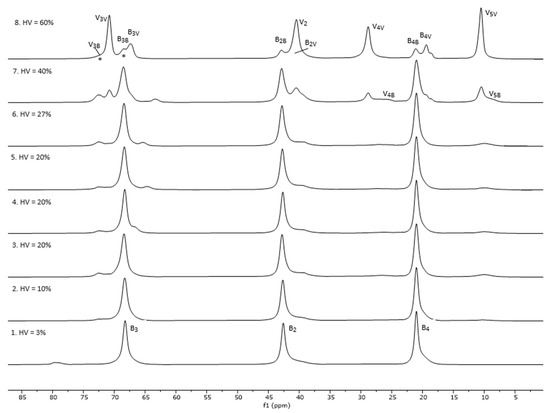
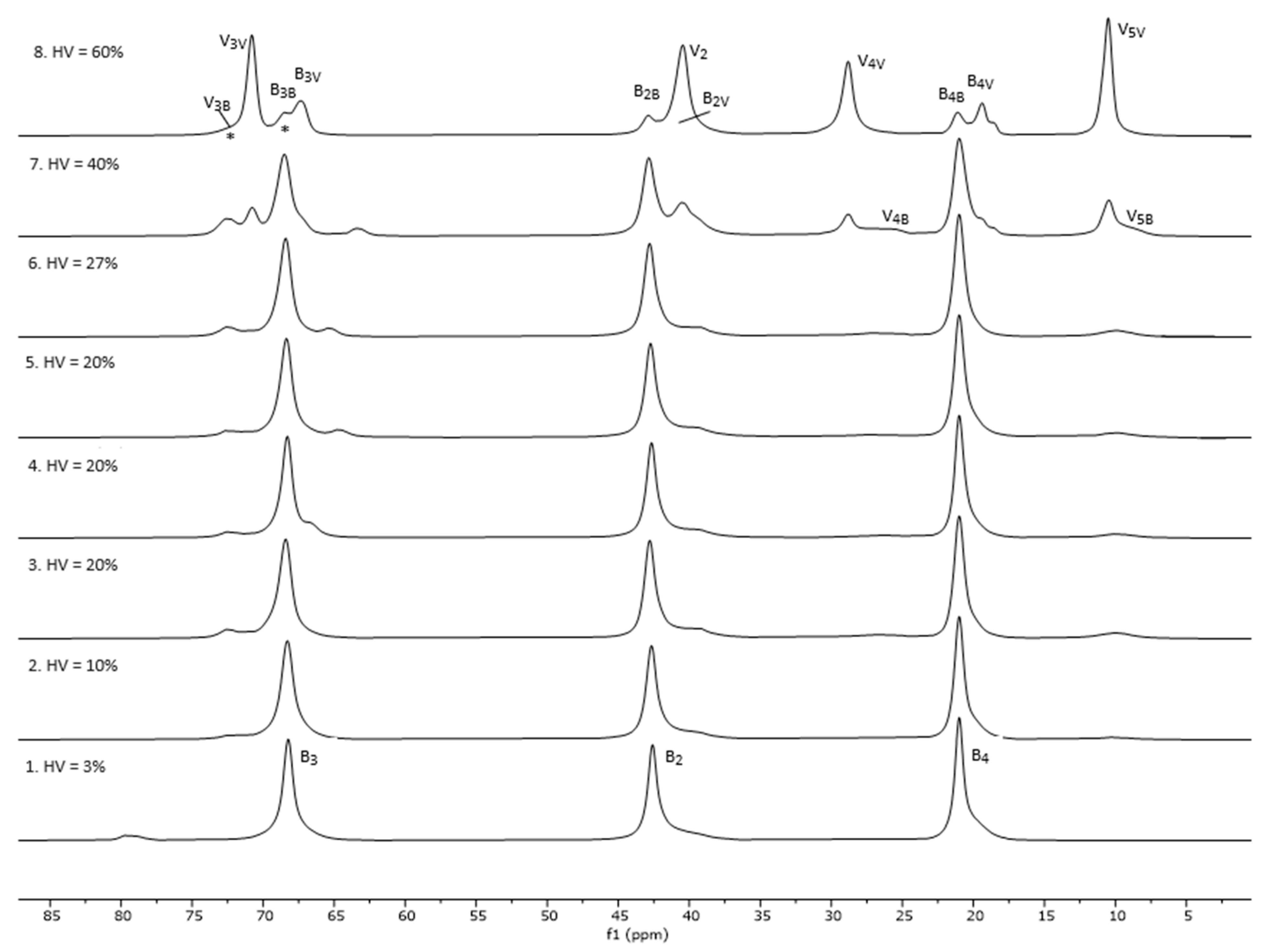
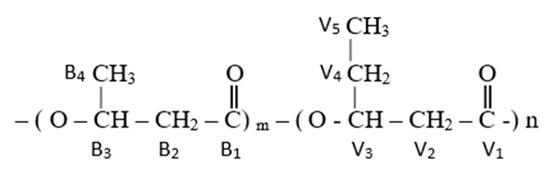
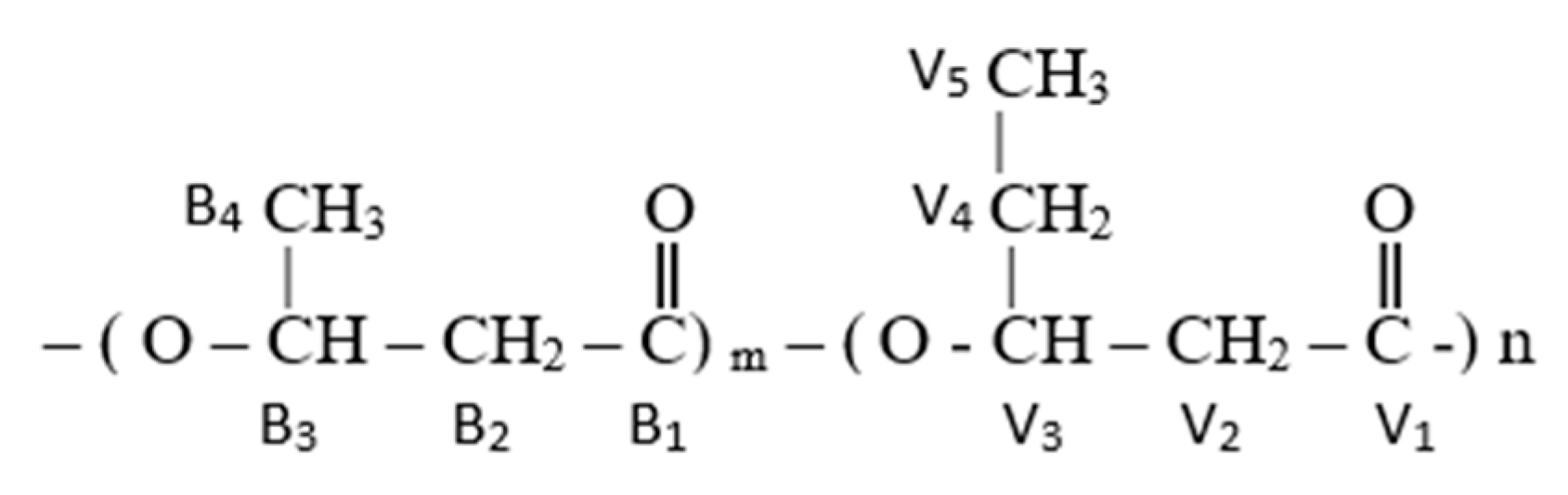
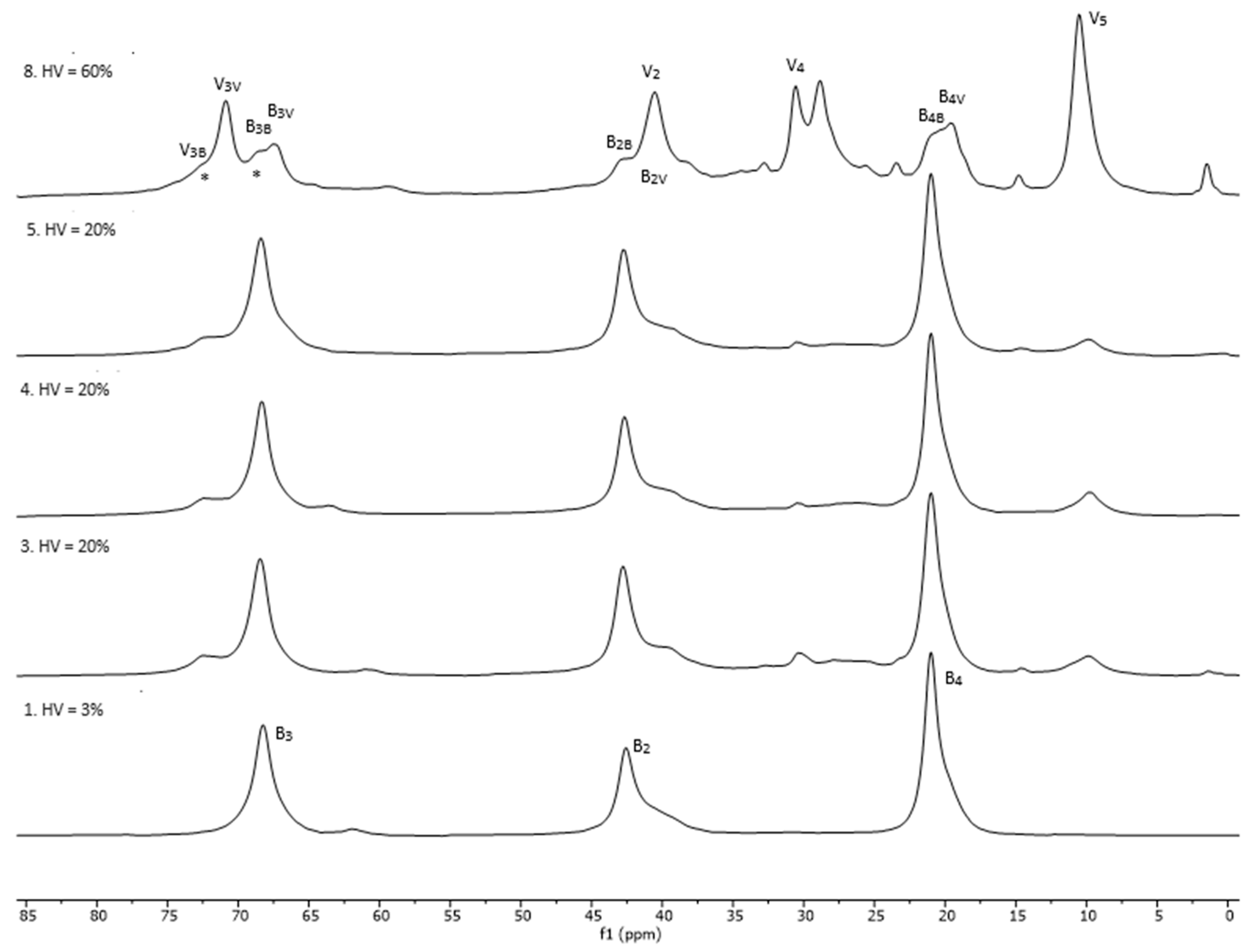
Eight copolymer samples were selected for this study, including a commercial sample (Sample 1), two samples sourced from municipal wastewater (Samples 2 and 4), one from fruit residues (Sample 3), and four from cheese whey (Samples 5–8), as detailed in Table 1. The solid-state 13C CP-MAS spectra for all eight samples are shown in Figure 1. The solid-state 13C SPE-MAS spectra for five of the samples are presented in Figure 2. The carbon numbers are provided in Scheme 1, and the peak assignments are noted directly on the spectra. From the peak intensities, the composition of each sample can be obtained.
Figure 1.
Solid-state 13C CP-MAS spectra of PHBV samples 1–8 in the range of 5–85 ppm. The letters B and V denote hydroxybutyrate and hydroxyvalerate, respectively. The first subscript indicates the carbon number (see Scheme 1), while the second subscript (B or V) specifies the crystalline lattice in which the carbon resides. The asterisk marks the possible presence of an amorphous peak.
Figure 2.
Solid-state 13C SPE-MAS of PHBV samples 1, 3, 4, 5, and 8 in the range of 0–85 ppm. The letters B and V denote hydroxybutyrate and hydroxyvalerate, respectively. The first subscript indicates the carbon number (Scheme 1), while the second subscript (B or V) specifies the crystalline lattice in which the carbon resides. The asterisk marks the possible presence of an amorphous peak.
Scheme 1.
Numbering scheme for PHBV.
The expected compositions from the fatty acid feed, the compositions reported previously from solution NMR, and the compositions derived from the current solid-state NMR data are also provided in Table 1. Notably, the composition data from CP-MAS provide generally lower HV values than those reported earlier from solution NMR [31]. It is known that in CP-MAS, the signal intensities are often biased by factors such as the cross-polarization efficiency and relaxation times, making them less quantitative. For this reason, the 13C SPE-MAS experiments (with gated proton decoupling) provided more quantitative results but required longer spectral acquisition times. Indeed, the data for SPE-MAS (last column in Table 1) show better agreement with the solution NMR data. These are also generally consistent with the expected composition from the fatty acid feed, except for the sample with the lowest content of HV derived from cheese whey (sample 5), probably because of the extraction process applied [33].
3.2. 13C Shifts Due to Crystal Lattice
In addition to providing composition information, some solid-state NMR peaks also show changes in 13C chemical shifts as a result of the composition. Thus, in Figure 1 for carbons V3, B3, V4, B4, and V5 in samples 7 and 8, two peaks can be seen covering 2 ppm or more for each carbon. This observation was also reported earlier by Kamiya et al. [13]. They noted three possible sources of multiple peaks, the comonomer sequence distribution, crystalline/amorphous regions, and crystalline lattice structures, with the most likely source being the crystalline lattice structures. Indeed, from our earlier work, the 13C shifts caused by the sequence distribution only spanned a shift range of about 0.2 ppm [31]. Consistent with Kamiya et al. [13], the assignments of the peaks due to crystalline lattices are shown in Figure 1. The SPE-MAS spectra in Figure 2 show similar results. Moreover, for samples 3, 4, and 5 (ca. 20% HV, from fruits, water residuals, and cheese whey), there seems to be no quantitative difference in the types of crystalline lattices observed.
3.3. Crystallinity
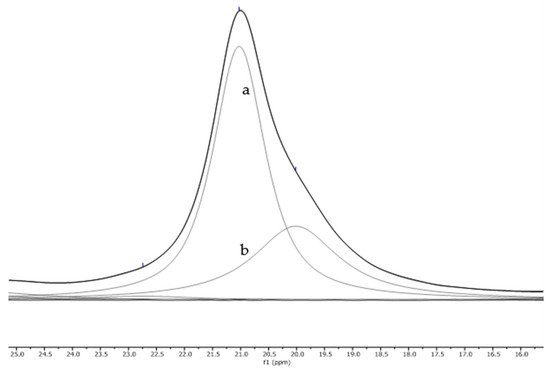
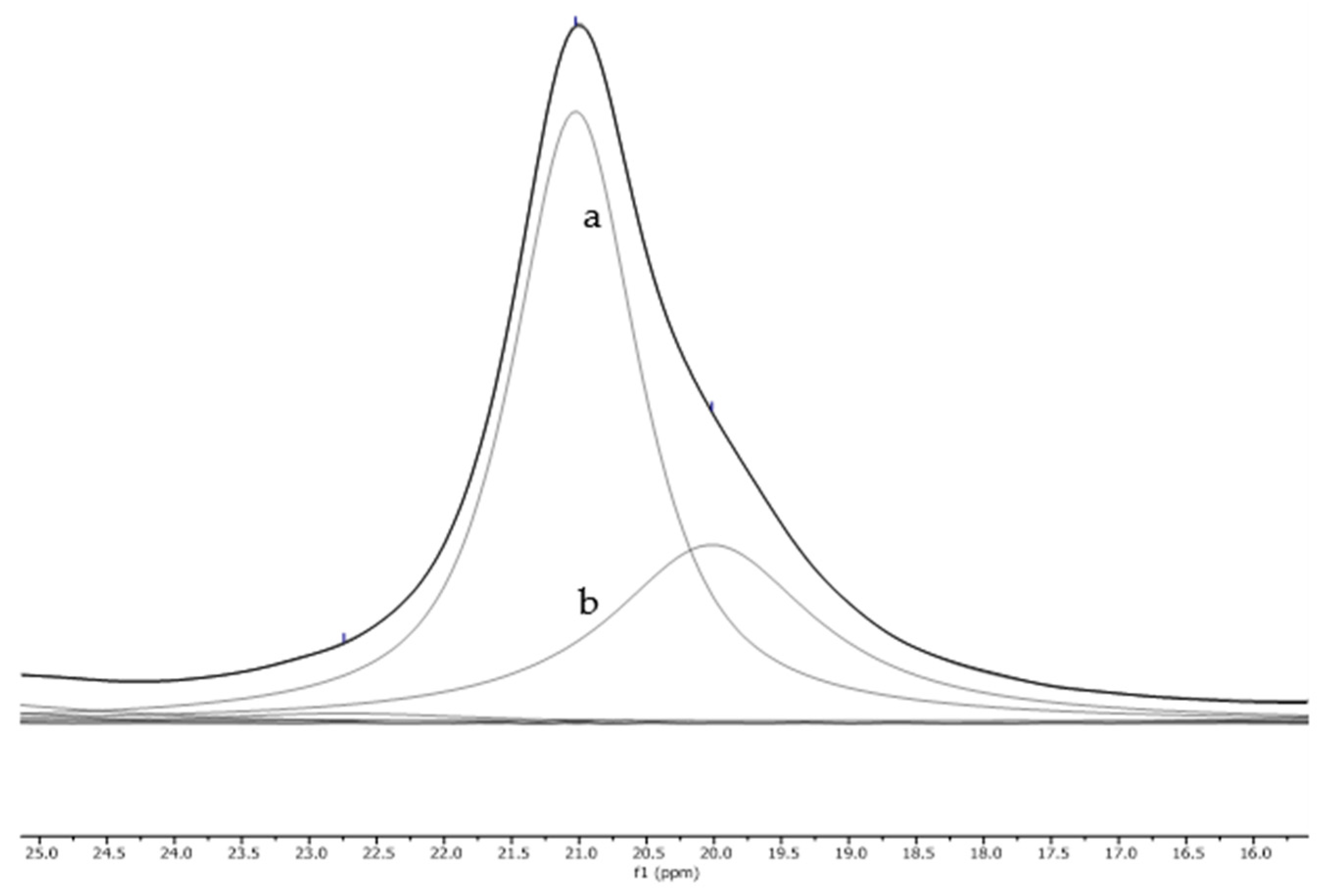
Earlier, Chen et al. [20] and Zhang et al. [21] investigated the structure and the mobility of the non-crystalline region of PHBV. Following Chen et al. [20], we took the butyrate methyl peak in the HB-rich region (20.9 ppm) of each CP-MAS spectrum and deconvoluted it to a narrow component (for crystalline fraction) and a broad component (for amorphous fraction). An example for sample 5 is shown in Figure 3. The results (Table 2, column 3) suggest that the crystallinity in the HB-rich region is roughly the same, about 76%. A similar analysis for the same methyl peaks in the available SPE-MAS spectra (Table 2, column 5) yields slightly lower values, with an average crystallinity of 70.5% in the HB-rich region. This latter result is considered more reliable, as the SPE-MAS is a more quantitative technique. However, due to the lower peak resolution of the SPE-MAS spectra and the severe overlap between peaks from HB-rich and HV-rich regions, the crystallinity in the HB-rich region of sample 8 could not be determined in the SPE-MAS spectrum. Overall, our analysis indicates that crystallinity in the HB-rich region of PHBV samples is comparable, consistent with earlier findings [13,20,21]. Notably, despite the use of different food-related wastes as bacterial sources, the crystallinity results remain similar.
Figure 3.
Solid-state 13C SPE-MAS methyl peak for PHBV sample 5; it can be deconvoluted to two component curves (a and b): a narrow component (a, 66%) and a broad component (b, 34%).
Table 2.
Percentages of crystalline and amorphous fractions estimated from the HB-rich regions in 13C CP-MAS and 13C SPE-MAS experiments.
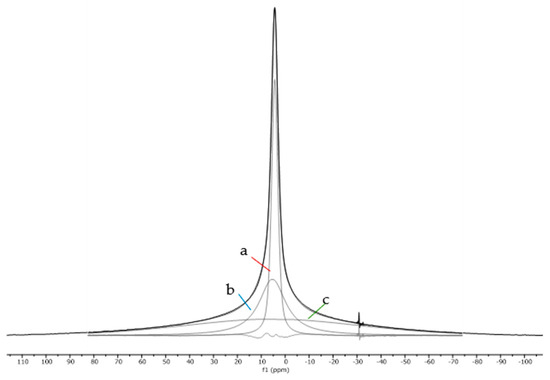
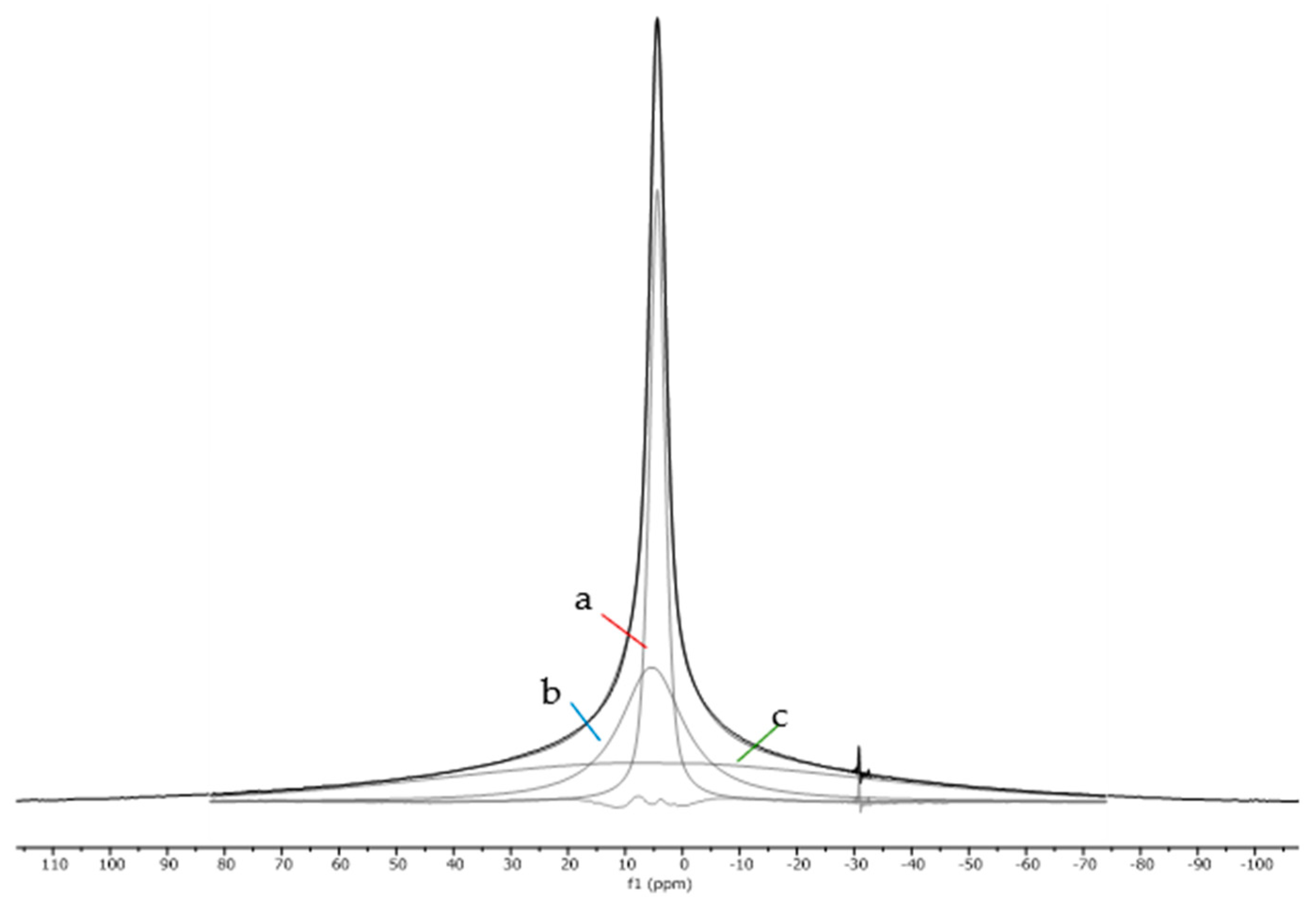
Another measure of crystallinity can be obtained from 1H SP-static NMR data. The 1H NMR spectra could not be deconvoluted to two components; instead, the use of three components produced satisfactory fits, including one narrow component (linewidth at half-height, LWHH, being less than 800 Hz), one medium in breadth (LWHH: 1200–4000 Hz), and one broad component (LWHH: 5000–15,000 Hz). An example of sample 5 is shown in Figure 4. The full results are summarized in Table 3. In general, the proportion of the broad component averages to about 38%, corresponding roughly to the amorphous region. The two narrower components correspond to different crystalline domains, with a total crystalline domain at about 62%. This result is slightly lower than the crystallinity estimated from the 13C CP-MAS and the 13C SPE-MAS data.
Figure 4.
The solid-state 1H SPE static spectrum for PHBV sample 5; it can be deconvoluted to three components: a narrow component (a, 27.3%), a medium component (b, 29.8%), and a broad component (c. 42.9%).
Table 3.
Analysis of 1H SP static NMR data via the three-component model.
Because the samples are derived from different bacterial sources, it is possible that they exhibit somewhat different behavior and may show compositional heterogeneity [31]. The 1H linewidths at half-height (LWHH) in Table 3 indicate that several of the peak components are exceptionally broad, which may suggest the presence of some heterogeneity. Samples 5–8, all obtained from cheese whey, display a trend in which the narrow component increases in intensities from 27% in sample 5 to 45% in sample 8, whereas the broad component appears to decrease correspondingly.
3.4. Mobility and Heterogeneity from Relaxation Times
The TCH and T1ρH relaxation times can be obtained from the CP-MAS-variable contact time (VCT) experiment, and these two parameters sometimes indicate the relative mobility and sample heterogeneity within a sample [34]. An example of the CP-MAS-VCT plot is provided in Figure S2. Table 4 presents the relaxation times for the carboxyl resonance, which could be fitted through the single-component analysis. For all eight samples of PHBV, the TCH values fall in a relatively narrow range of 865–1279 μs, and T1ρH values in the narrow range of 14.8–31.9 ms. Thus, these relaxation parameters are not sensitive to the sample composition. The results from this section and Section 3.3 suggest that PHBVs made from different food-related waste substances are not significantly different from one another with respect to crystallinity and molecular mobility.
Table 4.
CP-MAS-VCT relaxation times for PHBV samples obtained by fitting the carbonyl peaks through one-component analysis.
3.5. Comparison with Prior Work
In an earlier publication [30], Melendez et al. carried out electrospinning on four of the PHBV samples studied herein (samples 1, 5, 7, and 8) to produce fiber mats, which were annealed to generate bio-papers. Some of the results of their analyses can be compared with our NMR data to illustrate the utility of solid-state NMR as a complementary technique. A key finding in their earlier studies involved the wide-angle X-ray diffraction (WAXD) data, where they showed that sample 5 (with 20% HV) exhibited a PHB crystal morphology, sample 7 (with 40% HV) displayed the coexistence of PHV and PHB crystalline morphologies, and sample 8 (with 60% HV) showed a mostly PHV crystal morphology. These results are consistent with our solid-state NMR data in Figure 1. Thus, for sample 5, the major NMR peaks observed in Figure 1 are B3B, B2B, and B4B, corresponding to carbons in the PHB crystalline lattice. For sample 7, the peaks for B3B, B2B, and B4B are also present but so are B3V and B4V. Moreover, peaks can be distinctly seen for V3V, V3B, V4V, V4B, V5V, and V5B, indicating not only the coexistence of PHB and PHV crystals but also the likelihood of cocrystallization. Most of these peaks in sample 7 also appear in sample 8, except that the peak intensities are different; peaks V3V, V4V, and V5V are predominant, and peaks V3B, V4B, and V5B are almost negligible, confirming the presence of the PHV crystalline lattice. Also of interest are the B3 and B4 peaks: the intensities of the B3V and B4V peaks are only slightly larger than those of B3B and B4B. The possibility of cocrystallization was also noted earlier by Kamiya et al. [13].
Melendez et al. also conducted a DSC analysis on the same samples [30]. During the first heating, they observed a single melting point at 154.2 °C for sample 5, broad melting with two maxima of melting at 67.7 and 139.3 °C for sample 7, and a more defined melting point at 80.6 °C for sample 8. However, in the second heating, the melting points were 128.0 °C/153.8 °C, 152.6 °C, and 131.0 °C for samples 5, 6, and 7, respectively, whereas the melting curves were somewhat broad for samples 6 and 7. As they noted, their complex DSC data were consistent with the WAXD results; their data also align with solid-state NMR data produced here, where the broad melting temperatures observed likely reflect the mixed crystalline morphologies shown in Figure 1.
From their WAXD data, Melendez et al. [30] also calculated % crystallinity values of 43%, 37%, and 47% for samples 5, 7, and 8, respectively. These values support the NMR crystallinity data, indicating that these samples have roughly the same % crystallinity (Figure 3 and Table 2). The exact values for % crystallinity measured by NMR (about 62–70%) are higher than those observed for WAXD (37–47%). It is well-known that the % crystallinity values for many polymers measured by WAXD are lower than those determined by solid-state NMR, owing to the different length and time scales inherent to the two techniques [35,36]. It may also be noted that earlier WAXD studies of PHBV samples across a range of compositions reported the % crystallinity to be about 52–70% [37], much closer to the NMR results obtained in this work.
4. Conclusions
In the United States, approximately 30–40% of the food supply is wasted, amounting to more than 100 million tons of food waste each year. Food-related waste streams can serve as valuable and inexpensive carbon sources for producing PHAs, thereby lowering production costs and adding value to waste materials. In particular, we are interested in PHBV copolymers generated from selected food waste (such as cheese whey and fruit residues) and municipal waste streams. In this work, PHBV samples derived from these food-related wastes were analyzed using solid-state NMR, with an emphasis on the polymer composition, crystallinity, and molecular dynamics. Despite the possibility of sample heterogeneity, the solid-state NMR parameters display compatible trends, suggesting that PHBVs produced from food-related wastes can be useful as semi-crystalline bioplastic materials. For the PHBV samples derived from cheese whey, the NMR results appear to be consistent with previously published WAXD and DSC data. In particular, both NMR and WAXD indicate that the % crystallinity of the PHBV copolymer samples are roughly the same. Moreover, as with WAXD, the NMR results provide specific information on the crystal morphology (PHB, PHV, or mixture), and these morphologies depend on the copolymer composition.
This work demonstrates that solid-state NMR is a powerful analytical tool for studying PHBV, particularly with respect to its structure, crystallinity, and polymer dynamics. Incorporating solid-state NMR into future PHA characterization efforts will be highly beneficial for guiding continued development and supporting novel applications.
Supplementary Materials
The following supporting information can be downloaded at https://www.mdpi.com/article/10.3390/macromol5040061/s1, Figure S1: Solid-state 13C CP-MAS of PHBV samples at full sweep width; Figure S2: The lower graph shows the 13C CP-MAS-variable-contact time plots for PHBV sample 5; the upper graph provides the intensity plot for the carbonyl resonance, which is amenable to the one-component fit.
Author Contributions
Conceptualization, H.N.C. and A.B.; investigation and data curation, A.B., H.N.C., and J.C.E.; resources, A.B., H.N.C., and J.C.E.; writing—original draft preparation, H.N.C. and A.B.; writing—review and editing, A.B., H.N.C., and J.C.E. All authors have read and agreed to the published version of the manuscript.
Funding
This work was supported by the U.S. Department of Agriculture, Agricultural Research Service. A.B. acknowledges the receipt of a fellowship from the OECD Co-operative Research Program: Biological Resource Management for Sustainable Agricultural Systems in 2019 (Contract No. JA00100828).
Data Availability Statement
The raw data supporting the conclusions of this article will be made available by the authors on request.
Acknowledgments
The authors strongly acknowledge the contributions of Beatriz Melendez-Rodriguez, Cristina Prieto, and Jose Maria Lagaron (Novel Materials and Nanotechnology Group, IATA, CSIC, Valencia, Spain), who supplied the samples used and provided helpful information Mention of trade names or commercial products in this publication is solely for the purpose of providing specific information and does not imply recommendation or endorsement by the U.S. Department of Agriculture; USDA is an equal opportunity provider and employer.
Conflicts of Interest
Author John C. Edwards is employed by the company Process NMR Associates, LCC. The remaining authors declare that this research was conducted in the absence of any commercial or financial relationships that could be construed as a potential conflict of interest.
References
- Atarés, L.; Chiralt, A.; González-Martínez, C. Production of Polyhydroxyalkanoates for Biodegradable Food Packaging Applications Using Haloferax mediterranei and Agrifood Wastes. Foods 2024, 13, 950. [Google Scholar] [CrossRef] [Scilit]
- Chen, G.-Q.; Patel, M.K. Plastics Derived from Biological Sources: Present and Future: A Technical and Environmental Review. Chem. Rev. 2012, 112, 2082–2099. [Google Scholar] [CrossRef] [Scilit]
- Jo, S.Y.; Lim, S.H.; Lee, J.Y.; Son, J.; Choi, J.-I.; Park, S.J. Microbial production of poly(3-hydroxybutyrate-co-3-hydroxyvalerate), from lab to the shelf: A review. Int. J. Biol. Macromol. 2024, 274, 133157. [Google Scholar] [CrossRef] [Scilit]
- Rivera-Briso, A.L.; Serrano-Aroca, A. Poly(3-Hydroxybutyrate-co-3-Hydroxyvalerate): Enhancement Strategies for Advanced Applications. Polymers 2018, 10, 732. [Google Scholar] [CrossRef] [Scilit]
- Liu, Q.; Zhang, H.; Deng, B.; Zhao, X. Poly(3-hydroxybutyrate) and Poly(3-hydroxybutyrate-co-3-hydroxyvalerate): Structure, Property, and Fiber. Int. J. Polym. Sci. 2014, 2014, 374368. [Google Scholar] [CrossRef] [Scilit]
- Müller, K.; Geppi, M. Solid State NMR: Principles, Methods, and Applications; Wiley-VCH: Weinheim, Germany, 2021. [Google Scholar]
- Cheng, H.N.; Asakura, T.; English, A.D. (Eds.) NMR Spectroscopy of Polymers: Innovative Strategies for Complex Macromolecules; ACS Symposium Series, Number 1077; American Chemical Society: Washington, DC, USA, 2012. [Google Scholar]
- Cali, J.; Hu, W.; Kysor, E.; Kohlmann, O. Aging of polypropylene random copolymers studied by NMR relaxometry. Polymer 2021, 230, 124102. [Google Scholar] [CrossRef] [Scilit]
- Agarwal, V.; van Erp, T.B.; Balzano, L.; Gahleitner, M.; Parkinson, M.; Govaert, L.E.; Litvinov, V.; Kentgens, A.P.M. The chemical structure of the amorphous phase of propylene–ethylene random copolymers in relation to their stress–strain properties. Polymer 2014, 55, 896–905. [Google Scholar] [CrossRef] [Scilit]
- Hansen, E.W.; Kristiansen, P.E.; Pedersen, B. Crystallinity of Polyethylene Derived from Solid-State Proton NMR Free Induction Decay. J. Phys. Chem. B 1998, 102, 5444–5450. [Google Scholar] [CrossRef] [Scilit]
- Kitamaru, R.; Horii, F.; Murayama, K. Phase structure of lamellar crystalline polyethylene by solid-state high-resolution carbon-13 NMR detection of the crystalline-amorphous interphase. Macromolecules 1986, 19, 636–643. [Google Scholar] [CrossRef] [Scilit]
- Doi, Y.; Kawaguchi, Y.; Nakamura, Y.; Kunioka, M. Nuclear Magnetic Resonance Studies of Poly(3-hydroxybutyrate) and Polyphosphate Metabolism in Alcaligenes eutrophus. Appl. Environ. Microbiol. 1989, 55, 2932–2938. [Google Scholar] [CrossRef] [Scilit]
- Kamiya, N.; Sakurai, M.; Inoue, Y.; Chujo, R.; Doi, Y. Studies of cocrystallization of poly(3 -hydroxybutyrate-co-3-hydroxyvalerate) by solid state high resolution 13C NMR spectroscopy and differential scanning calorimetry. Macromolecules 1991, 24, 2178–2182. [Google Scholar] [CrossRef] [Scilit]
- Morin, F.G.; Marchessault, R.H. Solid-State 13C NMR Study of the Molecular Dynamics in Amorphous and Crystalline Poly(β-hydroxyalkanoates). Macromolecules 1992, 25, 576–581. [Google Scholar] [CrossRef] [Scilit]
- Spyro, A.; Marchessault, R.H. Carbon-13 Nuclear Magnetic Relaxation Measurements of Poly(4-hydroxybutyrate) and Poly(3-hydroxybutyrate-co-4-Hydroxyvalerate) in the bulk. Macromolecules 1995, 28, 6108–6111. [Google Scholar] [CrossRef] [Scilit]
- Inoue, Y. Solid-state structure and properties of bacterial copolyesters. J. Mol. Struct. 1998, 441, 119–127. [Google Scholar] [CrossRef] [Scilit]
- Mitomo, H.; Doi, Y. Lamellar thickening and cocrystallization of poly(hydroxyalkanoate)s on annealing. Int. J. Biol. Macromol. 1999, 25, 201–205. [Google Scholar] [CrossRef] [Scilit]
- Wang, Y.; Yamada, S.; Asakawa, N.; Yamane, T.; Yoshie, N.; Inoue, Y. Comonomer Compositional Distribution and Thermal and Characterization of Bacterial Poly(3-hydroxybutyrate-co-3-hydroxyvalerate)s with High 3-Hydroxyvalerate Content. Biomacromol. 2001, 2, 1315–1323. [Google Scholar] [CrossRef] [Scilit]
- Yoshie, N.; Saito, M.; Inoue, Y. Structural Transition of Lamella Crystals in a Isomorphous Copolyester, Poly(3-hydroxybutyrate-co-3-hydroxyvalerate). Macromolecules 2001, 34, 8953–8960. [Google Scholar] [CrossRef] [Scilit]
- Chen, Y.; Yang, G.; Chen, Q. Solid-state NMR study on the structure and mobility of the non-crystalline region of poly(3-hydroxybutyrae) and Poly(3-hydroxybutyrate-co-3-hydroxyvalerate). Polymer 2002, 43, 2095–2099. [Google Scholar] [CrossRef] [Scilit]
- Zhang, L.; Tang, H.; Hou, G.; Shen, Y.; Deng, F. The domain structure and mobility of semi-crystalline poly(3-hydroxybutyrae) and Poly(3-hydroxybutyrate-co-3-hydroxyvalerate): A solid state NMR study. Polymer 2007, 48, 2928–2938. [Google Scholar] [CrossRef] [Scilit]
- Kusuma, H.S.; Sabita, A.; Putri, N.A.; Azliza, N.; Illiyanasafa, N.; Darmokoesoemo, H.; Amenaghawon, A.N.; Kurniawan, T.A. Waste to wealth: Polyhydroxyalkanoates (PHA) production from food waste for a sustainable packaging paradigm. Food Chem. Mol. Sci. 2024, 9, 100225. [Google Scholar] [CrossRef] [Scilit]
- Nielsen, C.; Rahman, A.; Rehman, A.U.; Walsh, M.K.; Miller, C.D. Food waste conversion to microbial polyhydroxyalkanoates. Microb. Biotechnol. 2017, 10, 1338–1352. [Google Scholar] [CrossRef] [Scilit]
- Täuber, S.; Riedel, S.L.; Junne, S. Polyhydroxyalkanoate production from food residues. Appl. Microbiol. Biotechnol. 2025, 109, 171. [Google Scholar] [CrossRef] [Scilit]
- Arriaga, M.; Pinar, F.J.; Izarra, I.; del Amo, J.; Vicente, J.; Fernández-Morales, F.J.; Mena, J. Valorization of Agri-Food Waste into PHA and Bioplastics: From Waste Selection to Transformation. Appl. Sci. 2025, 15, 1008. [Google Scholar] [CrossRef] [Scilit]
- Melendez-Rodriguez, B.; Castro-Mayorga, J.L.; Reis, M.A.M.; Sammon, C.; Cabedo, L.; Torres-Giner, S.; Lagaron, J.M. Preparation and characterization of electrospun food biopackaging films of poly(3-hydroxybutyrate-co-3-hydroxyvalerate) derived from fruit pulp biowaste. Front. Sustain. Food Syst. 2018, 2, 38. [Google Scholar] [CrossRef] [Scilit]
- Valentino, F.; Moretto, G.; Lorini, L.; Bolzonella, D.; Pavan, P.; Majone, M. Pilot-Scale polyhydroxyalkanoate production from combined treatment of organic fraction of municipal solid waste and sewage sludge. Ind. Eng. Chem. Res. 2019, 58, 12149–12158. [Google Scholar] [CrossRef] [Scilit]
- Figueroa-Lopez, K.J.; Torres-Giner, S.; Enescu, D.; Cabedo, L.; Cerqueira, M.A.; Pastrana, L.M.; Lagaron, J.M. Electrospun active biopapers of food waste derived poly(3-hydroxybutyrate-co-3-hydroxyvalerate) with short-term and long-term antimicrobial performance. Nanomaterials 2020, 10, 506. [Google Scholar] [CrossRef] [Scilit]
- Melendez-Rodriguez, B.; Torres-Giner, S.; Lorini, L.; Valentino, F.; Sammon, C.; Cabedo, L.; Lagaron, J.M. Valorization of Municipal Biowaste into Electrospun Poly(3-hydroxybutyrate-co-3-hydroxyvalerate) Biopapers for Food Packaging Applications. ACS Appl. Bio Mater. 2020, 3, 6110–6123. [Google Scholar] [CrossRef] [Scilit]
- Melendez-Rodriguez, B.; Reis, M.A.M.; Carvalheira, M.; Sammon, C.; Cabedo, L.; Torres-Giner, S.; Lagaron, J.M. Development and Characterization of Electrospun Biopapers of Poly(3-hydroxybutyrate-co-3-hydroxyvalerate) Derived from Cheese Whey with Varying 3-Hydroxyvalerate. Biomacromolecules 2021, 22, 2935–2953. [Google Scholar]
- Cheng, H.N.; Biswas, A.; Vermillion, K.; Melendez-Rodriguez, B.; Lagaron, J.M. NMR Analysis and Triad Sequence Distributions of Poly(3-hydroxybutyrate-co-3-hydroxyvalerate). Polym. Test. 2020, 90, 106754. [Google Scholar] [CrossRef] [Scilit]
- Lanham, A.B.; Ricardo, A.R.; Albuquerque, M.G.E.; Pardelha, F.; Carvalheira, M.; Coma, M.; Fradinho, J.; Carvalho, G.; Oehmen, A.; Reis, M.A.M. Determination of the extraction kinetics for the quantification of polyhydroxyalkanoate monomers in mixed microbial systems. Process Biochem. 2013, 48, 1626–1634. [Google Scholar] [CrossRef] [Scilit]
- Melendez-Rodriguez, B.; Lagaron, J.M. (Novel Materials and Nanotechnology Group, IATA, CSIC, Paterna, Spain). Private communication, 2020.
- Cheng, H.N.; Klasson, K.T.; Wartelle, L.; Edwards, J.C. Solid state NMR and ESR studies of activated carbon produced from pecan shells. Carbon 2010, 48, 2455–2469. [Google Scholar] [CrossRef] [Scilit]
- Shen, X.; Hu, W.; Russell, T.P. Measuring the Degree of Crystallinity in Semicrystalline Regioregular Poly(3-hexylthiophene). Macromolecules 2016, 49, 4501–4509. [Google Scholar] [CrossRef] [Scilit]
- Rantzsch, V.; Haas, M.; Ozen, M.B.; Ratzsch, K.-F.; Riazi, K.; Kauffmann-Weiss, S.; Palacios, J.K.; Müller, A.J.; Vittorias, I.; Guthausen, G.; et al. Polymer crystallinity and crystallization kinetics via benchtop 1H NMR relaxometry: Revisited method, data analysis, and experiments on common polymers. Polymer 2018, 145, 162–173. [Google Scholar] [CrossRef] [Scilit]
- Kunioka, M.; Tamaki, A.; Doi, Y. Crystalline and Thermal Properties of Bacterial Copolyesters: Poly(3-hydroxybutyrate-co-3-hydroxyvalerate) and Poly(3-hydroxybutyrate-co-4-hydroxybutyrate). Macromolecules 1989, 22, 694–697. [Google Scholar] [CrossRef] [Scilit]


Disclaimer/Publisher’s Note: The statements, opinions and data contained in all publications are solely those of the individual author(s) and contributor(s) and not of MDPI and/or the editor(s). MDPI and/or the editor(s) disclaim responsibility for any injury to people or property resulting from any ideas, methods, instructions or products referred to in the content. |
© 2025 by the authors. Licensee MDPI, Basel, Switzerland. This article is an open access article distributed under the terms and conditions of the Creative Commons Attribution (CC BY) license (https://creativecommons.org/licenses/by/4.0/).