
Review

The Aging Skin–Psoriasis Interface: Could Cellular Senescence and Immunosenescence Slow Therapeutic Response?

1
Section of Dermatology, Department of Medical Sciences, University of Turin, 10126 Turin, Italy
2
Section of Dermatology, Beauregard Hospital, Azienda USL della Valle d’Aosta, 11100 Aosta, Italy
*
Author to whom correspondence should be addressed.
Dermato 2026, 6(2), 18; https://doi.org/10.3390/dermato6020018
Submission received: 16 January 2026 / Revised: 10 March 2026 / Accepted: 29 April 2026 / Published: 8 May 2026
(This article belongs to the Special Issue Reviews in Dermatology: Current Advances and Future Directions)

Abstract

Elderly psoriasis patients (≥65 years) demonstrate mainly preserved but substantially delayed therapeutic responses to IL-17 and IL-23 inhibitors, achieving lower PASI90 rates at early time-points with eventual “catch-up” by week 52, alongside increased adverse-event-driven discontinuation. This review synthesizes clinical efficacy data from real-world studies with emerging mechanistic evidence on immunosenescence and cellular senescence to propose the “Inflammatory Noise Floor” hypothesis. We postulate that senescent keratinocytes and fibroblasts constitutively secrete SASP cytokines (IL-6, IL-8, TNF-α) through pathways partially independent of IL-23/IL-17, potentially establishing a persistent baseline inflammation that IL-23/IL-17 blockade might not suppress. Concurrently, immunosenescence, characterized by CD8+CD28 T-cell accumulation, exhaustion marker upregulation, and Treg dysfunction, is hypothesized to impair adaptive immune re-equilibration. This dual mechanism represents one plausible, albeit theoretical, explanatory framework for the temporal lag, PASI plateau effects, and infection risk observed in elderly patients. Optimizing outcomes in the elderly may require a pragmatic approach: accepting stable PASI 75-90 as a successful endpoint and prospectively validating extended assessment timelines. While a direct correlation remains to be proven, this framework identifies cellular and immunosenescence as potential targets for future senotherapeutic interventions.

1. Introduction

Psoriasis affects approximately 2–3% of the global population, with prevalence in elderly populations (≥65 years) ranging from 0.14% to 1.99% [1]. Psoriasis frequently persists or emerges de novo in elderly patients, contributing to a substantial healthcare burden and quality-of-life impairment in this population [2]. The advent of IL-23 and IL-17-targeted biologics revolutionized psoriasis management [3]. In fact, these drugs achieve PASI90 response rates of 75–85% in registration trials conducted predominantly in younger cohorts [4,5,6]. However, real-world evidence reveals a striking age-related efficacy gap. Multiple clinical cohorts and registry analyses demonstrate that elderly patients (≥65 years) achieve significantly lower PASI90 rates (32–70%), experience delayed response kinetics (peak efficacy Week 16–24 vs. Week 4–12 in younger patients), and show higher discontinuation rates due to adverse events and infections [7,8]. Critically, this age-related resistance affects all biologic classes (anti-IL-23, anti-IL-17, TNF-α inhibitors), suggesting an underlying immunological mechanism [7,8]. While established clinical factors such as comorbidities, polypharmacy, and altered drug clearance significantly impact overall therapeutic outcomes, they may not fully account for the specific kinetic pattern observed: delayed but eventual “catch-up” responses by Week 52, plateau at intermediate PASI levels despite pathway blockade, and elevated infection risk [9]. Immunosenescence (age-related T-cell dysfunction, exhaustion marker upregulation, reduced naive T-cell pools, and impaired IL-23/Th17 responses), one of the hallmarks of aging, has been documented in psoriasis patients, particularly those with disease duration ≥15 years, suggesting disease-driven T-cell aging [10]. Simultaneously, cellular senescence, characterized by p16INK4a+ and p21CIP1+ keratinocyte and fibroblast accumulation with constitutive senescence-associated secretory phenotype (SASP) secretion of IL-6, IL-8, TNF-α, creates persistent baseline inflammation through non-IL-23/IL-17 pathways [11,12,13]. We hypothesize that SASP-driven inflammation establishes a “noise floor” of baseline pathological signaling that persists despite biologic IL-23/IL-17 blockade, explaining both temporal lag (immune system must overcome pre-existing SASP before mounting response) and ceiling effects (residual SASP maintains baseline inflammation). However, it is crucial to emphasize that this framework remains a theoretical model; direct human translational studies correlating immunosenescence and cellular senescence with individual biologic response kinetics are currently lacking.

2. Materials and Methods

A literature search was conducted across MEDLINE/PubMed in November 2025, to identify studies addressing biologic efficacy, immunosenescence, and cellular senescence in psoriasis patients aged 65 years or older. The search strategy employed the following query: (psoriasis) AND (elderly) AND (IL-23 OR IL-17 OR anti-TNF OR biologic* OR ustekinumab OR guselkumab OR risankizumab OR secukinumab OR ixekizumab OR tildrakizumab OR bimekizumab OR brodalumab OR infliximab OR etanercept OR adalimumab) AND (efficacy OR PASI OR “response rate” OR “drug survival” OR immunosenescence OR “cellular senescence” OR SASP OR “T cell” OR CD8 OR CD28 OR senolytic* OR senomorphic*). Search filters were applied restricting results to publications from the past decade (2015–2025), English-language articles, and studies specifically documenting patient populations aged 65 years or older. This search strategy yielded 384 articles for subsequent screening. A title and abstract screening were conducted, resulting in the exclusion of 356 articles deemed irrelevant to the research question. Comprehensive assessment of the remaining 28 articles confirmed that all publications met final inclusion criteria (clinical studies evaluating biologic efficacy in elderly psoriasis populations). To enhance mechanistic understanding of immunosenescence and cellular senescence pathways in psoriasis, a secondary search was executed utilizing the query: (psoriasis) AND (aging OR elderly OR aged OR immunosenescence OR “cellular senescence” OR SASP OR senescent) AND (immunosenescence OR senolytic* OR senomorphic* OR SASP). This strategy retrieved 25 additional articles, of which 16 were identified as meeting mechanistic inclusion criteria following full-text review. The combined search strategies yielded a total of 44 publications for inclusion in the analysis. In addition, we conducted targeted hand-searching and citation tracking to ensure the inclusion of foundational/seminal works that may not have been captured by the search strategy. Foundational papers on biomarkers of cellular senescence and SASP in humans were supplementarily included. We extracted study characteristics, efficacy endpoints (PASI response rates, time-to-response, and drug survival), safety outcomes, and biomarker measurements (immunosenescence markers, cellular senescence markers, and SASP components). Evidence synthesis was organized through narrative synthesis structured around three mechanistic pillars: (1) clinical efficacy and drug survival patterns in elderly psoriasis patients, (2) mechanistic evidence concerning immunosenescence and cellular senescence in psoriasis, and (3) the integration of findings into the “Inflammatory Noise Floor” hypothesis framework. Given the narrative nature of this review, no formal quality assessment or risk-of-bias evaluation was performed. The search strategy was intended to ensure broad coverage rather than exhaustive systematic inclusion.

3. Results

3.1. Clinical Efficacy Gap in Elderly (≥65 Years) Patients

Real-world clinical studies revealed a pattern of reduced biologic efficacy in elderly psoriasis patients. Rather than complete treatment failure, elderly patients demonstrate preserved, but substantially delayed and attenuated PASI responses compared to younger patients. Hacınecipoğlu et al. (2025) conducted a prospective analysis of 121 psoriasis patients stratified by age, comparing IL-17 and IL-23 inhibitor efficacy in patients <65 years (n = 78) vs. ≥65 years (n = 43) [9]. At Week 12/16, a disparity emerged: PASI75 achievement was 90.5% in younger patients vs. 65.1% in elderly patients (p = 0.010), while PASI90 achievement was 75.7% vs. 32.6% (p = 0.030). These differences represent not marginal variations but substantial clinical gaps. However, by Week 52, the initial gap substantially narrowed: elderly patients achieved 86.3% PASI75 versus 97.5% in younger patients (p = 0.055), indicating a “catch-up” phenomenon where elderly patients eventually achieved substantial response despite initial delay [9]. This temporal pattern, delayed onset but eventual efficacy, fundamentally differs from true treatment resistance and suggests an immune system that is functionally slow to respond to the therapy. This kinetic delay is supported by the findings of Mastorino et al. (2023), who analyzed bio-naïve “Superresponders” achieving PASI 100 by week 16 and maintaining it at week 28 [14]. Superresponders were significantly younger than non-Superresponders (mean age 52.2 SD 15.9 vs. 55.6 SD 15.4, p < 0.001), suggesting that advanced age is associated with a reduced likelihood of rapid early high-level clearance, in line with a delayed-response framework [14]. Orsini et al. (ESTER study, 2024) examined tildrakizumab specifically in elderly patients (n = 49, mean age 73.1 years), documenting that anti-IL-23 therapy achieved PASI90 response in 42.2% of elderly patients by Week 16, and in 60% of patients at week 28 [15]. This response trajectory reveals a distinct kinetic delay when compared to the real world data of the multicenter IL-PSO study (mean age 48.6 years): PASI90 rates of 52.4% at Week 16 and 76.1% at Week 28 [16]. The BioCAPTURE registry analysis (890 patients, of whom 102 aged ≥65 years) provided some evidence of age-related drug survival patterns. Specifically for ineffectiveness, the 1-year and 5-year drug survival were lower for older patients than for younger patients (76.5% vs. 85%, p = 0.036; and 44.5% vs. 60.5%, p = 0.006). Notably, linear regression analyses on PASI scores showed no statistical differences at 6, 12, 18, and 24 months of treatment [7]. Differential effects emerged across biologic classes. Chiricozzi et al. (2024) examining 4178 patients across European centers identified that among elderly patients, IL-23 inhibitors exhibited superior drug survival compared to IL-17 inhibitors in stratified analyses, despite elderly patients overall having lower drug survival than younger patients for IL-23 inhibitors (p < 0.001) but not IL-17 inhibitors (p = 0.2) [8]. This long-term persistence of anti-IL-23 is further supported by real-world data from the Frail-PsO Group [17]. In a cohort of 217 elderly patients (mean age 73 years), tildrakizumab demonstrated an overall drug survival of 80% at 24 months, with 70% of patients achieving PASI 100 and 75% achieving PASI 90 by week 102 [17]. These findings suggest that, although response kinetics may be slow in the early phases, substantial clinical success remains achievable, supporting the use of IL-23 inhibitors as a reliable long-term therapeutic strategy even in geriatric populations. This long-term perspective is crucial when interpreting the findings of Rosset et al. (2023), who analyzed the response to biologic therapies in patients stratified by age (<26, 26–40, 40–65, and >65 years; n = 278), focusing on anti–IL-17 and anti–IL-23 agents [18]. At 16 weeks, patients over 65 exhibited slower clinical improvement compared with the younger age groups in both PASI 90 (p = 0.029) and PASI < 3 (p = 0.004). Regarding treatment class differences, elderly patients responded more rapidly to anti-IL-17 therapies than to anti-IL-23 agents between weeks 16 and 28, with this trend reversing at week 52, where anti-IL-23 therapies showed better outcomes in the elderly compared to other age groups [18]. By 52 weeks, the percentage of patients achieving PASI-100 was similar across all age groups except for those over 65, who showed significantly less improvement (p = 0.01) [18,19]. The extended 104-week follow-up from the Frail-PsO Group suggests that this gap is not an indicator of permanent resistance but reflects a protracted “catch-up” period. The age-related efficacy gap finds validation in a recent, large-scale meta-analysis by Hjort et al. (2024) [19]; synthesizing data from over 21,000 patients across 40 studies, the authors identified older age as a significant independent negative predictor for achieving PASI 90 at 6 months (OR 0.99; 95% CI, 0.98–1.00; p = 0.04) [19]. While an OR of 0.99 per year may appear modest, it signifies a progressive cumulative reduction in therapeutic effectiveness, that results in a substantial response disparity when comparing young vs. older patients. These data suggest that the elderly population, burdened by the full spectrum of immunosenescence and comorbidities (often excluded from RCTs), exhibits a delayed and attenuated therapeutic responsiveness to standard biologic regimens, a phenomenon that RCTs may underestimate. Moreover, the superior IL-23 persistence in the elderly suggests that aging may preferentially affect upstream adaptive immune responses, consistent with immunosenescence-mediated T-cell dysfunction, however direct mechanistic evidence remains limited.

3.2. Safety Profile in Elderly Patients: Infections, Frailty, and Adverse-Event–Driven Discontinuation

Epidemiological evidence derived from registry and cohort analyses indicates that while elderly patients receiving biologic therapy exhibit an elevated incidence of adverse events (AEs), including infections, the absolute magnitude of this risk remains limited and lacks universal statistical significance across longitudinal studies [7,20,21]. Although the trajectory of treatment-ending AEs is notably higher in this demographic compared to younger cohorts (15.8% vs. 11.3%), the disparity regarding specific infectious disease rates is frequently slight, with serious adverse events (SAEs) remaining infrequent and typically amenable to management [7,20,22]. Data concerning the risk of tuberculosis (TB) remain heterogeneous; while select studies, such as those by Koo et al. (2022) [23], report significantly elevated hazard ratios for TB infection in patients on biologics, these signals are not consistently replicated in broader population-based assessments [24]. Critically, the risk of TB reactivation appears to be strictly class-dependent: it is most pronounced with anti-TNF, whereas IL-17 and IL-23 inhibitors demonstrate a superior safety profile, even among patients harboring latent infection [25,26]. The complex interplay of immunosenescence, frailty, and cumulative comorbidity burden likely contributes to the elevated overall AE rate observed in the elderly; however, these variables are not consistently identified as independent predictors of severe infectious outcomes [7,27]. Consequently, while advanced age constitutes an established independent risk factor for treatment discontinuation due to AEs, particularly with TNF and IL-17 inhibitors, recent multicentric evidence suggests that IL-23 inhibitors may offer superior drug survival and a more favorable safety profile in this population [7,8,22,28]. However, these observational findings remain susceptible to confounding by indication and channeling bias, as dermatologists may preferentially prescribe IL-23 inhibitors to frailer patients, potentially biasing drug survival comparisons. The relationship between frailty and biologic outcomes appears more nuanced than initially suggested; while both Brandão et al. (2024) and Rosset et al. (2023) report that frailty negatively impact both the efficacy and safety profiles of biologic therapies in elderly patients with psoriasis [29,30], a different perspective emerges from the data of the Frail-PsO Group [17]. In this multicenter analysis, despite a 41% prevalence of frailty, the rate of discontinuation due to adverse events was remarkably low (0.9% over 104 weeks) [17]. This is particularly striking compared to the 1–2% rates typically observed in younger populations within RCTs and suggests that while rigid RCTs protocols often mandate discontinuation for minor deviations, real-world management of IL-23 inhibitors allows for higher persistence even in older and frail patients [31]. Taken together, existing cohort and registry data suggest a modest but clinically relevant increase in overall AE burden and treatment-ending AEs in elderly patients, while the increase in specific serious infections is inconsistent across studies and appears strongly drug-class dependent. Therefore, clinical decision-making should prioritize individualized risk stratification, possibly favoring IL-17 and, in particular, IL-23 inhibitors over TNF inhibitors to mitigate infectious risks while maintaining therapeutic efficacy, thereby addressing the persistent need for prospective, age-stratified safety data regarding infection subtypes and frailty metrics [27,32].

3.3. Immunosenescence in Psoriasis: Mechanistic Underpinnings and Relevance for Biologic Response

Immunosenescence describes the age-associated remodeling of both innate and adaptive immunity, including thymic involution, reduced naïve T-cell output, increased memory and T-cell effector phenotypes, the accumulation of terminally differentiated/exhausted T cells (e.g., CD8+CD28 TEMRA), altered cytokine production, and impaired vaccine responses [33,34,35]. Psoriasis occurs against this backdrop, and several studies suggest that chronic psoriatic inflammation itself may accelerate or accentuate immune aging. Comparative immunophenotyping has demonstrated higher proportions of CD8+CD28 terminally differentiated effector memory cells (TEMRA) in psoriasis patients compared with age-matched healthy controls, with further increases in individuals with longer disease duration [10,36]. These CD8+CD28 subsets are associated with cytotoxicity, altered cytokine profiles, and reduced plasticity, features that may limit immune flexibility under pharmacologic modulation [37]. Additional studies have reported the elevated expression of exhaustion markers (e.g., PD-1, TIM-3, LAG-3) and the dysregulation of regulatory T-cell compartments in psoriasis, particularly in older patients [38]. Transcriptomic analyses reinforce these findings by identifying gene modules enriched for immunosenescence hallmarks (thymic output signatures, terminal differentiation markers, and exhaustion pathways) in psoriatic lesions and peripheral blood, with preliminary associations to biologic response patterns [39,40]. In elderly psoriasis cohorts, detailed profiling of lymphocyte subsets has revealed increased CD8+CD28 and CD57+ populations, decreased naïve T-cell pools, and reduced regulatory T-cell frequencies compared with younger patients and healthy controls [38]. From a therapeutic perspective, these changes suggest that while IL-17 or IL-23 blockade may efficiently neutralize key effector cytokines, the downstream immune network may re-equilibrate more slowly in an aged, immunosenescent system. Processes such as the contraction of pathogenic T-cell clones, the restoration of regulatory circuits, and the re-establishment of barrier homeostasis may require longer to occur, potentially explaining why older patients often exhibit delayed improvements and reduced early PASI90 rates under otherwise effective biologics [41]. This delayed immune recalibration may also be influenced by residual epigenetic imprinting. Conrad et al. (2023) demonstrated that, unlike new-onset disease, chronic psoriasis retains persistent “molecular scars” in DNA methylation despite treatment [42]. Accordingly, the prolonged disease duration typical of elderly patients may contribute to slower tissue and immune resetting, potentially limiting the speed of early clearance compared with younger cohorts. Crucially, this delayed immune recalibration in the skin is greatly mediated by tissue-resident memory T cells (TRMs) [43]. TRMs, particularly IL-17A-producing CD8+ populations, establish a localized disease memory in the skin, do not recirculate, and act as primary drivers of psoriasis chronicity [43]. In aged skin and after decades of disease duration, the prolonged accumulation and reduced turnover of highly differentiated TRMs creates a persistent immunological reservoir. This ingrained TRM burden likely requires extended pharmacological exposure to be effectively suppressed, thereby contributing to the temporal lag in achieving complete skin clearance in elderly patients [43]. A further dimension of aging psoriatic skin is the neuro-immuno-cutaneous axis. Psoriatic lesional skin exhibits elevated Substance P, CGRP, and NGF, which amplify keratinocyte activation and sustain neutrophil recruitment through pathways partially independent of the IL-23/IL-17 axis [44,45]. In elderly patients, this neuroimmune dysregulation is compounded by an age-related reduction in intraepidermal nerve fiber density and increased fiber tortuosity, impairing peripheral neuroimmune homeostasis [45]. SASP cytokines—particularly IL-6 and TNF-α—may exert additional neurotoxic effects on peripheral nerve terminals [46], suggesting a bidirectional reinforcement between senescent cell accumulation and progressive epidermal denervation. Intraepidermal nerve fiber density quantification via skin punch biopsy represents a candidate neuroimmunological outcome measure for future studies in this population. Moreover, immunosenescence may follow different trajectories according to the sex. Transcriptomic profiling across 172 healthy adults demonstrated that after age 65, males exhibit higher innate and pro-inflammatory immune activity and lower adaptive immune activity than age-matched females, with sex-based genomic differences widening rather than converging in later life [47]. Males accumulate CD8+CD28 TEMRA cells earlier and more extensively, consistent with accelerated immunosenescence and potentially greater biologic response delays, whereas females maintain relatively preserved naïve T-cell pools at the cost of higher autoimmune reactivity [47]. Registry data partially reflect this dichotomy, with older female patients showing marginally higher adverse event-driven discontinuation and older males showing faster drug survival loss for ineffectiveness, though neither trend achieves consistent statistical significance in stratified analyses [7,8].

3.4. Cellular Senescence and SASP in Psoriasis: A Second Axis of Aging Biology

Paralleling immunosenescence evidence, emerging data document cellular senescence accumulation in aging psoriatic skin, with constitutive senescence-associated secretory phenotype (SASP) secretion potentially creating a baseline inflammation. The foundational concept of SASP was initially established in general biogerontology and oncology models by Coppé et al. (2008, 2010) through demonstrating that senescent cells, while growth-arrested, actively secrete pro-inflammatory cytokines, chemokines, growth factors, and matrix-degrading enzymes in a cell-type and stress-dependent manner [12,48]. This paradigm revealed that senescence has non-cell-autonomous effects through paracrine and systemic SASP-mediated inflammation, fundamentally changing understandings of senescent cell biology from a merely protective mechanism to a driver of chronic inflammation. Mercurio et al. (2020) examined cellular senescence markers in psoriatic versus healthy skin biopsies [11]. Immunohistochemistry revealed markedly elevated p16INK4a+ cells in psoriatic epidermis versus healthy skin, with parallel increases in p21CIP1 staining and senescence-associated β-galactosidase activity. Mechanistically, the study identified intracellular insulin-like growth factor binding protein 2 (IGFBP2) as a novel mediator stabilizing p21 and contributing to keratinocyte senescence in psoriasis [11]. The functional consequence of cellular senescence (SASP) appears to operate, at least partially, independently of IL-23/IL-17 pathways. Prattichizzo et al. (2016) examined SASP modulation by TNF-α inhibitors in ex vivo endothelial cells and circulating angiogenic cells from psoriasis patients [13]. Anti-TNF treatment significantly reduced SASP-related cytokine expression (IL-6, IL-8, TNF-α, MCP-1) in both cell types and modulated SASP-associated microRNAs (miR-146a, miR-221, miR-222, miR-21) [13]. A mechanistically upstream driver of the senescence–SASP cascade is telomere attrition. Shortened telomeres activate a persistent DNA damage response, triggering ATM/ATR-mediated p53 stabilization, p21CIP1 upregulation, and p16INK4a/Rb pathway engagement, after which cells adopt the SASP phenotype through NF-κB activation [49,50,51]. In psoriasis, shorter leukocyte telomere length (LTL) has been independently associated with greater disease severity (OR 6.98; 95% CI 2.3–20.8) and metabolic comorbidities (OR 2.89; 95% CI 1.02–8.2), positioning LTL as a candidate biomarker of biological aging burden in this population [52]. The hyperproliferative epidermal phenotype may further accelerate epidermal telomere erosion beyond what leukocyte-based measurements capture 57. LTL and γH2AX quantification in skin biopsies represent candidate stratification biomarkers for future senescence-targeting interventions. Importantly, however, residual IL-6 and IL-8 remained elevated even after TNF-α neutralization, indicating that multiple non-TNF-dependent pathways sustain SASP [13]. The causal role of senescent cells in psoriasiform inflammation was demonstrated in an animal model, using a topical BCL-2 inhibitor (navitoclax) in imiquimod-induced psoriasis in mice [53]. The BCL-2 inhibitor selectively induces apoptosis in senescent cells by disrupting anti-apoptotic protein expression. Topical application reduced psoriasiform inflammation, decreased senescent cell burden (p16INK4a+ cells, SA-β-gal+), and reduced SASP-related cytokines (IL-6, IL-8, TNF-α). Notably, IL-17A and IL-23 cell infiltration remained partially intact, indicating that SASP suppression does not eliminate T-cell-dependent pathology but substantially reduces the inflammatory baseline [53]. This persistent T-cell infiltration despite SASP reduction in murine models suggests that SASP-driven inflammation and Th17-driven inflammation may operate through parallel but complementary pathways in vivo, though validation in human chronic plaque psoriasis is required. Given that senescent cell burden increases with age, it is plausible that older psoriatic skin carries a higher SASP-driven inflammatory baseline, which could slow resolution and sustain residual activity under biologic therapy, especially when therapy is directed at a single axis (e.g., IL-17 or IL-23). Importantly, while several of the studies cited above are psoriasis-specific, others derive from broader aging or immunosenescence research. Thus, our interpretation extrapolates some findings from general aging biology to the psoriatic context, and the direct quantitative contribution of immunosenescence and SASP to biologic response in psoriasis remains to be precisely defined.

3.5. The “Inflammatory Noise Floor” Hypothesis: Integrating Immunosenescence and Senescence/SASP as a Plausible Working Model

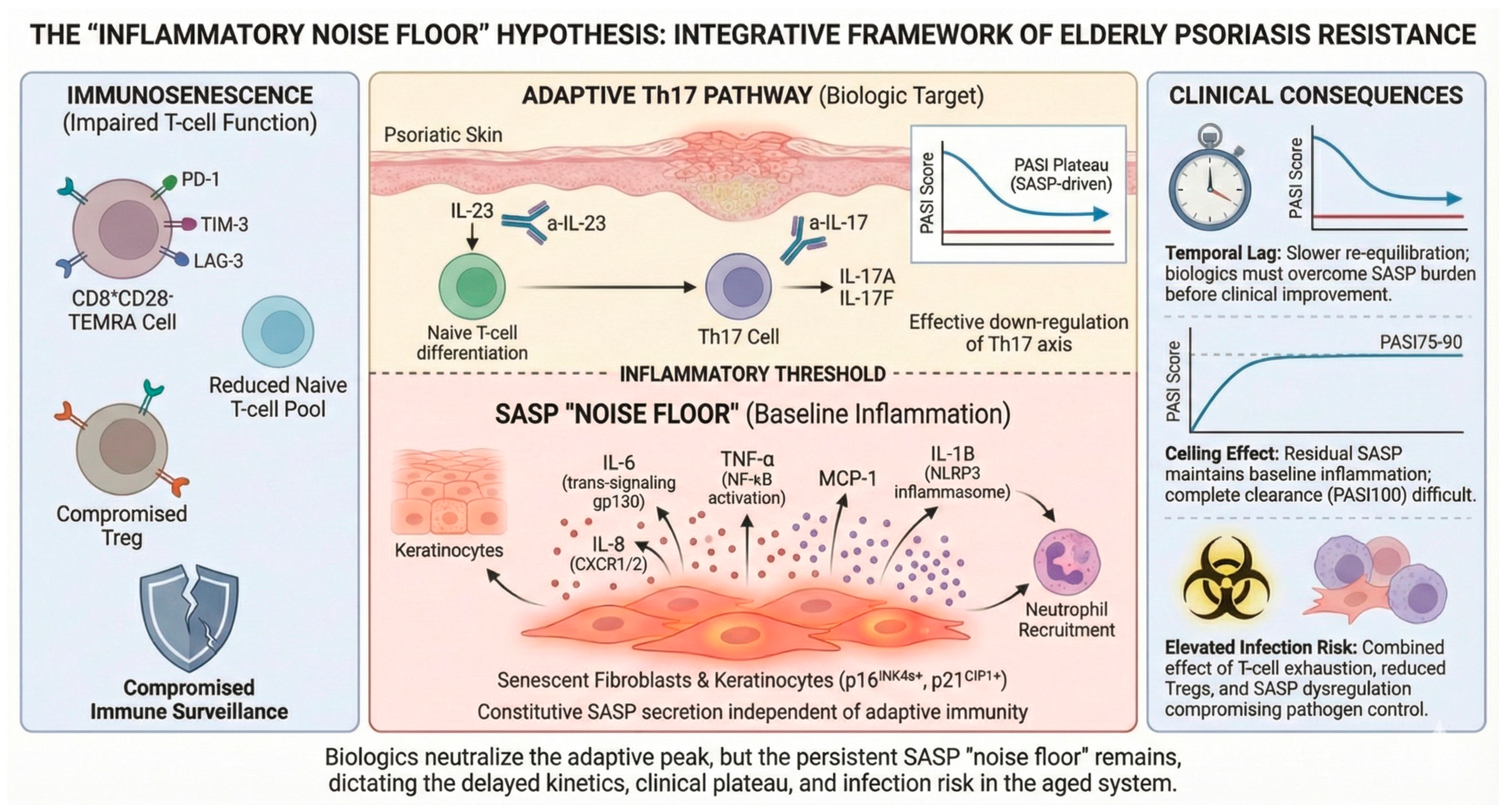
Synthesizing clinical and mechanistic evidence, we propose the ‘Inflammatory Noise Floor’ hypothesis as an integrative, hypothesis-generating framework that may help to explain age-related differences in biologic response in psoriasis (Figure 1). In aging skin, senescent fibroblasts and keratinocytes (accumulating p16INK4a+, p21CIP1+ cells) constitutively secrete SASP cytokines (IL-6, IL-8, TNF-α, MCP-1) creating a persistent, low-grade inflammatory state independent of adaptive immunity [12,47]. Simultaneously, immunosenescence impairs T-cell function: elevated CD8+CD28 TEMRA cells, exhaustion marker upregulation (PD-1, TIM-3, LAG-3), reduced naive T-cell pools, and compromised Treg function characterize elderly psoriasis patients [10,38,54]. When biologic IL-23 or IL-17 blockade is administered, these agents effectively downregulate Th17-mediated pathways, reducing Th17 cell numbers and canonical inflammatory mediators IL-17 and IL-23. However, SASP-driven inflammation persists through non-IL-23/IL-17 pathways. These include IL-6 trans-signaling via soluble IL-6 receptor and gp130, which continues to activate keratinocytes; IL-8/CXCR1/2 signaling sustains neutrophil recruitment; TNF-α/NF-κB activation drives inflammatory gene expression; and NLRP3 inflammasome activation produces IL-1β further amplifying inflammation [10,13,55]. These pathways are well described as parallel and interacting inflammatory pathways in psoriasis and may not be fully suppressed by IL-23 or IL-17 blockade [56]. At this point, it is critical to separate established human psoriasis data from extrapolated mechanistic insights. While the accumulation of p16INK4a+ senescent cells and elevated SASP cytokines are well-documented facts in human psoriatic skin biopsies, the concept that this specific SASP burden directly impedes or delays the kinetic efficacy of systemic biologics is an inductive extrapolation derived primarily from general biogerontology and murine models. Therefore, the ‘inflammatory noise floor’ hypothesis is proposed to help to explain three key clinical observations:
  • Temporal Lag: Initial biologics might need overcome pre-existing SASP-driven inflammation before achieving clinical PASI improvement. While the immune system retains sufficient competence to eventually respond (hence the catch-up by Week 52), its kinetics are hypothesized to be operationally slowed by both intrinsic immunosenescence, the slow clearance of aged tissue-resident memory T-cells, and the potential need to overcome the pre-existing SASP burden.
  • Ceiling Effect: Elderly patients plateau at intermediate PASI levels (PASI75-90 achievable, but PASI90-100 difficult) potentially because residual SASP-driven inflammation maintains baseline inflammatory state despite IL-23/IL-17 suppression. Complete PASI clearance may require not only Th17 suppression but also the dampening of SASP-driven pathways.
  • Elevated Infection Risk: T-cell exhaustion and reduced Treg function (immunosenescence) may subtly compromise immune surveillance, while SASP-mediated immune dysregulation further compromises pathogen control. This underlying vulnerability—which IL-23/IL-17 monotherapy may not fully reverse—could mechanistically explain the modest, albeit clinically relevant, increase in adverse-event-driven discontinuations observed in older cohorts.
These mechanistic insights may suggest a pragmatic recalibration of our clinical expectations. If the ‘Inflammatory Noise Floor’ indeed imposes a biological limit on total inflammatory suppression, the strict pursuit of PASI 100, may represent an unrealistic endpoint for many elderly patients. In this demographic, achieving a stable PASI 75-90 response should be recognized as a distinct and successful therapeutic tier, accepting the ‘ceiling’ as a reflection of chronological skin aging rather than pharmacological failure. Similarly, the slower response kinetics observed with anti-IL therapies must be viewed as a physiological characteristic of the aging immune system rather than a signal of inefficacy. Consequently, we suggest that future prospective trials should evaluate age-stratified evaluation protocols. In real-world practice, the standard 12-to-16-week decision point for defining primary failure might be premature for geriatric patients. Extending the assessment window (e.g., to 24–28 weeks) before considering a switch might allow for the necessary immunological ‘catch-up,’ preventing the premature abandonment of potentially effective biologic agents.

3.6. Alternative and Concurrent Explanations for Reduced Biologic Efficacy in Elderly Psoriasis Patients

It is essential to acknowledge the established clinical and epidemiological factors that contribute to this pattern and that must be considered as concurrent rather than mutually exclusive explanations of response pattern to biologics in elderly psoriatic patients. Disease duration and prior biologic exposure exert independent negative effects on therapeutic response. Data from the phase IIIb GUIDE study demonstrated that patients with long disease duration (>2 years) achieved complete skin clearance (PASI = 0) at week 28 at significantly lower rates than those with short disease duration (39.4% vs. 51.8%), with disease duration and prior biologic use identified as the two strongest independent predictors of non-response in multivariable analysis [55]. These findings are consistent with real-world data showing that prior biologic therapy reduces the probability of achieving early and complete responses with subsequent agents across different biologic classes [57], suggesting that cumulative immunological and tissue-level changes associated with prolonged psoriatic chronicity partially limit reversibility even under effective cytokine blockade. A key limitation of the cited literature is the frequent epidemiological conflation of chronological aging, biological frailty, and prolonged disease duration. Since most registries rely on arbitrary age thresholds (e.g., ≥65 years) without multivariate stratification, isolating the specific impact of intrinsic aging—and thus SASP or immunosenescence—from these compounding clinical variables remains difficult. Treatment selection bias is an inherent limitation of real-world registry data: elderly patients enrolled in observational cohorts frequently represent the most robust individuals within that age stratum, as frailer or more heavily comorbid patients are more likely to be excluded from treatment, lost to follow-up, or absent from registry enrollment altogether, potentially underestimating the true efficacy gap in the broader elderly psoriasis population [7,8]. Polypharmacy, present in the majority of patients aged ≥65 years and recognized as a defining management challenge in geriatric psoriasis guidelines, carries clinically relevant consequences: age-related reductions in hepatic and renal clearance, altered volume of distribution, and competitive plasma protein binding may attenuate biologic pharmacodynamic activity, while concomitant therapies can modulate systemic inflammatory tone in ways that offset or complicate therapeutic response [58,59]. Finally, treatment adherence and persistence represent underappreciated determinants of real-world outcomes in this population. Real-world data indicate that fewer than 55% of biologic-treated psoriasis patients maintain adequate adherence (medication possession ratio > 80%) over 12 months, with persistence declining markedly from the third year of treatment onward [60]; this pattern is likely amplified in elderly patients by cognitive decline, social isolation, complex self-injection schedules, and needle-related anxiety, factors that are underreported in registry databases. Acknowledging these concurrent explanatory dimensions, the immunosenescence and SASP-based framework should be understood as an additional and partially independent biological layer that may contribute specifically to the residual efficacy gap that persists after controlling for frailty, disease duration, selection bias, polypharmacy, and adherence.

3.7. Senotherapeutic Perspectives and Translational Opportunities

If senescence accumulation drives baseline inflammation limiting biologic efficacy in elderly psoriasis, targeting senescent cells or SASP emerges as a rational therapeutic strategy [53]. Current senotherapeutic approaches include senolytics (drugs inducing senescent cell apoptosis) and senomorphics (drugs suppressing SASP without eliminating cells) [61]. Senolytics (dasatinib + quercetin, fisetin) have entered human trials in non-dermatological aging settings, with pilot evidence in diabetic kidney disease and osteoporosis showing senescent cell elimination in human tissues [62,63]. However, no randomized trial has evaluated senolytics in psoriasis patients of any age. Senomorphics include selective JAK inhibitors (which may suppress SASP through STATs), mTOR inhibitors, and metformin, with preliminary anti-inflammatory properties in aging contexts [64,65,66]. Notably, ruxolitinib (JAK1/2 inhibitor) is approved for atopic dermatitis and non-segmental vitiligo, demonstrating distinct efficacy in modulating T-cell driven skin autoimmunity [67,68]. Furthermore, delgocitinib, a novel pan-JAK inhibitor recently approved for chronic hand eczema, suggests that the broad inhibition of JAK-STAT signaling is feasible and safe topically [69]. Given that SASP cytokines utilize multiple JAK pathways, investigation of these topical agents as adjuncts to systemic biologics in elderly psoriasis is reasonable to dampen the inflammatory “noise floor” [70]. However, despite this therapeutic promise, translating these interventions to frail elderly patients raises significant safety concerns. Systemic senolytics risk the indiscriminate clearance of reparative senescent cells, which could impair physiological tissue regeneration and induce on-target toxicities such as cytopenias [71,72]. In summary, no senotherapeutic agents are currently approved for psoriasis, but several are undergoing clinical trials for age-related diseases. Lifestyle modifications targeting immunosenescence, particularly metabolic intervention, show promise in preclinical models. Chen et al. (2023) demonstrated that time-restricted feeding (TRF) reduces immunosenescence, and psoriasiform inflammation in aged mice suggests the potential for dietary/metabolic interventions in human elderly psoriasis, though clinical trials are lacking [73]. Recent work characterizing biomarkers of cellular senescence and SASP in circulating cells has demonstrated that SASP-related secretomes associated with frailty, chronological age, and clinical outcomes in aging populations, provide translational pathways for patient stratification and monitoring [74]. Such biomarker approaches could enable the identification of elderly psoriasis patients with particularly high senescent cell burden who might benefit from senescence-targeting adjuncts.

4. Conclusions

Elderly psoriasis patients exhibit a distinct response pattern characterized by preserved but delayed efficacy and a probable “ceiling effect” on PASI90 achievement, often accompanied by higher discontinuation rates due to adverse events [8]. This review proposes the “Inflammatory Noise Floor” hypothesis as a tentative mechanistic framework to interpret these age-related discrepancies. We suggest that therapeutic resistance may result from the convergence of immunosenescence (marked by CD8+CD28 T-cell accumulation and Treg dysfunction) and cellular senescence, where p16INK4a+ keratinocytes constitutively secrete SASP factors (IL-6, IL-8) via pathways partially independent of the IL-23/IL-17 axis [10,11,38,56]. Consequently, we propose that while biologics effectively target acute inflammation, residual SASP-mediated “noise” might slow clinical improvement and compromise immune surveillance. However, acknowledging that it relies on indirect evidence and that a direct SASP-kinetics correlation remains to be proven, the proposed model remains an inductive, hypothesis-generating framework. Future research should prioritize transcriptomic profiling and biomarker validation to confirm this model [53,74]. In daily practice, these considerations suggest that a more pragmatic definition of success may be appropriate for many elderly patients: for a substantial proportion, a stable PASI 75–90 may represent a realistic and clinically acceptable endpoint, even if PASI 100 remains desirable whenever achievable. While prospective trials are strictly required to formalize these clinical strategies, recognizing these slower, age-dependent response kinetics is crucial to avoid misclassifying a ‘slow responder’ as a ‘non-responder’, suggesting that evaluation protocols might need to be tailored to the patient’s age by extending assessment windows before considering a treatment switch.

Author Contributions

Conceptualization, U.S. and F.R.; writing—original draft preparation, U.S., F.R. and O.C.; writing—review and editing, L.M. and S.R.; supervision, L.M., P.Q. and S.R. All authors have read and agreed to the published version of the manuscript.

Funding

This research received no external funding.

Institutional Review Board Statement

Not applicable.

Data Availability Statement

No new data were created or analyzed in this study. Data sharing is not applicable to this article.

Acknowledgments

During the preparation of this manuscript, the authors used Claude Sonnet 4.5 (Anthropic) to assist with manuscript structuring, and linguistic refinement. The authors used Google Gemini 3.0 for the development of scientific illustration. The authors have reviewed and edited the output and take full responsibility for the content of this publication.

Conflicts of Interest

The authors declare no conflicts of interest.

Abbreviations

The following abbreviations are used in this manuscript:
AEAdverse Event
BCL-2B-cell Lymphoma 2
CGRPCalcitonin Gene-Related Peptide
CIConfidence Interval
CDCluster of Differentiation (e.g., CD8, CD28, CD57)
CXCRC-X-C Motif Chemokine Receptor
FDAFood and Drug Administration
gp130Glycoprotein 130
IGFBP2Insulin-like Growth Factor Binding Protein 2
ILInterleukin (e.g., IL-6, IL-17, IL-23)
JAKJanus Kinase
LAG-3Lymphocyte-activation Gene 3
LTLLeukocyte Telomere Lenght
MCP-1Monocyte Chemoattractant Protein-1
miRMicroRNA
mTORMammalian Target of Rapamycin (or Mechanistic Target of Rapamycin)
NF-κBNuclear Factor kappa-light-chain-enhancer of activated B cells
NGFNerve Growth Factor
NLRP3NLR Family Pyrin Domain Containing 3
OROdds Ratio
PASIPsoriasis Area and Severity Index
PD-1Programmed Cell Death Protein 1
RbRetinoblastoma protein
RCTRandomized Control Trial
SA-β-galSenescence-Associated Beta-Galactosidase
SAESerious Adverse Event
SDStandard Deviation
SASPSenescence-Associated Secretory Phenotype
STATSignal Transducer and Activator of Transcription
TBTuberculosis
TEMRATerminally Differentiated Effector Memory re-expressing CD45RA T cells
Th17T helper 17 cells
TIM-3T-cell Immunoglobulin and Mucin-domain containing-3
TNF-αTumor Necrosis Factor-alpha
TregRegulatory T cell
TRFTime-Restricted Feeding
TRMTissue-Resident Memory T cells

References

  1. Parisi, R.; Symmons, D.P.M.; Griffiths, C.E.; Ashcroft, D.M.; on behalf of the Identification and Management of Psoriasis and Associated ComorbidiTy (IMPACT) Project Team. Global epidemiology of psoriasis: A systematic review of incidence and prevalence. J. Investig. Dermatol. 2013, 133, 377–385. [Google Scholar] [CrossRef]
  2. Ponikowska, M.; Vellone, E.; Czapla, M.; Uchmanowicz, I. Challenges Psoriasis and Its Impact on Quality of Life: Challenges in Treatment and Management. Psoriasis Targets Ther. 2025, 15, 175. [Google Scholar] [CrossRef] [PubMed]
  3. Brownstone, N.D.; Hong, J.; Mosca, M.; Hadeler, E.; Liao, W.; Bhutani, T.; Koo, J. Biologic Treatments of Psoriasis: An Update for the Clinician. Biologics 2021, 15, 39–51. [Google Scholar] [CrossRef] [PubMed]
  4. Warren, R.B.; Blauvelt, A.; Bagel, J.; Papp, K.A.; Yamauchi, P.; Armstrong, A.; Langley, R.G.; Vanvoorden, V.; De Cuyper, D.; Cioffi, C.; et al. Bimekizumab versus Adalimumab in Plaque Psoriasis. N. Engl. J. Med. 2021, 385, 130–141. [Google Scholar] [CrossRef] [PubMed]
  5. Blauvelt, A.; Armstrong, A.W.; Langley, R.G.; Gebauer, K.; Thaçi, D.; Bagel, J.; Guenther, L.C.; Paul, C.; Randazzo, B.; Flavin, S.; et al. Efficacy of guselkumab versus secukinumab in subpopulations of patients with moderate-to-severe plaque psoriasis: Results from the ECLIPSE study. J. Dermatol. Treat. 2022, 33, 2317–2324. [Google Scholar] [CrossRef]
  6. Langley, R.G.; Elewski, B.E.; Lebwohl, M.; Reich, K.; Griffiths, C.E.; Papp, K.; Puig, L.; Nakagawa, H.; Spelman, L.; Sigurgeirsson, B.; et al. Secukinumab in plaque psoriasis—results of two phase 3 trials. N. Engl. J. Med. 2014, 371, 326–338. [Google Scholar] [CrossRef]
  7. ter Haar, E.L.M.; Thomas, S.E.; Reek, J.M.P.A.v.D.; Otero, M.E.; Njoo, M.D.; Ossenkoppele, P.M.; Kop, E.N.; Dodemont, S.R.P.; Körver, J.E.M.; Kuijpers, A.L.A.; et al. Drug Survival, Safety, and Effectiveness of Biologics in Older Patients with Psoriasis: A Comparison with Younger Patients—A BioCAPTURE Registry Study. Drugs Aging 2022, 39, 715–727. [Google Scholar] [CrossRef]
  8. Chiricozzi, A.; Coscarella, G.; Puig, L.; Vender, R.; Yeung, J.; Carrascosa, J.; Piaserico, S.; Gisondi, P.; Lynde, C.; Ferreira, P.; et al. Age affects drug survival rates of interleukin (IL)-17 and IL-23 inhibitors in patients with plaque psoriasis: Results from a retrospective, multicentric, multi-country, cohort study. J. Eur. Acad. Dermatol. Venereol. 2024, 38, 2175–2185. [Google Scholar] [CrossRef]
  9. Hacınecipoğlu, F.; Çelik, G.; Kartal, S.P. Efficacy and Safety of IL-17 and IL-23 Inhibitors in Elderly Patients With Plaque Psoriasis: A Real-World Study. J. Dermatol. 2025, 52, 1166–1174. [Google Scholar] [CrossRef]
  10. Šahmatova, L.; Sügis, E.; Šunina, M.; Hermann, H.; Prans, E.; Pihlap, M.; Abram, K.; Rebane, A.; Peterson, H.; Peterson, P.; et al. Signs of innate immune activation and premature immunosenescence in psoriasis patients. Sci. Rep. 2017, 7, 7553. [Google Scholar] [CrossRef]
  11. Mercurio, L.; Lulli, D.; Mascia, F.; Dellambra, E.; Scarponi, C.; Morelli, M.; Valente, C.; Carbone, M.L.; Pallotta, S.; Girolomoni, G.; et al. Intracellular Insulin-like growth factor binding protein 2 (IGFBP2) contributes to the senescence of keratinocytes in psoriasis by stabilizing cytoplasmic p21. Aging 2020, 12, 6823–6851. [Google Scholar] [CrossRef]
  12. Coppé, J.-P.; Patil, C.K.; Rodier, F.; Sun, Y.; Muñoz, D.P.; Goldstein, J.; Nelson, P.S.; Desprez, P.-Y.; Campisi, J. Senescence-Associated Secretory Phenotypes Reveal Cell-Nonautonomous Functions of Oncogenic RAS and the p53 Tumor Suppressor. PLoS Biol. 2008, 6, e301. [Google Scholar] [CrossRef]
  13. Prattichizzo, F.; Giuliani, A.; Recchioni, R.; Bonafè, M.; Marcheselli, F.; De Carolis, S.; Campanati, A.; Giuliodori, K.; Rippo, M.R.; Brugè, F.; et al. Anti-TNF-α treatment modulates SASP and SASP-related microRNAs in endothelial cells and in circulating angiogenic cells. Oncotarget 2016, 7, 11945–11958. [Google Scholar] [CrossRef] [PubMed]
  14. Mastorino, L.; Susca, S.; Cariti, C.; Verrone, A.; Stroppiana, E.; Ortoncelli, M.; Dapavo, P.; Ribero, S.; Quaglino, P. ‘Superresponders’ at biologic treatment for psoriasis: A comparative study among IL17 and IL23 inhibitors. Exp. Dermatol. 2023, 32, 2187–2188. [Google Scholar] [CrossRef]
  15. Orsini, D.; Caldarola, G.; Dattola, A.; Campione, E.; Bernardini, N.; Frascione, P.; De Simone, C.; Richetta, A.G.; Galluzzo, M.; Skroza, N.; et al. Efficacy and safety of tildrakizumab in elderly patients: Real-world multicenter study (ESTER—Study). J. Dermatol. Treat. 2024, 35, 2319304. [Google Scholar] [CrossRef]
  16. Narcisi, A.; Valenti, M.; Gargiulo, L.; Ibba, L.; Amoruso, F.; Argenziano, G.; Bardazzi, F.; Burlando, M.; Carrera, C.G.; Damiani, G.; et al. Real-life effectiveness of tildrakizumab in chronic plaque psoriasis: A 52-week multicentre retrospective study—IL PSO (Italian landscape psoriasis). J. Eur. Acad. Dermatol. Venereol. 2022, 37, 93. [Google Scholar] [CrossRef]
  17. Mastorino, L.; Dapavo, P.; Burlando, M.; Gisondi, P.; Maronese, C.; Ruggiero, A.; Galluzzo, M.; Pisani, M.C.; Sacchelli, L.; Caldarola, G.; et al. Effectiveness and Safety of Tildrakizumab in Elderly and Frail Elderly Psoriatic Patients Up to 2 years. Psoriasis Targets Ther. 2025, 15, 339–350. [Google Scholar] [CrossRef] [PubMed]
  18. Rosset, F.; Mastorino, L.; Dapavo, P.; Ortoncelli, M.; Quaglino, P.; Ribero, S. Aging Impact in Response to Different Classes of Biological Treatment in Psoriatic Patients: A Real-Life Observational Study. J. Clin. Med. 2023, 12, 7215. [Google Scholar] [CrossRef] [PubMed]
  19. Hjort, G.; Schwarz, C.W.; Skov, L.; Loft, N. Clinical Characteristics Associated With Response to Biologics in the Treatment of Psoriasis: A Meta-analysis. JAMA Dermatol. 2024, 160, 830–837. [Google Scholar] [CrossRef]
  20. Ohata, C.; Anezaki, H.; Yanase, T.; Katayama, E.; Kaneko, S.; Saito, K.; Yamane, M.; Nakamaru, S.; Tsuruta, N.; Okazaki, F.; et al. Real-world safety and efficacy of biologics in elderly patients with psoriasis: A multicenter observational study. J. Dermatol. 2024, 51, 1634–1640. [Google Scholar] [CrossRef]
  21. Drucker, A.M.; Sutradhar, R.; Ling, V.; Gatley, J.M.; Eder, L.; Fahim, C.; Fralick, M.; Gomes, T.; Li, P.; MacDougall, S.; et al. Systemic Therapies for Psoriatic Disease and Serious Infections in Older Adults. JAMA Dermatol. 2025, 161, 490–497. [Google Scholar] [CrossRef]
  22. Sobotkova, T.; Hugo, J.; Salavec, M.; Kojanova, M.; Tichy, M.; Necas, M.; Machovcova, A.; Cetkovsky, M.; Kysilka, Z.; Tivadar, S.; et al. Efficacy, Safety, and Drug Survival During the First Year of Biologic Therapy for Psoriasis in Elderly Versus Younger Patients. Int. J. Dermatol. 2025, 64, 1401–1408. [Google Scholar] [CrossRef] [PubMed]
  23. Koo, T.; Baek, G.; Jue, M. Risk of tuberculosis infection and serial changes in interferon-gamma release assays in elderly patients with psoriasis receiving biologic therapy. J. Dermatol. 2022, 49, 887–894. [Google Scholar] [CrossRef] [PubMed]
  24. Wang, X.; Wong, S.H.; Wang, X.-S.; Tang, W.; Liu, C.-Q.; Niamul, G.; Wu, B.; Tam, L.-S.; Wu, J.C.Y.; Chan, F.K.L.; et al. Risk of tuberculosis in patients with immune-mediated diseases on biological therapies: A population-based study in a tuberculosis endemic region. Rheumatology 2019, 58, 803–810. [Google Scholar] [CrossRef]
  25. Torres, T.; Chiricozzi, A.; Puig, L.; Lé, A.M.; Marzano, A.V.; Dapavo, P.; Dauden, E.; Carrascosa, J.-M.; Lazaridou, E.; Duarte, G.; et al. Treatment of Psoriasis Patients with Latent Tuberculosis Using IL-17 and IL-23 Inhibitors: A Retrospective, Multinational, Multicentre Study. Am. J. Clin. Dermatol. 2024, 25, 333–342. [Google Scholar] [CrossRef]
  26. Mastorino, L.; Dapavo, P.; Trunfio, M.; Avallone, G.; Rubatto, M.; Calcagno, A.; Ribero, S.; Quaglino, P. Risk of Reactivation of Latent Tuberculosis in Psoriasis Patients on Biologic Therapies: A Retrospective Cohort from a Tertiary Care Centre in Northern Italy. Acta Derm. Venereol. 2022, 102, adv00821. [Google Scholar] [CrossRef]
  27. Megna, M.; Potestio, L.; Fabbrocini, G.; Camela, E. Treating psoriasis in the elderly: Biologics and small molecules. Expert Opin. Biol. Ther. 2022, 22, 1503–1520. [Google Scholar] [CrossRef]
  28. van Winden, M.E.C.; van der Schoot, L.S.; Arias, M.v.d.L.; van Vugt, L.J.; Reek, J.M.P.A.v.D.; van de Kerkhof, P.C.M.; de Jong, E.M.G.J.; Lubeek, S.F.K. Effectiveness and Safety of Systemic Therapy for Psoriasis in Older Adults: A Systematic Review. JAMA Dermatol. 2020, 156, 1229–1239. [Google Scholar] [CrossRef] [PubMed]
  29. Brandão, G.V.C.; Pereira, E.G.; Haddad, G.R.; Miot, L.D.B.; Marques, S.A.; Miot, H.A. Clinical characterization, physical frailty, and depression in elderly patients with psoriasis from a reference center in Brazil: A cross-sectional study. An. Bras. Dermatol. 2024, 99, 19–26. [Google Scholar] [CrossRef]
  30. Rosset, F.; Mastorino, L.; Dapavo, P.; Quaglino, P.; Ribero, S. Impact of comorbidities in elderly and frail patients and response to biological therapy in psoriasis. Exp. Dermatol. 2023, 32, 1162–1164. [Google Scholar] [CrossRef]
  31. Reich, K.; Papp, K.A.; Blauvelt, A.; Tyring, S.K.; Sinclair, R.; Thaçi, D.; Nograles, K.; Mehta, A.; Cichanowitz, N.; Li, Q.; et al. Tildrakizumab versus placebo or etanercept for chronic plaque psoriasis (reSURFACE 1 and reSURFACE 2): Results from two randomised controlled, phase 3 trials. Lancet 2017, 390, 276–288. [Google Scholar] [CrossRef]
  32. Megna, M.; Camela, E.; Battista, T.; Genco, L.; Martora, F.; Noto, M.; Picone, V.; Ruggiero, A.; Monfrecola, G.; Fabbrocini, G.; et al. Efficacy and safety of biologics and small molecules for psoriasis in pediatric and geriatric populations. Part II: Focus on elderly patients. Expert Opin. Drug Saf. 2023, 22, 43–58. [Google Scholar] [CrossRef]
  33. Liu, Z.; Liang, Q.; Ren, Y.; Guo, C.; Ge, X.; Wang, L.; Cheng, Q.; Luo, P.; Zhang, Y.; Han, X. Immunosenescence: Molecular mechanisms and diseases. Signal Transduct. Target. Ther. 2023, 8, 200. [Google Scholar] [CrossRef]
  34. Ayoub, M.; Jaoude, C.A.; Ayoub, M.; Hamade, A.; Rima, M. The Immune System and Cellular Senescence: A Complex Interplay in Aging and Disease. Immunology 2026, 177, 149–169. [Google Scholar] [CrossRef]
  35. Upadhyay, P.; Suhail, A.; Khanal, P.; Kumar, S. Mechanistic insights and biomarker discovery in immune cell aging and age-associated diseases. Front. Immunol. 2025, 16, 1637191. [Google Scholar] [CrossRef]
  36. Liu, G.; Huang, T.; Gao, X.; Ding, R.; Zheng, Y.; Tang, Y.; Bu, J.; Shen, E. Expression of Co-Inhibitory Molecules on Lymphocytes of Patients With Psoriasis. J. Dermatol. 2025, 52, 1698–1708. [Google Scholar] [CrossRef]
  37. Türk, L.; Filippov, I.; Arnold, C.; Zaugg, J.; Tserel, L.; Kisand, K.; Peterson, P. Cytotoxic CD8+ Temra cells show loss of chromatin accessibility at genes associated with T cell activation. Front. Immunol. 2024, 15, 1285798. [Google Scholar] [CrossRef]
  38. Liu, R.; Zhao, J.; Gao, Q.; Kuang, Y. Characteristics of peripheral blood lymphocyte subsets in elderly patients with psoriasis. Immun. Ageing 2025, 22, 42. [Google Scholar] [CrossRef]
  39. Cantó, E.; del Prado, M.E.; Vilarrasa, E.; López-Ferrer, A.; de Araníbar, F.J.G.L.; Ortiz, M.A.; Gut, M.; Mulet, M.; Esteve-Codina, A.; Osuna-Gómez, R.; et al. Transcriptomic Identification of Immune-Related Hubs as Candidate Predictor Biomarkers of Therapeutic Response in Psoriasis. Int. J. Mol. Sci. 2025, 26, 8118. [Google Scholar] [CrossRef]
  40. Solberg, S.M.; Aarebrot, A.K.; Sarkar, I.; Petrovic, A.; Sandvik, L.F.; Bergum, B.; Jonsson, R.; Bryceson, Y.T.; Appel, S. Mass cytometry analysis of blood immune cells from psoriasis patients on biological therapy. Eur. J. Immunol. 2021, 51, 694–702. [Google Scholar] [CrossRef]
  41. Nikolich-Žugich, J. The twilight of immunity: Emerging concepts in aging of the immune system. Nat. Immunol. 2017, 19, 10–19. [Google Scholar] [CrossRef]
  42. Conrad, C.; Gaulis, S.; Bier, K.; Gudjonsson, J.; Eidsmo, L.; Kärner, J.; Iversen, L.; Costanzo, A.; Jagiello, P.; Kolbinger, F.; et al. 828 Early intervention with secukinumab may affect the establishment of tissue memory in psoriasis: Results from a DNA methylation analysis. J. Investig. Dermatol. 2023, 143, S142. [Google Scholar] [CrossRef]
  43. Vu, T.T.; Koguchi-Yoshioka, H.; Watanabe, R. Skin-Resident Memory T Cells: Pathogenesis and Implication for the Treatment of Psoriasis. J. Clin. Med. 2021, 10, 3822. [Google Scholar] [CrossRef]
  44. Tang, J.; Zhao, S.; Shi, H.; Li, X.; Ran, L.; Cao, J.; He, Y. Effects on peripheral and central nervous system of key inflammatory intercellular signalling peptides and proteins in psoriasis. Exp. Dermatol. 2024, 33, e15104. [Google Scholar] [CrossRef]
  45. Lowy, D.B.; Makker, P.G.S.; Moalem-Taylor, G. Cutaneous Neuroimmune Interactions in Peripheral Neuropathic Pain States. Front. Immunol. 2021, 12, 660203. [Google Scholar] [CrossRef]
  46. Shen, Y.; Li, M.; Jin, S.; Yu, Z.; Liu, Q.; Yao, H.; Jiang, Y.; Fu, J.; Li, N. The role of interleukins in peripheral nerve injury and the current status of treatment. Front. Immunol. 2026, 16, 1691335. [Google Scholar] [CrossRef]
  47. Márquez, E.J.; Chung, C.-H.; Marches, R.; Rossi, R.J.; Nehar-Belaid, D.; Eroglu, A.; Mellert, D.J.; Kuchel, G.A.; Banchereau, J.; Ucar, D. Sexual-dimorphism in human immune system aging. Nat. Commun. 2020, 11, 751. [Google Scholar] [CrossRef]
  48. Coppé, J.-P.; Desprez, P.-Y.; Krtolica, A.; Campisi, J. The Senescence-Associated Secretory Phenotype: The Dark Side of Tumor Suppression. Annu. Rev. Pathol. Mech. Dis. 2010, 5, 99. [Google Scholar] [CrossRef]
  49. d’Adda di Fagagna, F.; Reaper, P.M.; Clay-Farrace, L.; Fiegler, H.; Carr, P.; von Zglinicki, T.; Saretzki, G.; Carter, N.P.; Jackson, S.P. A DNA damage checkpoint response in telomere-initiated senescence. Nature 2003, 426, 194–198. [Google Scholar] [CrossRef]
  50. Herbig, U.; Jobling, W.A.; Chen, B.P.; Chen, D.J.; Sedivy, J.M. Telomere shortening triggers senescence of human cells through a pathway involving ATM, p53, and p21(CIP1), but not p16(INK4a). Mol. Cell 2004, 14, 501–513. [Google Scholar] [CrossRef]
  51. Chien, Y.; Scuoppo, C.; Wang, X.; Fang, X.; Balgley, B.; Bolden, J.E.; Premsrirut, P.; Luo, W.; Chicas, A.; Lee, C.S.; et al. Control of the senescence-associated secretory phenotype by NF-κB promotes senescence and enhances chemosensitivity. Genes Dev. 2011, 25, 2125–2136. [Google Scholar] [CrossRef]
  52. Alwehaidah, M.S.; Bakhiet, M. Association of Leukocyte Telomere Length and the Risk of Disease Severity and Metabolic Comorbidities in Arab Patients with Psoriasis. Cytogenet. Genome Res. 2024, 164, 211–217. [Google Scholar] [CrossRef]
  53. Zhu, H.; Jiang, J.; Yang, M.; Zhao, M.; He, Z.; Tang, C.; Song, C.; Zhao, M.; Akbar, A.N.; Reddy, V.; et al. Topical application of a BCL-2 inhibitor ameliorates imiquimod-induced psoriasiform dermatitis by eliminating senescent cells. J. Dermatol. Sci. 2024, 115, 54–63. [Google Scholar] [CrossRef]
  54. Liu, Y.; Li, D.; Yu, X.; Li, X. Identification of a novel immunosenescence-related genes and integrative analyses in patients with psoriasis. Hum. Immunol. 2025, 86, 111218. [Google Scholar] [CrossRef]
  55. Schäkel, K.; Reich, K.; Asadullah, K.; Pinter, A.; Jullien, D.; Weisenseel, P.; Paul, C.; Gomez, M.; Wegner, S.; Personke, Y.; et al. Early disease intervention with guselkumab in psoriasis leads to a higher rate of stable complete skin clearance (‘clinical super response’): Week 28 results from the ongoing phase IIIb randomized, double-blind, parallel-group, GUIDE study. J. Eur. Acad. Dermatol. Venereol. 2023, 37, 2016–2027. [Google Scholar] [CrossRef]
  56. Griffiths, C.E.M.; Armstrong, A.W.; Gudjonsson, J.E.; Barker, J.N.W.N. Psoriasis. Lancet 2021, 397, 1301–1315. [Google Scholar] [CrossRef]
  57. Diotallevi, F.; Esposito, M.; Fargnoli, M.C.; Quaglino, P.; Mastorino, L.; Stingeni, L.; Hansel, K.; Feliciani, C.; Megna, M.; Gallo, L.; et al. Real-Life Experience with Tildrakizumab in Plaque Psoriasis with Palmoplantar Involvement: A Multi-Center Retrospective Italian Study. Dermatol. Ther. 2025, 15, 323–336. [Google Scholar] [CrossRef]
  58. Di Lernia, V.; Goldust, M. An overview of the efficacy and safety of systemic treatments for psoriasis in the elderly. Expert Opin. Biol. Ther. 2018, 18, 897–903. [Google Scholar] [CrossRef]
  59. Mataix, J.; García, L.; Belinchón, I.; Carrascosa, J.R.; de la Cueva, P.; Carrascosa, J. [Translated article] Moderate to Severe Psoriasis in Older Adults: Recommendations on Management From the Psoriasis Working Group of the Spanish Academy of Dermatology and Venereology (AEDV). Actas Dermosifiliogr. 2023, 114, T802–T811. [Google Scholar] [CrossRef]
  60. Murage, M.J.; Anderson, A.; Casso, D.; Oliveria, S.A.; Ojeh, C.K.; Muram, T.M.; Merola, J.F.; Zbrozek, A.; Araujo, A.B. Treatment patterns, adherence, and persistence among psoriasis patients treated with biologics in a real-world setting, overall and by disease severity. J. Dermatol. Treat. 2019, 30, 141–149. [Google Scholar] [CrossRef]
  61. Kirkland, J.L.; Tchkonia, T. Cellular Senescence: A Translational Perspective. EBioMedicine 2017, 21, 21–28. [Google Scholar] [CrossRef]
  62. Hickson, L.J.; Prata, L.G.L.; Bobart, S.A.; Evans, T.K.; Giorgadze, N.; Hashmi, S.K.; Herrmann, S.M.; Jensen, M.D.; Jia, Q.; Jordan, K.L.; et al. Senolytics decrease senescent cells in humans: Preliminary report from a clinical trial of Dasatinib plus Quercetin in individuals with diabetic kidney disease. EBioMedicine 2019, 47, 446–456. [Google Scholar] [CrossRef]
  63. Farr, J.N.; Xu, M.; Weivoda, M.M.; Monroe, D.G.; Fraser, D.G.; Onken, J.L.; Negley, B.A.; Sfeir, J.G.; Ogrodnik, M.B.; Hachfeld, C.M.; et al. Targeting cellular senescence prevents age-related bone loss in mice. Nat. Med. 2017, 23, 1072–1079. [Google Scholar] [CrossRef]
  64. Xu, M.; Tchkonia, T.; Ding, H.; Ogrodnik, M.; Lubbers, E.R.; Pirtskhalava, T.; White, T.A.; Johnson, K.O.; Stout, M.B.; Mezera, V.; et al. JAK inhibition alleviates the cellular senescence-associated secretory phenotype and frailty in old age. Proc. Natl. Acad. Sci. USA 2015, 112, E6301–E6310. [Google Scholar] [CrossRef]
  65. Zhang, L.; Pitcher, L.E.; Prahalad, V.; Niedernhofer, L.J.; Robbins, P.D. Recent advances in the discovery of senolytics. Mech. Ageing Dev. 2021, 200, 111587. [Google Scholar] [CrossRef]
  66. Kulkarni, A.S.; Gubbi, S.; Barzilai, N. Benefits of Metformin in Attenuating the Hallmarks of Aging. Cell Metab. 2020, 32, 15–30. [Google Scholar] [CrossRef]
  67. Rosmarin, D.; Passeron, T.; Pandya, A.G.; Grimes, P.; Harris, J.E.; Desai, S.R.; Lebwohl, M.; Ruer-Mulard, M.; Seneschal, J.; Wolkerstorfer, A.; et al. Two Phase 3, Randomized, Controlled Trials of Ruxolitinib Cream for Vitiligo. N. Engl. J. Med. 2022, 387, 1445–1455. [Google Scholar] [CrossRef]
  68. Papp, K.; Szepietowski, J.C.; Kircik, L.; Toth, D.; Eichenfield, L.F.; Leung, D.Y.; Forman, S.B.; Venturanza, M.E.; Sun, K.; Kuligowski, M.E.; et al. Efficacy and safety of ruxolitinib cream for the treatment of atopic dermatitis: Results from 2 phase 3, randomized, double-blind studies. J. Am. Acad. Dermatol. 2021, 85, 863–872. [Google Scholar] [CrossRef]
  69. Bissonnette, R.; Warren, R.B.; Pinter, A.; Agner, T.; Gooderham, M.; Schuttelaar, M.L.A.; Crépy, M.-N.; Stingeni, L.; Serra-Baldrich, E.; Baranowski, K.; et al. Efficacy and safety of delgocitinib cream in adults with moderate to severe chronic hand eczema (DELTA 1 and DELTA 2): Results from multicentre, randomised, controlled, double-blind, phase 3 trials. Lancet 2024, 404, 461–473. [Google Scholar] [CrossRef]
  70. Hosking, A.-M.; Juhasz, M.; Mesinkovska, N.A. Topical Janus kinase inhibitors: A review of applications in dermatology. J. Am. Acad. Dermatol. 2018, 79, 535–544. [Google Scholar] [CrossRef]
  71. Khosla, S. Senescent cells, senolytics and tissue repair: The devil may be in the dosing. Nat. Aging 2023, 3, 139–141. [Google Scholar] [CrossRef] [PubMed]
  72. Chaib, S.; Tchkonia, T.; Kirkland, J.L. Cellular senescence and senolytics: The path to the clinic. Nat. Med. 2022, 28, 1556–1568. [Google Scholar] [CrossRef]
  73. Chen, Y.; Li, X.; Yang, M.; Wang, L.; Lv, X.; Shen, K.; Wu, H.; Lu, Q. A 2-week time-restricted feeding attenuates psoriasis-like lesions with reduced inflammatory cytokines and immunosenescence in mice. Exp. Dermatol. 2023, 32, 2000–2011. [Google Scholar] [CrossRef]
  74. Schafer, M.J.; Zhang, X.; Kumar, A.; Atkinson, E.J.; Zhu, Y.; Jachim, S.; Mazula, D.L.; Brown, A.K.; Berning, M.; Aversa, Z.; et al. The senescence-associated secretome as an indicator of age and medical risk. JCI Insight 2020, 5, e133668. [Google Scholar] [CrossRef]
Figure 1. The “Inflammatory Noise Floor” Hypothesis: An Integrative Framework of Elderly Psoriasis Resistance. This schematic illustrates the proposed mechanism explaining altered therapeutic responses in aging psoriasis patients, integrating immunosenescence and cellular senescence. Central Panel: The diagram is bisected by an “Inflammatory Threshold.” Above it, Adaptive Th17 Pathways (the “Ceiling”) are effectively targeted by biologic agents (anti-IL-23, anti-IL-17), neutralizing the acute inflammatory peak. Below the threshold, the SASP “Noise Floor” persists independent of adaptive immunity. Senescent fibroblasts and keratinocytes maintain a baseline inflammatory state and sustaining neutrophil recruitment. Left Panel: Immunosenescence concurrently impairs immune function, characterized by the accumulation of exhausted T-cells (CD8+CD28 TEMRA expressing PD-1, TIM-3, LAG-3 markers), reduced naive T-cell pools, and compromised regulatory T-cell (Treg) function, leading to impaired immune surveillance. Right Panel: The persistent SASP floor combined with immunosenescence is hypothesized to contribute to three key Clinical Consequences: a “Temporal Lag” potentially linked to slower immune re-equilibration; a “Ceiling Effect” where residual SASP inflammation leads to a PASI plateau; and an “Elevated Infection Risk” due to compromised pathogen control. This framework is a hypothesis-generating model integrating clinical observations with mechanistic data from separate studies. Direct quantitative correlation between SASP burden and biologic response kinetics in elderly psoriasis patients has not been established.
Dermato 06 00018 g001
Disclaimer/Publisher’s Note: The statements, opinions and data contained in all publications are solely those of the individual author(s) and contributor(s) and not of MDPI and/or the editor(s). MDPI and/or the editor(s) disclaim responsibility for any injury to people or property resulting from any ideas, methods, instructions or products referred to in the content.