
Incubation Behavior of Threatened Oreopholus ruficollis in the Atacama Arid Ecosystem During a “Flowering Desert”: Implications for the Future Conservation of the Species
 ,
,
Simple Summary
Abstract
1. Introduction
2. Materials and Methods
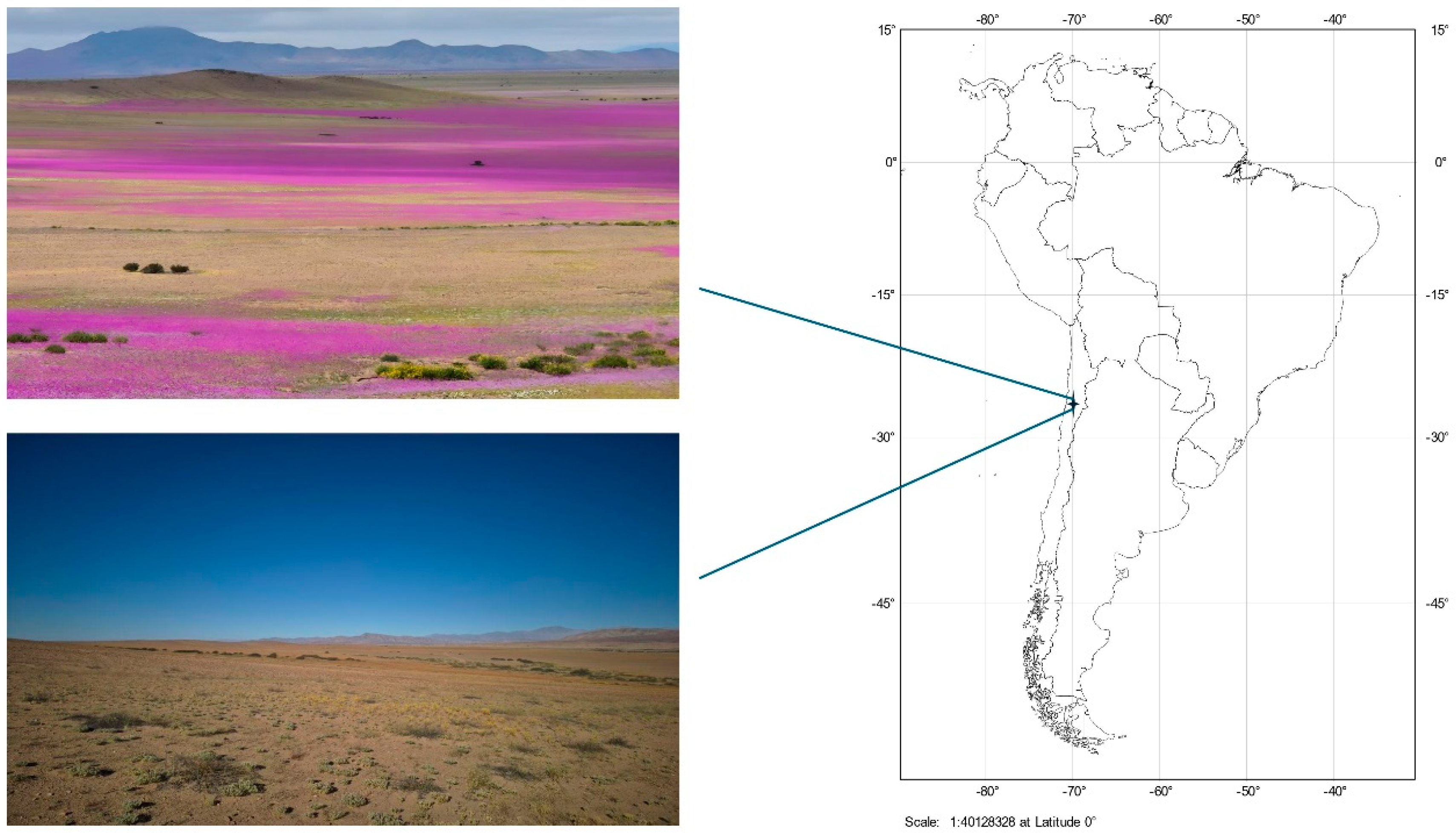
2.1. Study Area
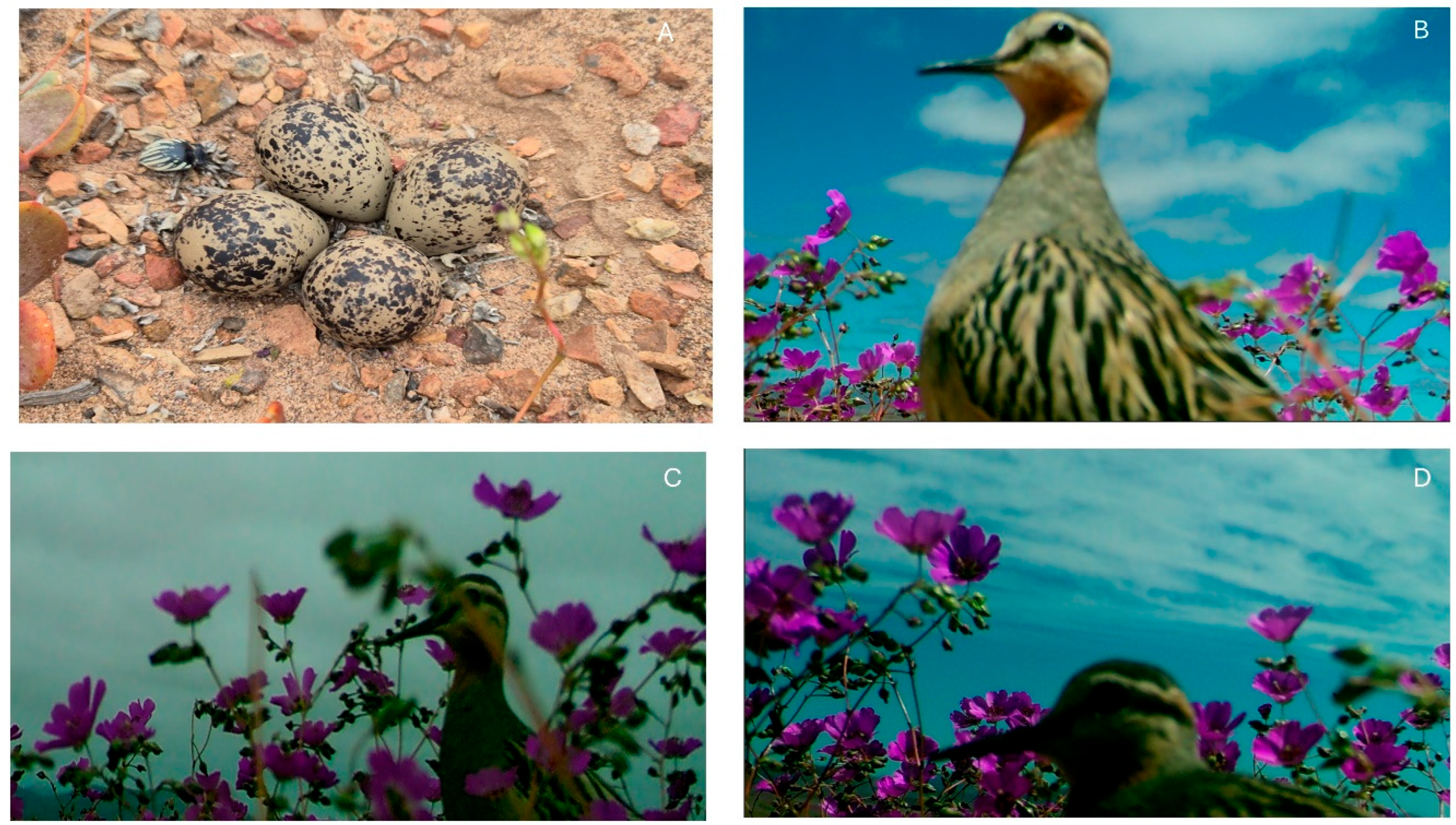
2.2. Reproductive Behavior
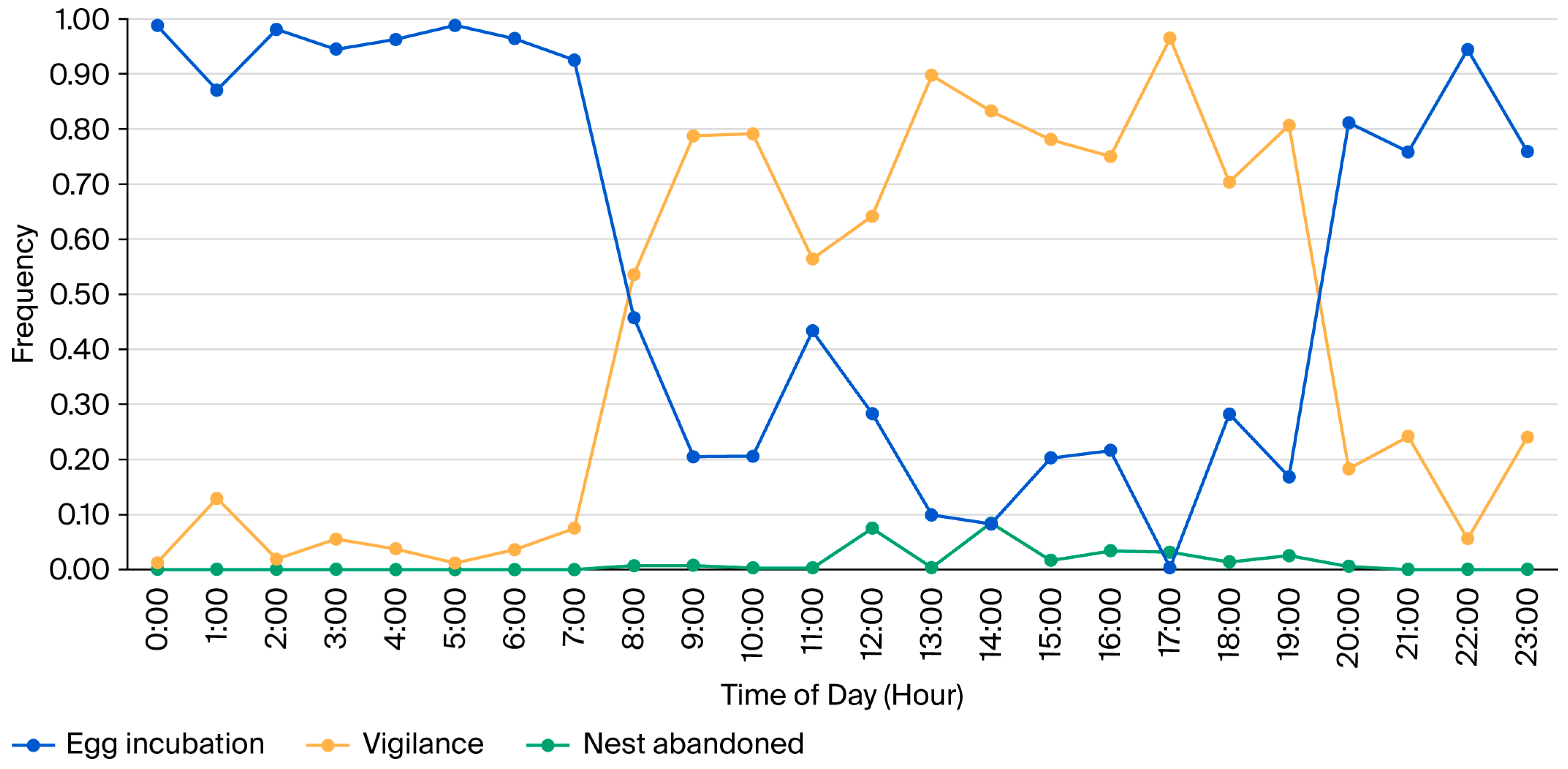
3. Results
4. Discussion
5. Conclusions
Author Contributions
Funding
Institutional Review Board Statement
Informed Consent Statement
Data Availability Statement
Acknowledgments
Conflicts of Interest
References
- Santoro, C.; Gayo, E.; Eugenia, M.; Capriles, J.; Rivadeneira, M.M.; Herrera, K.A. From the Pacific to the Tropical Forests: Networks of Social Interaction in the Atacama Desert, Late in the Pleistocene. Chungara 2019, 51, 5–25. [Google Scholar] [CrossRef] [Scilit]
- Contreras, R.C.; Carevic, F.; Arias, M.; Huanca, W.; Diaz, B. Desarrollo de Nuevos Loci de Microsatelites para Geoffroea decorticans. Bol. Soc. Argent. Bot. 2021, 56, 532–545. [Google Scholar] [CrossRef] [Scilit]
- Vidiella, P.; Armesto, J.; Gutierrez, J. Vegetation Changes and Sequential Flowering after Rain in the Southern Atacama Desert. J. Arid Environ. 1999, 43, 449–458. [Google Scholar] [CrossRef] [Scilit]
- Carevic, F.S. El Desierto Florido: Alternativas para su Aprovechamiento Sustentable. Idesia 2016, 34, 3–6. [Google Scholar] [CrossRef] [Scilit][Green Version]
- Campos, J.; Espinoza, J.; Ramos, J. Spatiotemporal Study of Existing Vegetation in the Atacama Region and its Relationship with Flowering Desert. GeoFocus 2022, 28, 83–93. [Google Scholar] [CrossRef] [Scilit]
- Vidal, M.A.; Pizarro-Araya, J.; Jerez, V.; Ortiz, J.C. Daily Activity and Thermoregulation in Predator-Prey Interaction during the Flowering Desert in Chile. J. Arid Environ. 2011, 75, 802–808. [Google Scholar] [CrossRef] [Scilit]
- Schulenberg, T.; Stotz, D.; Lane, D.; O’Neil, J.; Parker, T.; Brack Egg, A. Birds of Peru; Princeton University Press: Princeton, NJ, USA, 2010. [Google Scholar]
- Barros, R. Chorlo de Campo. In Atlas de las Aves Nidificantes de Chile; Medrano, F., Barros, R., Norambuena, H., Matus, R., Schmitt, F., Eds.; ROC: Rocas de Santo Domingo, Chile, 2018. [Google Scholar]
- Wiersma, P.; Kirwan, G.M.; Boesman, P. Tawny-throated Dotterel (Oreopholus ruficollis). In Handbook of the Birds of the World Alive; Lynx Edicions: Barcelona, Spain, 2018. [Google Scholar]
- Rivas, C.E.; Touret, A.; Wiersma, P.; Kirwan, G.M.; Boesman, P.F.D. Tawny-throated Dotterel [Oreopholus ruficollis], Version 2.1. In Birds of the World; Cornell Lab of Ornithology: Ithaca, NY, USA, 2025. [Google Scholar]
- Jaramillo, A. Field Guide to the Birds of Chile; Christopher Helm: London, UK, 2007. [Google Scholar]
- Valdes, X.; Rebolledo, L. Generos, Generaciones y Lugares: Cambios en el Medio Rural de Chile Central. Polis 2015, 14, 491–513. [Google Scholar] [CrossRef] [Scilit]
- Vilina, Y.; Gonzalez, J.L. The Migration Routes of the Tawny-throated Dotterel Oreopholus ruficollis in Chile. Wader Study Group Bull. 1998, 87, 59–65. [Google Scholar]
- Torres-Mura, J.C. Nidificación del Chorlo de Campo en los Andes del Norte de Chile. Bol. Inform. Union Ornitol. Chile 1993, 15, 17–18. [Google Scholar]
- Aguirre, J.; Seeger, H. Observaciones del Chorlo de Campo, Oreopholus ruficollis, en Chile Central. Bol. Chil. Ornitol. 1996, 3, 41–42. [Google Scholar]
- Squeo, F.; Arancio, G.; Gutierrez, J. Libro Rojo de la Flora Nativa y de los Sitios Prioritarios Para su Conservacion: Region de Atacama; Ediciones Universidad de La Serena: Atacama, Chile, 2008. [Google Scholar]
- Julia, C.; Montecinos, S.; Maldonado, A. Caracteristicas Climaticas de la Region de Atacama. In Libro Rojo de la Flora Nativa y de los Sitios Prioritarios Para su Conservacion; Ediciones Universidad de La Serena: Atacama, Chile, 2008; pp. 25–42. [Google Scholar]
- Sutherland, W.J.; Newton, I.; Green, R. Bird Ecology and Conservation: A Handbook of Techniques; Oxford University Press: Oxford, UK, 2004. [Google Scholar]
- Cox, W.A.; Pruett, M.S.; Benson, T.; Chiavacci, S.J.; Thompson, F.R. Development of Camera Technology for Monitoring Nests. In Video Surveillance of Nesting Birds, Studies in Avian Biology 43; University of California Press: Oakland, CA, USA, 2012; pp. 185–198. [Google Scholar]
- Kusch, A.; Marin, M. Distribucion del Chorlo de Campo, Oreopholus ruficollis en Chile. Anal. Inst. Patag. 2002, 30, 133–142. [Google Scholar]
- Vilina, Y.; Teillier, S. The Tawny-throated Dotterel Oreopholus ruficollis in Northern Chile. Wader Study Group Bull. 1990, 60, 32–33. [Google Scholar]
- Isacch, J.P.; Darrieu, C.A.; Martinez, M.M. Food Abundance and Dietary Relationships among Migratory Shorebirds Using Grasslands during the Non-breeding Season. Waterbirds 2005, 28, 238–245. [Google Scholar] [CrossRef] [Scilit]
- Gupta, S.; Agrawal, A.; Saxena, K. Defense Strategies in Birds of Charadriidae Family. Proc. Zool. Soc. 2022, 75, 395–412. [Google Scholar] [CrossRef] [Scilit]
- Mishra, H.; Kumar, A. Diagnosing Nest Predators and Anti-predator Response of Red-wattled Lapwing, Vanellus indicus. Acta Ecol. Sin. 2020, 42, 6–10. [Google Scholar]
- Gupta, R.; Kaushik, T.K. Spectrum of Threats to Nests of Yellow-wattled Lapwing Vanellus malabaricus. J. Appl. Nat. Sci. 2012, 4, 75–78. [Google Scholar] [CrossRef] [Scilit]
- Suuronen, A.; Munoz-Escobar, C.; Lensu, A.; Kuitunen, M.; Celis, N.G.; Astudillo, P.E. The Influence of Solar Power Plants on Microclimatic Conditions and the Biotic Community in Chilean Desert Environments. Environ. Manag. 2017, 60, 630–642. [Google Scholar] [CrossRef] [Scilit] [PubMed]
- Aguayo, M.; Pauchard, A.; Azocar, G.; Parra, O. Cambio del Uso del Suelo en el Centro Sur de Chile a Fines del Siglo XX. Rev. Chil. Hist. Nat. 2009, 82, 361–374. [Google Scholar] [CrossRef] [Scilit]
- Hidalgo, R.; Arenas, F.; Santana, D. Producción Inmobiliaria y Metropolización en el Litoral Central de Chile (1992–2012). Eure 2016, 42, 27–54. [Google Scholar] [CrossRef] [Scilit]


Disclaimer/Publisher’s Note: The statements, opinions and data contained in all publications are solely those of the individual author(s) and contributor(s) and not of MDPI and/or the editor(s). MDPI and/or the editor(s) disclaim responsibility for any injury to people or property resulting from any ideas, methods, instructions or products referred to in the content. |
© 2026 by the authors. Licensee MDPI, Basel, Switzerland. This article is an open access article distributed under the terms and conditions of the Creative Commons Attribution (CC BY) license.
Share and Cite
Carevic, F.S.; Sielfeld, W.; Contreras-Díaz, R.; Reyes, I.d.l.; Arias, M.; Barraza, R.; Carmona, E. Incubation Behavior of Threatened Oreopholus ruficollis in the Atacama Arid Ecosystem During a “Flowering Desert”: Implications for the Future Conservation of the Species. Birds 2026, 7, 49. https://doi.org/10.3390/birds7030049
Carevic FS, Sielfeld W, Contreras-Díaz R, Reyes Idl, Arias M, Barraza R, Carmona E. Incubation Behavior of Threatened Oreopholus ruficollis in the Atacama Arid Ecosystem During a “Flowering Desert”: Implications for the Future Conservation of the Species. Birds. 2026; 7(3):49. https://doi.org/10.3390/birds7030049
Chicago/Turabian StyleCarevic, Felipe S., Walter Sielfeld, Roberto Contreras-Díaz, Isadora de los Reyes, Mariana Arias, Rodrigo Barraza, and Erico Carmona. 2026. "Incubation Behavior of Threatened Oreopholus ruficollis in the Atacama Arid Ecosystem During a “Flowering Desert”: Implications for the Future Conservation of the Species" Birds 7, no. 3: 49. https://doi.org/10.3390/birds7030049
APA StyleCarevic, F. S., Sielfeld, W., Contreras-Díaz, R., Reyes, I. d. l., Arias, M., Barraza, R., & Carmona, E. (2026). Incubation Behavior of Threatened Oreopholus ruficollis in the Atacama Arid Ecosystem During a “Flowering Desert”: Implications for the Future Conservation of the Species. Birds, 7(3), 49. https://doi.org/10.3390/birds7030049