

Birds: Did Evolution of Biological Novelties Compromise Their Capacity to Effectively Adapt to Extreme Environmental Conditions?

Simple Summary
Abstract
1. Introduction
‘Evolutionary novelty, while often beneficial, frequently comes with associated costs. These costs can manifest as reduced fitness in certain environments, increased susceptibility to specific challenges, or trade-offs with other advantageous traits’.[1]
- The ‘buying time hypothesis’ suggests that when populations face different environments or harsher ECs, various phenotypes are rapidly produced (a plastic response), preventing extinction and providing time for the population to advance favourable genes that result in adaptive evolution [64].
- The ‘bet-hedging hypothesis’ suggests that organisms in shifting environments evolve purposeful traits that lower continuing fitness variation, at times abandoning highly viable payoffs during good times to avoid extinction under exacting ones [67].
- Do birds exhibit poorer rates of adaptive trait evolution compared to other vertebrates?
- Are physiological and morphological safety margins (reserve capacities) narrower in birds?
- For birds, is extinction risk associated with extent of respiratory specialisation?
2. Birds Are Specialist and Extreme Animals
- Superior brain-sanctioned problem-solving capacities—such as ‘tool use’, i.e., dropping of hard and difficult to break foods (i.e., nuts) from a height so as to break them open and access food [168,169,170] and food caching, i.e., strategically storing food for use during times of scarcity—allowed survival during difficult times [171,172,173,174];
- Light and strong feathers served important needs such as thermal insulation, sexual displays, communication and flight [178].
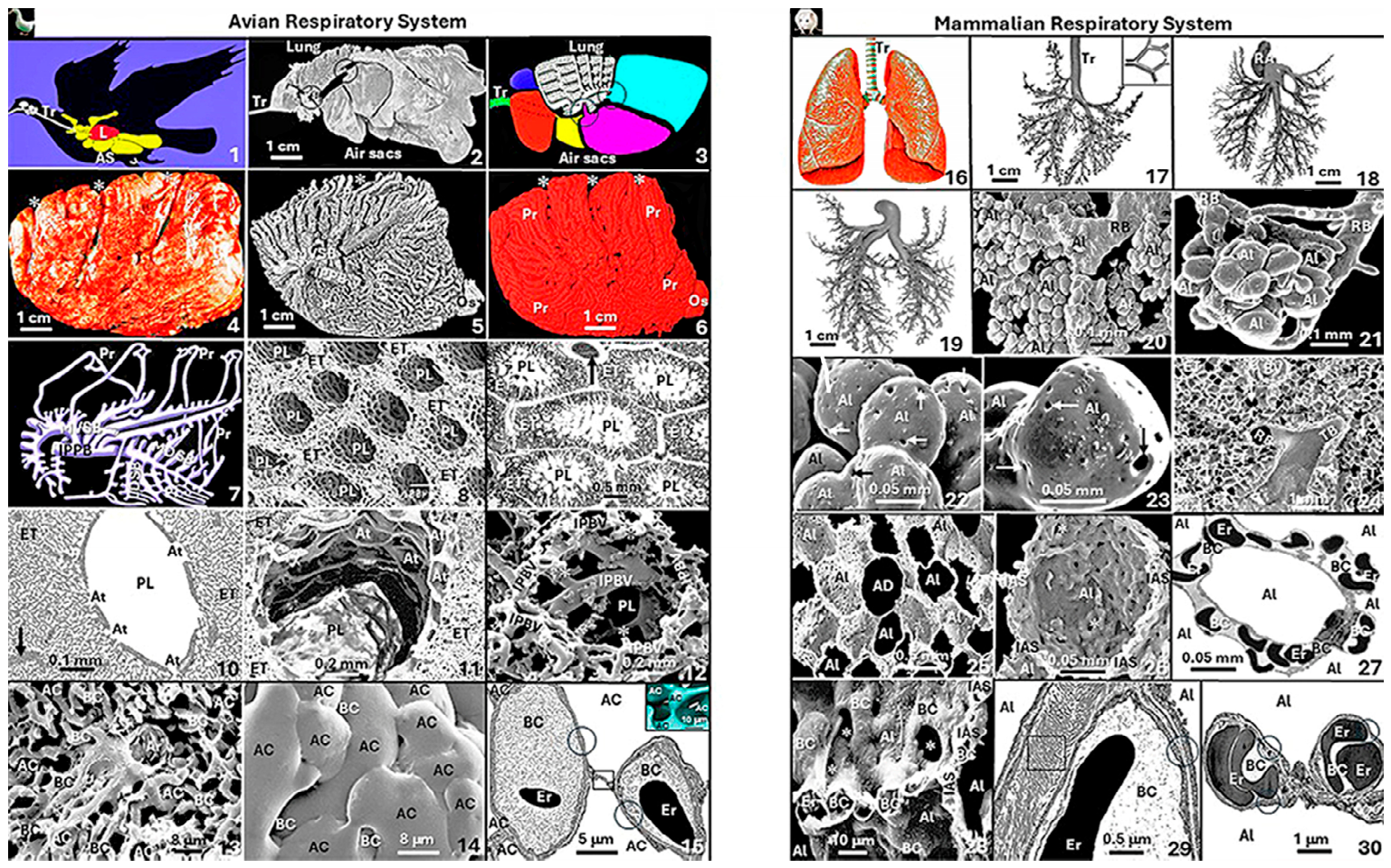
- The ARS is structurally and functionally separated into a small compact lung that serves as the gas exchanger while the air sacs ventilate it (lung) (Figure 1(1–3)).
- Practically rigid, the avian lungs are firmly fixed to the ribs and the vertebrae, causing them to be uninflatable (Figure 1(1–7)).
- Structurally, the airway (bronchial) system of the avian lung comprises a three-tier, hoop-like arrangement (Figure 1(7)).
- The exchange tissue is intensely partitioned into extremely small terminal respiratory units, the air capillaries (Figure 1(8–15)).
3. Environmental Conditions, Their Impacts on Birds and Aspects That Suggest Weakening of Their Adaptive Capacities
3.1. Susceptibility of Birds to Diseases and Injuries from Foreign Particulates
- Lacking a diaphragmatic partitioning, with some of them having pneumatized bones, the capacious air sacs (ASs) spread extensively in the coelomic cavity [259] for some species of birds such as the ostrich (Struthio camelus), and some of the ASs leave the coelomic cavity to lie subcutaneously [42,260,261,262,263,264,265] where they are highly vulnerable to injury from trauma and subsequent infection.
- Due to the dispersion of the ASs to most parts of the avian body, diseases and infections affect different parts of the body, ultimately spreading to the lung.
- The capacious ASs affords a large tidal volume that increases the measure of pathogens and particulates that are delivered to the lung.
- Because the walls of the ASs are very thin, delicate, poorly vascularized and scantly lined by an epithelium [182,265], the ASs are highly vulnerable to attack and injury from pathogens and particulates, and because of their fragility they provide little protection to the parts/organs of the body with which they interface.
- While paucity and lack of free avian respiratory macrophages (FARMs) on the respiratory surface of the avian lung [99,101,102] promoted gas exchange efficiency by reducing the thickness of the BGB [46,47,105], it concurrently caused the tissue barrier to become highly susceptible to structural failure [201,203] and injury from pathogens and particulates.
- While the rigidity of the avian lung supported intense subdivision of the gas exchange tissue, a process that created a large respiratory surface area, the air capillaries were apparently rendered highly vulnerable to infections and afflictions, particularly from dearth or absence of the FARMs from the respiratory surface [42,99,105,266].
- During each respiratory cycle, the large tidal volume, that stems from the large ASs leads to complete turnover of the volume of air in the lung [267], which delivers large quantities of pathogens and particulates to the lung.
- From synchronised actions of the cranial and caudal ASs, the exchange tissue of the avian lung is continuously and unidirectionally ventilated with air in a caudocranial direction, a process that increases the delivery and deposition of pathogens and injurious particulates in the exchange tissue [39,40,42,105,190].
- Because inhaled air containing large quantities of pathogens and particulates is shunted to the back of the lung via the intrapulmonary primary bronchus to the caudal ASs [40,41,42,43,190], compared to the other parts of the ARS, the caudal parts of the avian body are more vulnerable to injuries from inhaled pathogens and particulates [190].
3.2. Effects of Climate and Anthropogenic Habitat Devastation on Bird Life
- In conservation biology and evolutionary ecology, an ‘anthropogenic mortality surpassing evolutionary response rates model’ is a conjectural and mathematical schema that sculpts conditions where human-inflicted deaths happen too fast for natural selection to let the impacted population to adapt [338,339]: it causes precipitous population declines, degraded genetic diversity from inbreeding and likely local extinctions.
- In most species of animals, especially for small populations, instabilities that meaningfully increase risk of extinction can be investigated by a ‘demographic and environmental stochasticities model’ that combines randomness in individual births/deaths with environmental stochasticity, i.e., random changes in factors like weather, to determine likelihoods of species survival or extinction risk [340].
- A ‘species-focused, broad-based conservation strategies model’ applies an integrated approach designed to save particular endangered species while simultaneously protecting their broader ecosystems [344,345,346]: its goal is to address both immediate extinction risks and long-term ecological health.
3.3. Effects of Environmental Pollution on Birds
4. Conclusions
- In ecosystems facing rapid disruption, the ‘climate velocity’ or ‘velocity of climate change’ model determines the rapidity and the trajectory that climatic conditions change over the surface of the Earth, expressed in km.year−1 [399]. This value speaks to the rate at which species must travel, i.e., migrate, to preserve their existing climate niche.
- Representing the mean age of parents of a new cohort and in every respect driving how species react to ecological, demographic and ECs over time, ‘the generation time and temporal scaling in birds model’ is an important rating factor for population dynamics, where longer generation times correlate to robust total density reliance and greater scale of environmental unpredictability [400].
- Rapid reproduction rate;
- Dietary and habitat flexibility;
- Effective adaptation to ECs;
- Exploiting (adjusting to), rather than resisting, anthropogenetic effects.
- Living in specialist niches;
- Developing habitat loss and fragmentation;
- Migratory hazards;
- Increasing nest predation, especially for ground-nesting species;
- Invasion of exotic species that outcompete the native ones for resources;
- Climate-driven phenological mismatch which moves resource (food) availability out of phase with aspects such as breeding season;
Funding
Institutional Review Board Statement
Informed Consent Statement
Data Availability Statement
Acknowledgments
Conflicts of Interest
References
- Moczek, A.P. When the end modifies its means: The origins of novelty and the evolution of innovation. Biol. J. Linn. Soc. 2023, 139, 433–440. [Google Scholar] [CrossRef]
- Wagner, G.P.; Lynch, V.J. Evolutionary novelties. Curr. Biol. 2010, 20, R48–R52. [Google Scholar] [CrossRef]
- McKean, K.A.; Yourth, C.P.; Lazzaro, B.P.; Clark, A.G. The evolutionary costs of immunological maintenance and deployment. BMC Evol. Biol. 2008, 8, 76. [Google Scholar] [CrossRef] [PubMed]
- Orr, H.A. Fitness and its role in evolutionary genetics. Nat. Rev. Genet. 2009, 10, 531–539. [Google Scholar] [CrossRef]
- Mathot, K.J.; Kok, E.M.A.; Burant, J.B.; Dekinga, A.; Manche, P.; Saintonge, D.; Piersma, T. Evolutionary design of a flexible, seasonally migratory, avian phenotype: Why trade gizzard mass against pectoral muscle mass? Proc. R. Soc. B 2019, 286, 20190518. [Google Scholar] [CrossRef]
- Jaeger, J. The fourth perspective: Evolution and organismal agency. In Organization in Biology. History, Philosophy and Theory of the Life Sciences; Mossio, M., Ed.; Springer: Cham, Switzerland, 2024; Volume 33, pp. 159–186. [Google Scholar]
- Gregory, T.R. Understanding natural selection: Essential concepts and common misconceptions. Evol. Edu. Outreach 2009, 2, 156–175. [Google Scholar] [CrossRef]
- Gardner, A. The purpose of adaptation. Interface Focus 2017, 7, 20170005. [Google Scholar] [CrossRef]
- De Loof, A. The evolution of ‘life’: A metadarwinian integrative approach. Commun. Integr. Biol. 2017, 10, e1301335. [Google Scholar] [CrossRef] [PubMed]
- Weibel, E.R.; Taylor, C.R.; Bolis, L. (Eds.) Principles of Animal Design: The Optimization and Symmorphosis Debate; Cambridge University Press: Cambridge, UK, 2000. [Google Scholar]
- Garland, T.; Huey, R.B. Testing symmorphosis: Does structure match functional requirements? Evolution 1987, 41, 1404–1409. [Google Scholar] [CrossRef]
- Jones, J.H. Symmorphosis and the mammalian respiratory system: What is optimal design and does it exist. In Principles of Animal Design: The Optimization and Symmorphosis Debate; Weibel, E.R., Tylor, C.R., Bolis, L., Eds.; Cambridge University Press: Cambridge, UK, 1998; pp. 241–248. [Google Scholar]
- Diamond, J.M. The red flag of optimality. Nature 1992, 355, 206–294. [Google Scholar] [CrossRef]
- Garland, T. Conceptual and methodological issues in testing the predictions of symmorphosis. In Principles of Animal Design: The Optimization and Symmorphosis Debate; Weibel, E.R., Tylor, C.R., Bolis, L., Eds.; Cambridge University Press: Cambridge, UK, 1998; pp. 40–47. [Google Scholar]
- Maina, J.N. The lungs of the flying vertebrates–birds and bats: Is their structure optimized for this elite mode of locomotion? In Principles of Animal Design: The Optimization and Symmorphosis Debate; Weibel, E.R., Tylor, C.R., Bolis, L., Eds.; Cambridge University Press: Cambridge, UK, 1998; pp. 177–185. [Google Scholar]
- Taylor, C.R.; Weibel, E.R. Design of the mammalian respiratory system I. Problems and strategy. Respir. Physiol. 1981, 44, 1–10. [Google Scholar] [CrossRef] [PubMed]
- Seymour, R.S.; Runciman, S.; Baudinette, R.V. Development of maximum metabolic rate and pulmonary diffusing capacity in the super-precocial Australian Brush Turkey Alectura lathami: An allometric and morphometric study. Comp. Biochem. Physiol. A 2008, 150, 169–175. [Google Scholar] [CrossRef]
- Seymour, R.S.; Runciman, S.; Baudinette, R.V.; Pearson, J.T. Developmental allometry of pulmonary structure and function in the altricial Australian pelican Pelecanus conspicillatus. J. Exp. Biol. 2004, 207, 2663–2669. [Google Scholar] [CrossRef][Green Version]
- Runciman, S.; Seymour, R.S.; Baudinette, R.V.; Pearson, J.T. An allometric study of lung morphology during development in the Australian pelican, Pelecanus conspicillatus, from embryo to adult. J. Anat. 2005, 207, 365–380. [Google Scholar] [CrossRef]
- Hammond, K.A.; Chappel, M.A.; Cardullo, R.A.; Lin, R.S.; Johnsen, T.S. The mechanistic basis of aerobic performance variation in red jungle fowl. J. Exp. Biol. 2000, 203, 2053–2064. [Google Scholar] [CrossRef]
- Canals, M.; Donoso, C.; Figueroa, D.P.; Sabat, P. Pulmonary hematological parameters, energetic flight demands and their correlation with oxygen diffusion capacity in the lungs. Rev. Chil. Hist. Nat. 2007, 80, 275–284. [Google Scholar] [CrossRef]
- Weibel, E.R.; Taylor, C.R.; Hoppeler, H. Variations in functions and design: Testing symmorphosis in the respiratory system. Resp. Physiol. 1992, 87, 325–348. [Google Scholar] [CrossRef] [PubMed]
- Huber, K. Invited review: Resource allocation mismatch as pathway to disproportionate growth in farm animals–prerequisite for a disturbed health. Animal 2018, 12, 528–536. [Google Scholar] [CrossRef]
- Garland, T. Quick guide: Trade-offs. Curr. Biol. 2014, 24, R60–R61. [Google Scholar] [CrossRef] [PubMed]
- Garland, T.; Downs, C.J.; Ives, A.R. Trade-offs (and constraints) in organismal biology. Physiol. Biochem. Zool. 2022, 95, 82–112. [Google Scholar] [CrossRef]
- Debelgarric, M.; Récapet, C. Exploring physiological constraints on life-history traits using dynamic energy budgets. Ecol. Model. 2025, 501, 110993. [Google Scholar] [CrossRef]
- Duclos, K.K.; Hendrikse, J.L.; Jamniczky, H.A. Investigating the evolution and development of biological complexity under the framework of epigenetics. Evol. Dev. 2019, 21, 247–264. [Google Scholar] [CrossRef]
- Force, E.; Lamy, D.; Debernard, S.; Savouré, A.; Dacher, M. Developmental transitions involve common biological processes across living beings. Heliyon 2025, 11, e42995. [Google Scholar] [CrossRef]
- Ardia, D.R.; Parmentier, H.K.; Vogel, L.A. The role of constraints and limitation in driving indi-vidual variation in immune response. Ecol. Immunol. 2011, 25, 61–73. [Google Scholar]
- Holekamp, K.E.; Swanson, E.M.; Van Meter, P.E. Developmental constraints on behavioural flexibility. Philos. Trans. R. Soc. Lond. B 2013, 368, 20120350. [Google Scholar] [CrossRef]
- Goldsmith, T.C. Programmed aging, digital genetics, and the evolution of acquisition traits in mammals. Acad. Biol. 2025, 3, 1–6. [Google Scholar] [CrossRef]
- Sherry, T.W. When are birds dietarily specialized? Distinguishing ecological from evolutionary approaches. Stud. Avian Biol. 1990, 13, 47. [Google Scholar]
- Malmagro, R.; García-Navas, V.; Priyadarshana, T.S.; Neff, F.; Barrios, P.; Martínez-Núñez, C. The productivity gradient explains global bird specialisation better than climate stability. Glob. Ecol. Biogeogr. 2025, 34, e70107. [Google Scholar] [CrossRef]
- Di Cecco, G.J.; Hurlbert, A.H. Multiple dimensions of niche specialization explain changes in species’ range area, occupancy, and population size. Front. Ecol. Evol. 2022, 10, 921480. [Google Scholar] [CrossRef]
- Bicudo, J.; Eduardo, P.W.; Chappell, M.A.; Pearson, J.T.; Bech, C. Ecological and Environmental Physiology of Birds; Oxford University Press: Oxford, UK, 2010. [Google Scholar]
- Bundle, M.; Hoppeler, H.; Vock, R.; Tester, J.M.; Weyand, P.G. High metabolic rates in running birds. Nature 1999, 397, 31–32. [Google Scholar] [CrossRef]
- Gutiérrez, J.S.; Sabat, P.; Castañeda, L.E.; Contreras, C.; Navarrete, L.; Peña-Villalobos, I.; Navedo, J.G. Oxidative status and metabolic profile in a long-lived bird preparing for extreme endurance migration. Sci. Rep. 2019, 9, 17616. [Google Scholar] [CrossRef]
- Scheid, P. Mechanisms of gas exchange in bird lungs. Rev. Physiol. Biochem. Pharmacol. 1979, 86, 137–186. [Google Scholar]
- Fedde, M.R. The structure and gas flow pattern in the avian lung. Poult. Sci. 1980, 59, 2642–2653. [Google Scholar] [CrossRef]
- Hawkes, L.A. Why the superb physiological capacity of birds matters. J. Exp. Biol. 2025, 228, JEB247986. [Google Scholar] [CrossRef]
- Maina, J.N. Current Perspectives on the Functional Design of the Avian Respiratory System; Springer: Cham, Switzerland, 2023. [Google Scholar]
- Maina, J.N. Structure and function of the avian respiratory system. Philos. Trans. R. Soc. Lond. B 2025, 380, 20230435. [Google Scholar] [CrossRef]
- Maina, J.N. What it takes to fly: The structural and functional respiratory refinements in birds and bats. J. Exp. Biol. 2000, 203, 3045–3064. [Google Scholar] [CrossRef]
- Maina, J.N.; King, A.S.; Settle, J.G. An allometric study of the pulmonary morphometric parameters in birds, with mammalian comparison. Philos. Trans. R. Soc. Lond. B 1989, 326, 1–57. [Google Scholar] [CrossRef] [PubMed]
- Maina, J.N. The morphometry of the avian lung. In Form and Function in Birds; King, A.S., McLelland, J., Eds.; Academic Press: London, UK, 1989; Volume 4, pp. 307–368. [Google Scholar]
- Maina, J.N.; King, A.S. A morphometric study of the lung of a Humboldt penguin (Sphenicus humboldti). J. Vet. Med. Ser. C Anat. Histol. Embryol. 1987, 16, 293–297. [Google Scholar]
- Erwin, D.H. A conceptual framework of evolutionary novelty and innovation. Biol. Rev. 2021, 96, 1–15. [Google Scholar] [CrossRef]
- Bell, G. Evolutionary rescue. Annu. Rev. Ecol. Evol. Syst. 2017, 48, 605–627. [Google Scholar] [CrossRef]
- Carlson, S.M.; Cunningham, C.J.; Westley, P.A.H. Evolutionary rescue in a changing world. Trends Ecol. Evol. 2014, 29, 521–530. [Google Scholar] [CrossRef] [PubMed]
- Engle, N.L. Adaptive capacity and its assessment. Glob. Environ. Change 2011, 21, 647–656. [Google Scholar] [CrossRef]
- Lindsey, L.T.; Bruce, A.S.; Erik, A.B.; Wendy, F.; Sonya, R.G.; Nancy, G.; Gross, J.E.; Lawrence, D.J.; LeDee, O.E.; Olden, J.D.; et al. Persist in place or shift in space? Evaluating the adaptive capacity of species to climate change. Front. Ecol. Environ. 2020, 18, 520–528. [Google Scholar] [CrossRef]
- Foden, W.B.; Young, B.E.; Akçakaya, H.R.; Raquel, A.G.; Ary, A.H.; Bruce, A.S.; Thomas, C.D.; Wheatley, C.J.; Bickford, D.; Carr, J.A.; et al. Climate change vulnerability assessment of species. WIRES Clim. Change 2019, 10, e551. [Google Scholar] [CrossRef]
- Foden, W.B.; Butchart, S.H.M.; Stuart, S.N.; Vié, J.C.; Akçakaya, H.R.; Angulo, A.; DeVantier, L.M.; Gutsche, A.; Turak, E.; Cao, L.; et al. Identifying the world’s most climate change vulnerable species: A systematic trait-based assessment of all birds, amphibians and corals. PLoS ONE 2013, 8, e65427. [Google Scholar] [CrossRef]
- Gardali, T.; Seavy, N.E.; DiGaudio, R.T.; Comrack, L.A. A climate change vulnerability assessment of California’s at-risk birds. PLoS ONE 2012, 7, e29507. [Google Scholar] [CrossRef]
- Cabrelli, A.L.; Stow, A.J.; Hughes, L. A framework for assessing the vulnerability of species to climate change: A case study of the Australian elapid snakes. Biodivers. Conserv. 2014, 23, 3019–3034. [Google Scholar] [CrossRef]
- Manuck, S.B. The reaction norm in gene x environment interaction. Mol. Psychiatry 2010, 15, 881–882. [Google Scholar] [CrossRef][Green Version]
- Dupont, L.; Thierry, M.; Zinger, L.; Legrand, D.; Jacob, S. Beyond reaction norms: The temporal dynami-cs of phenotypic plasticity. Trends Ecol. Evol. 2024, 39, 41–51. [Google Scholar] [CrossRef]
- Barry, C.S.; Walker, V.M.; Cheesman, R.; Davey Smith, G.; Morris, T.T.; Davies, N.M. How to estimate heritability: A guide for genetic epidemiologists. Int. J. Epidemiol. 2023, 52, 624–632. [Google Scholar] [CrossRef] [PubMed]
- Wray, N.; Visscher, P. Estimating trait heritability. Nat. Edu. 2008, 1, 29. [Google Scholar]
- Levis, N.A.; Pfennig, D.W. Evaluating ‘plasticity-first’ evolution in nature: Key criteria and empirical approaches. Trends Ecol. Evol. 2016, 31, 563–574. [Google Scholar] [CrossRef]
- Levis, N.A.; Pfennig, D.W. Plasticity-led evolution: A survey of developmental mechanisms and empirical tests. Evol. Dev. 2020, 22, 71–87. [Google Scholar] [CrossRef]
- Diamond, S.E.; Martin, R.A. Buying time: Plasticity and population persistence. In Phenotypic Plasticity & Evolution: Causes, Consequences, Controversies; Pfennig, D.W., Ed.; CRC Press: Boca Raton, FL, USA, 2021; pp. 185–209. [Google Scholar]
- Rudman, S.M.; Greenblum, S.I.; Rajpurohit, S.; Betancourt, N.J.; Hanna, J.; Tilk, S.; Yokoyama, T.; Petrov, D.A.; Schmidt, P. Direct observation of adaptive tracking on ecological time scales in Drosophila. Science 2022, 375, eabj7484. [Google Scholar] [CrossRef]
- Chan, W.P.; Lenoir, J.; Mai, G.S.; Hung-Chi, K.; I-Ching, C.; Sheng-Feng, S. Climate velocities and species tracking in global mountain regions. Nature 2024, 629, 114–120. [Google Scholar] [CrossRef]
- Beaumont, H.; Gallie, J.; Kost, C.; Ferguson, G.; Rainey, P. Experimental evolution of bet hedging. Nature 2009, 462, 90–93. [Google Scholar] [CrossRef]
- Agrawal, A.A. phenotypic plasticity in the interactions and evolution of species. Sci. Compass 2001, 294, 321–346. [Google Scholar] [CrossRef] [PubMed]
- Przybylo, R.; Sheldon, B.C.; Merila, J. Climatic effects on breeding and morphology: Evidence for phenotypic plasticity. J. Anim. Ecol. 2000, 69, 395–403. [Google Scholar] [CrossRef]
- Oostra, V.; Saastamoinen, M.; Zwaan, B.J.; Wheat, C.W. Strong phenotypic plasticity limits potential for evolutionary responses to climate change. Nat. Commun. 2018, 9, 1005. [Google Scholar] [CrossRef] [PubMed]
- Langerhans, R.B.; Dewitt, T.J. Plasticity constrained: Over-generalized induction cues cause maladaptive phenotypes. Evol. Ecol. Res. 2002, 4, 857–870. [Google Scholar]
- Ghalambor, C.K.; McKay, J.K.; Carroll, S.P.; Reznick, D.N. Adaptive versus non-adaptive phenotypic plasticity and the potential for contemporary adaptation in new environments. Funct. Ecol. 2007, 21, 394–407. [Google Scholar] [CrossRef]
- Chen, L.; Khanna, M. Heterogeneous and long-term effects of a changing climate on bird biodiversity. GEC Adv. 2024, 2, 100008. [Google Scholar] [CrossRef]
- Stephenson, P.J.; Londoño-Murcia, M.C.; Borges, P.A.V.; Claassens, L.; Frisch-Nwakanma, H.; Ling, N.; McMullan-Fisher, S.; Meeuwig, J.J.; Machado-Unter, K.M.; Judith, L.; et al. Measuring the impact of conservation: The growing importance of monitoring fauna, flora and funga. Diversity 2022, 14, 824. [Google Scholar] [CrossRef]
- Vinton, A.C.; Gascoigne, S.J.L.; Sepil, I.; Salguero-Gómez, R. Plasticity’s role in adaptive evolution depends on environmental change components. Trends Ecol. Evol. 2022, 37, 1067–1078. [Google Scholar] [CrossRef]
- Guo, Y.-W.; Liu, Y.; Huang, P.-C.; Rong, M.; Wei, W.; Xu, Y.-H.; Wei, J.-H. Adaptive changes and genetic mechanisms in organisms under controlled conditions: A review. Int. J. Mol. Sci. 2025, 26, 2130. [Google Scholar] [CrossRef] [PubMed]
- Daniels, R.J.R. Patterns of regional species richness and endemism in Indian birds: A biogeographical perspective. Acad. Biol. 2025, 3. [Google Scholar] [CrossRef]
- Zera, A.J.; Harshman, L.G. The physiology of life history trade-offs in animals. Annu. Rev. Ecol. Syst. 2001, 32, 95–126. [Google Scholar] [CrossRef]
- Bennett, A.F.; Lenski, R.E. An experimental test of evolutionary trade-offs during temperature adaptation. Proc. Natl. Acad. Sci. USA 2007, 104, 8649–8654. [Google Scholar] [CrossRef] [PubMed]
- Chu, E.W.; Karr, J.R. Environmental Impact: Concept, Consequences, Measurement. Ref. Modul. Life Sci. 2017. [Google Scholar] [CrossRef]
- Ehrlich, E.; Becks, L.; Gaedke, U. Trait-fitness relationships determine how trade-off shapes affect species coexistence. Ecology 2017, 98, 3188–3198. [Google Scholar] [CrossRef]
- Farahpour, F.; Saeedghalati, M.; Brauer, V.; Hoffmann, D. Trade-off shapes diversity in eco-evolutionary dynamics. eLife 2018, 7, e36273. [Google Scholar] [CrossRef]
- Zinner, M.; Lukonin, I.; Liberali, P. Design principles of tissue organisation: How single cells coordinate across scales. Curr. Opin. Cell Biol. 2020, 67, 37–45. [Google Scholar] [CrossRef]
- Finn, C.; Grattarola, F.; Pincheira-Donoso, D. More losers than winners: Investigating Anthropocene defaunation through the diversity of population trends. Biol. Rev. 2023, 98, 1732–1748. [Google Scholar] [CrossRef] [PubMed]
- Bickel, J.; Bax, J.T. Bird Populations Are Shrinking Ever Faster in the Face of Climate Change and Agriculture-US Study. Available online: https://www.euronews.com/2026/03/09/bird-populations-are-shrinking-ever-faster-in-the-face-of-climate-change-and-agriculture-u (accessed on 18 March 2026).
- Kotz, M.; Amano, T.; Watson, J.E.M. Large reductions in tropical bird abundance attributable to heat extreme intensification. Nat. Ecol. Evol. 2025, 9, 1897–1909. [Google Scholar] [CrossRef] [PubMed]
- Daley, J. Birds Are Adapting to Climate Change, but Maybe Not Fast Enough: Animals Have Changed Their Behaviors but Might Not Be Able to Keep It Up. Available online: https://www.sierraclub.org/sierra/birds-are-adapting-climate-change-maybe-not-fast-enough (accessed on 19 March 2026).
- Lerm, R.E.; Medeiros, L.P.; Thompson, D.I.; Ehlers-Smith, D.A.; Downs, C.T. Bird communities show resilience to an extreme drought across a large savanna protected area. Glob. Ecol. Conserv. 2025, 64, e03933. [Google Scholar] [CrossRef]
- Freeman, B.G.; Eyster, H.N.; Heavyside, J.M.; Yip, D.A.; Mather, M.H.; Waterhouse, F.L. Pacific Northwest birds have shifted their abundances upslope in response to 30 years of warming temperatures. Ecology 2025, 106, e70193. [Google Scholar] [CrossRef]
- Ardila-Villamizar, M.; Sandoval, D.T.; Maldonado-Chaparro, A.A. Birds of a feather resist together: Sociality and species predict the resilience and recovery strategies of two neotropical birds. Ecol. Evol. 2025, 15, e71668. [Google Scholar] [CrossRef]
- Devictor, V.; Julliard, R.; Couvet, D.; Jiguet, F. Birds are tracking climate warming, but not fast enough. Proc. Biol. Sci. 2008, 275, 2743–2748. [Google Scholar] [CrossRef]
- Colles, A.; Liow, L.H.; Prinzing, A. Are specialists at risk under environmental change? Neoecological, paleoecological and phylogenetic approaches. Ecol. Lett. 2009, 12, 849–863. [Google Scholar] [CrossRef] [PubMed]
- Julliard, R.; Jiguet, F.; Couvet, D. Common birds facing global changes: What makes a species at risk? Glob. Change Biol. 2003, 10, 148–154. [Google Scholar] [CrossRef]
- Krishna, J.B.; Ashish, N.; Waghunde, R.R.; Dand, J.J.; Chaudhary, V. Climate change and avian vulnerability: A review of effects on migration, breeding, physiology and conservation. Int. J. Environ. Clim. Change 2025, 15, 766–776. [Google Scholar]
- Büchi, L.; Vuilleumier, S. Coexistence of specialist and generalist species is shaped by dispersal and environmental factors. Am. Nat. 2014, 183, 612–624. [Google Scholar] [CrossRef]
- Morelli, F.; Benedetti, Y.; Callaghan, C.T. Ecological specialization and population trends in European breeding birds. Glob. Ecol. Conserv. 2020, 22, e00996. [Google Scholar] [CrossRef]
- Morris, J.R.; Allhoff, K.T.; Valdovinos, F.S. Strange invaders increase disturbance and promote generalists in an evolving food web. Sci. Rep. 2021, 11, 21274. [Google Scholar] [CrossRef]
- Nganpiep, L.N.; Maina, J.N. Composite cellular defense stratagem in the avian respiratory system: Functional morphology of the free (surface) macrophages and specialized pulmonary epithelia. J. Anat. 2002, 200, 499–516. [Google Scholar] [CrossRef]
- Maina, J.N. A critical assessment of the cellular defences of the avian respiratory system: Are birds in general and poultry in particular relatively more susceptible to pulmonary infections/afflictions? Biol. Rev. 2023, 98, 2152–2187. [Google Scholar] [CrossRef]
- Mutua, P.M.; Gicheru, M.M.; Makanya, A.N.; Kiama, S.G. Comparative quantitative and qualitative attributes of the surface respiratory macrophages in the domestic duck and the rabbit. Int. J. Morphol. 2011, 29, 353–362. [Google Scholar] [CrossRef]
- Mutua, M.P.; Muya, S.; Gicheru, M.M. Protective roles of free avian respiratory macrophages in captive birds. Biol. Res. 2016, 49, 29. [Google Scholar] [CrossRef]
- Cooke, R.S.C.; Eigenbrod, F.; Bates, A.E. Ecological distinctiveness of birds and mammals at the global scale. Glob. Ecol. Conserv. 2020, 22, e00970. [Google Scholar] [CrossRef]
- Tobias, J.A.; Sheard, C.; Pigot, A.L.; Devenish, A.J.M.; Yang, J.; Sayol, F.; Neate-Clegg, M.H.C.; Alioravainen, N.; Weeks, T.L.; Barber, R.A.; et al. AVONET: Morphological, ecological and geographical data for all birds. Ecol. Let. 2022, 25, 581–597. [Google Scholar] [CrossRef]
- Maina, J.N. The Lung-Air Sac System of Birds: Development, Structure and Function; Springer: Heidelberg/Berlin, Germany, 2005. [Google Scholar]
- Hernando, M.G.; Roa, I.; Fernandez-Gil, J.; Benito-Fuertes, J.J.; Reguera, B.; Revilla, E. Trends in weather conditions favor generalist over specialist species in rear-edge alpine bird communities. Ecosphere 2022, 13, e3953. [Google Scholar] [CrossRef]
- Germain, R.R.; Feng, S.; Buffan, L.; Carmona, C.P.; Chen, G.; Graves, G.R.; Tobias, J.A.; Rahbek, C.; Lei, F.; Fjeldså, J.; et al. Changes in the functional diversity of modern bird species over the last million years. Proc. Natl. Acad. Sci. USA 2023, 120, e2201945119. [Google Scholar] [CrossRef]
- Ashrafzadeh, M.R.; Moradi, M.; Khosravi, R.; Naghipour, A.A.; Chamberlain, D. Impacts of climate change on a high elevation specialist bird are ameliorated by terrain complexity. Glob. Ecol. Conserv. 2024, 56, e03281. [Google Scholar] [CrossRef]
- Dudley, R. The Biomechanics of Insect Flight: Form, Function, Evolution; Princeton University Press: Princeton, NJ, USA, 2000. [Google Scholar]
- Koroljov, A.V. The flight of pterosaurs. Zh. Obshch. Biol. 2016, 77, 182–238. [Google Scholar] [CrossRef] [PubMed]
- Anderson, S.C.; Ruxton, G.D. The evolution of flight in bats: A novel hypothesis. Mammal Rev. 2020, 50, 426–439. [Google Scholar] [CrossRef]
- Pittman, M.; Barlow, L.A.; Kaye, T.G.; Habib, M.B. Pterosaurs evolved a muscular wing- body junction providing multifaceted flight performance benefits: Advanced aerodynamic smoothing, sophisticated wing root control, and wing force generation. Proc. Natl. Acad. Sci. USA 2021, 118, e2107631118. [Google Scholar] [CrossRef]
- Barrowclough, G.F.; Cracraft, J.; Klicka, J.; Zink, R.M. How many kinds of birds are there and why does it matter? PLoS ONE 2016, 11, e0166307. [Google Scholar] [CrossRef]
- Uetz, P.; Cherikh, S.; Shea, G.; Ineich, I.; Campbell, P.; Doronin, I.; Rosado, J.; Wynn, A.; Tighe, K.A.; McDiarmid, R.; et al. A global catalog of primary reptile type specimens. Zootaxa 2019, 4695, 438–450. [Google Scholar] [CrossRef]
- Myers, E.A.; Burbrink, F.T. Ecological opportunity: Trigger of adaptive radiation. Nat. Sci. Educ. 2012, 3, 23. [Google Scholar]
- Chaparro-Pedraza, P.C.; Roth, G.; Seehausen, O. The enrichment paradox in adaptive radiations: Emergence of predators hinders diversification in resource rich environments. Ecol. Lett. 2022, 25, 802–813. [Google Scholar] [CrossRef] [PubMed]
- Yamasaki, T.; Kobayashi, Y. Evolving dispersal ability causes rapid adaptive radiation. Sci. Rep. 2024, 14, 15734. [Google Scholar] [CrossRef]
- Jetz, W.; Thomas, G.H.; Joy, J.B.; Hartmann, K.; Mooers, A.O. The global diversity of birds in space and time. Nature 2012, 491, 444–448. [Google Scholar] [CrossRef] [PubMed]
- Title, P.O.; Rabosky, D.L. Tip rates, phylogenies and diversification: What are we estimating, and how good are the estimates? Methods Ecol. Evol. 2019, 10, 821–834. [Google Scholar] [CrossRef]
- Rabosky, D.L. Automatic detection of key innovations, rate shifts, and diversity-dependence on phylogenetic trees. PLoS ONE 2014, 9, e89543. [Google Scholar] [CrossRef] [PubMed]
- Scholl, J.P.; Wiens, J.J. Diversification rates and species richness across the Tree of Life. Proc. Biol. Sci. 2016, 283, 20161334. [Google Scholar] [CrossRef] [PubMed]
- Wingfield, J.C.; Pérez, J.H.; Krause, J.S.; Word, K.R.; González-Gómez, P.L.; Lisovski, S.; Chmura, H.E. How birds cope physiologically and behaviourally with extreme climatic events. Philos. Trans. R. Soc. Lond. B 2017, 372, 20160140. [Google Scholar] [CrossRef]
- Töpfer, T. Morphological variation in birds: Plasticity, adaptation, and speciation. In Bird Species: How They Arise, Modify and Vanish; Tietze, D., Ed.; Springer: Cham, Switzerland, 2007; pp. 63–74. [Google Scholar]
- Fragueira, R.; Helfenstein, F.; Fischer, K.; Beaulieu, M. Birds of different morphs use slightly different strategies to achieve similar reproductive performance following heat wave exposure. J. Anim. Ecol. 2021, 90, 2594–2608. [Google Scholar] [CrossRef]
- Swanson, D.L.; Vézina, F.; McKechnie, A.E.; Nord, A. Editorial: Avian behavioral and physiological responses to challenging thermal environments and extreme weather events. Front. Ecol. Evol. 2022, 10, 1034659. [Google Scholar] [CrossRef]
- Jokimäki, J.; Kaisanlahti-Jokimäki, M.L. Urban birds using insects on front panels of cars. Birds 2023, 4, 15–27. [Google Scholar] [CrossRef]
- Jokimäki, J.; Ramos-Chernenko, A. Innovative foraging behavior of urban birds: Use of insect food provided by cars. Birds 2024, 5, 469–486. [Google Scholar] [CrossRef]
- Benmazouz, I.; Jokimäki, J.; Juhasz, L.; Kaisanlahti-Jokimäki, M.L.; Paladi, P.; Kardos, G.; Lengyel, S.; Kövér, L. Morphological changes in hooded crows (Corvus cornix) related to urbanization. Front. Ecol. Evol. 2023, 11, 1196075. [Google Scholar] [CrossRef]
- Norberg, U.M. Energetics of flight. In Avian Energetics and Nutritional Ecology; Carey, C., Ed.; Springer: Boston, MA, USA, 1996; pp. 199–249. [Google Scholar]
- Butler, P.J. The physiological basis of bird flight. Philos. Trans. R. Soc. Lond. B Biol. Sci. 2016, 371, 20150384. [Google Scholar] [CrossRef]
- Bishop, C.M.; Butler, P.J.; Scanes, C.G. Flight. In Sturkie’s Avian Physiology, 6th ed.; Bishop, C.M., Butler, P.J., Scanes, C.G., Eds.; Academic Press: San Diego, CA, USA, 2015; pp. 919–974. [Google Scholar]
- Guglielmo, C.G. Obese super athletes: Fat-fueled migration in birds and bats. J. Exp. Biol. 2018, 221, jeb165753. [Google Scholar] [CrossRef]
- Groom, D.J.E.; Black, B.; Deakin, J.E.; DeSimone, J.G.; Lauzau, M.C.; Pedro, B.P.; Straight, C.R.; Unger, K.P.; Miller, M.S.; Gerson, A.R. Flight muscle size reductions and functional changes following long-distance flight under variable humidity conditions in a migratory warbler. Physiol. Rep. 2023, 11, e15842. [Google Scholar] [CrossRef] [PubMed]
- King, A.S.; King, D.Z. Avian morphology: General principles. In Form and Function in Birds; King, A.S., McLelland, J., Eds.; Academic Press: London, UK, 1979; Volume 1, pp. 1–38. [Google Scholar]
- King, A.S.; McLelland, J. Birds: Their Structure and Function, 2nd ed.; Bailliere Tindal: London, UK, 1984. [Google Scholar]
- Wyles, J.S.; Kunkel, J.G.; Wilson, A.C. Birds, behavior, and anatomical evolution. Proc. Nat. Acad. Sci. USA 1983, 80, 4394–4397. [Google Scholar] [CrossRef]
- O’Malley, B. Clinical Anatomy and Physiology of Exotic Species: Structure and Function of Mammals, Birds, Reptiles and Am phibians; W. B. Saunders: Edinburgh, UK, 2005. [Google Scholar]
- Roff, D.A. The evolution of flightlessness: Is history important? Evol. Ecol. 1994, 8, 639–657. [Google Scholar] [CrossRef]
- Iwaniuk, A.N.; Nelson, J.E.; James, H.F.; Olson, S.L. A comparative test of the correlated evolution of flightlessness and relative brain size in birds. J. Zool. 2004, 263, 317–327. [Google Scholar] [CrossRef]
- Wright, N.A.; Steadman, D.W.; Witt, C.C. Predictable evolution toward flightlessness in volant island birds. Proc. Natl. Acad. Sci. USA 2016, 113, 4765–4770. [Google Scholar] [CrossRef]
- Welty, J.C. The Life of Birds, 2nd ed.; Saunders: Philadelphia, PA, USA, 1979. [Google Scholar]
- Maderspacher, F. Flightless birds. Curr. Biol. 2022, 32, R1155–R1162. [Google Scholar] [CrossRef] [PubMed]
- Hieronymus, T.L. Qualitative skeletal correlates of wing shape in extant birds (Aves: Neoaves). BMC Evol. Biol. 2015, 15, 30. 141. [Google Scholar] [CrossRef]
- Chin, D.D.; Matloff, L.Y.; Stowers, A.K.; Tucci, E.R.; Lentink, D. Inspiration for wing design: How forelimb specialization enables active flight in modern vertebrates. J. R. Soc. Interface 2017, 14, 20170240. [Google Scholar] [CrossRef]
- Buhler, P. Light bones in birds. LA Mus. Nat. Hist. Sci. Ser. 1992, 36, 385–394. [Google Scholar]
- Cubo, J.; Casinos, A. Incidence and mechanical significance of pneumatization in the long bones of birds. Zool. J. Linn. Soc. 2000, 130, 499–510. [Google Scholar] [CrossRef]
- Dumont, E.R. Bone density and the light weight skeletons of birds. Proc. Biol. Sci. 2010, 277, 2193–2198. [Google Scholar] [PubMed]
- Hartman, F.A. Heart weight in birds. Condor 1955, 57, 221–238. [Google Scholar] [CrossRef]
- Dzialowski, E.M.; Crossley, D.A. The cardiovascular system. In Sturkie’s Avian Physiology, 7th ed.; Academic Press: San Diego, CA, USA, 2022; pp. 327–409. [Google Scholar]
- Louchart, A.; Viriot, L. From snout to beak: The loss of teeth in birds. Trends Ecol. Evol. 2011, 26, 663–673. [Google Scholar] [CrossRef]
- Meredith, R.W.; Zhang, G.; Gilbert, M.T.; Jarvis, E.D.; Springer, M.S. Evidence for a single loss of mineralized teeth in the common avian ancestor. Science 2014, 346, 254390. [Google Scholar] [CrossRef]
- Enoki, Y.; Morimoto, T. Gizzard myoglobin contents and feeding habits in avian species. Comp. Biochem. Physiol. A Mol. Integr. Physiol. 2000, 125, 33–43. [Google Scholar] [CrossRef]
- O’Malley, B. Clinical Anatomy and Physiology of Avian Species—From Bird Brains to Pigeon. 2008. Available online: https://www.vin.com/doc/?id=3866642 (accessed on 10 July 2025).
- McNab, B.K. Ecological factors affect the level and scaling of avian BMR. Comp. Biochem. Physiol. A Molec. Integr. Physiol. 2009, 152, 22–45. [Google Scholar] [CrossRef] [PubMed]
- Lovegrove, B.G. A phenology of the evolution of endothermy in birds and mammals. Biol. Rev. 2017, 92, 1213–1240. [Google Scholar] [CrossRef]
- Price, E.R.; Dzialowski, E.M. Development of endothermy in birds: Patterns and mechanisms. J. Comp. Physiol. B. 2018, 188, 373–391. [Google Scholar] [CrossRef]
- Swanson, D.L.; Stager, M.; Vézina, F.; Liu, J.S.; McKechnie, A.E.; Amirkhiz, R.E. Evidence for a maintenance cost for birds maintaining highly flexible basal, but not summit, metabolic rates. Sci. Rep. 2023, 13, 8968. [Google Scholar] [CrossRef] [PubMed]
- Biewener, A.A. Muscle function in avian flight: Achieving power and control. Phil. Trans. R. Soc. Lond. B 2011, 366, 1496–1506. [Google Scholar] [CrossRef]
- Hedrick, T.L.; Tobalske, B.W.; Ros, I.G.; Warrick, D.R.; Biewener, A.A. Morphological and kinematic basis of the hum mingbird flight stroke: Scaling of flight muscle transmission ratio. Proc. Biol. Sci. 2012, 279, 1986–1992. [Google Scholar] [PubMed]
- Scanes, C.G.; Dridi, S. (Eds.) Sturkie’s Avian Physiology, 7th ed.; Academic Press: New York, NY, USA, 2022. [Google Scholar]
- Harvey, E.P.; Ben-Tal, A. Robust unidirectional airflow through avian lungs: New insights from a piecewise linear mathematical model. PLoS Comput. Biol. 2016, 12, e1004637. [Google Scholar] [CrossRef]
- Packard, G.C.; Packard, M.J. Evolution of the cleidoic egg among reptilian antecedents of birds. Am. Zool. 1980, 20, 351–362. [Google Scholar] [CrossRef]
- Blackburn, D.; Evans, H.E. Why are there no viviparous birds? Amer. Natur. 1986, 128, 165–190. [Google Scholar] [CrossRef]
- Lodé, T. Oviparity or viviparity? That is the question. Reprod. Biol. 2012, 12, 259–264. [Google Scholar] [CrossRef] [PubMed]
- Rawal, D.; Rajpurohit, A. Cleidoic eggs: A key to water to land transition. Indian J. Appl. Pure Biol. 2025, 40, 621–627. [Google Scholar] [CrossRef]
- Cockburn, A. Prevalence of different modes of parental care in birds. Proc. R. Soc. B 2006, 273, 1375–1383. [Google Scholar] [CrossRef]
- Mock, D.W. Parental care in birds. Curr. Biol. 2022, 32, R1132–R1136. [Google Scholar] [CrossRef]
- Jacoboski, L.I. Why integrate evolutionary and functional aspects in bird studies in converted habitats? Int. Ornithol. 2018, 1, 1–2. [Google Scholar]
- Wiltschko, R.; Wiltschko, W. Magnetoreception in birds. J. R. Soc. Interface 2019, 16, 20190295. [Google Scholar] [CrossRef] [PubMed]
- Demšar, U.; Zein, B.; Long, J.A. A new data-driven paradigm for the study of avian migratory navigation. Mov. Ecol. 2025, 13, 16. [Google Scholar] [CrossRef]
- Rolando, A.; Zunino, M. Observations of tool use in corvids. Ornis Scand. 1992, 23, 201–202. [Google Scholar] [CrossRef]
- Hunt, G. Vice-anvil use in nut processing by two Corvus species. N. Z. J. Zool. 2013, 41, 68–76. [Google Scholar] [CrossRef][Green Version]
- Hunt, G.R.; Sakuma, F.; Shibata, Y. New Caledonian crows drop candle-nuts onto rock from communally used forks on branches. Emu 2002, 102, 283–290. [Google Scholar] [CrossRef]
- Raby, C.R.; Clayton, N.S. The cognition of caching and recovery in food-storing birds. In Advances in the Study of Behavior; Brockmann, H.J., Roper, T.J., Naguib, M., Wynne-Edwards, K.E., Mitani, J.C., Simmons, L.W., Eds.; Elsevier: Amsterdam, The Netherlands, 2010; Volume 41, pp. 1–34. [Google Scholar]
- Applegate, M.C.; Aronov, D. Flexible use of memory by food-caching birds. eLife 2022, 11, e70600. [Google Scholar] [CrossRef]
- Brea, J.; Clayton, N.S.; Gerstner, W. Computational models of episodic-like memory in food-caching birds. Nat. Commun. 2023, 14, 2979. [Google Scholar] [CrossRef]
- Cardoso, G.C. Paradoxical calls: The opposite signaling role of sound frequency across bird species. Behav. Ecol. 2012, 23, 237–241. [Google Scholar] [CrossRef]
- Crisologo, T.L.; Dzielski, S.A.; Purcell, J.R.; Webster, M.S.; Welbergen, J.A.; Dalziell, A.H. Selective alarm call mimicry in the sexual display of the male superb lyrebird (Menura novaehollandi ae). Evol. Ecol. 2023, 37, 245–266. [Google Scholar] [CrossRef]
- Brooke, M.L.; Hanley, S.; Laughlin, S.B. The scaling of eye size with body mass in birds. Proc. R. Soc. B Biol. Sci. 1999, 266, 405–412. [Google Scholar] [CrossRef]
- Kiltie, R.A. Scaling of visual acuity with body size in mammals and birds. Funct. Ecol. 2000, 14, 226–234. [Google Scholar] [CrossRef]
- Terrill, R.S.; Shultz, A.J. Feather function and the evolution of birds. Biol. Rev. 2023, 98, 540–566. [Google Scholar] [CrossRef]
- King, A.S. Structural and functional aspects of the avian lung and its air sacs. Intern. Rev. Gen. Exp. Zool. 1966, 2, 171–267. [Google Scholar]
- Duncker, H.R. The lung-air sac system of birds. A contribution to the functional an atomy of the respiratory apparatus. Ergeb. Anat. Entwicklung. 1971, 45, 1–171. [Google Scholar]
- King, A.S.; McLelland, J. (Eds.) Form and Function in Birds; Academic Press: London, UK, 1989; Volume 4. [Google Scholar]
- McLelland, J. Anatomy of the lungs and air sacs. In Form and Function in Birds; King, A.S., McLelland, J., Eds.; Academic Press: London, UK, 1989; Volume IV, pp. 221–279. [Google Scholar]
- Ehrlich, P.R.; Dobkin, D.S.; Wheye, D. The Birder’s Handbook: A Field Guide to the Natural History of North American Birds; Simon and Schuster: New York, NY, USA, 1988. [Google Scholar]
- Schwab, R.G.; Schafer, V.F. Avian Thermoregulation and Its Significance in Starling Control. In Proceedings of the 5th Vertebrate Pest Conference; University of California: Los Angeles, CA, USA, 1972; Volume 25. [Google Scholar]
- Mota-Rojas, D.; Titto, C.G.; de Mira Geraldo, A.; Martínez-Burnes, J.; Gómez, J.; Hernán dez-Ávalos, I. Efficacy and function of feathers, hair, and glabrous skin in the thermoregulation strategies of domestic animals. Animals 2021, 11, 3472. [Google Scholar] [CrossRef]
- Weibel, E.R. The Pathway for Oxygen: Structure and Function in the Mammalian Respiratory System; Harvard University Press: Cambridge, MA, USA, 1984. [Google Scholar]
- Bartholomew, G.A.; Lighton, J.R.B. Oxygen consumption during hover-feeding in free-ranging Anna hummingbirds. J. Exp. Biol. 1986, 123, 191–199. [Google Scholar] [CrossRef] [PubMed]
- Lindstedt, S.; Hokanson, J.; Wells, D.; Swain, S.D.; Hoppeler, H.; Navarro, V. Running energetics in the pronghorn antelope. Nature 1991, 353, 748–750. [Google Scholar] [CrossRef]
- Suarez, R.K.; Welch, K.C.; Hanna, S.K.; Herrera, M.L.G. Flight muscle enzymes and metabolic flux rates during hovering flight of the nectar bat, Glossophaga soricina: Further evidence of convergence with hummingbirds. Comp. Biochem. Physiol. A Mol. Integr. Physiol. 2009, 153, 136–140. [Google Scholar] [CrossRef] [PubMed]
- Weibel, E.R. Morphological basis of alveoli-capillary gas exchange. Physiol. Rev. 1973, 53, 419–495. [Google Scholar] [CrossRef]
- Maina, J.N.; King, A.S. The thickness of avian blood-gas barrier: Qualitative and quantitative observations. J. Anat. 1982, 134, 553–562. [Google Scholar]
- Meban, C. Thickness of the air-blood barriers in vertebrate lungs. J. Anat. 1980, 131, 299–307. [Google Scholar]
- West, J.B. Comparative physiology of the pulmonary blood-gas barrier: The unique avian solution. Am. J. Physiol. Regul. Integr. Comp. Physiol. 2009, 297, R1625–R1634. [Google Scholar]
- Maina, J.N.; West, J.B. Thin and strong! The bioengineering dilemma in the structural and functional design of the blood- gas barrier: Comparative and evolutionary perspectives. Physiol. Rev. 2005, 85, 811–844. [Google Scholar] [PubMed]
- Gehr, P.; Mwangi, D.K.; Ammann, A.; Maloiy, G.M.O.; Taylor, C.R.; Weibel, E.R. Design of the mammalian respiratory system. V. Scaling morpho-metric pulmonary diffusing capacity to body mass: Wild and domestic mammals. Respir. Physiol. 1981, 44, 61–86. [Google Scholar]
- Forrest, J.B. Structural aspects of gas exchange. Fed. Proc. 1979, 38, 209–214. [Google Scholar] [PubMed]
- Forster, R.E. Exchange of gases between alveolar air and pulmonary capillary blood: Pulmonary diffusing capacity. Physiol. Rev. 1957, 37, 391–452. [Google Scholar] [CrossRef] [PubMed]
- West, J.B. Thoughts on the pulmonary blood-gas barrier. Am. J. Physiol. Lung Cell Mol. Physiol. 2003, 285, L501–L513. [Google Scholar]
- West, J.B.; Tsukimoto, K.; Mathieu-Costello, O.; Prediletto, R. Stress failure in pulmonary capillies. J. Appl. Physiol. 1991, 70, 1731–1742. [Google Scholar] [CrossRef]
- West, J.B.; Mathieu-Costello, O.; Jones, J.H.; Birks, E.K.; Logemann, R.B.; Pascoe, J.R.; Tyler, W.S. Stress failure of pulmo nary capillaries in racehorses with exercise-induced pulmonary hemor- rhage. J. Appl. Physiol. 1993, 75, 1097–1109. [Google Scholar] [CrossRef]
- West, J.B.; Mathieu-Costello, O. Stress failure of pulmonary capillaries as a limiting factor for maximal exercise. Eur. J. Appl. Physiol. Occup. Physiol. 1995, 70, 99–108. [Google Scholar] [CrossRef] [PubMed]
- Maina, J.N.; Jimoh, S.A. Study of stress induced failure of the blood-gas barrier and the epithelial-epithelial cells connections of the lung of the domestic fowl, Gallus gallus variant domesticus after vascular perfusion. Biomed. Eng. Comput. Biol. 2013, 5, 77–88. [Google Scholar] [CrossRef] [PubMed]
- Maina, J.N.; Jimoh, S.A. Structural failures of the blood-gas barrier and the epithelial-epithelial cell connections in the different vascular regions of the lung of the domestic fowl (Gallus gallus variant domesticus), at rest and during exercise. Biol. Open 2013, 2, 267–276. [Google Scholar] [CrossRef] [PubMed][Green Version]
- Macklem, P.T.; Bouverot, P.; Scheid, P. Measurement of the distensibility of the parabronchi in duck lungs. Respir. Physiol. 1979, 38, 23–35. [Google Scholar] [CrossRef]
- Powell, F.L.; Hastings, R.H.; Mazzone, R.W. Pulmonary vascular resistance during unilateral pulmonary arterial occlusion in ducks. Am. J. Physiol. 1985, 249, R39–R43. [Google Scholar] [CrossRef]
- Watson, R.R.; Fu, Z.; West, J.B. Minimal distensibility of pulmonary capillaries in avian lungs compared with mammalian lungs. Respir. Physiol. Neurobiol. 2008, 160, 208–214. [Google Scholar] [CrossRef]
- Birks, E.K.; Mathieu-Costello, O.; Fu, Z.; Tyler, W.S.; West, J.B. Comparative aspects of the strength of pulmonary capillaries in rabbit, dog, and horse. Respir. Physiol. 1994, 97, 235–246. [Google Scholar] [CrossRef]
- Mathieu-Costello, O.; Willford, D.C.; Fu, Z.; Garden, R.M.; West, J.B. Pulmonary capillaries are more resistant to stress failure in dogs than in rabbits. J. Appl. Physiol. 1995, 79, 908–917. [Google Scholar] [CrossRef]
- Williamson, J.R.; Vogler, N.J.; Kilo, C. Regional variations in the width of the basement membrane of muscle capillaries in man and giraffe. Am. J. Pathol. 1971, 63, 359–370. [Google Scholar]
- Welling, L.W.; Grantham, J.J. Physical properties of isolated perfused renal tubules and tubular basement membranes. J. Clin. Investig. 1972, 51, 1063–1075. [Google Scholar] [CrossRef]
- Haworth, S.G.; Hall, S.M.; Panja, M.; Patel, M. Peripheral pulmonary vascular and airway abnormalities in adolescents with rheumatic mitral stenosis. Int. J. Cardiol. 1988, 18, 405–416. [Google Scholar] [CrossRef]
- Swayne, G.T.; Smaje, L.H.; Bergel, D.H. Distensibility of single capillaries and venules in the rat and frog mesentery. Int. J. Microcirc. Clin. Exp. 1989, 8, 25–42. [Google Scholar]
- Seymour, R.S.; Blaylock, A.J. The principle of Laplace and scaling of ventricular wall stress and blood pressure in mammals and birds. Physiol. Biochem. Zool. 2000, 73, 389–405. [Google Scholar] [CrossRef]
- Speckmann, E.W.; Ringer, R.K. The cardiac output and carotid and tibial blood pressure of the turkey. Can. J. Biochem. Physiol. 1963, 41, 2337–2341. [Google Scholar] [CrossRef]
- van Veen, L. Aortic rupture in poultry: A review. Tijdschr. Diergeneeskd. 1999, 124, 244–247. [Google Scholar]
- Mitchinson, M.J.; Keymer, I.F. Aortic rupture in ostriches (Struthio camelus)—A comparative study. J. Comp. Pathol. 1977, 87, 27–33. [Google Scholar] [CrossRef]
- Lichtenberger, M. Determination of indirect blood pressure in the companion bird. Semin. Avian Exot. Pet Med. 2005, 2, 149–152. [Google Scholar] [CrossRef]
- Sullivan, L. Blood Pressure. Veterian Key: Fastest Veterinary Medicine Insight Engine. Available online: https://veteriankey.com/3-blood-pressure/ (accessed on 22 March 2026).
- West, J.B.; Fu, Z.; Gu, Y.; Wagner, H.E.; Carr, J.A.; Peterson, K.L. Pulmonary artery pressure responses to increased cardiac output in chickens with raised metabolic rate. Comp. Biochem. Physiol. A Mol. Integr. Physiol. 2010, 156, 430–435. [Google Scholar] [CrossRef] [PubMed][Green Version]
- Evans, B.R.; Leighton, F.A. A history of One Health. Rev. Sci. Tech. 2014, 33, 413–420. [Google Scholar] [CrossRef] [PubMed]
- Lerner, H.; Berg, C. The concept of health in One Health and some practical implications for research and education: What is One Health? Infect. Ecol. Epidemiol. 2015, 5, 25300. [Google Scholar] [CrossRef]
- Messenger, A.M.; Barnes, A.N.; Gray, G.C. Reverse zoonotic disease transmission (zooanthroponosis): A systematic review of seldom-documented human biological threats to animals. PLoS ONE 2014, 9, e89055. [Google Scholar] [CrossRef]
- Wang, L.F.; Crameri, G. Emerging zoonotic viral diseases. Rev. Sci. Tech. 2014, 33, 569–581. [Google Scholar] [CrossRef]
- Salinas-Ramos, V.B.; Mori, E.; Bosso, L.; Ancillotto, L.; Russo, D. Zoonotic risk: One more good reason why cats should be kept away from bats. Pathogens 2021, 10, 304. [Google Scholar] [CrossRef] [PubMed]
- Shaheen, M.N.F. The concept of one health applied to the problem of zoonotic diseases. Rev. Med. Virol. 2022, 32, e2326. [Google Scholar] [CrossRef]
- Boseret, G.; Losson, B.; Mainil, J.G.; Thiry, E.; Saegerman, C. Zoonoses in pet birds: Review and perspectives. Vet. Res. 2013, 44, 36. [Google Scholar] [CrossRef] [PubMed]
- Hosseinian, S.A. Zoonotic diseases associated with pet birds. J. Zoonotic Dis. 2022, 6, 91–112. [Google Scholar]
- Qiu, Y.; Chenlong, L.; Chen, J.; Sun, Y.; Tang, T.; Zhang, Y.; Yang, Y.; Wang, G.; Xu, Q.; Zhang, X.; et al. The global distribution and diversity of wild-bird-associated pathogens: An integrated data analysis and modeling study. Med 2025, 6, 100553. [Google Scholar] [CrossRef] [PubMed]
- Softić, A.; Nicevic, M.; Koro-Spahic, A.; Terzic, I.; Goletic, S.; Kapo, N.; Salkic, J.; Omeragic, J.; Goletic, T. The monitoring of emergent zoonotic pathogens in wild and captive birds in Sarajevo Canton, Bosnia and Herzegovina. Front. Vet. Sci. 2025, 2, 1621094. [Google Scholar] [CrossRef]
- Najdenski, H.; Dimova, T.; Zaharieva, M.M.; Nikolov, B.; Petrova-Dinkova, G.; Dalakchieva, S.; Popov, K.; Hristova- Nikolova, I.; Zehtindjiev, P.; Peev, S.; et al. Migratory birds along the mediterranean—Black Sea flyway as carriers of zoonotic pathogens. Can. J. Microbiol. 2018, 64, 915–924. [Google Scholar] [CrossRef]
- Rappole, J.H.; Derrickson, S.R.; Hubalek, Z. Migratory birds and spread of West Nile virus in the western hemisphere. Emerg. Infect. Dis. 2000, 6, 319–328. [Google Scholar] [CrossRef] [PubMed]
- Cruz, B. The Impact of Living near Industrial Areas on Bird Microbial Health. 2024. Available online: https://www.midogtest.com/blog/the-impact-of-living-near-industrial-areas-on-bird-microbial-health/ (accessed on 18 September 2025).
- Newton, I. Migration mortality in birds. Ibis 2024, 167, 106–123. [Google Scholar] [CrossRef]
- Klaassen, M.; Hoye, B.J.; Nolet, B.A.; Buttemer, W.A. Ecophysiology of avian migration in the face of current global hazards. Philos. Trans. R. Soc. Lond. B 2012, 367, 1719–1732. [Google Scholar] [CrossRef]
- Ivy, C.M.; Williamson, J.L. On the physiology of high-altitude flight and altitudinal migration in birds. Integr. Comp. Biol. 2024, 64, 1766–1779. [Google Scholar] [CrossRef]
- McPherson, R.A.; Alger, K.E.; Hofmeister, E. Climate-related drivers of migratory bird health in the south-central USA. Biol. Rev. 2025, 100, 1272–1293. [Google Scholar] [CrossRef]
- Dick, M.; Guglielmo, C.G. Flight muscle protein damage during endurance flight is related to energy expenditure but not dietary polyunsaturated fatty acids in a migratory bird. J. Exp. Biol. 2019, 222, jeb187708. [Google Scholar] [CrossRef] [PubMed]
- Eikenaar, C.; Hessler, S.; Hegemann, A. Migrating birds rapidly increase constitutive immune function during stopover. R. Soc. Open Sci. 2020, 7, 192031. [Google Scholar] [CrossRef]
- Melo, A.M.; Stevens, D.A.; Tell, L.A.; Veríssimo, C.; Sabino, R.; Xavier, M.O. Aspergillosis, avian species and the One Health perspective: The possible importance of birds in azole resistance. Microorganisms 2020, 8, 2037. [Google Scholar] [CrossRef]
- Balakin, E.; Yurku, K.; Ivanov, M.; Izotov, A.; Nakhod, V.; Pustovoyt, V. Regulation of stress induced immunosuppression in the context of neuroendocrine, cytokine, and cellular processes. Biology 2025, 14, 76. [Google Scholar] [CrossRef]
- Alispahic, A.; Softic, A.; Kustura, A.; Omeragic, J.; Goletic, T. Clinical and welfare aspects of immunosuppression in poultry farming. In Clinical and Welfare Aspects of Immunosuppression in Poultry Farming; Bakker, J., de la Garza, M.A., Eds.; Intechopen: Rijeka, Croatia, 2025; pp. 1–24. [Google Scholar]
- Chan, J.F.W.; To, K.K.W.; Chen, H.; Yuen, K.Y. Cross-species transmission and emergence of novel viruses from birds. Curr. Opin. Virol. 2015, 10, 63–69. [Google Scholar] [CrossRef] [PubMed]
- Buchmann, K. Evolution of innate immunity: Clues from invertebrates via fish to mammals. Front. Immunol. 2014, 5, 459. [Google Scholar] [CrossRef]
- Wigley, P. Immunology of Birds; John Wiley and Sons, Ltd.: Hoboken, NJ, USA, 2017. [Google Scholar]
- Westerdahl, H.; Mellinger, S.; Sigeman, H.; Kutschera, V.E.; Proux-Wéra, E.; Lundberg, M.; Weissensteiner, M.; Churcher, A.; Bunikis, I.; Hansson, B.; et al. The genomic architecture of the passerine MHC region: High repeat content and contrasting evolutionary histories of single copy and tandemly duplicated MHC genes. Mol. Ecol. Resour. 2022, 22, 2379–2395. [Google Scholar] [CrossRef]
- Minias, P.; Włodarczyk, R.; Remisiewicz, M.; Cobzaru, I.; Janiszewski, T. Distinct evolutionary trajectories of MHC class I and class II genes in Old World finches and buntings. Heredity 2021, 126, 974–990. [Google Scholar] [CrossRef]
- Minias, P.; Pikus, E.; Whittingham, L.A.; Dunn, P.O. Evolution of copy number at the mhc varies across the avian tree of life. Genome Biol. Evol. 2019, 11, 17–28. [Google Scholar] [CrossRef] [PubMed]
- Hu, J.; Song, L.; Ning, M.; Niu, X.; Han, M.; Gao, C.; Feng, X.; Cai, H.; Li, T.; Li, F.; et al. A new chromosome-scale duck genome shows a major histocompatibility complex with several expanded multigene families. BMC Biol. 2024, 22, 31. [Google Scholar] [CrossRef] [PubMed]
- Ingle, D.; Bruellman, R.; Espana, E.; Galloway, K.; Anderson, T.; Meredith, T.L.; Porter, M.E. Science behind the lesson: It’s a bird! it’s a plane! it’s biomechanics! CourseSource 2019, 6, 1–6. [Google Scholar] [CrossRef]
- Jansen, M.; Stoks, R.; Coors, A.; van Doorslaer, W.; de Meester, L. Collateral damage: Rapid exposure-induced evolution of pesticide resistance leads to increased susceptibility to parasites. Evolution 2011, 65, 2681–2691. [Google Scholar] [CrossRef] [PubMed]
- Dutilleul, M.; Réale, D.; Goussen, B.; Lecomte, C.; Galas, S.; Bonzom, J.M. Adaptation costs to constant and alternating polluted environments. Evol. Appl. 2017, 10, 839–851. [Google Scholar] [CrossRef] [PubMed]
- Lawton, M. Management of respiratory disease in psittacine birds. Practice 1999, 21, 76–88. [Google Scholar] [CrossRef]
- Kallapura, G.; Hernandez-Velasco, X.; Pumford, N.R.; Bielke, L.R.; Hargis, B.M.; Tellez, G. Evaluation of respiratory route as a viable portal of entry for Salmonella in poultry. Vet. Med. 2014, 5, 59–73. [Google Scholar]
- Yehia, N.; Salem, H.M.; Mahmmod, Y.; Said, D.; Samir, M.; Mawgod, S.; Sorour, H.K.; AbdelRahman, M.A.A.; Selim, S.; Saad, A.M.; et al. Common viral and bacterial avian respiratory infections: An updated review. Poult. Sci. 2023, 102, 102553. [Google Scholar] [CrossRef]
- Liu, H.; Pan, S.; Wang, C.; Wenwen, Y.; Xiaofang, W.; Yang, H.; Xu, T.; Shi, K.; Si, H. Review of respiratory syndromes in poultry: Pathogens, prevention, and control measures. Vet. Res. 2025, 56, 101. [Google Scholar] [CrossRef]
- Hill, D.B.; Button, B.; Rubinstein, M.; Boucher, R.C. Physiology and pathophysiology of human airway mucus. Physiol. Rev. 2022, 102, 1757–1836. [Google Scholar] [CrossRef]
- Kia’i, N.; Bajaj, T. Histology, Respiratory Epithelium. 2023. Available online: https://www.ncbi.nlm.nih.gov/books/NBK541061/ (accessed on 20 August 2025).
- Dezube, R. Defense Mechanisms of the Respiratory System. Available online: https://www.msdmanuals.com/home/lung-and-airway-disorders/biology-of-the-lungs-and-airways/defense-mechanisms-of-the-respiratory-system (accessed on 20 August 2025).
- Lahellec, C.; Colin, P.; Bennejean, G.; Paquin, J.; Guillerm, A.; Debois, J. Influence of resident Salmonella on contamina tion of broiler flocks. Poult. Sci. 1986, 65, 2034–2039. [Google Scholar] [CrossRef]
- Mitchell, J.R. The number and location of air sacs in broiler chickens and the implication in Escherichia coli infection. J. S. Afr. Vet. Assoc. 1984, 2, 57–60. [Google Scholar]
- Bezuidenhout, A.J.; Groenewald, H.B.; Soley, J.T. An anatomical study of the respiratory air sacs in ostriches. Onderstepoort J. Vet. Res. 1999, 66, 317–325. [Google Scholar]
- Daoust, P.Y.; Dobbin, G.V.; Ridlington, A.R.C.F.; Dawson, S.D. Descriptive anatomy of the subcutaneous air diverticula in the Northern gannet Morus bassanus. Seabird 2008, 21, 64–67. [Google Scholar] [CrossRef]
- Casteleyn, C.; Cornillie, P.; Van Cruchten, S.; Van den Broeck, W.; van Ginneken, C.; Simoens, P. Anatomy of the lower respiratory tract in domestic birds, with emphasis on respiration. Anat. Histol. Embryol. 2018, 47, 89–99. [Google Scholar] [CrossRef]
- da Silva Viegas, K.A.; Correia, S.; Padula, K.; Martins, E.H.; de Vasconcelos Silva, J.A.; Cruz dos, L.E.; Filadelpho, A.L. Morphological analysis of air sacs in red-winged tinamou (Rhynchotus rufescens Temminck, 1815). Braz. Anim. Sci. 2024, 25, 79886E. [Google Scholar]
- Bezuidenhout, A.J. Light and electron microscopic study of the thoracic respiratory air sacs of the fowl. Anat. Histol. Embryol. 2005, 34, 185–191. [Google Scholar] [CrossRef] [PubMed]
- Kiama, S.G.; Adekunle, J.S.; Maina, J.N. Comparative in vitro study of interactions between particles and respiratory sur face macrophages, erythrocytes, and epithelial cells of the chicken and the rat. J. Anat. 2008, 213, 452–463. [Google Scholar] [CrossRef] [PubMed]
- Lasiewski, R.C.; Calder, W.A. A preliminary allometric analysis of respiratory variables in resting birds. Respir. Physiol. 1971, 11, 152–166. [Google Scholar] [CrossRef]
- Tell, L.A. Aspergillosis in mammals and birds: Impact on veterinary medicine. Med. Mycol. 2005, 43, 71–73. [Google Scholar] [CrossRef]
- Beernaert, L.A.; Pasmans, F.; Van Waeyenberghe, L.; Haesebrouck, F.; Martel, A. Aspergillus infections in birds: A re view. Avian Pathol. 2010, 39, 325–331. [Google Scholar] [CrossRef]
- Fletcher, O.J. Pathology of the avian respiratory system. Poult. Sci. 1980, 59, 2666–2679. [Google Scholar] [CrossRef] [PubMed]
- Crosta, L. Respiratory diseases of parrots: Anatomy, physiology, diagnosis and treatment. Vet. Clin. Exot. Anim. 2021, 24, 97–418. [Google Scholar] [CrossRef]
- Lightfoot, T.L. Lung and Airway Disorders of Pet Birds (Avian Flu, Bird Flu); Merck Veterinary Manual, 2025. Available online: https://www.msdvetmanual.com/bird-owners/disorders-and-diseases-of-birds/lung-and-airway-disorders-of-pet-birds (accessed on 24 February 2026).
- Abudabos, A.M.; Samara, E.M.; Hussein, E.O.S.; Al-Ghadi, M.Q.; Al-Atiyat, R.M. Impacts of stocking density on the performance and welfare of broiler chickens. Ital. J. Anim. Sci. 2013, 12, 11. [Google Scholar] [CrossRef]
- Akinyemi, F.T.; Bello, S.F.; Uyanga, V.A.; Oretomiloye, C.; Meng, H. Heat stress and gut microbiota: Effects on poultry productivity. Int. J. Poult. Sci. 2020, 19, 294–302. [Google Scholar] [CrossRef]
- Abo Ghanima, M.M.; Abd El-Hack, M.E.; Othman, S.I.; Taha, A.E.; Allam, A.A.; Eid Abdel-Moneim, A.M. Impact of different rearing systems on growth, carcass traits, oxidative stress biomarkers, and humoral immunity of broilers exposed to heat stress. Poult. Sci. 2020, 99, 3070–3078. [Google Scholar] [CrossRef]
- Akinyemi, F.; Adewole, D. Environmental stress in chickens and the potential effectiveness of dietary vitamin supplemen tation. Front. Anim. Sci. 2021, 2, 775311. [Google Scholar] [CrossRef]
- Hofmann, T.; Schmucker, S.S.; Bessei, W.; Grashorn, M.; Stefanski, V. Impact of housing environment on the immune system in chickens: A review. Animals 2020, 10, 1138. [Google Scholar] [CrossRef]
- Wasti, S.; Sah, N.; Mishra, B. Impact of heat stress on poultry health and performances and potential mitigation strategies. Animals 2020, 10, 1266. [Google Scholar] [CrossRef]
- Awad, E.A.; Najaa, M.; Zulaikha, Z.A.; Zulkifli, I.; Soleimani, A.F. Effects of heat stress on growth performance, selected physiological and immunological parameters, caecal microflora, and meat quality in two broiler strains. Asian-Australas. J. Anim. Sci. 2020, 33, 778–787. [Google Scholar] [CrossRef]
- Abo-Al-Ela, H.G.; El-Kassas, S.; El-Naggar, K.; Abdo, S.E.; Jahejo, A.R.; Al-Wakeel, R.A. Stress and immunity in poul try: Light management and nanotechnology as effective immune enhancers to fight stress. Cell Stress Chaperones (CSC) 2021, 26, 457–472. [Google Scholar] [CrossRef]
- Oke, O.E.; Akosile, O.A.; Oni, A.I.; Opowoye, I.O.; Ishola, C.A.; Adebiyi, J.O.; Odeyemi, A.J.; Adjei-Mensah, B.; Uyanga, V.A.; Abioja, M.O. Oxidative stress in poultry production. Poult. Sci. 2024, 103, 104003. [Google Scholar] [CrossRef]
- Ncho, C.J.; Berdos, J.I.; Gupta, V.; Rahman, A.; Mekonnen, K.T.; Bakhsh, A. Abiotic stressors in poultry production: A comprehensive review. J. Anim. Physiol. Anim. Nutr. 2025, 109, 30–50. [Google Scholar] [CrossRef]
- Elitok, B. Importance of stress factors in poultry. Juniper Online J. Case Stud. 2018, 7, 20–22. [Google Scholar] [CrossRef]
- Eugen, K.V.; Nordquist, R.E.; Zeinstra, E.; Staay, F.J.V. Stocking density affects stress and anxious behavior in the laying hen chick during rearing. Animals 2019, 9, 53. [Google Scholar] [CrossRef]
- Gržinić, G.; Piotrowicz-Cieślak, A.; Klimkowicz-Pawlas, A.; Górny, R.L.; Ławniczek-Wałczyk, A.; Piechowicz, L.; Olkowska, E.; Potrykus, M.; Tankiewicz, M.; Krupka, M.; et al. Intensive poultry farming: A review of the impact on the environment and human health. Sci. Total Environ. 2023, 858, 60014. [Google Scholar] [CrossRef]
- Izah, S.C.; Nurmahanova, A.; Ogwu, M.C.; Toktarbay, Z.; Umirbayeva, Z.; Ussen, K.; Koibasova, L.; Nazarbekova, S.; Tynybekov, B.; Guo, Z.; et al. Public health risks associated with antibiotic residues in poultry food products. J. Agric. Food Res. 2025, 21, 101815. [Google Scholar] [CrossRef]
- Trautmann, S. Climate change impacts on bird species. In Bird Species: How They Arise, Modify and Vanish; Tietze, D.T., Ed.; Springer: Cham, Switzerland, 2018; pp. 217–234. [Google Scholar]
- Freeman, B.G.; Scholer, M.N.; Ruiz-Gutierrez, V.; Fitzpatrick, J.W. Climate change causes upslope shifts and mountain top extirpations in a tropical bird community. Proc. Natl. Acad. Sci. USA 2018, 115, 11982–11987. [Google Scholar] [CrossRef]
- Simmons, R.E.; Barnard, P.; Dean, W.R.J.; Midgley, G.F.; Thuiller, W.; Hughes, G. Climate change and birds: Perspectives and prospects from Southern Africa. Ostrich 2005, 75, 295–308. [Google Scholar] [CrossRef]
- Wormworth, J.; Mallon, K. Climate Risk Report-Bird Species and Climate Change. The Global Status Report Version 1. Climate Risk Pty Ltd. 2006. Available online: www.climaterisk.net (accessed on 11 September 2025).
- Dutta, H. Insights into the impacts of four current environmental problems on flying birds. Energ. Ecol. Environ. 2017, 2, 329–349. [Google Scholar] [CrossRef]
- Li, B.; Liang, C.; Song, P.; Liu, D.; Qin, W.; Jiang, F.; Haifeng, G.; Hongme, G.; Tongzuo, Z. Threatened birds face new distribution under future climate change on the Qinghai-Tibet Plateau (QTP). Ecol. Indic. 2023, 150, 110217. [Google Scholar] [CrossRef]
- Pottier, P.; Kearney, M.R.; Wu, N.C.; Gunderson, A.R.; Rej, J.E.; Rivera-Villanueva, A.N.; Pietro, P.; Burke, S.; Drobniak, S.M.; Nakagawa, S. Vulnerability of amphibians to global warming. Nature 2025, 639, 954–961. [Google Scholar] [CrossRef]
- Walker, L.A.; Shore, R.F.; Turk, A.; Pereira, M.G.; Best, J. The predatory bird monitoring scheme: Identifying chemical risks to top predators in Britain. Ambio 2008, 37, 466–471. [Google Scholar] [CrossRef]
- Wormworth, J.; Şekercioğlu, Ç.H. Winged Sentinels: Birds and Climate Change, 1st ed.; Cambridge University Press: Cambridge, UK, 2011. [Google Scholar]
- Badry, A.; Krone, O.; Jaspers, V.L.B.; Mateo, R.; García-Fernández, A.; Leivits, M.; Shore, R.F. Towards harmonisation of chemical monitoring using avian apex predators: Identification of key species for pan-European biomonitoring. Sci. Total Environ. 2020, 731, 139198. [Google Scholar] [CrossRef]
- Price, T.D.; Hooper, D.M.; Buchanan, C.D.; Johansson, U.S.; Tietze, D.T.; Alstrom, P.; Olsson, U.; Ghosh-Harihar, M.; Ishtiaq, F.; Gupta, S.K.; et al. Niche filling slows the diversification of Himalayan songbirds. Nature 2014, 509, 222–225. [Google Scholar] [CrossRef]
- Ezard, T.H.; Purvis, A. Environmental changes define ecological limits to species richness and reveal the mode of macroevolutionary competition. Ecol. Lett. 2016, 19, 899–906. [Google Scholar] [CrossRef]
- Boyle, A.W.; Sandercock, B.K.; Martin, K. Patterns and drivers of intraspecific variation in avian life history along elevational gradients: A meta-analysis. Biol. Rev. 2016, 91, 469–482. [Google Scholar] [CrossRef]
- Stronen, A.V.; Norman, A.J.; Vander, W.E.; Paquet, P.C. The relevance of genetic structure in ecotype designation and conservation management. Evol. Appl. 2022, 15, 185–202. [Google Scholar] [CrossRef] [PubMed]
- Cooper, E. Birds and biodiversity: The vital role of birds in ecosystem function. J. Zool. Sci. 2023, 11, 007. [Google Scholar]
- Whelan, C.J.; Şekercioğlu, Ç.H.; Wenny, D.G. Why birds matter: From economic ornithology to ecosystem services. J. Ornithol. 2015, 56, 227–238. [Google Scholar] [CrossRef]
- Şekercioğlu, Ç.H.; Wenny, D.G.; Whelan, C.J. (Eds.) Why Birds Matter: Avian Ecological Function and Ecosystem Service; University of Chicago Press: Chicago, IL, USA, 2016. [Google Scholar]
- Sumasgutner, P.; Cunningham, S.J.; Hegemann, A.; Amar, A.; Watson, H.; Nilsson, J.F.; Andersson, M.N.; Isaksson, C. Interactive effects of rising temperatures and urbanisation on birds across different climate zones: A mechanistic perspective. Glob. Change Biol. 2023, 29, 2399–2420. [Google Scholar] [CrossRef]
- Hewitt, G.M. Genetic consequences of climatic oscillations in the quaternary. Phil. Trans. R. Soc. Lond. B 2004, 359, 183–195. [Google Scholar] [CrossRef]
- Prieto-Torres, D.A.; Lira-Noriega, A.; Navarro-Sigüenza, A.G. Climate change promotes species loss and uneven modification of richness patterns in the avifauna associated to neotropical seasonally dry forests. Perspect. Ecol. Conserv. 2010, 18, 19–30. [Google Scholar] [CrossRef]
- Kerr, J.T. Racing against change: Understanding dispersal and persistence to improve species’ conservation prospects. Proc. Biol. Sci. 2020, 287, 20202061. [Google Scholar] [CrossRef]
- Pfenning-Butterworth, A.; Buckley, L.B.; Drake, J.M.; Farner, J.E.; Farrell, M.J.; Gehman, A.M.; Mordecai, E.A.; Stephens, P.R.; Gittleman, J.L.; Davies, T.J. Interconnecting global threats: Climate change, biodiversity loss, and infectious diseases. Lancet Planet Health 2024, 8, e270–e283. [Google Scholar] [CrossRef]
- Bellard, C.; Bertelsmeier, C.; Leadley, P.; Thuiller, W.; Courchamp, F. Impacts of climate change on the future of biodiversity. Ecol. Lett. 2012, 15, 365–377. [Google Scholar] [CrossRef] [PubMed]
- McMahon, S.M.; Harrison, S.P.; Armbruster, W.S.; Bartlein, P.J.; Beale, C.M.; Edwards, M.E.; Kattge, J.; Midgley, G.; Morin, X.; Prentice, I.C. Improving assessment and modelling of climate change impacts on global terrestrial biodiversity. Trends Ecol. Evol. 2011, 26, 249–259. [Google Scholar] [CrossRef]
- Pereira, H.M.; Leadley, P.W.; Proenca, V.; Alkemade, R.; Scharlemann, J.P.W.; Fernandez-Manjarres, J.F.; Araújo, M.B.; Balvanera, P.; Biggs, R.; Cheung, W.W.L.; et al. Scenarios for global biodiversity in the 21st century. Science 2010, 330, 1496–1501. [Google Scholar] [CrossRef]
- Morin, X.; Lechowicz, M.J. Contemporary perspectives on the niche that can improve models of species range shifts under climate change. Biol. Lett. 2008, 4, 573–576. [Google Scholar] [CrossRef] [PubMed]
- Midgley, G.F.; Thuiller, W.; Higgins, S.I. Plant species migration as a key uncertainty in predicting future impacts of climate change on ecosystems: Progress and challenges. In Terrestrial Ecosystems in a Changing World; Canadell, J., Pataki, D.E., Pitelka, L.F., Eds.; Springer: Berlin, Germany, 2007; pp. 129–137. [Google Scholar]
- Scafetta, N. Impacts and risks of ‘realistic’ global warming projections for the 21st century. Geosci. Front. 2024, 15, 101774. [Google Scholar] [CrossRef]
- Kaiho, K. Extinction magnitude of animals in the near future. Sci. Rep. 2022, 12, 19593. [Google Scholar] [CrossRef]
- Kaiho, K. An animal crisis caused by pollution, deforestation, and warming in the late 21st century and exacerbation by nuclear war. Heliyon 2023, 9, e15221. [Google Scholar] [CrossRef] [PubMed]
- Şekercioğlu, Ç.H.; Primack, R.B.; Wormworth, J. The effects of climate change on tropical birds. Biol. Conserv. 2012, 148, 1–18. [Google Scholar] [CrossRef]
- Abbass, K.; Qasim, M.Z.; Song, H.; Murshed, M.; Mahmood, H.; Younis, I. A review of the global climate change impacts, adaptation, and sustainable mitigation measures. Environ. Sci. Pollut. Res. 2022, 29, 42539–42559. [Google Scholar] [CrossRef]
- Mann, M.E.; Zhang, Z.; Hughes, M.K.; Bradley, R.S.; Miller, S.K.; Rutherford, S.; Ni, F. Proxy-based reconstructions of hemispheric and global surface temperature variations over the past two millennia. Proc. Natl. Acad. Sci. USA 2008, 105, 13252–13257. [Google Scholar] [CrossRef]
- Warren, R.; Van DerWal, J.; Price, J.; Welbergen, J.A.; Atkinson, I.; Ramirez-Villegas, J.; Osborn, T.J.; Jarvis, A.; Shoo, L.P.; Williams, S.E.; et al. Quantifying the benefit of early climate change mitigation in avoiding biodiversity loss. Nat. Clim. Change 2013, 3, 678–682. [Google Scholar] [CrossRef]
- Brüniche-Olsen, A.; Kellner, K.F.; DeWoody, J.A. Island area, body size and demographic history shape genomic diversity in Darwin’s finches and related tanagers. Mol. Ecol. 2019, 28, 4914–4925. [Google Scholar] [CrossRef]
- Ripple, W.J.; Wolf, C.; Newsome, T.M.; Hoffmann, M.; Wirsing, A.J.; McCauley, D.J. Extinction risk is most acute for the world’s largest and smallest vertebrates. Proc. Natl. Acad. Sci. USA 2017, 114, 10678. [Google Scholar] [CrossRef] [PubMed]
- Chichorro, F.; Juslén, A.; Cardoso, P. A review of the relation between species traits and extinction risk. Biol. Conserv. 2019, 237, 220–229. [Google Scholar] [CrossRef]
- Owens, I.P.F.; Bennett, P.M. Ecological basis of extinction risk in birds: Habitat loss versus human persecution and introduced predators. Proc. Natl. Acad. Sci. USA 2000, 97, 12144–12148. [Google Scholar] [CrossRef]
- Hughes, E.C.; Edwards, D.P.; Bright, J.A.; Capp, E.J.R.; Cooney, C.R.; Varley, Z.K.; Thomas, G.H. Global biogeographic patterns of avian morphological diversity. Ecol. Lett. 2022, 25, 598–610. [Google Scholar] [CrossRef] [PubMed]
- Ali, J.R.; Blonder, B.W.; Pigot, A.L.; Tobias, J.A. Bird extinctions threaten to cause is proportionate reductions of functional diversity and uniqueness. Funct. Ecol. 2023, 37, 162–175. [Google Scholar] [CrossRef]
- Marra, P.P.; Francis, C.M.; Mulvihill, R.S.; Moore, F.R. The influence of climate on the timing and rate of spring bird migration. Oecologia 2005, 142, 307–315. [Google Scholar] [CrossRef]
- Møller, A.P.; Flensted-Jensen, E.; Klarborg, K.; Marda, W.; Nielsen, J.T. Climate change affects the duration of the reproductive season in birds. J. Anim. Ecol. 2010, 79, 777–784. [Google Scholar] [CrossRef] [PubMed]
- Charmantier, A.; Gienapp, P. Climate change and timing of avian breeding and migration: E volutionary versus plastic changes. Evol. Appl. 2014, 7, 15–28. [Google Scholar] [CrossRef]
- Huntley, B.; Collingham, Y.C.; Green, R.E.; Hilton, G.M.; Rahbek, C.; Willis, S. Potential impacts of climate change upon geographical distributions of birds. Ibis 2006, 148, 8. [Google Scholar] [CrossRef]
- Gill, J.A.; Alves, J.A.; Sutherland, W.J.; Appleton, G.F.; Potts, P.M.; Gunnarsson, T.G. Why is timing of bird migration advancing when individuals are not? Proc. R. Soc. B 2014, 281, 20132161. [Google Scholar] [CrossRef]
- Both, C.; Bouwhuis, S.; Lessells, C.M.; Visser, M.W. Climate change and population declines in a long-distance migratory bird. Nature 2006, 441, 81. [Google Scholar] [CrossRef]
- Harnos, A.; Fehérvári, P.; Piross, I.S.; Karcza, Z.; Ágh, N.; Kovács, S.; Csörgo, T. Exploratory analyses of migration timing and morphometrics of the pied flycatcher (Ficedula hypoleuca). Ornis Hung. 2016, 24, 109–126. [Google Scholar] [CrossRef]
- Saino, N.; Ambrosini, R.; Rubolini, D.; von Hardenberg, J.; Provenzale, A.; Hüppop, K.; Hüppop, O.; Lehikoinen, A.; Lehikoinen, E.; Rainio, K.; et al. Climate warming, ecological mismatch at arrival and population decline in migratory birds. Proc. R. Soc. B. 2011, 278, 835–842. [Google Scholar] [CrossRef]
- Grazer, V.M.; Martin, O.Y. Investigating climate change and reproduction: Experimental tools from evolutionary biology. Biology 2012, 1, 411–438. [Google Scholar] [CrossRef]
- Schmaljohann, H. The start of migration correlates with arrival timing, and the total speed of migration increases with migration distance in migratory songbirds: A cross-continental analysis. Mov. Ecol. 2019, 7, 25. [Google Scholar] [CrossRef] [PubMed]
- Haile, W.A. Impact of climate change on animal production and expansion of animal disease: A review on Ethiopia perspective. Am. J. Pure Appl. Biosci. 2020, 2, 64–76. [Google Scholar] [CrossRef]
- Radchuk, V.; Reed, T.; Teplitsky, C.; van de Pol, M.; Charmantier, A.; Hassall, C.; Adamík, P.; Adriaensen, F.; Ahola, M.P.; Arcese, P.; et al. Adaptive responses of animals to climate change are most likely insufficient. Nat. Commun. 2019, 10, 3109. [Google Scholar] [CrossRef]
- Niebuhr, B.B.; Wosniack, M.E.; Santos, M.C.; Raposo, E.P.; Viswanathan, G.M.; da Luz, M.G.; Pie, M.R. Survival in patchy landscapes: The interplay between dispersal, habitat loss and frag- mentation. Sci. Rep. 2015, 5, 11898. [Google Scholar] [CrossRef]
- Prugh, L.R.; Hodges, K.E.; Sinclair, A.R.; Brashares, J.S. Effect of habitat area and isolation on fragmented animal populations. Proc. Natl. Acad. Sci. USA 2008, 105, 20770–20775. [Google Scholar] [CrossRef] [PubMed]
- Andriuzzi, W. Phenological mismatches. Nat. Ecol. Evol. 2025, 9, 532. [Google Scholar] [CrossRef]
- Twining, C.W.; Shipley, J.R.; Matthews, B. Climate change creates nutritional phenological mismatch es. Trends Ecol. Evol. 2022, 37, 736–739. [Google Scholar] [CrossRef]
- Loveridge, A.J.; Valeix, M.; Elliot, N.B.; Macdonald, D.W. The landscape of anthropogenic mortality: How African lions respond to spatial variation in risk. J. Appl. Ecol. 2017, 54, 815–825. [Google Scholar] [CrossRef]
- Naude, V.N.; Balme, G.A.; O’Riain, J.; Hunter, L.T.B.; Fattebert, J.; Dickerson, T.; Bishop, J.M. Unsus Unsustainable anthropogenic mortality disrupts natal dispersal and promotes inbreeding in leopards. Ecol. Evol. 2020, 10, 3605–3619. [Google Scholar] [CrossRef]
- Lande, R.; Steinar, E.; Saether, B.-E. (Eds.) Demographic and environmental stochasticity. In Stochastic Population Dynamics in Ecology and Conservation; Oxford Series in Ecology and Evolution; Oxford Academic: Oxford, UK, 2003. [Google Scholar] [CrossRef]
- Bell, G. Evolutionary rescue and the limits of adaptation. Phil. Trans. R. Soc. B 2012, 368, 20120080. [Google Scholar] [CrossRef] [PubMed]
- Evans, D.M.; Che-Castaldo, J.P.; Crouse, D.; Davis, F.W.; Epanchin-Niell, R.; Flather, C.H.; Frohlich, R.K.; Goble, D.D.; Li, Y.W.; Male, T.D.; et al. Species recovery in the United States: Increasing the effectiveness of the endangered species act. Issues Ecol. 2016, 20. [Google Scholar]
- Taylor, G. Improving the Recovery Efforts of Threatened Species. Ph.D. Thesis, University College London, London, UK, 2019. [Google Scholar]
- Kovach, A.I.; Cheeseman, A.E.; Cohen, J.B.; Rittenhouse, C.D.; Whipps, C.M. Separating proactive conservation from species listing decisions. Environ. Manag. 2022, 70, 710–729. [Google Scholar] [CrossRef]
- Fujiwara, M.; Takada, T. Environmental Stochasticity. In eLS; John Wiley & Sons, Ltd.: Chichester, UK, 2017. [Google Scholar] [CrossRef]
- Ahmad, S.; Wanghe, K.; Jialing, L.; Gonzale, E.B.; Craig, C.; Strelnikov, I.I.; Bosso, L.; Mao, W. Climate-driven morphological variation in passerine birds. Glob. Ecol. Biogeogr. 2025, 34, e70164. [Google Scholar] [CrossRef]
- Burraco, P.; Hawkes, L.; Pilakouta, N.; Angelier, F.; Brans, K.I.; Orizaola, G. Evolutionary ecophysiology in extreme environments under a global change scenario. Conserv. Physiol. 2025, 13, coaf059. [Google Scholar] [CrossRef] [PubMed]
- Steyn, L.; Bouwman, H.; Maina, J.N. Associations between DDT and egg parameters of the house sparrow, Passer domesticus from the Thohoyandou area of South Africa. Chemosphere 2018, 198, 249–256. [Google Scholar] [CrossRef]
- Bouwman, H.; Yohannes, Y.B.; Nakayama, S.M.M.; Motohira, K.; Ishizuka, M.; Humphries, M.S.; van der Schyff, V.; du Preez, M.; Dinkelmann, A.; Ikenaka, Y. Evidence of impacts from DDT in pelican, cormorant, stork, and egret eggs from Kwa Zulu-Natal, South Africa. Chemosphere 2019, 225, 647–658. [Google Scholar] [CrossRef]
- Mansfield, I.; Reynolds, S.J.; Lynch, I.; Matthews, T.J.; Sadler, J.P. Birds as bioindicators of plastic pollution in terrestrial and freshwater environments: A 30-year review. Environ. Pollut. 2024, 348, 123790. [Google Scholar] [CrossRef]
- Sanderfoot, O.V.; Holloway, T. Air pollution impacts on avian species via inhalation exposure and associated outcomes. Environ. Res. Lett. 2017, 12, 083002. [Google Scholar] [CrossRef]
- Egwumah, F.A.; Egwumah, P.O.; Edet, D.I. Paramount roles of wild birds as bioindicators of contamination. Int. J. Avian Wildl. Biol. 2017, 2, 194–200. [Google Scholar]
- Barton, M.G.; Henderson, I.; Border, J.A.; Siriwardena, G. A review of the impacts of air pollution on terrestrial birds. Sci. Total Environ. 2023, 873, 162136. [Google Scholar] [CrossRef]
- Carrasco, L.; Jiménez-Mora, E.; Utrilla, M.J.; Pizarro, I.T.; Reglero, M.M.; Rico-San Román, L.; Martin-Maldonado, B. Birds as bioindicators: Revealing the widespread impact of microplastics. Birds 2025, 6, 10. [Google Scholar] [CrossRef]
- Souto, H.N.; de Campos Júnior, E.O.; Siqueira, M.V.B.M.; Campos, C.F.; Morais, C.R.; Pereira, B.B.; Morelli, S. Birds as environmental bioindicators of genotoxicity in Brazilian cerrado farmlands: An in situ approach. Animals 2025, 15, 3208. [Google Scholar] [CrossRef]
- Smits, J.E.G.; Fernie, K.J. Avian wildlife as sentinels of ecosystem health. Comp. Immunol. Microbiol. Infect. Dis. 2013, 36, 333–342. [Google Scholar] [CrossRef]
- Brown, R.E.; Brain, J.D.; Wang, N. The avian respiratory system: A unique model for studies of respiratory toxicosis and for monitoring air quality. Environ. Health Perspect. 1997, 105, 188–200. [Google Scholar] [CrossRef]
- Zhang, W.; Ma, J. Waterbirds as bioindicators of wetland heavy metal pollution. Procedia Environ. Sci. 2011, 10, 2769–2774. [Google Scholar] [CrossRef]
- Smith, P.A.; Smith, A.C.; Andres, B.; Francis, C.M.; Harrington, B.; Friis, C.; Morrison, R.I.G.; Paquet, J.; Winn, B.; Brown, S. Accelerating declines of North America’s shorebirds signal the need for urgent conservation action. Ornithol. Appl. 2023, 125, duad003. [Google Scholar] [CrossRef]
- Fry, D.M. Reproductive effects in birds exposed to pesticides and industrial chemicals. Environ. Health Perspect. 1995, 7, 165–171. [Google Scholar]
- Abbasi, N.A.; Jaspers, V.L.B.; Chaudhry, M.J.I.; Ali, S.; Malik, R.N. Influence of taxa, trophic level, and location on bioaccumulation of toxic metals in bird’s feathers: A preliminary biomonitoring study using multiple bird species from Pakistan. Chemosphere 2015, 120, 527–537. [Google Scholar] [CrossRef]
- Shore, R.F.; Taggart, M.A. Population-level impacts of chemical contaminants on apex avian species. Curr. Opin. Environ. Sci. Health 2019, 11, 65–70. [Google Scholar] [CrossRef]
- Maznikova, V.N.; Ormerod, S.J.; Gómez-Serrano, M.A. Birds as bioindicators of river pollution and beyond: Specific and general lessons from an apex predator. Ecol. Indic. 2024, 158, 111366. [Google Scholar] [CrossRef]
- Castagna, F.; Montano, L.; Lombardi, R.; Pagano, A.; Gigliotti, A.; Bava, R.; Lupia, C.; Costagliola, A.; Giordano, A.; Palma, E.; et al. Understanding environmental contamination through the lens of the peregrine falcon (Falco peregrinus). Environments 2024, 11, 264. [Google Scholar] [CrossRef]
- Vetere, A.; Di Ianni, F.; Gavezzoli, M.; Cococcetta, C. Avian toxicoses: A review. Front. Vet. Sci. 2025, 12, 1572736. [Google Scholar] [CrossRef]
- Salaberria, C.; Chávez-Zichinelli, C.A.; López-Rull, I.; Romano, M.C.; Schondube, J.E. Physiological status of house sparrows (Passer domesticus) along an ozone pollution gradient. Ecotoxicology 2023, 32, 261–272. [Google Scholar] [CrossRef]
- Zhang, H.; Guo, J.; Peng, P.; Wang, M.; Shen, J.; Sun, X.; Pengfei, C.; Guohua, D.; Dong, C.; Xuyong, L. Evolution and biological characteristics of the circulated H8N4 avian influenza viruses. J. Integr. Agric. 2025, 24, 3422355. [Google Scholar] [CrossRef]
- Salmón, P.; Stroh, E.; Herrera-Dueñas, A.; von Post, M.; Isaksson, C. Oxidative stress in birds along a NOx (nitrogen oxides) and urbanisation gradient: An interspecific approach. Sci. Total Environ. 2018, 622, 635643. [Google Scholar]
- Liang, Y.; Rudik, I.; Zou, E.Y.; Johnston, A.; Rodewald, A.D.; Kling, C.L. Conservation co-benefits from air pollution regulation: Evidence from birds. Proc. Natl. Acad. Sci. USA 2020, 117, 30900–30906. [Google Scholar] [CrossRef]
- Jat, R.; Gurjar, B.R. Contribution of different source sectors and source regions of Indo- Gangetic Plain in India to PM2.5 pollution and its short-term health impacts during peak polluted winter. Atmos. Pollut. Res. 2021, 12, 89–100. [Google Scholar] [CrossRef]
- Hedenström, A. Extreme endurance migration: What is the limit to non-stop flight? PLoS Biol. 2010, 8, e1000362. [Google Scholar] [CrossRef]
- Cortes-Ramirez, J.; Naish, S.; Sly, P.D.; Jagals, P. Mortality and morbidity in populations in the vicinity of coal mining: A systematic review. BMC Public Health 2018, 18, 721. [Google Scholar] [CrossRef]
- Sanderfoot, O.V.; Tingley, M.W.; Bassing, S.B.; Vaughan, J.K.; June, N.A.; Gardner, B. Hazardous wildfire smoke events can alter dawn soundscapes in dry forests of central and eastern Washington, United States. Glob. Ecol. Conserv. 2024, 54, e03044. [Google Scholar] [CrossRef]
- Saeed, M.; Abbas, G.; Alagawany, M.; Kamboh, A.A.; Abd, E.H.; Mohamed, E.; Khafaga, A.F.; Chao, S. Heat stress management in poultry farms: A comprehensive overview. J. Therm. Biol. 2019, 84, 414–425. [Google Scholar] [CrossRef] [PubMed]
- Brugaletta, G.; Teyssier, J.R.; Rochell, S.J.; Dridi, S.; Sirri, F. A review of heat stress in chickens. Part I: Insights into physiology and gut health. Front. Physiol. 2022, 13, 934381. [Google Scholar] [CrossRef] [PubMed]
- McKechnie, A.E.; Wolf, B.O. Climate change increases the likelihood of catastrophic avian mortality events during extreme heat waves. Biol. Lett. 2010, 6, 253–256. [Google Scholar] [CrossRef]
- Irannezhad, M.; Tahami, M.S.; Ahmadi, B.; Liu, J.; Chen, D. Compound climate extreme events threaten migratory birds’ conservation in western US. Sustain. Horiz. 2022, 3, 100023. [Google Scholar]
- Bathiany, S.; Dakos, V.; Scheffer, M.; Lenton, T.M. Climate models predict increasing temperature variability in poor countries. Sci. Adv. 2018, 4, eaar5809. [Google Scholar] [CrossRef]
- McBride, C.M.; Kruger, A.C.; Johnston, C.; Dyson, L. Projected changes in daily temperature extremes for selected locations over South Africa. Weather Clim. Extrem. 2025, 47, 100753. [Google Scholar] [CrossRef]
- Liu, Q.; Fu, C.; Xu, Z.; Aijun, D. Global warming intensifies extreme day-to-day temperature changes in mid–low latitudes. Nat. Clim. Change 2026, 16, 69–76. [Google Scholar] [CrossRef]
- Gorta, S.B.Z.; Allen, P.; Kingsford, R.T.; Berryman, A.J.; Davies, J.; Roderick, M.; Clarke, R.H. Environmental drivers of gadfly petrel vagrancy in the Southwest Pacific. Ibis 2026, 168, 616–663. [Google Scholar] [CrossRef]
- Phillips, R.A.; Fort, J.; Dias, M.P. Conservation status and overview of threats to seabirds. In Conservation of Marine Birds; Young, L., VanderWerf, E., Eds.; Academic Press: London, UK, 2023; pp. 35–56. [Google Scholar]
- Langen, T. The Surprising Recovery of Once-Rare Birds. The Conversations. Available online: https://theconversation.com/the-surprising-recovery-of-once-rare-birds-263595. (accessed on 30 January 2026).
- Impey, A.J.; Côté, I.M.; Jones, C.G. Population recovery of the threatened endemic Rodrigues fody (Foudia flavicans) (Aves, Ploceidae) following reforestation. Biol. Conserv. 2002, 107, 299–305. [Google Scholar] [CrossRef]
- Piironen, A.; Knetter, J.M.; Spragens, K.A.; Dooley, J.L.; Patil, V.; Reed, E.T.; Ross, M.; Gibson, D.; Behney, A.C.; Petrie, M.J.; et al. Environmental drivers of productivity explain population patterns of an Arctic-nesting bird across a half-century. Ecol. Appl. 2025, 35, e70067. [Google Scholar] [CrossRef] [PubMed]
- Grant, R.B. Evolution in Darwin’s Finches: A review of a study on Isla Daphne Major in the Galápagos Archipelago. Zoology 2003, 106, 255–259. [Google Scholar] [CrossRef]
- Lamichhaney, S.; Wbster, M.T.; Grant, B.R.; Grant, P.R. Rapid hybrid speciation in Darwin’s finches. Science 2018, 359, 224–228. [Google Scholar] [CrossRef]
- Laine, V.N.; Gossmann, T.I.; Schachtschneider, K.M.; Garroway, C.J.; Madsen, O.; Verhoeven, K.J.F.; de Jager, V.; Megens, H.J.; Warren, W.C.; Minx, P.; et al. Evolutionary signals of selection on cognition from the great tit genome and methylome. Nat. Commun. 2026, 7, 10474. [Google Scholar] [CrossRef]
- Loarie, S.R.; Duffy, P.B.; Hamilton, H.; Asner, G.P.; Field, C.B.; Ackerly, D.D. The velocity of climate change. Nature 2009, 462, 1052–1055. [Google Scholar] [CrossRef]
- Saether, B.E.; Lande, R.; Engen, S.; Weimerskorch, H.; Lillegard, M.; Altwegg, R.; Becker, P.H.; Bregnballe, T.; Brommer, J.E.; McCleery, R.H.; et al. Generation time and temporal scaling of bird population dynamics. Nature 2005, 436, 99–102. [Google Scholar] [CrossRef] [PubMed]
- Losos, J.B. Adaptive radiation, ecological opportunity, and evolutionary determinism. Am. Nat. 2010, 175, 623–639. [Google Scholar] [CrossRef]
- Chen, J.; Wang, Y.L. Effects of habitat fragmentation on bird behavior and extinction mechanisms. Int. J. Mol. Zool. 2024, 14, 97–110. [Google Scholar] [CrossRef]
- Plard, F.; Arlettaz, R.; Jacot, A.; Schaub, M. Disentangling the spatial and temporal causes of decline in a bird population. Ecol. Evol. 2020, 10, 6906–6918. [Google Scholar] [CrossRef] [PubMed]
- Sekerciğlu, C.H.; Sutherland, W.J.; Buechley, E.R.; Li, B.V.; Ocampo-Penuela, N.; Mahamued, B.A. Editorial: Avian biodiver- sity collapse in the Anthropocene: Drivers and consequences. Front. Ecol. Evol. 2023, 11, 1202621. [Google Scholar]
- Baptista, L.; Domingos, T.; Santos, J.; Proença, V. How do bird population trends relate to human pressures compared to economic growth? Sustainability 2025, 17, 3506. [Google Scholar] [CrossRef]
- Cuervo, J.J.; Møller, A.P. Colonial, more widely distributed and less abundant bird species undergo wider population fluctuations independent of their population trend. PLoS ONE 2017, 12, e0173220. [Google Scholar] [CrossRef]
- Jiguet, F.; Gadot, A.S.; Julliard, R.; Newson, S.E.; Couvet, D. Climate envelope, life history traits and the resilience of birds facing global change. Glob. Change Biol. 2007, 13, 1672–1684. [Google Scholar] [CrossRef]
- Dapporto, L.; Dennis-Macfie, R.L.H. The generalist–specialist continuum: Testing predictions for distribution and trends in British butterflies. Biol. Conserv. 2013, 157, 229–236. [Google Scholar] [CrossRef]
- Ataallahi, M.; Nejad, J.G.; Park, K.H. Selection of appropriate biomatrices for studies of chronic stress in animals: A review. J. Anim. Sci. Technol. 2022, 64, 621–639. [Google Scholar] [CrossRef]
- Takahashi, A.; Flanigan, M.E.; McEwen, B.S.; Russo, S.J. Aggression, social stress, and the immune system in humans and animal models. Front. Behav. Neurosci. 2018, 12, 56. [Google Scholar] [CrossRef]
- Ewert, A.; Chang, Y. Levels of nature and stress response. Behav. Sci. 2018, 8, 49. [Google Scholar] [CrossRef]
- Hirsch, M.S.; Watkins, J. A comprehensive review of biomarker use in the gynecologic tract including differential diagnoses and diagnostic pitfalls. Adv. Anat. Pathol. 2020, 27, 164–192. [Google Scholar] [CrossRef]
- Gangoso, L.; Cordes, J.; Miranda, F.; Arrondo, E.; Sánchez-Zapata, J.A.; del la Riva, M.; Cortés-Avizanda, A.; Donázar, J.A. Warmed soon: Early-life thermal stress elevates glucocorticoids and delays dispersal in a long-lived bird. Glob. Ecol. Conser. 2026, 67, e04141. [Google Scholar] [CrossRef]
- Faraguna, S.; Milinković, T.S.; Sobočanec, S.; Pinterić, M.; Belić, M. Assessment of oxidative stress and associated biomarkers in wild avian species. Animals 2025, 15, 1203. [Google Scholar] [CrossRef]
- Fattorini, D. Environmental Quality and Global Health. Academia Global and Public Health. 2025. Available online: https://api.semanticscholar.org/CorpusID:283662081 (accessed on 13 February 2026).
- Marsden, L.; Ryan-Collins, J.; Abrams, J.; Lenton, T. Ecosystem Tipping Points: Understanding Risks to the Economy and Financial System; Policy Report; UCL Institute for Innovation and Public Purpose: London, UK, 2024. [Google Scholar]
- van Nes, E.H.; Arani, B.M.S.; Staal, A.; van der Bolt, B.; Flores, B.M.; Bathiany, S.; Scheffer, M. What do you mean, ‘tipping point’? Trends Ecol. Evol. 2026, 31, 902–904. [Google Scholar] [CrossRef]
- Weiskopf, S.R.; Rubenstein, M.A.; Crozier, L.G.; Gaichas, S.; Griffis, R.; Halofsky, J.E.; Hyde, K.J.W.; Morelli, T.L.; Morisette, J.T.; Muñoz, R.C.; et al. Climate change effects on biodiversity, ecosystems, ecosystem services, and natural resource management in the United States. Sci. Total Environ. 2020, 733, 137782. [Google Scholar] [CrossRef] [PubMed]
- Simmons, R.; Barnard, P. Too hot to handle? Climate change, Africa–Birds and birding, October-November Issue, 2005. Available online: https://www.researchgate.net/publication/262763991_Too_hot_to_handle_the_impact_of_climate_change_on_African_birds (accessed on 13 February 2026).
- Pearce-Higgins, J.W.; Eglington, S.M.; Martay, B.; Chamberlain, D.E. Drivers of climate change impacts on bird communities. J. Anim. Ecol. 2015, 84, 943–954. [Google Scholar] [CrossRef]
- Frey, D. Could Some Birds Benefit from Climate Change? Available online: https://wildlife.org/could-some-birds-benefit-from-climate-change/ (accessed on 29 March 2026).
- Roberts, L.J.; Burnett, R.; Tietz, J.; Veloz, S. Recent drought and tree mortality effects on the avian community in southern Sierra Nevada: A glimpse of the future? Ecol. Appl. 2019, 29, e01848. [Google Scholar] [CrossRef] [PubMed]

Disclaimer/Publisher’s Note: The statements, opinions and data contained in all publications are solely those of the individual author(s) and contributor(s) and not of MDPI and/or the editor(s). MDPI and/or the editor(s) disclaim responsibility for any injury to people or property resulting from any ideas, methods, instructions or products referred to in the content. |
© 2026 by the author. Licensee MDPI, Basel, Switzerland. This article is an open access article distributed under the terms and conditions of the Creative Commons Attribution (CC BY) license.
Share and Cite
Maina, J.N. Birds: Did Evolution of Biological Novelties Compromise Their Capacity to Effectively Adapt to Extreme Environmental Conditions? Birds 2026, 7, 32. https://doi.org/10.3390/birds7020032
Maina JN. Birds: Did Evolution of Biological Novelties Compromise Their Capacity to Effectively Adapt to Extreme Environmental Conditions? Birds. 2026; 7(2):32. https://doi.org/10.3390/birds7020032
Chicago/Turabian StyleMaina, John Ndegwa. 2026. "Birds: Did Evolution of Biological Novelties Compromise Their Capacity to Effectively Adapt to Extreme Environmental Conditions?" Birds 7, no. 2: 32. https://doi.org/10.3390/birds7020032
APA StyleMaina, J. N. (2026). Birds: Did Evolution of Biological Novelties Compromise Their Capacity to Effectively Adapt to Extreme Environmental Conditions? Birds, 7(2), 32. https://doi.org/10.3390/birds7020032