Article

Multivariate Assessment of Geographic and Ecological Drivers of Heavy Metal Accumulation in Bird Feathers from Jalisco, Mexico

by
Hector Leal-Aguayo
1,
Blanca Catalina Ramírez-Hernández
1,*,
José L. Navarrete-Heredia
2,
Flor Rodríguez-Gómez
3,
Paulina Beatriz Gutiérrez-Martínez
4,*,
Marcela Mariel Maldonado-Villegas
4,
Diana Vega-Montes de Oca
5,
Diego A. García-Núñez
6 and
Aura Libertad Calleja-Rivera
6
1
Departamento de Ecología, Centro Universitario de Ciencias Biológicas y Agropecuarias, Universidad de Guadalajara, Zapopan 45200, Mexico
2
Centro de Estudios en Zoología, Centro Universitario de Ciencias Biológicas y Agropecuarias, Universidad de Guadalajara, Zapopan 45200, Mexico
3
Departamento de Bioingeniería Traslacional, Centro Universitario de Ciencias Exactas e Ingenierías, Universidad de Guadalajara, Guadalajara 44430, Mexico
4
Departamento de Ciencias Ambientales, Centro Universitario de Ciencias Biológicas y Agropecuarias, Universidad de Guadalajara, Zapopan 45200, Mexico
5
Doctorado en Biosistemática Ecología y Manejo de Recursos Naturales y Agrícolas, Centro Universitario de Ciencias Biológicas y Agropecuarias, Universidad de Guadalajara, Zapopan 45200, Mexico
6
Maestría en Biosistemática y Manejo de Recursos Naturales y Agrícolas, Centro Universitario de Ciencias Biológicas y Agropecuarias, Universidad de Guadalajara, Zapopan 45200, Mexico
*
Authors to whom correspondence should be addressed.
Birds 2026, 7(1), 11; https://doi.org/10.3390/birds7010011
Submission received: 13 January 2026 / Revised: 2 February 2026 / Accepted: 5 February 2026 / Published: 10 February 2026

Simple Summary

Birds can help us understand how polluted our environments are because their feathers accumulate the substances they are exposed to. In this study, we examined feathers from many bird species living in four different types of environments in Jalisco, Mexico, including an urban area, a semi-urban area, an agricultural zone, and a semi-natural site. We measured the presence of several metals and found that some of them, especially zinc, were common across most birds. We discovered that what birds eat plays a major role in the quantity of metals they accumulate, and the place where they live also matters but to a lesser degree. Only one region (CUAltos) consistently showed lower metal levels than the others. We also found that the general pattern of metal accumulation was very similar among all birds, suggesting that these substances are widespread in the region. Air pollution, especially particles and gases from city environments, was the main factor related to the differences that we observed. Farming activities had only a small influence, and whether birds were male, female, migratory, or resident did not change the results. Overall, our study shows that feathers offer a simple and harmless way to monitor pollution, and it highlights the importance of air quality for protecting both wildlife and people.

Abstract

This study evaluated heavy metal accumulation in bird feathers across four contrasting environments in Jalisco, Mexico (urban, semi-urban, agricultural, and semi-natural). We analyzed 370 feather samples from 58 species spanning seven trophic guilds using XRF spectrometry. Fifteen metals were quantified, with zinc (Zn) showing the highest concentrations overall. Multivariate analyses identified trophic guild as the strongest predictor of metal variation, while spatial differences were present but less pronounced. CUAltos was the only site consistently distinct from the others, mainly due to lower concentrations of several metals. Despite quantitative differences among guilds, their proportional metal profiles were similar—dominated by Zn, Y, Mo, and Hf—suggesting broad regional exposure rather than guild-specific accumulation. Redundancy Analysis indicated that atmospheric pollutants (COV and PM10) were the main environmental drivers of spatial variation, especially in Guadalajara’s urban sites. Agricultural variables, including agave cover, showed minor and non-significant effects. Neither sex nor migratory status influenced metal loads, consistent with feathers reflecting exposure during feather growth at the molt site, while potentially also incorporating locally deposited external contaminants. Overall, this study demonstrates the effectiveness of feathers as a non-invasive biomonitoring tool and highlights air quality as a key determinant of regional heavy metal contamination.

1. Introduction

Environmental pollution is a global challenge primarily driven by human activities such as urbanization, industrial development, transportation, and intensive agriculture. These processes release heavy metals—including lead, cadmium, arsenic, and mercury—into soils, water bodies, and the atmosphere, where they persist because they cannot be chemically or biologically degraded, accumulating in living organisms and posing risks to environmental and human health [1,2,3,4]. Although natural sources such as volcanic activity and rock weathering contribute to baseline concentrations, anthropogenic emissions now represent the dominant source in most terrestrial ecosystems [5,6,7,8].
From an ecotoxicological perspective, understanding how metals move through and accumulate within food webs requires considering the processes of bioaccumulation, bioconcentration, and biomagnification, which frequently result in higher concentrations in long-lived species and in organisms occupying elevated trophic positions [9,10,11]. Birds are widely recognized as effective bioindicators due to their broad geographic distribution, ecological diversity, and sensitivity to environmental change. Their longevity and physiological characteristics allow them to reflect the accumulation of heavy metals in the environment over time [12]. In particular, feathers represent a valuable non-invasive matrix for biomonitoring, as they integrate environmental exposure to contaminants such as mercury and other trace metals during their formation [13,14,15,16]. Feather sampling enables the assessment of metal exposure across species and habitats without harming individuals, making it especially suitable for large-scale ecological and conservation-oriented studies.
The use of feathers as non-invasive matrices in ecotoxicological and biomonitoring studies requires the application of washing procedures to reduce external contamination by trace metals. However, the effectiveness of these treatments is not uniform and may vary depending on the element and the protocol applied. Recent studies have shown that standard washing procedures do not always completely remove externally deposited materials; for example, ref. [17] demonstrated that residual external contamination may persist on feathers after washing. This limitation highlights the need to interpret feather metal concentrations with caution, particularly when assessing potential sources of contamination.
Although feathers primarily incorporate metals endogenously during their formation, they may also retain externally deposited materials through atmospheric particles; therefore, feather metal concentrations are generally interpreted as indicators of integrated environmental exposure rather than as direct measures of internal tissue burdens [18]. Elevated metal concentrations in birds have been associated with immunosuppression, endocrine disruption, reproductive impairments, and mortality [19].
In Mexico, and particularly in Jalisco, information on terrestrial wildlife exposure to heavy metals remains limited, despite rapid urbanization and industrial expansion that have increasingly contributed to environmental contamination in the region [20,21]. Birds therefore represent valuable biomonitors for assessing the spatial patterns of metal accumulation and their relationship with environmental quality. The study objective was to quantify heavy metal concentrations in bird feathers from four regions of Jalisco with different levels of human disturbance. Based on these environmental contrasts and the trophic ecology of the sampled species, we predicted higher concentrations in upper-trophic-level birds and in individuals from the urbanized region of Guadalajara.

2. Materials and Methods

2.1. Study Area

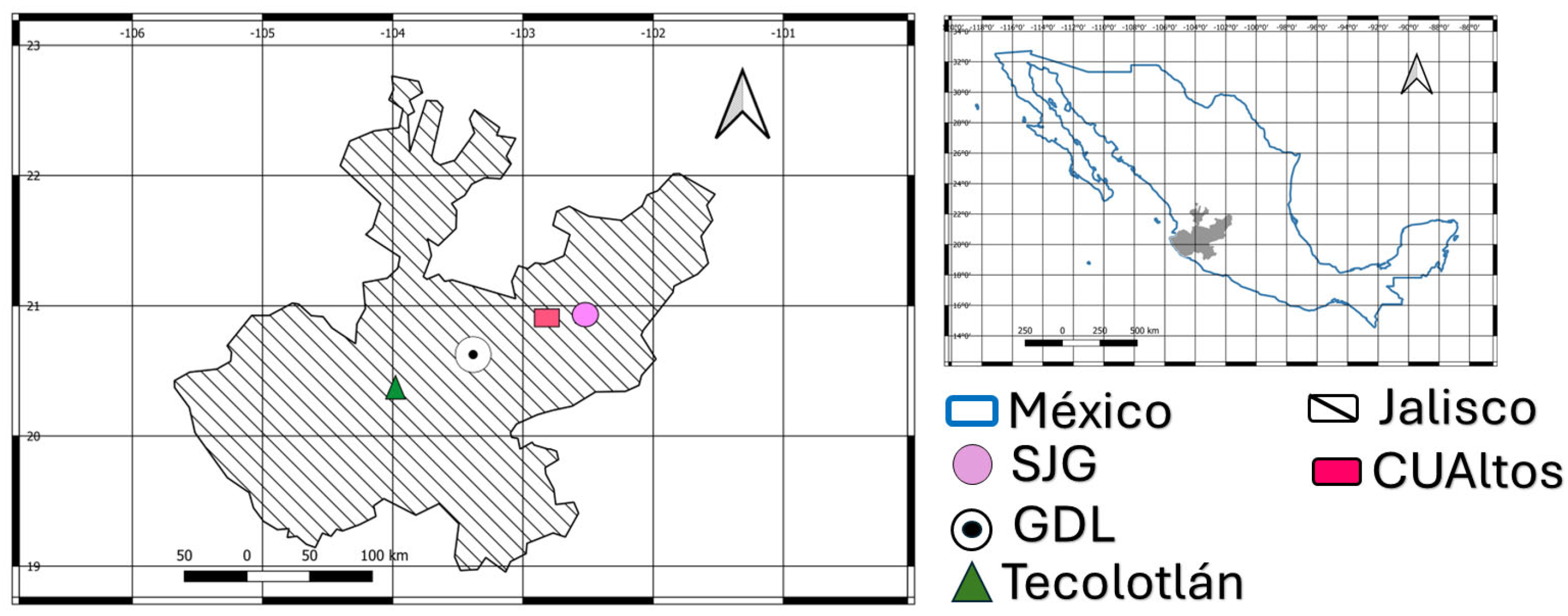
This study was conducted in four contrasting environments within the state of Jalisco, Mexico, each representing a different degree of anthropogenic influence: an urban area, a semi-urban area, an agricultural zone, and a semi-natural site located adjacent to a protected natural area (Figure 1).
The Guadalajara Metropolitan Zone (ZMG) served as the urban environment and included three representative urban parks: Colomos II, Alcalde, and Agua Azul. Located in Central Jalisco, the ZMG is the second most populated metropolitan area in Mexico, with over five million inhabitants and an approximate area of 2551 km2 [20]. The region experiences substantial atmospheric pollution, primarily driven by vehicular emissions and a wide range of industrial activities—including textile manufacturing, paint production, and battery industries.
San José de Gracia, located in the municipality of Tepatitlán de Morelos (20°40′28″ N, 102°34′01″ W), was selected as the agricultural site due to its extensive Agave tequilana cultivation and the predominance of agricultural and livestock activities, which represent the major potential sources of environmental contamination.
The Centro Universitario de los Altos (CUAltos) of the University of Guadalajara (20°47′01″ N, 102°43′41″ W), also located in Tepatitlán de Morelos, was designated as the semi-urban site. Its landscape consists of a mosaic of rural vegetation interspersed with agroindustrial facilities and bordered by residential areas, representing an intermediate transition between urban and rural environments.
Tecolotlán, located approximately 100 km southwest of Guadalajara, was selected as the semi-natural environment. This region lies near the “Área de Protección de Flora y Fauna Sierra de Quila” and is characterized by tropical dry forest, riparian corridors, secondary vegetation, and scattered agricultural patches. Although near the town of Tecolotlán, it maintains the lowest level of anthropogenic disturbance among the study sites.

2.2. Sample Collection

Bird sampling was conducted across multiple trophic guilds between July 2019 and January 2021. Captures were carried out using mist nets (Porzana Ltd., Icklesham, UK) [22] operated between 07:00 and 14:00 h. Each bird was identified using specialized field guides [23,24,25,26] and banded with aluminum rings provided by the organization Tierra de Aves (Mexico), enabling the detection of recaptures.
For each individual, breast feathers and the first primary feather (P1) were collected.
These feathers were selected to represent different portions of the plumage commonly used in avian ecotoxicology, acknowledging that feather age and growth timing may vary among species and individuals. Rather than assuming strict equivalence in exposure timing, the combined use of these feathers was intended to capture an integrated signal of metal exposure during feather formation.
The database included the detailed information for each bird, including species, age, sex, trophic guild [23], degree of cranial ossification, reproductive condition, fat score, plumage type, wing length, body mass, and capture coordinates. However, only a subset of these variables was used in the analyses presented in this study, specifically age, sex, and trophic guild, as these variables were directly relevant to the study (Table S1).
Bird capture activities were conducted under the scientific collection permit SGPA/DGVS/10147/19, issued by the “Secretaría de Medio Ambiente y Recursos Naturales” (SEMARNAT), ensuring compliance with Mexican wildlife regulations and ethical standards.

2.3. Sample Preparation and Quantification of Heavy Metals

Feathers were cleaned to remove exogenous contaminants by immersion in acetone for 12 h, followed by rinsing with distilled water and air-drying at room temperature. Although this procedure is widely used to reduce surface contamination, it may not completely eliminate all externally adhered soil particles and airborne particulates, which is considered when interpreting the results. Cleaned samples were subsequently analyzed using a Genius 5000 X-ray fluorescence (XRF) spectrophotometer (Skyray Instruments, Dallas, TX, USA), equipped with a 40 kV X-ray tube and a silver (Ag) anode excitation source.
Elemental analysis was performed using a non-destructive energy-dispersive X-ray fluorescence (ED-XRF) technique, which enables the direct quantification of heavy metals in the feather matrix without chemical digestion. Each sample was scanned for 90 s, and three analytical replicates were conducted per feather to evaluate sample heterogeneity and instrumental repeatability.
Instrument calibration and quality control procedures were carried out following the manufacturer’s recommendations and in accordance with the US EPA Method 6200 [27]. The pXRF instrument was standardized daily using an internal silver (Ag) target. Analytical accuracy was evaluated through the analysis of Certified Reference Materials (CRMs) appropriate for the pXRF calibration, with recovery rates consistently within the acceptable range of 90–110%. Precision was determined by analyzing CRMs in triplicate. The final concentration reported for each element corresponds to the arithmetic mean of the three measurements, with the relative standard deviation (RSD) values maintained below 5%, ensuring the precision and representativeness of the reported data.

2.4. Statistical Analysis

Heavy metal concentrations obtained from the Genius 5000 XRF spectrometer were square-root transformed to reduce the influence of extreme values. Bray–Curtis dissimilarities were calculated from the transformed matrix, as this metric is robust for quantitative ecological data and handles zero inflation effectively [28]. The model for resident species (Model I) is as follows:
Y = μ + G + A + Ag + (G × A) + (A g × G) + ε
where G = the trophic guild; A = the study area; Ag = the age; and ε = the residual error.
The model for the combined dataset (resident + migratory species) (Model II) is as follows:
Y = μ + S + G + Ag + (S × Ag) + ε
where S = the migratory status (resident vs. migrant)
PERMANOVA with 9999 permutations was used to evaluate the differences in metal concentrations among trophic guilds, age classes, and study areas, followed by the pairwise comparisons of significant factors. Principal Coordinates Analysis (PCoA) based on the Bray–Curtis distances was used to visualize multivariate patterns [29].
The Redundancy Analysis (RDA) was performed to assess associations between metal concentration profiles and environmental variables [30]. Environmental variables were selected a priori based on their documented role as sources, carriers, or proxies of trace metal inputs in terrestrial ecosystems. The environmental dataset included volatile organic compounds (COV) and PM10 concentrations, which were used as proxies of atmospheric pollution and anthropogenic emission gradients. PM10 was included as a primary physical substrate for the transport and dry deposition of trace elements [31], while COVs represent the emission intensity associated with industrial and vehicular activities, and they often co-occur with trace metals along common emission gradients [32].
In addition, agave cover and three indicators of livestock production (poultry, swine, and cattle) were incorporated as indicators of dominant agro-industrial land use in the study region. Intensive livestock production is a recognized source of metals such as Cu and Zn due to the use of mineral supplements in animal feed [33], while agricultural soils under intensive management may accumulate metals (e.g., Cd, Pb) derived from fertilizers and agrochemicals [34].
All analyses were conducted in RStudio 2025.09.2 (Build 418) using R version 4.5.1 (13 June 2025 ucrt). Multivariate analyses were performed using the packages vegan, pairwiseAdonis2, ggplot2, and tidyverse, which were also used for producing descriptive and exploratory plots.

3. Results

A total of 58 bird species were captured across the four study regions: Guadalajara, San José de Gracia, Centro Universitario de los Altos (CUAltos), and Tecolotlán. The assemblage encompassed seven trophic guilds—insectivores, granivores, omnivores, nectarivores, frugivores, carnivores, and scavengers—all of which were represented in every study area. For each individual, a composite feather sample consisting of breast feathers and the primary feather P1 was collected, yielding a total of 370 samples analyzed for trace metal concentrations.
The taxonomic composition of the sampled species and their mean concentrations for each metal are provided in Appendix A.
X-ray fluorescence (XRF) spectrometry detected a total of 22 elements in the feather samples. Seven of these elements (K, Ca, Fe, Ti, Sr, Nb, and Zr) were excluded from statistical analyses because their occurrence is largely associated with natural physiological processes or ubiquitous background levels in avian feathers. The remaining 15 metals included Mn, Cu, Ni, Zn, Mo, Ag, Sb, V, Cr, Ga, Rb, Y, Pb, Sn, and Hf.
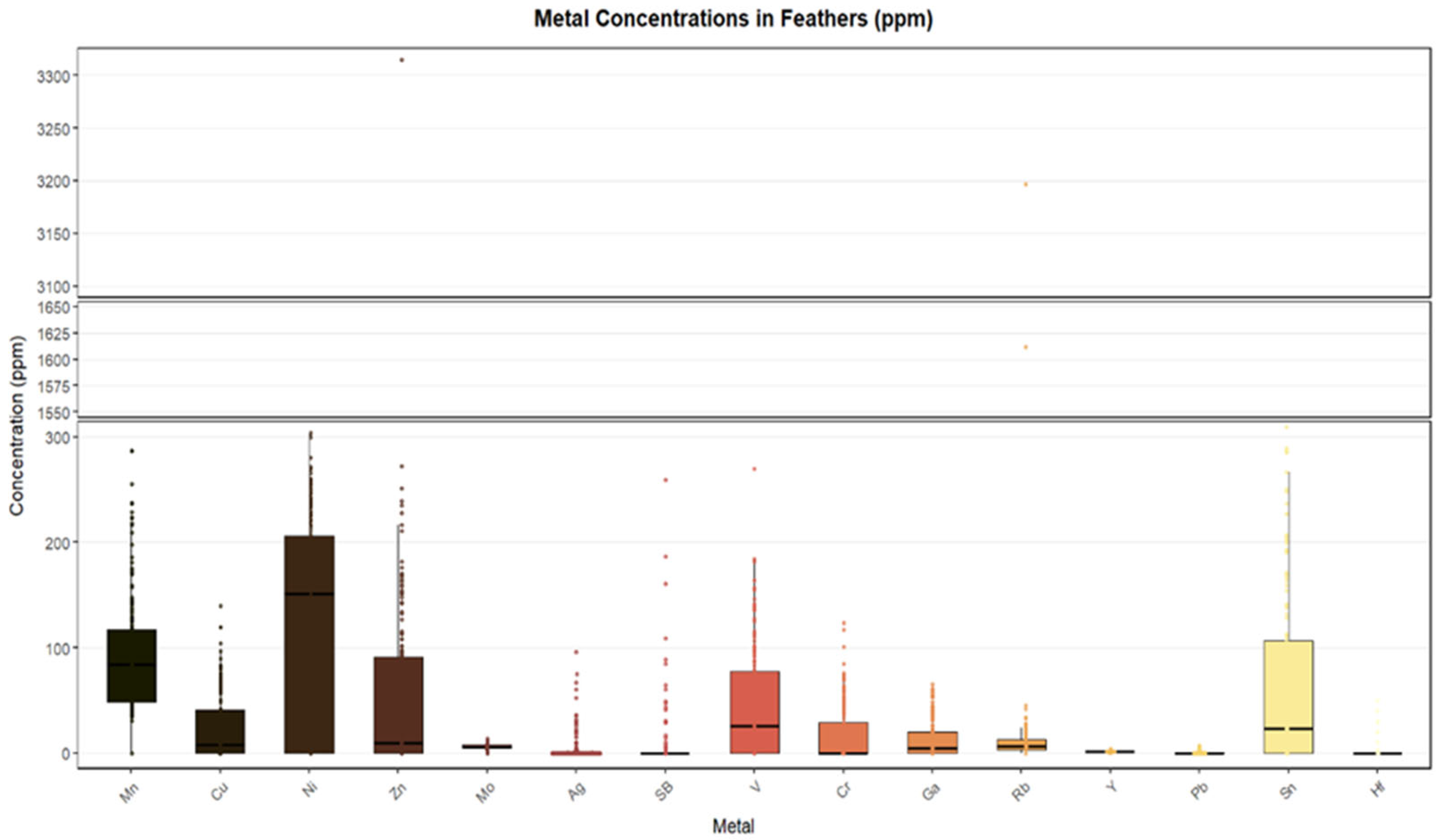
Among the quantified elements, zinc (Zn) showed the highest maximum values and some of the most elevated concentrations in several individuals (Figure 2). However, nickel (Ni) presented higher median levels across samples, which explains its more prominent boxplot distribution. Overall, both elements dominated the concentration profiles, reflecting a combination of physiological regulation and environmental exposure.

3.1. PERMANOVA Model I (Resident Species)

The PERMANOVA performed on resident species (Model I) revealed the significant effects of both trophic guild (p < 0.001) and study area (p = 0.009) on the multivariate structure of metal concentrations (Table 1). Trophic guild accounted for the largest proportion of explained variation (26.76%), followed by the study area (13.8%). Age contributed marginally to the model (p = 0.069; 9.99% of variation), while both interaction terms (Guild × Area and Age × Area) were non-significant.

3.2. Pairwise Comparisons Among Study Areas

Pairwise PERMANOVA tests (Table 2) revealed that the Centro Universitario de los Altos (CUAltos) differed significantly from all other study areas:
CUAltos vs. Guadalajara → p = 0.012;
CUAltos vs. Tecolotlán → p = 0.001;
CUAltos vs. San José de Gracia → p = 0.022.
No significant differences were detected among the remaining site pairs. This pattern indicates that CUAltos exhibits a distinct multielement signature when compared with the other regions.
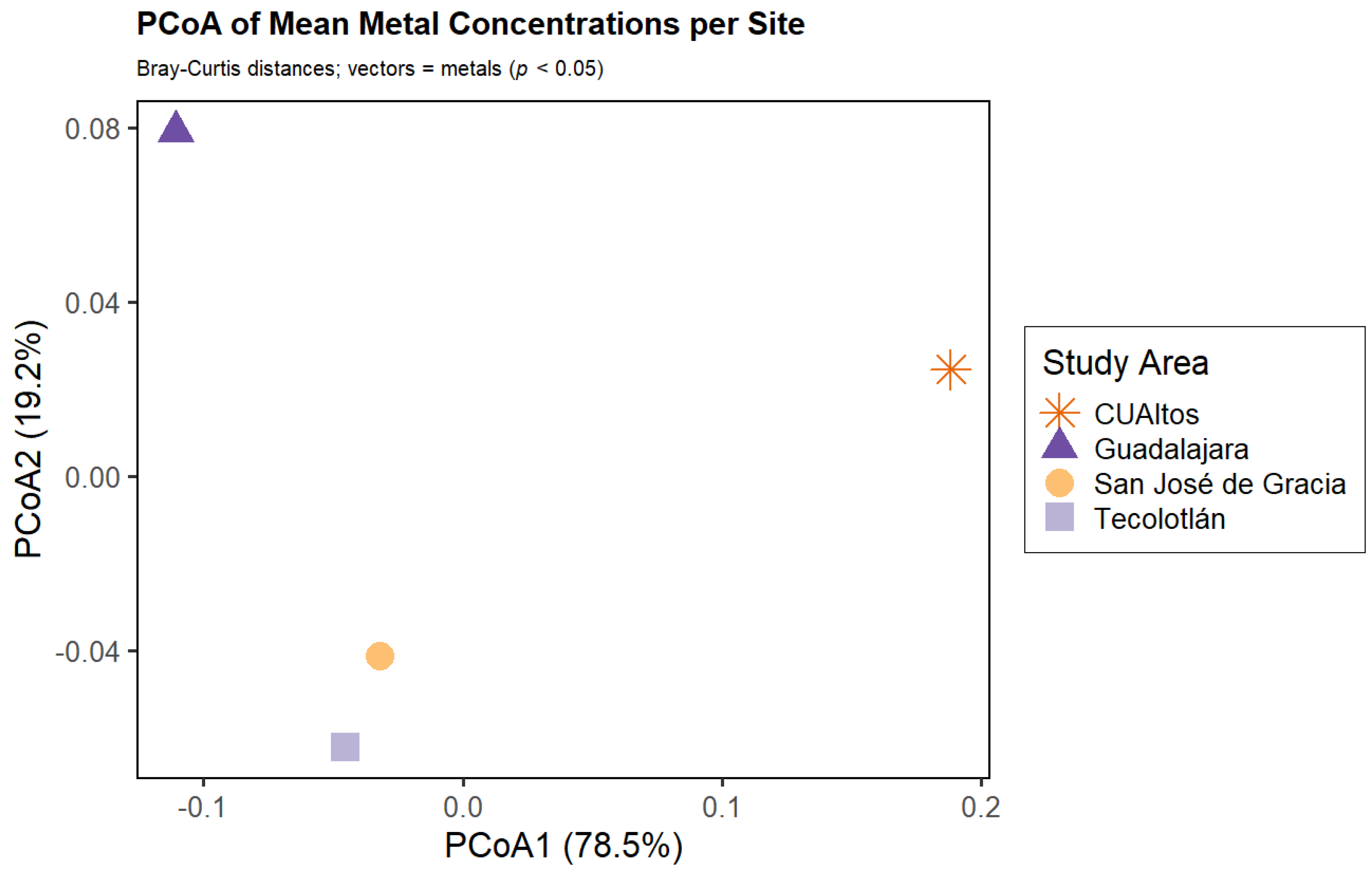
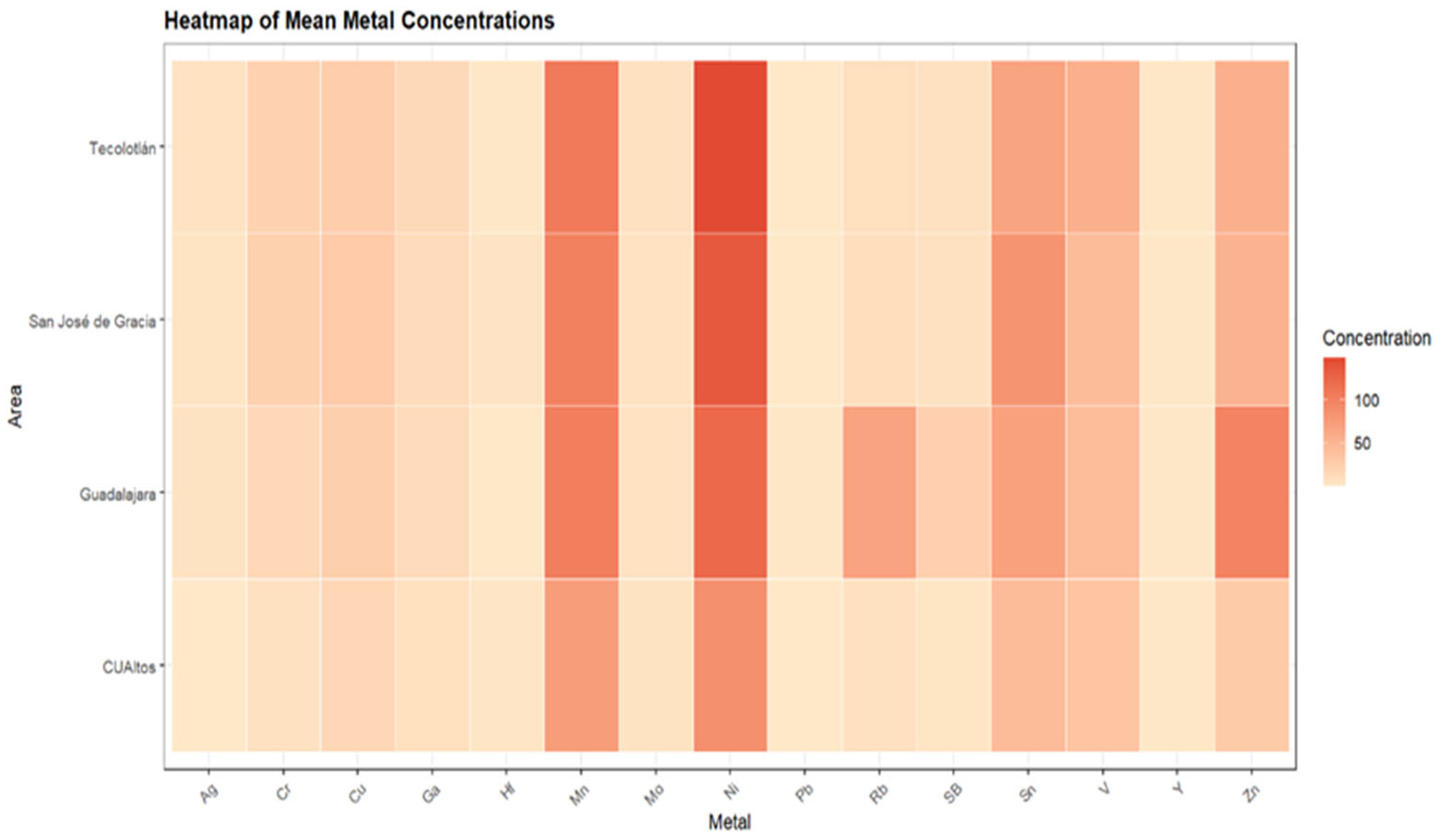
This differentiation was clearly reflected in the PCoA ordination (Figure 3), where CUAltos clustered separately from the remaining study areas. The same trend appeared in the heatmap of mean metal concentrations (Figure 4), which highlighted consistently lower concentrations of several metals in CUAltos relative to the other sites.
Overall, Model I explained 59.9% of the total multivariate variation, leaving 40.1% unexplained. These results indicate that ecological traits—particularly trophic guild—account for the largest proportion of explained variation in trace metal concentrations among resident birds, whereas spatial differences among study areas are present but comparatively weaker.

3.3. PERMANOVA Model II (Residents + Migrants)

When the dataset was expanded to include both resident and migratory species (Model II), trophic guild remained the only statistically significant factor structuring multivariate variation in metal concentrations (p < 0.001), accounting for 32.0% of the total variation (Table 3). Migratory status (S) and the Status × Age interaction were not significant predictors of metal composition. Age class again displayed a marginal effect (p = 0.069). Model II explained 43.2% of the total multivariate variation, leaving the remaining 56.8% unexplained.
These results indicate that including migratory individuals did not alter the dominant role of trophic ecology in determining metal burdens, and that feather metal loads are largely independent of migratory status—with feathers reflecting the conditions at the site and time of molt.

3.4. Trophic Guild Differences and Metal Profiles

Pairwise PERMANOVA comparisons among trophic guilds (Table 4) identified multiple statistically distinct guild pairs (see Table 4 for t-statistics and p-values from 9999 permutations). However, differences among guilds were manifested primarily in absolute metal concentrations rather than in unique proportional metal fingerprints.
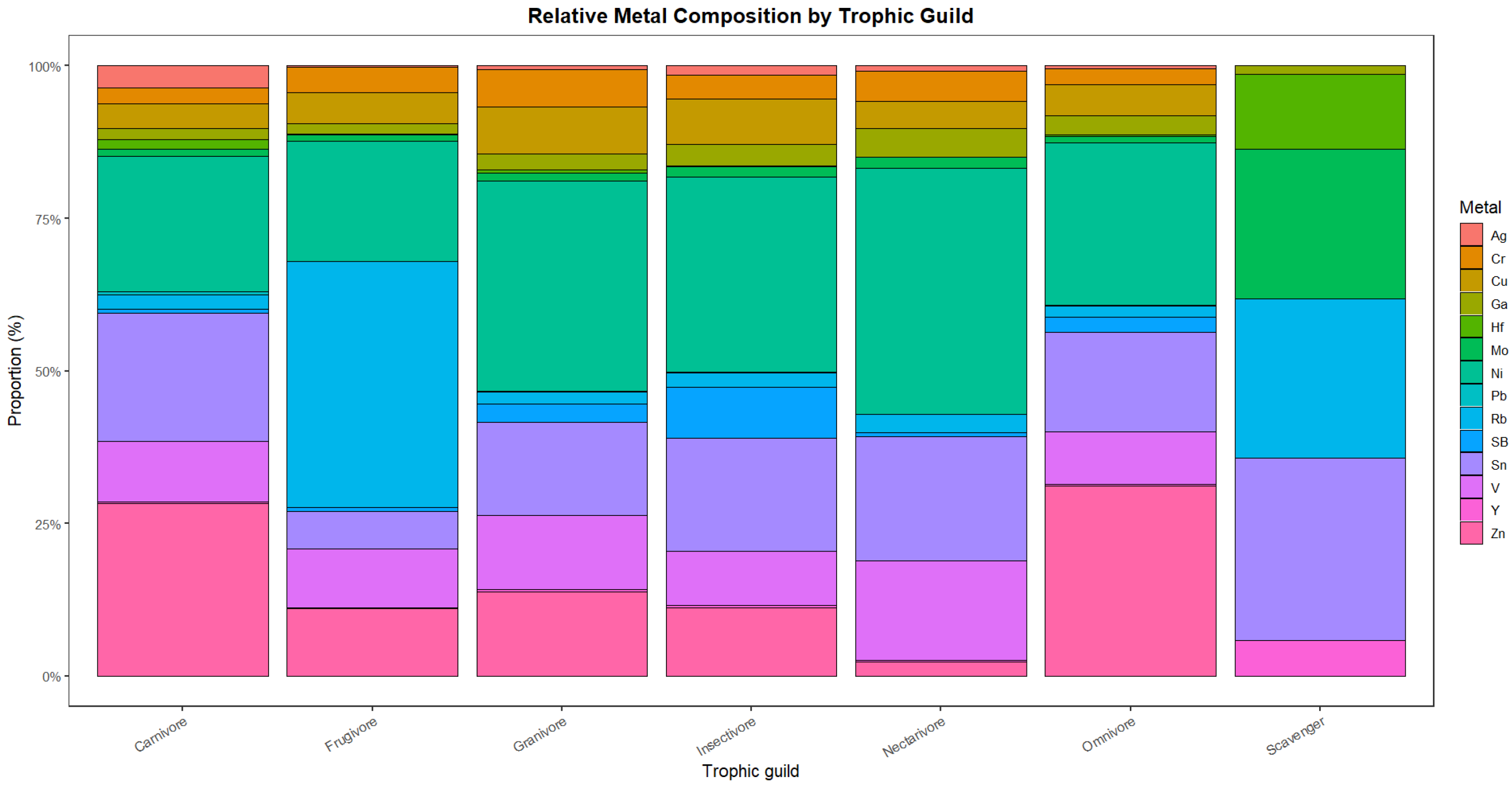
The stacked barplots of relative metal composition (Figure 5) show that Zn, Y, Mo, and Hf consistently contributed the largest proportions across all trophic guilds, whereas elements such as Sn, Ag, and Ga contributed minimally. Thus, while some guilds accumulated higher total metal loads than others, the overall proportional structure of the metal assemblage remained broadly similar across guilds. This pattern suggests the widespread regional exposure to the same group of trace elements, modulated in magnitude (but not composition) by trophic ecology.

3.5. Summary of Multivariate Patterns

Across both PERMANOVA models and complementary ordination-based analyses, two robust patterns emerged:
Trophic guild is the primary biological determinant of metal concentration patterns in feathers, explaining the largest fraction of multivariate variation.
CUAltos consistently differs spatially from the other study areas, forming a distinct cluster in ordinations and pairwise comparisons; no other area was consistently separated from the rest.
Together, these patterns underscore the joint influence of ecological traits (trophic position) and local spatial context on avian metal accumulation, with trophic ecology exerting the stronger effect in our dataset.

3.6. Redundancy Analysis (RDA)

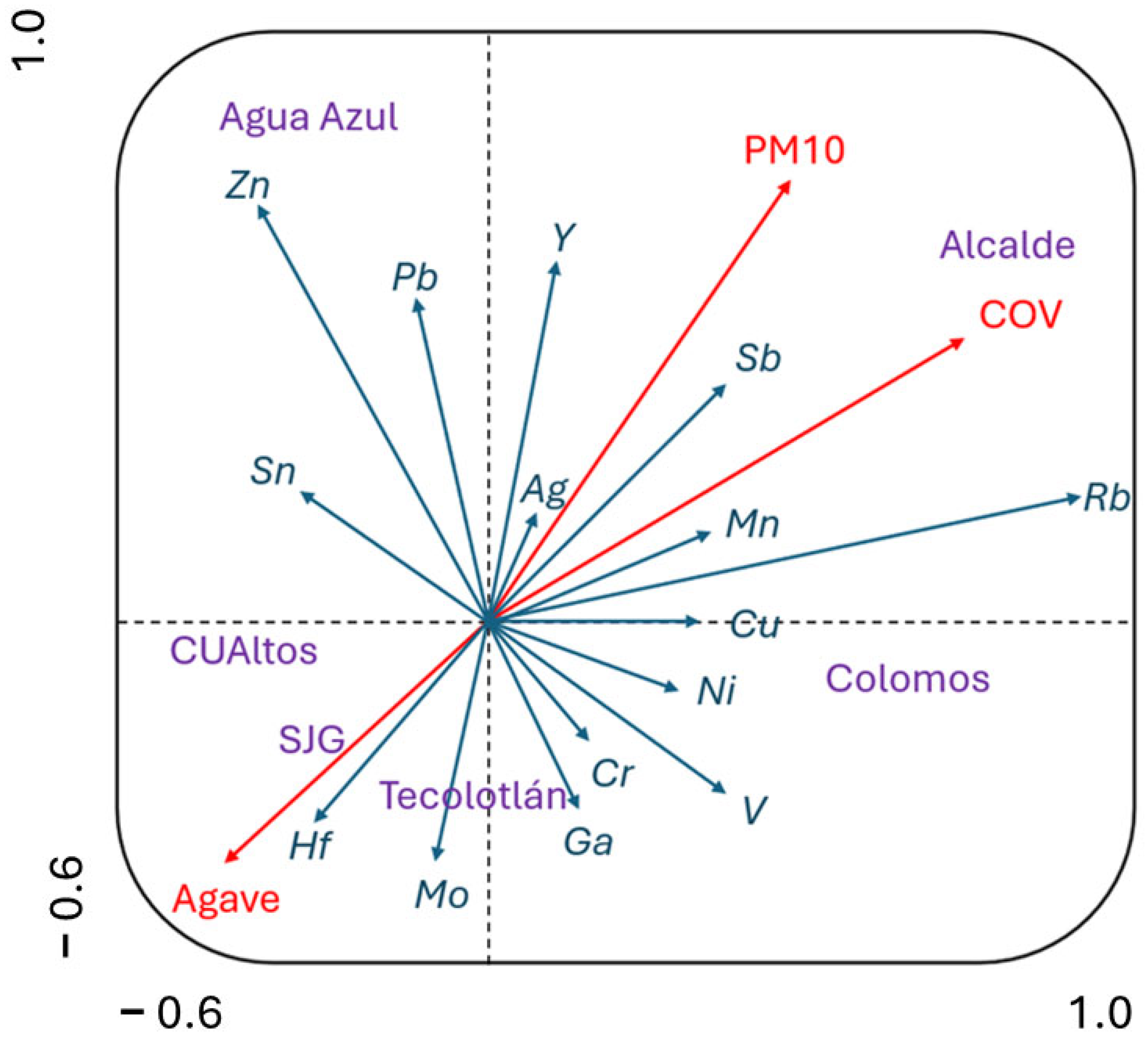
The RDA revealed that the spatial variation in feather metal concentrations was primarily associated with atmospheric pollution gradients, particularly volatile organic compounds (COVs) and particulate matter (PM10). In the ordination (Figure 6), long RDA vectors for COVs and PM10 aligned with metals such as Sb, Mn, and Rb, and the Guadalajara sampling sites (Colomos and Alcalde) were positioned along the positive end of this pollution gradient. Agua Azul was more closely associated with elements such as Zn and Sn. The agave cover variable exhibited a short vector oriented toward a different quadrant, reflecting its comparatively minor contribution.
Marginal effects indicated that COVs independently explained the greatest proportion of variance (Λ = 0.28), followed by PM10 (Λ = 0.21) and agave (Λ = 0.12). Conditional tests supported significant contributions of COVs (ΛA = 0.28, p = 0.017) and PM10 (ΛA = 0.22, p = 0.013), while agave did not contribute significantly (ΛA = 0.04, p = 0.592) (Table 5). The ordination also showed considerable overlap among the Tepatitlán-regional sites (CUAltos, Tecolotlán, and San José de Gracia), whereas Guadalajaran sites occupied more distinct positions in the RDA space.

4. Discussion

This study provides a comprehensive assessment of trace metal accumulation in wild birds across four contrasting environments in Jalisco, Mexico. Our multivariate analyses consistently demonstrated that trophic guild was the most influential factor explaining the variation in feather metal concentrations. This primary influence was followed by weaker, yet detectable, spatial differences among the study areas. These findings reinforce the efficacy of feathers as a biomonitoring tool, aligning with previous research [35,36,37]. Collectively, these results underscore the combined importance of dietary exposure pathways and local environmental conditions in shaping metal burdens within terrestrial bird populations. Although the inclusion of a large number of species may increase interspecific variability, the study objective was not to evaluate species-specific bioaccumulation patterns. Instead, analyses were intentionally structured around functional trophic guilds to identify the broad ecological and environmental drivers of metal exposure at the community level, following a widely applied guild-based ecological framework [38].
It is important to acknowledge that feathers can incorporate trace metals both endogenously during feather growth and exogenously through the post-formation deposition of atmospheric particles [39]. To minimize external contamination, all feathers were subjected to a standardized cleaning protocol prior to analysis, consisting of a 12 h acetone immersion followed by rinsing with distilled water. Although this procedure cannot guarantee the complete removal of all surface-bound particulates, the consistency of the observed patterns—particularly the dominant influence of trophic guild and the coherent spatial gradients detected across study areas—supports a predominantly diet-mediated incorporation of metals during feather formation rather than surface deposition as the primary driver of the observed variation. Additionally, guilds that forage on the ground or in wet substrates may experience greater contact with contaminated soils or marsh water, increasing the likelihood of residual external deposition even after washing. Therefore, trophic guild differences may partly reflect not only dietary uptake but also habitat-mediated exposure through contact with sediments and resuspended particles.
In addition, the interpretation of elemental profiles in feathers must account for the strong physiological regulation occurring during feather formation, which can alter elemental ratios relative to external environmental matrices. Zinc (Zn), for instance, is consistently abundant due to its structural role in keratin synthesis and is therefore tightly regulated. Nevertheless, both essential and non-essential elements may increase in concentration under elevated environmental availability through diet or exposure to contaminated atmospheric particulates during feather growth [40,41]. Consequently, elemental ratios in feathers are not expected to directly mirror those of soils or atmospheric particulates. Following a geochemical–ecotoxicological perspective [42], feather elements are interpreted as an integrated signal of the regional “chemical landscape”, reflecting both geological and anthropogenic inputs, and providing a robust framework for detecting the broad trophic and spatial patterns despite limited source specificity.
The ecological, environmental health, and conservation relevance of assessing heavy metals in birds stems from their effectiveness as sensitive biomonitors across trophic levels. Due to their persistence and toxicity, heavy metals readily enter food webs and pose a high risk of biomagnification in top predators [43,44]. Birds occupy a wide range of ecological niches, allowing them to provide information not only on contaminant presence but also on exposure pathways and biomagnification processes. Feather sampling represents a non-invasive and ethically sound method for assessing chronic exposure, as feathers accumulate metals during their formation [45,46]. In this study, feather analysis effectively characterized metal burdens across species and trophic guilds, highlighting the differential exposure risks within avian communities in Jalisco, Mexico. Future studies combining feather analysis with surface soil geochemistry and particulate characterization would help further disentangle endogenous uptake from external deposition pathways.

4.1. Influence of Trophic Guild

Across both statistical models—resident birds only (Model I) and the combined dataset including migrants (Model II)—trophic guild consistently accounted for the largest proportion of explained variation, confirming its role as the primary determinant of metal accumulation and supporting our initial hypothesis. Carnivorous and omnivorous guilds exhibited markedly higher dissimilarity in total metal loads compared with granivores and nectarivores, a pattern fully consistent with predictions derived from trophic transfer and biomagnification processes [47,48]. Despite these quantitative differences, the proportional composition of elements remained similar across guilds: Zn, Y, Mo, and Hf dominated the elemental profiles, whereas low-abundance elements such as Sn, Ag, and Ga occurred only in minimal proportions. This consistency in elemental “fingerprints” suggests that while diet determines the magnitude of metal accumulation, the regional exposure landscape is broadly shared across feeding strategies and likely driven by generalized environmental sources, such as inhaled dust or water ingestion [49,50].
This result supports the use of trophic guilds as the primary analytical unit in this study, as species sharing similar feeding strategies are expected to experience comparable exposure pathways regardless of their taxonomic identity. By emphasizing functional grouping rather than species-level comparisons, this framework is particularly suitable for multivariate analyses aimed at detecting the general patterns of environmental contamination.
The carnivorous guild exhibited the highest overall metal concentrations, clearly exceeding those observed in the other groups. This trophic category is particularly susceptible to metal contamination due to its elevated position in the food chain and the cumulative effects of biomagnification. Consequently, raptors are among the most frequently studied avian taxa in the assessments of heavy metals, organochlorines, and other persistent organic pollutants [51], and multiple studies report the comparable patterns of elevated metal accumulation [52,53].
Scavengers play an essential ecological role by recycling organic matter and reducing potential disease sources. Due to their high trophic position and carrion-based diet, they are generally expected to be vulnerable to biomagnification and, in some contexts, to the accidental ingestion of lead shot associated with hunting activities [1]. Nevertheless, in this study, scavengers exhibited the lowest metal concentrations, a pattern that contrasts with previous reports [54]. This unexpected result should be interpreted with caution, as scavenger exposure may vary strongly depending on local carrion availability, feeding behavior, and habitat use. Therefore, additional sampling focused on scavenger species would be valuable to determine whether this pattern is consistent across broader ecological contexts or reflects site-specific variability.
Granivores and frugivores exhibited the highest chromium concentrations, a pattern consistent with their close reliance on plant-based resources. By feeding directly on crops, granivores may serve as the indirect indicators of human exposure to metals present in agricultural products, whereas frugivores—the key seed dispersers that promote forest regeneration [55]—consume fruits in which chromium can occur naturally [56]. Although chromium is an essential element involved in glucose and cholesterol metabolism, its elevated concentrations may be carcinogenic [57]. Its accumulation in these guilds therefore suggests a diet-associated exposure pathway that likely explains the detected levels.
Nectarivores, represented by hummingbirds, exhibited the second-lowest overall metal concentrations, likely reflecting their highly specialized diet dominated by nectar and small invertebrates [58]. However, this guild also included the species with the highest vanadium concentration (270 ppm), indicating the potential for taxon-specific exposure pathways. Vanadium is not easily metabolized by birds, and its elevated concentrations in feathers have often been linked to external inputs, particularly iron oxide and hydroxide particles that adhere strongly to feather surfaces and may not be completely removed even after washing procedures. In this context, the high V levels detected in hummingbirds may reflect localized atmospheric deposition or contact with particulate matter in microhabitats where these species forage intensively. Additionally, vanadium can be mobilized from contaminated soils into plant tissues, suggesting that its uptake through floral resources could also represent a plausible dietary route in nectarivores [59]. Consistent with previous findings showing that vanadium levels in wild birds may reflect local contamination gradients [60], this pattern highlights the need for further investigation into both food-based and exogenous particulate sources of V in nectarivore guilds.
Insectivores exhibited the highest iron concentrations, consistent with previous reports indicating that insectivorous birds possess particularly efficient iron-absorption mechanisms, which may have physiological or health implications [61]. Finally, omnivores exhibited the third-highest metal levels, a pattern expected given their broad dietary spectrum and consistent with findings from similar studies [62].

4.2. Influence of Age and Sex

Age exhibited only a marginal, non-significant effect on metal accumulation, driven by a small number of individuals with exceptionally high Zn concentrations, which reduced the contrast between age classes. Although the bioaccumulation theory predicts higher metal burdens in adults due to prolonged exposure, this pattern is often difficult to detect in feather-based datasets because feathers primarily reflect metal incorporation during the specific molt period rather than lifetime accumulation. Moreover, age classification in wild birds is generally limited to broad categories (juvenile vs. adult), since the exact age cannot be determined once individuals reach adulthood, which may further reduce the resolution of age-related trends. In this context, the removal of extreme outliers—particularly among younger individuals—would likely strengthen the anticipated tendency toward higher metal concentrations in adults under chronic contamination scenarios [63,64]. Additionally, the inclusion of many species with contrasting life histories and molting strategies may obscure uniform age signals, and residual contributions from external deposition cannot be excluded as a factor influencing variability. In contrast, sex had no detectable effect, a result commonly reported in avian biomonitoring studies and consistent with the homogenizing influence of molt on physiological differences among individuals.

4.3. Spatial Variation Among Study Areas

Spatial differences, although statistically significant, were less pronounced than trophic effects but were nonetheless evident. Pairwise comparisons indicated that CUAltos differed significantly from the other study areas, a pattern consistent with its generally lower concentrations of several metals, as reported in comparable studies [65,66,67]. Rather than reflecting extreme metal values, this separation was driven by increased multivariate dissimilarity associated with overall lower metal burdens.
At the metal-specific level, clear spatial patterns emerged. Tecolotlán exhibited the elevated concentrations of Mn (manganese), Ni (nickel), and V (vanadium) (approximately 110, 152, and 57 ppm, respectively). Such elevations are commonly associated with emissions from heavy machinery, vehicular wear, and certain industrial processes, particularly those related to fuel combustion [68,69,70]. Urban sites in Guadalajara showed the highest Zn (zinc) concentrations (approximately 114 ppm), a pattern typically linked to intense urbanization through sources such as tire abrasion, galvanized materials, and municipal runoff [71,72]. San José de Gracia exhibited higher Cu (copper) concentrations (approximately 29 ppm), which may be associated with localized agricultural practices, given the widespread use of copper-based fungicides and fertilizers [73,74].
These metal-specific spatial differences strongly reflect the influence of local emission sources, including agricultural amendments, vehicular traffic, and small-scale industrial activities. Furthermore, Tecolotlán, CUAltos, and San José de Gracia share agave-dominated agricultural landscapes, which may account for their partial clustering in a multivariate space. In contrast, Guadalajara—the most intensely urbanized and densely populated area in the region—exhibited stronger atmospheric and diffuse contamination signatures typically associated with metropolitan environments.

4.4. Environmental Gradients Identified Using RDA

The Redundancy Analysis (RDA) effectively clarified the environmental drivers shaping the multivariate metal composition in bird feathers. Volatile Organic Compounds (COVs) and particulate matter (PM10) emerged as the strongest environmental predictors, exhibiting long vectors aligned with metals such as Sb (antimony), Mn (manganese), and Rb (rubidium). The clustering of urban sites in Guadalajara (Alcalde and Colomos) along this primary gradient strongly indicates heightened exposure to airborne pollutants associated with vehicular emissions, fossil fuel combustion, and industrial activities [75,76].
Interestingly, Agua Azul—although located within the same urban environment as the other Guadalajara sites—showed elevated Zn, Sn, and Pb concentrations, highlighting pronounced micro-scale heterogeneity and the presence of localized contamination hotspots within the metropolitan region [77]. This distinct pattern may reflect legacy industrial residues or localized sources, particularly of lead (Pb) and tin (Sn), elements that often persist in soils and resuspended dust long after regulatory phase-outs.
CUAltos and San José de Gracia clustered together, while Tecolotlán formed a nearby but distinct group, consistent with their shared agave-dominated agricultural matrices and semi-rural settings. Although the agave variable did not reach statistical significance, it improved overall model performance more than variables associated with poultry, swine, or cattle production, suggesting a subtle but non-negligible influence of agave-based land use on metal deposition patterns.
Importantly, the RDA clearly demonstrates that atmospheric pollutants (COVs and PM10) represent the dominant environmental forces shaping multivariate metal patterns across the study region. This result underscores the regional scale of air pollutant transport and its overriding influence on chronic metal burdens in terrestrial birds from Jalisco, even surpassing the effects of local agricultural activities.

4.5. Effects of Migratory Status

Migratory status did not contribute significantly to the overall variation in feather metal concentrations. This result should be interpreted cautiously, as feathers reflect metal exposure from the environment in which they were grown during molt, which in migratory species may occur far from the capture location [78]. Moreover, and critically, the complexity of species-specific molting strategies—including variation in molt timing and location—renders interpretation of the feather signal particularly challenging [79].
While migratory birds molting far from the capture area might be expected to exhibit distinct elemental profiles, the absence of clear differences may reflect multiple non-exclusive scenarios. These include broadly similar metal availability across molting and sampling regions, residual contributions from exogenous deposition, or the high variability in molt strategies among species. Because the geographic origin of feather growth cannot be determined with our current dataset, these alternative explanations cannot be disentangled and should be considered when interpreting the lack of a migratory effect. Consequently, trophic guild remained the most robust determinant in the combined dataset, reinforcing the conclusion that trophic ecology represents the dominant driver of metal accumulation patterns, largely independent of migratory status.

4.6. Ecotoxicological Implications

Although feather metal concentrations cannot be directly equated with internal toxicity thresholds due to differences in metal partitioning, storage, and excretion pathways, they reliably reflect bioavailable environmental exposure during the period of feather growth [45,65,80]. The pervasive dominance of Zn (zinc), Y (yttrium), Mo (molybdenum), and Hf (hafnium) across all sites suggests a broad regional exposure to these elements, likely associated with geological background levels and regionally transported dust inputs, as has been reported in other avian biomonitoring studies [49,81]. Meanwhile, site-specific peaks in Ni (nickel), V (vanadium), Mn (manganese), Cu (copper), and Pb (lead)—particularly in urban areas—clearly reflect localized and more acute anthropogenic sources, including industrial emissions, vehicular traffic, and targeted agricultural practices.
The strong influence of atmospheric pollutants (COVs and PM10) as the main drivers of metal patterning underscores the critical importance of air-quality monitoring and stricter regulatory measures, particularly in rapidly urbanizing regions such as the metropolitan area of Guadalajara [82,83]. Collectively, our findings highlight the value of wild birds as effective sentinels of both diffuse regional contamination and localized metal hotspots, providing a robust foundation for the development of long-term environmental monitoring programs in Western Mexico.

5. Conclusions

Trophic guild emerged as the strongest predictor of trace metal concentrations in feathers, exceeding the influence of spatial and demographic factors and underscoring the central role of diet in metal bioaccumulation.
Spatial patterns were present but comparatively weak, with CUAltos exhibiting distinct metal profiles driven by the consistently lower concentrations of several elements. Nonetheless, several metals showed clear site-specific peaks, including Zn in Guadalajara, Mn–Ni–V in Tecolotlán, and Cu in San José de Gracia, reflecting localized anthropogenic influences.
Atmospheric pollutants (PM10 and COVs) were identified as the primary environmental drivers shaping multivariate metal composition, highlighting the dominant role of air pollution in regional exposure dynamics. Agave-dominated landscapes exerted a modest but detectable influence on metal patterns, although this effect did not reach statistical significance.
Migratory status did not explain the variation in feather metal concentrations, but this result should be interpreted with caution. The absence of a migratory signal may reflect multiple non-exclusive factors, including broadly similar exposure conditions across regions, high variability in molt strategies among species, and residual contributions from locally deposited external particles.
Importantly, even if feathers cannot be completely cleared of exogenous materials, they remain effective and non-invasive biomonitoring tools because they capture the trace metal burden circulating in the surrounding environment, reinforcing the value of wild birds as sentinels in regional contamination assessments.


Supplementary Materials

The following supporting information can be downloaded at: https://www.mdpi.com/article/10.3390/birds7010011/s1, Table S1: Taxonomic composition of sampled bird species and associated demographic information. Additional supporting information is provided in Appendix A.

Author Contributions

Conceptualization, H.L.-A., J.L.N.-H., M.M.M.-V. and P.B.G.-M.; Methodology, H.L.-A., J.L.N.-H., F.R.-G., P.B.G.-M. and A.L.C.-R.; Investigation, H.L.-A., D.V.-M.d.O., D.A.G.-N. and A.L.C.-R.; Data curation, H.L.-A. and A.L.C.-R.; Formal analysis, H.L.-A., F.R.-G., D.V.-M.d.O. and D.A.G.-N.; Resources, B.C.R.-H. and F.R.-G.; Project administration, B.C.R.-H.; Supervision, B.C.R.-H.; Validation, B.C.R.-H. and J.L.N.-H.; Visualization, H.L.-A. and M.M.M.-V.; Writing—original draft preparation, H.L.-A.; Writing—review and editing, H.L.-A., B.C.R.-H., J.L.N.-H., F.R.-G., D.V.-M.d.O., P.B.G.-M. and D.A.G.-N. All authors have read and agreed to the published version of the manuscript.

Funding

This research was funded by el Secretaría de Ciencia, Humanidades, Tecnología e Innovación (SECIHTI), through a postgraduate scholarship awarded to the first author (CVU: 1002139). The APC was not funded by SECIHTI.

Institutional Review Board Statement

Ethical review and approval were waived for this study because all procedures involving live birds were conducted under an official scientific collecting permit issued by the Mexican environmental authority (SEMARNAT; permit No. SGPA/DGVS/10147/19), which authorizes the capture, handling, banding, and feather sampling of wild birds. All methods followed standard, non-lethal ornithological protocols, and no additional institutional ethical approval was required under national regulations.

Informed Consent Statement

Not applicable, as this study did not involve human participants and informed consent is only required for studies involving human subjects.

Data Availability Statement

The original contributions presented in this study are included in the article. Further inquiries can be directed to the corresponding author.

Acknowledgments

The authors acknowledge the scholarship support provided by SECIHTI. We also thank the Laboratorio de Sustentabilidad y Ecología Aplicada, Universidad de Guadalajara, for logistical and technical support. Special thanks are extended to the Agencia Metropolitana de Bosques Urbanos de Guadalajara for granting access and permission to conduct fieldwork in urban parks, and to the Centro Universitario de los Altos for providing facilities during the study. Finally, we are grateful to all volunteers who assisted with field sampling and data collection.

Conflicts of Interest

The authors declare no conflicts of interest.

Abbreviations

The following abbreviations are used in this manuscript:
GDLGuadalajara
SJGSan José de Gracia
CUAltosCentro Universitario de los Altos
COVsVolatile Organic Compounds
PM10Particulate Matter ≤ 10 μm
RDARedundancy analysis
MnManganese
CuCopper
NiNickel
ZnZinc
MoMolybdenum
AgSilver
SbAntimony
VVanadium
CrChromium
GaGallium
RbRubidium
YYttrium
PbLead
SnTin
HfHafnium
ppmParts per million

Appendix A

Presents a comprehensive table of the bird species recorded in the study, indicating their occurrence across the sampled areas. For each species, the table summarizes the mean feather concentrations of all analyzed trace metals. This appendix provides the taxonomic and spatial framework underlying the multivariate analyses, allowing detailed inspection of species-level patterns in metal exposure and facilitating comparison across sites and trophic groups.
Table A1. List of bird species recorded during the study, indicating their presence at each sampling area (GDL = Guadalajara; CUAltos = Centro Universitario de los Altos; SJG = San José de Gracia; Tecolotlán). Mean concentrations (ppm, dry weight) of trace metals measured in feathers are reported for each species, including Mn (manganese), Cu (copper), Ni (nickel), Zn (zinc), Mo (molybdenum), Ag (silver), Sb (antimony), V (vanadium), Cr (chromium), Ga (gallium), Rb (rubidium), Y (yttrium), Pb (lead), Sn (tin), and Hf (hafnium).
Species ListGDLCUAltosSJGTecolotlánMnCuNiZnMoAgSbVCrGaRbYPbSnHf
Columbiformes
Columbidae
Columbina incaxxxx94.3236.78177846.860.6924.4967.9111.6418.6213.10140.101190
Columbina talpacoti x36000700200151000
Columbina passerina xx36.640007.080027.6300.885.970.90.0100
Zenaida asiaticaxxxx62.9750.81831196.0414.91485137.914101330
Zenaida macrouraxxxx625018011055188015101510500
Columba liviax 36.380004.760051.19005.781010.210
Apodiformes
Trochilidae
Ramosomyia violicepsxxxx82.7112.441072.15.8910.80101030.65.61.4066.740
Saucerottia beryllinaxxxx135.909907.1100.47135.1015.493.11.10.00100
Cynanthus latirostrisxxxx081.392608.68.88000015.7832.71.50.4700
Heliomaster contantii x96.2160.31160536.05000.380.6728.7127.91.5000
Selasphorus rufusxxxx82.4417.182437.57.0117.70121.220.789.488.421.10.071160
Selasphorus sasinxxxx79.77016702.620058.9184.48033.31.702860
Cathartiformes
Cathartidae
Cathartes auraxxxx500004.900000.045.51.100.70
Coragyps atratusxxxx40000500001.131000
Accipitriformes
Accipitridae
Buteo jamaicesisxxx 443351582508295.46922.513.8122.541700.1
Accipiter striatus x 120055070.50803.63.99.51.1347.330.1
Strigiformes
Strigidae
Bubo virginianus x230202468253821.6924326.1121.12960
Glaucidium brasilianum x208.932.442221687.7218.4029.31016.3841.41.81.42154.50
Coraciiformes
Momotidae
Momotus mexicanusx x172.120.18165305.255.443.4770.5459.4642.868.521.20.9440
Piciformes
Picidae
Melanerpes uropygialisxxxx78.1239.51112295.780.4664.7642.5510.9213.997.211.20.544.50
Melanerpes aurifronsxxxx90.5831.25930704390.519113.210.312.50
Sphyraphicus varius x 97.2170.762211633.50070.887.1939.3312.71.30.0100
Dryobates scalarisxxxx43.7820.5194794.80039.6230.356.2156.331.40760
Falconiformes
Falconidae
Caracara plancus x54.30004.800000.16.371.101.250
Passeriformes
Tityridae
Pachyramphus aglaiae x100.848.0280648.431160146.47.3335.412140248.30
Tyrannidae
Pitangus sulphuratusxx 125.8018821111.513770036.533.20.90.900
Tyrannus crassirostis x83.226.77205640.9696.2091.976.0716.8821.11.30356.50
Contopus pertinaxx x82.6530.521491.94.8600053.240180.80203.80
Pyrocephalus rubinusxx 89.205.205.4300004.3767.011.45.300
Empidonax fulvifrons xx 44.060005.29000003.191033.220
Empidonax trailliixx 46.950003.38000003.22.1000
Camptostoma imberbe x 79.95019503.240.090023.1708.231.221100
Vireonidae
Vireo gilvusx x 41.16000000002.85801.901900
Troglodytidae
Troglodytes aedonxxx 41.680004.26000003.942038.790
Thryomanes bewickiixxxx46.42000400002.0063.21.1012.710
Campylorhynchus gularis xx 94.5621851398.805410.5332.55.81.9100
Thryophilus sinaloa x77.710742110.3000018.123.191.2000
Poloptilidae
Poloptila caeruleaxxxx37.640005.04000003.190.90240
Turdidae
Turdus rufopalliatusxxxx94.8328.98101717.010.223.3675.7403.09335910250
Catharus guttatusx x48.460.1623907.150066.79123.126.085.151013.650
Mimidae
Melanotis caerulescensxxxx73.735.95152866.232.9420.083.1530.680.753.1910670
Passeridae
Passer domesticusxxxx5013.9110535.100142.55111.211800
Fringillidae
Haemorhous mexicanusxxxx8454144933.41009117841.30.0123.50
Spinus psaltriax x 64.40247127.64032392.163.416.0822.41.40.0100
Melospiza lincolniixxx 72.941210216.5007030225.91.80.500
Melozone fuscaxxxx84.532.71508.92.500034.453.87.51.31.512.32
Melozone kienerix x7.8640120754.968024264.1718.841.43.600
Peucaea ruficauda x7315147408.3102.337241411430
Icteridae
Icterus cucullatusxxxx141.236.74240931.4200036.7510.2921.31.51.092370
Icterus pustullatusxxxx611970405002500.324.110260
Quiscalus mexicanusxxx 12421901366.2150301315.31081.54930
Parulidae
Setophaga coronataxxxx57.825.29559126.29.391.2415.864.4965.9855.541.10.8439.310
Cardellina pusillaxxxx57.6227.0657256.16008.94.6534.178.5310340
Leiothlypis ruficapillaxxx 1353512015413120402010310.1700
Geothlypis tolmiei xx 112.5014806.6306.9721.13024.5713.70.91300
Myioborus pictusx 60.0207909.380022.2337.8710.087.190.90910
Cardinalidae
Piranga ludovicianax xx99.32119.6237905.190051.633.0415.0815.11.20860
Thraupidae
Sporophila torqueolaxxx 10320.58126206.110039.2225.0816.896.691.31270

References

  1. Parra-Ochoa, E. Aves silvestres como bioindicadores de contaminación ambiental y metales pesados. CES Salud Publica 2014, 5, 59–69. [Google Scholar]
  2. Saulnier, A.; Bleu, J.; Boos, A.; El Masoudi, I.; Ronot, P.; Zahn, S.; Del Nero, M.; Massemin, S. Consequences of trace metal cocktail exposure in zebra finch (Taeniopygia guttata) and effect of calcium supplementation. Ecotoxicol. Environ. Saf. 2020, 193, 110357. [Google Scholar] [CrossRef]
  3. Peijnenburg, W.J.; Zablotskaja, M.; Vijver, M.G. Monitoring metals in terrestrial environments within a bioavailability framework and a focus on soil extraction. Ecotoxicol. Environ. Saf. 2007, 67, 163–179. [Google Scholar] [CrossRef]
  4. Pérez-López, M.; Cid-Galán, F.; Hernández-Moreno, D.; Oropesa-Jiménez, A.L.; López-Beceiro, A.; Fidalgo-Álvarez, L.; Soler-Rodríguez, F. Contenido de metales pesados en hígado y plumas de aves marinas afectadas por el accidente del “Prestige” en la costa de Galicia. Rev. Toxicol. 2004, 22, 191–199. [Google Scholar]
  5. Burger, M.; Pose-Román, D. Lead, Health and Environment: Experience in Uruguay; Universidad de la República, Montevideo, Uruguay; PAHO/WHO: Washington, DC, USA, 2010; Available online: http://www.cei.fmed.edu.uy/sites/www.dso1.fmed.edu.uy/files/materiales/plomo%20salud%20y%20ambiente.pdf (accessed on 5 December 2025).
  6. Reyes, Y.C.; Vergara, I.; Torres, O.E.; Díaz, M.; González, E.E. Heavy metals contamination: Implications for health and food safety. Rev. Ing. Inv. Des. 2016, 16, 66–77. [Google Scholar]
  7. González-Flores, E.; Tornero-Campante, M.A.; Sandoval-Castro, E.; Pérez-Magaña, A.; Gordillo-Martínez, A.J. Biodisponibilidad y fraccionamiento de metales pesados en suelos agrícolas enmendados con biosólidos de origen municipal. Rev. Int. Contam. Ambient. 2011, 27, 291–301. [Google Scholar]
  8. Tong, S.; von Schirnding, Y.E.; Prapamontol, T. Environmental lead exposure: A public health problem of global dimensions. Bull. World Health Organ. 2000, 78, 1068–1077. [Google Scholar] [PubMed]
  9. Rechimont, M.E.; Ruelas-Inzunza, J.; Amezcua, F.; Paéz-Osuna, F.; Castillo-Géniz, J.L. Hg and Se in Muscle and Liver of Blue Shark (Prionace glauca) from the Entrance of the Gulf of California: An Insight to the Potential Risk to Human Health. Arch. Environ. Contam. Toxicol. 2024, 86, 165–177. [Google Scholar] [CrossRef] [PubMed]
  10. Alava, J.; Gobas, F. Assessing Biomagnification and Trophic Transport of Persistent Organic Pollutants in the Food Chain of the Galapagos Sea Lion (Zalophus wollebaeki): Conservation and Management Implications. In New Approaches to the Study of Marine Mammals; IntechOpen: London, UK, 2012. [Google Scholar]
  11. Rivera, J.M.; Hernández-Almaraz, P. Bioacumulación y Transferencia de Metales y Contaminantes Emergentes a Través de las Cadenas Tróficas Marinas; Samsara Editorial: San Francisco, CA, USA, 2018. [Google Scholar]
  12. Estrada-Guerrero, D.M.; Soler-Tovar, D. Las aves como bioindicadores de contaminación por metales pesados en humedales. Ornitol. Colomb. 2014, 14, 145–160. [Google Scholar] [CrossRef]
  13. Ek, K.H.; Morrison, G.M.; Lindberg, P.; Rauch, S. Comparative Tissue Distribution of Metals in Birds in Sweden Using ICP-MS and Laser Ablation ICP-MS. Arch. Environ. Contam. Toxicol. 2004, 47, 259–269. [Google Scholar] [CrossRef] [PubMed]
  14. Naccari, C.; Cristani, M.; Cimino, F.; Arcoraci, T.; Trombetta, D. Common buzzards (Buteo buteo) bio-indicators of heavy metals pollution in Sicily (Italy). Environ. Int. 2009, 35, 594–598. [Google Scholar] [CrossRef]
  15. Swaileh, K.M.; Sansur, R. Monitoring urban heavy metal pollution using the House Sparrow (Passer domesticus). J. Environ. Monit. 2005, 8, 209–213. [Google Scholar] [CrossRef] [PubMed]
  16. Albert, C.; Renedo, M.; Bustamante, P.; Fort, J. Using blood and feathers to investigate large-scale Hg contamination in Arctic seabirds: A review. Environ. Res. 2019, 177, 108588. [Google Scholar] [CrossRef]
  17. Keute, J.; Rizzo, J.; Giunta, F.; Hernout, B.V. Evaluating washing techniques to eliminate external contamination of trace elements in bat fur and bird feathers. Ecotoxicol. Environ. Saf. 2024, 283, 116819. [Google Scholar] [CrossRef]
  18. Borghesi, F. Trace Elements in the Aquatic Environment: Analysis of Different Environmental Matrices and Biotic Components. Ph.D. Thesis, Università di Bologna, Bologna, Italy, 2016. Available online: https://amsdottorato.unibo.it/7547/1/borghesi_fabrizio_tesi.pdf (accessed on 25 January 2026).
  19. Lohr, M.T.; Hampton, J.O.; Cherriman, S.; Busetti, F.; Lohr, C. Completing a worldwide picture: Preliminary evidence of lead exposure in a scavenging bird from mainland Australia. Sci. Total Environ. 2020, 715, 135913. [Google Scholar] [CrossRef]
  20. Instituto Nacional de Estadística y Geografía (INEGI). Censo de Población y Vivienda. 2020. Available online: https://www.inegi.org.mx (accessed on 5 December 2025).
  21. Molina, L.; Molina, M. La Calidad del Aire en la Megaciudad de México: Un Enfoque Integral; Fondo de Cultura Económica: Ciudad de México, Mexico, 2005.
  22. Ralph, C.J.; Geupel, G.R.; Pyle, P.; Martin, T.E.; Desante, D.F.; Milá, B. Manual de Métodos de Campo Para el Monitoreo de aves Terrestres; Gen. Tech. Rep. PSW-GTR-159; U.S. Department of Agriculture, Forest Service, Pacific Southwest Research Station: Albany, CA, USA, 1996; Available online: https://www.birdpop.org/docs/pubs/Ralph_et_al_1996_Manual_de_Metodos_Para_El_Monitoreo_De_Aves.pdf (accessed on 5 December 2025).
  23. Howell, S.N.G.; Webb, S. A Guide to the Birds of Mexico and Northern Central America; Oxford University Press: Oxford, UK, 1995. [Google Scholar]
  24. Kaufman, K. Guía de Campo de Kaufman a las aves de Norte América/Kaufman Guide to North American Birds; Houghton Mifflin Harcourt: Boston, MA, USA, 2005. [Google Scholar]
  25. Pyle, P. Identification Guide to North American Birds, Part I: Columbidae to Ploceidae; Slate Creek Press: Bolinas, CA, USA, 1997. [Google Scholar]
  26. Vega-Montes de Oca, D. Las 100 Aves más Comunes del Área Metropolitana de Guadalajara. Tesis de Licenciatura. Bachelor’s Thesis, Universidad de Guadalajara, Guadalajara, Mexico, 2017. [Google Scholar]
  27. U.S. Environmental Protection Agency (EPA). Method 6200: Field Portable X-Ray Fluorescence Spectrometry for the Determination of Elemental Concentrations in Soils and Sediments; U.S. Environmental Protection Agency: Washington, DC, USA, 2007. Available online: https://www.epa.gov/sites/default/files/2015-12/documents/6200.pdf (accessed on 5 December 2025).
  28. Demey, J.; Vicente-Villardon, J.L.; Di-Rienzo, J.A.; Casanoves, F. Medidas de distancia y similitud. In Valoración y Análisis de la Diversidad Funcional y su Relación con los Servicios Ecosistémicos; Casanoves, F., Pla, L., Di Rienzo, J., Eds.; CATIE: Turrialba, Costa Rica, 2011; Chapter 5. [Google Scholar]
  29. Anderson, M.J. Permutational Multivariate Analysis of Variance (PERMANOVA). In Wiley StatsRef: Statistics Reference Online; Balakrishnan, N., Colton, T., Everitt, B., Piegorsch, W., Ruggeri, F., Teugels, J.L., Eds.; John Wiley & Sons, Ltd.: Hoboken, NJ, USA, 2017. [Google Scholar] [CrossRef]
  30. Legendre, P.; Gallagher, E.D. Ecologically meaningful transformations for ordination of species data. Oecologia 2001, 129, 271–280. [Google Scholar] [CrossRef] [PubMed]
  31. Niu, J.; Rasmussen, P.E.; Hassan, N.M.; Vincent, R. Concentration Distribution and Bioaccessibility of Trace Elements in Nano and Fine Urban Airborne Particulate Matter: Influence of Particle Size. Water Air Soil Pollut. 2010, 213, 211–225. [Google Scholar] [CrossRef]
  32. Srivastava, A. Source apportionment of ambient VOCS in Mumbai city. Atmos. Environ. 2004, 38, 6829–6843. [Google Scholar] [CrossRef]
  33. Nicholson, F.A.; Smith, S.R.; Alloway, B.J.; Carlton-Smith, C.; Chambers, B.J. An inventory of heavy metals inputs to agricultural soils in England and Wales. Sci. Total Environ. 2003, 311, 205–219. [Google Scholar] [CrossRef]
  34. Kaparwan, D.; Rana, N.S.; Dhyani, B.P. Heavy Metals Toxicity in Agricultural Soils—Critical Review of Possible Sources, Influence on Soil Health and Remedial Measures to Remove, Reduce and Stabilize Contaminants in Soil. Int. J. Curr. Microbiol. App. Sci. 2020, 9, 1467–1482. [Google Scholar] [CrossRef]
  35. Goede, A.A.; De Bruin, M. The use of bird feathers for indicating heavy metal pollution. Environ. Monit. Assess. 1986, 7, 249–256. [Google Scholar] [CrossRef]
  36. Malik, R.N.; Zeb, N. Assessment of environmental contamination using feathers of Bubulcus ibis L., as a biomonitor of heavy metal pollution, Pakistan. Ecotoxicology 2009, 18, 522–536. [Google Scholar] [CrossRef]
  37. Jaspers, V.L.B.; Covaci, A.; Herzke, D.; Eulaers, I.; Eens, M. Bird feathers as a biomonitor for environmental pollutants: Prospects and pitfalls. TrAC Trends Anal. Chem. 2019, 118, 223–226. [Google Scholar] [CrossRef]
  38. Root, R.B. The Niche Exploitation Pattern of the Blue-Gray Gnatcatcher. Ecol. Monogr. 1967, 37, 317–350. [Google Scholar] [CrossRef]
  39. Lavoie, R.A.; Kyser, T.K.; Friesen, V.L.; Campbell, L.M. Tracking overwintering areas of fish-eating birds to identify mercury exposure. Environ. Sci. Technol. 2015, 49, 863–872. [Google Scholar] [CrossRef]
  40. Kim, J.; Koo, T.H. Heavy metal concentrations in feathers of Korean shorebirds. Arch. Environ. Contam. Toxicol. 2008, 55, 122–128. [Google Scholar] [CrossRef]
  41. Parolini, M.; Sturini, M.; Maraschi, F.; Profumo, A.; Costanzo, A.; Caprioli, M.; Rubolini, D.; Ambrosini, R.; Canova, L. Trace elements fingerprint of feathers differs between breeding and non-breeding areas in an Afro-Palearctic migratory bird, the barn swallow (Hirundo rustica). Environ. Sci. Pollut. Res. 2021, 28, 15828–15837. [Google Scholar] [CrossRef]
  42. Borghesi, F.; Migani, F.; Andreotti, A.; Baccetti, N.; Bianchi, N.; Birke, M.; Dinelli, E. Metals and trace elements in feathers: A geochemical approach to avoid misinterpretation of analytical responses. Sci. Total Environ. 2016, 544, 476–494. [Google Scholar] [CrossRef] [PubMed]
  43. Grúz, A.; Szabó, R.; Pelyhe, C.; Stehel, L.; Jánossy, L.; Barkóczi, C.; Mézes, M.; Balogh, K. Trace elements in feathers of common buzzard (Buteo buteo) from Hungary. Environ. Sci. Pollut. Res. 2019, 26, 15301–15311. Available online: https://d-nb.info/1202701922/34 (accessed on 12 January 2026).
  44. Yao, T.; Zhu, G.; Zhang, Y.; Yan, P.; Li, C.; De Boer, W.F. Bird’s feather as an effective bioindicator for detection of trace elements in polymetallic contaminated areas in Anhui Province, China. Sci. Total Environ. 2021, 771, 144816. [Google Scholar] [CrossRef] [PubMed]
  45. Markowski, M.; Kaliński, A.; Skwarska, J.; Wawrzyniak, J.; Bańbura, M.; Markowski, J.; Zieliński, P.; Bańbura, J. Avian feathers as bioindicators of the exposure to heavy metal contamination of food. Bull. Environ. Contam. Toxicol. 2013, 91, 302–305. [Google Scholar] [CrossRef]
  46. Adeogun, A.O.; Chukwuka, A.V.; Fadahunsi, A.A.; Okali, K.D.; Oluwakotanmi, P.G.; Ibor, O.R.; Emasoga, P.; Egware, T.U. Bird feathers as a non-invasive method for ecotoxicological monitoring; a rapid review. Zoologist 2022, 20, 26–40. [Google Scholar] [CrossRef]
  47. Ali, H.; Khan, E. Trophic transfer, bioaccumulation, and biomagnification of non-essential hazardous heavy metals and metalloids in food chains/webs—Concepts and implications for wildlife and human health. Hum. Ecol. Risk Assess. Int. J. 2019, 25, 1353–1376. [Google Scholar] [CrossRef]
  48. Bjedov, D.; Bernal-Alviz, J.; Buelvas-Soto, J.A.; Jurman, L.A.; Marrugo-Negrete, J.L. Elevated Heavy Metal(loid) Blood and Feather Concentrations in Wetland Birds from Different Trophic Levels Indicate Exposure to Environmental Pollutants. Arch. Environ. Contam. Toxicol. 2024, 87, 127–143. [Google Scholar] [CrossRef] [PubMed]
  49. Okoro, H.K.; Orosun, M.M.; Agboola, A.F.; Emenike, E.C.; Nanduri, S.; Kedia, N.; Kariem, M.; Priya, A.; Rab, S.O. Health risk assessments of heavy metals in dust samples collected from classrooms in Ilorin, Nigeria and its impact on public health. Heliyon 2025, 11, e42769. [Google Scholar] [CrossRef]
  50. Ramírez-Cota, M.; Escobar-Sánchez, O.; Betancourt-Lozano, M.; Frías-Espericueta, M.G.; Zamora-Arellano, N.Y.; Osuna-Martínez, C.C. Heavy metals in drinking water sources in northern Mexico: A review of concentrations and human health risks assessment. J. Water Health 2025, 23, 684–700. [Google Scholar] [CrossRef]
  51. Campbell, M.O. Environmental chemistry and the conservation biology of raptors and waterbirds. In Critical Research Techniques in Animal; Campbell, M.O., Ed.; Nova Science Publishers, Inc.: New York, NY, USA, 2021; Chapter 4; ISBN 978-1-53619-846-1. [Google Scholar]
  52. Lebedeva, N.V. Accumulation of heavy metals by birds in the southwest of Russia. Russ. J. Ecol. 1997, 28, 41–46. [Google Scholar]
  53. Fonseca-Contreras, L.M. El Tecolote Llanero (Athene cunicularia) Como Especie Indicadora de Contaminación por Metales Pesados en la Ciudad de Pachuca, Hidalgo. Ph.D. Thesis, Universidad Autónoma del Estado de Hidalgo, Pachuca, Mexico, 2018. [Google Scholar]
  54. Navas-Ruiz, I.M. Contaminantes Ambientales Persistentes (Metales Pesados y Plaguicidas Organoclorados) en Rapaces al Sur de España. Ph.D. Thesis, Universidad de Murcia, Murcia, Spain, 2017. [Google Scholar]
  55. Salazar-Ramírez, L.F.; Pineda-Gómez, D.M.; Estévez-Varón, J.V.; Castaño-Villa, G.J. Riqueza y abundancia de aves frugívoras y nectarívoras en una plantación de aliso (Alnus acuminata) y un bosque secundario en los Andes centrales de Colombia. Bol. Cient. Mus. Hist. Nat. Univ. Caldas 2014, 18, 67–77. [Google Scholar]
  56. Giardina, E.B.; Heredia, O.S.; Castro, M.A.; Neffron, D.N. Fitotoxicidad del cromo sobre Phaseolus vulgaris L. Agron. Ambient. 2012, 32, 75–80. [Google Scholar]
  57. Innamorato-Costas, F.; Muñoz-Gil, J.; Marín-Espinoza, G. Contenido de metales pesados (Cr, Cu, Zn, Pb y Cd) en sangre y plumas de la codorniz (Coturnix coturnix japonica) y su relación con el peso y el sexo de las aves. Biol. 2018, 16, 261–272. [Google Scholar] [CrossRef]
  58. Arizmendi, M.C.; Berlanga, H. Colibríes de México y Norteamérica/Hummingbirds of Mexico and North America; Comisión Nacional para el Conocimiento y Uso de la Biodiversidad (CONABIO): Mexico City, Mexico, 2014; pp. 1–160.
  59. Di Fiore, C.; Nuzzo, A.; Torino, V.; De Cristofaro, A.; Notardonato, I.; Passarella, S.; Di Giorgi, S.; Avino, P. Honeybees as Bioindicators of Heavy Metal Pollution in Urban and Rural Areas in the South of Italy. Atmosphere 2022, 13, 624. [Google Scholar] [CrossRef]
  60. Mochizuki, M.; Ueda, F.; Sasaki, S.; Hondo, R. Vanadium contamination and the relation between vanadium and other elements in wild birds. Environ. Pollut. 1999, 106, 249–251. [Google Scholar] [CrossRef]
  61. Pérez-Sauza, L.R.; Sánchez-Godoy, F.; Espinosa-García, G. Hemosiderosis y enfermedad por almacenamiento de hierro, padecimientos silenciosos en aves silvestres en cautiverio y sus complicaciones: Reporte de dos casos. Clín. Vet. Abord. Diagn. Terap. 2016, 2, 1–7. [Google Scholar]
  62. Chapa-Vargas, L.; Mejía-Saavedra, J.J.; Monzalvo-Santos, K.; Puebla-Olivares, F. Blood lead concentrations in wild birds from a polluted mining region at Villa de la Paz, San Luis Potosí, Mexico. J. Environ. Sci. Health Part A 2010, 45, 90–98. [Google Scholar] [CrossRef] [PubMed]
  63. Berglund, Å.M.M.; Koivula, M.J.; Eeva, T. Species- and age-related variation in metal exposure and accumulation of two passerine bird species. Environ. Pollut. 2011, 159, 2368–2374. [Google Scholar] [CrossRef] [PubMed]
  64. Innangi, M.; De Rosa, D.; Danise, T.; Fozzi, I.; Giannotti, M.; Izzo, M.; Trifuoggi, M.; Fioretto, A. Analysis of 11 trace elements in flight feathers of Italian Sparrows in southern Italy: A study of bioaccumulation through age classes, variability in three years of sampling, and relations with body condition. Sci. Total Environ. 2019, 651, 2003–2012. [Google Scholar] [CrossRef]
  65. Dauwe, T.; Janssens, E.; Bervoets, L.; Blust, R.; Eens, M. Relationships between metal concentrations in great tit nestlings and their environment and food. Environ. Pollut. 2004, 131, 373–380. [Google Scholar] [CrossRef]
  66. Frantz, A.; Pottier, M.A.; Karimi, B.; Corbel, H.; Aubry, E.; Haussy, C.; Gasparini, J.; Castrec-Rouelle, M. Contrasting levels of heavy metals in the feathers of urban pigeons from close habitats suggest limited movements at a restricted scale. Environ. Pollut. 2012, 168, 23–28. [Google Scholar] [CrossRef]
  67. Loera, Y.; Gruppi, C.; Swing, K.; Campbell-Staton, S.C.; Milá, B.; Smith, T.B. Heavy Metal Contamination in Birds from Protected Regions in the Amazon: Heavy metals in birds from the Amazon. Environ. Toxicol. Chem. 2024, 43, 2601–2607. [Google Scholar] [CrossRef]
  68. Bhuie, A.K.; Ogunseitan, O.A.; White, R.R.; Sain, M.; Roy, D.N. Modeling the environmental fate of manganese from methylcyclopentadienyl manganese tricarbonyl in urban landscapes. Sci. Total Environ. 2005, 339, 167–178. [Google Scholar] [CrossRef]
  69. Machado, A.; García, N.; García, C.; Acosta, L.; Córdova, A.; Linares, M.; Giraldoth, D.; Velásquez, H. Contaminación por metales (Pb, Zn, Ni y Cr) en aire, sedimentos viales y suelo en una zona de alto tráfico vehicular. Rev. Int. Contam. Ambient. 2008, 24, 181–188. [Google Scholar]
  70. Rodríguez-Mercado, J.J.; Altamirano-Lozano, M.A. Vanadio: Contaminación, metabolismo y genotoxicidad. Rev. Int. Contam. Ambient. 2006, 22, 173–189. [Google Scholar]
  71. Tong, L.; Geng, Y.; Mei, Y.; Gao, Z.; Liu, S. Mapping the anthropogenic zinc cycle in China from 2000 to 2021: A dynamic material flow analysis. Resour. Policy 2024, 99, 105417. [Google Scholar] [CrossRef]
  72. Wang, M.; Liu, R.; Chen, W.; Peng, C.; Markert, B. Effects of urbanization on heavy metal accumulation in surface soils, Beijing. J. Environ. Sci. 2018, 64, 328–334. [Google Scholar] [CrossRef] [PubMed]
  73. Alves, A.; Ribeiro, R.; Azenha, M.; Cunha, M.; Teixeira, J. Effects of exogenously applied copper in tomato plants’ oxidative and nitrogen metabolisms under organic farming conditions. Horticulturae 2023, 9, 323. [Google Scholar] [CrossRef]
  74. Tamm, L.; Thuerig, B.; Apostolov, S.; Blogg, H.; Borgo, E.; Corneo, P.E.; Fittje, S.; de Palma, M.; Donko, A.; Experton, C.; et al. Copper use in organic agriculture in twelve European countries. agriRxiv 2021, agriRxiv.2021.00108. [Google Scholar] [CrossRef]
  75. Adamiec, E.; Jarosz-Krzemińska, E.; Wieszała, R. Heavy metals from non-exhaust vehicle emissions in urban and motorway road dusts. Environ. Monit. Assess. 2016, 188, 369. [Google Scholar] [CrossRef]
  76. Singh, S.; Devi, N.L. Heavy Metal Pollution in Atmosphere from Vehicular Emission. In Heavy Metal Toxicity: Environmental Concerns, Remediation and Opportunities; Singh, R.P., Singh, P., Srivastava, A., Eds.; Springer: Singapore, 2023; pp. 183–201. [Google Scholar] [CrossRef]
  77. Taka, M.; Sillanpää, N.; Niemi, T.; Warsta, L.; Kokkonen, T.; Setälä, H. Heavy metals from heavy land use? Spatio-temporal patterns of urban runoff metal loads. Sci. Total Environ. 2022, 817, 152855. [Google Scholar] [CrossRef]
  78. Meier, R.E.; Votier, S.C.; Wynn, R.B.; Guilford, T.; McMinn Grivé, M.; Rodríguez, A.; Newton, J.; Maurice, L.; Chouvelon, T.; Dessier, A.; et al. Tracking, feather moult and stable isotopes reveal foraging behaviour of a critically endangered seabird during the non-breeding season. Divers. Distrib. 2017, 23, 118–130. [Google Scholar] [CrossRef]
  79. Pyle, P. Defining moults in migratory birds: A sequence-based approach. J. Avian Biol. 2022, 2022, e02958. [Google Scholar] [CrossRef]
  80. Burger, J. Metals in feathers of brown noddy (Anous stolidus): Evidence for bioaccumulation or exposure levels? Environ. Monit. Assess. 1993, 24, 181–187. [Google Scholar] [CrossRef] [PubMed]
  81. Shotyk, W.; Bicalho, B.; Cuss, C.; Donner, M.; Grant-Weaver, I.; Javed, M.B.; Noernberg, T. Trace elements in the Athabasca Bituminous Sands: A geochemical explanation for the paucity of environmental contamination by chalcophile elements. Chem. Geol. 2021, 581, 120392. [Google Scholar] [CrossRef]
  82. Barton, M.G.; Henderson, I.; Border, J.A.; Siriwardena, G. A review of the impacts of air pollution on terrestrial birds. Sci. Total Environ. 2023, 873, 162136. [Google Scholar] [CrossRef] [PubMed]
  83. Quality of Urban Air Review Group (QUARG). Airborne Particulate Matter in the United Kingdom; Third Report; Prepared at the request of the Department of the Environment; University of Birmingham: Birmingham, UK, 1996; ISBN 0-9520771-3-2. [Google Scholar]
Figure 1. Location of the four sampling sites in Jalisco, Mexico, including urban (Guadalajara), semi-natural (Tecolotlán), semi-urban (CUAltos), and agricultural (San José de Gracia) environments. The inset shows Jalisco within Mexico. In the inset, Jalisco is shown in grey, whereas in the detailed map Jalisco is indicated by hatched shading.
Birds 07 00011 g001
Figure 2. Concentrations of detected metals (ppm) in feather samples across all individuals. Boxplots show the median, interquartile range, and 1.5 × IQR whiskers; points represent individual measurements. Breaks in the y-axis are included to visualize extreme values without compressing the central distribution.
Birds 07 00011 g002
Figure 3. Principal Coordinates Analysis (PCoA) based on Bray–Curtis distances of mean metal concentrations per study area. Each point represents the centroid of average concentrations for each site. Axes indicate the proportion of total variation explained by the first two coordinates (PCoA1 = 78.5%, PCoA2 = 19.2%).
Birds 07 00011 g003
Figure 4. Heatmap of mean metal concentrations per study area. Each cell represents the average concentration (ppm) of each metal across sampling sites within the four regions. Color intensity reflects relative concentration levels.
Birds 07 00011 g004
Figure 5. Relative composition of metal concentrations across trophic guilds in bird feathers. Bars show the proportional contribution of each metal within each guild. Although the absolute concentrations differ among species, the proportional profiles reveal consistent dominance of Zn, Y, Mo and Hf across guilds, while elements such as Sn, Ag and Ga appear in much lower proportions.
Birds 07 00011 g005
Figure 6. RDA triplot showing trace metal vectors (metals), environmental pressure vectors (COV, PM10, Agave), and sampling-site scores. Vector lengths indicate the strength of association; orientation indicates covariation.
Birds 07 00011 g006
Table 1. PERMANOVA results testing the effects of Area, Trophic Guild, and Age on resident bird assemblages. Significant p-values are indicated with asterisks (** p < 0.01; *** p < 0.001). The percentage of explained variation is shown for each factor.
FactordfPseudo-Fp-ValuePermsVariation Explained (%)
Area32.650.009 **992313.8
Guild67.28<0.001 ***991726.76
Age12.450.06999519.99
Area × Guild180.940.58598510
Area × Age31.390.18499329.33
Residuals11840.12
Total149100
Table 2. Pairwise PERMANOVA comparisons among study areas for Model I (resident birds only). Significant differences are marked with asterisks (* p < 0.05; ** p < 0.01; ). “t-value” corresponds to the multivariate test statistic, and “Perms” indicates the number of permutations used to compute p-values.
Groupstp (Perm)U. Perms
Guadalajara, Tecolotlán1.2070.1979946
Guadalajara, San José de Gracia0.7910.6189945
Guadalajara, CUAltos1.9770.012 *9945
Tecolotlán, San José de Gracia1.2590.1699952
Tecolotlán, CUAltos2.6340.001 **9944
San José de Gracia, CUAltos2.0510.022 *9946
Table 3. PERMANOVA results for Model II assessing the effects of migratory status (resident vs. migratory), trophic guild, and age class on variation in trace metal concentrations in bird feathers. Significant (*** p < 0.001) are indicated with triple asterisks. “df” = degrees of freedom; “Perms” = number of permutations used to compute p-values; “Variation explained (%)” corresponds to the proportion of total variance attributed to each model term.
FactordfPseudo-Fp-ValuePermsVariation Explained (%)
Status10.890.41899380
Guild68.06<0.001 ***992332
Age12.420.069993411.23
Status × Age10.420.18499520
Residuals16456.77
Total173100
Table 4. Pairwise comparisons of metal concentrations among avian trophic guilds based on PERMANOVA tests. Values correspond to t-statistics and associated p-values obtained from 9999 permutations. p < 0.05 (*), p < 0.01 (**), p < 0.001 (***).
All BirdsResident Birds
Pairwise Testtp-ValuePermstp-ValuePerms
Insectivore vs. Granivore1.3970.11799570.8330.5349957
Insectivore vs. Omnivore1.3830.12599630.7130.6959963
Insectivore vs. Nectarivore0.9710.38199350.4320.9339935
Insectivore vs. Frugivore1.7300.043 *99561.4290.0919956
Insectivore vs. Carnivore2.3110.006 **99401.6960.028 *9940
Insectivore vs. Scavenger4.000>0.001 ***99443.984>0.001 ***9944
Granivore vs. Omnivore0.4910.92299470.5260.919947
Granivore vs. Nectarivore1.4560.09399550.3890.9579955
Granivore vs. Frugivore1.0890.30099601.2510.1889960
Granivore vs. Carnivore1.9620.011 *99541.70.041 *9954
Granivore vs. Scavenger5.514>0.001 ***99415.499>0.001 ***9941
Omnivore vs. Nectarivore1.8310.023 *99470.6460.8049947
Omnivore vs. Frugivore1.1570.23099391.4330.0909939
Omnivore vs. Carnivore1.8820.009 **99531.6470.0619953
Omnivore vs. Scavenger7.128>0.001 ***99407.212>0.001 ***9940
Nectarivore vs. Frugivore2.0040.009 **99501.4570.1079950
Nectarivore vs. Carnivore2.4650.002 **99531.7460.036 *9953
Nectarivore vs. Scavenger4.443>0.001 ***99553.62>0.001 ***9955
Frugivore vs. Carnivore2.091>0.001 ***99441.5610.1039944
Frugivore vs. Scavenger7.559>0.001 ***99477.211>0.001 ***9947
Carnivore vs. Scavenger8.780>0.001 ***992511.349>0.001 ***9925
Table 5. Results of the redundancy analysis (RDA) showing marginal (Lambda1) and conditional (Lambda A) effects of environmental variables. Lambda1 indicates the variance explained by each variable individually, while Lambda A represents the additional variance explained after accounting for previously included variables. Significance was assessed using permutation tests.
Marginal EffectsConditional Effects
VariableLambda1Lambda ApF
COV0.280.280.0173.54
PM100.210.220.0133.4
Agave0.120.040.0590.7
p-value = 0.004
Disclaimer/Publisher’s Note: The statements, opinions and data contained in all publications are solely those of the individual author(s) and contributor(s) and not of MDPI and/or the editor(s). MDPI and/or the editor(s) disclaim responsibility for any injury to people or property resulting from any ideas, methods, instructions or products referred to in the content.