1. Introduction
Environmental pollution is a global challenge primarily driven by human activities such as urbanization, industrial development, transportation, and intensive agriculture. These processes release heavy metals—including lead, cadmium, arsenic, and mercury—into soils, water bodies, and the atmosphere, where they persist because they cannot be chemically or biologically degraded, accumulating in living organisms and posing risks to environmental and human health [
1,
2,
3,
4]. Although natural sources such as volcanic activity and rock weathering contribute to baseline concentrations, anthropogenic emissions now represent the dominant source in most terrestrial ecosystems [
5,
6,
7,
8].
From an ecotoxicological perspective, understanding how metals move through and accumulate within food webs requires considering the processes of bioaccumulation, bioconcentration, and biomagnification, which frequently result in higher concentrations in long-lived species and in organisms occupying elevated trophic positions [
9,
10,
11]. Birds are widely recognized as effective bioindicators due to their broad geographic distribution, ecological diversity, and sensitivity to environmental change. Their longevity and physiological characteristics allow them to reflect the accumulation of heavy metals in the environment over time [
12]. In particular, feathers represent a valuable non-invasive matrix for biomonitoring, as they integrate environmental exposure to contaminants such as mercury and other trace metals during their formation [
13,
14,
15,
16]. Feather sampling enables the assessment of metal exposure across species and habitats without harming individuals, making it especially suitable for large-scale ecological and conservation-oriented studies.
The use of feathers as non-invasive matrices in ecotoxicological and biomonitoring studies requires the application of washing procedures to reduce external contamination by trace metals. However, the effectiveness of these treatments is not uniform and may vary depending on the element and the protocol applied. Recent studies have shown that standard washing procedures do not always completely remove externally deposited materials; for example, ref. [
17] demonstrated that residual external contamination may persist on feathers after washing. This limitation highlights the need to interpret feather metal concentrations with caution, particularly when assessing potential sources of contamination.
Although feathers primarily incorporate metals endogenously during their formation, they may also retain externally deposited materials through atmospheric particles; therefore, feather metal concentrations are generally interpreted as indicators of integrated environmental exposure rather than as direct measures of internal tissue burdens [
18]. Elevated metal concentrations in birds have been associated with immunosuppression, endocrine disruption, reproductive impairments, and mortality [
19].
In Mexico, and particularly in Jalisco, information on terrestrial wildlife exposure to heavy metals remains limited, despite rapid urbanization and industrial expansion that have increasingly contributed to environmental contamination in the region [
20,
21]. Birds therefore represent valuable biomonitors for assessing the spatial patterns of metal accumulation and their relationship with environmental quality. The study objective was to quantify heavy metal concentrations in bird feathers from four regions of Jalisco with different levels of human disturbance. Based on these environmental contrasts and the trophic ecology of the sampled species, we predicted higher concentrations in upper-trophic-level birds and in individuals from the urbanized region of Guadalajara.
2. Materials and Methods
2.1. Study Area
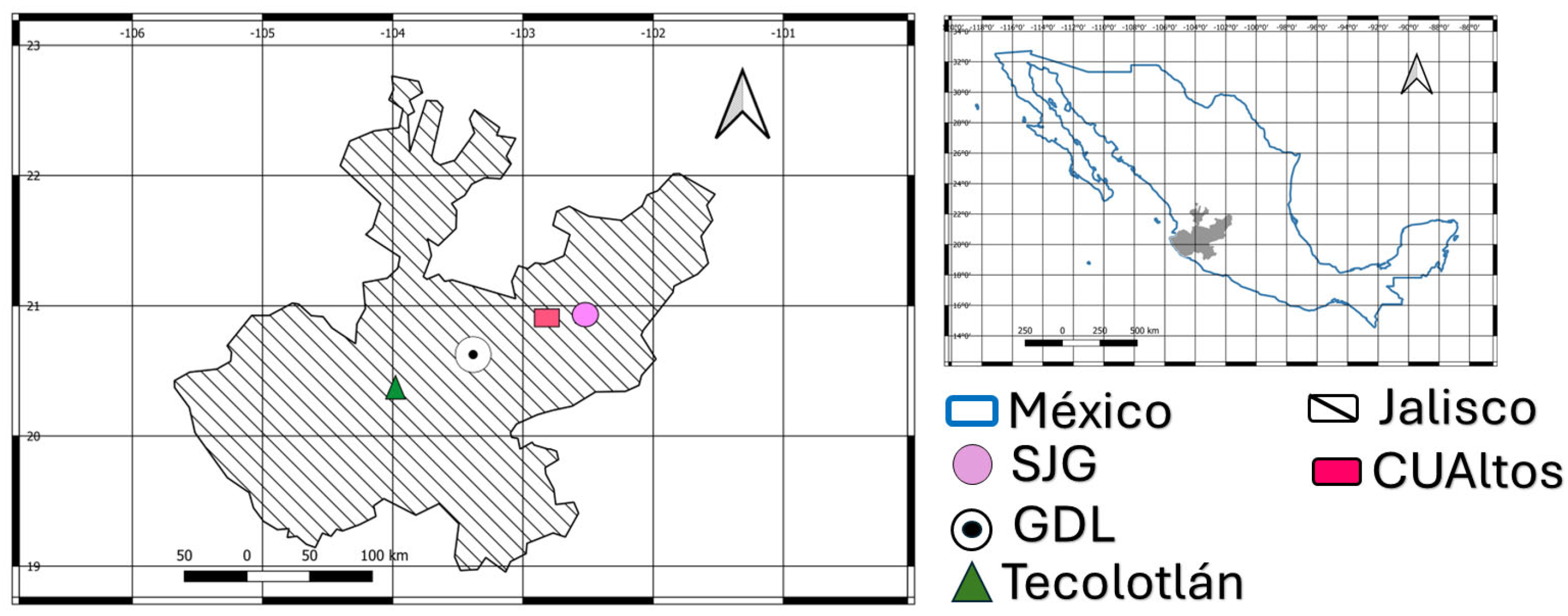
This study was conducted in four contrasting environments within the state of Jalisco, Mexico, each representing a different degree of anthropogenic influence: an urban area, a semi-urban area, an agricultural zone, and a semi-natural site located adjacent to a protected natural area (
Figure 1).
The Guadalajara Metropolitan Zone (ZMG) served as the urban environment and included three representative urban parks: Colomos II, Alcalde, and Agua Azul. Located in Central Jalisco, the ZMG is the second most populated metropolitan area in Mexico, with over five million inhabitants and an approximate area of 2551 km
2 [
20]. The region experiences substantial atmospheric pollution, primarily driven by vehicular emissions and a wide range of industrial activities—including textile manufacturing, paint production, and battery industries.
San José de Gracia, located in the municipality of Tepatitlán de Morelos (20°40′28″ N, 102°34′01″ W), was selected as the agricultural site due to its extensive Agave tequilana cultivation and the predominance of agricultural and livestock activities, which represent the major potential sources of environmental contamination.
The Centro Universitario de los Altos (CUAltos) of the University of Guadalajara (20°47′01″ N, 102°43′41″ W), also located in Tepatitlán de Morelos, was designated as the semi-urban site. Its landscape consists of a mosaic of rural vegetation interspersed with agroindustrial facilities and bordered by residential areas, representing an intermediate transition between urban and rural environments.
Tecolotlán, located approximately 100 km southwest of Guadalajara, was selected as the semi-natural environment. This region lies near the “Área de Protección de Flora y Fauna Sierra de Quila” and is characterized by tropical dry forest, riparian corridors, secondary vegetation, and scattered agricultural patches. Although near the town of Tecolotlán, it maintains the lowest level of anthropogenic disturbance among the study sites.
2.2. Sample Collection
Bird sampling was conducted across multiple trophic guilds between July 2019 and January 2021. Captures were carried out using mist nets (Porzana Ltd., Icklesham, UK) [
22] operated between 07:00 and 14:00 h. Each bird was identified using specialized field guides [
23,
24,
25,
26] and banded with aluminum rings provided by the organization Tierra de Aves (Mexico), enabling the detection of recaptures.
For each individual, breast feathers and the first primary feather (P1) were collected.
These feathers were selected to represent different portions of the plumage commonly used in avian ecotoxicology, acknowledging that feather age and growth timing may vary among species and individuals. Rather than assuming strict equivalence in exposure timing, the combined use of these feathers was intended to capture an integrated signal of metal exposure during feather formation.
The database included the detailed information for each bird, including species, age, sex, trophic guild [
23], degree of cranial ossification, reproductive condition, fat score, plumage type, wing length, body mass, and capture coordinates. However, only a subset of these variables was used in the analyses presented in this study, specifically age, sex, and trophic guild, as these variables were directly relevant to the study (
Table S1).
Bird capture activities were conducted under the scientific collection permit SGPA/DGVS/10147/19, issued by the “Secretaría de Medio Ambiente y Recursos Naturales” (SEMARNAT), ensuring compliance with Mexican wildlife regulations and ethical standards.
2.3. Sample Preparation and Quantification of Heavy Metals
Feathers were cleaned to remove exogenous contaminants by immersion in acetone for 12 h, followed by rinsing with distilled water and air-drying at room temperature. Although this procedure is widely used to reduce surface contamination, it may not completely eliminate all externally adhered soil particles and airborne particulates, which is considered when interpreting the results. Cleaned samples were subsequently analyzed using a Genius 5000 X-ray fluorescence (XRF) spectrophotometer (Skyray Instruments, Dallas, TX, USA), equipped with a 40 kV X-ray tube and a silver (Ag) anode excitation source.
Elemental analysis was performed using a non-destructive energy-dispersive X-ray fluorescence (ED-XRF) technique, which enables the direct quantification of heavy metals in the feather matrix without chemical digestion. Each sample was scanned for 90 s, and three analytical replicates were conducted per feather to evaluate sample heterogeneity and instrumental repeatability.
Instrument calibration and quality control procedures were carried out following the manufacturer’s recommendations and in accordance with the US EPA Method 6200 [
27]. The pXRF instrument was standardized daily using an internal silver (Ag) target. Analytical accuracy was evaluated through the analysis of Certified Reference Materials (CRMs) appropriate for the pXRF calibration, with recovery rates consistently within the acceptable range of 90–110%. Precision was determined by analyzing CRMs in triplicate. The final concentration reported for each element corresponds to the arithmetic mean of the three measurements, with the relative standard deviation (RSD) values maintained below 5%, ensuring the precision and representativeness of the reported data.
2.4. Statistical Analysis
Heavy metal concentrations obtained from the Genius 5000 XRF spectrometer were square-root transformed to reduce the influence of extreme values. Bray–Curtis dissimilarities were calculated from the transformed matrix, as this metric is robust for quantitative ecological data and handles zero inflation effectively [
28]. The model for resident species (Model I) is as follows:
where G = the trophic guild; A = the study area; Ag = the age; and ε = the residual error.
The model for the combined dataset (resident + migratory species) (Model II) is as follows:
where S = the migratory status (resident vs. migrant)
PERMANOVA with 9999 permutations was used to evaluate the differences in metal concentrations among trophic guilds, age classes, and study areas, followed by the pairwise comparisons of significant factors. Principal Coordinates Analysis (PCoA) based on the Bray–Curtis distances was used to visualize multivariate patterns [
29].
The Redundancy Analysis (RDA) was performed to assess associations between metal concentration profiles and environmental variables [
30]. Environmental variables were selected a priori based on their documented role as sources, carriers, or proxies of trace metal inputs in terrestrial ecosystems. The environmental dataset included volatile organic compounds (COV) and PM
10 concentrations, which were used as proxies of atmospheric pollution and anthropogenic emission gradients. PM
10 was included as a primary physical substrate for the transport and dry deposition of trace elements [
31], while COVs represent the emission intensity associated with industrial and vehicular activities, and they often co-occur with trace metals along common emission gradients [
32].
In addition, agave cover and three indicators of livestock production (poultry, swine, and cattle) were incorporated as indicators of dominant agro-industrial land use in the study region. Intensive livestock production is a recognized source of metals such as Cu and Zn due to the use of mineral supplements in animal feed [
33], while agricultural soils under intensive management may accumulate metals (e.g., Cd, Pb) derived from fertilizers and agrochemicals [
34].
All analyses were conducted in RStudio 2025.09.2 (Build 418) using R version 4.5.1 (13 June 2025 ucrt). Multivariate analyses were performed using the packages vegan, pairwiseAdonis2, ggplot2, and tidyverse, which were also used for producing descriptive and exploratory plots.
3. Results
A total of 58 bird species were captured across the four study regions: Guadalajara, San José de Gracia, Centro Universitario de los Altos (CUAltos), and Tecolotlán. The assemblage encompassed seven trophic guilds—insectivores, granivores, omnivores, nectarivores, frugivores, carnivores, and scavengers—all of which were represented in every study area. For each individual, a composite feather sample consisting of breast feathers and the primary feather P1 was collected, yielding a total of 370 samples analyzed for trace metal concentrations.
The taxonomic composition of the sampled species and their mean concentrations for each metal are provided in
Appendix A.
X-ray fluorescence (XRF) spectrometry detected a total of 22 elements in the feather samples. Seven of these elements (K, Ca, Fe, Ti, Sr, Nb, and Zr) were excluded from statistical analyses because their occurrence is largely associated with natural physiological processes or ubiquitous background levels in avian feathers. The remaining 15 metals included Mn, Cu, Ni, Zn, Mo, Ag, Sb, V, Cr, Ga, Rb, Y, Pb, Sn, and Hf.
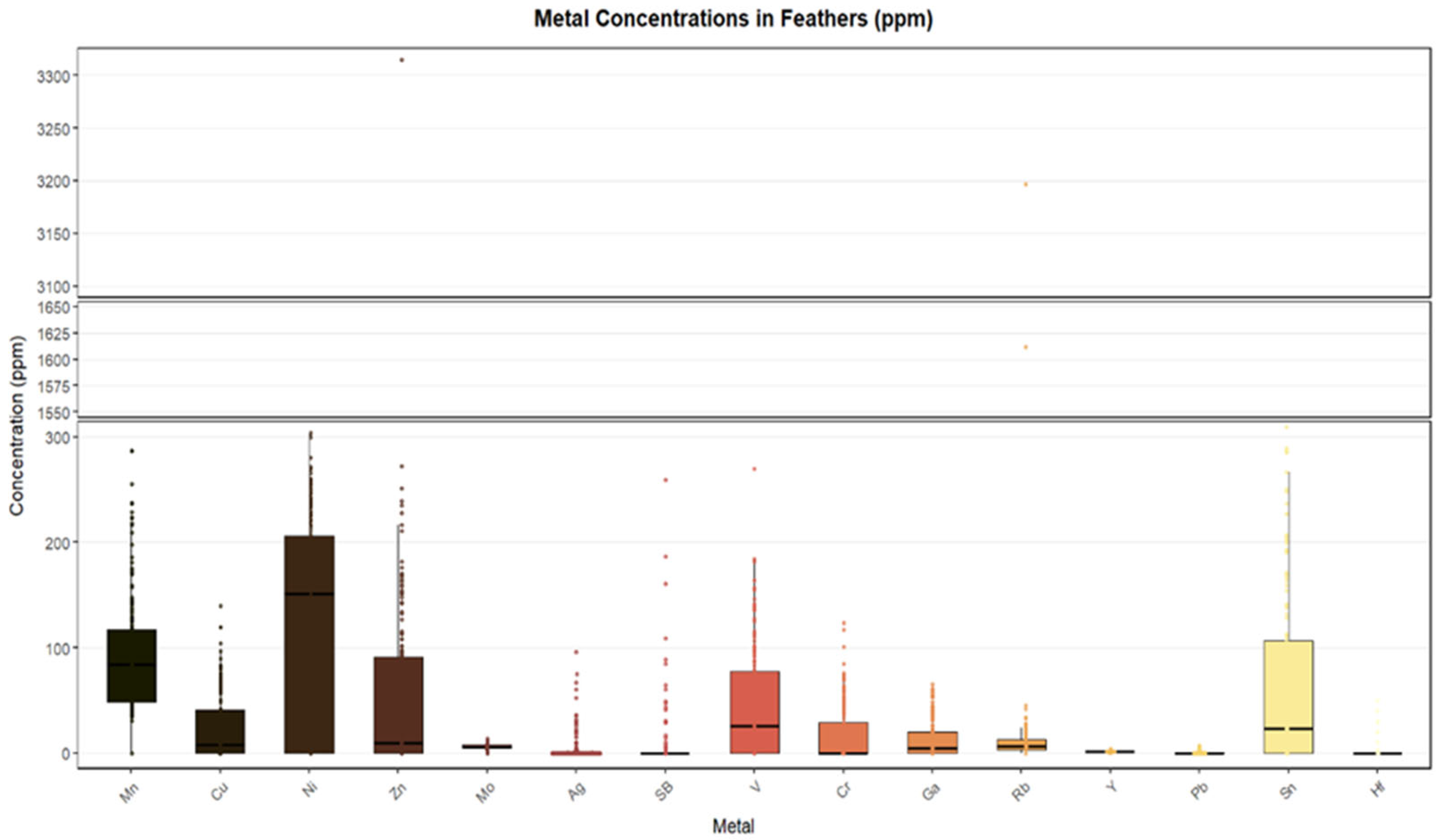
Among the quantified elements, zinc (Zn) showed the highest maximum values and some of the most elevated concentrations in several individuals (
Figure 2). However, nickel (Ni) presented higher median levels across samples, which explains its more prominent boxplot distribution. Overall, both elements dominated the concentration profiles, reflecting a combination of physiological regulation and environmental exposure.
3.1. PERMANOVA Model I (Resident Species)
The PERMANOVA performed on resident species (Model I) revealed the significant effects of both trophic guild (
p < 0.001) and study area (
p = 0.009) on the multivariate structure of metal concentrations (
Table 1). Trophic guild accounted for the largest proportion of explained variation (26.76%), followed by the study area (13.8%). Age contributed marginally to the model (
p = 0.069; 9.99% of variation), while both interaction terms (Guild × Area and Age × Area) were non-significant.
3.2. Pairwise Comparisons Among Study Areas
Pairwise PERMANOVA tests (
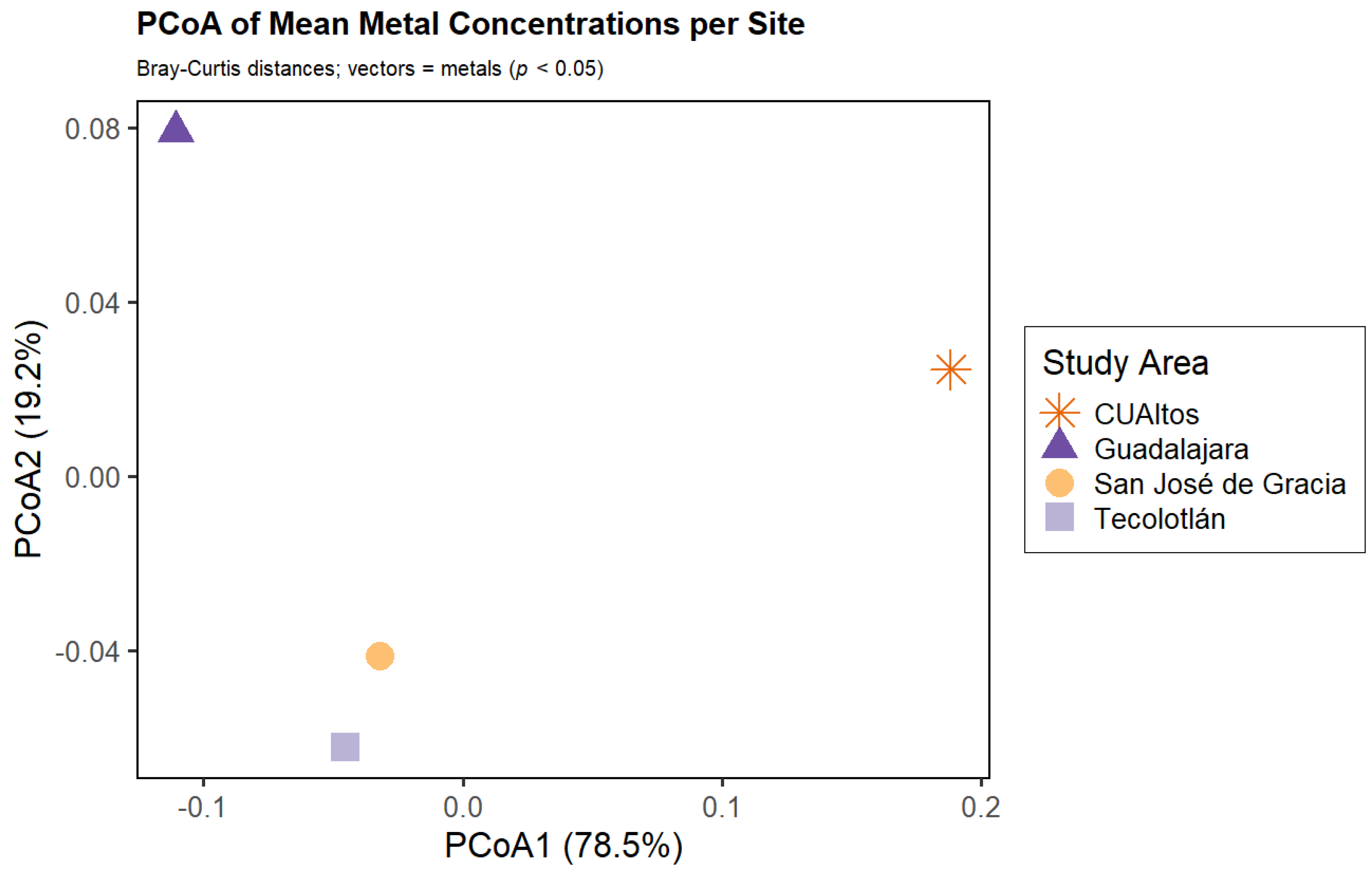
Table 2) revealed that the Centro Universitario de los Altos (CUAltos) differed significantly from all other study areas:
CUAltos vs. Guadalajara → p = 0.012;
CUAltos vs. Tecolotlán → p = 0.001;
CUAltos vs. San José de Gracia → p = 0.022.
No significant differences were detected among the remaining site pairs. This pattern indicates that CUAltos exhibits a distinct multielement signature when compared with the other regions.
This differentiation was clearly reflected in the PCoA ordination (
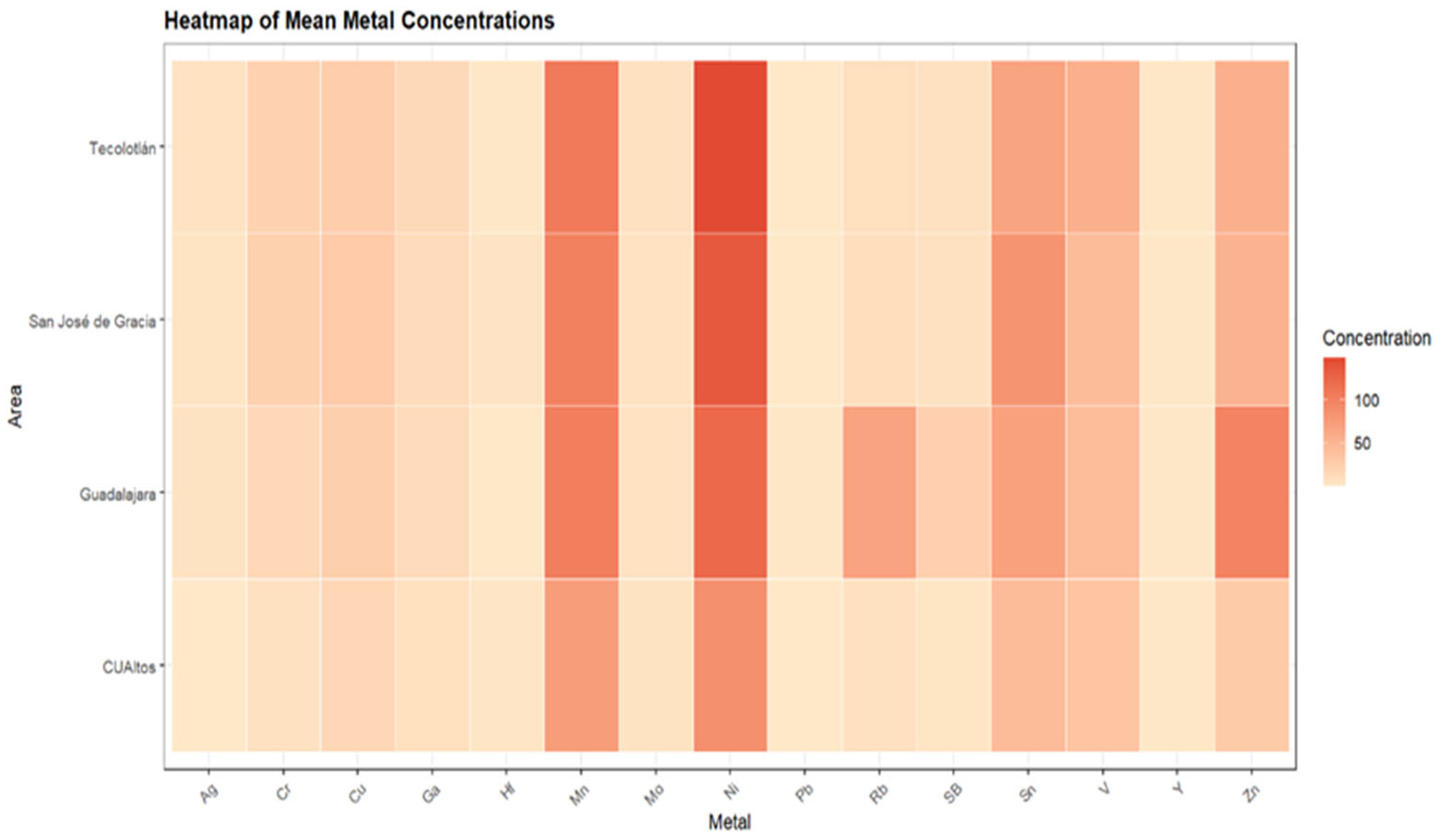
Figure 3), where CUAltos clustered separately from the remaining study areas. The same trend appeared in the heatmap of mean metal concentrations (
Figure 4), which highlighted consistently lower concentrations of several metals in CUAltos relative to the other sites.
Overall, Model I explained 59.9% of the total multivariate variation, leaving 40.1% unexplained. These results indicate that ecological traits—particularly trophic guild—account for the largest proportion of explained variation in trace metal concentrations among resident birds, whereas spatial differences among study areas are present but comparatively weaker.
3.3. PERMANOVA Model II (Residents + Migrants)
When the dataset was expanded to include both resident and migratory species (Model II), trophic guild remained the only statistically significant factor structuring multivariate variation in metal concentrations (
p < 0.001), accounting for 32.0% of the total variation (
Table 3). Migratory status (S) and the Status × Age interaction were not significant predictors of metal composition. Age class again displayed a marginal effect (
p = 0.069). Model II explained 43.2% of the total multivariate variation, leaving the remaining 56.8% unexplained.
These results indicate that including migratory individuals did not alter the dominant role of trophic ecology in determining metal burdens, and that feather metal loads are largely independent of migratory status—with feathers reflecting the conditions at the site and time of molt.
3.4. Trophic Guild Differences and Metal Profiles
Pairwise PERMANOVA comparisons among trophic guilds (
Table 4) identified multiple statistically distinct guild pairs (see
Table 4 for t-statistics and
p-values from 9999 permutations). However, differences among guilds were manifested primarily in absolute metal concentrations rather than in unique proportional metal fingerprints.
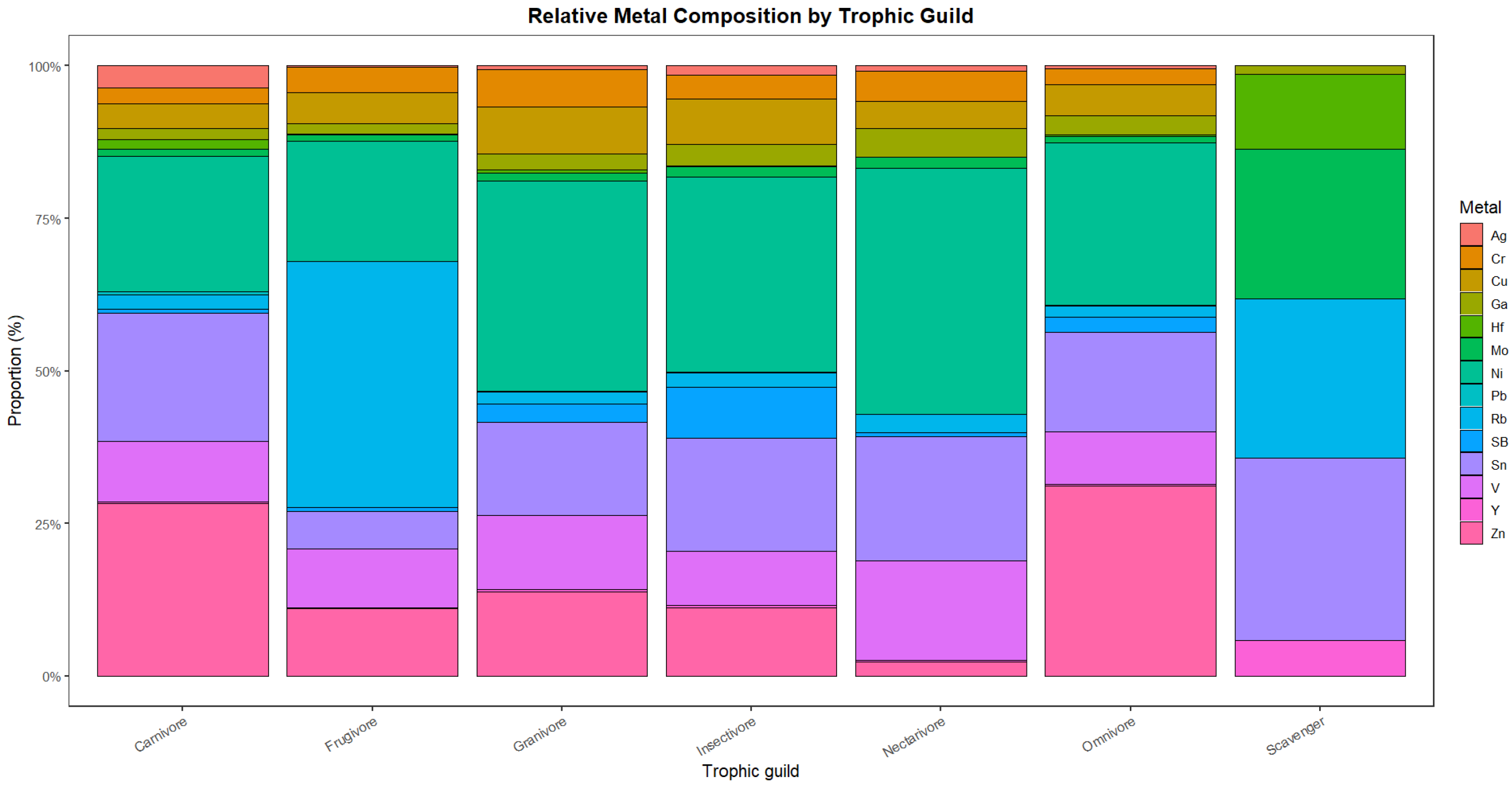
The stacked barplots of relative metal composition (
Figure 5) show that Zn, Y, Mo, and Hf consistently contributed the largest proportions across all trophic guilds, whereas elements such as Sn, Ag, and Ga contributed minimally. Thus, while some guilds accumulated higher total metal loads than others, the overall proportional structure of the metal assemblage remained broadly similar across guilds. This pattern suggests the widespread regional exposure to the same group of trace elements, modulated in magnitude (but not composition) by trophic ecology.
3.5. Summary of Multivariate Patterns
Across both PERMANOVA models and complementary ordination-based analyses, two robust patterns emerged:
Trophic guild is the primary biological determinant of metal concentration patterns in feathers, explaining the largest fraction of multivariate variation.
CUAltos consistently differs spatially from the other study areas, forming a distinct cluster in ordinations and pairwise comparisons; no other area was consistently separated from the rest.
Together, these patterns underscore the joint influence of ecological traits (trophic position) and local spatial context on avian metal accumulation, with trophic ecology exerting the stronger effect in our dataset.
3.6. Redundancy Analysis (RDA)
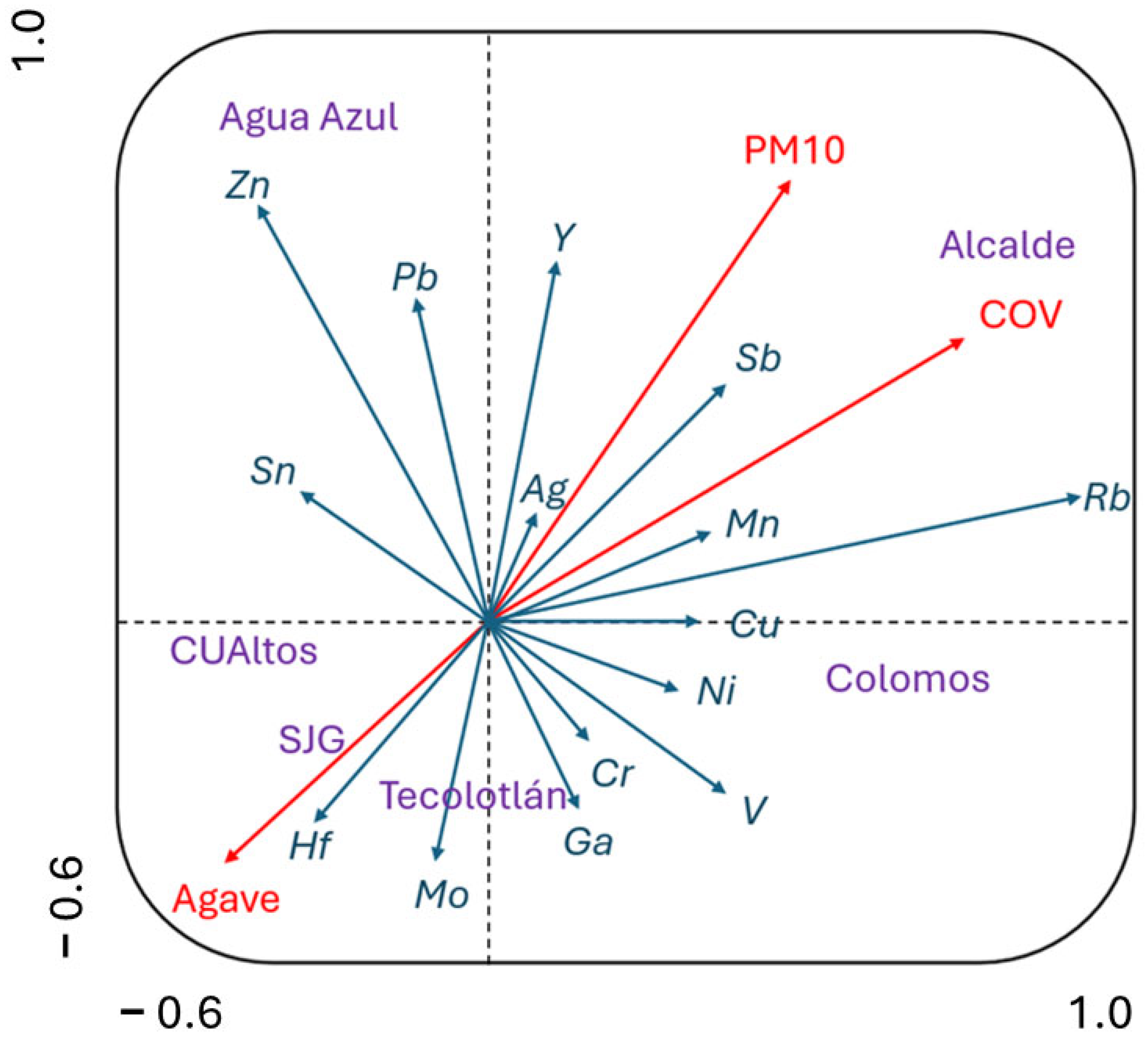
The RDA revealed that the spatial variation in feather metal concentrations was primarily associated with atmospheric pollution gradients, particularly volatile organic compounds (COVs) and particulate matter (PM10). In the ordination (
Figure 6), long RDA vectors for COVs and PM10 aligned with metals such as Sb, Mn, and Rb, and the Guadalajara sampling sites (Colomos and Alcalde) were positioned along the positive end of this pollution gradient. Agua Azul was more closely associated with elements such as Zn and Sn. The agave cover variable exhibited a short vector oriented toward a different quadrant, reflecting its comparatively minor contribution.
Marginal effects indicated that COVs independently explained the greatest proportion of variance (Λ = 0.28), followed by PM10 (Λ = 0.21) and agave (Λ = 0.12). Conditional tests supported significant contributions of COVs (ΛA = 0.28,
p = 0.017) and PM10 (ΛA = 0.22,
p = 0.013), while agave did not contribute significantly (ΛA = 0.04,
p = 0.592) (
Table 5). The ordination also showed considerable overlap among the Tepatitlán-regional sites (CUAltos, Tecolotlán, and San José de Gracia), whereas Guadalajaran sites occupied more distinct positions in the RDA space.
4. Discussion
This study provides a comprehensive assessment of trace metal accumulation in wild birds across four contrasting environments in Jalisco, Mexico. Our multivariate analyses consistently demonstrated that trophic guild was the most influential factor explaining the variation in feather metal concentrations. This primary influence was followed by weaker, yet detectable, spatial differences among the study areas. These findings reinforce the efficacy of feathers as a biomonitoring tool, aligning with previous research [
35,
36,
37]. Collectively, these results underscore the combined importance of dietary exposure pathways and local environmental conditions in shaping metal burdens within terrestrial bird populations. Although the inclusion of a large number of species may increase interspecific variability, the study objective was not to evaluate species-specific bioaccumulation patterns. Instead, analyses were intentionally structured around functional trophic guilds to identify the broad ecological and environmental drivers of metal exposure at the community level, following a widely applied guild-based ecological framework [
38].
It is important to acknowledge that feathers can incorporate trace metals both endogenously during feather growth and exogenously through the post-formation deposition of atmospheric particles [
39]. To minimize external contamination, all feathers were subjected to a standardized cleaning protocol prior to analysis, consisting of a 12 h acetone immersion followed by rinsing with distilled water. Although this procedure cannot guarantee the complete removal of all surface-bound particulates, the consistency of the observed patterns—particularly the dominant influence of trophic guild and the coherent spatial gradients detected across study areas—supports a predominantly diet-mediated incorporation of metals during feather formation rather than surface deposition as the primary driver of the observed variation. Additionally, guilds that forage on the ground or in wet substrates may experience greater contact with contaminated soils or marsh water, increasing the likelihood of residual external deposition even after washing. Therefore, trophic guild differences may partly reflect not only dietary uptake but also habitat-mediated exposure through contact with sediments and resuspended particles.
In addition, the interpretation of elemental profiles in feathers must account for the strong physiological regulation occurring during feather formation, which can alter elemental ratios relative to external environmental matrices. Zinc (Zn), for instance, is consistently abundant due to its structural role in keratin synthesis and is therefore tightly regulated. Nevertheless, both essential and non-essential elements may increase in concentration under elevated environmental availability through diet or exposure to contaminated atmospheric particulates during feather growth [
40,
41]. Consequently, elemental ratios in feathers are not expected to directly mirror those of soils or atmospheric particulates. Following a geochemical–ecotoxicological perspective [
42], feather elements are interpreted as an integrated signal of the regional “chemical landscape”, reflecting both geological and anthropogenic inputs, and providing a robust framework for detecting the broad trophic and spatial patterns despite limited source specificity.
The ecological, environmental health, and conservation relevance of assessing heavy metals in birds stems from their effectiveness as sensitive biomonitors across trophic levels. Due to their persistence and toxicity, heavy metals readily enter food webs and pose a high risk of biomagnification in top predators [
43,
44]. Birds occupy a wide range of ecological niches, allowing them to provide information not only on contaminant presence but also on exposure pathways and biomagnification processes. Feather sampling represents a non-invasive and ethically sound method for assessing chronic exposure, as feathers accumulate metals during their formation [
45,
46]. In this study, feather analysis effectively characterized metal burdens across species and trophic guilds, highlighting the differential exposure risks within avian communities in Jalisco, Mexico. Future studies combining feather analysis with surface soil geochemistry and particulate characterization would help further disentangle endogenous uptake from external deposition pathways.
4.1. Influence of Trophic Guild
Across both statistical models—resident birds only (Model I) and the combined dataset including migrants (Model II)—trophic guild consistently accounted for the largest proportion of explained variation, confirming its role as the primary determinant of metal accumulation and supporting our initial hypothesis. Carnivorous and omnivorous guilds exhibited markedly higher dissimilarity in total metal loads compared with granivores and nectarivores, a pattern fully consistent with predictions derived from trophic transfer and biomagnification processes [
47,
48]. Despite these quantitative differences, the proportional composition of elements remained similar across guilds: Zn, Y, Mo, and Hf dominated the elemental profiles, whereas low-abundance elements such as Sn, Ag, and Ga occurred only in minimal proportions. This consistency in elemental “fingerprints” suggests that while diet determines the magnitude of metal accumulation, the regional exposure landscape is broadly shared across feeding strategies and likely driven by generalized environmental sources, such as inhaled dust or water ingestion [
49,
50].
This result supports the use of trophic guilds as the primary analytical unit in this study, as species sharing similar feeding strategies are expected to experience comparable exposure pathways regardless of their taxonomic identity. By emphasizing functional grouping rather than species-level comparisons, this framework is particularly suitable for multivariate analyses aimed at detecting the general patterns of environmental contamination.
The carnivorous guild exhibited the highest overall metal concentrations, clearly exceeding those observed in the other groups. This trophic category is particularly susceptible to metal contamination due to its elevated position in the food chain and the cumulative effects of biomagnification. Consequently, raptors are among the most frequently studied avian taxa in the assessments of heavy metals, organochlorines, and other persistent organic pollutants [
51], and multiple studies report the comparable patterns of elevated metal accumulation [
52,
53].
Scavengers play an essential ecological role by recycling organic matter and reducing potential disease sources. Due to their high trophic position and carrion-based diet, they are generally expected to be vulnerable to biomagnification and, in some contexts, to the accidental ingestion of lead shot associated with hunting activities [
1]. Nevertheless, in this study, scavengers exhibited the lowest metal concentrations, a pattern that contrasts with previous reports [
54]. This unexpected result should be interpreted with caution, as scavenger exposure may vary strongly depending on local carrion availability, feeding behavior, and habitat use. Therefore, additional sampling focused on scavenger species would be valuable to determine whether this pattern is consistent across broader ecological contexts or reflects site-specific variability.
Granivores and frugivores exhibited the highest chromium concentrations, a pattern consistent with their close reliance on plant-based resources. By feeding directly on crops, granivores may serve as the indirect indicators of human exposure to metals present in agricultural products, whereas frugivores—the key seed dispersers that promote forest regeneration [
55]—consume fruits in which chromium can occur naturally [
56]. Although chromium is an essential element involved in glucose and cholesterol metabolism, its elevated concentrations may be carcinogenic [
57]. Its accumulation in these guilds therefore suggests a diet-associated exposure pathway that likely explains the detected levels.
Nectarivores, represented by hummingbirds, exhibited the second-lowest overall metal concentrations, likely reflecting their highly specialized diet dominated by nectar and small invertebrates [
58]. However, this guild also included the species with the highest vanadium concentration (270 ppm), indicating the potential for taxon-specific exposure pathways. Vanadium is not easily metabolized by birds, and its elevated concentrations in feathers have often been linked to external inputs, particularly iron oxide and hydroxide particles that adhere strongly to feather surfaces and may not be completely removed even after washing procedures. In this context, the high V levels detected in hummingbirds may reflect localized atmospheric deposition or contact with particulate matter in microhabitats where these species forage intensively. Additionally, vanadium can be mobilized from contaminated soils into plant tissues, suggesting that its uptake through floral resources could also represent a plausible dietary route in nectarivores [
59]. Consistent with previous findings showing that vanadium levels in wild birds may reflect local contamination gradients [
60], this pattern highlights the need for further investigation into both food-based and exogenous particulate sources of V in nectarivore guilds.
Insectivores exhibited the highest iron concentrations, consistent with previous reports indicating that insectivorous birds possess particularly efficient iron-absorption mechanisms, which may have physiological or health implications [
61]. Finally, omnivores exhibited the third-highest metal levels, a pattern expected given their broad dietary spectrum and consistent with findings from similar studies [
62].
4.2. Influence of Age and Sex
Age exhibited only a marginal, non-significant effect on metal accumulation, driven by a small number of individuals with exceptionally high Zn concentrations, which reduced the contrast between age classes. Although the bioaccumulation theory predicts higher metal burdens in adults due to prolonged exposure, this pattern is often difficult to detect in feather-based datasets because feathers primarily reflect metal incorporation during the specific molt period rather than lifetime accumulation. Moreover, age classification in wild birds is generally limited to broad categories (juvenile vs. adult), since the exact age cannot be determined once individuals reach adulthood, which may further reduce the resolution of age-related trends. In this context, the removal of extreme outliers—particularly among younger individuals—would likely strengthen the anticipated tendency toward higher metal concentrations in adults under chronic contamination scenarios [
63,
64]. Additionally, the inclusion of many species with contrasting life histories and molting strategies may obscure uniform age signals, and residual contributions from external deposition cannot be excluded as a factor influencing variability. In contrast, sex had no detectable effect, a result commonly reported in avian biomonitoring studies and consistent with the homogenizing influence of molt on physiological differences among individuals.
4.3. Spatial Variation Among Study Areas
Spatial differences, although statistically significant, were less pronounced than trophic effects but were nonetheless evident. Pairwise comparisons indicated that CUAltos differed significantly from the other study areas, a pattern consistent with its generally lower concentrations of several metals, as reported in comparable studies [
65,
66,
67]. Rather than reflecting extreme metal values, this separation was driven by increased multivariate dissimilarity associated with overall lower metal burdens.
At the metal-specific level, clear spatial patterns emerged. Tecolotlán exhibited the elevated concentrations of Mn (manganese), Ni (nickel), and V (vanadium) (approximately 110, 152, and 57 ppm, respectively). Such elevations are commonly associated with emissions from heavy machinery, vehicular wear, and certain industrial processes, particularly those related to fuel combustion [
68,
69,
70]. Urban sites in Guadalajara showed the highest Zn (zinc) concentrations (approximately 114 ppm), a pattern typically linked to intense urbanization through sources such as tire abrasion, galvanized materials, and municipal runoff [
71,
72]. San José de Gracia exhibited higher Cu (copper) concentrations (approximately 29 ppm), which may be associated with localized agricultural practices, given the widespread use of copper-based fungicides and fertilizers [
73,
74].
These metal-specific spatial differences strongly reflect the influence of local emission sources, including agricultural amendments, vehicular traffic, and small-scale industrial activities. Furthermore, Tecolotlán, CUAltos, and San José de Gracia share agave-dominated agricultural landscapes, which may account for their partial clustering in a multivariate space. In contrast, Guadalajara—the most intensely urbanized and densely populated area in the region—exhibited stronger atmospheric and diffuse contamination signatures typically associated with metropolitan environments.
4.4. Environmental Gradients Identified Using RDA
The Redundancy Analysis (RDA) effectively clarified the environmental drivers shaping the multivariate metal composition in bird feathers. Volatile Organic Compounds (COVs) and particulate matter (PM10) emerged as the strongest environmental predictors, exhibiting long vectors aligned with metals such as Sb (antimony), Mn (manganese), and Rb (rubidium). The clustering of urban sites in Guadalajara (Alcalde and Colomos) along this primary gradient strongly indicates heightened exposure to airborne pollutants associated with vehicular emissions, fossil fuel combustion, and industrial activities [
75,
76].
Interestingly, Agua Azul—although located within the same urban environment as the other Guadalajara sites—showed elevated Zn, Sn, and Pb concentrations, highlighting pronounced micro-scale heterogeneity and the presence of localized contamination hotspots within the metropolitan region [
77]. This distinct pattern may reflect legacy industrial residues or localized sources, particularly of lead (Pb) and tin (Sn), elements that often persist in soils and resuspended dust long after regulatory phase-outs.
CUAltos and San José de Gracia clustered together, while Tecolotlán formed a nearby but distinct group, consistent with their shared agave-dominated agricultural matrices and semi-rural settings. Although the agave variable did not reach statistical significance, it improved overall model performance more than variables associated with poultry, swine, or cattle production, suggesting a subtle but non-negligible influence of agave-based land use on metal deposition patterns.
Importantly, the RDA clearly demonstrates that atmospheric pollutants (COVs and PM10) represent the dominant environmental forces shaping multivariate metal patterns across the study region. This result underscores the regional scale of air pollutant transport and its overriding influence on chronic metal burdens in terrestrial birds from Jalisco, even surpassing the effects of local agricultural activities.
4.5. Effects of Migratory Status
Migratory status did not contribute significantly to the overall variation in feather metal concentrations. This result should be interpreted cautiously, as feathers reflect metal exposure from the environment in which they were grown during molt, which in migratory species may occur far from the capture location [
78]. Moreover, and critically, the complexity of species-specific molting strategies—including variation in molt timing and location—renders interpretation of the feather signal particularly challenging [
79].
While migratory birds molting far from the capture area might be expected to exhibit distinct elemental profiles, the absence of clear differences may reflect multiple non-exclusive scenarios. These include broadly similar metal availability across molting and sampling regions, residual contributions from exogenous deposition, or the high variability in molt strategies among species. Because the geographic origin of feather growth cannot be determined with our current dataset, these alternative explanations cannot be disentangled and should be considered when interpreting the lack of a migratory effect. Consequently, trophic guild remained the most robust determinant in the combined dataset, reinforcing the conclusion that trophic ecology represents the dominant driver of metal accumulation patterns, largely independent of migratory status.
4.6. Ecotoxicological Implications
Although feather metal concentrations cannot be directly equated with internal toxicity thresholds due to differences in metal partitioning, storage, and excretion pathways, they reliably reflect bioavailable environmental exposure during the period of feather growth [
45,
65,
80]. The pervasive dominance of Zn (zinc), Y (yttrium), Mo (molybdenum), and Hf (hafnium) across all sites suggests a broad regional exposure to these elements, likely associated with geological background levels and regionally transported dust inputs, as has been reported in other avian biomonitoring studies [
49,
81]. Meanwhile, site-specific peaks in Ni (nickel), V (vanadium), Mn (manganese), Cu (copper), and Pb (lead)—particularly in urban areas—clearly reflect localized and more acute anthropogenic sources, including industrial emissions, vehicular traffic, and targeted agricultural practices.
The strong influence of atmospheric pollutants (COVs and PM10) as the main drivers of metal patterning underscores the critical importance of air-quality monitoring and stricter regulatory measures, particularly in rapidly urbanizing regions such as the metropolitan area of Guadalajara [
82,
83]. Collectively, our findings highlight the value of wild birds as effective sentinels of both diffuse regional contamination and localized metal hotspots, providing a robust foundation for the development of long-term environmental monitoring programs in Western Mexico.
5. Conclusions
Trophic guild emerged as the strongest predictor of trace metal concentrations in feathers, exceeding the influence of spatial and demographic factors and underscoring the central role of diet in metal bioaccumulation.
Spatial patterns were present but comparatively weak, with CUAltos exhibiting distinct metal profiles driven by the consistently lower concentrations of several elements. Nonetheless, several metals showed clear site-specific peaks, including Zn in Guadalajara, Mn–Ni–V in Tecolotlán, and Cu in San José de Gracia, reflecting localized anthropogenic influences.
Atmospheric pollutants (PM10 and COVs) were identified as the primary environmental drivers shaping multivariate metal composition, highlighting the dominant role of air pollution in regional exposure dynamics. Agave-dominated landscapes exerted a modest but detectable influence on metal patterns, although this effect did not reach statistical significance.
Migratory status did not explain the variation in feather metal concentrations, but this result should be interpreted with caution. The absence of a migratory signal may reflect multiple non-exclusive factors, including broadly similar exposure conditions across regions, high variability in molt strategies among species, and residual contributions from locally deposited external particles.
Importantly, even if feathers cannot be completely cleared of exogenous materials, they remain effective and non-invasive biomonitoring tools because they capture the trace metal burden circulating in the surrounding environment, reinforcing the value of wild birds as sentinels in regional contamination assessments.



 ,
,