2.1. Competency-Based Education in Hospitality Management
Competency-Based Education (CBE) has emerged as a prominent pedagogical approach in higher education, shifting the emphasis from time-based instruction to the demonstration of clearly defined, measurable competencies (
Mulder, 2018;
Wesselink et al., 2010). In hospitality management education, CBE has been increasingly adopted to address persistent gaps between academic preparation and industry expectations (
Suh et al., 2012). By emphasizing performance-based learning outcomes, CBE enables students to progress based on demonstrated mastery rather than on instructional duration (
Shah & Liu, 2021).
CBE is particularly relevant in hospitality education, where graduate employability depends heavily on applied, behavioral, and managerial competencies (
Bharwani & Jauhari, 2013;
Chang & Werther, 2021). Prior studies indicate that CBE facilitates the integration of theoretical knowledge with experiential learning, enhancing job readiness in areas such as customer service, financial management, leadership, and team coordination (
Kasa et al., 2020;
Silitonga, 2021;
Tesone & Ricci, 2006). Nevertheless, hospitality graduates continue to face competency mismatches, especially in leadership, strategic thinking, and intercultural communication, suggesting limitations in how competencies are embedded within curricula (
N.-Y. Kim, 2024;
Shah & Liu, 2021).
Scholars further caution that competencies should not be treated as static checklists but as dynamic, context-dependent capabilities shaped by social interaction and organizational environments (
Quintela et al., 2024;
Suh et al., 2012). The effectiveness of CBE implementation, therefore, depends on institutional support structures, including faculty development, continuous assessment mechanisms, and curriculum integration strategies (
A. M. H. Chen et al., 2024;
Lin et al., 2025). Collectively, the literature suggests that while CBE provides a robust framework for competency development, its impact ultimately depends on how competencies are perceived by students and formally reflected in curriculum design.
However, the implementation of CBE in Asian educational systems is frequently hindered by cultural and structural constraints. Traditional hierarchical teaching, rooted in Confucian heritage, often creates barriers to student-centered approaches, as instructors may resist relinquishing authority (
Abdullah, 2020;
Hong, 2011;
Oktadiana & Chon, 2017). This cultural backdrop often leads to a “credential trap”, where intense competition for university prestige and an obsession with grade point average (GPA) overshadow the acquisition of actual task-based skills (
Abelmann et al., 2009;
Shin et al., 2018;
So & Kang, 2014). Consequently, bridging the gap between curriculum planning and practical implementation remains a challenge, as rigid regulatory frameworks, particularly in South Korea, often favor traditional subject-based models over integrated competency development (
Hallinger & Lu, 2011;
Lee & Xu, 2024;
Shin et al., 2018).
Furthermore, technological disruptions such as artificial intelligence (AI) and robotics are redefining core competencies, necessitating digital literacy from an early stage of education (
Deri et al., 2024;
Jabeen et al., 2021). Institutions must adapt by embedding AI-driven simulations and interdisciplinary projects to foster analytical decision-making skills (
Neophytou et al., 2025;
Seo & Kim, 2021). This shift requires graduates to manage new digital job roles while maintaining essential soft competencies like creativity, critical thinking, and leadership (
Adeyinka-Ojo et al., 2020;
Ercik & Kardaş, 2024). Ultimately, hospitality curricula in Singapore, Hong Kong, and South Korea must balance high-tech proficiency with high-touch human services to ensure long-term employability in a post-pandemic industry (
Jones, 2019;
Xu et al., 2022).
2.2. Student Competency Self-Evaluation in Higher Education
Self-evaluation has become an increasingly important practice in higher education, particularly as institutions seek to assess not only learning outcomes but also students’ perceived readiness for professional environments. Unlike traditional assessment approaches that rely primarily on externally measured performance, self-evaluation emphasizes reflective judgment, allowing students to evaluate their own competencies by integrating cognitive, emotional, and behavioral dimensions of learning (
Boud & Falchikov, 2006;
García-Aracil et al., 2018) This reflective process has been linked to higher learning engagement, stronger learning ownership, and the development of lifelong learning capabilities (
Kolmos et al., 2021).
Empirical evidence suggests that structured self-evaluation can enhance deeper cognitive processing and encourage students to critically reassess their learning experiences, thereby improving the alignment between educational outcomes and career expectations (
McIver & Murphy, 2021). In addition, self-evaluated competencies have been shown to relate positively to career-related outcomes such as job search success and employability perceptions, particularly when supported by adaptive career behaviors (
H. Chen et al., 2023).
In hospitality education, the importance of self-evaluation is particularly pronounced given the service-intensive, people-oriented nature of the industry. Hospitality graduates are expected to demonstrate not only technical proficiency but also higher-order managerial and interpersonal competencies, including leadership, communication, and intercultural sensitivity (
Cheung et al., 2010;
Shum et al., 2018). However, prior studies consistently report that hospitality graduates often feel insufficiently prepared for managerial roles, revealing a misalignment between curriculum emphasis and industry expectations (
Nachmias et al., 2017).
To address this issue, the present study adopts the Student Competency Self-Evaluation Scale (SCSES) to examine students’ perceived competencies in hospitality education. The SCSES focuses on broader, transferable managerial competencies, specifically financial management, strategic planning, leadership, communication, and cultural awareness, that are frequently highlighted in hospitality and management education literature as critical for long-term career development (
Fraser, 2020;
Shariff & Razak, 2022). These domains were selected based on established conceptual frameworks but are treated as empirically testable constructs, allowing their dimensionality to be validated through exploratory factor analysis (EFA).
Unlike conventional hospitality assessments that emphasize operational and technical skills, the SCSES prioritizes higher-order competencies that support adaptability, leadership potential, and strategic decision-making. This focus responds to persistent concerns that hospitality curricula tend to overemphasize operational training while underdeveloping managerial and soft skills essential for career progression (
Fraser, 2020;
Papageorgiou et al., 2024). By concentrating on these less visible yet critical competencies, the SCSES offers a structured approach to evaluating whether hospitality education adequately prepares students for evolving industry demands.
Moreover, while related constructs such as employability perception and career adaptability have received scholarly attention (
Y. Liu et al., 2022;
Yan et al., 2023), competency-focused self-evaluation instruments tailored specifically to hospitality education remain limited. The SCSES, therefore, fills an important gap by providing a context-sensitive framework that fosters reflective learning among students while offering institutions insights into curriculum effectiveness and alignment with industry needs.
However, cross-national self-evaluation data must be interpreted with caution due to cultural biases. In East Asian collectivistic societies, cultural demands for modesty often lead students to underreport their actual proficiency (
M.-J. Liu et al., 2022). This modesty bias may result in students downplaying their knowledge, which can be misinterpreted as a lack of confidence (
Jackson, 2025). Empirical evidence further suggests that students from East Asian backgrounds may produce more unfavorable self-assessments due to culturally motivated self-criticism rather than lower ability (
Y.-H. Kim et al., 2016). To mitigate these biases, this study focuses on identifying underlying competency structures through factor analysis and examining patterns of alignment with curriculum clusters, providing a more balanced interpretation of how students from different cultural backgrounds perceive their professional readiness.
2.3. Curriculum Composition and Regional Contexts in Hospitality Education
Curriculum composition is a key mechanism through which hospitality education translates industry expectations into structured learning outcomes. In this context, a curriculum refers to an integrated set of compulsory and elective courses designed to develop disciplinary knowledge and professional competencies (
Wang & Abukhalifeh, 2021). As the hospitality industry becomes more complex and globally interconnected, curricula are increasingly expected to move beyond vocational training and incorporate managerial, strategic, and interpersonal competencies that support long-term career development (
Hein & Riegel, 2013).
Globally, hospitality programs are expected to balance industry-specific skills with transferable competencies such as strategic thinking, financial literacy, leadership, and intercultural communication (
Baum, 2019;
Sisson & Adams, 2013). Nevertheless, substantial evidence points to persistent misalignment between curriculum content and labor market expectations, particularly regarding graduates’ preparedness for managerial and decision-making roles (
Johanson et al., 2011;
Nachmias et al., 2017). Scholars therefore emphasize the need for stronger collaboration between higher education institutions and industry stakeholders to enhance curriculum relevance and graduate employability (
Deri et al., 2024;
Stefanini et al., 2021).
In Asia, hospitality education systems increasingly pursue international recognition through globally benchmarked curricula and pedagogical standards (
Hsu, 2014;
Law et al., 2020;
Thomas & Sebastian, 2025). At the same time, curriculum flexibility remains essential to accommodate regional industry characteristics and labor market dynamics (
Alexakis & Jiang, 2019). These systems share a common cultural heritage characterized by Confucian values of community, productivity, and efficiency. Despite these shared roots, the “Asian Tiger” economies of Singapore, Hong Kong, and South Korea have undergone dramatic socioeconomic changes, leading to divergent pedagogical philosophies (
Cheng, 2017). For example, while all three regions have introduced project-based learning to foster student autonomy, implementation ranges from Singapore’s compulsory “project learning” to South Korea’s “exam-free semesters” designed for self-directed career exploration (
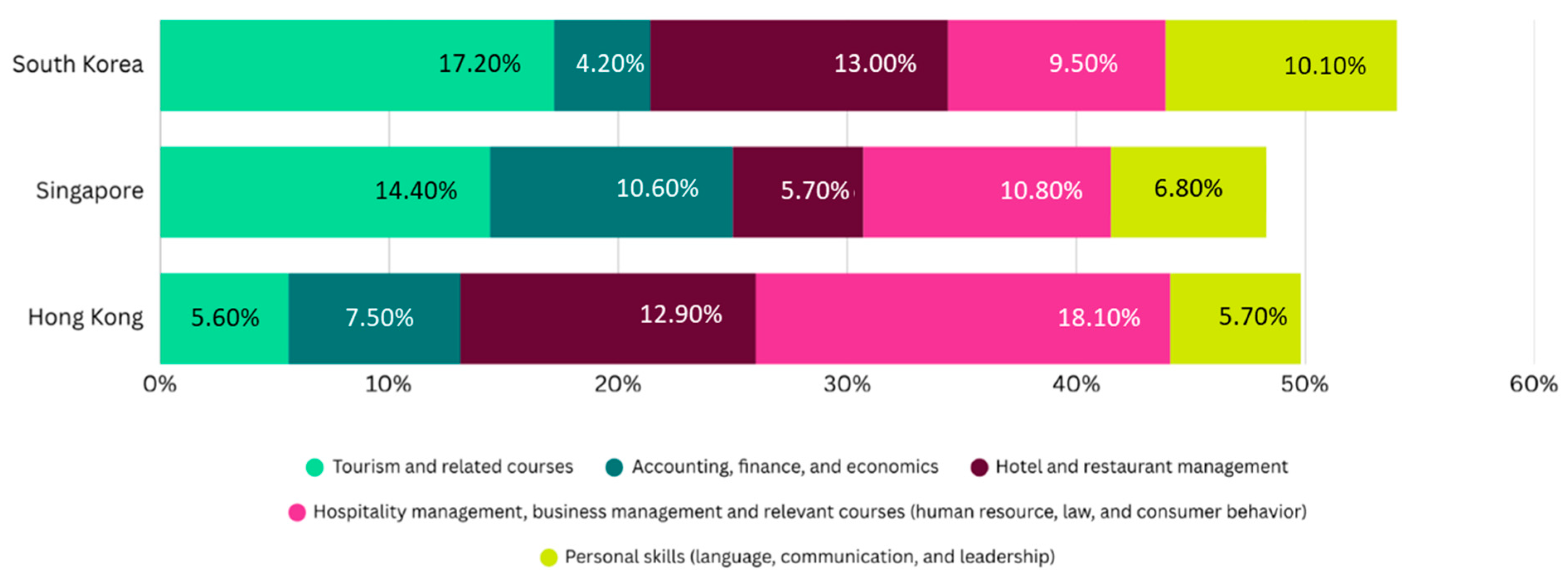
Cheng, 2017). For comparative purposes, hospitality curricula in South Korea, Singapore, and Hong Kong can be broadly classified into five competence-based areas: tourism-related studies; accounting, finance, and economics; hotel and restaurant operations; hospitality and business management; and personal and professional skills, including communication and leadership. This categorization provides a structured basis for cross-national comparison of curriculum emphasis.
In South Korea, hospitality education programs are characterized by their disciplinary specialization and strong international orientation. Unlike business-based hospitality programs in some Asian contexts, many Korean programs operate as independent departments dedicated specifically to hospitality and tourism studies (
Wang & Abukhalifeh, 2021). The South Korean vision for education integrates ancient principles like
Hongik Ingan (benefiting humankind) with futuristic thinking to address the pressures of a highly competitive academic culture (
Cheng, 2017). These curricula often incorporate courses on leadership, communication, and professional etiquette, reflecting the service-intensive nature of hospitality careers. Increasing attention has also been given to intercultural competence and global engagement, driven by demographic changes and Korea’s strategic ambition to strengthen its position in international hospitality education (
Jang et al., 2021;
Kang, 2021). Nevertheless, prior studies suggest that despite curricular expansion and the integration of internships, concerns remain regarding graduates’ readiness for managerial roles and their adaptability to industry change (
Na & Lee, 2021).
Singapore’s hospitality education system presents a contrasting model, shaped by a strong policy emphasis on employability and industry alignment. The system utilizes a “tight-loose” management approach to foster individualized development alongside national wellness goals (
Cheng, 2017). Institutions such as the Singapore Institute of Technology embed practical training within on-campus facilities (
Varaprasad, 2021). This applied orientation reflects Singapore’s broader educational philosophy, in which curriculum development is closely informed by industry consultation and labor market analysis (
Lam & May-Fung, 2021). As a result, Singapore has been a pioneer in learning technologies, using them as practical tools to facilitate collaborative and individualized learning (
Cheng, 2017).
Hong Kong represents one of Asia’s most mature and internationally recognized hospitality education hubs, anchored by globally ranked institutions. The region has engaged in long-term, sustained education reforms that redefine the focus from teaching to diverse, experiential learning (
Cheng, 2017). Hospitality curricula in Hong Kong typically combine Western pedagogical frameworks with localized industry content, placing strong emphasis on leadership, communication, and service excellence (
Cheung et al., 2010;
Law et al., 2020). While initiatives like “Education 2.1” emphasize the learning process, high-stakes university entrance examinations remain a fundamental barrier to expanding students’ learning experiences (
Cheng, 2017). Furthermore, scholars note ongoing challenges in balancing theoretical depth with practical industry demands, particularly in preparing graduates for operational realities (
Fraser, 2020).
A comparative synthesis of these regional contexts suggests that while these systems share a common cultural foundation, their reform trajectories are driven by distinct strategic priorities. South Korea’s model reflects an academic-specialist approach, where hospitality education is treated as an independent discipline integrated with visionary philosophical aims (
Cheng, 2017;
Na & Lee, 2021). In contrast, Singapore demonstrates a pragmatic, industry-proactive philosophy that prioritizes immediate employability through “tight-loose” government steering and the rapid adoption of learning technologies (
Cheng, 2017;
Lam & May-Fung, 2021). Meanwhile, Hong Kong emphasizes a sustained, process-oriented reform that focuses on experiential learning and diverse pedagogical outcomes, even while grappling with the constraints of high-stakes testing (
Cheng, 2017;
Cheung et al., 2010). These divergent national philosophies shape the unique curricular DNA of each region.
Despite contextual differences, a shared challenge across hospitality education systems in Asia is the need to develop dynamic and future-oriented curricula. As the scope of hospitality continues to expand to include sectors such as events, cruise tourism, and recreation, curricular structures must be continually reassessed and updated (
Sisson & Adams, 2013). Research consistently indicates that curricula that balance technical proficiency with managerial, strategic, and interpersonal competencies are more effective in supporting long-term career success rather than short-term job placement alone (
Alexakis & Jiang, 2019;
Jiang & Alexakis, 2017). These considerations underscore the importance of examining curriculum composition alongside student competency outcomes, particularly in comparative, cross-national contexts.
2.4. Hypothesis and Research Questions
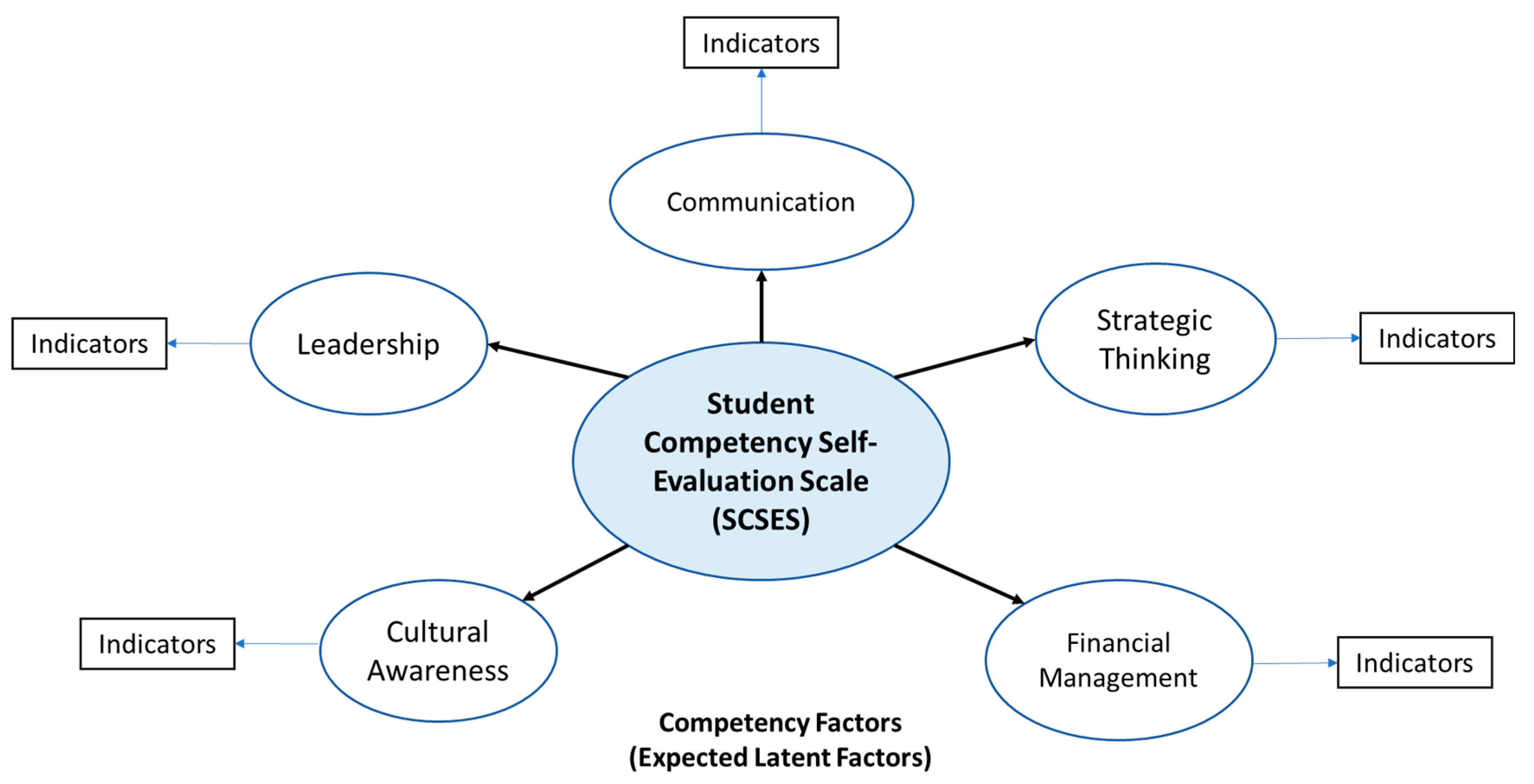
This study seeks to understand how hospitality education in Asia aligns with evolving industry needs by analyzing curriculum structures in relation to students’ competency perceptions. To ensure the robustness of the findings and justify the use of Partial Least Squares Structural Equation Modeling (PLS-SEM), the study proposes a measurement-based hypothesis. Unlike traditional path modeling, PLS-SEM is employed here to validate the multidimensionality of the student competency construct and to assess the internal consistency and validity of the measurement model across different national contexts. The proposed measurement model, illustrating the expected relationships between the latent competency domains, is presented in
Figure 1. Consequently, the following hypothesis and research questions are proposed:
Proposition 1. The Student Competency Self-Evaluation Scale (SCSES) is a multidimensional measurement model comprising five distinct latent domains—leadership, communication, financial management, strategic thinking, and cultural awareness—that demonstrate robust convergent and discriminant validity.
RQ1. What core competency domains emerge from hospitality students’ self-assessment in South Korea, Singapore, and Hong Kong, and how do students in each country evaluate their perceived competence across these domains?
RQ2. How is the curriculum in hospitality education programs structured across the three countries, and to what extent does the distribution of curriculum content reflect emphasis on different competency areas?
RQ3. What are the comparative competency profiles of hospitality education across South Korea, Singapore, and Hong Kong, as reflected by student self-evaluation and curriculum emphasis? What actionable insights can inform curriculum enhancement in South Korea?