
Economic Valuation and Community-Based Management: The Whale Shark Wildlife Tourism in La Paz Bay, Mexico


 , , , , and
Abstract
1. Introduction
1.1. Wildlife Tourism
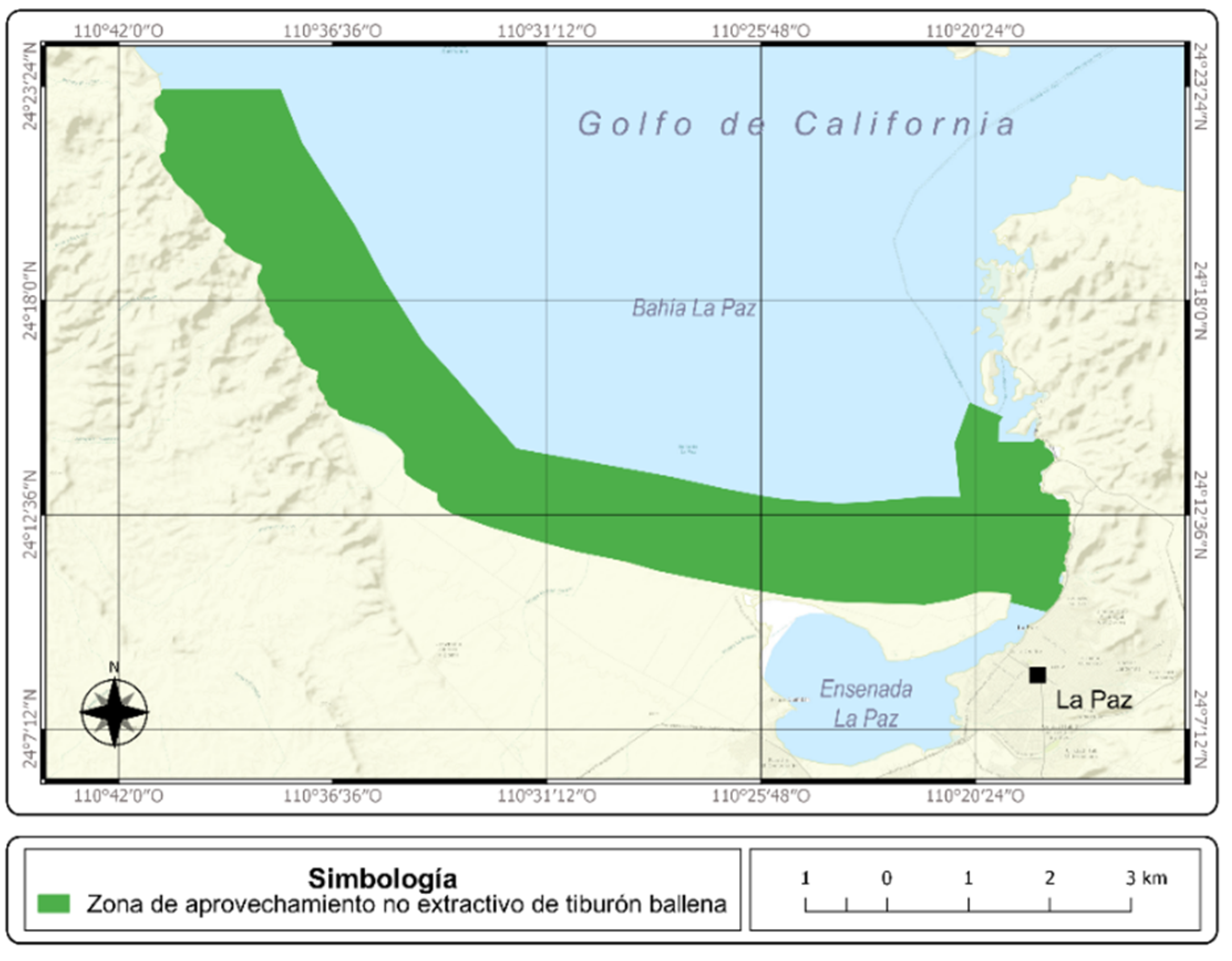
1.2. Whale Shark Wildlife Tourism in La Paz Bay, Mexico
1.3. Community-Based Management
2. Materials and Methods
2.1. Sampling
2.2. Travel Cost Method
T = tw + (t1 + t2)x
d + wT = w(t1 + t2)x + z + (c1 + c2)x
d + wT = z + x[(c1 + wt1) + (c2 + wt2)]
2.3. Recreational Demand Estimation
2.4. Proposed Recreational Demand Models
3. Results
3.1. Data
3.2. Econometrics
3.3. Willingness-to-Pay
4. Discussion
4.1. Environmental Valuation
4.2. Community-Based Management
5. Conclusions
Author Contributions
Funding
Institutional Review Board Statement
Informed Consent Statement
Data Availability Statement
Acknowledgments
Conflicts of Interest
Appendix A
World Economic Valuation Studies for Wildlife Tourism
| Author(s)/Year | Area/Site | Specie | USD * |
| (Wilson & Tisdell, 2002) | South-Eastern Queensland, Australia | W ST | 17,189,043 509,666 |
| (Enríquez-Andrade et al., 2003) | Bahía de los Ángeles, México | WS | 3,554,722 |
| (Topelko & Dearden, 2005) | Belize | WS | 4,204,918 |
| (Rowat & Engelhardt, 2007) | Seychelles | WS | 7,687,869 |
| (Catlin et al., 2010) | Ningaloo, Australia | WS | 5,409,485 |
| (Vianna et al., 2011) | Viti Levu, Fiji Islands | S | 4,626,350 |
| (Du Preez et al., 2012) | Aliwal Shoal Marine Protected Area, South Africa | S | 473,501 |
| (Vianna et al., 2012) | Palau, Island | S | 25,672,131 |
| (Cisneros-Montemayor et al., 2013) | Belize Mexico | S S | 469,054 16,127,156 |
| (Cagua et al., 2014) | South Ari, Maldive Islands | WS | 5,855,738 |
| (Ruiz-Sakamoto, 2015) | Revillagigedo National Park, Mexico | S | 8,377,049 |
| (Schwoerer et al., 2016) | Eastern Pacific Coast Baja California Sur, Mexico | W | 281,185 |
| (Huveneers et al., 2017) | Australia | S | 43,237,704 |
| (Cisneros-Montemayor et al., 2019) | Mexico | S | 12,400,000 |
| (Cisneros-Montemayor et al., 2020) | Baja California Sur, Mexico | SS | 47,000,000 |
| (Oropeza-Cortés et al., 2023) | Laguna San Ignacio, Mexico | GW | 908,502 |
| Source: Author’s elaboration. Note: GW: grey whale, S: sharks, SS: several species, ST: sea turtles, W: whales, WS: whale shark. * Direct expenditure in 2020 updated USD. | |||
References
- Abegão, J. L. R. (2019). Where the wild things were is where humans are now: An overview. Human Ecology, 47, 669–679. [Google Scholar] [CrossRef]
- Armitage, D. (2005). Adaptive capacity and community-based natural resource management. Environmental Management, 35, 703–715. [Google Scholar] [CrossRef] [PubMed]
- Balmford, A., Gravestock, P., Hockley, N., McClean, C. J., & Roberts, C. M. (2004). The worldwide costs of marine protected areas. Proceedings of the National Academy of Sciences, 101(26), 9694–9697. [Google Scholar] [CrossRef] [PubMed]
- Beal, D. J. (1995). Sources of variation in estimates of cost reported by respondents in travel cost surveys. Australasian Parks and Leisure Journal, 5(1), 3–8. [Google Scholar]
- Beckley, L. E., Cliff, G., & Smale, M. J. (1997). Recent strandings and sightings of whale sharks in South Africa. Environmental Biology of Fishes, 50, 343–348. [Google Scholar] [CrossRef]
- Bennett, N. J., Kaplan-Hallam, M., Augustine, G., Ban, N., Belhabib, D., Brueckner-Irwin, I., Charles, A., Couture, J., Eger, S., Fanning, L., Foley, P., Goodfellow, A. M., Greba, L., Gregr, E., Hall, D., Harper, S., Maloney, B., McIsaac, J., Ou, W., … Bailey, M. (2018). Coastal and Indigenous community access to marine resources and the ocean: A policy imperative for Canada. Marine Policy, 87, 186–193. [Google Scholar] [CrossRef]
- Bennett, N. J., Katz, L., Yadao-Evans, W., Ahmadia, G. N., Atkinson, S., Ban, N. C., Dawson, N. M., de Vos, A., Fitzpatrick, J., Gill, D., Imirizaldu, M., Lewis, N., Mangubhai, S., Meth, L., Muhl, E.-K., Obura, D., Spalding, A. K., Villagomez, A., Wagner, D., … Wilhelm, A. (2021). Advancing social equity in and through marine conservation. Frontiers in Marine Science, 8, 711538. [Google Scholar] [CrossRef]
- Berkes, F. (2007). Community-based conservation in a globalized world. Proceedings of the National Academy of Sciences, 104(39), 15188–15193. [Google Scholar] [CrossRef]
- Berkes, F. (2021). Advanced introduction to community-based conservation. Edward Elgar Publishing. [Google Scholar]
- Bethlelem, J. (2008). Applied survey methods a statistical perspective. John Wiley & Sons. [Google Scholar]
- Brooks, J., Waylen, K. A., & Mulder, M. B. (2013). Assessing community-based conservation projects: A systematic review and multilevel analysis of attitudinal, behavioral, ecological, and economic outcomes. Environmental Evidence, 2, 2. [Google Scholar] [CrossRef]
- Brugès, M. L. (2024). Assessing the economic value of tourism with the Munk’s pygmy devil ray (Mobula munkiana) in Baja California Sur, México [Master’s thesis, Marine Resource Management, Instituto Politécnico Nacional, Centro Interdisciplinario de Ciencias Marinas]; p. 70. [Google Scholar]
- Burch, S., Gupta, A., Inoue, C. Y., Kalfagianni, A., Persson, Å., Gerlak, A. K., Ishii, A., Patterson, J., Pickering, J., Scobie, M., Van der Heijden, J., Vervoort, J., Adler, C., Bloomfield, M., Djalante, R., Dryzek, J., Galaz, V., Gordon, C., Harmon, R., … Zondervan, R. (2019). New directions in earth system governance research. Earth System Governance, 1, 100006. [Google Scholar] [CrossRef]
- Cagua, E. F., Collins, N., Hancock, J., & Rees, R. (2014). Whale shark economics: A valuation of wildlife tourism in South Ari Atoll, Maldives. PeerJ, 2, e515. [Google Scholar] [CrossRef]
- Cameron, A. C., & Trivedi, P. K. (2007). Regression analysis of count data (6th ed., p. 411). Econometric Society Monographs, Num. 30. Cambridge University Press. [Google Scholar]
- Cameron, C. A., & Windmeijer, F. A. (1996). R-squared measures for count data regression models with applications to health-care utilization. Journal of Business & Economic Statistics, 14(2), 209–220. Available online: https://www.jstor.org/stable/1392433 (accessed on 3 March 2025).
- Cameron, C. A., & Windmeijer, F. A. (1997). An R-squared measure of goodness of fit for some common nonlinear regression models. Journal of Econometrics, 77(2), 329–342. [Google Scholar] [CrossRef]
- Carrillat, F. A., Mazodier, M., & Eckert, C. (2024). Why advertisers should embrace event typicality and maximize leveraging of major events. Journal of the Academy of Marketing Science, 52, 1585–1607. [Google Scholar] [CrossRef]
- Catlin, J., Jones, R., Jones, T., Norman, B., & Wood, D. (2010). Discovering wildlife tourism: A whale shark tourism case study. Current Issues in Tourism, 13(4), 351–361. [Google Scholar] [CrossRef]
- Cárdenas-Torres, N., Enríquez-Andrade, R., & Rodríguez-Dowdell, N. (2005, May 9–12). Community-based management through ecotourism in Bahia de los Angeles, Mexico (p. 67). The First International Whale Shark Conference: Promoting International Collaboration in Whale Shark Conservation, Science and Management, Perth, Australia. [Google Scholar]
- Cárdenas-Torres, N., Enríquez-Andrade, R., & Rodríguez-Dowdell, N. (2007). Community-based management through ecotourism in Bahia de los Angeles, Mexico. Fisheries Research, 84(1), 114–118. [Google Scholar] [CrossRef]
- Chen, H. L., Lewinson, R. L., An, L., Tsai, Y. H., Stow, D., Shi, L., & Yang, S. (2020). Assessing the effects of payments for ecosystem services programs on forest structure and species biodiversity. Biodiversity and Conservation, 29, 2123–2140. [Google Scholar] [CrossRef]
- Child, B. (1996). The practice and principles of community-based wildlife management in Zimbabwe: The CAMPFIRE programme. Biodiversity and Conservation, 5, 369–398. [Google Scholar] [CrossRef]
- Christiersson, A. (2003). An economic valuation of the coral reefs at Phi Phi island. A travel cost approach (p. 55) [Master’s thesis, Lulea University of Technology]. [Google Scholar]
- Cisneros-Montemayor, A. M., Barnes-Mauthe, M., Al-Abdulrazzak, D., Navarro-Holm, E., & Sumaila, R. (2013). Global economic value of shark ecotourism: Implications for conservation. Fauna & Flora International, Oryx, 47(3), 381–388. [Google Scholar] [CrossRef]
- Cisneros-Montemayor, A. M., Becerril-García, E. E., Berdeja-Zavala, O., & Ayala-Bocos, A. (2019). Shark ecotourism in Mexico: Scientific research, conservation, and contribution to a blue economy. Advances in Marine Biology, 85(1), 71–92. [Google Scholar] [CrossRef]
- Cisneros-Montemayor, A. M., Townsel, A., Gonzales, C. M., Haas, A. R., Navarro-Holm, E. E., Salorio-Zuñiga, T., & Johnson, A. F. (2020). Nature-based marine tourism in the Gulf of California and Baja California Peninsula: Economic benefits and key species. Natural Resources Forum, 44, 111–128. [Google Scholar] [CrossRef]
- Clark, E., & Nelson, D. R. (1997). Young whale sharks, Rhincodon typus, feeding on a copepod bloom near La Paz, Mexico. Environmental Biology of Fishes, 50, 63–73. [Google Scholar] [CrossRef]
- Clark, G. L., Feiner, A., & Viehs, M. (2015). From the stockholder to the stakeholder: How sustainability can drive financial outperformance. SSRN. [Google Scholar] [CrossRef]
- Clawson, M., & Knetsch, L. (1996). Economics of outdoor recreation (328p). Resource for the Future [RFF]. [Google Scholar]
- Cooley, S., Schoeman, D., Bopp, L., Boyd, P., Donner, S., Ghebrehiwet, D. Y., Ito, S.-I., Kiessling, W., Martinetto, P., Ojea, E., Racault, M.-F., Rost, B., & Skern-Mauritzen, M. (2022). Oceans and coastal ecosystems and their services. In H.-O. Pörtner, D. C. Roberts, M. Tignor, E. S. Poloczanska, K. Mintenbeck, A. Alegría, M. Craig, S. Langsdorf, S. Löschke, V. Möller, A. Okem, & B. Rama (Eds.), Climate change 2022: Impacts, adaptation and vulnerability. contribution of working group II to the sixth assessment report of the intergovernmental panel on climate change (pp. 379–550). Cambridge University Press. [Google Scholar] [CrossRef]
- Cox, M., Arnold, G., & Villamayor-Tomás, S. (2010). A review of design principles for community-based natural resource management. Ecology and Society, 15(4), 38. Available online: http://www.ecologyandsociety.org/vol15/iss4/art38/ (accessed on 13 June 2025). [CrossRef]
- Czajkowski, M., Giergiczny, M., Kronenberg, J., & Englin, J. (2019). The individual travel cost method with consumer-specific values of travel time savings. Environmental and Resource Economics, 74, 961–984. [Google Scholar] [CrossRef]
- De Silva-Dávila, R., & Palomares-García, J. R. (1998). Unusual larval growth production of Nyctiphanes simplex in Bahía de la Paz, Baja California Sur, Mexico. Journal of Crustacean Biology, 18, 490–498. [Google Scholar] [CrossRef]
- Djunaidi, A., Jompa, J., Nadiarti, N., Bahar, A., & Tilahunga, S. D. (2021). Benefit sharing from whale shark tourism in Botubarani, Gorontalo and Labuhan Jambu, Teluk Saleh. IOP Conference Series: Earth and Environmental Science, 763, 012063. [Google Scholar] [CrossRef]
- Dressler, W., Büscher, B., Schoon, M., Brockington, D., Hayes, T., Kull, C. A., McCarthy, J., & Shrestha, K. (2010). From hope to crisis and back again? A critical history of the global CBNRM narrative. Environmental Conservation, 37(1), 5–15. [Google Scholar] [CrossRef]
- Du Preez, M., Dicken, M., & Hosking, S. G. (2012). The value of tiger shark diving within the Aliwal Shoal marine protected area: A travel cost analysis. South African Journal of Economics, 80(3), 387–399. [Google Scholar] [CrossRef]
- Eckert, S. A., & Stewart, B. S. (2001). Telemetry and satellite tracking of whale sharks, Rhincodon typus, in the Sea of Cortez, Mexico, and the North Pacific Ocean. Environmental Biology of Fishes, 60, 299–308. [Google Scholar] [CrossRef]
- Emerton, L. (2001). The nature of benefits and the benefits of nature: Why wildlife conservation has not economically benefited communities in Africa. In D. Hulme, & M. Murphee (Eds.), African wildlife and livelihood: The promise and performance of community conservation (pp. 208–226). James Curry. [Google Scholar]
- Enríquez-Andrade, R., Rodríguez-Dowdell, N., Zavala-Gonzáles, A., Cárdenas-Torres, N., Vázquez-Haikin, A., & Godínez-Reyes, C. (2003). Conservación y Aprovechamiento Sustentable del Tiburón Ballena a Través del Ecoturismo en Bahía de los Ángeles, Baja California. (Informe Técnico). Dirección Regional en Baja California del Área de Protección de Flora y Fauna-Islas del Golfo de California. Available online: http://fcm.ens.uabc.mx/~enriquez/complementos/proyectos/Tiburonballenaecoturismo.pdf (accessed on 20 August 2025).
- Esmail, N., McPherson, J. M., Abulu, L., Amend, T., Amit, R., Bhatia, S., Bikaba, D., Brichieri-Colombi, T. A., Brown, J., Buschman, V., Fabinyi, M., Farhadinia, M., Ghayoumi, R., Hay-Edie, T., Horigue, V., Jungblut, V., Jupiter, S., Keane, A., Macdonald, D. W., … Wintle, B. (2023). What’s on the horizon for community-based conservation? Emerging threats and opportunities. Trends in Ecology & Evolution, 38(7), 666–680. [Google Scholar] [CrossRef]
- Forest Trends & The Katoomba Group. (2010). Payments for ecosystem services: Getting started in marine and coastal ecosystems: A primer (p. 80). Forest Trends, The Katoomba Group and UNEP. [Google Scholar]
- García-Baciero, A., Acevedo-Escobedo, K. M., Cruz-Castillo, M., & Ramírez-Macías, D. (2025). Moving towards sustainable whale shark-human interactions: A case study in Bahía de La Paz, Baja California Sur, Mexico. Marine Policy, 174, 106606. [Google Scholar] [CrossRef]
- Gill, D. A., Mascia, M. B., Ahmadia, G. N., Glew, L., Lester, S. E., Barnes, M., Craigie, I., Darling, E. S., Free, C. M., Geldmann, J., Holst, S., Jensen, O. P., White, A. T., Basurto, X., Coad, L., Gates, R. D., Guannel, G., Mumby, P. J., Thomas, H., … Fox, H. E. (2017). Capacity shortfalls hinder the performance of marine protected areas globally. Nature, 543(7647), 665–669. [Google Scholar] [CrossRef] [PubMed]
- Graham, R. T., & Roberts, C. M. (2007). Assessing the size, growth rate, and structure of a seasonal population of whale sharks (Rhincodon typus Smith 1828) using conventional tagging and photo identification. Fisheries Research, 84, 71–80. [Google Scholar] [CrossRef]
- Greiber, T. (2009). Payment for ecosystem services. legal and institutional frameworks (xvi+296p). IUCN. [Google Scholar]
- Grima, N., Singh, S. J., Smetschka, B., & Ringhofer, L. (2016). Payment for Ecosystem Services (PES) in Latin America: Analysing the performance of 40 case studies. Ecosystem Services, 17, 24–32. [Google Scholar] [CrossRef]
- Groves, R. M., & Peytcheva, E. (2008). The impact of nonresponse rates on nonresponse bias: A meta-analysis. Public Opinion Quarterly, 72(2), 167–189. [Google Scholar] [CrossRef]
- Gruber, J. S. (2010). Key principles of community-based natural resource management: A synthesis and interpretation of identified effective approaches for managing the commons. Environmental Management, 45, 52–66. [Google Scholar] [CrossRef]
- Gupta, T., Chen, S., & Mohanty, S. (2025). More the merrier: Effects of plural brand names on perceived entitativity and brand attitude. Journal of Consumer Psychology, 35(1), 150–157. [Google Scholar] [CrossRef]
- Haab, T., & McConnell, K. (2002). Valuing environmental and natural resources: The econometrics of non-market valuation (p. 326). Edward Elgar Publishing. [Google Scholar]
- Hacohen-Domené, A., Galván-Magaña, F., & Ketchum-Mejia, J. (2006). Abundance of whale shark (Rhincodon typus) preferred prey species in the southern Gulf of California, Mexico. Cybium, 30(4), 99–102. [Google Scholar]
- Hanley, N., Shogren, J. F., & White, B. (2001). Introduction to environmental economics (p. 368). Oxford University Press. [Google Scholar]
- Hellerstein, D. (1995). Welfare estimation using aggregate and individual observation models: A comparison using Monte Carlo techniques. American Journal of Agricultural Economics, 77(3), 620–630. [Google Scholar] [CrossRef]
- Hernández-Trejo, V., Urciaga-García, J., Hernández-Vicent, M. A., & Palos-Arocha, L. O. (2009). Valoración económica del Parque Nacional Bahía de Loreto a través de los servicios de recreación de pesca deportiva. Región y Sociedad, 21(44), 195–223. Available online: https://www.scielo.org.mx/scielo.php?pid=S1870-39252009000100008&script=sci_abstract (accessed on 9 January 2026). [CrossRef]
- Heyman, W. D., Graham, R. T., Kjerfve, B., & Johannes, R. E. (2001). Whale sharks, Rhincodon typus, aggregate to feed on fish spawn in Belize. Marine Ecology Progress Series, 215, 275–282. [Google Scholar] [CrossRef]
- Higginbottom, K. (2004). Wildlife tourism: Impacts, management and planning (p. 302). Cooperative Research Centre for Sustainable Tourism Pty Ltd. [Google Scholar]
- Hilbe, J. M. (2011). The negative binomial regression (p. 553). Cambridge University Press. [Google Scholar]
- Hueth, D., & Strong, E. (1984). A critical review of the travel cost, hedonic travel cost and household production models for measurement of quality changes in recreational experiences. Journal of Agricultural and Resource Economics, 13(2), 89–107. [Google Scholar] [CrossRef]
- Huveneers, C., Meekan, M. G., Apps, K., Ferreira, L. C., Pannell, D., & Vianna, G. M. S. (2017). The economic value of shark-diving tourism in Australia. Reviews in Fish Biology and Fisheries, 27, 665–680. [Google Scholar] [CrossRef]
- Jiménez, E. U., & Rosat, I. E. (1997). Econometría aplicada (p. 355). Alfa Centauro. [Google Scholar]
- Johnson, A. F., Gonzales, C., Townsel, A., & Cisneros-Montemayor, A. M. (2019). Marine ecotourism in the Gulf of California and the Baja California Peninsula: Research trends and information gaps. Scientia Marina, 83(2), 177–185. [Google Scholar] [CrossRef]
- Ketchum, J. T. (2003). Distribución espacio-temporal y ecología alimentaria del tiburón ballena (Rhincodon typus) en la Bahía de La Paz y zonas adyacentes en el suroeste del Golfo de California (p. 91) [Master’s thesis, CICIMAR-IPN]. [Google Scholar]
- Ketchum, J. T., Galván-Magaña, F., & Klimley, P. (2013). Segregation and foraging ecology of whale sharks, Rhincodon typus, in the southwestern Gulf of California. Environmental Fish Biology, 96, 779–795. [Google Scholar] [CrossRef]
- Khan, M. (2019). Corporate governance, ESG, and stock returns around the world. Financial Analysts Journal, 75(4), 103–123. [Google Scholar] [CrossRef]
- Koch, D.-J., & Verholt, M. (2020). Limits to learning: The struggle to adapt to unintended effects of international payment for environmental services programmes. International Environmental Agreement, 20, 507–539. [Google Scholar] [CrossRef]
- Larson, D. M., & Lew, D. K. (2014). The opportunity cost of travel time as a noisy wage fraction. American Journal of Agricultural Economics, 96(2), 420–437. [Google Scholar] [CrossRef]
- Leh, F. C., Mokhtar, F. Z., Rameli, N., & Ismail, K. (2018). Measuring recreational value using Travel Cost Method (TCM): A number of issues and limitations. International Journal of Academic Research in Business and Social Sciences, 8(10), 1381–1396. [Google Scholar] [CrossRef]
- Lohr, S. L. (2022). Sampling: Design and analysis (3rd ed.). Chapman and Hall/CRC. [Google Scholar] [CrossRef]
- Manning, R. E. (2011). Studies in outdoor recreation: Search and research for satisfaction (p. 684). Oregon State University Press. [Google Scholar]
- Mau, R. (2008). Managing for conservation and recreation: The Ningaloo whale shark experience. Journal of Ecotourism, 7(2–3), 213–225. [Google Scholar] [CrossRef]
- Maxwell, S. M., Hazen, E. L., Lewison, R. L., Dunn, D. C., Bailey, H., Bograd, S. J., Briscoe, D. K., Fossette, S., Hobday, A. J., Bennett, M., Benson, S., Caldwell, M. R., Costa, D. P., Dewar, H., Eguchi, T., Hazen, L., Kohin, S., Sippel, T., & Crowder, L. B. (2015). Dynamic ocean management: Defining and conceptualizing real-time management of the ocean. Marine Policy, 58, 42–50. [Google Scholar] [CrossRef]
- Mayer, M., Brenner, L., Schauss, B., Stadler, C., Arnegger, J., & Job, H. (2018). The nexus between governance and the economic impact of whale-watching. The case of the coastal lagoons in the El Vizcaíno Biosphere Reserve, Baja California, Mexico. Ocean & Coastal Management, 162, 46–59. [Google Scholar] [CrossRef]
- Milder, J. C., Scherr, S. J., & Bracer, C. (2010). Trends and future potential of payment for ecosystem services to alleviate rural poverty in developing countries. Ecology and Society, 15(2), 4. Available online: http://www.ecologyandsociety.org/vol15/iss2/art4/ (accessed on 27 April 2025). [CrossRef]
- Moriel-Robles, L. (2009). Socio-economic drivers influencing sustainability in asocial-ecological system: Insights from whale shark tourismin northern Quintana Roo, Mexico [Master’s thesis, Stockholm University]. Available online: https://urn.kb.se/resolve?urn=urn:nbn:se:su:diva-50958 (accessed on 5 October 2025).
- Mulder, E. M. (2016). Finding the balance between tourism and conservation: The pathway to safe and sustainable whale shark tourism in South-Ari Atoll [Master’s thesis, Marine Systems and Policy, University of Edinburgh School of Geosciences]. [Google Scholar]
- Nelson, J. D. (2004). Distribution and foraging ecology by whale sharks (Rhincodon typus) within Bahia de Los Angeles, Baja California Norte, Mexico (p. 118) [Master’s thesis, University of San Diego]. [Google Scholar]
- Norman, B. M., & Stevens, J. D. (2007). Size and maturity status of the whale shark (Rhincodon typus) at Ningaloo Reef in Western Australia. Fisheries Research, 84, 81–86. [Google Scholar] [CrossRef]
- Oropeza-Cortés, M. G., Hernández-Trejo, V., & Romero-Vadillo, E. (2023). Economic valuation of recreational gray whale watching at San Ignacio Lagoon, Mexico. El Periplo Sustentable, 45, 183–200. [Google Scholar] [CrossRef]
- Pearce, D. W., & Turner, R. K. (1990). Economics of natural resources and the environment. JHU Press. [Google Scholar]
- Pearce, S. J., Grace, M. K., & Araujo, G. (2021). Conservation of whale sharks. In D. M. D. Alistair, & J. P. Simon (Eds.), Whale sharks: Biology, ecology, & conservation (2nd ed.). Chapter 12. Taylor & Francis. [Google Scholar] [CrossRef]
- Pendleton, L. H., & Rooke, J. (2007). Using the literature to value coastal uses—recreational saltwater angling in California. COVC (Coastal Ocean Values Center) Working Paper, 1, 36. [Google Scholar]
- Petatán-Ramírez, D., Whitehead, D. A., Guerrero-Izquierdo, T., Ojeda-Ruiz, M. A., & Becerril-García, E. E. (2020). Habitat suitability of Rhincodon typus in three localities of the Gulf of California: Environmental drivers of seasonal aggregations. Journal of Fish Biology, 97(4), 1177–1186. [Google Scholar] [CrossRef]
- Pham-Do, K. H., & Pham, T. T. T. (2020). Tourism in marine protected areas: A view from Nha Trang Bay, Vietnam. Tourism Management Perspectives, 33, 100623. [Google Scholar] [CrossRef]
- Ramírez-Macías, D. (2005, May 9–12). Characterization of molecular markers for populational studies of the whale shark (Rhincodon typus, smith 1828) of the gulf of California (p. 86). The First International Whale Shark Conference: Promoting International Collaboration in Whale Shark Conservation, Science and Management, Pert, Australia. [Google Scholar]
- Ramírez-Macías, D., Cáceres-Puig, J. I., Acevedo-Escobedo, K. M., & García-Baciero, A. (2026). Key elements for developing sustainable whale shark-human interactions in coastal aggregation areas. Marine Policy, 183, 106926. [Google Scholar] [CrossRef]
- Ramírez-Macías, D., & Saad, G. (2016, May 16–18). Key elements for managing whale shark tourism in the Gulf of California. The 4th International Whale Shark Conference (p. 2), Doha, Qatar. [Google Scholar]
- Randall, A. (1994). A diffilculty with the travel cost method. Land Economics, 70(1), 88–96. [Google Scholar] [CrossRef]
- Reyes-Salinas, A., Cervantes-Durante, R., Morales-Pérez, A., & Valdez-Holguín, J. E. (2003). Seasonal variability of primary productivity and its relation to the vertical stratification in La Paz bay, B. C. S. Hidrobiológica, 13, 103–110. [Google Scholar]
- Rodger, K., Smith, A., Davis, C., Newsome, D., & Patterson, P. (2010). A framework to guide the sustainability of wildlife tourism operations: Examples of marine wildlife tourism in Western Australia (p. 69). Sustainable Tourism Pty Ltd. [Google Scholar]
- Rodríguez-Dowdell, N., Enríquez-Andrade, R., & Cárdenas-Torres, N. (2007). Property rights-based management: Whale shark ecotourism in Bahia de los Angeles, Mexico. Fisheries Research, 84, 119–127. [Google Scholar] [CrossRef]
- Rolfe, J., & Prayaga, P. (2007). Estimating values for recreational fishing at freshwater dams in Queensland. Australian Journal of Agricultural and Resource Economics, 51(2), 157–174. Available online: https://onlinelibrary.wiley.com/doi/10.1111/j.1467-8489.2007.00369.x. [CrossRef]
- Rowat, D., & Engelhardt, U. (2007). Seychelles: A case study of community involvement in the development of whale shark ecotourism and its socio-economic impact. Fisheries Research, 84(1), 109–113. [Google Scholar] [CrossRef]
- Rowat, D., & Gore, M. (2007). Regional-scale horizontal and local-scale vertical movements of whale sharks in the Indian Ocean off Seychelles. Fisheries Research, 84, 32–40. [Google Scholar] [CrossRef]
- Ruiz-Sakamoto, A. T. (2015). Estimación del valor económico total y catálogo de foto identificación de la manta gigante (Manta birostris Walbaum, 1792) en el Archipiélago de Revillagigedo (p. 46) [Bachelor’s thesis, UABCS.]. [Google Scholar]
- Scheaffer, R. L., Mendenhall, W., III, Ott, R. L., & Gerow, K. (2012). Elementary survey sampling (7th ed., p. 452). Cengage Learning. [Google Scholar]
- Schleimer, A., Araujo, G., Penketh, L., Heath, A., McCoy, E., Labaja, J., Lucey, A., & Ponzo, A. (2015). Learning from a provisioning site: Code of conduct compliance and behaviour of whale sharks in Oslob, Cebu, Philippines. PeerJ, 3, e1452. [Google Scholar] [CrossRef]
- Schwoerer, T., Knowler, D., & Garcia-Martinez, S. (2016). The value of whale watching to local communities in Baja, Mexico: A case study using applied economic rent theory. Ecological Economics, 127, 90–101. [Google Scholar] [CrossRef]
- Secretaria de Medio Ambiente y Recursos Naturales (SEMARNAT). (2021). Plan de Manejo de Rhincodon typus (tiburón ballena) para realizar la actividad de aprovechamiento no extractivo a través de la observación y nado en la Bahía de La Paz, B. C. S. Temporada 2021. México, p. 41. Available online: https://biblioteca.semarnat.gob.mx/janium/Documentos/Ciga/libros2023/CD009111.pdf (accessed on 8 February 2025).
- Shaw, D. (1998). On-site samples: Regression problems of non-negative integers, truncation and endogenous stratification. Journal of Econometrics, 37(2), 211–223. [Google Scholar] [CrossRef]
- Smith, K., & Kaoru, Y. (1990). Signals or noise? explaining the variation in recreation benefit estimates. American Journal of Agricultural Economics, 72(2), 419–433. [Google Scholar] [CrossRef]
- Stankey, G. H., & McCool, S. F. (1984). Limits of acceptable change: A new framework for managing the bob Marshall wilderness (General Technical Report INT-176). USDA Forest Service.
- Stevens, J. D. (2007). Whale shark (Rhincodon typus) biology and ecology: A review of the primary literature. Fisheries Research, 84, 4–9. [Google Scholar] [CrossRef]
- Sustainable Travel Tech. (2024). Sustainable travel tech: Innovations in eco-friendly tourism. Available online: https://visitworld.live/sustainable-travel-tech-innovations-in-eco-friendly-tourism/ (accessed on 11 November 2024).
- Taylor, J. G. (1996). Seasonal occurrence, distribution and movements of the whale shark, Rhincodon typus, at Ningaloo Reef, Western Australia. Marine & Freshwater Research, 47, 637–642. [Google Scholar]
- Taylor, J. G. (2007). Ram filter-feeding and nocturnal feeding of whale sharks (Rhincodon typus) at Ningaloo Reef, Western Australia. Fisheries Research, 84, 65–70. [Google Scholar] [CrossRef]
- The Economics of Ecosystem Services and Biodiversity (TEEB). (2012). Why value the oceans? A discussion paper. The Economics of Ecosystems & Biodiversity. [Google Scholar]
- Thomson, J. A., Araujo, G., Labaja, J., McCoy, E., Murray, R., & Ponzo, A. (2017). Feeding the world’s largest fish: Highly variable whale shark residency patterns at a provisioning site in the Philippines. Royal Society Open Science, 4(9), 170394. [Google Scholar] [CrossRef] [PubMed]
- Tisdell, C. A. (2002). The economics of conserving wildlife and natural areas. Edward Elgar. [Google Scholar]
- Topelko, K. N., & Dearden, P. (2005). The shark watching industry and its potential contribution to shark conservation. Journal of Ecotourism, 4(2), 108–128. [Google Scholar] [CrossRef]
- Turner, R. K., Pearce, D. W., & Bateman, I. (1993). Environmental economics: An elementary introduction (p. 328). JHU Press. [Google Scholar]
- Valentine, A. V. P., & Curnock, M. (2001). Wildlife tourism research report no. 11, status assessment of wildlife tourism in Australia series, tourism based on free-ranging marine wildlife: Opportunities and responsibilities. CRC for Sustainable Tourism. [Google Scholar]
- Vásquez-Lavín, F., Cerda-Urrutia, A., & Orrego-Suaza, S. (2007). Valoración económica del ambiente (p. 368). Thomson Learning. [Google Scholar]
- Vianna, G. M. S., Meekan, M. G., Pannell, D. J., Marsh, S. P., & Meeuwig, J. J. (2012). Socio-economic value and community benefits from shark-diving tourism in Palau: A sustainable use of reef shark populations. Biological Conservation, 145, 267–277. [Google Scholar] [CrossRef]
- Vianna, G. M. S., Meeuwig, J. J., Pannell, D., Sykes, H., & Meekan, M. G. (2011). The socio-economic value of the shark-diving industry in Fiji (p. 26). Australian Institute of Marine Science, University of Western Australia. [Google Scholar]
- Visseren-Hamakers, I. J., Razzaque, J., McElwee, P., Turnhout, E., Kelemen, E., Rusch, G. M., Fernández-Llamazares, Á., Chan, I., Lim, M., Islar, M., Gautam, A. P., Williams, M., Mungatana, E., Karim, M. S., Muradian, R., Gerber, L. R., Lui, G., Liu, J., Spangenberg, J. H., … Zaleski, D. (2021). Transformative governance of biodiversity: Insights for sustainable development. Current Opinion in Environmental Sustainability, 53, 20–28. [Google Scholar] [CrossRef]
- Vivekanandan, E., & Zala, M. S. (1994). Whale shark fishery off Veraval. Indian Journal of Fisheries, 41, 37–40. [Google Scholar]
- Wells, M. P. (1998). Socio-economic and political aspects of biodiversity conservation in Nepal. International Journal of Social Economics, 25(2/3/4), 226–243. [Google Scholar] [CrossRef]
- Whitehead, D. A., Jakes-Cota, U., Pancaldi, F., Galván-Magaña, F., & González-Armas, R. (2020). The influence of zooplankton communities on the feeding behavior of whale sharks, Gulf of California. Revista Mexicana de Biodiversidad, 91, E913054. [Google Scholar] [CrossRef]
- Whitehead, D. A., Petatán-Ramírez, D., Olivier, D., González-Armas, R., Pancaldi, F., & Galvan-Magaña, F. (2019). Seasonal trends in whale shark Rhincodon typus sightings in an established tourism site in the Gulf of California, Mexico. Journal of Fish Biology, 95, 982–984. [Google Scholar] [CrossRef]
- Wilson, C., & Tisdell, C. (2002). Conservation and economic benefits of wildlife-based marine tourism: Sea turtles and whales as case studies (Working Paper #64, p. 19). Economics, Ecology and The Environment, School of Economics, The University of Queensland. [Google Scholar]
- Wolfson, F. H. (1987). The whale shark Rhincodon typus, Smith 1828, off Baja California, México (Chondrichthyes: Rhincodontidae). Memoirs of the Fifth Symposium on Marine Biology, UABCS, 5, 103–108. [Google Scholar]
- Womersley, F. C., Humphries, N. E., Queiroz, N., Vedor, M., da Costa, I., Furtado, M., Tyminski, J. P., Abrantes, K., Araujo, G., Bach, S. S., Barnett, A., Berumen, M. L., Lion, S. B., Braun, C. D., Clingham, E., Cochran, J. E. M., de la Parra, R., Diamant, S., Dove, A. D. M., … Sims, D. W. (2022). Global collision-risk hotspots of marine traffic and the world’s largest fish, the whale shark. Proceedings of the National Academy of Sciences of the United States of America, 119(20), e2117440119. [Google Scholar] [CrossRef]
- Wooldrige, J. M. (2002). Econometric analysis cross section and panel data (777p). Massachusetts Institute of Technology. [Google Scholar]
- Wunder, S. (2005). Payment for environmental services: Some nuts and volts. (CIFOR Ocassional Paper No. 42). Center for International Forestry Research. [Google Scholar]
- Zhang, F., Wang, X., Nunes, P. A. L. D., & Ma, C. (2015). The recreational value of gold coast beaches, Australia: An application of the travel cost method. Ecosystem Services, 11, 106–114. [Google Scholar] [CrossRef]
- Ziegler, A., Dearden, P., & Collins, R. (2015). Participant crowding and physical contact rates of whale shark tours on Isla Holbox, Mexico. Journal of Sustainable Tourism, 24, 616–636. [Google Scholar] [CrossRef]
- Ziegler, J., & Dearden, P. (2021). Whale shark tourism as an incentive-based conservation approach. In D. M. D. Alistair, & J. P. Simon (Eds.), Whale sharks: Biology, ecology, & conservation; Chapter 10 (2nd ed.). Taylor & Francis. [Google Scholar] [CrossRef]
- Ziegler, J. A., Diamant, S., Pierce, S. J., Bennett, R., & Kiszka, J. J. (2021). Economic value and public perceptions of whale shark tourism in Nosy Be, Madagascar. Tourism in Marine Environments, 16(3), 167–182. [Google Scholar] [CrossRef]


| Variable | Description |
|---|---|
| V | Dependent, number of trips in the last 5 years, (V ≥ 0) |
| dom | 1: If the visitor is domestic or local, 0: Other |
| alone | 1: If the visitor travels alone, 0: Other |
| lgroup | Natural logarithm for the number of tourists on board the boat, including the interviewee |
| sanct | 1: If the visitor agrees to inform citizens and visitors that the WS area is a natural sanctuary; 0: Other |
| gguide | 1: If the visitor considers that the guide had a good performance during the tour, 0: Other |
| rules | 1: If the visitor was informed about the rules to carry out the WS wildlife tourism activity; 0: Other |
| first | 1: If the visitor is visiting the WS area for the first time |
| consd | 1: If the visitor considers that the conservation status of the WS area is deficient, 0: Other |
| couple | 1: If the visitor visits the WS area with his couple/wife, 0: Other |
| Dependent: V | Poisson Model | |||
|---|---|---|---|---|
| TP | TPOME | TPTTC | TPTTCOME | |
| n = 334 | n = 334 | n = 334 | n = 334 | |
| ltp | −0.7198 | |||
| [0.1229] ** | ||||
| ltpome | −0.2087 | |||
| [0.0391] ** | ||||
| ltpttc | −0.6449 | |||
| [0.1230] ** | ||||
| ltpttcome | −0.5804 | |||
| [0.1063] ** | ||||
| dom | 0.3809 | 0.2588 | 0.3384 | 0.2296 |
| [0.0819] ** | [0.0822] ** | [0.0791] ** | [0.0739] ** | |
| alone | −0.7283 | −0.5016 | −0.7323 | −0.5566 |
| [0.1970] ** | [0.1435] ** | [0.1945] ** | [0.1500] ** | |
| group | −0.8575 | −0.7316 | −0.8428 | −0.7865 |
| [0.3175] ** | [0.3165] * | [0.3201] ** | [0.3163] * | |
| sanct | −0.6054 | −0.4869 | −0.5753 | −0.5268 |
| [0.0894] ** | [0.0858] ** | [0.0890] ** | [0.0860] ** | |
| gguide | 2.0483 | 2.3514 | 2.1046 | 2.2958 |
| [0.2075] ** | [0.2002] ** | [0.2041] ** | [0.1929] ** | |
| rules | 0.1672 | 0.1492 | 0.1632 | 0.1547 |
| [0.0524] ** | [0.0696] * | [0.0570] ** | [0.0624] * | |
| first | −1.0402 | −1.0732 | −1.0251 | −1.046 |
| [0.0631] ** | [0.0637] ** | [0.0640] ** | [0.0637] ** | |
| consd | 0.3212 | 0.3394 | 0.3243 | 0.3299 |
| [0.0841] ** | [0.0849] ** | [0.0848] ** | [0.0842] ** | |
| couple | −0.6101 | −0.5983 | −0.6131 | −0.6057 |
| [0.0903] ** | [0.0824] ** | [0.0867] ** | [0.0842] ** | |
| _cons | 3.0114 | 2.5788 | 3.0912 | 3.0205 |
| [0.4343] ** | [0.3751] ** | [0.4792] ** | [0.4467] ** | |
| Chi2 Wald (10) | 716.47 | 712.41 | 712.64 | 715.54 |
| Pr > Chi2 Wald (10) | 0.0000 | 0.0000 | 0.0000 | 0.0000 |
| Pearson R2 | 0.8422 | 0.8329 | 0.8390 | 0.8374 |
| Pseudo LL | −535.09301 | −543.5885 | −537.0061 | −542.02082 |
| Concept | Poisson Model | Average | |||
|---|---|---|---|---|---|
| TP | TPOME | TPTTC | TPTTCOME | ||
| WTP | 8.00 | 27.00 | 9.00 | 10.00 | 13.50 |
| WS-REV | 304,600 | 1,028,025 | 342,675 | 380,750 | 514,013 |
| Upper value per WS | 4173 | 14,083 | 4694 | 5216 | 7041 |
| Average value per WS | 3016 | 10,178 | 3393 | 3770 | 5089 |
| Lower value per WS | 2361 | 7969 | 2656 | 2952 | 3985 |
Disclaimer/Publisher’s Note: The statements, opinions and data contained in all publications are solely those of the individual author(s) and contributor(s) and not of MDPI and/or the editor(s). MDPI and/or the editor(s) disclaim responsibility for any injury to people or property resulting from any ideas, methods, instructions or products referred to in the content. |
© 2026 by the authors. Licensee MDPI, Basel, Switzerland. This article is an open access article distributed under the terms and conditions of the Creative Commons Attribution (CC BY) license.
Share and Cite
Moreno-Gutiérrez, M.; Hernández-Trejo, V.; Avilés-Polanco, G.; Jakes-Cota, U.; Ojeda-Ruiz de la Peña, M.Á.; Marín-Monroy, E.A.; Almendarez-Hernández, L.C. Economic Valuation and Community-Based Management: The Whale Shark Wildlife Tourism in La Paz Bay, Mexico. Tour. Hosp. 2026, 7, 53. https://doi.org/10.3390/tourhosp7020053
Moreno-Gutiérrez M, Hernández-Trejo V, Avilés-Polanco G, Jakes-Cota U, Ojeda-Ruiz de la Peña MÁ, Marín-Monroy EA, Almendarez-Hernández LC. Economic Valuation and Community-Based Management: The Whale Shark Wildlife Tourism in La Paz Bay, Mexico. Tourism and Hospitality. 2026; 7(2):53. https://doi.org/10.3390/tourhosp7020053
Chicago/Turabian StyleMoreno-Gutiérrez, Mónica, Víctor Hernández-Trejo, Gerzaín Avilés-Polanco, Ulianov Jakes-Cota, Miguel Ángel Ojeda-Ruiz de la Peña, Elvia Aida Marín-Monroy, and Luís César Almendarez-Hernández. 2026. "Economic Valuation and Community-Based Management: The Whale Shark Wildlife Tourism in La Paz Bay, Mexico" Tourism and Hospitality 7, no. 2: 53. https://doi.org/10.3390/tourhosp7020053
APA StyleMoreno-Gutiérrez, M., Hernández-Trejo, V., Avilés-Polanco, G., Jakes-Cota, U., Ojeda-Ruiz de la Peña, M. Á., Marín-Monroy, E. A., & Almendarez-Hernández, L. C. (2026). Economic Valuation and Community-Based Management: The Whale Shark Wildlife Tourism in La Paz Bay, Mexico. Tourism and Hospitality, 7(2), 53. https://doi.org/10.3390/tourhosp7020053