

Connectivity and Safety: Key Drivers for Tourism Experiences in Remote Regions in the Post-Pandemic Era

 ,
,  ,
,  ,
, 
Abstract
1. Introduction
2. Literature Review
3. Materials and Methods
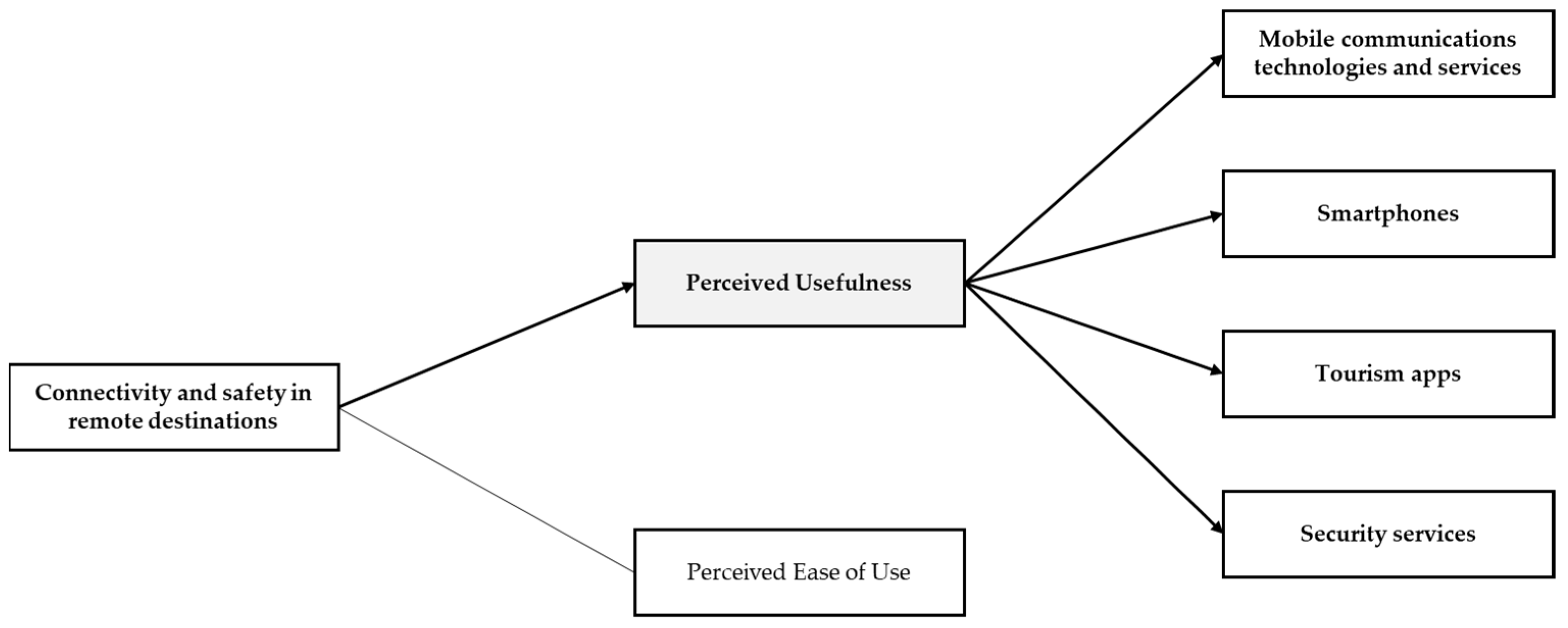
- Which mobile communications technologies and services are most used and are most important for tourists?
- Intensity of usage of smartphones in different places within remote destinations.
- Which tourism app features are more relevant?
- What is the importance and relevance of security services for tourists?
4. Results
4.1. Usage of Mobile Communication Services and Technologies
4.2. Intensity of Smartphone Use
4.3. Tourism App Features
4.4. Importance and Relevance of Security Services
5. Discussion
6. Conclusions and Suggestions
Author Contributions
Funding
Institutional Review Board Statement
Informed Consent Statement
Data Availability Statement
Conflicts of Interest
References
- Aguirre, A., Zayas, A., Gómez-Carmona, D., & López Sánchez, J. A. (2022). Smart tourism destinations really make sustainable cities: Benidorm as a case study. International Journal of Tourism Cities, 9(1), 51–69. [Google Scholar] [CrossRef] [Scilit]
- Alipour, H., Olya, H. G. T., Maleki, P., & Dalir, S. (2020). Behavioral responses of 3S tourism visitors: Evidence from a Mediterranean Island destination. Tourism Management Perspectives, 33, 100624. [Google Scholar] [CrossRef] [Scilit]
- Anand, K., Arya, V., Suresh, S., & Sharma, A. (2023). Quality dimensions of augmented reality-based mobile apps for smart-tourism and its impact on customer satisfaction & reuse intention. Tourism Planning & Development, 20(2), 236–259. [Google Scholar] [CrossRef] [Scilit]
- Baker, D. M. A., & Fulford, M. (2016). Cruise Passengers’ perceived value and willingness to recommend. Tourism & Management Studies, 12(1), 74–85. [Google Scholar] [CrossRef] [Scilit]
- Bardolet, E., & Sheldon, P. J. (2008). Tourism in archipelagos: Hawai’i and the Balearics. Annals of Tourism Research, 35(4), 900–923. [Google Scholar] [CrossRef] [Scilit]
- Beltrán López, G. (2017). Los municipios turísticos del interior de la Comunitat Valenciana en internet. Universitat de València. Available online: https://dialnet.unirioja.es/servlet/tesis?codigo=171159 (accessed on 10 July 2024).
- Boes, K., Buhalis, D., & Inversini, A. (2015). Conceptualising smart tourism destination dimensions. In I. Tussyadiah, & A. Inversini (Eds.), Information and communication technologies in tourism 2015 (pp. 391–403). Springer International Publishing. [Google Scholar] [CrossRef] [Scilit]
- Bulchand-Gidumal, J. (2022). Post-COVID-19 recovery of island tourism using a smart tourism destination framework. Journal of Destination Marketing & Management, 23, 100689. [Google Scholar] [CrossRef] [Scilit]
- Carvalho, S., & Carvalho, J. V. (2020). The Implications of digital marketing and e-commerce in the tourism sector growth. In Á. Rocha, A. Abreu, J. V. de Carvalho, D. Liberato, E. A. González, & P. Liberato (Eds.), Advances in tourism, technology and smart systems (pp. 161–170). Springer. [Google Scholar] [CrossRef] [Scilit]
- Chen, C.-F., & Chen, F.-S. (2010). Experience quality, perceived value, satisfaction and behavioral intentions for heritage tourists. Tourism Management, 31(1), 29–35. [Google Scholar] [CrossRef] [Scilit]
- Chen, C.-F., & Tsai, D. (2007). How destination image and evaluative factors affect behavioral intentions? Tourism Management, 28(4), 1115–1122. [Google Scholar] [CrossRef] [Scilit]
- Chen, S., Law, R., Zhang, M., & Si, Y. (2021). Mobile communications for tourism and hospitality: A review of historical evolution, present status, and future trends. Electronics, 10(15), 1804. [Google Scholar] [CrossRef] [Scilit]
- Chung, C., Li, J., Chung, N., & Shin, S. (2024). The impact of smartphone usage on domestic travelers’ existential authenticity and behavioral perception toward island destinations: A cross-country comparison of Hainan Island and Jeju Island. Journal of Destination Marketing & Management, 31, 100846. [Google Scholar] [CrossRef] [Scilit]
- Corte, V., D’Andrea, C., Savastano, I., & Zamparelli, P. (2017). Smart cities and destination management: Impacts and opportunities for tourism competitiveness. European Journal of Tourism Research, 17, 7–27. [Google Scholar] [CrossRef] [Scilit]
- Couto, G., Pimentel, P., Oliveira, A., Ponte, J. C., Santos, C., Estima, D., & Castanho, R. (2022). SmartDest: Converting the Azores into a smart tourist destination. In Handbook of research on sustainable development goals, climate change, and digitalization (pp. 409–432). IGI Global Scientific Publishing. [Google Scholar] [CrossRef] [Scilit]
- Dias, S., & Afonso, V. A. (2021). Impact of mobile applications in changing the tourist experience. European Journal of Tourism, Hospitality and Recreation, 11(1), 113–120. [Google Scholar] [CrossRef] [Scilit]
- Dorcic, J., Komsic, J., & Markovic, S. (2019). Mobile technologies and applications towards smart tourism—State of the art. Tourism Review, 74(1), 82–103. [Google Scholar] [CrossRef] [Scilit]
- Elkhwesky, Z., El Manzani, Y., & Elbayoumi Salem, I. (2024). Driving hospitality and tourism to foster sustainable innovation: A systematic review of COVID-19-related studies and practical implications in the digital era. Tourism and Hospitality Research, 24(1), 115–133. [Google Scholar] [CrossRef] [Scilit] [PubMed]
- Farías, A., & Cancino, C. A. (2021). Digital transformation in the Chilean lodging sector: Opportunities for sustainable businesses. Sustainability, 13(14), 8097. [Google Scholar] [CrossRef] [Scilit]
- Fontanari, M., & Traskevich, A. (2023). Smart-solutions for handling overtourism and developing destination resilience for the post-COVID-19 era. Tourism Planning & Development, 20(1), 86–107. [Google Scholar] [CrossRef] [Scilit]
- Gretzel, U. (2010). Travel in the network: Redirected gazes, ubiquitous connections and new frontiers. In Post-global network and everyday life. Peter Lang. [Google Scholar]
- Gretzel, U., Fuchs, M., Baggio, R., Hoepken, W., Law, R., Neidhardt, J., Pesonen, J., Zanker, M., & Xiang, Z. (2020). e-Tourism beyond COVID-19: A call for transformative research. Information Technology & Tourism, 22(2), 187–203. [Google Scholar] [CrossRef] [Scilit]
- Huang, C. D., Goo, J., Nam, K., & Yoo, C. W. (2017). Smart tourism technologies in travel planning: The role of exploration and exploitation. Information & Management, 54(6), 757–770. [Google Scholar] [CrossRef] [Scilit]
- Iskender, A., Sirakaya-Turk, E., Cardenas, D., & Harrill, R. (2024). COVID or VOID: A systematic literature review of technology adoption and acceptance in hospitality and tourism since the breakout of COVID-19. Tourism and Hospitality Research, 24(1), 95–114. [Google Scholar] [CrossRef] [Scilit]
- Jeong, M., & Shin, H. H. (2020). Tourists’ experiences with smart tourism technology at smart destinations and their behavior intentions. Journal of Travel Research, 59(8), 1464–1477. [Google Scholar] [CrossRef] [Scilit]
- Jorge, F., Sousa, N., Losada, N., Teixeira, M. S., Alén, E., Melo, M., & Bessa, M. (2023). Can virtual reality be used to create memorable tourist experiences to influence the future intentions of wine tourists? Revista Turismo & Desenvolvimento, 43, 67–76. [Google Scholar] [CrossRef]
- Jovicic, D. Z. (2019). From the traditional understanding of tourism destination to the smart tourism destination. Current Issues in Tourism, 22(3), 276–282. [Google Scholar] [CrossRef] [Scilit]
- Kuo, T.-S., Huang, K.-C., Nguyen, T. Q., & Nguyen, P. H. (2019). Adoption of mobile applications for identifying tourism destinations by travellers: An integrative approach. Journal of Business Economics and Management, 20(5), 860–877. [Google Scholar] [CrossRef] [Scilit]
- Liang, S., Schuckert, M., Law, R., & Masiero, L. (2017). The relevance of mobile tourism and information technology: An analysis of recent trends and future research directions. Journal of Travel & Tourism Marketing, 34(6), 732–748. [Google Scholar] [CrossRef] [Scilit]
- Mang, C. F., Piper, L. A., & Brown, N. R. (2016). The incidence of smartphone usage among tourists. International Journal of Tourism Research, 18(6), 591–601. [Google Scholar] [CrossRef] [Scilit]
- McCabe, S., Sharples, M., & Foster, C. (2012). Stakeholder engagement in the design of scenarios of technology-enhanced tourism services. Tourism Management Perspectives, 4, 36–44. [Google Scholar] [CrossRef] [Scilit]
- Moon, H., & Han, H. (2019). Tourist experience quality and loyalty to an island destination: The moderating impact of destination image. Journal of Travel & Tourism Marketing, 36(1), 43–59. [Google Scholar] [CrossRef] [Scilit]
- Myers, G., & Scarinci, J. (2022). Consumers’ use of smartphone technology for travel and tourism in a COVID era: A scoping review. Journal of Resilient Economies, 2, 169–180. [Google Scholar] [CrossRef] [Scilit]
- Pencarelli, T. (2020). The digital revolution in the travel and tourism industry. Information Technology & Tourism, 22(3), 455–476. [Google Scholar] [CrossRef] [Scilit]
- Ponte, J., Couto, G., Pimentel, P., & Oliveira, A. (2018). Tourism activities and companies in a sustainable adventure tourism destination: The Azores. Tourism & Management Studies, 14(4), 25–38. [Google Scholar] [CrossRef] [Scilit]
- Ponte, J., Couto, G., Pimentel, P., Sousa, Á., & Oliveira, A. (2019). Tourist satisfaction with the municipality of Ponta Delgada (Azores). Revista de Gestão e Secretariado, 10(3), 192–217. [Google Scholar] [CrossRef] [Scilit]
- Sanfiel-Fumero, M. Á., Armas-Cruz, Y., & González-Morales, O. (2017). Sustainability of the tourist supply chain and governance in an insular biosphere reserve destination: The perspective of tourist accommodation. European Planning Studies, 25(7), 1256–1274. [Google Scholar] [CrossRef] [Scilit]
- Scalabrini, E., Correia, A. I., Nunes, A., Veloso, C. M., Vieira, E., Ferreira, F. A., Silva, G., Fonseca, M., Carrança, P., Santos, S., & Fernandes, P. O. (2023). The use of mobile technology in outdoor tourism: A systematic review. In A. Mesquita, A. Abreu, J. V. Carvalho, & C. H. P. de Mello (Eds.), Perspectives and trends in education and technology (pp. 667–675). Springer Nature. [Google Scholar] [CrossRef] [Scilit]
- Schmidt-Rauch, S., & Schwabe, G. (2014). Designing for mobile value co-creation—The case of travel counselling. Electronic Markets, 24(1), 5–17. [Google Scholar] [CrossRef] [Scilit]
- Segittur. (2015). Smart destination report: Building the future. Available online: https://www.segittur.es/smart-tourism-destinations/dti-projects/libro-blanco-destinos-turisticos-inteligentes/ (accessed on 10 July 2024).
- Shoemaker, S., & Lewis, R. C. (1999). Customer loyalty: The future of hospitality marketing. International Journal of Hospitality Management, 18(4), 345–370. [Google Scholar] [CrossRef] [Scilit]
- Sousa, N., Jorge, F., Teixeira, M. S., Losada, N., Melo, M., & Bessa, M. (2023). An exploratory study about the effect of COVID-19 on the intention to adopt virtual reality in the tourism sector. Sustainability, 15(11), 8725. [Google Scholar] [CrossRef] [Scilit]
- Stefanov, T., Varbanova, S., Stefanova, M., & Tsenkova, Y. (2023). Mobile applications for cultural tourism—Past, present, and future. criteria for a successful mobile app. International Journal of Interactive Mobile Technologies (iJIM), 17(24), 54–78. [Google Scholar] [CrossRef] [Scilit]
- Taherdoost, H. (2017). Determining sample size; How to calculate survey sample size. International Journal of Economics and Management Systems, 2, 237–239. Available online: https://www.iaras.org/home/caijems/determining-sample-size-how-to-calculate-survey-sample-size (accessed on 10 July 2024).
- Tasnim, Z., Shareef, M. A., Dwivedi, Y. K., Kumar, U., Kumar, V., Malik, F. T., & Raman, R. (2023). Tourism sustainability during COVID-19: Developing value chain resilience. Operations Management Research, 16(1), 391–407. [Google Scholar] [CrossRef] [Scilit]
- Tavitiyaman, P., Qu, H., Tsang, W. L., & Lam, C. R. (2021). The influence of smart tourism applications on perceived destination image and behavioral intention: The moderating role of information search behavior. Journal of Hospitality and Tourism Management, 46, 476–487. [Google Scholar] [CrossRef] [Scilit]
- Um, T., & Chung, N. (2021). Does smart tourism technology matter? Lessons from three smart tourism cities in South Korea. Asia Pacific Journal of Tourism Research, 26(4), 396–414. [Google Scholar] [CrossRef] [Scilit]
- Venkatesh, V., Thong, J. Y. L., & Xu, X. (2012). Consumer acceptance and use of information technology: Extending the unified theory of acceptance and use of technology. MIS Quarterly, 36(1), 157. [Google Scholar] [CrossRef] [Scilit]
- Wang, D., Xiang, Z., & Fesenmaier, D. R. (2014). Adapting to the mobile world: A model of smartphone use. Annals of Tourism Research, 48, 11–26. [Google Scholar] [CrossRef] [Scilit]
- Wang, D., Xiang, Z., & Fesenmaier, D. R. (2016). Smartphone use in everyday life and travel. Journal of Travel Research, 55(1), 52–63. [Google Scholar] [CrossRef] [Scilit]
- Weaver, D. B. (2017). Core–periphery relationships and the sustainability paradox of small island tourism. Tourism Recreation Research, 42(1), 11–21. [Google Scholar] [CrossRef] [Scilit]
- Xiang, Z., Tussyadiah, I., & Buhalis, D. (2015). Smart destinations: Foundations, analytics, and applications. Journal of Destination Marketing & Management, 4(3), 143–144. [Google Scholar] [CrossRef] [Scilit]
- Ye, B. H., Ye, H., & Law, R. (2020). Systematic review of smart tourism research. Sustainability, 12(8), 3401. [Google Scholar] [CrossRef] [Scilit]


| Group | Items |
|---|---|
| Sociodemographic characteristics |
|
| |
| |
| |
| |
| |
| Experience in the Azores |
|
| |
| |
| |
| |
| |
| |
| Degree of interest, importance, and relevance given to mobile communication and security services and technologies in tourism destinations |
|
| Variables | Description | Frequency |
|---|---|---|
| Age | Less than 17 | 40 (5.4%) |
| 18–24 | 123 (16.7%) | |
| 25–34 | 229 (31.0%) | |
| 35–44 | 147 (19.9%) | |
| 45–54 | 118 (16.0%) | |
| 55–64 | 62 (8.4%) | |
| More than 65 | 19 (2.6%) | |
| Professional situation | Liberal professional | 225 (30.5%) |
| President | 11 (1.5%) | |
| Manager | 166 (22.5%) | |
| CEO | 79 (10.7%) | |
| Retired | 34 (4.6%) | |
| Student/internship | 152 (20.6%) | |
| Unemployed | 25 (3.4%) | |
| Gender | Male | 291 (39.4%) |
| Female | 445 (60.3%) | |
| Academic degree | Elementary school | 26 (3.5%) |
| Technical/professional training | 68 (9.2%) | |
| High school | 141 (19.1%) | |
| Undergraduate | 141 (19.1%) | |
| University education (Masters/PhD) | 358 (48.5%) | |
| Civil status | Single | 364 (49.3%) |
| Divorced | 41 (5.6%) | |
| Married | 256 (34.7%) | |
| Civil union | 72 (9.8%) | |
| Widow | 5 (0.7%) | |
| Country of residence | Portugal | 340 (46.1%) |
| Foreign | 398 (53.9%) |
| Mobile Communication Services | Median | Mode |
|---|---|---|
| Voice call | 4.00 | 4 |
| Internet for messaging | 4.00 | 4 |
| Internet for video calls | 4.00 | 4 |
| Internet for browsing | 4.00 | 5 |
| Internet for making videos for social media | 3.00 | 2 |
| Internet for sending photos | 4.00 | 4 |
| Wi-Fi | 5.00 | 5 |
| Quality of Mobile Communication | Portugal | Foreign | Total |
|---|---|---|---|
| Very poor quality | 2.1% | 0.5% | 1.2% |
| Poor quality | 22.1% | 7.3% | 14.1% |
| Similar quality | 55.5% | 55.5% | 55.5% |
| Better quality | 16.5% | 26.4% | 21.8% |
| Very high quality | 3.8% | 10.3% | 7.3% |
| Access to a Smartphone | <17 | 18–24 | 25–34 | 35–44 | 45–54 | 55–64 | +65 |
|---|---|---|---|---|---|---|---|
| More than once per hour | 64.1% | 64.2% | 50.0% | 42.9% | 34.2% | 38.7% | 21.1% |
| Once every hour | 10.3% | 15.4% | 25.0% | 25.9% | 19.7% | 16.1% | 15.8% |
| Three to five times per day | 23.1% | 14.6% | 23.2% | 29.9% | 39.3% | 41.9% | 57.9% |
| Once per day | 2.6% | 5.7% | 1.8% | 1.4% | 6.8% | 3.2% | 5.3% |
| Zone | Median | Mode |
|---|---|---|
| Isolated rural areas | 4.00 | 4 |
| Urban areas | 4.00 | 4 |
| Maritime zone | 4.00 | 4 |
| Mobile Communication Services/Zone | Isolated Rural Areas | Urban Areas | Maritime Zone | |||
|---|---|---|---|---|---|---|
| Median | Mode | Median | Mode | Median | Mode | |
| Voice services | 3.00 | 3 | 4.00 | 4 | 3.00 | 3 |
| Internet services | 4.00 | 4 | 4.00 | 5 | 3.00 | 4 |
| Live video | 2.00 | 1 | 3.00 | 3 | 2.00 | 1 |
| Messaging services | 4.00 | 4 | 4.00 | 4 | 3.00 | 4 |
| Features | Median | Mode |
|---|---|---|
| Restaurants by area | 4.00 | 4 |
| Tourist attraction by zone | 4.00 | 4 |
| Activities by zone | 4.00 | 4 |
| Ticket reservation | 4.00 | 4 |
| Security Services | Median | Mode |
|---|---|---|
| Emergency calls service | 5.00 | 5 |
| Knowing that an emergency network is available and at their disposal | 5.00 | 5 |
Disclaimer/Publisher’s Note: The statements, opinions and data contained in all publications are solely those of the individual author(s) and contributor(s) and not of MDPI and/or the editor(s). MDPI and/or the editor(s) disclaim responsibility for any injury to people or property resulting from any ideas, methods, instructions or products referred to in the content. |
© 2026 by the authors. Licensee MDPI, Basel, Switzerland. This article is an open access article distributed under the terms and conditions of the Creative Commons Attribution (CC BY) license.
Share and Cite
Couto, G.; Pimentel, P.; Santos, C.; Cota, N.; Beire, A.R.; Oliveira, A. Connectivity and Safety: Key Drivers for Tourism Experiences in Remote Regions in the Post-Pandemic Era. Tour. Hosp. 2026, 7, 36. https://doi.org/10.3390/tourhosp7020036
Couto G, Pimentel P, Santos C, Cota N, Beire AR, Oliveira A. Connectivity and Safety: Key Drivers for Tourism Experiences in Remote Regions in the Post-Pandemic Era. Tourism and Hospitality. 2026; 7(2):36. https://doi.org/10.3390/tourhosp7020036
Chicago/Turabian StyleCouto, Gualter, Pedro Pimentel, Carlos Santos, Nuno Cota, Ana Rita Beire, and André Oliveira. 2026. "Connectivity and Safety: Key Drivers for Tourism Experiences in Remote Regions in the Post-Pandemic Era" Tourism and Hospitality 7, no. 2: 36. https://doi.org/10.3390/tourhosp7020036
APA StyleCouto, G., Pimentel, P., Santos, C., Cota, N., Beire, A. R., & Oliveira, A. (2026). Connectivity and Safety: Key Drivers for Tourism Experiences in Remote Regions in the Post-Pandemic Era. Tourism and Hospitality, 7(2), 36. https://doi.org/10.3390/tourhosp7020036