
Decoding Sustainable Air Travel Choices: An Extended TPB of Green Aviation



Abstract
1. Introduction
2. Literature Review
2.1. Environmental Awareness
2.2. Perceived Service Quality
2.3. Green Air Travel Behavior
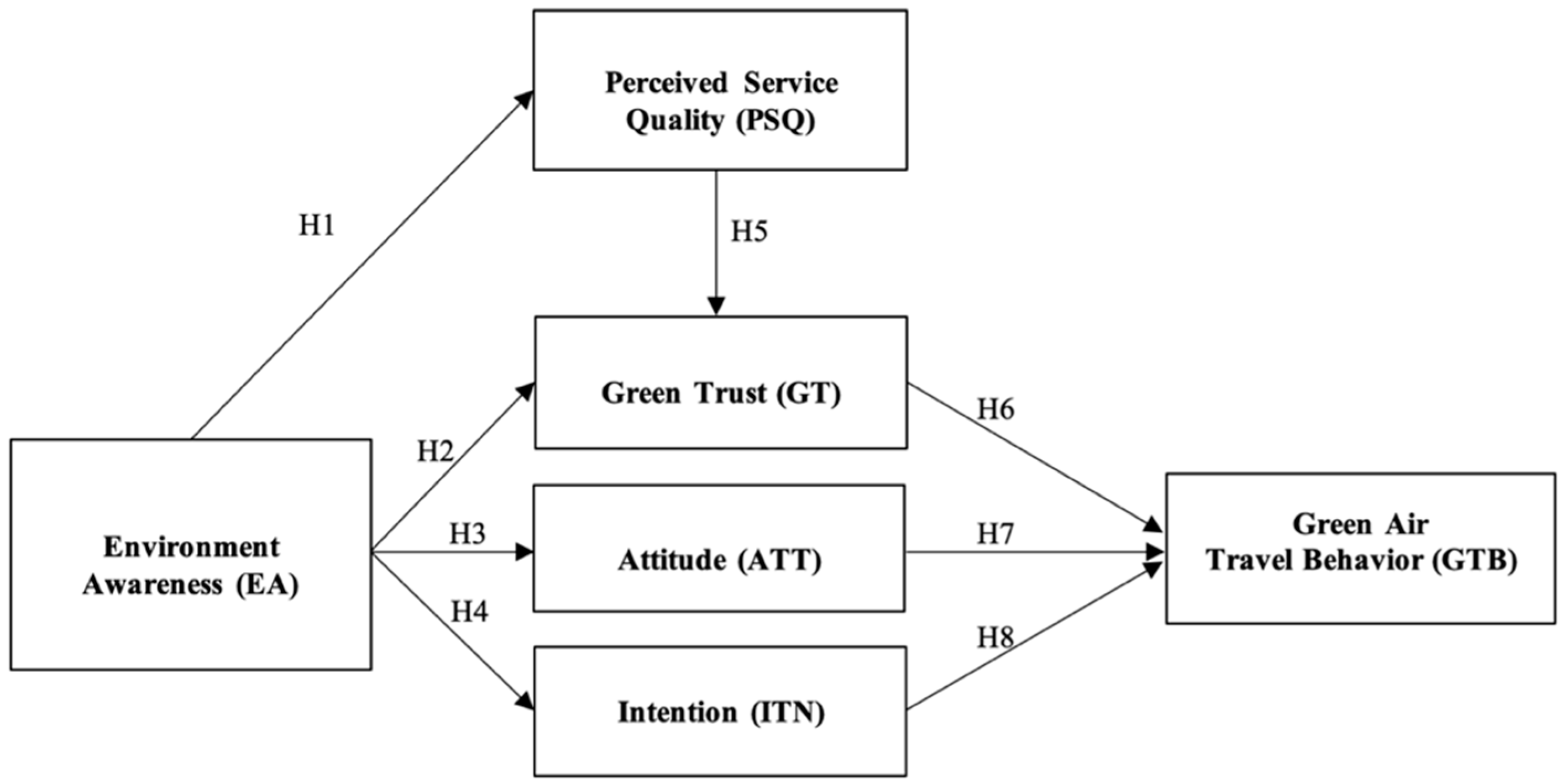
3. Conceptual Framework Development and Hypothesis
4. Methodology
4.1. Data Acquisition
4.2. Population and Sampling
4.3. Research Instrument
4.4. Data Collection and Analysis
5. Results
6. Discussion
7. Conclusions
Research Limitations
8. Future Research Directions
Author Contributions
Funding
Institutional Review Board Statement
Informed Consent Statement
Data Availability Statement
Conflicts of Interest
References
- Adams, M., Tweneboah-Koduah, E. Y., Braimah, S. M., & Odoom, R. (2025). The effect of green perceived values on urban homeowners’ greening intention: The mediating role of green attitude. Marketing Intelligence & Planning, 43(2), 374–392. [Google Scholar] [CrossRef]
- Ajzen, I. (1991). The theory of planned behavior. Organizational Behavior and Human Decision Processes, 50(2), 179–211. [Google Scholar] [CrossRef]
- Akan, Ş., Özdemir, E., & Bakır, M. (2022). Purchase intention toward green airlines and willingness to pay more: Extending the theory of planned behavior. In K. Kiracı, & K. T. Çalıyurt (Eds.), Corporate governance, sustainability, and information systems in the aviation sector, volume I: Accounting, finance, sustainability, governance & fraud: Theory and application (pp. 107–126). Springer. [Google Scholar] [CrossRef]
- Albayati, H., Alistarbadi, N., & Rho, J. J. (2023). Assessing engagement decisions in NFT Metaverse based on the Theory of Planned Behavior (TPB). Telematics and Informatics Reports, 10, 100045. [Google Scholar] [CrossRef]
- Alfaro, V. N., & Chankov, S. (2022). The perceived value of environmental sustainability for consumers in the air travel industry: A choice-based conjoint analysis. Journal of Cleaner Production, 380, 134936. [Google Scholar] [CrossRef]
- Bakır, M., & Itani, N. (2024). Modelling behavioural factors affecting consumers’ intention to adopt electric aircraft: A multi-method investigation. Sustainability, 16(19), 8467. [Google Scholar] [CrossRef]
- Barker, T., & Peters, S. (2023). Carbon pricing in Thailand: Strategies and implications for climate policy. Environmental Science & Policy, 134, 50–62. [Google Scholar] [CrossRef]
- Baumeister, S., Nyrhinen, J., Kemppainen, T., & Wilska, T.-A. (2022). Does airlines’ eco-friendliness matter? Customer satisfaction towards an environmentally responsible airline. Transport Policy, 128, 89–97. [Google Scholar] [CrossRef]
- Bayramoğlu, K., Bayraktar, M., Seyhan, A., & Yuksel, O. (2025). Evaluation of techniques to reduce carbon emissions from ships within the scope of revised greenhouse gas emission targets for 2030, 2040, and 2050. Ocean Engineering, 334, 121605. [Google Scholar] [CrossRef]
- Chechi, M., & Cottam, H. (2021). Understanding carbon offset behavior in air travel: The role of the TPB. Environmental Science & Policy, 124, 205–214. [Google Scholar] [CrossRef]
- Chen, F. Y. (2013). The intention and determining factors for airline passengers’ participation in carbon offset schemes. Journal of Air Transport Management, 29, 17–22. [Google Scholar] [CrossRef]
- Chien, F. (2023). The role of technological innovation, carbon finance, green energy, environmental awareness, and urbanization towards carbon neutrality: Evidence from novel CUP-FM CUP-BC estimations. Geoscience Frontiers, 10, 101696. [Google Scholar] [CrossRef]
- Choi, Y., Choi, M., Oh, M., & Kim, S. (2019). Perceived CSR, airline image, and loyalty: The mediating role of customer trust. Sustainability, 11(12), 3281. [Google Scholar] [CrossRef]
- Crosby, P., Thompson, D., & Best, R. (2024). Air travellers’ attitudes towards carbon emissions: Evidence from the Google Flights interface. Journal of Sustainable Tourism, 1–24. [Google Scholar] [CrossRef]
- Demir, Ş. Ş. (2025). Sustainable airline choice: The role of environmental awareness, carbon offsets, and perceived corporate social responsibility. Corporate Social Responsibility and Environmental Management, 32(5), 6627–6640. [Google Scholar] [CrossRef]
- Despotović, J., Rodić, V., & Caracciolo, F. (2021). Farmers’ environmental awareness: Construct development, measurement, and use. Journal of Cleaner Production, 295, 126378. [Google Scholar] [CrossRef]
- Fornell, C., & Larcker, D. F. (1981). Evaluating structural equation models with unobservable variables and measurement error. Journal of Marketing Research, 18(1), 39–50. [Google Scholar] [CrossRef]
- Fu, M., Schmalz, U., Tseng, K.-N., & Schmidkonz, C. (2025). Factors influencing environmentally friendly air travel: A systematic, mixed-method review. Economics, 19(1), 20250160. [Google Scholar] [CrossRef]
- Hair, J., Hollingsworth, C. L., Randolph, A. B., & Chong, A. Y. L. (2017). An updated and expanded assessment of PLS-SEM in information systems research. Industrial Management & Data Systems, 117(3), 442–458. [Google Scholar] [CrossRef]
- Helferich, M., Thøgersen, J., & Bergquist, M. (2023). Direct and mediated impacts of social norms on pro-environmental behavior. Global Environmental Change, 80, 102680. [Google Scholar] [CrossRef]
- IATA. (2024). Annual review 2023: Making sustainability an industry priority. IATA. Available online: https://www.iata.org/contentassets/c81222d96c9a4e0bb4ff6ced0126f0bb/annual-review-2023.pdf (accessed on 3 October 2025).
- Jibran, R., Rasul, M., Hussain, M., Shahid, R., & Yasin, M. (2025). Impact of perceived service quality on repurchase intention and word of mouth: Mediating role of customer satisfaction. Qlantic Journal of Social Sciences, 6(3), 69–78. [Google Scholar] [CrossRef]
- Kim, H., Lee, Y., Koo, J.-H., & Yeo, M. J. (2025). Changes in future carbon dioxide emissions and contributing factors in Southeast Asia under the shared socioeconomic pathways. Energy for Sustainable Development, 86, 101721. [Google Scholar] [CrossRef]
- Kumari, S., Jaglan, S., Chouksey, A., Walia, R., Ahlawat, A., Garg, A., & Verma, M. (2024). Carbon footprint analysis of cement production in India. Evergreen, 11(4), 2882–2889. [Google Scholar] [CrossRef]
- Leal Filho, W., Ng, A. W., Sharifi, A., Janová, J., Özuyar, P. G., Hemani, C., Heyes, G., Njau, D., & Rampasso, I. (2023). Global tourism, climate change and energy sustainability: Assessing carbon reduction mitigating measures from the aviation industry. Sustainability Science, 18(4), 983–996. [Google Scholar] [CrossRef]
- Leenoi, P. (2023). Carbon credits: A mechanism for achieving sustainability targets. Krungsri. Available online: https://www.krungsri.com/en/research/research-intelligence/carbon-credit-2023 (accessed on 4 October 2025).
- Liao, S.-H., Hu, D.-C., & Chen, C.-J. (2025). Perceived service quality and electronic word-of-mouth on food delivery services: Extended theory of planned behaviour. British Food Journal, 127(3), 1080–1097. [Google Scholar] [CrossRef]
- Liao, W., Fan, Y., & Wang, C. (2023). Exploring the equity in allocating carbon offsetting responsibility for international aviation. Transportation Research Part D: Transport and Environment, 114, 103566. [Google Scholar] [CrossRef]
- Nunnally, J. C. (1978). An overview of psychological measurement. In B. B. Wolman (Ed.), Clinical diagnosis of mental disorders (pp. 97–146). Springer. [Google Scholar] [CrossRef]
- Park, S. H., Hsieh, C. M., & Lee, C. K. (2017). Examining Chinese college students’ intention to travel to Japan using the extended theory of planned behavior: Testing destination image and the mediating role of travel constraints. Journal of Travel and Tourism Marketing, 34(1), 113–131. [Google Scholar] [CrossRef]
- Reyes-García, V., García-Del-Amo, D., Porcuna-Ferrer, A., Schlingmann, A., Abazeri, M., Attoh, E. M. N. A. N., da Cunha Ávila, J. V., Ayanlade, A., Babai, D., Benyei, P., Calvet-Mir, L., Carmona, R., Caviedes, J., Chah, J., Chakauya, R., Cuní-Sanchez, A., Fernández-Llamazares, Á., Galappaththi, E. K., Gerkey, D., … LICCI Consortium. (2024). Local studies provide a global perspective of the impacts of climate change on Indigenous Peoples and local communities. Sustain Earth Reviews, 7(1), 1. [Google Scholar] [CrossRef]
- Rouse, S. R., Box, S. C., Winter, S. R., & Rice, S. (2024). Support for green initiatives in aviation: A case study across American aviation consumers. Journal of the Air Transport Research Society, 2, 100020. [Google Scholar] [CrossRef]
- Ruangkanjanases, A., You, J. J., Chien, S. W., Ma, Y., Chen, S. C., & Chao, L. C. (2020). Elucidating the effect of antecedents on consumers’ green purchase intention: An extension of the theory of planned behavior. Frontiers in Psychology, 11, 1433. [Google Scholar] [CrossRef] [PubMed]
- Scheelhaase, J., & Maertens, S. (2020). How to improve the global “Carbon Offsetting and Reduction Scheme for International Aviation” (CORSIA)? Transportation Research Procedia, 51, 108–117. [Google Scholar] [CrossRef]
- Schleich, J., & Alsheimer, S. (2024). The relationship between willingness to pay and carbon footprint knowledge. Ecological Economics, 219, 108151. [Google Scholar] [CrossRef]
- Sung, P. L., Hsiao, T. Y., Huang, L., & Morrison, A. M. (2021). The influence of green trust on travel agency intentions to promote low-carbon tours for the purpose of sustainable development. Corporate Social Responsibility and Environmental Management, 28, 45–57. [Google Scholar] [CrossRef]
- Tan, X.-C., Wang, Y., Gu, B.-H., Kong, L.-S., & Zeng, A. (2022). Research on the national climate governance system toward carbon neutrality—A critical literature review. Fundamental Research, 2(3), 384–391. [Google Scholar] [CrossRef]
- TGO. (2024). Carbon credit price, volume, and transaction value from the T-VER project. Available online: https://carbonmarket.tgo.or.th/index.php?lang=TH&mod=aG9tZQ== (accessed on 5 October 2025).
- van den Bergh, J., van Beers, C., & King, L. C. (2024). Prioritize carbon pricing over fossil-fuel subsidy reform. iScience, 27(1), 108584. [Google Scholar] [CrossRef]
- Warburg, J., Frommeyer, B., Koch, J., Gerdt, S.-O., & Schewe, G. (2021). Voluntary carbon offsetting and consumer choices for environmentally critical products: An experimental study. Business Strategy and the Environment, 30(8), 3698–3710. [Google Scholar] [CrossRef]
- Yraola, S. D., III, & Mendiola, A. A. (2024). The theory of planned behavior and its influences on willingness-to-pay for green air travel: A values orientation perspective. Journal of Management for Global Sustainability, 12(1), 4. [Google Scholar] [CrossRef]
- Zeren, D., & Kara, A. (2021). Effects of brand heritage on intentions to buy of airline services: The mediating roles of brand trust and brand loyalty. Sustainability, 13(1), 303. [Google Scholar] [CrossRef]



| Saturated Model | Estimated Model | |
|---|---|---|
| SRMR | 0.045 | 0.056 |
| d_ULS | 1.332 | 1.980 |
| d_G | 0.982 | 1.020 |
| Constructs | Measurement Label | Loading | t-Value |
|---|---|---|---|
| Environmental Awareness (EA) VIF = 1.000; CR = 0.946; α = 0.928; AVE = 0.777 | EA2. I am aware of the environmental impacts caused by air travel. | 0.943 | 26.498 |
| EA2. I understand the importance of reducing carbon emissions from flights. | 0.897 | 20.471 | |
| EA3. I stay informed about current environmental policies related to aviation. | 0.862 | 16.235 | |
| EA4. I recognize the role of individual travelers in minimizing air travel’s environmental footprint. | 0.868 | 19.325 | |
| EA5. I am concerned about the effects of climate change caused by greenhouse gas emissions. | 0.832 | 16.068 | |
| Perceived Service Quality (PSQ) VIF = 1.121; CR = 0.934; α = 0.910; AVE = 0.739 | PSQ1. The airline provides clear information about its environmental initiatives. | 0.959 | 23.705 |
| PSQ2. The airline offers high-quality services that reflect its commitment to sustainability. | 0.866 | 14.475 | |
| PSQ3. The in-flight services meet my expectations for eco-friendly practices. | 0.891 | 13.854 | |
| PSQ4. The airline demonstrates transparency about its carbon offset programs. | 0.774 | 12.717 | |
| PSQ5. I feel that the airline’s sustainability efforts enhance my overall travel experience. | 0.794 | 10.139 | |
| Green Trust (GT) VIF = 1.442; CR = 0.978; α = 0.971; AVE = 0.757 | GT1. I trust that the airline’s claims about sustainability are genuine. | 0.941 | 32.057 |
| GT2. I believe the airline genuinely cares about reducing its environmental impact. | 0.914 | 25.792 | |
| GT3. The airline’s environmental policies are reliable and well-implemented. | 0.943 | 32.603 | |
| GT4. I feel confident that my carbon offset contributions are used effectively. | 0.985 | 50.236 | |
| GT5. The airline’s green initiatives positively influence my trust in their brand. | 0.951 | 32.766 | |
| Attitude (ATT) VIF = 1.497; CR = 0.940; α = 0.920; AVE = 0.757 | ATT1. I have a positive attitude toward choosing airlines that prioritize environmental sustainability. | 0.873 | 17.192 |
| ATT2. Supporting airlines with green policies is important to me when making travel decisions. | 0.831 | 12.205 | |
| ATT3. I believe that sustainable air travel is necessary for protecting the environment. | 0.864 | 13.692 | |
| ATT4. I feel responsible for reducing my carbon footprint when flying. | 0.913 | 21.430 | |
| ATT5. I am motivated to choose eco-friendly travel options whenever possible. | 0.868 | 13.985 | |
| Intention (ITN) VIF = 1.153; CR = 0.956; α = 0.940; AVE = 0.813 | ITN1. I intend to select airlines that offer carbon offset programs in my future travels. | 0.714 | 7.538 |
| ITN2. I plan to support airlines that demonstrate strong environmental responsibility. | 0.945 | 16.295 | |
| ITN3. I am willing to change my travel habits to be more environmentally sustainable. | 0.931 | 16.035 | |
| ITN4. I intend to participate in carbon offsetting when booking flights. | 0.957 | 17.311 | |
| ITN5. I plan to encourage others to choose sustainable air travel options. | 0.939 | 18.633 | |
| Green Air Travel Behavior (GTB) CR = 0.971; α = 0.962; AVE = 0.869 | GTB1. I actively choose flights from airlines with strong environmental commitments. | 0.934 | 18.742 |
| GTB2. I participate in carbon offset programs when booking air travel. | 0.978 | 26.418 | |
| GTB3. I avoid unnecessary flights to reduce my environmental impact. | 0.960 | 23.404 | |
| GTB4. I prefer airlines that use sustainable aviation fuels or technologies. | 0.881 | 11.656 | |
| GTB5. I seek information about the environmental performance of airlines before purchasing tickets. | 0.905 | 12.030 |
| Construct | EA | PSQ | GT | ATT | INT | GTB |
|---|---|---|---|---|---|---|
| Environmental Awareness (EA) | ||||||
| Perceived Service Quality (PSQ) | 0.353 | |||||
| Green Trust (GT) | 0.433 | 0.428 | ||||
| Attitude (ATT) | 0.455 | 0.579 | 0.575 | |||
| Intention (ITN) | 0.340 | 0.213 | 0.303 | 0.364 | ||
| Green Air Travel Behavior (GTB) | 0.319 | 0.475 | 0.345 | 0.381 | 0.174 |
| Construct | EA | PSQ | GT | ATT | INT | GTB |
|---|---|---|---|---|---|---|
| Environmental Awareness (EA) | 0.881 | |||||
| Perceived Service Quality (PSQ) | 0.329 | 0.859 | ||||
| Green Trust (GT) | 0.412 | 0.407 | 0.947 | |||
| Attitude (ATT) | 0.426 | 0.532 | 0.543 | 0.870 | ||
| Intention (ITN) | 0.317 | 0.195 | 0.290 | 0.343 | 0.902 | |
| Green Air Travel Behavior (GTB) | 0.302 | 0.448 | 0.335 | 0.365 | 0.165 | 0.932 |
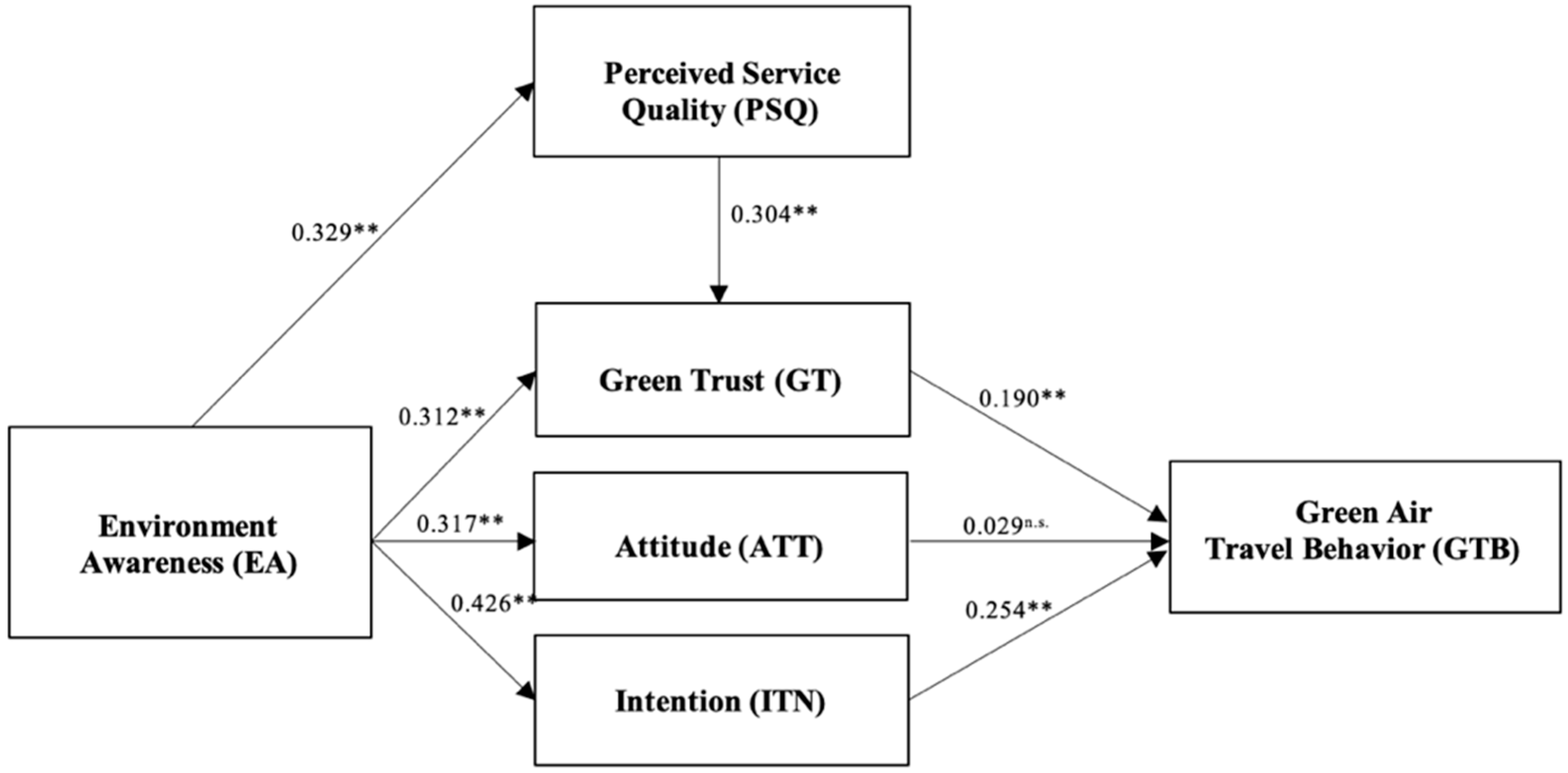
| Direct Effect | Path | t-Value | p-Values | Results |
|---|---|---|---|---|
| H1 | EA→PSQ | 6.441 *** | 0.000 | Supported |
| H2 | EA→GT | 8.041 *** | 0.000 | Supported |
| H3 | EA→ATT | 8.994 *** | 0.000 | Supported |
| H4 | EA→ITN | 5.912 *** | 0.000 | Supported |
| H5 | PSQ→GT | 6.097 *** | 0.000 | Supported |
| H6 | GT→GTB | 2.935 ** | 0.003 | Supported |
| H7 | ATT→GTB | 3.616 ** | 0.000 | Supported |
| H8 | INT→GTB | 0.425 (n.s.) | 0.671 | Not supported |
Disclaimer/Publisher’s Note: The statements, opinions and data contained in all publications are solely those of the individual author(s) and contributor(s) and not of MDPI and/or the editor(s). MDPI and/or the editor(s) disclaim responsibility for any injury to people or property resulting from any ideas, methods, instructions or products referred to in the content. |
© 2025 by the authors. Licensee MDPI, Basel, Switzerland. This article is an open access article distributed under the terms and conditions of the Creative Commons Attribution (CC BY) license (https://creativecommons.org/licenses/by/4.0/).
Share and Cite
Laphet, J.; Sanvises, D.; Tandamrong, D.; Tantrabundit, P. Decoding Sustainable Air Travel Choices: An Extended TPB of Green Aviation. Tour. Hosp. 2025, 6, 232. https://doi.org/10.3390/tourhosp6050232
Laphet J, Sanvises D, Tandamrong D, Tantrabundit P. Decoding Sustainable Air Travel Choices: An Extended TPB of Green Aviation. Tourism and Hospitality. 2025; 6(5):232. https://doi.org/10.3390/tourhosp6050232
Chicago/Turabian StyleLaphet, Jakkawat, Dultadej Sanvises, Duangrat Tandamrong, and Pongsatorn Tantrabundit. 2025. "Decoding Sustainable Air Travel Choices: An Extended TPB of Green Aviation" Tourism and Hospitality 6, no. 5: 232. https://doi.org/10.3390/tourhosp6050232
APA StyleLaphet, J., Sanvises, D., Tandamrong, D., & Tantrabundit, P. (2025). Decoding Sustainable Air Travel Choices: An Extended TPB of Green Aviation. Tourism and Hospitality, 6(5), 232. https://doi.org/10.3390/tourhosp6050232