Article

Factors That Influence the Teachers’ Involvement in Outdoor, Nature-Based Educational Activities and Environmental Education Programs

by
Anastasia Chrysomalidou
,
Ioannis Takos
,
Ioannis Spiliotis
and
Panteleimon Xofis
*
Department of Forest and Natural Environment Sciences, School of Agricultural and Forestry Sciences, Democritus University of Thrace, 1st km Drama-Mikrochori, 66100 Drama, Greece
*
Author to whom correspondence should be addressed.
J. Zool. Bot. Gard. 2026, 7(1), 3; https://doi.org/10.3390/jzbg7010003
Submission received: 27 October 2025 / Revised: 17 December 2025 / Accepted: 19 December 2025 / Published: 24 December 2025

Abstract

It is widely recognized that outdoor and nature-based educational activities can significantly enhance pupils’ learning, increase environmental awareness and improve pupils’ well-being. At the same time, a growing body of literature supports that the extent to which outdoor learning is implemented depends largely on factors, such as the general institutional context of schools, social and geomorphological aspects and the teacher’s own motivation. The current study employs data collected from 507 primary, middle and high schools in Greece, using a structured questionnaire, and investigates the factors that prevent teachers from engaging in outdoor teaching activities in a green space, as well as those that encourage them to be involved in such educational learning approaches. The results identify institutional barriers, such as the demanding school curriculum, lack of financial resources, limited available time, and insufficient external support, as the main constraints preventing teachers from implementing outdoor activities in nature. On the other hand, it appears that altruistic and intrinsically driven factors, such as personal environmental interest, knowledge of the positive outcomes of environmental education, and a sense of social contribution, are the main factors promoting the adoption of outdoor green education approaches. Availability of green spaces and support by leadership also appear to promote teachers’ engagement in outdoor activities. The findings of the current study highlight the need for educational reforms, to include outdoor, nature-based learning in the school curriculum, provide training and financial support and enhance the confidence of teachers in outdoor, nature-based education. Addressing these barriers could enhance education’s role in fostering sustainable development and reconnecting pupils with nature.

1. Introduction

Access to nature is important for children’s education, personal development, health and well-being but it is equally important for fostering environmental awareness from early ages [1,2,3]. Evidence from the international literature shows that both neurotypical children and children with special educational needs, such as children on the autism spectrum, experience improvements in mental health and overall well-being when they participate in outdoor activities [4,5,6,7]. Even brief Environmental Education Programs (EEPs) conducted in managed environments, such as zoos can positively influence pupils’ sense of connection to nature and their environmental attitudes [8,9]. Furthermore, direct contact with the biotic and abiotic elements of natural environment has a stronger impact on children’s development than indirect experiences (e.g., virtual exposure through screens or printed material), due to the richness and diversity provided by real-world green spaces [10,11].
Despite these well-documented benefits, international studies report a dramatic decline in the time children spend in natural environments over recent decades [12,13,14,15,16]. Since children spend a large part of their time at school, schools now should have a great responsibility for providing opportunities for direct and indirect contact with nature. An effective measure, which can contribute significantly to reducing the loss of young people’s contact with the natural environment, is outdoor and close to nature education [17]. Additionally, the participation of pupils in formal, structured EEPs, that can be conducted indoors or outdoors, is another pathway where contact of pupils with nature can occur [18]. Outdoor education involves moving traditional classroom lessons to locations outside the school building, like forests, parks, school gardens, or museums, for a few minutes to hours and days [6]. For the purposes of this study, the concepts of outdoor education and outdoor learning denote a common set of outdoor practices, including play, gardening, field-based activities, and curriculum-integrated lessons conducted in outdoor settings [19,20], which are not simply implemented outside the school building but particularly in outdoor spaces. Outdoor spaces are defined as unroofed spaces that teachers can access for educational needs, including school playgrounds, sports fields, local parks or green spaces [21] nature reserves, national parks, and others.
International literature further emphasizes that even schools located in highly urbanized areas can still access sites that are suitable for nature-related education activities. According to the biologist Schilthuizen [22], the city center is not the place where someone would expect to see a biologist working, as environmental scientists believe that the real world lies outside the urban fabric, in the forests, valleys and meadows. Unfortunately, very few people understand that nature also exists in cities, and many teachers are unaware of the opportunities provided for nature-related educational activities inside urban areas, and as a result, they do not take advantage of it [23]. An environmental scientist with a trained and observant eye can identify and make use of natural elements embedded within the organic structure of the city. A noisy city center, despite its artificial appearance is in fact a constellation of small ecosystems. Even in the seemingly lifeless streets, with bricks, tar and cement, fascinating, and often complex organisms exist and interact [22]. From dandelions emerging through cracks in the ground, to ants emerging from a tree to start a new colony, urban nature can be abundant, one just needs to be aware of it [24].
A substantial body of international research also highlights the benefits of outdoor education for teachers themselves. Fieldwork is an effective and enjoyable educational practice [25], in which teachers themselves also benefit. Teaching outdoors allows them to be more creative, to develop innovative teaching strategies [26], and to develop a more pro-environmental professional identity. According to Becker [27], even the most talented and skilled teacher is miserable in the classroom and extremely inferior compared to the mastery of nature. Furthermore, fieldwork provides an opportunity for teachers to develop more positive and productive relationships with their pupils [6,28,29]. This is possibly due to their supportive and collaborative role in a process of exploratory and experiential learning. Teachers in outdoor environments may also perceive symptoms of inattention and hyperactivity in children as less disruptive and evaluate these behaviors as milder, partly because they feel better equipped to manage them [30]. Mosca et al. [31] found that teachers involved in outdoor green education exhibit higher levels of perceived affective qualities and restorativeness, more favorable views of social relationships within the school, and greater overall life satisfaction than those who work predominantly indoors.
Nevertheless, international research consistently identifies significant barriers to the widespread implementation of outdoor learning. Lock [32] points out that most of the studies in the United Kingdom, in the period 1963–2009, report that only one teacher per school is practicing outdoor education, which results in reduced provision of close-to-nature education opportunities for pupils. Similarly, in England, outdoor learning is often driven by the personal passion of one or a few educators, which means that children often have unstable and uneven patterns of engagement with the natural world during their school years [26]. Results reported by Montiel et al. [33] reveal that the use of outdoor spaces in Elche, Spain, does not occur on a regular and systematic basis. Usually, it is practiced only by individual, enthusiastic teachers, and it is limited just to a group of pupils and for a limited period of time. Similar issues of inequity and injustice are observed for pupils with disabilities, according to research by Healey et al. [34], in the United Kingdom. According to them, educational institutions and teachers who attempt the full inclusion of pupils with disabilities in outdoor activities face many obstacles.
Walker et al. [35] and Thompson and Chapman [36] identify several barriers affecting the implementation of outdoor learning in schools and universities in England and in Australia, respectively. These barriers include (i) concerns about health and safety; (ii) teachers’ lack of confidence in outdoor learning; (iii) restrictive school and university curriculum requirements; (iv) shortages of time, resources, and support; and (v) broader changes within and beyond the education sector. Similarly, the results reported by Dyment [37] for Canadian schools also highlight the teachers’ lack of confidence in outdoor learning, restrictive curricular frameworks, and wider educational changes as major obstacles to greater engagement of teachers and pupils in outdoor activities and EEPs. Van Dijk-Wesselius et al. [38], examining obstacles encountered by primary teachers in the Netherlands when attempting to incorporate green schoolyards into educational practice, emphasize insufficient experience and training among teachers as a critical limitation. Consistent with these findings, Waite’s [19] survey of experts on outdoor learning across 19 different countries reveals a set of commonly shared barriers. The most significant globally were teachers’ lack of training and confidence in working outdoors and in linking curriculum requirements to outdoor activities. Financial costs and the need for volunteer support to meet health and safety requirements and to expand outdoor learning opportunities were also widely regarded as major constraints. Comparable barriers to outdoor education for sustainable development are reported in the review by Hu and Mou [17].
In response to these challenges, governmental policies in some countries provide additional support for education in and for nature. For example, according to Jordet (cited in [39]), the Scandinavian educational approach of outdoor learning, named udeskole, has been successfully introduced into Norway’s national curriculum. Similarly, Denmark introduced a new curriculum in 2014, which states that there should be more physical activity for pupils during the school day [26]. Singapore supports the greening of cities, promoting biodiversity and wildlife, and encourages connections with nature, especially among young people [40]. At the same time, it has incorporated outdoor education into its new curriculum [26] to broaden pupils’ experiences in ways that can promote holistic learning [41], which encompasses academic, emotional, and social development, and skill acquisition [42]. In Malaysia, since 1998, environmental education has been formally integrated into the national curriculum, integrating various aspects of the environment into each subject taught in the classroom [43]. It is therefore possible that in the future other national curricula could also be restructured to include aspects of outdoor learning [26].
Internationally, therefore, several studies have investigated the extent, nature, and scope of different approaches of outdoor and environmental education in schools and have demonstrated that educational contexts vary from country to country [39]. It is therefore important to be aware of local, regional, and national contexts and how curriculum and outdoor education practices are framed and shaped by cultural, social, political, and geographical factors [44]. Understanding how different goals are approached internationally can help to enhance and support outdoor learning [19].
Such contextual awareness is particularly relevant in Greece. According to Gkontelos et al. [45], in Greece, the school environment, along with the difficult working conditions, professional stress, and socioeconomic crisis, negatively affects the emotional state of teachers and makes them extremely vulnerable to burnout, with detrimental consequences for both their quality of life and educational processes. Despite the documented benefits of outdoor education for teacher well-being, participation rates in Greece remain low. Chrysomalidou et al. [46] highlighted that in secondary education schools in Greece, less than 19.2% of teachers are engaged in outdoor and nature-based education activities, while the respective percentage in primary schools is 41.1%.
The structure of the Greek educational system further constrains the implementation of outdoor and nature-based education, particularly in secondary education. The strongly exam-centered nature of secondary education—especially in high schools—creates intense pressure on the educational community to complete the curriculum and prepare pupils both for the demanding national exams required for promotion to the next grade and for the highly competitive university entrance examinations. At the same time, when teachers decide to conduct an outdoor educational activity outside the school premises, they face a substantial administrative burden, including issuing travel permits from the Education Directorate, arranging vehicle rental procedures, collecting parental consent forms, and other bureaucratic requirements. These processes act as significant inhibiting and limiting factors for organizing such activities. As a result, outdoor and nature-based activities, which are not mandatory in the national curriculum, depend largely on the motivation of individual teachers. This framework creates unequal environmental and educational opportunities for pupils. Similar inequalities and injustices are also observed in the implementation of EEPs, which are not officially integrated into the school curriculum. As a result, teachers who wish to implement EEPs must do it outside the regular school timetable, which serves as a disincentive for both teachers and pupils. Consequently, EEPs are implemented only occasionally and by a limited number of educators and pupils [46].
In line with international findings, outdoor and environmental education in Greece is therefore characterized by fragmented implementation, reliance on individual teacher initiative, and systemic barriers that limit its reach and sustainability. Within this context, the present study aims to identify the factors that motivate teachers to implement outdoor and close-to-nature educational activities and EEPs, as well as those that hinder their implementation. It is anticipated that the findings of this research will contribute to a broader dialogue for the development of strategies that could strengthen these educational approaches and increase the contact of pupils with nature and the natural environment. Such strategies ultimately seek to contribute significantly to the enhancement of the connection of people with nature and support the cultivation of their environmental awareness.

2. Materials and Methods

A quantitative data survey was conducted using an anonymous, online questionnaire with closed-ended questions, created on Google Forms. The survey questions were formulated based on previous research. Some questions derived from earlier research looking for the school provision of access to nature and the barriers to teaching outdoors (e.g., [21,35,39,47,48,49,50]). The pupil benefits of outdoor nature-based learning and EEPs were identified from the rich relevant research literature too [18,30,51,52,53,54,55,56,57,58,59,60,61,62,63,64,65,66]. The questionnaire incorporated the constructs and items presented in Table 1. Approval to conduct the research in schools was granted by the Greek Ministry of Education. The survey questionnaire was e-mailed twice (December 2022 and January 2023) to the 8168 primary, middle, and high schools that existed in Greece during the 2022–2023 school year, which were attended by pupils aged between six and 18 years old [46]. An attached letter informed all schools about the purpose of the survey, that their participation was voluntary, anonymous, and they could withdraw at any time. The questionnaire had to be answered by one representative member of the school’s education community, who could provide valid data. According to Raosoft’s sample size calculator “http://www.raosoft.com/samplesize.html (accessed on 29 June 2022)”, the minimum required survey sample size was determined at 367 schools. Finally, valid responses were received from 507 schools. The school representatives who participated in the survey were mainly school principals (75.5%), 9.7% were vice principals, 14% were regular teachers without any additional official positions, and 0.8% were administrators and psychologists. It has to be mentioned that in the Greek educational system, principals and vice principals are not solely managers or administrators. They are active educators with many years of teaching experience, who continue to teach and participate in all educational processes. They also maintain direct and frequent interaction with the teachers in their schools. For these reasons, school principals and vice principals are typically among the most informed individuals regarding the educational practices, constraints, and motivations of the teaching staff, and therefore can provide reliable and comprehensive assessments of their school’s overall situation.
Stratification of the valid responses was satisfactory in terms of education level, settlement size, and regional unit. Conversely, participation by private schools was minimal. The identities of the schools involved and the institutional roles of the respondents are maintained in strict confidence.
The questionnaire consisted primarily of questions where the responses of the participants followed a 5-point Likert scale. That allowed the respondents to express their perceptions on the significance of factors affecting, positively or negatively, the teachers’ engagement in outdoor and nature-based education and EEPs. The survey also included some quantitative questions, such as the number of school-organized visits to natural areas, the number of teachers and pupils involved in such activities, and other relevant numerical indicators. As the data reflect the perceptions of school representatives rather than direct responses from all teachers, the findings should be interpreted as school-level perspectives rather than individual teacher-level accounts.
The IBM SPSS Statistics (version 26; IBM Corp., Armonk, NY, USA) was employed for the statistical analysis of the obtained data. The questionnaire was first piloted in 40 schools to evaluate and refine its validity and reliability. Data from the main survey were subsequently re-examined, and the instrument’s reliability and validity were again confirmed. Reliability was assessed using Cronbach’s alpha for internal consistency, while convergent and discriminant validity were evaluated through Principal Component Analysis (PCA) and the Average Variance Extracted (AVE) and Composite Reliability (CR) indices [67]. Continuous variables were tested for normality, and the results indicated that the null hypothesis of normal distribution was rejected (p > 0.05), confirming non-normality. Consequently, non-parametric methods were employed in the data analysis, specifically the Wilcoxon Mann–Whitney U test, the Kruskal–Wallis test, and Spearman’s rho correlation coefficient.

3. Results

3.1. Factors Limiting the Number of Visits Organized by the School to Places Outside the School Premises Where Pupils Can Have Direct Contact with Nature

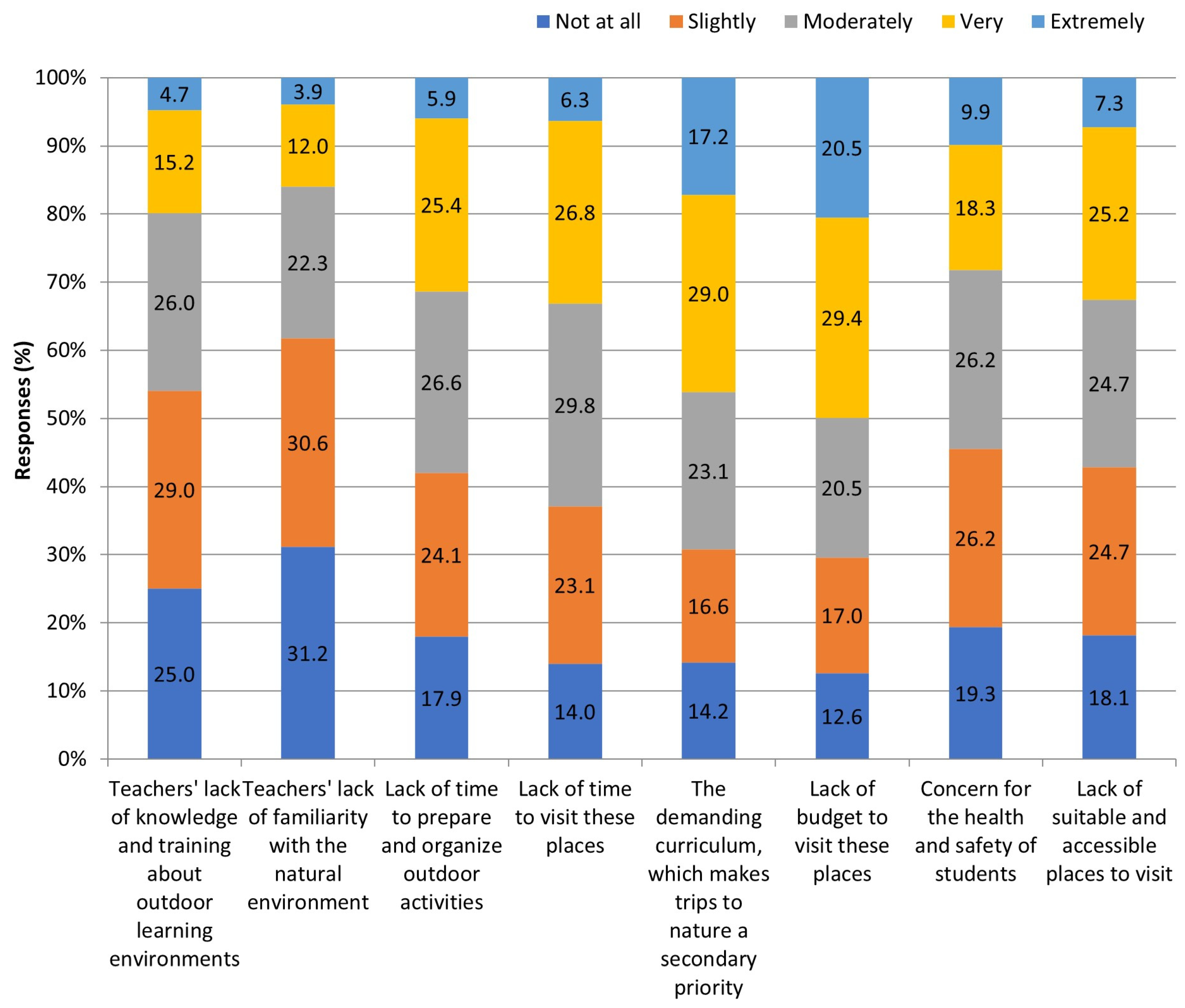
The survey revealed multiple factors that play a significant role in limiting school-organized visits to sites providing direct contact with nature, with institutional constraints emerging as the predominant category. Specifically, 46.2% of respondents, school representatives (mainly school principals) stated that the demanding school curriculum is a very or extremely important factor, which makes nature trips a secondary priority. Almost 50% stated that the lack of a relevant budget limits the visits to nature, while approximately 33% believes that the lack of time to visit appropriate outdoor locations is also a very to extremely important limiting factor. Teachers’ lack of knowledge and familiarity with outdoor learning environments, lack of time to prepare and organize outdoor activities, lack of suitable and accessible locations, and concern for pupil health and safety appear to be, for the school representatives, slightly less important factors limiting visits in nature (Figure 1).
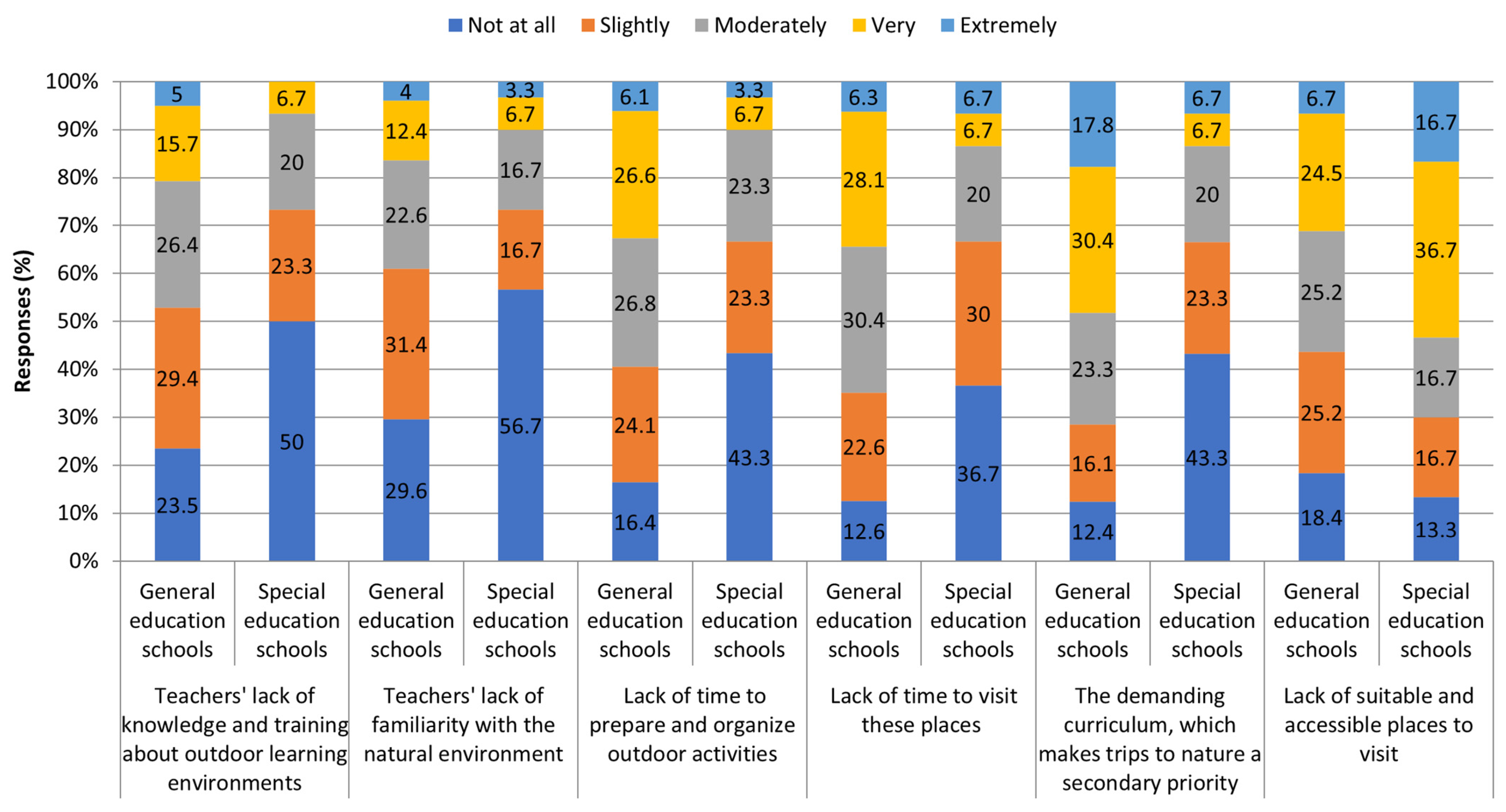
Great discrepancies in the responses of the school representatives were observed between the different school categories (Table 2, Figure 2 and Figure 3). In particular, the lack of time to visit locations for outdoor education activities is considered a very to extremely important factor by the 52.1% of high schools, and this value is statistically significantly higher than primary and middle schools. The same factor is considered very or extremely important in preventing visits to such places by the 34.4% of general schools, as opposed to 13.4% of special education schools. Similarly, according to the assessment of school representatives, the curriculum requirements restrict the visits to nature significantly in primary and middle schools compared to high schools. This factor is particularly limiting for vocational high schools and even more for general high schools, since 52.2% and 73.6%, respectively, stated that this reason affects very to extremely the number of school visits to places where pupils can have direct contact with nature. On the contrary, for special education schools, this factor is not actually an obstacle. Regarding the lack of budget, all school category representatives agree that it is a very to extremely inhibiting reason for organizing nature trips (Table 2, Figure 1).
According to Table 2 and Figure 1, Figure 2 and Figure 3, survey participants estimate that the lack of knowledge and familiarity of teachers with outdoor education does not significantly reduce the number of visits to nature in any category or level of education, although between some categories, there are statistically significant differences. Nevertheless, the time it takes teachers in middle school and high school to organize outdoor activities is considered a very to extremely important factor limiting visits to nature at a rate of 41.7% and 42%, respectively, while in primary schools this percentage is statistically significantly smaller (21.3%). A corresponding statistically significant difference exists between the schools of general and special education, with the latter considering the factor of preparation time for outdoor activities as very to extremely important at a rate of only 10% as opposed to the 34.4% of the former. On the other hand, special education school representatives consider the lack of suitable and accessible places to visit as a major (very and extremely) prohibiting factor at a percentage of 53.4%. No school category is particularly concerned about the health and safety of pupils during field trips.
Spearman’s rho correlation test between the estimated by survey participants (mainly school principals) factors that may limit the number of school-organized visits to places where pupils can have direct contact with nature and the percentage of teachers in a school providing outdoor opportunities for learning resulted in a statistically significant negative relationship for all factors except lack of budget and concern for pupil health and safety (Table 3). Furthermore, Spearman’s rho correlation test between these factors and the number of visits to natural areas showed a negative relationship. The same negative relationship is also maintained when referring to visits to urban and peri-urban places, with the exception of the factors of lack of time to visit these sites and the health and safety concern, with natural green spaces.

3.2. Factors Limiting the Opportunities the Schools Provide for Outdoor Activities Inside the School Premises

Four factors were examined as potentially limiting factors for organizing outdoor activities in the green spaces available inside the school premises, as shown in Figure 4. Apparently, none of them was identified by survey participants as significantly suspensive in organizing such activities. However, the one that was identified as possibly the suspensive is the feeling of teachers that during activities in the school natural environment, they will disturb other classes of pupils or be disturbed by pupils from other classes.
The statistical processing of the data revealed a weak, negative, and statistically significant correlation between the above factors and the percentage of teachers who provide outdoor opportunities for learning to their school pupils, as well as the frequency of use of the school yard (Table 4).

3.3. Factors That Influence the Teachers Who Show Interest in the Implementation of EEPs

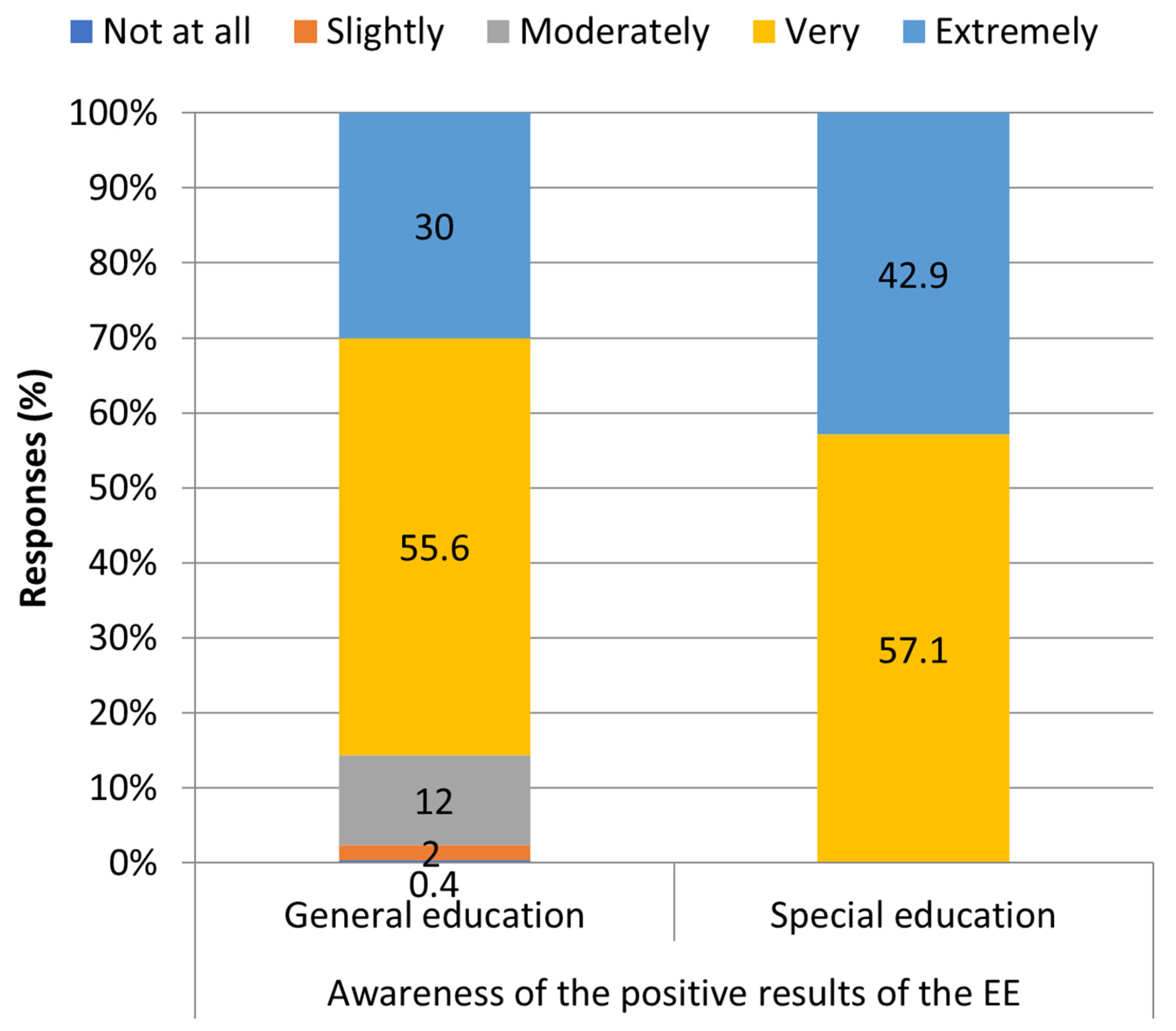
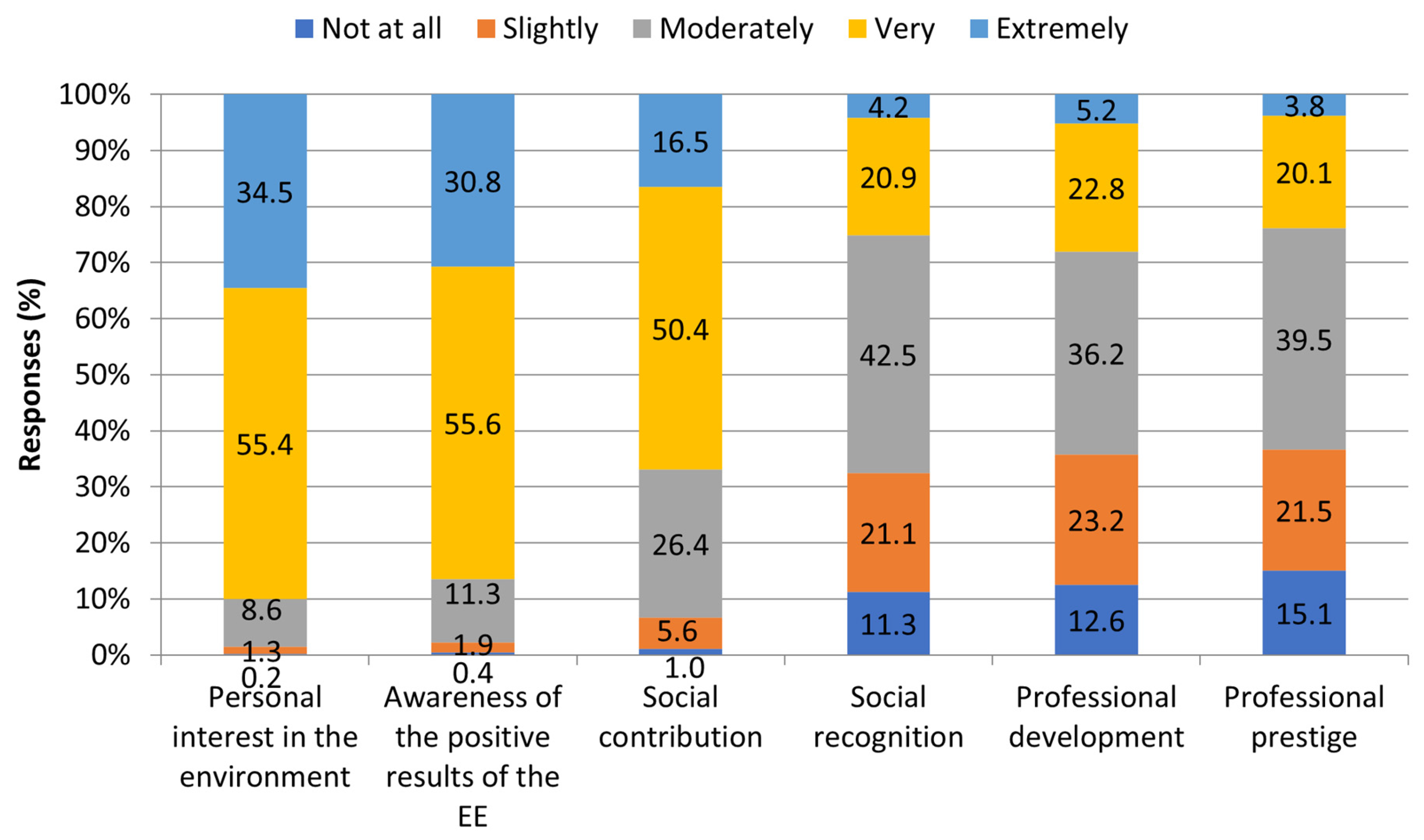
According to the school representatives who participated in the survey, the factors that encourage teachers to be involved in implementing an EEP are mainly altruistic (such as personal interest in the environment, awareness of the positive results of EEPs, and social contribution) and less egocentric (such as social recognition, professional development, and professional prestige; Figure 5). This was observed in all school categories, as there is no statistically significant difference between them (p > 0.05), for any of the factors examined. The only exception is the awareness of the positive results of EEPs, which is a statistically significant factor positively affecting special education teachers more than general education teachers (Z = 2.100, p = 0.036) (Figure 6).
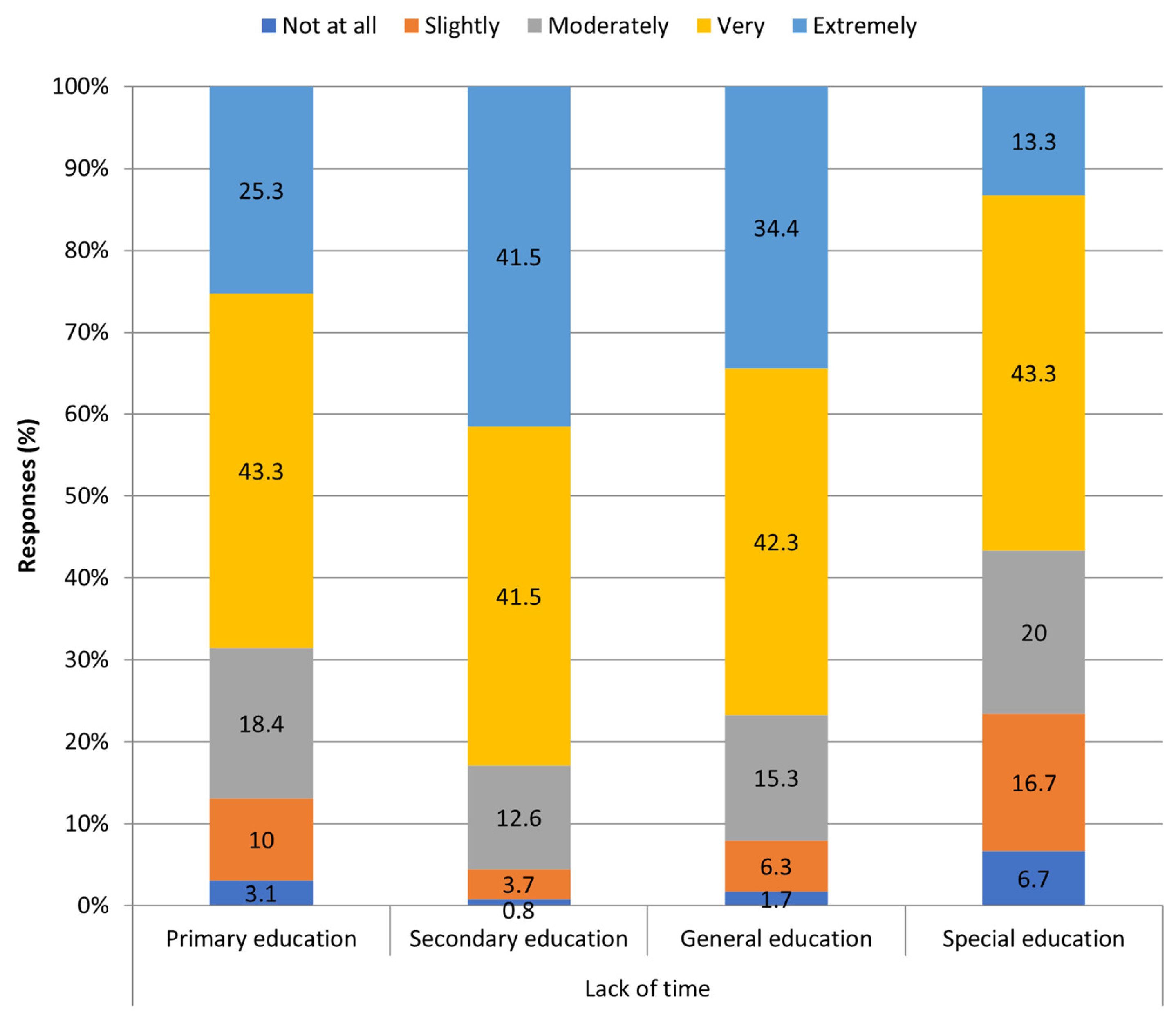
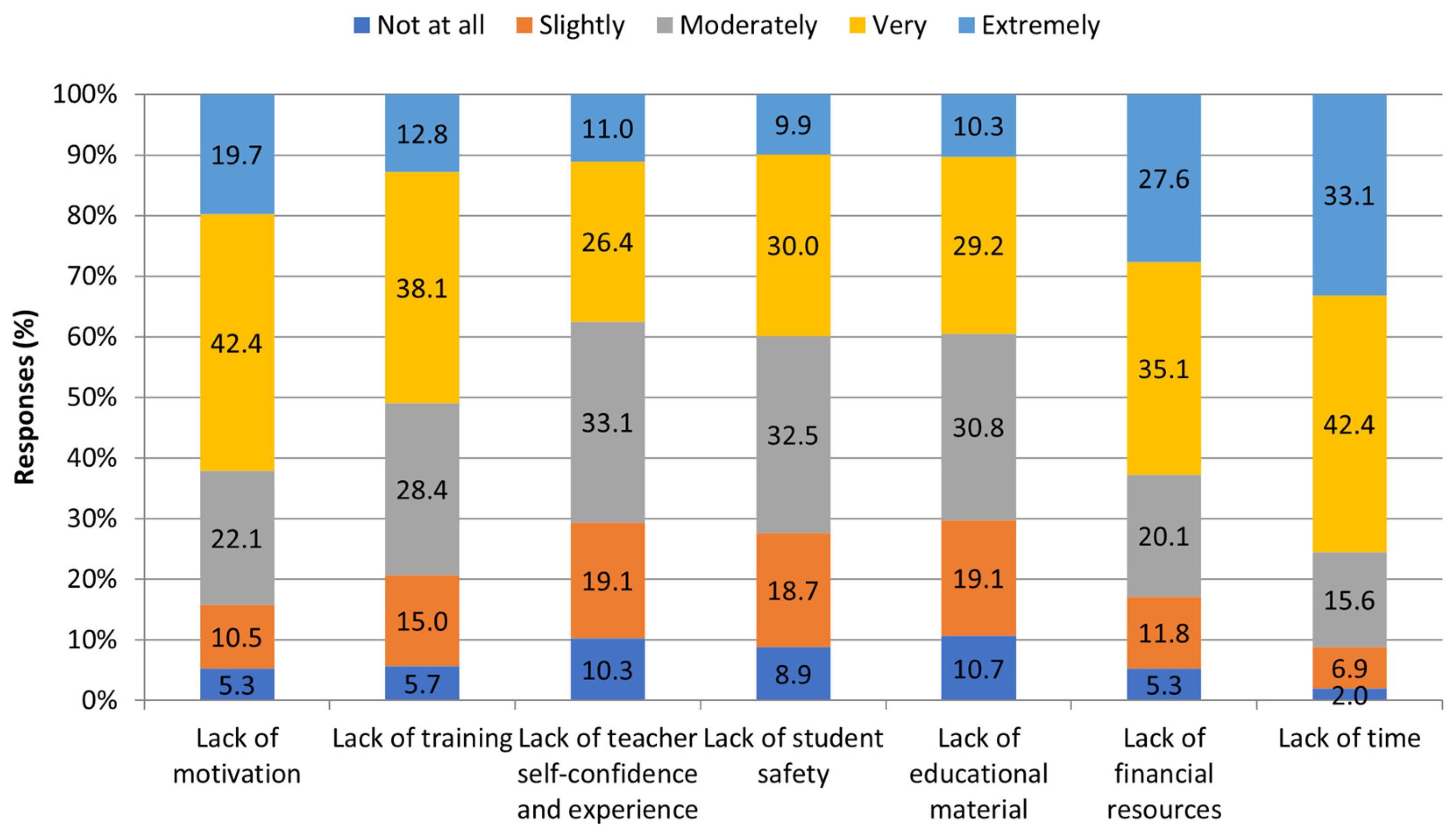
Lack of time, as well as lack of financial resources and motivation, were acknowledged by the school representatives to be the most important factors that prevent teachers from undertaking EEPs. This was a common perception among all school categories without statistically significant differences among them in most cases (Figure 7). Exceptions are the lack of motivation, which seems to be more negatively influential in secondary schools, compared to primary schools (Z = 3.570, p < 0.01, Figure 8), and the lack of time, which is also considered a more suspensive factor in secondary education and general education schools compared to primary and special education schools (Figure 9).
Spearman’s rho correlation test revealed that schools that identified the above altruistic factors as important in encouraging teachers to participate and implement EEPs are also the schools where there is an increased interest by teachers in implementing such programs. There is a statistically significant positive relation between all of these factors and the teachers’ interest in the implementation of EEPs (Table 5). Professional prestige was also found to be positively correlated with an increased interest of teachers in implementing EEPs. Furthermore, most of the factors that were identified as preventive for the teachers to engage in EEPs were found to be negatively associated with teachers’ interest in undertaking and implementing EEPs (Table 5). Finally, the factors mentioned above also indirectly affect the percentage of teachers who provide outdoor, close-to-nature learning opportunities, as this is positively correlated with teachers’ interest in EEPs (Table 5).

4. Discussion

The responses obtained in this survey reveal that the main reasons affecting and preventing teachers from organizing or participating in visits to places where pupils can have direct contact with nature are budget restrictions, the demanding school curriculum, and the lack of time. According to Walker et al. [35] and Bentsen et al. [39], the same three factors are also responsible for restricting the engagement of teachers in such initiatives in England and Denmark, respectively. Similarly, the undergraduate education students in England who participated in the research by Scott et al. [47] mentioned the same three factors among the main ones that limit outdoor education.
High schools in Greece seem to be more affected by the demands of the curriculum and the lack of time to organize outdoor learning activities, which is possibly explained by the highly exam-centered character of the country’s high schools. This is reinforced both by the extremely difficult and competitive exams for the admission of graduate pupils to higher education, and by the demanding written promotion exams of 1st- and 2nd-grade high school pupils. Conversely, in Sweden, according to Magntorn and Helldén’s [68], pressure to achieve goals is a positive impetus for fieldwork rather than a barrier to it. However, the survey data indicate that in special education schools in Greece, these reasons are not significant obstacles, perhaps due to the lesser pressure to achieve cognitive goals and the greater need to develop basic skills through experiential activities.
Lack of time, along with lack of financial resources and lack of motivation, are considered by school representatives to be the most important factors preventing teachers from undertaking EEPs. Lack of time seems to be more significant for general education schools—and especially for secondary schools—which also consider, more than other school categories, that there are no incentives to undertake EEPs. This may be reinforced by the fact that secondary education teachers in Greece have to carry out EEPs outside the school timetable and beyond their compulsory teaching hours, which acts as a strong disincentive. In addition, in the Greek education system, when teachers decide to implement a teaching activity outside the school area, they face a heavy administrative workload, such as issuing a travel permit, auctioning a vehicle lease, collecting parental consent declarations, etc., often resulting in their reluctance to take pupils outside the school premises.
In accordance with our results, Young and LaFollette [69] observed that the main reason teachers in Illinois did not participate in environmental education was the lack of time and the lack of support by the state. Furthermore, according to the findings by Sukma et al. [70], the majority of teachers in West Sumatra believe that environmental education—which by design includes outdoor and nature-based activities—is important for pupils; however, lack of time is one of the most significant constraints. Also, some teachers believe that, in order to integrate environmental education into the learning process, it is necessary to reorganize the formal curriculum [70].
Teachers’ lack of knowledge and familiarity with outdoor learning environments, lack of time to prepare and organize outdoor activities, lack of suitable and accessible locations, and concern for pupils’ health and safety are also considered by the survey participants as inhibiting factors for the implementation of outdoor education and EEPs in Greece. Planning and preparing innovative courses and educational activities, ensuring that outdoor conditions are appropriate, and utilizing new ways of evaluating the achievement of teaching goals are time-consuming and discouraging processes, especially for educators who are not convinced that outdoor environmental education is a valuable teaching tool [49]. According to [71], practice interventions that build the capacity of educators to support empathy development for nature in young children are needed. Glackin’s [21] research on secondary school teachers in London, as well as Scott et al. [47] and Walker et al. [35] in primary school teachers in England observed that teachers’ lack of confidence or commitment to outdoor learning, health and safety concerns and their lack of training in organizing and implementing outdoor activities are quite significant causes for limiting outdoor education too. Particularly, in the study of Scott et al. [47], it was reported that class size and ensuring a safe adult/child ratio were seen as potential barriers to fieldwork. A common concern identified among primary school teachers involved in forest school programs in a UK study was the need to manage pupil risk [48]. In the current study, it is observed that these factors prevent relatively fewer schools in Greece from implementing this educational method. In the study of Bentsen et al. [39] in Danish schools, security was not perceived as a significant barrier to teaching outside the classroom. Similarly, in the research of Mygid et al. [28] in Denmark, no safety, economic, and place-related barriers were mentioned by the teachers. This fact can probably be explained by Denmark’s long tradition of educating children in nature, resulting in teachers’ familiarity and sense of security in these environments. It also highlights how the different cultures of societies can influence the ways young people are educated.
According to the research participants, teachers in secondary general education schools perceive the workload required for outdoor education activities as high, whereas primary education teachers consider it more manageable. This may be due to a lack of relevant training during their university studies, since many of these teachers attended higher education programs that include very little or no pedagogical or teaching-related coursework. It has to be noted here that secondary education teachers are appointed according to their disciplinary specialization. Furthermore, the lack of relevant experience, partly due to the tight curriculum, may also contribute to their low engagement in nature-related educational activities.
In contrast, primary school teachers, who receive broader general training combined with stronger pedagogical preparation, may receive some relevant scientific training and practical experience during their undergraduate studies. They may also experience less curriculum-related pressure due to the absence of final exams in primary school. Similarly, Kendall et al. [72] report that the quantity and quality of training in education outside the classroom vary considerably depending on the tertiary institution from which teachers graduate, resulting in some teachers being inadequately prepared for outdoor teaching.
Including courses on outdoor learning in the undergraduate training of future educators would help them understand how outdoor learning is both feasible and beneficial, enabling them to integrate it into their own educational practice [26]. A survey of 4th-year undergraduate students (final-year pre-service teachers) at the Faculty of Education, University of Murcia (Spain), suggests that training programs implemented in school gardens foster high intrinsic motivation, as they are cooperative, interdisciplinary, experiential, and more enjoyable [73]. Bixler et al. [74] argue that the most effective way to convince teachers of the value of outdoor learning is for them to experience it themselves. Outdoor education offers opportunities for personal growth, professional development, and the acquisition of new skills, enriching teachers’ professional lives and providing a sense of accomplishment and satisfaction [75,76]. Therefore, outdoor environmental education and hands-on experience appear to be very important components of teacher training [77].
Regarding the lack of suitable and accessible places to visit, special education schools differ from the rest, as more than half of their representatives express concern about this issue. This may be due to the fact that many pupils in these schools face mobility challenges and require transportation even for much shorter distances compared to pupils in general education. As a result, nearby green areas become effectively inaccessible when they must be reached by vehicle—especially given the additional limiting factor of insufficient school budgets.
All of the above examined factors, except lack of budget and concern for pupil health and safety, were negatively associated with teachers’ willingness to engage in outdoor nature-based learning activities and in EEPs. Regarding the lack of budget, it may not affect the number of teachers who choose nature visits, as they often select locations that can be reached without transportation, which is usually the greatest cost associated with such activities. As for concerns about pupil health and safety, as mentioned above, this is not considered an important reason that would prevent pupils’ trips to nature, and therefore it does not influence the percentage of teachers who choose outdoor learning activities.
In contrast, none of the aforementioned deterrent factors related to outdoor, nature-based education were associated with the number of school trips to urban green spaces, possibly because these areas are more easily and quickly accessible. However, the number of field trips to natural environments was negatively associated with most of the deterrents to outdoor education, except for lack of time to visit these sites and concern for pupil health and safety. The absence of correlation between the number of nature field trips and health and safety concerns was expected, as this factor was not considered particularly important by the schools participating in the survey. Nonetheless, the lack of correlation with the time required to visit these locations warrants further investigation, since for high schools, time is a particularly significant and pressing constraint.
Most of the research participants do not consider (a) the lack of appreciation for the value of the school’s natural environment, (b) the perception that outdoor green activities are a waste of time, (c) the feeling of being watched or even surveilled, or (d) the feeling of being disturbed during outdoor, nature-based activities within the school grounds, to be significant reasons for limiting the amount of outdoor education. Yet, all of these factors appear to be significantly and negatively correlated to the percentage of teachers who provide opportunities for outdoor education and to the frequency of the use of the school green infrastructures for education purposes.
The deterrent most frequently identified by survey participants is the concern that, during activities in the school’s natural environment, teachers and pupils may disturb other classes, or be disturbed by them. Similarly, Glackin’s research [21] shows that fear of disturbing or being disturbed, as well as the feeling of being observed and therefore judged, leads teachers to avoid taking children outside the classroom for lessons.
Apart from investigating the reasons that prevent teachers from engaging in EEPs, it was also considered important to investigate the reasons that encourage them to engage in such programs. Based on the presented results, which emerged from the perceptions of the school representatives, the reasons that promote teachers’ involvement in EEPs are mainly altruistic and less egocentric. Similarly, Young and LaFollette [69] found in their study that the factor most likely to motivate teachers in Illinois to teach about the environment was their personal interest in the subject. Teachers with a strong personal affinity for nature and outdoor environments are intrinsically motivated by the opportunity to engage pupils in activities that reflect their own interests and values [78]. Notably, responses from special education schools assigned greater importance to the positive effects of EEPs compared to those from general education schools. This may be because teachers in these settings engage more frequently in environmental education that is conducted outdoors and are therefore better positioned to perceive its impact on their pupils.
The benefits of outdoor teaching and of pupils’ participation in EEPs are uncontested. However, teachers’ engagement in such activities remains low for the reasons outlined above. Clearly, there is a need for both theoretical and practical training for all teachers in Greece regarding outdoor teaching and environmental education, as such training would help them recognize its benefits for pupils as well as for themselves [78]. It would enable them to appreciate the value of outdoor spaces near the school and to use them with confidence, safety, and comfort.
Furthermore, according to the literature review by Javornic and Mirazchiyski [79], effective teaching practices and a positive school culture must be accompanied by strong and supportive school leadership and administration in order to substantially enhance school effectiveness and create learning environments in which pupils can thrive. Enthusiasm from school administrators can strongly influence even those teachers who are initially less enthusiastic about nature-based education [80]. Therefore, principals and school counselors should support, rather than discourage, teachers’ efforts to conduct lessons outdoors, organize frequent field trips, and collaborate with nearby nature centers, farms, and forest reserves in implementing EEPs [81].
Awareness of the benefits associated with spending time in nature and for nature is a key driver of outdoor green education [19]. According to Maynard et al. [82], teachers reported feeling happier and more relaxed when teaching outdoors. These constitute strong internal incentives for the extensive and sustained implementation of outdoor, nature-based educational approaches.
At the same time, policymakers should ensure that environmental education is integrated throughout the entire basic education cycle as a long-term, interdisciplinary component of the national curriculum, rather than an isolated initiative undertaken by a few individual teachers [83]. The state must also create the conditions necessary for outdoor and environmental education to develop in Greece by formally embedding it in the curriculum, reducing the pressure to meet narrowly defined cognitive goals, and providing resources as well as both intrinsic and extrinsic—egoistic and altruistic—incentives for teachers.
According to Waite [50] extrinsic motivations for promoting outdoor education must be complemented by intrinsic incentives, as governmental endorsement alone is insufficient; teachers must also personally recognize the value of outdoor learning in order to make use of its benefits for children. Kollmuss and Agyeman [84] argue that a complex interplay of internal factors (e.g., personality traits, value systems) and external factors (e.g., infrastructure, economic conditions, policy, social and cultural context) shapes egoistic and altruistic incentives that activate pro-environmental behavior.
Despite the representative nationwide sample of schools that participated in this research, a potential limitation is that responses may disproportionately come from schools that are already more active in outdoor and environmental activities or from teachers and school staff with a particular interest in the environment. An additional limitation arises from the fact that the conclusions rely on the assessment of a single representative from each school—most often the school principal or vice principal—rather than on direct reports of teachers’ personal experiences, feelings, or motivations.
Although a larger-scale assessment based on interviews with a greater number of individual teachers would further enhance the validity of the findings, we believe that our approach also produces valid and informative results. This is because the high proportion of responses from school principals reduces the risk associated with this methodological limitation. In Greece, principals and vice principals are not merely school managers or administrators; they are active educators with many years of teaching experience, who continue to teach pupils and participate in all educational processes. They also maintain direct and frequent contact with the teaching staff. For these reasons, principals and vice principals are often those who can provide the most accurate and comprehensive information regarding the functioning of their schools.
Future studies could employ qualitative or mixed-methods approaches, including interviews or focus groups with teachers, to more precisely explore the factors that influence teachers’ implementation of outdoor educational activities in nature. Moreover, an important factor not accounted for in this research is the specific topography of the areas in which the participating schools are located. A valuable recommendation for future research is the incorporation of spatial analyses of schools and their surrounding green spaces.

5. Conclusions

The benefits of outdoor teaching and of pupils’ participation in EEPs are uncontested. The more teachers engage in such activities, the greater the advantages for pupils, society, and the environment [46]. Therefore, to enable the systematic implementation of these approaches in Greek schools, it is essential to address the factors that inhibit participation and to strengthen those that encourage it. Reducing the barriers requires a multifaceted strategy involving increased funding, professional development, supportive policies, and a shift in educational priorities to recognize the value of learning experiences that extend beyond the classroom and a strict curriculum. If such challenges are effectively managed, nature- and environment-focused activities can more easily be incorporated into everyday school practice, resulting in a possibly enriched pupils’ overall educational experience.
Both intrinsic and extrinsic incentives are crucial for motivating teachers to adopt such practices. While intrinsic drivers relate to personal fulfillment, professional growth, and alignment with individual values, extrinsic ones include financial support, recognition, opportunities for advancement, and administrative support. A balanced combination of these factors can foster more consistent and sustainable implementation.
It is therefore important for both policymakers and educators to be informed about the benefits of this pedagogical approach, to work collaboratively to reduce obstacles, and to create conditions that support its wider adoption. This aligns with Waite’s [19] findings, which highlight that school-based outdoor learning can be strengthened through national policy inclusion, increased awareness of its benefits, integrated teacher training, partnerships with external providers, and the development of diverse green infrastructures within school grounds.

Author Contributions

Conceptualization, P.X. and A.C.; methodology, A.C. and P.X.; software, A.C. and I.S.; validation, A.C., P.X. and I.S.; formal analysis, A.C.; investigation, A.C.; resources, A.C.; data curation, A.C.; writing—original draft preparation, A.C. and P.X.; writing—review and editing, P.X. and A.C.; visualization, A.C.; supervision, P.X. and I.T. All authors have read and agreed to the published version of the manuscript.

Funding

This research received no external funding.

Institutional Review Board Statement

All participants were informed that their anonymity is assured, why the research is being conducted, how their data will be used, and that there are no risks or financial costs associated. The study was conducted in accordance with the Declaration of Helsinki and approved by the Ethics Committee of the International Hellenic University and by the Hellenic Ministry of Education, Religious Affairs, and Sports.

Informed Consent Statement

Informed consent was obtained from all subjects involved in the study.

Data Availability Statement

The research data is unavailable due to privacy.

Acknowledgments

We sincerely thank the schools that participated in the research, as without their contribution, this research could not have been carried out.

Conflicts of Interest

The authors declare no conflicts of interest.

References

  1. Robinson, J.M.; Barrable, A. Optimising early childhood educational settings for health using nature-based solutions: The microbiome aspect. Educ. Sci. 2023, 13, 211. [Google Scholar] [CrossRef]
  2. Richardson, M.; Cormack, A.; McRobert, L.; Underhill, R. 30 Days wild: Development and evaluation of a large-scale nature engagement campaign to improve well-being. PLoS ONE 2016, 11, e0149777. [Google Scholar] [CrossRef] [PubMed]
  3. Collado, S.; Staats, H.; Corraliza, J.A. Experiencing nature in children’s summer camps: Affective, cognitive and behavioural consequences. J. Environ. Psychol. 2013, 33, 37–44. [Google Scholar] [CrossRef]
  4. Hansen, K.G.; Barene, S. Exploring the Associations Between School Climate and Mental Wellbeing: Insights from the MOVE12 Pilot Study in Norwegian Secondary Schools. Eur. J. Investig. Health Psychol. Educ. 2025, 15, 46. [Google Scholar] [CrossRef]
  5. Morsanuto, S.; Cassese, F.P.; Tafuri, F.; Tafuri, D. Outdoor Education, Integrated Soccer Activities, and Learning in Children with Autism Spectrum Disorder: A Project Aimed at Achieving the Sustainable Development Goals of the 2030 Agenda. Sustainability 2023, 15, 13456. [Google Scholar] [CrossRef]
  6. Lauterbach, G. “Building roots”—Developing agency, competence, and a sense of belonging through education outside the classroor. Educ. Sci. 2023, 13, 1107. [Google Scholar] [CrossRef]
  7. Becker, C.; Lauterbach, G.; Spengler, S.; Dettweiler, U.; Mess, F. Effects of Regular Classes in Outdoor Education Settings: A Systematic Review on Students’ Learning, Social and Health Dimensions. Int. J. Environ. Res. Public Health 2017, 14, 485. [Google Scholar] [CrossRef]
  8. Byrne, K.; Collins, C.; Bolger, M.K.; Butler, F. Science Education in Primary Students in Ireland: Examining the Use of Zoological Specimens for Learning. J. Zool. Bot. Gard. 2023, 4, 507–526. [Google Scholar] [CrossRef]
  9. Kleespies, M.W.; Feucht, V.; Becker, M.; Dierkes, P.W. Environmental Education in Zoos—Exploring the Impact of Guided Zoo Tours on Connection to Nature and Attitudes towards Species Conservation. J. Zool. Bot. Gard. 2022, 3, 56–68. [Google Scholar] [CrossRef]
  10. Adams, S.; Savahl, S. Nature as children’s space: A systematic review. J. Environ. Educ. 2017, 48, 291–321. [Google Scholar] [CrossRef]
  11. Kellert, S.R. Experiencing nature: Affective, cognitive, and evaluative development. In Children and Nature: Psychological, Sociocultural, and Evolutionary Investigations; Kahn, P.H., Jr., Kellert, S.R., Eds.; The MIT Press: London, UK, 2002; pp. 117–151. [Google Scholar]
  12. Soga, M.; Yamanoi, T.; Tsuchiya, K.; Koyanagi, T.F.; Kanai, T. What are the drivers of and barriers to children’s direct experiences of nature? Landsc. Urban Plan. 2018, 180, 114–120. [Google Scholar] [CrossRef]
  13. Hand, K.L.; Freeman, C.; Seddon, P.J.; Recio, M.R.; Stein, A.; Heezik, Y. Restricted home ranges reduce children’s opportunities to connect to nature: Demographic, environmental and parental influences. Landsc. Urban Plan. 2018, 172, 69–77. [Google Scholar] [CrossRef]
  14. Soga, M.; Gaston, K.J. Extinction of experience: Evidence, consequences and challenges of loss of human-nature interactions. Front. Ecol. Environ. 2016, 14, 94–101. [Google Scholar] [CrossRef]
  15. Natural England. Monitor of Engagement with the Natural Environment: A Pilot to Develop an Indicator of Visits to the Natural Environment by Children; Natural England: Cambridgeshire, UK, 2016. [Google Scholar]
  16. Natural England. Childhood and Nature: A Survey on Changing Relationships with Nature Across Generations; Natural England: Cambridgeshire, UK, 2009. [Google Scholar]
  17. Hu, R.; Mou, S. Outdoor Education for Sustainable Development: A Systematic Literature Review. Sustainability 2025, 17, 3338. [Google Scholar] [CrossRef]
  18. Otto, S.; Pensini, P. Nature-based environmental education of children: Environmental knowledge and connectedness to nature, together, are related to ecological behaviour. Glob. Environ. Change 2017, 47, 88–94. [Google Scholar] [CrossRef]
  19. Waite, S. Where are we going? International views on purposes, practices and barriers in school-based outdoor learning. Educ. Sci. 2020, 10, 311. [Google Scholar] [CrossRef]
  20. Donaldson, G.W.; Donaldson, L.E. Outdoor Education a Definition. J. Health Phys. Educ. Recreat. 1958, 29, 17–63. [Google Scholar] [CrossRef]
  21. Glackin, M. ‘Control must be maintained’: Exploring teachers’ pedagogical practice outside the classroom. Br. J. Sociol. Educ. 2018, 39, 61–76. [Google Scholar] [CrossRef]
  22. Schilthuizen, Μ. Darwin Goes to Town: The Paths of Evolution in the Modern Urban Environment; University Publications of Crete: Crete, Greece, 2021. [Google Scholar]
  23. Tilling, S. Ecological science fieldwork and secondary school biology in England: Does a more secure future lie in Geography? Curric. J. 2018, 29, 538–556. [Google Scholar] [CrossRef]
  24. Derr, V.; Lance, K. Biophilic boulder: Children’s environments that foster connections to nature. Child. Youth Environ. 2012, 22, 112–143. [Google Scholar] [CrossRef]
  25. Rickinson, M.; Dillon, J.; Teamey, K.; Morris, M.; Choi, M.Y.; Sanders, D.; Benefield, P. A Review of Research on Outdoor Learning; Field Studies Council: London, UK, 2004. [Google Scholar]
  26. Gilchrist, M.; Passy, R.; Waite, S.; Cook, R. Exploring schools’ use of natural spaces. In Risk, Protection, Provision and Policy, Geographies of Children and Young People; Freeman, C., Tranter, P., Skelton, T., Eds.; Springer: Singapore, 2015; Volume 12. [Google Scholar]
  27. Becker, P. To be in the garden or not to be in the garden—That is the question here: Some aspects of the educational chances that are inherent in tamed and untamed nature. J. Adventure Educ. Outdoor Learn. 2014, 15, 79–92. [Google Scholar] [CrossRef]
  28. Mygind, E.; Bølling, M.; Barfod, K.S. Primary teachers’ experiences with weekly education outside the classroom during a year. Educ. 3-13 2019, 47, 599–611. [Google Scholar] [CrossRef]
  29. Barker, S.; Slingsby, D.; Tilling, S. Teaching Biology Outside the Classroom. Is It Heading for Extinction? A Report on Biology Fieldwork in the 14–19 Curriculum; Field Studies Council/British Ecological Society: Preston Montford, UK, 2002. [Google Scholar]
  30. Ulset, V.; Vitaro, F.; Brendgen, M.; Bekkhus, M.; Borge, A.I.H. Time spent outdoors during preschool: Links with children’s cognitive and behavioral development. J. Environ. Psychol. 2017, 52, 69–80. [Google Scholar] [CrossRef]
  31. Mosca, O.; Mérac, E.R.; Pedditzi, M.L.; Meloni, C.; Isoni, C.; Livi, S.; Fornara, F. A Comparison of Outdoor Green and Indoor Education: Psycho-Environmental Impact on Kindergarten and Primary Schools Teachers. Sustainability 2024, 16, 8106. [Google Scholar] [CrossRef]
  32. Lock, R. Biology fieldwork in schools and colleges in the UK: An analysis of empirical research from 1963 to 2009. J. Biol. Educ. 2010, 44, 58–64. [Google Scholar] [CrossRef]
  33. Montiel, I.; Asunción, M.M.; Navarro-Pedreño, J.; Maiques, S. Transforming learning spaces on a budget: Action research and service-learning for co-creating sustainable spaces. Educ. Sci. 2021, 11, 418. [Google Scholar] [CrossRef]
  34. Healey, M.; Jenkins, A.; Leach, J.; Roberts, C. Issues in Providing Learning Support for Disabled Students Undertaking Fieldwork and Related Activities; Geography Discipline Network: Gloucester, UK, 2001. [Google Scholar]
  35. Walker, E.; Bormpoudakis, D.; Tzanopoulos, J. Assessing challenges and opportunities for schools’ access to nature in England. Urban For. Urban Green. 2021, 61, 127097. [Google Scholar] [CrossRef]
  36. Thompson, S.M.; Chapman, N. Learning Along the GreenWay: An Experiential, Transdisciplinary Outdoor Classroom for Planetary Health Education. Sustainability 2025, 17, 4143. [Google Scholar] [CrossRef]
  37. Dyment, J.E. Green school grounds as sites for outdoor learning: Barriers and opportunities. Int. Res. Geogr. Environ. Educ. 2005, 14, 28–45. [Google Scholar] [CrossRef]
  38. Van Dijk-Wesselius, J.E.; van den Berg, A.E.; Maas, J.; Hovinga, D. Green Schoolyards as Outdoor Learning Environments: Barriers and Solutions as Experienced by Primary School Teachers. Front. Psychol. 2020, 10, 2919. [Google Scholar] [CrossRef]
  39. Bentsen, P.; Jensen, F.S.; Mygind, E.; Randrup, T.B. The extent and dissemination of udeskole in Danish schools. Urban For. Urban Green. 2010, 9, 235–243. [Google Scholar] [CrossRef]
  40. Kolesnikov-Jessop, S. An Urban Jungle for the 21st Century. The New York Times, 28 July 2011. [Google Scholar]
  41. Tan, Y.S.M.; Atencio, M. Unpacking a place-based approach–“what lies beyond?” Insights drawn from teachers’ perceptions of outdoor education. Teach. Teach. Educ. 2016, 56, 25–34. [Google Scholar] [CrossRef]
  42. Atencio, M.; Tan, Y.S.M.; Ho, S.; Ching, C.T. The place and approach of outdoor learning within a holistic curricular agenda: Development of Singaporean outdoor education practice. J. Adventure Educ. Outdoor Learn. 2015, 15, 181–192. [Google Scholar] [CrossRef]
  43. Mustam, B.; Daniel, E.S. Informal and formal environmental education infusion: Actions of malaysian teachers and parents among students in a polluted area. Malays. Online J. Educ. Sci. 2016, 4, 9–20. [Google Scholar]
  44. Bentsen, P.; Mygind, E.; Randrup, T.B. Towards an understanding ofudeskole: Education outside the classroom in a Danish context. Educ. 3-13 2009, 37, 29–44. [Google Scholar] [CrossRef]
  45. Gkontelos, A.; Vaiopoulou, J.; Stamovlasis, D. Burnout of Greek Teachers: Measurement Invariance and Differences across Individual Characteristics. Eur. J. Investig. Health Psychol. Educ. 2023, 13, 1029–1042. [Google Scholar] [CrossRef]
  46. Chrysomalidou, A.; Takos, I.; Spiliotis, I.; Xofis, P. The participation of teachers in Greece in outdoor education activities and the schools’ perceptions of the benefits to students. Educ. Sci. 2024, 14, 804. [Google Scholar] [CrossRef]
  47. Scott, G.W.; Boyd, M.; Scott, L.; Colquhoun, D. Barriers to biological fieldwork: What really prevents teaching out of doors? J. Biol. Educ. 2015, 49, 165–178. [Google Scholar] [CrossRef]
  48. Connolly, M.; Haughton, C. The perception, management and performance of risk amongst Forest School educators. Br. J. Sociol. Educ. 2015, 38, 105–124. [Google Scholar] [CrossRef]
  49. Dillon, J.; Dickie, I. Learning in the Natural Environment: Review of Social and Economic Benefits and Barriers; NECR092; Natural England: Cambridgeshire, UK, 2012. [Google Scholar]
  50. Waite, S. Outdoor learning for children ged 2–11: Perceived barriers, potential solutions. In Proceedings of the 4th International Outdoor Education Conference “Outdoor Education Research and Theory: Critical Reflections, New Directions”, Victoria, Australia, 15–18 April 2009. [Google Scholar]
  51. Sturrock, G.R.; Zandvliet, D.B. Citizenship outcomes and place-based learning environments in an integrated environmental studies program. Educ. Sci. 2023, 13, 292. [Google Scholar] [CrossRef]
  52. Lauterbach, G.; Fandrem, H.; Dettweiler, U. Does “out” get you “in”? Education outside the classroom as a means of inclusion for students with immigrant backgrounds. Educ. Sci. 2023, 13, 878. [Google Scholar] [CrossRef]
  53. Ardoin, N.M.; Bowers, A.W. Early childhood environmental education: A systematic review of the research literature. Educ. Res. Rev. 2020, 31, 100353. [Google Scholar] [CrossRef] [PubMed]
  54. Wallner, P.; Kundi, M.; Arnberger, A.; Eder, R.; Allex, B.; Weitensfelder, L.; Hutter, H.P. Reloading Pupils’ Batteries: Impact of Green Spaces on Cognition and Wellbeing. Int. J. Environ. Res. Public Health 2018, 15, 1205. [Google Scholar] [CrossRef]
  55. Scott, J.T.; Kilmer, R.P.; Wang, C.; Cook, J.R.; Haber, M.G. Natural environments near schools: Potential benefits for socio-emotional and behavioral development in early childhood. Am. J. Community Psychol. 2018, 62, 419–432. [Google Scholar] [CrossRef]
  56. McCormick, R. Does Access to Green Space Impact the MentalWell-Being of Children: A Systematic Review. J. Pediatr. Nurs. 2017, 37, 3–7. [Google Scholar] [CrossRef]
  57. Ho, N.F.; Zhou, J.; Fung, D.S.S.; Kua, P.H.J.; Huang, Y.X. Equine-assisted learning in youths at-risk for school or social failure. Cogent Educ. 2017, 4, 1334430. [Google Scholar] [CrossRef]
  58. Waite, S.; Passy, R.; Gilchrist, M.; Hunt, A.; Blackwell, I. Natural Connections Demonstration Project, 2012-2016: Final Report; NECR215; Natural England: Cambridgeshire, UK, 2016. [Google Scholar]
  59. Truong, S.; Gray, T.; Ward, K. “Sowing and growing” life skills through garden-based learning to re-engage disengaged youth. Learn. Landsc. 2016, 10, 361–385. [Google Scholar] [CrossRef]
  60. Dadvand, P.; Nieuwenhuijsen, M.J.; Esnaola, M.; Forns, J.; Basagaña, X.; Alvarez-Pedrerol, M.; Rivas, I.; López-Vicente, M.; Castro Pascual, M.; Su, J.; et al. Green spaces and cognitive development in primary schoolchildren. Proc. Natl. Acad. Sci. USA 2015, 112, 7937–7942. [Google Scholar] [CrossRef]
  61. Sahoo, S.K.; Senapati, A. Effect of sensory diet through outdoor play on functional behaviour in children with ADHD. Indian J. Occup. Ther. 2014, 46, 49–54. [Google Scholar]
  62. Cooley, S.J.; Holland, M.J.G.; Cumming, J.; Novakovic, E.G.; Burns, V.E. Introducing the use of a semi-structured video diary room to investigate students’ learning experiences during an outdoor adventure education groupwork skills course. High. Educ. 2014, 67, 105–121. [Google Scholar] [CrossRef]
  63. Ruiz-Gallardo, J.R.; Verde, A.; Valdés, A. Garden-Based Learning: An Experience with “At Risk” Secondary Education Students. J. Environ. Educ. 2013, 44, 252–270. [Google Scholar] [CrossRef]
  64. Czeisler, C.A. Perspective: Casting light on sleep deficiency. Nature 2013, 497, S13. [Google Scholar] [CrossRef] [PubMed]
  65. O’Brien, L.; Murray, R. Forest School and its impacts on young children: Case studies in Britain. Urban For. Urban Green. 2007, 6, 249–265. [Google Scholar] [CrossRef]
  66. Taylor, A.F.; Kuo, F.; Sullivan, W.C. Views of nature and self-discipline: Evidence from inner city children. J. Environ. Psychol. 2002, 22, 49–63. [Google Scholar] [CrossRef]
  67. Fornell, C.; Larcker, D.F. Evaluating structural equation models with unobservable variables and measurement error. J. Mark. Res. 1981, 18, 39–50. [Google Scholar] [CrossRef]
  68. Magntorn, O.; Helldén, G. Reading Nature-experienced teachers’ reflections on a teaching sequence in ecology: Implications for future teacher training. Nord. Stud. Sci. Educ. 2006, 2, 67–81. [Google Scholar] [CrossRef]
  69. Young, R.M.; LaFollette, S. Assessing the status of environmental education in Illinois elementary schools. Environ. Health Insights 2009, 3, 95–103. [Google Scholar] [CrossRef]
  70. Sukma, E.; Ramadhan, S.; Indriyani, V. Integration of environmental education in elementary schools. J. Phys. Conf. Ser. 2020, 1481, 12136. [Google Scholar] [CrossRef]
  71. Ernst, J.; Underwood, C.; Wojciehowski, M.; Nayquonabe, T. Empathy Capacity-Building through a Community of Practice Approach: Exploring Perceived Impacts and Implications. J. Zool. Bot. Gard. 2024, 5, 395–415. [Google Scholar] [CrossRef]
  72. Kendall, S.; Murfield, J.; Dillon, L.; Wilkin, A. Education Outside the Classroom: Research to Identify What Training Is Offered by Initial Teacher Training Institutions; National Foundation for Educational Research: London, UK, 2006. [Google Scholar]
  73. Cárceles, J.O.; Fernández, G.E.A.; Fernández-Díaz, M.; Fernández, J.M.E. School gardens: Initial training of future primary school teachers and analysis of proposals. Educ. Sci. 2022, 12, 303. [Google Scholar] [CrossRef]
  74. Bixler, R.D.; Floyd, M.F.; Hammitt, W.E. Environmental socialization: Quantitative tests of the childhood play hypothesis. Environ. Behav. 2002, 34, 795–818. [Google Scholar] [CrossRef]
  75. Mannion, G.; Fenwick, A.; Lynch, J. Place-responsive pedagogy: Learning from teachers’ experiences of excursions in nature. Environ. Educ. Res. 2013, 19, 792–809. [Google Scholar] [CrossRef]
  76. Dillon, J.; Morris, M.; O’Donnell, L.; Reid, A.; Rickinson, M.; Scott, W. Engaging and Learning with the Outdoors: The Final Report of the Outdoor Classroom in a Rural Context Action Research Project; National Foundation for Education Research: Slough, UK, 2005. [Google Scholar]
  77. Abramovich, A.; Miedijensky, S. From a guided teacher into leader: A three-stage professional development (TSPD) model for empowering teachers. High. Educ. Stud. 2019, 9, 57–71. [Google Scholar] [CrossRef]
  78. Amissah-Essel, S.; Hagan, J.E.; Schack, T. Assessing the Quality of Physical Environments of Early Childhood Schools within the Cape Coast Metropolis in Ghana Using a Sequential Explanatory Mixed-Methods Design. Eur. J. Investig. Health Psychol. Educ. 2020, 10, 1158–1175. [Google Scholar] [CrossRef]
  79. Javornik, S.; Mirazchiyski, E.K. Factors Contributing to School Effectiveness: A Systematic Literature Review. Eur. J. Investig. Health Psychol. Educ. 2023, 13, 2095–2111. [Google Scholar] [CrossRef]
  80. Waite, S. Losing our way? The downward path for outdoor learning for children aged 2–11 years. J. Adventure Educ. Outdoor Learn. 2010, 10, 111–126. [Google Scholar] [CrossRef]
  81. Kuo, M.; Barnes, M.; Jordan, C. Do Experiences with Nature Promote Learning? Converging Evidence of a Cause-and-Effect Relationship. Front. Psychol. 2019, 10, 305. [Google Scholar] [CrossRef]
  82. Maynard, T.; Waters, J.; Clement, J. Child-initiated learning, the outdoor environment and the ‘underachieving’ child. Early Years 2013, 33, 212–225. [Google Scholar] [CrossRef]
  83. Isenaj, Z.S.; Moshammer, H.; Berisha, M.; Weitensfelder, L. Effect of an Educational Intervention on Pupil’s Knowledge, Attitudes, Perceptions, and Behavior on Air Pollution in Public Schools in Pristina. Eur. J. Investig. Health Psychol. Educ. 2025, 15, 69. [Google Scholar] [CrossRef]
  84. Kollmuss, A.; Agyeman, J. Mind the Gap: Why do people act environmentally and what are the barriers to pro-environmental behavior? Environ. Educ. Res. 2002, 8, 239–260. [Google Scholar] [CrossRef]
Figure 1. Relative importance of institutional, operational, and teacher-related factors perceived by school representatives as limiting school-organized visits to natural environments enabling direct pupil–nature contact.
Jzbg 07 00003 g001
Figure 2. Statistically significant differences between primary, middle, and high schools in perceived factors limiting visits to natural environments offering direct contact with nature.
Jzbg 07 00003 g002
Figure 3. Statistically significant differences between general and special education schools in perceived barriers to organizing visits to natural environments.
Jzbg 07 00003 g003
Figure 4. Perceived organizational and social constraints affecting the implementation of outdoor learning activities within school grounds, as assessed by school representatives.
Jzbg 07 00003 g004
Figure 5. Perceived altruistic and extrinsic factors motivating teachers’ engagement in EEPs, according to school representatives’ assessments.
Jzbg 07 00003 g005
Figure 6. Influence of teachers’ awareness of the positive outcomes of EEPs on their likelihood of implementation, comparing general and special education schools.
Jzbg 07 00003 g006
Figure 7. Perceived institutional and personal barriers limiting teachers’ implementation of EEPs across school categories.
Jzbg 07 00003 g007
Figure 8. Effect of perceived lack of teachers’ motivation on the likelihood of EEP implementation, by education level.
Jzbg 07 00003 g008
Figure 9. Effect of perceived time constraints on teachers’ likelihood of implementing EEPs across school categories.
Jzbg 07 00003 g009
Table 1. Conceptual structure of the questionnaire, including survey constructs and corresponding items used to assess school-level practices, barriers, and motivations related to outdoor education and Environmental Education Programs (EEPs).

ConstructQuestion
School activities related to nature outside the school areaIn the current school year, 2022–2023, how many opportunities will pupils at your school have to participate in school-organized visits to locations outside the school area (e.g., fieldwork, field trips, educational and teaching visits)?
Of these visits to locations outside the school area, how many will take place in natural settings where pupils can have direct contact with nature (e.g., nature reserves, national parks, forests, wetlands)?
Of these visits to locations outside the school area, how many will take place in urban and peri-urban green sites where pupils still have direct contact with nature (e.g., gardens, parks)?
Of these visits to locations outside the school area, how many will be at nature education sites where pupils can experience indirect contact with nature (e.g., zoos, museums, aquariums)?
Nature and school activities related to nature within the school areaWhat kind of vegetation and how much vegetation does your school have?
In addition to visits to locations outside the school area, in what ways does your school provide opportunities for pupils to learn about or interact with nature?
School activities in direct contact with natureIn your opinion, what factors might limit the number of visits organized by your school to places where pupils can have direct contact with nature?
What are the possible reasons that may limit the opportunities your school provides for pupils to interact directly with nature in the natural environment of the school area?
With which activities does the direct contact of the pupils with nature take place during the outdoor activities of your school?
How do you think pupils were affected during the school activities in direct contact with nature?
Environmental Education Programs (EEPs)In your opinion, what influences those teachers who show interest in implementing EEPs in your school?
How do you think the EEPs have helped the pupils at your school?
It is a fact that a large part of teachers does not conduct EEPs. What do you think this is due to?
Table 2. Results of non-parametric Kruskal–Wallis and Wilcoxon Mann–Whitney U tests comparing school representatives’ assessments of factors limiting visits to natural environments across school levels and school types.
Factors Limiting School Visits to Places Where Direct Contact with Nature Can Be PracticedSchool CategoriesH/Zp
Teachers’ lack of knowledge and training about outdoor learning environmentsPrimary-high schools−41.9000.023
Primary-middle schools−44.9640.010
High-middle schools3.0641.000
General-vocational high schools−0.6030.546
General-special education schools−3.0770.002
Teachers’ lack of familiarity with the natural environmentPrimary-high schools−26.2120.280
Primary-middle schools−40.90.022
High-middle schools14.7341.000
General-vocational high schools0.3510.726
General-special education schools−2.4360.015
Lack of time to prepare and organize outdoor activitiesPrimary-middle schools−62.4340.000
Primary-high schools−79.0510.000
Middle-high schools−16.6171.000
General-vocational high schools−0.3320.740
General-special education schools−3.5280.000
Lack of time to visit these placesMiddle-primary schools7.9781.000
Middle-high schools−87.9740.000
Primary-high schools−79.9960.000
General-vocational high schools1.2420.214
General-special education schools−3.5430.000
The demanding curriculum, which makes trips to nature a secondary priorityMiddle-primary schools7.9591.000
Middle-high schools−90.1800.000
Primary-high schools−82.2210.000
General-vocational high schools2.4570.014
General-special education schools−4.5220.000
Lack of budget to visit these placesMiddle-primary schools2.2310.328
Middle-high schools
Primary-high schools
General-vocational high schools−1.3470.178
General-special education schools0.6930.489
Concern for the health and safety of pupilsMiddle-primary schools2.8980.235
Middle-high schools
Primary-high schools
General-vocational high schools0.8240.410
General-special education schools0.7050.481
Lack of suitable and accessible places to visitMiddle-primary schools2.0660.356
Middle-high schools
Primary-high schools
General-vocational high schools0.8230.410
General-special education schools2.1880.029
Table 3. Spearman’s rho correlations between perceived limiting factors for nature-based school visits, the proportion of teachers providing outdoor learning opportunities, and the frequency of visits to natural and urban green environments.
Factors Limiting School Visits to Places of Direct Contact with NaturePercentage of School Teachers Who Provide Outdoor Learning Opportunities for PupilsNumber of Visits to Natural Areas Where Pupils Can Have Direct Contact with Nature (e.g., Nature Reserves, National Parks, Forests, Wetlands)Number of Visits to Urban and Peri-Urban Green Sites Where Pupils Still Have Direct Contact with Nature (e.g., Gardens, Parks)
Lack of time to visit these places−0.144 **−0.0450.012
Lack of budget to visit these places−0.004−0.101 *−0.032
Lack of suitable and accessible places to visit−0.100 *−0.148 **−0.074
Concern for the health and safety of pupils0.021−0.005−0.044
The demanding curriculum, which makes trips to nature a secondary priority−0.215 **−0.091 *−0.028
Teachers’ lack of knowledge and training about outdoor learning environments−0.313 **−0.120 **−0.075
Teachers’ lack of familiarity with the natural environment−0.342 **−0.109 *−0.069
Lack of time to prepare and organize outdoor activities−0.302 **−0.119 **0.007
* p < 0.05, ** p < 0.01.
Table 4. Spearman’s rho correlations between perceived constraints on outdoor learning within school grounds, teacher engagement in outdoor activities, and the frequency of educational use of school green spaces.
Factors That Limit the Opportunities That the School Provides to Pupils for Direct Interaction with Nature in the Natural Environment of the School SpacePercentage of School Teachers Who Provide Outdoor Learning Opportunities for PupilsFrequency of Use, for Educational Activities, of the School’s Natural Environment Where Children Can Have Direct Contact with Nature
Teachers do not appreciate the value of the school’s natural environment−0.291 **−0.171 **
Teachers fear that during activities in the school’s natural environment, they will disturb other classes of pupils or be disturbed by pupils from other classes−0.324 **−0.187 **
Teachers feel they are exposed to being watched or surveilled−0.255 **−0.149 **
Teachers consider outdoor learning activities a waste of time−0.406 **−0.198 **
** p < 0.01.
Table 5. Spearman’s rho correlations between motivating and inhibiting factors for teachers’ reported interest in EEPs implementation, and engagement in outdoor learning activities.
Factors Affecting Teachers’ Interest in EEPsTeachers’ Interest in the Implementation of EEPs
Factors that motivate teachers to implement EEPsPersonal interest in the environment0.139 **
Awareness of the positive results of the EE0.218 **
Social contribution0.218 **
Social recognition0.066
Professional development0.023
Professional prestige0.103 *
Factors that prevent teachers to implement EEPsLack of motivation−0.108 *
Lack of training−0.165 **
Lack of time−0.101 *
Lack of pupil safety−0.007
Lack of educational material0.036
Lack of financial resources0.031
Lack of teacher self-confidence and experience−0.226 **
Percentage of school teachers who provide outdoor learning opportunities for pupils0.418 **
* p < 0.05, ** p < 0.01.
Disclaimer/Publisher’s Note: The statements, opinions and data contained in all publications are solely those of the individual author(s) and contributor(s) and not of MDPI and/or the editor(s). MDPI and/or the editor(s) disclaim responsibility for any injury to people or property resulting from any ideas, methods, instructions or products referred to in the content.