Article

Functional Herkogamy and Pollination Biology in Passiflora cincinnata Mast.

by
Lucas Peixinho Campos Nery
1,
Tatiane Cezário dos Santos
2,
Juliana Martins Ribeiro
3 and
Natoniel Franklin de Melo
3,*
1
Programa de Pós-Graduação em Agronomia—Produção Vegetal, Universidade Federal do Vale do São Francisco, Petrolina CEP 56300-990, PE, Brazil
2
Programa de Pós-Graduação em Recursos Genéticos Vegetais, Universidade Estadual de Feira de Santana, Feira de Santana CEP 44036-900, BA, Brazil
3
Embrapa Semiárido, Petrolina CEP 56302-970, PE, Brazil
*
Author to whom correspondence should be addressed.
J. Zool. Bot. Gard. 2026, 7(1), 2; https://doi.org/10.3390/jzbg7010002
Submission received: 22 October 2025 / Revised: 5 December 2025 / Accepted: 17 December 2025 / Published: 23 December 2025

Abstract

Fruit production in passionfruit species is primarily associated with cross-pollination, but the role of herkogamy, the spatial separation between stigmas and anthers, in reproductive success remains poorly understood. This study evaluated the influence of style deflexion on fruit set in Passiflora cincinnata Mast., a native species of the Brazilian Caatinga, using accessions conserved in a Passionfruit Germplasm Bank (BAG). Flowers were classified into three morphotypes: stigmas positioned below the anthers, stigmas aligned with the anthers, and stigmas positioned above the anthers. Pollen viability was evaluated using subsamples of randomly selected flowers within each floral morphotype. Across all accessions, 41.75% of flowers displayed stigma below the anthers, 26.32% exhibited aligned the stigma with the anthers, and 31.93% had stigma positioned above, with pollen viability consistently high (96.4–96.7%). Flowers in which stigmas were located below the anthers (negative deflexion) showed the highest fruit set under hand pollination (73.3%), whereas flowers with aligned or elevated stigmas produced only a few fruits (4.7%) in heterotypic crosses. These findings demonstrated that herkogamy strongly shapes reproductive outcomes in P. cincinnata. Integrating this knowledge into germplasm management, conservation, and breeding initiatives will be essential for improving passionfruit cultivation and promoting sustainable agricultural practices in semiarid ecosystems.

1. Introduction

The genus Passiflora comprises species of high ecological and economic value in South America, several of which are native to the Caatinga biome [1]. Among them, P. cincinnata Mast., the Caatinga passionfruit, stands out for its hardiness, drought tolerance, and potential for agro-industrial uses and breeding, as well as intimate interactions with local pollinators [2]. As observed in cultivated and wild passionfruit, fruit set in Passiflora largely depends on cross-pollination performed by large bees, particularly Xylocopa spp., making floral morphology and reproductive function central to mating success [3].
Within this context, herkogamy—the spatial separation of stigmas and anthers—is a classic mechanism that reduces sexual interference and promotes outcrossing in angiosperms [4]. In Passiflora, so-called functional herkogamy often arises from style deflexion during anthesis, which alters stigma–anther alignment across the day. Experimental studies show that herkogamy, together with dichogamy, can lower unwanted self-pollen deposition and modulate mating patterns [5]. Moreover, not only the mean but also the within-plant variability of traits such as style deflexion can have opposing effects on fitness components, influencing both male and female performance [6]. In the present study, we adopt the functional definition of herkogamy sensu Lloyd and Webb [7], referring to the effective spatial configuration between stigmas and anthers that determines opportunities for self- and cross-pollen deposition. Under this functional framework, style deflexion generates continuous variation in stigma–anther geometry, and the resulting floral forms represent different expressions of a herkogamy gradient rather than discrete morphotypes. This approach is widely used in studies of mating-system evolution [7,8,9] and is particularly appropriate in Passiflora, where dynamic movements of the style during anthesis modulate the degree of sexual interference and influence reproductive outcomes.
Comparative evidence across the genus Passiflora reinforces this relevance. P. edulis f. edulis (gulupa) changes the relative position of stigmas and anthers—associated with style curvature during anthesis—related to fruit set under Andean cultivation [10]. P. foetida had three sequential floral phases recognized (stigmas above, at the same level as, and below the anthers), with broad stigma receptivity and reproductive success under different pollination treatments, characterizing melittophily and highlighting daily herkogamy dynamics [11]. P. suberosa is highly self-compatible, with partial autogamy and floral traits consistent with mixed mating strategies despite style movements that generate functional herkogamy [12].
For P. cincinnata, pioneering field studies in Petrolina (Pernambuco, Brazil) documented diurnal anthesis, synchronized style deflexion, and the predominance of effective Xylocopa pollinators, and showed that most flowers behave functionally as male during much of the day, with female function restricted to the early hours of anthesis before full style deflexion [2]. Nevertheless, a direct, quantitative link between stigma–anther alignment and fruit set under controlled pollination has remained only partially tested across floral morphotypes. Addressing this gap has practical implications for ex situ conservation and the management of active germplasm banks in semiarid environments, as well as for the design of crosses in breeding programs.
Here, we investigate functional herkogamy and pollination biology in P. cincinnata using accessions conserved in a Caatinga Passionfruit Germplasm Bank. Given the self-incompatible breeding system of this species, we hypothesize that style deflexion—and the resulting stigma–anther spatial arrangement—affects fruit set. Specifically, we predict greater reproductive success when the stigma is positioned below the anthers, as this geometry may enhance the deposition of compatible pollen delivered by floral visitors [9,13,14,15,16].
By integrating floral morphometrics, pollen viability, and hand-pollination assays with field-relevant pollinator information, our study aims to clarify how herkogamy shapes reproduction in P. cincinnata and to translate these insights into practical guidance for germplasm conservation, sustainable cultivation, and breeding in semiarid systems.

2. Materials and Methods

2.1. Study Area and Germplasm

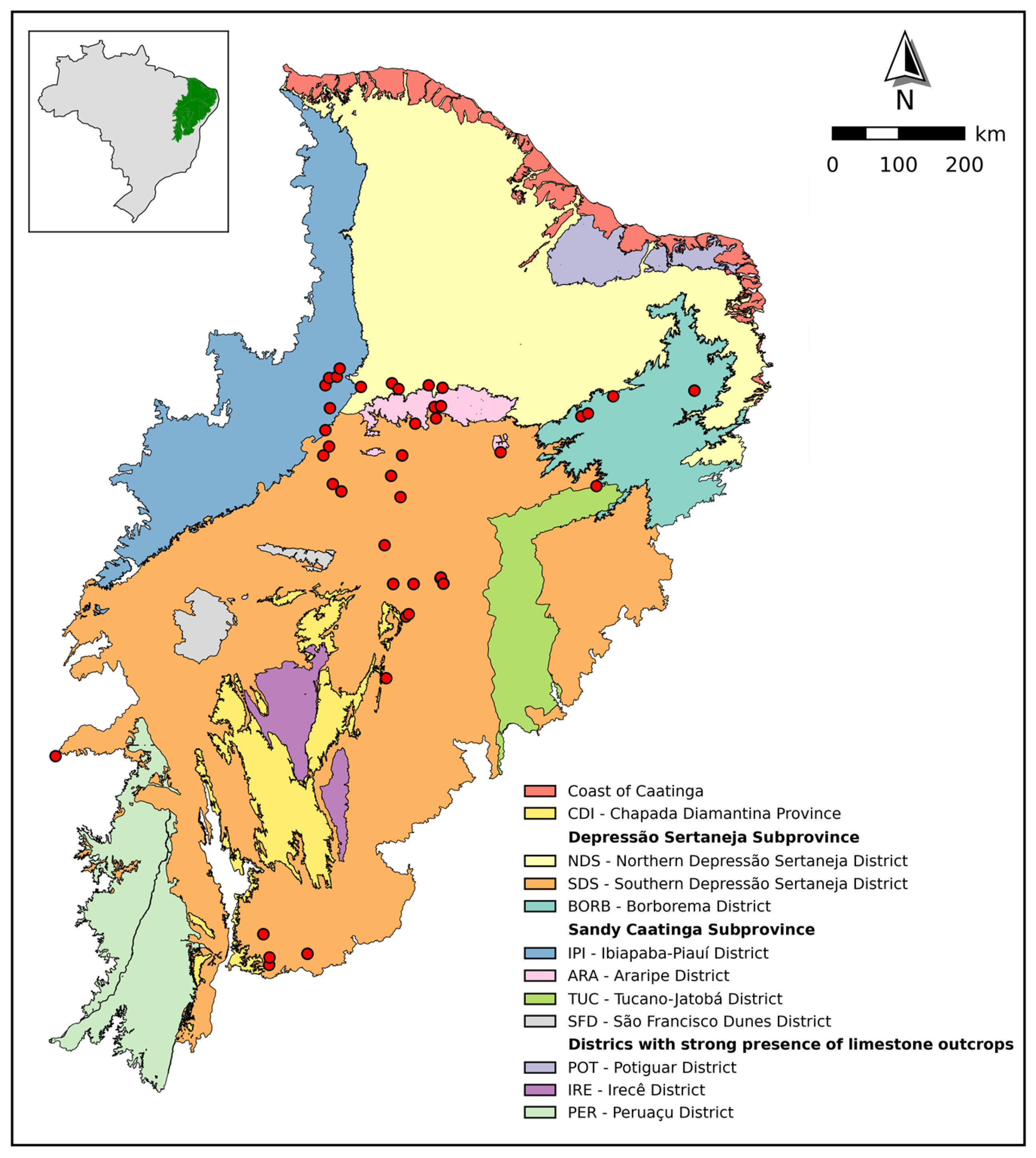
The experiment was conducted at the Experimental Field of Embrapa Semiárido, Petrolina, Pernambuco, Brazil (09°09′ S, 40°22′ W; altitude: 354 m). The plants originated from selected seeds of P. cincinnata maintained in the Passionfruit Active Germplasm Bank (BAG Maracujá) of Embrapa Semiárido (Table S1). Figure 1 shows a map illustrating the geographic origin of the P. cincinnata accessions across Northeastern Brazil, overlaid on the Caatinga Domain according to the delimitation proposed by [17]. Plants were spaced 3.0 m × 5.0 m, with two plants per site, and trained on a single-wire trellis system positioned 1.80 m above the ground. Irrigation was performed twice weekly using a micro-sprinkler system (Amanco Wavin, Joinville, SC, Brazil). The environmental conditions reported in this study refer to the environment in which the plants were grown, not to the accession’s site of provenance.

2.2. Floral Morphometrics and Stigma–Anther Curvature Classes

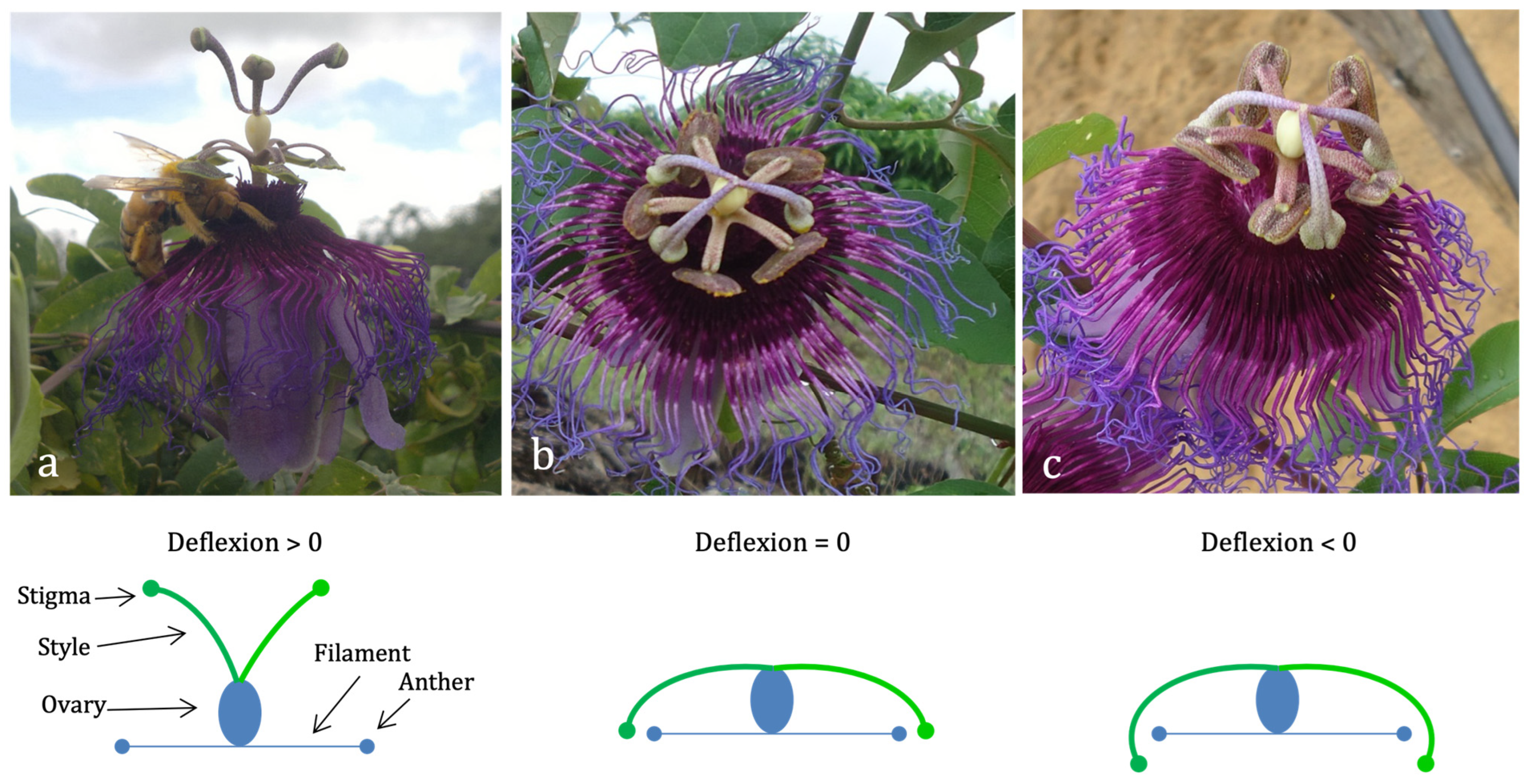
Observations were performed daily between 08:00 and 10:00 h, when flowers were at full anthesis. Flowers were classified according to style deflexion (curvature) relative to the anther line, following [5]: Deflexion < 0: stigmas positioned below the anther line; Deflexion = 0: stigmas positioned at or near the anther line; Deflexion > 0: stigmas positioned above the anther line (Figure 2).

2.3. Pollination Treatments

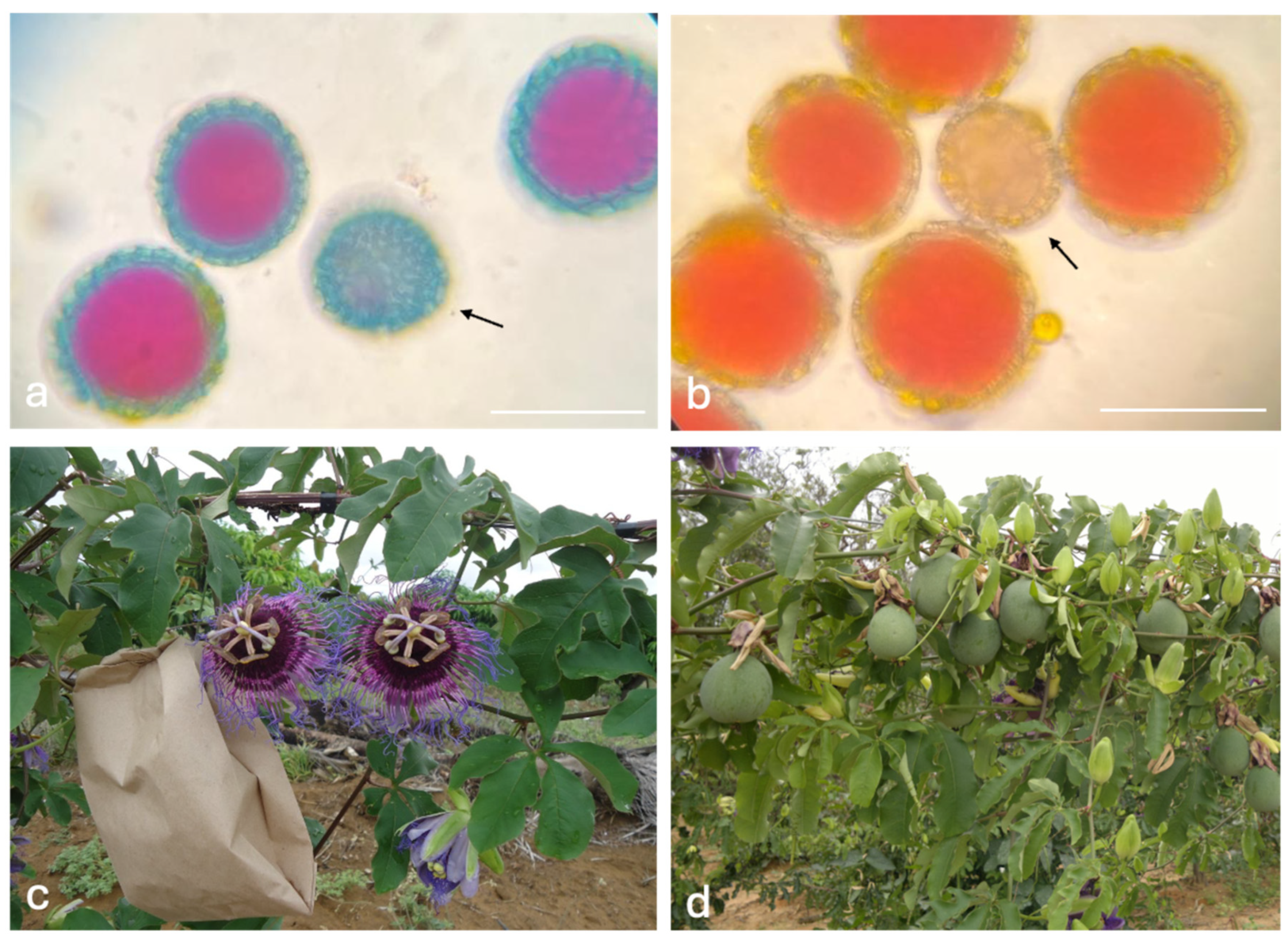
In addition to natural pollination by floral visitors, controlled hand-pollinations were performed using flowers from all three style-deflexion types (d < 0, d = 0, and d > 0). Crosses were carried out between 06:00 and 10:00 h, when flowers were fully open and stigmas exhibited maximum receptivity, as verified by stigma turgidity and mucilage presence. Observations across accessions indicated weak diurnal dichogamy, with anther dehiscence occurring shortly after anthesis and stigmas remaining receptive throughout the morning [16,18]; thus, all hand-pollinations were conducted within this window to minimize variation in sexual phase. Crosses were planned to include all possible combinations among these types (♂ × ♀), as follows: (d < 0 × d < 0), (d < 0 × d = 0), (d < 0 × d > 0); (d = 0 × d < 0), (d = 0 × d = 0), (d = 0 × d > 0); (d > 0 × d < 0), (d > 0 × d = 0), (d > 0 × d > 0). Flower buds at the pre-anthesis stage were bagged with paper bags to ensure isolation (Figure 3). After anthesis, flowers from five selected accessions were identified according to their deflexion type, and at least five flowers per type were used for each cross combination. Self-pollination tests (autogamy/manual selfing) were not performed because P. cincinnata is strongly self-incompatible, and previous studies demonstrate complete fruit-set failure under selfing [2]; thus, this study prioritized controlled outcrosses relevant to natural mating.

2.4. Pollen Viability Assessment

Pollen viability was analyzed using three flowers per deflexion type (d > 0, d < 0, and d = 0), each collected from different plants. Pollen was collected from one anther per flower (three anthers per deflexion type). Anthers were squashed on microscope slides and stained with 1.2% acetic carmine following [19], and with Alexander’s stain [20] for differential detection of viable and non-viable pollen. Under acetic carmine staining, pollen grains retaining dense and homogeneous cytoplasmic content were scored as viable, whereas grains appearing empty, shrunken or lightly stained were considered non-viable. Under Alexander’s staining, pollen grains exhibiting intact cytoplasm and staining purple/red were recorded as viable, whereas grains lacking cytoplasmic contents and staining blue/green were recorded as non-viable. In total, more than 4000 pollen grains were evaluated under a light microscope (Leica Microsystems, Wetzlar, Germany) at 400× magnification.

2.5. Statistical Analyses

Fruit set data from pollination treatments were analyzed using generalized linear mixed models (GLMMs) with a binomial error distribution, considering deflexion type and cross combination as fixed effects, and accession as a random effect. Pollen viability and morphometric data were analyzed by analysis of variance (ANOVA) followed by Tukey’s HSD post hoc test for mean comparisons. Prior to the analyses, the data were tested for normality and homoscedasticity to ensure that the assumptions of the ANOVA were met. Statistical significance was set at p < 0.05. All analyses were performed in R v.4.3.1 [21] using the lme4, emmeans, and ggplot2 packages. Deflexion frequencies (d < 0; d = 0; d > 0) were analyzed using multivariate approaches (RDA, PERMANOVA) and multinomial models. In addition, the X2Y metric (lares package) was computed to quantify how much each predictor reduced prediction error relative to a null model, and χ2 tests and Cramer’s V were applied to evaluate categorical associations between accessions and deflexion types.

3. Results

The GLMM revealed significant differences in the frequency of style-deflexion categories (χ2 = 15.62, df = 2, p < 0.001). Flowers with negative style deflexion (d < 0), in which stigmas were positioned below the anther line, were the most frequent (41.75%), followed by positive deflexion (d > 0) (31.93%) and no deflexion (d = 0) (26.32%) (Table 1 and Table S2).
Artificial pollination experiments involving five accessions (five flowers per cross combination; 25 pollination attempts per combination) demonstrated that style deflexion strongly influenced reproductive success (Table 2; Figure 3). When fruit set was analyzed according to the floral morphology of the female receptor, flowers with stigmas positioned below the anthers (♀ d < 0) produced 55 fruits from 75 pollination attempts (73.3%). In contrast, flowers with stigmas aligned with the anther level (♀ d = 0) set only 7 fruits from 75 attempts (9.3%), whereas flowers with stigmas positioned above the anthers (♀ d > 0) failed to set fruit (0/75). When the two non-receptive morphotypes (♀ d = 0 and ♀ d > 0) are combined, only 7 fruits were formed among 150 pollination attempts (4.7%).
This contrast was highly significant (χ2 = 118.10, df = 1, p < 0.0001; Yates-corrected χ2 = 114.68), confirming that fruit formation is overwhelmingly restricted to crosses involving ♀ d < 0 flowers and supporting a functional reproductive isolation mediated by style deflexion. Under natural pollination, plants produced fruit in approximately 43% of flowers (mean natural fruit set = 0.43 ± 0.04).
Despite differences in fruit set, pollen viability did not vary significantly across deflexion types (p > 0.05). Pollen grains were consistently viable, with 96.71%, 96.45%, and 96.52% viability for flowers with d < 0, d = 0, and d > 0, respectively (Table 3).

4. Discussion

Our results demonstrate that floral herkogamy in Passiflora cincinnata is a key determinant of reproductive success, with a predominance of flowers exhibiting negative style deflexion (d < 0), consistent with previous observations from [2], who reported that 72.6% of flowers displayed downward-curved styles. The high frequency of flowers with stigmas at or above the anther level (d = 0 and d > 0), combined with their very low or null fruit set under controlled pollinations, indicates that many flowers function predominantly as males. This pattern supports the hypothesis that P. cincinnata express a mixed mating strategy with functional andromonoecy, in which morphotypes with stigmas at or above the anther level contribute disproportionately to male function due to their negligible fruit set, whereas only flowers with stigmas positioned below the anthers contribute effectively to female reproduction. Accordingly, flowers with stigmas positioned below the anthers (d < 0) should be regarded as the only morphotype expressing functional hermaphroditism, whereas flowers with stigmas aligned with or above the anthers (d = 0 and d > 0) can be considered functionally males based on their virtual inability to set fruit under controlled pollination. In addition, the contrasting reproductive roles of the floral morphotypes are consistent with the broader framework in which herkogamy and dichogamy act to reduce self-pollination and sexual interference, thereby reinforcing outcrossing in self-incompatible species such as P. cincinnata. This pattern also parallels findings in P. incarnata, where style deflexion and dichogamy not only contribute to limiting self-pollination but are additionally associated with enhanced pollen export and increase male fitness rather than female reproductive success [5,6].
Floral morphologies that promote spatial or temporal separation of sexual functions are recognized mechanisms to reduce sexual interference in hermaphroditic plants [5]. The virtual absence of fruit set in flowers with stigmas aligned with or above the anthers (morphotypes d = 0 and d > 0) may also reflect asymmetric allocation between male and female function, resembling early stages in evolutionary transitions toward sex separation described in recent models [22,23]. In P. cincinnata, the predominance of d < 0 flowers and the absence of fruit set in d = 0 and d > 0 morphotypes suggest strong herkogamy-mediated specialization, where pollen presentation is optimized for pollinators, especially large bees (Xylocopa spp.) [2]. Dai and Galloway [5] demonstrated that herkogamy and dichogamy may evolve primarily under selection on male fitness, consistent with our finding of high pollen viability (~96%) across all morphotypes, indicating that pollen quality is not limiting reproduction, but flower morphology dictates reproductive success.
The high and consistent pollen viability (>96%) observed across floral morphotypes is comparable to values reported for P. cincinnata and other Passiflora species [2,24]. In addition, the phenotypic variation observed among style-deflexion morphotypes may also reflect underlying genetic differences, and partial heritability of these floral traits cannot be excluded. This reinforces that morphological traits rather than gametophytic viability are the key reproductive filters in this species. However, internal female traits, such as possible variation in ovule viability among deflexion morphotypes, may also contribute to the fruit-set patterns observed, and future evaluations of ovule performance will help clarify this possibility. Similarly, studies in P. edulis and P. tripartita show that reproductive barriers are rarely due to pollen sterility but to incompatibility systems and pollinator availability [10,11].
The pronounced herkogamy and functional differentiation among morphotypes reflect a trade-off between pollen export and seed production, as highlighted by [6], who showed antagonistic selection pressures on style deflexion variability, influencing both seed number and seed weight in P. incarnata. Our data suggest that P. cincinnata may maintain morphotype diversity through similar evolutionary pressures, with flowers in which the stigma is positioned below the anthers (d < 0) functioning as the only truly hermaphroditic morphotype, while other morphotypes, although less frequent and unable to set fruit under controlled conditions, may still contribute to pollination ecology by sustaining pollinator visitation and increasing mating opportunities.
Understanding the interplay of floral morphology and pollinator interactions is crucial for conservation and breeding efforts. Studies in P. foetida, P. suberosa, and other wild Passiflora species show that floral architecture is often fine-tuned to specific pollinator groups, with Xylocopa bees being essential for successful fruiting [3,11,12]. In semi-arid agroecosystems, where pollinator populations may be threatened, knowledge of floral morphotype frequencies and pollination dynamics can inform crop management strategies, such as optimizing pollinator attraction or selecting morphotypes with higher reproductive output. These findings have practical implications for the cultivation and management of P. cincinnata, particularly in semi-arid regions. Although flower morphotypes cannot be identified at the seed or seedling stage, variation in style deflexion and the resulting differences in reproductive success may still influence fruit set under field conditions. Thus, once plants reach reproductive maturity, the identification of individuals consistently expressing the favorable morphotype (d < 0) can help guide the selection of superior genotypes and support management practices aimed at optimizing pollinator activity, improving planting designs, and enhancing overall productivity.
This study focused on controlled hand-pollinations and floral morphometrics and did not evaluate other potential contributors to female reproductive success, such as ovule development, stylar physiology, or post-zygotic barriers. Although our results suggest functional differences among deflexion morphotypes, the genetic basis of such variation remains unknown. Future research combining quantitative genetic analyses, controlled crosses across generations, and detailed anatomical or physiological evaluations of ovule performance would help clarify the mechanisms underlying style-deflexion polymorphism and its evolutionary consequences in P. cincinnata.

5. Conclusions

Our results demonstrate that style-deflexion generates strong functional differences among floral morphotypes of P. cincinnata. Only flowers with stigmas positioned below the anthers (d < 0) express full hermaphroditic function, whereas flowers with stigmas aligned with or above the anthers (d = 0 and d > 0) behave as functionally male under controlled pollination. The marked fruit-set combined with the stability of pollen viability among morphotypes suggests that stigma–anther geometry is the primary determinant of female reproductive success in this species. Phenotypic variation in deflexion may also reflect underlying genetic components, and reduced fruit set in d = 0 and d > 0 morphotypes could be linked to patterns of asymmetric resource allocation described for early stages in the evolution of sex separation. Future studies assessing ovule performance, floral physiology, and the genetic basis of deflexion will help clarify the mechanisms underlying this floral polymorphism.

Supplementary Materials

The following supporting information can be downloaded at: https://www.mdpi.com/article/10.3390/jzbg7010002/s1, Table S1: List of the 57 accessions of Passiflora cincinnata Mast. from the Active Germplasm Bank of Embrapa Semiárido, along with the collection site and edaphoclimatic characteristics. Table S2: Frequency distribution of flower types according to stigma deflexion in 57 accessions of Passiflora cincinnata Mast. from the Active Germplasm Bank of Embrapa Semiárido, based on a sample of 10 flowers per accession.

Author Contributions

Conceptualization, N.F.d.M. and L.P.C.N.; methodology, L.P.C.N. and N.F.d.M.; investigation, L.P.C.N. and T.C.d.S.; data curation, L.P.C.N. and N.F.d.M.; writing—original draft preparation, N.F.d.M.; writing—review and editing, L.P.C.N., J.M.R. and N.F.d.M.; visualization, L.P.C.N.; supervision, N.F.d.M. and J.M.R.; project administration, N.F.d.M. All authors have read and agreed to the published version of the manuscript.

Funding

This research was funded by Empresa Brasileira de Pesquisa Agropecuária (Grant numbers SEG-10.20.02.12.00.07.01 and SEG-20.23.02.004.00.05), Facepe (L.P.C.N.—Grant number IBPG-0011-5.01/24) and CNPq (N.F.M.—Grant number PQ-306505/2022-3).

Institutional Review Board Statement

Not applicable.

Informed Consent Statement

Not applicable.

Data Availability Statement

The data presented in this study are available within the article.

Acknowledgments

The authors would like to thank the Coordenação de Aperfeiçoamento de Pessoal de Nível Superior (CAPES—0001), Embrapa Semiárido, and the Universidade Estadual de Feira de Santana. We are grateful to the anonymous reviewers for their constructive comments and insightful suggestions, which substantially improved the quality of this manuscript. In particular, we thank Victor Rosas-Guerrero (Superior School in Sustainable Development, Autonomous University of Guerrero, Tecpan de Galeana, Guerrero, Mexico) for his valuable contribution during the peer-review process.

Conflicts of Interest

Authors Juliana Martins Ribeiro and Natoniel Franklin de Melo were employed by the company Embrapa Semiárido. The remaining authors declare that the research was conducted in the absence of any commercial or financial relationships that could be construed as a potential conflict of interest.

References

  1. Bernacci, L.C.; Nunes, T.S.; Mezzonato, A.C.; Milward-de-Azevedo, M.A.; Imig, D.C.; Cervi, A.C. Passiflora . In Flora do Brasil 2020; Jardim Botânico do Rio de Janeiro: Rio de Janeiro, Brazil, 2020. Available online: https://floradobrasil2020.jbrj.gov.br/reflora/floradobrasil/FB12508 (accessed on 23 November 2025).
  2. Kiill, L.H.P.; Siqueira, K.M.M.; Araújo, F.P.; Trigo, S.P.M.; Feitoza, E.A.; Lemos, I.B. Biologia reprodutiva de Passiflora cincinnata Mast. (Passifloraceae) na região de Petrolina (Pernambuco, Brazil). Oecol. Aust. 2010, 14, 115–127. [Google Scholar] [CrossRef]
  3. Amela García, M.T. Breeding system and related floral features under natural and experimental conditions of Passiflora suberosa (Passifloraceae). Bol. Soc. Argent. Bot. 2008, 43, 83–93. [Google Scholar]
  4. Webb, C.J.; Lloyd, D.G. The avoidance of interference between the presentation of pollen and stigmas in angiosperms. II. Herkogamy. N. Z. J. Bot. 1986, 24, 163–178. [Google Scholar] [CrossRef]
  5. Dai, C.; Galloway, L.F. Do dichogamy and herkogamy reduce sexual interference in a self-incompatible species? Funct. Ecol. 2011, 25, 271–278. [Google Scholar] [CrossRef]
  6. Dai, C.; Liang, X.; Ren, J.; Liao, M.; Li, J.; Galloway, L.F. The mean and variability of a floral trait have opposing effects on fitness traits. Ann. Bot. 2016, 117, 421–429. [Google Scholar] [CrossRef] [PubMed]
  7. Lloyd, D.G.; Webb, C.J. The evolution of heterostyly. In Evolution and Function of Heterostyly; Barrett, S.C.H., Ed.; Springer: Berlin/Heidelberg, Germany, 1992; pp. 151–178. [Google Scholar]
  8. Armbruster, W.S.; Bolstad, G.H.; Hansen, T.F.; Keller, B.; Conti, E.; Bjerknes, Ø.; Pélabon, C. The measure and mismeasure of reciprocity in heterostylous flowers. New Phytol. 2009, 183, 530–544. [Google Scholar] [CrossRef] [PubMed]
  9. Barrett, S.C.H. “A most complex marriage arrangement”: Recent advances on heterostyly and unresolved questions. New Phytol. 2019, 224, 1051–1067. [Google Scholar] [CrossRef] [PubMed]
  10. Ángel-Coca, C.; Nates-Parra, G.; Ospina-Torres, R.; Melo Ortiz, C.D.; Amaya, M. Biología floral y reproductiva de la gulupa Passiflora edulis Sims f. edulis. Caldasia 2011, 33, 433–451. [Google Scholar]
  11. Beavon, M.A.; Kelly, D. Invasional meltdown: Pollination of the invasive liana Passiflora tripartita var. mollissima (Passifloraceae) in New Zealand. N. Z. J. Ecol. 2012, 36, 100–107. [Google Scholar]
  12. Amela García, M.T.; Hoc, P.S. Biología floral de Passiflora foetida (Passifloraceae): Fases florales, polinizadores y sistema reproductivo. Rev. Biol. Trop. 1998, 46, 191–201. [Google Scholar]
  13. Barrett, S.C.H. The evolution of plant sexual diversity. Nat. Rev. Genet. 2002, 3, 274–284. [Google Scholar] [CrossRef] [PubMed]
  14. Barrett, S.C.H.; Shore, J.S. New insights on heterostyly: Comparative biology, ecology and genetics. In Self-Incompatibility in Flowering Plants: Evolution, Diversity, and Mechanisms; Franklin-Tong, V.E., Ed.; Springer: Berlin/Heidelberg, Germany, 2008; pp. 3–32. [Google Scholar] [CrossRef]
  15. Ferrero, V.; de Vega, C.; Stafford, G.I.; van Staden, J.; Johnson, S.D. Heterostyly and reciprocal herkogamy promote pollen transfer in Nerine humilis (Amaryllidaceae). Ann. Bot. 2011, 108, 797–807. [Google Scholar] [CrossRef]
  16. Glover, B.J. Understanding Flowers and Flowering: An Integrated Approach, 2nd ed.; Oxford University Press: Oxford, UK, 2014. [Google Scholar]
  17. Moro, M.F.; Amorim, V.O.; de Queiroz, L.P.; da Costa, L.R.F.; Maia, R.P.; Taylor, N.P.; Zappi, D.C. Biogeographical districts of the Caatinga dominion: A proposal based on geomorphology and endemism. Bot. Rev. 2024, 90, 376–429. [Google Scholar] [CrossRef]
  18. Harder, L.D.; Barrett, S.C.H. Ecology and Evolution of Flowers; Oxford University Press: Oxford, UK, 2006. [Google Scholar]
  19. Radford, A.E.; Dickison, W.C.; Massey, J.R.; Bell, C.R. Vascular Plant Systematics; Harper & Row: New York, NY, USA, 1974. [Google Scholar]
  20. Alexander, M.P. Differential staining of aborted and nonaborted pollen. Stain Technol. 1969, 44, 117–122. [Google Scholar] [CrossRef] [PubMed]
  21. R Core Team. R: A Language and Environment for Statistical Computing; R Foundation for Statistical Computing: Vienna, Austria, 2023. [Google Scholar]
  22. Barrett, S.C.H.; Hough, J. Sexual dimorphism in flowering plants. J. Exp. Bot. 2013, 64, 67–82. [Google Scholar] [CrossRef] [PubMed]
  23. Dorken, M.E.; Barrett, S.C.H. Sex determination and the evolution of dioecy from monoecy in angiosperms. Proc. R. Soc. B Biol. Sci. 2021, 288, 20211189. [Google Scholar]
  24. Cobra, S.S.O.; Silva, C.A.; Krause, W.; Lage, L.A. Availability of floral resources in yellow passion fruit cultivars. Commun. Sci. 2017, 8, 555–561. [Google Scholar] [CrossRef]
Figure 1. Distribution of Passiflora cincinnata Mast. accessions in Northeastern Brazil, overlaid on the Caatinga Domain as delimited by Moro et al. [17]. The shaded area represents the extent of the Caatinga biome, while red circles indicate the geographic origin of the accessions conserved in the germplasm bank.
Jzbg 07 00002 g001
Figure 2. Flowers and diagrams of style deflexion types in Caatinga passionfruit (Passiflora cincinnata Mast.). (a) Flower with deflexion > 0 (stigmas positioned above the anther line). Note the presence of a pollinator of the genus Xylocopa. (b) Flower with deflexion = 0 (stigmas positioned at or near the anther line). (c) Flower with deflexion < 0 (stigmas positioned below the anther line).
Jzbg 07 00002 g002
Figure 3. Pollen viability and controlled crosses between flowers with different style deflexion types in Passiflora cincinnata Mast. (a) Pollen grains stained with Alexander’s stain; (b) pollen grains stained with 1.2% acetic carmine. Well-stained grains indicate preserved cytoplasmic content and functional integrity; arrows in (a,b) indicate non-viable grains. (c) Open flowers and one flower bagged with paper for use in controlled pollination; (d) fruits formed after controlled crosses. Scale bars = 40 µm in (a,b).
Jzbg 07 00002 g003
Table 1. Summary of stigma–anther deflexion categories in 57 accessions of Passiflora cincinnata based on 570 flowers (10 per accession).
Deflexion CategoryTotal FlowersPercentage (%)
d < 023841.75
d = 015026.32
d > 018231.93
Table 2. Fruit set resulting from artificial pollination among Passiflora cincinnata Mast. accessions with different style deflexion types. Each cross combination involved five accessions and five flowers per cross (25 pollination attempts per combination).

d < 0d = 0d > 0
d < 02050
d = 01920
d > 01600
Total55
(73.3%)
7
(0.02%)
0
(0.0%)
Table 3. Evaluation of pollen viability in flowers of Passiflora cincinnata Mast. with different style deflexion types, assessed using 1.2% acetic carmine [19] and Alexander’s stain [20].
Style Deflexion TypeViability
(Acetic Carmine)
Viability
(Alexander Stain)
Mean Pollen Grain Viability (%)Total Grains Counted
d < 0 96.4197.0196.711620
d = 0 96.0996.8196.451333
d > 0 96.4296.6296.521082
Disclaimer/Publisher’s Note: The statements, opinions and data contained in all publications are solely those of the individual author(s) and contributor(s) and not of MDPI and/or the editor(s). MDPI and/or the editor(s) disclaim responsibility for any injury to people or property resulting from any ideas, methods, instructions or products referred to in the content.