1. Introduction
Major depressive disorder (MDD) is characterized not only by affective and cognitive disturbances but also by pervasive alterations in sensory and perceptual processing that reflect broader cortical dysfunction [
1]. Emerging evidence suggests that depression involves disrupted integration across sensory, motor, and cognitive domains, leading to measurable impairments in psychomotor speed, attention, and sensory discrimination [
2,
3]. Among these, tactile perception offers a particularly sensitive window into cortical processing efficiency and interhemispheric coordination, as it depends on dynamic sensorimotor integration within well-defined neural circuits [
4]. Quantifying these subtle sensory anomalies through objective measures may thus provide valuable biomarkers for identifying neurofunctional alterations associated with depression [
5].
In contemporary clinical psychiatry, diagnosis of depressive disorder remains primarily symptom-based, relying on subjective reporting and clinician-rated scales. This approach, although clinically practical, may fail to capture underlying neurobiological heterogeneity [
1,
2]. The identification of objective, mechanism-informed biomarkers capable of complementing traditional psychiatric assessment represents a critical step toward improving diagnostic precision and treatment stratification [
2,
3].
Recent studies employing computerized vibrotactile testing, such as the Brain Gauge system, have demonstrated that measures of reaction time, variability, and discrimination accuracy can capture cortical processing deficits associated with various neuropsychiatric conditions, including depression [
4,
6]. These tasks probe multiple dimensions of somatosensory and cognitive function—such as temporal order judgment, duration discrimination, and amplitude differentiation—allowing for the assessment of sensory precision and cortical plasticity [
7]. In depressive disorders, altered tactile processing has been linked to aberrant thalamocortical oscillations and impaired gating of sensory input, suggesting that psychomotor slowing and response inconsistency may reflect deeper network-level dysregulation [
2,
3]. Thus, quantitative tactile metrics provide an objective, reproducible means of characterizing cortical function that may complement traditional clinical assessments of depression [
8,
9].
However, despite increasing evidence of sensorimotor dysfunction in MDD, few studies have applied multivariate statistical models to predict depression status from objective tactile metrics, leaving a methodological gap in the quantitative characterization of such alterations [
2,
3,
7,
10]. Previous research has demonstrated that psychomotor slowing and increased intra-individual variability are consistently associated with depressive outcomes, yet these measures have rarely been integrated into logistic or machine-learning frameworks capable of distinguishing depressed from non-depressed individuals based on sensory-derived data [
7,
10]. By employing the Brain Gauge vibrotactile assessment and a cross-validated logistic regression approach, the present study focused on whether a combined set of tactile metrics—particularly those related to discrimination accuracy, reaction time, and variability—can serve as discriminative biomarkers of depression beyond traditional clinical observation. Finally, acknowledging that individual heterogeneity in depression often hampers the reliability of categorical diagnoses, the use of quantitative predictive modeling may provide a reproducible and mechanistically grounded framework for identifying neurofunctional profiles associated with depressive symptomatology.
Therefore, the objective of this study was to determine whether alterations in tactile processing are associated with depression using a comprehensive set of Brain Gauge metrics. Specifically, we sought to (i) compare cortical and behavioral measures between depressed and non-depressed individuals, (ii) quantify the magnitude of group differences through effect-size analyses, and (iii) identify independent predictors of depression status through cross-validated logistic modeling. We hypothesized that individuals with depression would exhibit slower and more variable tactile responses compared with healthy controls, and that vibrotactile metrics would discriminate between groups, serving as potential quantitative biomarkers of depression-related cortical dysfunction.
2. Materials and Methods
2.1. Recruitment and Participants
Participants were recruited through community advertisements and direct invitation at the Neuromodulation Laboratory of the Federal University of Juiz de Fora. Interested individuals contacted the research team and were screened for eligibility. The informed consent process was conducted by a trained research investigator prior to any assessment procedures. The BDI-I was administered in person by a certified neuropsychologist. The somatosensory assessment was conducted by trained laboratory staff using standardized instructions.
A two-tailed a priori sample size calculation (effect size = 0.94; α = 0.05; power = 0.95) indicated a minimum required sample of 62 participants. Considering an anticipated 30% attrition rate, we recruited a total of 82 participants. The inclusion criteria were as follows: participants between 18 and 45 years, right-handed, who did not have impairments in auditory acuity, and with no history of self-report use of any psychoactive substances. The exclusion criteria included any self-reported history of serious or unstable medical conditions (e.g., diabetes mellitus, hypertension); a comorbid diagnosis of psychiatric disorders such as schizophrenia, Parkinson’s disease, schizoaffective disorder, or personality disorders; neurological illnesses including epilepsy, dementia, or traumatic brain injury; alcohol or substance abuse within the previous six months or a current diagnosis of a substance-related psychiatric disorder; intoxication or high-dose benzodiazepine use within 24 h before assessment; receipt of electroconvulsive therapy or repetitive transcranial magnetic stimulation within the past three months; and pregnancy or lactation in women. All participants were fully informed about the study objectives and procedures before inclusion, and written informed consent was obtained from each subject. The research protocol received prior approval from the Ethics Committee of the Federal University of Juiz de Fora (CAAE: 86938325.4.0000.5147, date of approval: 1 September 2025).
2.2. Clinical Assessment
All participants were assessed at the premises of the Neuromodulation Laboratory at the Federal University of Juiz de Fora (Governador Valadares, Minas Gerais, Brazil). Depression was assessed using the 21-item Brazilian version of the Beck Depression Inventory (BDI-I), applied by a certified neuropsychologist. The BDI-I is a self-report instrument widely validated for clinical and research settings in Brazil. Each item is rated on a 4-point Likert scale ranging from 0 (“absent”) to 3 (“severe”), resulting in a total score between 0 and 63, with higher scores indicating greater depressive symptom severity. The diagnostic criterion for depression followed the conventional cutoff established in the Brazilian validation study, in which scores ≥ 19 indicate the presence of clinically relevant depressive symptoms, whereas lower scores denote minimal or absent symptoms. The instrument demonstrates high internal consistency (Cronbach’s α = 0.86) and strong convergent validity with structured clinical interviews and other standardized depression scales. Participants were divided in 2 groups: those diagnosed with depression, and the control group without depression.
2.3. Somatosensory Assessment
All somatosensory assessments were conducted by trained research staff who completed standardized instruction in the administration of the Brain Gauge battery prior to data collection. The assessment protocol followed a fixed procedural script to ensure consistency across participants, including standardized verbal instructions, demonstration trials, and controlled task sequencing. Testing was performed in a quiet, temperature-controlled laboratory environment to minimize external sensory interference. Participants were seated comfortably with the non-dominant hand positioned consistently on the device according to manufacturer guidelines, and hand placement was visually verified before each task. Research staff monitored adherence to instructions but did not provide performance feedback during test trials. To reduce expectancy or performance bias, assessors were not involved in participants’ clinical classification beyond procedural administration. These standardized procedures were implemented to ensure reproducibility and minimize operator-dependent variability.
Comprehensive somatosensory evaluation was performed using the Brain Gauge (Cortical Metrics, Carrboro, NC, USA), a computerized vibrotactile device designed to quantify cortical and perceptual processing through multi-domain tactile paradigms. Participants rested their non-dominant hand on the device with the index (D2) and middle (D3) fingertips placed over two 5 mm probes delivering controlled vibrotactile stimuli. Responses were made with the dominant hand using a computer mouse, selecting whether the left or right stimulus occurred first, lasted longer, or differed in amplitude, frequency, or duration.
The study employed the full Brain Gauge assessment battery, which comprises a series of adaptive two-alternative forced-choice tasks probing multiple aspects of somatosensory and cognitive function, including the variables: Reaction Time (RT), Reaction Time Variability (RTVar), Amplitude Discrimination (AD), Duration Discrimination (DUR), Temporal Order Judgment (TOJ), TOJ with Confounding Stimulus (TOJc), Speed, Accuracy, and Plasticity. Each task consisted of an initial training phase (three trials with feedback) followed by approximately 20–25 test trials (without feedback). Task difficulty was automatically adjusted based on participant performance, decreasing the inter-stimulus interval or stimulus duration following correct responses and increasing it after incorrect ones, according to a staircase paradigm.
The Brain Gauge software (version 2.0.0-575) automatically calculated quantitative indices for each domain, including latency measures (in milliseconds) and normalized performance scores (0–100), where higher values indicate better performance. For the present study, all raw task metrics and derived composite indices were exported for analysis, including accuracy, speed, consistency, and information processing metrics that reflect both peripheral sensory integrity and cortical processing efficiency. These measures together provide a multidimensional profile of tactile perception, sensorimotor integration, and cognitive function, allowing for objective comparison between participants with and without depressive symptoms.
2.4. Statistical Procedures
All statistical analyses were performed using Python (version 3.11) with the pandas, scipy, statsmodels, and scikit-learn libraries. Preliminary data screening involved the identification of missing values, assessment of outliers, and evaluation of variable distributions. The Shapiro–Wilk test indicated deviation from normality in several variables; therefore, nonparametric statistical tests were used. Continuous variables were summarized as median and interquartile ranges (IQR). Group differences between depressed and non-depressed participants were assessed using the Mann–Whitney U test. All p-values were adjusted for multiple comparisons using the Benjamini–Hochberg false discovery rate (FDR) post hoc procedure. The rank-biserial correlation method was used to calculate the effect sizes (ES). The ES was qualitatively classified following the thresholds: small (>0.3); moderate (0.4 to 0.6); large (<0.70).
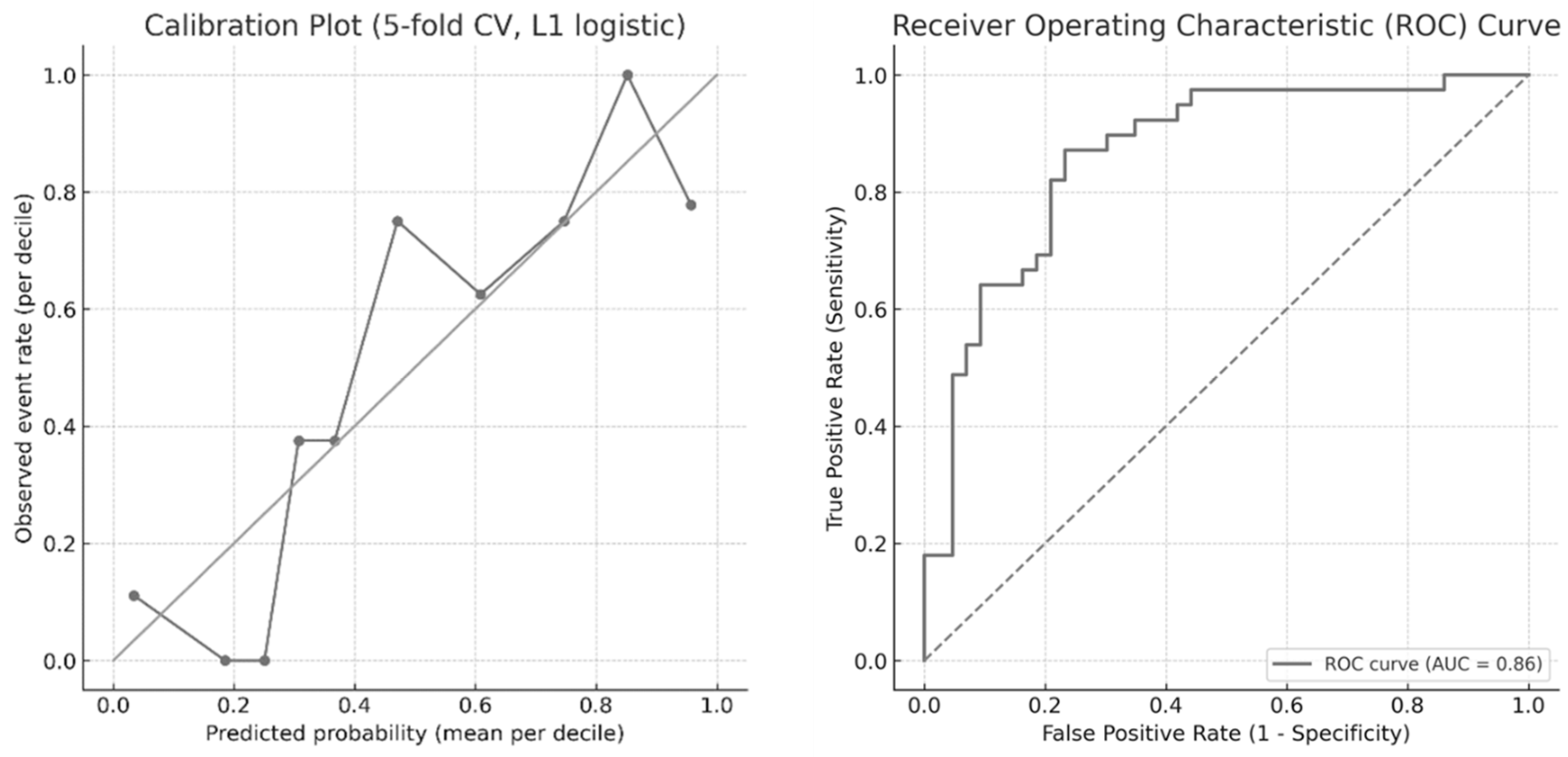
To identify independent predictors of depression status, a multivariate logistic regression approach was implemented. Before modeling, all continuous predictors were imputed by the median and standardized as z-scores to ensure comparability of coefficients and convergence stability. Some Brain Gauge metrics were potentially correlated; thus, a two-stage modeling strategy was adopted: 1. logistic regression with L1-penalization (LASSO) was applied using five-fold stratified cross-validation (solver = Stochastic Average Gradient Augmented or SAGA, penalty = L1, scoring = area under the curve or AUC). The L1 penalty introduces sparsity by shrinking non-informative coefficients toward zero; 2. The optimal penalty parameter (inverse of regularization strength or C) was automatically determined as the one maximizing the cross-validated area under the ROC curve (AUC). Only variables with non-zero coefficients in the final cross-validated model were retained as independent predictors. This procedure simultaneously controls for multicollinearity and overfitting, favoring a parsimonious, data-driven selection of features. The subset of predictors selected in the LASSO step was then refitted in a conventional maximum-likelihood logistic regression. This unpenalized model provides unbiased coefficient estimates suitable for clinical interpretation. Regression coefficients (β) were exponentiated to yield odds ratios (ORs) with 95% confidence intervals (95% CI). Model fit was assessed with the Hosmer–Lemeshow goodness-of-fit test and the Nagelkerke pseudo-R2 statistic. Predictive performance was assessed using a stratified five-fold cross-validation of the penalized model, reporting the AUC, sensitivity, specificity, precision, recall, and F1-score at the Youden-optimal cutoff (maximizing sensitivity + specificity − 1). Calibration of predicted probabilities was assessed by grouping predictions into deciles and plotting observed versus expected event rates. All tests were two-tailed, with α = 0.05. This analytic framework ensures that the resulting model balances discriminative performance, interpretability, and robustness, while transparently documenting the data-driven process by which Brain Gauge metrics were selected as independent predictors of depression status.
4. Discussion
The present findings suggest that depression is associated with greater temporal instability in sensorimotor processing—indexed by elevated reaction time variability (RT Variability)—and with lower task speed, whereas controls show the opposite pattern. These findings align with contemporary frameworks that reconceptualize MDD as a disorder marked by psychomotor slowing and timing control disorder rather than purely affective disturbance. In particular, meta-analytic and actigraphy-based evidence consistently demonstrates reduced motor activity and slowed behavior in depressive samples, which is congruent with our lower Speed and higher RT Variability in the MDD group [
11,
12].
Beyond simple chronometry, the between-group differences also encompassed temporal judgments—such as duration discrimination and temporal order judgment—suggesting broader cortical timing and integration deficits. This pattern dovetails with vibrotactile and multisensory timing literature showing that TOJ and duration judgments sensitively index cortical temporal precision and integration, which are plausible loci of dysfunction in affective illness [
13]. Mechanistically, the current timing abnormalities are compatible with reports of altered thalamocortical and frontoparietal oscillations in MDD, where atypical network dynamics could degrade temporal fidelity and response stability [
13,
14,
15].
The analysis showed Speed and RT Variability as independent predictors in our cross-validated logistic model, supporting their non-redundant contribution to case–control discrimination. While machine-learning approaches have classified depression from other digital signals (e.g., actigraphy, smartphone keystrokes), tactile metrics have been underexplored, so our results extend digital-phenotyping evidence into the somatosensory domain [
16,
17,
18,
19]. Notably, the Brain Gauge platform has preliminary psychometric support [
7,
9,
20]. It also has shown sensitivity to neuropsychiatric dysfunction, lending plausibility to its use as an objective readout of cortical efficiency in MDD [
9,
21].
The magnitude and breadth of the effects—several metrics surviving FDR correction with moderate-to-very-large effect sizes—argue against random fluctuation and in favor of clinically meaningful differences. Those results mirror broader evidence that psychomotor and timing abnormalities in depression are present across measurement modalities, including wearables and laboratory tasks [
12]. At the same time, our null results for simultaneous and sequential amplitude discrimination after multiple-comparison control suggest that not all tactile domains are equivalently impacted, which is consistent with the literature emphasizing temporal rather than intensity coding as the more sensitive probe of cortical dysregulation [
13].
From a translational perspective, our model achieved strong discrimination (AUC 0.86) with balanced sensitivity and specificity and good calibration under cross-validation, indicating potential for clinic-adjacent screening or phenotyping. Comparable performance ranges have been reported for machine-learning systems trained on other digital signals in MDD, suggesting that tactile metrics could complement existing toolkits rather than compete with them [
17]. Moreover, the neurophysiological plausibility of a timing-instability phenotype is reinforced by EEG literature linking depressive symptoms to aberrant oscillatory dynamics and long-range temporal correlations that can normalize with successful treatment [
22].
Importantly, the present findings should not be interpreted as contradicting established monoaminergic models of depression or implying the inefficacy of conventional pharmacotherapy. Rather, they suggest that psychomotor slowing and temporal instability may represent partially independent neurofunctional dimensions within the depressive phenotype. If replicated longitudinally, tactile timing metrics such as RT variability and Speed could serve not only as diagnostic markers but also as stratification tools for treatment personalization. For instance, psychomotor-dominant profiles characterized by heightened temporal variability may theoretically show differential responsiveness to interventions known to modulate fronto-parietal and thalamocortical dynamics, including dopaminergic or noradrenergic agents, psychostimulant augmentation strategies, or neuromodulatory approaches such as repetitive transcranial magnetic stimulation and rhythmic sensory stimulation. While the current cross-sectional design precludes direct conclusions regarding treatment mechanisms, these results provide a mechanistically grounded framework for future studies investigating whether cortical timing biomarkers can inform precision-based therapeutic decision-making in major depressive disorder.
Beyond predictive performance, these findings have direct implications for clinical psychiatry. In routine psychiatric practice, the diagnosis and monitoring of depressive disorders remain largely dependent on subjective symptom reporting and clinician-rated scales, which may insufficiently capture underlying neurobiological heterogeneity. The identification of quantifiable cortical timing instability as a measurable dimension of the depressive phenotype supports the integration of biologically grounded markers into psychiatric assessment frameworks. Rather than replacing conventional diagnostic criteria, tactile metrics such as reaction time variability and Speed may serve as complementary tools to refine phenotypic characterization, support objective monitoring of psychomotor dysfunction, and inform future stratified treatment approaches. Within the context of biological psychiatry, the present results contribute to an emerging model in which measurable alterations in cortical dynamics provide mechanistic anchors for understanding symptom expression and potentially guiding precision-based interventions. Although longitudinal validation is required, the incorporation of such objective neurofunctional markers may represent an important step toward more integrated, interdisciplinary models of psychiatric diagnosis and treatment.
Strengths of this study include a comprehensive vibrotactile battery, FDR control of multiplicity, and a transparent pipeline combining LASSO feature selection with maximum-likelihood refitting for interpretable odds ratios—design choices aligned with best practices for biomarker development. The use of objective, standardized tasks also addresses calls for quantifiable, mechanism-proximal endpoints in psychiatric research [
16]. Nevertheless, limitations warrant caution: depressive symptoms were assessed via self-report, thus, social desirability bias cannot be excluded. Additionally, voluntary recruitment may introduce non-response bias. Although the tasks were standardized, participant awareness of being evaluated may have influenced performance (Hawthorne effect). Also, depression classification using BDI-I cut-offs may introduce diagnostic noise relative to interview-based diagnoses; our right-handed cohort limits generalizability; exclusion of psychoactive-substance users improves internal validity but reduces ecological representativeness; and the cross-sectional design precludes causal inference or assessment of sensitivity to change. These caveats are common across digital biomarker studies and underscore the need for multi-site, out-of-sample validation with standardized clinical anchors [
17]. Future work should test whether RT Variability and Speed are change-sensitive to treatments (e.g., pharmacotherapy, psychotherapy, neuromodulation) and whether shifts in these metrics track normalization of oscillatory dynamics or predict remission/relapse. Randomized and longitudinal designs could also compare tactile metrics against actigraphy and keystroke-based markers to quantify incremental prognostic value and ecological feasibility [
17,
18,
19]. Finally, given preliminary work showing that vibrotactile stimulation can modulate cortical rhythms and mood-relevant symptoms, multimodal studies may probe whether targeted sensory interventions can reduce temporal variability and improve psychomotor efficiency in MDD [
23].
In summary, the present data suggest tactile timing (RT Variability) and execution speed as compact, objective correlates of the depressive phenotype that are consistent with modern “speed disorder” accounts of MDD and with large-scale digital phenotyping results—while also revealing domain specificity (timing > intensity) within somatosensory processing. With rigorous external validation and longitudinal testing, these tactile metrics could join the growing repertoire of mechanistically interpretable digital biomarkers for affective disorders.
5. Conclusions
Objective tactile metrics derived from vibrotactile assessment—particularly execution Speed and reaction time variability—demonstrated robust discriminative capacity between individuals with and without major depressive disorder. These measures captured core neurofunctional dimensions of depression, namely psychomotor slowing and temporal instability, which are increasingly recognized as biologically meaningful components of the depressive phenotype. By integrating cross-validated logistic modeling with mechanistically grounded cortical metrics, the present findings contribute to the field of biological psychiatry by identifying quantifiable markers of altered cortical timing dynamics in major depressive disorder.
Within the context of clinical psychiatry, such objective measures may complement traditional symptom-based assessment by providing reproducible, neurofunctionally informed indicators of psychomotor dysfunction. Although these findings do not replace established diagnostic frameworks, they support the incorporation of biologically anchored markers into interdisciplinary models of psychiatric evaluation. With longitudinal validation and external replication, tactile timing metrics may contribute to improved phenotypic stratification, objective monitoring of symptom trajectories, and the development of precision-guided therapeutic strategies in major depressive disorder.