


Abstract
(1) Background: The families of military personnel preparing for deployment are exposed to anticipatory stressors that may adversely affect their psychological well-being. This study aimed to examine the associations between anxiety, psychological resilience, and trait hope among the family members of military personnel during the pre-deployment period. (2) Methods: A cross-sectional online survey was conducted between 20 September and 20 December 2025 and included 73 Romanian adult participants. From a psychiatric perspective, anxiety during the pre-deployment phase represents a clinically relevant form of anticipatory distress that may benefit from early identification and preventive intervention. Anxiety was assessed using the Generalized Anxiety Disorder 7-item scale (GAD-7), psychological resilience with the Brief Resilience Scale (BRS), and trait hope with the Adult Hope Scale (Agency and Pathways subscales). Pearson correlation analyses, multivariable linear regression, and hierarchical regression models were applied. (3) Results: Participants reported moderate anxiety levels (GAD-7 mean 7.52 ± 4.98). Anxiety was strongly negatively correlated with psychological resilience (r = −0.75, p < 0.001) and moderately negatively correlated with total hope (r = −0.67, p < 0.001), Agency (r = −0.61, p < 0.001), and Pathways (r = −0.64, p < 0.001). Psychological resilience emerged as a significant negative predictor of anxiety (β = −0.64, p < 0.001). Hierarchical regression showed that trait hope explained additional variance in anxiety severity beyond resilience and sociodemographic variables (ΔR2 = 0.07, p < 0.001). (4) Conclusions: Psychological resilience and trait hope were independently and jointly associated with lower pre-deployment anxiety in military families, underscoring their relevance to preventive and community psychiatry as modifiable resources for early screening and non-pharmacological intervention.
1. Introduction
In the context of the Romanian Armed Forces, military deployments refer to the temporary assignment of Romanian military personnel outside the national territory to participate in international peacekeeping, collective defense, and security operations under the auspices of multinational organizations such as the North Atlantic Treaty Organization (NATO) and the European Union (EU). As of early 2025, Romania has contributed approximately 970 troops to multiple overseas missions, including peacekeeping in Bosnia and Herzegovina (EUFOR Althea), stability operations in Kosovo (KFOR), NATO Enhanced Forward Presence in Poland, and capacity-building support in the Central African Republic (EUTM RCA). These deployments are typically rotational and voluntary for professional personnel, involving extended periods away from home and preparation and reintegration phases that can affect not only service members but also their spouses and family systems. Contributions to multinational battle groups along NATO’s eastern flank (units deployed to Slovakia and Bulgaria), as well as command roles in EU missions such as EUFOR ALTHEA, further illustrate the breadth of operational commitments undertaken by Romanian troops in support of regional and international security [1,2].
Military deployments affect not only service members but also their families, with stressors emerging throughout the deployment cycle (before, during, and after). Families are an essential support system for military personnel, fostering resilience through greater cohesion and emotional connection during the pre-deployment and separation phases. Yet they simultaneously represent a vulnerability source due to anticipatory anxiety, role renegotiations, and indirect psychological strain on spouses and children from mission preparation. Recent empirical work highlights how pre-deployment notifications and farewell periods amplify familial emotional distress, with children reporting heightened sadness, irritability, and adaptive challenges that persist into deployment, underscoring the need for targeted family-centered interventions to mitigate these cascading effects [3,4].
Recent work continues to highlight that family members, especially partners, may experience elevated psychological strain linked to uncertainty, role changes, and perceived threat during deployment-related phases. International research on military families has increasingly documented the psychological burden experienced by spouses and partners across the deployment cycle, with most empirical evidence originating from North American, Western European, and Australian contexts. These studies have primarily focused on deployment and post-deployment phases, emphasizing outcomes such as anxiety, depression, caregiver burden, and family functioning. By comparison, the pre-deployment phase has received substantially less empirical attention, particularly outside Anglo-Saxon military systems [3,5,6,7].
Empirical evidence supports that spouse/family well-being is shaped by a balance of stressors and psychosocial resources; family stressors and available resources can meaningfully relate to mental health outcomes across the deployment context [6,8]. Even when research focuses on deployment or post-deployment phases, qualitative and mixed evidence indicate that anticipatory strain and uncertainty are salient for spouses, including anxiety-related experiences linked to unpredictable schedules and separation-related stress [9].
Within health psychology frameworks, resilience (conceptualized as the ability to “bounce back” from stress) is a key protective construct; extensive contemporary studies continue to support robust psychometric functioning and interpretability of the Brief Resilience Scale (BRS) in community samples [10,11]. Hope, conceptualized as goal-directed thinking (agency and pathways), is frequently studied as a positive psychological resource. Importantly for the Romanian sample, a recent psychometric validation of the Romanian Adult Hope Scale (AHS/Trait Hope Scale) supports culturally appropriate measurement in Romania [12]. Anxiety symptoms can be efficiently screened with the GAD-7, and recent psychometric and diagnostic-accuracy syntheses continue to support its reliability and validity across populations and settings [13,14].
Within psychiatry, anxiety disorders and subthreshold anxiety symptoms are increasingly recognized as targets for early identification and prevention, particularly in populations exposed to chronic or anticipatory stressors.
Despite growing international interest in the mental health of military personnel and their families, empirical research has disproportionately focused on deployment and post-deployment periods, with comparatively limited evidence addressing the psychological well-being of family members during the pre-deployment phase. Moreover, few studies have simultaneously examined anxiety alongside modifiable protective psychological resources, such as resilience and trait hope, particularly in Eastern European military contexts [15,16].
This study aimed to examine psychological distress and protective psychological factors among Romanian family members of military personnel preparing for deployment, using a cross-sectional survey design, thereby addressing an underexplored phase of the deployment cycle and extending existing international evidence to a Central and Eastern European military context.
Specifically, the study sought to assess anxiety using the GAD-7, evaluate psychological resilience and trait hope using the BRS and the Trait Hope Scale, respectively, and investigate the associations among anxiety, resilience, and hope. An additional objective was to explore whether resilience and hope act as protective factors in relation to anxiety symptoms during the pre-deployment period.
Based on existing evidence in health and military psychology, the following hypotheses were formulated and tested in the present cross-sectional study:
H1:
Higher anxiety symptom severity, as measured by the GAD-7, is significantly associated with lower levels of psychological resilience, as measured by the BRS.
H2:
Higher anxiety symptom severity, as measured by the GAD-7, is significantly associated with lower levels of trait hope, as measured by the Trait Hope Scale.
H3:
Psychological resilience and trait hope are positively associated, such that individuals with higher resilience report higher levels of hope.
H4:
Psychological resilience is a significant negative predictor of anxiety symptom severity in multivariable regression models, after adjustment for relevant sociodemographic and deployment-related characteristics.
H5:
Trait hope explains additional variance in anxiety symptom severity beyond psychological resilience and sociodemographic variables, demonstrating incremental protective value in hierarchical regression analyses.
2. Materials and Methods
2.1. Study Design
This study employed a cross-sectional, observational design. Data were collected via a self-administered, anonymous online questionnaire on Google Forms, without remuneration. The study focused on psychological distress and protective psychological factors among family members of Romanian military personnel preparing for deployment to external missions. All variables were measured at a single time point.
The present manuscript reports only baseline pre-intervention data, collected as part of a broader doctoral research project. No interventions or digital applications were implemented or accessed by participants in the dataset analyzed in this article.
2.2. Study Population and Eligibility Criteria
The target population consisted of 73 adult family members of active-duty Romanian military personnel who were part of a contingent preparing for deployment. All participants were aged 18 years or older and had a direct family relationship with a service member scheduled for an external mission.
Inclusion criteria were adulthood (≥18 years), voluntary participation, the ability to understand and complete the questionnaires in Romanian, and confirmation of being a family member of a Romanian military service member in the pre-deployment phase. Exclusion criteria included incomplete responses to key variables, questionnaires that did not meet eligibility requirements, lack of access to the internet or to digital devices required to complete the questionnaires, or inability to operate such devices.
2.3. Data Collection Procedure
The questionnaire was distributed via digital communication channels accessible to military families (Google Forms). Participants were recruited through a mix of digital channels, including informal family communication groups and professional networks for military families; no centralized military registry was used. This recruitment approach was chosen to ensure accessibility and voluntary participation in a population that is geographically dispersed and not centrally enumerated, and to be consistent with prior survey-based research in military family contexts. As recruitment relied on voluntary participation through digital channels, the sample may overrepresent individuals with greater digital access, higher engagement with family support networks, or greater psychological awareness.
The data collection period ran from 20 September 2025 to 20 December 2025 (3 months). Before accessing the questionnaire, participants received detailed information about the study’s purpose, procedures, confidentiality, and the voluntary nature of participation. Electronic informed consent was obtained by accepting the questionnaire. No personally identifiable information was collected. Participants could discontinue the survey at any time without providing a reason.
2.4. Ethical Consideration
The study was conducted in accordance with the ethical principles outlined in the Declaration of Helsinki. The present research was approved in accordance with Ethics Approval No. 26, issued by the Research Ethics Committee of the Victor Babeș University of Medicine and Pharmacy, Timișoara, and endorsed on 3 March 2025. Participants were informed that the data would be used exclusively for scientific purposes. They were also informed that participation posed no foreseeable risks.
2.5. Measures and Instruments
Sociodemographic data included age, sex, educational level, and place of residence. Deployment-related variables included the type of relationship to a military service member, presence of children, previous deployment experience, expected mission duration, and perceived social support during the pre-deployment period.
Anxiety symptoms were assessed using the GAD-7 scale with seven items measuring the frequency of anxiety symptoms over the past two weeks. Each item is rated on a four-point Likert scale ranging from 0 (“not at all”) to 3 (“nearly every day”). Total scores range from 0 to 21, with higher scores indicating greater anxiety symptom severity. The GAD-7 has demonstrated excellent internal consistency, with reported Cronbach’s alpha = 0.92 in the original validation study and consistently high reliability across subsequent validation studies and cultural contexts [17].
Psychological resilience was measured using the BRS, which comprises six items assessing the ability to recover from stress. Responses are rated on a five-point Likert scale ranging from 1 (“strongly disagree”) to 5 (“strongly agree”). The BRS has shown good to excellent internal consistency, with Cronbach’s alpha coefficients typically ranging between 0.80 and 0.91 across validation studies. The scale was initially developed and validated by Smith et al. (2008) as a unidimensional measure of the ability to recover from stress [18].
Trait hope was assessed using the Trait Hope Scale developed by Snyder. The scale evaluates goal-directed thinking through two dimensions: agency and pathways. Higher scores reflect higher levels of dispositional hope. The scale demonstrates acceptable to good internal consistency, with Cronbach’s alpha values typically ranging from 0.74 to 0.84 for the total score, especially in the Romanian population [12].
2.6. Data Management and Quality Control
Survey data were exported to a structured database format (Excel, Microsoft Office, .xlsx format). Data were stored securely and accessed only by the research team. Initial screening was performed to identify missing, duplicate, or inconsistent responses. Items requiring reverse scoring were processed before the scale was computed. Scale scores were calculated according to standard scoring procedures for each instrument.
2.7. Statistical Analysis
Statistical analyses were performed using Python, version 3.12. Data processing and analysis were conducted using the pandas, numpy, scipy, statsmodels, and pingouin libraries. Descriptive statistics were used to summarize sociodemographic characteristics and questionnaire scores. Internal consistency of the GAD-7, BRS, and Trait Hope Scale was assessed using Cronbach’s alpha. Normality of continuous variables was assessed before inferential analyses. Sex was coded as 0 = male and 1 = female. Bivariate associations among anxiety, resilience, and hope were examined using Pearson or Spearman correlation coefficients, depending on the distribution of the data. Multivariable linear regression models were used to identify predictors of anxiety symptom severity. Hierarchical regression analyses were conducted to assess the incremental contribution of trait hope beyond resilience and sociodemographic variables. All statistical tests were two-tailed. Statistical significance was set at p < 0.05.
2.8. Reporting Standards and Use of Generative Artificial Intelligence
This study was reported in accordance with the STROBE guidelines (Supplementary Materials Table S1) for observational cross-sectional studies [19]. In addition, generative artificial intelligence (GenAI version GPT-5.2) was used in a limited and transparent manner during manuscript preparation. Specifically, ChatGPT (version GPT-5.2, OpenAI) was used to assist with the structuring and linguistic refinement of selected sections of the manuscript. All content produced with GenAI assistance was critically reviewed, verified, and edited by the authors, who take full responsibility for the accuracy, integrity, and originality of the final manuscript.
3. Results
3.1. Participant Characteristics
A total of 73 participants were included in the analysis (n = 73). The mean age is 38.8 ± 13.0 years, with a median of 37 years (IQR: 29–50) and a range of 19–69 years. Most participants identify as female (59/73, 80.8%), while 14/73 (19.2%) identify as male. Most respondents live in urban areas (46/73, 63.0%), and 27/73 (37.0%) live in rural areas. Most participants report cohabiting with the military service member (62/73, 84.9%).
The sample is predominantly composed of spouses or partners of military personnel (42, 57.5%), followed by parents (20, 27.4%). In comparison, adult children (8, 11.0%) and siblings (4.1%) represent smaller proportions of participants, indicating that the primary respondents are immediate family members most directly involved in the pre-deployment context. Nearly half (35/73, 47.9%) report having children in their care, while 38/73 (52.1%) do not. Among respondents who provide a numeric answer for the number of children (valid n = 34), the mean is 1.50 ± 0.62, with a median of 1 (range 1–3).
The upcoming mission represents the first pre-deployment preparation for most service members (53/73, 72.6%), while 20/73 (27.4%) report it is not. The expected mission duration is most commonly 3–6 months (47/73, 64.4%), followed by unknown duration (20/73, 27.4%), over 6 months (5/73, 6.8%), and under 3 months (1/73, 1.4%). All available sociodemographic and deployment-related variables are summarized in Table 1.
Table 1.
Sociodemographic and deployment-related characteristics of the study sample (n = 73).
3.2. Descriptive Statistics of Psychological Measures
Anxiety levels, measured using the GAD-7, show a mean score of 7.52, with a median of 6.00 and a range of 0 to 20, indicating moderate anxiety symptoms with considerable interindividual variability. The GAD-7 demonstrates excellent internal consistency in the present sample (Cronbach’s α = 0.918).
Psychological resilience, assessed with the BRS, presents a mean score of 21.66, a median of 23.00 (IQR: 17.00–26.00), and values ranging from 7 to 30, reflecting heterogeneity in perceived stress recovery capacity. The BRS shows good reliability (Cronbach’s α = 0.844).
Trait hope, as measured by its subscales and total score, demonstrates moderate–high central values. The Agency subscale shows a mean score of 25.71, with a median of 26.00 and a range of 12 to 32, with acceptable internal consistency (Cronbach’s α = 0.797). The Pathways subscale has a mean of 26.61, a median of 27.00, and a range of 13–32, demonstrating good reliability (Cronbach’s α = 0.849). The total Hope score has a mean of 52.32, a median of 53.00, and a range of 26 to 64, with good internal consistency in the present sample (Cronbach’s α = 0.890).
Descriptive statistics for anxiety, psychological resilience, and trait hope are presented in Table 2.
Table 2.
Descriptive statistics and reliability of psychological measures (n = 73).
3.3. Correlation Analyses Between Anxiety, Resilience, and Hope
To test H1 (higher anxiety is associated with lower psychological resilience), H2 (higher anxiety is associated with lower trait hope), and H3 (psychological resilience is positively associated with trait hope), Pearson correlation analyses are conducted. Statistical significance is evaluated using a p-value threshold of <0.05. Correlation coefficients and significance levels are reported below and summarized in Table 3.
Table 3.
Pearson correlation matrix between anxiety, resilience, and hope measures (n = 73).
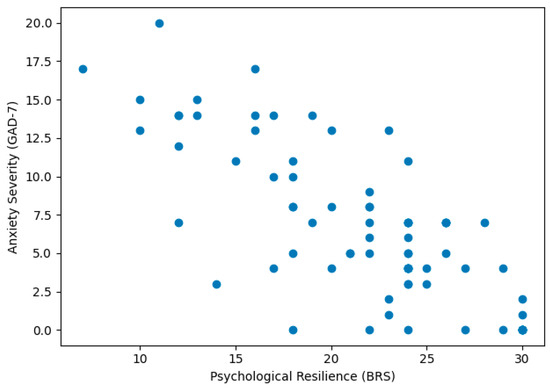
Anxiety severity, measured using the GAD-7, shows a strong negative correlation with psychological resilience (r = −0.75, p < 0.05), indicating that higher anxiety scores are associated with lower levels of resilience, supporting H1. The magnitude of these correlation coefficients indicates large effect sizes, suggesting clinically meaningful associations between anxiety severity and both psychological resilience and trait hope.
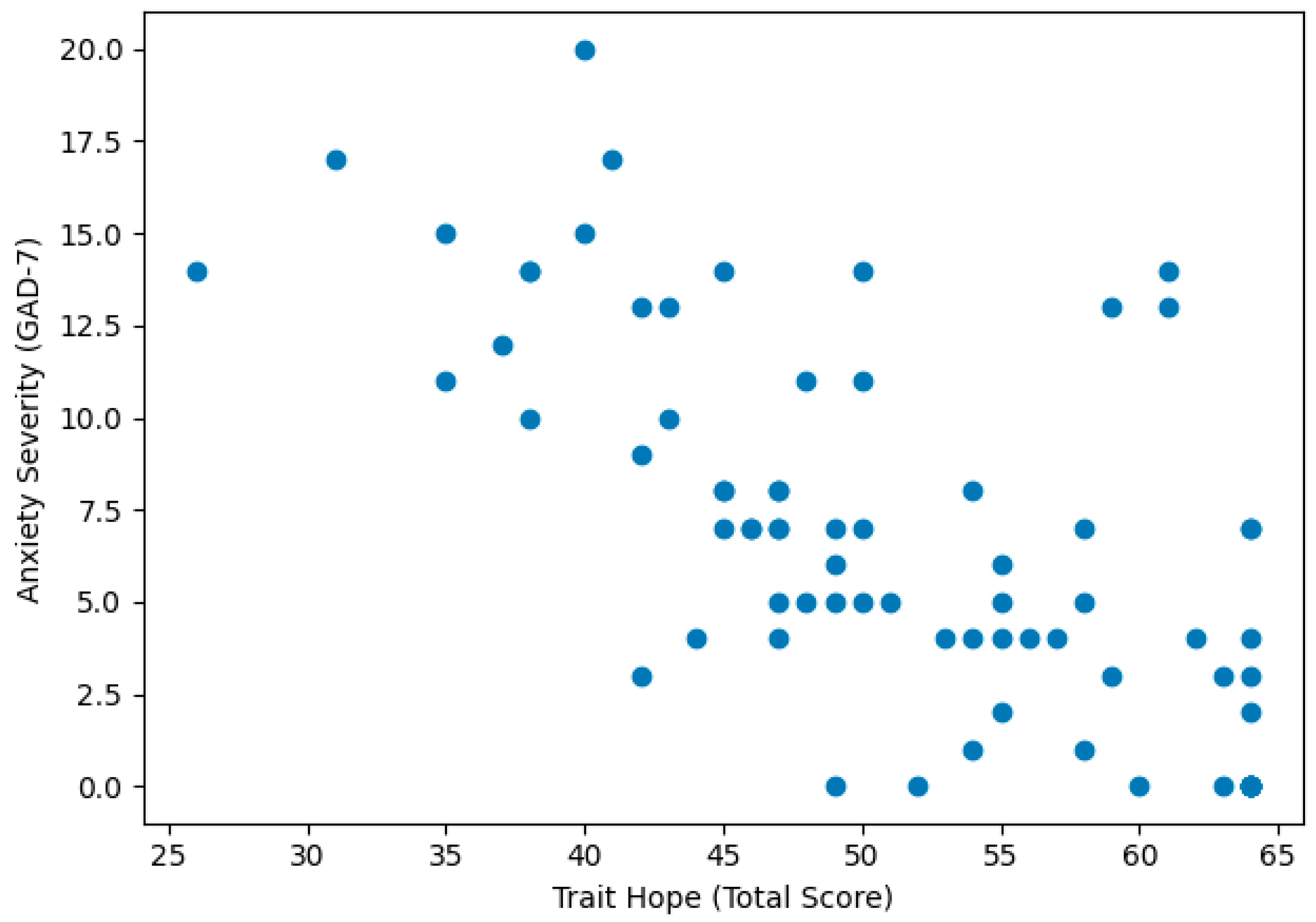
Significant negative correlations are observed between anxiety and trait hope. GAD-7 scores are negatively associated with the total Hope score (r = −0.67, p < 0.05), the Agency subscale (r = −0.61, p < 0.05), and the Pathways subscale (r = −0.64, p < 0.05), supporting H2.
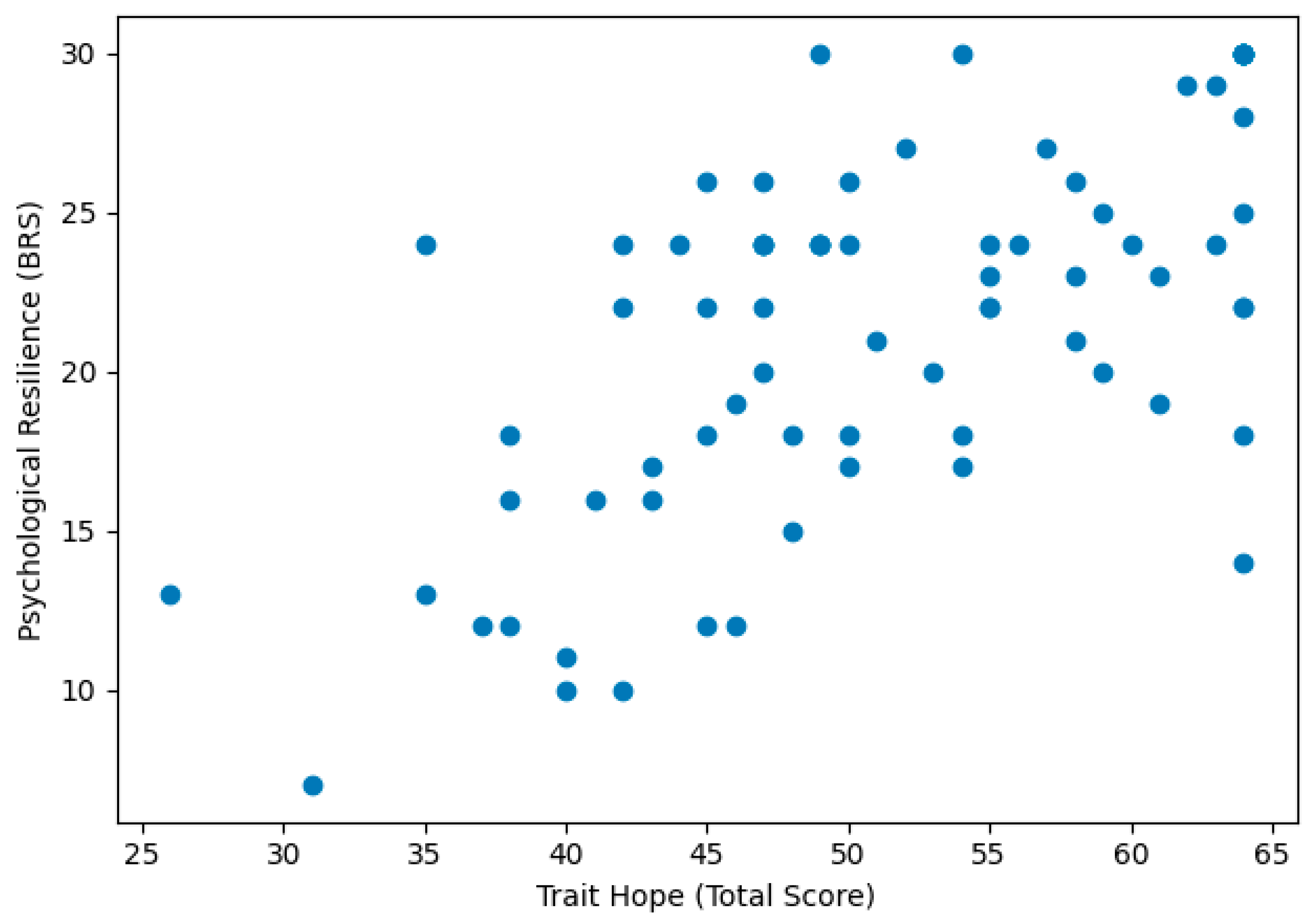
Psychological resilience shows significant positive correlations with trait hope and its components, including the total Hope score (r = 0.61, p < 0.05), Agency (r = 0.56, p < 0.05), and Pathways (r = 0.58, p < 0.05). The Agency and Pathways subscales are also strongly correlated (r = 0.74, p < 0.05), supporting H3.
3.4. Multivariable Regression Analyses
To test H4 (psychological resilience is a significant negative predictor of anxiety symptom severity after adjustment for relevant sociodemographic characteristics), a multivariable linear regression analysis is conducted. Anxiety severity (GAD-7 total score) is included as the dependent variable. Psychological resilience (BRS total score) is entered as the main predictor, with age and sex as covariates.
The multivariable regression model is statistically significant (F (3,67) = 27.36, p < 0.05) and explains 55.1% of the variance in anxiety symptom severity (R2 = 0.551; adjusted R2 = 0.530). Psychological resilience emerges as a strong and statistically significant negative predictor of anxiety. Higher BRS scores are associated with lower GAD-7 scores (β = −0.64, SE = 0.08, t = −8.38, p < 0.001; 95% CI: −0.79 to −0.49). The relatively narrow confidence interval indicates a stable and substantial association, with higher resilience scores corresponding to meaningfully lower anxiety symptom severity. This finding supports H4. Age is not significantly associated with anxiety severity (β = −0.02, SE = 0.03, p = 0.561). Sex does not show a significant effect on GAD-7 scores (β ≈ 0.00, SE = 1.09, p = 1.000). The near-zero coefficient indicates a lack of association rather than model error. Variance inflation factors (VIFs) were examined and indicated no problematic multicollinearity (all VIFs < 2). (Table 4).
Table 4.
Multivariable linear regression predicting anxiety severity (GAD-7) (n = 73).
3.5. Hierarchical Regression Analyses
To test H5 (trait hope explains additional variance in anxiety symptom severity beyond psychological resilience and sociodemographic variables), a hierarchical linear regression analysis is conducted. Anxiety severity (GAD-7 total score) is entered as the dependent variable. Predictors are entered in three sequential steps: Model 1: age and sex; Model 2: Model 1 + psychological resilience (BRS); Model 3: Model 2 + trait hope (total score).
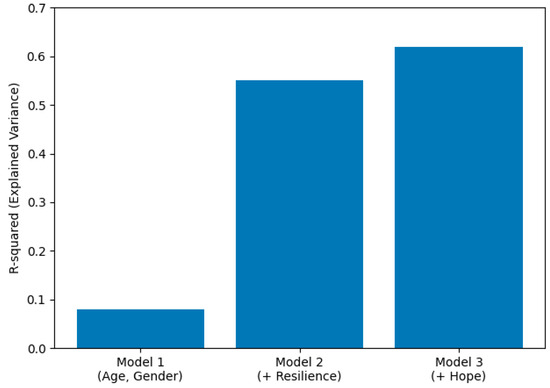
In Model 1, sociodemographic variables account for a small proportion of the variance in anxiety severity (R2 = 0.08). Neither age nor sex showed statistically significant associations with GAD-7 scores. In Model 2, the addition of psychological resilience increases the explained variance substantially (R2 = 0.55). The change in explained variance from Model 1 to Model 2 is statistically significant (ΔR2 = 0.47; F-change (1,67) = 70.17, p < 0.05). Psychological resilience remains a strong negative predictor of anxiety severity.
In Model 3, the inclusion of trait hope results in a further significant increase in explained variance (R2 = 0.62). The incremental contribution of hope beyond resilience and sociodemographic variables is statistically significant (ΔR2 = 0.07; F change (1, 66) = 13.06, p < 0.05). Although modest in size, this incremental effect represents a meaningful additional proportion of explained variance in anxiety severity, supporting the clinical relevance of trait hope beyond resilience alone. This finding supports H5, indicating that trait hope provides additional explanatory value for anxiety symptom severity beyond psychological resilience (Table 5 and Figure 1). The main associations are illustrated in Figure 2, Figure 3 and Figure 4.
Table 5.
Hierarchical linear regression models predicting anxiety severity (GAD-7) (n = 73).
Figure 1.
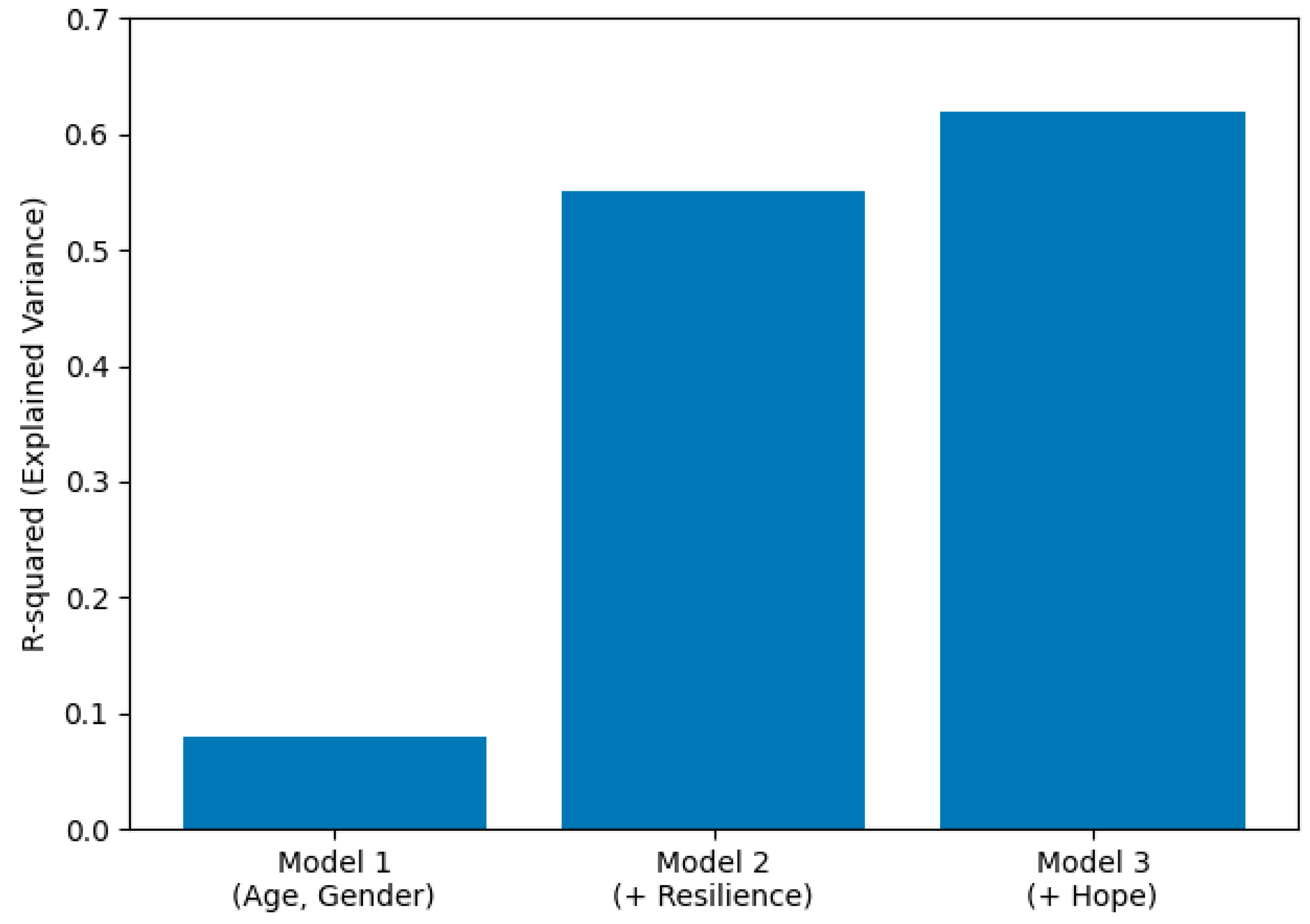
Incremental variance explained in anxiety severity (GAD-7).
Figure 2.
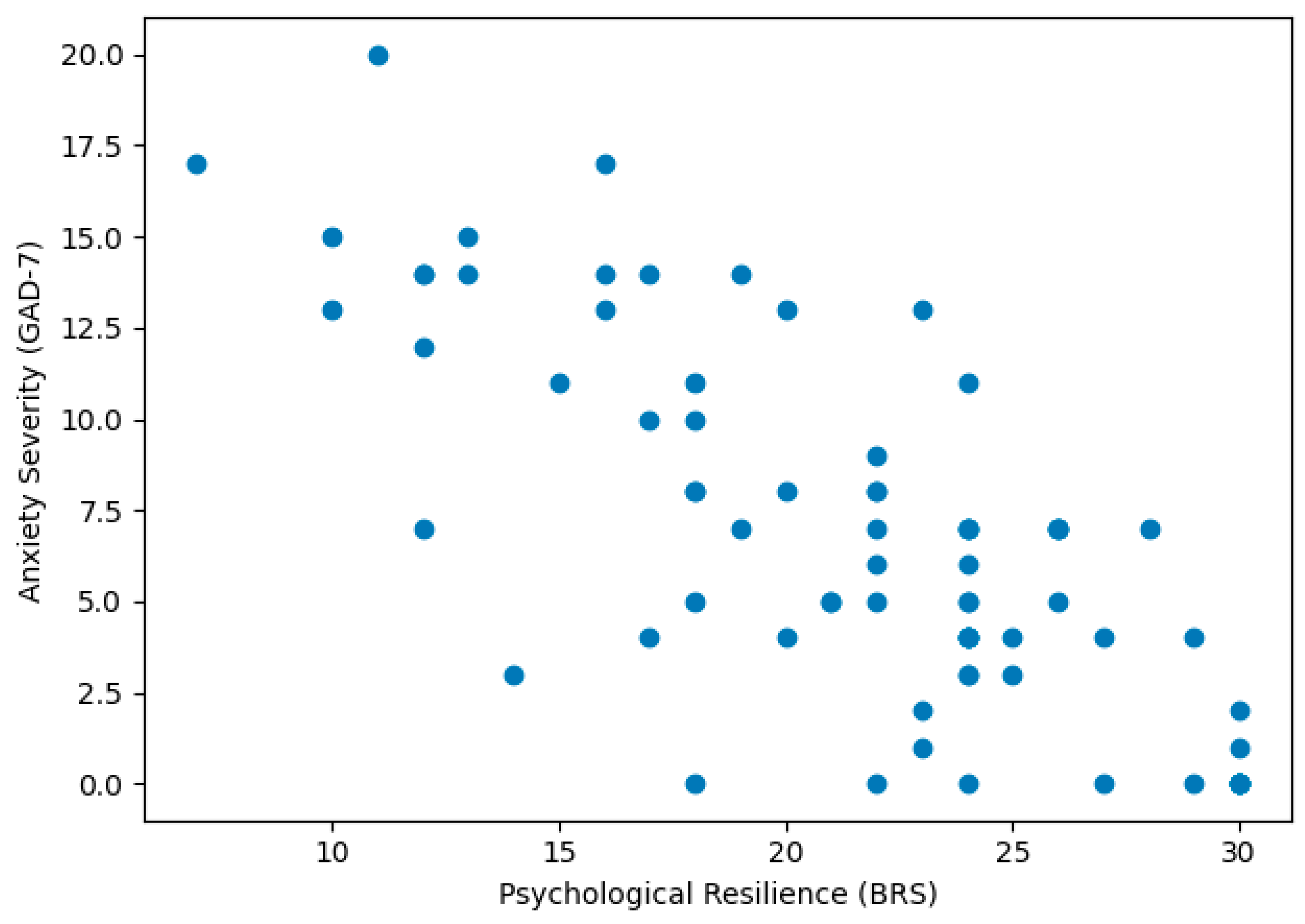
Scatterplot showing the association between anxiety (GAD-7) and psychological resilience (BRS). Higher resilience scores are associated with lower anxiety severity, consistent with the strong negative correlation observed.
Figure 3.
Scatterplot showing the association between anxiety (GAD-7) and trait hope (total score). The positive association between psychological resilience (BRS total score) and trait hope (total score) supports the complementary relationship between these protective psychological resources.
Figure 4.
Scatterplot showing the association between resilience (BRS) and trait hope (total score). Higher levels of trait hope are associated with lower anxiety severity, consistent with the reported correlation analysis.
4. Discussion
The present cross-sectional study investigated associations between anxiety, psychological resilience, and trait hope (including Agency and Pathways subscales) among Romanian family members of military personnel preparing for deployment. Higher anxiety levels correlated significantly with lower psychological resilience and trait hope. Psychological resilience and trait hope were positively associated, indicating convergence between these psychological resources.
Multivariable analyses revealed psychological resilience as a robust negative associated factor of anxiety severity, even after adjusting for sociodemographic factors, supporting its role as a relevant psychological resource in the pre-deployment phase. Hierarchical regression further demonstrated that trait hope accounted for additional variance in anxiety beyond resilience and sociodemographic variables, underscoring its unique contribution to psychological adjustment. Collectively, these results highlight that resilience and hope, both independently and interactively, show consistent inverse associations with anxiety in this population, emphasizing their importance as psychological resources during the anticipatory stage of military deployments.
Family members exhibited moderate anxiety symptom severity during the pre-deployment period (GAD-7: mean 7.52 ± 4.98, median 6.00), aligning with the deployment-cycle framework that identifies this phase as one of anticipatory stressors, such as uncertainty, role changes, and family reorganization, contributing to psychological strain in both service members and their families [20].
These findings resonate with recent qualitative and observational studies documenting heightened emotional burden and anxiety among military spouses facing imminent deployments. For instance, a qualitative study of Canadian special operations spouses found substantial psychological strain associated with operational intensity [21]. Similarly, studies on military lifestyles report increased anxiety and emotional distress across deployment-related periods [22], while work on attachment mechanisms highlights how separation activates stress responses in family members [5]. Scoping reviews further underscore recurrent psychological support needs across the deployment trajectory, including the pre-deployment phase [23,24].
Psychological resilience showed a strong inverse association with anxiety symptom severity during the pre-deployment period. This relationship persisted in multivariable models, with resilience remaining significantly associated after adjustment for sociodemographic covariates, indicating an association beyond age and sex effects. The Brief Resilience Scale demonstrated good internal consistency in this sample (Cronbach’s α = 0.844), supporting its reliability.
These results align with the military family literature, which frames resilience as a key psychological resource for coping with deployment-related stress. Previous reviews have linked resilience-related processes to improved psychosocial outcomes across the deployment cycle [25]. Spouse-focused studies similarly describe coping and problem-solving resources as buffers against psychological strain [26], including among families exposed to high-demand operational environments [9,27,28].
Evidence from broader adult and occupational populations further supports the association between BRS-assessed resilience and lower anxiety, suggesting a transdiagnostic relevance [29]. Similar associations have been reported in active-duty and pre-deployment contexts, reinforcing the relevance of resilience during anticipatory phases of stress exposure [30,31,32].
Trait hope was also significantly and inversely correlated with anxiety severity, both at the total Hope score level (r = −0.67, p < 0.05) and across Agency and Pathways subscales. In hierarchical models, hope explained additional variance in anxiety severity beyond resilience and sociodemographic variables (ΔR2 = 0.07), indicating non-redundant explanatory value. These findings are consistent with Snyder’s hope theory, which conceptualizes hope as a cognitive-motivational system supporting goal pursuit and emotional regulation under stress. Agency reflects motivational engagement, whereas Pathways represents perceived capacity to generate routes toward goals; both dimensions have been linked to lower anxiety and enhanced coping across psychosocial research [33,34].
In military contexts, where resilience has traditionally received greater emphasis, emerging evidence indicates that hope is an additional correlate of psychological adjustment. Studies among military spouses report associations between higher hope, lower distress, and improved coping during deployment cycles [35].
Furthermore, positive psychology research on extreme stressors shows Agency and Pathways independently predicting adaptive responses. Collectively, these results extend prior evidence by showing that trait hope is associated with lower anxiety in pre-deployment military families, affirming the unique role of cognitive-motivational resources in anticipatory stress [34,36,37].
Trait hope explained additional variance in anxiety symptom severity beyond psychological resilience and sociodemographic variables, as shown by hierarchical regression analyses. This indicates that, despite moderate correlations between resilience and hope, they offer non-redundant explanatory value for anxiety outcomes in pre-deployment military family members [38].
These results align with conceptual models distinguishing resilience, primarily the capacity to recover from stressors, from hope as a forward-oriented cognitive-motivational system involving goal-directed Agency and Pathways. Health psychology studies confirm that hope predicts mental health outcomes independently of resilience, coping, and optimism; for instance, hierarchical models in adults show hope accounting for unique variance in anxiety and depression after controlling for resilience [39].
In military contexts, where resilience has traditionally received greater emphasis, emerging evidence identifies hope as an additional correlate of psychological adjustment. Studies among military spouses report associations between higher hope, lower distress, and improved coping during deployment cycles [35]. Similar patterns are observed in other high-stress occupational settings, supporting the relevance of hope beyond resilience alone [40,41,42].
Findings from non-military high-stress contexts, including healthcare workers and crisis-exposed populations, further support hope as a distinct cognitive resource explaining incremental variance in anxiety beyond resilience and coping strategies [43]. Methodologically, hierarchical regression strengthens interpretation by demonstrating the incremental validity of hope, suggesting that resilience alone does not fully capture psychological resources relevant to pre-deployment anxiety. Together, these findings support complementary roles of resilience and hope in anticipatory stress adaptation models [44].
The study’s findings suggest potential implications for future research on psychological support strategies for military families during the pre-deployment period. The strong inverse relationships between anxiety and both psychological resilience and trait hope suggest that these psychological resources may represent promising targets for future research, rather than solely focusing on symptom reduction.
First, future research may explore resilience-enhancing approaches for military family members prior to deployment. Previous studies suggest that structured, family-centered, and strengths-based programs are feasible and may reduce distress among military spouses [24]. Similarly, scoping reviews of resilience-building programs identified a range of family- and couple-focused psychosocial support approaches aimed at strengthening coping and reducing distress across deployment cycles [23].
Second, the incremental contribution of trait hope beyond resilience supports exploration of hope-focused components—such as goal clarification, motivational enhancement, and pathway generation—in future intervention research. Although evidence in military contexts remains limited, broader psychosocial models highlight the relevance of building cognitive-motivational skills consistent with hope theory.
Third, integrated, multimodal support approaches, including digital or mobile platforms, could be explored to concurrently address resilience and cognitive resources, such as hope. Multilevel frameworks emphasizing communication, problem-solving, and social connectedness have been proposed in military family research [45,46].
Family-centered preventive programs, such as the Families OverComing Under Stress (FOCUS) model or Cognitive Behavioral Stress Management (CBSM), adapted for military families, illustrate how skills-based approaches can support psychological well-being during deployment [47,48].
From a service-delivery perspective, these findings suggest the potential relevance of proactive psychological support before deployment, complementing existing post-deployment services. Military family readiness initiatives and reintegration programs may provide suitable platforms for future research embedding resilience- and hope-focused approaches [49].
The integration of peer support and community resources, as seen in resilience communities and family support groups, could supplement formal psychological services by providing sustained support networks and shared coping strategies that mitigate pre-deployment anxiety and enhance adaptive functioning.
This study has several limitations that should be considered when interpreting the findings. First, the cross-sectional design precludes causal inferences regarding the relationships among anxiety, psychological resilience, and trait hope; accordingly, all associations should be interpreted as associative rather than predictive. Second, the use of self-reported measures may introduce response and social desirability biases. Third, the relatively modest sample size may limit statistical power and constrain the complexity of multivariable analyses, including the ability to adjust for additional deployment-related variables.
The predominantly female composition of the sample may further limit the generalizability of the findings to male family members, although this distribution likely reflects caregiving roles commonly assumed within military families. Additionally, voluntary online recruitment may have introduced selection bias, potentially overrepresenting individuals with greater digital access or psychological engagement.
Despite these limitations, the study also has notable strengths. It addresses an understudied population—family members of military personnel during the pre-deployment phase—within a Romanian and Eastern European context. The use of validated instruments with strong internal consistency (e.g., GAD-7, BRS, Adult Hope Scale) enhances measurement reliability, and a theory-driven analytical approach, incorporating correlation, multivariable, and hierarchical regression analyses, allowed examination of the independent and incremental associations of resilience and hope with anxiety.
These findings provide a methodologically transparent foundation for future longitudinal research and the cautious exploration of potential intervention approaches, including studies that further account for social support and deployment-related characteristics.
5. Conclusions
This cross-sectional study demonstrated that family members of Romanian military personnel preparing for deployment experienced moderate levels of anxiety, which were closely associated with lower psychological resilience and lower trait hope. Psychological resilience emerged as a strong psychological resource factor, showing a robust inverse association with anxiety severity and remaining a significant negative association factor after adjustment for sociodemographic characteristics. Trait hope, including both Agency and Pathways components, was also inversely associated with anxiety and explained additional variance in anxiety severity beyond resilience and sociodemographic factors. Together, these findings suggest that resilience and hope represent complementary psychological resources associated with lower anxiety during the pre-deployment period. These findings suggest that pre-deployment psychological support for military families may be informed by early anxiety screening and by future research exploring resilience- and hope-oriented approaches during the anticipatory phase of deployment, in military medical care.
Families are a central psychosocial context associated with resilience and hope that may support adaptive coping among military personnel during deployment.
Given the observational, cross-sectional design, the present findings should not be interpreted as evidence of the effectiveness of specific interventions. Rather, they indicate that psychological resilience and trait hope may represent promising psychological targets for future longitudinal and interventional research aimed at reducing anxiety during the pre-deployment phase.
Supplementary Materials
The following supporting information can be downloaded at: https://www.mdpi.com/article/10.3390/psychiatryint7020054/s1, Table S1: STROBE checklist for cross-sectional studies.
Author Contributions
Conceptualization, A.C.N. and L.P.; methodology, A.C.N.; software, A.C.N. and I.-A.T.; validation, L.P., D.T. and C.G.-O.; formal analysis, I.-A.T.; investigation, A.C.N.; resources, A.C.N. and I.-A.T.; data curation, A.C.N.; writing—original draft preparation, A.C.N., L.P. and D.T.; writing—review and editing, C.G.-O. and A.-C.B.; visualization, I.-A.T.; supervision, A.-C.B.; project administration A.-C.B.; funding acquisition, A.C.N. All authors have read and agreed to the published version of the manuscript.
Funding
We would like to acknowledge Victor Babeș University of Medicine and Pharmacy, Timișoara, for covering the publication costs for this research paper.
Institutional Review Board Statement
The study was conducted in accordance with the Declaration of Helsinki, and approved by the Research Ethics Committee of the Victor Babeș University of Medicine and Pharmacy, Timișoara (protocol code: No. 26 and date of approval: 3 March 2025).
Informed Consent Statement
Informed consent was secured from all participants in the study.
Data Availability Statement
The data supporting this study are available from the corresponding author upon request. However, for ethical reasons, they are not publicly accessible.
Acknowledgments
During the preparation of this work, the authors used ChatGPT (OpenAI, Version 5.2) to enhance language clarity and improve grammatical accuracy. After using these tools/services. The authors have reviewed and edited the output and take full responsibility for the content of this publication.
Conflicts of Interest
The authors declare no conflicts of interest.
Abbreviations
The following abbreviations are used in this manuscript:
| BRS | Brief Resilience Scale |
| CBSM | Cognitive Behavioral Stress Management |
| CI | Confidence interval |
| EUFOR ALTHEA | European Union Force Althea |
| EUTM RCA | European Union Training Mission in the Central African Republic |
| GAD-7 | Generalized Anxiety Disorder 7-item scale |
| IQR | Interquartile Range |
| KFOR | Kosovo Force |
| NATO | North Atlantic Treaty Organization |
| SD | Standard deviation |
| STROBE | Strengthening the Reporting of Observational Studies in Epidemiology |
| VIFs | Variance inflation factors |
References
- Ministry of National Defence. Defence Minister’s Videoconference with the Romanian Soldiers Deployed to the Theaters of Operations; Ministry of National Defence: Canberra, Australia, 2025.
- Ministry of Foreign Affairs. Romania’s Participation in NATO’s Missions and Operations; Ministry of Foreign Affairs: Singapore, 2025.
- Pessoa Dos Santos, R.; Francisco, R.; Ribeiro, M.T.; Roberto, M.S. Psychological and Emotional Experiences during a Military Mission: A Longitudinal Study with Soldiers and Spouses. Couple Fam. Psychol. Res. Pract. 2021, 10, 38–53. [Google Scholar] [CrossRef] [Scilit]
- Hoopsick, R.A.; Homish, D.L.; Collins, R.L.; Nochajski, T.H.; Read, J.P.; Homish, G.G. Is Deployment Status the Critical Determinant of Psychosocial Problems among Reserve/Guard Soldiers? Psychol. Serv. 2020, 17, 461–471. [Google Scholar] [CrossRef] [Scilit]
- Hansom, A.M.; Guerrero, L.K. Attachment Style During a Partner’s Deployment with the United States Navy: Associations with Relational Satisfaction, Stress, and Changes over Time. Int. J. Environ. Res. Public Health 2025, 22, 1056. [Google Scholar] [CrossRef] [Scilit]
- Ormeno, M.D.; Roh, Y.; Heller, M.; Shields, E.; Flores-Carrera, A.; Greve, M.; Hagan, J.; Kostrubala, A.; Onasanya, N. Special Concerns in Military Families. Curr. Psychiatry Rep. 2020, 22, 82. [Google Scholar] [CrossRef] [Scilit]
- Corry, N.H.; Radakrishnan, S.; Williams, C.S.; Sparks, A.C.; Woodall, K.A.; Fairbank, J.A.; Stander, V.A. Association of Military Life Experiences and Health Indicators among Military Spouses. BMC Public Health 2019, 19, 1517. [Google Scholar] [CrossRef] [Scilit]
- Mallonee, S.; Riggs, D.; Stander, V. The Impact of Family Stressors and Resources on Military Spouse’s Perception of Post-Deployment Reunion Stress. Mil. Psychol. 2020, 32, 369–379. [Google Scholar] [CrossRef] [Scilit]
- Richer, I.; Frank, C.; Guérin, E. Understanding Special Operations Forces Spouses Challenges and Resilience: A Mixed-Method Study. Mil. Behav. Health 2022, 10, 100–111. [Google Scholar] [CrossRef] [Scilit]
- Rösner, C.; Brähler, E.; Sachser, C.; Clemens, V.; Petrowski, K. New Norm Values of the Brief Resilience Scale (BRS) from the German General Population with New Post-COVID-19 Data. BMC Psychol. 2024, 12, 499. [Google Scholar] [CrossRef] [Scilit] [PubMed]
- Zhou, Z.; Ma, Z. Evaluating the Brief Resilience Scale in 21 Countries: Psychometric Properties and Measurement Invariance Across Sex, Age, and Countries. Assessment 2025, 10731911251355124. [Google Scholar] [CrossRef] [Scilit] [PubMed]
- Neagu, A.C.; Ursoniu, S.; Papava, I.; Trăilă, I.-A.; Palaghian, L.; Giurgi-Oncu, C.; Bredicean, A.-C. Psychometric Validation of the Romanian Version of the Adult Hope Scale (AHS). Behav. Sci. 2025, 15, 920. [Google Scholar] [CrossRef] [Scilit]
- Dhira, T.A.; Rahman, M.A.; Sarker, A.R.; Mehareen, J. Validity and Reliability of the Generalized Anxiety Disorder-7 (GAD-7) among University Students of Bangladesh. PLoS ONE 2021, 16, e0261590. [Google Scholar] [CrossRef] [Scilit]
- Park, S.-H.; Park, S.K. An Updated Systematic Review and Meta-Analysis of the Predictive Validity of the General Anxiety Disorder (GAD)-7 and GAD-2 in Screening for Anxiety Disorders. J. Affect. Disord. 2025, 391, 119913. [Google Scholar] [CrossRef] [Scilit]
- Palace, M.; Zamazii, O.; Terbeck, S.; Bokszczanin, A.; Berezovski, T.; Gurbisz, D.; Szwejka, L. Mapping the Factors behind Ongoing War Stress in Ukraine-based Young Civilian Adults. Appl. Psychol. Health Well-Being 2024, 16, 868–885. [Google Scholar] [CrossRef] [Scilit]
- Pisaruk, A.; Shatilo, V.; Chyzhova, V.; Koshel, N.; Pisaruk, L.; Ivanov, S. Posttraumatic Stress Disorder: Online Poll of People Who Experienced War Stress in Ukraine in 2022. Ageing Longev. 2022, 3, 57–62. [Google Scholar] [CrossRef] [Scilit]
- Spitzer, R.L.; Kroenke, K.; Williams, J.B.W.; Löwe, B. A Brief Measure for Assessing Generalized Anxiety Disorder: The GAD-7. Arch. Intern. Med. 2006, 166, 1092. [Google Scholar] [CrossRef] [Scilit]
- Smith, B.W.; Dalen, J.; Wiggins, K.; Tooley, E.; Christopher, P.; Bernard, J. The Brief Resilience Scale: Assessing the Ability to Bounce Back. Int. J. Behav. Med. 2008, 15, 194–200. [Google Scholar] [CrossRef] [Scilit]
- Cuschieri, S. The STROBE Guidelines. Saudi J. Anaesth. 2019, 13, 31. [Google Scholar] [CrossRef] [Scilit] [PubMed]
- Louie, A.D.; Cromer, L.D. Parent–Child Attachment during the Deployment Cycle: Impact on Reintegration Parenting Stress. Prof. Psychol. Res. Pract. 2014, 45, 496–503. [Google Scholar] [CrossRef] [Scilit]
- Guérin, E.; Richer, I. Piloting the Home Ship: Understanding the Deployment Experience of Canadian Special Operations Forces Command Spouses. Mil. Psychol. 2024, 36, 168–183. [Google Scholar] [CrossRef] [Scilit]
- Er, F. The Effects of Military Lifestyle and Operational Deployments on Marital Dynamics: A Qualitative Study of Military Spouses in Türkiye. Armed Forces Soc. 2024, 0095327X241305405. [Google Scholar] [CrossRef] [Scilit]
- Ohlsson, A.; Nilsson, S.; Larsson, G. Social and Psychological Support for Military Personnel and Their Families in Connection with Military Deployment: A Scoping Review and Thematic Analysis. J. Veterans Stud. 2024, 10, 160–172. [Google Scholar] [CrossRef] [Scilit]
- Kees, M.; Rosenblum, K. Evaluation of a Psychological Health and Resilience Intervention for Military Spouses: A Pilot Study. Psychol. Serv. 2015, 12, 222–230. [Google Scholar] [CrossRef] [Scilit]
- Hébert, M.L.; Tippe, J.M.; Aquin, C.; Maximos, M.; Brémault-Phillips, S.; Sevigny, P.R. Military Family-Centred Resilience-Building Programming Across the Deployment Cycle: A Scoping Review. Int. J. Environ. Res. Public Health 2024, 21, 1378. [Google Scholar] [CrossRef] [Scilit]
- Sullivan, K.S.; Park, Y.; Richardson, S.; Stander, V.; Jaccard, J. The Role of Problem Solving Appraisal and Support in the Relationship between Stress Exposure and Posttraumatic Stress Symptoms of Military Spouses and Service Member Partners. Stress Health 2024, 40, e3371. [Google Scholar] [CrossRef] [Scilit]
- Ziff, E.; Garland-Jackson, F. “I’m Not Your ‘Typical’ Military Wife”: The Construction of Gender and Agency Through Stereotypes. Armed Forces Soc. 2020, 46, 376–396. [Google Scholar] [CrossRef] [Scilit]
- O’Neal, C.W.; Lucier-Greer, M.; Duncan, J.M.; Mallette, J.K.; Arnold, A.L.; Mancini, J.A. Vulnerability and Resilience within Military Families: Deployment Experiences, Reintegration, and Family Functioning. J. Child. Fam. Stud. 2018, 27, 3250–3261. [Google Scholar] [CrossRef] [Scilit]
- To, Q.G.; Vandelanotte, C.; Cope, K.; Khalesi, S.; Williams, S.L.; Alley, S.J.; Thwaite, T.L.; Fenning, A.S.; Stanton, R. The Association of Resilience with Depression, Anxiety, Stress and Physical Activity during the COVID-19 Pandemic. BMC Public Health 2022, 22, 491. [Google Scholar] [CrossRef] [Scilit]
- Sefidan, S.; Pramstaller, M.; La Marca, R.; Wyss, T.; Sadeghi-Bahmani, D.; Annen, H.; Brand, S. Resilience as a Protective Factor in Basic Military Training, a Longitudinal Study of the Swiss Armed Forces. Int. J. Environ. Res. Public Health 2021, 18, 6077. [Google Scholar] [CrossRef] [Scilit] [PubMed]
- Vest, B.M.; Heavey, S.C.; Homish, D.L.; Homish, G.G. Marital Satisfaction, Family Support, and Pre-Deployment Resiliency Factors Related to Mental Health Outcomes for Reserve and National Guard Soldiers. Mil. Behav. Health 2017, 5, 313–323. [Google Scholar] [CrossRef] [Scilit]
- Li, M.; Stas, L.; Vanroelen, C.; Moortel, D.D. Linked Lives and Work-Family Dynamics: Gendered Workload, Family Support, and Mental Well-Being among Urban Chinese Dual-Earner Households. Int. J. Equity Health 2025, 24, 312. [Google Scholar] [CrossRef] [Scilit] [PubMed]
- Gallagher, M.W.; Long, L.J.; Richardson, A.; D’Souza, J.; Boswell, J.F.; Farchione, T.J.; Barlow, D.H. Examining Hope as a Transdiagnostic Mechanism of Change Across Anxiety Disorders and CBT Treatment Protocols. Behav. Ther. 2020, 51, 190–202. [Google Scholar] [CrossRef] [Scilit] [PubMed]
- Akat, M. Trait Anxiety, Dispositional Hope and Mental Well-Being: Examining Longitudinal Mediation. BMC Psychol. 2025, 13, 548. [Google Scholar] [CrossRef] [Scilit]
- Giff, S.T.; Renshaw, K.D.; Carter, S.P.; Paige, L.C. Deployment-Related Coping Strategies in Military Couples: Associations with Relationship Satisfaction. Mil. Psychol. 2020, 32, 432–440. [Google Scholar] [CrossRef] [Scilit]
- Richardson, A.L. Hope and Anxiety. Curr. Opin. Psychol. 2023, 53, 101664. [Google Scholar] [CrossRef] [Scilit]
- Flood, A.; Keegan, R.J. Cognitive Resilience to Psychological Stress in Military Personnel. Front. Psychol. 2022, 13, 809003. [Google Scholar] [CrossRef] [Scilit]
- Wang, X.; Wang, S.; Yang, D.; Chu, Y.; Hao, Y.; Dai, H. Associations among Resilience, Hope, Social Support, Stress, and Anxiety Severity in Chinese Women with Abnormal Cervical Cancer Screening Results. Heliyon 2022, 8, e12539. [Google Scholar] [CrossRef] [Scilit]
- Senger, A.R. Hope’s Relationship with Resilience and Mental Health during the COVID-19 Pandemic. Curr. Opin. Psychol. 2023, 50, 101559. [Google Scholar] [CrossRef] [Scilit] [PubMed]
- Cole, R.; Ward, C.; Quintana, T.; Burgin, E. Military Spouses’ Perceptions of Their Resilience. Prof. Couns. 2024, 14, 83–99. [Google Scholar] [CrossRef] [Scilit]
- Skomorovsky, A.; Dursun, S. Introduction: Resilience in Military Families. Mil. Behav. Health 2022, 10, 71–73. [Google Scholar] [CrossRef] [Scilit]
- Saltzman, W.R.; Lester, P.; Beardslee, W.R.; Layne, C.M.; Woodward, K.; Nash, W.P. Mechanisms of Risk and Resilience in Military Families: Theoretical and Empirical Basis of a Family-Focused Resilience Enhancement Program. Clin. Child. Fam. Psychol. Rev. 2011, 14, 213–230. [Google Scholar] [CrossRef] [Scilit] [PubMed]
- Esbit, S.; Kaim, A.; Kimhi, S.; Bankauskaite, D.; Baran, M.; Baran, T.; Cosciug, A.; Eshel, Y.; Dumbadze, S.; Gabashvili, M.; et al. Hope and Distress: A Cross-Country Study Amid the Russian-Ukrainian War. Stress Health 2025, 41, e70033. [Google Scholar] [CrossRef] [Scilit]
- Chmitorz, A.; Kunzler, A.; Helmreich, I.; Tüscher, O.; Kalisch, R.; Kubiak, T.; Wessa, M.; Lieb, K. Intervention Studies to Foster Resilience—A Systematic Review and Proposal for a Resilience Framework in Future Intervention Studies. Clin. Psychol. Rev. 2018, 59, 78–100. [Google Scholar] [CrossRef] [Scilit]
- Muir, C.; Adams, E.A.; Evans, V.; Geijer-Simpson, E.; Kaner, E.; Phillips, S.M.; Salonen, D.; Smart, D.; Winstone, L.; McGovern, R. A Systematic Review of Qualitative Studies Exploring Lived Experiences, Perceived Impact, and Coping Strategies of Children and Young People Whose Parents Use Substances. Trauma Violence Abus. 2023, 24, 3629–3646. [Google Scholar] [CrossRef] [Scilit] [PubMed]
- Cramm, H.; Godfrey, C.M.; Murphy, S.; McKeown, S.; Dekel, R. Experiences of Children Growing up with a Parent Who Has Military-Related Post-Traumatic Stress Disorder: A Qualitative Systematic Review. JBI Evid. Synth. 2022, 20, 1638–1740. [Google Scholar] [CrossRef] [Scilit] [PubMed]
- Lester, P.; Saltzman, W.R.; Woodward, K.; Glover, D.; Leskin, G.A.; Bursch, B.; Pynoos, R.; Beardslee, W. Evaluation of a Family-Centered Prevention Intervention for Military Children and Families Facing Wartime Deployments. Am. J. Public Health 2012, 102, S48–S54. [Google Scholar] [CrossRef] [Scilit] [PubMed]
- Bryant, R.A. Post-traumatic Stress Disorder: A State-of-the-art Review of Evidence and Challenges. World Psychiatry 2019, 18, 259–269. [Google Scholar] [CrossRef] [Scilit]
- Scherrer, J.F.; Widner, G.; Shroff, M.; Matthieu, M.; Balan, S.; Van Den Berk-Clark, C.; Price, R.K. Assessment of a Postdeployment Yellow Ribbon Reintegration Program for National Guard Members and Supporters. Mil. Med. 2014, 179, 1391–1397. [Google Scholar] [CrossRef] [Scilit]

Disclaimer/Publisher’s Note: The statements, opinions and data contained in all publications are solely those of the individual author(s) and contributor(s) and not of MDPI and/or the editor(s). MDPI and/or the editor(s) disclaim responsibility for any injury to people or property resulting from any ideas, methods, instructions or products referred to in the content. |
© 2026 by the authors. Licensee MDPI, Basel, Switzerland. This article is an open access article distributed under the terms and conditions of the Creative Commons Attribution (CC BY) license.