
Next Article in Journal
The Causal Relationship of Agricultural Standards, Climate Change and Greenhouse Gas Recovery
Previous Article in Journal
Assessing Neural Network Approaches for Solar Radiation Estimates Using Limited Climatic Data in the Mediterranean Sea
 
 
Environmental Sciences Proceedings concluded publication with Volume 29, Issue 1. It has been succeeded by Environmental and Earth Sciences Proceedings, which has a revised scope and a new editorial direction and is now published here. To preserve historical data integrity, the information on this webpage is retained but will no longer be updated.
Proceeding Paper

Spatiotemporal Distribution of Soil Moisture Content over Ukraine and Its Relationship to Atmospheric Conditions †
Department of Military Training, Odessa State Environmental University, 15 Lvovskaya str., 65122 Odessa, Ukraine
Presented at the 3rd International Electronic Conference on Atmospheric Sciences, 16–30 November 2020; Available online: https://ecas2020.sciforum.net/.
Environ. Sci. Proc. 2021, 4(1), 20; https://doi.org/10.3390/ecas2020-08117

Published: 13 April 2021
(This article belongs to the Proceedings of The 3rd International Electronic Conference on Atmospheric Sciences)

Abstract

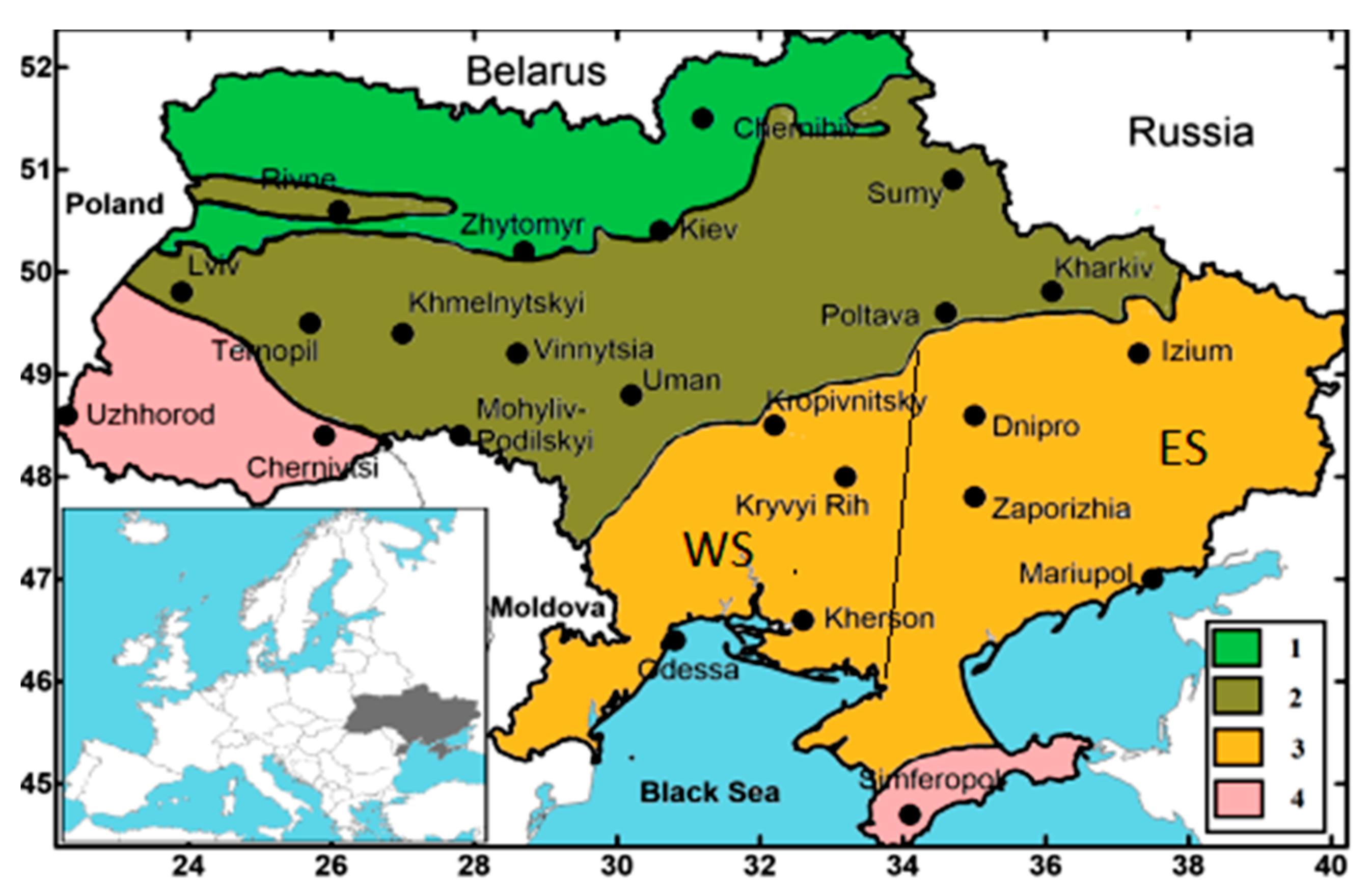
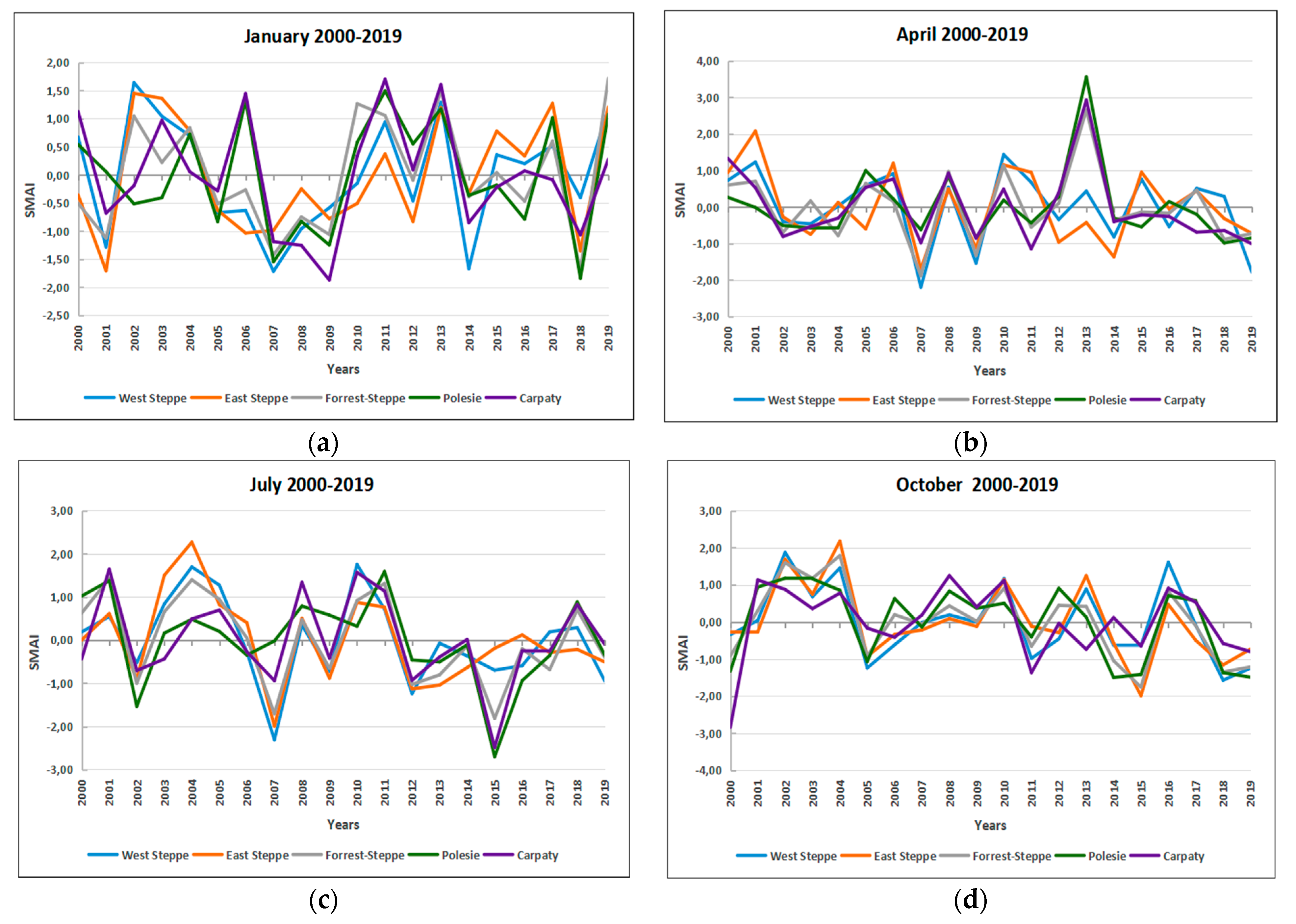
Spatiotemporal distribution of the soil moisture content of 0–10 cm underground has been assessed across the aroclimatic zones of Ukraine for the period 2000–2019. Calculated Soil Moisture Anomaly Index (SMAI) was used to characterize the degree of saturation of the soil, comparing to normal conditions. The North Atlantic Oscillation index (NAO) and the European Continental Blocking Index (ECBI) were used for the estimation of the influence of atmospheric circulation on soil moisture content in different seasons. The clear annual soil moisture content course is observed in all agroclimatic zones of Ukraine, when the maximum is observed in February, and the minimum is in August. The lowest soil moisture values are fixed in the Western Steppe and the maximum in the Carpathian region and Polesie. The analysis of time series of the SMAI showed the tendency to transition from mostly positive values to negative values in the past decade in summer and autumn. In winter and spring, no significant trends were found in the SMAI values. Analysis of the statistical relationship between the SMAI and the NAO indices, and the SMAI and the ECBI indices showed the features of the state of zonal flow and determined certain anomalies of soil moisture content.
Keywords: soil moisture; North Atlantic Oscillation; blocking index soil moisture; North Atlantic Oscillation; blocking index