
Review

Review of Virtual Inertia Based on Synchronous Generator Characteristic Emulation in Renewable Energy-Dominated Power Systems


by
Fikri Waskito
,
F. Danang Wijaya
* and
Eka Firmansyah
Department of Electrical and Information Engineering, Universitas Gadjah Mada, Yogyakarta 55281, Indonesia
*
Author to whom correspondence should be addressed.
Electricity 2025, 6(4), 69; https://doi.org/10.3390/electricity6040069 (registering DOI)
Submission received: 4 September 2025 / Revised: 8 November 2025 / Accepted: 14 November 2025 / Published: 1 December 2025
(This article belongs to the Topic Power System Dynamics and Stability, 2nd Edition)

Abstract

The increasing integration of renewable energy sources is reshaping power systems from centralized, synchronous generator-based architectures to more inverter-dominated and decentralized architectures. This transition, however, results in a significant reduction in system inertia, posing challenges to frequency stability. To address this issue, various control strategies have been proposed to emulate the inertial response of traditional synchronous generators—commonly known as virtual inertia. This study reviews inverter-based virtual inertia and related control strategies that replicate or extend synchronous generator dynamics, covering five main approaches: droop control, synchronverters, virtual synchronous generators (VSGs), the swing equation-based approach, and data-driven grid-forming (GFM) methods. While all approaches enhance frequency nadir and RoCoF, they differ in complexity, robustness, and adaptability. Droop control offers simplicity but lacks true inertia support, whereas synchronverter and swing equation-based controls provide closer emulation of synchronous behavior for grid-forming or islanded systems. VSG offers a more practical grid-following solution, and data-driven GFM introduces adaptability through learning-based mechanisms. Overall, this study contributes to a comprehensive understanding of how these control strategies can be implemented through inverter control to maintain frequency stability in renewable-dominated power systems.

1. Introduction

The integration of renewable energy into electric power systems has become a significant research topic in the past few decades. Currently, fossil fuel-based power plants, particularly those using oil and gas, dominate electricity generation. However, these fuel sources are limited, costly, and harmful to the environment [1]. This situation has pushed the rapid development of renewable energy technologies to reduce greenhouse gas emissions. International initiatives, such as the Kyoto Protocol (2005) and the Paris Agreement (2015), aim to promote global efforts toward net-zero emissions (NZEs) and environmental sustainability [2,3]. The United Nations’ Sustainable Development Goal (SDG) 7 aims to provide affordable, reliable, clean, renewable, and sustainable energy for all [4]. Renewable energy plays a critical role in providing sustainable, green energy to meet daily human needs while reducing emissions and mitigating climate change.
The increasing prevalence of renewable energy systems will transform traditional electricity generation systems, which primarily involve one-way transmission from generation to load, into more decentralized systems. These systems allow power to be injected back into the grid, enabling consumers to also become producers, known as “prosumers” [5,6]. This shift leads to a transition from systems dominated by synchronous generators to those connected to inverters [1].
However, the high penetration of renewable energy could negatively impact system stability due to reduced inertia, which plays a vital role in maintaining stability [7]. As a result, high penetration of solar photovoltaics (PVs) and wind turbines can lead to serious frequency stability issues: system frequency tends to fluctuate more significantly, and the Rate of Change of Frequency (RoCoF) increases, potentially triggering emergency load shedding and threatening system security [7]. Furthermore, integrating PV systems into the distribution network can alter the voltage profile. For instance, excessive solar PV penetration may lead to overvoltage on distribution lines, while sudden decreases in PV output may cause voltage drops that could activate protective relays [8]. In weak power distribution systems, rapid changes in power generation can also lead to a frequency drop.
Several grid operators have reported a decline in system inertia response as renewable energy increases, such as ERCOT (Texas) and ENTSO-E (Europe), and have therefore recommended additional inertia support to maintain stability [9]. Some grid codes, particularly in Europe, require wind turbines to provide an inertial response [10,11]. Indonesia also has regulations for distributed generation (DG) units connected to the main grid, ensuring that electrical parameters, such as frequency and voltage, remain within acceptable ranges [12].
Recent studies have highlighted that maintaining frequency stability in low-inertia power systems requires a coordinated approach that combines both technical and operational measures. Technically, the adoption of grid-forming control in inverter-based resources has been recognized as an effective strategy to provide virtual inertia and enhance system frequency resilience under conditions of high renewable contribution [13]. Virtual inertia, aimed at improving system stability, has been a prominent area of research in recent years [14]. As most power systems are still dominated by synchronous generators, which rely on fossil fuels, early studies of inverter control technology have focused on emulating the characteristics of these generators [15,16,17]. As a result, researchers are focusing on controlling on-grid inverters to replicate synchronous generator behavior and improve system stability [14].
However, mimicking synchronous generator characteristics with an inverter has drawbacks, including slow response to frequency changes in the system. Furthermore, synchronization challenges, particularly those involving phase-locked loops (PLLs), add complexity [17]. Some inverter control methods can replicate synchronous generator characteristics without relying on PLLs [18,19,20]. Nevertheless, inverter controls based on induction generators have shown improved responses to changes in system frequency [21,22,23].
Current research has yet to explore control strategies for systems with multiple renewable energy sources, presenting an opportunity for future studies [24]. Moreover, the increasing use of power electronic equipment has raised concerns about high harmonic distortion in the grid [25]. In Indonesia, the application of inverter-based renewable energy resources is expanding. As an archipelagic nation with approximately 17,000 islands located near the equator, Indonesia holds vast potential for PV solar power generation. However, many remote islands still rely on diesel power plants, which are cost-effective regarding initial investment but entail high operating costs and significant environmental impacts from CO2 emissions. According to the 2021–2030 Electricity Supply Business Plan (RUPTL), PT PLN, Indonesia’s state-owned electricity company, is working to replace diesel plants with renewable energy solutions, such as solar PV, wind, biomass, and micro-hydro systems, particularly in rural and isolated areas [26].
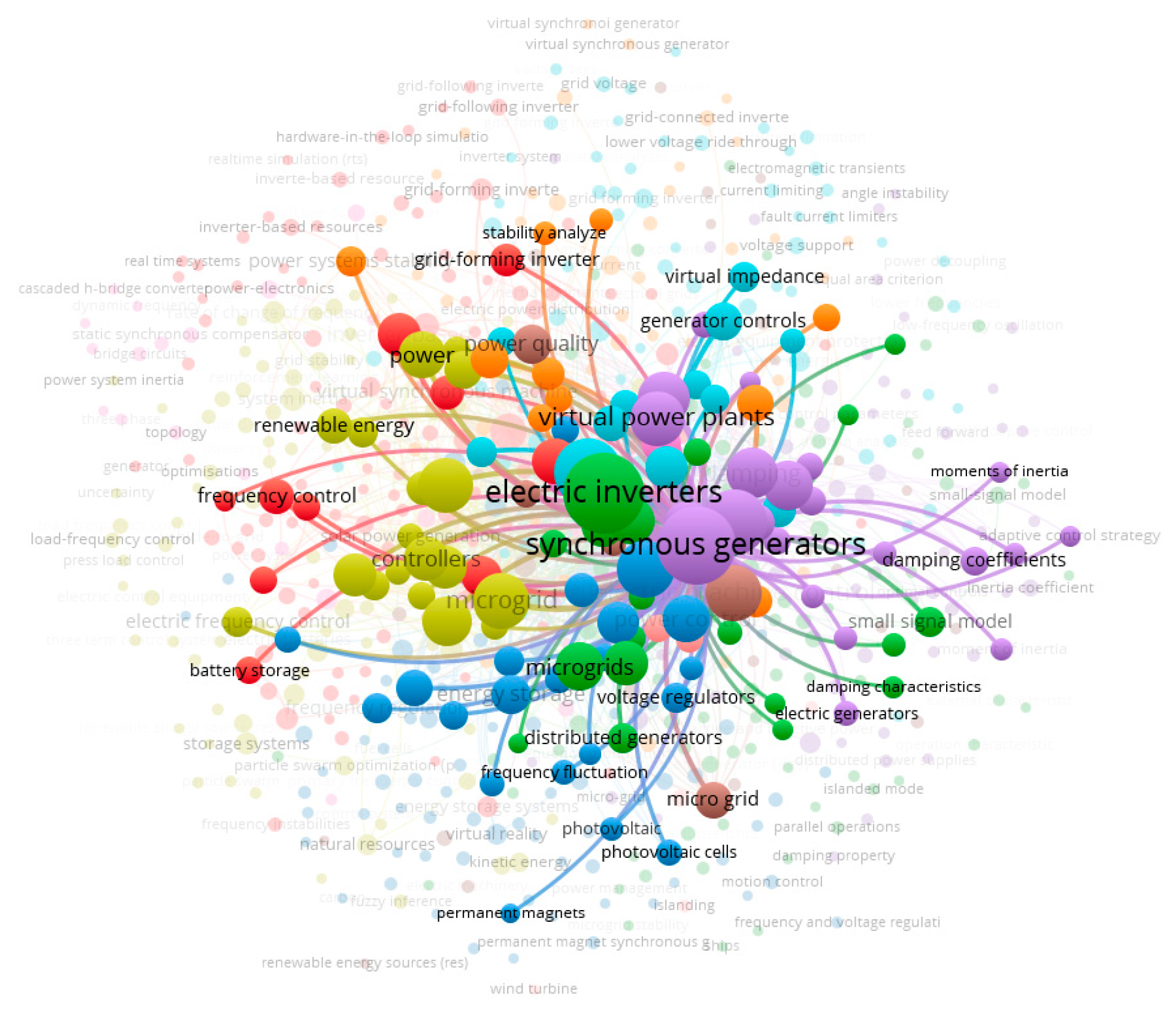
To learn more about trends in this topic relating to virtual inertia with an inverter, a bibliometric analysis was conducted using VOSviewer version 1.6.20 based on Scopus-indexed articles from 2015 to 2025 [27]. The co-occurrence map of keywords shows that terms such as virtual inertia, droop control, frequency, stability, microgrid, and virtual synchronous generator (VSG) appear most frequently and are highly connected, as shown in Figure 1.
This review paper explores the concept of implementing virtual inertia through inverter-based control strategies to address the reduction in system inertia resulting from the diminished role of synchronous generators. The key contribution of this review is to provide a comprehensive comparison and analysis of several major control methods that emulate synchronous generator characteristics. The methods reviewed include droop control, synchronverter control, VSG control, the swing equation-based approach, data-driven grid-forming (GFM), and other derivative techniques reported in the recent literature. By synthesizing these different strategies, this study aims to highlight their respective principles, advantages, limitations, and suitability for enhancing frequency stability in renewable-energy-dominated power systems.

2. Effect of High Renewable Energy Penetration on System Stability

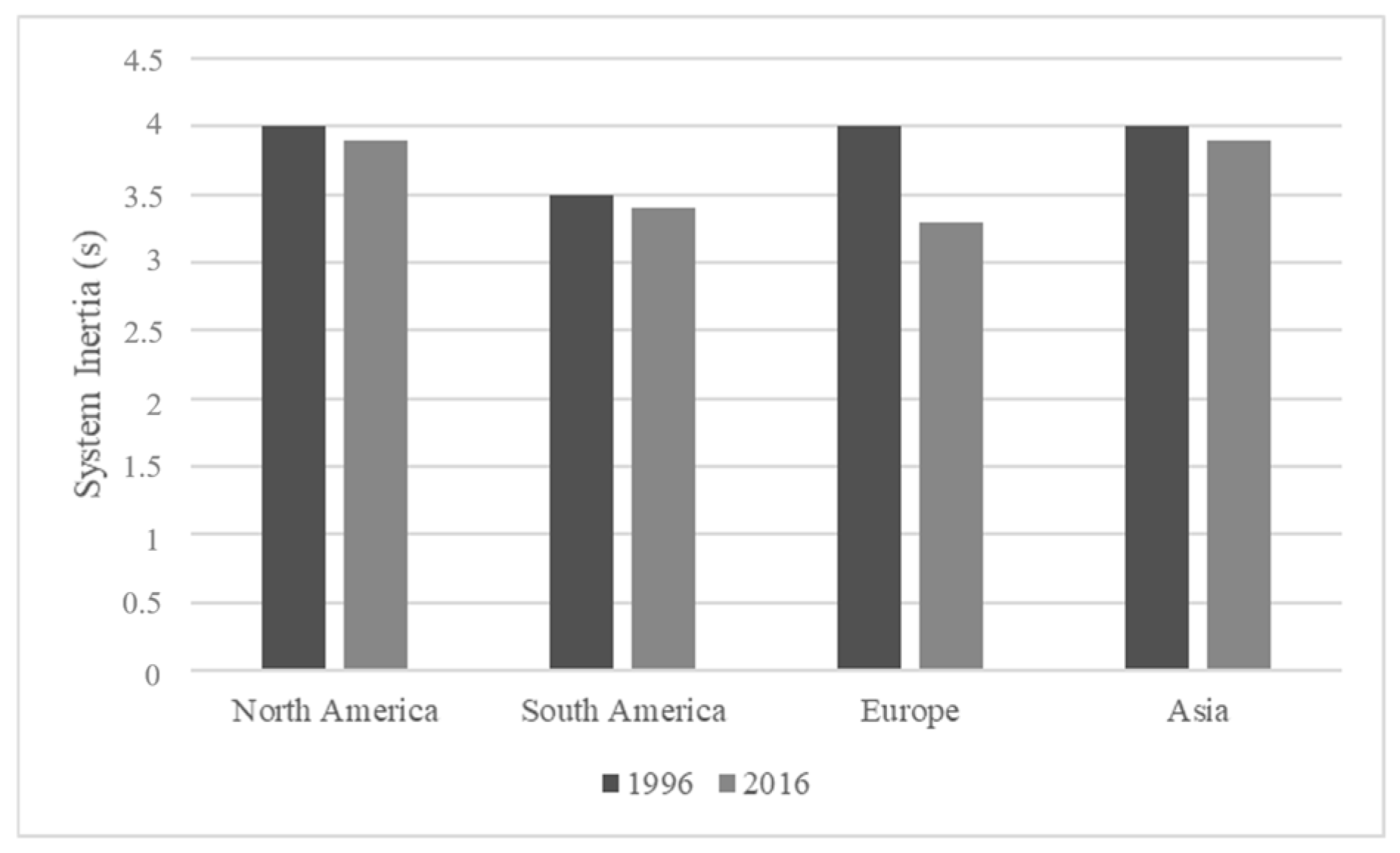
Large-scale integration of renewable generation is transforming existing grids through inverter interfaces, a change that inevitably reduces the system’s overall inertia [25]. Lower inertia weakens frequency stability; even moderate disturbances may cause significant frequency excursions [7]. Several regions show a reduction in overall power system inertia, especially between 1996 and 2016, as shown in Figure 2. During this period, global electricity consumption increased by over 80%, yet the share of renewable energy sources grew by only 4%. Despite this modest increase, it contributed to a decline in system inertia. In Europe, where the share of renewable energy rose by approximately 20% during this period, the system inertia constantly dropped by nearly 20%, or around 0.6 s. In contrast, regions such as Asia, the United States, and South America experienced only a 2.5–3% reduction in system inertia, reflecting less pronounced renewable energy integration [28].
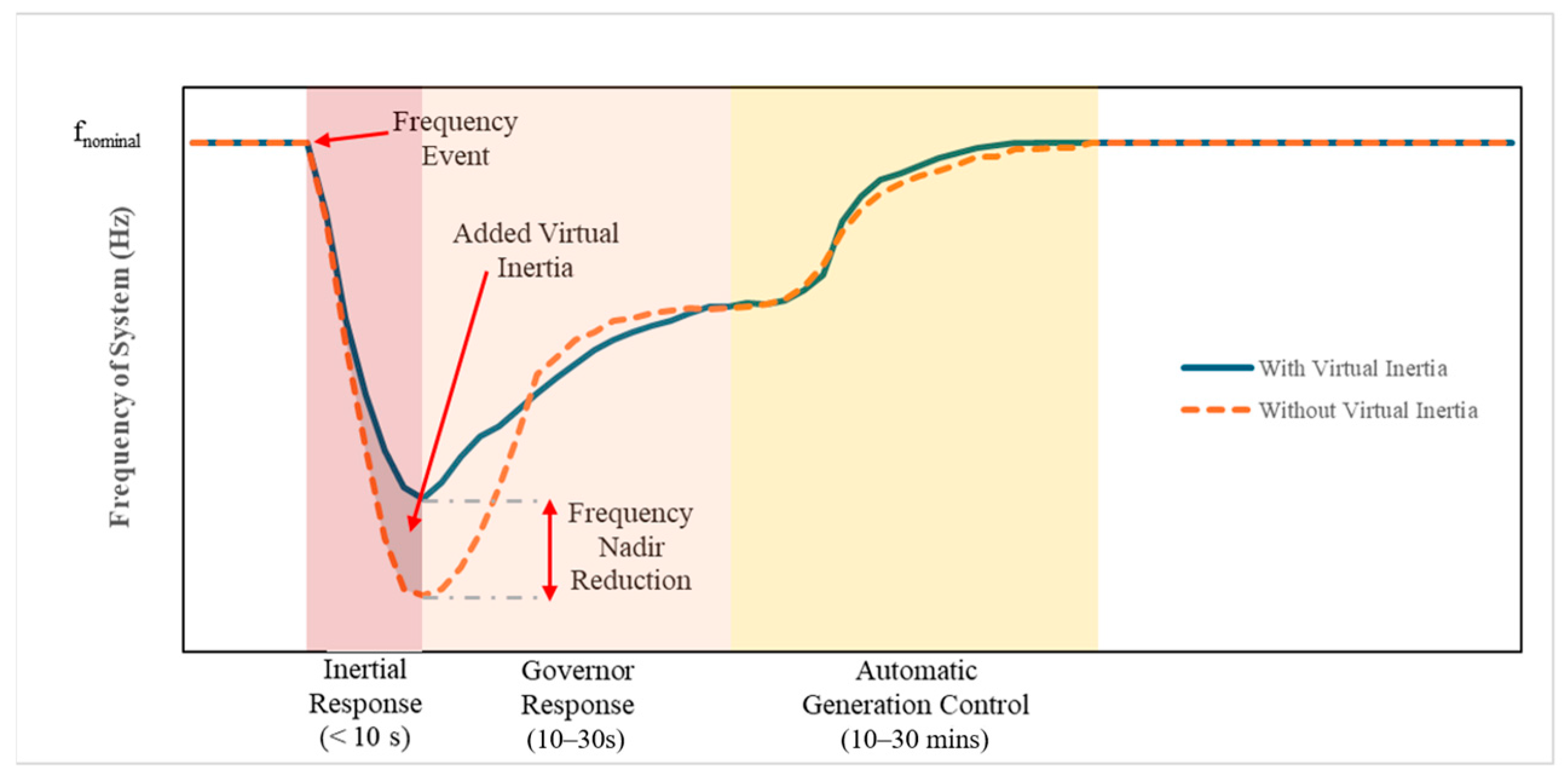
To counter this, researchers have focused on injecting virtual inertia, a strategy to restore stability. By implementing virtual inertia control on PV or wind inverters, these inverters can autonomously deliver a rapid inertial response within the first few seconds after a disturbance. This quick response helps slow the frequency drop and raise the frequency nadir, giving primary control systems (from conventional generators or storage) time to take over, as shown in Figure 3 [7].
Studies have shown that virtual inertia reduces frequency deviation and RoCoF, speeds up frequency recovery, and lowers the need for emergency load shedding [29]. Some grid codes, particularly in Europe, require wind turbines to provide an inertial response [10,11]. As such, it is now viewed as a crucial ancillary service for high-PV and wind grids. Virtual inertia thus plays a vital role in maintaining frequency reliability and supporting the transition to low-carbon power systems dominated by intermittent generation.

3. Virtual Inertia Applications in Power Systems

Virtual inertia can be incorporated into PV systems and wind turbines by integrating energy storage systems [30]. Virtual inertia can be implemented in either of two general types of inverters, depending on their control modes: grid-following (GFL) or grid-forming (GFM). Both types can support system frequency regulation, depending on their control characteristics and operational context, including through virtual inertia [31]. GFL operates by tracking grid voltage and frequency, injecting current accordingly, and is widely used for its simplicity, though it may require enhancements such as virtual inertia and droop control to improve frequency stability [32]. However, its response still differs from that of synchronous machines, especially in low-inertia systems, where its support may be insufficient [33,34]. In contrast, GFM inverters emulate synchronous machines by forming their own voltage and frequency references, allowing them to synchronize with the grid independently and provide stronger support for frequency and voltage control—an advantage particularly critical in systems lacking conventional inertia [33,34].
Virtual inertia control strategies in inverters for intermittent power sources are predominantly applied within three-phase power networks, as these systems provide a more suitable framework for advanced control functionalities [35]. Nonetheless, such control methods are not limited to three-phase configurations, as they can also be extended to single-phase local distribution networks, particularly in residential or small-scale applications, where maintaining frequency and voltage stability is equally critical [36,37,38]. Research has demonstrated that incorporating the swing equation into the control of single-phase inverters enables the emulation of virtual inertia, allowing the inverter to dynamically respond to sudden load variations and thereby enhance grid stability [37].
Within existing grids, the bulk of grid-connected inverters originates from wind farms [14]. Most modern turbines utilize Variable-Speed Wind Turbines (VSWTs) equipped with back-to-back converters that decouple the generator from the grid, thus altering the system’s dynamic response. One strategy to reduce instability is to use virtual inertia in the system, such as via a synchronverter [17].
In terms of the economic aspect, implementing virtual inertia or frequency regulation systems through battery energy storage systems (BESSs) and grid-forming inverters requires cost–benefit evaluation. Studies indicate that providing reliable inertia support often requires oversizing battery capacity, as additional power and energy margins are needed to handle rapid frequency deviations. This design requirement increases both capital expenditure (CapEx) and system complexity. For example, a study found that when higher reliability levels are targeted, the benefit–cost ratio of virtual inertia from a BESS decreases due to growing investment in converter capacity and standby energy reserves [39]. Beyond equipment cost, maintaining headroom for fast frequency response also leads to renewable curtailment, since part of the generation must be withheld to provide inertial power. As a result, while BESS-based inertia emulation improves dynamic performance, it may not always be the most cost-effective standalone option.
Compared to conventional reserves or pure BESS frequency responses, hybrid configurations—where grid-forming inverter control provides instantaneous “synthetic inertia,” supported by a BESS for longer-duration fast frequency response (FFR)—offer a more balanced techno-economic outcome. This combination reduces the need for large battery oversizing and minimizes energy curtailment while still improving system resilience. Recent analyses also highlight that battery degradation and cycling costs significantly affect the long-term profitability of frequency-support services [40]. A study shows that virtual inertia emulated via control strategies in inverter-based resources can reduce reliance on large battery reserves, potentially improving cost efficiency, by developing coordinated control schemes for PV-BESSs [41]. Therefore, in a modern power system, virtual inertia is part of an integrated frequency-support portfolio alongside grid-forming control, BESS-based FFR, and other measures to achieve optimal reliability at a reasonable cost.
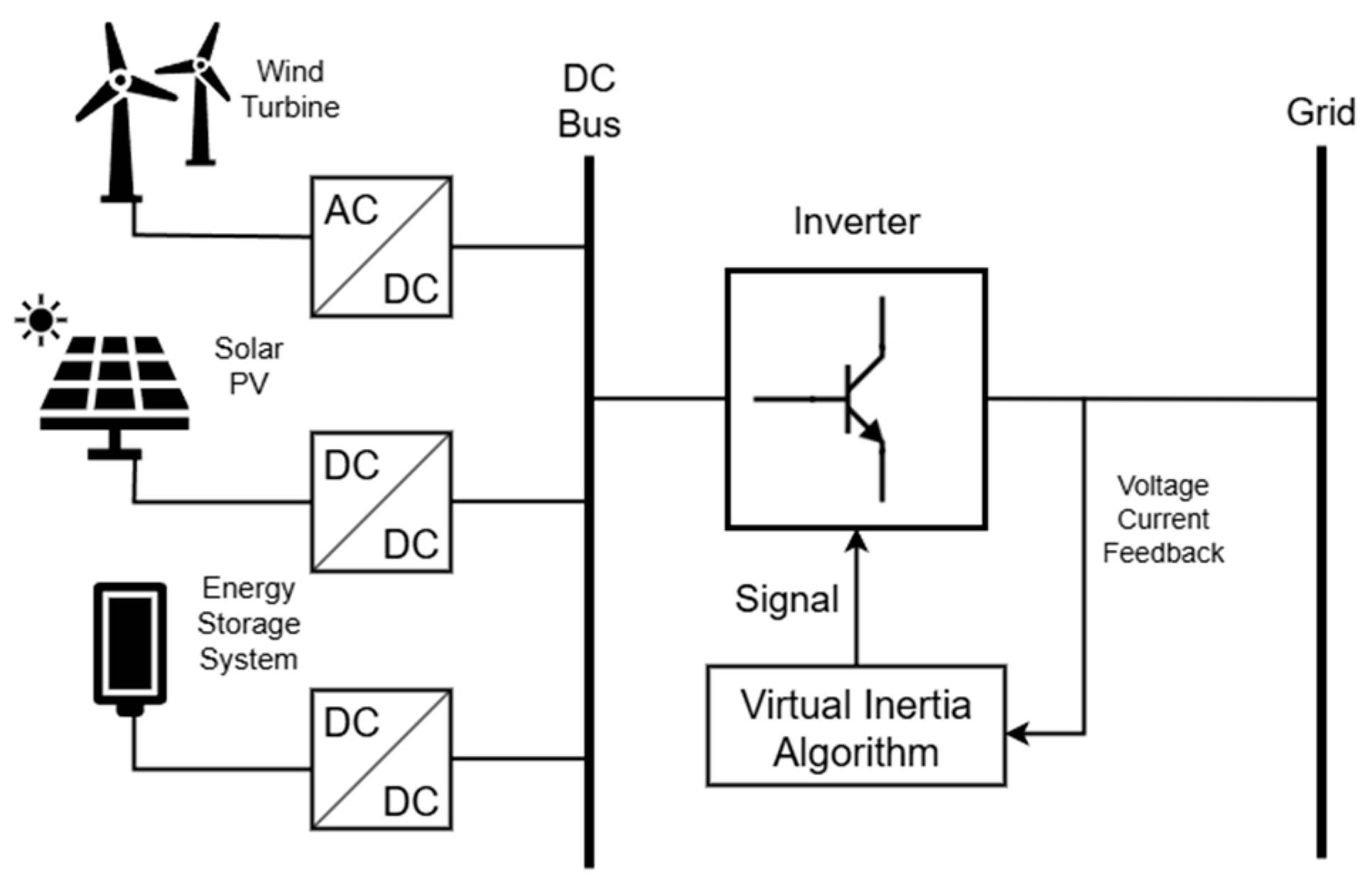
Conceptually, virtual inertia combines a smart control system with renewable energy sources and fast-responding batteries to mimic the inertia provided by traditional power plants [7]. As shown in Figure 4, a typical setup includes several renewable energy generators and a battery system, all connected to the grid using power electronic devices. When these components work together as a unit, they form a microgrid—a small, locally managed network that can either stay connected to the main grid or operate independently, often with a high share of distributed energy sources.
Virtual inertia control systems in inverters for intermittent power plants are primarily implemented in three-phase networks [35]. However, it is also possible to implement in a single-phase local network to support the grid’s stability. Prior research indicates that implementing the swing equation in the single-phase inverter enhances grid stability by providing virtual inertia to respond to a load change event [37]. Another method using the VSG model was applied to a single-phase PV inverter and demonstrated via simulation to support the stability of a small-scale power system [42].
Since renewable energy systems usually rely on converting electricity between AC and DC, current power grids already have many inverters. This high number of inverters leads to a loss of natural inertia in the system [25]. One practical way to solve this issue is by programming each inverter to behave like an actual generator. The earliest versions accomplished this by copying the operation of an induction generator, which makes sense since these machines have long been used in fossil fuel power plants [43]. By mimicking the torque and speed behavior of induction generators, these inverter controllers can help keep the grid stable using the existing hardware found in most renewable setups.

4. Virtual Inertia Methods

Frequency control in an inverter can be classified from various perspectives. In terms of control methods, it can generally be divided into control based on synchronous machines and those that are not, such as droop control [36]. Control strategies for inverters that mimic the characteristics of synchronous machines are fundamentally based on the swing equation, which serves as the basic model for the rotor dynamics of a synchronous generator in response to power imbalances between mechanical input and electrical output to the grid. This control method is appropriate for classification as a means of achieving virtual inertia in an inverter-based generation system.

4.1. Droop Control

The concept of droop control originated from the steady-state characteristics of synchronous generators operating in parallel. In conventional power systems, multiple generators share active and reactive power proportionally to their ratings without requiring direct communication. This autonomous coordination arises naturally from the generator’s inherent speed–power and voltage–reactive power relationships, in which an increase in load results in a small reduction in frequency and terminal voltage, prompting generators to proportionally adjust their power output.
Inspired by this physical behavior, droop control was introduced for inverter-based distributed generators, initially in the context of microgrids [44], to emulate the self-regulating characteristics of synchronous machines through simple control mechanisms [45]. This method establishes proportional relationships between frequency and active power (P–f) and between voltage and reactive power (Q–V), allowing multiple inverters to share load changes autonomously without communication. In general, the equations for droop control are shown in Equations (1) and (2).
ω = ω 0 k p   ( P P 0 )
V = V 0 k q   ( Q Q 0 )
The symbols ω and ω0 denote the inverter frequency and the nominal angular frequency, respectively. V and V0 are, respectively, the inverter output voltage magnitude and nominal voltage magnitude. P and Q represent measured active and reactive power at PCC, and P0 and Q0 are reference active and reactive power, respectively. Finally, kp and kq are droop coefficients for frequency and voltage control, respectively.
The performance of droop control is largely determined by the selection of the droop coefficients kp and kq. These parameters govern the sensitivity of frequency and voltage to active and reactive power variations, respectively. Improper tuning may lead to inaccurate power sharing, frequency deviation, or voltage regulation. Therefore, the design of droop coefficients involves a trade-off between steady-state accuracy and dynamic response. Various approaches have been proposed in the literature to improve the performance of droop control. These include different strategies for selecting droop coefficients, such as fixed-drop coefficients [44], optimization-based tuning [46], adaptive droop control [47], and model predictive control-based tuning [48].
Despite its simplicity, droop control has some major drawbacks. It can cause large deviations in frequency and voltage, as shown in [49]. Furthermore, droop control is known to exhibit poor dynamic performance due to the absence of inertia [50].

4.2. Synchronverter

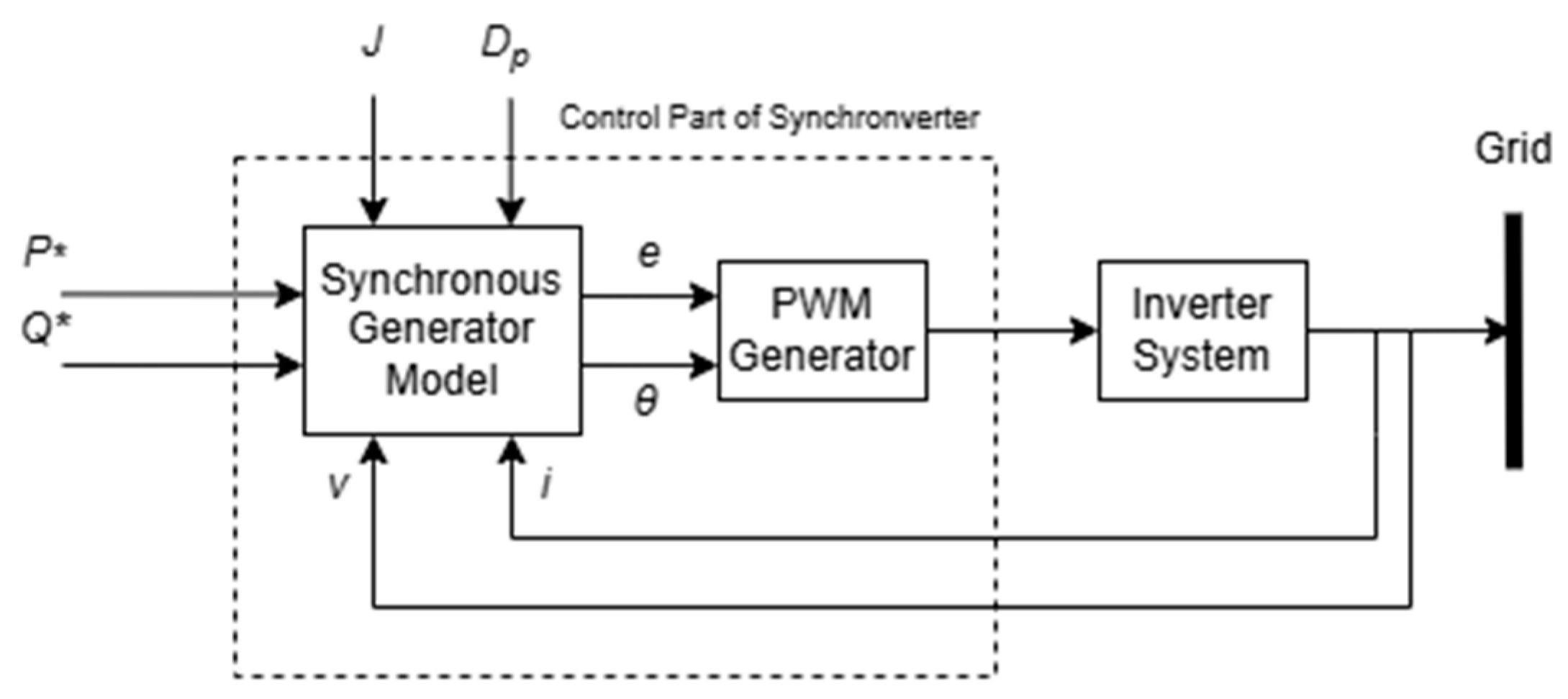
A synchronverter is one of the early strategies proposed for virtual inertia and is a method that an inverter-based system can use to mimic a synchronous generator [35]. As synchronous machines are still dominant in fossil-fuel-based power plants, modeling the inverter after them simplifies grid synchronization, as the network “sees” every source as another synchronous unit. Figure 5 summarizes the architecture of the synchronverter, where the inverter supplies power while an embedded controller emulates electro-mechanical dynamics [7].
The primary advantage of a synchronverter is that it enables inverter-based DG units to integrate seamlessly into existing power systems without significantly altering the system’s dynamic stability [7]. This compatibility with traditional synchronous generator-based operations is what makes synchronverters attractive, especially in transitioning grids. The underlying concept and control topology have been extensively studied and refined in the literature, most notably by Q. C. Zhong [5,51].
Synchronverters regulate power output using a frequency droop mechanism that mimics the synchronous generator’s natural response to load variations by adjusting its frequency [52]. Their internal dynamics are modeled by the following equations that govern synchronous generators:
T e = M f i f i , sin θ ,
e = θ M f i f sin θ ,
Q = θ M f i f i , cos θ .
In this equation, T e denotes electromagnetic torque, M f is the mutual inductance between the field and stator windings, and i f is the excitation current. The angle between the rotor and stator phase is represented by θ , e is the open-circuit voltage, and Q is the reactive power. These quantities are defined as vectors in 3D space to reflect actual physical interactions.
In real-time operation, these equations are discretized and solved within a digital controller during every control cycle. The controller measures the inverter’s current and the grid voltage as feedback, then calculates the necessary gate signals to operate the power electronic switches. As illustrated in Figure 5, the control logic includes adjustable parameters such as the virtual inertia ( J ) and the damping coefficient ( D p ), both of which are key to maintaining system stability [53].
The synchronverter’s control system consists of two major loops: frequency and voltage. In the frequency loop, the mechanical torque T m is derived from the reference active power and the nominal grid frequency ω n , generating the virtual angular speed ω . This speed is integrated to compute the phase angle used in pulse width modulation (PWM), which dictates how the inverter switches operate.
In the voltage loop, the reference voltage is compared to the actual grid voltage. The error is multiplied by a voltage droop constant D q , then combined with the error between the desired and actual reactive power. This composite signal is integrated (with a gain of 1/kv) to produce the term M f i f , which directly influences PWM control. The final outputs of the controller, e and θ , are critical for generating accurate switching signals [7].
An important aspect of synchronverter control is that its mathematical structure resembles an improved version of a PLL, also known as a sinusoid-locked loop. This allows it to stay naturally synchronized with the grid voltage [38]. Variant synchronverters for single-phase applications have also been designed and studied [36,54]. Although basic synchronverters rely on PLLs to lock into the grid frequency during start-up, PLLs can be unstable in weak grid conditions [55,56]. To overcome this, researchers have developed self-synchronizing versions of synchronverters that do not depend on PLLs [5].
Interestingly, the concept of synchronverter control has also been extended to rectifiers, enabling them to operate like synchronous motors [57]. This allows the system to gain inertia not only from generators but also from the load side. Because synchronverters are implemented using voltage-source inverters, they can operate in a grid-forming mode [36]. This is particularly useful for DG systems that are not always connected to a main grid. Another advantage is that synchronverters do not require using the frequency derivative, which is often avoided because it can introduce noise and instability in control systems [7].
However, despite their ability to closely mimic synchronous generator behavior, synchronverters involve complex differential equations. This complexity can sometimes lead to numerical problems in real-time control. Additionally, because they are based on voltage-source operation, they may lack inherent protection against sudden grid disturbances. As a result, external protection devices are often needed to ensure safe and reliable performance.
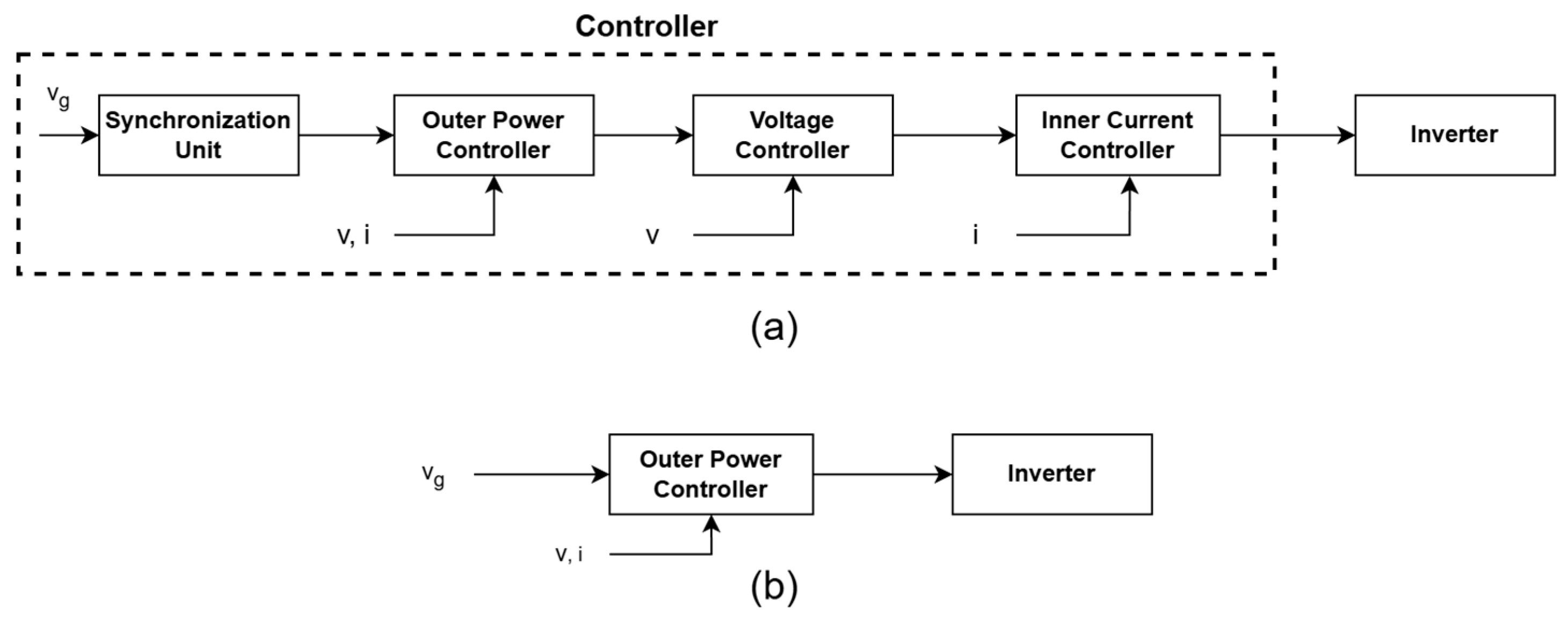
The fundamental concept of the synchronverter encourages modification and improvement by researchers. One study presented a self-synchronized synchronverter that eliminates the need for a dedicated synchronization unit, which is traditionally required to maintain inverter-grid synchronization—typically implemented using a PLL [5]. By removing this component, the proposed strategy reduces system nonlinearity, simplifies the controller structure, increases system bandwidth, and shortens the duration of synchronization, as shown in Figure 6. Unlike prior approaches, which rely on a backup PLL during grid connection or faults, this method achieves full synchronization—both before and after connection—using only the synchronverter’s internal control [7]. Simulation and experimental results confirm its effectiveness under normal conditions and grid disturbances.
The improved synchronverter achieves performance enhancements of over 65% in frequency tracking, 83% in active power control, and 70% in reactive power control. Its simplified architecture not only lowers computational and development requirements but also improves reliability. While the study focuses on synchronverter-based systems, it opens the possibility for applying similar self-synchronizing strategies to other inverter control methods—particularly those already capable of tracking grid frequency during operation, such as the controller outlined in [55].
Another research study proposed an enhanced version of the synchronverter model to improve the integration of converter-interfaced renewable energy sources into the power grid [58]. The key innovations include clear decoupling between the inertial response (IR) and primary frequency response (PFR), improved oscillation damping through a single damping term, and fully separated active and reactive power control loops. A closed-form condition for a critically damped inertial response is also introduced, aligning with ENTSO-E standards. The model’s performance is evaluated through time-domain simulations under frequency ramp variations, demonstrating superior results compared to conventional synchronverter designs.

4.3. Virtual Synchronous Generator (VSG)

As the share of static DG units in power systems continues to increase, this can degrade voltage and frequency responses and even increase the risk of instability during major disturbances [59]. To mitigate these challenges, the VSG concept has emerged as an effective solution [30]. VSGs are designed to imitate the inertia behavior and characteristics of synchronous generators, especially in power systems where many DG units are connected [17]. The main idea is that the VSG adjusts its output power in response to changes in the system frequency. Unlike synchronous generators, VSGs do not need to model all the complex equations of real machines, making them one of the simplest ways to add virtual inertia to DG systems. However, using many DG units that behave as current sources may cause system instability [60]. The first practical application of the VSG concept was carried out by Beck and Hesse in 2007 [17]. To control the output power of the VSG, Equation (6) is used:
P V S G = K D Δ ω + K I d Δ ω d t .
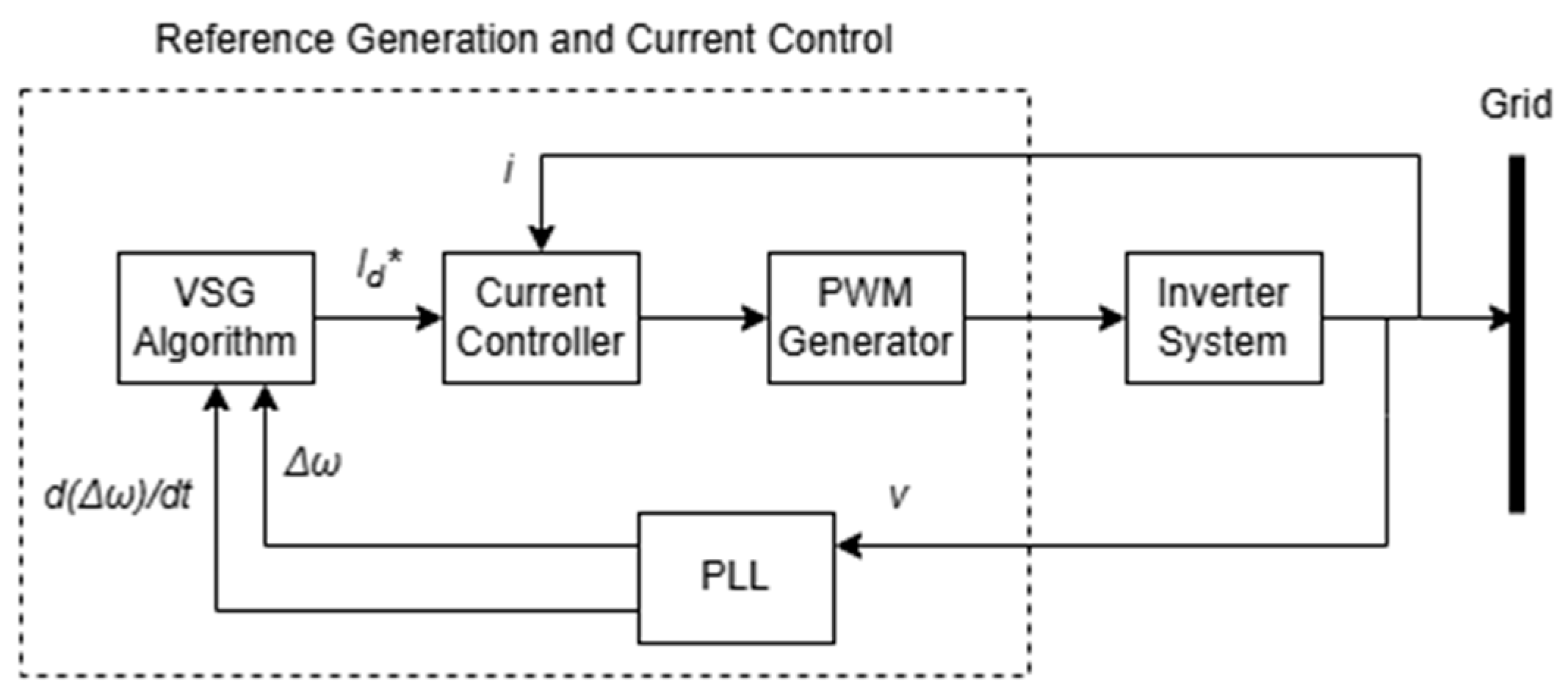
In this equation, Δ ω is the frequency deviation, and d Δ ω / d t is its RoCoF. The terms K D (damping constant) and K I (inertia constant) control how the VSG responds. Like droop control, K D helps bring the frequency back to normal and reduces the frequency dip after a disturbance. K I helps react quickly to frequency changes, reducing the RoCoF. This is especially important in islanded grids, where a large RoCoF could mistakenly trigger protection systems. The VSG model is shown in Figure 7 [7].
To apply this strategy, a PLL is used to measure both the frequency change and the RoCoF [7]. These values are used in Equation (6) to calculate the power reference for the inverter. Then, current references are generated for the inverter’s current control system. This approach uses a d q reference frame, where the d -axis current can be calculated as shown in Equation (7) [61]:
I d = 2 3 V d P V S G V q Q V d 2 + V q 2 .
In this case, the d and q components of the grid voltage are V d and V q . If only active power is being controlled, then the reactive power Q and q -axis current I q are set to zero. The inverter’s current controller uses these inputs and grid current feedback to generate switching signals. This way, the inverter works as a voltage-source inverter with current control [62].
VSGs are widely used to simulate inertia in wind power systems [63]. However, they have several drawbacks. VSGs only simulate inertia when the frequency changes, not when the input power varies [64]. Measuring the frequency derivative accurately using a PLL is also difficult, especially in weak grids, where PLL performance can degrade or interfere with other PLLs [65]. PLLs can become unstable or inaccurate during voltage sags, harmonic distortion, or fast frequency changes [56].
Improvements to the VSG strategy to achieve virtual inertia and better support to the grid have been reported in various studies [30,66]. An adaptive virtual inertia control strategy to improve frequency stability in VSG-based microgrids was introduced [30], the key idea of which is to dynamically adjust the virtual inertia based on the system’s frequency condition: high inertia is applied when the frequency deviates from nominal to slow down changes, and low inertia is used when the frequency returns to normal to speed up recovery. Compared to existing variable-inertia methods, the proposed approach offers three main improvements: a concise, unified mathematical formula for describing inertia changes; a control algorithm that avoids using noise-sensitive frequency derivatives; and a formal stability analysis based on Lyapunov theory [34], along with practical design guidelines [30]. A unified mathematical model of the adaptive virtual inertia is shown in the following Equation (8):
J = J 0 + k ω ω   d ω d t .
The defined inertia consists of two parts. The first part, J 0 , represents the nominal constant inertia, while the second part, k ω ω   d ω / d t , functions as the adaptive compensation component. Here, k is a positive coefficient that determines how strongly the inertia compensation responds to frequency dynamics. In practice, the total inertia moment is continuously updated in real time according to the difference between the actual angular speed ω and the reference value ω   , as well as the rate at which this difference changes d ω / d t . Notably, when the system is operating in the nominal steady state ω = ω   , the adaptive compensation term is zero, so the overall inertia simply equals J 0 . The proposed method improves frequency regulation by adapting to both high and low inertia, demonstrating better performance during disturbances and recovery [30]. Tested under various load types, it effectively stabilizes frequency and supports greater integration of DG in modern power systems.
Furthermore, alternative approaches utilizing the VSG model have also been explored specifically for a single-phase model [38,42,67]. In particular, the application of a VSG-based control to a single-phase PV inverter has shown promising results in simulation studies, effectively contributing to the frequency and voltage stability of isolated or weak distribution systems [67]. These findings indicate that, even in limited configurations, single-phase inverters can be equipped with virtual inertia functionality, reinforcing their potential role in future distributed energy systems with high penetration of renewable energy sources.

4.4. Swing Equation-Based Model

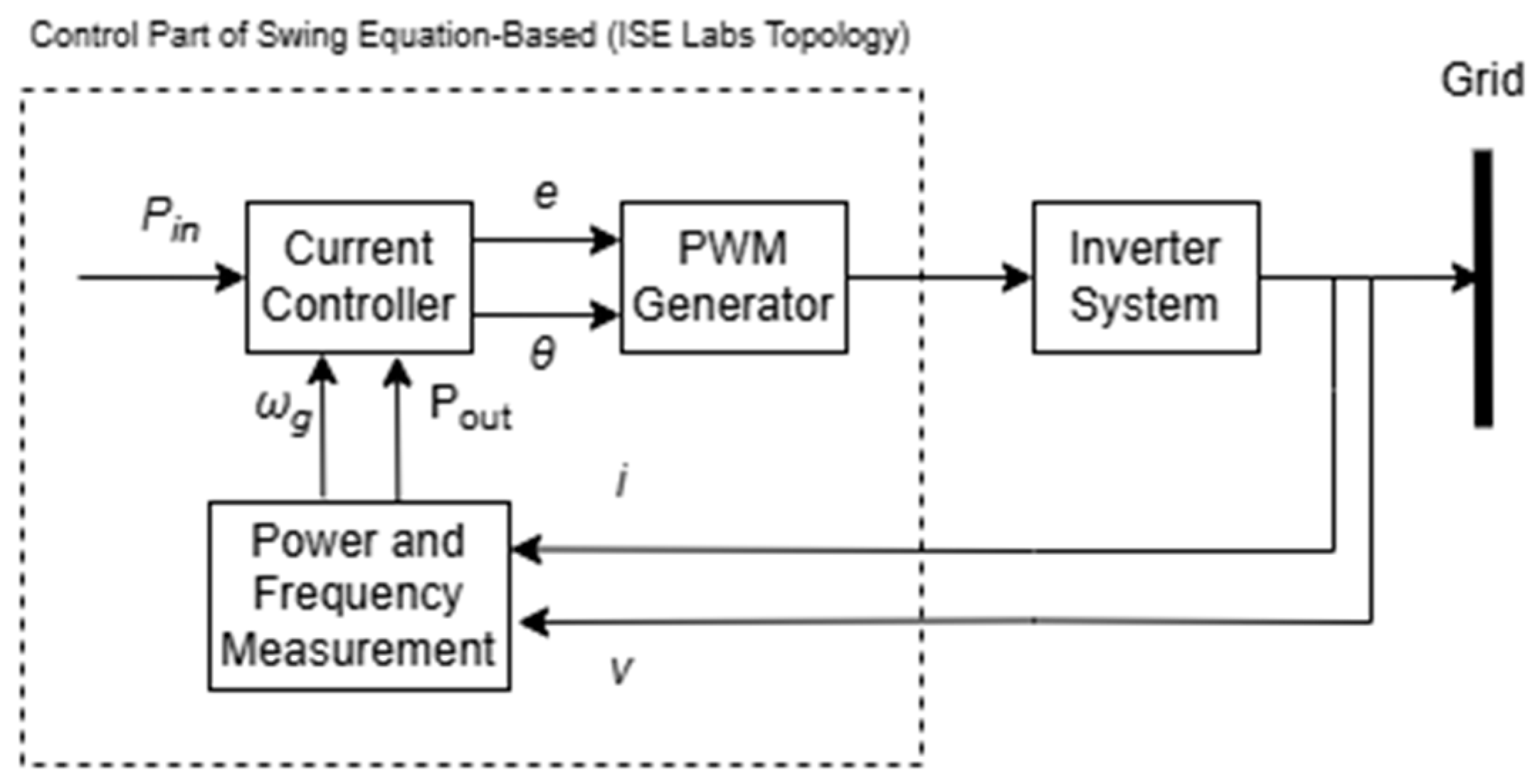
The virtual inertia method developed by Ise Lab follows a similar idea to earlier strategies, but instead of modeling a full synchronous generator, it simplifies the approach by solving the power–frequency swing equation in each control cycle to simulate [68]. The control structure, shown in Figure 8, operates by measuring the inverter’s output current ( i ) and terminal voltage ( v ) to calculate the grid frequency ( ω g ) and output power ( P o u t ) [60]. These values, along with the estimated input power ( P i n ), are used as inputs to the main control block [69].
In every control cycle, the swing equation is solved, as shown in Equations (9) and (10), to generate the phase angle command ( θ ) for the PWM signal [60]. The swing equation is like the one used for synchronous machines and includes the virtual angular frequency ( ω m ), grid/reference frequency ( ω g ), moment of inertia ( J ), damping factor ( D p ), input power ( P i n ), and output power ( P o u t ). The input power ( P i n ) is estimated using a governor model that reacts to frequency deviation from the reference frequency ( ω   ).
P i n P o u t = J ω m d ω m d t + D p ω ω   ,
Δ ω = ω m ω g .
To create the voltage reference ( e ), the Q V droop method can be applied, as described in [70]. Like synchronverter control, this method does not require frequency derivatives, which is beneficial because frequency derivatives often introduce noise and make the system harder to manage. Additionally, this control strategy allows DG units to operate in the grid-forming mode. However, one drawback is the possibility of numerical instability, especially when the inertia ( J ) and damping ( D p ) parameters are not tuned properly, which can result in oscillations in the system [69].
In the traditional topology developed by Ise Lab, a key issue found during virtual inertia emulation is active power oscillations [7,69]. When a frequency disturbance occurs, a DG unit must quickly inject or absorb power, which can sometimes exceed its power rating. While conventional synchronous generators can handle this due to their built-in overload capacity, inverters cannot. To address such peaks, inverter components—especially switches—must be oversized, thereby increasing the size and cost of the inverter system [55].
To solve this problem, an alternating-moment-of-inertia technique was introduced [69]. In this method, the inertia constant J is adjusted based on the relative virtual angular velocity and its rate of change. This approach helps reduce power oscillations and improve stability not only for the local unit but also for nearby virtual inertia systems. A similar idea was proposed in other research, where the “virtual stator reactance” of the virtual inertia unit is modified to reduce active power oscillations [59]. This technique closely resembles the synchronverter method described in [71] and is also useful for more effectively sharing transient power among multiple virtual inertia units in a microgrid.

4.5. Data-Driven Grid-Forming Methods

Conventional grid-forming control methods are primarily model-based, relying on accurate system representations to design controllers and ensure stability. However, such detailed models are not always available due to system complexity, parameter uncertainty, or proprietary restrictions. Simultaneously, modern power systems have become increasingly data-rich, driven by the widespread deployment of digital sensors, PMUs, and advanced monitoring devices. This abundance of data opens new opportunities for data-driven approaches that can learn system behavior directly from measurements. Inspired by the success of artificial intelligence (AI) and machine learning in other engineering domains, data-driven GFM control has recently emerged as a promising approach for achieving adaptive, resilient inverter operation in converter-dominated power systems.
In the context of inverter modeling, a data-driven GFL model was proposed in [72,73], and in [74], a data-driven model for the GFM inverter was proposed using system identification (SysId) methods. The approach requires a well-designed probing signal to uncover the GFM governing equations. Neural network-based virtual inertia was proposed in [75], where a recurrent probabilistic wavelet fuzzy neural network was employed to emulate the inertial response of synchronous machines in a microgrid. In [76], a GFM algorithm for PVs with a battery energy storage station (BESS) was proposed using adaptive dynamic programming.

5. Method Comparison

A summary of the five main virtual inertia methods discussed in this paper is shown in Table 1 [7]. Starting with the droop control approach, this conventional method replicates the governor droop characteristic of synchronous machines. It offers a simple implementation that does not require communication links, making it suitable for basic load-sharing functions. However, it does not provide virtual inertia support, limiting its effectiveness in low-inertia systems with high renewable penetration.
The other method, the synchronous generator model-based approach, is known as the synchronverter. This method precisely emulates the dynamic behavior of a synchronous generator, enabling seamless integration with conventional grid operations. It does not rely on the frequency derivative, and the PLL is used only for synchronization, making it a robust and realistic control method. However, its implementation can suffer from numerical instability, and it is typically realized as a voltage source without built-in overcurrent protection, which may pose challenges during fault conditions.
The third approach is the frequency–power response strategy, also known as the VSG. This method is the simplest to implement and is generally configured as a voltage source with inherent overcurrent protection. Despite these advantages, it depends on the frequency derivative and uses a PLL for synchronization, making it vulnerable to instability and electrical noise. The fourth method, the swing equation-based strategy, such as Ise Lab’s method, offers a simpler model than the synchronverter while still avoiding the need for a frequency derivative. It also uses the PLL only for synchronization, but its simplicity can lead to power and frequency oscillations. Like the other two strategies, it is commonly implemented as a voltage source without overcurrent protection. Finally, data-driven grid-forming control introduces a modern method that eliminates the need for explicit models. Its adaptability and self-learning capability enable real-time response tuning based on data availability. Nevertheless, its performance heavily depends on the quality and volume of available data, which can limit robustness in practical grid applications.
A performance comparison of virtual inertia methods was also conducted, as shown in Table 2 [7]. Among the three control topologies studied, the lowest frequency point (nadir) and the RoCoF showed similar reductions. This indicates that all virtual inertia implementations effectively mitigated the immediate frequency deviation following a disturbance. The improvement in frequency nadir from 57.3 Hz to above 58 Hz demonstrates the ability of virtual inertia to reduce the depth of frequency dips, which is critical for preventing under-frequency load-shedding events. Likewise, the lower RoCoF values (from 1.9 to around 1.5–1.7 Hz/s) reflect a slower rate of frequency decline, indicating a gentler, more controllable transient response.
However, noticeable differences emerged in the settling time across the tested methods. The settling time is the time it takes for the system frequency to return to within ±0.25 Hz of its final steady-state value following a disturbance. In all three cases, introducing virtual inertia resulted in a longer settling time compared to the system without it, an expected outcome, since virtual inertia intentionally slows the dynamic response to emulate the behavior of synchronous machines. This delay occurs because the inertia emulation momentarily stores and releases energy to oppose rapid frequency changes, thus prolonging the oscillatory behavior before the steady state is reached. Among the tested methods, the VSG and Ise Lab approaches exhibited the longest settling times (around 17–18 s) due to their stronger inertial emulation and more complex control loops. In contrast, the synchronverter achieved more balanced performance—a moderate enhancement in frequency nadir and RoCoF—while maintaining a comparatively shorter settling time (13.2 s). This suggests that the synchronverter offers a practical trade-off between system stability and dynamic recovery speed [7].

6. Conclusions

This study reviewed five major control strategies for implementing virtual inertia in inverter-based power systems. Droop control enables decentralized power sharing without communication but lacks inertia emulation, resulting in limited dynamic performance under high renewable penetration. The synchronverter most closely replicates synchronous generator behavior and avoids reliance on frequency derivatives, though it may face numerical instability and lacks built-in current protection. The virtual synchronous generator (VSG) offers a simpler implementation with inherent current limitation, but its reliance on frequency derivatives and PLLs makes it sensitive to noise and prone to instability. The swing equation-based method simplifies modeling but can introduce oscillations if not properly tuned. Meanwhile, emerging data-driven grid-forming control eliminates the need for explicit models, achieving adaptability through learning-based techniques at the cost of high data dependency.
All these methods aim to enhance frequency resilience in converter-dominated grids, yet their trade-offs must be balanced with system needs. Synchronverter, swing equation-based, and data-driven GFM methods are better suited for grid-forming or islanded systems, whereas VSG and droop control remain practical for grid-following configurations. Future research should focus on integrating virtual inertia into grid-forming inverter frameworks, applying adaptive tuning methods, and validating large-scale performance under renewable energy domination in the grid to establish virtual inertia as the key to stable and reliable power systems.

Author Contributions

Conceptualization, F.D.W. and E.F.; methodology, F.D.W., F.W. and E.F.; software, F.W.; validation, F.D.W. and E.F.; formal analysis, F.W. and E.F.; investigation, E.F.; resources, F.D.W.; data curation, E.F.; writing—original draft preparation, F.W.; writing—review and editing, F.D.W. and E.F.; visualization, F.W.; supervision, F.D.W.; project administration, F.W.; funding acquisition, F.D.W. All authors have read and agreed to the published version of the manuscript.

Funding

This research received no external funding.

Data Availability Statement

No new data were created or analyzed in this study. Data sharing is not applicable to this article.

Acknowledgments

The work was funded by the Rekognisi Tugas Akhir (RTA) Program within the Research Directorate of Universitas Gadjah Mada. Any opinions, findings, and conclusions or recommendations expressed herein are those of the authors and do not necessarily reflect those of the Research Directorate of Universitas Gadjah Mada.

Conflicts of Interest

The authors declare no conflicts of interest.

Abbreviations

The following abbreviations are used in this manuscript:
ACAlternating Current
DCDirect Current
DGDistributed Generation
ENTSO-EThe European Network of Transmission System Operators for Electricity
ERCOTThe Electric Reliability Council of Texas, Inc.
GFLGrid-Following
GFMGrid-Forming
IRInertial Response
NZENet-Zero Emissions
PFRPrimary Frequency Response
PLLPhase-Locked Loop
PLNPerusahaan Listrik Negara (State Electricity Company)
PVPhotovoltaics
PWMPulse Width Modulation
RoCoFRate of Change of Frequency
RUPTLRencana Usaha Penyediaan Tenaga Listrik (Electricity Supply Business Plan)
SDGSustainable Development Goal
VSGVirtual Synchronous Generator
VSWTVariable-Speed Wind Turbine

References

  1. Guerrero, J.M.; Blaabjerg, F.; Zhelev, T.; Hemmes, K.; Monmasson, E.; Jemei, S.; Comech, M.P.; Granadino, R.; Frau, J.I. Distributed Generation: Toward a New Energy Paradigm. IEEE Ind. Electron. Mag. 2010, 4, 52–64. [Google Scholar] [CrossRef]
  2. UNFCCC. The Paris Agreement—Publication. Available online: https://unfccc.int/documents/184656 (accessed on 12 March 2024).
  3. UNFCCC. Kyoto Protocol to the United Nations Framework Convention on Climate Change; UNFCCC: Bonn, Germany, 2005. [Google Scholar]
  4. Trinh, V.; Chung, C. Renewable energy for SDG-7 and sustainable electrical production, integration, industrial application, and globalization: Review. Clean. Eng. Technol. 2023, 15, 100657. [Google Scholar] [CrossRef]
  5. Zhong, Q.-C.; Nguyen, P.-L.; Ma, Z.; Sheng, W. Self-Synchronized Synchronverters: Inverters Without a Dedicated Synchronization Unit. IEEE Trans. Power Electron. 2014, 29, 617–630. [Google Scholar] [CrossRef]
  6. Van, T.V.; Visscher, K.; Diaz, J.; Karapanos, V.; Woyte, A.; Albu, M.; Bozelie, J.; Loix, T.; Federenciuc, D. Virtual synchronous generator: An element of future grids. In Proceedings of the 2010 IEEE PES Innovative Smart Grid Technologies Conference Europe (ISGT Europe), Gothenburg, Sweden, 11–13 October 2010; pp. 1–7. [Google Scholar]
  7. Tamrakar, U.; Shrestha, D.; Maharjan, M.; Bhattarai, B.P.; Hansen, T.M.; Tonkoski, R. Virtual Inertia: Current Trends and Future Directions. Appl. Sci. 2017, 7, 654. [Google Scholar] [CrossRef]
  8. Heckmann, W.; Duc, N.H.; Ruiz, D.G.; Kulkarni, S.S.; Van, N.N. Smart Energy Buildings: PV Integration and Grid Sensitivity for the Case of Vietnam. In Proceedings of the 11th International Conference on Smart Cities and Green ICT Systems, Online, 27–29 April 2022; pp. 117–124. [Google Scholar]
  9. Poolla, B.K.; Bolognani, S.; Dorfler, F. Optimal Placement of Virtual Inertia in Power Grids. IEEE Trans. Autom. Control. 2017, 62, 6209–6220. [Google Scholar] [CrossRef]
  10. Van de Vyver, J.; De Kooning, J.D.M.; Meersman, B.; Vandevelde, L.; Vandoorn, T.L. Droop Control as an Alternative Inertial Response Strategy for the Synthetic Inertia on Wind Turbines. IEEE Trans. Power Syst. 2016, 31, 1129–1138. [Google Scholar] [CrossRef]
  11. Thiesen, H.; Jauch, C.; Gloe, A. Design of a System Substituting Today’s Inherent Inertia in the European Continental Synchronous Area. Energies 2016, 9, 582. [Google Scholar] [CrossRef]
  12. Ministry of Energy and Mineral Resources (KESDM). Peraturan Menteri Energi dan Sumber Daya Mineral Nomor 20 Tahun 2020 tentang Aturan Jaringan Sistem Tenaga Listrik (Grid Code). Indonesia: BN 2020/NO 1794; JDIH ESDM.GO.ID: 8 HLM. 2020. Available online: https://jdih.esdm.go.id/dokumen/view?id=2120 (accessed on 1 September 2025).
  13. Khan, M.; Wu, W.; Li, L. Grid-forming control for inverter-based resources in power systems: A review on its operation, system stability, and prospective. IET Renew. Power Gener. 2024, 18, 887–907. [Google Scholar] [CrossRef]
  14. Ndirangu, J.G.; Nderu, J.N.; Muhia, A.M.; Maina, C.M. Power quality challenges and mitigation measures in grid integration of wind energy conversion systems. In Proceedings of the 2018 IEEE International Energy Conference (ENERGYCON), Limassol, Cyprus, 3–7 June 2018; pp. 1–6. [Google Scholar]
  15. Ye, Y.; Qiao, Y.; Lu, Z. Revolution of frequency regulation in the converter-dominated power system. Renew. Sustain. Energy Rev. 2019, 111, 145–156. [Google Scholar] [CrossRef]
  16. Svensson, J. Synchronisation methods for grid-connected voltage source converters. IEE Proc. Gener. Transm. Distrib. 2001, 148, 229–235. [Google Scholar] [CrossRef]
  17. Beck, H.-P.; Hesse, R. Virtual synchronous machine. In Proceedings of the 2007 9th International Conference on Electrical Power Quality and Utilisation, Barcelona, Spain, 9–11 October 2007; pp. 1–6. [Google Scholar]
  18. Konstantopoulos, G.C.; Zhong, Q.-C.; Ming, W.-L. PLL-Less Nonlinear Current-Limiting Controller for Single-Phase Grid-Tied Inverters: Design, Stability Analysis, and Operation Under Grid Faults. IEEE Trans. Ind. Electron. 2016, 63, 5582–5591. [Google Scholar] [CrossRef]
  19. Liu, J.; Miura, Y.; Ise, T. Comparison of dynamic characteristics between virtual synchronous generator and droop control in inverter-based distributed generators. IEEE Trans. Power Electron. 2016, 31, 3600–3611. [Google Scholar] [CrossRef]
  20. Dong, W.; China Electric Power Research Institute; Liu, K.; Chen, L. A novel frequency-changer control strategy based on a virtual synchronous motor. CSEE J. Power Energy Syst. 2019, 5, 199–205. [Google Scholar] [CrossRef]
  21. Ashabani, M.; Freijedo, F.D.; Golestan, S.; Guerrero, J.M. Inducverters: PLL-Less Converters with Auto-Synchronization and Emulated Inertia Capability. IEEE Trans. Smart Grid 2016, 7, 1660–1674. [Google Scholar] [CrossRef]
  22. Harnefors, L.; Hinkkanen, M.; Riaz, U.; Rahman, F.M.M.; Zhang, L. Robust Analytic Design of Power-Synchronization Control. IEEE Trans. Ind. Electron. 2019, 66, 5810–5819. [Google Scholar] [CrossRef]
  23. Amin, M.; Rygg, A.; Molinas, M. Self-Synchronization of Wind Farm in an MMC-Based HVDC System: A Stability Investigation. IEEE Trans. Energy Convers. 2017, 32, 458–470. [Google Scholar] [CrossRef]
  24. Negri, S.; Tironi, E.; Danna, D.S. Integrated control strategy for islanded operation in smart grids: Virtual inertia and ancillary services. In Proceedings of the 2017 IEEE International Conference on Environment and Electrical Engineering and 2017 IEEE Industrial and Commercial Power Systems Europe (EEEIC/I&CPS Europe), Milan, Italy, 6–9 June 2017; pp. 1–6. [Google Scholar]
  25. Askarian, I.; Eren, S.; Pahlevani, M.; Knight, A.M. Digital Real-Time Harmonic Estimator for Power Converters in Future Micro-Grids. IEEE Trans. Smart Grid 2018, 9, 6398–6407. [Google Scholar] [CrossRef]
  26. PT PLN (Persero). Rencana Usaha Penyediaan Tenaga Listrik (RUPTL) 2021–2030. 2021. Available online: https://gatrik.esdm.go.id/assets/uploads/download_index/files/376d5-paparan-pln-bapak-murtaqi-.pdf (accessed on 1 September 2025).
  27. Van Eck, N.J.; Waltman, L. Software survey: VOSviewer, a computer program for bibliometric mapping. Scientometrics 2010, 84, 523–538. [Google Scholar] [CrossRef]
  28. Fernández-Guillamón, A.; Gómez-Lázaro, E.; Muljadi, E.; Molina-García, Á. Power systems with high renewable energy sources: A review of inertia and frequency control strategies over time. Renew. Sustain. Energy Rev. 2019, 115, 109369. [Google Scholar] [CrossRef]
  29. Shi, R.; Zhang, X. VSG-Based Dynamic Frequency Support Control for Autonomous PV–Diesel Microgrids. Energies 2018, 11, 1814. [Google Scholar] [CrossRef]
  30. Hou, X.; Sun, Y.; Zhang, X.; Lu, J.; Wang, P.; Guerrero, J.M. Improvement of Frequency Regulation in VSG-Based AC Microgrid Via Adaptive Virtual Inertia. IEEE Trans. Power Electron. 2020, 35, 1589–1602. [Google Scholar] [CrossRef]
  31. Ferreira, Y.R.; Trentini, R.; Kutzner, R. Control strategy for Inertia Emulation through Grid-Following Inverters. In Proceedings of the 2021 9th International Conference on Systems and Control (ICSC), Caen, France, 24–26 November 2021; pp. 50–55. [Google Scholar]
  32. Golestan, S.; Monfared, M.; Freijedo, F.D.; Guerrero, J.M. Performance Improvement of a Prefiltered Synchronous-Reference-Frame PLL by Using a PID-Type Loop Filter. IEEE Trans. Ind. Electron. 2014, 61, 3469–3479. [Google Scholar] [CrossRef]
  33. Poolla, B.K.; Gros, D.; Dorfler, F. Placement and Implementation of Grid-Forming and Grid-Following Virtual Inertia and Fast Frequency Response. IEEE Trans. Power Syst. 2019, 34, 3035–3046. [Google Scholar] [CrossRef]
  34. Lim, S.; Seo, K.; Park, J.-W.; Lee, K.Y. New frequency stability assessment based on contribution rates of wind power plants. Int. J. Electr. Power Energy Syst. 2025, 164, 110388. [Google Scholar] [CrossRef]
  35. Zhong, Q.-C.; Weiss, G. Synchronverters: Inverters that mimic synchronous generators. IEEE Trans. Ind. Electron. 2011, 58, 1259–1267. [Google Scholar] [CrossRef]
  36. Rezazadeh, H.; Monfared, M.; Fazeli, M.; Golestan, S. Single-phase Grid-forming Inverters: A Review. In Proceedings of the 2023 International Conference on Computing, Electronics & Communications Engineering (iCCECE), Swansea, UK, 14–16 August 2023; pp. 7–10. [Google Scholar]
  37. Sekizaki, S.; Sasaki, Y.; Yorino, N.; Zoka, Y.; Nakamura, Y.; Nishizaki, I. A development of a single-phase synchronous inverter for grid resilience and stabilization. In Proceedings of the 2017 IEEE Innovative Smart Grid Technologies—Asia (ISGT-Asia), Auckland, New Zealand, 4–7 December 2017; pp. 1–6. [Google Scholar]
  38. Zhang, Q.; Sun, X.-D.; Zhong, Y.-R.; Matsui, M.; Ren, B.-Y. Analysis and Design of a Digital Phase-Locked Loop for Single-Phase Grid-Connected Power Conversion Systems. IEEE Trans. Ind. Electron. 2011, 58, 3581–3592. [Google Scholar] [CrossRef]
  39. Saha, S.; Saleem, M.I.; Roy, T.K.; Oo, A.M.T. Virtual Inertia Planning for Enhancing Grid Stability in Low-Inertia Systems. IET Energy Syst. Integr. 2025, 7, 70019. [Google Scholar] [CrossRef]
  40. Jaffal, H.; Guanetti, L.; Rancilio, G.; Spiller, M.; Bovera, F.; Merlo, M. Battery Energy Storage System Performance in Providing Various Electricity Market Services. Batteries 2024, 10, 69. [Google Scholar] [CrossRef]
  41. Shi, Y.; Peng, Q.; Liu, T.; Meng, J.; Zeng, X.; Chen, G. Coordinated Virtual Inertia Control of Grid-Connected Photovoltaic-Battery Energy Storage System Considering Power Reserve and Fluctuation Smoothing. In Proceedings of the 2023 IEEE 14th International Symposium on Power Electronics for Distributed Generation Systems (PEDG), Shanghai, China, 9–12 June 2023; pp. 428–433. [Google Scholar]
  42. Jana, S.K.; Srinivas, S. Single Phase Solar Inverter with Inertia Emulation. In Proceedings of the 2018 8th IEEE India International Conference on Power Electronics (IICPE), Jaipur, India, 13–15 December 2018; pp. 1–6. [Google Scholar]
  43. Zografos, D.; Ghandhari, M.; Eriksson, R. Power system inertia estimation: Utilization of frequency and voltage response after a disturbance. Electr. Power Syst. Res. 2018, 161, 52–60. [Google Scholar] [CrossRef]
  44. Guerrero, J.M.; Vasquez, J.C.; Matas, J.; de Vicuna, L.G.; Castilla, M. Hierarchical Control of Droop-Controlled AC and DC Microgrids—A General Approach Toward Standardization. IEEE Trans. Ind. Electron. 2011, 58, 158–172. [Google Scholar] [CrossRef]
  45. Chandorkar, M.C.; Divan, D.M.; Adapa, R. Control of parallel connected inverters in standalone AC supply systems. IEEE Trans. Ind. Appl. 1993, 29, 136–143. [Google Scholar] [CrossRef]
  46. Tao, X.; Zhang, L.; Wang, F. Droop Control Optimization Strategy for Parallel Inverters in a Microgrid Based on an Improved Population Division Fruit Fly Algorithm. IEEE Access 2022, 10, 24877–24894. [Google Scholar] [CrossRef]
  47. Vasquez, J.C.; Guerrero, J.M.; Luna, A.; Rodriguez, P.; Teodorescu, R. Adaptive Droop Control Applied to Voltage-Source Inverters Operating in Grid-Connected and Islanded Modes. IEEE Trans. Ind. Electron. 2009, 56, 4088–4096. [Google Scholar] [CrossRef]
  48. Samanta, S.; Lagoa, C.M.; Chaudhuri, N.R. Nonlinear Model Predictive Control for Droop-Based Grid Forming Converters Providing Fast Frequency Support. IEEE Trans. Power Deliv. 2023, 39, 790–800. [Google Scholar] [CrossRef]
  49. Du, W.; Chen, Z.; Schneider, K.P.; Lasseter, R.H.; Nandanoori, S.P.; Tuffner, F.K.; Kundu, S. A Comparative Study of Two Widely Used Grid-Forming Droop Controls on Microgrid Small-Signal Stability. IEEE J. Emerg. Sel. Top. Power Electron. 2020, 8, 963–975. [Google Scholar] [CrossRef]
  50. Mohammed, N.; Udawatte, H.; Zhou, W.; Hill, D.J.; Bahrani, B. Grid-Forming Inverters: A Comparative Study of Different Control Strategies in Frequency and Time Domains. IEEE Open J. Ind. Electron. Soc. 2024, 5, 185–214. [Google Scholar] [CrossRef]
  51. Zhong, Q.-C. Virtual Synchronous Machines: A unified interface for grid integration. IEEE Power Electron. Mag. 2016, 3, 18–27. [Google Scholar] [CrossRef]
  52. Kundur, P.S. Power System Stability and Control; McGraw Hill: New York, NY, USA, 1994. [Google Scholar]
  53. Piya, P.; Karimi-Ghartemani, M. A stability analysis and efficiency improvement of synchronverter. In Proceedings of the 2016 IEEE Applied Power Electronics Conference and Exposition (APEC), Long Beach, CA, USA, 20–24 March 2016; pp. 3165–3171. [Google Scholar]
  54. Shao, T.; Zheng, T.Q.; Li, H.; Zhang, X. Parameter design and hot seamless transfer of single-phase synchronverter. Electr. Power Syst. Res. 2018, 160, 63–70. [Google Scholar] [CrossRef]
  55. Zhang, L.; Harnefors, L.; Nee, H.-P. Power-Synchronization Control of Grid-Connected Voltage-Source Converters. IEEE Trans. Power Syst. 2010, 25, 809–820. [Google Scholar] [CrossRef]
  56. Wang, S.; Hu, J.; Yuan, X. Virtual Synchronous Control for Grid-Connected DFIG-Based Wind Turbines. IEEE J. Emerg. Sel. Top. Power Electron. 2015, 3, 932–944. [Google Scholar] [CrossRef]
  57. Ma, Z.; Zhong, Q.-C.; Yan, J.D. Synchronverter-based control strategies for three-phase PWM rectifiers. In Proceedings of the 2012 7th IEEE Conference on Industrial Electronics and Applications (ICIEA), Singapore, 18–20 July 2012; pp. 225–230. [Google Scholar]
  58. Kryonidis, G.C.; Malamaki, K.-N.D.; Mauricio, J.M.; Demoulias, C.S. A new perspective on the synchronverter model. Int. J. Electr. Power Energy Syst. 2022, 140, 108072. [Google Scholar] [CrossRef]
  59. Liu, J.; Miura, Y.; Bevrani, H.; Ise, T. Enhanced Virtual Synchronous Generator Control for Parallel Inverters in Microgrids. IEEE Trans. Smart Grid 2017, 8, 2268–2277. [Google Scholar] [CrossRef]
  60. Jafari, M.; Gharehpetian, G.B.; Anvari-Moghaddam, A. On the Role of Virtual Inertia Units in Modern Power Systems: A Review of Control Strategies, Applications and Recent Developments. Int. J. Electr. Power Energy Syst. 2024, 159, 110067. [Google Scholar] [CrossRef]
  61. Shrestha, D.; Tamrakar, U.; Ni, Z.; Tonkoski, R. Experimental verification of virtual inertia in diesel generator based microgrids. In Proceedings of the 2017 IEEE International Conference on Industrial Technology (ICIT), Toronto, ON, Canada, 22–25 March 2017; pp. 95–100. [Google Scholar]
  62. Tamrakar, U.; Tonkoski, R.; Ni, Z.; Hansen, T.M.; Tamrakar, I. Current control techniques for applications in virtual synchronous machines. In Proceedings of the 2016 IEEE 6th International Conference on Power Systems (ICPS), New Delhi, India, 4–6 March 2016; pp. 1–6. [Google Scholar]
  63. Yan, R.; Saha, T.K.; Modi, N.; Masood, N.-A.; Mosadeghy, M. The combined effects of high penetration of wind and PV on power system frequency response. Appl. Energy 2015, 145, 320–330. [Google Scholar] [CrossRef]
  64. Zhang, W.; Cantarellas, A.M.; Rocabert, J.; Luna, A.; Rodriguez, P. Synchronous Power Controller with Flexible Droop Characteristics for Renewable Power Generation Systems. IEEE Trans. Sustain. Energy 2016, 7, 1572–1582. [Google Scholar] [CrossRef]
  65. Colak, I.; Kabalci, E.; Bayindir, R. Review of multilevel voltage source inverter topologies and control schemes. Energy Convers. Manag. 2011, 52, 1114–1128. [Google Scholar] [CrossRef]
  66. Chen, S.; Sun, Y.; Han, H.; Fu, S.; Luo, S.; Shi, G. A Modified VSG Control Scheme with Virtual Resistance to Enhance Both Small-Signal Stability and Transient Synchronization Stability. IEEE Trans. Power Electron. 2023, 38, 6005–6014. [Google Scholar] [CrossRef]
  67. Zhang, Z.; Wu, J.; Zhu, Z.; Zhang, Z. Analysis and Design of a Modified Virtual Synchronous Generator Control Strategy for Single-phase Inverter Application. In Proceedings of the 2020 23rd International Conference on Electrical Machines and Systems (ICEMS), Hamamatsu, Japan, 24–27 November 2020; pp. 432–437. [Google Scholar]
  68. Sakimoto, K.; Miura, Y.; Ise, T. Stabilization of a Power System Including Inverter-Type Distributed Generators by a Virtual Synchronous Generator. Electr. Eng. Jpn. 2014, 187, 7–17. [Google Scholar] [CrossRef]
  69. Alipoor, J.; Miura, Y.; Ise, T. Power System Stabilization Using Virtual Synchronous Generator with Alternating Moment of Inertia. IEEE J. Emerg. Sel. Top. Power Electron. 2015, 3, 451–458. [Google Scholar] [CrossRef]
  70. Hirase, Y.; Abe, K.; Sugimoto, K.; Sakimoto, K.; Bevrani, H.; Ise, T. A novel control approach for virtual synchronous generators to suppress frequency and voltage fluctuations in microgrids. Appl. Energy 2018, 210, 699–710. [Google Scholar] [CrossRef]
  71. Natarajan, V.; Weiss, G. Synchronverters with Better Stability Due to Virtual Inductors, Virtual Capacitors, and Anti-Windup. IEEE Trans. Ind. Electron. 2017, 64, 5994–6004. [Google Scholar] [CrossRef]
  72. Valdivia, V.; Lazaro, A.; Barrado, A.; Zumel, P.; Fernandez, C.; Sanz, M. Black-box modeling of three phase voltage source inverters based on transient response analysis. In Proceedings of the Twenty-Fifth Annual IEEE Applied Power Electronics Conference and Exposition—APEC 2010, Palm Springs, CA, USA, 21–25 February 2010; pp. 1279–1286. [Google Scholar]
  73. Guruwacharya, N.; Bhandari, H.; Subedi, S.; Vasquez-Plaza, J.D.; Stoel, M.L.; Tamrakar, U.; Wilches-Bernal, F.; Andrade, F.; Hansen, T.M.; Tonkoski, R. Data-driven Modeling of Commercial Photovoltaic Inverter Dynamics Using Power Hardware-in-the-Loop. In Proceedings of the 2022 International Symposium on Power Electronics, Electrical Drives, Automation and Motion (SPEEDAM), Sorrento, Italy, 22–24 June 2022; pp. 924–929. [Google Scholar]
  74. Guruwacharya, N.; Chakraborty, S.; Saraswat, G.; Bryce, R.; Hansen, T.M.; Tonkoski, R. Data-Driven Modeling of Grid-Forming Inverter Dynamics Using Power Hardware-in-the-Loop Experimentation. IEEE Access 2024, 12, 52267–52281. [Google Scholar] [CrossRef]
  75. Tan, K.-H.; Lin, F.-J.; Shih, C.-M.; Kuo, C.-N. Intelligent Control of Microgrid with Virtual Inertia Using Recurrent Probabilistic Wavelet Fuzzy Neural Network. IEEE Trans. Power Electron. 2019, 35, 7451–7464. [Google Scholar] [CrossRef]
  76. Mu, C.; Zhang, Y.; Jia, H.; He, H. Energy-Storage-Based Intelligent Frequency Control of Microgrid with Stochastic Model Uncertainties. IEEE Trans. Smart Grid 2020, 11, 1748–1758. [Google Scholar] [CrossRef]
Figure 1. A keyword co-occurrence network created based on Scopus articles.
Electricity 06 00069 g001
Figure 2. A comparison of overall inertia between regions in 1996–2016.
Electricity 06 00069 g002
Figure 3. A comparison of frequency response with and without virtual inertia [7].
Electricity 06 00069 g003
Figure 4. The virtual inertia setup in a grid [7].
Electricity 06 00069 g004
Figure 5. A schematic diagram of a synchronverter model.
Electricity 06 00069 g005
Figure 6. (a) A general control model of an on-grid inverter; (b) the proposed control structure, where the synchronization function and others are integrated into the power controller [5].
Electricity 06 00069 g006
Figure 7. A schematic diagram of the VSG model.
Electricity 06 00069 g007
Figure 8. A schematic diagram of the swing Equation-based virtual inertia model.
Electricity 06 00069 g008
Table 1. A comparison of virtual inertia methods.
MethodsFeaturesDrawbacks
Droop Control
  • Replicates the governor droop characteristic
  • Simple and no communication needed
  • No virtual inertia support
Synchronverter
  • Accurately replicates synchronous generator behavior
  • Does not require frequency derivative
  • PLLs solely used for synchronization purposes
  • Potential for numerical computation issues
  • Commonly used as a voltage source without overcurrent safety features
VSG
  • Extremely straightforward to implement
  • Generally acts as a voltage source with built-in overcurrent protection
  • Susceptible to instability due to PLL usage
  • Relies on frequency derivative
  • Sensitive to electrical noise
Swing-Equation-Based Method
  • Simpler structure than synchronverter
  • No dependency on frequency derivative
  • PLL only utilized for synchronization
  • Risk of frequency and power oscillations
  • Often deployed as a voltage source lacking overcurrent safeguards
Data-Driven Grid Forming
  • No model is needed
  • Adaptable and self-learning
  • Highly dependent on data availability and quality
Table 2. A comparison of the performance of various virtual inertia methods [7].
MethodMinimum
Frequency (Hz)
Maximum
RoCoF (Hz/s)
Settling Time (s)
No Virtual Inertia57.31.911.3
Synchronverter58.11.513.2
Ise Lab58.61.617.7
VSG58.31.717.9
Disclaimer/Publisher’s Note: The statements, opinions and data contained in all publications are solely those of the individual author(s) and contributor(s) and not of MDPI and/or the editor(s). MDPI and/or the editor(s) disclaim responsibility for any injury to people or property resulting from any ideas, methods, instructions or products referred to in the content.