
Proceeding Paper

Characterization of Nanocapsules of Sodium Alginate and Moringa oleifera Extract by AFM as a Therapeutic Alternative †

by
Erick Barrita Marroquín
,
Antonio Canseco Urbieta
,
Francisco Emanuel Velásquez Hernández
,
Fernando Mejía Zarate
,
Arturo Zapién Martínez
and
Ivonne Arisbeth Diaz Santiago
*
Chemical Sciences Faculty, Benito Juárez Autonomous University of Oaxaca (UABJO), Av. Universidad S/N, Oaxaca de Juárez C. P. 68120, Mexico
*
Author to whom correspondence should be addressed.
Presented at the International Symposium on Nanotechnology for Medicine, Environment and Energy, Veracruz, Mexico, 5–7 November 2025.
Mater. Proc. 2025, 28(1), 2; https://doi.org/10.3390/materproc2025028002
Published: 11 December 2025

Abstract

Alginate nanocapsules loaded with Moringa oleifera extract, a plant traditionally used for its hypoglycemic properties, were developed as a therapeutic alternative for type II diabetes mellitus. The nanocapsules were obtained by manually spraying a WO emulsion with an airbrush and were stabilized in 2% calcium chloride. Characterization by atomic force microscopy revealed spherical particles with an average diameter of 10.087 nm, an area of 298.441 nm2, and a density of 0.207556/nm2, confirming efficient encapsulation and uniform morphology. This low-cost method is promising for the creation of controlled release systems in resource-limited settings.

1. Introduction

Type II diabetes mellitus (DM2) is one of the leading causes of mortality in Mexico, with an estimated prevalence of 11.1% [1,2], making it one of the main causes of death in the country. Southern regions, such as Oaxaca, have the highest relative increases in diabetes mortality and face greater barriers to access to health services. In addition, this region has a predominantly indigenous population that maintains traditional medicine and herbal practices [3], reflecting the need to develop acceptable and accessible treatment strategies for this demographic sector. Moringa oleifera, known as the “tree of life,” has been used in the treatment of diabetes, hypertension, hepatic and renal disorders, and digestive issues. Its leaves contain flavonoids such as quercetin and kaempferol [4]: they are bioactive compounds with antioxidant and antidiabetic properties, which have been shown to improve insulin sensitivity, reduce blood glucose, and modulate digestive enzymes such as α-amylase and α-glucosidase in vitro, in vivo, and in silico models [5]. However, the therapeutic efficacy of these compounds may be limited by their bioavailability and susceptibility to degradation in the gastrointestinal system. To overcome these disadvantages, nanotechnology can be used, with nanoencapsulation being a notable strategy for protecting bioactive compounds, improving their stability, controlling their release, and potentially increasing their absorption. Sodium alginate is a biopolymer widely used in capsule formation through ionic gelation, due to its biocompatibility, low cost, and ability to encapsulate hydrophilic and lipophilic compounds. Accessible manufacturing methods, such as manual airbrush spraying, allow nanocapsules to be generated without the need for highly specialized equipment, representing an accessible alternative for contexts with limited resources. In this sense, the encapsulation of Moringa oleifera extracts in alginate by manual spraying represents an innovative and low-cost strategy for the development of controlled release systems, with the potential to contribute to the treatment of DM2.

2. Materials and Methods

2.1. Plant Materials

Moringa oleifera leaves were collected in the Isthmus of Tehuantepec, Oaxaca, Mexico, where branches with good leaf integrity, free of pests, and of an intense green color were selected. Branches with pests, yellowed leaves, and poor visual conditions were excluded. They were then transferred to Laboratory 1 of Natural Products at the Faculty of Chemical Sciences, where the stems and branches were discarded, leaving only the leaves for drying in the desiccator.

2.2. Extraction

The Moringa Oleifera leaves were dried until they reached a constant weight. Once the weight remained constant, they were finely ground and then macerated with 96% ethanol for 40 days. After this period, the ethanolic extract of Moringa oleifera leaves underwent a filtration process for subsequent drying by open ventilation.

2.3. Identification of Secondary Metabolites

For their identification, the method described by Domínguez was used [6], which is based on qualitative tests for the determination of secondary metabolites: flavonoids, phenolic compounds, tannins, lipids, carbohydrates, steroids, triterpenes, alkaloids, and saponins.

2.4. Nanoencapsulation

The nanoencapsulation technique was derived from an experimental process combining material and experimental data from various methods [7,8,9,10,11].
The nanocapsules were obtained by a manual process involving the spraying of a sodium alginate and Moringa oleifera extract emulsion; for this purpose, a WO emulsion [Milli-Q Advantage A10 system (Millipore, Molsheim, France)/extra virgin olive oil (Olivo del Real, Mexico City, Mexico)] with 3% w/v Moringa oleifera extract, 1% sodium alginate (food grade. Deiman, Mexico City, Mexico) relative to the total volume of the emulsion, and 1.5% Tween 80 as an emulsifier. It was kept in continuous agitation on a grill with magnetic stirrer for 1 h at a temperature of 30 °C to eliminate all existing lumps. A double-action metal airbrush (Berlla, Pneumatic Airbrush model, China), with a 0.33 mm needle, capacity of 7, and maximum outlet pressure of 30 psi was used for spraying to generate the microdroplets that were directed into the calcium chloride bath (2% solution). The air compression system was used in conjunction with an oil–water separator filter to prevent contaminants in the sample, as well as an ADIR industrial line air compressor and a 2.5 HP model 202 compressor with a maximum capacity of 180 psi, which supplied air at a pressure of 30 psi. This methodology was carried out in triplicate, showing similar results.

2.5. Considerations for the Manufacture of Nanocapsules

The 70-30 WO emulsion is used to generate high-oil-content capsules; since the extract is dissolved in it, preserving adequate flow properties is also essential. If the emulsion becomes too viscous (due to a high oil concentration), it may not pass easily through the airbrush nozzle.
Fill the airbrush reservoir with 8 mL of the prepared emulsion. Adjust the compressor to a pressure setting (ideally between 20 and 30 psi). Various pressure levels were tested, and it was observed that by reducing the pressure, the aspersion of the emulsion is slower and may lead to nozzle clogging. Conversely, increasing the air pressure also causes issues at the nozzle. Secure the airbrush spraying area to prevent waste on the walls of the container holding the CaCl2 bath or on non-viable zones. Spray directly onto the CaCl2 bath, keeping both the nozzle position and air pressure constant to ensure homogeneity. Maintain a 10–15 cm distance between the airbrush and the surface of the bath. This distance prevents excessive dispersion (at distances greater than 15 cm), in contrast to shorter distances where it may expose the bottom of the bath container due to excessive air pressure. Avoid interrupting the spraying process or altering the operating conditions during capsule formation, as this may lead to erratic emulsion release and result in atypical capsules.

2.6. Characterization by Atomic Force Microscopy (AFM)

The samples of sodium alginate nanocapsules loaded with Moringa oleifera extract were characterized using atomic force microscopy FM imaging was performed with a Nanoscope Analysis 1.40 system (Bruker Corporation, Billerica, MA, USA). For the analysis, 3 µL of the nanocapsule suspension was deposited on previously cleaned muscovite mica substrates and left to dry at room temperature to allow particle adsorption. The measurements were performed in tapping mode at room temperature, using antimony-doped silicon tips with rectangular geometry antimony, with a radius of 8 nm, a length of 125 µm, a width of 40 µm, a frequency of 300 KHz, and a spring constant of 40 N/m. The tip specifications are a height of 10–15 µm, a front angle of 15 ± 2°, a back angle of 25 ± 2°, and a side angle of 17.5 ± 2°. The images were acquired with a resolution of 1028 × 1028 pixels, covering areas of 5 × 5 µm2, at a scanning speed of 0.5 to 1.5 Hz. The analysis of roughness, size, and particle distribution was performed using NanoScope Analysis 1.40 system (Bruker Corporation, Billerica, MA, USA), obtaining average values for height, diameter, area, and surface density.

3. Results

3.1. Moringa Oleifera Extract

During the maceration process with 96% ethanol, 986.5 g of Moringa oleifera leaves was used, yielding 18 g of dry extract, which corresponds to a yield of 1.82% based on the dry weight of the plant. Equation (1) was used for the relevant calculation.
Yield (%) = (Dry extract weight/Plant material weight) × 100
Yield (%) = (18 g/986.5 g) × 100 = 1.82%

3.2. Results of Phytochemical Analysis

Phytochemical analysis of Moringa oleifera extract showed the presence of various secondary metabolites in different concentrations (Table 1). A strong presence of flavonoids (+++) was observed, as well as a moderate presence of phenolic compounds, lipids, steroids, and triterpenes (++). However, tannins were present in low concentrations (+), while no carbohydrates, alkaloids, or saponins were detected in the tests performed.

3.3. Nanocapsule Characterization

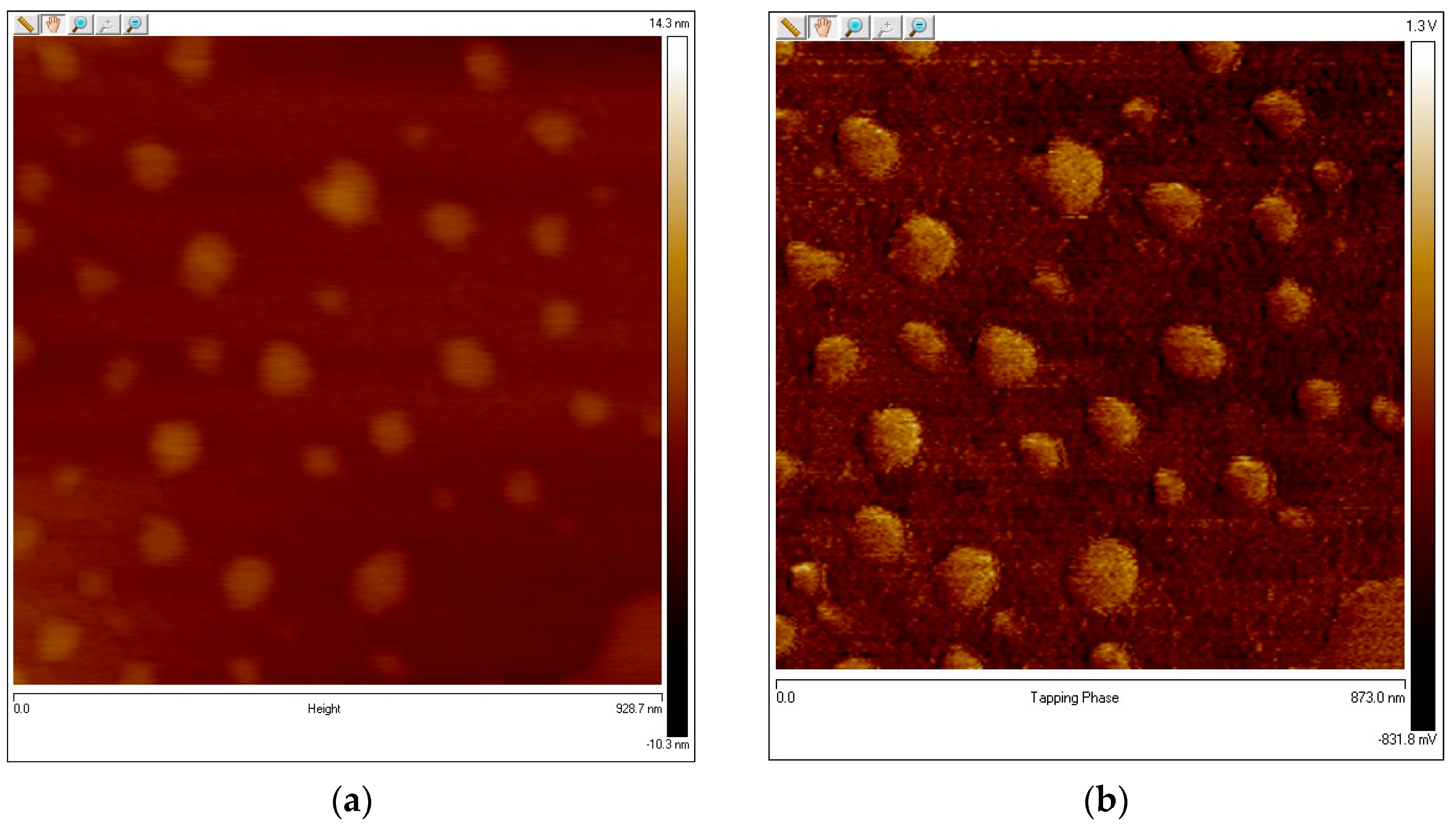
The spraying technique allowed the formation of nanocapsules with average dimensions of 811.189 pm in height, an area of 298.441 nm2, a diameter of 10.087 nm, and a density of 207.556/µm2 (data obtained from NanoScope Analysis 1.40 system) (Table 2). The encapsulation of the Moringa oleifera extract was found to be efficient, maintaining its stability during the process, and the images obtained by microscopy confirmed the regular morphology of the particles, as shown in Figure 1 and Figure 2. The encapsulation efficiency is reflected in the high number of nanocapsules obtained and the dimensions from 10 nm to 265 nm.
In Table 2, two values of sigma are reported as 0; the value sigma = 0.000 for the nanocapsule density of 0.207556/nm2 is a direct consequence of the analysis method. Since no independent regions within the same image were analyzed (e.g., through segmentation into sub-quadrants), there was no variability available to calculate a standard deviation. Therefore, σ = 0. A similar situation applies to the values reported for the number of particles analyzed.
The depth histogram corresponding to the analyzed nanocapsules (n = 1868) exhibited a unimodal distribution with a main peak centered at 19.2 ± 2.1 nm (Figure 3). No values were recorded below 15 nm, indicating that all particles belong to a single structural population, with no evidence of aggregates or multilayer formations. The slight tail toward higher values (up to approximately 30 nm) suggests natural variation associated with the degree of deformation or flattening of the nanocapsules on the surface. Together with the average height of 0.81 nm obtained from topographic analysis, these results indicate that the nanocapsules tend to adopt a flattened or discoidal morphology.

4. Discussion

Characterization using atomic force microscopy (AFM) shows that the nanocapsules obtained are on average 10 nm in size, with morphological characteristics that demonstrate a regular surface and homogeneous distribution. These results are comparable to other studies that also use nanoencapsulation methods, such as extrusion-assisted or spray drying ion gelation, which report particles ranging from 50 to 500 nm with spherical morphology [7,11]. However, unlike commonly used techniques, the manual airbrush spraying method developed did not require expensive equipment or specialized infrastructure, which significantly reduces the initial investment and operating costs. This makes it an attractive alternative for laboratories with low budgets and could be a potential solution for communities with limited resources.
The relatively flattened surface observed in AFM could facilitate the interaction of nanocapsules with biological membranes, as has been described for alginate-based release systems in other studies.
The results obtained provide solid evidence that it is possible to generate low-cost encapsulation technologies.

5. Conclusions

An ethanolic extract of Moringa oleifera was obtained with a yield of 1.82%, with a high concentration of flavonoids and phenolic compounds, which are groups of secondary metabolites reported to have hypoglycemic activity. The manual airbrush spraying technique allowed the formation of sodium alginate nanocapsules with spherical morphology, homogeneous distribution, and size in the range of 10–265 nm. When characterized by atomic force microscopy, it was theorized that the maximum values near 256 nm result from the presence of atypically large capsules observed in AFM micrographs. These anomalies may be attributed to human error during the spraying process. For future studies, it is recommended to implement a screening step to ensure size homogeneity among the nanocapsules.
The method developed has the advantage of being reproducible, low- cost, and not dependent on specialized equipment. The findings of this study suggest that the encapsulation of Moringa oleifera extracts may contribute to the development of accessible controlled-release systems with potential therapeutic application in cases of type 2 diabetes mellitus.
Future research should evaluate the LADME system in order to validate its therapeutic effectiveness and optimize its application as a treatment. Additionally, particle size could be evaluated using Dynamic Light Scattering (DLS), along with zeta potential measurements, toxicity assays, and in vitro release studies.

Author Contributions

Conceptualization: E.B.M., I.A.D.S. and A.C.U. designed the experiment based on observations and community needs; formal analysis: A.C.U. captured and analyzed the micrographs of the nanocapsules; research: I.A.D.S. and F.M.Z. managed the plant with the relevant phytochemical processes; methodology: A.Z.M., E.B.M. and A.C.U. contributed to the creation of the nanoencapsulation method; resources: A.Z.M., F.E.V.H., I.A.D.S. and F.M.Z. provided plant material, laboratory reagents, and laboratory space to perform the project; supervision: I.A.D.S., E.B.M. and A.C.U. led the execution and provided comments and suggestions; writing and editing was carried out by E.B.M., I.A.D.S. and A.C.U. All authors have read and agreed to the published version of the manuscript.

Funding

This research did not receive external funding.

Institutional Review Board Statement

Not applicable.

Informed Consent Statement

Not applicable.

Data Availability Statement

All data generated or used during this study are available in this publication or through the corresponding author upon reasonable request.

Acknowledgments

We would like to thank the students from Laboratory 1 of Natural Products at the Faculty of Chemical Sciences of the UABJO for their support, as well as the management of the Faculty of Chemical Sciences, which has always supported and encouraged us in these projects. Special mention goes to Claudia Elizabeth Porras Antonio, who provided us with some of the necessary plant material and to Daniel Salazar Hernandez for his unconditional support.

Conflicts of Interest

The authors declare no conflicts of interest.

Abbreviations

The following abbreviations are used in this manuscript:
AFMAtomic Force Microscopy
DM2Type II Diabetes mellitus
WOWater/Oil

References

  1. International Diabetes Federation. IDF Diabetes Atlas, 11th ed.; International Diabetes Federation: Brussels, Belgium, 2025. [Google Scholar]
  2. Organización Mundial de la Salud. Diabetes [Internet]. 2021. Available online: https://www.who.int/es/news-room/fact-sheets/detail/diabetes (accessed on 22 September 2025).
  3. Giacinto, R.E.; Castañeda, S.F.; Perez, R.L.; Nodora, J.N.; Gonzalez, P.; Lopez, E.J.; Talavera, G.A. Diabetes cultural beliefs and traditional medicine use among health center patients in Oaxaca, Mexico. J. Immigr. Minor. Health 2016, 18, 1413–1422. [Google Scholar] [CrossRef] [PubMed]
  4. Setyani, W.; Murwanti, R.; Sulaiman, T.; Hertiani, T. Flavonoid from Moringa oleifera leaves revisited: A review article on in vitro, in vivo, and in silico studies of antidiabetic insulin-resistant activity. J. Adv. Pharm. Technol. Res. 2023, 14, 283–288. [Google Scholar] [CrossRef] [PubMed] [PubMed Central]
  5. Watanabe, S.; Okoshi, H.; Yamabe, S.; Shimada, M. Moringa oleifera Lam. in diabetes mellitus: A systematic review and meta-analysis. Molecules 2021, 26, 3513. [Google Scholar] [CrossRef] [PubMed] [PubMed Central]
  6. Domínguez, X.A. Métodos de Investigación Fitoquímica, reimpresa ed.; Editorial Limusa: Mexico City, Mexico, 1988; 281p. [Google Scholar]
  7. Ortiz-Romero, N.; Ochoa-Martínez, L.A.; González-Herrera, S.M.; Rutiaga-Quiñones, O.M.; Gallegos-Infante, J.A. Avances en las investigaciones sobre la encapsulación mediante gelación iónica: Una revisión sistemática. TecnoLógicas 2021, 24, e1962. [Google Scholar] [CrossRef]
  8. Trujano-Miranda, F.A.; Lozano-Covarrubias, J.M.; González-Gallardo, S.; Coria-Hernández, J.; Llorente-Bousquets, A. Caracterización de microcápsulas de alginato de sodio-gelana de alto acilo-Ca2+ con microscopía electrónica de barrido (MEB). In Memorias del Congreso Nacional de Tecnología (CONATEC), Año 3, No. 3, Septiembre 2020–Agosto 2021; UNAM: Cuautitlán, Mexico, 2021. [Google Scholar]
  9. Enascuta, C.-E.; Sirbu, E.-E.; Pasarin, D.; Ghizdareanu, A.I.; Senin, R.; Hosu, I.S.; Gavrilă, A.-M.; Burdusel, B.-A.; Lavric, V. Enhancement of microencapsulation of rapeseed oil bioactive compounds in alginate through sonication. Foods 2025, 14, e1576. [Google Scholar] [CrossRef]
  10. Frent, O.D.; Vicas, L.G.; Duteanu, N.; Morgovan, C.M.; Jurca, T.; Pallag, A.; Muresan, M.E.; Filip, S.M.; Lucaciu, R.-L.; Marian, E. Sodium alginate—Natural microencapsulation material of polymeric microparticles. Int. J. Mol. Sci. 2022, 23, 3140. [Google Scholar] [CrossRef]
  11. Díaz-Montesa, E.; Cerón-Montes, G.; Vargas-León, E. Encapsulación de compuestos bioactivos: Una revisión sistemática. Pädi Boletín Científico Cienc. Básicas Ing. ICBI 2021, 10, 17–28. [Google Scholar] [CrossRef]
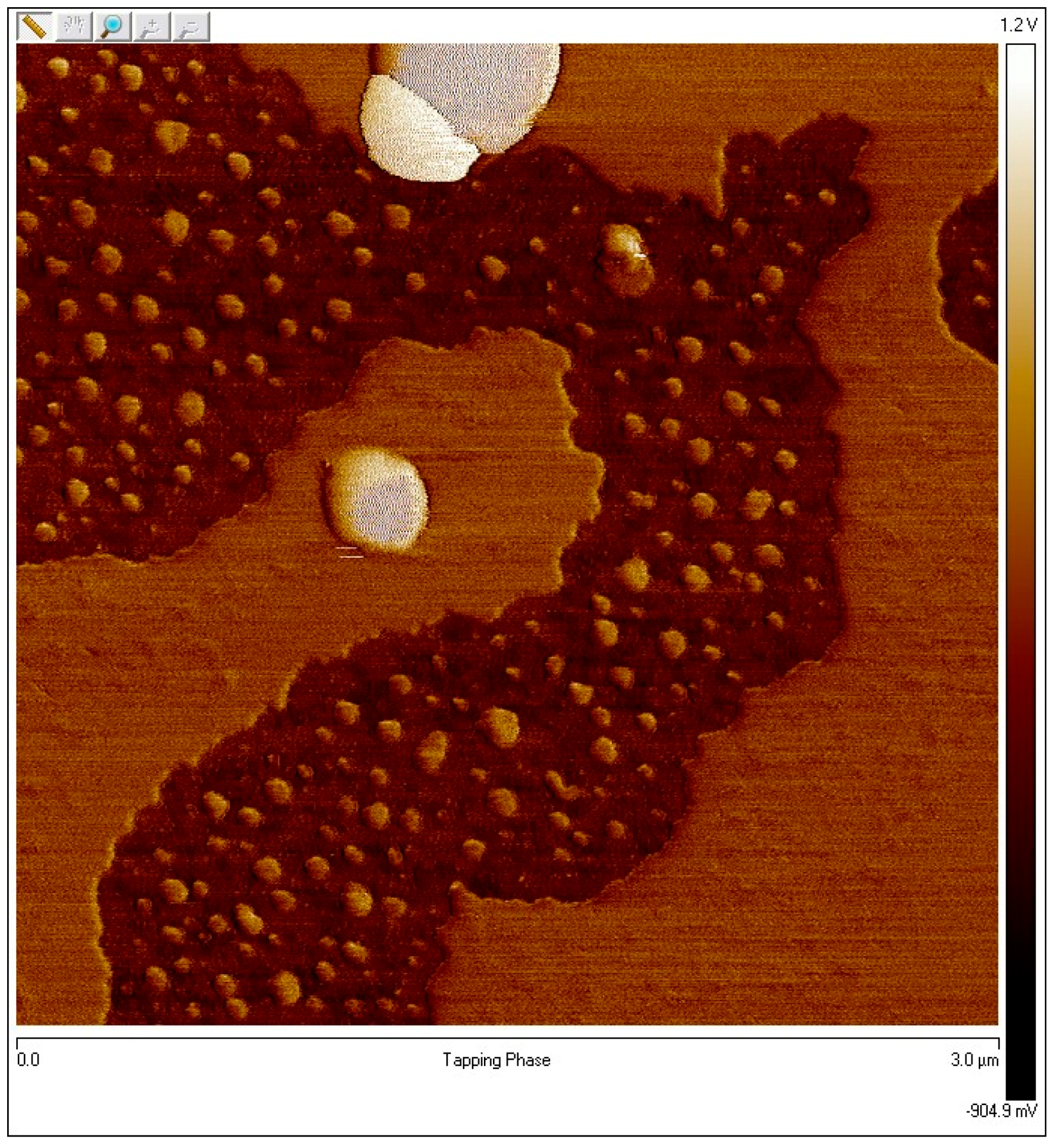
Figure 1. Atomic force microscopy (AFM) micrographs in tapping mode, obtained over a 9 μm2 area, showing a high density of sodium alginate nanocapsules containing Moringa oleifera extract. The nanocapsules exhibited an average diameter of 10.1 nm and a mean height of 0.81 nm, confirming their flattened oval spheroidal morphology.
Materproc 28 00002 g001
Figure 2. Representative AFM micrographs of sodium alginate nanocapsules with Moringa oleifera extract. (a) The “Height” image, acquired over a 928.7 × 928.7 nm area, shows circular and flattened nanocapsules with heights ranging from 1.5 to 3 nm and apparent diameters between 25 and 55 nm, uniformly distributed across the surface. (b) The “Tapping Phase” image, obtained over an 873 × 873 nm area, reveals circular and flattened nanocapsules with high viscoelastic contrast (0.8–1.3 V). Apparent diameters ranged from 25 to 60 nm, with a random spatial distribution and no evidence of aggregation. The absence of dark halos or tip-related artifacts suggests stable and flat adsorption of the nanocapsules, supporting their flattened spheroidal morphology on the surface.
Materproc 28 00002 g002
Figure 3. Depth histogram of nanocapsules (n = 1868): peak at 19.2 nm, no events below 15 nm, and a tail extending up to 30 nm. This distribution indicates a population with controlled thickness.
Materproc 28 00002 g003
Table 1. Results of the identification of secondary metabolites using the methodology described by Domínguez [6].
MetaboliteResult
Flavonoids+++
Phenolic compounds++
Tannins +
Lipids++
Carbohydrates-
Steroids++
Triterpenes++
Alkaloids-
Saponins-
The results are expressed with crosses: scarce (+); moderate (++); abundant (+++); none (-).
Table 2. Morphological data of nanocapsules with Moringa oleifera extract obtained from NanoScope software.
Particles Analyzed 1868.000
ParameterAverage MinimumMaximumSigma
Density0.207556 (/nm2)0.207556 (/nm2)0.207556 (/nm2)0.000 (/nm2)
Height0.811189 (nm)0.596688 (nm)9.049459 (nm)0.526251 (nm)
Area 298.441 (nm2)8.583 (nm2)55,429.457 (nm2)1759.585 (nm2)
Diameter10.087 (nm)3.306 (nm)265.660 (nm)16.681 (nm)
Disclaimer/Publisher’s Note: The statements, opinions and data contained in all publications are solely those of the individual author(s) and contributor(s) and not of MDPI and/or the editor(s). MDPI and/or the editor(s) disclaim responsibility for any injury to people or property resulting from any ideas, methods, instructions or products referred to in the content.