1. Introduction
Hybrid polymer composites reinforced with a combination of natural and synthetic fibers have attracted growing interest for applications where mechanical efficiency, lightweight design, and environmental considerations must be addressed simultaneously. The use of multiple reinforcement types within a single polymer matrix allows hybrid composites to exploit the distinct advantages of different fibers, leading to a material performance that cannot be achieved through single-fiber systems alone. Natural fibers are valued for their low density, renewability, biodegradability, and economic benefits, whereas synthetic fibers contribute high strength, stiffness, and durability under long-term service conditions. Owing to this complementary behavior, hybrid fiber composites are increasingly explored for structural and semi-structural components in automotive, civil, and aerospace applications [
1,
2,
3].
Jute fibers, among the various natural reinforcements, are particularly attractive due to their favorable specific properties, widespread availability, and low cost. Despite these advantages, polymer composites reinforced exclusively with jute fibers generally suffer from limited stiffness, reduced load-bearing capability, and susceptibility to moisture, which constrain their use in demanding engineering environments [
4,
5]. The incorporation of synthetic fibers such as glass and carbon into jute-based composites has been widely reported as an effective strategy to overcome these drawbacks. Such hybridization improves mechanical performance while retaining the ductility and sustainability benefits imparted by natural fibers [
6,
7,
8]. Moreover, the selective placement of high-modulus fibers within the laminate structure enables improved stress transfer and enhanced resistance to tensile and bending loads.
The overall mechanical behavior of hybrid laminates is governed not only by reinforcement type but also by stacking sequence and ply orientation. Previous studies have demonstrated that outer plies play a dominant role in flexural response due to their exposure to maximum tensile and compressive stresses, while inner plies contribute to stiffness continuity and structural stability [
9,
10,
11]. Consequently, hybrid laminate design involves inherent trade-offs between stiffness, strength, and deformation capacity, making material selection a multi-objective optimization problem rather than a single-property decision.
To manage this complexity, composite material studies increasingly employ statistical and decision-support methodologies. One-way analysis of variance (ANOVA) is frequently used to confirm the statistical significance of experimentally observed differences and to establish the reliability of measured responses [
12]. In addition, multi-criteria decision-making (MCDM) techniques, particularly the combined application of the Analytic Hierarchy Process (AHP) and the Technique for Order Preference by Similarity to Ideal Solution (TOPSIS), offer a systematic approach for ranking material alternatives based on several mechanical attributes simultaneously [
13,
14,
15]. Response Surface Methodology (RSM) is a powerful statistical and optimization tool widely employed in composite materials research to model and optimize material properties influenced by multiple interacting variables. By constructing second-order polynomial regression models and analyzing variance through ANOVA, RSM enables the evaluation of factor interactions while significantly reducing the number of required experimental trials compared to conventional one-factor-at-a-time approaches. Its application in polymer and nanocomposite systems has demonstrated effectiveness in predicting and optimizing mechanical, thermal, and functional properties within predefined practical ranges [
16,
17,
18].
In this conference proceeding, an integrated experimental and analytical framework is proposed to evaluate and optimize epoxy-based hybrid composites reinforced with jute, glass, and carbon fibers. Six laminate configurations with different stacking sequences were manufactured and tested under tensile and flexural loading conditions. The experimental data were analyzed using one-way ANOVA and ranked through an integrated AHP–TOPSIS approach, followed by desirability-based optimization using RSM. This study highlights key mechanical performance trends and demonstrates the effectiveness of combining statistical validation with multi-criteria decision-making for rational hybrid laminate selection.
2. Materials and Methods
2.1. Materials and Laminate Fabrication
Hybrid composite laminates based on an epoxy matrix were prepared by combining natural and synthetic fiber reinforcements. The matrix system consisted of an epoxy resin (LY556) cured with a compatible hardener (HY590). Bidirectional jute fiber mats together with unidirectional glass and carbon fiber mats were employed as reinforcements to obtain laminates exhibiting a balanced combination of stiffness, strength, and deformation capability. The reinforcing fibers were used in their as-supplied condition without chemical surface treatment to preserve fabrication simplicity and industrial applicability. No alkali or coupling agent treatment was applied. However, prior to fabrication, the fiber mats were stored under controlled laboratory conditions to minimize moisture absorption. All laminates were fabricated under similar environmental conditions to ensure consistency in interfacial bonding behavior.
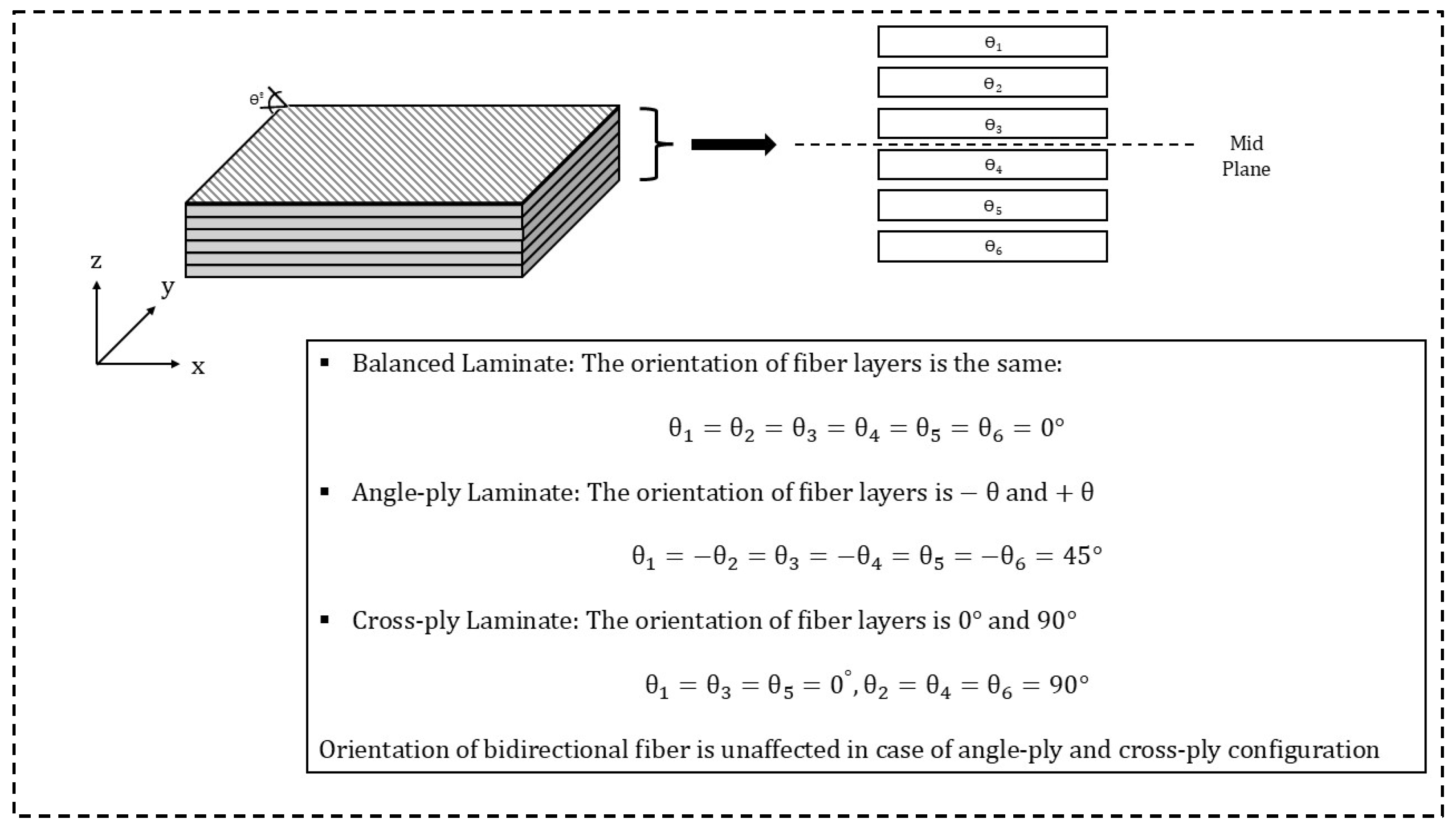
Laminate fabrication was carried out using the hand lay-up process, a simple and economical technique widely adopted to produce fiber-reinforced polymer composites. The fiber layers were arranged sequentially according to predefined laminate designs, encompassing balanced, angle-ply, and cross-ply configurations. During lay-up, particular attention was given to achieving a uniform resin distribution between adjacent plies, while entrapped air was reduced through careful manual rolling. Following stacking, the laminates were allowed to cure under ambient conditions for a duration of 36 h to ensure adequate cross-linking of the epoxy matrix. All laminate configurations were fabricated using an identical number of fiber plies and comparable lay-up procedures to maintain consistency in reinforcement content. The final laminate thickness was maintained at approximately 5 mm for all configurations, as verified through post-fabrication measurements. Since the number of reinforcement layers and the fabrication protocol were kept constant across all specimens, the overall fiber-to-matrix proportion is considered approximately uniform. Therefore, the observed variations in mechanical performance are primarily attributed to differences in stacking sequence and fiber orientation rather than changes in fiber content.
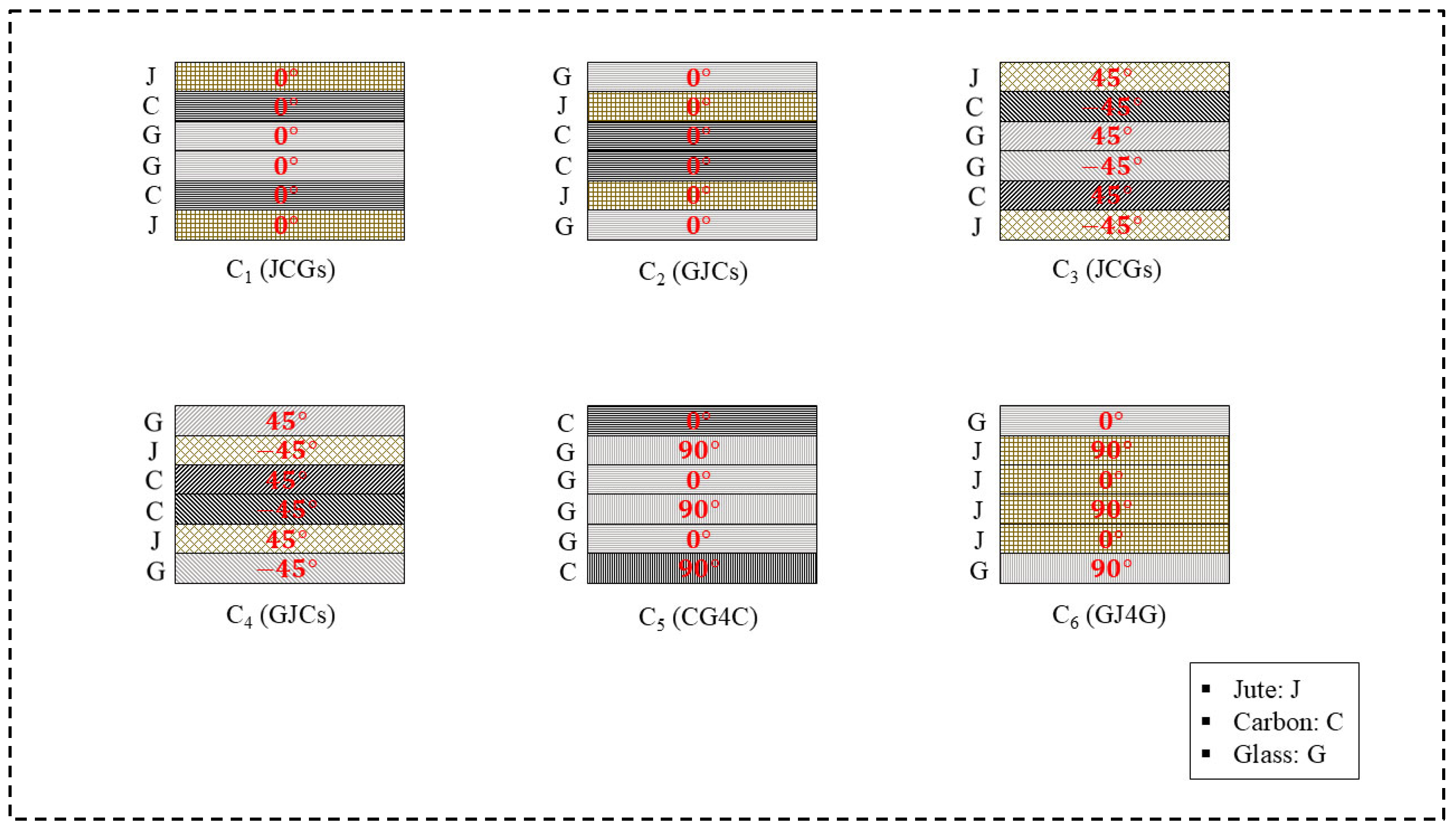
A total of six laminate configurations were produced by systematically varying the fiber arrangement and stacking sequence while keeping the matrix system unchanged. For each laminate type, three identical specimens were fabricated to maintain experimental repeatability. The corresponding laminate codes and architectural details are provided in
Table 1. The different laminate configurations considered in this study are illustrated in
Figure 1, while the fiber orientation and stacking sequences are shown in
Figure 2.
2.2. Mechanical Testing
The mechanical behavior of the fabricated hybrid laminates was evaluated through tensile and flexural testing performed in accordance with relevant ASTM standards. Tensile characterization was carried out following ASTM D3039 using a universal testing machine operated at a uniform crosshead speed of 2 mm/min. The acquired load–displacement responses were subsequently used to determine tensile strength, elastic modulus, and strain at failure.
Flexural performance was assessed by means of a three-point bending test conducted in compliance with ASTM D790. All specimens were tested under controlled laboratory conditions at a constant crosshead speed of 1.5 mm/min. Flexural strength and flexural modulus were obtained from the corresponding load–deflection curves. For each laminate configuration, three specimens were examined, and average values were considered for further analysis to ensure result consistency.
2.3. Statistical Analysis and Optimization Framework
The experimental data were examined using statistical techniques to confirm the consistency of the observed mechanical trends and to provide a reliable basis for comparative evaluation of the laminate configurations. For each measured property, average values and corresponding standard deviations were determined. One-way analysis of variance (ANOVA) was conducted at a 95% confidence level to identify statistically meaningful differences among the laminate groups. When significant differences were detected, Tukey’s honestly significant difference (HSD) procedure was applied to perform pairwise comparisons between laminate configurations.
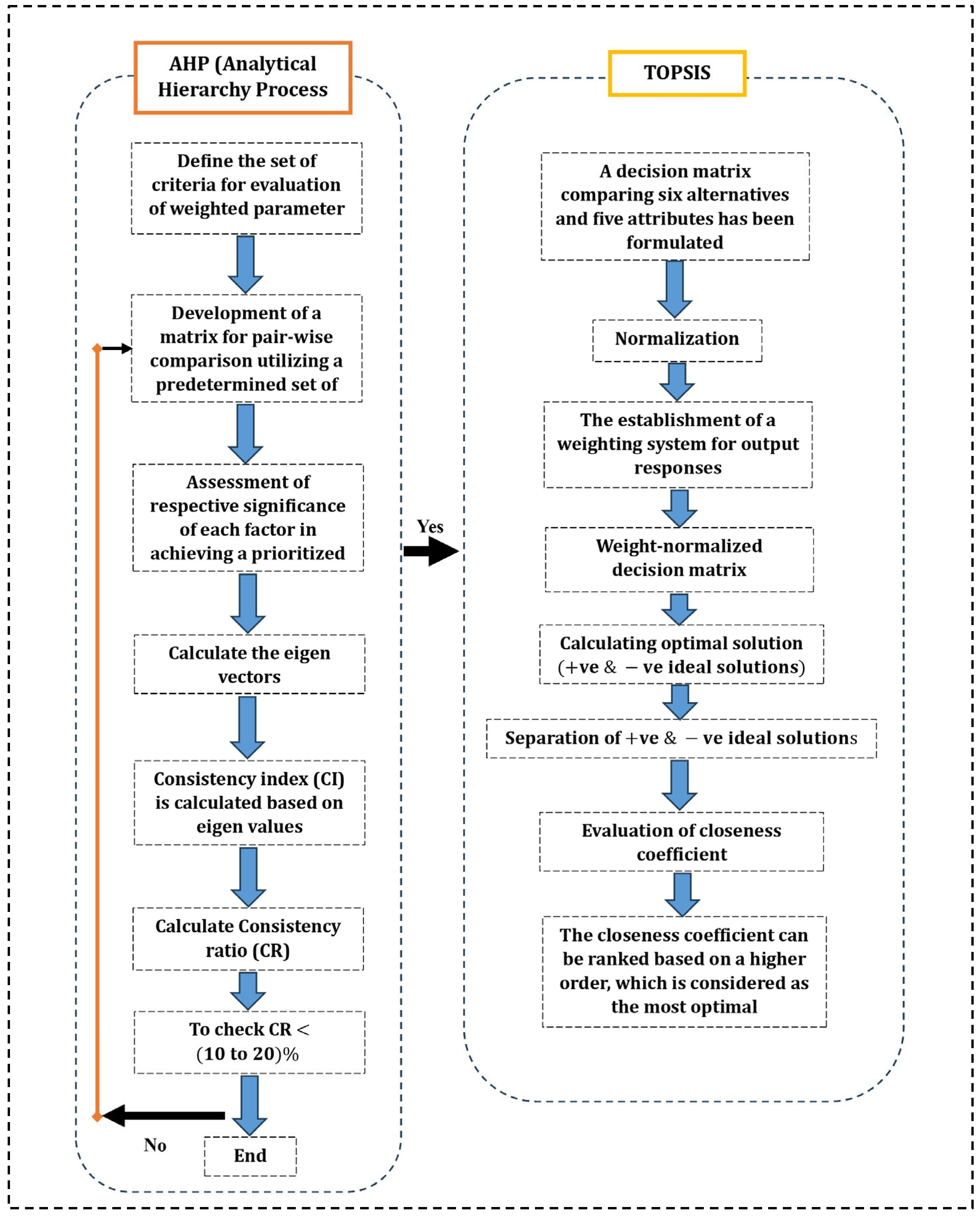
To facilitate systematic material selection involving multiple performance criteria, a combined multi-criteria decision-making approach was implemented. The Analytic Hierarchy Process (AHP) was employed to establish relative weightings for the selected mechanical parameters, namely tensile strength, flexural strength, tensile modulus, flexural modulus, and strain at failure. These weight factors were then integrated into the Technique for Order Preference by Similarity to Ideal Solution (TOPSIS), enabling the ranking of laminate configurations based on their relative closeness to an idealized performance state. The workflow of the AHP-TOPSIS methodology used in this study is illustrated in
Figure 3.
In addition, Response Surface Methodology (RSM) was employed as a multi-response optimization framework to evaluate the combined performance of the experimentally measured mechanical properties. In the present study, the independent variables correspond to discrete laminate configurations (C1–C6) rather than continuously varying process parameters. Therefore, RSM was applied primarily for desirability-based performance assessment and comparative ranking of the experimental results, rather than for constructing a predictive continuous regression model. This approach enabled the identification of laminate architectures that achieve an optimal balance between stiffness, strength, and ductility.
3. Results and Discussion
The mechanical performance of the jute–glass–carbon hybrid laminates was strongly influenced by reinforcement type and stacking sequence. Laminates incorporating carbon fibers exhibited superior stiffness and strength due to the high elastic modulus of the carbon reinforcement. In contrast, configurations containing jute fibers demonstrated a greater deformation capacity, indicating improved ductility and energy absorption during loading.
During tensile testing, balanced laminates containing jute fibers exhibited higher strain at failure, indicating progressive damage accumulation and delayed fracture. In contrast, carbon-rich configurations displayed an almost-linear elastic response followed by abrupt failure, characteristic of brittle high-modulus systems. A pronounced difference in tensile strength was observed between C1 and C2, although both represented balanced stacking arrangements. This disparity is attributed to differences in ply positioning, which directly influence tensile load transfer efficiency. In C1, high-strength synthetic fibers are more favorably aligned with the loading direction, promoting effective stress redistribution across the laminate thickness. Conversely, C2 likely contains weaker reinforcement layers in critical tensile regions, leading to premature damage initiation and reduced ultimate strength. These findings demonstrate that stacking sequence strongly governs tensile performance.
Under flexural loading, the influence of stacking sequence became even more evident, as outer plies experience maximum tensile and compressive stresses. Laminates incorporating high-stiffness fibers in the outer layers exhibited superior bending resistance, confirming the critical contribution of outer-ply reinforcement to flexural behavior.
One-way ANOVA confirmed statistically significant differences among laminate configurations for all measured mechanical properties at a 95% confidence level (p < 0.001). This statistical validation reinforces that the observed performance variations are structurally governed by hybridization strategy and stacking architecture rather than experimental variability.
The overall performance assessment conducted using the integrated AHP–TOPSIS analysis revealed that cross-ply laminates with carbon-dominant outer layers achieved the highest overall rankings due to their favorable stiffness–strength balance. Balanced laminates containing jute fibers ranked competitively as a result of enhanced strain-to-failure, highlighting the inherent trade-off between stiffness and ductility in hybrid composite systems. Configuration C2 consistently exhibited the lowest performance across multiple mechanical parameters. This inferior behavior is attributed to an unfavorable stacking arrangement that limits efficient stress transfer between reinforcement layers. When weaker plies dominate critical stress regions, premature damage initiation and interfacial debonding can occur, leading to reduced global stiffness and strength. These observations emphasize that laminate architecture optimization is essential to fully exploit hybrid reinforcement benefits.
Table 2 summarizes the mean mechanical properties obtained from three specimens for each laminate configuration, including tensile strength, flexural strength, tensile modulus, flexural modulus, and strain at break. These averaged values serve as the quantitative input for the subsequent AHP–TOPSIS ranking and desirability-based RSM analysis. The results reveal clear performance distinctions among laminate architectures, with C
5 exhibiting superior stiffness-dominated properties and C
1 demonstrating enhanced tensile strength and ductility. Although most properties showed limited experimental scatter, comparatively higher variability was observed in certain tensile modulus measurements. This variation can be attributed to inherent fabrication inconsistencies associated with the hand lay-up process and natural fiber variability. Nevertheless, one-way ANOVA confirmed statistically significant differences among configurations, indicating that the observed trends are structurally governed rather than random.
Further analysis using Response Surface Methodology indicated that stacking sequence exerted a more pronounced influence on flexural behavior compared to tensile response, highlighting the sensitivity of bending performance to outer-ply positioning. The desirability-based optimization results identified carbon-dominant cross-ply laminates as the most suitable option for applications where stiffness is critical, while jute-containing laminates remain preferable in scenarios requiring higher damage tolerance and deformation capacity.
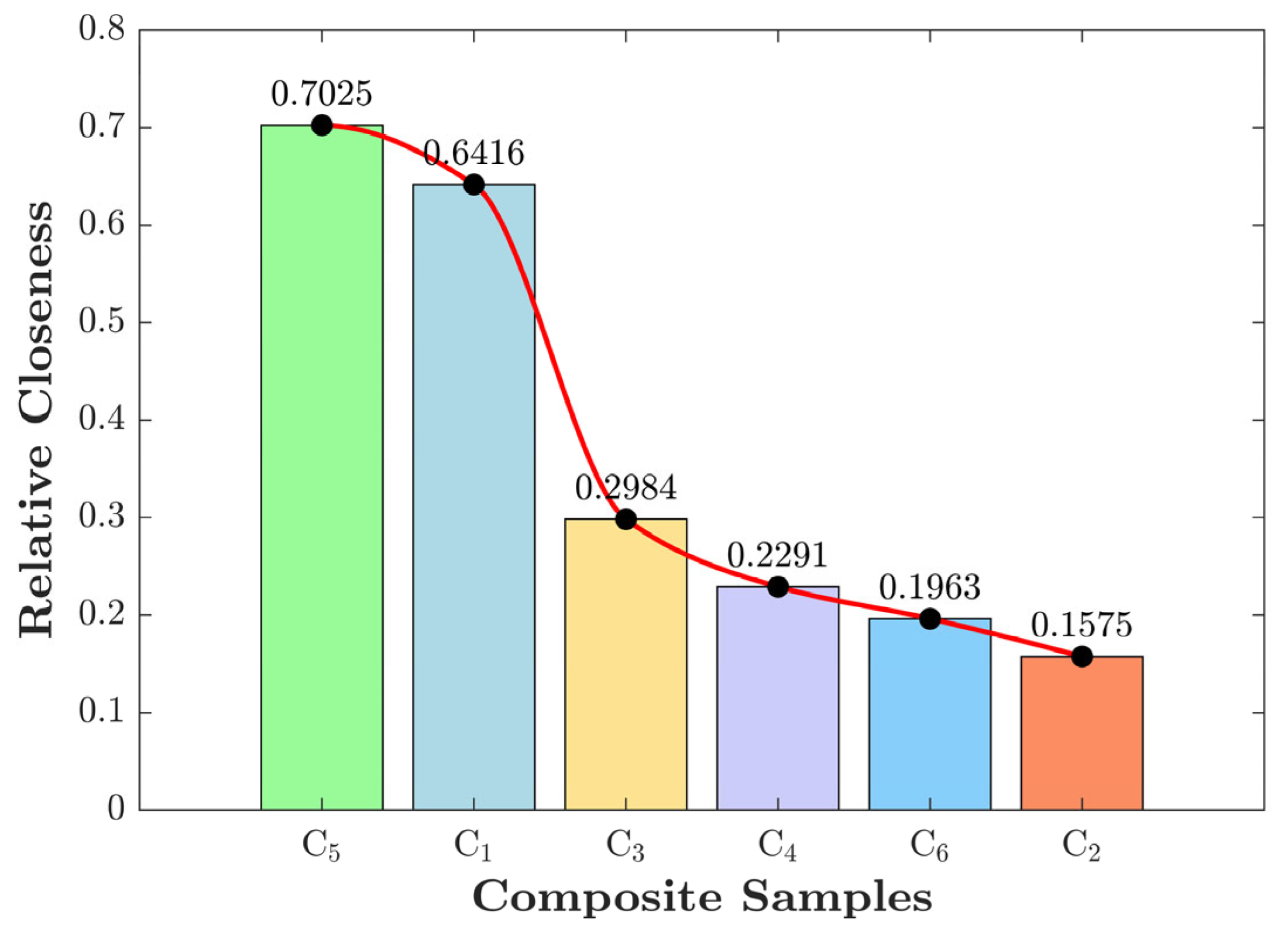
Figure 4 presents the AHP–TOPSIS-based ranking of laminate configurations derived from the mean experimental mechanical properties summarized in
Table 2, including tensile strength (TS), flexural strength (FS), tensile modulus (TM), flexural modulus (FM), and strain at break (BS). The ranking is based on average values obtained from three specimens per configuration, with statistically significant differences among laminates confirmed by one-way ANOVA (
p < 0.001 for all properties). The cross-ply laminate CG4C (C
5) achieved the highest relative closeness coefficient (0.7025), primarily due to its superior flexural strength (228.44 MPa) and tensile modulus (7.72 GPa). The balanced laminate JCGs (C
1) ranked second, attributed to their highest tensile strength (301.00 MPa) and enhanced strain at break (16.93%). The AHP-derived criteria used in the ranking were tensile modulus (0.3499), tensile strength (0.2665), strain at break (0.2200), flexural modulus (0.1084), and flexural strength (0.0551), with a consistency ratio of 4.46%, indicating acceptable judgment consistency.
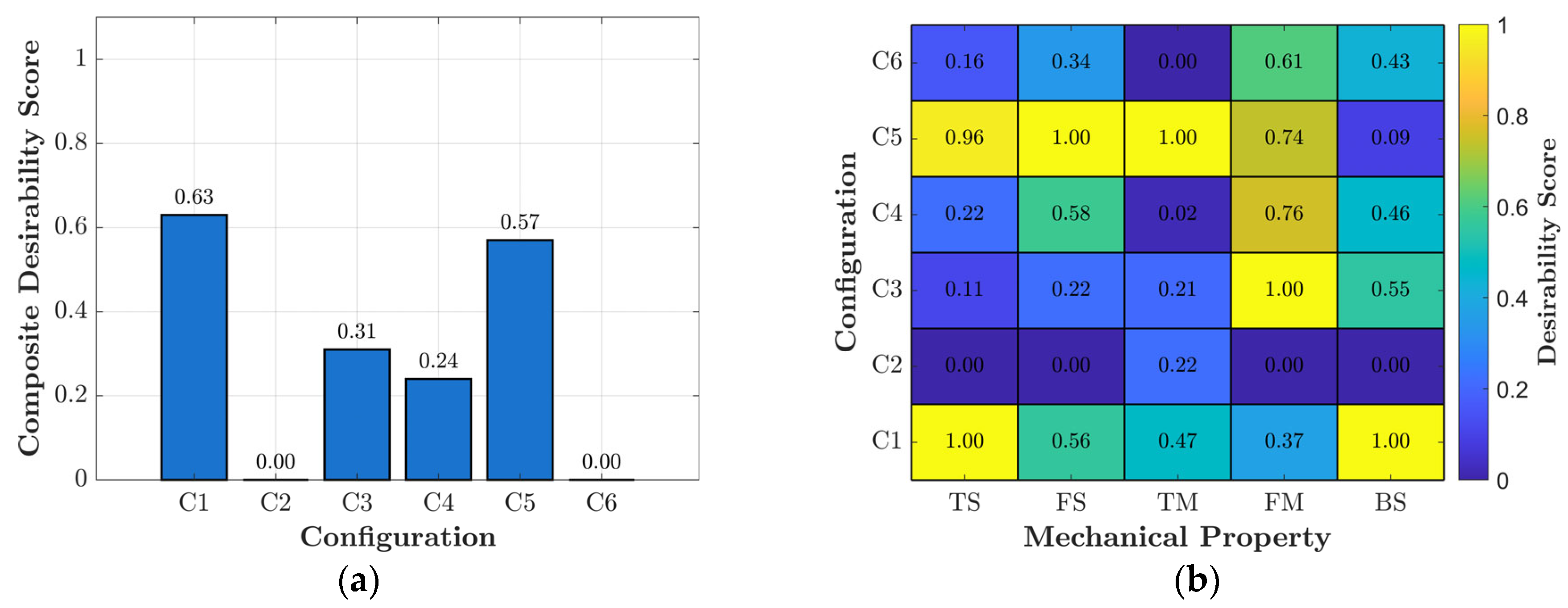
Figure 5 illustrates the desirability-based multi-objective optimization obtained using Response Surface Methodology. Individual desirability functions were defined for each mechanical response by normalizing the mean experimental values summarized in
Table 2 between the observed minimum and maximum limits, where a desirability value of 0 represents an unacceptable performance and 1 indicates an optimal performance. The overall composite desirability index was calculated as the geometric mean of the individual desirability values. The normalization ranges were based on the experimentally measured limits of tensile strength (28.5–301.0 MPa), flexural strength (25.5–228.4 MPa), tensile modulus (0.93–7.72 GPa), flexural modulus (1.65–9.61 GPa), and strain at break (2.32–16.93%). The heatmap in
Figure 5b further highlights the property-wise contribution to overall performance, demonstrating that carbon-rich laminates are predominantly governed by stiffness-driven desirability, whereas jute-containing configurations benefit primarily from strain-based contributions.