1. Introduction
Concrete possesses relatively high compressive strength but significantly lower tensile strength [
1,
2]. Consequently, it is typically reinforced with materials that are strong in tension, traditionally steel, but increasingly advanced composites such as fiber-reinforced polymer (FRP). Although concrete is not typically designed to resist direct tension, understanding its tensile strength is crucial for estimating the load at which cracking may occur. This knowledge is important because tensile strength affects crack formation and propagation, particularly on the tension side of reinforced concrete flexural members. Additionally, shear, torsion, and other forces can induce tensile stresses in specific sections of a concrete member. In many cases, the behavior of a member changes once cracking begins, making tensile strength an important consideration in the design and proportioning of concrete elements. This is especially relevant in the design of highway and airfield slabs, where shear strength and crack resistance are critical to sustaining heavy loads.
Concrete has a very low coefficient of thermal expansion and undergoes shrinkage as it matures. All concrete structures are prone to some degree of cracking, primarily due to shrinkage and tensile stresses. When subjected to long-duration loads, concrete is also susceptible to creep. The ultimate strength of concrete is influenced by several factors, including the water–cementitious ratio (w/c), the composition of its constituents, mixing procedures, placement techniques, and curing methods. A lower water–cementitious ratio generally results in stronger concrete compared to a higher ratio [
3].
Concrete cracking can result from tensile stresses induced by shrinkage or stresses occurring during setting and use. FRP techniques such as carbon fiber-reinforced polymer (CFRP) are employed to mitigate this issue [
4]. CFRP is commonly bonded to the tension zone, typically the underside of flexural members, to enhance both bending resistance and shear performance in reinforced concrete (RC) and consequently its cracking moment [
5]. However, failure often occurs when tensile loads exceed critical thresholds, typically due to debonding at the CFRP–concrete interface or at the CFRP plate ends. Therefore, accurate prediction and identification of failure modes are essential for mitigating such issues. Numerical simulations have advanced understanding of CFRP strengthening. Various studies such as [
6,
7,
8] have developed models to simulate debonding across various strengthening systems. Despite these advancements, limited research has addressed the influence of CFRP plate length on beam performance, particularly in pre-cracked concrete under tensile loading. This gap is critical in the context of retrofitting damaged RC beams and bridges, where timely intervention and CFRP length directly affect strengthening efficacy. A study by [
9] suggests that initial crack length primarily affects the stress field near the crack tip, with negligible impact on overstressed CFRP regions or the CFRP-concrete interface. Crack propagation typically halts after reaching a certain length, and ultimate failure arises from new crack formation or crack coalescence rather than continued propagation of the initial notch [
10]. This study therefore aims to numerically investigate the contribution of tensile concrete to the moment resistance of CFRP singly reinforced concrete beams. Specifically, it explores the effects of CFRP plate length on stress fields at the initial crack, the CFRP–concrete interface, and the CFRP termination zone. The analysis employs Box’s complex method to provide detailed insights into the failure mechanisms and optimization strategies for CFRP-strengthened RC beams.
1.1. FRP–Concrete Bond–Slip Relationships
The bond–slip relationship between fiber reinforced polymer (FRP) and concrete governs the efficiency of stress transfer and plays a critical role in the strength, stiffness, and failure mechanisms of FRP-strengthened and FRP-reinforced concrete members. Numerous experimental and analytical studies have demonstrated that the interfacial behavior can be represented by a constitutive relationship between bond shear stress and relative slip at the FRP–concrete interface [
11,
12].
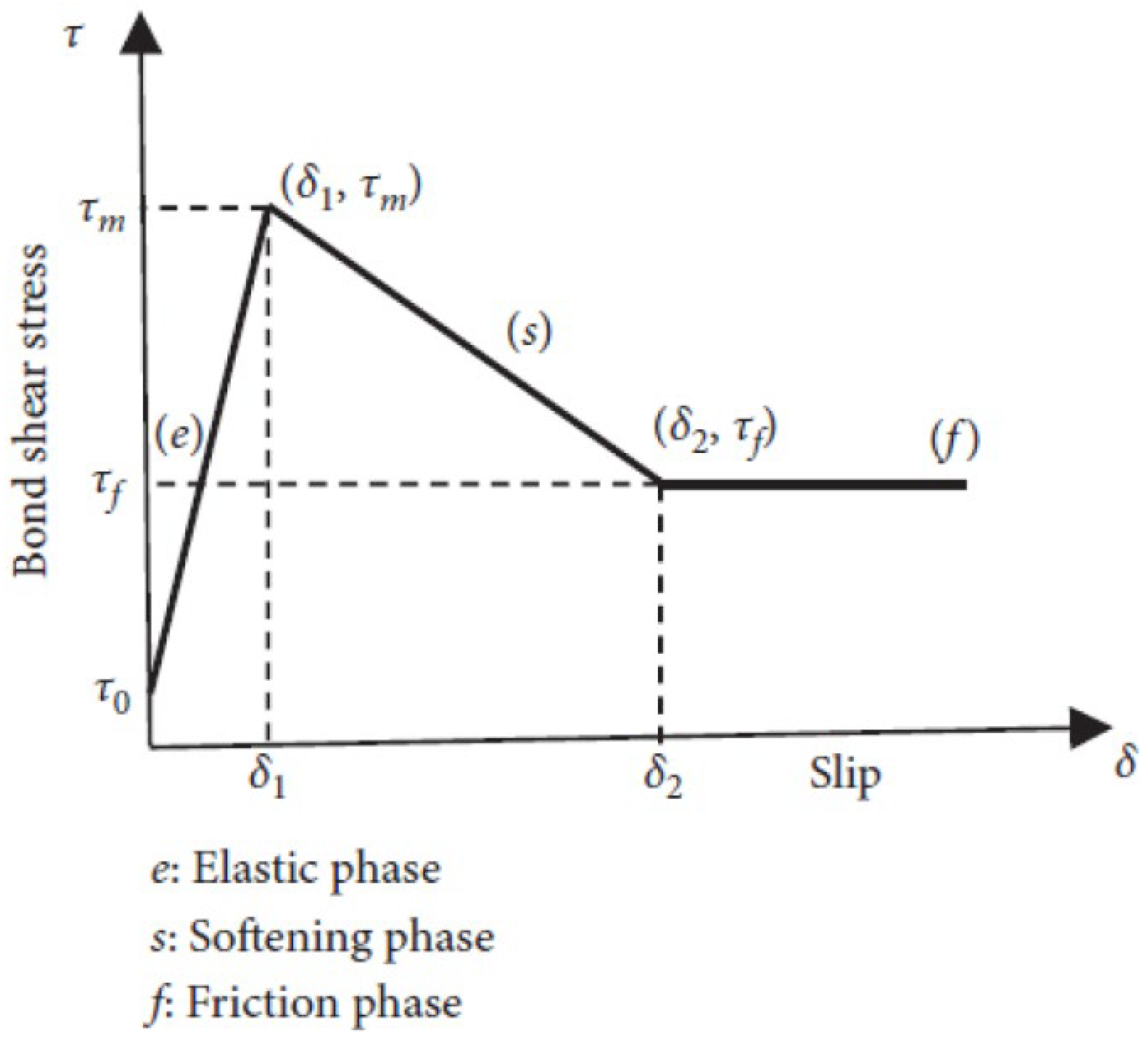
In general, the FRP concrete bond–slip response, as illustrated in
Figure 1, is characterized by three distinct stages. The initial elastic stage exhibits an approximately linear increase in bond stress with slip, during which the interface remains largely intact and damage is limited to microcracking in the concrete. This is followed by a nonlinear softening stage, where progressive cracking and crushing of the concrete adjacent to the interface reduce the interfacial stiffness while the bond stress approaches its peak value. The final debonding stage is marked by the propagation of interfacial cracks and a gradual reduction in bond stress with increasing slip, ultimately leading to complete separation of the FRP from the concrete substrate [
13].
Several analytical models have been proposed to describe this behavior, including bilinear and nonlinear bond–slip laws developed from experimental observations [
14,
15]. More recently, ref. [
16] developed a theoretical bond–slip model based on a thick-walled cylinder formulation, providing improved insight into the mechanics of stress transfer and debonding at the FRP–concrete interface. The validity of this model was confirmed through comparison with experimental pull-out test results.
Figure 1.
Bond stress–slip relationship [
16].
Figure 1.
Bond stress–slip relationship [
16].
The accurate representation of the FRP–concrete bond–slip relationship is therefore essential for reliable prediction of effective bond length, interfacial fracture energy, and debonding failure modes, and it forms a fundamental component of current design recommendations and analytical procedures for FRP-strengthened concrete structures [
17].
1.2. Contribution of Concrete Tension to the Stress Diagram
The true stress–strain diagram of plain concrete under high loading rates is fundamentally important for assessing the resistance of civil engineering structures to accidental loads, such as those caused by earthquakes and explosions. Even after cracking occurs in reinforced concrete structures, the concrete continues to contribute to the overall stiffness of the structure due to the phenomenon known as tension stiffening [
18].
According to the bending theory of reinforced concrete, it is assumed that concrete cracks in regions subjected to tensile strains. After cracking, the tensile forces are carried entirely by the reinforcement. It is also assumed that plane sections of a structural member remain plane after deformation, resulting in a linear strain distribution across the section.
The typical cross-sectional behavior of a reinforced concrete member under bending, including the corresponding strain diagram and concrete stress distributions, is described in detail in the literature (see Fig. 4.3 of Ref. [
19]).
Depending on the loading level and limit state considered, three idealized forms of concrete stress distribution are commonly adopted.
Triangular Stress Distribution: This occurs when stress is nearly proportional to strain, typically under service-level loading conditions. It is used in the analysis at the serviceability limit state.
Rectangular-Parabolic Stress Block: This represents the stress distribution at failure, where compressive strains enter the plastic range. It is used in design calculations for the ultimate limit state.
Equivalent Rectangular Stress Block: A simplified representation of the rectangular-parabolic distribution, often used for ease of calculation in design [
19].
2. Methodology
It is generally assumed that fiber-reinforced polymers (FRPs) behave as perfectly linear-elastic materials up to failure. Consequently, flexural failure of an FRP-reinforced concrete section may occur either due to the rupture of the FRP or the crushing of the concrete. The ultimate flexural strength corresponding to both failure modes can be determined using a methodology similar to that employed for steel-reinforced concrete sections [
13].
The relationships between the depth of the neutral axis (
x), the maximum concrete compressive strain (εcu2), and the steel strains are expressed as follows:
where d is the effective depth of the beam and
is the depth of the compression reinforcement.
For analysis of a section with known steel strains, the depth of the neutral axis can be determined by rearranging Equation (1) as
At the ultimate limit state, the maximum compressive strain in the concrete is taken as
for concrete.
For steel with
, the yield strain is given as
; inserting these values for
and
into Equation (3) gives
Hence, to ensure yielding of the tension steel at the ultimate limit state:
At the ultimate limit state, it is essential that flexural member sections exhibit ductile behavior, ensuring that failure occurs through the gradual yielding of the tension reinforcement rather than the formation of plastic hinges, which in turn allows for the redistribution of bending moments, leading to a safer and more economical structural design; [
20] imposes a limit on the depth of the neutral axis.
2.1. Assumption for CFRP-Reinforced Concrete Section Analysis
The flexural behavior of concrete sections reinforced with carbon-fiber reinforced polymer (CFRP) bars were analyzed under the assumption that CFRPs exhibit perfectly linear elastic behavior up to failure. Unlike conventional steel reinforcement, CFRPs do not yield prior to rupture. Therefore, flexural failure occurs either due to the rupture of the CFRP or due to the crushing of the concrete in compression. The analysis methodology follows strain compatibility and internal force equilibrium, similar to steel-reinforced sections, with modifications to account for CFRP behavior [
21].
The maximum strain in the concrete at the ultimate limit state is = 0.0035.
Plane sections remain plane, ensuring linear strain distribution across the depth.
CFRP reinforcement behaves as a linear elastic material until rupture, with no yielding.
The compressive stress–strain curve of the concrete is parabolic.
No tensile strength is attributed to the concrete.
A perfect bond is assumed between the CFRP bars and the concrete.
The compressive contribution of the CFRP reinforcement is neglected due to its low compressive capacity.
2.2. Strain Compatibility and Stress Block Analysis
For the analysis of a section with known CFRP strains, the depth of the neutral axis can be determined using Equation (3). The neutral axis depth,
, is obtained from the strain compatibility relationship [
19]
At the ultimate limit state, the maximum compressive strain in concrete is assumed as
. For the CFRP reinforcement with a characteristic tensile strength of
,
= 152 GPa, corresponding to the minimum value recommended by [
22] is adopted. The ultimate tensile strain of CFRP is therefore defined as
Substituting values into Equation (3), the neutral axis depth becomes:
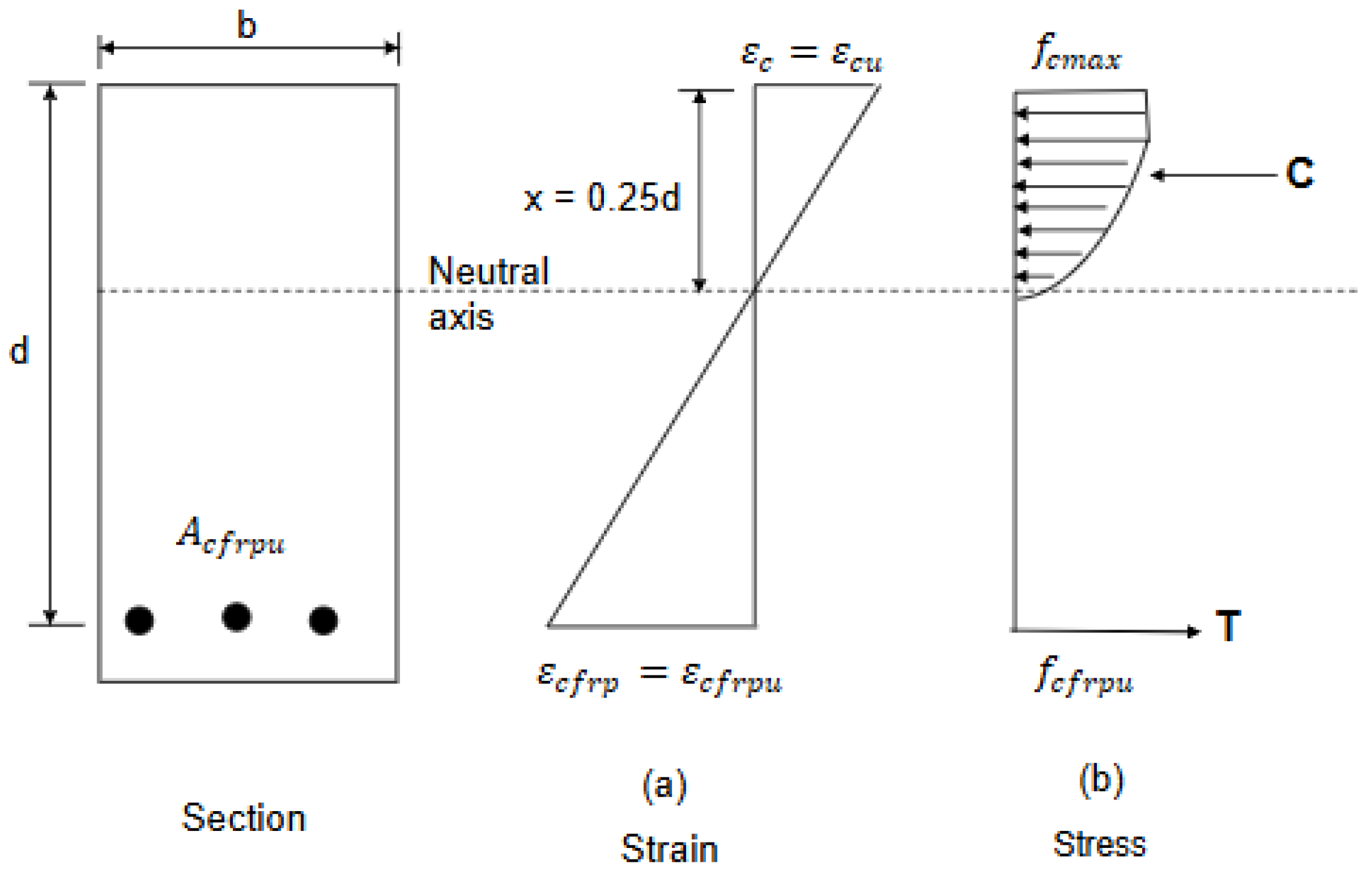
To prevent premature crushing of concrete, the neutral axis depth can be limited, as shown in
Figure 2 to say:
which is similar to the recommendation provided for steel [
23].
Ultimate Load Theory for Concrete Beams with CFRP
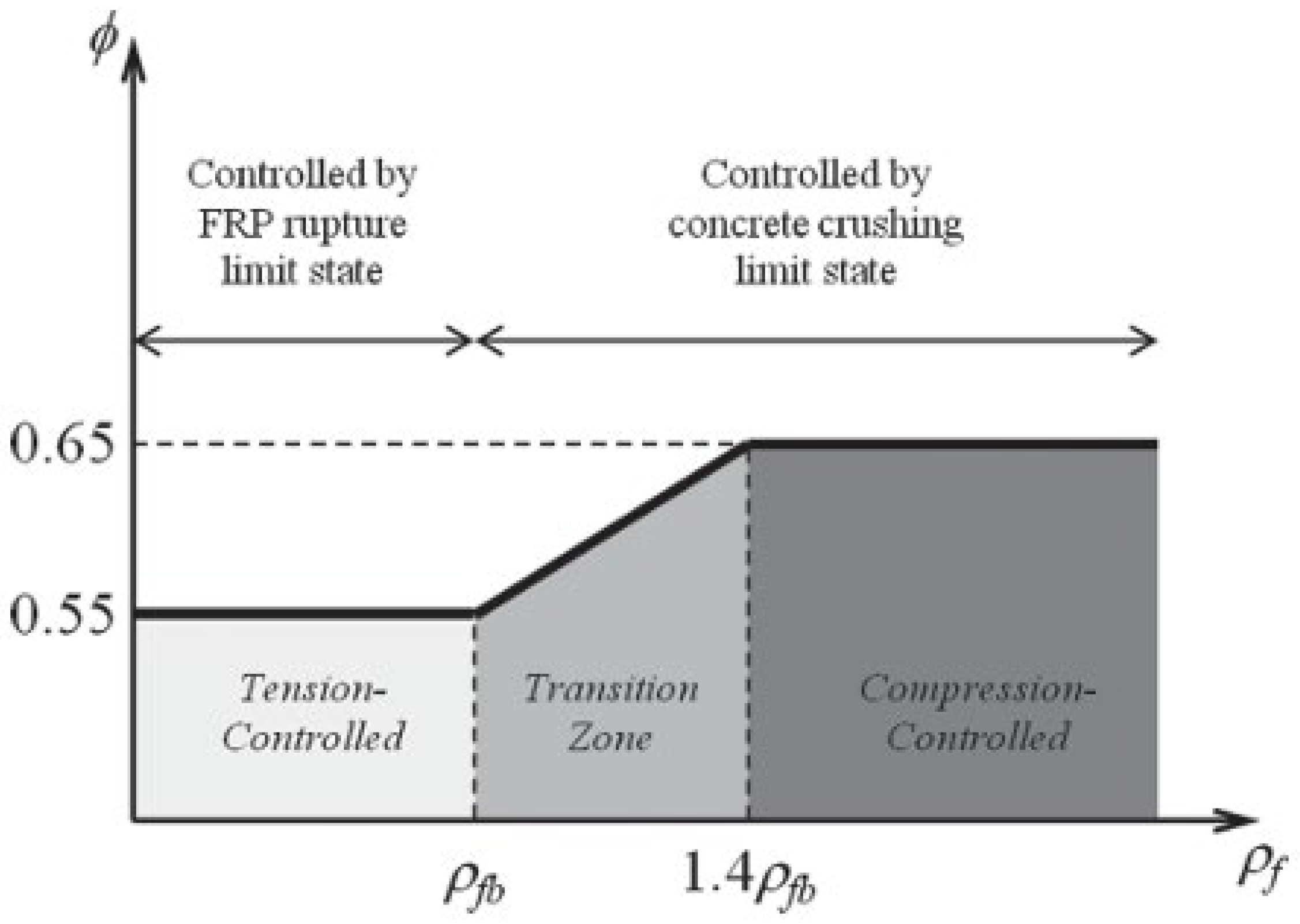
Ultimate load theory for reinforced concrete beams is based on the evaluation of the ultimate moment of resistance, which is governed by the compressive strength of concrete and the tensile capacity of the reinforcement. These material strengths are modified using appropriate strength reduction factors to ensure structural reliability. Concrete exhibits a brittle and sudden failure in compression, while CFRP reinforcement behaves in a linear elastic manner up to rupture without yielding. To account for the brittle failure characteristics of both materials, higher safety margins are introduced through strength reduction factors rather than a single global factor of safety The failure modes and corresponding strength reduction factors adopted in this study are illustrated in
Figure 3. In accordance with ACI 440.1R-2016, strength reduction factors of approximately 0.65 for compression-controlled failure and 0.55 for tension-controlled failure governed by CFRP rupture are adopted.
When the characteristic strength of concrete is derived from cube tests, it must be multiplied by a factor of 2/3 to reflect its reduced strength in bending. This adjustment is necessary because the flexural strength of concrete is significantly lower than its cube compressive strength [
10].
The design moment of resistance is obtained from the expression
where
= nominal (theoretical) moment capacity from equilibrium and compatibility;
= strength reduction factor (which depends on failure mode).
From force equilibrium:
where C = compressive force and T is the tensile force of concrete section.
If → concrete crushing (compression-controlled).
If → CFRP rupture will occur (tension-controlled).
The strength reduction factors corresponding to different failure modes are summarized in
Table 1.
Using internal lever arm:
or equivalently:
The ultimate moment of resistance was determined by first evaluating the nominal flexural capacity based on strain compatibility and force equilibrium between the concrete compression block and CFRP tensile reinforcement. The nominal moment was subsequently reduced using strength reduction factors recommended by ACI 440.1R, depending on the governing failure mode, to obtain the design moment capacity.
The design moment of resistance for a CFRP-reinforced concrete section is therefore given as:
which corresponds to
where
3. Results and Discussion
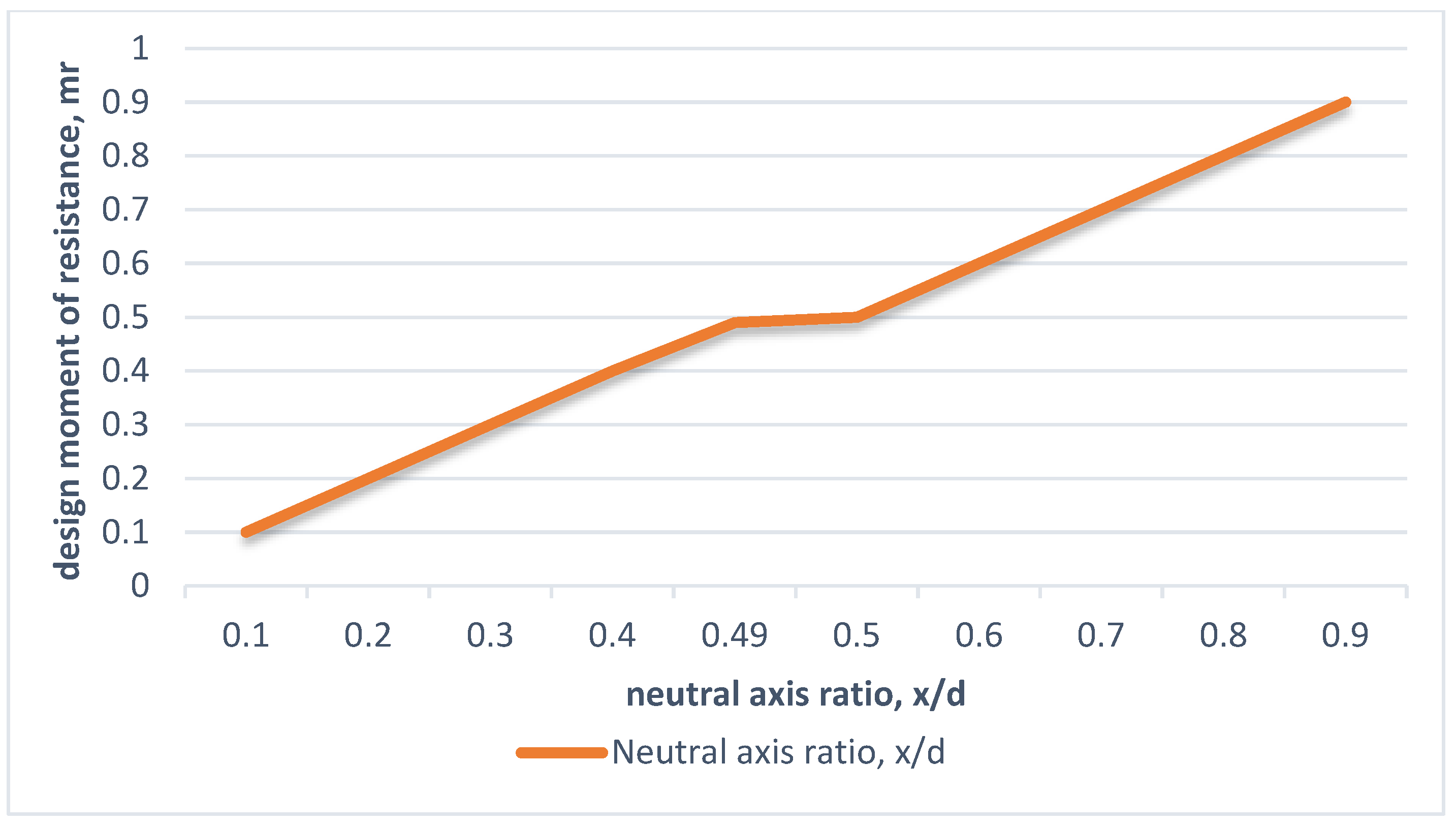
A reduction in the neutral axis depth implies that a smaller portion of the concrete section is effectively utilized in compression. Consequently, the section becomes tension-controlled, leading to premature failure governed by CFRP tensile rupture before the concrete in the compression zone reaches its ultimate strain. This failure mode is not recommended for safe structural design, as CFRP rupture occurs without significant warning and precedes concrete crushing. The design moment resistance of CFRP-reinforced concrete sections at different neutral axis depths is presented in
Table 2.
At a neutral axis depth of , the normalized design moment resistance is approximately , indicating that only a small portion of the concrete compression zone is mobilized. This condition corresponds to a tension-controlled failure governed by CFRP rupture, resulting in relatively low flexural efficiency.
At
, the neutral axis is relatively deep, indicating that a larger portion of the concrete section is effectively engaged in compression. Consequently, the section exhibits compression-controlled behavior, with failure governed by concrete crushing after the CFRP reinforcement has developed significant tensile strain. This results in an approximately 180–200% increase in the design moment resistance, confirming that deeper compression zones significantly enhance flexural performance while maintaining structural safety. The influence of neutral axis depth on the moment of resistance of CFRP-reinforced concrete beams is illustrated in
Figure 4.
This failure mode is generally preferred in structural design, as concrete crushing is more predictable and provides greater warning prior to collapse compared with the sudden tensile rupture of CFRP reinforcement.
The idealized stress–strain distributions are proposed, and the three potential flexural failure modes for CFRP-reinforced concrete sections are balanced failure, compression failure, and tension failure. Compression failure is the most desirable out of the three failure modes above. This failure mode is less violent than tension failure and is similar to the failure of an over-reinforced section when using steel reinforcement, while tension failure is less desirable, since tensile rupture of CFRP reinforcement will occur with less warning. Tension failure will occur when the reinforcement ratio is below the balanced reinforcement ratio for the section. This failure mode is permissible with certain safeguards.
3.1. Balanced Failure
Balanced failure will occur when concrete crushing occurs simultaneously with CFRP tensile rupture. At any varied value of the effective depth within a section, the neutral axis was calculated to be 0.25d, which is equal to one-fourth of the effective depth, and the stress–strain distribution is almost the same as that suggested by [
20] for steel reinforcement. But it was noted that, due to the fiber nature of the CFRP reinforcement and the reduction in the neutral axis value as compared to that of steel reinforcement, the balanced failure condition is drastically different for CFRP-reinforced concrete than it is for members reinforced with steel. This is because CFRP will not yield at the balanced condition; a CFRP-reinforced concrete member at the balanced condition will fail suddenly, although accompanied by cracking and a significant amount of deflection. This suggests a catastrophic failure mode, as illustrated by the stress-strain diagram for a balanced section in Fig. 6.1 of [
24].
3.2. Compression Failure
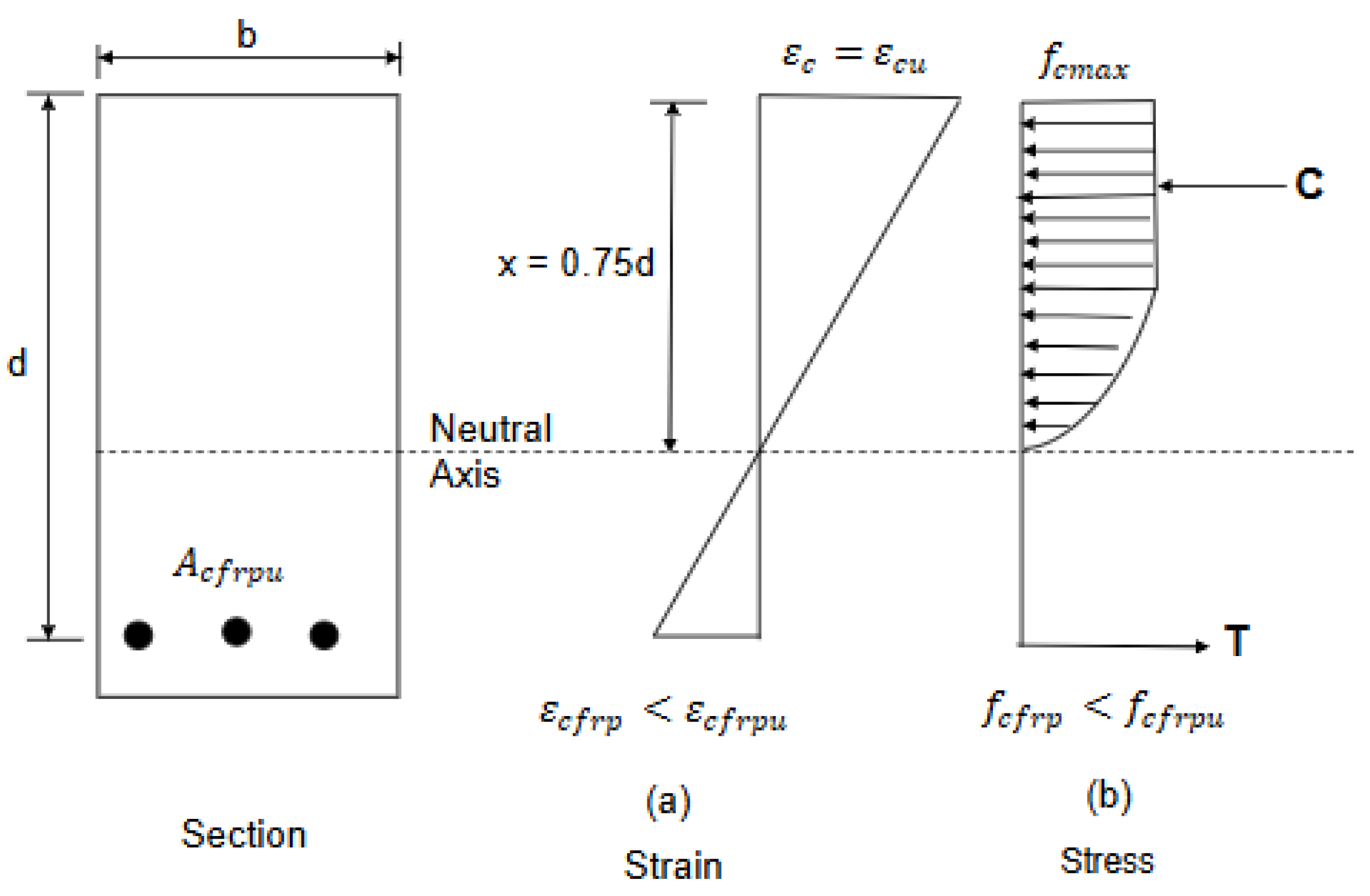
The neutral axis is limited from 0.5d as that for steel reinforcement to 0.75d while the CFRP does not yield. This shows that more concrete can still be used at compression so that the concrete can be able to carry more loads and still be safe. It can be concluded that, if a CFRP-reinforced concrete section contains sufficient tensile reinforcement, then failure of the section will be induced by the crushing of the concrete in the compression zone before the CFRP reaches its ultimate strain [
18]. Hence, the stress diagram at this failure is proportional to the neutral axis due to the high tensile strength of the CFRP reinforcement. For the case of compression failure, the stress–strain relationships in the cross-section are as shown in
Figure 5.
3.3. Tension Failure
At tension failure, less concrete is being used because the neutral axis is less than the limited value for the balanced condition. This shows that the CFRP reinforcement has failed before the concrete reaches its ultimate strain. Also, if the CFRP reinforcement ratio is less than the balanced failure reinforcement ratio, then the section will fail by CFRP tensile rupture before the concrete in the compression zone crushes. This behavior is consistent with the stress-strain illustration of an FRP rupture-controlled section shown in Fig. 6.3 of [
24].
3.4. Optimization Using Box’s Complex Method
Box’s complex optimization method was employed to validate the data and to establish the proposed values or percentages of concrete contribution when the CFRP reinforcement has not yielded, as well as the probability of failure () as the effective depth () and neutral axis depth () were varied for a cracked section.
The objective function in this case is given as:
Subjected to
0 ≤ X1 ≤ 250 and
0 ≤ X2 ≤ 125.
This is constrained to
where
X1 = the effective depth of the section;
X2 = the depth of the neutral axis.
Box’s complex method operates by generating a set of feasible points (the “complex”), evaluating the objective function at each point, and replacing the worst-performing point with a reflection across the centroid of the remaining points. If the new point violates any constraint, it is projected back into the feasible region. The process is repeated until convergence is achieved based on changes in objective value or design variables [
25]
The input variables are d = 0, 25, 50, 75, 100……250 and x = 0, 25, 50, 75…125 while the output variables are
X1 and
X2, which are functions of d and x inserted. The parameters of the optimization model are summarized in
Table 3 and
Table 4, with
Table 3 showing the model for constant effective depth (
) and
Table 4 showing the model for constant neutral axis (
).
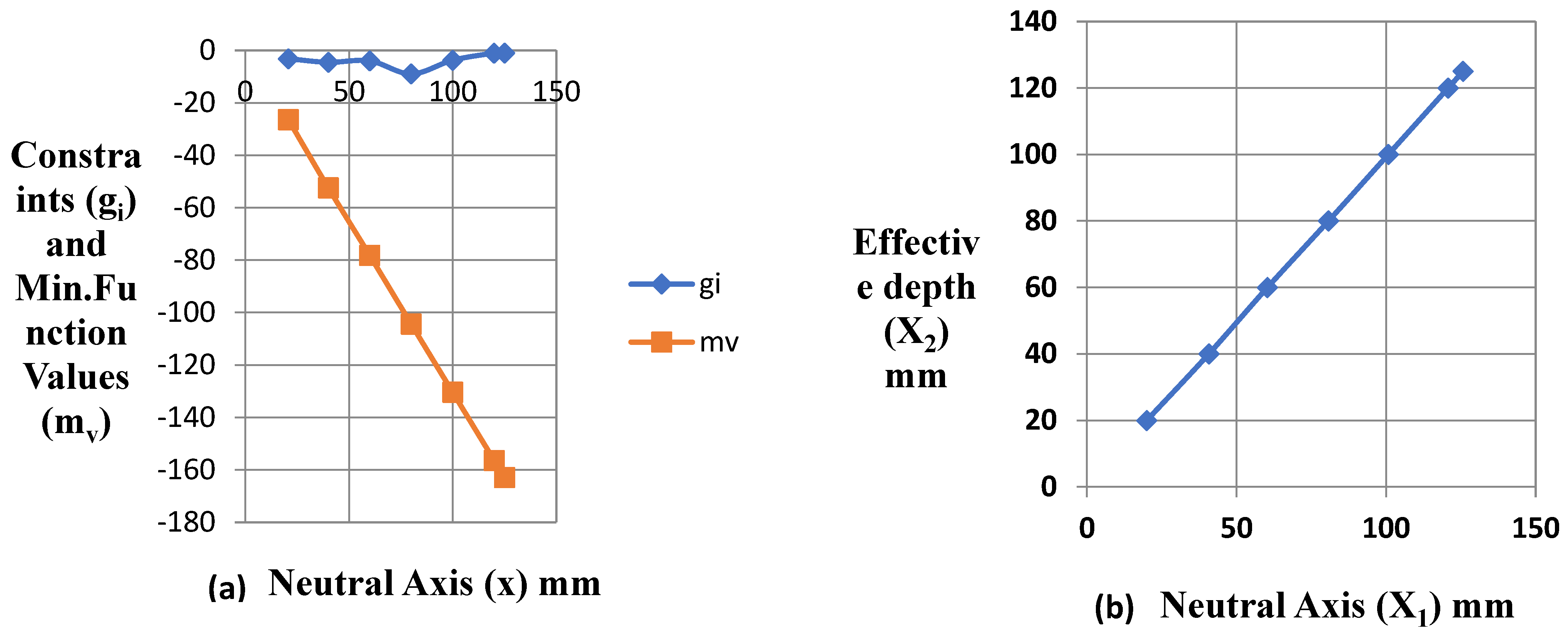
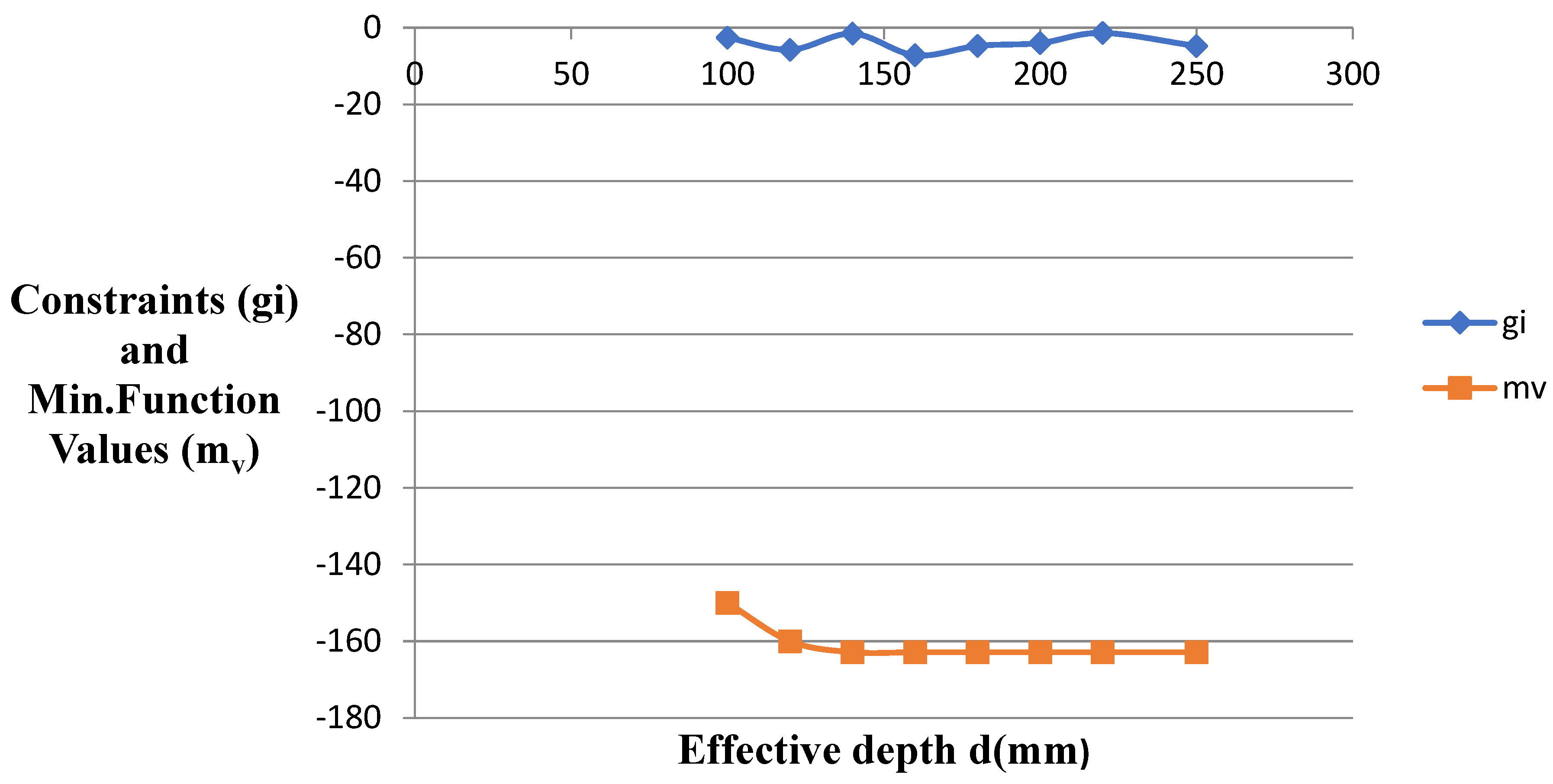
The optimization results illustrate the relationship between the neutral axis depth and the effective depth, as well as their respective contributions to the overall performance of the concrete section. In addition, the variations and interactions among the governing variables, and their influence on the tensile strength of concrete, are presented in
Figure 6 and
Figure 7, respectively. In these figures,
denotes the constraint values, while
represents the minimum objective function values. The purpose of these figures is to provide a clear visual assessment of the level of safety implied by the optimization process.
4. Conclusions
Generally, in engineering design the main concern nowadays is optimization (safety and economy). A design that is economical and at the same time durable is achieved by a careful and appropriate selection of design methods. Safety measures involve measures of limit state violations and contributions. This work has presented the contribution of tensile concrete to the resistance moment of CFRP singly reinforced concrete with characterized assessment carried out using Box’s complex optimization method. Three failure modes were identified which are failure at balance, tension, and compression mode. Analysis has shown that approximately 200% of more concrete can still be utilized when CFRP reinforcement is used at compression failure with more suitable and safe moment of resistance. The limit function for each of the failure mode described is developed, and the stress–strain distribution is proposed to be taken as the stress distribution from more than 0.5d up to 0.75d (which can still be safe), where ‘d’ is the effective depth of the section. Further research is recommended to investigate the anchorage and termination effects of CFRP-reinforced concrete; more detailed studies on CFRP end anchorage, adhesive performance, and hybrid reinforcement systems would help mitigate premature debonding.
Author Contributions
Conceptualization, MO. and S.A.; methodology, M.O. and S.A.; software, M.O.; validation, M.O. and D.O.; formal analysis, M.O.; investigation, M.O. and S.A.; resources, M.O.; data curation, M.O. and D.O.; writing—original draft preparation, M.O.; writing—review and editing, D.O.; visualization, M.O. and S.A.; supervision, S.A.; project administration, M.O. and S.A.; funding acquisition, M.O. and D.O. All authors have read and agreed to the published version of the manuscript.
Funding
This research received no external funding.
Institutional Review Board Statement
Not applicable.
Informed Consent Statement
Not applicable.
Data Availability Statement
All data generated or analyzed during this study are included in the manuscript.
Conflicts of Interest
The authors declare no conflicts of interest.
References
- Akinkurolere, O.O.; Awolusi, T.F.; Oguntayo, D.O.; Babalola, O.E.; Aladegboye, O.; Oyejobi, D.O. Water absorption, sorptivity and permeability properties of concrete containing chemical and mineral admixtures. LAUTECH J. Civ. Environ. Stud. 2021, 6, 118–127. [Google Scholar] [CrossRef]
- Awolusi, T.F.; Oguntayo, D.O.; Aladegboye, O.J.; Azab, M.; Deifalla, A.F. Optimization of concrete containing polyethylene terephthalate powder and rice husk ash using response surface methodology. J. Eng. 2023, 2023, 6237122. [Google Scholar] [CrossRef]
- Al-Gasham, T.S.; Alhozaimy, A.M. Impact of Different Water-Cement Ratios on Concrete Strength: A Review. World J. Adv. Res. Rev. 2021, 10, 123–129. Available online: https://wjarr.com/sites/default/files/WJARR-2021-0037.pdf (accessed on 25 December 2025).
- Awolusi, T.F.; Oguntayo, D.O.; Oyejobi, D.O.; Agboola, B.D.; Akinkurolere, O.O.; Babalola, O.E. Performance evaluation of discontinuous coconut and steel fibers as reinforcement in concrete using the artificial neural network approach. Cogent Eng. 2022, 9, 2105035. [Google Scholar] [CrossRef]
- Jahami, A.; Issa, C.A. An updated review on the effect of CFRP on flexural performance of reinforced concrete beams. Int. J. Concr. Struct. Mater. 2024, 18, 14. Available online: https://ijcsm.springeropen.com/articles/10.1186/s40069-023-00651-y (accessed on 25 December 2025). [CrossRef]
- Zhou, Y.W.; Guo, M.H.; Sui, L.L.; Xing, F.; Hu, B.; Huang, Z.Y.; Yun, Y. Shear strength components of adjustable hybrid bonded CFRP shear strengthened RC beams. Compos. Part B Eng. 2019, 163, 36–51. [Google Scholar] [CrossRef]
- Atas, A.; Soutis, C. Strength prediction of bonded joints in CFRP composite laminates using cohesive zone elements. Compos. B Eng. 2014, 58, 25–34. [Google Scholar] [CrossRef]
- Chen, G.M.; Li, S.W.; Fernando, D.; Liu, P.C.; Chen, J.F. Full-range FRP failure behaviour in RC beams shear-strengthened with FRP wraps. Int. J. Solids Struct. 2017, 125C, 1–21. [Google Scholar] [CrossRef]
- Guo, Y.C.; Huang, H.L.; Li, L.J.; Deng, J.; Zhong, G.Q. Effect of Crack on Interfacial Stresses of RC Beam Strengthened with CFRP. Key Eng. Mater. 2011, 462–463, 559–562. [Google Scholar] [CrossRef]
- Lopes, A.V.; Lopes, S.M.R. Revisiting cracking in reinforced concrete beams: An updated analysis. Appl. Sci. 2023, 13, 3926. [Google Scholar] [CrossRef]
- Lu, X.Z.; Teng, J.G.; Ye, L.P.; Jiang, J.J. Bond–slip models for FRP sheets/plates bonded to concrete. Eng. Struct. 2005, 27, 920–937. [Google Scholar] [CrossRef]
- Dai, J.G.; Ueda, T.; Sato, Y. Development of the nonlinear bond stress–slip model of fiber reinforced plastics sheet–concrete interfaces with a simple method. J. Compos. Constr. 2005, 9, 52–62. [Google Scholar] [CrossRef]
- Fédération internationale du béton (fib). fib Model Code for Concrete Structures 2010; (fib Bulletin 55, First Complete Draft); Fédération internationale du béton: Lausanne, Switzerland, 2010; Available online: https://shop.fib-international.org/publications/free-documents/146-model-code-2010-first-complete-draft-volume-1-pdf (accessed on 25 January 2025).
- Wang, H.; Sun, X.; Peng, G.; Luo, Y.; Ying, Q. Experimental Study on Bond Behaviour between BFRP Bar and Engineered Cementitious Composite. Constr. Build. Mater. 2015, 95, 448–456. [Google Scholar] [CrossRef]
- Cao, J.; Wu, F.; Zhao, B.; Lei, H.; Li, Z.; Chen, A. Experimental and Analytical Investigations for the Bond Slip and Anchorage Design Between BFRP Bar and Engineered Cementitious Composites. Structures 2024, 68, 107075. [Google Scholar] [CrossRef]
- Li, Q.; Fu, M.; Xie, B. Analyzing the Bond Behavior of Fiber-Reinforced Polymer (FRP) Bars Embedded in Engineered Cementitious Composites (ECCs) with the Nonlocal Continuum Rod Model. Math. Probl. Eng. 2020, 2020, 1710364. [Google Scholar] [CrossRef]
- ACI Committee 440. Guide for the Design and Construction of Externally Bonded FRP Systems for Strengthening Concrete Structures (ACI 440.2R-17); American Concrete Institute: Farmington Hills, MI, USA, 2017. [Google Scholar]
- Nuroji, N.; Prawiro, M.A.D.; Hu, H.T.; Lie, H.A. The tension stiffening stress–strain relationship of concrete in tension, newly developed test methods and implementation. AIP Conf. Proc. 2024, 3026, 080023. [Google Scholar] [CrossRef]
- Mosley, W.H.; Bungey, J.H.; Hulse, R. Reinforced Concrete Design to Eurocode 2, 7th ed.; Palgrave Macmillan: London, UK, 2012. [Google Scholar]
- BS EN 1992-1-1:2023; Eurocode 2: Design of Concrete Structures—General Rules for Buildings, Bridges, and Civil Engineering Structures. British Standards Institution: London, UK, 2023.
- Nawaz, W.; Elchalakani, M.; Karrech, A.; Yehia, S.; Yang, B.; Youssf, O. Flexural behavior of all lightweight reinforced concrete beams externally strengthened with CFRP sheets. Constr. Build. Mater. 2022, 327, 126966. [Google Scholar] [CrossRef]
- ACI 440.1R-16; Guide for the Design and Construction of Structural Concrete Reinforced with FRP Bars. American Concrete Institute: Farmington Hills, MI, USA, 2016.
- EN 1992-1-1:2004 + A1:2014; Eurocode 2: Design of Concrete Structures—Part 1-1: General Rules and Rules for Buildings. Comité Européen de Normalisation: Brussels, Belgium, 2004.
- ISIS Canada Corporation. Reinforcing Concrete Structures with Fibre Reinforced Polymers, Design Manual No. 3; ISIS Canada: Winnipeg, MB, Canada, 2001; ISBN 0-9689006-6-6. [Google Scholar]
- Khan, M.S.; Peng, T.; Ali, S.M.; Rehman, F.U.; Wu, Y. Cost Optimization of Prestressed U-Shaped Simply Supported Girder Using Box Complex Method. Sustainability 2023, 15, 11457. [Google Scholar] [CrossRef]
| Disclaimer/Publisher’s Note: The statements, opinions and data contained in all publications are solely those of the individual author(s) and contributor(s) and not of MDPI and/or the editor(s). MDPI and/or the editor(s) disclaim responsibility for any injury to people or property resulting from any ideas, methods, instructions or products referred to in the content. |
© 2026 by the authors. Licensee MDPI, Basel, Switzerland. This article is an open access article distributed under the terms and conditions of the Creative Commons Attribution (CC BY) license (https://creativecommons.org/licenses/by/4.0/).