
Proceeding Paper

Graphene–MXene Heterostructure for Biomedical and Environmental Antimicrobial Applications †

by
Avdhesh Kumar
,
Ankit Singh
and
Manish Pratap Singh
*
Department of Physics, Faculty of Engineering and Technology, Veer Bahadur Singh Purvanchal University, Jaunpur 222003, India
*
Author to whom correspondence should be addressed.
Presented at the 4th International Online Conference on Materials, 3–6 November 2025; Available online: https://sciforum.net/event/IOCM2025.
Mater. Proc. 2025, 26(1), 10; https://doi.org/10.3390/materproc2025026010

Published: 10 February 2026
(This article belongs to the Proceedings of The 4th International Online Conference on Materials)

Abstract

The increasing threat of bacterial infections and the limitations of conventional antibiotics have intensified the search for innovative antimicrobial substances. This study investigates a heterostructure nanomaterial of graphene and MXene designed to efficiently inhibit bacterial growth. The graphene–MXene heterostructure was prepared via eco-friendly and non-hazardous ultrasonication to ensure uniform dispersion and interfacial interaction between the 2D components. Powder X-ray diffraction (PXRD), Fourier-Transform Infrared Spectroscopy (FTIR), and High-Resolution Transmission Electron Microscopy (HR-TEM) confirmed the successful integration of the graphene-and-MXene-based heterostructure. Antibacterial activity has assessed using colony-forming unit (CFU) quantification against Escherichia coli (E. coli). Substantially reduced CFU counts and significant inhibition of bacterial growth are observed in the presence of graphene–MXene heterostructure compared to pristine materials. This study opens new avenues for the future development of 2D heterostructures engineered for microbial resistance under diverse conditions. Thus, the design of graphene–MXene heterostructure is a promising strategy for next-generation antimicrobial applications.

1. Introduction

Increasing world populations and changing environments impose challenges related to health across the world. A significant portion of these health issues is directly linked to bacterial infections. However, the misuse of conventional antibiotics has accelerated the development of antimicrobial resistance, reduced the efficacy of standard treatments, and driven an urgent demand for alternative antibacterial strategies. Conventional antibiotics typically target specific biochemical pathways such as protein synthesis or cell wall formation. Unfortunately, bacteria frequently adapt through genetic mutation, horizontal gene transfer, or biofilm formation mechanisms that undermine antibiotic efficacy and facilitate resistance. Given these limitations, interest has surged in the design of novel, non-antibiotic antimicrobial agents. Among the emerging candidates, 2D nanomaterials [1,2,3,4,5,6] are especially promising because their planar geometry facilitates intimate contact with bacterial membranes and enables both physical and chemical modes of antibacterial action [7,8]. Graphene and related materials have been reported to exhibit antibacterial activity through mechanisms that include membrane stress and physical disruption, which is often attributed to exposed edges and strong surface interactions with bacterial envelopes. However, depending on composition and surface chemistry, graphene materials may show limited intrinsic oxidative-stress capability, and antibacterial performance can be enhanced by surface modification or hybrid design strategies. In parallel, Ti3C2Tx MXene is one of the most extensively studied MXenes for antibacterial applications [3,9], where its surface terminations and redox-active interfaces are frequently associated with oxidative-stress-related pathways and strong microbe–material interactions. While graphene and MXene can each act as antibacterial agents, integrating them into a 2D–2D heterostructure provides a rational pathway to synergistic enhancement by combining complementary mechanisms in a single architecture. Prior work has shown that MXene-functionalized graphene nanocomposites can deliver potent antibacterial effects against both Gram-positive (e.g., Methicillin-resistant Staphylococcus aureus (MRSA) and Gram-negative (e.g., (E. coli) bacteria while maintaining low cytotoxicity toward human cells at relevant concentrations, supporting the biomedical promise of MXene–graphene hybrid systems. More broadly, prospective and previous studies emphasize that MXene–graphene composites offer considerable biomedical potential, but also highlight ongoing needs related to interface control, reproducibility, and translation-oriented design considerations [8,10,11,12,13,14,15].
Despite these advances, fabrication routes for graphene/MXene hybrids often rely on chemical functionalization, binders/surfactants, or multi-step processing, which may introduce residues, block active surfaces, or complicate biomedical and environmental deployment. In addition, although synergistic antibacterial effects are widely proposed, fewer studies explicitly connect a cleanly formed heterointerface characterized by strong interfacial coupling and preserved accessible surface area to direct microbiological performance metrics. These gaps motivate the development of a green, mild, and scalable approach that can assemble graphene–MXene heterostructures while retaining surface-accessible active sites and enabling clear antibacterial validation relevant to bionanomaterials applications. The present study reports the integration of graphene with Ti3C2Tx MXene to develop a heterostructure using an eco-friendly ultrasonication-assisted assembly. This strategy is designed to promote uniform dispersion and strong interfacial integration without harsh reagents or high-temperature treatment. The formation and interfacial characteristics of the heterostructure are confirmed using complementary structural and morphological characterizations. Finally, antibacterial performance is quantified using CFU measurements against E. coli, establishing the heterostructure’s efficacy and supporting its potential as a next-generation antimicrobial bionanomaterial platform.

2. Materials and Methods

Materials: Di Methyl Sulfoxide (DMSO, 99.9%), Hydrofluoric acid (HF, 48%), and Ti3AlC2 MAX phase powder (98%) were purchased from Sigma-Aldrich, St. Louis, MO, USA. Single-layer graphene (SLG) was purchased from Adnano, Bangalore, India.
Methods: Delaminated MXene was synthesized according to a previously reported procedure [16]. Ti3AlC2 was etched in HF to selectively remove Al layers, and the product was washed with deionized water until a neutral pH was achieved. The multilayered MXene was then subsequently intercalated with DMSO and sonicated in aqueous medium to obtain a stable colloidal suspension of delaminated flakes. The suspension was centrifuged, and the collected delaminated MXene was dried and used for characterization. The graphene–MXene heterostructure was synthesized by dispersing 0.50 g graphene in 200 mL DI water, followed by sonication for 2 h. Then, 0.05 g MXene was added and again ultrasonicated for an additional 2 h at room temperature. The final dispersion was centrifuged, and the precipitate was collected and dried. The obtained sample was used for further investigation.

3. Results and Analysis

3.1. Characterization

The synthesized graphene–MXene sample was characterized using a wide range of advanced analytical techniques, including PXRD, FTIR, and HR-TEM. PXRD patterns of the synthesized samples were collected over the 5–70° 2θ range using a powder X-ray diffractometer (EMPYREAN, Malvern Panalytical, Great Malvern, UK) equipped with a Cu Kα radiation source (λ = 1.5406 Å, 40 kV). Functional groups were identified using a high-resolution Fourier-Transform Infrared (FT-IR) spectrometer (Model: FT/IR-4700, JASCO, Harpenden, UK) with 1 cm−1 resolution across the 400–2000 cm−1 range. The HR-TEM (Tecnai-20 G2, FEI Company World Headquarters, 5350 NE Dawson Creek Drive Hillsboro, Hillsboro, OR, USA) was used to examine morphology and heterostructure features at an accelerating voltage of 200 kV, and selected-area electron diffraction (SAED) patterns were also acquired.

3.2. HRTEM, SAED, and EDS Analysis

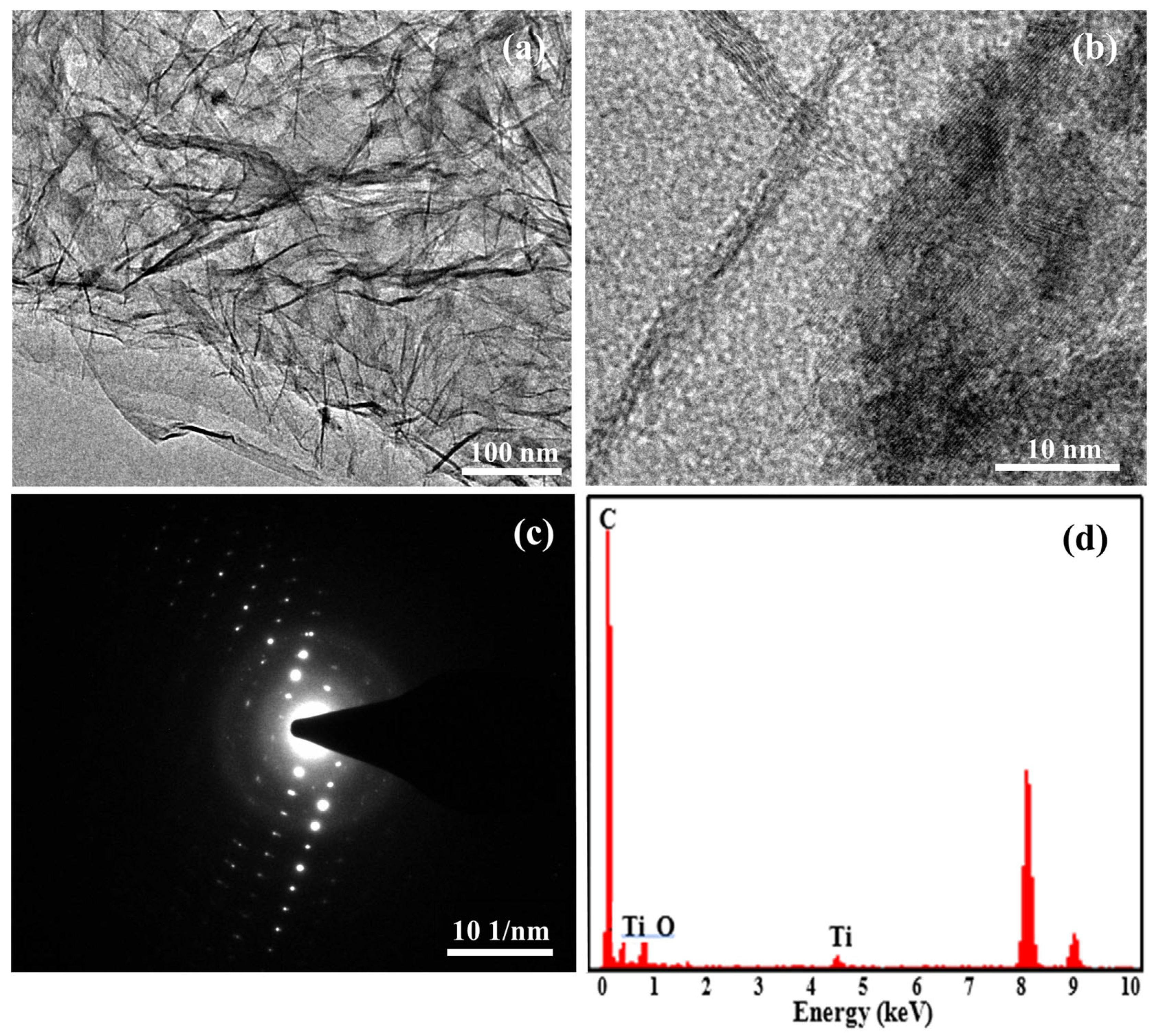
The nanoscale morphology and crystallinity of the graphene–MXene heterostructure are presented in Figure 1. The TEM image (Figure 1a) reveals a continuous network of thin, highly transparent, and wrinkled sheet-like layers, characteristic of graphene-based nanosheets, with local darker regions attributed to the presence of higher mass-thickness MXene domains anchored on the graphene surface. The overlap of these nanosheets and the uniform sheet-sheet contact suggest effective heterostructure assembly and intimate interfacial coupling rather than isolated or phase-separated components. Such a stacked 2D architecture can promote the formation of interconnected conductive pathways and increase the accessible surface area and edge density, which is advantageous for surface-driven interactions during antibacterial activity. The HRTEM image (Figure 1b) further confirms the presence of crystalline domains in the heterostructure, where well-resolved lattice fringes are observed within the darker regions, indicating an ordered Ti-based phase consistent with MXene nanosheets. The coexistence of crystalline domains with the surrounding low-contrast sheet-like matrix supports the successful integration of MXene onto graphene sheets at the nanoscale and formation of a heterostructure. In addition, the corresponding SAED pattern (Figure 1c) displays distinct diffraction spots distributed in ring-like features, confirming the crystalline nature of the heterostructure within the selected area. The retained diffraction features indicate that the hybridization process preserves the structural integrity of the 2D constituents, supporting the formation of a stable graphene–MXene heterostructure. The EDS (Figure 1d) results further confirmed the heterostructure formation. Elemental mapping revealed strong carbon signals attributable to graphene support, along with distinct titanium peaks corresponding to MXene. Oxygen is also detected, which can be associated with surface terminations or partial oxidation of MXene. The higher carbon intensity confirms the greater presence and the extensive coverage of graphene over the MXene nanosheets. The absence of any impurity-related peaks further demonstrates that the heterostructure is chemically pure. Although EDS alone does not prove bonding, when combined with the TEM co-localization, it provides consistent evidence that graphene and Ti-containing MXene are integrated within the same nanoscale architecture.

3.3. PXRD Analysis

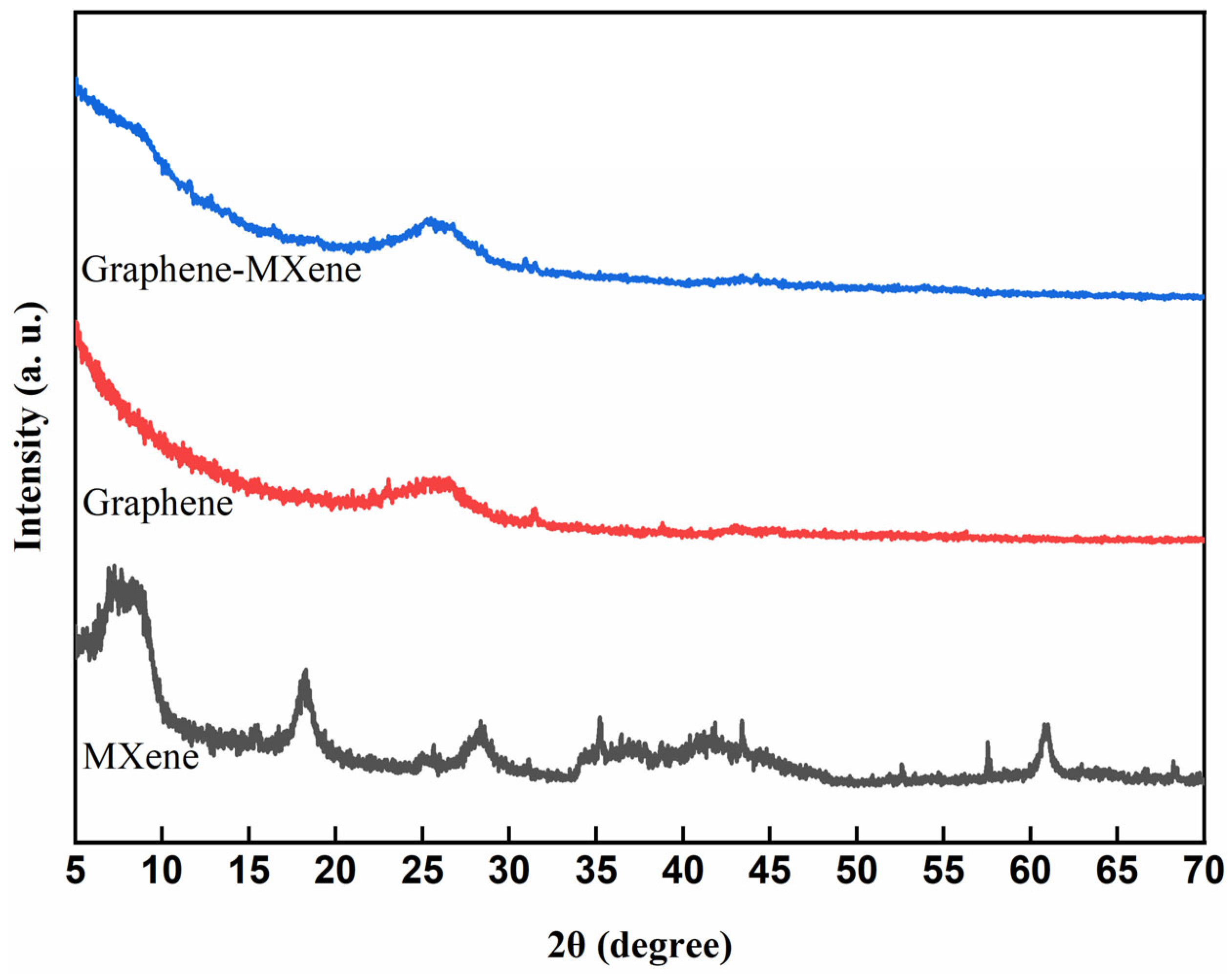
The structural analysis of graphene, MXene, and the graphene–MXene heterostructure was examined using powder X-ray diffraction. Figure 2 presents the PXRD pattern of graphene, MXene, and the graphene–MXene heterostructure between the 5° to 70° 2θ range. The PXRD pattern of MXene shows the characteristic reflections at 8.9°, 18.5°, and 27.9° 2θ correspond to the (002), (004), and (006) planes, respectively. The (002) reflection at a low 2θ angle, which is characteristic of its layered geometry and expanded interlayer spacing after etching and delamination. The PXRD pattern of MXene matches the standard JCPDS file number 96-722-1325 [17]. Graphene exhibits a broad diffraction band centered at 25.2° 2θ angle. This is the typical signature of few-layer graphene with limited long-range stacking order. In the graphene–MXene sample, the diffraction profile contains contributions from both graphene and MXene. The MXene characteristic (002) peak undergoes a slight shift, and the graphene characteristic band broadens further in the graphene–MXene sample. These structural changes reflect interlayer interactions and the altered stacking compared to the pristine materials. This information confirms the formation of an integrated layered architecture, i.e., heterostructure rather than a simple composite. These PXRD observations align with the HR-TEM evidence of stacked/overlapped sheets and support formation of an integrated heterostructured assembly.

3.4. FTIR Analysis

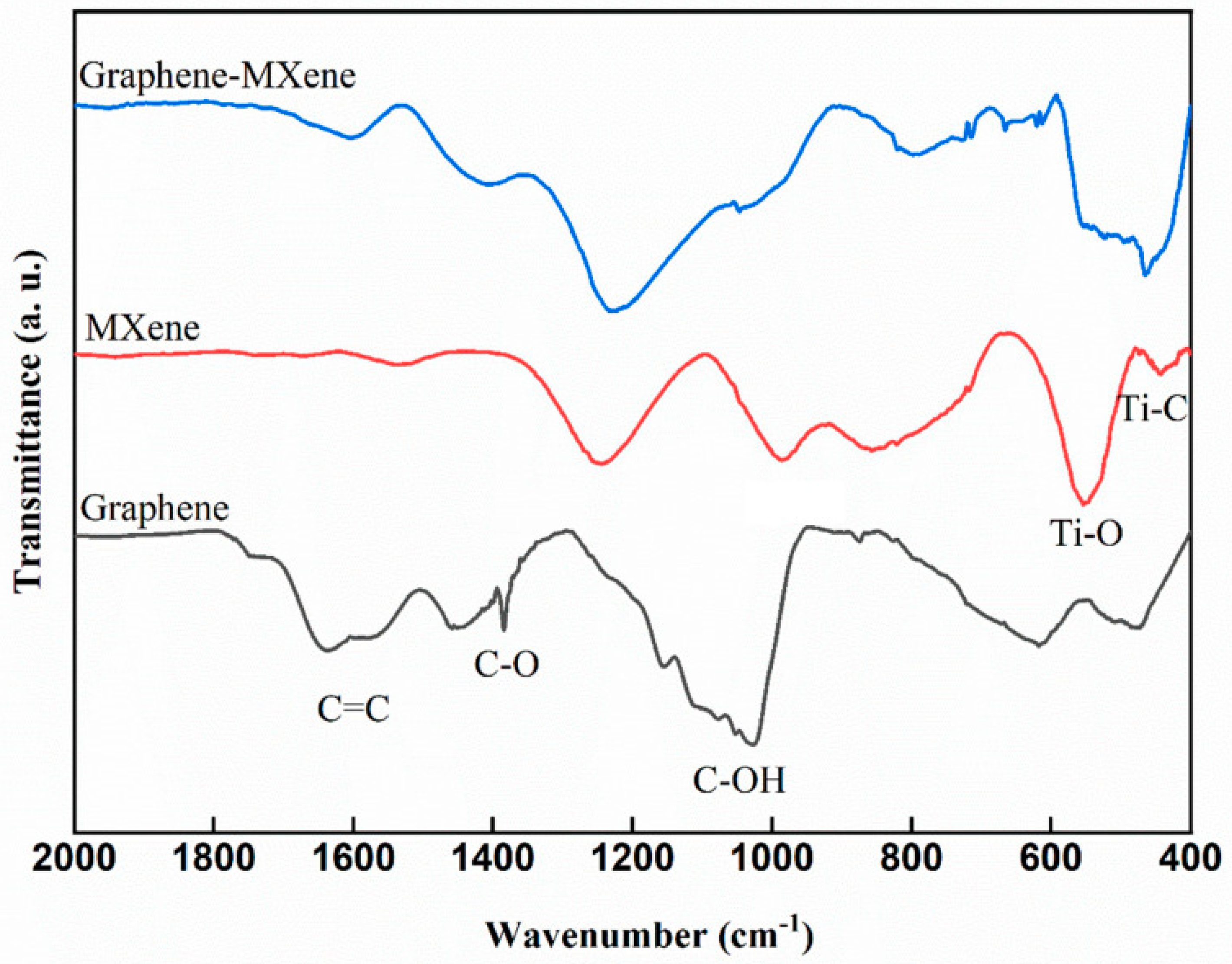
FTIR spectroscopy was employed to verify the chemical functionalities of graphene, MXene, and the assembled graphene-MXene heterostructure. The Figure 3 shows the FTIR spectra of graphene, MXene, and MXene–graphene heterostructure in the range of 2000–400 cm−1. The pristine graphene displayed the characteristic sp2 carbon band (C=C stretching) along with oxygen-containing features attributed to C-O and C-OH vibrations, indicating residual surface functionalities. In contrast, MXene exhibited prominent bands in the low-wavenumber region corresponding to Ti-C and Ti-O vibrations, consistent with Ti-based MXene sheets bearing surface terminations (Tx). The graphene-MXene spectrum combined the principal bands of both constituents and showed a distinct feature, suggesting the contribution of terminations from the HF-etched MXene within the heterostructure. The changes in band intensity/broadening in the fingerprint region for the heterostructure relative to the pristine materials indicate interfacial interactions between graphene oxygen functionalities and MXene terminal groups, supporting successful heterostructure formation.

3.5. Antimicrobial Activity Analysis

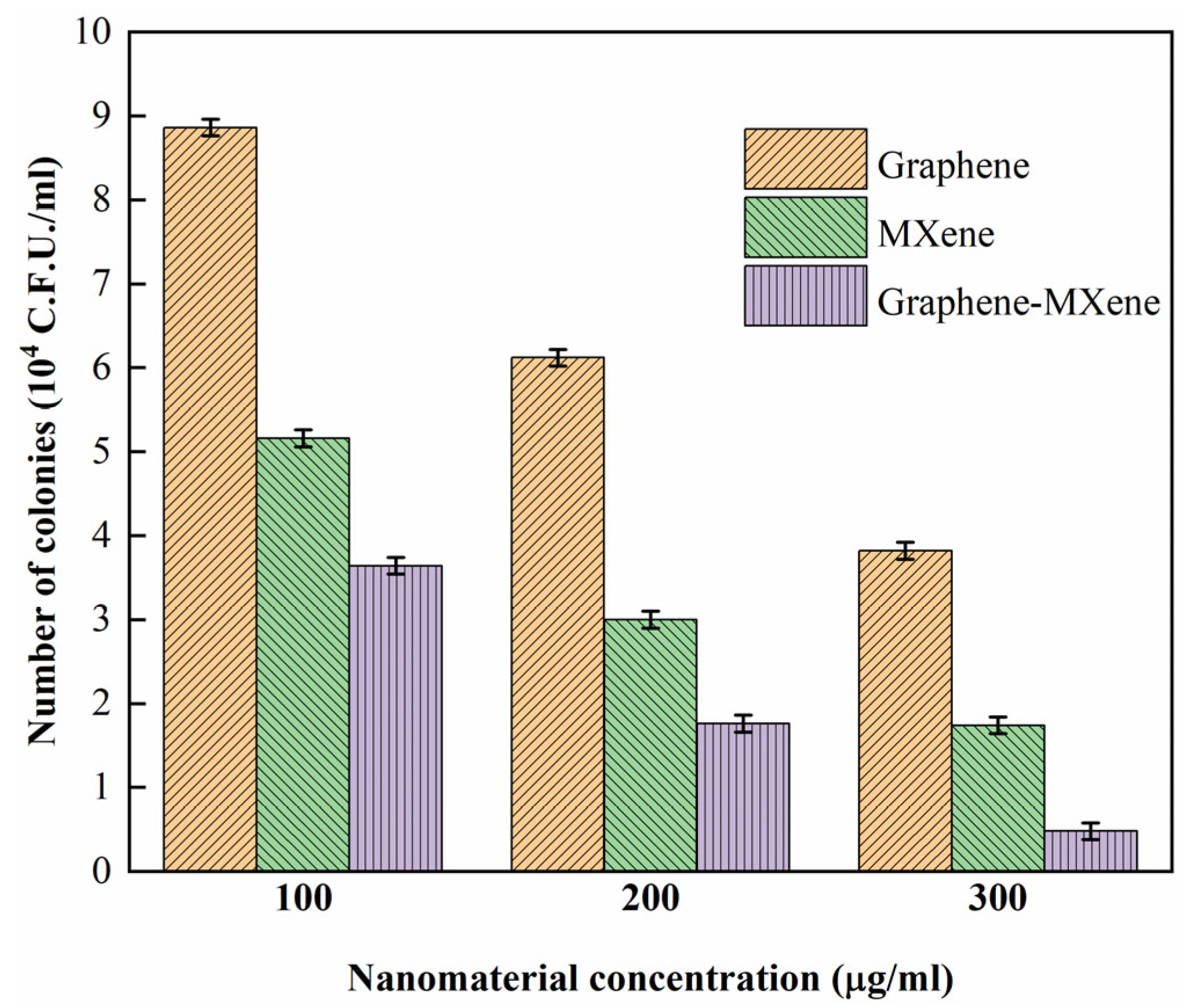
The antibacterial activity of graphene, MXene, and the MXene-graphene heterostructure was evaluated against E. coli using the colony survival (SFU) method. Figure 4 shows the number of colonies in E. coli colonies after treatment with different concentrations of graphene, MXene, and the MXene–graphene heterostructure. The number of CFUs per mL values obtained in broth containing the nanomaterials are summarized in Table 1. The observed results show the dose-dependent antimicrobial activity of graphene, MXene, and the MXene–graphene heterostructure. Figure 4 represents the comparative study of antimicrobial efficiency of graphene, MXene, and the MXene-graphene heterostructure. The colony-forming units (CFUs) are measured at different concentrations of the samples. The concentration is taken from 100 µg/mL to 300 µg/mL with an interval of 100 µg/mL. The CFUs were calculated by the general formula
C F U = N u m b e r   o f   C o l o n i e s   o n   c e l l   c u l t u r e   d i s h × d i l u t i o n   f a c t o r
The highest number of CFUs was at 100 µg/mL, and they decreased with the increment in the concentration of the applied nanomaterial sample.
n 100 > n 200 > n 300
where n100, n200, and n300 are the number of CFUs per ml in the 100 µg/mL, 200 µg/mL, and 300 µg/mL concentration of the nanomaterial sample in agar solution, respectively. All three samples show antimicrobial properties against the Gram-negative bacteria E. coli. Among the three, the highest number of CFUs in graphene solution at each concentration shows that Graphene has the least antimicrobial property against the E. coli. The number of CFUs in MXene is lower than that of graphene, suggesting that MXene has better antimicrobial properties than Graphene. While the MXene–graphene heterostructure shows the lowest number of CFUs at all concentrations, which is prominent, the antimicrobial property of the MXene–graphene heterostructure is higher than both the individual nanomaterials, graphene and MXene. The two important observations are as follows: (i) The number of CFUs decreases when the concentration of graphene, MXene, or the MXene–graphene heterostructure is increased. (ii) The MXene–graphene heterostructure has the fewest number of CFUs; hence, the formation of the heterostructure enhanced the antimicrobial activity over the graphene and MXene.

4. Conclusions

In this work, a graphene–MXene heterostructure was successfully fabricated using an eco-friendly ultrasonication-assisted approach to promote uniform dispersion and interfacial interaction between the two components. The formation of the heterostructure was confirmed by complementary structural and spectroscopic analyses, including PXRD, FTIR, and HR-TEM (with SAED). Antibacterial performance evaluated by CFU quantification against E. coli demonstrated a clear dose-dependent reduction in viable colonies for graphene, MXene, and the graphene–MXene heterostructure over the tested concentration range (100–300 µg mL−1). Notably, the graphene–MXene heterostructure consistently exhibited the lowest CFU counts compared with the pristine materials, indicating that heterostructure formation enhances antimicrobial activity. These findings highlight graphene–MXene heterostructures as a promising method for developing next-generation antimicrobial materials, while further studies on the mechanism, long-term stability, and biocompatibility will be important for application-oriented deployment.

Author Contributions

Conceptualization, A.K., A.S. and M.P.S.; methodology, A.K.; software, A.K. and A.S.; validation, A.K., and A.S.; formal analysis, A.K. and A.S.; investigation, A.K.; resources, A.K. and M.P.S.; data curation, A.K.; writing—original draft preparation, A.K.; writing—review and editing, A.S. and M.P.S.; visualization, M.P.S.; supervision, M.P.S.; project administration, M.P.S. All authors have read and agreed to the published version of the manuscript.

Funding

This research was funded by Council of Science & Technology, U.P. (Letter No. CST/E &T/D-1235 & Dated: 23 August 2025), and Science and Engineering Research Board (SERB), New Delhi, India, for the Teaching Associateship for Research Excellence (TARE), grant no. TAR/2022/000617.

Institutional Review Board Statement

Not applicable.

Informed Consent Statement

Not applicable.

Data Availability Statement

The data presented in this study are available on request from the corresponding author.

Acknowledgments

M.P.S. is thankful to Department of Higher Education, Government of Uttar Pradesh, India, for the Centre of Excellence Grant. The authors gratefully acknowledge Ram Naraian of the Department of Biotechnology, Veer Bahadur Singh Purvanchal University, Jaunpur, for providing the bacterial culture and supporting the antibacterial measurements.

Conflicts of Interest

The authors declare no conflicts of interest.

References

  1. Ye, S.; Zhang, H.; Lai, H.; Xu, J.; Yu, L.; Ye, Z.; Yang, L. MXene: A wonderful nanomaterial in antibacterial. Front. Bioeng. Biotechnol. 2024, 12, 1338539. [Google Scholar] [CrossRef] [PubMed]
  2. Wang, Z.; Zhou, W.; Yang, H.; Wang, L.; Li, X.; Zhou, Z. MXenes: Next-generation 2D nanomaterials for effective antimicrobial applications. Chem. Eng. J. 2025, 516, 163681. [Google Scholar] [CrossRef]
  3. Li, H.; Mu, M.; Chen, B.; Zhou, L.; Han, B.; Guo, G. MXene-based nanomaterials for antibacterial and wound healing. Mater. Res. Lett. 2024, 12, 67–87. [Google Scholar] [CrossRef]
  4. Salmi, M.S.; Ahmed, U.; Aslfattahi, N.; Rahman, S.; Hardy, J.G.; Anwar, A. Potent antibacterial activity of MXene-functionalized graphene nanocomposites. RSC Adv. 2022, 12, 33142–33155. [Google Scholar] [CrossRef] [PubMed]
  5. Gnanasekar, S.; He, X.; Nagay, B.E.; Xu, K.; Rao, X.; Duan, S.; Murugesan, S.; Barão, V.A.; Kang, E.-T.; Xu, L. Antibacterial MXenes: An emerging non-antibiotic paradigm for surface engineering of orthopedic and dental implants. Bioact. Mater. 2025, 51, 150–176. [Google Scholar] [CrossRef] [PubMed]
  6. Singh, A.; Kumar, A.; Chaurasiya, N.; Rani, A.; Gupta, M.; Yadav, B.C.; Singh, M.P. Highly sensitive and fast-responsive room-temperature LPG sensor based on hydrothermally synthesized MoTe2. Front. Nanotechnol. 2025, 7, 1623625. [Google Scholar] [CrossRef]
  7. Gungordu Er, S.; Edirisinghe, M.; Tabish, T.A. Graphene-Based Nanocomposites as Antibacterial, Antiviral and Antifungal Agents. Adv. Healthc. Mater. 2023, 12, e2201523. [Google Scholar] [CrossRef] [PubMed]
  8. Darini, R.; Ahari, H.; Khosrojerdi, A.; Jannat, B.; Babazadeh, H. Antimicrobial properties of Graphene sheets embedded with Titanium Oxide and Calcium Oxide nanoparticles for industrial wastewater treatment. Sci. Rep. 2025, 15, 1007. [Google Scholar] [CrossRef] [PubMed]
  9. Rasool, K.; Helal, M.; Ali, A.; Ren, C.E.; Gogotsi, Y.; Mahmoud, K.A. Antibacterial Activity of Ti3C2Tx MXene. ACS Nano 2016, 10, 3674–3684. [Google Scholar] [CrossRef] [PubMed]
  10. Meng, L.; Viñes, F.; Illas, F. Theoretical modelling of the Hydrogen evolution reaction on MXenes: A critical review. Curr. Opin. Electrochem. 2023, 40, 101332. [Google Scholar] [CrossRef]
  11. Zou, F.; Zhou, H.; Jeong, D.Y.; Kwon, J.; Eom, S.U.; Park, T.J.; Hong, S.W.; Lee, J. Wrinkled surface-mediated antibacterial activity of graphene oxide nanosheets. ACS Appl. Mater. Interfaces 2017, 9, 1343–1351. [Google Scholar] [CrossRef] [PubMed]
  12. Singh, M.P.; Dhumal, N.R.; Kim, H.J.; Kiefer, J.; Anderson, J.A. Removal of Confined Ionic Liquid from a Metal Organic Framework by Extraction with Molecular Solvents. J. Phys. Chem. C 2017, 121, 10577–10586. [Google Scholar] [CrossRef]
  13. Alimohammadi, F.; Sharifian, M.; Attanayake, N.H.; Thenuwara, A.C.; Gogotsi, Y.; Anasori, B.; Strongin, D.R. Antimicrobial Properties of 2D MnO2 and MoS2 Nanomaterials Vertically Aligned on Graphene Materials and Ti3C2 MXene. Langmuir 2018, 34, 7192–7200. [Google Scholar] [CrossRef] [PubMed]
  14. Mayerberger, E.A.; Street, R.M.; McDaniel, R.M.; Barsoum, M.W.; Schauer, C.L. Antibacterial properties of electrospun Ti3C2Tz (MXene)/chitosan nanofibers. RSC Adv. 2018, 8, 35386–35394. [Google Scholar] [CrossRef] [PubMed]
  15. Zou, X.; Zhang, L.; Wang, Z.; Luo, Y. Mechanisms of the Antimicrobial Activities of Graphene Materials. J. Am. Chem. Soc. 2016, 138, 2064–2077. [Google Scholar] [CrossRef] [PubMed]
  16. Naguib, M.; Kurtoglu, M.; Presser, V.; Lu, J.; Niu, J.; Heon, M.; Hultman, L.; Gogotsi, Y.; Barsoum, M.W. Two-dimensional nanocrystals produced by exfoliation of Ti3AlC2. Adv. Mater 2011, 23, 4248–4253. [Google Scholar] [CrossRef] [PubMed]
  17. Nishad, H.S.; Mane, S.M.; Patole, S.P.; Lee, J.; Gosavi, S.; Walke, P.S. Temperature driven pseudocapactive performance of WO3/MXene nanocomposite for asymmetric aqueous supercapacitors. Chem. Eng. J. 2024, 495, 153360. [Google Scholar] [CrossRef]
Figure 1. (a) TEM image of the graphene–MXene heterostructure showing overlapped graphene sheets and darker MXene domains. (b) HRTEM image displaying lattice fringes of the hybrid structure, (c) corresponding SAED pattern confirming crystallinity, and (d) EDS spectrum indicating the presence of C, Ti, and O elements in the graphene–MXene heterostructure.
Materproc 26 00010 g001
Figure 2. PXRD pattern of graphene, MXene, and MXene–graphene heterostructure.
Materproc 26 00010 g002
Figure 3. FTIR spectra of graphene, MXene, and MXene-graphene heterostructure.
Materproc 26 00010 g003
Figure 4. Number of colony-forming units of E. coli at various concentrations of graphene, MXene, and the MXene–graphene heterostructure.
Materproc 26 00010 g004
Table 1. Calculated number of colonies.
Concentration of Samples (µg/mL)100200300
Nanomaterials
Graphene2.67 × 1052.28 × 1051.32 × 105
MXene2.47 × 1051.62 × 1056.90 × 104
MXene–Graphene6.40 × 1043.70 × 1043.00 × 104
Disclaimer/Publisher’s Note: The statements, opinions and data contained in all publications are solely those of the individual author(s) and contributor(s) and not of MDPI and/or the editor(s). MDPI and/or the editor(s) disclaim responsibility for any injury to people or property resulting from any ideas, methods, instructions or products referred to in the content.