
Proceeding Paper

Metal-Organic Frameworks as Novel Photocatalysts: Opportunities for Catalyst Design †
by
Edgar Clyde R. Lopez
1,2
1
Chemical Engineering Department, Adamson University, Manila 1000, Philippines
2
Nanotechnology Research Laboratory, Department of Chemical Engineering, University of the Philippines Diliman, Quezon City 1100, Philippines
Presented at the 4th International Online Conference on Nanomaterials, 5–19 May 2023; Available online: https://iocn2023.sciforum.net/.
Mater. Proc. 2023, 14(1), 3; https://doi.org/10.3390/IOCN2023-14541

Published: 5 May 2023
(This article belongs to the Proceedings of The 4th International Online Conference on Nanomaterials)

Abstract

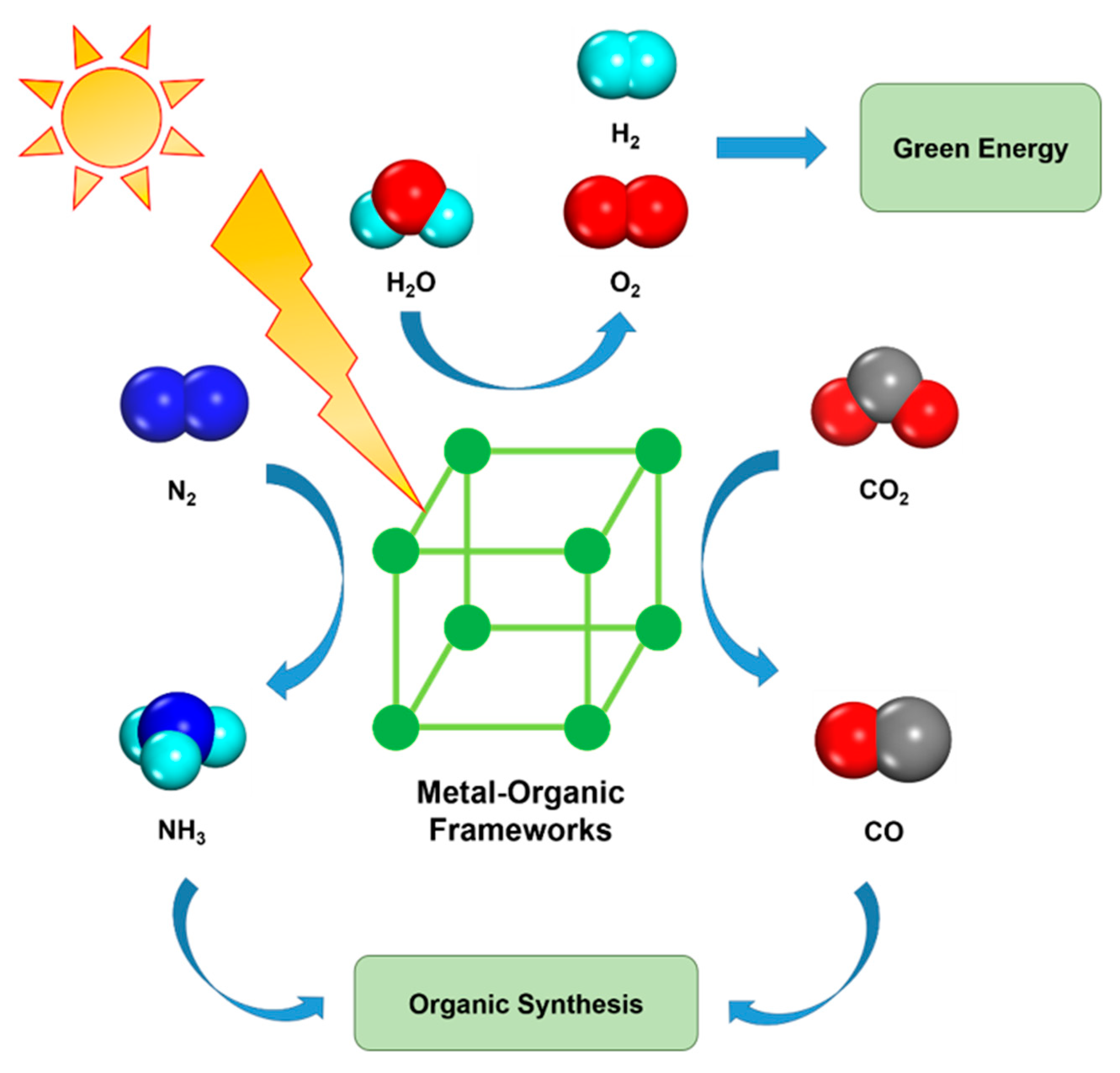
Metal-organic frameworks (MOFs) are an evolving class of crystalline porous materials made of organic linkers and metallic nodes. The rich chemistry of MOFs allows them to have an almost infinite number of possible structures. Consequently, they have been of great interest because of their highly tunable properties and unique features, such as their high porosity, high surface area, structural stability, structural diversity, and tailorability. These enable MOFs to be a flexible catalytic platform for photocatalytic applications. Thus, this paper discusses the opportunities of MOFs for use in catalysis. In particular, the use of metal-organic frameworks as a photocatalyst is briefly discussed. Specifically, MOFs can be used as a photocatalyst for carbon dioxide reduction (CO2RR), nitrogen reduction reactions (NRRs), and water-splitting reactions (HERs and ORRs). However, using MOFs as catalytic platforms has some challenges that must be addressed to achieve commercialization. Therefore, this paper also discusses some prospects of designing MOFs for their specific catalytic applications to improve their catalytic properties and enhance selectivity. More importantly, an outlook is also provided on how MOF catalysts can further be developed to enable other catalytic reactions. Overall, MOFs have great potential as a photocatalytic material, provided they are uniquely designed to suit their intended applications.
Keywords: metal-organic frameworks; photocatalysis; carbon dioxide reduction; nitrogen reduction; water splitting metal-organic frameworks; photocatalysis; carbon dioxide reduction; nitrogen reduction; water splitting