Abstract
This work blends the domain of Precision Agriculture with the prevalent paradigm of Ambient Intelligence, so as to enhance the interaction between farmers and Intelligent Environments, and support their various daily agricultural activities, aspiring to improve the quality and quantity of cultivated plants. In this paper, two systems are presented, namely the Intelligent Greenhouse and the AmI seedbed, targeting a wide range of agricultural activities, starting from planting the seeds, caring for each individual sprouted plant up to their transplantation in the greenhouse, where the provision for the entire plantation lasts until the harvesting period.
1. Introduction
Throughout their cultivation activities, farmers often face complex decision-making problems [1], which do not necessarily have straightforward solutions. This complexity becomes apparent when considering the amount and type of information that they have to process on a daily basis. In more detail, farmers must be aware of various parameters of their cultivated area (e.g., soil moisture levels, weather conditions), while they should also be able to assess the status of each plant separately [2]. The advancements in technological components, such as sensors, actuators, robotics, and mechanized equipment, have contributed towards the alleviation of several complex tasks and the emergence of the term Precision Agriculture (PA). PA depends inherently on Information and Communication Technologies (ICTs), so as to analyze data collected from multiple resources and make informed decisions associated with plant cultivation [3]. However, despite the fact that PA undoubtedly contributes to the improvement of the quantity and quality of agricultural products and the optimization of resource utilization [4], there is still limited research towards creating human-oriented agriculture-related intelligent environments (i.e., farms, greenhouses) whose primary goal is to satisfy the needs of the people working in them. The term “Intelligent Greenhouse” [5], became prevalent in the past quinquennium, and refers to greenhouses that focus on minimizing their carbon footprint [6], permitting the creation of self-regulating cultivation environments, automating several agricultural activities [7]. They are usually equipped with several I/O devices and control devices [8], and permit users to monitor and control them remotely. Apart from technologically enhanced greenhouses, there are several approaches concentrating on seedbeds [9], so as to streamline the process of planting the seeds and caring for the seedling before transplanting them elsewhere. However, these approaches do not support automated daily care and precise seedling measurement, while there is no provision for the post-grow period of seedlings, especially for climbing and brassica vegetables. In general, existing solutions targeting either greenhouses or seedbeds mainly focus on advancing the hardware infrastructure rather than focusing on the needs of users and enhancing User Experience (UX). Conversely, this work takes advantage of the Ambient Intelligence (AmI) paradigm [10] towards creating a user-centric [11] Intelligent Environment (IE) consisting of a greenhouse and a seedbed. Both systems target the domain of PA, deliver novel interaction techniques, and respond to user needs.
2. Design Process
A user-centered design approach was followed, based on the Design Thinking Methodology [12], which is an iterative process consisting of five phases: Empathize, Define, Ideate, Prototype, and Test. For the first two phases, the design team studied the related work on the domain of Intelligent Systems for Agriculture and examined relevant commercial solutions. Next, in order to gain an empathic understanding of the user needs, the team defined specific personas (i.e., Agronomist, Professional Farmer, and Hobby/Amateur Farmer) and created several motivating scenarios under the guidance of an agronomist familiar with AmI Technologies. Then, for the Ideate phase, the team organized several brainstorming sessions with the participation of several stakeholders, that resulted in an abundance of ideas which were subsequently filtered, so as to remove unfeasible solutions and to prioritize the most promising ones. This process led to the decision of firstly investigating the potentials of AmI in the domain of closed-type Agriculture, and to the formulation of a list with high-level requirements (Table 1) for an AmI Seedbed and an Intelligent Greenhouse. For the Prototype phase, the design team, along with specialists from other relevant fields (e.g., automation and robotics engineers), collaborated during focus group meetings in order to (i) decide the type of sensors, actuators, and other technological components that should be used, (ii) identify any custom-made artefacts that should be designed and developed, (iii) discuss the specifics regarding the installation of the technological equipment (e.g., where each sensor should be placed), and (iv) pinpoint the requirements that the greenhouse construction should satisfy so as to accommodate the envisioned scenarios. As a next step, User Interface (UI) and UX experts undertook the task of prototyping the identified end-user applications.
Table 1.
High-level requirements.
3. AmI Seedbed and Intelligent Greenhouse
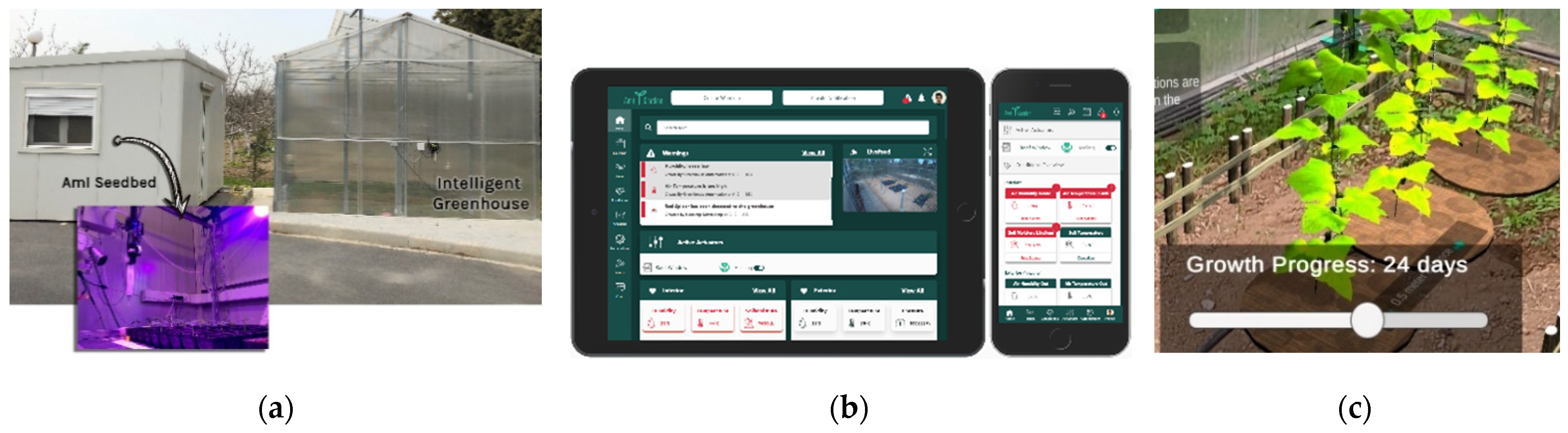
The AmI Seedbed (Figure 1a) is a PA Computer Numerical Control (CNC) project that comprises a metal bench on which there are various sensors to measure air temperature and humidity and a Cartesian (xyz) coordinate robotic “arm” made of high-quality aluminum linear rail profiles. The robotic system’s head is equipped with a commercial Raspberry Pi camera for image capturing and custom-made 3D printed planting and irrigation units. A small air pump through a tiny tube that ends to a trunk and is used for planting seeds into well-prepared pots with soil substrate, while a thin water tube pours water precisely into each pot.
Figure 1.
(a) AmI Seedbed and Intelligent Greenhouse, (b) snapshots of the web applications, (c) AR plant growth simulation.
The Intelligent Greenhouse (Figure 1a) is a small-scale (approximately 25 m2) experimental gable-type greenhouse covered with polycarbonate cover sheets and equipped with various sensors, actuators, as well as custom-made artifacts (Table 2). The installed sensors permit the monitoring of internal and external conditions (e.g., air and soil temperature and humidity, solar radiation, external weather conditions), as well as the assessment of specific parameters of each plant (e.g., weight). Additionally, the employed actuators can be controlled via appropriate software, permitting users to manually control them, and enabling the greenhouse to automatically change its status so as to optimize its interior conditions based on Artificial Intelligence (AI). Finally, custom-made control panels are installed on the pathway in front of each cultivation zone, allowing users to view the zone’s current status and, if needed, adjust its actuators.
Table 2.
The technological infrastructure of the Intelligent Greenhouse.
4. End-User Applications
Intuitive and user-friendly applications [13] were designed and developed targeting PCs, tablets, smartphones (Figure 1b), and other technologically-enhanced artifacts (e.g., billboards, smart TVs, the smart refrigerator of the Intelligent Home [14]) so as to enable remote and on-site management of multiple dispersed greenhouses and seedbeds. The applications satisfy the requirements A-H mentioned in Table 1 and deliver personalized content, keeping in mind the characteristics and needs of each user. Additionally, following the advancements in the domain of Mixed Reality (MR), and considering their benefits towards PA, the mobile applications foster such technologies so as to offer advanced visualizations regarding the greenhouse’s conditions. For example, the application features a simulation tool that offers an animated visualization of the plant growth (Figure 1c).
5. Conclusions and Future Work
Currently, the end-user applications are accessible via a PC in the greenhouse’s storehouse. Through that PC, the in-house agronomist is able to monitor and control the greenhouse, as well as analyze the collected data, so as to suggest automations and improvements in the system’s decision-making logic. In the past five months, the AmI Seedbed undertook the tasks of automatically (i) planting several pots with cucumber seeds (which are of great importance for the local (Cretan) agricultural economy), (ii) capturing an image of each pot to calculate the seedlings’ growth stage according to the percentage of their leaf area, and (iii) irrigating them on a daily basis. Each column of the seedbed was irrigated with a different amount of water, starting from 0 mL and ending at 18 mL, so as to investigate the optimal amount of irrigation. The latter revealed that 4–6 mL of water per day lead to normal grown seedlings up to the stage of four leaves and a height of approximately 120–140 mm. Next, the young cucumbers were transplanted into the greenhouse, where the intelligent infrastructure was used to reach optimal internal conditions (i.e., temperature, humidity, and soil moisture) automatically. The results were quite positive, and we were able to harvest almost 100 kg of cucumbers out of a net cultivation area of 2 m2 (nine plants distributed in two rows 1 m away, and a 40 cm gap between each plant). Regarding future work, we are planning a full-scale user-based evaluation with the participation of agronomists, professional farmers, and hobbyists so as to assess the UX, while apart from improving the current infrastructure, we are already investigating the potentials of AmI in open-area fields.
Author Contributions
Conceptualization, C.S. (Christos Stratakis), M.B. and A.L.; Methodology, A.L. and M.K.; Project administration, C.S. (Constantine Stephanidis); Software, N.M.S., M.D., G.K., T.E. and E.K.; Supervision, C.S. (Christos Stratakis), M.B. and A.L.; Writing—original draft, M.K. and C.S. (Christos Stratakis); Writing—review & editing, A.L. All authors have read and agreed to the published version of the manuscript.
Funding
This research received no external funding.
Institutional Review Board Statement
Not applicable.
Informed Consent Statement
Not applicable.
Data Availability Statement
Data is contained within the article.
Acknowledgments
This work has been supported by the FORTH-ICS internal RTD Programme ‘Ambient Intelligence and Smart Environments’.
Conflicts of Interest
The authors declare no conflict of interest.
References
- Aubert, B.A.; Schroeder, A.; Grimaudo, J. IT as Enabler of Sustainable Farming: An Empirical Analysis of Farmers’ Adoption Decision of Precision Agriculture Technology. Decis. Support Syst. 2012, 54, 510–520. [Google Scholar] [CrossRef] [Green Version]
- Atherton, B.C.; Morgan, M.; Shearer, S.A.; Stombaugh, T.S.; Ward, A.D. Site-Specific Farming: A Perspective on Information Needs, Benefits and Limitations. J. Soil Water Conserv. 1999, 54, 455–461. [Google Scholar]
- Council, N.R. Precision Agriculture in the 21st Century: Geospatial and Information Technologies in Crop Management; The National Academies Press: Washington, DC, USA, 1997; ISBN 0-309-05893-7. [Google Scholar]
- McBratney, A.; Whelan, B.; Ancev, T.; Bouma, J. Future Directions of Precision Agriculture. Precis. Agric. 2005, 6, 7–23. [Google Scholar] [CrossRef]
- Muñoz, A.; Park, J. Agriculture and Environment Perspectives in Intelligent Systems; IOS Press: Amsterdam, The Netherlands, 2019; Volume 24, ISBN 1-61499-969-4. [Google Scholar]
- Smart Greenhouse. Available online: https://myfood.eu/our-technology/smart-greenhouse/ (accessed on 8 March 2021).
- Belgibaev, B.; Nikulin, V.; Umarov, A. Designing Smart Greenhouses, Satisfactory Price-Quality. J. Math. Mech. Comput. Sci. 2020, 105, 174–190. [Google Scholar] [CrossRef]
- Mirabella, O.; Brischetto, M. A Hybrid Wired/Wireless Networking Infrastructure for Greenhouse Management. IEEE Trans. Instrum. Meas. 2010, 60, 398–407. [Google Scholar] [CrossRef]
- FarmBot | Open-Source CNC Farming. Available online: https://farm.bot/ (accessed on 27 November 2020).
- Aarts, E.; Wichert, R. Ambient intelligence. In Technology Guide; Springer: Berlin/Heidelberg, Germany, 2009; pp. 244–249. [Google Scholar]
- Stephanidis, C. Human Factors in Ambient Intelligence Environments. Handb. Hum. Factors Ergon. 2012, 1354–1373. [Google Scholar]
- Plattner, H.; Meinel, C.; Weinberg, U. Design-Thinking; Springer: Berlin/Heidelberg, Germany, 2009; ISBN 3-86880-013-1. [Google Scholar]
- Bekiaris, I.; Leonidis, A.; Korozi, M.; Stratakis, C.; Zidianakis, E.; Doxastaki, M.; Stephanidis, C. GRETA: Pervasive and AR Interfaces for Controlling Intelligent Greenhouses. In Proceedings of the 2021 17th International Conference on Intelligent Environments (IE), Dubai, United Arab Emirates, 21–24 June 2021. [Google Scholar]
- Leonidis, A.; Korozi, M.; Kouroumalis, V.; Poutouris, E.; Stefanidi, E.; Arampatzis, D.; Sykianaki, E.; Anyfantis, N.; Kalligiannakis, E.; Nicodemou, V.C. Ambient Intelligence in the Living Room. Sensors 2019, 19, 5011. [Google Scholar] [CrossRef] [PubMed] [Green Version]
Publisher’s Note: MDPI stays neutral with regard to jurisdictional claims in published maps and institutional affiliations. |
© 2022 by the authors. Licensee MDPI, Basel, Switzerland. This article is an open access article distributed under the terms and conditions of the Creative Commons Attribution (CC BY) license (https://creativecommons.org/licenses/by/4.0/).