

Proceeding Paper

On the Use of Muscle Activation Patterns and Artificial Intelligence Methods for the Assessment of the Surgical Skills of Clinicians †

by
Ejay Nsugbe
1,*,
Halin Buruno
2,
Stephanie Connelly
3,
Oluwarotimi Williams Samuel
4 and
Olusayo Obajemu
5
1
Nsugbe Research Labs, Swindon SN1 3LG, UK
2
Medic Minds, Limerick University, V94 T9PX Limerick, Ireland
3
Hereford County Hospital, Wye Valley NHS Trust, Hereford HR1 2ER, UK
4
School of Computing and Engineering, University of Derby, Derby DE22 1GB, UK
5
Department of Automatic Control and Systems Engineering, University of Sheffield, Sheffield S10 2TN, UK
*
Author to whom correspondence should be addressed.
Presented at the 10th International Electronic Conference on Sensors and Applications (ECSA-10), 15–30 November 2023; Available online: https://ecsa-10.sciforum.net/.
Eng. Proc. 2023, 58(1), 116; https://doi.org/10.3390/ecsa-10-16231
Published: 15 November 2023

Abstract

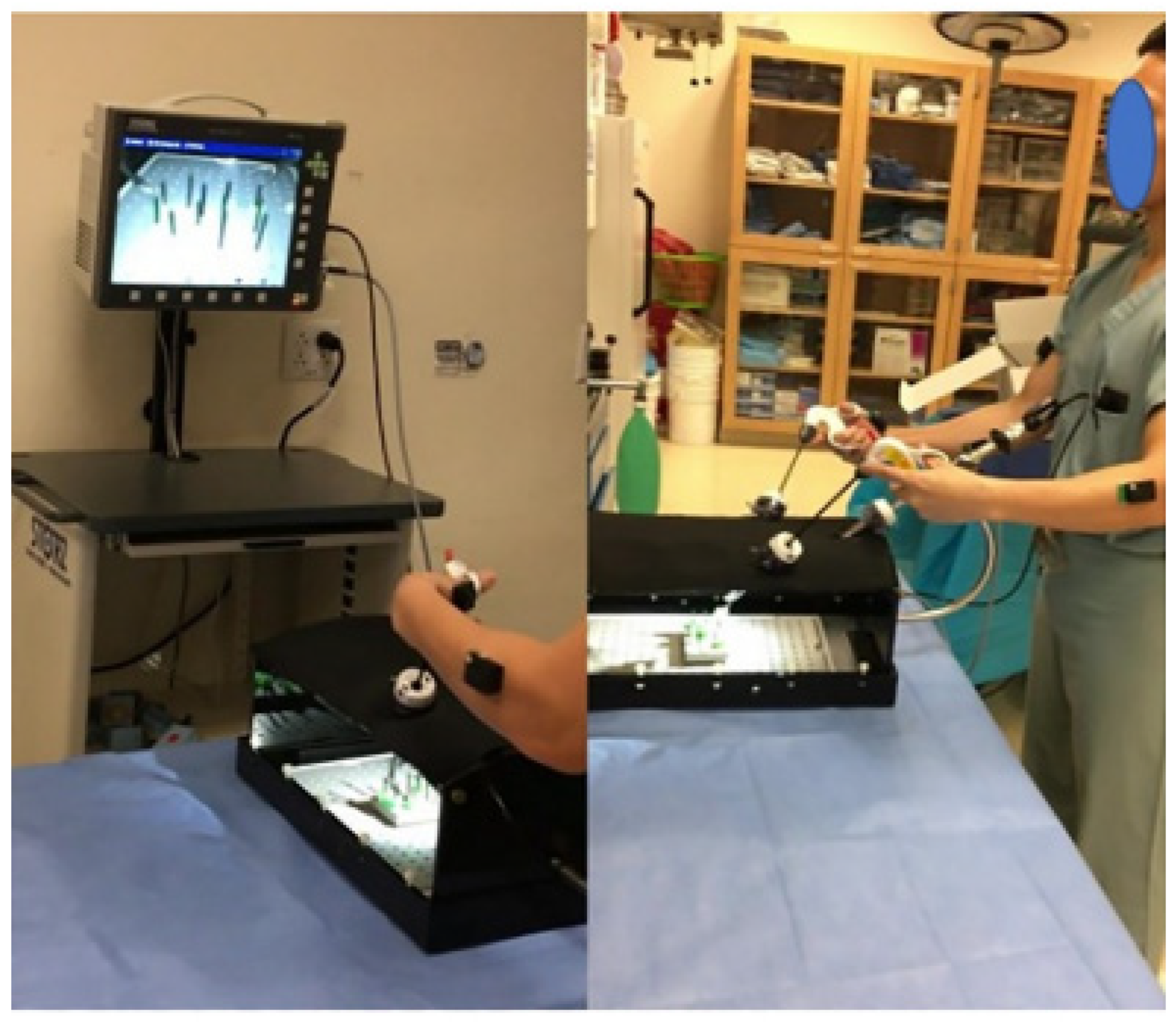
The ranking and evaluation of a surgeon’s surgical skills is an important factor in order to be able to appropriately assign patient cases according to the necessary level of surgeon competence in addition to helping us in the process of pinpointing the specific clinicians within the surgical cohort who require further developmental training. One of the more frequent means of surgical skills evaluation is through a qualitative assessment of a surgeon’s portfolio alongside other supporting pieces of information, a process which is rather subjective. The contribution presented as part of this paper involves the use of a set of Delsys Trigno EMG wearable sensors, which track and record the muscular activation patterns of a surgeon during a surgical procedure, alongside computationally driven artificial intelligence (AI) methods towards the differentiation and ranking of the surgical skills of a clinician in a quantitative fashion. The participants in the research involved novice-level surgeons, intermediate-level surgeons and expert-level surgeons in various simulated surgical cases. A comparison of different signal processing approaches has shown that the proposed approach can prove beneficial in monitoring and differentiating the skillsets of various surgeons for various kinds of surgical cases. The presented method could also be used to track the evolution of the surgical competencies of various trainee surgeons at various stages during their training.
Keywords: wearable sensors; surgery; surgical education; artificial intelligence; EMG; machine learning; signal processing wearable sensors; surgery; surgical education; artificial intelligence; EMG; machine learning; signal processing

