

Abstract
Water with a high concentration of oxygen is needed for the aquaculture industry in Japan. In the current study, the pressurized dissolution method was employed to generate high-concentration oxygenated water (HCOW) by producing oxygen nanobubbles in the water. In order to investigate factors such as temperature, geometric conditions, and their influence on the oxygen concentration, a special nanobubble generator was improved by changing the number and the diameter of the holes of the perforated plate in this study. Then, an experimental system where oxygen and water were separately introduced inside the proposed nanobubble generator was designed. The dissolved oxygen concentration was measured under different conditions. Finally, the produced HCOW was used to cultivate a mini-sunflower. Through a series of experiments, it was found that with the improved perforated plate, the dissolved oxygen concentration was increased and the nanobubble generator reached the saturation state quickly, while the mini-sunflower cultivated with the HCOW appeared to grow larger than that with tap water.
1. Introduction
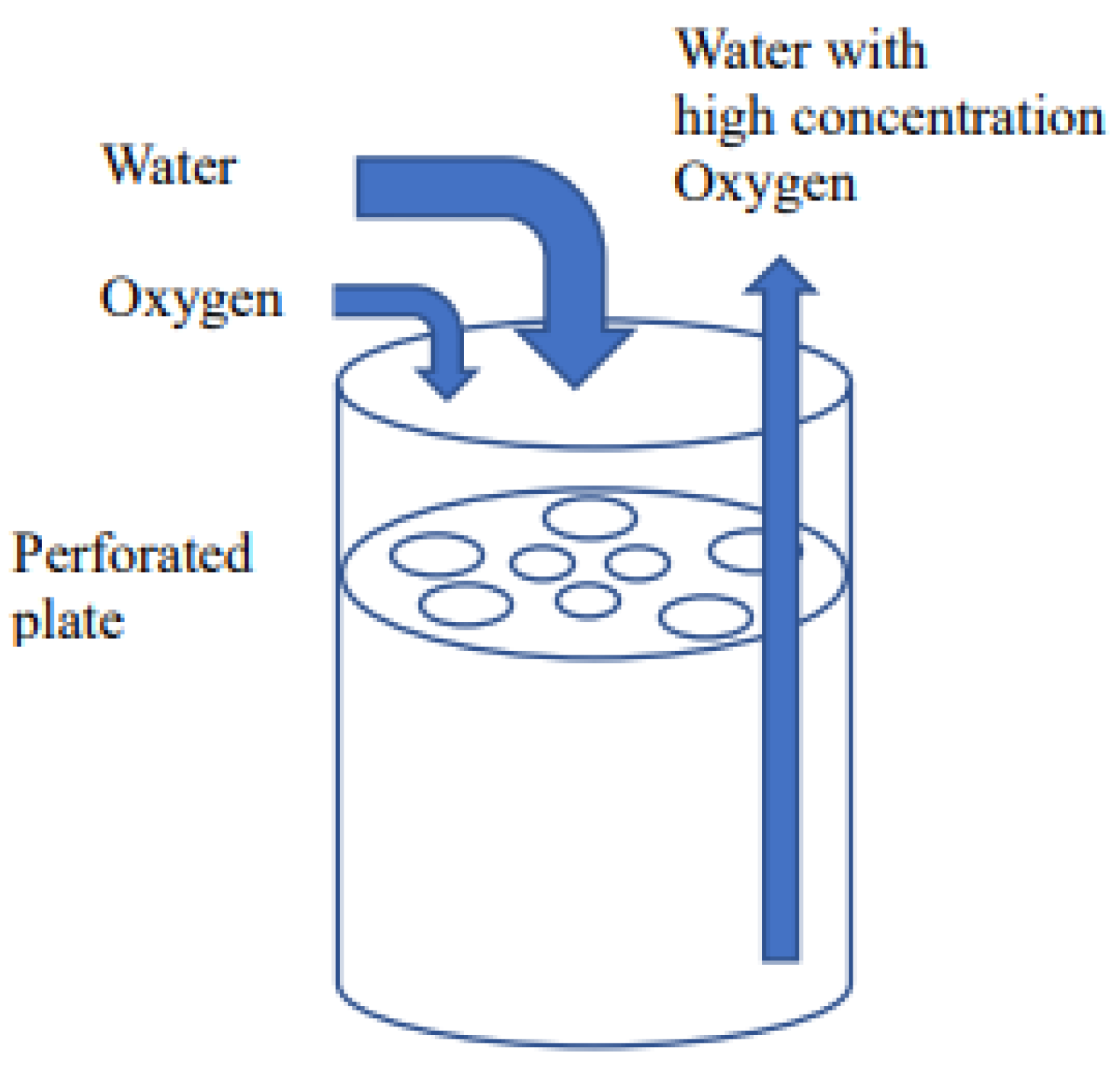
Oxygen dissolved in water above the saturation concentration is called high-concentration oxygenated water (HCOW). Recently, the growth-promoting effect of leafy vegetable leaves in hydroponic cultivation by using high-concentration oxygen water was reported [1]. In the aquaculture industry, high-concentration oxygenated water is employed to enhance the growth of fish, while its sterilization ability has also been verified. In order to produce high-concentration oxygenated water, special oxygen-dissolving equipment is used based on the pressurized dissolution method (PDM) [2]. The principle of PDM is as follows.
As shown in Figure 1, oxygen gas is introduced into a cylindrical container, inside which a perforated plate is mounted. In the space between the top cover of the container and the perforated plate, the pressure increases to form a higher-pressure atmosphere. When water is introduced into the container at the same time, more oxygen dissolves into the water according to Henry’s law. After the oxygenated water passes through the perforated plate, it is sheared and dropped into a lower-pressure space where the extra oxygen is released and oxygen nanobubbles are generated. Finally, the water with a high concentration of oxygen is pumped out of the container.
Figure 1.
Pressurized dissolution method.
The pressure inside the container and the geometric conditions influence the concentration of the oxygenated water. In previous studies [3], the geometric structure of the perforated plate was improved to increase the dissolved oxygen concentration by changing the number and the diameter of the holes. Through a series of experiments, it was found that with the improved perforated plate, the dissolved oxygen concentration was increased, and the nanobubble generator reached the saturation state quickly.
Therefore, in this study, we designed and fabricated a new perforated plate with the number and diameter of the holes changed. An experiment system was established to verify the effect of HCOW when the new perforated plate was used. Finally, mini-sunflowers were cultivated with HCOW. In a series of experiments, it was found that the improved perforated plate increased the dissolved oxygen concentration and fish grew.
2. Methods
2.1. Experiment
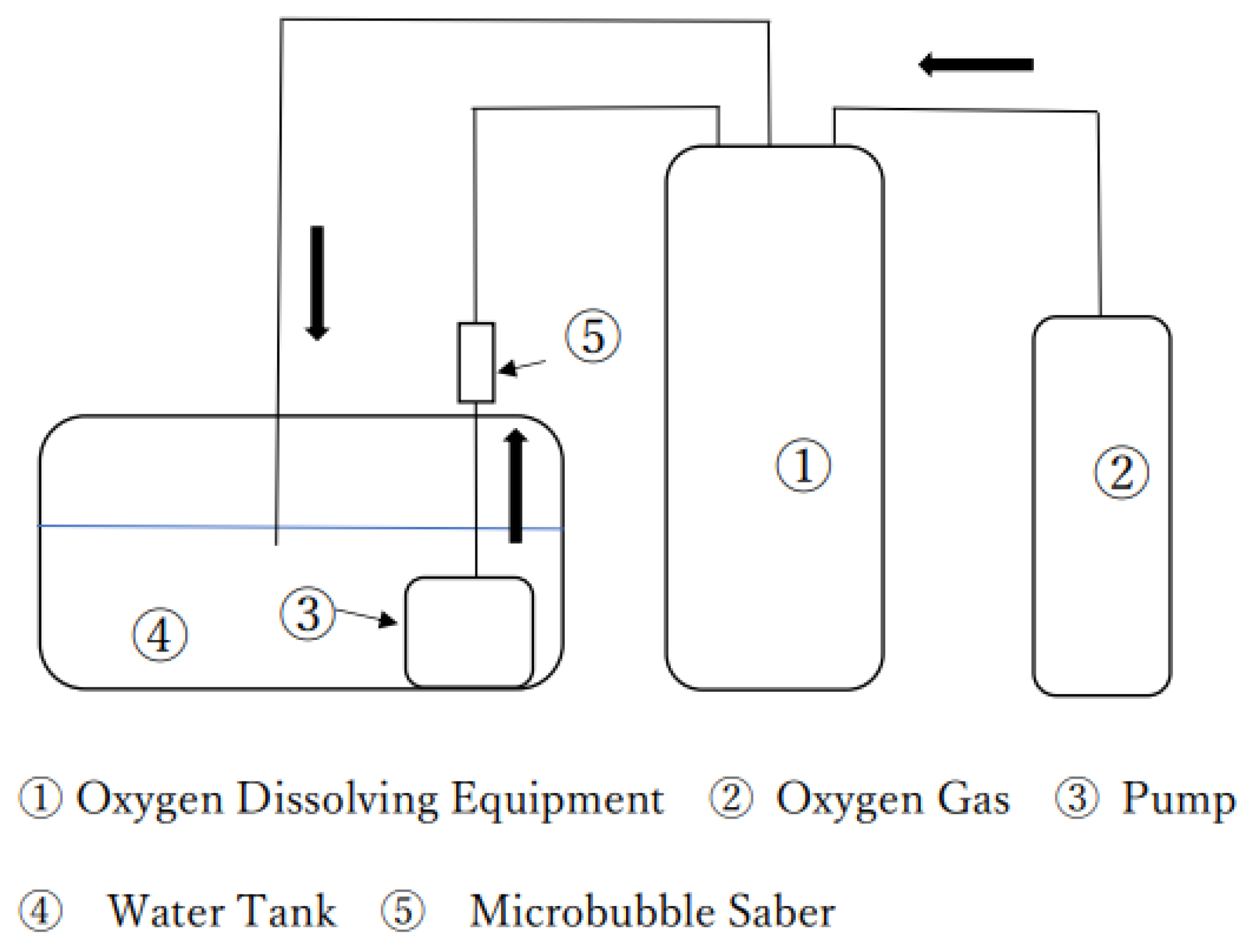
The experiment system for the proposed oxygen-dissolving equipment is demonstrated in Figure 2. This experimental system consists of an oxygenated water generator, oxygen tank, and water pump water tank. Oxygen flows into the oxygenated water generator through a pressure regulator from the oxygen tank, and water is pumped into the generator at the same time. The oxygen concentration of the HCOW in the water tank is measured with an oxygen meter. The basic experimental conditions are listed in Table 1.
Figure 2.
Experiment system for oxygen-dissolving generator.
Table 1.
Basic experimental conditions.
2.2. Perforated Plates
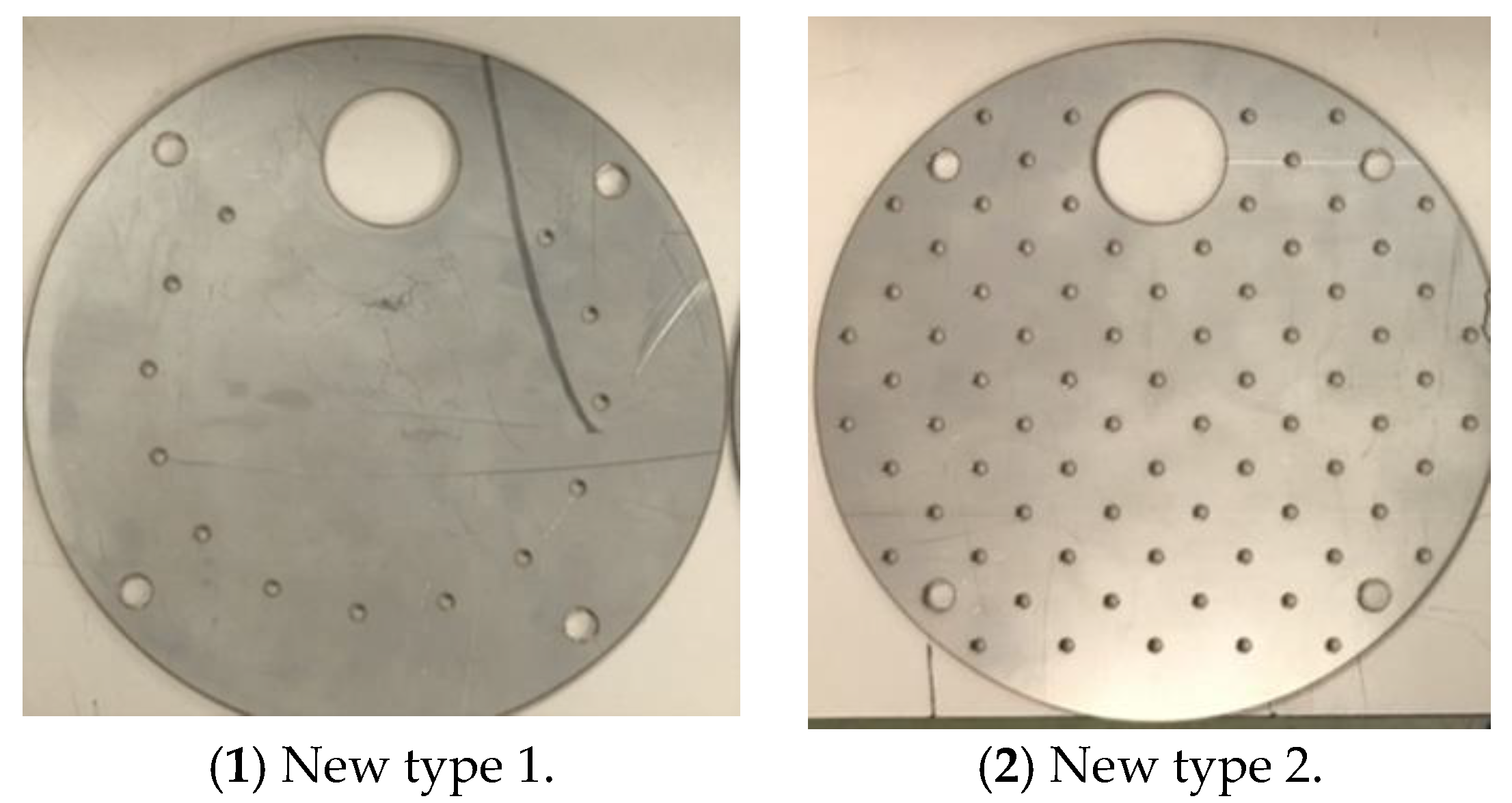
To increase the oxygen concentration, two new perforated plates were designed and produced as shown in Figure 3. The diameter of the hole in both perforated plates was 3 mm, and the number of holes for each perforated plate was different. The new type 1 had 13 holes, and new type 2 had 77 (Table 2). We determined how much the oxygen concentration increased compared to the old perforated plate with the diameter of each hole being 5 mm and the number of holes being 13.
Figure 3.
Effect of geometric conditions of perforated plate (1) New type 1 with 13 holes; (2) New type 2 with 77 holes.
Table 2.
Dimensions of the new perforated plate.
2.3. Cultivation of Mini-Sunflowers
An experiment on mini-sunflowers’ growth using high-concentration oxygen water and tap water was conducted. Throughout the experiment lasting for 3 months, their growth states were observed by taking photos, and ultimately, the length and weight of their roots were measured.
3. Results and Discussions
3.1. The Effect of the Geometric Conditions of the Perforated Plate
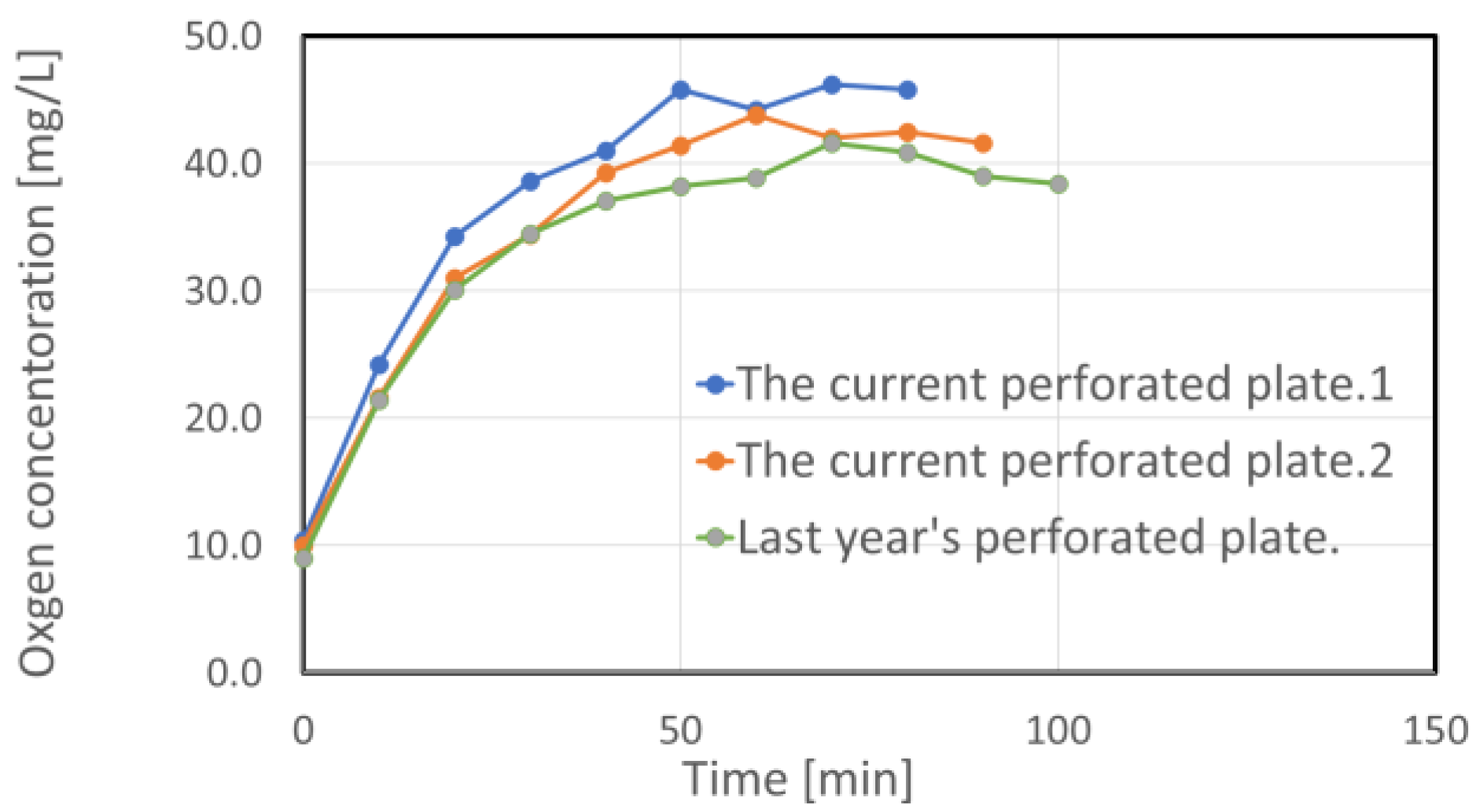
The effect of the geometric conditions of the proposed perforated plate on oxygen concentration is demonstrated in Figure 4. Compared with the old type (the number of holes was 13 with a diameter of 5 mm), for the new type, the oxygen concentration reached saturation and its saturated oxygen concentration was higher than that of the old type. When the hole number was 77, the oxygen concentration showed a maximum value of 47 mg/L. The increased number of holes and the decreased diameter of the perforated plate sheared the falling water more effectively and increased the oxygen concentration.
Figure 4.
Effect of geometric conditions on oxygen.
3.2. Cultivation of the Mini-Sunflowers
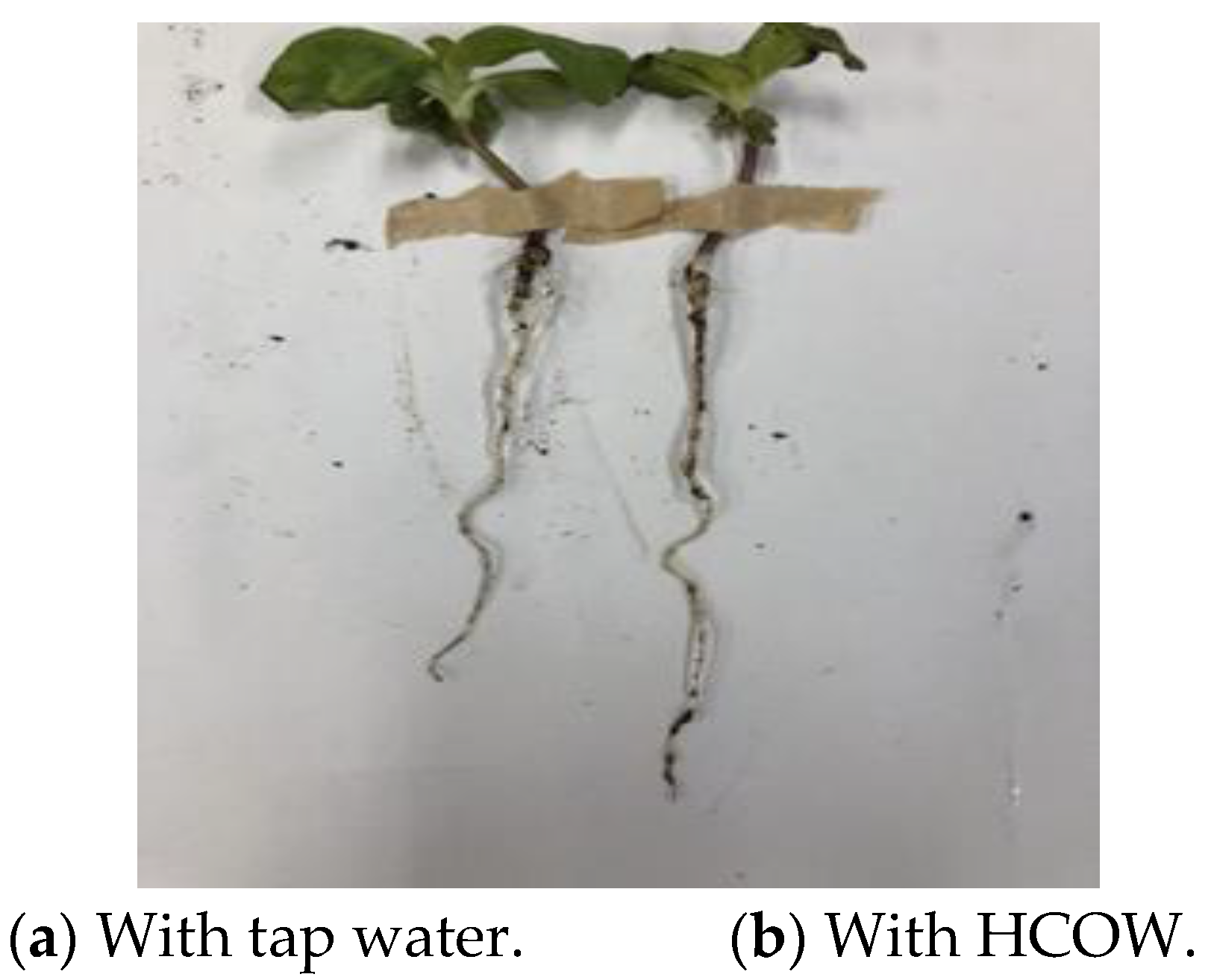
The shape of the mini-sunflowers is illustrated in Figure 5, and the length and weight of them are also shown in Table 3. Essentially, mini-sunflower (a) was cultivated with tap water and mini-sunflower (b) was cultivated with HCOW daily. Figure 5 shows that mini-sunflower (a), cultivated with the high-oxygen-concentration water, had longer and thicker roots than (b). The weight of the mini-sunflowers cultivated with HOCW was 0.239 g, which was larger than those cultivated with tap water. With HOCW, the microbiota in the soil was activated, and the growth of the mini-sunflower enhanced.
Figure 5.
Cultivation of mini-sunflowers with tap water (a) and HCOW (b).
Table 3.
Comparison of growth of mini-sunflowers’ cultivated with HCOW and tap water.
4. Conclusions
When new types of perforated plates were used, with the increased hole number and decreased diameter, the oxygen concentration increased and the maximum oxygen concentration reached 47 mg/L. By using HCOW, the growth of the mini-sunflower was enhanced significantly.
Author Contributions
Conceptualization, N.Z.; methodology, M.L.; experiment, K.S.; data curation, M.L; writing—N.Z.; writing—review and editing, N.Z. All authors have read and agreed to the published version of the manuscript.
Funding
This research received no external funding.
Institutional Review Board Statement
Not applicable.
Informed Consent Statement
Not applicable.
Data Availability Statement
Data are contained within the article.
Acknowledgments
The authors would like to thank Eiji Takeuchi for his kind suggestion.
Conflicts of Interest
The authors declare no conflict of interest.
References
- Tanaka, Y.; Tamaki, H.; Tanaka, K.; Tozawa, E.; Matsuzawa, H.; Toyama, T.; Kamagata, Y.; Mori, K. Duckweed-Microbe Co-Cultivation Method for Isolating a Wide Variety of Microbes Including Taxonomically Novel Microbes. Microbes Environ. 2018, 33, 402–405. [Google Scholar] [CrossRef] [PubMed]
- Ushikubo, F.Y.; Oshita, S.; Furukawa, T.; Makino, Y.; Kawagoe, Y.; Furihata, K.; Shiina, T. Properties of micro/nano-bubble water and its possible effect on physiological activity. J. Agric. Mech. 2008, 70, 15–16. [Google Scholar]
- Zhu, N. Development of High Concentration Oxygen Water Generator based on Nanobubble. In Proceedings of the 2022 JSME-IIP/ASME-ISPS Joint International Conference on Micromechatronics for Information and Precision Equipment, Nagoya, Japan, 28–31 August 2021. [Google Scholar]
Disclaimer/Publisher’s Note: The statements, opinions and data contained in all publications are solely those of the individual author(s) and contributor(s) and not of MDPI and/or the editor(s). MDPI and/or the editor(s) disclaim responsibility for any injury to people or property resulting from any ideas, methods, instructions or products referred to in the content. |
© 2023 by the authors. Licensee MDPI, Basel, Switzerland. This article is an open access article distributed under the terms and conditions of the Creative Commons Attribution (CC BY) license (https://creativecommons.org/licenses/by/4.0/).