

Abstract
The mid-infrared spectral (MIR) region is poorly exploited in Earth Observation (EO) applications despite its potential for impacting several application fields, from climatological studies to land management. Among these, high-temperature events (HTE) monitoring plays a key role. Here we discuss the expected impact on EO data and relevant scientific applications by presenting data simulations and relevant Signal-to-Noise Ratio (SNR) evaluation for an innovative, high spatial-resolution multispectral imager—based on Compressive Sensing approach and working in the MIR—studied in the frame of the ASI-funded “SISSI” project. The working principle, expected data output, and performances with impact on HTE detection and monitoring are presented.
1. Introduction
Compressive Sensing (CS) is a new paradigm that, relying on a priori knowledge about the signal’s sparsity, allows the reconstruction of the signal in an efficient way by using fewer samples than in a classical approach, thus merging the acquisition and compression steps into a single one. A CS instrument’s architecture is implemented—in its simplest form—by using a light modulation element (Spatial Light Modulator—SLM) and a single pixel detector on which the light is concentrated through a lens (condenser). Each acquisition (measurement) is given by the product—element by element—between each element of the encoding binary pattern applied to the modulator and the corresponding element of the image focused on it, and the subsequent integration is carried out by the condenser on the single-pixel detector. Based on the sparseness of the data to be acquired, it is possible to reconstruct the initial image with sufficient quality by making a number of measurements equal to or less than half of the pixels of the image to be reconstructed, thus merging the acquisition and compression phases into a single step. In this paper, we present the expected SNR performances of a high spatial-resolution multispectral imager—based on the Compressive Sensing approach and working in the MIR—and we discuss the impact on High-Temperature Event (HTE)-related studies.
2. The SISSI Instrument
The working principle of the SISSI instrument is inspired by the CS single-pixel camera concept [1]; however, in the case of the SISSI instrument, a parallel acquisition is implemented [2]: the images of MxM groups of adjacent micromirrors of the SLM, each group being made up of NxN micromirrors suitably coded by a binary mask for each frame, is collected by each element of the detector. This allows the spatial acquisition of the scene. Table 1 reports the main features of the instrument. Further details can be found in [2].
Table 1.
Main specifications of the SISSI instrument.
3. Data Simulations and CS Algorithm Performance Evaluation
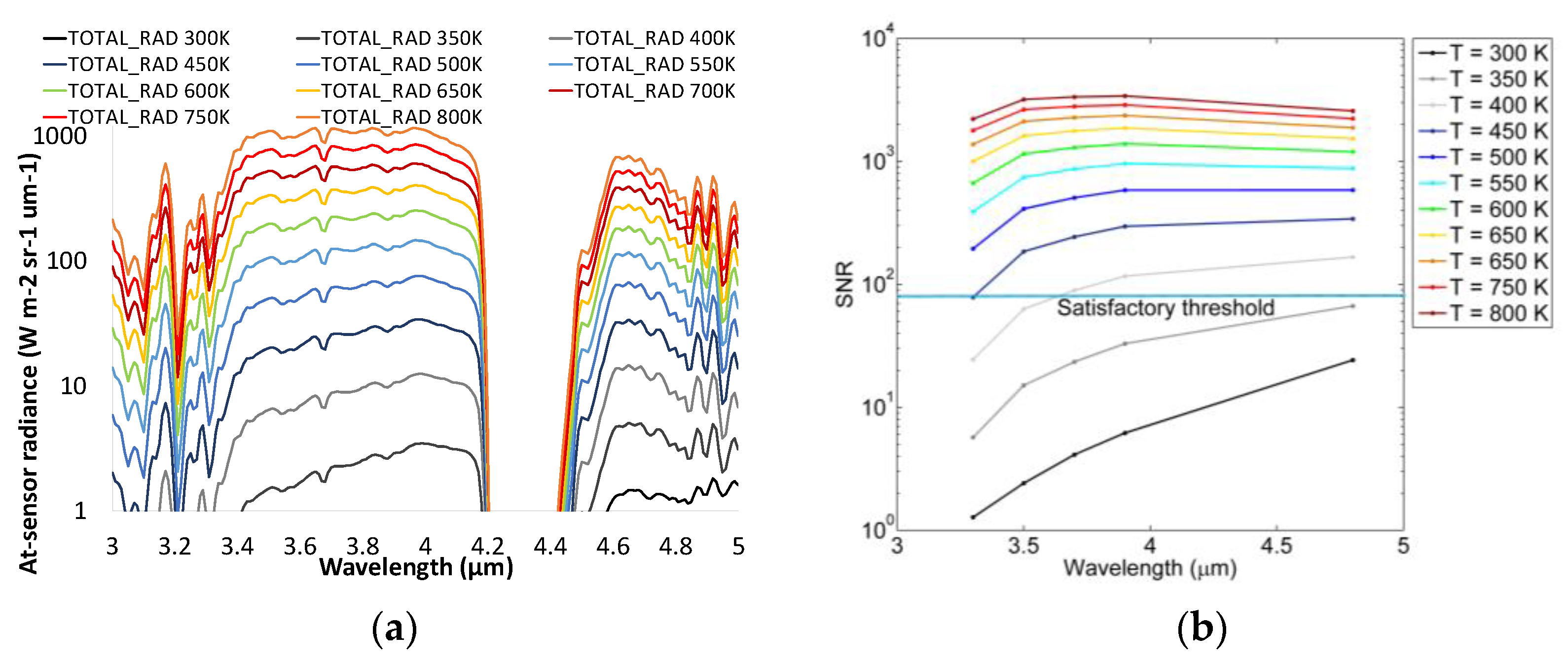
In order to evaluate the radiometric performance of the SISSI instrument in terms of SNR, the black body radiance spectra (emissivity = 1) for temperatures ranging from 300 K to 800 K were evaluated and propagated up to the at-sensor altitude (700 Km) using MODTRAN 6 radiative transfer software [3].
At-sensor radiance spectra simulations were performed with a spectral resolution of 10 nm in order to have a sufficient number of samples in the Full Width Half Maximum (FWHM) of the SISSI spectral bands. Simulated spectra are shown in Figure 1a. The effective radiance reaching the detector can be evaluated taking into account the overall transmittance of the optical system, the diffraction efficiency of DMD and the number of DMD micromirrors turned on, and the quantum efficiency of the detector itself. As far as the SNR values are concerned, we considered the following noise contributions: photonic noise and read out noise (dark current data were not available for this detector and thus, the calculated SNR value is slightly overestimated). SNR values are reported in Figure 1b. It can be noted that the expected data quality is satisfactory (SNR > 80) in the temperature range 450–800 K, and still acceptable for 400 K, except for the 3.3-µm band. For temperatures lower than 400 K, the data quality is probably insufficient for most applications.
Figure 1.
(a) At-sensor radiance (logarithmic scale) calculated using MODTRAN software. (b) SNR (logarithmic scale) evaluated at different temperatures for SISSI spectral bands.
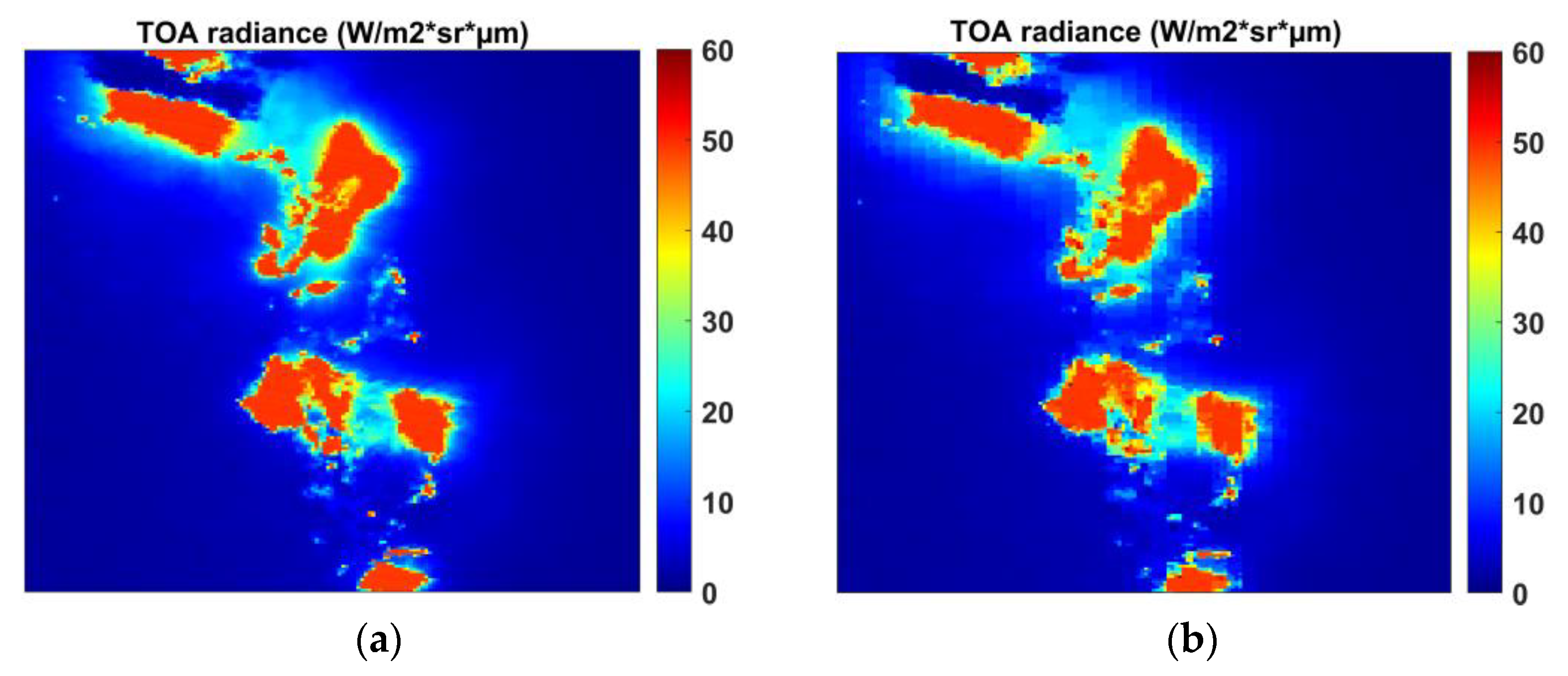
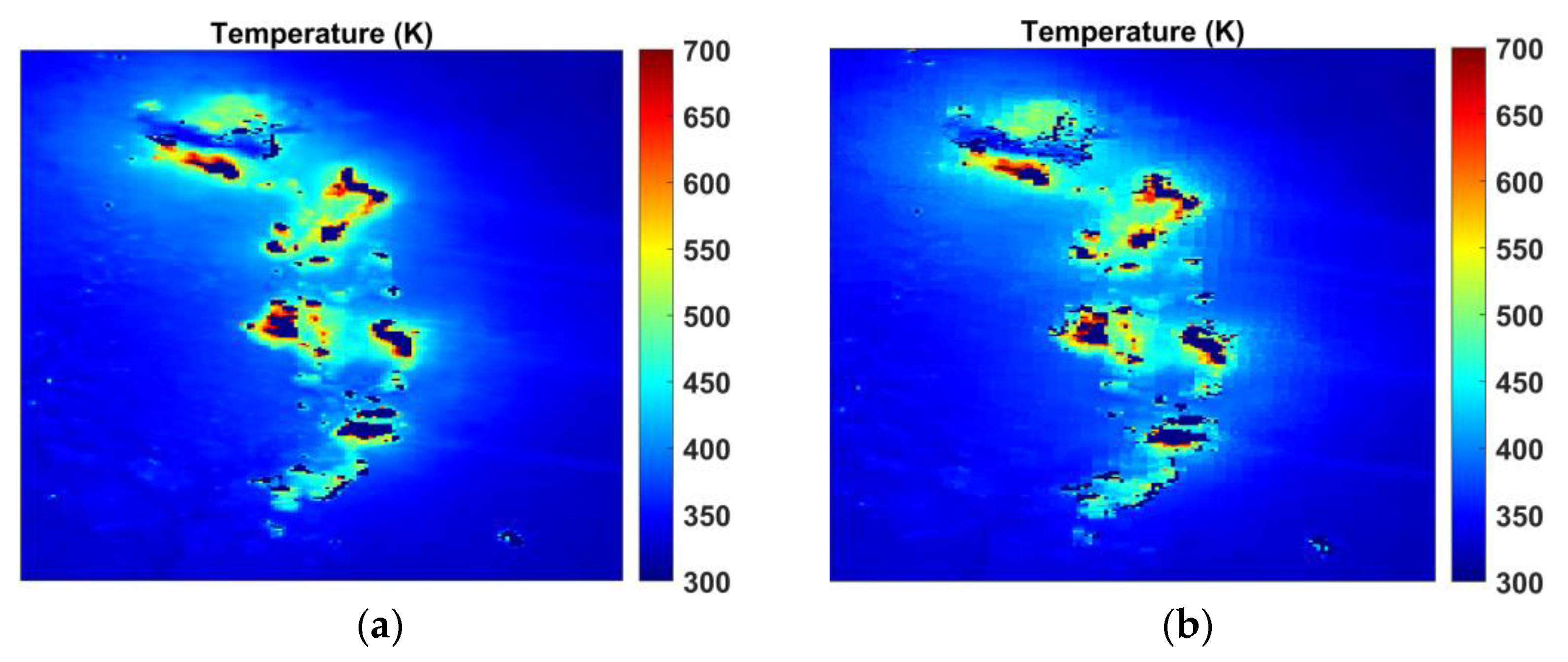
In order to test the CS reconstruction performance, we used a simulated SISSI-like dataset obtained starting from a scenario acquired by the MASTER airborne instrument over a wildfire in California (USA) on 17 June 2016 [3,4]. The CS acquisition process was simulated and the CS algorithm was applied to reconstruct the images of the five channels. Afterwards, temperature fields were calculated, by means of the Temperature Emissivity Separation (TES) algorithm [5], from both original and reconstructed images acquired with a compression ratio (CR) of 50%. In Figure 2, we report Top Of Atmosphere (TOA) radiance values for the simulated and reconstructed SISSI image at 3.9 µm, while in Figure 3 we report the estimated temperature fields. The normalized RMSE (Root Mean Squared Error) between the two temperature fields (Figure 3a,b) is 1.5% and shows a satisfactory performance of the developed reconstruction algorithm.
Figure 2.
(a) TOA radiance for SISSI-like simulated data at 3.9 µm; (b) TOA radiance reconstructed by applying CS algorithm on simulated CS acquisition with CR = 50%.
Figure 3.
Temperature fields were estimated using (a) SISSI simulated channels; and (b) SISSI-like channels reconstructed by applying the CS algorithm on simulated CS acquisition with CR = 50%.
4. Main Applications
The scientific targets of SISSI mainly concern HTE-related studies, such as fire front and active burning areas analysis; detection of trace gases emitted to the atmosphere by biomass burning; flaring events analysis; and hot spot temperature estimation of lava flows.
The central wavelength and the Full-Width Half Maximum (FWHM) of the five spectral channels were chosen taking into account both SNR and target scientific applications. Products involving temperature estimation generally require spatial resolution of less than 50 m and a number of channels larger than two. Multispectral acquisitions allow for estimates of ground temperatures, by extending to the MIR spectral range the methods originally developed for the Thermal Infrared (TIR), like TES algorithms [5]. Furthermore, the spectral channels at 3.3 µm and 4.8 µm are positioned in the absorption bands of CH4 and CO2, respectively, allowing the detection of emissions of these greenhouse gases. The spatial resolution plays a fundamental role in a better HTE characterization, while the CS approach helps to mitigate saturation effects in the reconstructed image.
5. Conclusions
Here we presented the performances—in terms of SNR evaluation and CS reconstruction quality—of a CS-based multispectral imager in the MIR based on a simulated dataset. The results were promising in view of the use of the instrument for studying HTE-related phenomena, such as fires, trace gases emitted by biomass burning, flaring, and hot spot temperature estimation of lava flows.
Author Contributions
Conceptualization, D.G., T.B., F.B., C.L., E.M., V.N., L.P., V.R. (Vito Romaniello), M.S., D.V. and V.R. (Valentina Raimondi); methodology, D.G., T.B., F.B., C.L., E.M., V.N., L.P., V.R. (Vito Romaniello), M.S., D.V. and V.R. (Valentina Raimondi); software, D.G., T.B., C.L., E.M., V.N., L.P., V.R. (Vito Romaniello), M.S. and D.V.; validation, D.G., T.B., F.B., C.L., E.M., V.N., L.P., V.R. (Vito Romaniello), T.S., M.S.d.C., M.S., D.V. and V.R. (Valentina Raimondi); formal analysis, T.B., C.L., E.M., V.R. (Vito Romaniello), M.S. and D.V.; validation, D.G., T.B., F.B., C.L., E.M., V.N., L.P., V.R. (Vito Romaniello), T.S., M.S.d.C., M.S., D.V. and V.R. (Valentina Raimondi); investigation, D.G., M.B., T.B., F.B., C.L., E.M., V.N., L.P., V.R. (Vito Romaniello), T.S., M.S.d.C., M.S., D.V. and V.R. (Valentina Raimondi); resources, F.B., E.M. and V.R.; data curation, D.G., C.L., V.N., L.P., V.R. (Vito Romaniello), M.S. and D.V.; validation, D.G., T.B., F.B., C.L., E.M., V.N., L.P., V.R. (Vito Romaniello), T.S., M.S.d.C., M.S., D.V. and V.R. (Valentina Raimondi); writing—original draft preparation, D.G., C.L. and V.R. (Vito Romaniello); writing—review and editing, D.G., C.L., V.R. (Vito Romaniello), F.B., E.M. and V.R.; visualization, D.G., C.L., V.N., L.P., V.R. (Vito Romaniello), M.S. and D.V.; supervision, E.M., F.B. and V.R. (Valentina Raimondi); project administration, V.R.; funding acquisition, V.R. (Valentina Raimondi). All authors have read and agreed to the published version of the manuscript.
Funding
This research was funded by ASI (Italian Space Agency), grant number ASI N. 2020-3-U.0 “Spettrometro a Immagine a Super-risoluzione Spaziale nel medio Infrarosso” (SISSI)”.
Institutional Review Board Statement
Not applicable.
Informed Consent Statement
Not applicable.
Data Availability Statement
Data analysed in this study are available at: https://masterprojects.jpl.nasa.gov/Data_Products (accessed on 01 June 2020).
Conflicts of Interest
The authors declare no conflict of interest.
References
- Duarte, M.F.; Davenport, M.A.; Takhar, D.; Laska, J.N.; Sun, T.; Kelly, K.F.; Baraniuk, R.G. Single-Pixel Imaging via Compressive Sampling. IEEE Signal Process. Mag. 2008, 25, 83–91. [Google Scholar] [CrossRef]
- Lastri, C.; Amato, G.; Baldi, M.; Bianchi, T.; Buongiorno, M.F.; Corti, C.; Corti, F.; Corti, M.; Franci, E.; Guzzi, D.; et al. SISSI Project: A Feasibility Study for a Super Resolved Compressive Sensing Multispectral Imager in the Medium Infrared. Eng. Proc. 2021, 8, 28. [Google Scholar] [CrossRef]
- Berk, A.; Conforti, P.; Kennett, R.; Perkins, T.; Hawes, F.; van den Bosch, J. MODTRAN® 6: A Major Upgrade of the MODTRAN® Radiative Transfer Code. In Proceedings of the 2014 6th Workshop on Hyperspectral Image and Signal Processing: Evolution in Remote Sensing (WHISPERS), Lausanne, Switzerland, 24–27 June 2014; pp. 1–4. [Google Scholar]
- Hook, S.J.; Myers, J.J.; Thome, K.J.; Fitzgerald, M.; Kahle, A.B. The MODIS/ASTER Airborne Simulator (MASTER)—A New Instrument for Earth Science Studies. Remote Sens. Environ. 2001, 76, 93–102. [Google Scholar] [CrossRef]
- Gillespie, A.; Rokugawa, S.; Matsunaga, T.; Cothern, J.S.; Hook, S.; Kahle, A.B. A Temperature and Emissivity Separation Algorithm for Advanced Spaceborne Thermal Emission and Reflection Radiometer (ASTER) Images. IEEE Trans. Geosci. Remote Sens. 1998, 36, 1113–1126. [Google Scholar] [CrossRef]
Disclaimer/Publisher’s Note: The statements, opinions and data contained in all publications are solely those of the individual author(s) and contributor(s) and not of MDPI and/or the editor(s). MDPI and/or the editor(s) disclaim responsibility for any injury to people or property resulting from any ideas, methods, instructions or products referred to in the content. |
© 2023 by the authors. Licensee MDPI, Basel, Switzerland. This article is an open access article distributed under the terms and conditions of the Creative Commons Attribution (CC BY) license (https://creativecommons.org/licenses/by/4.0/).