Permanent Magnet Synchronous Machine Control Performance and Analysis for Environment-Friendly Electric Vehicle Applications †

 ,
,  ,
,
Abstract
:1. Introduction
2. Research Areas in EVs
3. Mathematical Modelling of PMSM
3.1. PM Synchronous Motor Described Mathematically
3.2. PM Synchronous Motor Vector Control
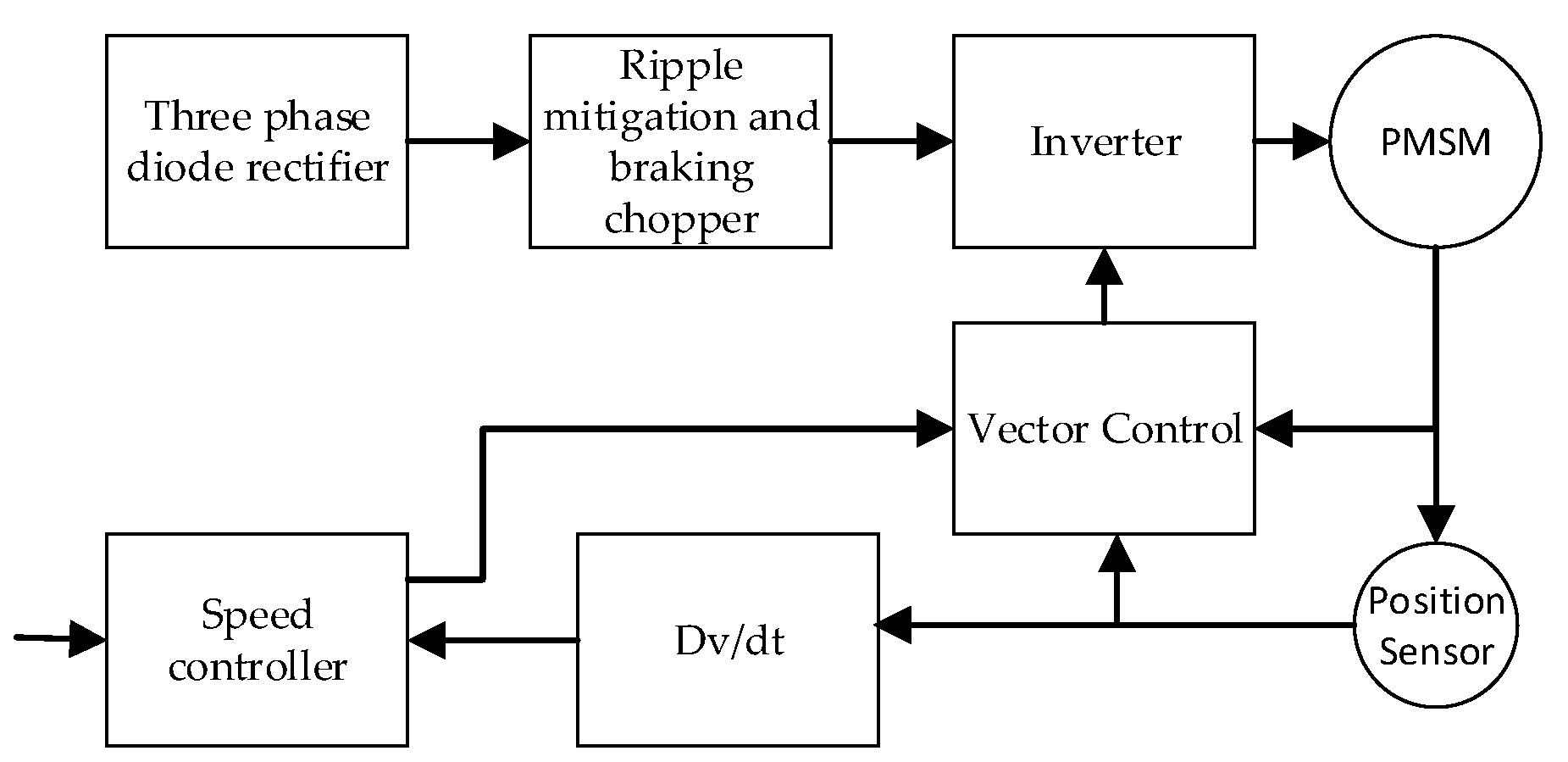
3.3. An Illustration of Vector Control
- Measurements of the motor’s phase voltages and currents;
- Clarke transformation to convert them into the two-phase system;
- The inverse Park transformation is used to convert the stator-voltage space vector from the d–q coordinate system to the two-phase system, and output is produced.
4. Vector Controller Design Implementation
5. Simulation of PMSM Control
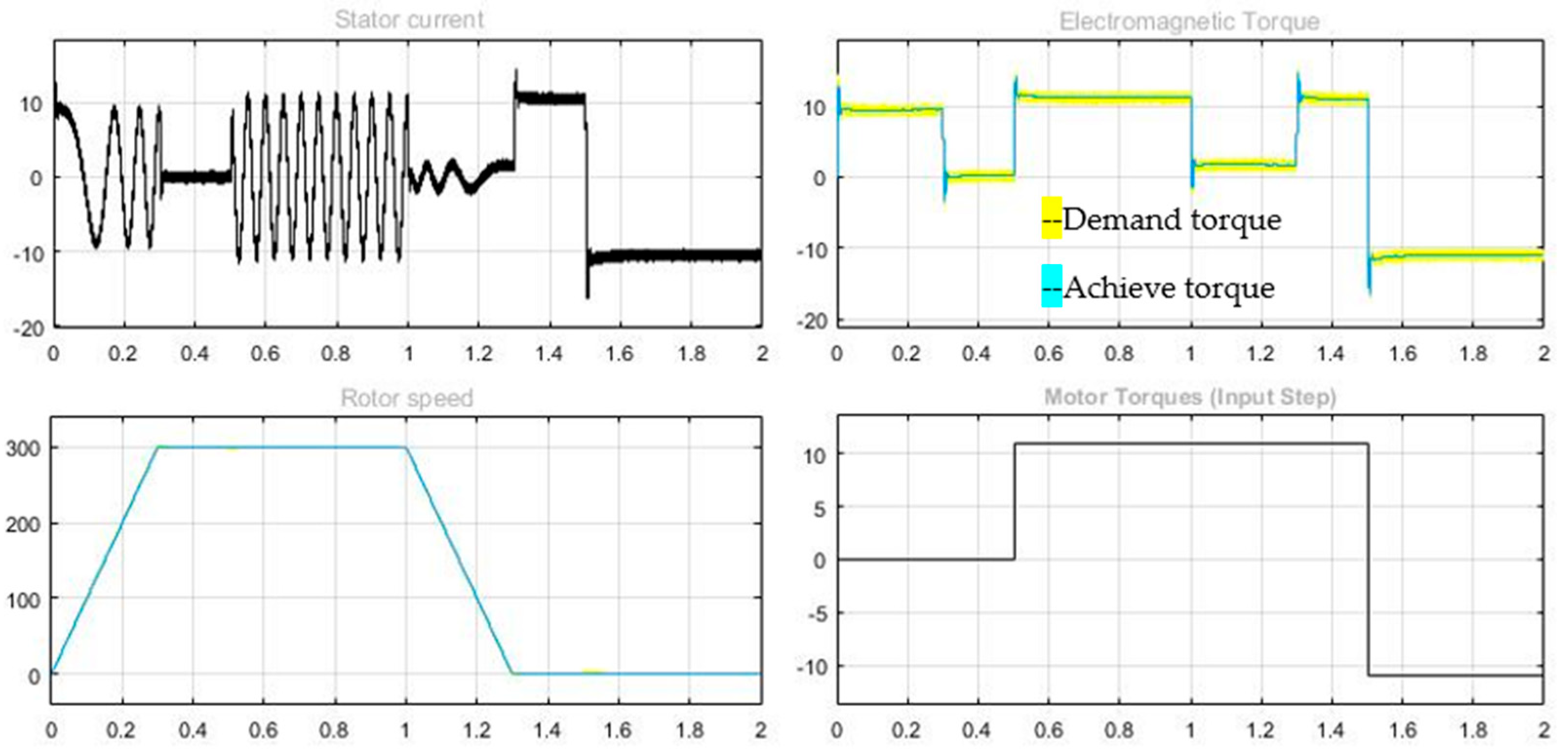
5.1. Case I (Wref = 300 rpm)
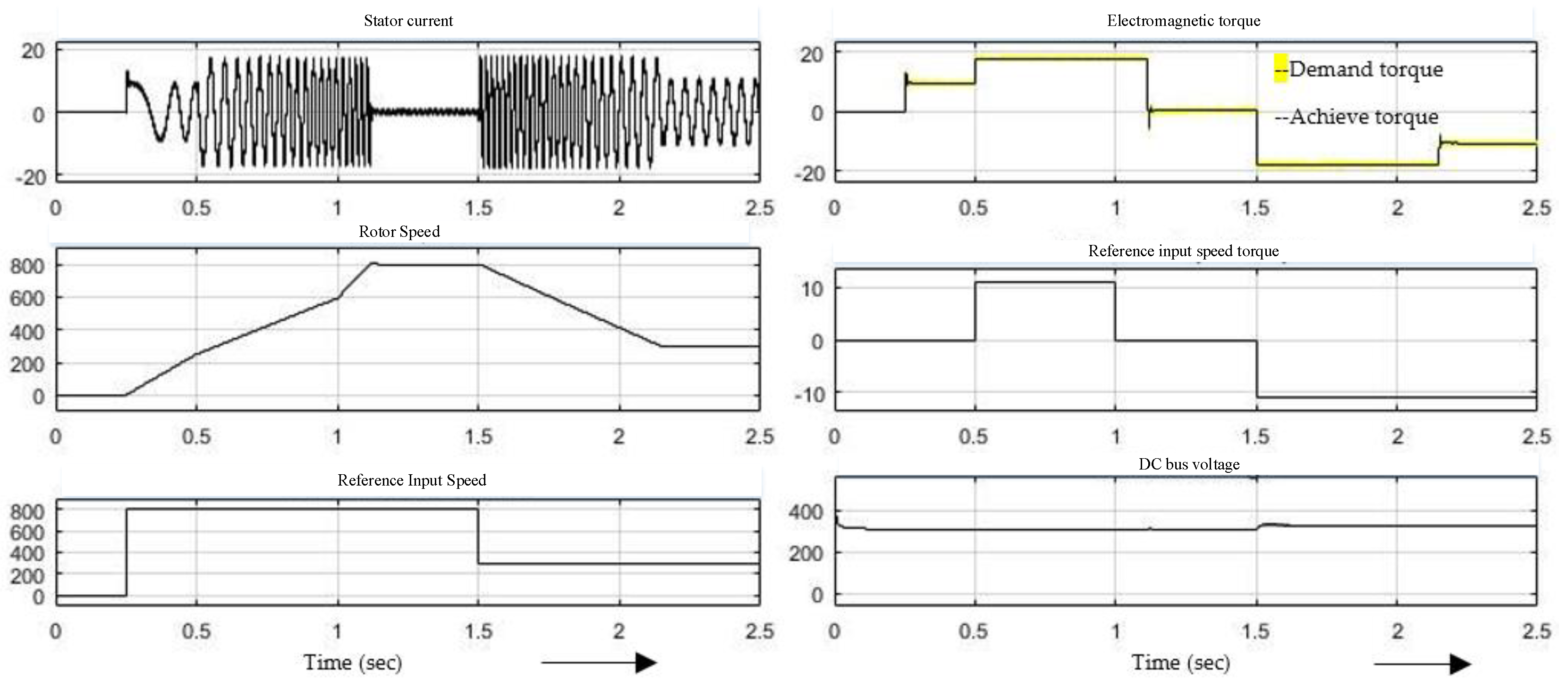
5.2. Case II (Wref = 1000 rpm)
6. MATLAB Simulation for Desired Speed and Torque Response
7. Results and Discussion
Author Contributions
Funding
Institutional Review Board Statement
Informed Consent Statement
Data Availability Statement
Conflicts of Interest
References
- Anand, V.; Singh, V.; Mekhlief, S. Power electronics for renewable energy systems. In Renewable Energy for Sustainable Growth Assessment; John Wiley & Sons, Inc.: Hoboken, NJ, USA, 2022; pp. 81–117. [Google Scholar]
- Yan, G. Simulation for the vector control algorithm of permanent magnet synchronous motor. In Proceedings of the 7th International Conference on Intelligent Human-Machine Systems and Cybernetics, Hangzhou, China, 26–27 August 2015. [Google Scholar]
- Song, K.; Liu, W.; Luo, G. Permanent Magnet Synchronous Motor Field Oriented Control and HIL Simulation. In Proceedings of the IEEE Vehicle Power and Propulsion Conference (VPPC), Harbin, China, 3–5 September 2012. [Google Scholar]
- Akbar, S.; Vaimann, T.; Asad, B.; Kallaste, A.; Sardar, M.U.; Kudelina, K. State-of-the-Art Techniques for Fault Diagnosis in Electrical Machines: Advancements and Future Directions. Energies 2023, 16, 6345. [Google Scholar] [CrossRef]
- Sardar, M.U.; Vaimann, T.; Kütt, L.; Kallaste, A.; Asad, B.; Akbar, S.; Kudelina, K. Inverter-Fed Motor Drive System: A Systematic Analysis of Condition Monitoring and Practical Diagnostic Techniques. Energies 2023, 16, 5628. [Google Scholar] [CrossRef]
- Sun, T.; Lee, S.H.; Hong, J.P. Faults Analysis and Simulation for Interior Permanent Magnet Synchronous Motor Using Simulink MATLAB. In Proceedings of the International Conference on Electrical Machines and Systems, Seoul, Republic of Korea, 8–11 October 2017. [Google Scholar]
- Yaqoob, M.; Sardar, M.U.; Shahid, M.U.; Shahid, T.; Mutloob, T.; Shah, S.I.; Huzaif, M. Supervisor Control of Power System for Stability Problems and Improvements Using Computer Control Technology. In Proceedings of the 2023 International Conference on Emerging Power Technologies (ICEPT), Topi, Pakistan, 6–7 May 2023; pp. 1–6. [Google Scholar] [CrossRef]
- Cui, B.; Zhou, J.; Ren, Z. Modeling and Simulation of Permanent Magnet Synchronous Motor Drives. In Proceedings of the Fifth International Conference on Electrical Machines and Systems (ICEMS 2001), Shenyang, China, 18–20 August 2001. [Google Scholar] [CrossRef]
- Sardar, M.U.; Manfeng, D.; Saleem, U.; Hassan, M.; Nawaz, M.K. State-of-the-Art Design Optimization of an IPM Synchronous Motor for Electric Vehicle Applications. In Proceedings of the 2022 International Conference on Emerging Trends in Electrical, Control, and Telecommunication Engineering (ETECTE), Lahore, Pakistan, 2–4 December 2022. [Google Scholar]
- Sardar, M.U.; Manfeng, D.; Hassan, M.; Saleem, U. Robust Design Optimization of an IPM Synchronous Motor for Electric Vehicle Applications. In Proceedings of the 2023 IEEE International Conference on Emerging Trends in Engineering, Sciences and Technology (ICES&T), Bahawalpur, Pakistan, 9–11 January 2023; pp. 1–6. [Google Scholar] [CrossRef]
- Sardar, M.U.; Manfeng, D.; Saleem, U.; Siddique, S. Design and Numerical Optimization for High-Performance IPM Synchronous Motor Using PSO Search Algorithm. In Proceedings of the 2023 IEEE International Conference on Emerging Trends in Engineering, Sciences and Technology (ICES&T), Bahawalpur, Pakistan, 9–11 January 2023; pp. 1–5. [Google Scholar] [CrossRef]
- Kashif Nawaz, M.; Dou, M.; Riaz, S.; Usman Sardar, M. Current control of permanent magnet synchronous motors using improved model predictive control. Math. Probl. Eng. 2022, 2022, 1736931. [Google Scholar] [CrossRef]
- Hassan, M.M.; Shaikh, M.S.; Jadoon, H.U.; Atif, M.R.; Sardar, M.U. Dynamic modeling and vector control of AC induction traction motor in china railway. Sukkur IBA J. Emerg. Technol. 2020, 3, 115–125. [Google Scholar]
- Xu, Y.; Shi, T.; Yan, Y.; Gu, X. Dual-Vector Predictive Torque Control of Permanent Magnet Synchronous Motors Based on a Candidate Vector Table. Energies 2019, 12, 163. [Google Scholar] [CrossRef]
- Sardar, M.U.; Manfeng, D.; Saleem, U.; Nawaz, M.K.; Hassan, M. A Scholarly Review of Methods for Design Optimization of IPM Synchronous Motors Used in Electric Vehicles. In Proceedings of the 2022 International Conference on Emerging Trends in Electrical, Control, and Telecommunication Engineering (ETECTE), Lahore, Pakistan, 2–4 December 2022. [Google Scholar]


| Quality | Synchronous Motor | Induction Motor |
|---|---|---|
| Speed | Constant and unaffected by load | The speed diminishes as the load rises |
| Torque-voltage characteristic | Direct relationship between torque and input voltage | Direct relationship between torque and input voltage squared |
| Cost | More expensive than IM | Cost-effective motor |
| Sr. No. | Design Procedure | Implementation Plan | Sr. No. | Design Procedure | Implementation Plan |
|---|---|---|---|---|---|
| 1. | Sampling Time |
| 3 | Maximum switching frequency |
|
| 2. | Current controller hysteresis band |
| 4 | The controller measurement vector |
|
Disclaimer/Publisher’s Note: The statements, opinions and data contained in all publications are solely those of the individual author(s) and contributor(s) and not of MDPI and/or the editor(s). MDPI and/or the editor(s) disclaim responsibility for any injury to people or property resulting from any ideas, methods, instructions or products referred to in the content. |
© 2023 by the authors. Licensee MDPI, Basel, Switzerland. This article is an open access article distributed under the terms and conditions of the Creative Commons Attribution (CC BY) license (https://creativecommons.org/licenses/by/4.0/).
Share and Cite
Sardar, M.U.; Yaqoob, M.; Akbar, S.; Shah, S.I.A.; Shahid, M.U.; Mutloob, T. Permanent Magnet Synchronous Machine Control Performance and Analysis for Environment-Friendly Electric Vehicle Applications. Eng. Proc. 2023, 46, 7. https://doi.org/10.3390/engproc2023046007
Sardar MU, Yaqoob M, Akbar S, Shah SIA, Shahid MU, Mutloob T. Permanent Magnet Synchronous Machine Control Performance and Analysis for Environment-Friendly Electric Vehicle Applications. Engineering Proceedings. 2023; 46(1):7. https://doi.org/10.3390/engproc2023046007
Chicago/Turabian StyleSardar, Muhammad Usman, Muhammad Yaqoob, Siddique Akbar, Syed Imran Ahmad Shah, Muhammad Usama Shahid, and Tayyaba Mutloob. 2023. "Permanent Magnet Synchronous Machine Control Performance and Analysis for Environment-Friendly Electric Vehicle Applications" Engineering Proceedings 46, no. 1: 7. https://doi.org/10.3390/engproc2023046007
APA StyleSardar, M. U., Yaqoob, M., Akbar, S., Shah, S. I. A., Shahid, M. U., & Mutloob, T. (2023). Permanent Magnet Synchronous Machine Control Performance and Analysis for Environment-Friendly Electric Vehicle Applications. Engineering Proceedings, 46(1), 7. https://doi.org/10.3390/engproc2023046007