You are currently viewing a new version of our website. To view the old version click .
Engineering Proceedings
  • Proceeding Paper
  • Open Access

14 November 2020

Promoting Autonomy in Care: Combining Sensor Technology and Social Robotics for Health Monitoring †

and
Cologne Cobots Lab, TH Köln—University of Applied Sciences, 50679 Cologne, Germany
*
Authors to whom correspondence should be addressed.
Presented at the 7th Electronic Conference on Sensors and Applications, 15–30 November 2020; Available online: https://ecsa-7.sciforum.net/.
This article belongs to the Proceedings 7th International Electronic Conference on Sensors and Applications

Abstract

As the world’s population grows significantly older, there are not enough caregivers in many countries for all the elderly people in need of care. To promote their autonomy while also supporting their caregivers, we propose a health monitoring system comprised of a social robot, and various wearable and non-wearable sensors. Through the use of patient-reported outcome measures (PROMs), captured in conversation with the social robot, the subjective health status of the user is determined. This is supplemented by objective information gathered from wearable and non-wearable sensors used to measure numerous biosignals. By combining the subjective data obtained from interaction with the user and the objective data from the sensor network, a health report for both users and caregivers is generated. The data are visualized for the user and caregiver in a customizable and easily accessible health monitoring dashboard, which also warns the user and their caregivers when the data deviate from the expected values or ranges. The goal is to use this information to improve the quality of care, as changes in the user’s health status can be determined more quickly by themselves and their caregivers. The proposed system establishes a good base for further testing and optimization together with the user, to ensure a useful and appropriate combination of sensors and technological devices that the user is comfortable with.

2. Sensor-Robot Ecosystem

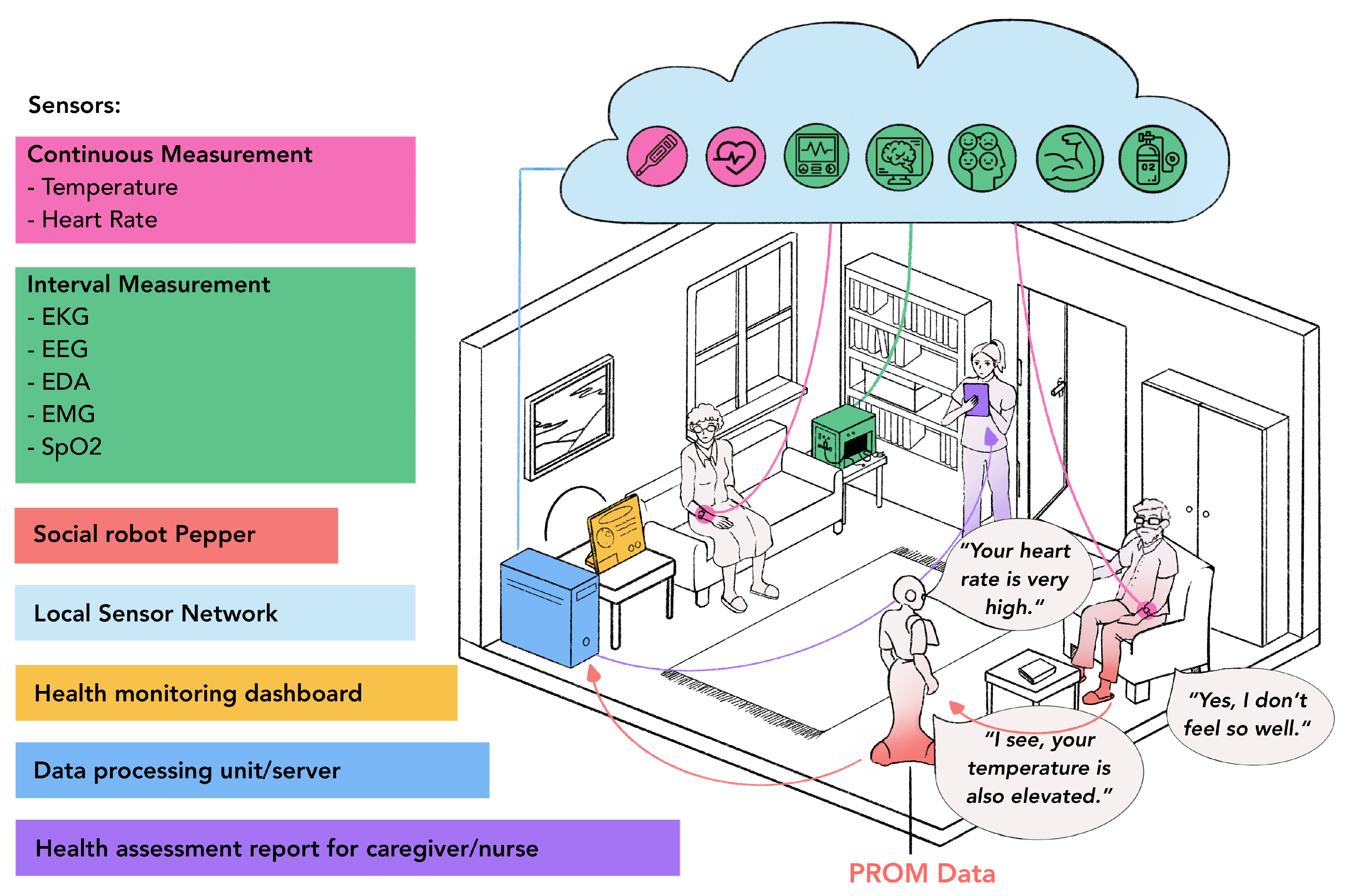
In order to find an optimal sensor–robot ecosystem for the users, a complex system of hard- and software components is required. The proposed system is comprised of various health care sensors, a social robot, a data processing unit and a visualization dashboard–user interface, as shown in Figure 1. The elderly person or people at home are outfitted with wrist-worn wearable devices (pink) that incorporate sensors capable of continuous measurements of objective health-related data, such as skin temperature and heart rate. Additional information is acquired in interval measurements, when needed, with stationary sensors (green). These include an EKG sensor to determine heart health, an electroencephalogram (EEG) sensor to measure brain activity, an EDA sensor for emotional responses, an electromyography (EMG) sensor for muscle activity, and an SpO2 sensor. Through conversation with the social robot (red) and the use of PROMs, the subjective well-being of the elderly person is determined. When sensor data are acquired that deviate from the expected values, a suitable PROMs questionnaire is chosen and the social robot approaches the user to explore the questions in a conversation. Likewise, when PROMs answers are given that indicate a negative change in the user’s health state, the sensor data are used to determine if there are correlations. If the data are highly alarming, the user and/or the caregiver/nurse/doctor are immediately notified. This acquired objective and subjective data are collected and processed in the data processing unit (blue) and then used to generate a health assessment report (purple) for the user and caregiver/nurse. Additionally, they are visualized in the health monitoring dashboard (yellow). The specific components are described in the following.
Figure 1. The proposed ecosystem consists of various health care sensors for continuous (pink) and interval (green) measurements in a local sensor network (light blue), a social robot (red), a health monitoring dashboard (yellow), a data processing unit (blue), and a health assessment report (purple).

2.1. Hardware Components

The robot used in our ecosystem is the social robot Pepper (SoftBank Robotics, Tokyo, Japan). For the continuous sensor measurements and data transfer, we use the WiFi- and Bluetooth-enabled ESP32 microcontroller (Espressif Systems, Shanghai, China). The MAX30102 is used to determine the heart rate through an optical measurement of the pulse wave, and the MAX30205 is used to measure the skin temperature (both sensors: Maxim Integrated, San Jose, CA, USA). To record an EKG, the MAX86150 (Maxim Integrated, San Jose, CA, USA) development board by Protocentral (Bangalore, India) is used, as it allows a measurement with dry electrodes using the index fingertips of each hand, while simultaneously recording a photoplethysmogram (PPG) used to determine the SpO2 levels. For periodical measurements, i.e., EEG, EDA, and EMG, the BITalino (r)evolution Plugged Kit BLE/BT (PLUX Wireless Biosignals, Lisbon, Portugal) is used. For the visualization using the health monitoring dashboard, any internet-enabled device with a browser can be used. To facilitate the user interaction with the dashboard, a large touch screen device is recommended. Finally, to process and store the acquired data, a computer or server connected to the local WiFi network is required.

2.2. Software Components

In order to facilitate the conversation between Pepper and the user and to be ready for a variety of answers to the PROMs questions, we use Google’s natural language understanding platform Dialogflow (Google, Palo Alto, CA, USA). To control Pepper, we use the NAOqi software development kit (SDK) provided by SoftBank and the robot operating system (ROS). As an on-premise IoT platform and visualization dashboard, we use the ThingsBoard Community Edition (Thingsboard, New York, NY, USA) connected to an SQL database for storing the acquired sensor data. An example for the visualization using the health monitoring dashboard is given in Section 3. For the communication between the sensors and ThingsBoard, a local WiFi network is used. Depending on the preferences of the user, an online network is only required to send the health assessment report to the caregiver or nurse.

3. Results and Discussion

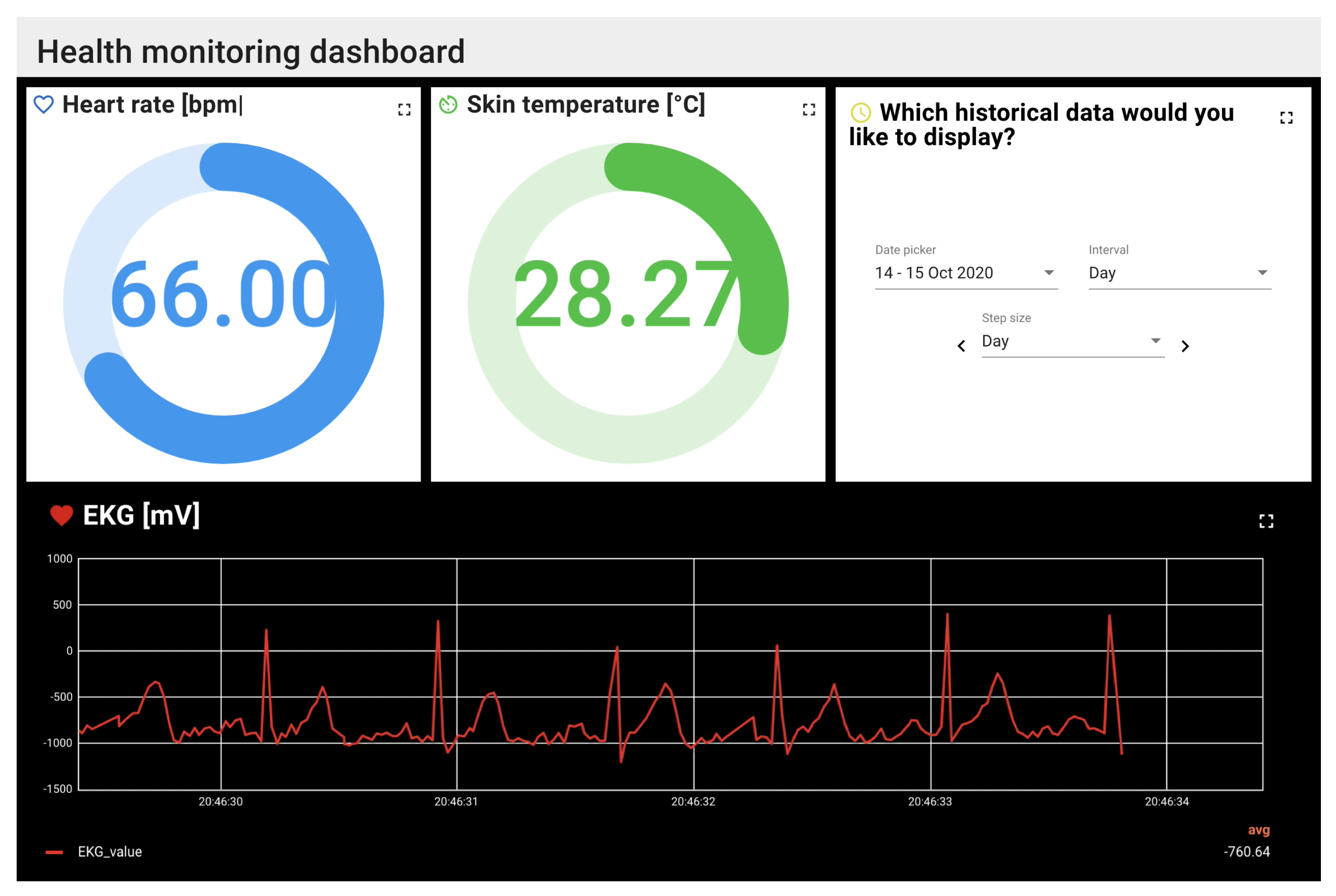
An example of the health monitoring dashboard, generated using ThingsBoard, is shown in Figure 2. It can be accessed through any browser in the same network, using the IP address and specified port of the host. The heart rate (top left) was measured using an optical measurement on the wrist. The skin temperature (top middle) was also measured by skin contact on the wrist. While this type of sensor and application can not be used to measure the core body temperature, it is nevertheless useful in determining fluctuations in skin temperature and deviations from the normal temperature values of the user, once a baseline has been established. The EKG (bottom) is shown in real time and can also be used to measure the heart rate or the heart rate variability to determine the heart health of the user. Additionally, the obtained EKG can be sent to the nurse or doctor of the user. It is also possible to visualize historical data using the dashboard, the desired interval can be specified using the top right widget. To visualize the data of other sensors, additional widgets can be created and customized based on user preferences.
Figure 2. An example of the health monitoring dashboard is shown, including heart rate (beats per minute), skin temperature ( C), and an EKG measurement. Historical data can also be chosen for visualization.
This work highlights the technical viewpoint of the proposed architecture for a sensor–robot ecosystem for the health monitoring of elderly people at home. However, it also provides a basis for integrating the interdisciplinary sociotechnical perspective by investigating the following research questions during the further development of the system together with the users:
  • Which are the most important PROMs and sensors to detect specific health and care situations? How large are the differences between individual users?
  • (How) can we combine PROMs and different sensors to increase the quality of care of elderly users in their homes?
  • In which way, if at all, does this combination reduce the burden of care of both the elderly users and their caregivers (both trained and untrained)?
  • To which degree can these results be transferred to other age groups and care situations (e.g., nursing homes)?

4. Conclusions and Future Work

As mentioned in Section 1, the biggest concerns regarding the use of assistive technologies in the care sector are privacy, trust, and the added value of such technologies. By including the user in the development of our ecosystem and thus answering the above mentioned research questions, we can address and alleviate these concerns. Additionally, through the use of a social robot, the user’s permission to store their data and/or send them to others in the health assessment report can also be periodically updated or revoked, if desired.
In the future, we will integrate more sensors into the ecosystem, such as sensors for fall detection, activity monitoring, emotion recognition, and on-wrist blood pressure measurement through the use of PPG and EKG, as explained in [17]. It is also important to test the robustness of the system through long-term measurements in realistic settings, in order to determine the effects of activities and situations not anticipated in the lab setting. In this context, we will also investigate how well the system works when only the users interact with it and deduce how to optimally reduce required maintenance to ensure long-term user satisfaction.

Author Contributions

Conceptualization, C.N. and A.R.; methodology, C.N. and A.R.; software, C.N.; validation, C.N.; formal analysis, C.N.; investigation, C.N.; resources, A.R.; data curation, C.N.; writing—original draft preparation, C.N.; writing—review and editing, C.N. and A.R.; visualization, C.N.; supervision, A.R.; project administration, A.R.; funding acquisition, A.R. All authors have read and agreed to the published version of the manuscript.

Funding

This research received no external funding.

Acknowledgments

The authors would like to thank Caroline Dick for her valuable help in visualizing the concept of the system.

Conflicts of Interest

The authors declare no conflict of interest.

References

  1. Bundesministerium für Gesundheit (Federal Ministry of Health). Zahlen und Fakten zur Pflegeversicherung; Technical Report; Federal Ministry of Health (Germany): Bonn, Germany, 2020. [Google Scholar]
  2. Flake, R.; Kochskämper, S.; Risius, P.; Seyda, S. Fachkräfteengpass in der Altenpflege; Technical Report; German Economic Institute (IW): Cologne, Germany, 2018. [Google Scholar]
  3. Statistisches Bundesamt (Destatis). Mehr Pflegebedürftige; Technical Report; Federal Statistical Office (Germany): Wiesbaden, Germany, 2018. [Google Scholar]
  4. Majumder, S.; Mondal, T.; Deen, M.J. Wearable Sensors for Remote Health Monitoring. Sensors 2017, 17, 130. [Google Scholar] [CrossRef] [PubMed]
  5. Saner, H. Wearable Sensors for Assisted Living in Elderly People. Front. ICT 2018, 5, 1. [Google Scholar] [CrossRef]
  6. Donati, M.; Celli, A.; Ruiu, A.; Saponara, S.; Fanucci, L. A Telemedicine Service System Exploiting BT/BLE Wireless Sensors for Remote Management of Chronic Patients. Technologies 2019, 7, 13. [Google Scholar] [CrossRef]
  7. Serhani, M.A.; El Kassabi, H.T.; Ismail, H.; Nujum Navaz, A. ECG Monitoring Systems: Review, Architecture, Processes, and Key Challenges. Sensors 2020, 20, 1796. [Google Scholar] [CrossRef] [PubMed]
  8. Marques, G.; Pitarma, R.; Garcia, N.M.; Pombo, N. Internet of Things Architectures, Technologies, Applications, Challenges, and Future Directions for Enhanced Living Environments and Healthcare Systems: A Review. Electronics 2019, 8, 1081. [Google Scholar] [CrossRef]
  9. Coşar, S.; Fernandez-Carmona, M.; Agrigoroaie, R.; Pages, J.; Ferland, F.; Zhao, F.; Yue, S.; Bellotto, N.; Tapus, A. ENRICHME: Perception and Interaction of an Assistive Robot for the Elderly at Home. Int. J. Soc. Robot. 2020, 12, 779–805. [Google Scholar] [CrossRef]
  10. Loza-Matovelle, D.; Verdugo, A.; Zalama, E.; Gómez-García-Bermejo, J. An Architecture for the Integration of Robots and Sensors for the Care of the Elderly in an Ambient Assisted Living Environment. Robotics 2019, 8, 76. [Google Scholar] [CrossRef]
  11. Do, H.M.; Pham, M.; Sheng, W.; Yang, D.; Liu, M. RiSH: A Robot-Integrated Smart Home for Elderly Care. Robot. Auton. Syst. 2018, 101, 74–92. [Google Scholar] [CrossRef]
  12. Casaccia, S.; Revel, G.M.; Scalise, L.; Bevilacqua, R.; Rossi, L.; Paauwe, R.A.; Karkowsky, I.; Ercoli, I.; Artur Serrano, J.; Suijkerbuijk, S.; et al. Social Robot and Sensor Network in Support of Activity of Daily Living for People with Dementia. In Dementia Lab 2019. Making Design Work: Engaging with Dementia in Context; Brankaert, R., IJsselsteijn, W., Eds.; Communications in Computer and Information Science; Springer International Publishing: Cham, Switzerland, 2019; pp. 128–135. [Google Scholar] [CrossRef]
  13. Collins, S.; Ŝabanović, S.; Fraune, M.; Randall, N.; Eldridge, L.; Piatt, J.A.; Bennett, C.C.; Nagata, S. Sensing Companions: Potential Clinical Uses of Robot Sensor Data for Home Care of Older Adults with Depression. In Companion of the 2018 ACM/IEEE International Conference on Human-Robot Interaction (HRI ’18); Association for Computing Machinery: Chicago, IL, USA, 2018; pp. 89–90. [Google Scholar] [CrossRef]
  14. Boumans, R.; van Meulen, F.; Hindriks, K.; Neerincx, M.; Olde Rikkert, M. A Feasibility Study of a Social Robot Collecting Patient Reported Outcome Measurements from Older Adults. Int. J. Soc. Robot. 2020, 12, 259–266. [Google Scholar] [CrossRef]
  15. Yusif, S.; Soar, J.; Hafeez-Baig, A. Older People, Assistive Technologies, and the Barriers to Adoption: A Systematic Review. Int. J. Med. Inform. 2016, 94, 112–116. [Google Scholar] [CrossRef] [PubMed]
  16. Richert, A.; Schiffmann, M.; Yuan, C. A Nursing Robot for Social Interactions and Health Assessment. In Advances in Human Factors in Robots and Unmanned Systems; Chen, J., Ed.; Advances in Intelligent Systems and Computing; Springer International Publishing: Cham, Switzerland, 2020; pp. 83–91. [Google Scholar] [CrossRef]
  17. Ding, X.; Zhang, Y.T. Pulse Transit Time Technique for Cuffless Unobtrusive Blood Pressure Measurement: From Theory to Algorithm. Biomed. Eng. Lett. 2019, 9, 37–52. [Google Scholar] [CrossRef] [PubMed]
Publisher’s Note: MDPI stays neutral with regard to jurisdictional claims in published maps and institutional affiliations.

Article Metrics

Citations

Article Access Statistics

Multiple requests from the same IP address are counted as one view.