1. Overview and Motivation
Sustainability assessment (SA) is a method to support decision making processes through the evaluation of system effectiveness, environmental integrity, economic valuation, and social implications [1]. SA can be carried out through the application of life-cycle-based techniques for quantitative assessment, or by performing a mainly qualitative approach via sustainability rating systems (SRS).
In the field of civil engineering, many SRS have been proposed, all based on assigning point values to actions that are determined to contribute to the overall sustainability of the project. However, only few of these systems can be applied specifically to compare road pavement technologies and/or maintenance and rehabilitation strategies. This study focuses on adapting two of these tools: GreenPave [2], developed in the US, and BE2ST (Building Environmentally and Economically Sustainable Transportation–Infrastructure–Highways) [3], developed in Canada. The investigation consisted of evaluating the feasibility of increasing the amount of reclaimed asphalt (RA) in European wearing courses by carrying out a comparative analysis of eight different mixtures, containing up to 90% of RA.
2. Methodology, Results and Main Contribution
As anticipated above, the SA was performed using two SRS: GreenPave and BE2ST. Both tools allow us to carry out an SA exercise by assigning a label to each compared alternative, from Gold to Bronze according to the final rating; however, GreenPave limits the assessment to the asphalt mixtures technology development phase, while BE2ST allows us to also compare road pavement maintenance strategies. Even if there are some similarities, the scores are assigned with different criteria. In fact, if GreenPave groups the sustainability goals into four categories (Pavement technologies, Material and Resources, Energy and Atmosphere, Innovation and Design Process), BE2ST judges the performance, evaluating the Life Cycle Assessment [4,5] for environmental aspects, the Life Cycle Cost Analysis for economic impacts [6], the traffic noise, the social costs, the social carbon costs and the recycling ratio. Furthermore, BE2ST expresses the results as a percentage of the baseline: the label depends on the term of comparison.
In order to apply the former tool to the EU context, ECORCE M [7] was used instead of PALATE for calculating environmental indicators, while the Social Carbon Cost was assessed by considering the European average annual salary.
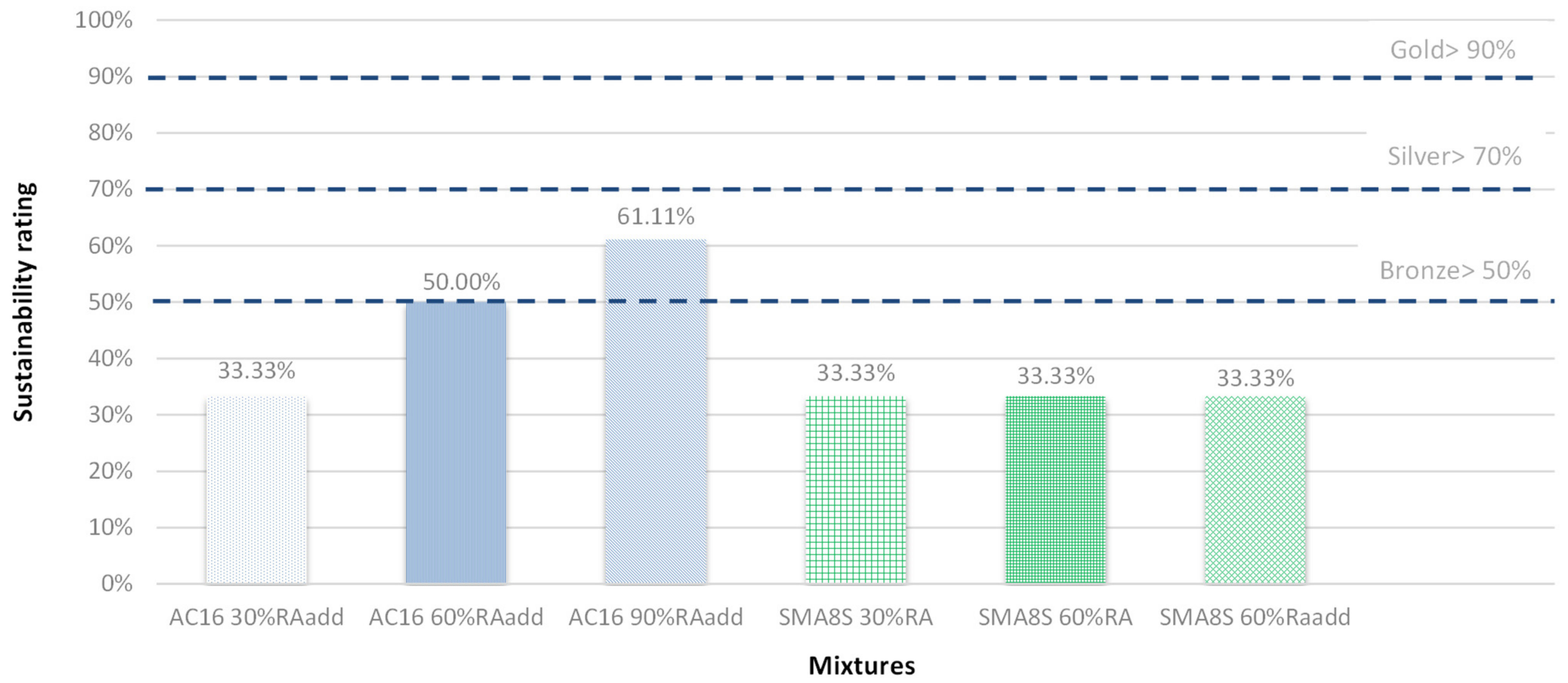
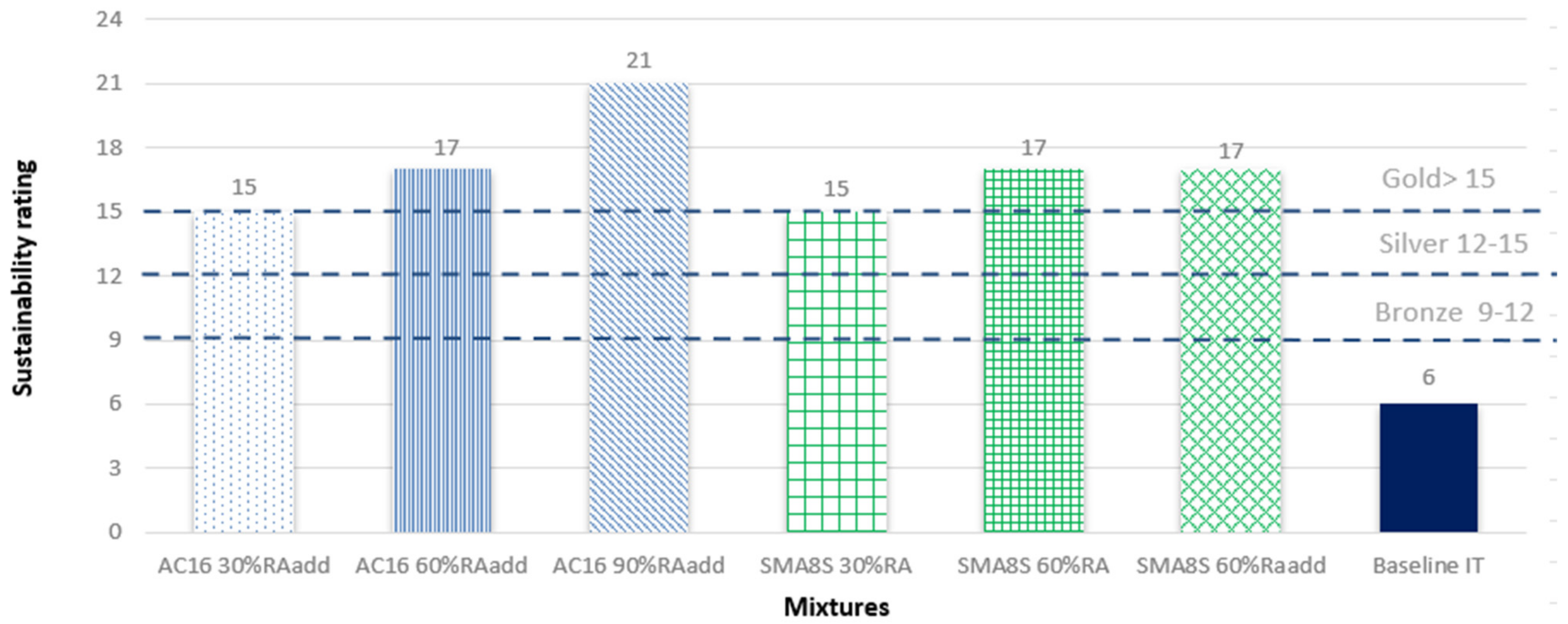
At first, the study provides limits and benefits of the EU-adapted SRS; then, a validation of the tools was performed by carrying out a SA of three case studies. As a result, both SRSs provide similar trends of scores when compared with hot asphalt mixtures for wearing courses with no recycled materials; however, GreenPave labels all the RA technologies as Gold or Silver, unlike conventional asphalts, which never meet the requirements for sustainability (Figure 1). On the other side, with BE2ST, almost all the new mixtures achieve a label (Figure 2).
Figure 1.
Results of the south EU case study calculated with EU-adapted GreenPave system.
Figure 2.
Results of the south EU case study calculated with EU-adapted BE2ST system.
3. Conclusions and Future Works
In conclusion, it can be stated that, regardless of the SRS tools, maximizing the quantity of RA in hot mix asphalt for wearing courses, while guaranteeing the same level of durability, seems to be a more sustainable solution than not recycling at all. This is true for both a single intervention and by considering a 60-year maintenance strategy.
Author Contributions
Conceptualization, G.B. and D.L.P.; methodology, G.B. and D.L.P.; software, D.L.P.; validation, G.B. and D.L.P.; formal analysis, G.B. and D.L.P.; investigation, G.B. and D.L.P.; resources, D.L.P.; data curation, G.B. and D.L.P.; writing—original draft preparation, G.B., D.L.P.; writing—review and editing, G.B., D.L.P.; visualization, D.L.P., G.G., P.H.O., S.M., C.M. and U.G.; supervision, D.L.P., G.G., P.H.O., S.M., C.M. and U.G.; project administration, D.L.P.; funding acquisition, D.L.P. All authors have read and agreed to the published version of the manuscript.
Funding
This research was carried out within the project “AllBack2Pave: Toward a sustainable 100% recycling of reclaimed asphalt in road pavements”, funded by the Conference of Directors of Roads (CEDR) for the Call 2012 “Recycling- Road construction in a post-fossil fuel society”.
Institutional Review Board Statement
Not applicable.
Informed Consent Statement
Not applicable.
Data Availability Statement
The results of this project are freely published within the website of the CEDR Transnational Road research Programme Call 2012 “Recycling”CEDR https://www.cedr.eu/call-2012-recycling-road-construction-post-fossil-fuel-society.
Acknowledgments
The research presented in this report was carried out as part of the CEDR Transnational Road research Programme Call 2012 “Recycling”. The funding for the research is provided by the national road administrations of Denmark, Finland, Germany, Ireland, Netherlands and Norway.
Conflicts of Interest
The authors declare no conflict of interest. The funders had no role in the design of the study; in the collection, analyses, or interpretation of data; in the writing of the manuscript, or in the decision to publish the results.
References
- Eisenman, A.A. Sustainable Streets and Highways: An Analysis of Green Roads Rating Systems. Master’s Thesis, Georgia Institute of Technology, Atlanta, GA, USA, 2012. [Google Scholar]
- Lane, B.; Lee, S.; Bennett, B.; Chan, S. GreenPave Reference Guide: Version 2.0; Ontario Ministry of Transportation’s Materials Engineering and Research Office: Toronto, AN, Canada, 2014. [Google Scholar]
- Lee, J.C.; Edil, T.B.; Benson, C.H.; Tinjum, J.M. Evaluation of Variables Affecting Sustainable Highway Design with BE2ST-in-Highways. Transp. Res. Rec. J. Transp. Res. Board Natl. Acad. 2013, 2233, 178–186. [Google Scholar] [CrossRef]
- ISO 14040:2006. Environmental Management—Life Cycle Assessment—Principles and Framework. International Organization for Standardization (ISO): Geneva, Switzerland, 2006.
- ISO 14044:2006. Environmental Management—Life Cycle Assessment—Requirements and Guidelines. International Organization for Standardization (ISO): Geneva, Switzerland, 2006.
- FHWA. Life-Cycle Cost Analysis in Pavement Design—In Search of Better Investment Decisions; Federal Highway Administration (FHWA): Washington, DC, USA, 1998. [Google Scholar]
- Dauvergne, M.; Jullien, A.; Proust, C.; Tamagny, P.; Ventura, A.; Coelho, C.; Naullet, M.; Prual, J.M.; Fesser, A.; Tremblayt, M.; et al. ECORCE M User’s Manual; French Institute of Science and Technology for Transport Development and Networks (IFSTTAR): Nantes, France, 2014. [Google Scholar]
Publisher’s Note: MDPI stays neutral with regard to jurisdictional claims in published maps and institutional affiliations. |
© 2022 by the authors. Licensee MDPI, Basel, Switzerland. This article is an open access article distributed under the terms and conditions of the Creative Commons Attribution (CC BY) license (https://creativecommons.org/licenses/by/4.0/).