Proceeding Paper

Photocatalytic Degradation of Brilliant Blue FCF Dye Using Biosynthesized ZnO Nanoparticles †

1
Department of Chemistry, Integral University, Lucknow 226026, India
2
Department of Chemistry, Isabella Thoburn College, Lucknow 226007, India
*
Author to whom correspondence should be addressed.
Presented at the 6th International Electronic Conference on Applied Sciences, 9–11 December 2025; Available online: https://sciforum.net/event/ASEC2025.
Eng. Proc. 2026, 124(1), 23; https://doi.org/10.3390/engproc2026124023

Published: 9 February 2026
(This article belongs to the Proceedings of The 6th International Electronic Conference on Applied Sciences)

Abstract

In recent years, photocatalysis based on metal oxides has gained significant attention as an effective and environmentally sustainable strategy for the degradation of dye pollutants under mild operating conditions. Among the various metal oxide photocatalysts, zinc oxide (ZnO) is particularly attractive due to its appropriate band gap, excellent chemical stability, low cost, and capability to operate under visible light. In this work, ZnO nanoparticles (NPs) were green-synthesized using Livistona chinensis leaf extract and subsequently assessed for their photocatalytic performance in the degradation of the synthetic dye Brilliant Blue FCF. The synthesized ZnO NPs achieved approximately 76% dye removal within 90 min of visible light irradiation. These findings demonstrate the potential of ZnO NPs as an efficient, economical, and eco-friendly visible-light-driven photocatalyst, supporting their application in sustainable wastewater remediation.

1. Introduction

Brilliant Blue FCF (E133) is a synthetic anionic dye extensively employed in textile dyeing, food processing, pharmaceuticals, cosmetics, and paper industries due to its high coloring strength and chemical stability. However, its widespread use has led to serious environmental concerns, as Brilliant Blue FCF is highly stable, toxic, and resistant to biodegradation, allowing it to persist in aquatic environments for extended periods [1]. The discharge of dye-contaminated wastewater not only causes severe aesthetic pollution but also reduces light penetration in water bodies, thereby disrupting photosynthetic activity and aquatic ecosystems. Moreover, exposure to synthetic dyes has been associated with adverse health effects, including allergic reactions, mutagenicity, and potential carcinogenicity, making their effective removal from wastewater a critical environmental challenge [2].
Among the available treatment methods, photocatalytic degradation has emerged as an efficient and sustainable approach for the removal of organic pollutants, such as Brilliant Blue, under mild environmental conditions. Unlike conventional methods, including adsorption, coagulation, and chemical oxidation, photocatalysis enables the complete mineralization of organic dyes into environmentally benign products (CO2 and H2O) through the generation of reactive oxygen species under light irradiation [3]. Semiconductor-based photocatalysts have attracted increasing attention due to their ability to utilize solar or visible light, thereby offering an energy-efficient and environmentally friendly solution for wastewater treatment. In this regard, ZnO NPs have been extensively studied because of their favorable chemical, optical, and electronic properties. ZnO, a wide-band-gap semiconductor with high exciton binding energy, excellent chemical stability, non-toxicity, and low cost, represents a promising alternative to conventional photocatalysts such as TiO2 [4]. As nanocrystalline metal oxides with a high surface-to-volume ratio, ZnO NPs provide a large number of active sites, facilitating enhanced adsorption of dye molecules and efficient generation of electron–hole pairs under light irradiation. Consequently, ZnO NPs have been widely explored for diverse applications, including photocatalysis, biosensing, solar energy conversion, antimicrobial coatings, and biomedical uses [5,6]. Further, ZnO can be functionalized with other organic ligands such as Schiff base to enhance its photocatalytic and biological activities [7,8]. Despite their advantages, many conventional physical and chemical synthesis methods for ZnO NPs, such as sol–gel, hydrothermal, and chemical precipitation techniques, often involve high energy consumption, expensive precursors, and hazardous chemicals, raising concerns regarding cost, scalability, and environmental sustainability [9]. These limitations have encouraged a shift toward greener and more sustainable nanoparticle synthesis routes. In this context, plant-mediated or phytosynthesis approaches have emerged as eco-friendly alternatives that utilize naturally occurring phytochemicals such as flavonoids, phenolics, alkaloids, and terpenoids as reducing, stabilizing, and capping agents [10]. Plant-based synthesis offers several advantages, including simplicity, low cost, reduced energy requirements, and the elimination of toxic reagents, making it an environmentally responsible and scalable approach [11]. Furthermore, biosynthesized ZnO NPs often exhibit enhanced photocatalytic performance due to surface functionalization by plant-derived biomolecules, which can improve charge separation, inhibit electron–hole recombination, and increase visible-light responsiveness [12]. Livistona chinensis species have various secondary metabolites that act as capping and reducing agents [13]. These characteristics make green-synthesized ZnO NPs particularly attractive for sustainable wastewater treatment applications, including the efficient degradation of recalcitrant dyes such as Brilliant Blue FCF under visible or solar light irradiation. In a recent study, Yang et al. reported a facet-engineered S-scheme ZnO/Zn3In2S6 (ZnO/ZIS) heterostructure exhibiting enhanced photocatalytic activity toward organic contaminants under UV–visible light irradiation. The ZnO/ZIS photocatalyst achieved a BPA degradation efficiency of approximately 91%, which was significantly higher than that of bare ZnO (25%) and Zn3In2S6 (66%) [14]. Some of the green-synthesized ZnO NPs and their photocatalytic activity are given in Table 1.

2. Materials and Methods

ZnO NPs were synthesized via a green route using Livistona chinensis leaf extract and subsequently evaluated for their photocatalytic performance in the degradation of synthetic dyes under visible light irradiation. The photocatalytic activity of the nanoparticles was investigated using Brilliant Blue FCF, a triarylmethane dye, as the model pollutant. Changes in dye concentration were monitored using a UV–Visible spectrophotometer (Agilent Cary UV–Vis Compact Peltier, Santa Clara, CA, USA, 200–800 nm). Visible light irradiation was provided by a Philips light-emitting diode (LED) lamp (Philips Lighting, Eindhoven, New Zealand) (22 W, 220–240 V AC, 50 Hz, 90 lm W−1). The study was conducted at room temperature under neutral conditions (pH 7), with the light source positioned 30 cm from the sample.

3. Experimental Section

3.1. Synthesis of ZnO NPs

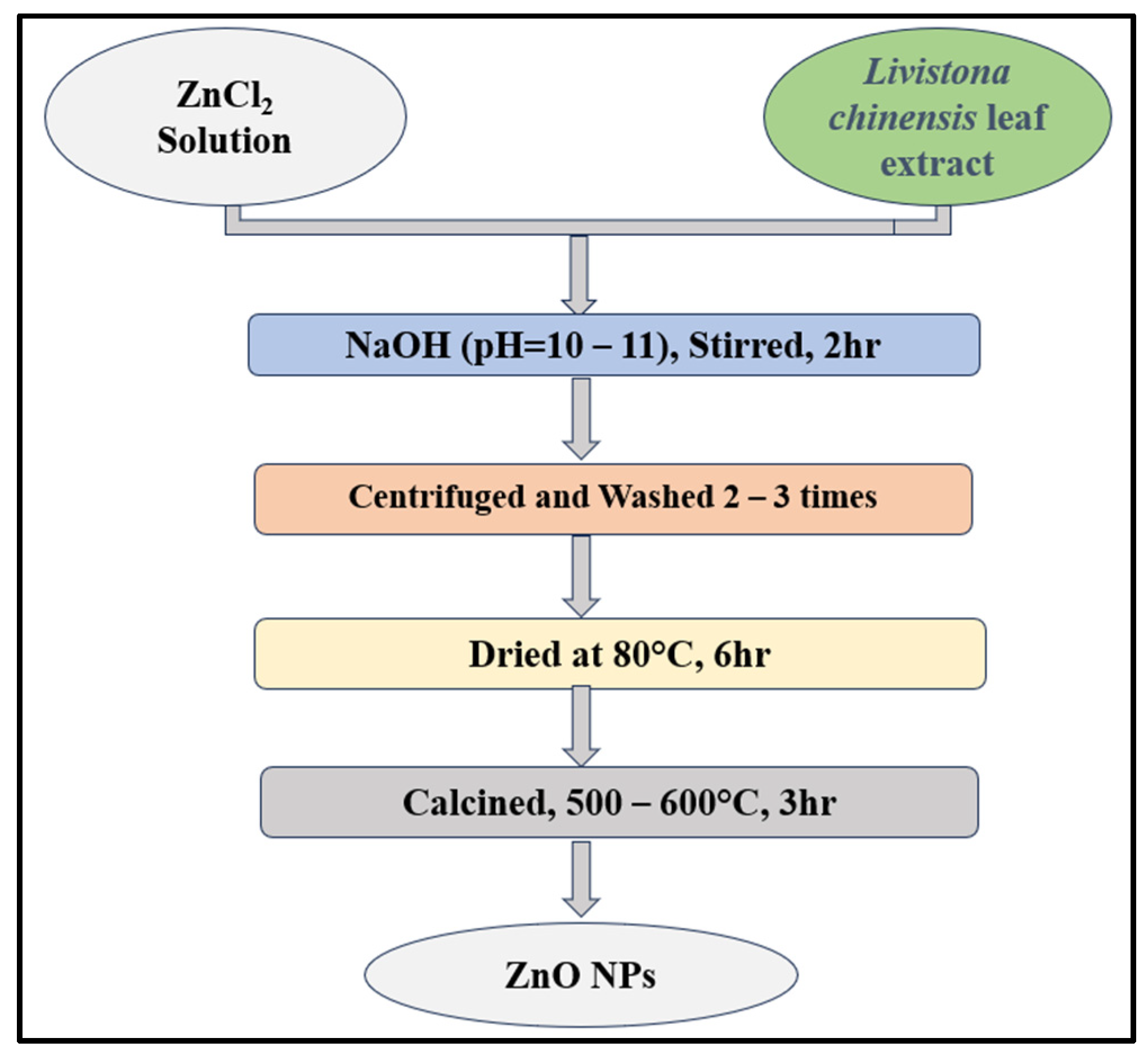
Livistona chinensis leaf extract was employed as an eco-friendly reducing and stabilizing agent for the synthesis of ZnO NPs. Briefly, 50 mL of a 0.01 M zinc chloride solution was heated to 60 °C, followed by the dropwise addition of 10 mL of the plant extract under continuous stirring. The pH of the reaction mixture was adjusted to 10–11 using NaOH, and the temperature was maintained at 80 °C for 2 h. The resulting white precipitate was thoroughly washed and dried at 80 °C for 6 h. Finally, the dried product was calcined at 500–600 °C for 3 h to obtain ZnO NPs, as reported in our earlier study [20]. The schematic representation of the formation of ZnO NPs is given in Figure 1.

3.2. Photocatalytic Activity Evaluation

The activity of ZnO NPs was tested for Brilliant Blue FCF (10 mg/L) under visible light. 50 mg ZnO NPs were added to 50 mL dye solution, stirred in the dark for 30 min, and then irradiated for 90 min. Samples were collected at 15 min intervals, centrifuged, and analyzed spectrophotometrically to determine degradation efficiency using a UV–visible spectrophotometer (200 nm to 800 nm).

4. Results and Discussion

4.1. Characterization

The synthesized ZnO NPs were examined using various spectroscopic and analytical techniques. UV–visible spectroscopy revealed a distinct absorption peak at 377 nm, indicative of ZnO NP formation. The presence of Zn–O bonding was further verified by a characteristic FT-IR vibration observed at 513 cm−1. X-ray diffraction analysis confirmed the crystalline nature of the material, with an average crystallite size of approximately 25 nm. Scanning electron microscopy showed predominantly non-spherical, triangular-like nanoparticle morphologies, consistent with observations reported in our previous study. The structural and morphological characteristics of the ZnO nanoparticles have been extensively reported in our earlier publication. The present study employed the same batch of ZnO NPs; therefore, only minimal characterization details are provided here, as the data are fully consistent with [20].

4.2. Photocatalytic Potential

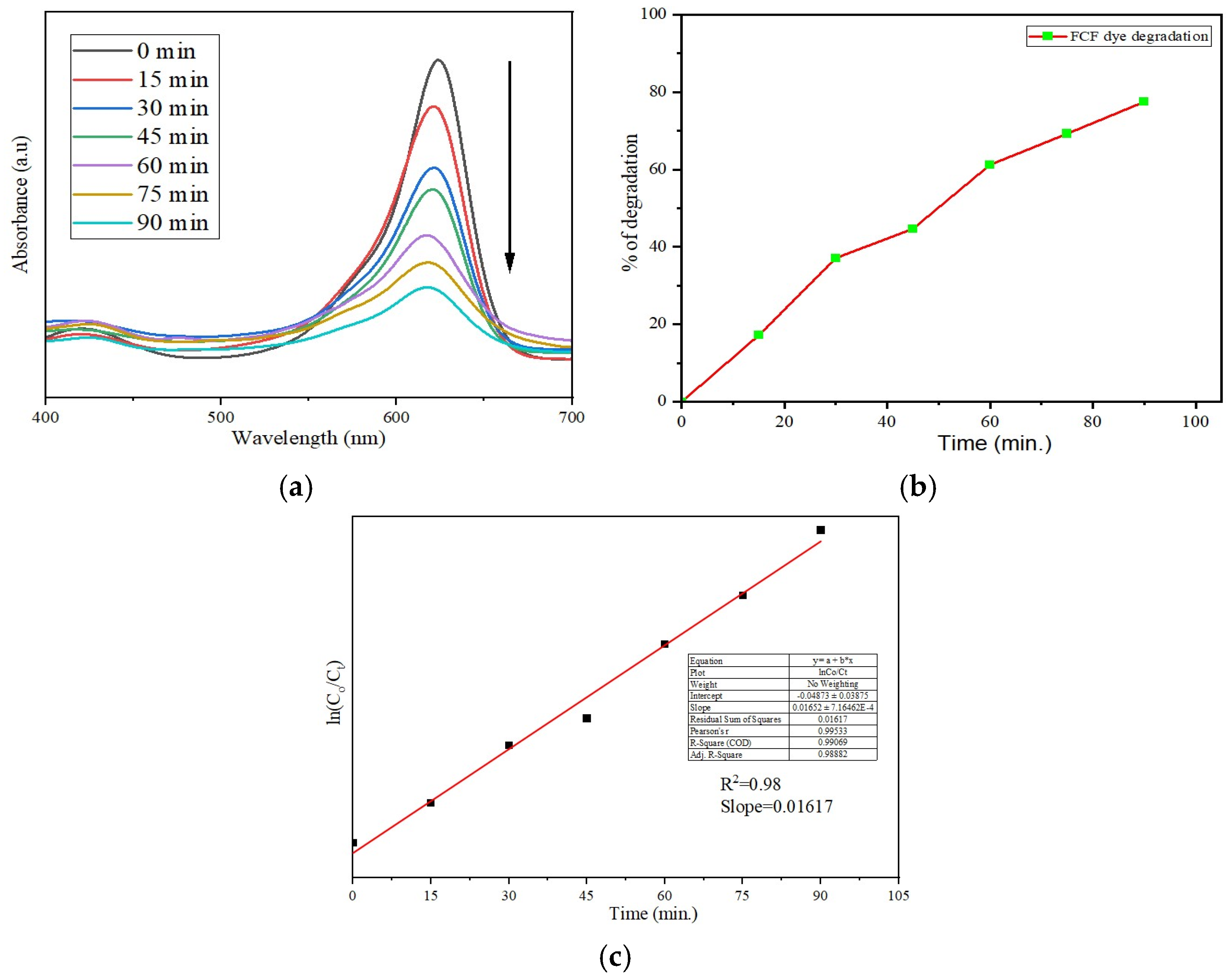
In this study, ZnO NPs showed strong photocatalytic efficiency toward Brilliant Blue FCF when exposed to visible light. A gradual decline in the dye’s absorbance (λmax ≈ 622 nm) in the UV–Vis spectra confirmed continuous breakdown of the chromophore. Within 90 min, the nanoparticles achieved around 76% degradation, highlighting their good photocatalytic capability. The photocatalytic degradation of Brilliant Blue FCF followed pseudo-first-order kinetics, with an excellent linear fit (R2 = 0.98). From the slope of the kinetic plot, the rate constant was determined to be 0.01617 min−1, indicating efficient degradation performance under the applied conditions. Various photocatalytic studies on Brilliant Blue dye demonstrate that ZnO-based and green-synthesized nanomaterials achieve high degradation efficiencies within relatively short irradiation times under visible or solar light. Alamzeb et al. reported efficient solar-light-driven photocatalytic degradation of Brilliant Blue dye, achieving over 90% degradation within approximately 60–120 min of solar irradiation, depending on catalyst composition and operating conditions. Importantly, the study also reported significant mineralization (>70% TOC removal) over prolonged irradiation, indicating an effective breakdown of the dye molecules rather than simple decolorization [21]. Parvin et al. demonstrated that hydrothermally synthesized silver-doped ZnO nanoparticles exhibited superior photocatalytic performance toward Brilliant Blue FCF dye compared to pristine ZnO, achieving approximately 95–98% degradation within 60–90 min of light irradiation. The enhanced activity was attributed to improved visible-light absorption, reduced electron–hole recombination, and surface plasmon resonance effects induced by Ag doping. Additionally, the Ag-ZnO photocatalyst retained more than 90% degradation efficiency after several reuse cycles and showed effective performance in both synthetic dye solutions and real municipal wastewater, confirming its stability and practical applicability [22]. Cu-doped ZnO nanoparticles synthesized via a green route using Cassia fistula leaf extract exhibited excellent dye degradation performance toward Coomassie Brilliant Blue. In the presence of a Fenton reagent, the Cu–ZnO nanoparticles achieved approximately 96% degradation within 60 min under neutral conditions, demonstrating a strong synergistic catalytic effect [23]. In a recent study, zinc oxide nanoparticles (ZnO NPs) were synthesized using Phyllanthus acidus leaf extract, utilizing its inherent reducing and stabilizing properties. Optical characterization revealed that the green-synthesized ZnO nanoparticles possessed a band gap energy of 3.21 eV, indicating their suitability for visible-light-driven applications. The synthesized ZnO NPs demonstrated effective photocatalytic performance toward the degradation of methylene blue under simulated solar light irradiation, achieving a maximum degradation efficiency of 72% within 90 min [24]. The UV–Vis spectra illustrating the degradation process with time, percentage degradation, and kinetic plot are shown in Figure 2a–c, respectively.
Under visible-light irradiation, ZnO NPs generate reactive oxygen species (ROS) through photoinduced electron–hole pairs. The photogenerated electrons react with dissolved oxygen to form superoxide radicals (O2), while holes oxidize surface-adsorbed water or hydroxyl ions to produce hydroxyl radicals (OH). These reactive species attack the chromophoric and aromatic structures of Brilliant Blue FCF, leading to bond cleavage, decolorization, and gradual breakdown of the dye molecules into simpler products, ultimately resulting in mineralization to CO2 and H2O [25,26,27,28].

5. Conclusions

This study confirms that ZnO NPs are an efficient, eco-friendly, and cost-effective photocatalyst for the degradation of Brilliant Blue FCF under visible light irradiation. Approximately 76% dye degradation was achieved within 90 min, demonstrating the good photocatalytic performance of the synthesized NPs. The degradation process followed pseudo-first-order kinetics, indicating an effective interaction between the dye molecules and reactive species generated on the ZnO surface. Unlike our earlier study on Malachite Green degradation, the present proceedings focus on Brilliant Blue FCF, enabling a comparative understanding of dye-dependent photocatalytic behavior of green-synthesized ZnO NPs. These results highlight the potential of ZnO NPs as a sustainable and promising material for wastewater treatment applications.

Author Contributions

Conceptualization, T.K.; proofreading, N.F.; writing—original draft preparation, writing—review and editing, E.V.; supervision, T.K. All authors have read and agreed to the published version of the manuscript.

Funding

This research received no external funding.

Institutional Review Board Statement

Not applicable.

Informed Consent Statement

Not applicable.

Data Availability Statement

No new data were generated during the study.

Acknowledgments

The authors acknowledge the support extended by the Department of Chemistry, Integral University, Lucknow, and the R&D cell of the university for the Manuscript Communication Number (IU/R&D/2026-MCN0004228). The corresponding author acknowledges the support extended to her through the Outstanding Researcher Award for the year 2024 by the university.

Conflicts of Interest

The authors declare no conflicts of interest.

References

  1. Brauch, J.A. Underutilized Fruits and Vegetables as Potential Novel Pigment Sources. In Handbook on Natural Pigments in Food and Beverages; Woodhead Publishing: Cambridge, UK, 2024; pp. 391–418. [Google Scholar] [CrossRef]
  2. Ahmed, S.; Annu, S.A.; Ikram, S. A Review on Biogenic Synthesis of ZnO Nanoparticles Using Plant Extracts and Microbes: A Prospect towards Green Chemistry. J. Photochem. Photobiol. B Biol. 2017, 166, 272–284. [Google Scholar] [CrossRef] [PubMed]
  3. Saif, S.; Tahir, A.; Asim, T.; Chen, Y.; Khan, M.; Adil, S.F. Green Synthesis of ZnO Hierarchical Microstructures by Cordia myxa and Their Antibacterial Activity. Saudi J. Biol. Sci. 2019, 26, 1364–1371. [Google Scholar] [CrossRef]
  4. Xu, J.; Huang, Y.; Zhu, S.; Abbes, N.; Jing, X.; Zhang, L. A Review of the Green Synthesis of ZnO Nanoparticles Using Plant Extracts and Their Prospects for Application in Antibacterial Textiles. J. Eng. Fiber Fabr. 2021, 16, 15589250211046242. [Google Scholar] [CrossRef]
  5. Baruah, S.; Dutta, J. Hydrothermal growth of ZnO nanostructures. Sci. Technol. Adv. Mater. 2009, 10, 013001. [Google Scholar] [CrossRef] [PubMed]
  6. Raghupathi, K.R.; Koodali, R.T.; Manna, A.C. Size-dependent bacterial growth inhibition and mechanism of antibacterial activity of ZnO nanoparticles. Langmuir 2011, 27, 4020–4028. [Google Scholar] [CrossRef] [PubMed]
  7. Veg, E.; Raza, A.; Bansal, P.; Rai, S.; Sharma, S.; Gupta, R.; Dwivedi, S.; Joshi, S.; Khan, A.R.; Khan, T. Synthesis and characterization of ZnO–thiosemicarbazone nanoconjugates for enhanced biological and photocatalytic activity through surface synergy. Inorg. Chem. Commun. 2025, 181, 115265. [Google Scholar] [CrossRef]
  8. Veg, E.; Joshi, S.; Khan, T. Design and fabrication of heterojunctions of thiosemicarbazones and metal oxide nanoparticles in search of their medicinal activity. Eng. Proc. 2024, 67, 46. [Google Scholar] [CrossRef]
  9. Rasmussen, J.W.; Martinez, E.; Louka, P.; Wingett, D.G. Zinc oxide nanoparticles for selective destruction of tumor cells. Expert Opin. Drug Deliv. 2010, 7, 1063–1077. [Google Scholar] [CrossRef]
  10. Ahmed, S.; Ahmad, M.; Swami, B.L.; Ikram, S. A review on plants extract mediated synthesis of silver nanoparticles for antimicrobial applications. J. Adv. Res. 2016, 7, 17–28. [Google Scholar] [CrossRef]
  11. Iravani, S. Green synthesis of metal nanoparticles using plants. Green Chem. 2011, 13, 2638–2650. [Google Scholar] [CrossRef]
  12. Dang, V.D.; Nguyen, H.H.T.; Nguyen, X.C.; Truong, H.B. Green Synthesis of Zinc Oxide Nanomaterials for Water Remediation: A Review. Int. J. Environ. Res. 2025, 19, 197. [Google Scholar] [CrossRef]
  13. Veg, E.; Raza, A.; Rai, S.; Sharma, S.; Ahmad, M.I.; Jabeen, S.; Joshi, S.; Khan, T. Synthesis, characterization and antibacterial activity evaluation of CuO NPs and B-CuO NPs obtained from Livistona chinensis leaf extract. Chem. Biodivers. 2024, 22, e202401596. [Google Scholar] [CrossRef]
  14. Yang, Y.; Du, Z.; Yang, H.; Bagchi, D.; Yang, R.; Menezes, P.W.; Meng, S. Facet-Engineered S-Scheme Heterostructure with Enhanced Active Sites for Efficient Photocatalytic Degradation of Organic Contaminants. Adv. Funct. Mater. 2026, e25991. [Google Scholar] [CrossRef]
  15. Purushotham, D.; Ramesh, A.M.; Thimmappa, D.S.; Kalegowda, N.; Gajendramurthy, G.H.; Kollur, S.P.; Mahadevamurthy, M. Green Synthesis of Zinc Oxide Nanoparticles Using Aqueous Extract of Pavonia zeylanica to Mediate Photocatalytic Degradation of Methylene Blue: Studies on Reaction Kinetics, Reusability and Mineralization. Int. J. Mol. Sci. 2025, 26, 4739. [Google Scholar] [CrossRef] [PubMed]
  16. Mohamed, E.A.; Altalhi, A.A.; Ahmed, H.M.; Negm, N.A. High-Performance Photocatalytic Degradation of Methylene Blue from Industrial Wastewater Using Bio-Inspired ZnO Nanoparticles under Visible Light. Desalination Water Treat. 2025, 324, 101539. [Google Scholar] [CrossRef]
  17. Kalidasan, K.; Chavanich, S.; Jagan, K.S.G.; Surendhiran, S.; Vidaarth, T.M.N.; Karthik, S.; Viyakarn, V. Evaluation of Biogenic Zinc Oxide Nanoparticles from Sonneratia ovata Leaf Extract for Multivariate Factorial Photocatalytic and Biological Activities. Biocatal. Agric. Biotechnol. 2025, 69, 103759. [Google Scholar] [CrossRef]
  18. Younas, M.U.; Iqbal, M.; Ahmad, N.; Iqbal, S.; Kausar, A.; Nazir, A.; Anjum, F. Biogenic Synthesis of Zinc Oxide Nanoparticles Using NARC G1 Garlic (Allium sativum) Extract, Their Photocatalytic Activity for Dye Degradation and Antioxidant Activity of the Extract. Results Chem. 2025, 13, 102035. [Google Scholar] [CrossRef]
  19. Abdulqodus, A.N.; Abdulrahman, A.F.; Mostafa, S.H.; Kareem, A.A.; Hamad, S.M.; Ahmed, S.M.; Almessiere, M.A.; Shaikhah, D. Green Synthesis of ZnO Nanoparticles: Effect of pH on Morphology and Photocatalytic Degradation Efficiency. Appl. Phys. A 2025, 131, 720. [Google Scholar] [CrossRef]
  20. Veg, E.; Raza, A.; Rai, S.; Bansal, P.; Sharma, S.; Mishra, N.; Khan, T. Green synthesis of ZnO and α-Fe2O3 nanoparticles using Chinese fan palm leaf extract for their biological and photocatalytic activity evaluation. RSC Sustain. 2025, 3, 5609–5631. [Google Scholar] [CrossRef]
  21. Alamzeb, M.; Faryad, S.; Ullah, I.; Hussain, J.; Setzer, W.N. Photocatalytic Degradation of Brilliant Blue Dye Under Solar Light Irradiation: An Insight into Mechanistic, Kinetics, Mineralization and Scavenging Studies. J. Fluoresc. 2025, 35, 9093–9111. [Google Scholar] [CrossRef] [PubMed]
  22. Parvin, T.; Keerthiraj, N.; Ibrahim, I.A.; Phanichphant, S.; Byrappa, K. Photocatalytic Degradation of Municipal Wastewater and Brilliant Blue Dye Using Hydrothermally Synthesized Surface-Modified Silver-Doped ZnO Designer Particles. Int. J. Photoenergy 2012, 2012, 670610. [Google Scholar] [CrossRef]
  23. Khan, K.A.; Shah, A.; Nisar, J. Electrochemical detection and removal of brilliant blue dye via photocatalytic degradation and adsorption using phyto-synthesized nanoparticles. RSC Adv. 2024, 14, 2504–2517. [Google Scholar] [CrossRef]
  24. Kandasamy, M.; Suresh, S.; Rameshkumar, P.; Jayasree, R.; Sathishkumar, P.; Gunnasegaran, P.; Topare, N.S.; Thambidurai, S.; Arumugam, J.; Jothilakshmi, R.; et al. Green synthesis of ultrafine zinc oxide nanoparticles for photocatalytic degradation of methylene blue dye: Optimization and kinetic studies. Results Eng. 2025, 27, 105846. [Google Scholar] [CrossRef]
  25. Pollard, Z.A.; Karod, M.; Schmitz, A.; Pian, B.; Barstow, B.; Goldfarb, J.L. ZnO Precursor’s ability to catalyze formation of reactive oxygen species to degrade aqueous organic pollutants. Chem. Eng. J. 2024, 480, 147499. [Google Scholar] [CrossRef]
  26. Jabeen, S.; Veg, E.; Ahmad, M.I.; Bala, S.; Khan, T. A comprehensive review on metal oxide-based nanomaterials: Synthesis, characterization, environmental, and therapeutic applications. ChemistrySelect 2025, 10, e202500080. [Google Scholar] [CrossRef]
  27. Fatima, N.; Veg, E.; Dwivedi, S.; Pandey, A.; Khan, T. Photocatalytic activity of ZnFe2O4 for the degradation of Fast Green FCF and Orange II. Eng. Proc. 2025, 117, 4. [Google Scholar] [CrossRef]
  28. Jabeen, S.; Siddiqui, V.U.; Sharma, S.; Rai, S.; Bansal, P.; Bala, S.; Raza, A.; Ahmad, M.I.; Khan, A.R.; Khan, T. A novel green synthesis of CuFe2O4 Nanoparticles from Cissus rotundifolia for photocatalytic and antimicrobial activity evaluation. J. Alloys Compd. 2024, 984, 174020. [Google Scholar] [CrossRef]
Figure 1. Schematic representation of the synthesis of ZnO NPs.
Engproc 124 00023 g001
Figure 2. (a) UV–visible spectra of photocatalytic degradation of Brilliant Blue FCF by ZnO NPs; (b) % degradation; (c) pseudo-first-order kinetic plot.
Engproc 124 00023 g002
Table 1. Different green-synthesized ZnO NPs and their photocatalytic activity.
S. No.Plant SourceDye Name Light Source Time
(Minutes)
% DegradationReference
1Pavonia zeylanica (leaf extract)MBSunlight12089.32[15]
2Citrus peel extractMBVisible light9094[16]
3Sonneratia ovata leavesEthidium bromideUV irradiation12098[17]
4Allium sativumRB-5 Sunlight24088.6[18]
5Allium Caliphalum WendelbowMOUltraviolet irradiation14074[19]
6Livistona chinensisBB-FCFVisible Light9076Present Study
Disclaimer/Publisher’s Note: The statements, opinions and data contained in all publications are solely those of the individual author(s) and contributor(s) and not of MDPI and/or the editor(s). MDPI and/or the editor(s) disclaim responsibility for any injury to people or property resulting from any ideas, methods, instructions or products referred to in the content.