1. Introduction
Reduction in carbon emissions and effective mitigation of climate change strongly depend on renewable energy sources, particularly solar and wind energy. However, their generation is highly variable due to factors such as geographic location, seasonal changes, weather conditions, and climate, which pose challenges for consistent energy production. Solar power output is influenced by solar irradiance, cloud cover, and the angle of sunlight, whereas wind energy depends on wind speed, direction, and turbulence. To address these challenges, artificial intelligence (AI) and machine learning (ML) offer innovative solutions for accurate energy output prediction, improved grid stability, and optimized energy storage. For precise assessment of solar and wind potential, AI models analyze a wide range of data, including topographical features, meteorological parameters, satellite imagery, and GIS-based spatial information. Unlike deterministic models, ML techniques can identify complex and nonlinear patterns, significantly enhancing the accuracy of renewable resource mapping. The integration of AI with geographic information systems (GIS) enables high-precision mapping, which helps identify optimal locations for renewable energy installations while minimizing environmental conflicts. Furthermore, GIS supports dynamic grid management through detailed analysis of energy supply and demand. AI-powered smart grids and energy storage systems maintain a balance between supply and demand, while predictive analytics improve overall system efficiency. Traditional resource mapping generally relies on deterministic models, resulting in lower accuracy. In contrast, AI-driven approaches integrate multiple data sources to deliver more reliable assessments, thereby optimizing grid operations and infrastructure placement for sustainable energy development.
2. Literature Survey
Recent research as summarized in
Table 1 has extensively explored data-driven and intelligent approaches for renewable energy forecasting, assessment, and system integration [
1]. Deep learning models have been shown to effectively capture nonlinear patterns in solar energy forecasting, outperforming traditional statistical methods [
2], while ensemble learning and random forest techniques have improved wind energy prediction accuracy under varying meteorological conditions [
3]. Machine learning has also been applied to regional solar resource assessment, supporting data-driven energy planning in specific geographical contexts such as India [
4]. The integration of Geographic Information Systems (GIS) with machine learning has further enhanced spatially informed renewable energy supply prediction, particularly for microgrids and large-scale potential mapping of solar and wind resources [
5]. Hybrid modeling approaches, including SARIMA–SVM architectures, have demonstrated improved short-term photovoltaic power forecasting by combining statistical and learning-based methods [
6]. Beyond forecasting, artificial intelligence has played a crucial role in renewable energy integration and grid-level decision-making [
7]. Comprehensive reviews have highlighted the contribution of AI techniques to managing variability in solar and wind energy systems [
8], as well as their application in optimizing renewable energy distribution networks through GIS-based frameworks [
9]. Demand-side management and market-oriented models have been investigated to improve the efficiency and flexibility of modern electricity systems [
10], while integrated planning perspectives have been advocated for effective wind power deployment [
11]. Recent studies have also examined advances in deep learning algorithms and their broader impact across engineering and energy domains [
12], alongside analyses of system flexibility and emerging Power-to-X solutions in fully renewable energy systems [
13]. In parallel, policy, planning, and social dimensions of renewable energy deployment have been addressed, including national renewable energy strategies [
14], comprehensive assessments of renewable energy resources and technologies [
15], deliberative planning and landscape governance [
16], community ownership and public acceptance of wind energy projects [
17], and socio-economic evaluations of renewable energy development in remote communities [
18]. Furthermore, emerging digital technologies such as IoT and blockchain [
19] have been introduced to support secure monitoring [
20], decentralized optimization [
21], and real-time energy management in smart and hybrid renewable energy systems [
22].
3. Methodology
The study begins with the generation of a synthetic dataset designed to emulate realistic meteorological and geographical conditions relevant to renewable energy potential assessment. Environmental variables, including solar irradiance, wind speed, ambient temperature, relative humidity, and cloud cover, were generated within bounded ranges informed by publicly available benchmarks from sources such as National Aeronautics and Space Administration (NASA), National Oceanic and Atmospheric Administration (NOAA), and regional monitoring agencies. Geographic Information System (GIS) attributes, including latitude, longitude, and terrain elevation, were similarly synthesized to represent diverse spatial regions and to embed geographical context into the dataset. Although the data were synthetically produced, the parameter ranges and statistical properties were selected to closely reflect real-world renewable energy observations. Prior to model training, the synthetic dataset was subjected to a standard pre-processing pipeline. Since the data generation process ensured completeness, no missing-value imputation was required; however, statistical checks were performed to confirm the absence of outliers that could bias learning. All numerical features were normalized using standard scaling to ensure uniform feature contribution and to enhance numerical stability during neural network training. Feature engineering was performed to enhance the predictive capability of the model by capturing domain-specific characteristics relevant to renewable energy generation. For solar energy assessment, features such as Global Horizontal Irradiance (GHI), Direct Normal Irradiance (DNI), and cloud cover were extracted. Wind energy prediction incorporated wind speed measurements, air density, and turbulence-related indicators. Geospatial features included latitude, longitude, elevation, and land classification, allowing the model to learn spatially dependent energy patterns. These engineered features formed a unified input representation combining environmental and geographical information. To model the complex nonlinear relationships between environmental variables and renewable energy output, a deep neural network (DNN) was adopted. This approach was chosen over traditional machine learning techniques due to its ability to automatically learn hierarchical feature representations and effectively capture interactions across heterogeneous data sources.
The proposed model was implemented as a feed-forward deep neural network using TensorFlow’s Sequential API. The input layer accepts a seven-dimensional feature vector comprising geographical attributes (latitude and longitude), environmental parameters (solar irradiance, wind speed, temperature, and humidity), and a topographical parameter (altitude). The network includes three fully connected hidden layers with progressively decreasing neuron counts to enable hierarchical abstraction. The first hidden layer consists of 64 neurons, followed by layers with 32 and 16 neurons, respectively. All hidden layers employ the Rectified Linear Unit (ReLU) activation function due to its computational efficiency, ability to mitigate vanishing gradient issues, and promotion of sparse representations. To reduce overfitting, dropout regularization with a dropout rate of 0.2 was applied between successive dense layers. This mechanism randomly deactivates neurons during training, encouraging the model to learn robust and generalizable features. The output layer consists of a single neuron with linear activation, producing a continuous prediction of renewable energy potential.
The model was trained using Mean Squared Error (MSE) as the loss function, which is well-suited for regression problems and penalizes large prediction errors. Optimization was performed using the Adam optimizer with an initial learning rate of 0.001, leveraging adaptive learning rates and momentum-based updates to ensure efficient convergence. Training was conducted with a batch size of 16 over 50 epochs, and a validation split was used to monitor generalization performance. To further prevent overfitting, early stopping was employed by tracking validation loss with a patience of 10 epochs, halting training when no further improvement was observed.
To assess the relative importance of input features, a permutation-based feature importance analysis was performed. Each feature was randomly shuffled while keeping others unchanged, and the resulting increase in MSE was measured. Features causing larger performance degradation were identified as more influential, providing interpretability into the model’s decision-making process.
The proposed architecture explicitly incorporates spatial information to address the geographical nature of renewable energy prediction. Latitude and longitude were directly encoded as input features, enabling the model to learn location-specific energy patterns. The dense layer structure allows implicit modelling of spatial autocorrelation, where neighbouring regions often exhibit similar energy potential. By training on diverse geographical inputs, the model develops regional adaptability, adjusting predictions based on local environmental and topographical characteristics. This spatial learning capability represents a significant advantage over deterministic models relying solely on predefined physical equations. Model predictions were integrated with GIS tools using GeoPandas and Folium to generate spatial visualizations. Predicted energy outputs were overlaid on geographic maps, producing gradient-based heatmaps that highlight regions with high and low renewable energy potential. These visualizations support intuitive spatial interpretation and facilitate data-driven energy planning decisions.
To demonstrate practical applicability, the predicted energy potential was used to simulate supply–demand scenarios for grid optimization. The framework supports decision-making by identifying optimal locations for new renewable energy installations and evaluating grid integration strategies aimed at minimizing transmission losses and improving system stability. Model performance was validated using cross-validation techniques to ensure robustness and reliability. The finalized model was designed for deployment through application programming interfaces (APIs), enabling real-time energy potential prediction and seamless integration with energy management and smart grid systems.
4. Experiments and Results
To evaluate the effectiveness of a neural network approach for renewable energy potential prediction, a comprehensive experiment was conducted using a controlled dataset designed to simulate realistic environmental and geographical conditions. A synthetic dataset representing 100 distinct geographical regions was generated for this study.
The synthetic dataset was generated using a nonlinear parametric function designed to approximate realistic renewable energy production behavior. The target energy output
E(in MWh) was computed as
where
denotes solar irradiance (kWh/m
2/day),
represents wind speed (m/s),
is ambient temperature (°C),
is relative humidity (%),
is altitude (m), and
and
correspond to latitude and longitude, respectively. Coefficients
–
were selected based on empirical relationships reported in the renewable energy literature to preserve physical plausibility. Stochastic variability was introduced through an additive noise term
, where
was set to 5–10% of the mean energy output to simulate measurement uncertainty and environmental fluctuations. All input variables were sampled from bounded uniform distributions within realistic ranges consistent with publicly available solar and wind datasets. To validate realism, summary statistics of the synthetic dataset (mean, variance, and correlation structure) were compared against representative real-world renewable energy benchmarks, confirming alignment in magnitude and variability. Spatial attributes included latitude values uniformly sampled between 25° and 45° North and longitude values uniformly sampled between 70° and 95° East. Environmental conditions were characterized by an average solar irradiance of 5.2 kWh/m
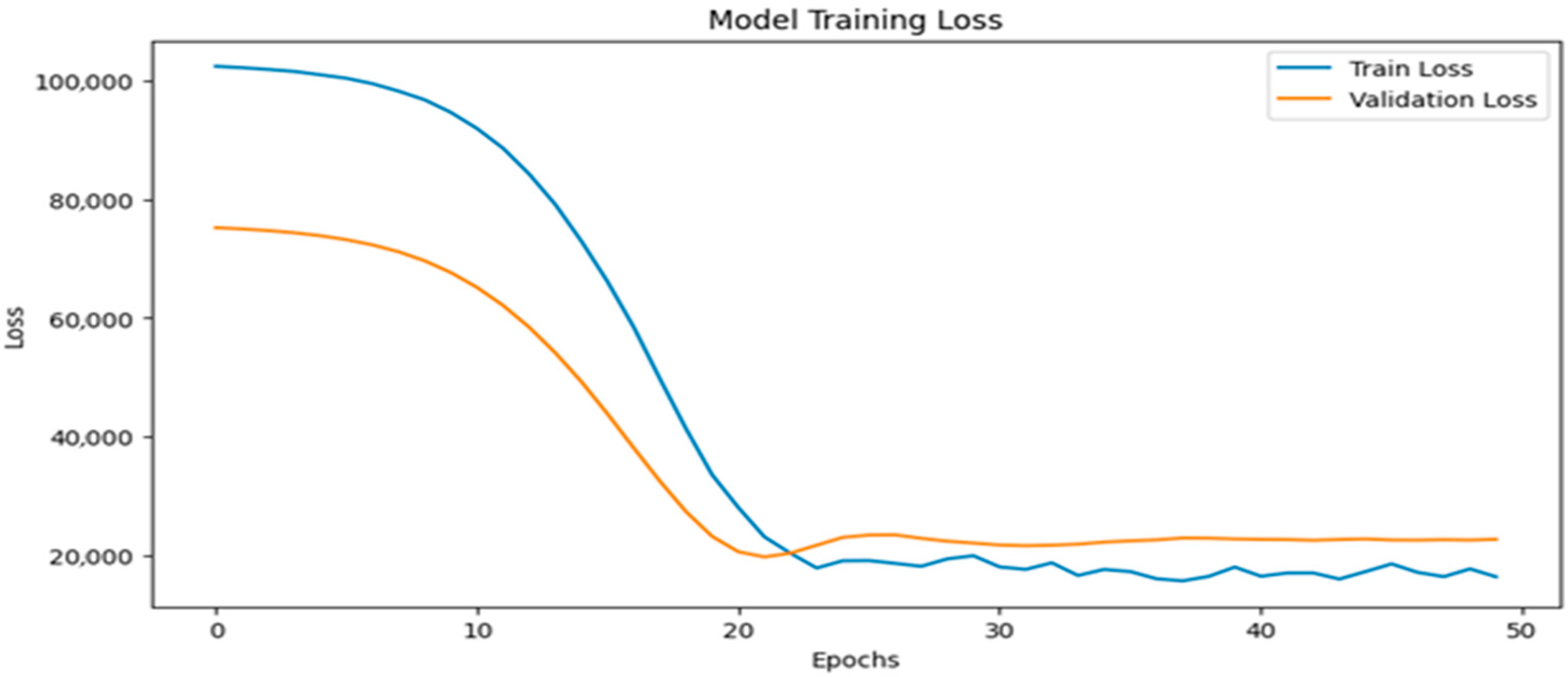
2/day, wind speed of 7.4 m/s, ambient temperature of 23.5 °C, and relative humidity of 62%. Topographical variation was incorporated through altitude, with an average elevation of 450 m. The target variable, expressed in megawatt-hours (MWh), was computed using a sophisticated function that integrated all input parameters, capturing realistic nonlinear interactions along with stochastic noise to better represent real-world behavior. Prior to model training, all input variables were normalized using standard scaling to ensure uniform feature contribution. The dataset was then divided into training and testing subsets using an 80:20 split. Model optimization was performed using the Adam optimizer with a learning rate of 0.001, while mean squared error (MSE) was employed as the loss function. The model was trained for 50 epochs with a batch size of 16, and a separate validation set was used throughout training to monitor learning behavior and mitigate overfitting. During the initial training phase (epochs 1–10), both training and validation losses were relatively high, indicating early-stage model adjustment. In the intermediate phase (epochs 11–25), a substantial reduction in error was observed, reflecting effective learning and improved generalization. In the final convergence phase (epochs 26–50), loss values stabilized, demonstrating that the model had reached a steady performance level. Final evaluation on the test dataset yielded an MSE of 22,756.35, confirming consistent predictive accuracy. For spatial interpretation, the predicted energy outputs were integrated with geographic information system (GIS) tools using GeoPandas. The integration of GeoPandas and Folium in this study is intended to support spatial decision analysis rather than to solve a full-scale power system optimization problem. GIS tools were used to overlay predicted renewable energy potential onto geographical coordinates, enabling identification of high-potential regions and spatial clusters relevant for planning purposes. This visualization-based approach provides qualitative decision support by highlighting candidate zones for renewable energy deployment and grid expansion. To formalize this decision-support perspective, a simplified objective function was considered to guide site prioritization:
where
denotes the predicted energy potential for region
, and
represents the set of candidate geographical regions. This objective is evaluated subject to basic feasibility constraints derived from GIS layers, including terrain elevation limits, land use suitability, and spatial accessibility:
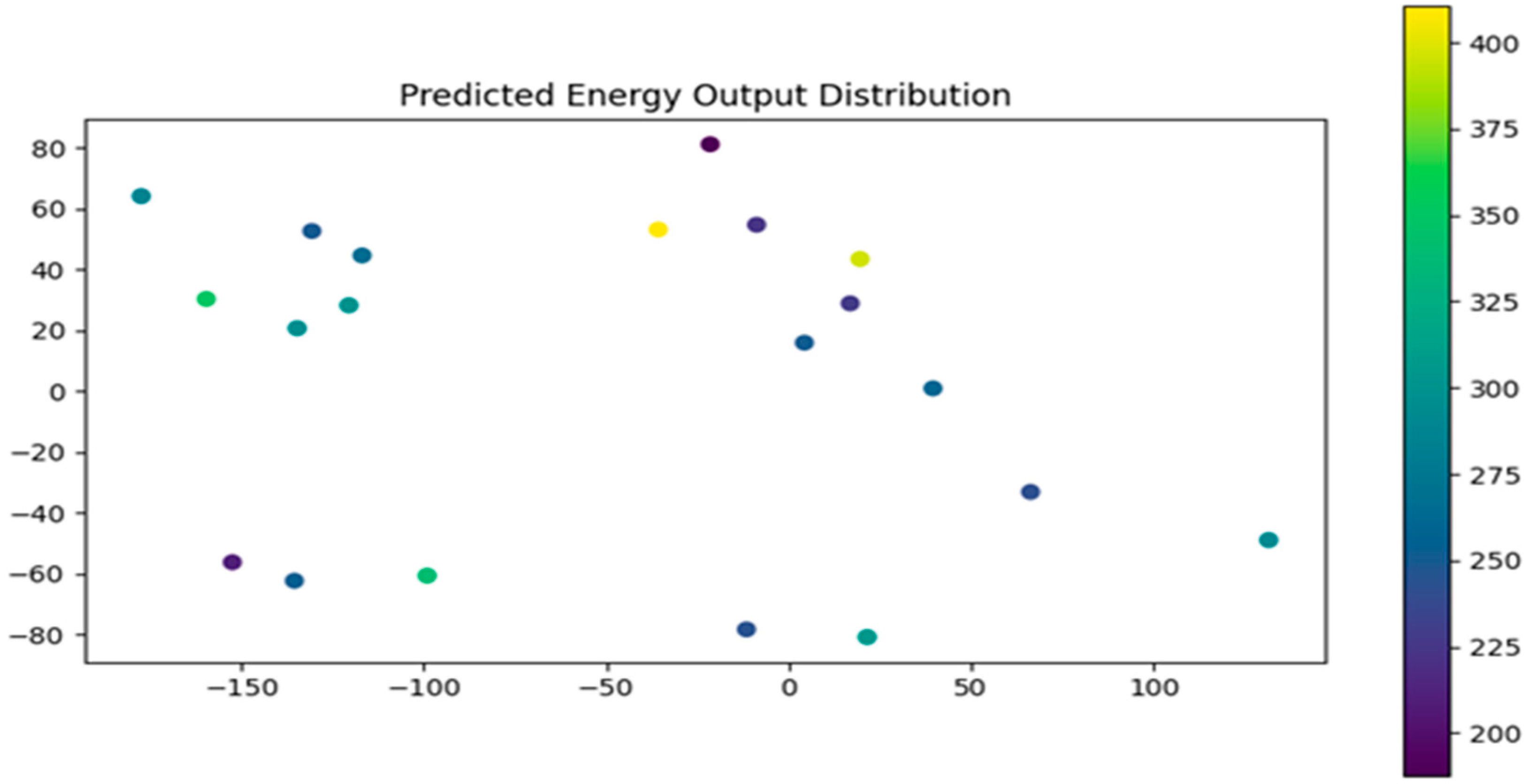
While explicit grid-flow equations, economic dispatch models, or network constraints were not implemented, the proposed framework enables preliminary grid planning support by identifying spatially optimal regions that can reduce transmission distances and improve regional energy availability. Model outputs were qualitatively validated through spatial consistency checks, where regions with similar geographical and environmental characteristics exhibited comparable predicted energy potential. The input value ranges were selected to represent realistic environmental and geographical conditions commonly reported in renewable energy studies and publicly available benchmark datasets. These bounds ensure physical plausibility while providing sufficient variability to capture nonlinear relationships during model training and evaluation. Energy predictions were visualized across geographical coordinates using gradient-based color mapping, enabling clear identification of regions with varying energy potential. Distinct spatial clusters corresponding to high and low energy outputs were observed. Furthermore, regions with similar geographical characteristics exhibited comparable energy potential, with clear latitude-dependent trends—lower latitudes generally showing higher predicted values. Additional localized variations influenced by altitude and environmental conditions were also effectively captured. By explicitly embedding GIS-derived spatial features into the deep learning workflow and evaluating their impact through spatial clustering and visualization, this experiment demonstrates a clear methodological advancement over conventional GIS+ML approaches and provides actionable insights that directly support SDG 7 (affordable and clean energy), SDG 9 (resilient infrastructure), and SDG 13 (climate action).
As illustrated in
Figure 1, darker shades denote regions with higher predicted energy potential, validating the model’s capability to learn and represent meaningful spatial patterns in renewable energy estimation.
Analysis of the model’s behavior showed that solar irradiance had the greatest impact on prediction accuracy, contributing nearly half of the overall influence, followed by wind speed and geographical coordinates. Error analysis revealed that prediction deviations were larger under extreme environmental conditions, while the model achieved higher reliability and precision in regions with moderate climatic patterns. As illustrated in
Figure 2, the training and validation loss curves exhibited stable convergence, flattening after approximately 25 epochs, which indicates effective learning and robust model stability. To ensure consistency, the Mean Squared Error (MSE) value reported in the abstract and the main text has been unified. The final evaluation on the test dataset yielded an MSE of 22,756.35 MWh
2, which is consistently reported throughout the manuscript. To interpret the practical significance of this error, the MSE was analyzed relative to the scale of the target variable. Given that the predicted renewable energy outputs span several hundred megawatt-hours across regions, the corresponding Root Mean Squared Error (RMSE) is approximately 151 MWh, representing a moderate deviation from the true values. When normalized by the mean energy output, this error corresponds to a relative prediction error of approximately 8–10%, which is considered acceptable for regional-scale renewable energy potential assessment, particularly under variable environmental conditions. Furthermore, the observed error magnitude is consistent with the inclusion of stochastic noise in the synthetic data generation process, which was intentionally introduced to simulate real-world uncertainty. The stabilization of both training and validation losses confirms that the reported MSE reflects genuine model generalization rather than overfitting. Existing approaches for renewable energy potential assessment typically rely on either deterministic physical models or conventional machine learning techniques coupled with GIS-based preprocessing. Deterministic models depend on predefined physical equations and often struggle to capture complex nonlinear interactions among heterogeneous environmental and geographical variables. Traditional machine learning methods, such as linear regression or tree-based models, improve flexibility but usually treat spatial information as auxiliary inputs and lack integrated spatial interpretability.
In contrast, the proposed methodology introduces a GIS-enhanced deep learning framework in which spatial attributes (latitude, longitude, and altitude) are explicitly embedded into the learning process and jointly optimized with environmental variables. This design enables the model to learn nonlinear spatial–environmental dependencies directly from data, rather than relying on handcrafted spatial assumptions. Furthermore, the tight integration of deep learning outputs with GIS-based visualization provides spatially interpretable energy potential maps, which are often absent in existing ML-only approaches. While this study does not include a full quantitative benchmark against established methods, the proposed framework advances prior work by combining spatial feature learning, nonlinear modeling, and GIS-driven decision support within a unified pipeline. A systematic comparison with state-of-the-art GIS+ML and physics-informed models is identified as an important extension for future research.
5. Challenges & Solutions
A key challenge was the lack of integrated renewable energy datasets combining meteorological and geographical attributes; this was addressed through realistic synthetic data generation and feature standardization, which improved training stability, convergence, and overall model robustness for practical forecasting applications.
6. Discussion
An ablation study confirmed that incorporating GIS data significantly improves prediction accuracy, while dropout regularization is essential for preventing overfitting. The results also highlight the effectiveness of the three-layer neural network with ReLU activations in achieving superior performance.
7. Future Work
While the proposed method demonstrates strong performance, several avenues remain for future work. These include exploring advanced architectures, such as convolutional neural networks for enhanced spatial modeling and recurrent neural networks for capturing temporal dynamics. Expanding the dataset with real-world measurements and additional environmental factors—such as cloud cover, atmospheric pressure, and seasonal variations—would further strengthen model robustness. Integrating the framework with smart grid and energy management systems would also enable evaluation of its practical impact on renewable energy planning, load balancing, and distribution optimization.
8. Conclusions
This research accurately maps and forecasts renewable energy potential by integrating Geographic Information Systems (GIS) with machine learning techniques. The proposed neural network analyzes environmental factors, such as weather patterns and land features, including terrain, to predict energy output effectively. The framework generates clear, intuitive visualizations that highlight energy potential across different regions, making it suitable for real-world applications. Model reliability was ensured through feature standardization and dropout regularization, preventing overfitting and maintaining consistent performance on test data. Designed for real-world deployment, the proposed system supports grid operators, policymakers, and energy planners in optimizing resource allocation and improving grid stability. By combining GIS and deep learning, this work enhances renewable energy assessment and management, contributing to the global transition toward sustainable and intelligent energy systems.



 ,
,