Proceeding Paper

Study of the Influence of the Geometric Shape of Structural Elements on the Hydrodynamic Pattern in a Radial Precipitator †

by
Aleksandrina Bankova
1,*,
Anastas Yangyozov
2,
Stefan Tenev
1 and
Asparuh Atanasov
1
1
Department of Mechanics and Machine Elements, Faculty of Manufacturing and Technologies, Technical University—Varna, Studentska 1, 9000 Varna, Bulgaria
2
Department of Thermal Engineering, Faculty of Shipbuilding, Technical University—Varna, Studentska 1, 9000 Varna, Bulgaria
*
Author to whom correspondence should be addressed.
Presented at the 6th International Conference on Communications, Information, Electronic and Energy Systems, Ruse, Bulgaria, 26–28 November 2025.
Eng. Proc. 2026, 122(1), 12; https://doi.org/10.3390/engproc2026122012
Published: 16 January 2026

Abstract

Wastewater treatment facilities of a diameter of approximately 15 m or more provide the opportunity to process large volumes of stormwater. The current report investigates the operation of a stormwater radial precipitator, without an impeller, working with particles of various sizes. A distinguishing feature is that the two-phase flow is solely gravity-driven, which leads to reduced energy requirements. This entails the necessity of a facility in which the linear and the local losses are minimized as much as possible. Linear losses can be reduced by decreasing the precipitator’s size. The initially proposed 15 m diameter proved to be ineffective since the sand only reached a certain zone and could not flow further to the outlet due to the insufficient energy. Therefore, it was necessary to reduce the size of the radial precipitator, which resulted in a shorter path for the sand particles and the water, which, in turn, reduced the linear resistance. As for the local losses, it turned out that many areas of the precipitator construction could be geometrically modified to significantly reduce the energy loss of the sand–water mixture. The boundary layer cannot be removed. However, it is possible the size and the number of vortex structures inside the settler to be reduced in order to create an optimal working environment.

1. Introduction

In the recent decades, with the rapid development of computer technology, computational fluid dynamics (CFD) software and techniques have become powerful and effective tools for studying complex flows. Many researchers [1,2,3,4,5,6] have proven that CFD can predict the flow field accurately and reliably in many mixing tanks.
Previous research related to hydrodynamic analysis has proposed mathematical models that can predict the solid content and the particle size distribution in tanks (often quite different from the feed material) [7]. In their study, the authors Schmid et al. theoretically and numerically explored electrohydrodynamic (EHD) flows and presented the results in model electrostatic filters (EF). They show the effect of the flow on the resulting secondary flows through mathematical dependencies in laminar and “RANS” models of study. According to them, the high accuracy, and the correct computation of the entire channel, with proper boundary conditions at the inlet and outlet, are critical for the accurate flow field calculations [8]. According to another study, by the same authors, secondary flows have only a minor impact on the overall particle sedimentation, although they cause some local sedimentation modelling. They argue that the heterogeneity of turbulence has a stronger effect on particle dynamics [9]. Recently, Soldati [10] published a systematic study on the influence of secondary flow on particle dynamics, calculating their trajectories in a highly detailed flow field obtained through a direct numerical simulation, with and without coupling to an electric field. However, this study was limited to the effect of an electrochemical–diffusion flow, using a simplified distribution of the electric field.
Research and various sources on particle transport, whether denser (e.g., mineral sediments) or less dense (e.g., air bubbles) than the surrounding fluid, show that if the settling velocity of the particles is much lower than the flow’s friction velocity, turbulence will be strong enough to keep the particles in suspension. Small particles closely follow the flow of the fluid with components of velocity u, v, and w along the respective X, Y, and Z axes, so their movement is described by the equation used for chemical solutions considering concentration C. In some cases, in the particle transport equations, it is more convenient to use the particle concentration n (particles/m3) instead of concentration C (kg/m3). Then, the equation for particle motion is the following:
n t + u n x + v n y + w + w p n z   = D x 2 n x 2 + D y 2 n y 2 + D z 2 n z 2
In turbulent flow, the diffusion coefficients Dx, Dy, Dz for the respective particles can be assumed to be the same as those for the dissolved particles. In laminar flows, the particle diffusion will be a function of their size.
Particles whose density differs from the fluid’s, whether higher (e.g., sand grains or metal spheres) or lower (e.g., air bubbles), will have a vertical velocity relative to the fluid wp, which is accounted for with an additional component in the advection term. Equation (1) is valid for particles with density close to the surrounding fluid. If the particle size d and their density ρp are higher than those of the surrounding fluid ρF, then additional equations should be introduced, but this is not addressed in this report. In the simplified case, a particle, surrounded by fluid, is considered to be acted upon by gravitational, lift, and drag forces. In Equation (1), in the fourth term, the movement velocity along the vertical axis z, can be determined according to:
w p = 4 3 g d ( ρ p ρ F ) ρ F C D 1 / 2
where CD is the drag coefficient, g = 9.81 m/s2—the gravitational acceleration [11].

2. Materials and Methods

2.1. Numerical Model

The current paper describes some stages in the development of a three-dimensional CFD model of a radial precipitator working with a mixture of stormwater and particles of different sizes. When using Ansys CFX 2021 is a computational fluid dynamics (CFD) software product, the rules for operation described in [12,13] were followed.
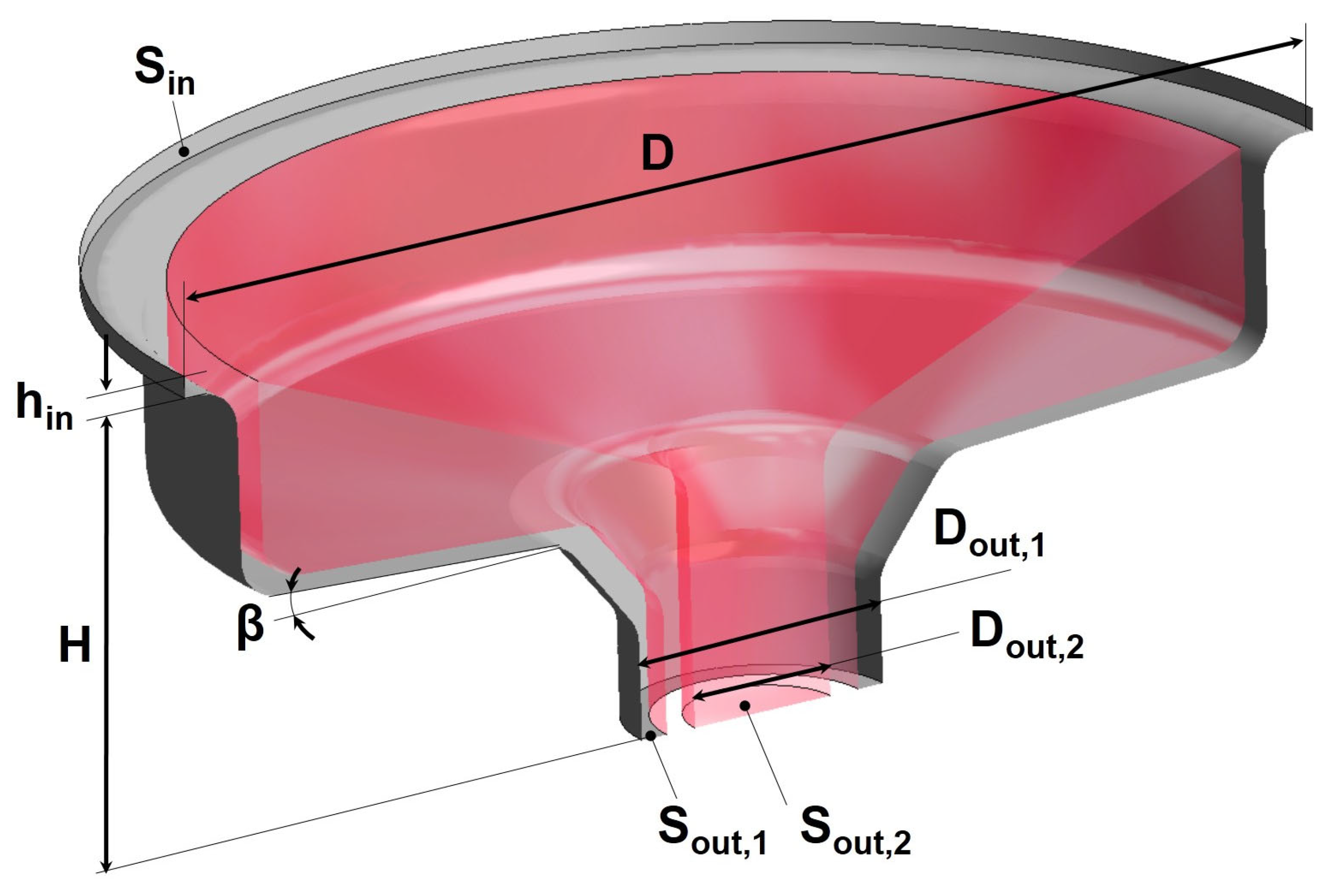
Figure 1 shows the three-dimensional cross-section of one of the models under consideration. Table 1 presents the geometric dimensions of the precipitator.
The so-called Control Volume Method is used in the software product. The sand particles’ behavior in the fluid area is described by the Lagrangian method [14].
During the initial modeling, a model with periodic boundary conditions was created, but the fluid pattern was proved to be not symmetric. The interaction between the particles of various sizes and the water, along with phenomena such as Turbulent Dispersion and Particle Collision, which were considered and included, contributed to the asymmetry. A CFD model with periodic boundaries would have significantly reduced the computation time, but in the end, the possibility to study the complex processes occurring in the facility led to the decision to model the entire volume and to conduct a detailed analysis. A three-dimensional shape of the precipitator was created by the geometric module of ANSYS Design Modeler. The dimensions were clarified and the parameters were introduced. The latter would be modified during the research process. In this module, the solid body part and the fluid volume were separated. The surfaces on which boundary conditions would be applied were labeled. These data were passed to the next module, Mesh, to create a mesh for the fluid region. It is unstructured with 286,771 nodes and 656,111 elements, consisting of tetrahedra, pyramids, and prisms. After the first calculation, the Yplus value was checked, and it turned out to be around 25.
According to Patankar [15], this mesh has appropriate size and density in the vicinity of the walls, and the next stage of modelling can be initiated, namely the boundary conditions setting. This is achieved by the CFX-Pre-module. Some of the settings are shown in Table 2.
The number of the particles and the mass flow rate “sand” change during the investigation, while their size and the mass flow rate “water” remain constant, as described in Table 2. The hydrostatic pressure is modelled, and for this purpose, the settings of the CFD model are adjusted. The vector of gravitational acceleration is set with a magnitude of g = 9.81 m/s2 and a sign “-” along the Y-axis. The settings for the Particle Collision–Turbulent Dispersion and the Sommerfeld Collision Model are included.
The parameters for the computational process are set in the CFX-Solver module, and for better visualization, the same parameters are shown in Table 3.
The created model allows for changes both in the construction and in the boundary conditions, which define the outflow mode of the water and sand mixture. The results obtained in the CFX-Post module are described in the report below.

2.2. Construction Modification

In this stage of the precipitator internal space creation, several constructions are analysed, which were modified after initial analysis. CFD modelling allows for quick detection of inefficient designs and helps focus efforts on improving the variants with better performance. Models that do not show convergence during the computational process are not considered for further analysis.
Constructions of precipitators used in treatment plants were taken into account when creating the model. These served as prototypes for creating the baseline version and the subsequent modifications.
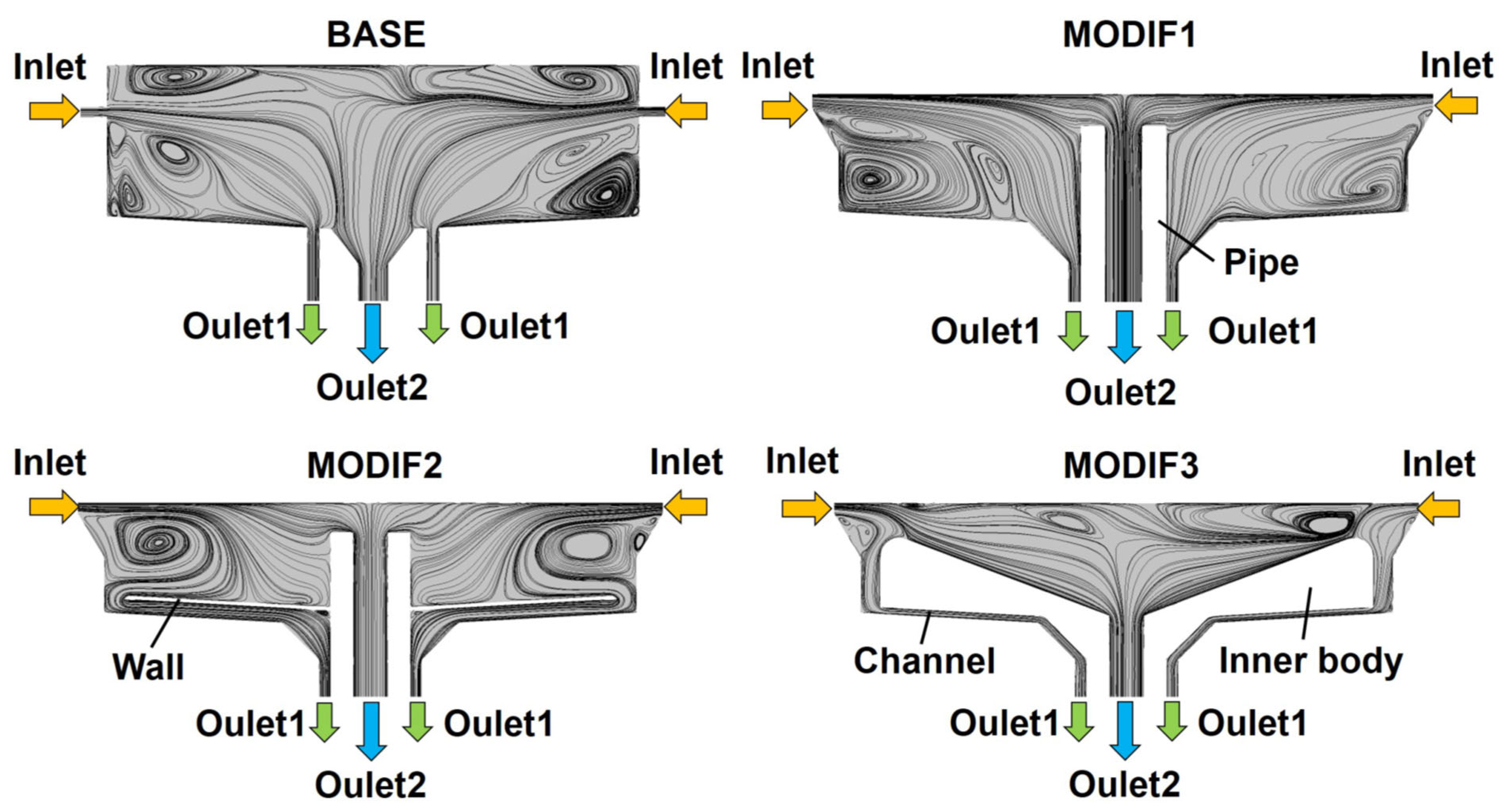
In the baseline version BASE, the sand and water mixture is fed radially through the incoming ring in the upper half of the facility—see Figure 2. The sand, as the denser component, moves along the outer wall. Two outlets are provided: one for sand (with a ring-shaped section with a radius of 0.209 m) and one for water (with a radius of 0.118 m). It is observed that in the base version, there are numerous vortices that consume part of the fluid’s energy. This energy dissipates due to the high losses from the high velocity at the precipitator’s outlet. This shows that the BASE design is unsuitable, as the sand particles encounter a wall of rotating water (the vortex in the lower half is visible). In reality, these particles cannot exit through the precipitator’s outlet.
In Modification 1 (MODIF1), a pipe-in-pipe element is used. Water flows from the central part, which is larger in diameter, while the water–sand mixture flows from the ring- shaped cross-section pipe. In this configuration, numerous vortices are still observed. They consume the fluid’s energy in order to exist within the volume of the precipitator. When the water–sand mixture is introduced, a conical shape is created to help direct the sand mass toward the outer wall. Ultimately, the sand fails to exit through the ring-shaped section outlet in the lowest part of the precipitator due to the vortices that are generated. This configuration also turned out to be ineffective.
In Modification 2 (MODIF2), an additional wall (a double bottom) was introduced under which the sand can flow and be directed toward the outlet. The height of this channel should not be too small because it is necessary to allow enough water to pass through along with the sand. These aids pushing the solid particles toward the outlet. However, the presence of vortices once again indicates an inefficient design from a hydrodynamic perspective. This configuration also fails to meet the requirements for an efficient precipitator.
From the presented design options so far, it is clear that the structure needs to be modified in such a way that the vortices are either removed or weakened. One of the approaches suggested in this study is to introduce an additional body inside the structure. What shape should it have? The process of searching for the appropriate shape is not presented in the report. The idea being implemented is to direct the water–sand mixture toward channels of a specific size and shape, while taking into account the specifics of the two-phase flow.
In Modification 3 (MODIF3), an additional body is introduced inside the precipitator. This body is hollow and its purpose is to direct the water–sand mixture toward the two outlets in the lowest part of the system. This body should have the simplest possible shape to avoid complicating the assembly and increasing manufacturing costs; thus, it should not raise the cost of the precipitator. The sand, which has a smaller mass flow rate than the water, is directed toward a vertical ring-shaped channel along the outer wall, allowing it to move in a straight line with minimal resistance. At the end of the vertical channel, a large inlet area (1.108 m2) is provided, resulting in low local losses. The sand–water mixture then curves and is directed into a conical-shaped channel towards the bottom of the precipitator. In this case, the movement is centripetal, and the channel has a decreasing cross-section toward the outlet. Capturing the sand at the beginning, at the inlet of the precipitator, is a critical moment that requires special attention (the influence of the radius R and the slope of the inlet section is discussed below). Sufficient volume is provided in the central part of the construction to drain the water without the sand. The absence of obstacles, i.e., resistance, during the movement of water in the core of the system, ensures a continuous flow of purified water.
The next goal is to analyse the impact of adding a rounding, R = 0.06 m, at the highest part of the internal body. Figure 2 shows that after the rounding a relatively small vortex is formed. It should be investigated how the size of the geometric parameter R helps improve the hydrodynamic behaviour in the settler. This configuration ensures successful sand drainage through the outlet with a ring-shaped cross-section. The precipitator is functional, but further improvements are needed for the flow around the internal body.
The calculations were carried out with a water mass flow rate of Gw = 62 kg/s and a sand mass flow rate of Gs = 1 kg/s.
  • Effect of the inlet slope γ—MODIFG:
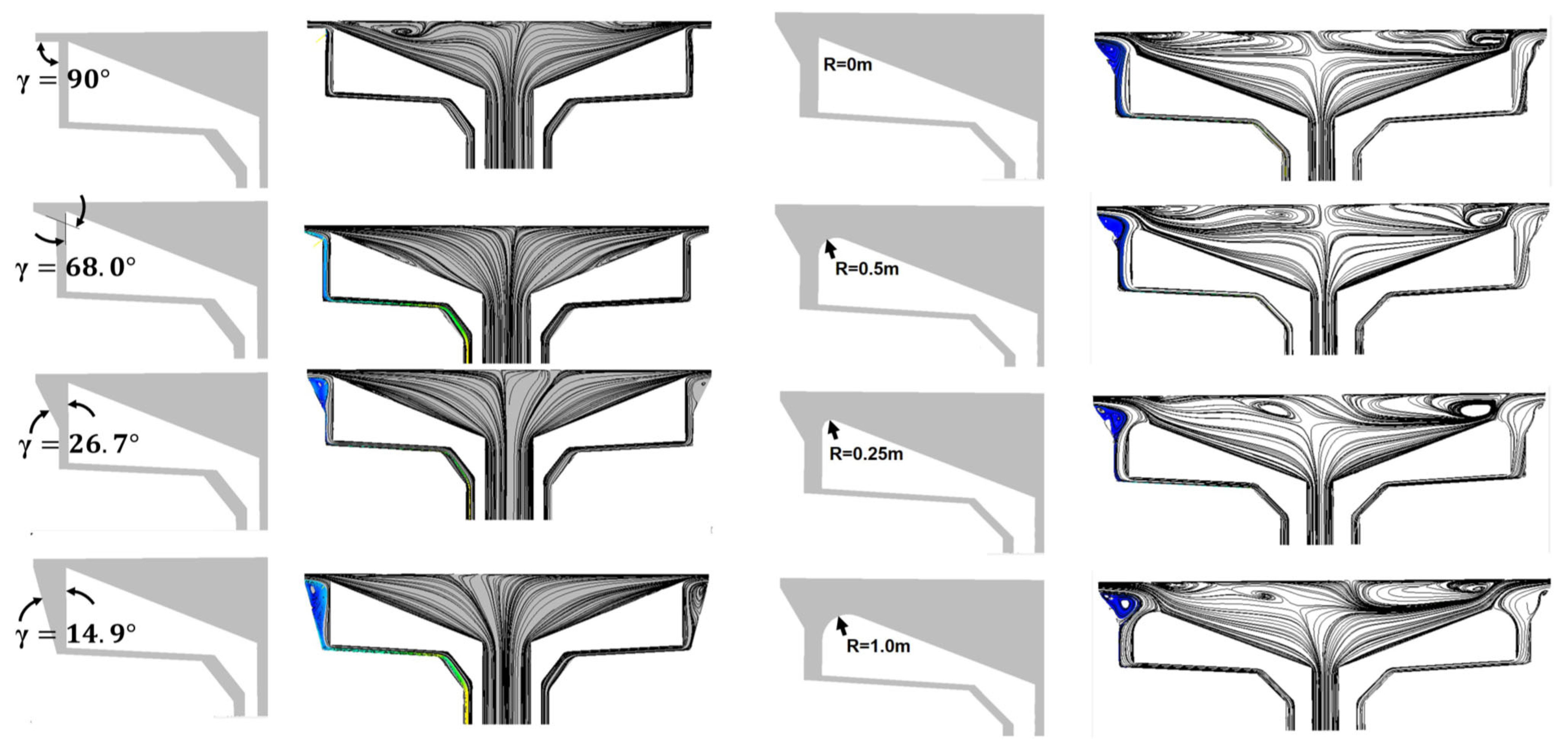
In the version with γ = 90°, vortices are formed in the upper part of the precipitator, above the inner body, which makes this design inefficient. In the versions with γ = 14.9° and γ = 26.7°, vortices are present near the inlet path where the sand descends. These vortices are shown in blue. These designs are ineffective because they slow down the sand particles and make the sedimentation process impossible.
Among the presented variants in Figure 2, the vortices in MODIF3 prove to be the smallest Comparative analysis shows that MODIF3 is the most promising for optimization in the next stage. In this configuration, the velocity of the water–sand mixture does not exceed 1 m/s, which meets the requirements for the operation of such a system [16,17,18,19,20,21]. The next question that needs to be addressed is whether it is possible to improve this configuration by eliminating the vortices in the zone above the internal body. This issue will be discussed in the next section.

2.3. Model Optimization

The next task is to develop a MODIF3 filter design, in which minimal modifications can positively affect the hydrodynamic behavior in the facility. In the created geometric model of the MODIF3 variant, the parameters of the geometric shape of the filter are introduced, such as: radius R and angle γ. The first parameter R is changed for three new designs with a rounding of the upper edge of the inner body: R = 0; 0.03 m; 0.06 m; and 0.09 m. The second parameter γ is changed in the range γ = 90°; 68°; 26.7°; and 14.9°. At the next stage, it is necessary to determine the optimal values of angle γ and radius R, at which the existing vortices are weakened. These values were introduced and the result is shown in Figure 3 for the MODIF3 variant.
Calculations show that in the design with an angle of γ = 68°, there is a significant change in the size of the vortices in the facility, and the sand flows vertically downward with an average velocity of 0.6 m/s.
  • Effect of the radius R—MODIFR:
It turns out that changing the rounding radius—or its absence—does not positively influence or eliminate the vortices in the precipitator. Vortices appear both in the inlet section and above the wall of the inner body. Their location changes. The reason is the low water velocity (around 0.2 m/s) in the diffused section. Due to the low kinetic energy and the increasing cross-sectional area, the fluid separates or forms recirculating flows, which create the conditions for the vortex formation.
In the design variants with the optimal values—radius R = 0 m and, in the second set of calculations, with an inlet slope of γ = 68°—the large vortex structures are weakened and reduced in size.

3. Results and Discussion

3.1. Optimized Design

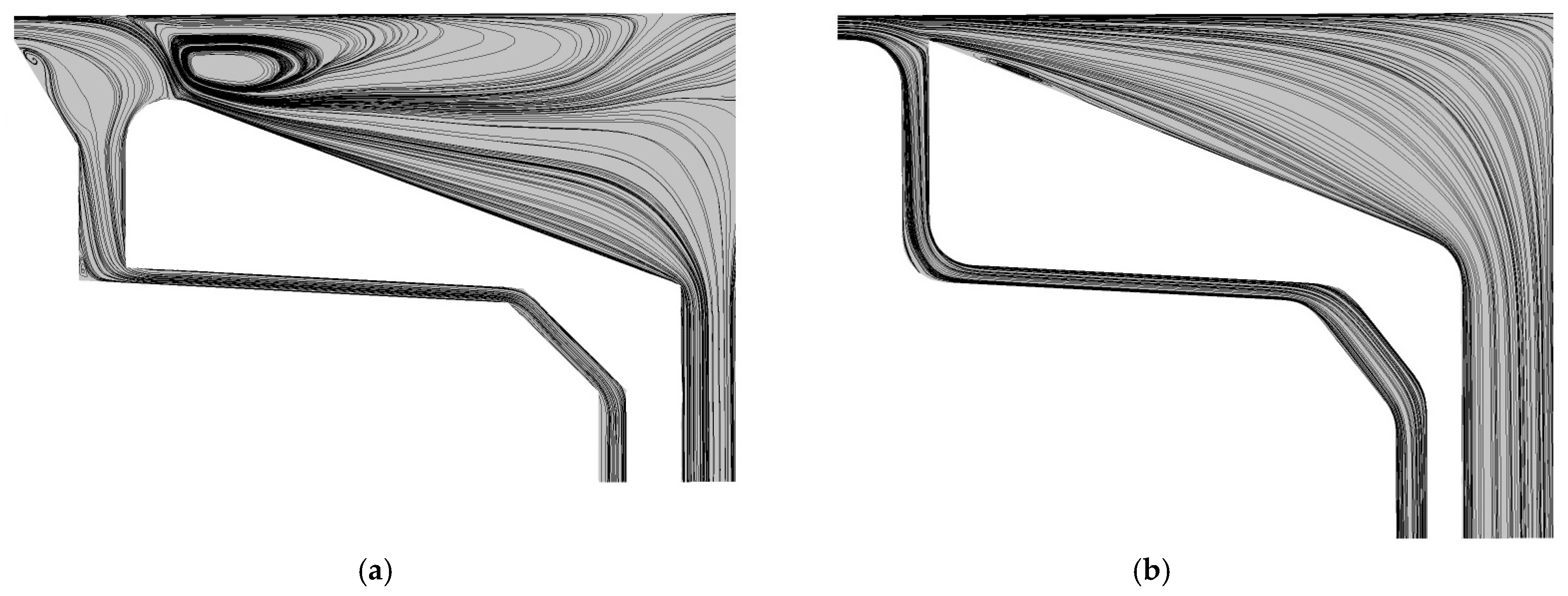
From the options examined above, two designs stood out with noticeably improved hydrodynamic flow characteristics. These were combined into the FINAL design by introducing the following modification: rounding is added at the inlet of the water–sand mixture, and the rounding at the highest part of the inner body is removed. In this way, the beneficial effect of the inlet slope angle γ = 68° is taken into account. The presence of a sharp edge (R = 0 m) in the FINAL design is a more suitable option compared to the MODIF3R modification with a variable rounding radius R. The reason is that under the given outflow conditions in the FINAL design, the vortex is pressed against the wall of the inner body and is very small in size, which improves the flow pattern in the precipitator—see Figure 4b FINAL. The same figure also shows the additionally introduced rounding’s with R = 0.06 m (at all sharp edges), which form channels where the sand can run. This further reduces local flow resistances.
In summary, in the FINAL version, the inlet is shaped so that the top of the inner body is designed with a sharp edge, slope γ = 68°, and with a rounded inlet. In this configuration, no vortex is generated that would consume the energy of the moving fluid. The FINAL design, as modelled, is now ready to be tested with varying quantities of water and sand.
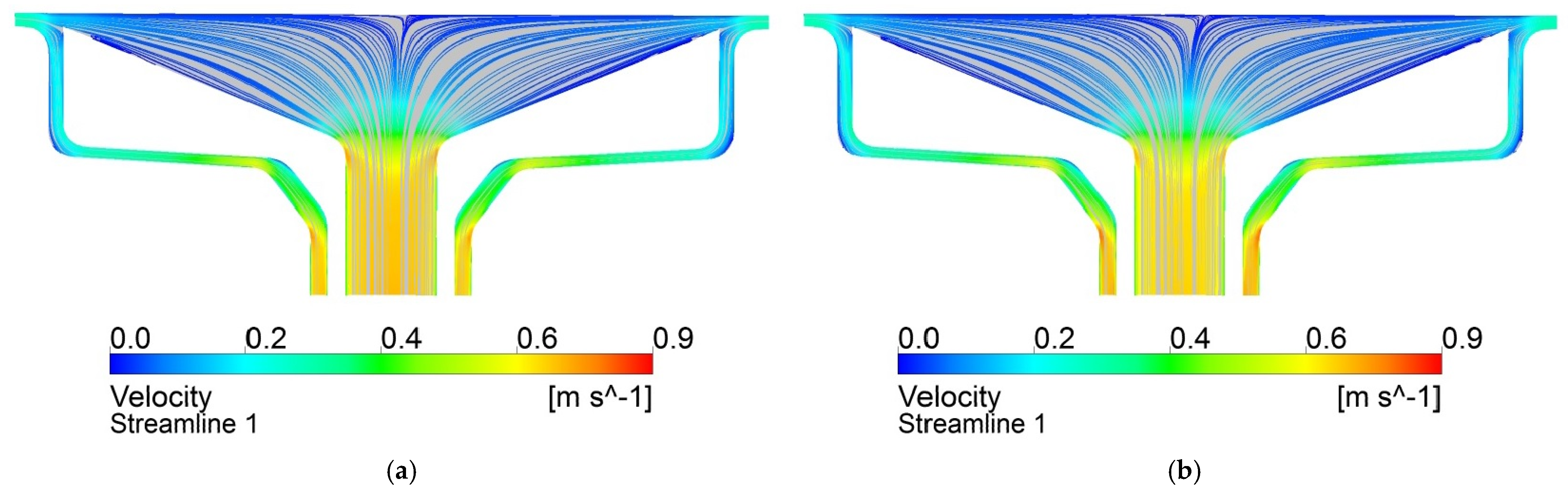
Figure 5 presents streamlines showing the changes in the water flow velocities. In the CFX-Pre-module, the mass flow rate of the water was set to Gw = 62 kg/s, and for the sand: Gs = 1 kg/s, and in another simulation—Gw = 62 kg/s and Gs = 3 kg/s.
Additionally, flow velocities lower than 1 m/s were achieved, and there was unification in the following: the velocity field of the sand in the outlet section of the settler, and the purity of the water exiting through the central outlet.

3.2. Testing in Different Operation Modes

When a sand flow rate above 5 kg/s is set, a deterioration in the convergence of the computational process is observed, which leads to a blockage of the process within the facility. Under these conditions, the water flow rate is not changed in order to meet the requirement for maintaining low velocities in the precipitator. The water content in the channel filled with sand is of particular importance for ensuring proper drainage [22,23]. The model represents a plane with 250 streamlines projected within it. This method of visualization allows for an analysis of the influence of the proposed shape of the inner body on the vortex formation in the two-phase mixture. The analysis of the flow surrounding the inner body with the proposed shape shows that the water flow does not separate from the walls, and consequently, no vortices are formed. It is evident from the figure that the flow velocities do not exceed 0.9 m/s.
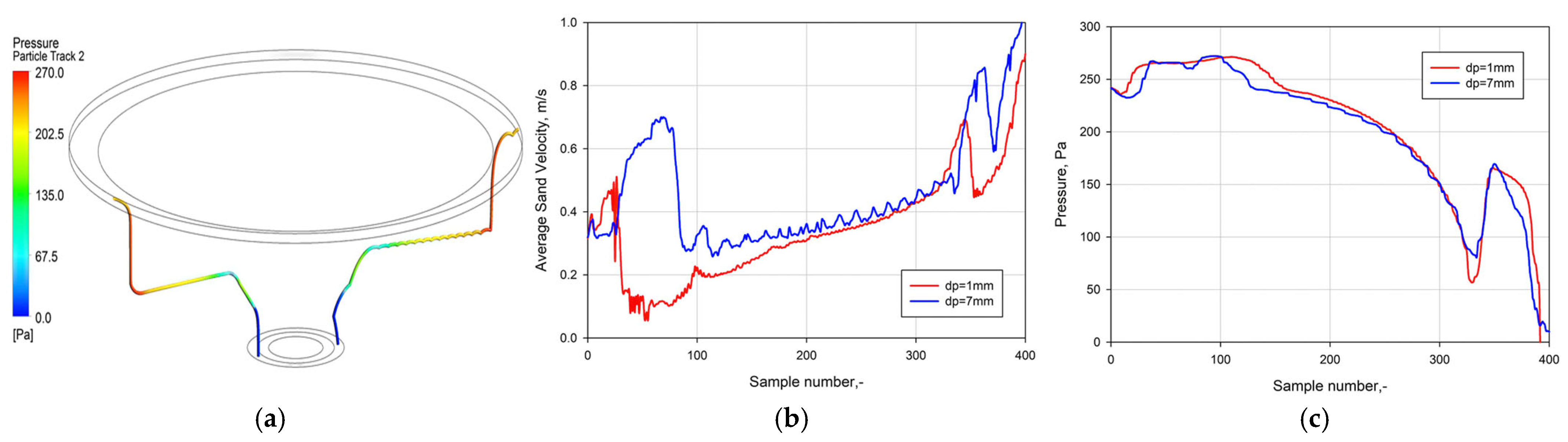
So far, a qualitative representation of the movement of the two-component mixture has been presented. With the developed model, it is also possible to perform a quantitative assessment by extracting the data of interest. As long as the fluid is concerned, the trajectory of all sand particles can be calculated, but this would complicate the analysis. Therefore, two randomly selected particles with sizes of 1 mm and 7 mm are chosen, and their motion within the fluid is visualized. In the CFX-Post module, the trajectory is displayed using a single monochrome colour. The module also allows for visualization of how the static pressure acting on the particles mentioned above changes during their movement from the inlet to the outlet of the precipitator.
Figure 6 shows the change in the average velocity of the sand particles with sizes of 1 mm and 7 mm.
In addition to the effects described above, the sand particles are also influenced by the action of inertial forces, collisions with the walls, turbulent dispersion force, rotation system force, added mass force, etc. However, the simulation does not take into account the buoyancy force, since the temperature of the mixture in the facility is assumed to remain constant during operation—that is, no heat is added to or removed from the precipitator.
Additionally, the data obtained using the SST (Shear Stress Transport) turbulence model for pressure and sand velocity were analysed and compared.
As the sand-and-water particles move toward the outlet of the facility, the cross-sectional area decreases, which leads to an increase in the velocity of both water and sand (Figure 5 and Figure 6b). On the other hand, this results in a decrease in the static pressure (Figure 6a,b). The transition from the inclined bottom to the final vertical section is accompanied by a pressure increase through the curvature, which we modelled with a rounded shape.
The average velocity of the sand is higher for the 7 mm particle compared to the 1 mm particle (Figure 6c). This aligns with relation (2), according to which larger and heavier particles will have a higher settling velocity wp.

4. Conclusions

For large precipitator dimensions, the sand particles must travel long distances, which, due to high friction forces, leads to a reduction in their kinetic energy and eventually to their stoppage. Therefore, reducing the size of the precipitator could allow for operation without the need for additional pumps.
In the present study, no external energy is supplied to the precipitator to drive or accelerate the sedimentation process. The system relies solely on gravitational force to move the sand toward the outlet. Any linear and/or local resistances are undesirable.
The water vortex in the baseline (BASE) design obstructs the movement of sand toward the outlet, and therefore it must be eliminated. This is achieved by designing an appropriate shape of the walls of the precipitator.
The introduction of an internal body with a carefully selected shape leads to an improved flow pattern within the facility. The vortex structures are reduced in size, and in some areas of the fluid, they disappear entirely. Adding such a hollow body inside the settler reduces the overall weight of the structure, although it is more complex to manufacture. The reduced water volume during operation also lessens the load on the supporting structure.
Adding an inlet slope when introducing the water–sand mixture into the facility is a positive modification, as it directs the sand vertically and facilitates its discharge.
The shape and the position of the internal body ensure a mass flow rate of the exiting clean water that corresponds to half of the mass flow entering the precipitator. This configuration allows for an even distribution of water into the core of the precipitator, while also providing sufficient water to transport the sand toward the outlet via a separate channel, in which flow resistance is overcome.
The addition of a rounded edge is not a good design solution for this type of precipitator configuration. It results in the generation of vortices, which hinder the separation and discharge of sand.
The motion of the sand particles is centripetal, meaning that the cross-sectional area of the channel in the direction of the precipitator outlet decreases. This leads to an increase in the velocity of the water–sand mixture. The increasing kinetic energy of the mixture provides the necessary energy to overcome resistance in the outlet section. However, excessively high velocity would increase the resistance in the outlet channel. An average discharge velocity of around 0.35 m/s is considered optimal for these dimensions and for a mass flow rate of Gw = 62 kg/s and Gp = 1 kg/s.
The cross-sectional area in the radial channel beneath the internal body decreases from 1.108 m2 to 0.058 m2. As a result:
  • the velocity of the water increases from 0.26 to 0.58 m/s;
  • the pressure decreases from 240 to 90 Pa;
  • the velocity of the sand increases from 0.15 to 0.43 m/s.
The analysis presented in this report allows the recommendations above to be applied, but only for a precipitator with the specified dimensions and design. When scaling up, the flow pattern changes, and new recommended values for sand flow rate must be determined.

Author Contributions

Conceptualization, A.B. and A.Y.; methodology, A.Y.; software, S.T.; validation, A.Y.; formal analysis, A.Y.; investigation, A.B.; resources, A.A.; data curation, A.Y.; writing—original draft preparation, A.B.; writing—review and editing, A.Y.; visualization, S.T.; supervision, A.B.; project administration, A.A.; funding acquisition, A.B. and S.T. All authors have read and agreed to the published version of the manuscript.

Funding

The study was partially funded by the scientific research project NP7/2025 “Research and comparative analysis of power/working machines with elements of complex three-dimensional shape” at the Technical University of Varna, funded specifically by the state budget. We thank the entire project team and its leader for the data processing and visualization activities. The authors thank their university colleagues for their assistance.

Institutional Review Board Statement

Not applicable.

Informed Consent Statement

Informed Consent Statement: Informed consent was obtained from all subjects involved in the study.

Data Availability Statement

The data presented in this study is available on request from the corresponding authors.

Conflicts of Interest

The authors declare no conflicts of interest.

References

  1. Hoseini, S.; Najafi, G.; Ghobadian, B.; Akbarzadeh, A. Impeller shape-optimization of stirred-tank reactor: CFD and fluid structure interaction analyses. Chem. Eng. J. 2021, 413, 127497. [Google Scholar] [CrossRef]
  2. Tamburini, A.; Gagliano, G.; Micale, G.; Brucato, A.; Scargiali, F.; Ciofalo, M. Direct numerical simulations of creeping to early turbulent flow in unbaffled and baffled stirred tanks. Chem. Eng. Sci. 2018, 192, 161–175. [Google Scholar] [CrossRef]
  3. Neria, I.; Alonzo-Garcia, A.; Martínez-Delgadillo, S.; Mendoza-Escamilla, V.; Yáñez-Varela, J.; Verdin, P.; Rivadeneyra-Romero, G. PIV and dynamic LES of the turbulent stream and mixing induced by a V-grooved blade axial agitator. Chem. Eng. J. 2019, 374, 1138–1152. [Google Scholar] [CrossRef]
  4. Saikali, E.; Rodil, M.; Bois, G.; Bieder, U.; Leterrier, N.; Bertrand, M.; Dolias, Y. Validation of the hydrodynamics in a turbulent un-baffled stirred tank: A necessity for vortex-reactor precipitation studies. Chem. Eng. Sci. 2020, 214, 115426. [Google Scholar] [CrossRef]
  5. Zhao, Z.; Chen, F.; Liu, J.; Liu, Q.; Hou, Y.; Yang, N.; Xie, G. Numerical Simulation Study of Gas-Liquid Two-Phase Flow in a Pressurized Leaching Stirred Tank. Processes 2024, 12, 896. [Google Scholar] [CrossRef]
  6. Li, L.; Xu, B. CFD simulation of hydrodynamics characteristics in a tank with forward-reverse rotating impeller. J. Taiwan Inst. Chem. Eng. 2022, 131, 104174. [Google Scholar] [CrossRef]
  7. Perret, Y. Hydrodynamics of Hydrate Slurries in Prepicipators Application to Precipitators Design. In Essential Readings in Light Metals; Donaldson, D., Raahauge, B.E., Eds.; Springer: Cham, Switzerland, 2016; pp. 559–562. [Google Scholar] [CrossRef]
  8. Schmid, H.J.; Stolz, S.; Buggisch, H. On the Modelling of the Electro-Hydrodynamic Flow Field in Electrostatic Precipitators. Flow Turbul. Combust. 2002, 68, 63–89. [Google Scholar] [CrossRef]
  9. Schmid, H.J. On the modelling of the particle dynamics in electro-hydrodynamic flow fields: II. Influences of inhomogeneities on electrostatic precipitation. Powder Technol. 2003, 135–136, 136–149. [Google Scholar] [CrossRef]
  10. Soldati, A. On the effects of the electrohydrodynamic flows and turbulence on aerosol transport and collection in wire-plate electrostatic precipitators. J. Aerosol Sci. 2000, 31, 293–305. [Google Scholar] [CrossRef]
  11. Nepf, H. Conceptual Model of Diffusion. Transport Processes in the Environment, Lecture Notes MIT OpenCourseWare: 2008. Available online: https://ocw.mit.edu/courses/1-061-transport-processes-in-the-environment-fall-2008/pages/lecture-notes/1-anim/ (accessed on 30 September 2025).
  12. Ansys CFX-Solver Manager User’s Guide; Simulate the Future; ANSYS, Inc.: Canonsburg, PA, USA, 2021; pp. 1–209.
  13. ANSYS CFX Tutorials, Release 18.0; Ansys CFX, Computational Fluid Dynamics (CFD) Software: Canonsburg, PA, USA, 2017; pp. 1–1052.
  14. Patankar, N.A.; Joseph, D.D. Modeling and numerical simulation of particulate flows by the Eulerian–Lagrangian approach. Int. J. Multiph. Flow 2001, 27, 1659–1684. [Google Scholar] [CrossRef]
  15. Ebrahimi, M.; Tamer, M.; Villegas, R.; Chiappetta, A.; Mozaffari, F. Application of CFD to Analyze the Hydrodynamic Behaviour of a Bioreactor with a Double Impeller. Processes 2019, 7, 694. [Google Scholar] [CrossRef]
  16. Liu, X.; García, M. Computational fluid dynamics modeling for the design of large primary settling tanks. J. Hydraul. Eng. 2011, 137. [Google Scholar] [CrossRef]
  17. Georgieva, V. Generalized Network Modeling of Water Purification Processes; Bulgarian Academy of Sciences, Institute of Biophysics and Biomedical Engineering: Sofia, Bulgaria, 2017; pp. 1–46. [Google Scholar]
  18. Arsov, R.; Draganov, D.; Kostova, I.; Koleva-Simeonova, M. Design of Wastewater Treatment Plants; Tehnika Publishing House: Sofia, Bulgaria, 2017; pp. 1–840. [Google Scholar]
  19. Bankova, A.; Yangyozov, A.; Tenev, S.; Atanasov, A. Simulation of a Two-Phase Fluid Flow in a Design Solution of a Secondary Radial Settling Tank for Wastewater Treatment. Eng. Proc. 2025, 104, 21. [Google Scholar] [CrossRef]
  20. Toneva, D.; Dimitrova, D. Some Aspects of the Water Crisis in Bulgaria. In Environment. Technology. Resources. Rezekne, Latvia, Proceedings of the 15th International Scientific and Practical Conference; Rezekne Academy of Technologies: Rēzekne, Lettland, 2024; Volume I, pp. 373–377. [Google Scholar] [CrossRef]
  21. Nikolova, N.; Toneva, D.; Tsonev, Y.; Burgess, B.; Tenekedjiev, K. Novel Methods to Construct Empirical CDF for Continuous Random Variables using Censor Data. In Proceedings of the 2020 IEEE 10th International Conference on Intelligent Systems (IS), Varna, Bulgaria, 28–30 August 2020; pp. 61–68. [Google Scholar] [CrossRef]
  22. Song, S.; Le-Clech, P.; Shen, Y. Microscale fluid and particle dynamics in filtration processes in water treatment: A review. Water Res. 2023, 233, 119746. [Google Scholar] [CrossRef] [PubMed]
  23. Allam, A.N.; Ben-Mansour, R.; Habib, M.A. Computational Fluid Dynamics of Wastewater Treatment Using Sand Filter. In Proceedings of the 2024 IEEE Sustainable Power and Energy Conference (iSPEC), Kuching, Sarawak, Malaysia, 24–27 November 2024; pp. 309–314. [Google Scholar] [CrossRef]
Figure 1. General view of the radial precipitator in cross section.
Engproc 122 00012 g001
Figure 2. Surface streamlines designed in a plane for variants BASE, MODIF1, MODIF2, MODIF3.
Engproc 122 00012 g002
Figure 3. Changes in the geometric shape of elements of the precipitator and the influence it has on the formation of vortices.
Engproc 122 00012 g003
Figure 4. Streamlines picture in a structure with modification MODIF3R (a), compared to the final version FINAL (b).
Engproc 122 00012 g004
Figure 5. Streamlines pattern with changing water velocity MODIF3R (a), compared to the final version FINAL (b).
Engproc 122 00012 g005
Figure 6. Trajectory of a 1 mm and 7 mm sand particle with visualization of static pressure and sand velocity—(a,b) decrease in the static pressure, (c) the average velocity of the sand.
Engproc 122 00012 g006
Table 1. Geometric Dimensions of The Precipitator.
NameValue
Height, H1 m
Diameter, D2 m
Volume, V1.32–0.52 m3
Height of the inlet channel, hin0.034 m
Output area 1, Sout,10.0502062 m2
Output area 2, Sout,20.0430629 m2
Slope, β86.8°
Entrance area Sin0.206857 m2
Outlet outer diameter 1 water, Dout,20.236 m
Outer diameter. outlet 2 water and sand, Dout,10.418 m
Table 2. Physical properties of sand and water. Modelling conditions.
NameValueCondition
Sand density2300 kg/m3constant
Size1–10 mmconstant
Water density997 kg/m3constant
Mass flow rate “water”62 kg/sconstant
Mass flow rate “sand”1–10 kg/svariable
Number of particles200; 5000; 12,000variable
Turbulence modelk-eps; SSTvariable
Water velocity inlet 0.3 m/sconstant
Outlet pressure 10 Paconstant
Outlet pressure 20 Paconstant
Table 3. Parameters of the computational process.
NameValue
Advection schemeHigh resolution
Max iterations150
Convergence criteria RMS residual target1 × 105
Max. Particle Intg. Time Step1 × 1010 s
Particle Termination Control Maximum Tracking Time10 s
Maximum Tracking Distance10 m
Max.num. Integration steps1000
Disclaimer/Publisher’s Note: The statements, opinions and data contained in all publications are solely those of the individual author(s) and contributor(s) and not of MDPI and/or the editor(s). MDPI and/or the editor(s) disclaim responsibility for any injury to people or property resulting from any ideas, methods, instructions or products referred to in the content.