

Dynamic Random-Access Memory and Non-Volatile Memory Allocation Strategies for Container Tasks †
Abstract
1. Introduction
2. Container Task Scheduling
2.1. System Model and Problem Definition
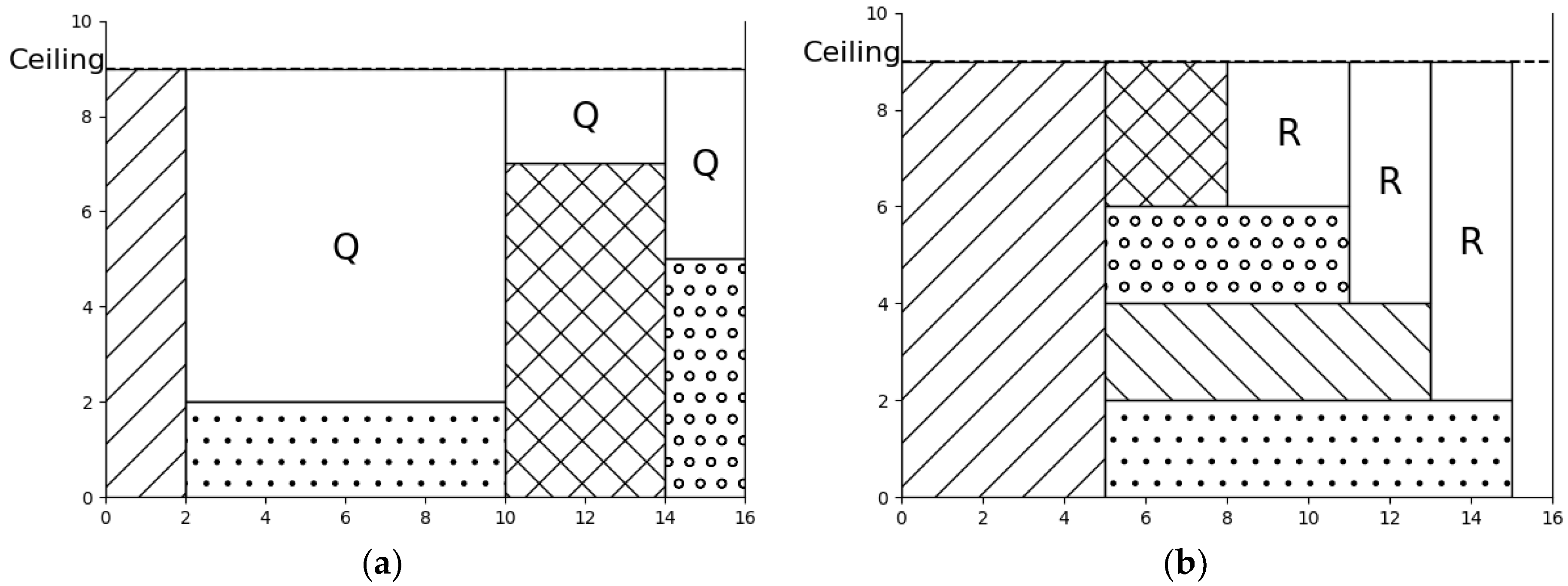
2.2. Level-Approach Task Scheduling with Memory and Computing Resource Constraints
| Algorithm 1: Level-Approach Task Scheduling onto Computing Units with DRAM Allocation |
 |
| Algorithm 2: Monotonic Stacking Scheme for Task Scheduling in a Region |
 |
2.3. Recursive Strategy for Using Remaining Regions of Computing and Memory Resources
2.4. Overall Scheme for Managing DRAM, NVM, and Computing Units
| Algorithm 3: Container-based Heterogeneous Rsources Scheduling (CHRS) |
 |
3. Performance Evaluation
3.1. Environment Setup and System Configuration
3.2. Evaluated Solutions
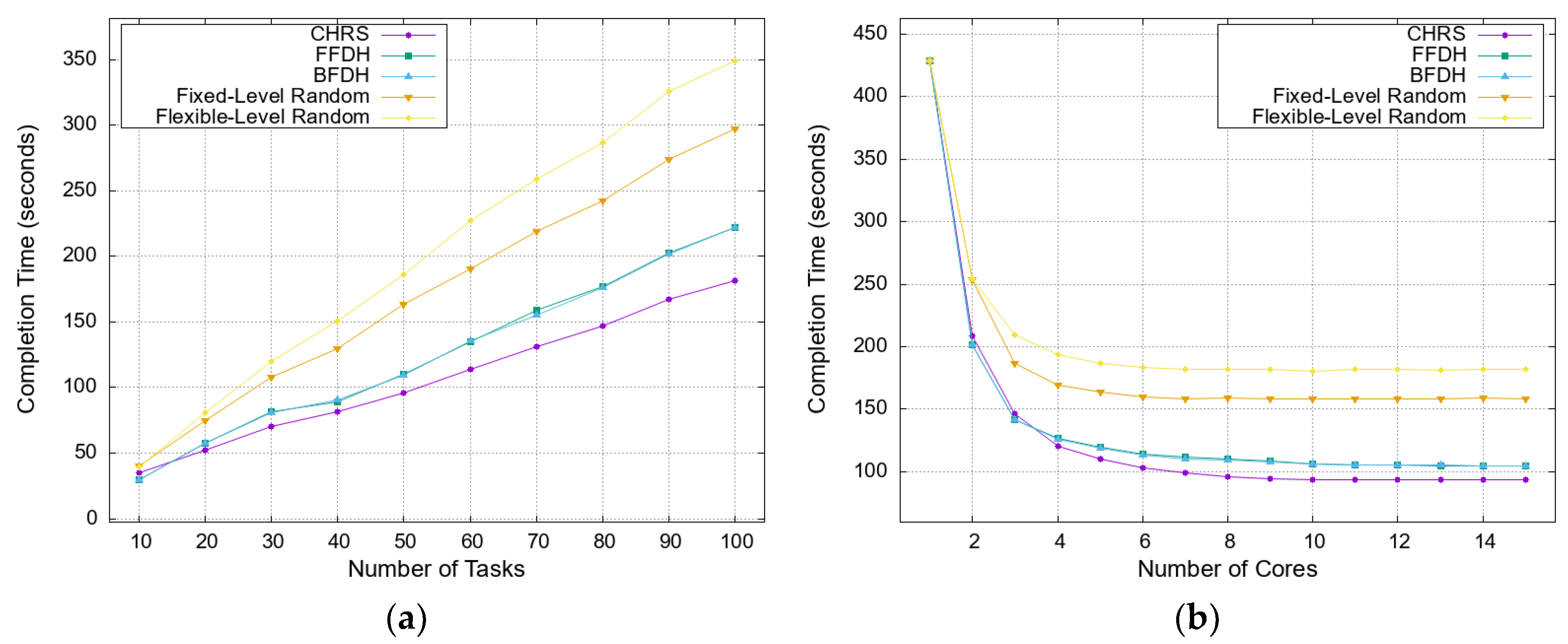
- CHRS: This is the proposed solution of this paper, where Algorithm 3 balances the loading on heterogeneous memory and uses Algorithms 1 and 2 for the task scheduling on DRAM for the overall Makespan reduction.
- First-fit decreasing height (FFDH): This solution sorts all tasks in a non-increasing order of their heights (the execution time with DRAM) and schedules tasks one by one. We modified the original FFDH to account for both the DRAM size and the number of cores. It schedules a task to a level in a first-fit fashion. If there is no feasible level to accommodate a new task, a new level is created for the task.
- Best-fit decreasing height (BFDH): The behavior of BFDH is similar to FFDH. The difference is that BFDH selects the level with the minimum remaining DRAM space from all feasible levels for accommodating a new task.
- Fixed-level random: This solution randomly selects a task and tries all levels one by one to schedule the task into a level with enough remaining DRAM space and cores to accommodate the task, and where the height of the task is not greater than the height of the level. If there is no feasible level, a new level is created to accommodate the task, and the height of the level is equal to the height of the task.
- Flexible-level random: This solution is similar to fixed-level random. The difference is that this solution can assign a task to an existing level even though the task is higher than the level. In this case, the ceiling of the level is extended to the height of the task.
3.3. Results
4. Conclusions
Author Contributions
Funding
Institutional Review Board Statement
Informed Consent Statement
Data Availability Statement
Conflicts of Interest
References
- Chhajer, S.; Thyagaturu, A.S.; Yatavelli, A.; Lalwaney, P.; Reisslein, M.; Raja, K.G. Hardware accelerations for container engine to assist container migration on client devices. In Proceedings of the IEEE International Symposium on Local and Metropolitan Area Networks, Orlando, FL, USA, 13–15 July 2020. [Google Scholar]
- Xu, X.; Yu, H.; Pei, X. A novel resource scheduling approach in container based clouds. In Proceedings of the IEEE 17th International Conference on Computational Science and Engineering, Chengdu, China, 19–21 December 2014. [Google Scholar]
- Aliyun. Alibaba Cloud Container Compute Service. 2024. Available online: https://www.alibabacloud.com/en?_p_lc=1 (accessed on 1 July 2024).
- Amazon. Amazon EC2 Container Service. Available online: https://aws.amazon.com/ecs/ (accessed on 1 July 2024).
- Microsoft. Azure Container Service. 2024. Available online: https://azure.microsoft.com/en-us/services/container-service/ (accessed on 1 July 2024).
- Bernstein, D. Containers and cloud: From LXC to Docker to Kubernetes. IEEE Cloud Comput. 2014, 1, 81–84. [Google Scholar] [CrossRef]
- Saha, P.; Govindaraju, M.; Marru, S.; Pierce, M.E. Integrating Apache Airavata with Docker, Marathon, and Mesos. Concurr. Comput. Pract. Exp. 2016, 28, 1952–1959. [Google Scholar] [CrossRef]
- Cérin, C.; Menouer, T.; Saad, W.; Abdallah, W.B. A new Docker Swarm scheduling strategy. In Proceedings of the IEEE International Symposium on Cloud and Service Computing, Kanazawa, Japan, 22–25 November 2017. [Google Scholar]
- Vieux, V.; Luzzardi, A.; Totla, N.; Chen, D.; Xian, J.; Beslic, A.; Kaewkasi, C.; Sun, A.; Prasad, A.; Firshman, B.; et al. Classic Swarm: A Docker Native Clustering System. 2018. Available online: https://github.com/docker-archive/classicswarm (accessed on 1 July 2024).
- Muniswamy, S.; Vignesh, R. Dsts: A hybrid optimal and deep learning for dynamic scalable task scheduling on container cloud environment. J. Cloud Comput. 2022, 11, 33. [Google Scholar] [CrossRef]
- Tang, B.; Luo, J.; Obaidat, M.S.; Vijayakumar, P. Container-based task scheduling in cloud-edge collaborative environment using priority aware greedy strategy. Clust. Comput. 2023, 26, 3689–3705. [Google Scholar] [CrossRef]
- Zhu, L.; Huang, K.; Fu, K.; Hu, Y.; Wang, Y. A priority-aware scheduling framework for heterogeneous workloads in container-based cloud. Appl. Intell. 2023, 53, 15222–15245. [Google Scholar] [CrossRef]
- Spillner, J. Resource management for cloud functions with memory tracing, profiling and autotuning. In Proceedings of the 6th International Workshop on Serverless Computing, Delft, The Netherlands, 7–11 December 2020. [Google Scholar]
- Mao, Y.; Oak, J.; Pompili, A.; Beer, D.; Han, T.; Hu, P. DRAPS: Dynamic and resource-aware placement scheme for Docker containers in a heterogeneous cluster. In Proceedings of the IEEE 36th International Performance Computing and Communications Conference, San Diego, CA, USA, 10–12 December 2017. [Google Scholar]
- Azab, A. Enabling docker containers for high-performance and many task computing. In Proceedings of the IEEE International Conference on Cloud Engineering, Vancouver, BC, Canada, 4–7 April 2017. [Google Scholar]
- Torre, R.; Urbano, E.; Salah, H.; Nguyen, G.T.; Fitzek, F.H.P. Towards a better understanding of live migration performance with Docker containers. In Proceedings of the 25th European Wireless Conference, Aarhus, Denmark, 2–4 May 2019. [Google Scholar]
- Intel. Intel Optane DC Persistent Memory. 2020. Available online: https://www.intel.com/content/www/us/en/architecture-and-technology/optane-dc-persistent-memory.html (accessed on 1 July 2024).
- Wu, K.; Huang, Y.; Li, D. Unimem: Runtime data management on non-volatile memory-based heterogeneous main memory. In Proceedings of the International Conference for High Performance Computing, Networking, Storage and Analysis, Denver, CO, USA, 12–17 November 2017. [Google Scholar]
- Zhao, X.; Challa, P.; Zhong, C.; Jiang, S. Developing index structures in persistent memory using spot-on optimizations with dram. In Proceedings of the 15th ACM/SPEC International Conference on Performance Engineering, London, UK, 7–11 May 2024. [Google Scholar]
- Raybuck, A.; Stamler, T.; Zhang, W.; Erez, M.; Peter, S. Hemem: Scalable tiered memory management for big data applications and real NVM. In Proceedings of the ACM SIGOPS 28th Symposium on Operating Systems Principles, Virtual, 26–29 October 2021. [Google Scholar]
- Klinkenberg, J.; Kozhokanova, A.; Terboven, C.; Foyer, C.; Goglin, B.; Jeannot, E. H2m: Exploiting heterogeneous shared memory architec tures. Future Gener. Comput. Syst. 2023, 148, 39–55. [Google Scholar] [CrossRef]
- Chhetri, N. A Comparative Analysis of Node.js (Server-Side Javascript). Master’s Thesis, St. Cloud State University, St. Cloud, MI, USA, 2016. [Google Scholar]
- de Carvalho, L.R.; de Ara’ujo, A.P.F. FaaS-oriented node.js applications in an RPC approach using the node2faas framework. IEEE Access 2023, 11, 112027–112043. [Google Scholar] [CrossRef]



| Item | Specification |
|---|---|
| Operating system | Red Hat Enterprise Linux 9.0 |
| Kernel version | 5.14.0-70.30.1.el9_0.x86_64 |
| Container | Podman 4.1.1 |
| Processor | Intel Xeon Gold 6240 CPU @ 2.60GHz |
| Memory | 32 GB DDR4 DRAM 512 GB Intel Optane DC persistent memory |
Disclaimer/Publisher’s Note: The statements, opinions and data contained in all publications are solely those of the individual author(s) and contributor(s) and not of MDPI and/or the editor(s). MDPI and/or the editor(s) disclaim responsibility for any injury to people or property resulting from any ideas, methods, instructions or products referred to in the content. |
© 2026 by the authors. Licensee MDPI, Basel, Switzerland. This article is an open access article distributed under the terms and conditions of the Creative Commons Attribution (CC BY) license (https://creativecommons.org/licenses/by/4.0/).
Share and Cite
Chang, C.-W.; Ho, C.-Y. Dynamic Random-Access Memory and Non-Volatile Memory Allocation Strategies for Container Tasks. Eng. Proc. 2025, 120, 68. https://doi.org/10.3390/engproc2025120068
Chang C-W, Ho C-Y. Dynamic Random-Access Memory and Non-Volatile Memory Allocation Strategies for Container Tasks. Engineering Proceedings. 2025; 120(1):68. https://doi.org/10.3390/engproc2025120068
Chicago/Turabian StyleChang, Che-Wei, and Chen-Yu Ho. 2025. "Dynamic Random-Access Memory and Non-Volatile Memory Allocation Strategies for Container Tasks" Engineering Proceedings 120, no. 1: 68. https://doi.org/10.3390/engproc2025120068
APA StyleChang, C.-W., & Ho, C.-Y. (2025). Dynamic Random-Access Memory and Non-Volatile Memory Allocation Strategies for Container Tasks. Engineering Proceedings, 120(1), 68. https://doi.org/10.3390/engproc2025120068