


Abstract
In this study, ZnO thin films were prepared on the flexible stainless steel (FSS) substrates by the sol–gel method. ZnO nanorods were then hydrothermally grown in the presence of polyvinyl pyrrolidone (PVP) to obtain polymer/nanooxide composites. The microstructure and resistive switching properties of the composites were investigated. X-ray diffraction results confirmed that the PVP-doped ZnO nanorods retained the hexagonal wurtzite structure and had a preferred (002) orientation despite a slight decrease in crystallinity. Surface morphology analysis showed that the addition of PVP resulted in an increase in the nanorod density and a more regular hexagonal structure. Electrical measurements showed a significant improvement in the resistive switching behavior, with a high-resistance state to low-resistance state (HRS/LRS) ratio of 4.67 × 10³. In addition, radiation-tolerant cyclic tests demonstrated that the polymer–oxide hybrid structure effectively buffered irradiation-induced defects, stabilized conductive filament pathways, and preserved switching reliability. These results highlight the potential of PVP-doped ZnO nanorod composites as reliable, flexible, and radiation-tolerant RRAM devices for future aerospace and high-radiation electronics applications.
1. Introduction
Resistive random-access memory (RRAM) has become a promising candidate for the next generation of non-volatile memory due to its simple metal-insulator-metal (MIM) structure, high switching speed, low power consumption, and excellent scalability [1,2,3,4,5]. Beyond conventional applications, RRAM has recently received growing interest for aerospace and nuclear electronics, where radiation-tolerant memory devices are required to maintain stable operation under ionizing radiation [6]. Among various metal oxides, zinc oxide (ZnO) has attracted much attention due to its wide bandgap (about 3.37 eV), high exciton binding energy, chemical stability, and ease of solution preparation [7,8]. In addition, its resistive switching behavior is strongly affected by intrinsic defects such as oxygen vacancies, which play a key role in regulating the conduction mechanism and switching dynamics [9,10,11].
In flexible electronic devices, integrating ZnO onto bendable substrates is crucial for the development of wearable and conformal storage devices. Flexible stainless steel (FSS) is an appropriate substrate due to its high mechanical strength, good thermal stability, and high temperature processability [12,13]. However, the crystallinity and surface morphology of the seed layer need to be strictly controlled to prepare high-quality ZnO films on FSS. Rapid thermal annealing (RTA) has been shown to effectively improve the crystallinity of the ZnO seed layer, thereby promoting the uniform growth of vertically oriented ZnO nanorods via hydrothermal synthesis [14,15]. In addition, polyvinyl pyrrolidone (PVP) is a commonly used polymer additive that can effectively improve the dispersion, particle size, and morphology of ZnO and enhance some of its properties by adsorbing on the ZnO surface [16,17].
In this study, ZnO thin films were deposited on FSS substrates by a sol–gel method, followed by RTA at different temperatures to optimize the crystallinity of the seed layer. ZnO nanorods were then grown via a hydrothermal process with and without the addition of PVP to form a hybrid polymer–oxide composite structure. The structural and optical properties of the films were characterized by X-ray diffraction (XRD). The resistive switching characteristics were evaluated to determine the effects of polymer incorporation and thermal treatment on the device performance. In addition, the radiation-tolerant cyclic tests were conducted to evaluate device stability under irradiation.
2. Experimental
The ZnO seed layer was deposited on FSS substrates using sol–gel spin coating. A 0.5 M zinc acetate dihydrate [Zn(CH3COO)2·2H2O, 99.0%, Sigma-Aldrich, St. Louis, MO, USA] solution was prepared in a 1:1 molar ratio in 2-methoxyethanol (Sigma-Aldrich, St. Louis, MO, USA) with monoethanolamine (MEA, Sigma-Aldrich, St. Louis, MO, USA) as a stabilizer. The solution was magnetically stirred at 60 °C for 1 h to ensure homogeneity. After aging for 24 h, the precursor solution was spin-coated onto ultrasonically cleaned FSS substrates at 3000 revolutions per minute (RPM) for 30 s. The coated film was pre-baked at 300 °C for 5 min to remove residual solvent. This coating and baking process was repeated 5 times to obtain a uniform coating. Finally, rapid thermal annealing (RTA) was performed at 600 °C for 5 min in air to improve crystallinity. ZnO nanorods were grown on seed-coated substrates using a low-temperature hydrothermal method. A growth aqueous solution containing 25 mM zinc nitrate hexahydrate [Zn(NO3)2·6H2O, 99.0%, Sigma-Aldrich, St. Louis, MO, USA] and 25 mM hexamethylenetetramine (HMTA, Sigma-Aldrich, St. Louis, MO, USA) was prepared. For PVP-doped samples, polyvinylpyrrolidone (PVP, Sigma-Aldrich, St. Louis, MO, USA) was added at a concentration of 1.0 g/L. The substrate was placed face down in the solution and incubated in a sealed container at 90 °C for 6 h. After the growth was completed, the sample was rinsed with deionized water and dried at 60 °C. The hydrothermal growth process was repeated once to increase the density of the nanorods.
The crystal structure and phase purity of the ZnO thin films and nanorods were analyzed by X-ray diffraction (XRD, Bruker D8 Advance, Bruker AXS GmbH, Karlsruhe, Germany) combined with Cu Kα radiation (λ = 1.5406 Å). The scanning range was 20°~60° (2θ) with a step size of 0.02°. Field emission scanning electron microscopy (FESEM, JEOL JSM-6700F, JEOL Ltd., Tokyo, Japan) was used to characterize the surface morphology and nanorod orientation. To fabricate the resistive switching element, a top aluminum (Al) electrode with a diameter of 200 μm was thermally evaporated onto the surface of the ZnO nanorods through a shadow mask to form a metal–insulator–metal (MIM) structure. The bottom electrode was an FSS substrate. The final device structure was Al/ZnO-NRs/FSS. The current–voltage (I-V) characteristics of the RRAM device were measured at room temperature using a Keithley 2400 current–voltage characterization test system. A DC voltage sweep was applied from 0 V to +5 V and then back to 0 V with a constant current limit of 1 mA to prevent permanent dielectric breakdown. The resistive switching behavior, durability, and retention performance of undoped and PVP-doped ZnO nanorod-based elements were evaluated. In addition, radiation-tolerant analysis was performed to investigate device stability under irradiation. The fabricated RRAM cells were exposed to γ-ray irradiation with total ionizing dose (TID) levels up to 300 krad(Si).
3. Result and Discussion
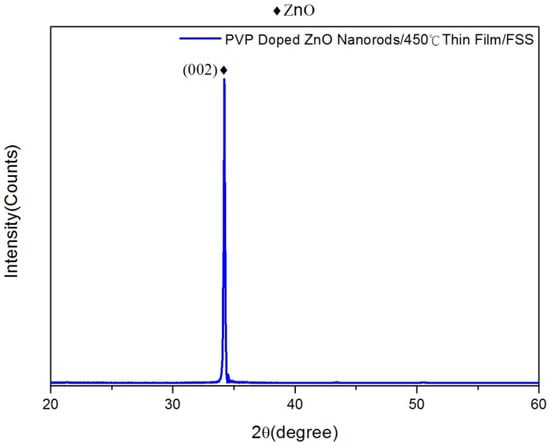
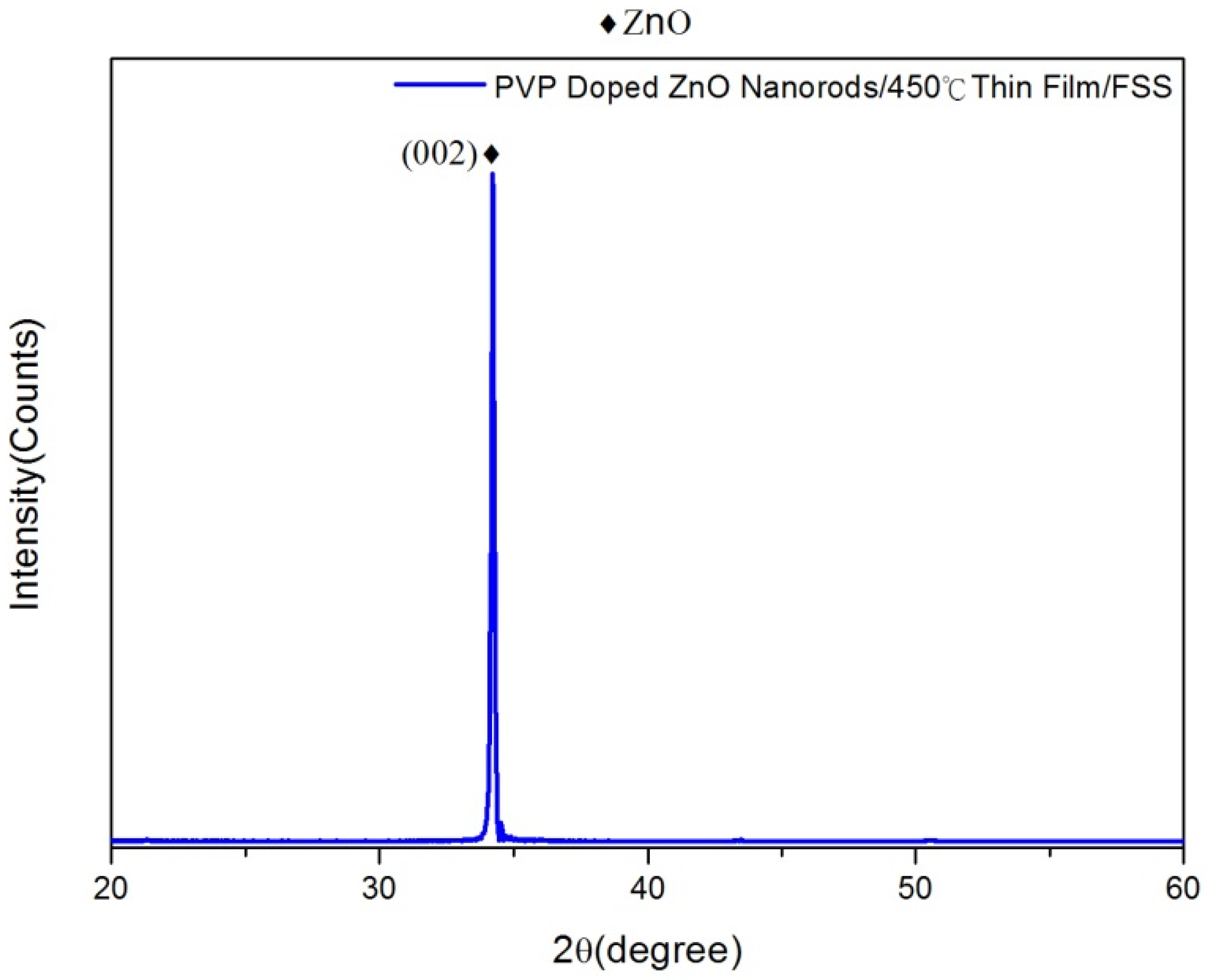
Figure 1 shows the XRD patterns of PVP-doped ZnO nanorods deposited on the FSS substrates. All samples exhibit diffraction peaks corresponding to the hexagonal wurtzite structure of ZnO (JCPDS Card No. 36-1451), with the most prominent peak located at 2θ ≈ 34.4°, which corresponds to the (002) crystallographic plane. This indicates that the ZnO nanorods are preferentially oriented along the c-axis, perpendicular to the substrate surface. The incorporation of polyvinylpyrrolidone (PVP) during the hydrothermal synthesis process. The dominant (002) orientation was preserved, confirming that vertical alignment was successfully maintained even in the presence of polymer additives.
Figure 1.
X-ray diffraction patterns of PVP-doped ZnO nanorods deposited on FSS substrates.
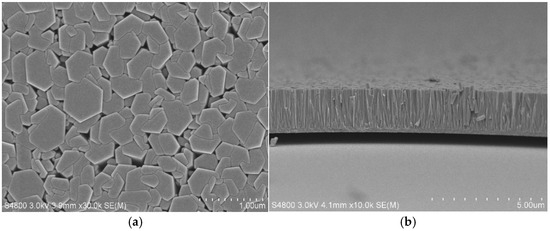
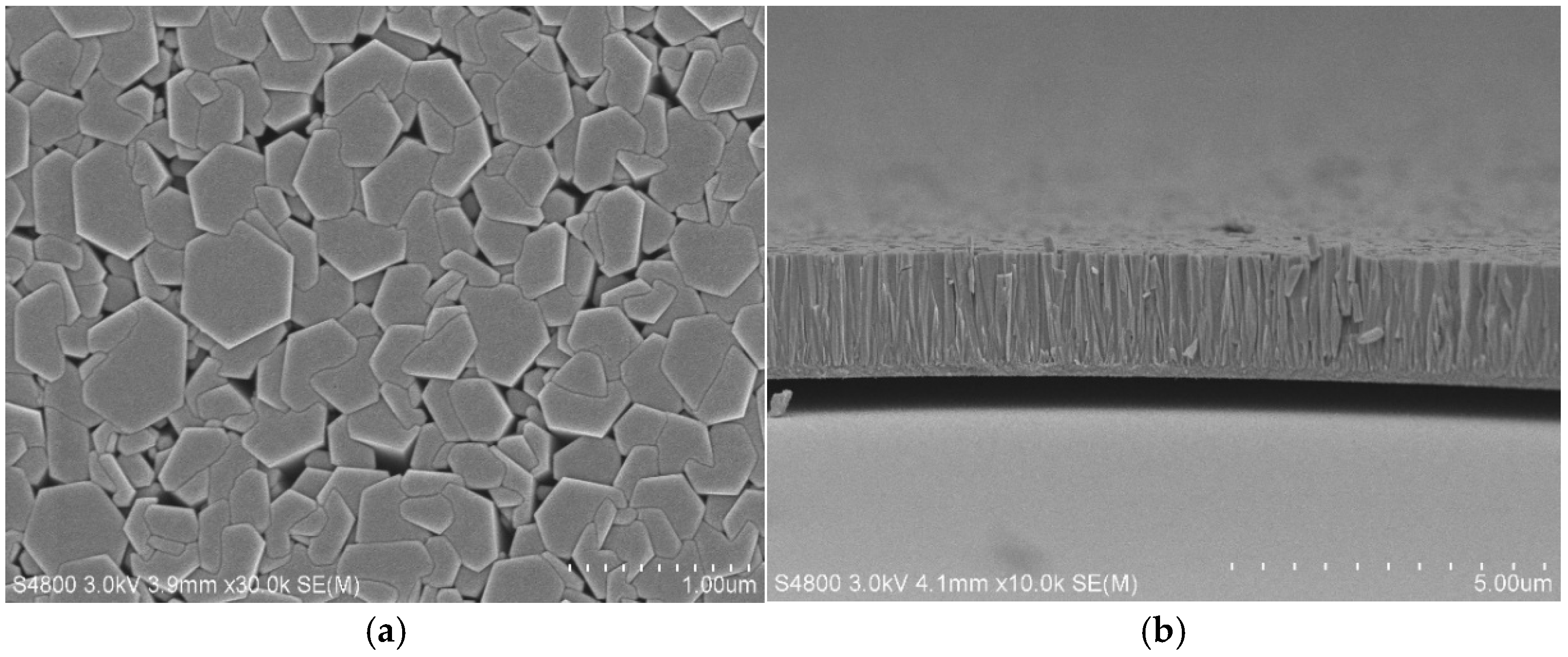
Figure 2 shows scanning electron microscope (SEM) images of PVP-doped ZnO nanorods deposited on an FSS substrate. The top view (Figure 2a) shows that the ZnO nanorods exhibit a dense and uniform hexagonal structure. Each grain exhibits clear polygonal facets, most of which are hexagonal, indicating good crystallinity and uniform lateral growth. The average lateral size of a single nanorod is about 300–500 nm, and the distance between the rods is very small. The cross-sectional SEM image (Figure 2b) clearly shows that the ZnO nanorods are vertically arranged and densely stacked to form a columnar array structure perpendicular to the FSS substrate. The measured thickness of the nanorod array is about 4.5–5 μm, which is consistent across the entire substrate, reflecting the stable growth conditions during the hydrothermal process.
Figure 2.
SEM images of PVP-doped ZnO nanorods (a) top view and (b) cross-section.
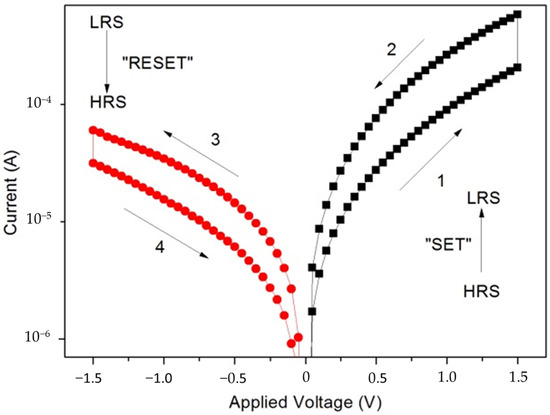
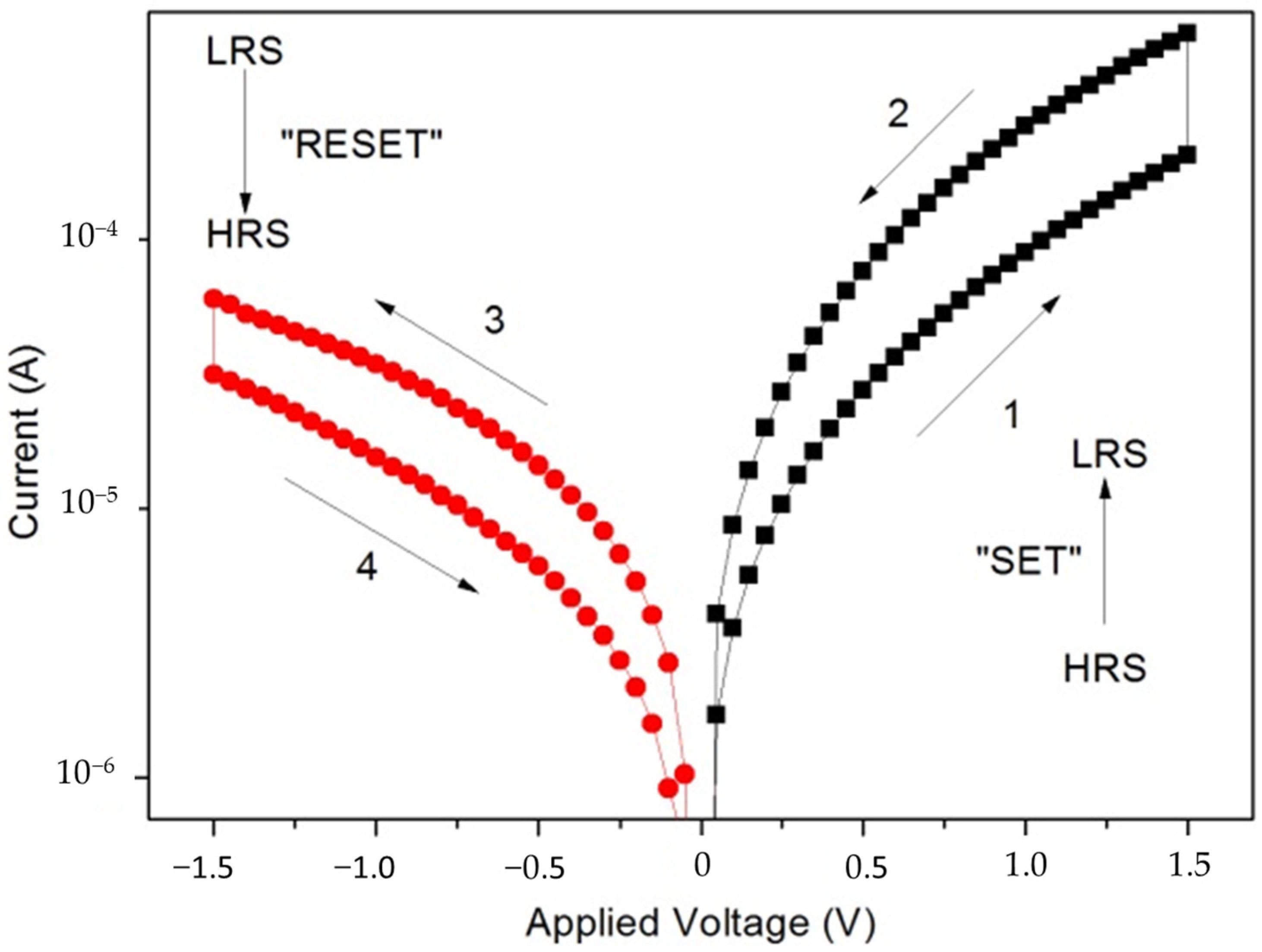
Figure 3 shows the typical I-V characteristics of the PVP-doped ZnO nanorod RRAM device measured under bipolar voltage sweeps. The device exhibits clear resistive switching behavior with a typical bipolar pattern: a “SET” process occurs under positive bias, causing the device to transition from a high-resistance state (HRS) to a low-resistance state (LRS), while a “RESET” process occurs under negative bias, causing the device to switch back from the low-resistance state to the high-resistance state. In the forward sweep (path 1), the current increases sharply around +1.0 V, indicating the formation of a conductive filament and the transition to the low-resistance state. In the reverse sweep (path 3), the device switches back to the high-resistance state at about −1.0 V, probably due to the breakage of the conductive path. At 1 V, the current ratio between the high-resistance state and the low-resistance state is about 103–104.
Figure 3.
Bipolar I–V characteristics of the PVP-doped ZnO nanorod RRAM device. The black squares and red dots represent the I–V curves measured under positive and negative voltage sweeps, respectively.
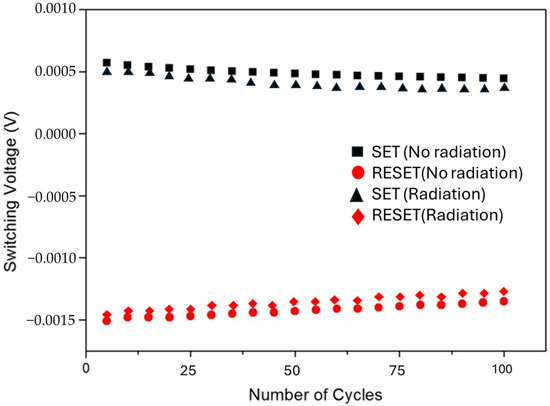
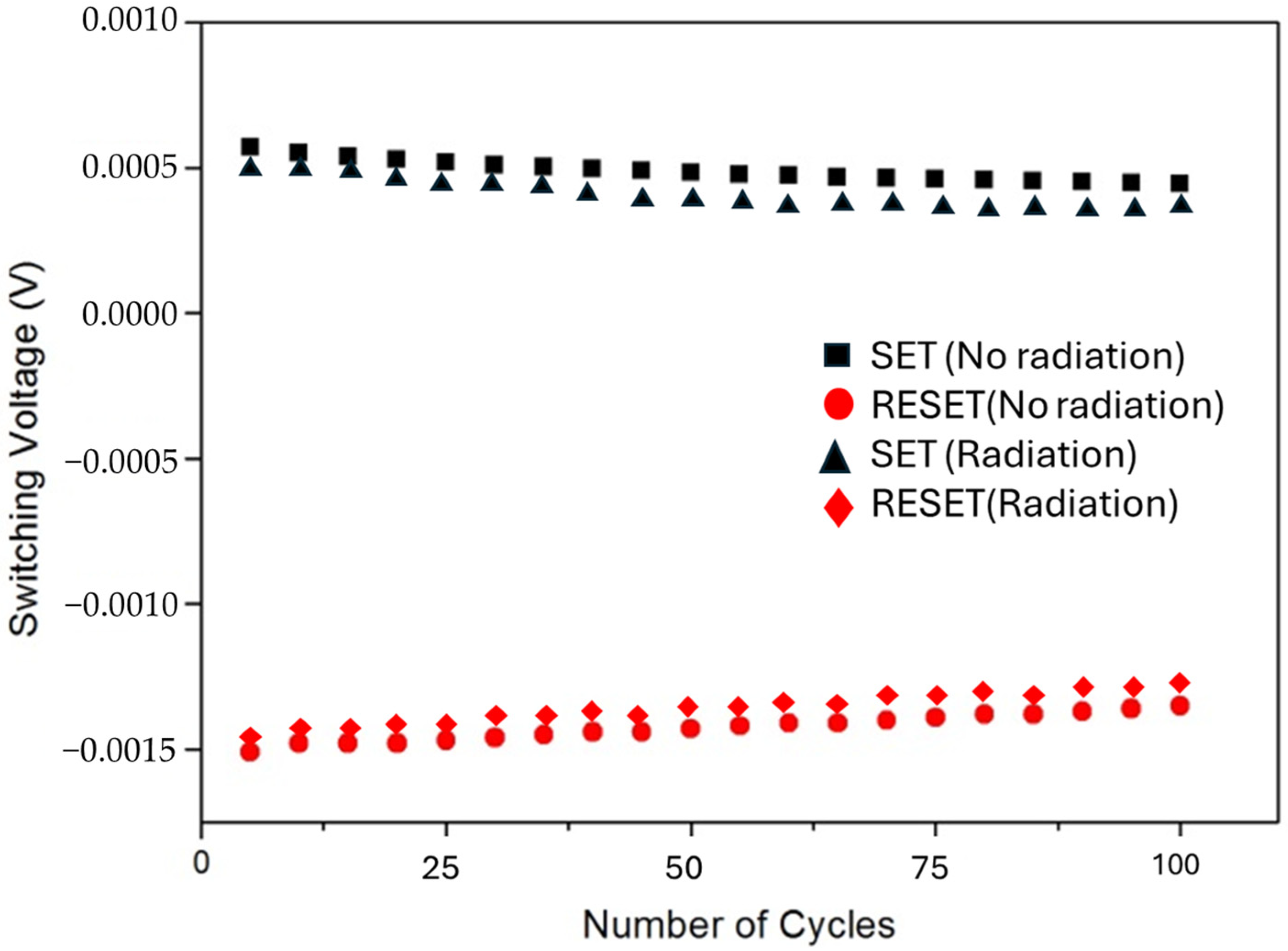
Figure 4 shows the endurance performance of the PVP-doped ZnO nanorod RRAM device under normal conditions and after gamma-ray irradiation. The SET and RESET switching voltages were recorded for 100 consecutive cycles. For the unirradiated device, the SET voltage remained stable at approximately +0.0005 V, and the RESET voltage remained stable at approximately −0.0015 V, demonstrating excellent repeatability. The irradiated device exhibited a slight downward shift in the SET voltage and a corresponding upward shift in the RESET voltage, attributed to radiation-induced defect generation and charge trapping. However, the device maintained stable bipolar switching behavior with negligible performance degradation, confirming that the polymer–oxide hybrid structure enhances the device’s radiation resistance and cycling endurance, thereby supporting reliable RRAM applications in harsh environments.
Figure 4.
Endurance characteristics of PVP-doped ZnO nanorod RRAM devices with and without radiation exposure.
4. Conclusions
In this study, we successfully fabricated hybrid polymer–oxide composite RRAM devices by incorporating PVP into ZnO nanorod structures grown on the FSS substrate. The ZnO thin films, prepared via sol–gel spin coating and treated with RTA, provided high-quality seed layers that enabled the vertical alignment of nanorods through hydrothermal growth. Structural analysis confirmed that the PVP-doped ZnO nanorods retained the wurtzite crystal structure with preferred (002) orientation, while SEM observations revealed dense, vertically aligned arrays with improved surface morphology. Electrical measurements demonstrated stable bipolar resistive switching behavior with a high HRS/LRS current ratio exceeding 103, and well-defined SET and RESET processes. Endurance testing over 20 cycles further confirmed the reliability and repeatability of the switching performance. Furthermore, radiation-tolerant cyclic tests under γ-ray irradiation revealed that the devices maintained stable SET/RESET voltages with only slight drift, indicating that the polymer–oxide hybrid structure effectively suppressed radiation-induced leakage and defect generation. The incorporation of PVP effectively modulated the surface states of ZnO nanorods, reduced trap-induced defects, and improved switching uniformity. These results suggest that PVP-doped ZnO nanorod structures are promising candidates for high-performance, flexible non-volatile memory applications.
Author Contributions
Conceptualization, M.-C.K. and K.-H.C.; methodology, M.-C.K. and W.-C.C.; formal analysis, M.-C.K., K.-H.C. and Y.-K.K.; investigation, M.-C.K.; resources, K.-H.C.; data curation, M.-C.K. and Y.-K.K.; writing—original draft preparation, K.-H.C. and W.-C.C.; writing—review and editing, M.-C.K. and Y.-K.K.; visualization, M.-C.K. and Y.-K.K.; project administration, M.-C.K. and K.-H.C.; funding acquisition, M.-C.K. All authors have read and agreed to the published version of the manuscript.
Funding
This research was supported by the National Science Council of the Republic of China under grant No. NSTC 114-2221-E-324-007.
Institutional Review Board Statement
Not applicable.
Informed Consent Statement
Not applicable.
Data Availability Statement
The data presented in this study are available on request from the corresponding author due to confidentiality agreement.
Conflicts of Interest
The authors declare no conflict of interest.
References
- Guo, Z.; Lai, X.; Xu, W.; Sun, D.; Chen, C. Reactive sputtering deposited α-MoO3 thin films for forming-free resistive random-access memory. Solid-State Electron. 2025, 227, 109130. [Google Scholar] [CrossRef] [Scilit]
- Duan, X.; Qing, Y.; Wang, Y.; Hong, R.; Chen, J.; Yang, P.; Yin, Y.; Zhou, X.; Liu, X.; Jiang, B. Total ionizing dose radiation effect of HfO2/TaOx-based resistive random-access memories. Microelectron. Reliab. 2025, 165, 115590. [Google Scholar] [CrossRef] [Scilit]
- Tung, C.-T.; Dabhi, C.K.; Salahuddin, S.; Hu, C. A versatile compact model of resistive random-access memory (RRAM). Solid-State Electron. 2024, 220, 108989. [Google Scholar] [CrossRef] [Scilit]
- Ozga, M.; Mroczynski, R.; Wolska, A.; Klepka, M.; Godlewski, M.; Witkowski, B.S. Studies on resistive switching mechanisms in RRAM memory structures based on copper (II) oxide. Solid-State Electron. 2025, 228, 109140. [Google Scholar] [CrossRef] [Scilit]
- Patil, S.V.; Mullani, N.B.; Nirmal, K.; Hyun, G.; Alimkhanuly, B.; Kamat, R.K.; Park, J.H.; Kim, S.; Dongale, T.D.; Lee, S. Spike-time dependent plasticity of tailored ZnO nanorod-based resistive memory for synaptic learning. J. Sci. Adv. Mater. Devices 2023, 8, 100617. [Google Scholar] [CrossRef] [Scilit]
- Song, H.; Ni, K.; Tang, Y.; Wang, J.; Guo, H.; Zhong, X. Total ionizing dose effects of 60Co-γ ray radiation on the resistive switching and its bending performance of Al-in-O/InOx-based flexible RRAM device. Radiat. Phys. Chem. 2021, 182, 109394. [Google Scholar] [CrossRef] [Scilit]
- Han, S.W.; Shin, M.W. UV-laser annealing for improved resistive switching performance and reliability of flexible resistive random-access memory. J. Alloys Compd. 2022, 908, 164658. [Google Scholar] [CrossRef] [Scilit]
- Patil, A.R.; Dongale, T.D.; Kamat, R.K.; Rajpure, K.Y. Binary metal oxide-based resistive switching memory devices: A status review. Mater. Today Commun. 2023, 34, 105356. [Google Scholar] [CrossRef] [Scilit]
- Kaushik, S.; Pandey, S.; Singhal, R.; Kumar, R. ZnO based RRAM performance enhancement by 100 MeV Ag9+ irradiation. Appl. Surf. Sci. Adv. 2022, 9, 100260. [Google Scholar] [CrossRef] [Scilit]
- Jeong, H.; Shin, J.; Kim, S.; Pak, J.J. Improved resistive switching characteristics by O2 plasma treatment in bi-layer Ti/ZnO/OPT-ZnO/ITO RRAM. Curr. Appl. Phys. 2023, 49, 120–126. [Google Scholar] [CrossRef] [Scilit]
- Ghafoor, F.; Kim, H.; Ghafoor, B.; Rehman, S.; Khan, M.A.; Aziz, J.; Rabeel, M.; Maqsood, M.F.; Dastgeer, G.; Lee, M.-J.; et al. Interface engineering in ZnO/CdO hybrid nanocomposites to enhanced resistive switching memory for neuromorphic computing. J. Colloid Interface Sci. 2024, 659, 1–10. [Google Scholar] [CrossRef] [Scilit] [PubMed]
- Xiang, H.; Liu, Y.; Liu, Y.; Su, E.; Su, X. Electromagnetic wave absorbing properties of flexible thermal conductive ZnO@FeSiAl silicone rubber. Mater. Today Nano 2025, 29, 100587. [Google Scholar] [CrossRef] [Scilit]
- Patil, A.M.; Lokhande, V.C.; Ji, T.; Lokhande, C.D. New design of all-solid state asymmetric flexible supercapacitor with high energy storage and long term cycling stability using m-CuO/FSS and h-CuS/FSS electrodes. Electrochim. Acta 2019, 307, 30–42. [Google Scholar] [CrossRef] [Scilit]
- Wang, F.-H.; Chen, M.-S.; Liu, H.-W.; Kang, T.-K. Influence of rapid thermal annealing time on physical properties of Mg and F co-doped ZnO thin films deposited by radio frequency magnetron sputtering. Thin Solid Films 2022, 757, 139393. [Google Scholar] [CrossRef] [Scilit]
- Chen, Y.J.; Jen, H.-W.; Wong, M.-S.; Ho, C.-H.; Liang, J.-H.; Liu, J.-T.; Pang, J.-H. The study of rapid thermal annealing on arsenic-doped ZnO for the p-type ZnO formation. J. Cryst. Growth 2013, 362, 193–196. [Google Scholar] [CrossRef] [Scilit]
- Khaleel, M.R.; Hashim, F.S.; Alkhayatt, A.H.O. Preparation, characterization, and the antimicrobial activity of PVA-PVP/ZnO nanofiber films via indigenous electrospinning setup. J. Mol. Struct. 2024, 1310, 138325. [Google Scholar] [CrossRef] [Scilit]
- Shah, J.; Khan, A.D.; Sarker, M.R.; Alhodaib, A.; Khan, A.; Soliyeva, M.; Tirth, V.; Khan, S.N.; Hayat, K.; Alsuhaibani, A.M.; et al. Optimization of an innovative hybrid approach ZnO-doped PVP nanofibers for electrical devices applications. Results Phys. 2024, 60, 107664. [Google Scholar] [CrossRef] [Scilit]
Disclaimer/Publisher’s Note: The statements, opinions and data contained in all publications are solely those of the individual author(s) and contributor(s) and not of MDPI and/or the editor(s). MDPI and/or the editor(s) disclaim responsibility for any injury to people or property resulting from any ideas, methods, instructions or products referred to in the content. |
© 2026 by the authors. Licensee MDPI, Basel, Switzerland. This article is an open access article distributed under the terms and conditions of the Creative Commons Attribution (CC BY) license.