Abstract
Over the last twenty years, architects and designers have been working towards minimizing the impact that buildings have on the environment. In spite of the fact that many architects claim their buildings are environment-friendly, the claims cannot be justified unless a Life Cycle Analysis (LCA) is conducted. The two major parts of the theoretical basis of the proposed scheme are the concept of sustainability of the environment and methods of assessing the building’s environmental impacts. The objective of this report is to evaluate the possible ecological impact of an educational building through its life cycle, from extracting raw materials to the end of life. In order to accomplish the goal of the study, a single-case method of a life cycle assessment was used to determine which stage of the life cycle (manufacturing, construction, consumption, maintenance, and dismantling) made the most contribution to the overall impact. The main installation system (foundation, frame, wall, floor, roof) of a building will have an impact on the environment during its life cycle. A typical new educational building was used as a case study in Islamabad, along with an optimized LCA method based on energy consumption inventories, the material input and output, and the assessment of the environmental impact.
1. Introduction
Out of the many causes of the exhaustion of natural resources & undesirable outcomes such as poisonous waste, global warming, air pollution, water pollution, and many other terrible outcomes, one of the main ones is the construction and building industry [1]. Globally, the construction and building sector show an increase in emissions and energy use. In 2018, building construction and operations accounted for the greatest share of global final energy use (36%) and energy-related CO2 emissions (39%) [2].
The construction sector in Pakistan adds up to 380 billion PKR to the grass domestic product (GDP). 36.38% of the population resides in urban areas. The housing demand in Pakistan is growing due to the 2.4% growth rate of the population [3]. Currently, households have a share of 45% in electricity consumption in Pakistan. The total electricity units sold in Pakistan in March 2020 were 2.3 million kWh, which was 5.3% greater than for the same month in the previous year [4].
The daily decisions significantly impact the environment, and architects have yet to realize that. In recent years, architects have started to focus on reducing the effect of buildings that they have designed on the environment. Despite claims that architects make that their buildings are eco-friendly, it cannot be proved until an LCA is conducted. Compared with other products, buildings are more difficult to evaluate from an ecological perspective because they are large and have a complicated model material.
The concept of LCA moved from domestic consumption or commercial products to materials and components used in buildings. An L.C. analysis of all existing buildings is very important to determine and evaluate how key design systems (foundation, frame, wall, floor, roof) affect the environmental performance of the building.
2. Methodology
The framework of this study is centered on the concept of environmental sustainability in buildings. After World War II, a concept of visionary economic growth driven by technology created an awareness that there is a close relationship between economic growth and the ecosystem. It gave rise to the contemporary concept of sustainability. The environmental movements in the 1960s and books like “Silent Spring” [5] and “The Population Bomb” [6] increased this awareness among the public.
The framework is based upon a single-study method. This approach is realistic and assesses the buildings in a true-to-life context. In this study, the results relate to the possible environmental impacts of certain phases of the life cycle of the building as well as the material used in the building. The criteria for selecting the building are that it should be rather new, an educational building, and that it must be registered or certified for a green rating program. The selected building is the US. Pakistan Center for Advanced Studies in Energy.
The standard set by international organizations for standards are chosen as the framework for identifying, qualifying, and evaluating inputs and outputs, and the probable impact in this study is ISO 14040 [7]. LCA is a very comprehensive approach to assessing environmental impacts, and the consequent environmental releases are identified, quantified, and then evaluated. The four main steps of LCA analysis are the definition of the objectives and scope of the study, analysis of the system inventory, and assessment of the impact interpretation of the results.
The study employs the L.C. analysis over 60 years to quantify the impact that different life cycle phases have on the environment. First of all, the scope and objectives of the study are defined along with the determination of the system boundary, unit of function, and requirement of data and its quality. Calculated the inputs and outputs of the inventory in the building and its maintenance over 60 years. The inventory includes the material, energy and other characteristics required for operation. The third step is assessing the impact caused by the material and energy consumption and the operational energy consumed throughout a building’s service life. This stage of LCIA considers eight types of environmental impacts. The life cycle impact calculation tool used for steps two and three of the analysis is ATHENA 4.1. The results are interpreted, conclusions are drawn, and recommendations are made in step four.
3. Results and Discussion
3.1. Absolute Environmental Impact Values
The absolute environmental impact values of the case study building are shown in Table 1.
Table 1.
Environmental Profile.
3.2. Environmental Impacts over the Life Cycle Phases
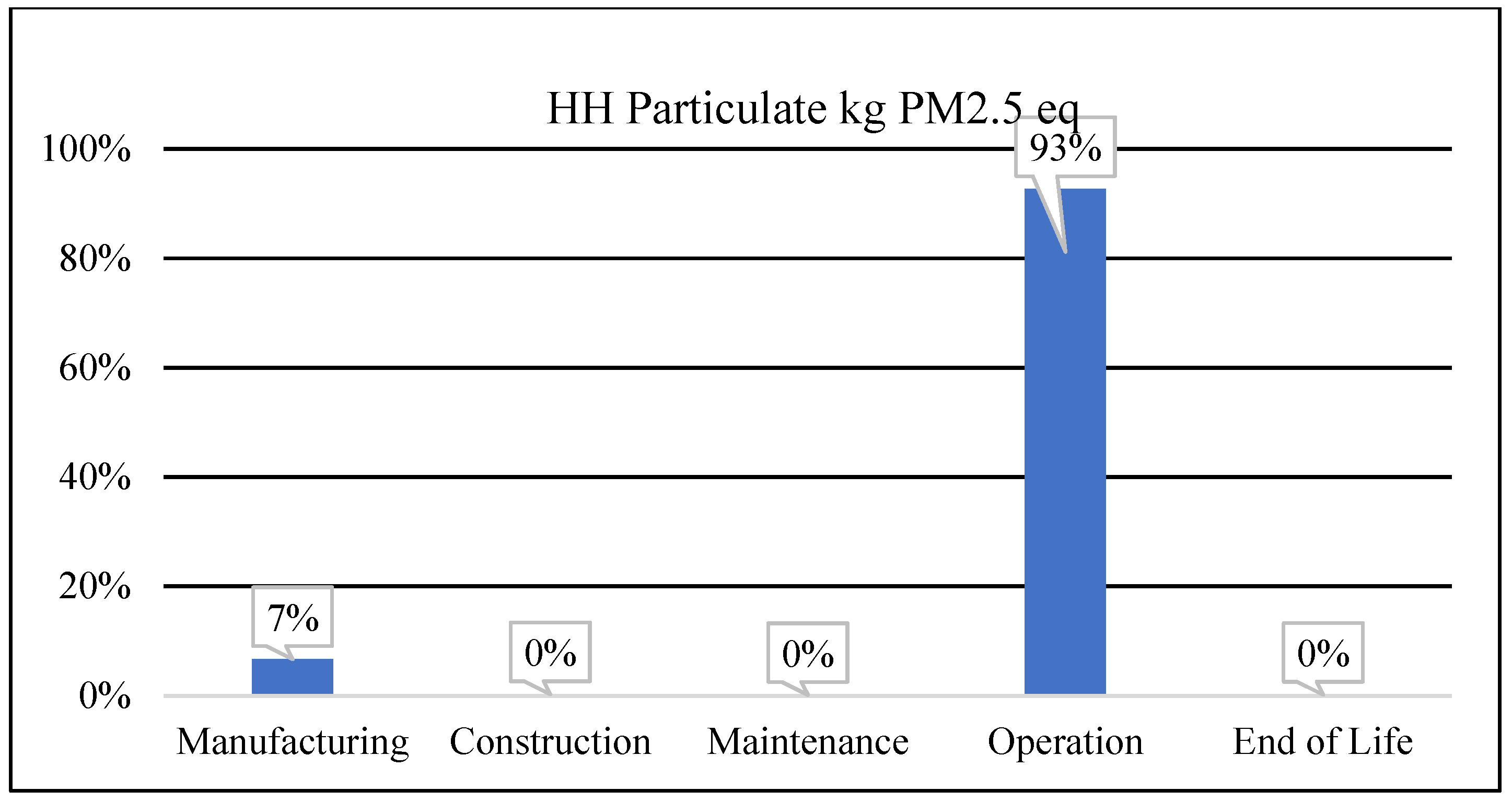
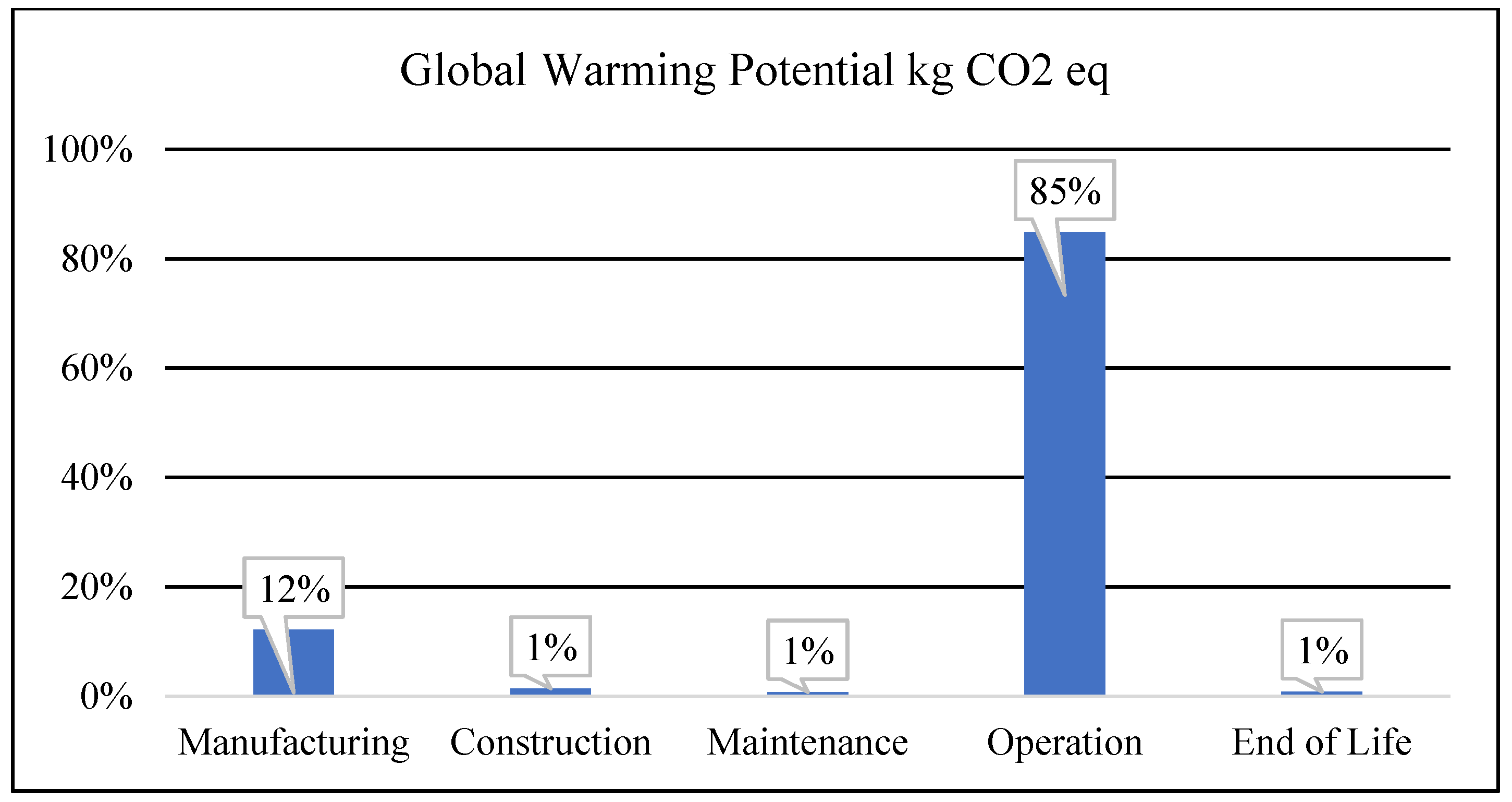
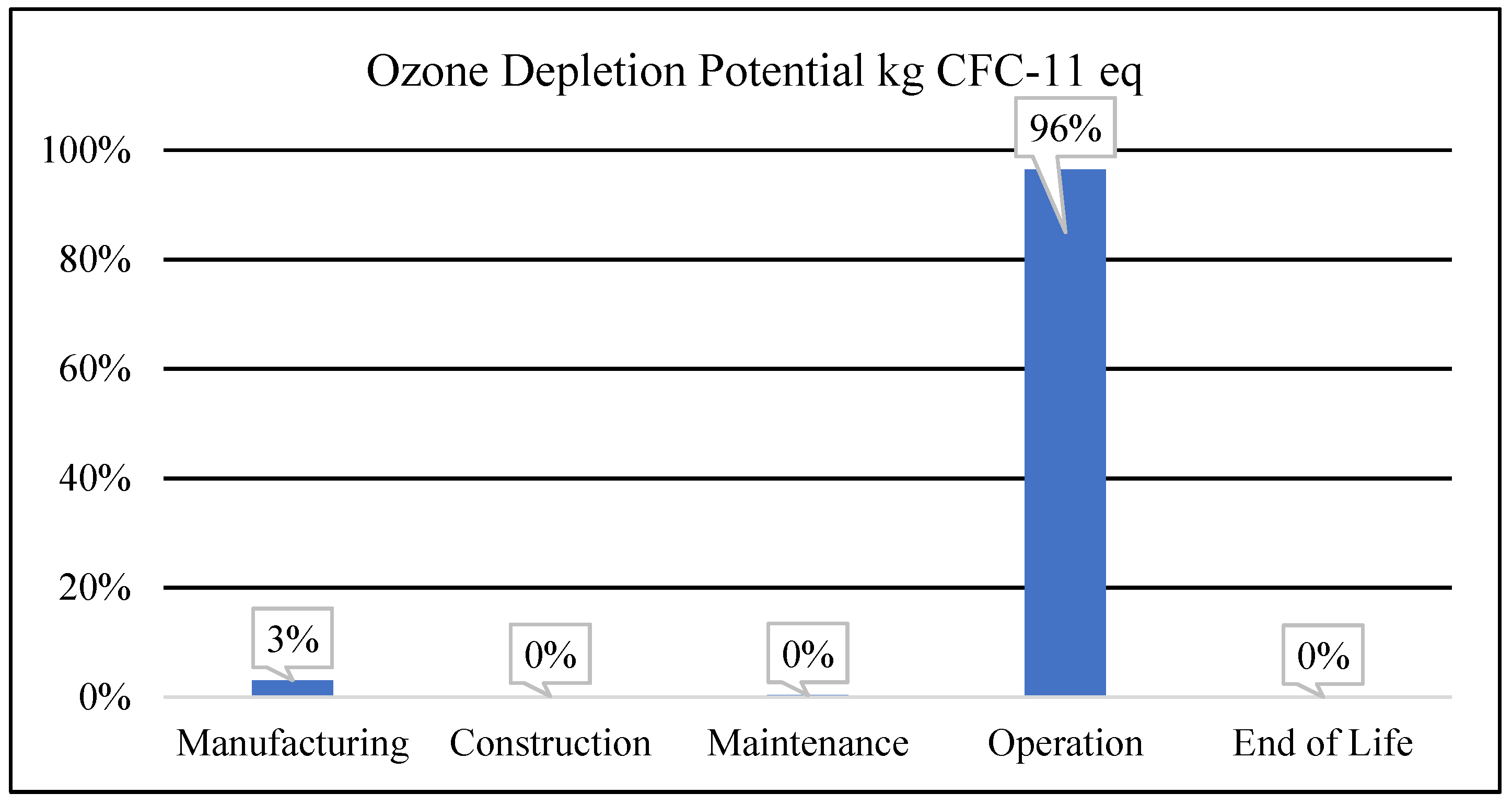
The operational phase contributes the most, at 96%, to the ozone depletion potential as shown in Figure 1. The second highest contribution is the HH particulate, can be seen in Figure 2, which is around 93%. The total primary energy coming from the operational phase is 91% as in Table 1. Similarly, the biggest addition to the global warming potential is from this phase, at 85% as per Figure 3.
Figure 1.
Contribution to Ozone Depletion Potential by life cycle stages.
Figure 2.
Contribution to HH Particulate impacts by life cycle stages.
Figure 3.
Contribution to Global Warming Potential by life cycle stages.
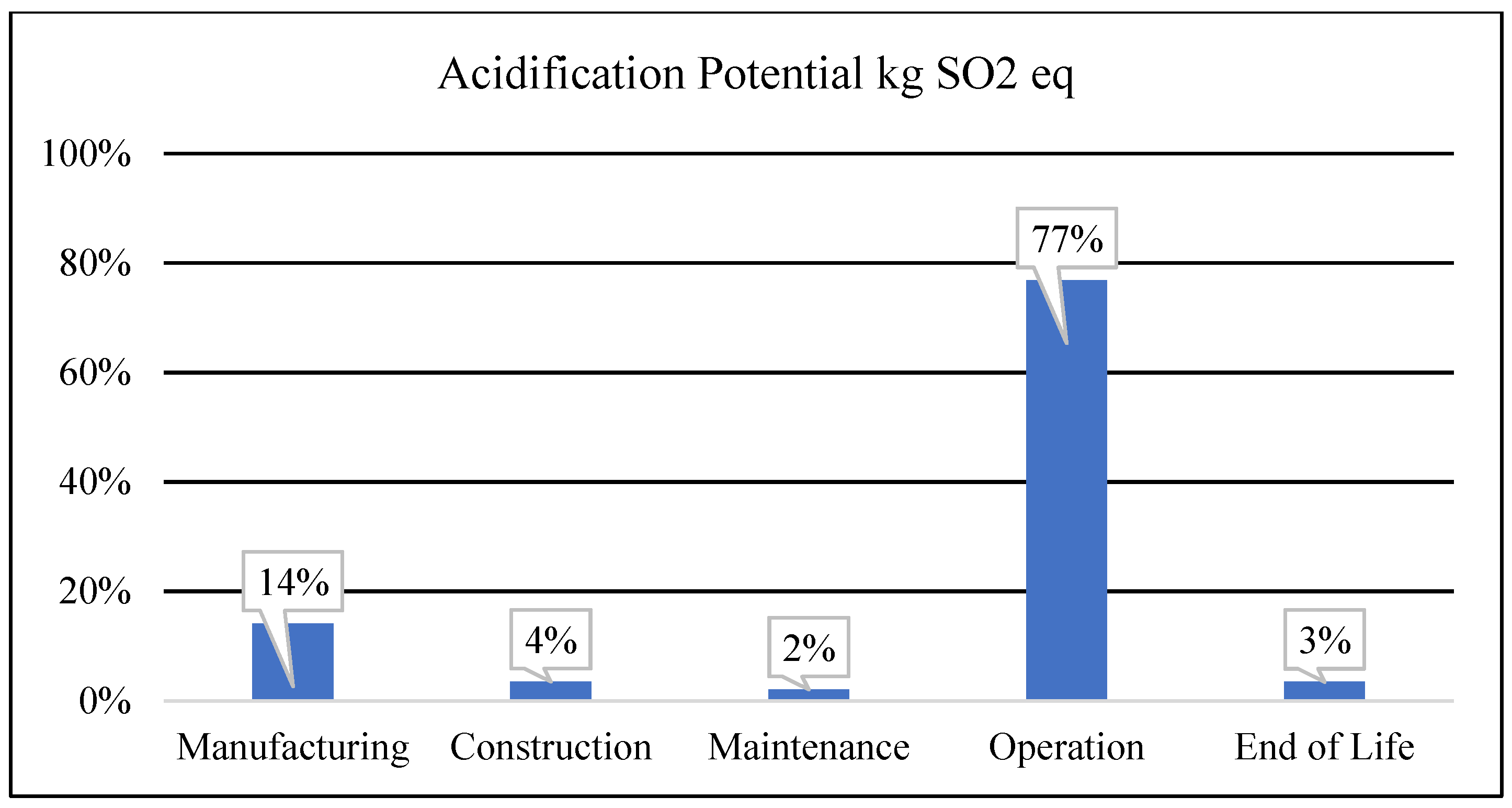
Manufacturing of raw material adds up to 12% and 14% to Global warming potential and acidification potential according to Figure 3 and Figure 4. End of life phase contributes highest in acidification potential about 3% as in Figure 4.
Figure 4.
Contribution to Acidification by life cycle stages.
Data Availability Statement
Derived data supporting the findings of this study are available from the corresponding author on request.
References
- Ripple, W.J.; Wolf, C.; Newsome, T.M.; Gregg, J.W.; Lonten, T.M.; Palomo, I.; Eikelboom, J.A.J.; Law, B.E.; Huq, S.; Duffy, P.B.; et al. World Scientists’ Warning of a Climate Emergency 2021. Bioscience 2021. [Google Scholar] [CrossRef]
- IEA. Global Status Report for Buildings and Construction. 2019. Available online: https://www.iea.org/reports/global-status-report-for-buildings-and-construction-2019 (accessed on 10 July 2021).
- Board of Investment Prime Minister Office. Pakistan: Housing and Construction. Available online: https://invest.gov.pk/housing-and-construction (accessed on 30 July 2021).
- Government of Pakistan. Chapter 14: Energy (Pakistan Economic Survey 2019–20); LR Lloyd’s Regist: Government of Pakistan: Islamabad, Pakistan, 2020; Volume 100, pp. 1–35. [Google Scholar]
- Carson, R. Silent Spring; Houghton Mifflin: Boston, MA, USA, 1962. [Google Scholar]
- Ehrlich, P.R. The Population Bomb; Ballantine Books: New York, NY, USA, 1971. [Google Scholar]
- ISO (International Organization for Standardization). Environmental Management-Life Cycle Assessment-Principles and Framework (ISO 14040:1997). Environ. Manag. Syst. Requir. 1997, 44, 12. [Google Scholar]
Publisher’s Note: MDPI stays neutral with regard to jurisdictional claims in published maps and institutional affiliations. |
© 2021 by the authors. Licensee MDPI, Basel, Switzerland. This article is an open access article distributed under the terms and conditions of the Creative Commons Attribution (CC BY) license (https://creativecommons.org/licenses/by/4.0/).