Proceeding Paper

Determination of Fatigue Crack Size in High-Strength Bolting Assemblies Using Hydrogen-Induced Cracking †
1
Fraunhofer Institute for Large Structures in Production Engineering, Albert-Einstein-Straße 30, 18059 Rostock, Germany
2
Business and Design, Department of Mechanical Engineering, University of Applied Sciences Technology, Ph.-Müller-Straße 14, 23966 Wismar, Germany
3
Manufacturing Technology, Faculty of Mechanical Engineering and Marine Technologies, University of Rostock, Albert-Einstein-Straße 30, 18059 Rostock, Germany
*
Author to whom correspondence should be addressed.
Presented at the 8th International Conference of Engineering Against Failure (ICEAF VIII), Kalamata, Greece, 22–25 June 2025.
Eng. Proc. 2025, 119(1), 31; https://doi.org/10.3390/engproc2025119031
Published: 19 December 2025

Abstract

For the validation of approaches like fracture mechanics used for the description of crack propagation in high-strength bolting assemblies, it is often necessary to determine the size of an existing crack in the tested assembly. However, since the fatigue crack typically initiates in the root of the first load bearing thread, it is not directly accessible during fatigue testing. The crack size determination method presented here achieves further propagation of the original fatigue crack after the fatigue test by hydrogen-induced cracking under constant load. The characteristic microstructure of the resulting fracture surface then allows for the determination of the original crack size. In the present study, the fatigue crack sizes in M12 bolting assemblies are determined and a corresponding linear elastic fracture mechanics model is validated. The presented method reliably leads to a failure in the plane of the original fatigue crack and allows for a precise measurement of the crack length. The validated fracture mechanics model describes the crack propagation reasonably well, taking into account the overall service life. Overall, the presented method is a valuable addition to existing crack size determination methods and a versatile tool in the further development of more advanced fracture mechanics models for high-strength bolting assemblies.

1. Introduction

Due to ever-increasing demands on the fatigue resistance of bolting assemblies used in structures like wind turbine towers, available fatigue strength potentials must be used as effectively as possible. For the investigation and consideration of existing potentials, concepts beyond the well-established nominal stress concept (see, for example, [1]) like the notch-strain-approach and the fracture mechanics approach are also invoked.
In fracture mechanics, the number of cycles between an initial crack size a i and a final crack size a e is determined by (numerical) integration of a suitable crack propagation law, e.g., the Paris–Erdogan law [2], see Equations (1) and (2).
d a d N = C · ( Δ K ) m ,
N = d N = a i a e 1 C · ( Δ K ) m   d a  
The characteristic parameter here is the so-called stress intensity factor Δ K , which is determined for a given crack configuration using a suitable model approach as a function of the crack size. Since no dedicated models are available for bolting assemblies, substitute models are often used; these can be found in the FKM Guideline [3], for example. Typical equivalent models are given by the hollow cylinder model under variable stresses with circumferential (external) surface crack and the round bar model under constant tension with circumferential surface crack, see, for example, Pyttel [4] and Eichstädt [5]. In the present paper, the round bar model is used.
In order to check this model for its capability to describe the crack propagation in the investigated bolting assemblies, the crack sizes a i and a e have to be known as input parameters to the calculation acc. to Equation (2). The final crack sizes a e can be determined by assessing the fracture surface after testing, since the typical fatigue crack surface structure often allows for a clear distinction between fatigue crack and residual ductile crack. However, since the fatigue crack typically initiates in the first load bearing thread, it is not directly accessible during fatigue testing. Hence, the initial crack size a i is more difficult to determine.
To select an appropriate method for determining the initial crack size, two major requirements are formulated, taking into account the equipment available for the present study, which only allows for a crack size measurement when the fracture surface is visible:
  • Requirement 1: Destructive tests must ensure that the failure occurs in the plane of the original fatigue crack (root of the first load bearing thread) to allow access for an optical crack size measurement;
  • Requirement 2: The transition from original fatigue crack to residual fracture must be as clear as possible to reduce errors in the crack size measurement.
These requirements are, for example, fulfilled by the well-known method of heat-tinting, in which the crack surface at any point during testing is marked by applying a high temperature to the specimen. However, this process often requires disassembling the specimen from the testing machine. Hence, special care has to be taken after the heat-tinting to exactly recreate the nut position to ensure further testing under the exact same conditions. Furthermore, in some cases the original nut position is unknown (see, for example, Section 4). Therefore, the present study uses a method which fulfills both stated requirements and does not rely on the knowledge of the exact nut position to reduce possible errors during re-assembly of the test specimen.

2. Materials and Methods

The developed method uses the presence of hydrogen to fulfil the two major requirements for crack size determination formulated in the previous section. The associated testing process consists of the following main steps:
  • Step 1: Fatigue testing of the bolting assembly up to a defined criterion (e.g., frequency drop, specified number of load cycles, );
  • Step 2: Removal of the bolting assembly from the fatigue testing machine and application of a suitable (e.g., hydrochloric) acid at the first load bearing thread;
  • Step 3: Application of static load ( 0.7 0.8 · R m , m i n ) to the bolting assembly until failure;
  • Step 4: Determination of fatigue crack size by fracture surface assessment.
The fatigue tests of Step 1 presented in this article are carried out on bolting assemblies consisting of uncoated HV bolts of nominal diameter M12 with threads rolled before heat treatment and property class 10.9, in accordance with EN 14399-4 [6], nuts acc. to ISO 4032 [7] and washers acc. to ISO 7089 [8]. This configuration is chosen in the course of the underlying research project (FOSTA P1703/IGF No. 01IF22748N) to investigate the influence of nut type and also serves as a test series for the fracture mechanics validation. The tests are carried out on a high-frequency pulsator from ZwickRoell (ZwickRoell GmbH & Co. KG, Ulm, Germany) at the Fraunhofer IGP Rostock in alignment with the specifications of DIN 969 [9]. The bolting assemblies are tested with two free loaded threads. A total of n = 9 bolting assemblies are tested until failure at three different stress levels, Δ σ 1 = 225   N/mm2, Δ σ 2 = 170   N/mm2 and Δ σ 3 = 140   N/mm2, as a reference. In order to generate fatigue cracks in the early stage of crack propagation with an order of magnitude of 0.1   mm a 0.5   mm, a frequency drop of Δ f = 0.125 Hz is determined in pre-tests as suitable stop criterion for n = 9 additional tests on the three specified stress levels, which then go through the subsequent Steps 2 to 4.
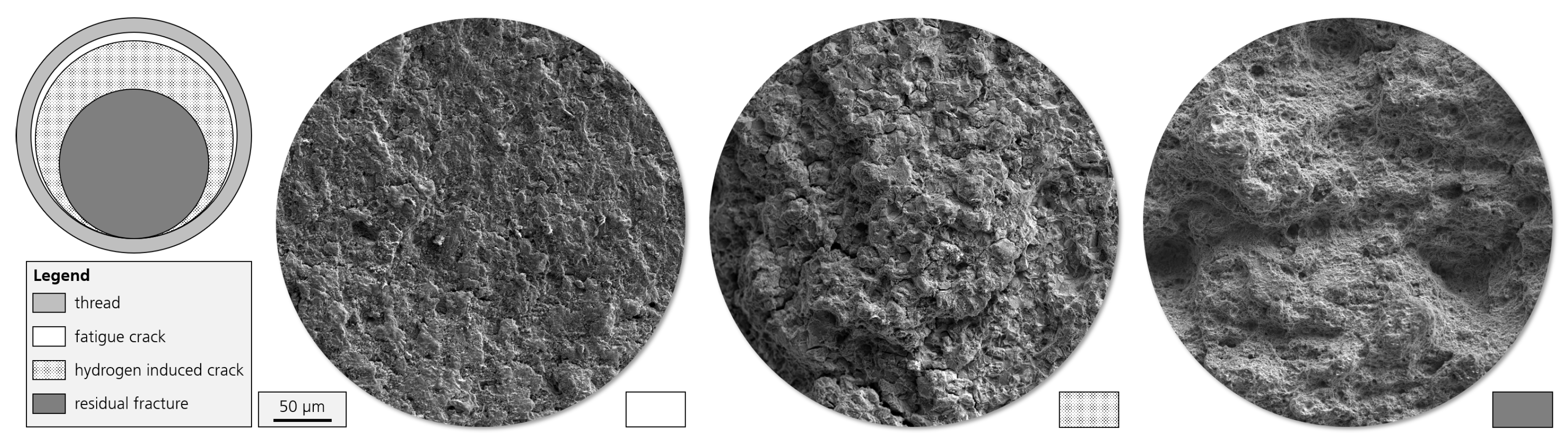
By application of the acid in Step 2, corrosion processes are initiated. A reaction product of these processes is hydrogen, which diffuses into the fatigue crack and accumulates at the crack tip, where it leads to hydrogen-induced cracking under static load in Step 3, ultimately resulting in specimen failure at the location of the original crack. The resulting fracture surface consists of the transcrystalline fatigue crack, an intercrystalline hydrogen-induced brittle fracture surface and a transcrystalline ductile residual fracture surface; see Figure 1.
This characteristic microstructure allows for the determination of the original crack size using a scanning electron microscope, since original fatigue crack and hydrogen-induced brittle fracture surface are clearly distinguishable.
Furthermore, the present investigations show that fatigue fracture and brittle fracture can be differentiated macroscopically, which further simplifies the procedure. For this purpose, the profile of the fracture surface is scanned using a Keyence 3D (Keyence Deutschland GmbH, Frankfurt am Main, Germany) profilometer. In the plane of the maximum fatigue crack size, a 2D profile is generated and the crack size is measured. In this process, advantage can be taken of the fact that due to the thread geometry, the fatigue crack initiates under an angle of approx. 30° [10] and later changes to a plane approx. perpendicular to the direction of the main acting stresses. Also, the hydrogen-induced crack propagates on this perpendicular plane. Hence, the end of the cracks in their early stage investigated here can be identified at the switch of the propagation plane. Furthermore, both crack types can be distinguished visually, which provides an additional criterion for the crack size determination.

3. Results

The results are summarized in Table 1 and further discussed in the following sections regarding initial crack size (Section 3.1), final crack size (Section 3.2) and fracture mechanics validation (Section 3.3).

3.1. Initial Crack Size Determination

3.1.1. Failure Locations

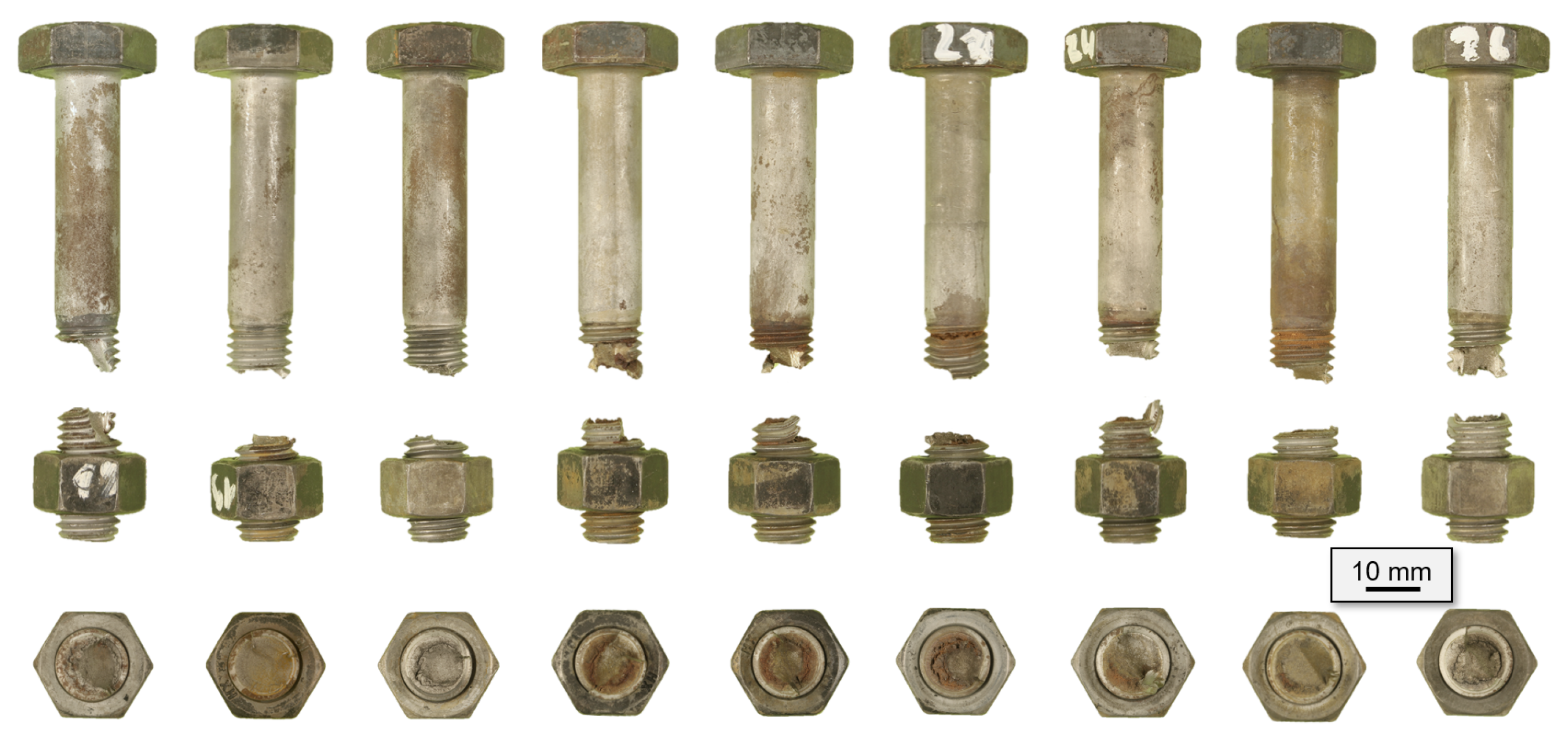
Figure 2 shows the failure locations of the bolting assemblies tested in accordance with the test method described in Section 2. In order to allow for an optical crack size measurement, the failure of the bolting assemblies must occur in the plane of the original fatigue crack (Requirement 1). This requirement is fulfilled for all tested bolting assemblies, since all failed at the root of the former first load bearing thread, which is also the location of the original fatigue crack.
However, it can also be seen that the final ductile residual fracture sometimes leaves the plane of the original fatigue crack. Nevertheless, as discussed in the following sections, it is still possible to determine the maximum crack depth.

3.1.2. Initial Crack Size Measurement

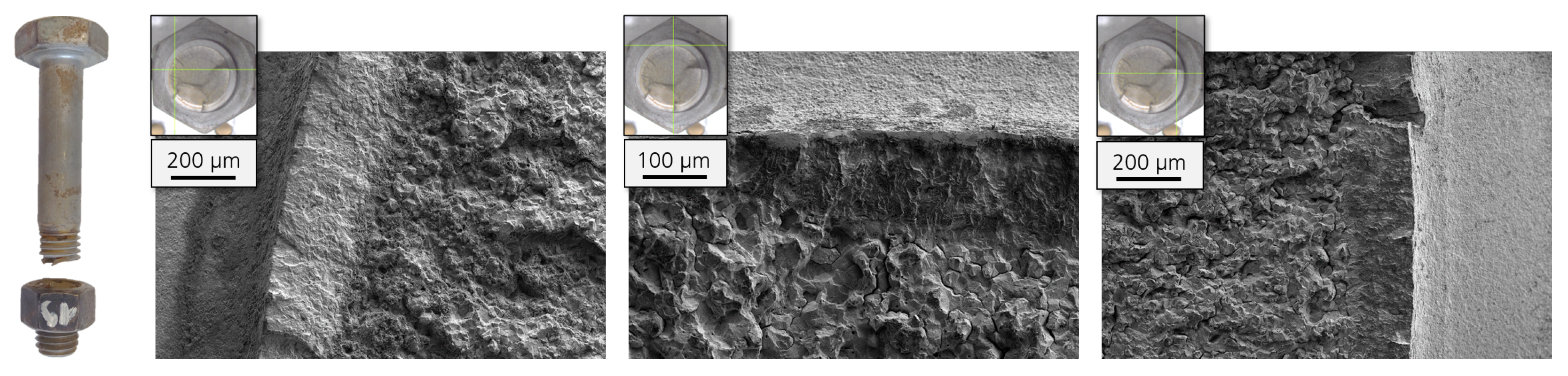
As described in Section 2, the crack size can be determined based on the distinction between the original transcrystalline fatigue crack surface and the intercrystalline hydrogen-induced brittle fracture surface using a scanning electron microscope. Three exemplary images of the transition between fatigue crack and brittle fracture on different locations of the same fracture surface are shown in Figure 3.
As is apparent in all images, the line of transition between the two fracture types is clearly distinguishable. Hence, the size of the original fatigue crack can be measured as the distance between the thread root and this transition line. On all bolts investigated here, a crescent-shaped fatigue crack was observed. Since the round bar model assumes a circumferential crack of constant depth, the actual crack shape is idealized and the crack depth for the fracture mechanics calculation is measured at the point of the maximum depth of the actual crack.
However, scanning electron microscopes are often not generally available and the crack size measurement using such devices is time-consuming due to the specimen preparation. Therefore, as described in Section 2, the crack size determination using a 3D profilometer is chosen as an easier alternative, which makes use of the fact that fatigue cracks in high-strength bolting assemblies initiate at an angle of approx. 30° at the thread root [10].
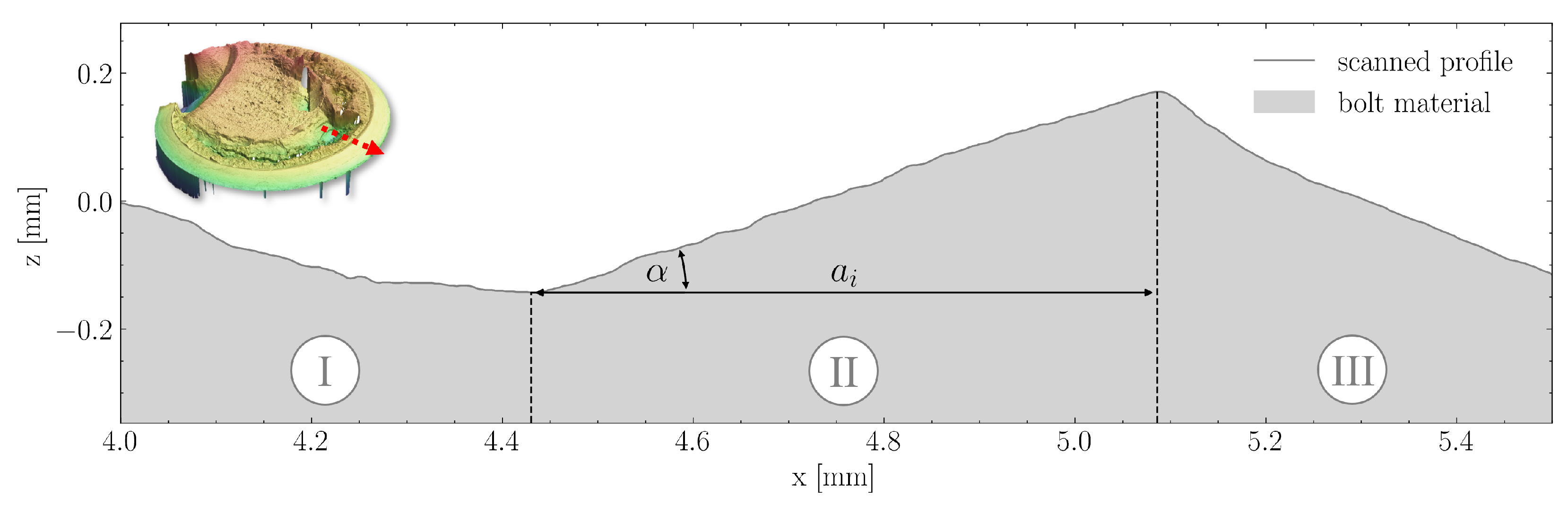
For the crack size determination with a 3D profilometer, the fracture surface is scanned to gather corresponding height data. Again, taking into account the defect idealization of crescent-shaped cracks, the crack size is measured along the profile line of the maximum crack depth. An example of a resulting height profile is shown in Figure 4. As shown, the profile can be divided into the sections of the hydrogen-induced brittle fracture (section I), the original fatigue crack (section II) under an angle α 30 °, and the surface of the former first load bearing thread (section III). The crack depth a i of the original fatigue crack is measured as the horizontal length of section II. The results of these measurements for all tested bolting assemblies are summarized in Table 1.

3.2. Final Crack Size Determination

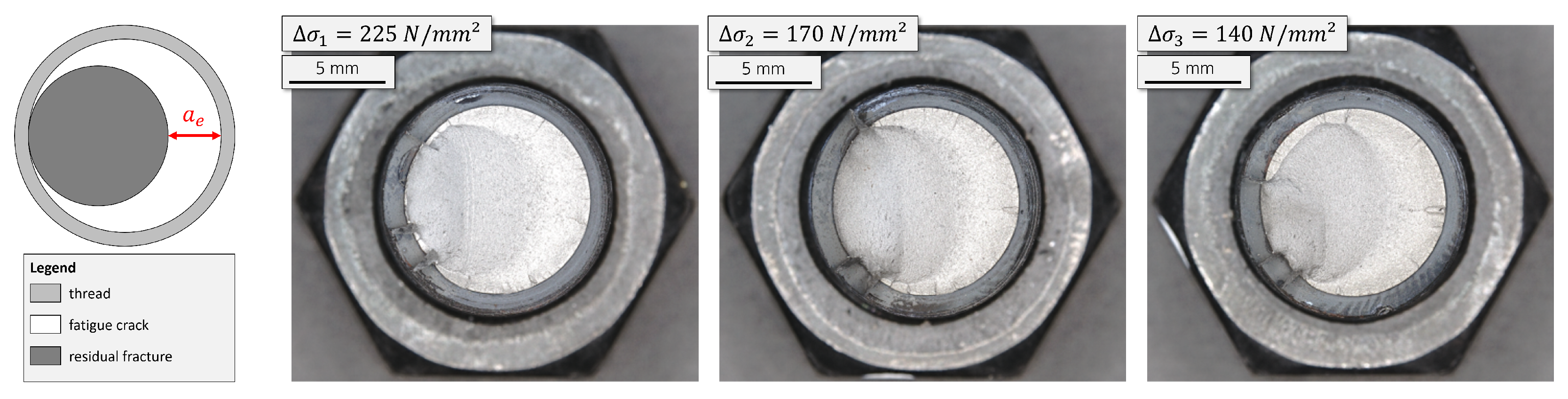
Examples of the final fracture surfaces after ultimate failure from the fatigue tests without application of hydrogen are shown in Figure 5 for all three different load levels. As can be seen, the fatigue fracture surfaces typically have a crescent-like shape. Following the same idealization as described in Section 3.1.2, the final fatigue crack size is determined as the maximum depth of the crescent shape. For every load level, the mean value of the three available specimens is determined. The results are summarized in Table 1.

3.3. Validation of Fracture Mechanics Calculations

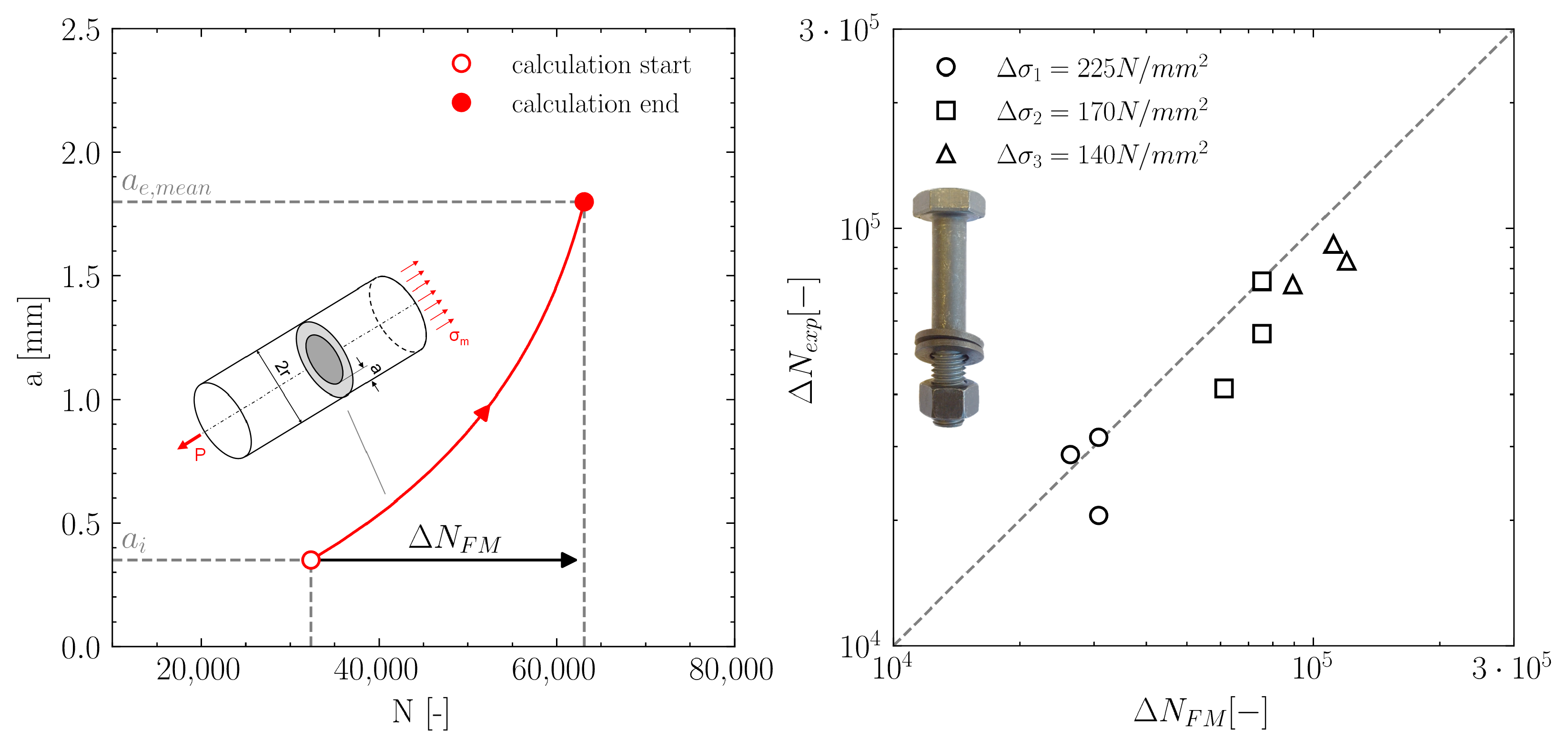
After the determination of initial and final fatigue crack size, the number of load cycles Δ N F M for further crack propagation can be calculated by integrating the Paris–Erdogan law acc. to Equation (2). This calculation is performed using the actual initial fatigue crack size a i for the tested specimen, as well as the average final fatigue crack size a e , m e a n for the corresponding load level, see Figure 6, left. The necessary material constants are taken from [2] for 42CrMo4 as C = 2 · 10 8 and m = 2.63 in accordance with [5].
Validation of the fracture mechanics model is then possible by comparing Δ N F M to the number of load cycles Δ N e x p observed during the actual fatigue tests. Δ N e x p is calculated as the difference between the number of load cycles N i up to the initial fatigue crack and the average number of load cycles N e , m e a n for the corresponding load level. The difference Δ N e x p Δ N F M can then be set into relation to the crack propagation life ( Δ N r e l , c p ) as well as the overall service life ( Δ N r e l , s l ) . The results are shown in Table 1. Furthermore, the comparison of test results and calculation results is shown in Figure 6 (right).

4. Discussion

As shown in Section 3.1, the requirements for the crack size determination method stated in Section 1 can be met with the proposed procedure based on hydrogen-induced cracking. The tested specimens consistently failed at the root of the first load bearing thread, which allows us to optically measure the original fatigue crack size (Requirement 1). A clear distinction between the original fatigue crack and the residual hydrogen-induced fracture (Requirement 2) is possible and allows for crack size measurement using a scanning electron microscope or, in the special case of high-strength bolting assemblies, in a simplified manner by using a 3D profilometer. For larger cracks, crack size estimation, even without any additional equipment, should be possible.
An obvious downside of crack size determination using hydrogen-induced cracking is the need for the handling of aggressive acids for hydrogen generation. The process therefore requires more preparation and planning and is thus more demanding than, for example, heat-tinting. However, a major advantage of the proposed method is its independence of the knowledge of the exact position of the original fatigue crack. Since the hydrogen diffuses to the area of highest multiaxiality and grid expansion [11], it automatically accumulates at the crack tip of any present fatigue crack, inducing further crack propagation. It is therefore especially useful when the original nut position of the bolting assembly is not known, which is often the case for bolting assemblies from actual service applications after their service life. For example, this method has already been used to check hot-dip galvanized M36 HV bolting assemblies in service for 14 years in a wind turbine tower for any existing fatigue cracks, see [12].
Furthermore, as shown in Section 3.3, crack size determination using hydrogen-induced cracking is a versatile tool in the validation of fracture mechanics models and allows us to draw conclusions about the performance of different modeling approaches. Regarding the model used in the present paper, it can be seen that, especially on the lower load levels, large differences of up to Δ N r e l , c p = 29 % occur between fatigue test and calculation when taking into account only the crack propagation life, while the highest load level shows good agreement. Therefore, it is found that more advanced models than the round bar model used in the present study may be needed to correctly describe the crack propagation on lower load levels. Possible reasons for this can be seen in simplifications like the crack shape idealization discussed in Section 3.1.2 and the neglect of the initial crack propagation at an angle of approx. 30° in the real bolting assembly, as shown in Figure 4. However, considering the overall service life of the tested bolting assemblies, the differences between test and fracture mechanics calculations fall to or below Δ N r e l , s l = 10 % for all load levels, showing that the round bar model performs reasonably well, taking into account its ease of use and the minor role of crack propagation life compared to crack initiation life, especially on the lower load levels. Therefore, the round bar model is found to be a versatile tool when investigating the overall service life of the tested bolting assemblies, for example, in combination with a notch-strain calculation for the determination of the crack initiation life. It was also successfully used by the authors to describe crack propagation in larger bolting assemblies of size M36, see [12].

5. Conclusions

The presented test method is a useful addition to the available tools for crack size determination. It ensures access to the original fatigue crack for crack size measurement, while the original fatigue crack can clearly be distinguished from further hydrogen-induced crack propagation. The presented method proves helpful in the assessment of the basic round bar fracture mechanics model and indicates that this model is especially useful if the overall service life of high-strength bolting assemblies is of interest. However, when solely investigating crack propagation life, more advanced models are required, whose performance can also be assessed in future using the presented method.

Author Contributions

Conceptualization, R.G., D.S. and F.W.; methodology, R.G., D.S. and F.W.; software, F.W.; validation, M.L. and J.M.; formal analysis, M.L. and J.M.; investigation, F.W. and J.M.; resources, W.F. and D.S.; data curation, F.W.; writing—original draft preparation, F.W.; writing—review and editing, W.F., R.G., M.L., J.M., D.S. and F.W.; visualization, R.G. and F.W.; supervision, W.F., R.G. and D.S.; project administration, F.W.; funding acquisition, W.F., R.G. and D.S. All authors have read and agreed to the published version of the manuscript.

Funding

The IGF-project (No. 01IF22748N) of the Research Association for Steel Application (FOSTA e.V.), Düsseldorf has been funded by the DLR and AiF within the program for sponsorship by Industrial Collective Research (IGF) of the German Federal Ministry of Economic Affairs and Climate Action, based on a decision made by the German Bundestag.

Institutional Review Board Statement

Not applicable.

Informed Consent Statement

Not applicable.

Data Availability Statement

The original contributions presented in this study are included in the article. Further inquiries can be directed to the corresponding author.

Acknowledgments

The authors would like to thank all project partners involved.

Conflicts of Interest

The authors declare no conflicts of interest. The funders had no role in the design of the study; in the collection, analyses, or interpretation of data; in the writing of the manuscript; or in the decision to publish the results.

References

  1. Glienke, R.; Schwarz, M.; Johnston, C.; Hagemann, M.; Seidel, M. Update on the Fatigue Strength of Large-Size Bolting assemblies in Steel Construction. IJOPE 2023, 33, 81–89. [Google Scholar] [CrossRef]
  2. Paris, P.; Erdogan, F. A critical analysis of crack propagation laws. J. Basic Eng. 1963, 85, 528–533. [Google Scholar] [CrossRef]
  3. Forschungskuratorium Maschinenbau e.V. (FKM). FKM-Richtlinie: Bruchmechanischer Festigkeitsnachweis, 4th ed.; VDMA Verlag: Frankfurt am Main, Deutschland, 2018. [Google Scholar]
  4. Pyttel, B.; Varfolomeyev, I.; Berger, C. Praktische Anwendung der FKM-Richtlinie “Bruchmechanischer Festigkeitsnachweis für Maschinenbauteile”. In Proceedings of the 40th Meeting of the DVM Working Group on Fracture Processes, Stuttgart, Germany, 19–20 February 2008. [Google Scholar]
  5. Eichstädt, R. Fatigue Assessment of Large-Size Bolting Assemblies for Wind Turbine Support Structures. Ph.D. Thesis, Gottfried Wilhelm Leibniz Universität, Hannover, Germany, 2019. [Google Scholar]
  6. EN 14399-4:2015-04; High-Strength Structural Bolting Assemblies for Preloading—Part 4: System HV—Hexagon Bolt and Nut Assemblies. Beuth Verlag GmbH: Berlin, Germany, 2015.
  7. DIN EN ISO 4032:2023-12; Fasteners—Hexagon Regular Nuts (Style 1). Beuth Verlag GmbH: Berlin, Germany, 2023.
  8. DIN EN ISO 7089:2000-11; Plain Washers—Normal Series, Product Grade A. Beuth Verlag GmbH: Berlin, Germany, 2000.
  9. DIN 969:2020-02; Threaded Fasteners—Axial Load Fatigue Testing—Test Methods and Evaluation of Results. Beuth Verlag GmbH: Berlin, Germany, 2020.
  10. Wiegand, H.; Kloos, K.-H.; Thomala, W. Schraubenverbindungen, 5th ed.; Springer: Berlin/Heidelberg, Germany, 2007; pp. 172–173. [Google Scholar]
  11. Hoche, H. Im Schatten der Schraube: Warum man die Mutter bei Wasserstoffversprödung nicht unterschätzen sollte. In Proceedings of the WAB-Innovationszirkel Gründungsstrukturen & Stahlbau, Bremen, Germany, 20 March 2025. [Google Scholar]
  12. Schwarz, M.; Wegener, F.; Hinrichs, J.; Stolle, C.; Güres, S.; Seidel, M.; Glienke, R.; Flügge, W. Remaining fatigue resistance of bolting assemblies in a wind turbine tower at the end of the planned service life. In Proceedings of the 2nd International Conference on Durability, Repair and Maintenance of Structures DRMS, Porto, Portugal, 13–14 March 2025. [Google Scholar]
Figure 1. Schematic view of the fracture surface (left) and exemplary scanning electron microscope images of the three different surface types (right, magnification ×250).
Engproc 119 00031 g001
Figure 2. M12 bolting assemblies after failure due to static load in the presence of hydrogen (top row) and corresponding fracture surfaces (bottom row).
Engproc 119 00031 g002
Figure 3. Scanning electron microscope images of three different locations around the circumference of a tested M12 bolting assembly at the transition between original fatigue crack and brittle fracture.
Engproc 119 00031 g003
Figure 4. Scanned profile of a fracture surface at the line of the maximum crack depth (red arrow) with sections of hydrogen-induced brittle fracture (section I), original fatigue crack (section II) and thread surface (section III).
Engproc 119 00031 g004
Figure 5. Schematic view of the fracture surface for pure cyclic testing without the application of hydrogen (left) and exemplary fracture surfaces for all three tested load levels (right).
Engproc 119 00031 g005
Figure 6. Exemplary fracture mechanics calculation for the determination of the crack propagation life between initial and final crack (left) and results of all performed fracture mechanics calculations for the tested M12 bolting assemblies in comparison to the test results (right).
Engproc 119 00031 g006
Table 1. Results of initial crack size determination, final crack size determination and fracture mechanics validation.
Initial Crack SizeFinal Crack SizeFracture Mechanics Validation
Δ σ N i a i N e N e , mean a e a e , mean Δ N exp  (1) Δ N FM Δ N rel , cp  (2) Δ N rel , sl  (3)
[N/mm2] [−] [mm] [−] [−] [mm] [mm] [−] [−] [%] [%]
22532,3370.3561,16363,9222.31.831,58530,771−8.8−3.7
43,3820.3567,7181.620,54030,771
35,2240.4562,8841.628,69826,400
17079,7230.30105,253135,6732.32.455,95075,366−23.3−9.8
61,0500.30154,7942.574,62375,366
94,3260.45146,9712.541,34761,186
140167,4090.50237,509240,7672.12.073,35889,285−29.0−10.0
149,1170.35233,5391.991,650111,400
157,3560.30251,2542.083,411119,800
(1) Δ N e x p = ( N e , m e a n N i ) . (2) Δ N r e l , c p = ( Δ N e x p , m e a n Δ N F M , m e a n ) / Δ N e x p , m e a n . (3) Δ N r e l , s l = ( Δ N e x p , m e a n Δ N F M , m e a n ) / ( Δ N e , m e a n ) .
Disclaimer/Publisher’s Note: The statements, opinions and data contained in all publications are solely those of the individual author(s) and contributor(s) and not of MDPI and/or the editor(s). MDPI and/or the editor(s) disclaim responsibility for any injury to people or property resulting from any ideas, methods, instructions or products referred to in the content.