
Proceeding Paper

Flexural Strength Investigation of Flat-Oriented PLA Filament 3D Printing Parts Under Different Infill Styles and Printing Conditions †
by
Nikolaos A. Fountas
1,
John D. Kechagias
2,
Stefanos Zaoutsos
3 and
Nikolaos M. Vaxevanidis
1,*
1
Department of Mechanical Engineering Educators, School of Pedagogical and Technological Education (ASPETE), GR 15122 Amarousion, Greece
2
Design and Manufacturing Laboratory, FWSD Department, University of Thessaly, 11-13 V., GR 41300 Karditsa, Greece
3
Department of Energy Systems, University of Thessaly, GR 41500 Larissa, Greece
*
Author to whom correspondence should be addressed.
Presented at the 8th International Conference of Engineering Against Failure (ICEAF VIII), Kalamata, Greece, 22–25 June 2025.
Eng. Proc. 2025, 119(1), 18; https://doi.org/10.3390/engproc2025119018
Published: 15 December 2025

Abstract

Fused filament fabrication (FFF) is a widely used material extrusion-based 3D printing process known for its cost-effectiveness, versatility, and ability to produce intricate components. However, the strength of interlayer bonding is significantly influenced by printing parameters, material characteristics, and the chosen printing paths. The present study employs a custom response surface design derived from an L9 orthogonal array to strictly investigate the impact of three distinct infill patterns under varying printing temperatures and printing speeds on the responses of flexural strength, σb, and elasticity modulus, E (MPa). Flat-oriented poly-lactic acid (PLA) specimens were subjected to three-point bending tests to evaluate flexural strength for 100% infill rates and a 0.2 mm layer height. Besides the experimental investigation and the statistical analysis, failure modes of the fractured samples were observed to correlate the independent printing parameters with the aforementioned response. The desirability function was employed to identify the set of optimal parameters for maximizing the flexural strength and elasticity modulus for the particular PLA material brand examined. The results indicated that infill pattern and printing speed have significant impact on both responses. The optimal parameters were identified as “centroid” for infill style, 203.03 °C for printing temperature and 25 mm/s for printing speed.

1. Introduction

Additive manufacturing (AM) currently upends the rules of competition in the production of different parts and components, either metallic or plastic. AM’s technologies have already proven to be cost-effective and are applied by engineering industries worldwide. A majority of AM strategies implements the “layer-by-layer” operation to build parts, having examined and determined the process-related parameters in advance. AM allows for a wide range of applications, either custom or industrial, whilst offering benefits such as low costs, on-demand processing, user-friendly application and simplification of fabricating complex components. Nevertheless, despite the benefits and ease in applications of AM technologies, several drawbacks are experienced, such as voids among deposited layers resulting in increased porosity, reduced mechanical performance and poor surface finish with post-processing requirements [1,2,3]. In addition, reliable AM processes should consider room conditions, i.e., humidity, room temperature, moisture, etc., [4,5] to deliver trustworthy and applicable results related to process parameter effects [6,7,8,9,10], mechanical property examination [11] and process optimization. One distinguished AM technique is fused deposition modeling (FDM) or 3D printing. FDM allows for fabricating both aesthetic and functional components using relatively low-cost materials and equipment compared to other AM technologies’ requirements. Among the wide range of materials concerning AM, plastics in the form of filaments are undoubtedly those that are preferred by the majority of users for practical applications. However, the process of preparing a 3D model for its fabrication using any of the commercially available 3D printing systems requires a careful determination of FDM control parameters, since their settings will affect the properties of the fabricated objects.
This work emphasizes an experimental study concerning the influence of three FDM-related parameters on the flexural strength, σb (MPa), and elasticity modulus, E (MPa), of PLA flat-oriented specimens under three different infill style patterns and printing conditions, referring to printing temperature and printing speed. The specimens were designed according to ASTM D790-17 standard [12]. Experiments were established with reference to the L9 orthogonal array, whereas a continuous experimental domain was determined by implementing a customized response surface design with the same lower and upper FDM parameter bounds. Having generated the regression models to represent the experimental domain and its constraints, an optimization process was conducted by implementing the desirability function (DF) to maximize both objectives of flexural strength, σb (MPa), and elasticity modulus, E (MPa).

2. Experimental Section

2.1. Materials and Methods

The highest flexural tension while being stressed before total failure, along with the linear proportion between stress and strain, referring to the elastic deformation zone of the stress–strain curve, play key roles in characterizing materials’ properties with emphasis on strength. Consequently, flexural strength, σb (MPa), and elasticity modulus, E (MPa), were selected as the objectives for investigating the strength of 3D-printed PLA (NEEMA3D™ ATHENA, Athens, Greece) flat-oriented specimens. Three parameters—one categorical (Infill style If) and two numerical (printing temperature, T (°C) and printing speed, S (mm/s)—were selected for fabricating nine PLA experimental specimens with standard geometry according to ASTM D790. Experimental specimens were fabricated by following the experimental protocol established according to the L9 Taguchi orthogonal array. As a categorical factor, infill style, If, involves three distinct printing patterns, namely “centroid-C”, “gyroid-G” and “Lines ±45o-L”.
Printing temperature and printing speed are the two numerical factors, holding three levels each. The values for 3D-printing parameters were selected according to the work material and the manufacturer’s general recommended aspects concerning the experimental resources. The 3D-printing experiments were conducted using the Creality® Ender 3 and its corresponding software Creality® Slicer 4.8 (Shenzhen Creality 3D Technology Co., Ltd., Shenzhen, China). The parameters and levels for designing the experiment are given in Table 1.
Constant parameters related to 3D printing operation refer to bed temperature 60 °C, layer thickness 0.2 mm, infill density 100%, flow rate 100%, nozzle diameter 0.4 mm and filament diameter equal to 1.75 mm. Printing positioning for all experimental items was set in the middle of the printing bed to reduce positioning errors. Environmental temperature was 23 ± 2 °C. Given the three FDM-related parameters and their levels, an L9 orthogonal array was firstly adopted to establish the sequence of experimental tryouts with reference to the selected FDM parameters. The specimens were 3D-printed as per ASTM D790, with dimensions 20 mm (width) × 80 mm (length) × 3.2 mm (thickness).
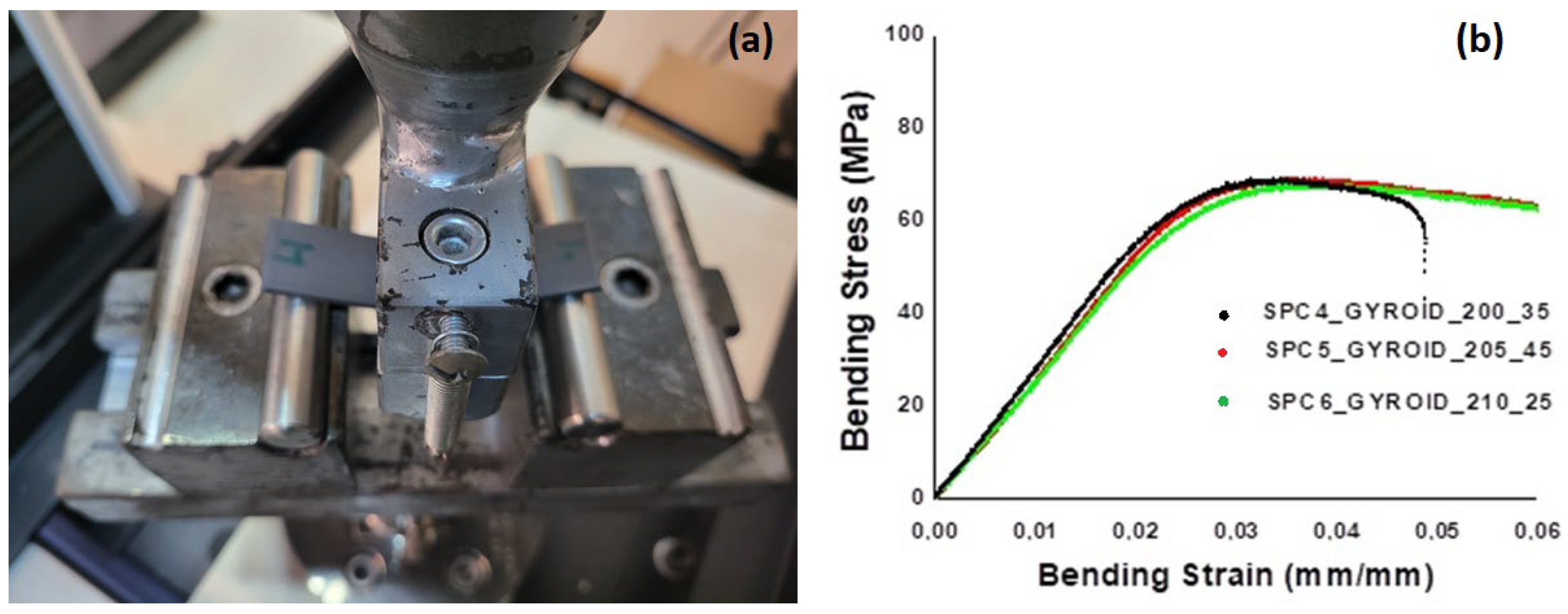
The samples were sequentially tested for their flexural properties (3-point bending) in an INSTRON® 3382 Universal testing machine (Instron®, Norwood, MA, USA) with a capacity of 100 kN at a constant temperature of 25 °C and with a cross-head. Experimental tests were performed by maintaining cross-head speed at 5 mm/min, thus ensuring stability in material deformation prior to total failure. Cross-head motion is interrupted either when observing severe fracture or reaching total failure. An indicative flexure experimental setup—presenting the 4th experimental sample along with its stress–strain curve—is shown in Figure 1. The forces the experimental samples were subjected to indicate the phase where recoverable viscoelastic deformation is exceeded, thus resulting in plastic deformation. During the 3-point bending experiments, different failure modes were observed in experimental samples, since these were built by determining different FFF-related process parameter settings. Flexural experiments were conducted under a controllable environment (room temperature 23 ± 2 °C; relative humidity 50 ± 5%), as ISO R291:1977 suggests [13].
The series of experiments are given in Table 2, along with the results obtained for flexural strength, σb, and elasticity modulus, E. From the 9 experiments, no. 1, 2 and 8 exhibited the highest flexural strength, σb (85.3, 86.4 and 81.0 MPa). At the same time, the first three experiments exhibited the highest results for elasticity modulus, E (3472, 3345 and 3317 MPa). An early observation of selected parameter levels indicated that the “centroid” infill style is the most advantageous for 3D-printing when it comes to the selected PLA material’s strength, whereas the other two parameters suggest variations based on their imminent interactions. According to the nine experiments conducted, a 3D-printing setup adjusted to the “centroid” pattern style with printing temperature ranging between 200 °C and 205 °C and printing speed set to 25 mm/sec should be close to the most advantageous (optimal) parameter levels, at least for the PLA filament material examined.

2.2. Fracture Analysis and Failure Modes

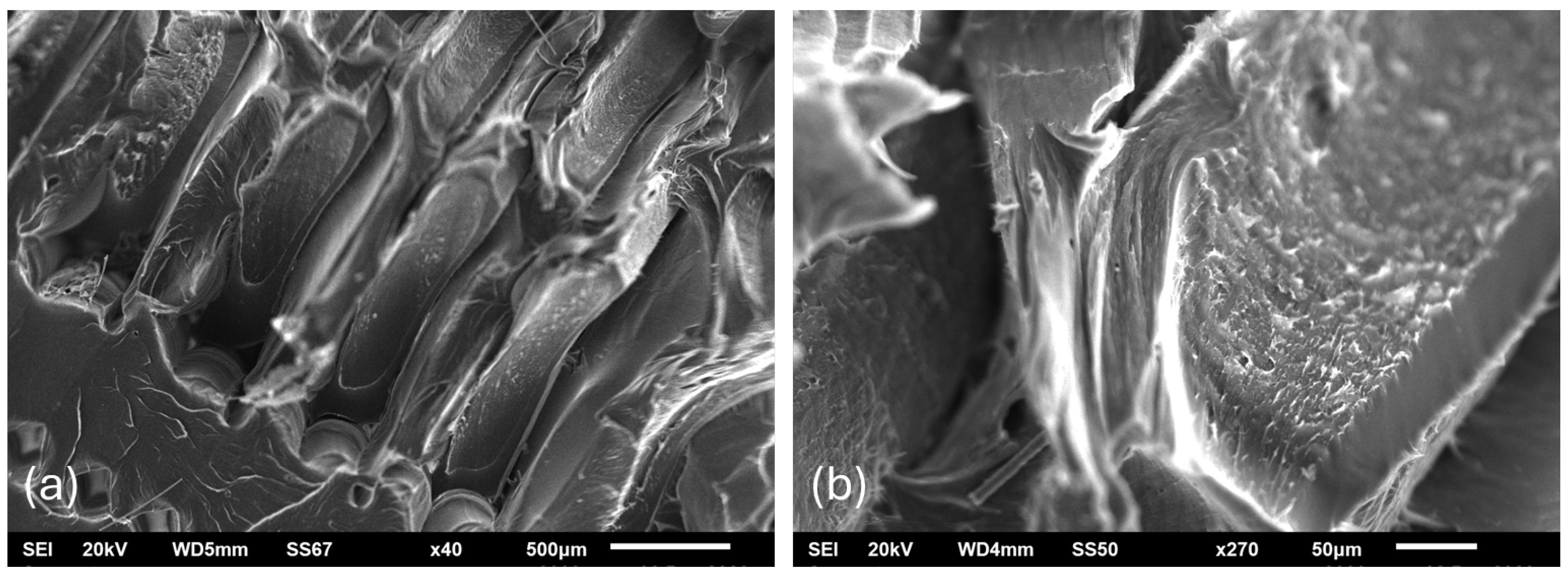
Despite the occurrence of minor importance defects (i.e., pores and small regions of weak bonding), all samples were deemed suitable for further examination in terms of flexural properties by conducting 3-point bending tests. All specimens experienced a macroscopic failure under sustained three-point bending loading mode. A brittle fracture was observed on the surface of the failure, while strain whitening occurred in the top side, where compressive stresses are developed in the coupons. Limited-to-moderate plastification was another feature observed on the underside of each specimen, where tensile stress is applied. Additionally, smoothness on the surface of failure denotes the brittle nature of the material, which is the case for the failure in the NEEMA3D™ ATHENA 3D-printed PLA filament, when the strain rate is relatively high and the environmental conditions are room temperature. Scanning electron microscope (SEM) depictions are very illuminating regarding the failure mode that occurs when the values of parameters of infill or printing speed vary (see Figure 2a,b).

3. Statistical Analysis and Regression Model Generation

To study the results for the responses of flexural strength and elasticity modulus in a continuous experimental domain in terms of the independent variables, a custom response surface design was applied, maintaining the same boundaries for low- and high-parameter levels. With reference to the response surface design, the non-linear effects of process-related FFF parameters can be examined, whilst the flexural strength and elasticity modulus are predicted by generating reliable second-order full quadratic models correlating inputs and outputs. Experimental data analysis was conducted using MINITAB® 17 statistical software. Equations (1) and (2) give the second-order, full-quadratic regression models:
UBS = −10,623 + 107.8 × T − 20.2 × S − 0.271 × T2 + 0.0023 × S2 + 0.0957 × T × S
E = −423,417 + 4337 × T − 994 × S − 10.95 × T2 + 1.04 × S2 + 4.39 T × S
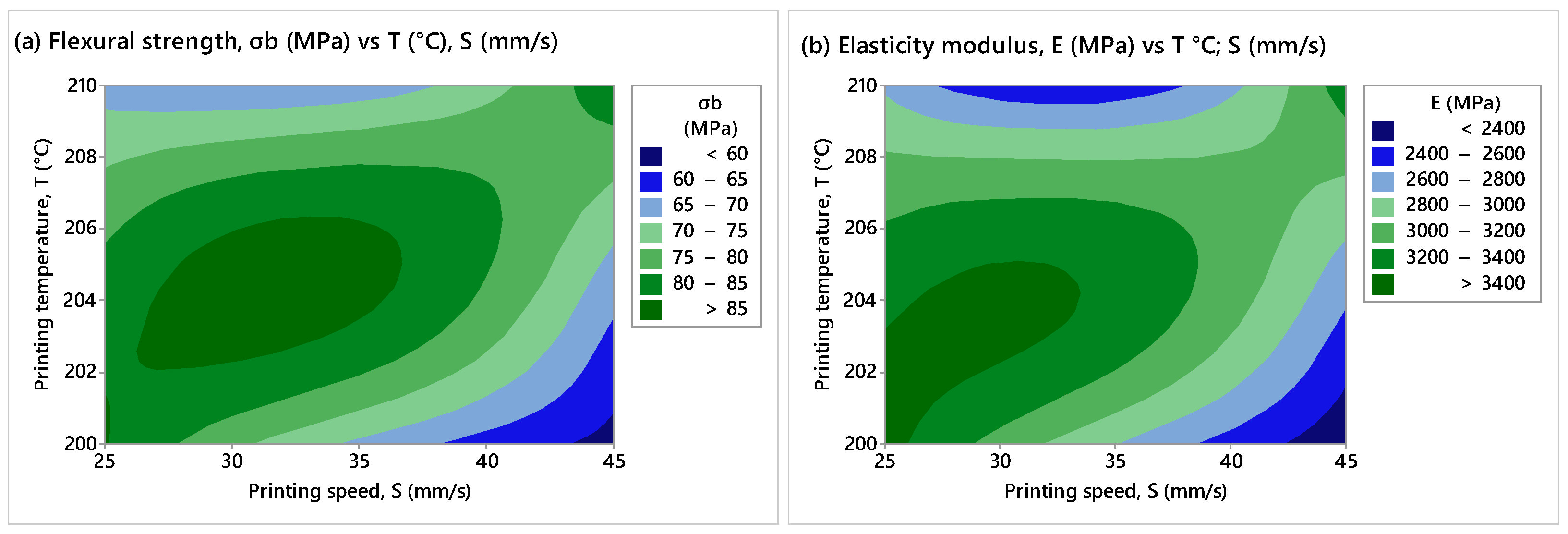
The models’ adequacy in terms of response prediction is validated by either F or p-values. Increased F values should normally correspond to reduced p-values and vice-versa. Low p-values (p < 0.05) found the in analysis of variance (ANOVA) suggest that their corresponding variables have a significant influence on the response under question. As far as lack of fit is concerned, it should be insignificant enough for the model to fit the experimental results well; therefore, large p-values are preferred. According to ANOVA’s p-values, it was shown that flexural strength for NEEMA3D™ ATHENA PLA samples is affected by all model terms: linear, square and interaction terms. The individual significance of each term is computed by t-test at a 95% confidence level, implying the importance of model terms with a p-value below or equal to 0.05. Coefficient of determination (R2) reveals the total variation percentage in the response explained by the terms in the model. In this work, R2 has been found to be equal to 96.27% and 93.53% for flexural strength and elasticity modulus, respectively. Experiments no. 1, 2 and 8 exhibited the highest resulting values for flexural strength, as shown in an early stage. Residuals’ normality test and the corresponding p-value validated the adequacy of the flexural strength model. It was observed that residuals follow an adequate normal distribution, accompanied with a p-value far beyond 0.05 (p-value = 0.620), suggesting that the prediction model for flexural strength may explain variability with an insignificant lack of fit error equal to 3.73%. Similar results were presented for the prediction model corresponding to the elasticity modulus. The model’s predicted values are close to the experimental ones, with a lack of fit error equal to 6.47%, whilst the model’s residuals exhibit an adequate normal distribution, with a p-value equal to 0.542. Figure 3a depicts the synergistic effect of the two numerical FFF-related parameters: printing temperature and printing speed. These assumptions are valid for all infill pattern modes, with emphasis on the “centroid-c” infill pattern style. According to the indications of Figure 3a, printing temperature increases flexural strength when set to middle levels, i.e., 205 °C. Printing speed should be kept at low-to-moderate speeds, i.e., in the range between 25 and 35 mm/s. By examining the contour plot depicted in Figure 3a, it can be observed that the most advantageous region concerning the increase in flexural strength is close to the contour plot’s central region. Based on the contour plot, flexural strength seems to be increased when selecting a value between 202 and 205 °C when it comes to printing temperature. At the same time, a printing speed between 27 and 33 mm/s is to be selected. Similar interpretations characterize the results corresponding to the second objective of the elasticity modulus. According to Figure 3b, printing temperature favours elasticity when set to middle levels close to 205 °C, whereas printing speed should be determined using low values, i.e., 25 mm/s. As regards infill style, “centroid” is the most beneficial for maintaining increased results for elasticity modulus, E. By examining Figure 3b, it can be seen that the variability between independent FFF parameters—printing temperature and printing speed—appears quite similar to that obtained for the flexural strength objective, suggesting that increased elasticity is to be maintained by setting low-to-moderate printing temperatures and printing speeds (i.e., 200 to 205 °C and 25 to 33 mm/s).

4. Parameter Optimization Using Desirability Function (DF)

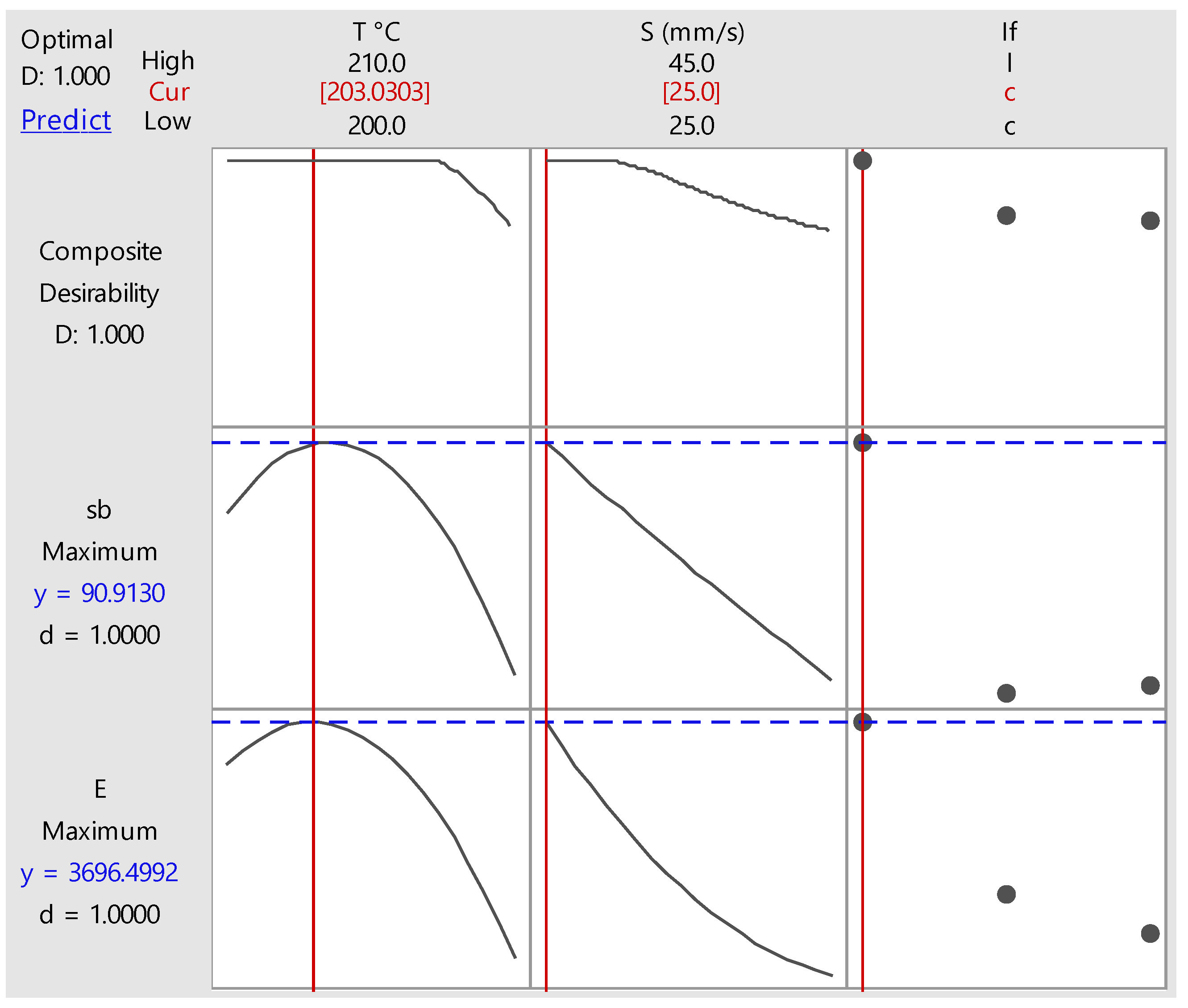
To simultaneously optimize the responses of flexural strength and elasticity modulus with respect to FFF-independent parameters, when it comes to the selected PLA filament material, the desirability function (DF), which is embedded in the response surface methodology setup interface of Minitab® R17, was applied. To treat the two objectives equally and determine their importance, a scale-free and normalized value was set between “0” and “1”. The former normalized value of “0” implies an unacceptable result, whilst the latter prompts an ideal output. Further on, individual “desirabilities” are combined to generate a common solution that will benefit both optimization criteria. To facilitate decision-making and reduce iterative computations, a single solution was set to be generated by the DF operator. Figure 4 depicts the optimal settings corresponding to both the optimization objectives of flexural strength and elasticity modulus.
Based on the optimization plot obtained, optimal values for flexural strength, σb, and elasticity modulus, E, were found to be equal to 90.913 MPa and 3696.499 MPa, respectively. This combinatorial solution is achieved by setting 203.03 °C for printing temperature and 25 mm/s for printing speed. These two values are set for the “centroid” infill style, which, yet again, is suggested as the optimal infill style for 3D printing. By comparing the suggested values corresponding to the objectives of flexural strength, σb, and elasticity modulus, E, with the highest values obtained by the experiments (86.4 and 3472 MPa for σb and E), notable gains are observed.

5. Conclusions and Future Perspectives

In this work, the effect of printing temperature, printing speed and infill style parameters were examined, with flexural strength and elasticity modulus as the objectives under interest in the case of the NEEMA3D™ ATHENA PLA filament. Experiments were designed and conducted according to the L9 orthogonal array. Printed samples were fabricated using a low-cost 3D printer and used for performing flexural tests. The samples were examined to collect important information concerning their failure mode and strength behaviour. To investigate the complex relation between inputs and outputs, a continuous experimental domain was formulated through a custom response surface design. Consequently, parameter effects and interactions were investigated by conducting regression analysis utilizing two full quadratic models with high correlation and a low lack of fit. Printing speed exhibits a dominant effect on both objectives studied, followed by printing temperature. However, the quadratic term referring to printing temperature follows next in the hierarchy, compared to that referring to printing speed. Such results motivate further research exploring the effects of different FFF-related parameters on strength objectives, so as to examine inter-laminar bonding effects with respect to the thermal energy absorbed by neighbouring layers.
Acknowledging the limitations of investigating the three independent parameters, this study will further examine the potential effects of additional FDM-related factors. In addition, a variety of filament materials (including other PLA brands) and process variables will be experimentally investigated to generate robust predictive entities with the broader goal of process optimization. Another important future prospect is to examine the strength properties of 3D-printed materials when vertically orienting the experimental components.

Author Contributions

Conceptualization, J.D.K. and S.Z.; methodology, J.D.K. and N.M.V.; software, N.A.F. and N.M.V.; validation, J.D.K., N.A.F. and N.M.V.; formal analysis, S.Z.; resources, J.D.K., S.Z. and N.A.F.; data curation, J.D.K. and N.M.V.; writing—original draft preparation, J.D.K. and N.A.F.; writing—review and editing, J.D.K. and N.M.V.; visualization, S.Z.; supervision, J.D.K. and N.A.F.; project administration, N.M.V. All authors have read and agreed to the published version of the manuscript.

Funding

This research received no external funding.

Institutional Review Board Statement

Not applicable.

Informed Consent Statement

Not applicable.

Data Availability Statement

Data is contained in the manuscript.

Acknowledgments

The authors acknowledge financial support for the dissemination of this work from the Special Account for Research of ASPETE (ELKE) through the funding program “Strengthening ASPETE’s research”.

Conflicts of Interest

The authors declare no conflicts of interest.

Abbreviations

The following abbreviations are used in this manuscript:
ANOVAAnalysis of variance
DFDesirability function
FFFFused filament fabrication
FDMFused deposition modeling
PLAPoly-lactic acid
σbFlexural strength
SEMScanning electron microscope

References

  1. Tao, Y.; Kong, F.; Li, Z.; Zhang, J.; Zhao, X.; Yin, Q.; Xing, D.; Li, P. A review on voids of 3D printed parts by fused filament fabrication. J. Mater. Res. Technol. 2021, 15, 4860–4879. [Google Scholar] [CrossRef]
  2. Khosravani, M.R.; Soltani, P.; Reinicke, T. Failure and fracture in adhesively bonded 3D-printed joints: An overview on the current trends. Eng. Fail. Anal. 2023, 105, 107574. [Google Scholar] [CrossRef]
  3. Alsoufi, M.S.; Alhazmi, M.W.; Suker, D.K.; Yunus, M.; Malibari, R.O. From 3D models to FDM 3D prints: Experimental study of chemical treatment to reduce stairs-stepping of semi-sphere profile. AIMS Mater. Sci. 2019, 6, 1086–1106. [Google Scholar] [CrossRef]
  4. Zaldivar, R.J.; Mclouth, T.D.; Ferrelli, G.L.; Patel, D.N.; Hopkins, A.R.; Witkin, D. Effect of initial filament moisture content on the microstructure and mechanical performance of ULTEM® 9085 3D printed parts. Addit. Manuf. 2018, 24, 457–466. [Google Scholar] [CrossRef]
  5. Kim, T.; Kim, M.-K.; Fang, Y.; Suhr, J. Moisture Effects on Qualities and Properties of Laser Powder Bed Fusion (LPBF) Additive Manufacturing of As-Built 17-4PH Stainless Steel Parts. Metals 2023, 13, 1550. [Google Scholar] [CrossRef]
  6. Kechagias, J.; Chaidas, D.; Vidakis, N.; Salonitis, K.; Vaxevanidis, N.M. Key parameters controlling surface quality and dimensional accuracy: A critical review of FFF process. Mater. Manuf. Process. 2022, 37, 963–984. [Google Scholar] [CrossRef]
  7. Ahmed, S.W.; Hussain, G.; Altaf, K.; Ali, S.; Alkahtani, M.; Abidi, M.H.; Alzabidi, A. On the Effects of Process Parameters and Optimization of Interlaminate Bond Strength in 3D Printed ABS/CF-PLA Composite. Polymers 2020, 12, 2155. [Google Scholar] [CrossRef] [PubMed]
  8. Asadi-Eydivand, M.; Solati-Hashjin, M.; Farzad, A.; Abu Osman, N.A. Effect of technical parameters on porous structure and strength of 3D printed calcium sulfate prototypes. Robot. Comput. Integr. Manuf. 2016, 37, 57–67. [Google Scholar] [CrossRef]
  9. Markiz, N.; Horváth, E.; Ficzere, P. Influence of printing direction on 3D printed ABS specimens. Prod. Eng. Arch. 2020, 26, 27–130. [Google Scholar] [CrossRef]
  10. Ouhsti, M.; El Haddadi, B.; Belhouideg, S. Effect of printing parameters on the mechanical properties of parts fabricated with open-source 3D printers in PLA by fused deposition modeling. Mech. Mech. Eng. 2018, 22, 895–908. [Google Scholar] [CrossRef]
  11. Cantrell, J.T.; Rohde, S.; Damiani, D.; Gurnani, R.; DiSandro, L.; Anton, J.; Young, A.; Jerez, A.; Steinbach, D.; Kroese, C.; et al. Experimental characterization of the mechanical properties of 3D-printed ABS and polycarbonate parts. Rapid Prototyp. J. 2017, 23, 811–824. [Google Scholar] [CrossRef]
  12. ASTM D790-17; Standard Test Methods for Flexural Properties of Unreinforced and Reinforced Plastics and Electrical Insulating Materials. ASTM International: West Conshohocken, PA, USA, 2017.
  13. ISO R291:1977; Plastics—Standard Atmospheres for Conditioning and Testing. ISO: Geneva, Switzerland, 1977.
Figure 1. Experimental apparatus: (a) bending test in Instron® 3382 universal testing machine; (b) indicative stress–strain curves for 4th, 5th and 6th experimental samples.
Engproc 119 00018 g001
Figure 2. SEM micrographs: (a) failure mode fracture examination; (b) fractured part morphology.
Engproc 119 00018 g002
Figure 3. Parameter effects on objectives: (a) contour plot for T and S interaction effect on flexural strength, σb (MPa); (b) contour plot for T and S interaction effect on elasticity modulus, E (MPa).
Engproc 119 00018 g003
Figure 4. Optimization plot corresponding to composite desirability between the two objectives of flexural strength, σb, and elasticity modulus, E.
Engproc 119 00018 g004
Table 1. Experimental level-inputs for setting the FFF parameters.
3D Printing ParametersLevels
123
Infill style, IfCGL
Printing temperature, T (°C) 200205210
Printing speed, S (mm/s)253545
Table 2. Order of experiments and corresponding results for flexural strength, σb (MPa), and elasticity modulus, E (MPa).
Exp.IfT (°C)S (mm/s)σb (MPa)E (MPa)
1C2002585.33472
2C2053586.43345
3C2104584.03317
4G2003568.92805
5G2054568.52724
6G2102567.72763
7L2004558.72268
8L2052581.03294
9L2103566.62458
Disclaimer/Publisher’s Note: The statements, opinions and data contained in all publications are solely those of the individual author(s) and contributor(s) and not of MDPI and/or the editor(s). MDPI and/or the editor(s) disclaim responsibility for any injury to people or property resulting from any ideas, methods, instructions or products referred to in the content.